Alloreferent and Apparent Seasonal Polyphenism of Dielis tejensis with an Updated Key to Nearctic Dielis Species (Hymenoptera: Scoliidae) †


Simple Summary
Abstract
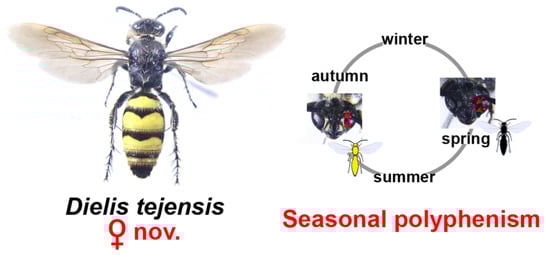
1. Introduction
2. Materials and Methods
2.1. Collections
2.2. Geographic Distribution and Nomenclature
2.3. Phenotypic Analysis
2.4. Mitochondrial DNA Isolation and Sequencing
3. Results
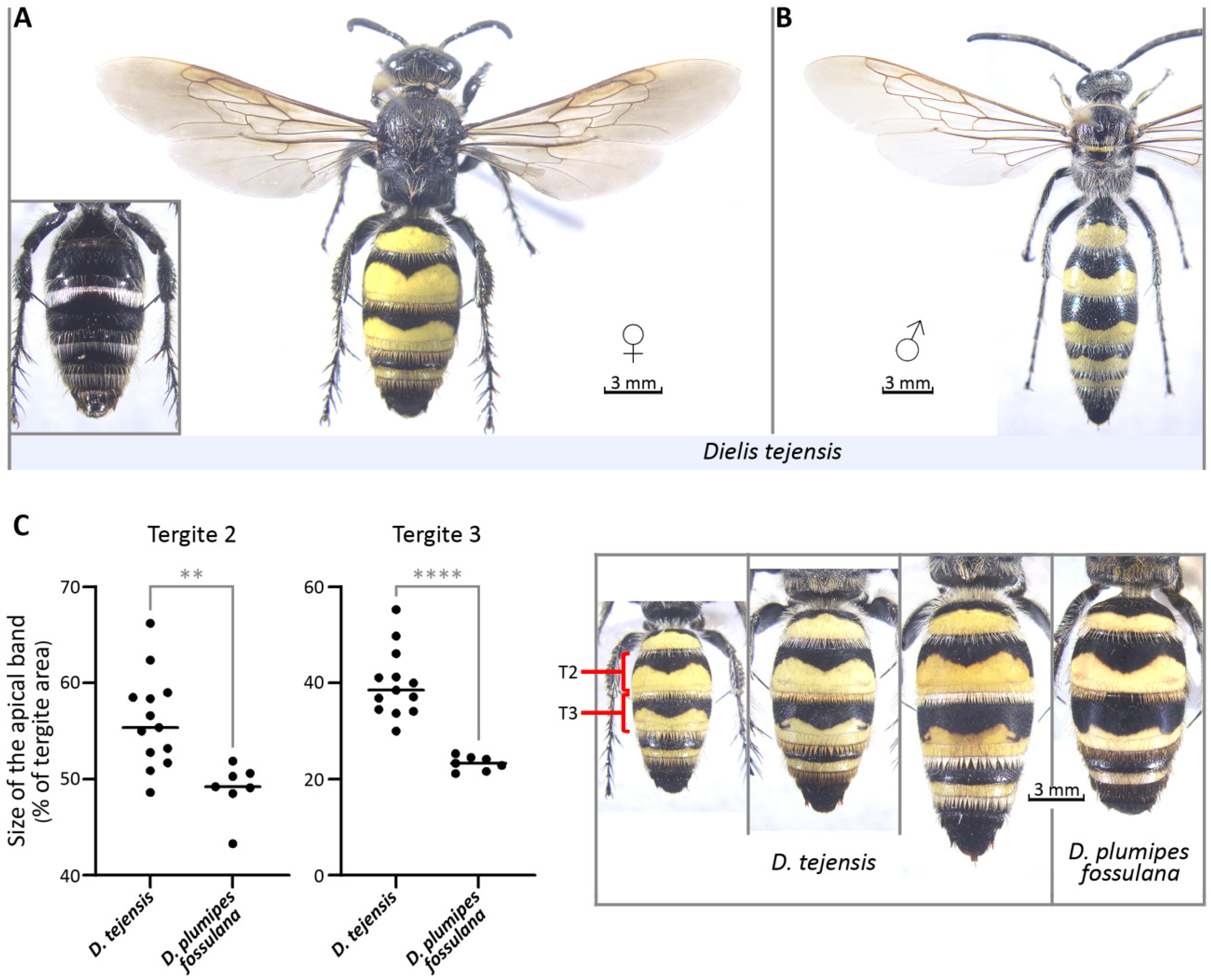
3.1. D. tejensis, Female Nova
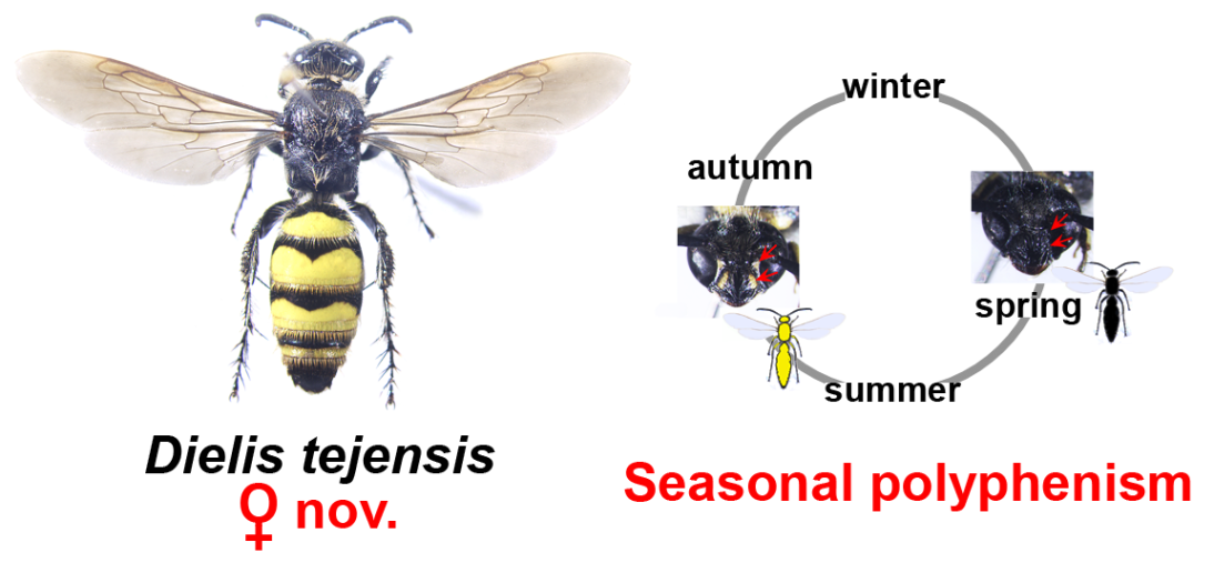
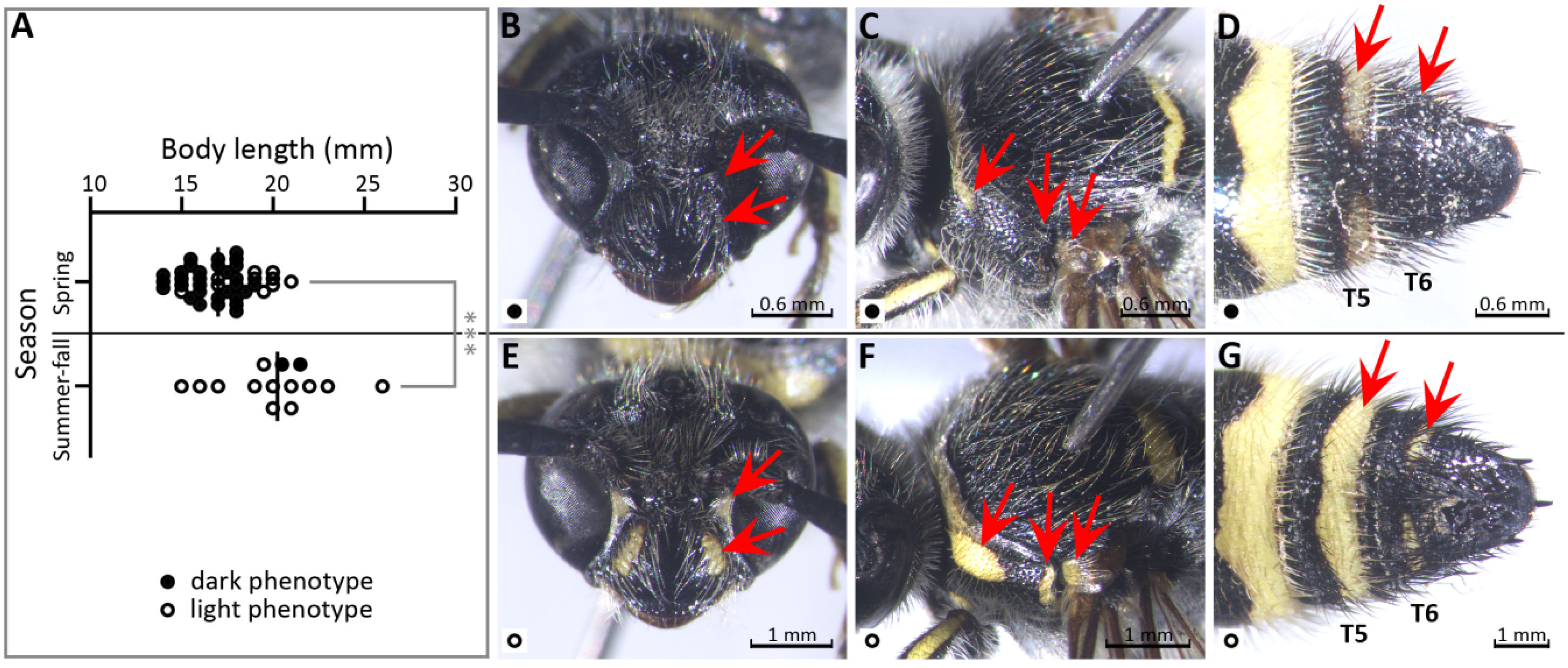
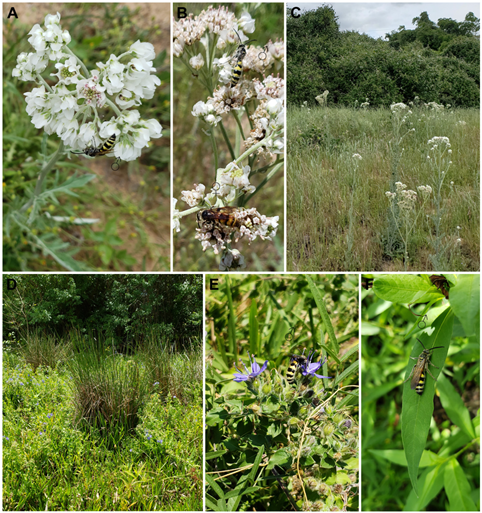
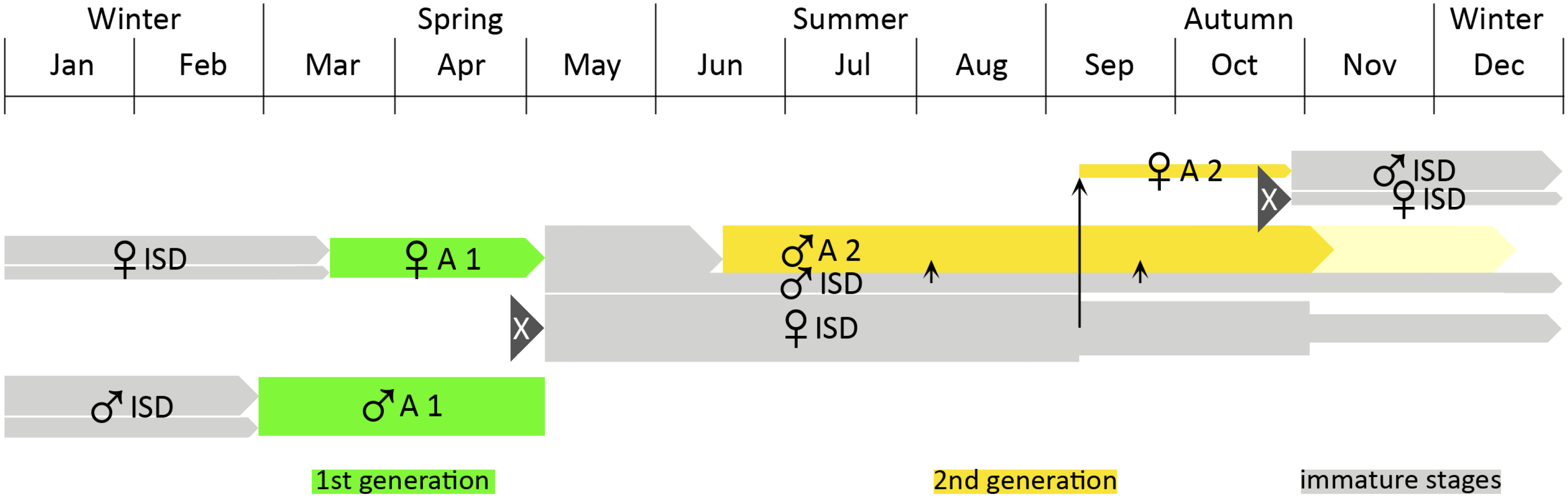
3.2. Seasonal Phenotypic Variability and Bionomics of D. tejensis
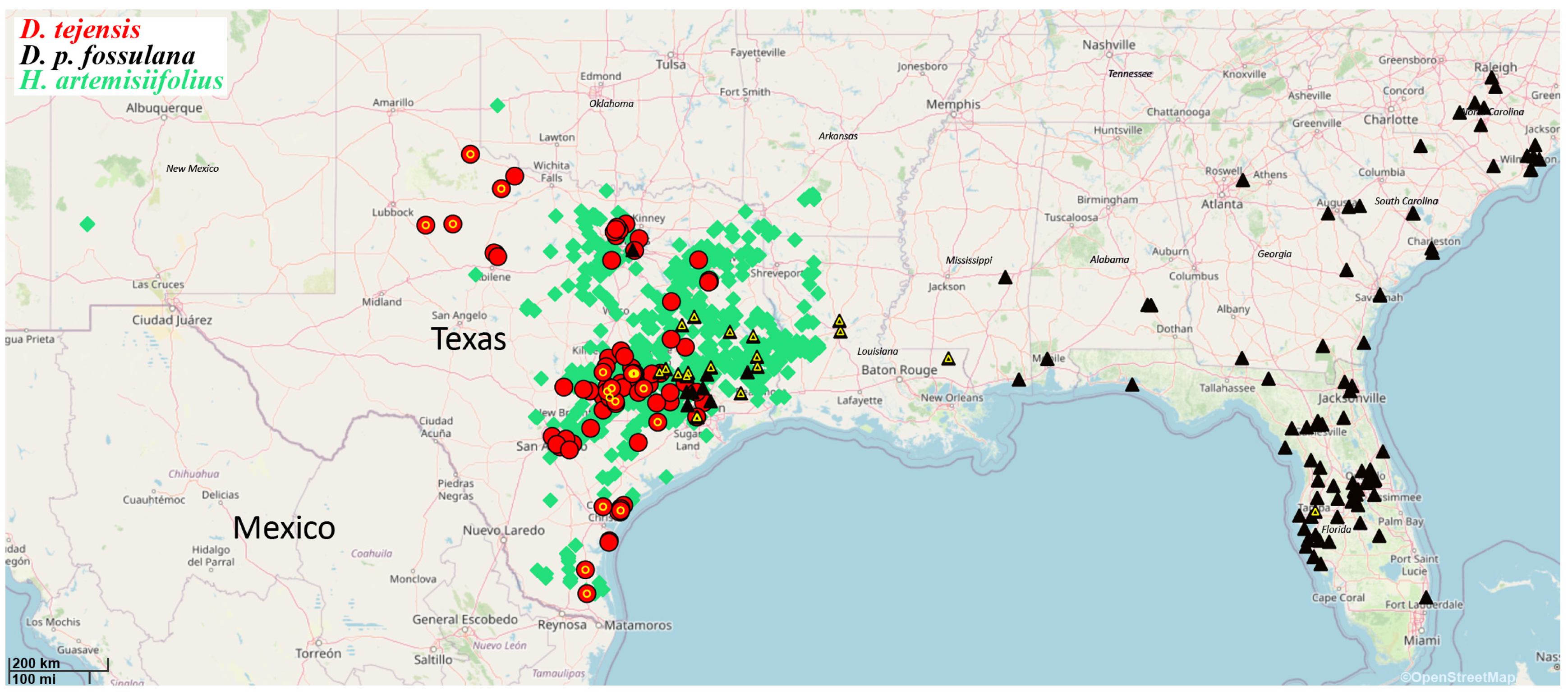
3.3. Geographic Distribution of D. tejensis
3.4. Key to Nearctic Species of Dielis
- 1
- Antennae short, with 10 flagellomeres; metasoma with six visible segments, its basal segment as wide as the propodeum, hypopygium with two short lateral spines (females)......................................................................................................2
- –
- Antennae long, with 11 flagellomeres; metasoma composed of seven visible segments, its basal segment narrower than propodeum, hypopygium with three long, apical spines projecting beyond the end of metasoma (males)...............................9
- 2(1)
- Pronotum usually with humeral round yellow spots; middorsal part of propodeum not longer than metanotum, rounding off into entirely punctate vertical area posterior medialis (mainly southwestern United States and northern Mexico, including Sonoran ecozone)....................................................................................pilipes (Saussure)
- –
- Pronotum without yellow spots; the transition between the middorsal part of the propodeum and vertical area posterior medialis is abrupt, often in form of a ridge, area posterior medialis impunctate, except along its upper margin (plumipes species-group sensu Bradley, 1964)............................................................................3
- 3(2)
- Metasomal bands orange to red (sometimes yellow or orange band on T1 in D. tolteca), bands on metasomal tergites T2 and T3 occupying almost the entire tergite surface.........................................................................................................................................4
- –
- Metasomal bands yellow and narrower, rarely occupying more than 2/3 of the tergite surface......................................................................................................5
- 4(3)
- Tergites T2, T3 almost entirely orange to red, sometimes orange-red band on T4 (usually between apical and subapical fringes); wings dark brown (Mexico, Central and most of South America, and the Caribbean region, introduced in Florida and Louisiana, established in Florida).....................................................dorsata (Fabricius)
- –
- Tergites T2, T3 almost completely and T4, usually between apical and subapical fringes, orange to dark orange, sometimes also yellow or orange apical band on T1 (form dives Provancher); wings darkened but somewhat less than those in D. dorsata (Lower Sonoran ecozone from the eastern USA to South-Central Texas, Mexico, El Salvador, Honduras, Nicaragua, and Haiti).................................tolteca (Saussure)
- 5(3)
- Humeral bristles white or nearly so; metanotum smooth and polished, at most sparsely punctate, devoid of bristles, sometimes with a transverse yellow bar; metasomal band on T4 broken or absent; metasomal sternites S2 and often S3 with apical yellow bands reduced to lateral stripes (Florida and the Caribbean region; ssp. nassauensis Bradley in the Bahamas)...........................................trifasciata (Fabricius)
- –
- Humeral bristles pale yellow to dark orange; metanotum punctate hirsute and entirely black; metasomal band on T4 present or absent; metasomal sternites entirely black.........................................................................................................6
- 6(5)
- Pronotal vestiture dark orange; metasomal dorsal bristles, except those on the last two apical segments, pale orange; apical and subapical fringes on T3–T4 brown; yellow bands on T1–T4 relatively narrow, band on T3 occupies up to 1/4 of the tergite surface and features wide and shallow median notch and slightly deeper lateral notches on each side (Austroriparian ecozone from North Carolina to eastern Texas)...................................................................plumipes fossulana (Fabricius)
- –
- Pronotal vestiture pale yellow to pale orange; metasomal dorsal bristles, except those on the last two apical segments, white and yellow to pale orange; apical and subapical fringes on T3–T4 pale yellow, pale orange or brown; yellow bands on T1–T3 wider, T2 band occupying from half to 2/3 of the tergite surface and featuring usually acute median notch, T3 band occupying up to almost half of the tergite surface and featuring usually insignificant or no lateral notches....................................................7
- 7(6)
- Area posterior medialis of propodeum usually very coarsely rugose, T4 band often incomplete or absent (plains of Upper Austral ecozone between Appalachian and Rocky Mts)........................................................................plumipes confluenta (Say)
- –
- Area posterior medialis of propodeum smooth, T4 band always present and complete........................................................................................................8
- 8(7)
- Posterior margin of the dorsal surface of propodeum not forming an overhanging ledge, having instead “a median projecting point carried laterad by a short carina” [29] (Upper Austral ecozone from Massachusetts to Georgia and Kentucky, east of the Appalachian Mts)..................................................................plumipes plumipes (Drury)
- –
- Dorsal surface of propodeum forming an overhanging ledge or shelf, similar to that of, e.g., D. plumipes fossulana or D. plumipes confluenta (from Oklahoma through East Texas to the Gulf Coast)..........................................................tejensis Szafranski
- 9(1)
- Frons divided by the longitudinal groove nearly reaching the spatium frontale, flanked by glabrous, impunctate tubercles devoid of bristles; eye margins entirely black; mandibles entirely black–brown; pronotum usually without transverse yellow stripe along the posterodorsal margin but with round yellow spots within each humeral angle; pro- and mesotibiae with a longitudinal yellow stripe on the dorsal side; propodeum rounding from behind the metanotum into the posterior area; all vestiture on the metasomal segment V white (note that the presence of a yellow band on the segment V is no longer specific to this species) (mainly southwestern United States and northern Mexico, including Sonoran ecozone)...................pilipes (Saussure)
- –
- Frons mostly with a weak median groove terminating in a pit, punctate and with erect bristles; usually yellow stripe along the inner edge of the eye lower lobe, often spreading on the scrobes; mandibles yellow at the base; pronotum without or with yellow stripe along its posterior margin; at least protibiae with yellow stipe dorsally; dorsal area of the propodeum well defined, its midsection longer than that of metanotum; vestiture of the metasomal segment V black except for the white setae originating from apical yellow band in D. tejensis (plumipes species-group sensu Bradley, 1964).................................................................................................10
- 10(9)
- Eye outer margin often with narrow yellow stripe; pronotum with a yellow stripe along its posterior edge continuous with humeral spots that usually extend uninterruptedly to the spots at the edges of the pronotal lobes near tegulae; at least pro- and mesotibiae with yellow stripes on the dorsal side; femora usually with a yellow stripe......................................................................................................11
- –
- Eye outer margin usually entirely black; pronotum entirely black or with a posterior median yellow stripe continuous with humeral spots that, however, even if elongated, do not reach spots on the pronotal lobes next to the tegulae; usually only protibiae with a yellow stripe on their dorsal side; femora usually black, at most with apical yellow spot......................................................................................13
- 11(10)
- Clypeus either entirely yellow or yellow with black central spot; metasomal sternite S2 band broad, S2 and usually S3 bands uninterrupted medially (Florida and the Caribbean region; ssp. nassauensis Bradley in the Bahamas)........trifasciata (Fabricius)
- –
- Clypeus black with yellow lateral margins; sternite apical bands S2–S4 narrow and interrupted medially.................................................................................12
- 12(11)
- Forewing setae restricted mostly to subcostal, stigmatal, marginal and submarginal cells; harpe with a thin row of setae (Mexico, Central and most of South America, and the Caribbean region, introduced in Florida and Louisiana, established in Florida)....................................................................................dorsata (Fabricius)
- –
- Forewing membrane usually more broadly setose, also on its anterior half beyond cells; harpe with a brush of relatively long prominent setae (Lower Sonoran ecozone of the USA, Mexico, El Salvador, Honduras, Nicaragua, and Haiti).tolteca (Saussure)
- 13(10)
- Pronotum with well-defined humeral spots that, however, do not reach the posterior edges of pronotal lobes near the tegulae, but are linked together by a yellow stripe along posterodorsal edge of pronotum; metasomal segment V with apical yellow band broadly interrupted medially on the sternite; in addition, a residual widely interrupted apical T6 band is sometimes present (from Oklahoma through East Texas to the Gulf Coast)..................................................tejensis Szafranski
- –
- Humeral spots on pronotum absent or inconspicuous, dorsal face of pronotum at most with a weak median yellow stripe along its posteriol edge; metasomal segment V usually entirely black................................................................................................14
- 14(13)
- Pronotum sometimes with a weak posterior yellow stripe; yellow bands on T2 and T3 relatively narrow, T2–T4 bands with broad and shallow median and lateral emarginations, S2–S4 bands narrowly interrupted in the middle, tergites with a brilliant deep blue iridescence (Austroriparian ecozone from North Carolina to eastern Texas).................................................................................plumipes fossulana (Fabricius)
- –
- Pronotum typically without posterior yellow stripe; yellow bands on T1–T3 wider than those on D. plumipes fossulana, T2–T4 bands with narrower median notches and rudimentary or relatively less developed lateral notches, S2–S4 bands widely interrupted medially, tergites with a more greenish reflection..........................................15
- 15(14)
- Occurs in the Upper Austral ecozone from Massachusetts to Georgia and Kentucky, east of the Appalachian Mts............................................plumipes plumipes (Drury)
- –
- Occurs on the plains of the Upper Austral ecozone between Appalachians and Rocky Mts..................................................................plumipes confluenta (Say)
4. Discussion
5. Conclusions
Supplementary Materials
Funding
Data Availability Statement
Acknowledgments
Conflicts of Interest
References
- Osten, T. Checkliste der dolchwespen der welt (Insecta: Hymenoptera, Scoliidae). Ber. Naturforsch. Ges. Augsb. 2005, 62, 1–62. [Google Scholar]
- Pilgrim, E.M.; von Dohlen, C.D.; Pitts, J.P. Molecular phylogenetics of Vespoidea indicate paraphyly of the superfamily and novel relationships of its component families and subfamilies. Zool. Scr. 2008, 37, 539–560. [Google Scholar] [CrossRef] [Scilit]
- Johnson, B.R.; Borowiec, M.L.; Chiu, J.C.; Lee, E.K.; Atallah, J.; Ward, P.S. Phylogenomics resolves evolutionary relationships among ants, bees, and wasp. Curr. Biol. 2013, 23, 2058–2062. [Google Scholar] [CrossRef] [Scilit]
- Wilson, J.S.; von Dolen, C.D.; Forister, M.L.; Pitts, J.P. Family-level divergences in the stinging wasps (Hymenoptera: Aculeata), with correlations to angiosperm diversification. Evol. Biol. 2013, 40, 101–107. [Google Scholar] [CrossRef] [Scilit]
- Branstetter, M.G.; Danforth, B.N.; Pitts, J.P.; Faircloth, B.C.; Ward, P.S.; Buffington, M.L.; Gates, M.W.; Kula, R.R.; Brady, S.G. Phylogenomic insights into the evolution of stinging wasps and the origins of ants and bees. Curr. Biol. 2017, 27, 1019–1025. [Google Scholar] [CrossRef] [Scilit]
- Peters, R.S.; Krogmann, L.; Mayer, C.; Donath, A.; Gunkel, S.; Meusemann, K.; Kozlov, A.; Podsiadlowski, L.; Petersen, M.; Lanfear, R.; et al. Evolutionary history of the Hymenoptera. Curr. Biol. 2017, 27, 1013–1018. [Google Scholar] [CrossRef] [Scilit]
- Blaimer, B.B.; Santos, B.F.; Cruaud, A.; Gates, M.W.; Kula, R.R.; Mikó, I.; Rasplus, J.Y.; Smith, D.R.; Talamas, E.J.; Brady, S.G.; et al. Key innovations and the diversification of Hymenoptera. Nat. Commun. 2023, 14, 1212. [Google Scholar] [CrossRef] [Scilit]
- Clausen, C.P. Biology of some Japanese and Chosenese grub parasites (Scoliidae). USDA Tech. Bull. 1932, 308, 1–26. [Google Scholar]
- Abbate, A.; Campbell, J.; Bremer, J.; Kern, W.H. The introduction and establishment of Campsomeris dorsata (Hymenoptera: Scoliidae) in Florida. Fla. Entomol. 2018, 101, 543–545. [Google Scholar] [CrossRef] [Scilit]
- Clausen, C.P. (Ed.) Introduced Parasites and Predators of Arthropod Pests and Weeds: A World Review; Agriculture Handbook No. 480; U.S. Dept. of Agriculture: Washington, DC, USA, 1978; p. 545. [Google Scholar]
- Piek, T.; Buitenhuis, A.; Simonthomas, R.T.; Ufkes, J.G.; Mantel, P. Smooth muscle contracting compounds in the venom of Megascolia flavifrons (Hym: Scoliidae) with notes on the stinging behavior. Comp. Biochem. Physiol. C 1983, 75, 145–152. [Google Scholar] [CrossRef] [Scilit]
- Alberto-Silva, C.; Portaro, F.C.V.; Kodama, R.T.; Pantaleão, H.Q.; Rangel, M.; Nihei, K.I.; Konno, K. Novel neuroprotective peptides in the venom of the solitary scoliid wasp Scolia decorate ventralis. J. Venom. Anim. Toxins Incl. Trop. Dis. 2021, 27, e20200171. [Google Scholar] [CrossRef] [Scilit]
- Szafranski, P. Evolutionarily recent, insertional fission of mitochondrial cox2 into complementary genes in bilaterian Metazoa. BMC Genom. 2017, 18, 269. [Google Scholar] [CrossRef] [Scilit]
- Szafranski, P. Intercompartmental piecewise gene transfer. Genes 2018, 8, 260. [Google Scholar] [CrossRef] [Scilit] [PubMed]
- Szafranski, P. New Dielis species and structural dichotomy of the mitochondrial cox2 gene in Scoliidae wasps. Sci. Rep. 2023, 13, 1950. [Google Scholar] [CrossRef] [Scilit] [PubMed]
- Liu, Z.; Yang, S.-J.; Wang, Y.-Y.; Peng, Y.-Q.; Chen, H.-Y.; Luo, S.-X. Tackling the taxonomic challenges in the family Scoliidae (Insecta, Hymenoptera) using an integrative approach: A case study from southern China. Insects 2021, 12, 892. [Google Scholar] [CrossRef] [Scilit] [PubMed]
- Khouri, Z.; Gillung, J.P.; Kimsey, L.S. The evolutionary history of mammoth wasps (Hymenoptera: Scoliidae). bioRxiv 2022. [Google Scholar] [CrossRef] [Scilit]
- Golfetti, I.F.; da Silva, M.; Dos Santos, E.F.; Noll, F.B. Phylogenetic analysis and biogeography of Scolia (Hymenoptera, Scoliidae, Scoliinae): Implications for the classification and origin of Scoliini. Cladistics 2025, 41, 304–320. [Google Scholar] [CrossRef] [Scilit]
- Liu, Z.; van Achterberg, C.; Chen, H. Mitochondrial phylogenomics of Scoliidae from China, with evidence to challenge the former placement of the Colpa group. Insects 2024, 15, 758. [Google Scholar] [CrossRef] [Scilit]
- Betrem, J.G. The taxon Dielis (Hymenoptera: Scoliidae) and its type. Entomol. News 1962, 73, 205–207. [Google Scholar]
- Bradley, J.C. Further notes on the American taxa of Campsomeris (Hymenoptera: Scoliidae). Entomol. News 1964, 75, 101–108. [Google Scholar]
- Argaman, Q. Generic synopsis of Scoliidae (Hymenoptera, Scolioidea). Ann. Hist.-Nat. Mus. Natl. Hung. 1996, 88, 171–222. [Google Scholar]
- Ramírez-Guillén, L.D.; Falcon-Brindis, A.; Gómez, B. The Scoliidae wasps (Hymenoptera: Scoliidae) of Mexico: Taxonomy and biogeography. Zootaxa 2023, 5214, 47–88. [Google Scholar] [CrossRef] [Scilit] [PubMed]
- Krombein, K.V. Superfamily Scolioidea. In Catalog of Hymenoptera in America North of Mexico; Krombein, K.V., Hurd, P.D., Jr., Smith, D.R., Burks, B.D., Eds.; Smithsonian Institution Press: Washington, DC, USA, 1979; Volume 2, pp. 1253–1321. [Google Scholar]
- Beaty, T.L.; Smith, D.L.; Elliott, N.B. Genetic analysis of Bahamian Campsomeris (Hymenoptera: Scoliidae). J. Kans. Entomol. Soc. 2009, 82, 76–90. [Google Scholar] [CrossRef] [Scilit]
- Turner, B.L. Hymenopappus carrii (Asteraceae: Helenieae), a new species from the gulf coastal prairie of south-central Texas. Phytologia 2015, 97, 132–136. [Google Scholar]
- Yoder, M.J.; Mikó, I.; Seltmann, K.C.; Bertone, M.A.; Deans, A.R. A gross anatomy ontology for Hymenoptera. PLoS ONE 2010, 5, e15991. [Google Scholar] [CrossRef] [Scilit]
- Betrem, J.G.; Bradley, J.C. The African Campsomerinae (Hymenoptera, Scoliidae). Mon. Ned. Ent. Ver. 1972, 6, 1–326. [Google Scholar]
- Bradley, J.C. The species of Campsomeris (Hymenoptera-Scoliidae) of the plumipes group, inhabiting the United States, the Greater Antilles, and the Bahama islands. Proc. Acad. Nat. Sci. Phila. 1928, 80, 313–337. [Google Scholar]
- Hurd, P.D., Jr. The Scoliidae of California (Hymenoptera: Aculeata). Bull. Calif. Insect Surv. 1952, 1, 141–152. [Google Scholar]
- Porter, C.C. Scoliidae (Hymenoptera) of the lower Río Grande Valley. Fla. Entomol. 1981, 64, 441–453. [Google Scholar] [CrossRef] [Scilit]
- MacKey, W.P. The scoliid wasps of the southwestern United States (Hymenoptera: Scoliidae). Southwest. Nat. 1987, 32, 357–362. [Google Scholar] [CrossRef] [Scilit]
- Grissell, E.E. Scoliid wasps of Florida, Campsomeris, Scolia and Trielis spp. (Insecta: Hymenoptera: Scoliidae): EENY-409/IN745, 6/2007. EDIS 2007, 2007, 1–8. [Google Scholar]
- Fischman, B.J.; Pitts-Singer, T.L.; Robinson, G.E. Nutritional regulation of phenotypic plasticity in a solitary bee (Hymenoptera: Megachilidae). Environ. Entomol. 2017, 46, 1070–1079. [Google Scholar] [CrossRef] [Scilit] [PubMed]
- Gill, H.K.; Goyal, G.; Chahil, G. Insect diapause: A review. J. Agric. Sci. Technol. A 2017, 7, 454–473. [Google Scholar] [CrossRef] [Scilit]
- Tamang, A.M.; Parkash, R.; Srivastava, R.K.; Singh, P. Adaptive changes in energy reserves and effect of body melanization on thermal tolerance in Drosophila simulans. Comp. Biochem. Physiol. A 2022, 271, 111258. [Google Scholar] [CrossRef] [Scilit] [PubMed]
- Colinet, H.; Kustre, A. The apparent seasonal biphenism in Drosophila suzukii stems in reality from continuous reaction norms. Pest Manag. Sci. 2025, 81, 507–517. [Google Scholar] [CrossRef] [Scilit]
- Simpson, S.J.; Sward, G.A.; Lo, N. Polyphenism in insects. Curr. Biol. 2011, 21, R738–R749. [Google Scholar] [CrossRef] [Scilit]
- Grearson, K.J.; Liston, A.D. Review of seasonal polyphenism in the Symphyta (Hymenoptera), exemplified by Pristiphora leucopus (Hellén, 1948) (Tenthredinidae). Zootaxa 2012, 3502, 72–88. [Google Scholar] [CrossRef] [Scilit]
- Stone, G.N.; Schönrogge, K.; Atkinson, R.J.; Bellido, D.; Pujade-Villar, J. The population biology of oak gall wasps (Hymenoptera: Cynipidae). Annu. Rev. Entomol. 2002, 47, 633–668. [Google Scholar] [CrossRef] [Scilit]
- Li, Z.; Shi, J.; Yang, L.; Cheng, Y.; Liu, X.; Sun, S. Diapause induction, color changes, and supercooling point of diapause larvae of Tetrastichus septentrionalis Yang (Hymenoptera: Eulophidae). Insects 2023, 14, 826. [Google Scholar] [CrossRef] [Scilit]
- Lo Pinto, M.; Guarino, S.; Agrò, A. Evidence of Seasonal Variation in Body Color in Adults of the Parasitoid Cirrospilus pictus (Hymenoptera: Eulophidae) in Sicily, Italy. Insects 2023, 14, 90. [Google Scholar] [CrossRef] [Scilit]
- Rusina, L.Y.; Gilev, A.V.; Skorokhod, O.V.; Firman, L.A. Seasonal dynamics of the phenotypic structure of a population of the paper wasp Polistes dominulus (Christ) (Hymenoptera, Vespidae). Entomol. Rev. 2006, 86, 168–175. [Google Scholar] [CrossRef] [Scilit]
- Heinze, J. Life history evolution in ants: The case of Cardiocondyla. Proc. R. Soc. B 2017, 284, 20161406. [Google Scholar] [CrossRef] [Scilit]
- dos Santos Lima, J.C.; da Silva Cavalcante, E.; Ramos Gonçalves, C.; Lima-Junior, S.E.; Lima Cardoso, C.A.; Antonialli-Junior, W.F. Effect of Seasonal Variation on the Cuticular Chemical Composition of Atta laevigata (Smith 1858) (Hymenoptera: Formicidae). J. Chem. Ecol. 2025, 51, 15. [Google Scholar] [CrossRef] [Scilit]
- Tsuruta, T.; Matsuka, M.; Sasaki, M. Temperature as a causative factor in the sesonal color dimorphism of Apis cerana japonica workers. Apidologie 1989, 20, 149–155. [Google Scholar] [CrossRef] [Scilit]
- Elmer, M.C.; Monro, K.; Thompson, H.; Stuckey, A.; Kellermann, V. Phenotypic plasticity underlies seasonal and latitudinal variation in thermal tolerance in a native bee. Ecology 2025, 106, e70183. [Google Scholar] [CrossRef] [Scilit]



Disclaimer/Publisher’s Note: The statements, opinions and data contained in all publications are solely those of the individual author(s) and contributor(s) and not of MDPI and/or the editor(s). MDPI and/or the editor(s) disclaim responsibility for any injury to people or property resulting from any ideas, methods, instructions or products referred to in the content. |
© 2026 by the author. Licensee MDPI, Basel, Switzerland. This article is an open access article distributed under the terms and conditions of the Creative Commons Attribution (CC BY) license.
Share and Cite
Szafranski, P. Alloreferent and Apparent Seasonal Polyphenism of Dielis tejensis with an Updated Key to Nearctic Dielis Species (Hymenoptera: Scoliidae). Insects 2026, 17, 295. https://doi.org/10.3390/insects17030295
Szafranski P. Alloreferent and Apparent Seasonal Polyphenism of Dielis tejensis with an Updated Key to Nearctic Dielis Species (Hymenoptera: Scoliidae). Insects. 2026; 17(3):295. https://doi.org/10.3390/insects17030295
Chicago/Turabian StyleSzafranski, Przemyslaw. 2026. "Alloreferent and Apparent Seasonal Polyphenism of Dielis tejensis with an Updated Key to Nearctic Dielis Species (Hymenoptera: Scoliidae)" Insects 17, no. 3: 295. https://doi.org/10.3390/insects17030295
APA StyleSzafranski, P. (2026). Alloreferent and Apparent Seasonal Polyphenism of Dielis tejensis with an Updated Key to Nearctic Dielis Species (Hymenoptera: Scoliidae). Insects, 17(3), 295. https://doi.org/10.3390/insects17030295