1. Introduction
Pomacea canaliculata (Gastropoda: Mesogastropoda: Ampullariidae) [
1] is a widespread South American freshwater mollusk whose range is rapidly expanding and is now becoming a common component of the fauna of many countries in Southeast Asia. It is listed among China’s first cohort of invasive alien species. Listed among China’s first cohort of invasive alien species, it has rapidly spread since its introduction, colonizing paddy fields, ditches, and wetland ecosystems across multiple southern provinces [
2]. This snail exhibits a broad diet and high reproductive capacity, causing severe damage to economically important aquatic crops such as rice, water bamboo, and lotus root. This leads to significant yield losses, quality degradation, and substantial annual economic damage [
3]. Statistics indicate that the infestation area of
P. canaliculata in China had reached 1.7011 million hectares by 2020 [
4].
Current control strategies for
P. canaliculata are generally categorized into physical and chemical methods. Chemical control relies heavily on molluscicides such as niclosamide ethanolamine salt (NES) and metaldehyde (MD) [
5]. However, their long-term and extensive use raises concerns regarding pesticide residues, water pollution, and potential threats to aquaculture and ecological security. Physical methods, such as manual collection of snails and egg masses, are notably inefficient [
6]. Consequently, developing environmentally friendly and sustainable biological control technologies has become an urgent need for managing
P. canaliculata.
Some practical attempts have been made at biological control using aquatic animals like ducks and soft-shelled turtles to consume
P. canaliculata [
7,
8]. However, large-scale application is often limited by farming conditions, control precision, and scope of applicability. Finding a natural enemy organism that is adapted to aquatic environments, highly specific, and offers efficient control presents a new direction for managing this invasive snail.
Fireflies (Insecta: Coleoptera: Lampyridae) [
9,
10,
11], represent an important group of resource insects. The larvae of many terrestrial species feed on mollusks such as snails and slugs, demonstrating considerable potential for the biological control of agricultural and forestry pests [
12,
13].
Aquatica leii is an aquatic firefly species endemic to China, belonging to the family Lampyridae [
14]. Its entire larval stage occurs in clean aquatic environments such as streams and paddy fields, where it preys on small snails and bivalves [
15]. Therefore, this study considers it to possess the biological basis for acting as a potential natural enemy against
P. canaliculata.
To date, research on the biological characteristics and ecological functions of
A. leii, both domestically and internationally, remains in its early stages [
16,
17,
18]. There is a lack of systematic reports on its predatory capability against
P. canaliculata, its feeding preferences, or its control efficacy. Therefore, this study employs
A. leii larvae as test subjects. By measuring parameters such as lethal time and consumption rate per unit time against
P. canaliculata, we preliminarily assess the potential of
A. leii for application in the biological control of
P. canaliculata. The aim is to provide a scientific basis for the eco-friendly management of
P. canaliculata and the utilization of aquatic fireflies as a biological resource.
3. Results
3.1. Feeding Preference
To determine whether the larvae of
A. leii actively select
P. canaliculata as prey and to evaluate their choice preference in the presence of different prey items—thereby assessing their targeted predation potential against
P. canaliculata in natural environments—a two-choice experiment was conducted, with the results summarized in
Table 1.
The chi-square goodness-of-fit test results indicated that while the larvae of A. leii showed a tendency to preferentially select C. chinensis as the initial attack target, this difference was not statistically significant (χ2 = 2.78, p > 0.05). Similarly, no significant difference was observed in the proportion of larvae that ultimately fed on either snail species (χ2 = 1.00, p > 0.05). These results suggest that A. leii larvae are capable of and willing to accept P. canaliculata as a food source. However, it should be noted that the total number of replicates (36 across all instars combined) may limit the statistical power of the chi-square test to detect small but biologically meaningful preferences. Furthermore, prey choice experiments were conducted only at a 1:1 ratio, which does not capture potential density-dependent shifts in feeding decisions that may occur in natural habitats where prey abundance varies. Future studies should incorporate multiple prey density ratios to better understand the foraging behavior of A. leii under ecologically relevant conditions.
3.2. Lethal Time
This study found that the first and second instar larvae of
A. leii were incapable of preying on intact
P canaliculata, only consuming processed snail tissue. This observation is consistent with findings reported by Guo Zhaoxiang in a study on
Pyrocoelia pectoralis [
21]. To accurately assess the actual predatory effect of each larval instar, these two early instars were excluded from the experimental design. To facilitate observation and eliminate interference from factors such as natural mortality of
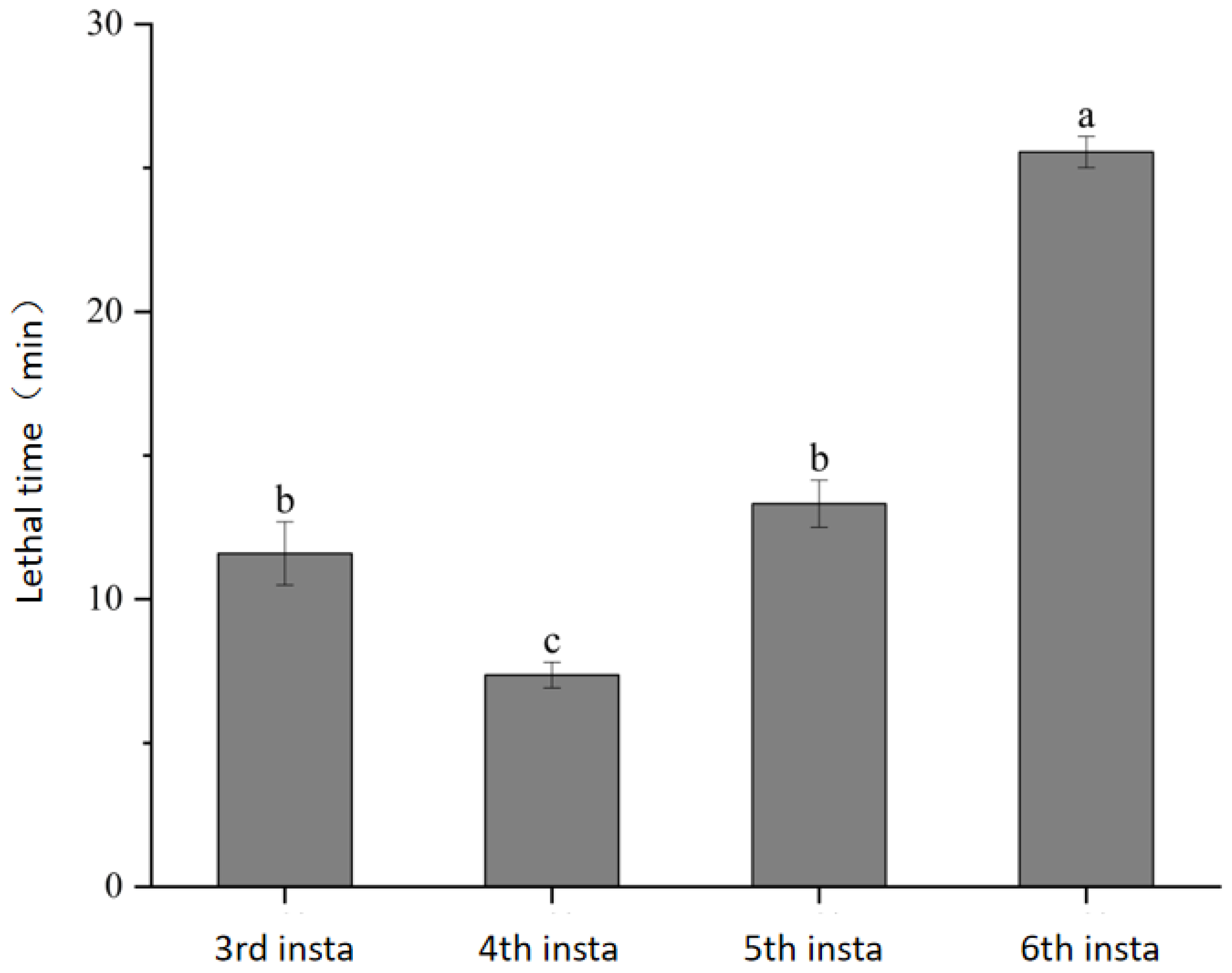
P. canaliculata, individual snails were housed separately in transparent rearing containers measuring 4.0 cm × 4.0 cm × 2.5 cm. Under constant temperature conditions of 28 °C, the lethal time exerted by third, fourth, fifth, and sixth instar larvae on
P. canaliculata was determined (
Figure 1).
The data indicate that the lethal time required by sixth-instar larvae to kill P. canaliculata was significantly longer than that of all other instars, with a mean of 25.89 min, suggesting the slowest predatory process against P. canaliculata at this stage. In contrast, fourth-instar larvae exhibited the shortest mean lethal time of only 7.37 min, which differed significantly from the third-, fifth-, and sixth-instar groups, indicating that fourth-instar larvae likely possess the strongest lethal capacity against P. canaliculata.
The lethal times of third- and fifth-instar larvae were relatively similar, at 11.26 min and 12.99 min respectively, with no statistically significant difference between them. However, both were significantly longer than that of the fourth-instar group and shorter than that of the sixth-instar group. These results demonstrate that lethal time does not simply decrease or increase progressively with larval instar.
3.3. Measurement of Consumption Amount
Prey consumption is a key metric for evaluating the predatory efficacy and energy acquisition strategy of a natural enemy. To systematically analyze the nutritional niche and utilization efficiency of
A. leii larvae at different instars toward their prey, this study, following the recording of lethal time, measured the actual amount of
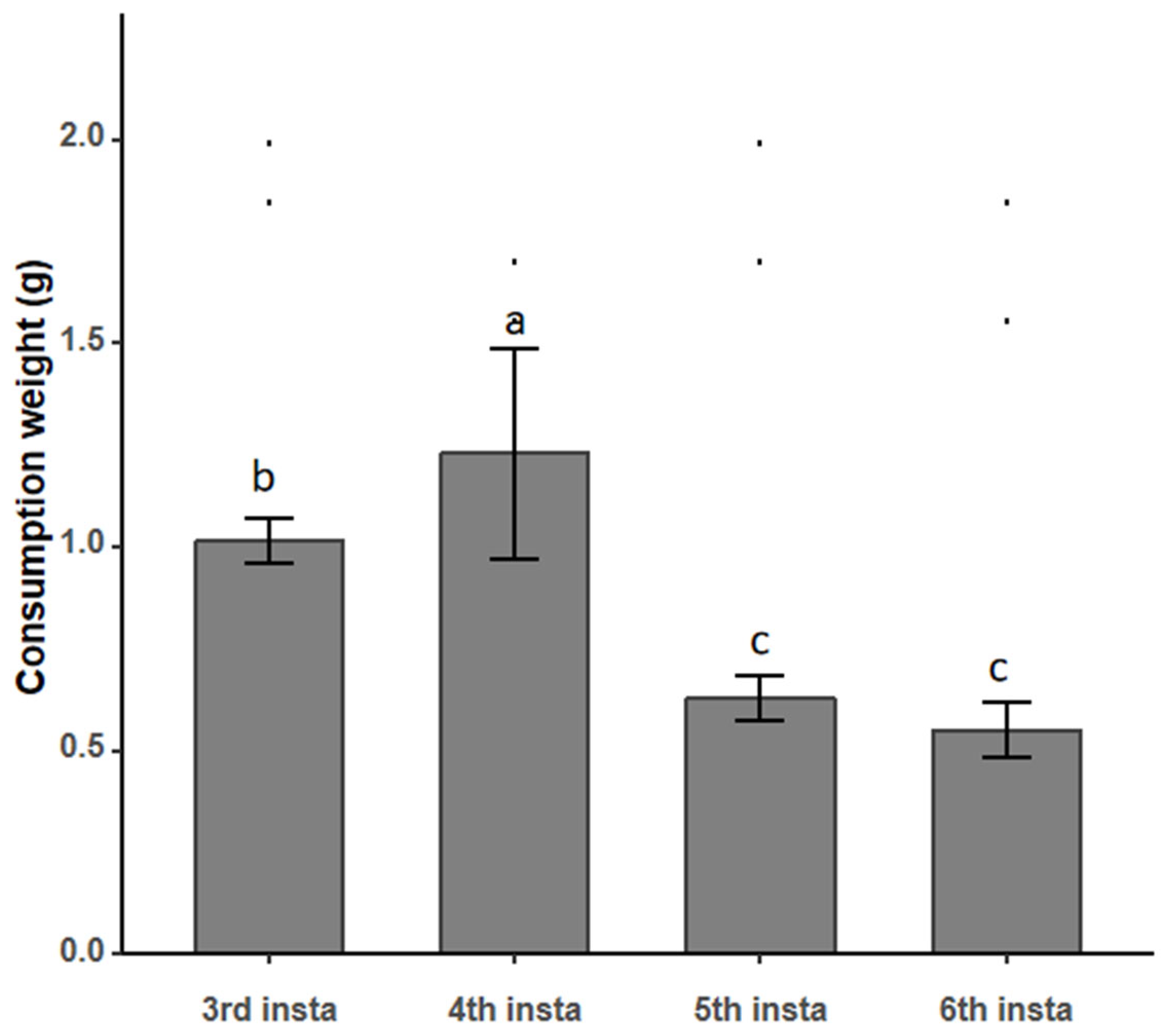
P. canaliculata tissue consumed per unit time by larvae of each instar (with three replicates per instar) (
Figure 2).
As shown in
Figure 2, the average consumption amounts of larvae at different instars exhibited significant inter-group differences. Among them, the fourth-instar larvae showed the highest consumption, with an average of 1.23 g, whereas the sixth-instar larvae showed the lowest consumption, averaging only 0.55 g. Overall, larvae at the third and fourth instars had relatively higher consumption levels, while consumption tended to decrease as larval development progressed beyond these stages.
3.4. Lethal Efficiency of Aquatica leii Digestive Tract Fluids Against Pomacea canaliculata
This study has confirmed that
A. leii larvae are capable of preying upon
P. canaliculata and accept it as a food source. The feeding process of lampyrid larvae is not merely a matter of physical ingestion. Studies have shown that they primarily inject digestive tract fluids rich in various enzymes (such as proteases and lipases) into their prey [
13] to facilitate external pre-digestion, thereby liquefying and absorbing the prey’s tissues [
18]. Consequently, digestive tract fluid is a key physiological factor enabling firefly larvae to kill and digest mollusk prey [
13]. Therefore, this study investigated the direct effect of in vitro digestive tract fluids from
A. leii on
P. canaliculata (
Table 2) to further elucidate its potential as a biocontrol agent.
The data presented in
Table 2 clearly demonstrate that the midgut extract exhibited exceptionally strong lethal activity, causing the death of 27, 30, and 30
P. canaliculata individuals across the three replicate groups, respectively, resulting in an overall mortality rate as high as 96.7%. In contrast, the lethal effects observed in the other treatment groups were minimal.
4. Discussion
The strong reproductive capacity of
P. canaliculata and the lack of effective natural enemies to control it make the management of this invasive species particularly challenging [
22]. This study found that the larvae of the aquatic firefly
A. leii possess clear predatory capability and lethal potential against
P. canaliculata. The results indicate that although
A. leii larvae show a preference for the native snail
Cipangopaludina chinensis under free-choice conditions, they also exhibit a positive willingness to feed on
P. canaliculata. This finding holds significant ecological importance: in habitats where
P. canaliculata has invaded extensively and displaced native snail species,
A. leii can utilize the invader as an effective alternative prey resource. This allows the firefly population to persist and continue exerting pest control functions. This ability reduces the dependency of its control efficacy on specific native prey, thereby enhancing its environmental adaptability and stability as a biological control agent.
It is important to note that in this part of the experiment, larvae were provisioned with dissected snail tissue rather than live, intact prey. Therefore, the measured consumption amount reflects ingestion rate under conditions of easy access to food, not the full predation capacity (which includes search, attack, and handling of live snails). This limitation should be considered when interpreting the ecological relevance of these consumption values.
The study further reveals that
A. leii larvae are not only behaviorally receptive to
P. canaliculata as food but also capable of killing it. Predatory efficacy varied significantly among larval instars, with the 4th-instar larvae exhibiting optimal performance, characterized by the shortest mean lethal time, the highest consumption per unit time, and the most prominent snail control efficiency. In contrast, consumption decreased and lethal time increased in later instars (5th–6th), which may be related to their physiological shift towards the prepupal stage and associated changes in energy allocation strategies—a finding consistent with observations in other Coleoptera species [
21,
23]. This instar-specific pattern provides clear guidance for practical application: when implementing control through mass rearing and release or field population augmentation, priority should be given to utilizing active 3rd and 4th instar larvae to achieve the best cost–benefit ratio and immediate pest suppression effect. Simultaneously, it highlights the need to consider the generation cycle and instar structure in natural population management to ensure sustained control pressure.
This study found that the lethal effect of
A. leii larvae on
P. canaliculata is not solely due to physical consumption but is significantly mediated by the injection of digestive tract fluid, with midgut secretions playing a decisive role. The lethal effects of extracts from different parts of
A. leii varied markedly. No mortality of
P. canaliculata was observed in the physiological saline control group or the foregut extract treatment group during the observation period, indicating that mere mechanical stimulation or foregut secretions lack significant lethal activity. While mouthpart and hindgut extracts caused mortality in a few individuals, their mortality rates were only 3.3% and 16.7%, respectively, indicating limited efficacy. In stark contrast, the midgut extract achieved a mortality rate as high as 96.7% against
P. canaliculata, far exceeding that of extracts from other digestive tract sections. This suggests that the midgut likely contains specific enzymes or toxins [
18] capable of efficiently disrupting the tissue and physiological functions of
P. canaliculata. This data further confirms that the digestive fluid or related enzyme systems within the midgut of
A. leii larvae are the key physiological factors responsible for the death of
P. canaliculata. It is worth noting that all extracts were standardized to the same concentration (0.5 g tissue equivalent per mL) prior to injection, ensuring that the observed differences in lethal activity reflect intrinsic properties of each digestive tract region rather than concentration variations. The 10 µL dose was selected based on a pre-experiment showing that this volume induced clear mortality without causing immediate death from injection trauma. Future studies should explore dose–response relationships to further characterize the potency of midgut-derived compounds.
Although our experimental design included multiple controls (physiological saline, sterile water, and sham injection) to account for physical injury and solvent effects, we acknowledge that an additional control using gut contents from a non-molluscivorous aquatic insect would further strengthen the specificity of the observed activity. Future studies incorporating such controls, along with investigations into the temporal dynamics of toxin secretion and transport within the digestive tract, will help clarify the mechanisms underlying the potent lethal effect of A. leii midgut secretions.
5. Conclusions
This study provides the first systematic evidence that larvae of the aquatic firefly Aquatica leii have significant potential as a biocontrol agent against the invasive snail Pomacea canaliculata. The main findings and their implications are summarized as follows:
A. leii larvae readily accept P. canaliculata as prey, with the 4th instar exhibiting optimal predatory performance—characterized by the shortest mean lethal time (7.37 min) and the highest weekly consumption (1.23 g). This identifies the 4th instar as the key functional stage for snail suppression and provides practical guidance for mass rearing and release strategies in biocontrol programs.
Midgut crude extract from 4th-instar larvae induced 96.7% mortality in
P. canaliculata within 12 h, far exceeding the effects of extracts from other digestive tract regions. This suggests that predation by A. leii may involve not only physical consumption but also the action of specific digestive enzymes or toxins, a hypothesis that requires further biochemical validation. Secreted by the midgut, which rapidly incapacitates prey through an “injection–external digestion” mode [
18]. This discovery not only explains the high lethal efficiency observed but also points toward the development of novel biogenic molluscicides.
As a native aquatic natural enemy insect [
24],
A. leii possesses clear potential for integration into green control systems for
P. canaliculata. The dual effectiveness of its predatory behavior and physiological lethal mechanism offers a new pathway to replace or supplement existing chemical methods. Future research should focus on field validation of control efficacy, ecological safety assessment, and isolation and characterization of the midgut active compounds to advance this resource insect from experimental promise to practical application.