Spectral Preferences of Encarsia formosa: Unravelling Attraction to LED Monitoring Traps



Simple Summary
Abstract
1. Introduction
2. Materials and Methods
2.1. Plant and Insect Rearing
2.2. Investigating Spectral Preferences of Encarsia formosa in Multiple Choice Arenas
2.3. Response of Encarsia formosa to LED-Enhanced and Standard Whitefly Monitoring Traps
2.4. Response of Encarsia formosa to Modified Whitefly LED Monitoring Traps
2.5. Statistical Analysis
3. Results
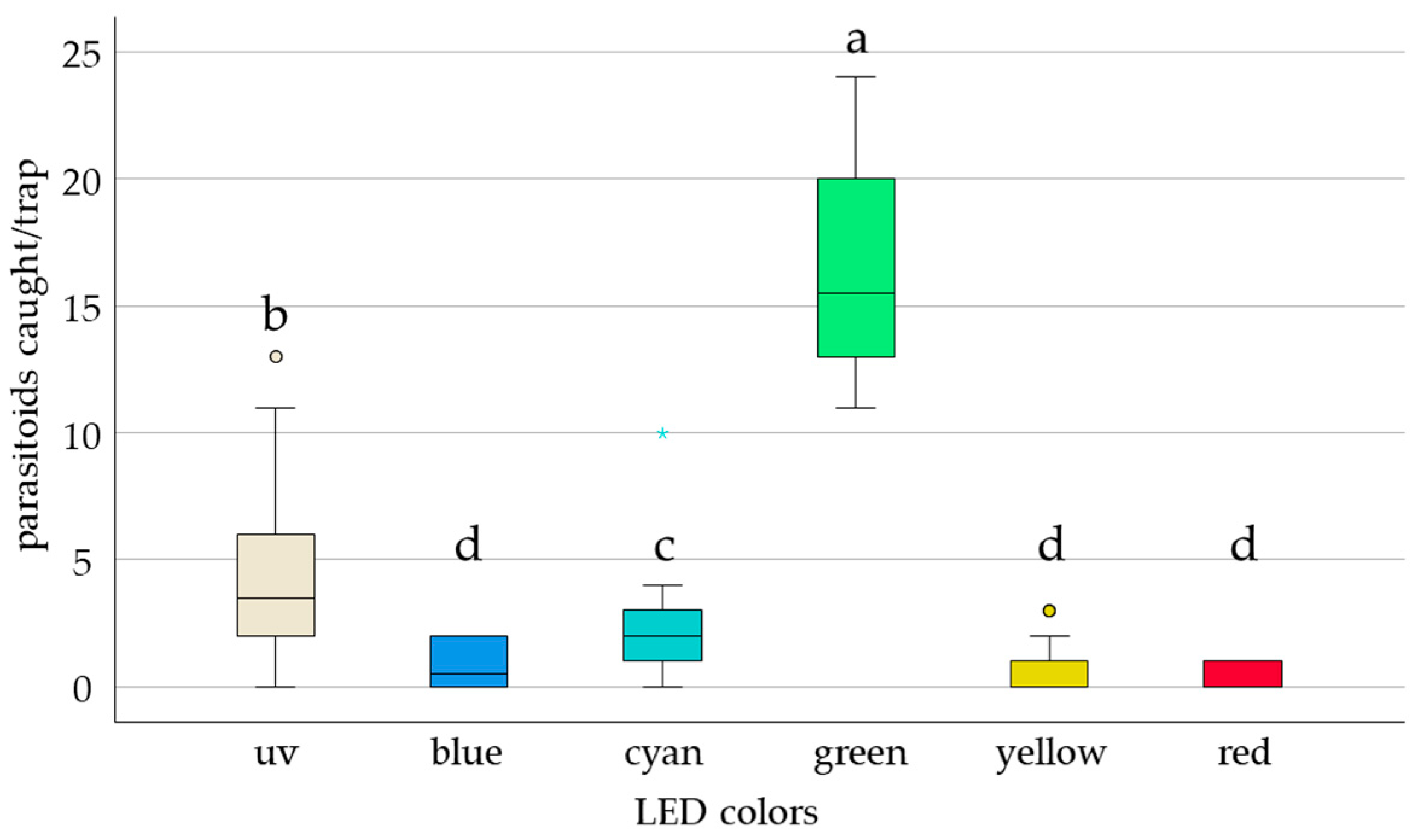
3.1. Visual Preference of Encarsia formosa for Different LED Spectra
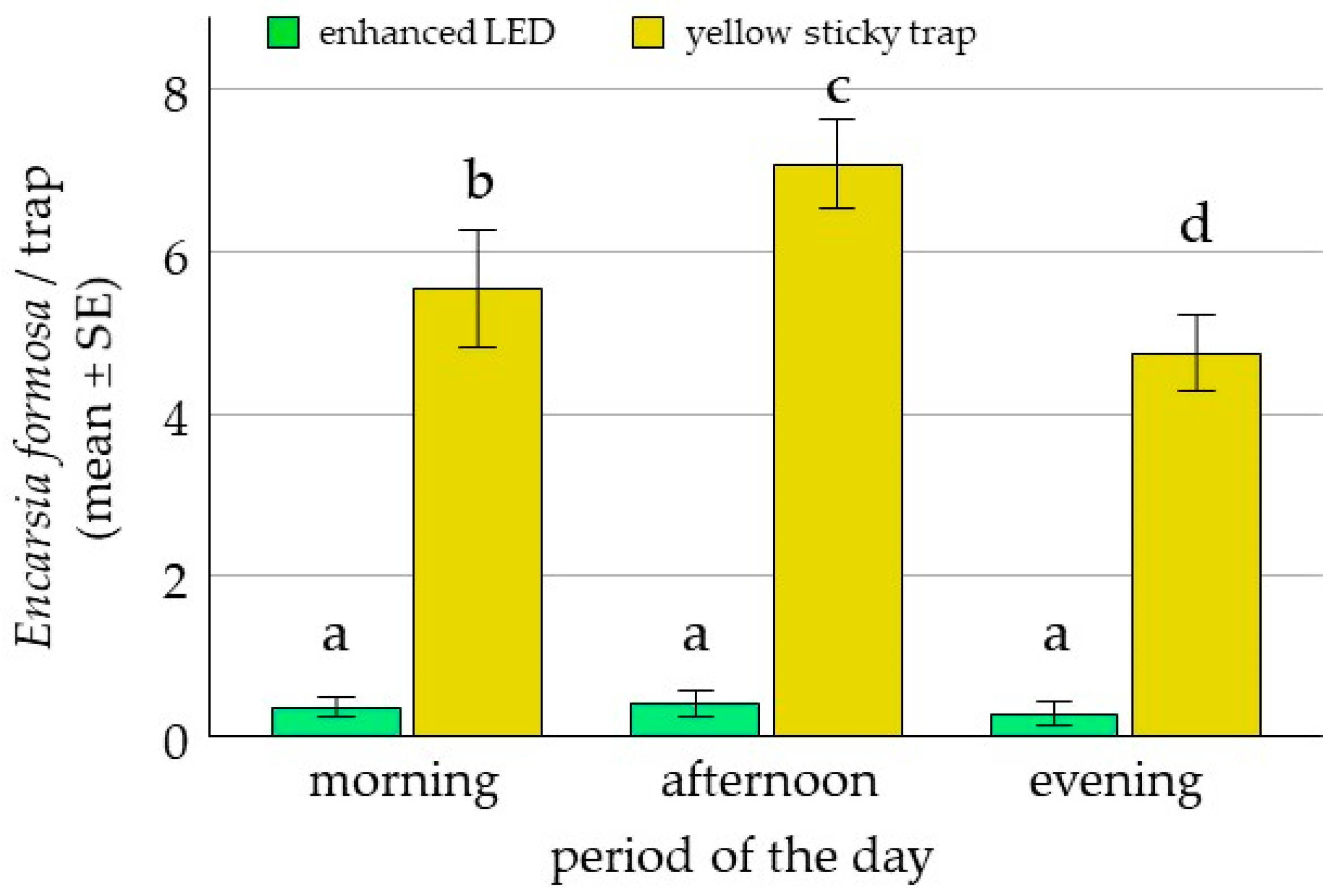
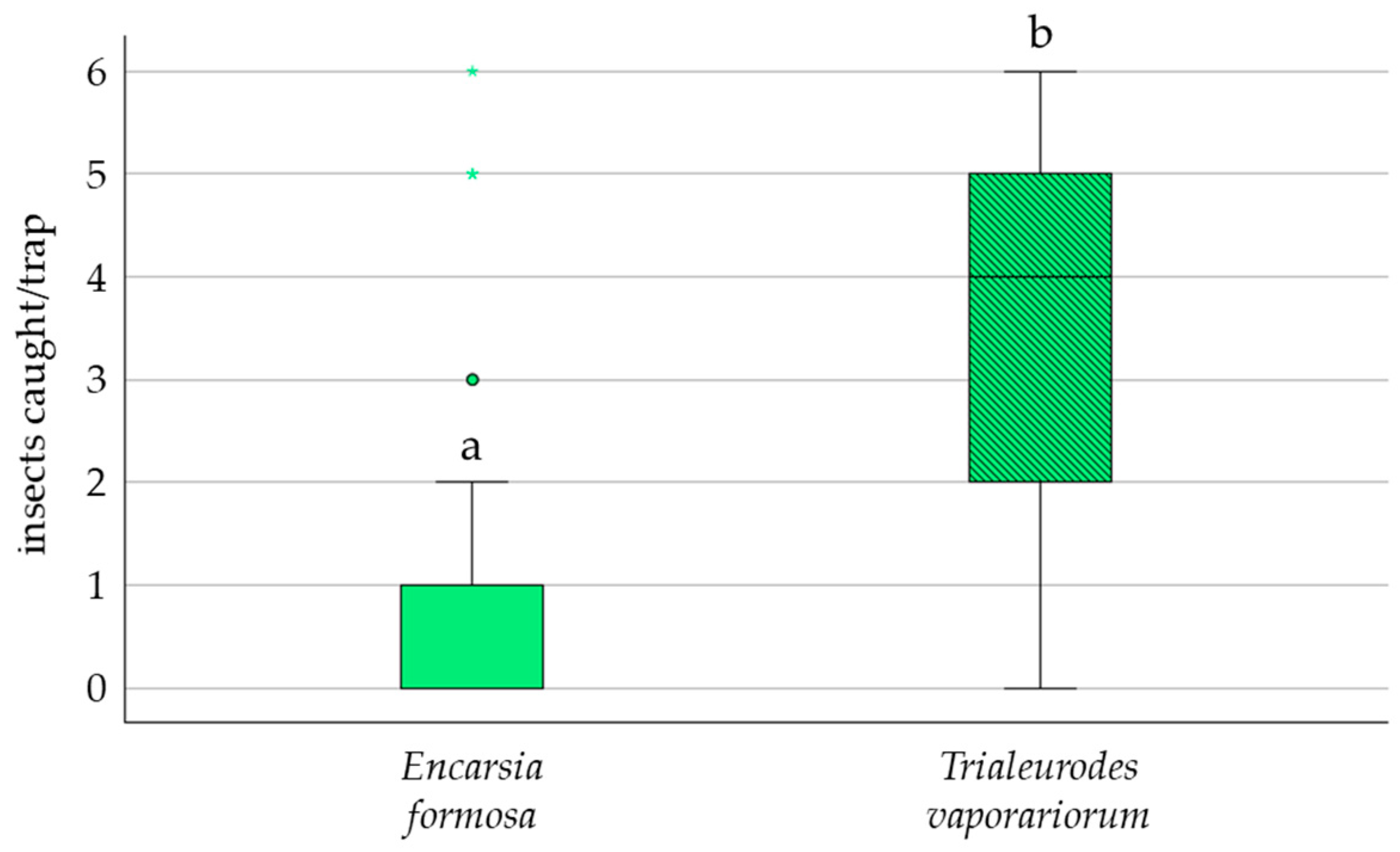
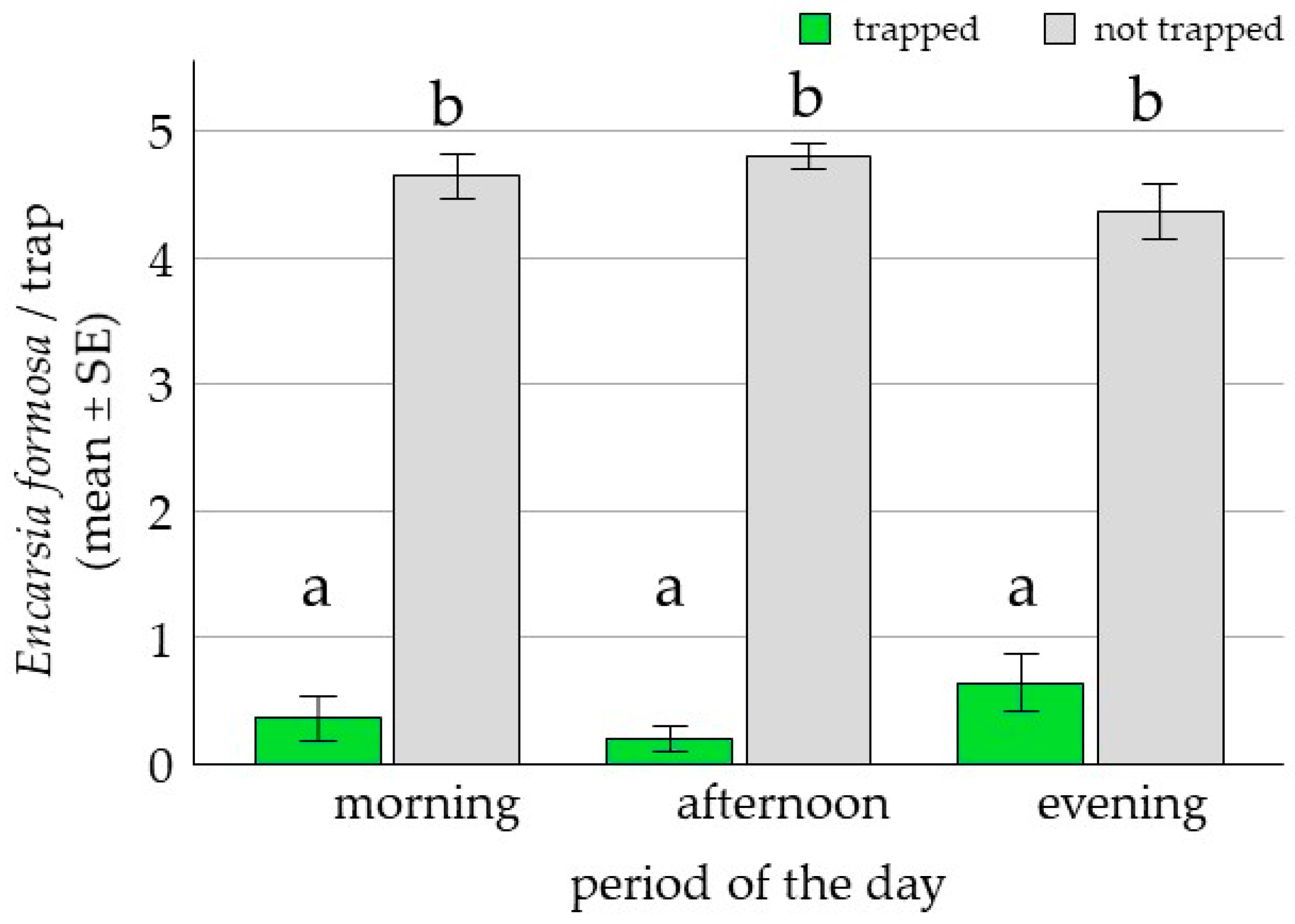
3.2. Behavioral Response of Encarsia to Whitefly Monitoring Traps
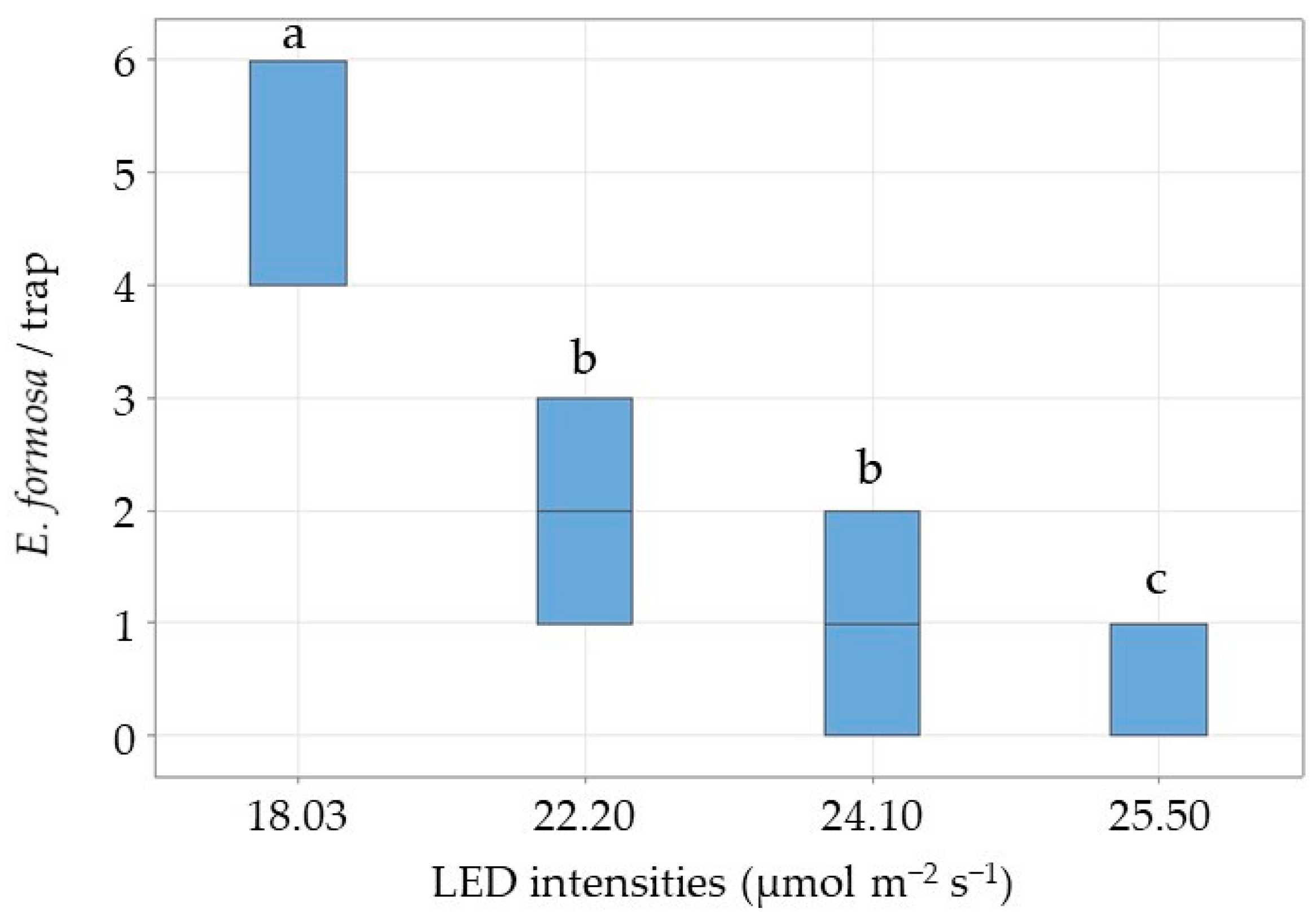
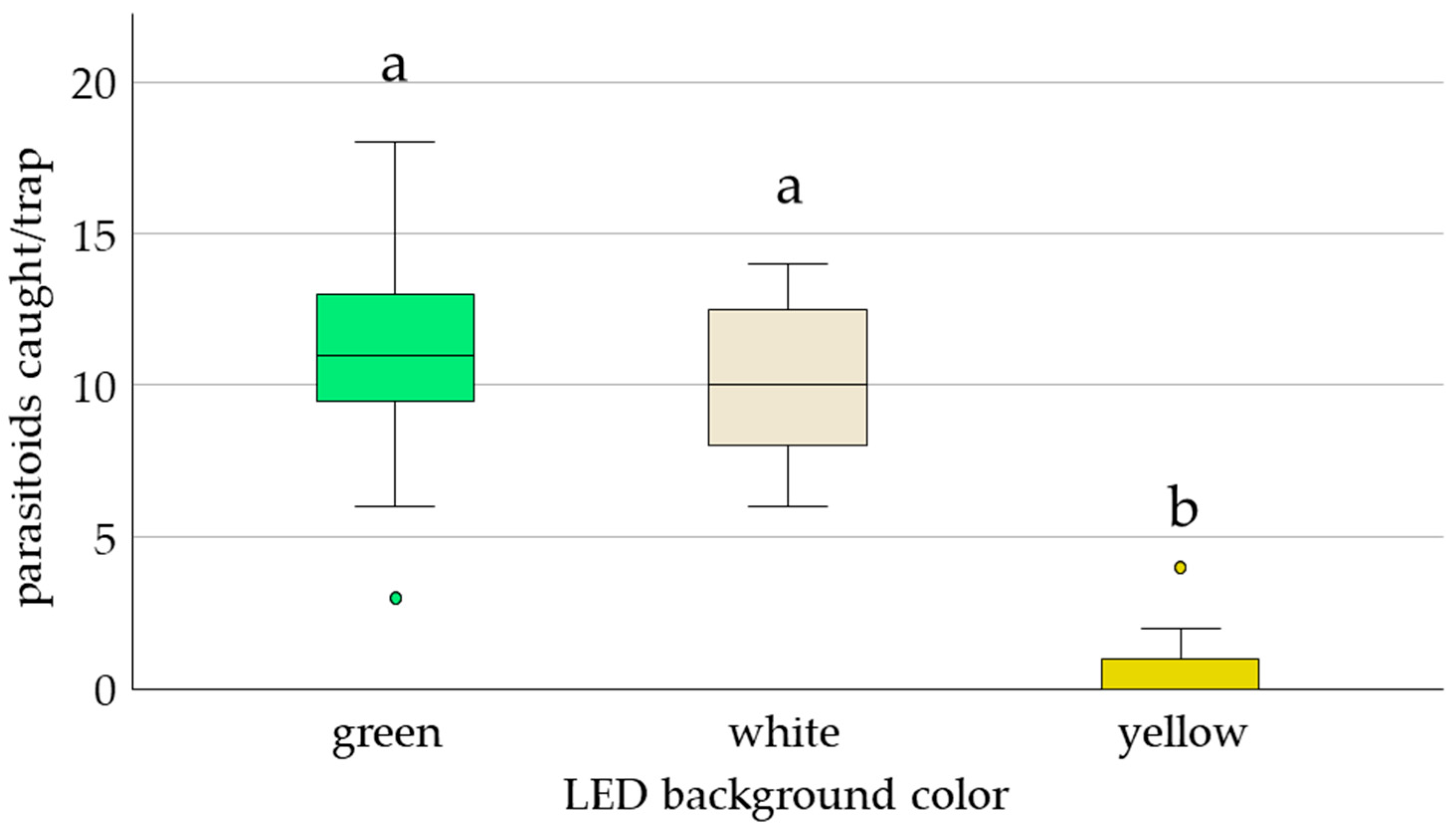
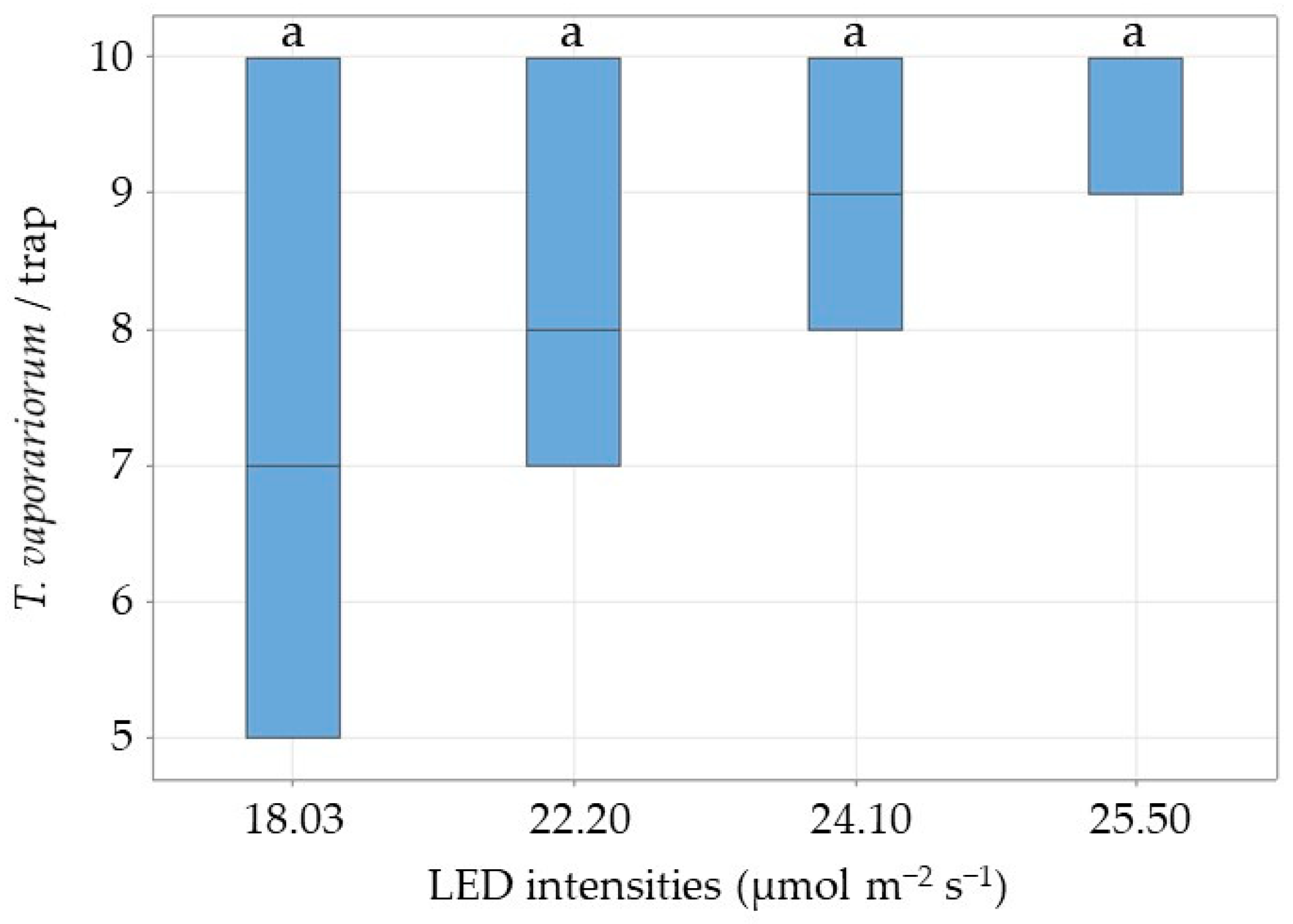
3.3. Behavioral Response to Modifications of the Whitefly LED Monitoring Trap at Different Intensities
4. Discussion
5. Conclusions
Author Contributions
Funding
Data Availability Statement
Acknowledgments
Conflicts of Interest
References
- Kelber, A.; Vorobyev, M.; Osorio, D. Animal colour vision—Behavioural tests and physiological concepts. Biol. Rev. 2003, 78, 81–118. [Google Scholar] [CrossRef] [PubMed]
- Kelber, A.; Osorio, D. From spectral information to animal colour vision: Experiments and concepts. Proc. R. Soc. B-Biol. Sci. 2010, 277, 1617–1625. [Google Scholar] [CrossRef] [PubMed]
- Owens, A.C.; Lewis, S.M. The impact of artificial light at night on nocturnal insects: A review and synthesis. Ecol. Evol. 2018, 8, 11337–11358. [Google Scholar] [CrossRef] [PubMed]
- van de Veire, M.; Vacante, V. Greenhouse-Whitefly control through the combined use of the color attraction system with the parasite wasp Encarsia formosa [Hym, Aphelinidae]. Entomophaga 1984, 29, 303–310. [Google Scholar] [CrossRef]
- Gillespie, D.R.; Quiring, D. Yellow sticky traps for detecting and monitoring Greenhouse-Whitefly (Homoptera, Aleyrodidae) adults on greenhouse tomato crops. J. Econ. Entomol. 1987, 80, 675–679. [Google Scholar] [CrossRef]
- Boeckmann, E.; Hommes, M.; Meyhoefer, R. Yellow traps reloaded: What is the benefit for decision making in practice? J. Pest Sci. 2015, 88, 439–449. [Google Scholar] [CrossRef]
- Moreau, T.L.; Isman, M.B. Trapping whiteflies? A comparison of greenhouse whitefly (Trialeurodes vaporariorum) responses to trap crops and yellow sticky traps. PEST Manag. Sci. 2011, 67, 408–413. [Google Scholar] [CrossRef]
- Natwick, E.T.; Byers, J.A.; Chu, C.C.; Lopez, M.; Henneberry, T.J. Early detection and mass trapping of Frankliniella occidentalls1 and thrips tabaci1 in vegetable crops. Southwest. Entomol. 2007, 32, 229–238. [Google Scholar] [CrossRef]
- Zhang, J.; Li, H.; Liu, M.; Zhang, H.; Sun, H.; Wang, H.; Miao, L.; Li, M.; Shu, R.; Qin, Q. A Greenhouse Test to Explore and Evaluate Light-Emitting Diode (LED) Insect Traps in the Monitoring and Control of Trialeurodes vaporariorum. Insects 2020, 11, 94. [Google Scholar] [CrossRef]
- Grupe, B.; Meyhöfer, R. Blue LED trap and commercial lure improve western flower thrips (Frankliniella occidentalis) monitoring in cucumber crops. J. Pest. Sci. 2024, 97, 2047–2058. [Google Scholar] [CrossRef]
- Stukenberg, N.; Gebauer, K.; Poehling, H.M. Light emitting diode(LED)-based trapping of the greenhouse whitefly (Trialeurodes vaporariorum). J. Appl. Entomol. 2015, 139, 268–279. [Google Scholar] [CrossRef]
- Otieno, J.A.; Stukenberg, N.; Weller, J.; Poehling, H.M. Efficacy of LED-enhanced blue sticky traps combined with the synthetic lure Lurem-TR for trapping of western flower thrips (Frankliniella occidentalis). J. Pest Sci. 2018, 91, 1301–1314. [Google Scholar] [CrossRef]
- Grupe, B.; Meyhöfer, R. Whitefly Detected: LED Traps Enhance Monitoring of Trialeurodes vaporariorum in Greenhouse-Grown Tomato. Horticulturae 2024, 10, 960. [Google Scholar] [CrossRef]
- Hoddle, M.S.; van Driesche, R.G.; Sanderson, J.P. Biology and use of the whitefly parasitoid Encarsia formosa. Annu. Rev. Entomol. 1998, 43, 645–669. [Google Scholar] [CrossRef]
- van Lenteren, J.C.; van Roermund, H.J.; Sütterlin, S. Biological Control of Greenhouse Whitefly (Trialeurodes vaporariorum) with the Parasitoid Encarsia formosa: How Does It Work? Biol. Control 1996, 6, 1–10. [Google Scholar] [CrossRef]
- Grupe, B.; Meyhöfer, R. Light-emitting diode traps in commercial greenhouses: A field study report on Encarsia formosa bycatch. Entomol. Exp. Appl. 2025, 173, 40–48. [Google Scholar] [CrossRef]
- Chen, T.Y.; Chu, C.C.; Henneberry, T.J.; Umeda, K. Monitoring and trapping insects on poinsettia with yellow sticky card traps equipped with light-emitting diodes. HortTechnology 2004, 14, 337–341. [Google Scholar] [CrossRef]
- Chu, C.C.; Simmons, A.M.; Chen, T.Y.; Alexander, P.J.; Henneberry, T.J. Lime green light-emitting diode equipped yellow sticky card traps for monitoring whiteflies, aphids and fungus gnats in greenhouses. Insect Sci. 2004, 11, 125–133. [Google Scholar] [CrossRef]
- Stukenberg, N. LED Based Trapping of Whiteflies and Fungus Gnats: From Visual Ecology to Application. Ph.D. Thesis, Leibniz University, Hannover, Germany, 2018. [Google Scholar]
- Stukenberg, N.; Pietruska, M.; Waldherr, A.; Meyhöfer, R. Wavelength-Specific Behavior of the Western Flower Thrips (Frankliniella occidentalis): Evidence for a Blue-Green Chromatic Mechanism. Insects 2020, 11, 423. [Google Scholar] [CrossRef]
- Simmons, A.M.; McCutcheon, G.S. Daily Foraging Incidence of Encarsia pergandiella (Hymenoptera: Aphelinidae) on Cowpea. J. Entomol. Sci. 2001, 36, 218–221. [Google Scholar] [CrossRef]
- Boeckmann, E.; Meyhoefer, R. Sticky trap monitoring of a pest-predator system in glasshouse tomato crops: Are available trap colours sufficient? J. Appl. Entomol. 2017, 141, 339–351. [Google Scholar] [CrossRef]
- Wickham, H. ggplot2: Elegant Graphics for Data Analysis; Springer: New York, NY, USA, 2016; ISBN 978-3-319-24277-4. [Google Scholar]
- Lenth, R.; Piaskowski, J. emmeans: Estimated Marginal Means, Aka Least-Squares Means. R Package Version 2.0.1, 2025. Available online: https://rvlenth.github.io/emmeans/ (accessed on 10 February 2026).
- Park, J.; Kim, J.; Park, H.; Cho, K. Development of Time-Efficient Method for Estimating Aphids Density Using Yellow Sticky Traps in Cucumber Greenhouses. J. ASIA-Pac. Entomol. 2001, 4, 143–148. [Google Scholar] [CrossRef]
- Cloyd, R.A. Management of Fungus Gnats (Bradysia sp.) in Greenhouses and nurseries. Floric. Ornam. Biotechnol. 2008, 2, 84–88. [Google Scholar]
- Hall, D.G.; Sétamou, M.; Mizell, R.F. A comparison of sticky traps for monitoring Asian citrus psyllid (Diaphorina citri Kuwayama). CROP Prot. 2010, 29, 1341–1346. [Google Scholar] [CrossRef]
- Ezizi, Y. Control of the greenhouse whitefly, Trialeurodes vaporariorum Westwood (Homoptera: Aleyrodidae) by the integrated use of yellow sticky traps and the parasite Encarsia formosa Gahan (Hymenoptra: Aphelinidae). Appl. Entomol. Zool. 1987, 22, 159–165. [Google Scholar]
- McCormack, K. Enhancing the Monitoring and Trapping of Protected Crop Pests by Incorporating LED Technology into Existing Traps. Ph.D. Thesis, University of Edinburgh, Edinburgh, UK, 2016. [Google Scholar]
- Athanasiadou, M.; Meyhöfer, R. Blue and UV light-emitting diodes (LEDs) disturb the greenhouse whitefly (Trialeurodes vaporariorum) from its host. J. Pest Sci. 2023, 97, 1355–1367. [Google Scholar] [CrossRef]
- Athanasiadou, M.; Seger, R.; Meyhöfer, R. Potential of blue light-emitting diodes (LEDs) to disturb whiteflies on the crop: A new push–pull strategy? J. Pest Sci. 2024, 98, 1117–1133. [Google Scholar] [CrossRef]
- Athanasiadou, M.; Meyhöfer, R. Exploring the effectiveness of methyl salicylate and attractive traps in dispersing and recapturing glasshouse whiteflies: Advances in push-pull strategy. PEST Manag. Sci. 2025, 81, 6620–6629. [Google Scholar] [CrossRef]
- Vernon, R.S.; Gillespie, D.R. Influence of Trap Shape, Size, and Background Color on Captures of Frankliniella-Occidentalis (Thysanoptera, Thripidae) in a Cucumber Greenhouse. J. Econ. Entomol. 1995, 88, 288–293. [Google Scholar] [CrossRef]
- Agee, H.R.; Mitchell, E.R.; Flanders, R.V. Spectral Sensitivity of the Compound Eye of Coccinella septempunctata (Coleoptera: Coccinellidae). Ann. Entomol. Soc. Am. 1990, 83, 817–819. [Google Scholar] [CrossRef]
- Jaeger, R.G.; Hailman, J.P. 2 Types of phototactic behaviour in Anuran Amphibians. Nature 1971, 230, 189–190. [Google Scholar] [CrossRef]
- Chen, Z.; Xu, R.; Kuang, R.-P.; Sun, R. Phototactic behaviour of the parasitoid Encarsia formosa (Hymenoptera: Aphelinidae). Biocontrol Sci. Technol. 2016, 26, 250–262. [Google Scholar] [CrossRef]
- Grupe, B.; Dieckhoff, C.; Meyhöfer, R. Keep an eye on natural enemies: What Aphidius on sticky traps tells us about aphid pest population dynamics. Entomol. Exp. ET Appl. 2023, 171, 722–731. [Google Scholar] [CrossRef]
- Kim, M.G.; Yang, J.Y.; Chung, N.H.; Lee, H.S. Photo-Response of Tobacco Whitefly, Bemisia tabaci Gennadius (Hemiptera: Aleyrodidae), to Light-emitting Diodes. J. Korean Soc. Appl. Biol. Chem. 2012, 55, 567–569. [Google Scholar] [CrossRef]
- Ye, H. The influence of temperature and light on the taking-off of Tomicus piniperda. Chin. Bull. Entomol. 2000, 37, 342–344. [Google Scholar]
- Ekejiuba, E.E.; Meyhöfer, R. Spectral Preferences of Encarsia formosa: Unravelling Attraction to LED Monitoring Traps. 2026. [Data Set] LUIS. Available online: https://data.uni-hannover.de/dataset/spectral-preferences-of-encarsia-formosa-unravelling-attraction-to-led-monitoring-traps (accessed on 12 February 2026).





| LED Color | Manufacturer | Type | Peak Wavelength Measured (nm) |
Initial Photo Flux (μmol m−2 s−1) |
Adjusted Photo Flux (μmol m−2 s−1) |
|---|---|---|---|---|---|
| UV | Roithner 1 | H2A1-H365-E | 365 | 14.1 | 8.1 |
| blue | Osram 2 | Oslon SSL 80 LB CP7P | 466 | 43.7 | 8.1 |
| cyan | Roithner 1 | B5-433-B505 | 507 | 24.9 | 8.1 |
| green | Osram 2 | B5-433-B525 | 523 | 32.1 | 8.1 |
| yellow | Roithner 1 | LED 565-O3U | 590 | 8.1 | 8.1 |
| red | Osram 2 | Oslon SSL LR CP7P | 634 | 33.8 | 8.1 |
Disclaimer/Publisher’s Note: The statements, opinions and data contained in all publications are solely those of the individual author(s) and contributor(s) and not of MDPI and/or the editor(s). MDPI and/or the editor(s) disclaim responsibility for any injury to people or property resulting from any ideas, methods, instructions or products referred to in the content. |
© 2026 by the authors. Licensee MDPI, Basel, Switzerland. This article is an open access article distributed under the terms and conditions of the Creative Commons Attribution (CC BY) license.
Share and Cite
Ekejiuba, E.E.; Meyhöfer, R. Spectral Preferences of Encarsia formosa: Unravelling Attraction to LED Monitoring Traps. Insects 2026, 17, 246. https://doi.org/10.3390/insects17030246
Ekejiuba EE, Meyhöfer R. Spectral Preferences of Encarsia formosa: Unravelling Attraction to LED Monitoring Traps. Insects. 2026; 17(3):246. https://doi.org/10.3390/insects17030246
Chicago/Turabian StyleEkejiuba, Emeka Emmanuel, and Rainer Meyhöfer. 2026. "Spectral Preferences of Encarsia formosa: Unravelling Attraction to LED Monitoring Traps" Insects 17, no. 3: 246. https://doi.org/10.3390/insects17030246
APA StyleEkejiuba, E. E., & Meyhöfer, R. (2026). Spectral Preferences of Encarsia formosa: Unravelling Attraction to LED Monitoring Traps. Insects, 17(3), 246. https://doi.org/10.3390/insects17030246