Enhanced Honey Bee Colony Strength and Economic Returns from Fall and Winter Feeding with a Complete Pollen-Replacing Feed

 ,
,
Simple Summary
Abstract
1. Introduction
2. Materials and Methods
2.1. Beekeeping Operations, Colony Selection, and Feeding
2.2. Colony Inspection
2.3. Spring Build-Up Treatment Group Assignments
2.4. Analyses
2.5. Economic Analysis Methods
3. Results
3.1. Colony Strength in Almonds
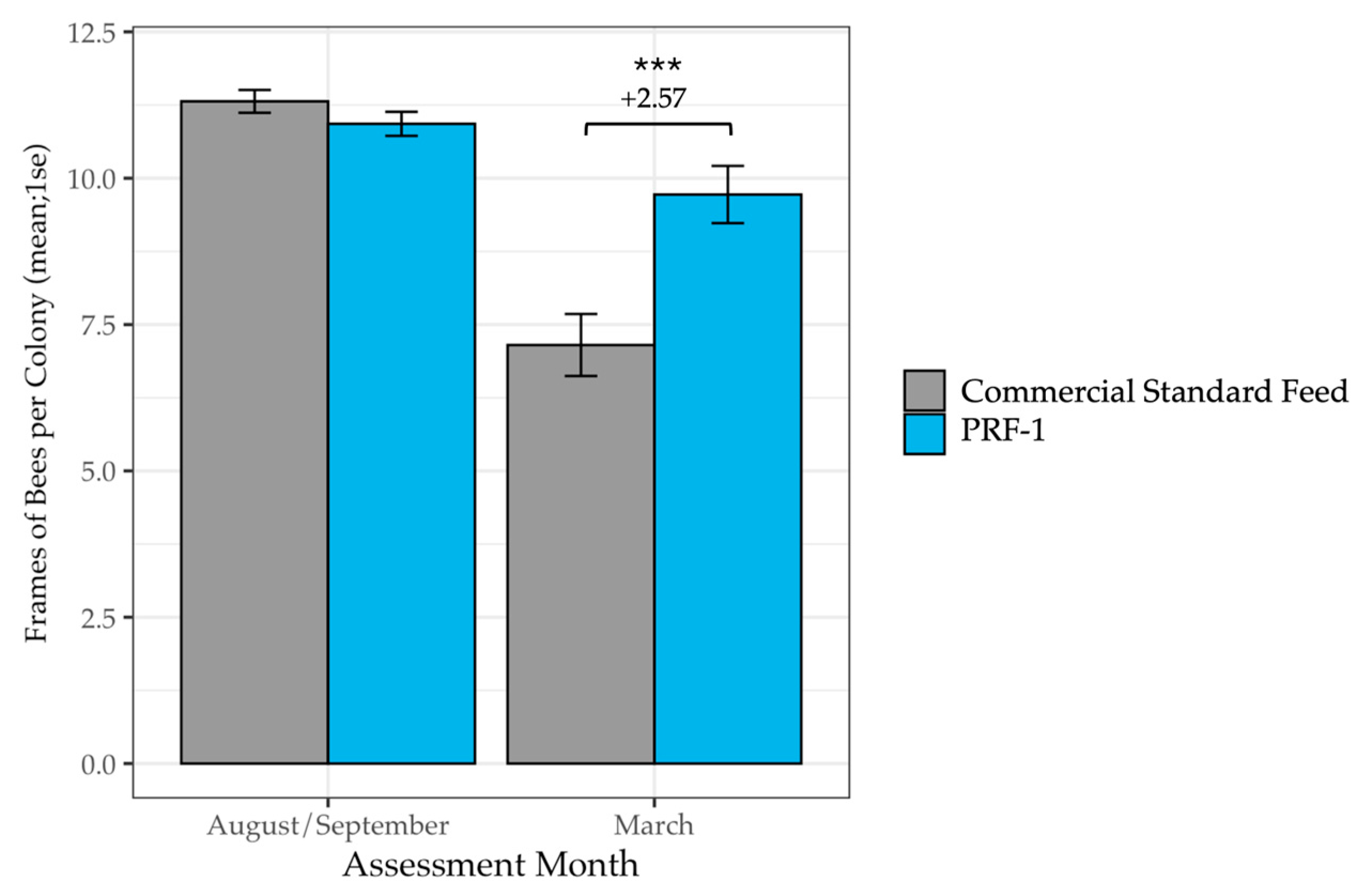
3.2. Colony Strength After Almonds
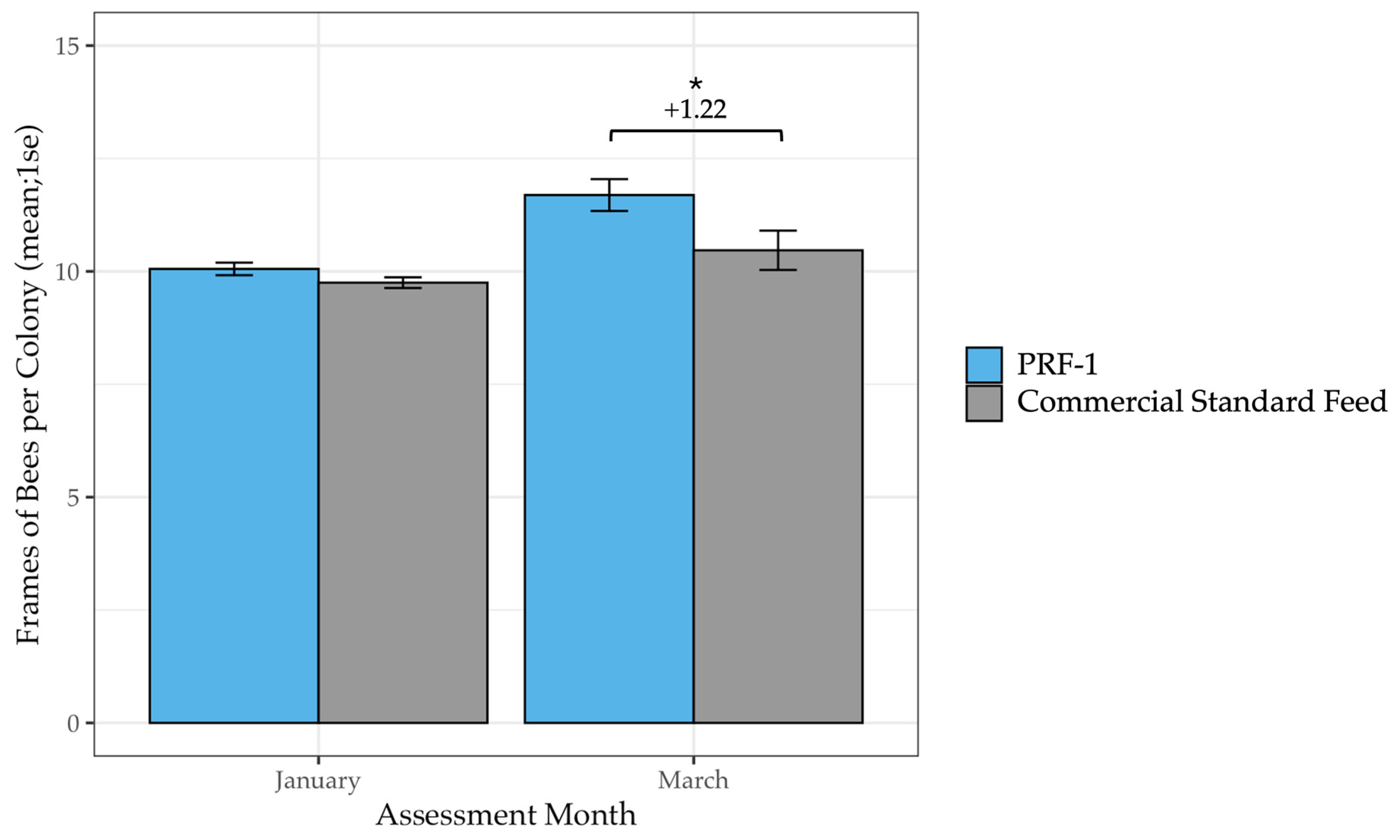
3.3. Spring Build Up
3.4. Economic Analysis Results
3.4.1. Projected Revenue for Year 1
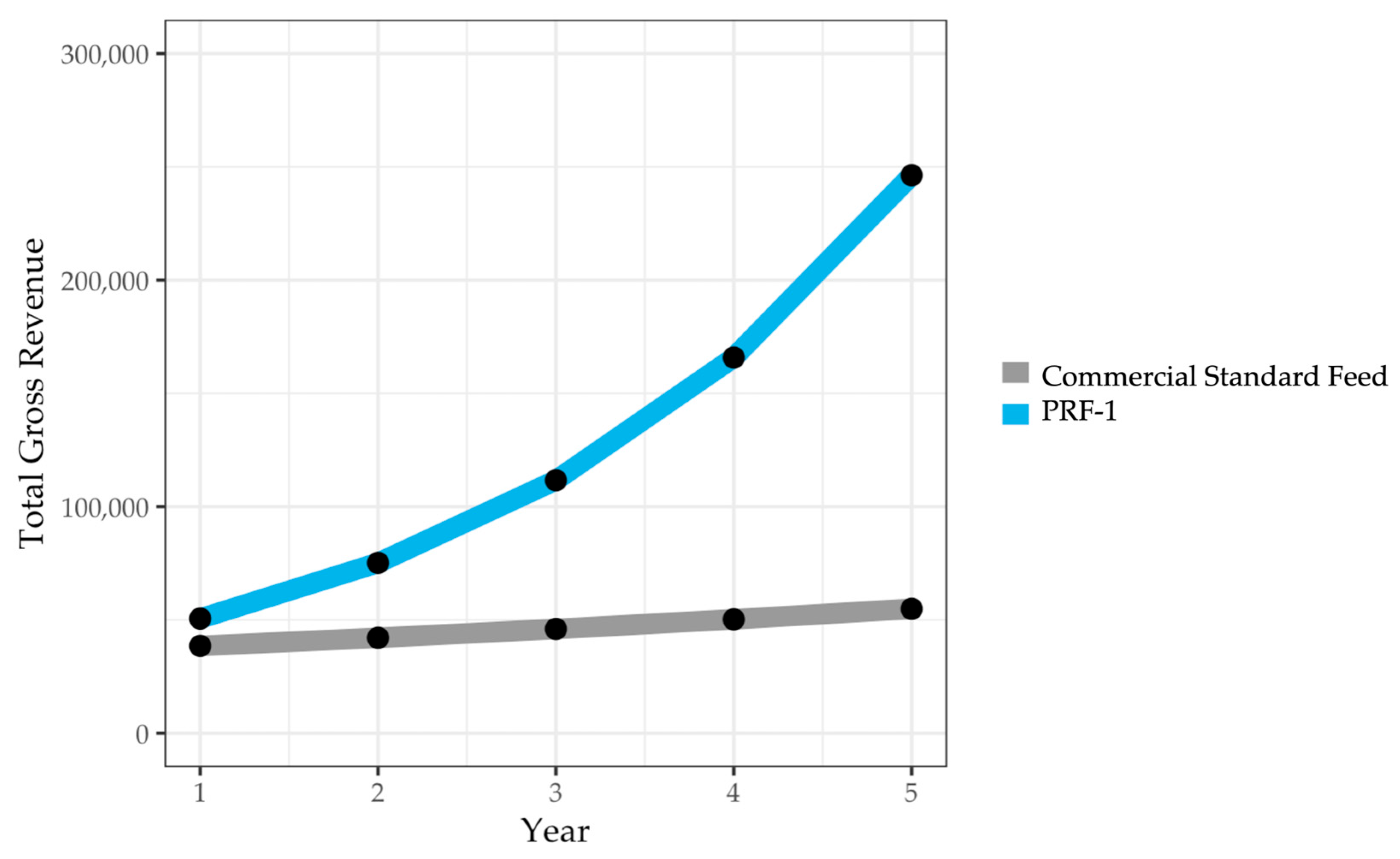
3.4.2. Projected Gross Revenue for Five Years
4. Discussion
Supplementary Materials
Author Contributions
Funding
Data Availability Statement
Acknowledgments
Conflicts of Interest
Abbreviations
| PRF-1 | Pollen-Replacing Feed 1 |
References
- Baylis, K.; Lichtenberg, E.M.; Lichtenberg, E. Economics of pollination. Annu. Rev. Resour. Econ. 2021, 13, 335–354. [Google Scholar] [CrossRef]
- Khalifa, S.A.M.; Elshafiey, E.H.; Shetaia, A.A.; El-Wahed, A.A.A.; Algethami, A.F.; Musharraf, S.G.; AlAjmi, M.F.; Zhao, C.; Masry, S.H.D.; Abdel-Daim, M.M.; et al. Overview of bee pollination and its economic value for crop production. Insects 2021, 12, 688. [Google Scholar] [CrossRef] [PubMed]
- Gray, A.; Adjlane, N.; Arab, A.; Ballis, A.; Brusbardis, V.; Bugeja Douglas, A.; Cadahía, L.; Charrière, J.-D.; Chlebo, R.; Coffey, M.F.; et al. Honey bee colony loss rates in 37 countries using the COLOSS survey for winter 2019–2020: The combined effects of operation size, migration and queen replacement. J. Apic. Res. 2023, 62, 204–210. [Google Scholar] [CrossRef]
- Giacobino, A.; Steinhauer, N.; Brunner, S.; Garcia-Andersen, N.; Aurell, D.; Bruckner, S.; Rogers, S.; Williams, G. Preliminary Results from the 2024–2025 US Beekeeping Survey: Honey Bee Colony Loss and Management. Preprint 2025, 4-2. [Google Scholar]
- Lamas, Z.S.; Rinkevich, F.; Garavito, A.; Shaulis, A.; Boncristiani, D.; Hill, E.; Chen, Y.P.; Evans, J.D. Viruses and vectors tied to honey bee colony losses. bioRxiv 2025. [Google Scholar] [CrossRef]
- Nearman, A.; Crawford, C.L.; Guarna, M.M.; Chakrabarti, P.; Lee, K.; Cook, S.; Hill, E.; Seshadri, A.; Slater, G.; Lamas, Z.S.; et al. Insights from US beekeeper triage surveys following unusually high honey bee colony losses 2024–2025. Sci. Total Environ. 2025, 1003, 180650. [Google Scholar] [CrossRef]
- Steinhauer, N.; Kulhanek, K.; Antúnez, K.; Human, H.; Chantawannakul, P.; Chauzat, M.-P.; vanEngelsdorp, D. Drivers of colony losses. Curr. Opin. Insect Sci. 2018, 26, 142–148. [Google Scholar] [CrossRef]
- Huang, Z. Pollen nutrition affects honey bee stress resistance. Terr. Arthropod Rev. 2012, 5, 175–189. [Google Scholar] [CrossRef]
- Brodschneider, R.; Crailsheim, K. Nutrition and health in honey bees. Apidologie 2010, 41, 278–294. [Google Scholar] [CrossRef]
- Dolezal, A.G.; Toth, A.L. Feedbacks between nutrition and disease in honey bee health. Curr. Opin. Insect Sci. 2018, 26, 114–119. [Google Scholar] [CrossRef]
- Goodrich, B.K. Contracting for pollination services. Choices 2019, 34, 1–13. [Google Scholar]
- Otto, C.R.V.; Roth, C.L.; Carlson, B.L.; Smart, M.D. Land-use change reduces habitat suitability for supporting managed honey bee colonies in the Northern Great Plains. Proc. Natl. Acad. Sci. USA 2016, 113, 10430–10435. [Google Scholar] [CrossRef] [PubMed]
- Simone-Finstrom, M.; Li-Byarlay, H.; Huang, M.H.; Strand, M.K.; Rueppell, O.; Tarpy, D.R. Migratory management and environmental conditions affect lifespan and oxidative stress in honey bees. Sci. Rep. 2016, 6, 32023. [Google Scholar] [CrossRef] [PubMed]
- Donkersley, P.; Rhodes, G.; Pickup, R.W.; Jones, K.C.; Wilson, K. Honeybee nutrition is linked to landscape composition. Ecol. Evol. 2014, 4, 4195–4206. [Google Scholar] [CrossRef]
- Paray, B.A.; Kumari, I.; Hajam, Y.A.; Sharma, B.; Kumar, R.; Albeshr, M.F.; Farah, M.A.; Khan, J.M. Honeybee nutrition and pollen substitutes: A review. Saudi J. Biol. Sci. 2021, 28, 1167–1176. [Google Scholar] [CrossRef]
- Farrar, C. The overwintering of productive colonies. In The Hive and the Honey Bee; Dadant & Sons: Hamilton, IL, USA, 1963; p. 341. [Google Scholar]
- Haydak, M.H. Honey bee nutrition. Annu. Rev. Entomol. 1970, 15, 143–156. [Google Scholar]
- DeGrandi-Hoffman, G.; Wardell, G.; Ahumada-Segura, F.; Rinderer, T.; Danka, R.; Pettis, J. Comparisons of pollen substitute diets for honey bees: Consumption rates by colonies and effects on brood and adult populations. J. Apic. Res. 2008, 47, 126–130. [Google Scholar] [CrossRef]
- DeGrandi-Hoffman, G.; Chen, Y.; Rivera, R.; Carroll, M.; Chambers, M.; Hidalgo, G.; de Jong, E.W. Honey bee colonies provided with natural forage have lower pathogen loads and higher overwinter survival than those fed protein supplements. Apidologie 2016, 47, 186–196. [Google Scholar] [CrossRef]
- Noordyke, E.R.; van Santen, E.; Ellis, J.D. Evaluating the strength of western honey bee (Apis mellifera L.) colonies fed pollen substitutes over winter. J. Appl. Entomol. 2022, 146, 291–300. [Google Scholar] [CrossRef]
- Tawfik, A.I.; Ahmed, Z.H.; Abdel-Rahman, M.F.; Moustafa, A.M. Influence of winter feeding on colony development and the antioxidant system of the honey bee, Apis mellifera. J. Apic. Res. 2020, 59, 752–763. [Google Scholar] [CrossRef]
- Oliver, R. A Comparative Trial of the Pollen Subs 2020: Part 3. Am. Bee J. 2021, 161, 997–1001. [Google Scholar]
- DeGrandi-Hoffman, G.; Graham, H.; Ahumada, F.; Smart, M.; Ziolkowski, N. The Economics of Honey Bee (Hymenoptera: Apidae) Management and Overwintering Strategies for Colonies Used to Pollinate Almonds. J. Econ. Entomol. 2019, 112, 2524–2533. [Google Scholar] [CrossRef] [PubMed]
- United States Department of Agriculture National Agricultural Statistics Service (USDA NASS). Honey; USDA NASS: Washington, DC, USA, 2025.
- Quinlan, G.M.; Grozinger, C.M. Evaluating the role of social context and environmental factors in mediating overwintering physiology in honey bees (Apis mellifera). J. Exp. Biol. 2024, 227, jeb247314. [Google Scholar] [CrossRef] [PubMed]
- Kunc, M.; Dobeš, P.; Hurychová, J.; Vojtek, L.; Poiani, S.B.; Danihlík, J.; Havlík, J.; Titěra, D.; Hyršl, P. The year of the honey bee (Apis mellifera L.) with respect to its physiology and immunity: A search for biochemical markers of longevity. Insects 2019, 10, 244. [Google Scholar] [CrossRef]
- Bogaert, T.; Reams, T.; Maillet, I.; Kulhanek, K.; Duyck, M.; Eertmans, F.; Fauvel, A.M.; Hopkins, B.; Bogaert, J. A nutritionally complete pollen-replacing diet protects honeybee colonies during stressful commercial pollination—Requirement for isofucosterol. Proc. R. Soc. B Biol. Sci. 2025, 292, 20243078. [Google Scholar] [CrossRef]
- Delaplane, K.S.; van der Steen, J.; Guzman-Novoa, E. Standard methods for estimating strength parameters of Apis mellifera colonies. J. Apic. Res. 2013, 52, 1–12. [Google Scholar] [CrossRef]
- Bates, D.; Mächler, M.; Bolker, B.; Walker, S. Fitting Linear Mixed-Effects Models Using lme4. J. Stat. Softw. 2015, 67, 1–48. [Google Scholar]
- Goodrich, B.K.; Goodhue, R.E. Are all colonies created equal? The role of honey bee colony strength in almond pollination contracts. Ecol. Econ. 2020, 177, 106744. [Google Scholar] [CrossRef]
- United States Department of Agriculture National Agricultural Statistics Service (USDA NASS). Cost of Pollination; USDA NASS: Washington, DC, USA, 2024.
- Goodrich, B.K. Do more bees imply higher fees? Honey bee colony strength as a determinant of almond pollination fees. Food Policy 2019, 83, 150–160. [Google Scholar] [CrossRef]
- Traynor, J. A history of almond pollination in California. Bee World 2017, 94, 69–79. [Google Scholar] [CrossRef]





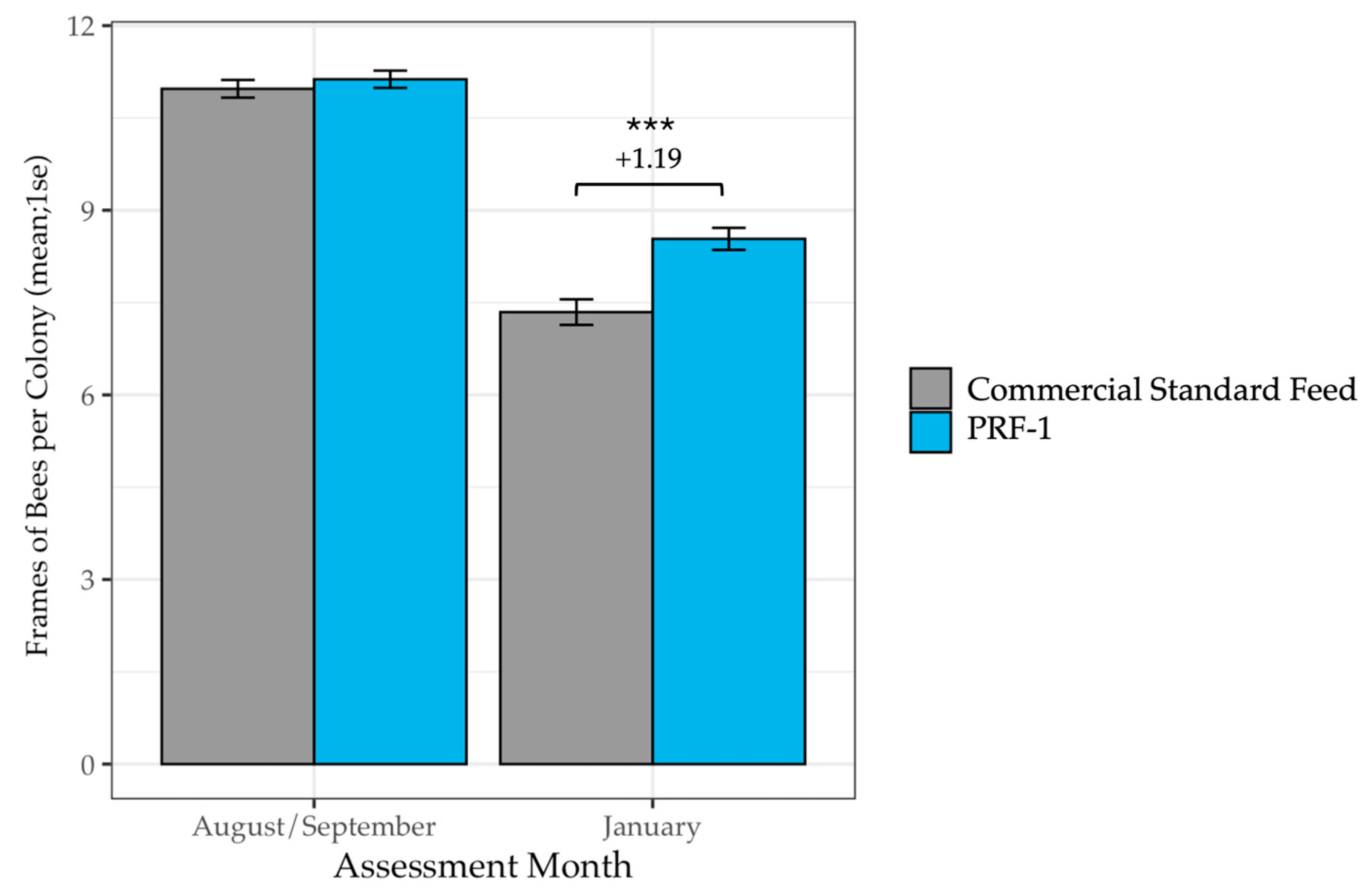
| Diet | Assessment Month | n Colonies | Frames of Bees (Mean ± 1 S.E.) |
|---|---|---|---|
| PRF-1 | August/September | 385 | 11.13 ± 0.14 |
| PRF-1 | January | 383 | 8.54 ± 0.18 |
| Commercial Standard Feed | August/September | 382 | 10.97 ± 0.14 |
| Commercial Standard Feed | January | 381 | 7.35 ± 0.21 |
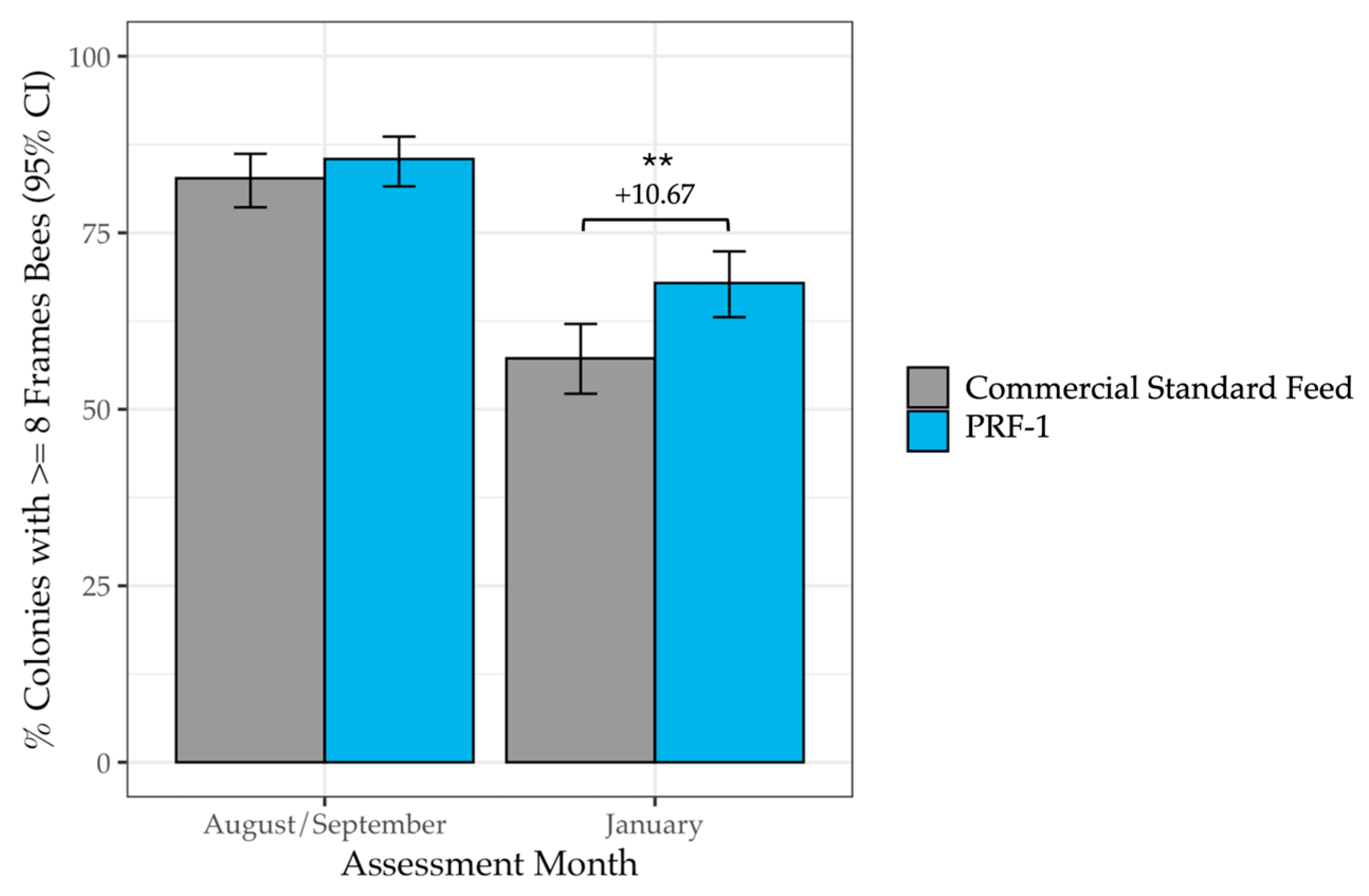
| Diet | Assessment Month | n Colonies | % Colonies with ≥8 Frames of Bees [95% CI] |
|---|---|---|---|
| PRF-1 | August/September | 385 | 85.45 [81.58–88.63] |
| PRF-1 | January | 383 | 67.89 [63.05–72.26] |
| Commercial Standard Feed | August/September | 382 | 82.72 [78.61–86.18] |
| Commercial Standard Feed | January | 381 | 57.22 [52.20–62.10] |
| Diet | Assessment Month | n Colonies | Frames of Bees (Mean ± 1 S.E.) |
|---|---|---|---|
| PRF-1 | August/September | 141 | 10.93 (±0.21) |
| PRF-1 | March | 140 | 9.72 (±0.49) |
| Commercial Standard Feed | August/September | 147 | 11.31 (±0.19) |
| Commercial Standard Feed | March | 146 | 7.15 (±0.53) |
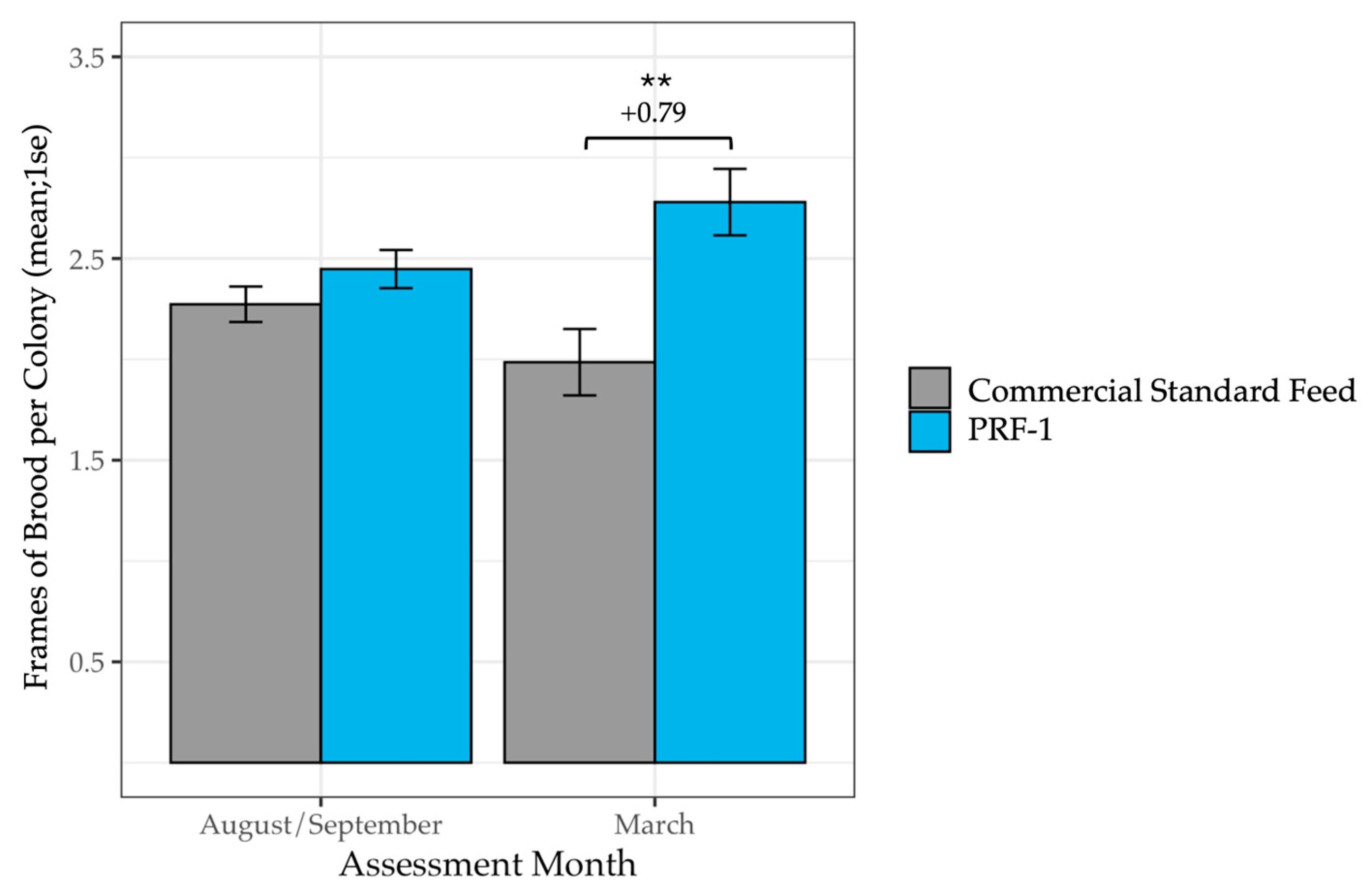
| Diet | Assessment Month | n Colonies | Frames of Brood (Mean ± 1 S.E.) |
|---|---|---|---|
| PRF-1 | August/September | 141 | 2.45 (±0.09) |
| PRF-1 | March | 140 | 2.78 (±0.16) |
| Commercial Standard Feed | August/September | 147 | 2.27 (±0.09) |
| Commercial Standard Feed | March | 146 | 1.99 (±0.16) |
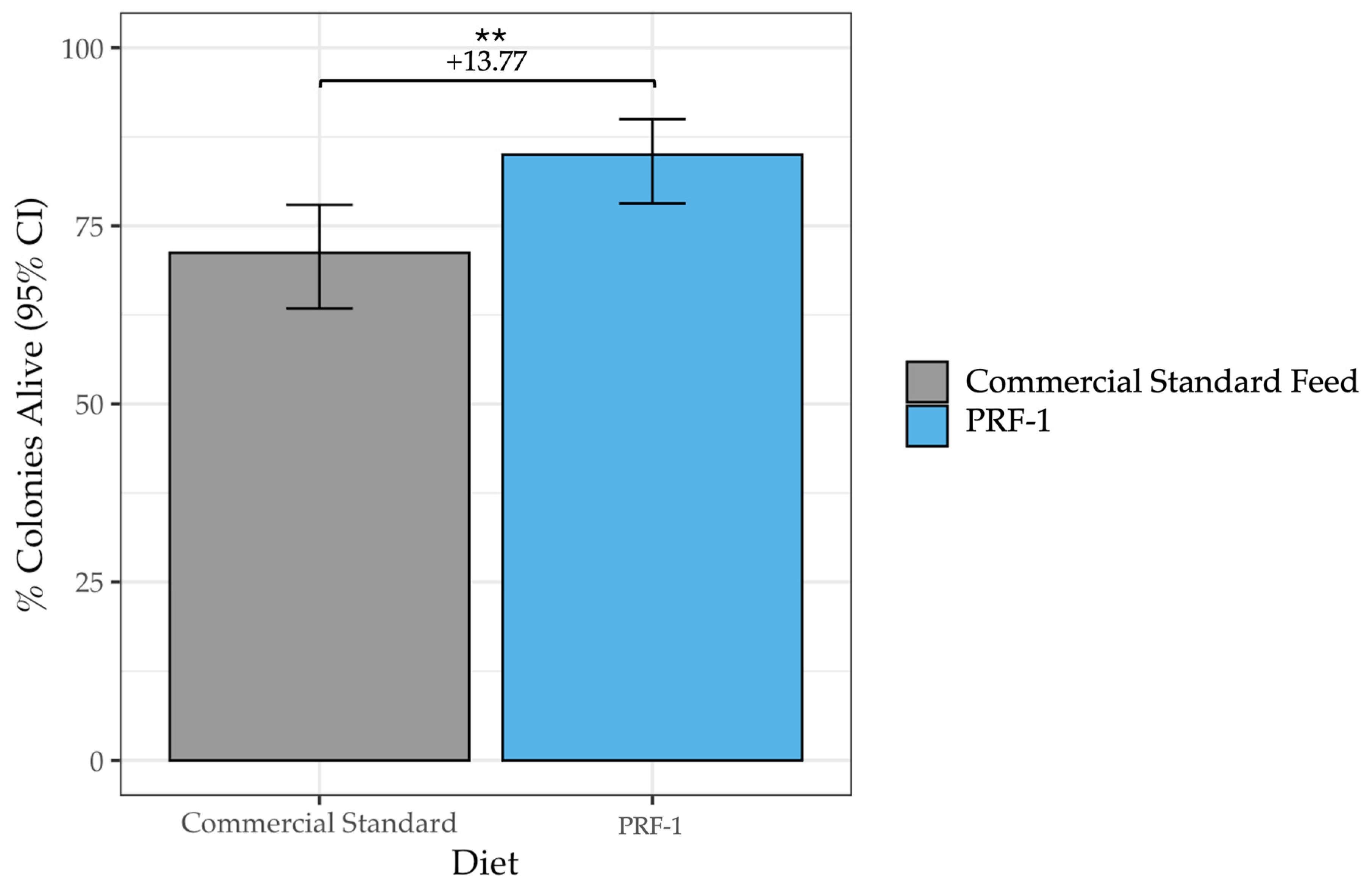
| Diet | Assessment Month | n Colonies | % Colonies Alive [95% CI] |
|---|---|---|---|
| PRF-1 | March | 140 | 85.00 [78.16–89.97] |
| Commercial Standard Feed | March | 146 | 71.23 [63.42–77.96] |
| Diet | Assessment Month | n Colonies | Frames of Brood (Mean ± 1 S.E.) |
|---|---|---|---|
| PRF-1 | January | 93 | 10.05 (±0.14) |
| PRF-1 | March | 93 | 11.69 (±0.35) |
| Commercial Standard Feed | January | 92 | 9.75 (±0.12) |
| Commercial Standard Feed | March | 92 | 10.47 (±0.44) |
| In Almonds (Operation Consists of Overwintered Colonies from a Starting Point of 100 Colonies in the Fall) | PRF-1 | Commercial Standard Feed | Difference |
|---|---|---|---|
| Colony Health Metric | |||
| # Colonies with ≥ 8 frames of bees in January (% Colonies with ≥ 8 frames of bees in January × 100) | 67.89 | 57.22 | 10.67 |
| Economic Metric | |||
| Gross revenue in almond pollination fees (# Colonies with ≥ 8 frames of bees in January × $181/hive) | $12,288.09 | $10,356.82 | $1931.27 |
| After almonds (Operation consists of 5-frame colonies generated from all frames of bees available in March) | PRF-1 | Commercial Standard Feed | Difference |
| Colony Health Metric | |||
| Mean frames of bees per colony in March (includes dead colonies as 0 frames of bees) | 9.72 | 7.15 | 2.57 |
| Total frames of bees in March (Mean frames of bees per colony in March × # of colonies alive in fall) | 972.00 | 715.00 | 257.00 |
| # 5-frame colonies produced (Total frames of bees/5) | 194.40 | 143.00 | 51.40 |
| Economic Metric | |||
| Gross revenue in apple pollination fees (# 5-frame colonies produced × $58.1/hive) | $11,294.64 | $8308.30 | $2986.34 |
| Gross revenue in honey production (# 5-frame colonies produced × $139.07/hive) | $27,035.21 | $19,887.01 | $7148.20 |
| TOTAL Gross Revenue in Year 1 | $50,617.94 | $38,552.13 | $12,065.81 |
| Year | Colony Health and Economic Metrics | PRF-1 | Commercial Standard Feed | Difference |
|---|---|---|---|---|
| 2 | # Hives in Almonds | 100.83 | 62.51 | 38.32 |
| Gross Revenue in Almond Pollination Fees | $18,250.47 | $11,315.03 | $6935.43 | |
| Total Frames of Bees in March | 1443.63 | 781.15 | 662.48 | |
| # 5-frame Hives Produced in March | 288.73 | 156.23 | 132.50 | |
| Gross Revenue in Apple Pollination Fees | $16,774.98 | $9076.98 | $7698.00 | |
| Gross Revenue in Honey Production | $40,153.12 | $21,726.96 | $18,426.17 | |
| TOTAL Gross Revenue | $75,178.57 | $42,118.97 | $33,059.60 | |
| 3 | # Hives in Almonds | 149.76 | 68.30 | 81.46 |
| Gross Revenue in Almond Pollination Fees | $27,105.89 | $12,361.90 | $14,743.99 | |
| Total Frames of Bees in March | 2144.10 | 853.42 | 1290.68 | |
| # 5-frame Hives Produced in March | 428.82 | 170.68 | 258.14 | |
| Gross Revenue in Apple Pollination Fees | $24,914.47 | $9916.79 | $14,997.68 | |
| Gross Revenue in Honey Production | $59,636.06 | $23,737.13 | $35,898.93 | |
| TOTAL Gross Revenue | $111,656.42 | $46,015.82 | $65,640.60 | |
| 4 | # Hives in Almonds | 222.42 | 74.62 | 147.80 |
| Gross Revenue in Almond Pollination Fees | $40,258.10 | $13,505.62 | $26,752.47 | |
| Total Frames of Bees in March | 3184.46 | 932.38 | 2252.07 | |
| # 5-frame Hives Produced in March | 636.89 | 186.48 | 450.41 | |
| Gross Revenue in Apple Pollination Fees | $37,003.37 | $10,834.29 | $26,169.08 | |
| Gross Revenue in Honey Production | $88,572.43 | $25,933.29 | $62,639.14 | |
| TOTAL Gross Revenue | $165,833.90 | $50,273.20 | $115,560.69 | |
| 5 | # Hives in Almonds | 330.34 | 81.52 | 248.82 |
| Gross Revenue in Almond Pollination Fees | $59,791.97 | $14,755.16 | $45,036.81 | |
| Total Frames of Bees in March | 4729.60 | 1018.65 | 3710.96 | |
| # 5-frame Hives Produced in March | 945.92 | 203.73 | 742.19 | |
| Gross Revenue in Apple Pollination Fees | $54,957.99 | $11,836.68 | $43,121.32 | |
| Gross Revenue in Honey Production | $131,549.19 | $28,332.64 | $103,216.55 | |
| TOTAL Gross Revenue | $246,299.16 | $54,924.48 | $191,374.68 |
Disclaimer/Publisher’s Note: The statements, opinions and data contained in all publications are solely those of the individual author(s) and contributor(s) and not of MDPI and/or the editor(s). MDPI and/or the editor(s) disclaim responsibility for any injury to people or property resulting from any ideas, methods, instructions or products referred to in the content. |
© 2026 by the authors. Licensee MDPI, Basel, Switzerland. This article is an open access article distributed under the terms and conditions of the Creative Commons Attribution (CC BY) license.
Share and Cite
Kulhanek, K.; Bogaert, J.; Fauvel, A.M.; Hopkins, B.; Bogaert, T. Enhanced Honey Bee Colony Strength and Economic Returns from Fall and Winter Feeding with a Complete Pollen-Replacing Feed. Insects 2026, 17, 243. https://doi.org/10.3390/insects17030243
Kulhanek K, Bogaert J, Fauvel AM, Hopkins B, Bogaert T. Enhanced Honey Bee Colony Strength and Economic Returns from Fall and Winter Feeding with a Complete Pollen-Replacing Feed. Insects. 2026; 17(3):243. https://doi.org/10.3390/insects17030243
Chicago/Turabian StyleKulhanek, Kelly, Jan Bogaert, Anne Marie Fauvel, Brandon Hopkins, and Thierry Bogaert. 2026. "Enhanced Honey Bee Colony Strength and Economic Returns from Fall and Winter Feeding with a Complete Pollen-Replacing Feed" Insects 17, no. 3: 243. https://doi.org/10.3390/insects17030243
APA StyleKulhanek, K., Bogaert, J., Fauvel, A. M., Hopkins, B., & Bogaert, T. (2026). Enhanced Honey Bee Colony Strength and Economic Returns from Fall and Winter Feeding with a Complete Pollen-Replacing Feed. Insects, 17(3), 243. https://doi.org/10.3390/insects17030243