Did Cold Resistance Influence the Success of the Halobiont Darkling Beetle Centorus rufipes (Coleoptera, Tenebrionidae) During the Pleistocene?
 , , , , ,
  and
and
Simple Summary
Abstract
1. Introduction
- Find overwintering sites of C. rufipes, determine overwintering stages, and collect material in the pre-winter season to determine cold resistance.
- Measure the cold resistance of overwintering stages.
- Estimate the temperature conditions of overwintering in the modern range of C. rufipes using climate reference books and databases.
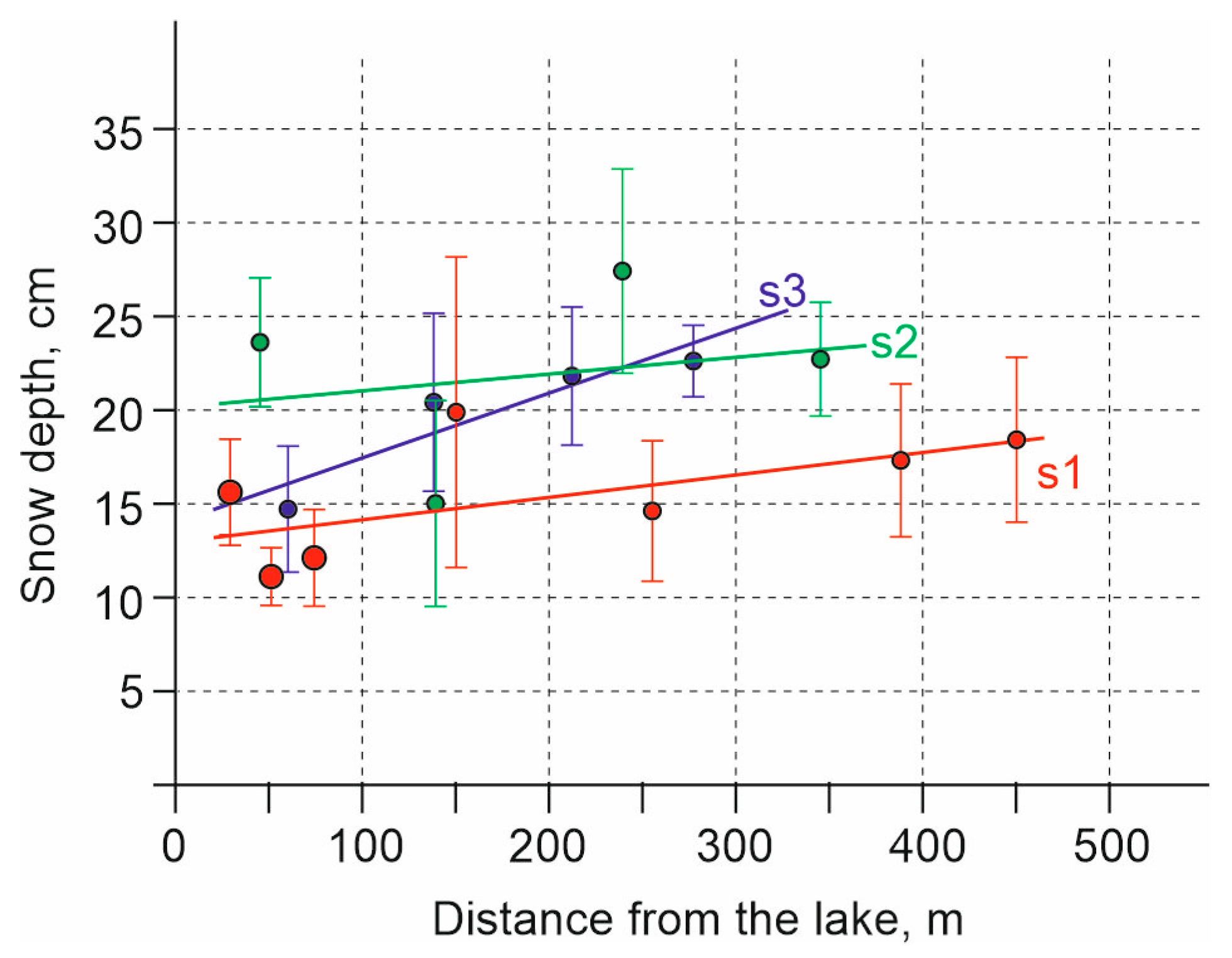
- Measure soil temperatures and snow depth at the C. rufipes collection site at different distances from the water.
- Compare the cold resistance of C. rufipes and other darkling beetle species with the temperature conditions at their overwintering sites.
2. Materials and Methods
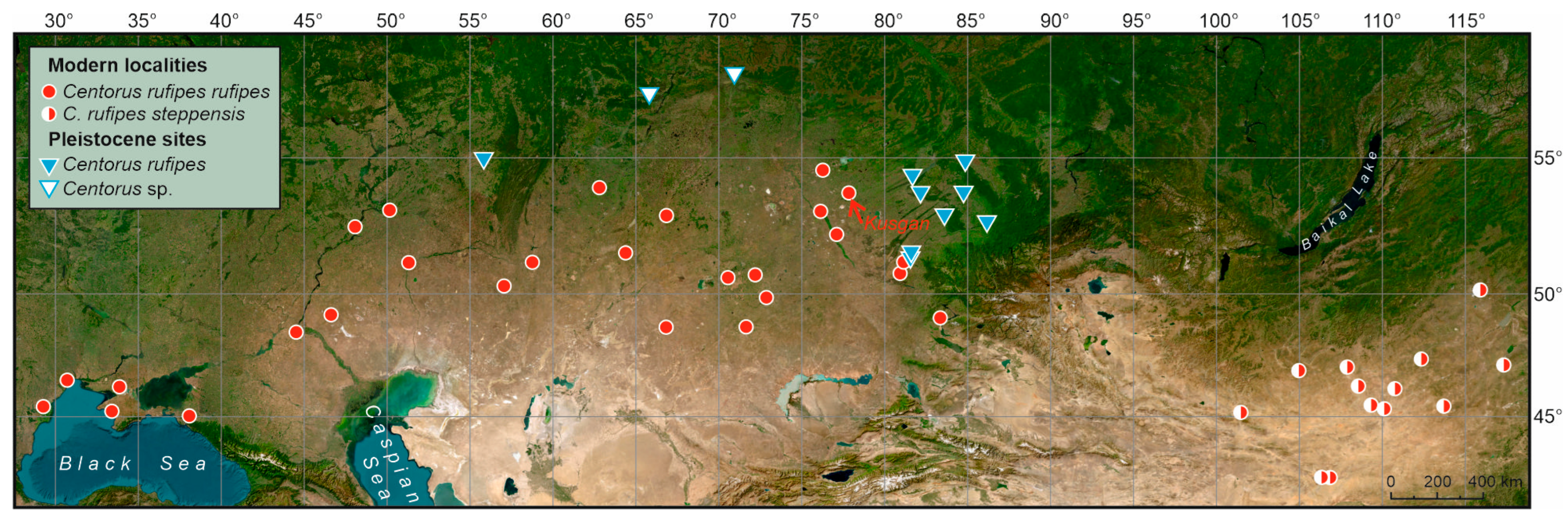
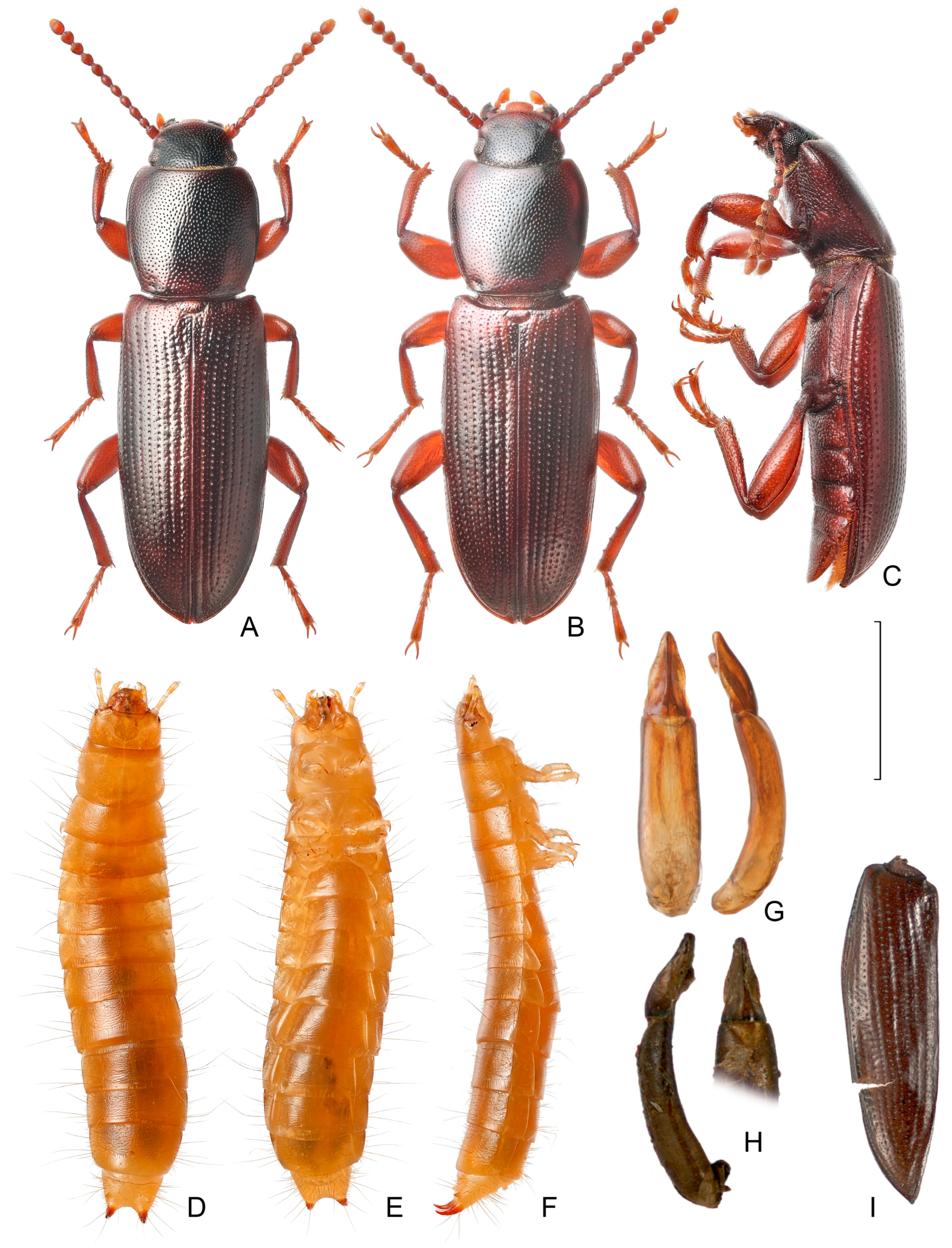
2.1. Taxonomical Remarks, Distribution and Ecology of Centorus rufipes
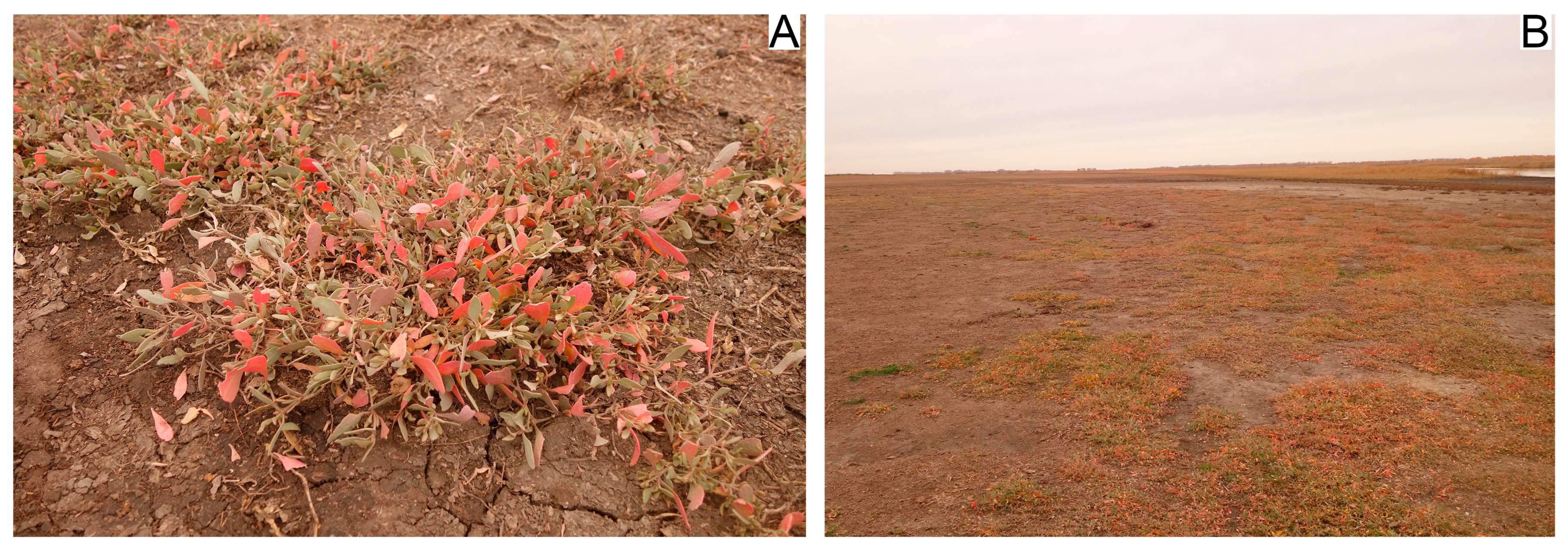
2.2. Study Area
2.3. Collection Localities and Metods
2.4. Measuring Cold Resistance
2.5. Study of Overwintering Conditions
2.6. Statistical Analysis
3. Results
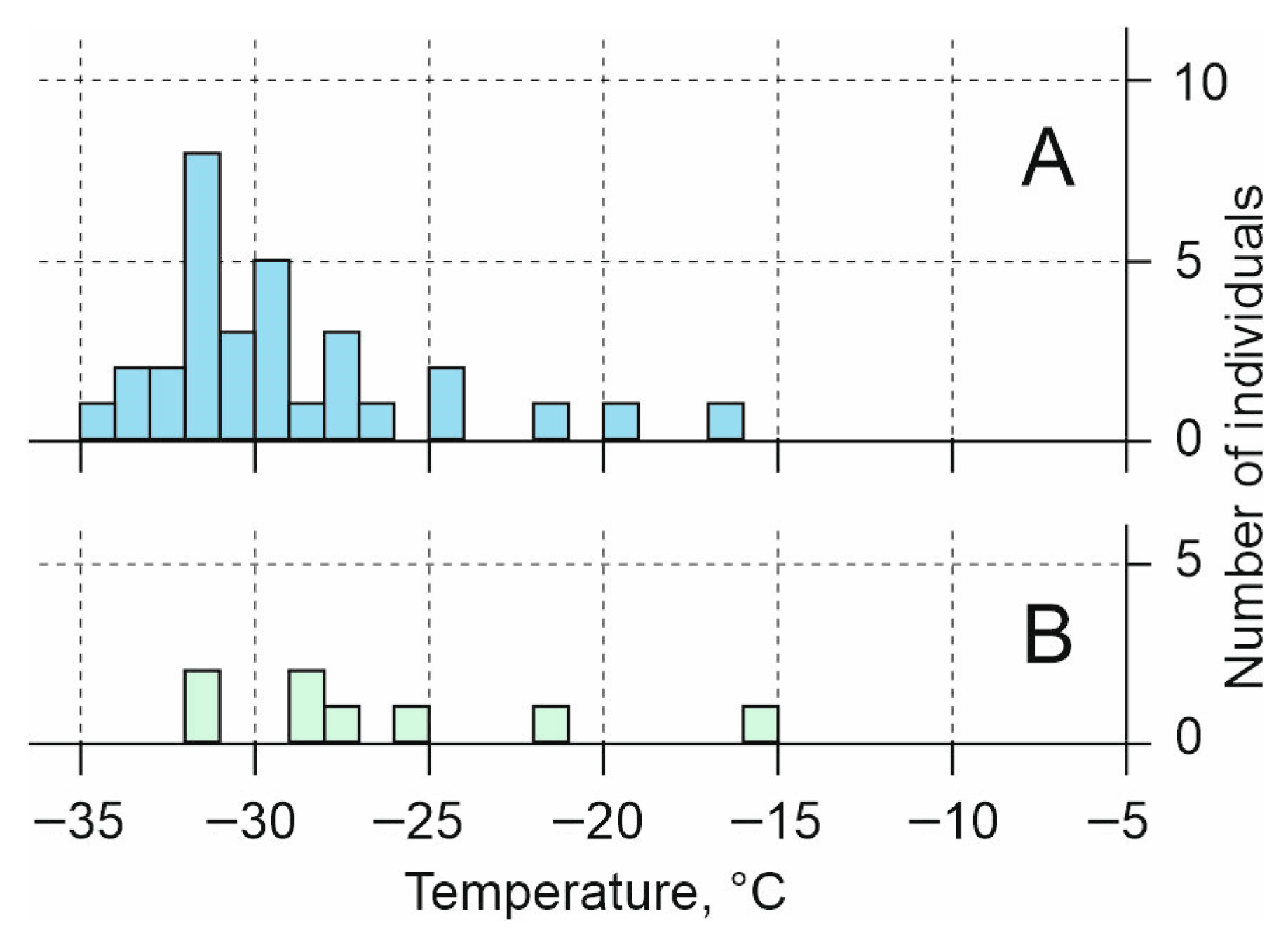
3.1. Cold Resistance
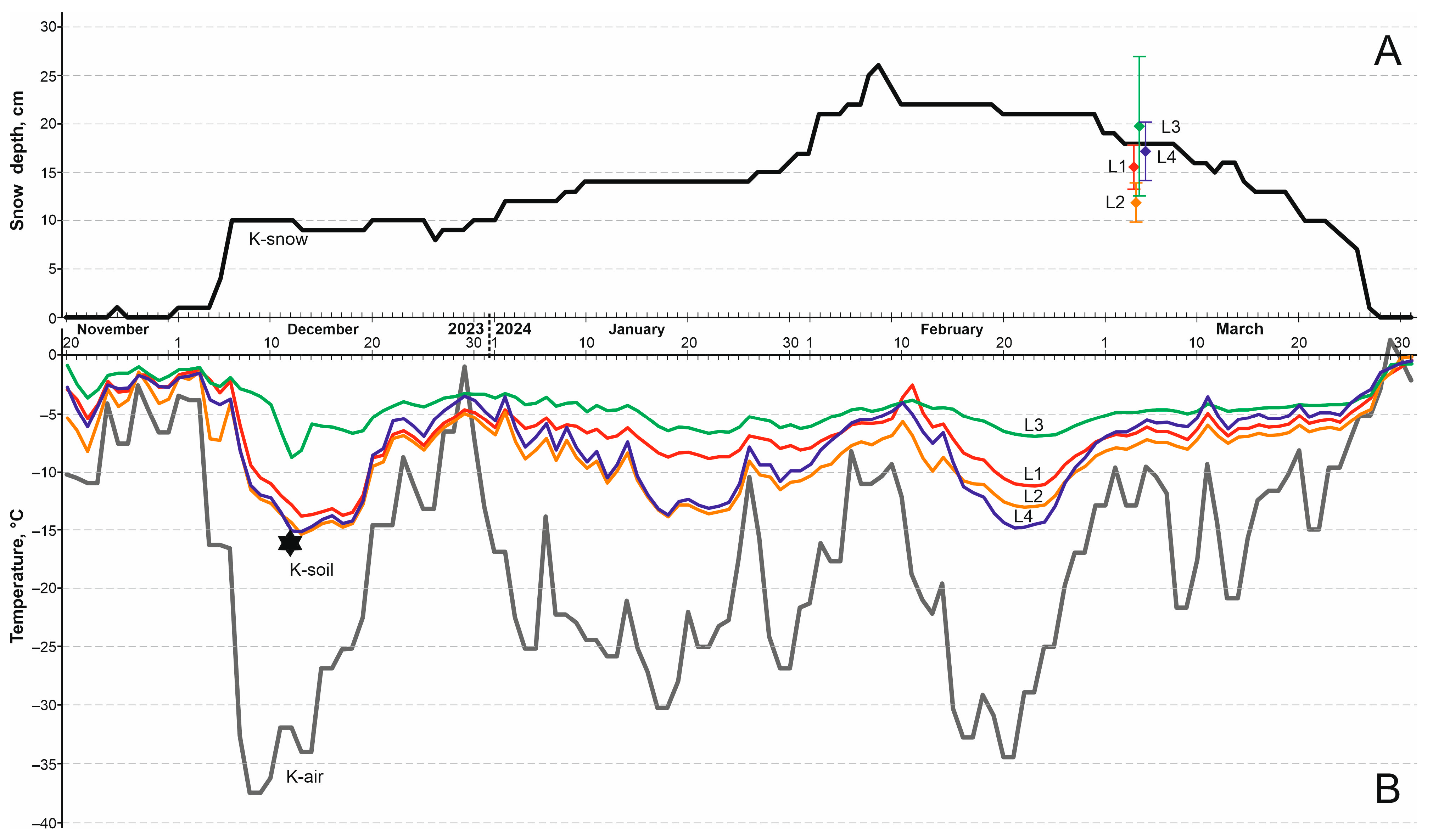
3.2. Climatic Conditions near Kusgan Lake in the 2023–2024 Season
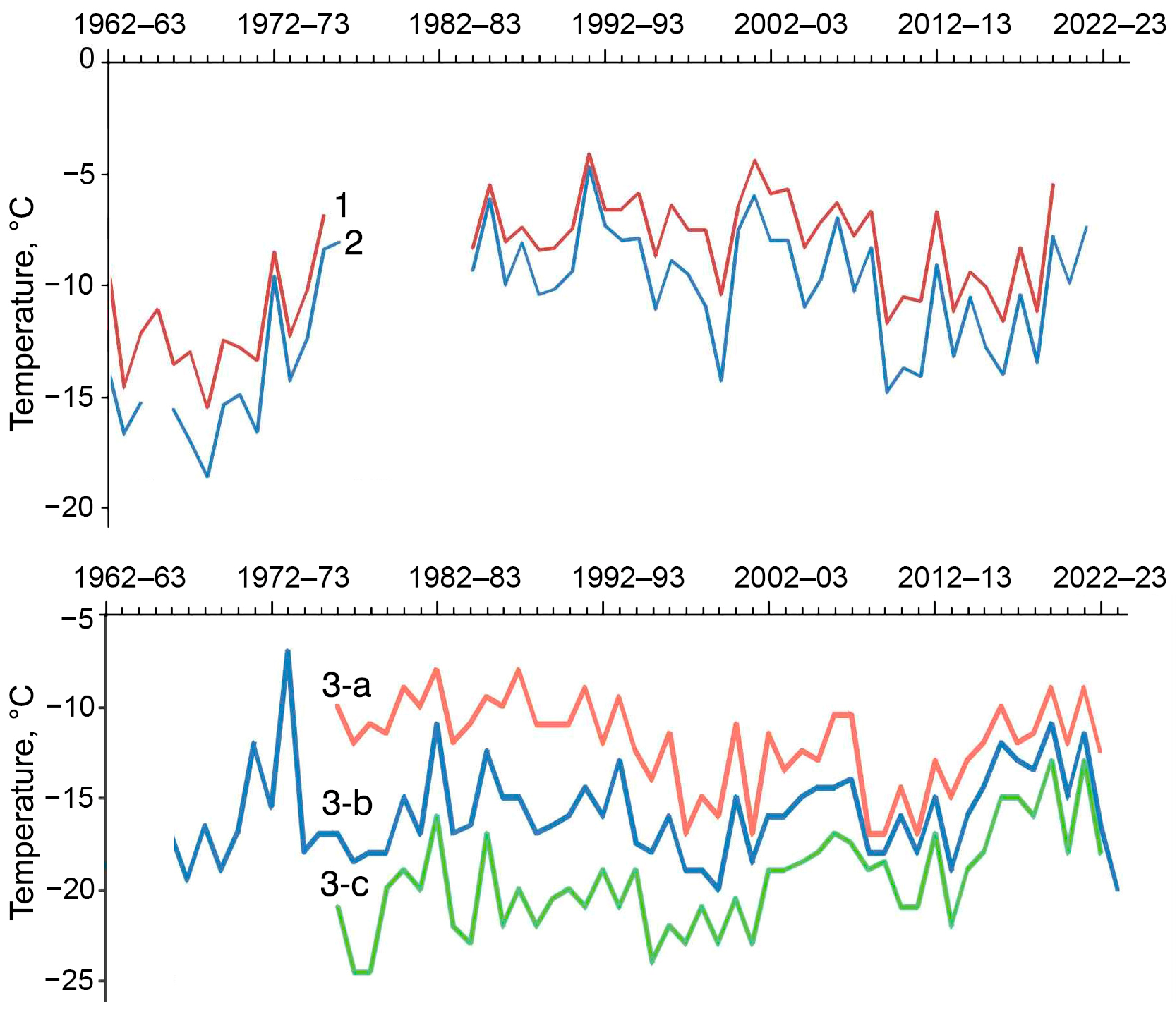
3.3. Variation in Overwintering Conditions of Centorus rufipes in Recent Decades
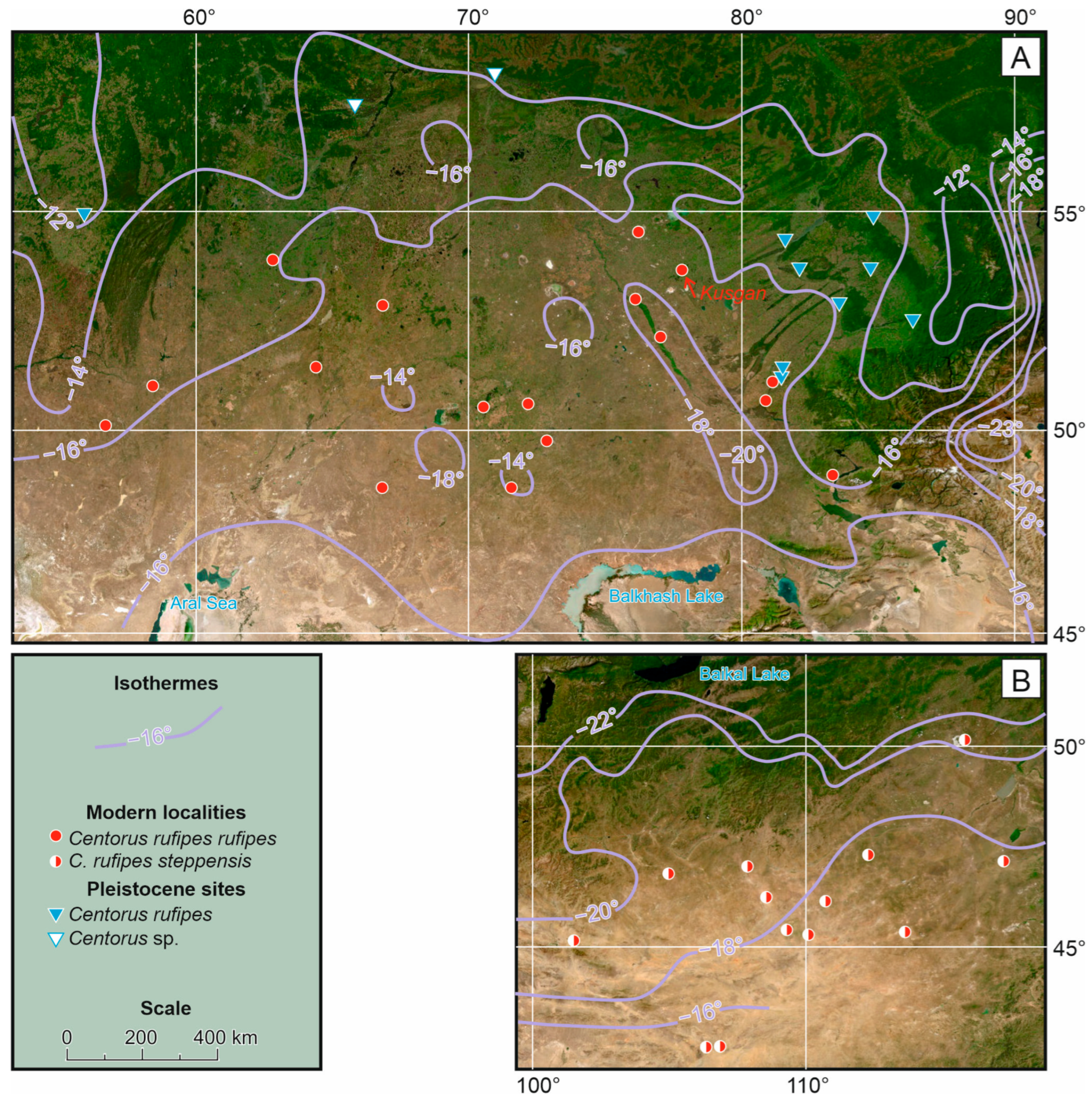
3.4. Climate Conditions Within the Range of Centorus rufipes
4. Discussion
4.1. Cold Resistance
4.2. Temperatures During Overwintering of Centorus rufipes and the Influence of Salt Lakes
4.3. On the Reasons of the Success of Centorus rufipes in the Pleistocene
5. Conclusions
Author Contributions
Funding
Data Availability Statement
Acknowledgments
Conflicts of Interest
Abbreviations
| LGM | last glacial maximum |
| LLT | low lethal temperature |
| SCP | supercooling point |
References
- Frenzel, B. Maximum cooling of the last glaciation (about 20 000 to 18000 y. BP). In Atlas of Paleoclimates and Paleoenvironments of the Northern Hemisphere, Late Pleistocene and Holocene; Frenzel, B., Pécsi, M., Velichko, A.A., Eds.; Geogr. Inst. HAS: Budapest, Hungary; Gustav Fisher Verlag: Stuttgart, Germany, 1992; pp. 97–99. Available online: https://epic.awi.de/id/eprint/29922/1/Fre1992a.pdf (accessed on 1 September 2025).
- Yurtsev, B.A. The Pleistocene “Tundra-Steppe” and the productivity paradox: Thelandscape approach. Quat. Sci. Rev. 2001, 20, 165–174. [Google Scholar] [CrossRef]
- Zimov, S.A.; Zimov, N.S.; Tikhonov, A.N.; Chapin, F.S. Mammoth steppe: A high-productivity phenomenon. Quat. Sci. Rev. 2012, 57, 26–45. [Google Scholar] [CrossRef]
- Chytrý, M.; Horsák, M.; Danihelka, J.; Ermakov, N.; German, D.A.; Hájek, M.; Hájková, P.; Kočí, M.; Kubešová, S.; Lustyk, P.; et al. A modern analogue of the Pleistocene steppe-tundra ecosystem in southern Siberia. Boreas 2019, 48, 36–56. [Google Scholar] [CrossRef]
- Elias, S.A. Quaternary Insects and Their Environments; Smithsonian Institution Press: Washington, DC, USA; London, UK, 1994; pp. 1–284. [Google Scholar]
- Kuzmina, S.A. Macroentomology analysis: Methods, opportunities, and examples of reconstructions of paleoclimatic andpaleoenvironmental conditions in the Quaternary of the northeastern Siberia. Contemp. Probl. Ecol. 2017, 10, 336–349. [Google Scholar] [CrossRef]
- Zinovyev, E. Sub-fossil beetle assemblages associated with the “mammoth fauna” in the Late Pleistocene localities of the Ural Mountains and West Siberia. ZooKeys 2011, 100, 149–169. [Google Scholar] [CrossRef] [PubMed]
- Gurina, A.A.; Dudko, R.Y.; Prosvirov, A.S.; Tshernyshev, S.E.; Legalov, A.A.; Zinovyev, E.V. Coleoptera assemblages from the Quaternary deposits of Kizikha river, the southernmost late Pleistocene insects of the West Siberian Plain. Invertebr. Zool. 2019, 16, 165–182. [Google Scholar] [CrossRef]
- Gurina, A.A.; Dudko, R.Y.; Ivanov, A.V.; Kotov, A.A.; Mikhailov, Y.E.; Prokin, A.A.; Prosvirov, A.S.; Solodovnikov, A.Y.; Zinovyev, E.V.; Legalov, A.A. New Data on the Distribution of Southern Forests for theWest Siberian Plain during the Late Pleistocene: A Paleoentomological Approach. Diversity 2023, 15, 56. [Google Scholar] [CrossRef]
- Weather and Climate. Available online: http://www.pogodaiklimat.ru/climate.php (accessed on 1 September 2025). (In Russian)
- National Centers for Environmental Information. Available online: https://www.ncei.noaa.gov (accessed on 1 September 2025).
- Gurina, A.A.; Dudko, R.Y.; Zinovyev, E.V.; Legalov, A.A. Quaternary paleoentomology: 10 years in the south of Western Siberia. Priroda 2022, 3–11. [Google Scholar] [CrossRef]
- Mordkovich, V.G.; Dudko, R.J.; Khudyaev, S.A.; Lyubechanskii, I.I. Changes in the Ground Beetle and Darkling Beetle Communities (Coleoptera: Carabidae, Tenebrionidae) in the Mountain Hollows of the Tuva and Altai Republics over 60 Years: A Trend or a Fluctuation? Contemp. Probl. Ecol. 2022, 15, 579–596. [Google Scholar] [CrossRef]
- Gurina, A.A.; Dudko, R.Y.; Zinovyev, E.V.; Borodin, A.V.; Tshernyshev, S.E.; Legalov, A.A. Late Pleistocene taphocoenosis of insects and small mammals from the upper reaches of the Ob river. Paleontol. J. 2018, 52, 1610–1622. [Google Scholar] [CrossRef]
- Dudko, R.Y.; Danukalova, G.A.; Gurina, A.A.; Ivanov, A.V.; Mikhailov, Y.E.; Osipova, E.M.; Prosvirov, A.S.; Solodovnikov, A.Y.; Legalov, A.A.; Zinovyev, E.V. Insects and molluscs of the Late Pleistocene at the Gornovo site (Southern Ural foreland, Russia): New data on palaeoenvironment reconstructions. Quat. Int. 2022, 632, 154–177. [Google Scholar] [CrossRef]
- Bakhmet’ev, P.I. Theoretical and practical implications of my research on anabiosis in animals. Priroda 1912, 12, 1427–1442. [Google Scholar]
- Salt, R.W. Studies on the Freezing Process in Insects; University of Minnesota Agricultural Experiment Station: St. Paul, MN, USA, 1936; pp. 1–41. [Google Scholar]
- Hou, F.; Ma, J.; Liu, X.; Wang, Y.; Liu, X.N.; Zhang, F.C. Seasonal changes in antifreeze protein gene transcription and water content of beetle Microdera punctipennis (Coleoptera: Tenebrionidae) from Gurbantonggut desert in Central Asia. Cryoletters 2010, 31, 359–370. [Google Scholar]
- Li, N.G. Ice-nucleating activity of hemolymph of Upis ceramboides beetle inhabiting in central Yakutia. Probl. Cryobiol. Cryomed. 2011, 21, 34–45. [Google Scholar]
- Dudko, R.Y.; Alfimov, A.V.; Gurina, A.A.; Meshcheryakova, E.N.; Reshetnikov, S.V.; Legalov, A.A.; Berman, D.I. Insufficient Cold Resistance as a Possible Reason for the Absence of Darkling Beetles (Coleoptera, Tenebrionidae) in Pleistocene Sediments of Siberia. Insects 2024, 15, 64. [Google Scholar] [CrossRef] [PubMed]
- Skopin, N.G. Zur Revision der eurasiatischen Arten der Gattung Belopus Gb. Entomol. Abh. 1974, 40, 65–103. [Google Scholar]
- Iwan, D.; Löbl, I. (Eds.) Catalogue of Palaearctic Coleoptera. Vol. 5, Tenebrionoidea, revised and updated 2nd ed.; Brill: Leiden, The Netherlands; Boston, MA, USA, 2020; pp. 1–945. [Google Scholar]
- Kaszab, Z. Beiträge zur Kenntnis der Tenebrioniden-Fauna des mittleren Teiles der Mongolischen Volksrepublik (Coleoptera). Acta zool. Acad. Sci. Hung. 1964, 10, 363–404. [Google Scholar]
- Medvedev, G.S. Proceedings of the Zoological Institute. Vol. 220. Key to the Darkling Beetles of Mongolia; Zoologicheskii Institut: Leningrad, Russia, 1990; pp. 1–253. [Google Scholar]
- Kiselev, S.V. Late Pleistocene Coleoptera of Transurals. Paleontol. J. 1973, 7, 70–73. [Google Scholar]
- Zinovyev, E.V. Fauna Nasekomykh Urala i Zapadno-Sibirskoi Ravniny v Chetvertichnom Periode [Insect Fauna of the Ural and West Siberian Plain in the Quaternary Period]. Ph.D. Thesis, Institute of Plant and Animal Ecology, UB RAS, Yekaterinburg, Russia, 2020. [Google Scholar]
- Gvozdetskii, N.A.; Mikhailov, N.I. Fizicheskaya Geografia SSSR. Aziatskaya Chast’ [Physical Geography of the USSR. Asian Part], 3rd ed.; Mysl’: Moscow, Russia, 1978; pp. 1–512. [Google Scholar]
- Strakhovenko, V.D.; Taran, O.P.; Ermolaeva, N.I. Geochemical characteristics of the sapropel sediments of small lakes in the Ob’-Irtysh interfluve. Geol. Geophys. 2014, 55, 1466–1477. [Google Scholar] [CrossRef]
- Berman, D.I.; Meshcheryakova, E.N.; Alfimov, A.V.; Leirikh, A.N. The distribution of the earthworm Dendrobaena octaedra (Lumbricidae: Oligochaeta) in the north of the Holarctic is limited by insufficient frost resistance. Zool. Zhurn. 2002, 81, 1210–1221. [Google Scholar]
- Berman, D.I.; Leirikh, A.N. Overwintering and Cold Hardiness of the Invertebrates in the Northeast Asia; KMK Scientific Press: Moscow, Russia, 2019. [Google Scholar]
- RP5.ru Weather for 241 Countries of the World. Available online: https://rp5.ru/Weather_in_the_world (accessed on 1 September 2025).
- VNIIGMII-MCD All-Russian Research Institute of Hydrometeorological Information—World Data Center. Available online: http://www.meteo.ru/data (accessed on 1 September 2025). (In Russian)
- Pakhnev, S.Y. (Ed.) Spravochnik po Klimatu SSSR [USSR Climate Guide; Issue 20, Part 2; Gidrometeoizdat: Leningrad, Russia, 1965; pp. 1–396. [Google Scholar]
- Polozova, L.G. (Ed.) Spravochnik po Klimatu SSSR [USSR Climate Guide]; Issue 9, Part 2; Gidrometeoizdat: Moscow, Russia, 1965; pp. 1–362. [Google Scholar]
- Orlova, V.V. (Ed.) Spravochnik po Klimatu SSSR [USSR Climate Guide]; Issue 18, Part 2; Gidrometeoizdat: Leningrad, Russia, 1966; pp. 1–656. [Google Scholar]
- Orlova, V.V. (Ed.) Spravochnik po Klimatu SSSR [USSR Climate Guide]; Issue 9, Part 4; Gidrometeoizdat: Leningrad, Russia, 1968; pp. 1–372. [Google Scholar]
- Polozova, L.G.; Sharova, V.Y. (Eds.) Spravochnik po Klimatu SSSR [USSR Climate Guide]; Issue 18, Part 4; Gidrometeoizdat: Leningrad, Russia, 1968; pp. 1–550. [Google Scholar]
- Kukharskaya, L.V. (Ed.) Spravochnik po Klimatu SSSR [USSR Climate Guide]; Issue 20, Part 4; Gidrometeoizdat: Leningrad, Russia, 1969; pp. 1–332. [Google Scholar]
- Lebedev, A.N.; Kodrau, O.D. (Eds.) Klimaticheskii Spravochnik Zarubezhnoi Azii. [Climate Reference Book of Foreign Asia]; Part 1; Gidrometeoizdat: Leningrad, Russia, 1974; pp. 1–540. [Google Scholar]
- Pilnikova, Z.N. (Ed.) Nauchno-Prikladnoi Spravochnik po Klimatu SSSR [Scientific and Applied Reference Book on the Climate of the USSR]; Issue 20; Gidrometeoizdat: Saint-Petersburg, Russia, 1993; pp. 1–719. [Google Scholar]
- Shulgin, A.M. Klimat Pochv i Ego Regulirovanie [Soil Climate and Its Regulation]; Gidrometeoizdat: Leningrad, Russia, 1972; pp. 1–340. [Google Scholar]
- Nekrasov, I.A. Taliki Rechnykh Dolin i Zakonomernosti ikh Rasprostraneniya [Taliks of River Valleys and Patterns of their Distribution]; Nauka: Moscow, Russia, 1967; pp. 1–140. [Google Scholar]
- Voronina, L.V. Teplovoi Rezhim Pochv Solontsovykh Kompleksov [Thermal Regime of Soils of Solonetz Complexes]; Nauka: Novosibirsk, Russia, 1992; pp. 1–141. [Google Scholar]
- Srebryanskaya, N.I. Phenomena of seasonal freezing and thawing of soils of Central Baraba. Research of the Baraba Lowland as an object of agricultural use. Tr. Pochvennogo Instituta Im. V.V. Dokuchaeva 1954, 42, 172–232. [Google Scholar]
- Velichko, A.A. (Ed.) Paleoclimates and Paleoenvironmens of Extra-Tropical Regions of the Northern Hemisphere. Late Pleistocene—Holocene. Atlas-Monograph; GEOS: Moscow, Russia, 2009; pp. 1–120+24 maps. [Google Scholar]
- Zykin, V.S.; Zykina, V.S.; Orlova, L.A. Reconstruction of changes in the natural environment and climate of the Late Pleistocene based on sediments of Lake Aksor. Archaeol. Ethnol. Anthropol. Eurasia 2003, 16, 2–16. [Google Scholar]
- Zykina, V.S.; Zykin, V.S. Loess-Soil Sequence and Environment and Climate Evolution of West Siberia in Pleistocene; Academic Publishing House “GEO”: Novosibirsk, Russia, 2012; pp. 1–477. [Google Scholar]
- Izyumenko, S.A. (Ed.) Spravochnik po Klimatu SSSR [USSR Climate Guide]; Issue 24, Part 2; Gidrometeoizdat: Leningrad, Russia, 1966; pp. 1–401. [Google Scholar]
- Tsepelev, K.A.; Zinovyev, E.V.; Dudko, R.Y.; Tshernyshev, S.E.; Legalov, A.A. Carrion beetles (Coleoptera, Silphidae) in younger Dryas of Chick River (late Pleistocene of Siberia). Euroasian Entomol. J. 2013, 12, 27–34. [Google Scholar]
- Zinovyev, E.V.; Dudko, R.Y.; Gurina, A.A.; Prokin, A.A.; Mikhailov, Y.E.; Tsepelev, K.A.; Tshernyshev, S.E.; Kireev, M.S.; Kostyunin, A.E.; Legalov, A.A. First records of sub-fossil insects from Quaternary deposits in the southeastern part of West Siberia, Russia. Quat. Int. 2016, 420, 221–232. [Google Scholar] [CrossRef]




| Temperature, °C | Number of Individuals | Survivors, % |
|---|---|---|
| −5 | 20 | 95 |
| −25 | 19 | 63 |
| −30 | 21 | 19 |
| −40 | 15 | 0 |
Disclaimer/Publisher’s Note: The statements, opinions and data contained in all publications are solely those of the individual author(s) and contributor(s) and not of MDPI and/or the editor(s). MDPI and/or the editor(s) disclaim responsibility for any injury to people or property resulting from any ideas, methods, instructions or products referred to in the content. |
© 2026 by the authors. Licensee MDPI, Basel, Switzerland. This article is an open access article distributed under the terms and conditions of the Creative Commons Attribution (CC BY) license.
Share and Cite
Dudko, R.Y.; Gurina, A.A.; Alfimov, A.V.; Agrikolyanskaya, N.I.; Lyubechanskii, I.I.; Meshcheryakova, E.N.; Reshetnikov, S.V.; Legalov, A.A.; Berman, D.I. Did Cold Resistance Influence the Success of the Halobiont Darkling Beetle Centorus rufipes (Coleoptera, Tenebrionidae) During the Pleistocene? Insects 2026, 17, 204. https://doi.org/10.3390/insects17020204
Dudko RY, Gurina AA, Alfimov AV, Agrikolyanskaya NI, Lyubechanskii II, Meshcheryakova EN, Reshetnikov SV, Legalov AA, Berman DI. Did Cold Resistance Influence the Success of the Halobiont Darkling Beetle Centorus rufipes (Coleoptera, Tenebrionidae) During the Pleistocene? Insects. 2026; 17(2):204. https://doi.org/10.3390/insects17020204
Chicago/Turabian StyleDudko, Roman Yu., Anna A. Gurina, Arcady V. Alfimov, Natalia I. Agrikolyanskaya, Ilya I. Lyubechanskii, Ekaterina N. Meshcheryakova, Sergei V. Reshetnikov, Andrei A. Legalov, and Daniil I. Berman. 2026. "Did Cold Resistance Influence the Success of the Halobiont Darkling Beetle Centorus rufipes (Coleoptera, Tenebrionidae) During the Pleistocene?" Insects 17, no. 2: 204. https://doi.org/10.3390/insects17020204
APA StyleDudko, R. Y., Gurina, A. A., Alfimov, A. V., Agrikolyanskaya, N. I., Lyubechanskii, I. I., Meshcheryakova, E. N., Reshetnikov, S. V., Legalov, A. A., & Berman, D. I. (2026). Did Cold Resistance Influence the Success of the Halobiont Darkling Beetle Centorus rufipes (Coleoptera, Tenebrionidae) During the Pleistocene? Insects, 17(2), 204. https://doi.org/10.3390/insects17020204