Human Activities and Climate Change Accelerate the Spread Risk of Hyphantria cunea in China
 , and
, and 
Simple Summary
Abstract
1. Introduction
2. Materials and Methods
2.1. Data Sources
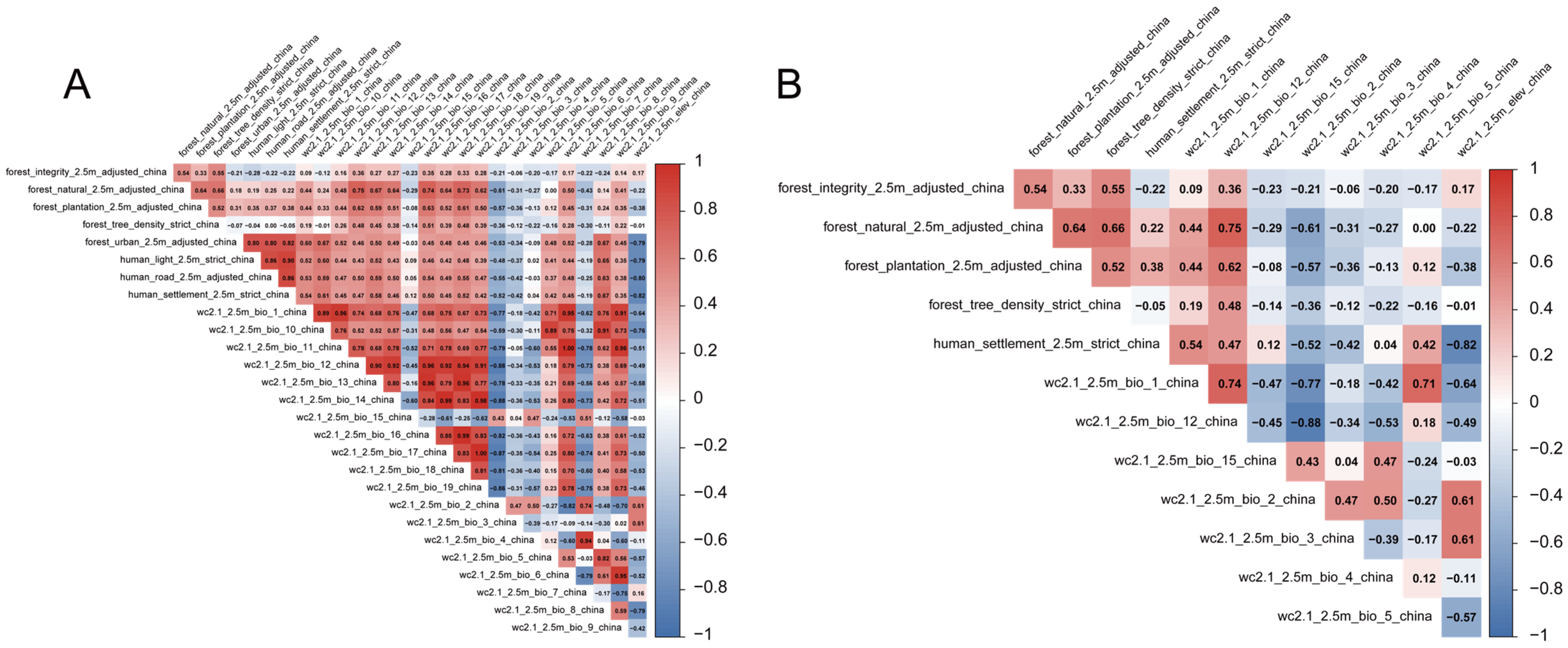
2.2. Selection of Environmental Variables
2.3. Species Distribution Modeling
2.4. Estimation of Potential Carbon Stock
3. Results
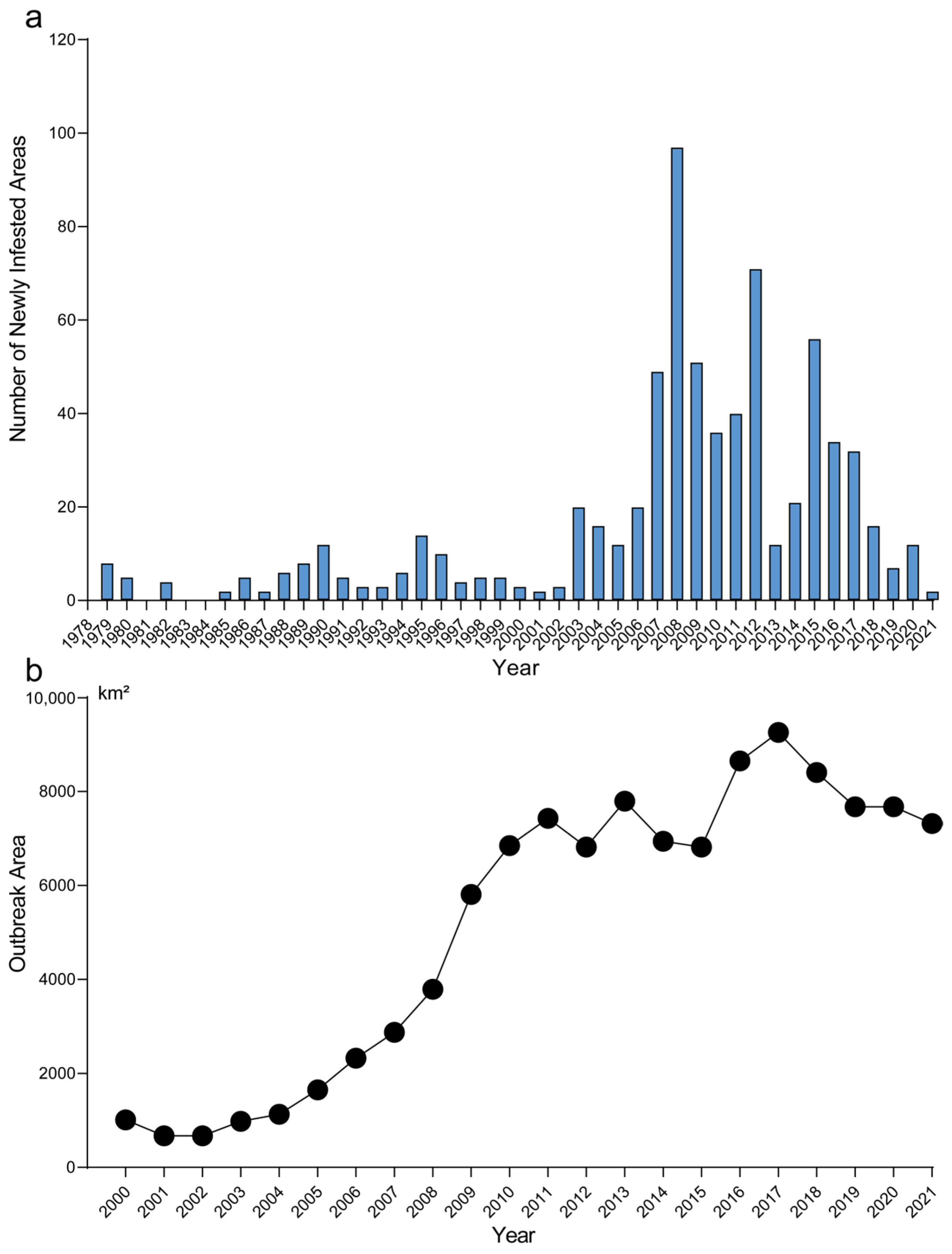
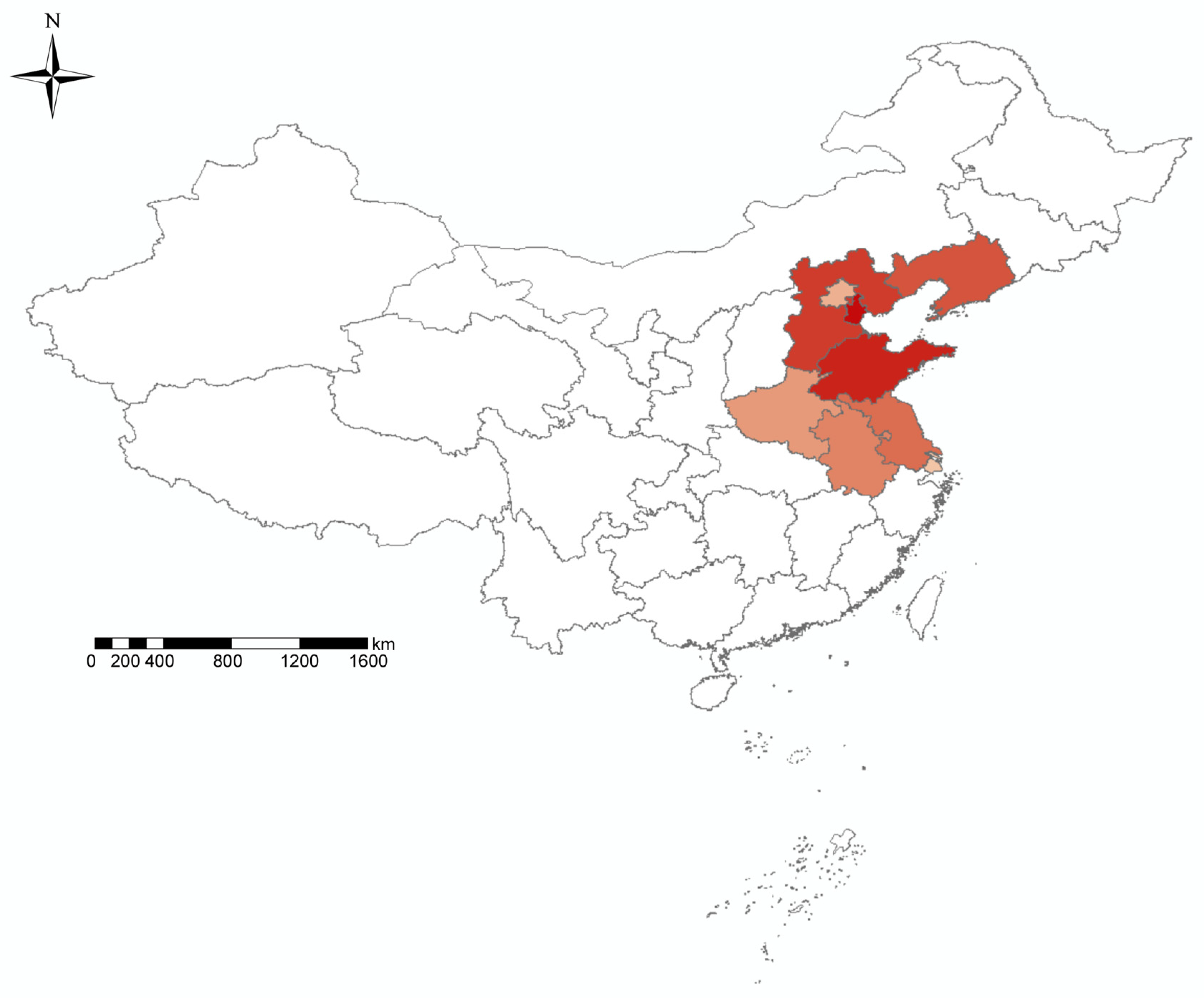
3.1. Historical Spread and Outbreak Dynamics of Hyphantria cunea in China
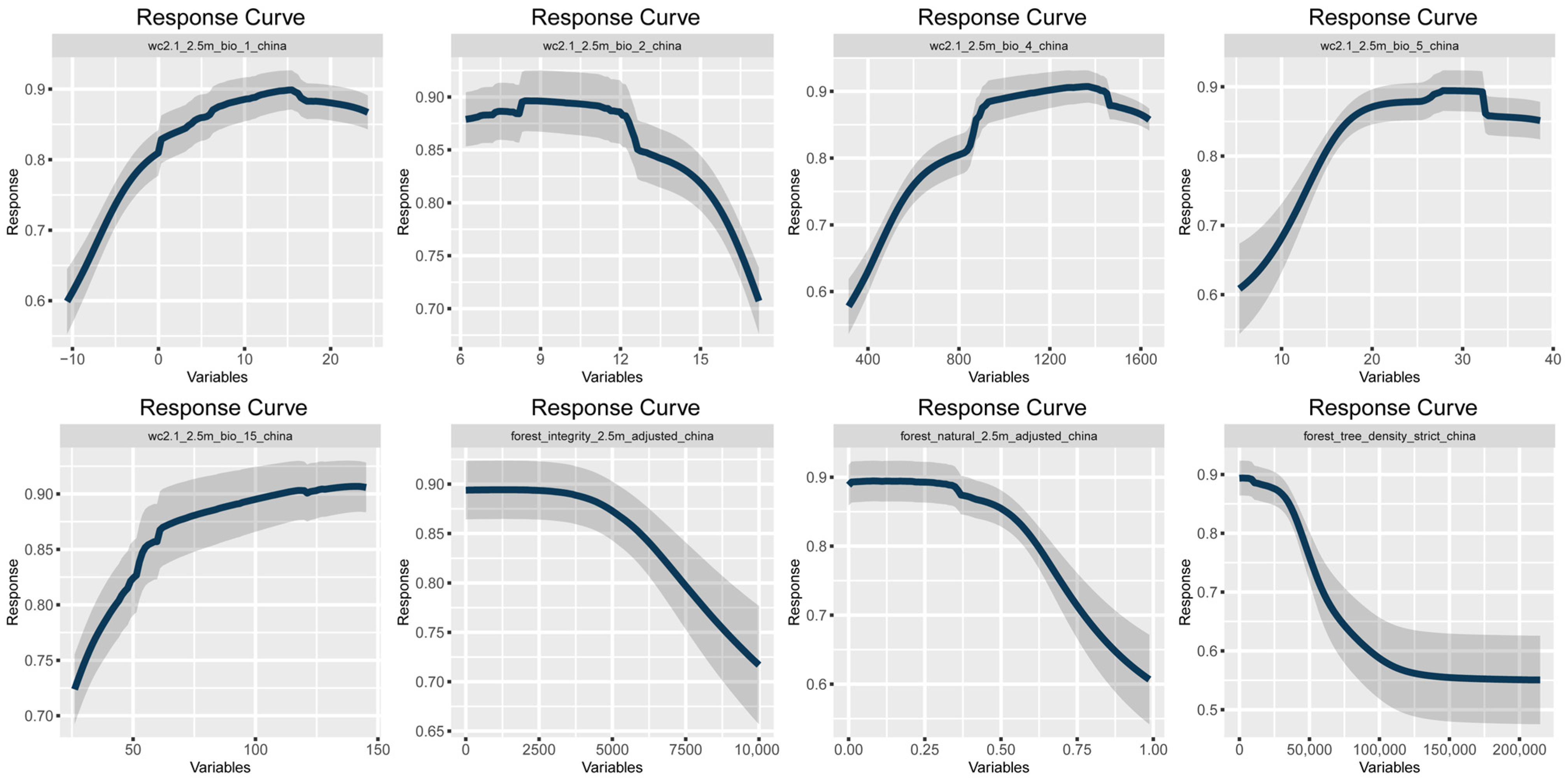
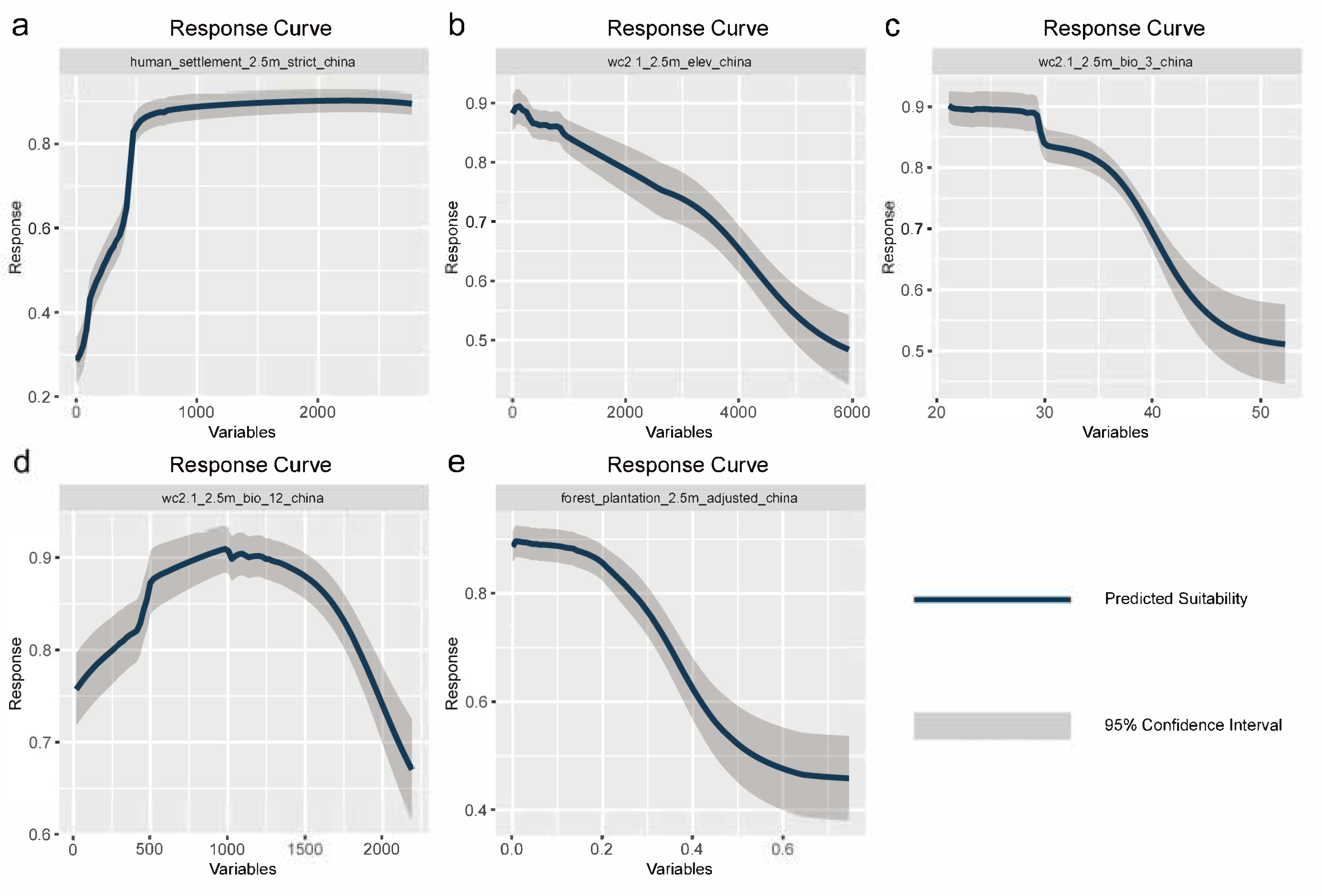
3.2. Comparison of Human Activity, Forest Type, and Climate Change on the Habitat Suitability of Fall Webworm
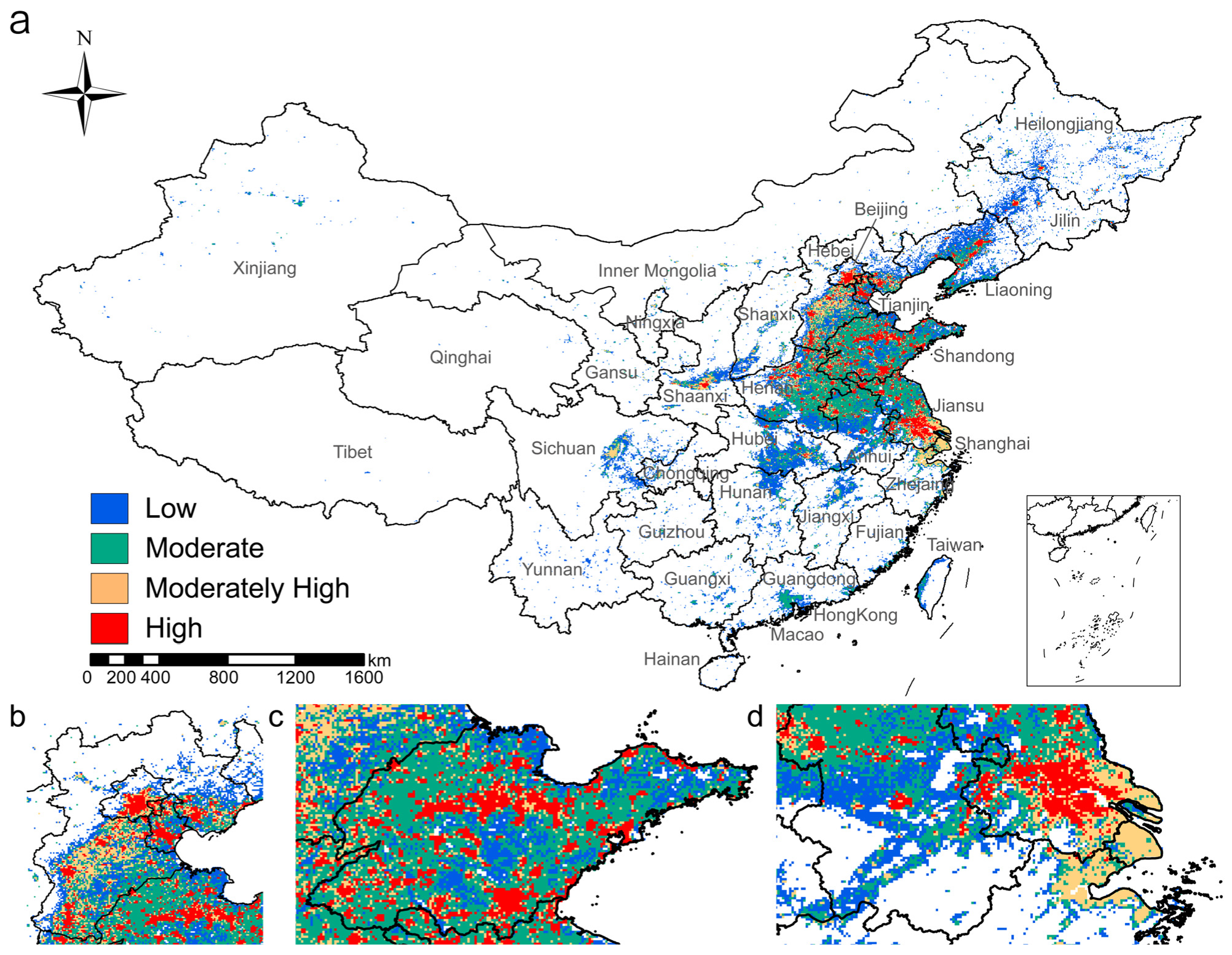
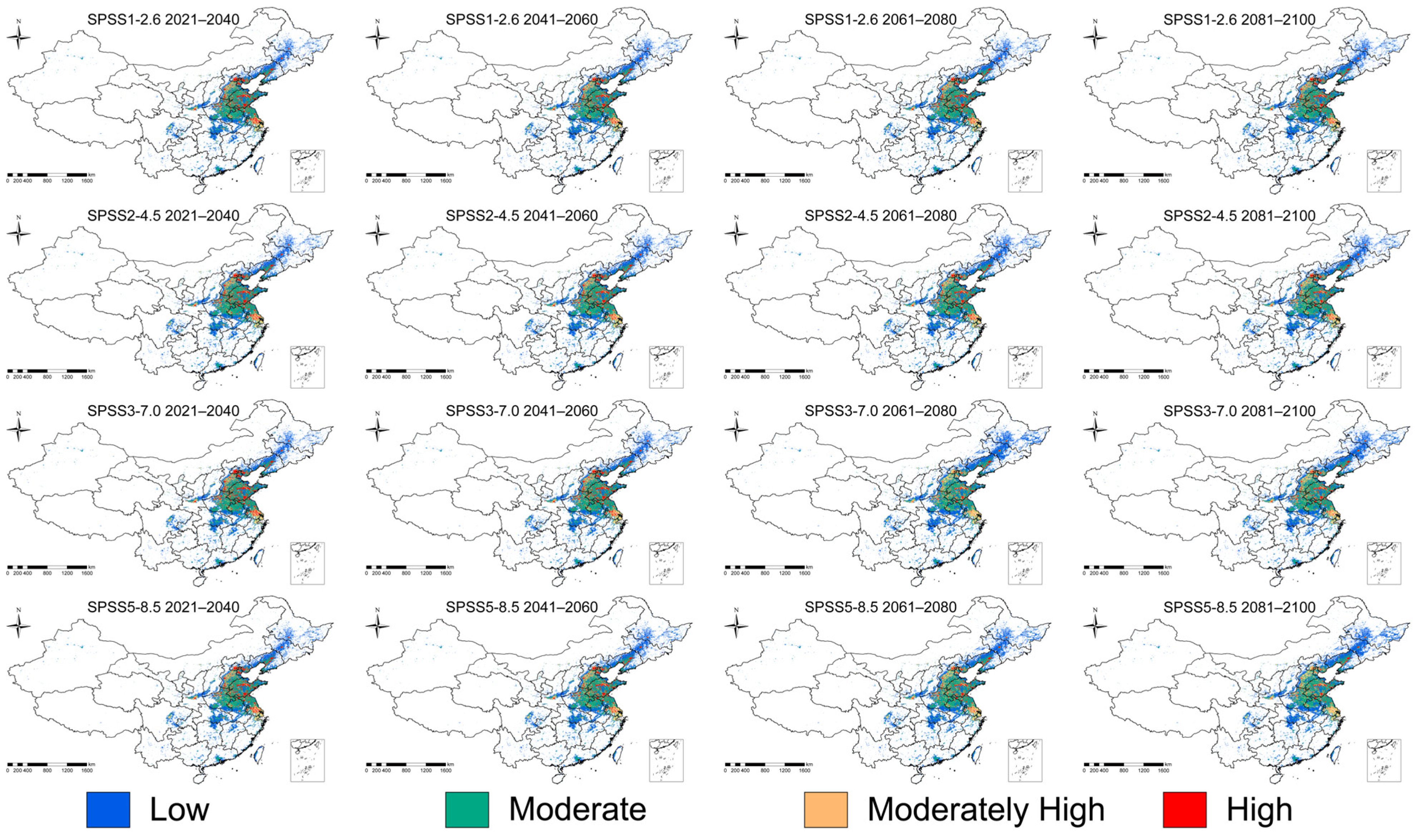
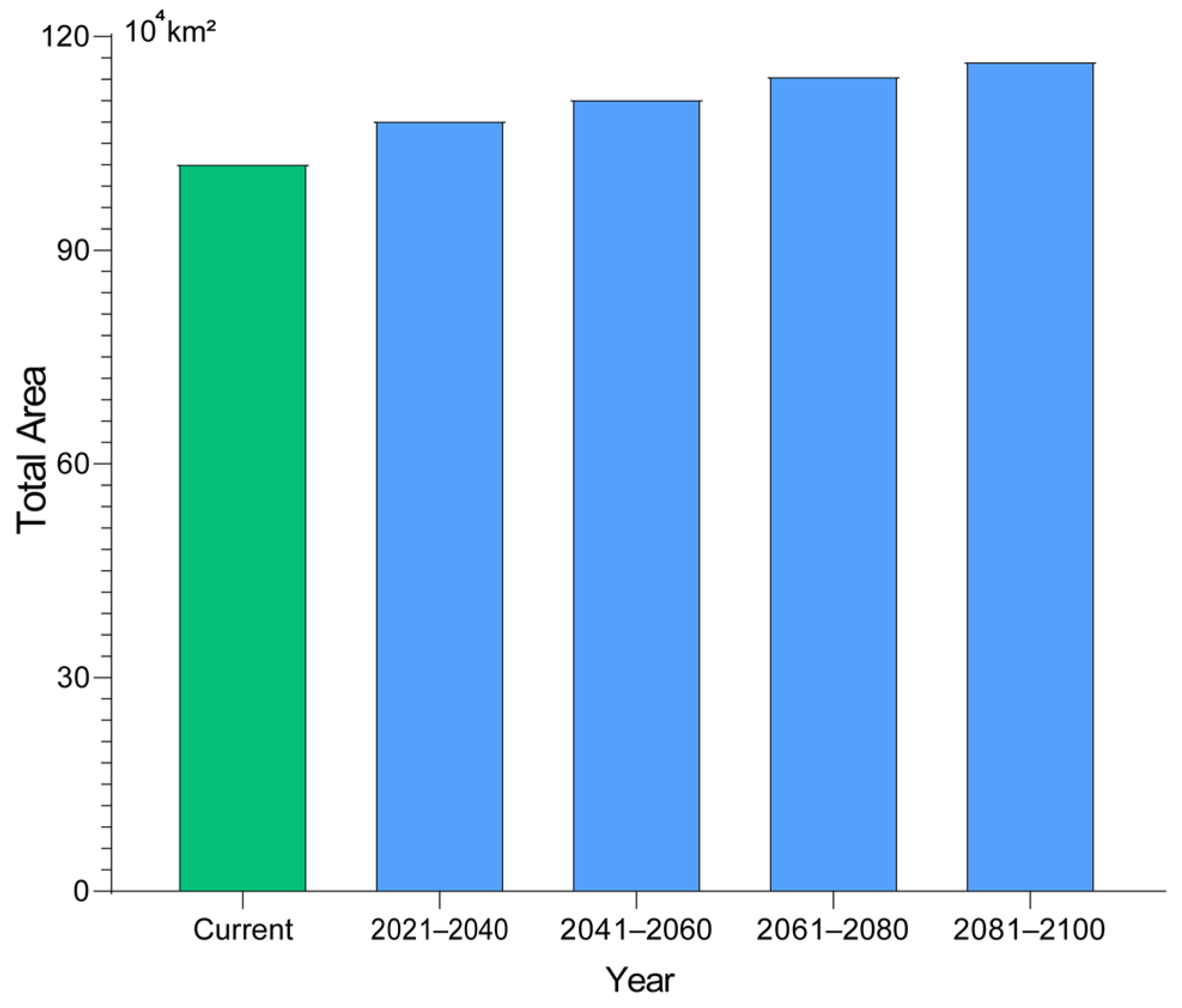
3.3. Current and Future Expansion of Fall Webworm’s Suitable Habitat
4. Discussion
Supplementary Materials
Author Contributions
Funding
Data Availability Statement
Acknowledgments
Conflicts of Interest
Correction Statement
Appendix A

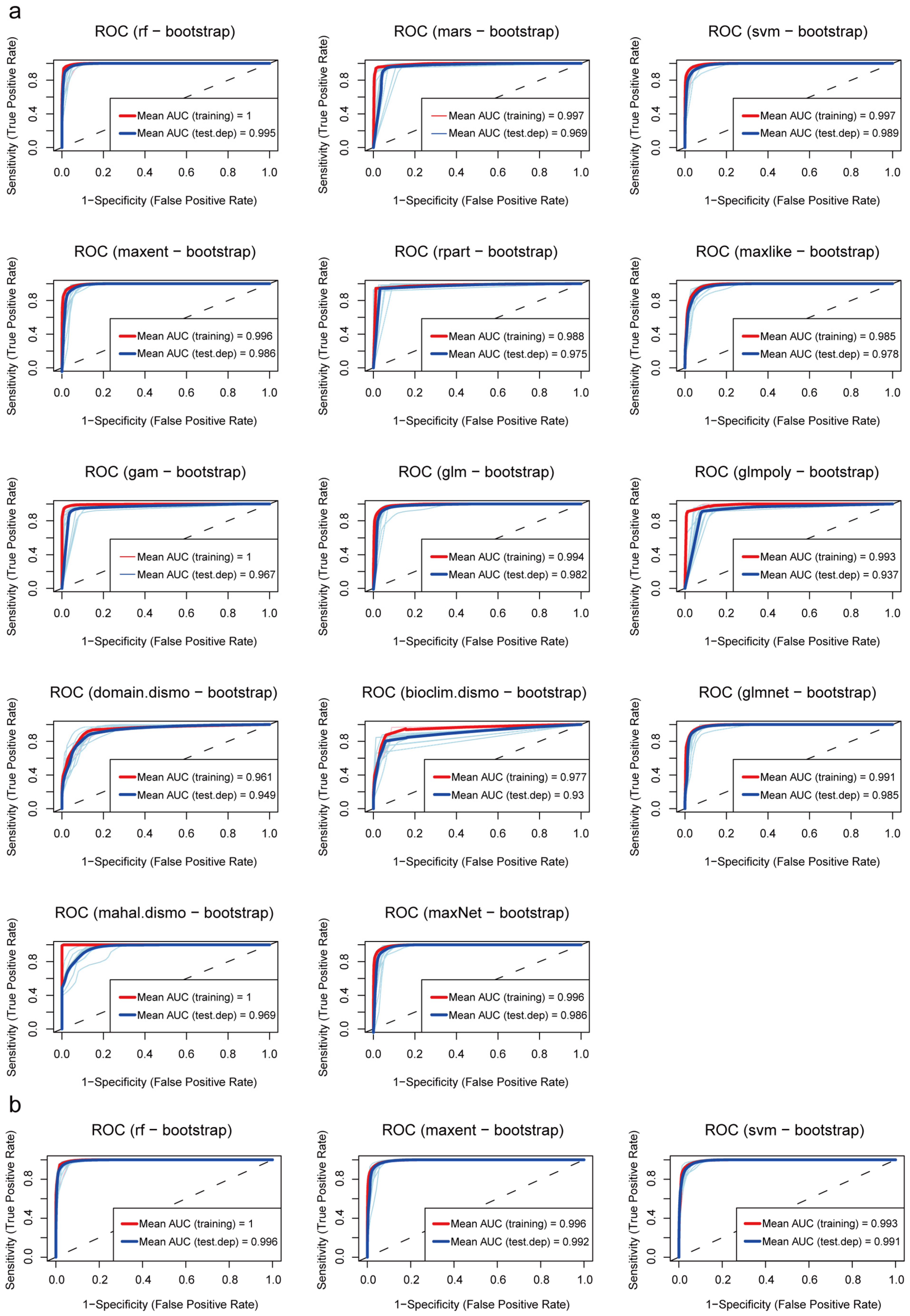
| Methods | TSS | AUC (Training) | AUC (Test.Dep) | ΔAUC |
|---|---|---|---|---|
| rf | 0.97 | 1 | 0.995 | 0.005 |
| mars | 0.95 | 0.997 | 0.969 | 0.028 |
| svm | 0.95 | 0.997 | 0.989 | 0.008 |
| maxent | 0.95 | 0.996 | 0.986 | 0.010 |
| rpart | 0.94 | 0.988 | 0.975 | 0.013 |
| maxlike | 0.9 | 0.985 | 0.978 | 0.007 |
| gam | 0.93 | 1 | 0.967 | 0.033 |
| glm | 0.9 | 0.994 | 0.982 | 0.012 |
| glmpoly | 0.91 | 0.993 | 0.937 | 0.056 |
| domain.dismo | 0.86 | 0.961 | 0.949 | 0.012 |
| bioclim.dismo | 0.9 | 0.977 | 0.930 | 0.047 |
| glmnet | 0.87 | 0.991 | 0.985 | 0.006 |
| mahal.dismo | 0.92 | 1 | 0.969 | 0.031 |
| maxNet | 0.95 | 0.996 | 0.986 | 0.010 |


References
- Zhou, J.; Du, J.; Bonifácio, L.; Yin, W.; Huang, L.; Ning, J.; Han, D.; Hu, J.; Song, W.; Zhao, L. Vulnerability of global pine forestry’s carbon sink to an invasive pathogen–vector system. Glob. Change Biol. 2024, 30, e17614. [Google Scholar] [CrossRef] [Scilit]
- FAO. Global Forest Resources Assessment 2025; FAO: Rome, Italy, 2025; ISBN 978-92-5-140082-1. [Google Scholar]
- Convention on Biological Diversity (CBD). Welcome to the CBD Secretariat. Available online: https://www.cbd.int/secretariat (accessed on 21 December 2025).
- Hulme, P.E. Trade, transport and trouble: Managing invasive species pathways in an era of globalization. J. Appl. Ecol. 2009, 46, 10–18. [Google Scholar] [CrossRef] [Scilit]
- Bellard, C.; Thuiller, W.; Leroy, B.; Genovesi, P.; Bakkenes, M.; Courchamp, F. Will climate change promote future invasions? Glob. Chang. Biol. 2013, 19, 3740–3748. [Google Scholar] [CrossRef] [Scilit] [PubMed]
- Early, R.; Bradley, B.A.; Dukes, J.S.; Lawler, J.J.; Olden, J.D.; Blumenthal, D.M.; Gonzalez, P.; Grosholz, E.D.; Ibañez, I.; Miller, L.P.; et al. Global threats from invasive alien species in the twenty-first century and national response capacities. Nat. Commun. 2016, 7, 12485. [Google Scholar] [CrossRef] [Scilit]
- Ramsfield, T.D.; Bentz, B.; Faccoli, M.; Jactel, H.; Brockerhoff, E.G. Forest health in a changing world: Effects of globalization and climate change on forest insect and pathogen impacts. Forestry 2016, 89, 245–252. [Google Scholar] [CrossRef] [Scilit]
- Intergovernmental Science-Policy Platform on Biodiversity and Ecosystem Services (IPBES). IPBES Secretariat Home Page. Available online: https://www.ipbes.net/node/36759 (accessed on 21 December 2025).
- Wang, P.; Xue, Y.; Jiang, H.; Liu, C.; Zhang, C.; Huang, H.; Zhang, G.; Wan, F.; Zhang, Y.; Courchamp, F. Escalating economic costs of invasive species in China driven by hidden impacts and policy gaps. Entomol. Gen. 2025, 45, 667–678. [Google Scholar] [CrossRef] [Scilit]
- Diagne, C.; Leroy, B.; Vaissière, A.C.; Gozlan, R.E.; Roiz, D.; Jarić, I.; Salles, J.M.; Bradshaw, C.J.A.; Courchamp, F. Author correction: High and rising economic costs of biological invasions worldwide. Nature 2022, 608, E35. [Google Scholar] [CrossRef] [Scilit]
- Panzavolta, T.; Bracalini, M.; Benigno, A.; Moricca, S. Alien invasive pathogens and pests harming trees, forests, and plantations: Pathways, global consequences and management. Forests 2021, 12, 1364. [Google Scholar] [CrossRef] [Scilit]
- Zheng, W.F.; Fan, S.M.; Zhang, N.; Huang, R.F.; Cui, S.P.; Zhang, Z.W.; Gao, R.H. Analysis of the risk of invasion and potential habitat areas of Hyphantria cunea in Shanxi Province. For. Res. 2025, 38, 76–85. [Google Scholar]
- Wu, N.; Zhang, S.; Li, X.; Cao, Y.; Liu, X.; Wang, Q.; Liu, Q.; Liu, H.; Hu, X.; Zhou, X.J.; et al. Fall webworm genomes yield insights into rapid adaptation of invasive species. Nat. Ecol. Evol. 2019, 3, 105–115. [Google Scholar] [CrossRef] [Scilit] [PubMed]
- Moon, J.H.; Won, S.J.; Choub, V.; Choi, S.I.; Ajuna, H.B.; Ahn, Y.S. Biological control of fall webworm larva (Hyphantria cunea Drury) and growth promotion of poplar seedlings (Populus × canadensis Moench) with Bacillus licheniformis PR. For. Ecol. Manag. 2022, 525, 120574. [Google Scholar] [CrossRef] [Scilit]
- Wen, X.; Fang, G.; Chai, S.; He, C.; Sun, S.; Zhao, G.; Lin, X. Can ecological niche models be used to accurately predict the distribution of invasive insects? A case study of Hyphantria cunea in China. Ecol. Evol. 2024, 14, e11159. [Google Scholar] [CrossRef] [Scilit] [PubMed]
- National Forestry and Grassland Administration (NFGA). Announcement No. 2 of 2025 on Fall Webworm (Hyphantria cunea) Infested Areas. Available online: http://202.99.63.178/c/www/gsgg/612535.jhtml (accessed on 21 December 2025).
- GBIF Occurrence Download. Available online: https://doi.org/10.15468/dl.rz82rb (accessed on 19 June 2023). [CrossRef]
- Aiello-Lammens, E.M.; Boria, R.A.; Radosavljevic, A.; Vilela, B.; Anderson, R.P. spThin: An R package for spatial thinning of species occurrence records for ecological niche models. Ecography 2015, 38, 541–545. [Google Scholar] [CrossRef] [Scilit]
- Fischer, G.; Shah, M.; Tubiello, F.N.; van Velhuizen, H. Socio-economic and climate change impacts on agriculture: An integrated assessment, 1990–2080. Philos. Trans. R. Soc. Lond. B Biol. Sci. 2005, 360, 2067–2083. [Google Scholar] [CrossRef] [Scilit] [PubMed]
- Graham, M.H. Confronting multicollinearity in ecological multiple regression. Ecology 2003, 84, 2809–2815. [Google Scholar] [CrossRef] [Scilit]
- Voldoire, A.; Sanchez-Gomez, E.; Salas y Mélia, D.; Decharme, B.; Cassou, C.; Sénési, S.; Valcke, S.; Beau, I.; Alias, A.; Chevallier, M.; et al. The CNRM-CM5.1 global climate model: Description and basic evaluation. Clim. Dyn. 2013, 40, 2091–2121. [Google Scholar] [CrossRef] [Scilit]
- Mi, C.; Ma, L.; Yang, M.; Li, X.; Meiri, S.; Roll, U.; Oskyrko, O.; Pincheira-Donoso, D.; Harvey, L.P.; Jablonski, D.; et al. Global protected areas as refuges for amphibians and reptiles under climate change. Nat. Commun. 2023, 14, 1389. [Google Scholar] [CrossRef] [Scilit]
- Williams, J.N.; Seo, C.; Thorne, J.; Nelson, J.K.; Erwin, S.; O’Brien, J.M.; Schwartz, M.W. Using species distribution models to predict new occurrences for rare plants. Divers. Distrib. 2009, 15, 565–576. [Google Scholar] [CrossRef] [Scilit]
- Zhu, Z.; Wang, Y.; Wang, S.; Shang, S.; Ma, J.; Tian, B.; Wang, Z.; Zhao, X. Research on predictive model of plankton based on multivariate adaptive regression splines. Acta Sci. Circumst. 2025, 45, 414–423. [Google Scholar]
- Zhang, K.; Yao, L.; Meng, J.; Tao, J. Maxent modeling for predicting the potential geographical distribution of two peony species under climate change. Sci. Total Environ. 2018, 634, 1326–1334. [Google Scholar] [CrossRef] [Scilit]
- Biber, M.F.; Voskamp, A.; Hof, C. Potential effects of future climate change on global reptile distributions and diversity. Glob. Ecol. Biogeogr. 2023, 32, 519–534. [Google Scholar] [CrossRef] [Scilit]
- Mugo, R.; Saitoh, S.-I. Ensemble modelling of skipjack tuna (Katsuwonus pelamis) habitats in the western North Pacific using satellite remotely sensed data: A comparative analysis using machine-learning models. Remote Sens. 2020, 12, 2591. [Google Scholar] [CrossRef] [Scilit]
- Tsoar, A.; Allouche, O.; Steinitz, O.; Rotem, D.; Kadmon, R. A comparative evaluation of presence-only methods for modelling species distribution. Divers. Distrib. 2007, 13, 397–405. [Google Scholar] [CrossRef] [Scilit]
- Allouche, O.; Tsoar, A.; Kadmon, R. Assessing the accuracy of species distribution models: Prevalence, kappa and the true skill statistic (TSS). J. Appl. Ecol. 2006, 43, 1223–1232. [Google Scholar] [CrossRef] [Scilit]
- Seidl, R.; Klonner, G.; Rammer, W.; Essl, F.; Moreno, A.; Neumann, M.; Dullinger, S. Invasive alien pests threaten the carbon stored in Europe’s forests. Nat. Commun. 2018, 9, 1626. [Google Scholar] [CrossRef] [Scilit]
- Li, W.B.; Teng, Y.; Zhang, M.Y.; Shen, Y.; Liu, J.W.; Qi, J.W.; Wang, X.C.; Wu, R.F.; Li, J.H.; Garber, P.A.; et al. Human activity and climate change accelerate the extinction risk to non-human primates in China. Glob. Change Biol. 2024, 30, e17114. [Google Scholar] [CrossRef] [Scilit]
- Potgieter, L.J.; Li, D.; Baiser, B.; Kühn, I.; Aronson, M.F.J.; Carboni, M.; Celesti-Grapow, L.; de Matos, A.C.L.; Lososová, Z.; Montaño-Centellas, F.A.; et al. Cities shape the diversity and spread of nonnative species. Annu. Rev. Ecol. Evol. Syst. 2024, 55, 157–180. [Google Scholar] [CrossRef] [Scilit]
- Gaertner, M.; Wilson, J.R.U.; Cadotte, M.W.; MacIvor, J.S.; Zenni, R.D.; Richardson, D.M. Non-native species in urban environments: Patterns, processes, impacts and challenges. Biol. Invasions 2017, 19, 3461–3469. [Google Scholar] [CrossRef] [Scilit]
- Tang, X.; Yuan, Y.; Liu, X.; Zhang, J. Potential range expansion and niche shift of the invasive Hyphantria cunea between native and invasive countries. Ecol. Entomol. 2021, 46, 910–925. [Google Scholar] [CrossRef] [Scilit]
- Lu, X.; Du, X.-M.; An, J.-M. Prediction of suitable areas for Hyphantria cunea in China based on the GARP model. Agric. Technol. 2016, 36, 46–50. [Google Scholar]
- Xue, M.; Hao, D.; Zhao, X.; Geng, Y.; Hu, T.; Xie, C. Effects of extreme climate on the distribution and potential habitat of Hyphantria cunea in China. J. Nanjing For. Univ. 2024, 48, 197–203. [Google Scholar]
- Ge, X.; He, S.; Zhu, C.; Wang, T.; Xu, Z.; Zong, S. Projecting the current and future potential global distribution of Hyphantria cunea (Lepidoptera: Arctiidae) using CLIMEX. Pest. Manag. Sci. 2019, 75, 160–169. [Google Scholar] [CrossRef] [Scilit] [PubMed]




| Environmental Variable | Contribution (%) |
|---|---|
| Human settlement | 51.8 |
| Elevation | 4 |
| Isothermality (Bio3) | 2.2 |
| Annual precipitation (Bio12) | 2.1 |
| Forest plantation | 2 |
| Forest natural | 1.7 |
| Annual mean temperature (Bio1) | 1.5 |
| Forest integrity | 1.4 |
| Mean diurnal temperature range (Bio2) | 1.3 |
| Forest tree density | 1.3 |
| Max. temperature of warmest month (Bio5) | 1.3 |
| Temperature seasonality (Bio4) | 1.2 |
| Precipitation seasonality (Bio15) | 1 |
| Climate Scenario | Period (Year) | Low Suitable Area (104 km2) | Medium Suitable Area (104 km2) | High Suitable Area (104 km2) | Total Area (104 km2) | Area Change (104 km2) | Area Change Ratio (%) |
|---|---|---|---|---|---|---|---|
| Current | 2025 | 43.01 | 35.42 | 23.90 | 102.33 | - | - |
| SSP1-2.6 | 2021–2040 | 45.85 | 37.66 | 24.59 | 108.10 | 5.77 | 5.64 |
| 2041–2060 | 46.91 | 37.31 | 24.40 | 108.63 | 6.30 | 6.16 | |
| 2061–2080 | 47.02 | 37.48 | 24.34 | 108.85 | 6.52 | 6.38 | |
| 2081–2100 | 47.92 | 37.15 | 24.29 | 109.37 | 7.04 | 6.88 | |
| SSP2-4.5 | 2021–2040 | 45.78 | 38.40 | 24.64 | 108.81 | 6.49 | 6.34 |
| 2041–2060 | 47.46 | 37.95 | 24.59 | 110.00 | 7.67 | 7.50 | |
| 2061–2080 | 49.14 | 38.00 | 24.42 | 111.57 | 9.24 | 9.03 | |
| 2081–2100 | 49.25 | 37.29 | 24.01 | 110.55 | 8.23 | 8.04 | |
| SSP3-7.0 | 2021–2040 | 45.07 | 39.16 | 25.01 | 109.24 | 6.91 | 6.75 |
| 2041–2060 | 46.98 | 38.85 | 24.85 | 110.68 | 8.36 | 8.17 | |
| 2061–2080 | 57.27 | 36.25 | 23.20 | 116.72 | 14.39 | 14.07 | |
| 2081–2100 | 53.89 | 37.64 | 24.04 | 115.56 | 13.24 | 12.94 | |
| SSP5-8.5 | 2021–2040 | 46.10 | 37.74 | 24.55 | 108.39 | 6.06 | 5.92 |
| 2041–2060 | 48.39 | 38.36 | 24.62 | 111.38 | 9.05 | 8.85 | |
| 2061–2080 | 52.63 | 37.95 | 24.03 | 114.61 | 12.29 | 12.01 | |
| 2081–2100 | 57.27 | 36.25 | 23.20 | 116.72 | 14.39 | 14.07 |
Disclaimer/Publisher’s Note: The statements, opinions and data contained in all publications are solely those of the individual author(s) and contributor(s) and not of MDPI and/or the editor(s). MDPI and/or the editor(s) disclaim responsibility for any injury to people or property resulting from any ideas, methods, instructions or products referred to in the content. |
© 2026 by the authors. Licensee MDPI, Basel, Switzerland. This article is an open access article distributed under the terms and conditions of the Creative Commons Attribution (CC BY) license.
Share and Cite
Duan, M.; Ning, J.; Wang, G.; Xu, Z.; Li, S.; Zhang, Z.; Zhang, L.; Zhao, L. Human Activities and Climate Change Accelerate the Spread Risk of Hyphantria cunea in China. Insects 2026, 17, 154. https://doi.org/10.3390/insects17020154
Duan M, Ning J, Wang G, Xu Z, Li S, Zhang Z, Zhang L, Zhao L. Human Activities and Climate Change Accelerate the Spread Risk of Hyphantria cunea in China. Insects. 2026; 17(2):154. https://doi.org/10.3390/insects17020154
Chicago/Turabian StyleDuan, Mu, Jing Ning, Gejiao Wang, Zhaochen Xu, Shengming Li, Zhen Zhang, Longwa Zhang, and Lilin Zhao. 2026. "Human Activities and Climate Change Accelerate the Spread Risk of Hyphantria cunea in China" Insects 17, no. 2: 154. https://doi.org/10.3390/insects17020154
APA StyleDuan, M., Ning, J., Wang, G., Xu, Z., Li, S., Zhang, Z., Zhang, L., & Zhao, L. (2026). Human Activities and Climate Change Accelerate the Spread Risk of Hyphantria cunea in China. Insects, 17(2), 154. https://doi.org/10.3390/insects17020154