Decoding Biodiversity in Baiyangdian Lake: A DNA Barcode Reference Library for Aquatic Insects
 , ,
, ,  , ,
, ,  and
and
Simple Summary
Abstract
1. Introduction
2. Materials and Methods
2.1. Sample Collection and Identification
2.2. Molecular Experiments
2.3. Sequence Processing and DNA Barcode Analysis
3. Results
3.1. Sequence Information
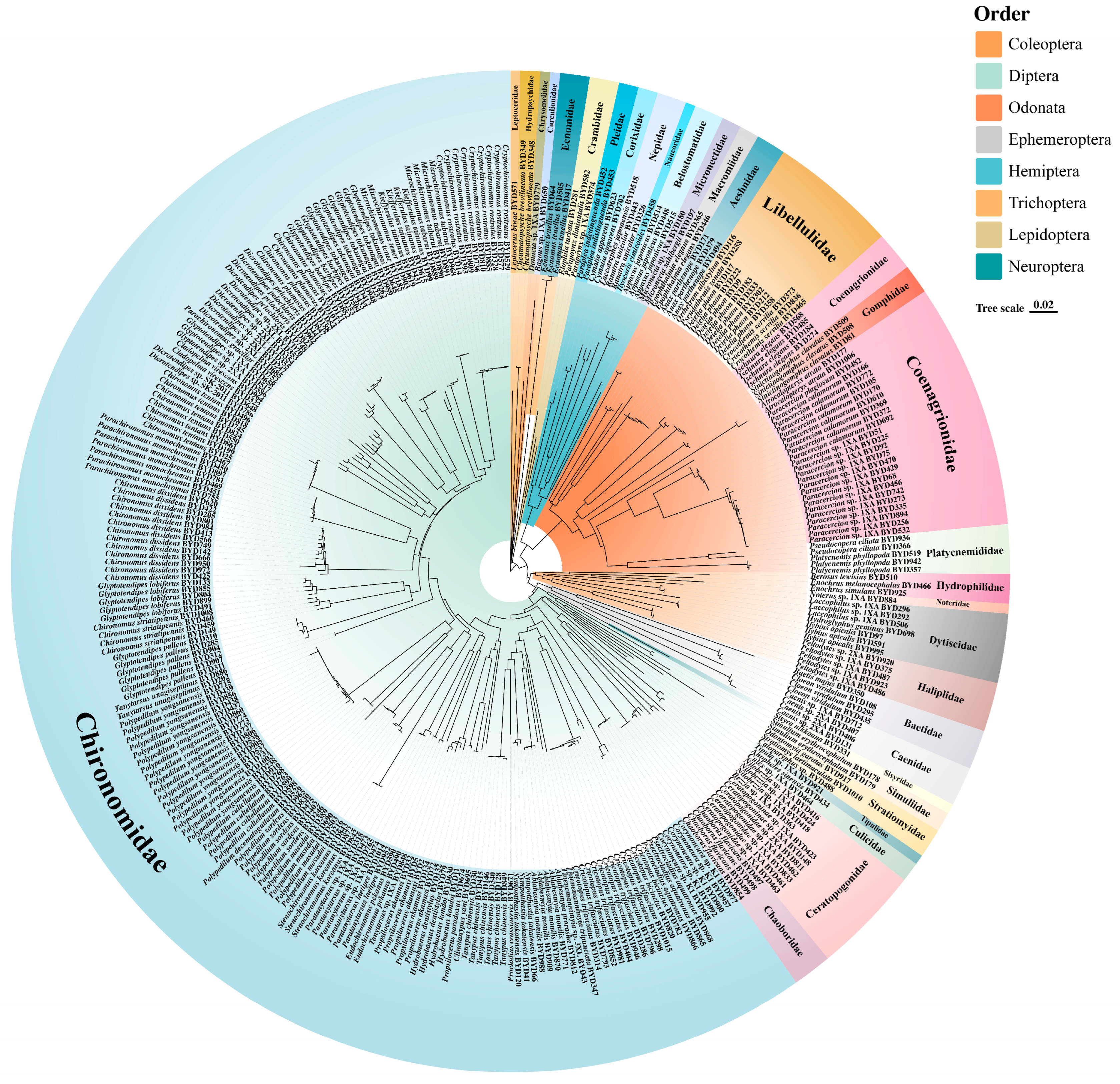
3.2. Phylogenetic Tree
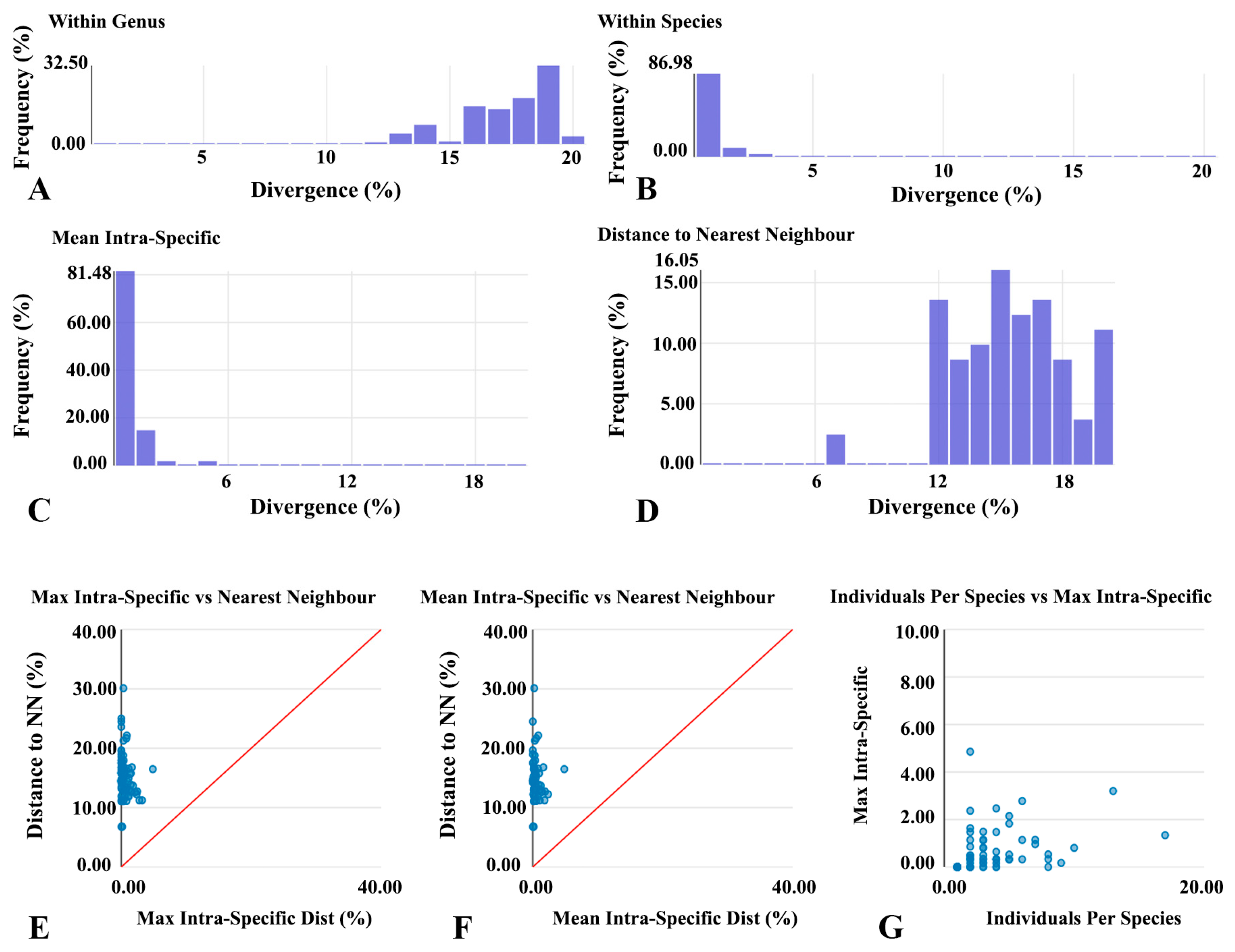
3.3. Genetic Differentiation and Barcode Gap Analysis
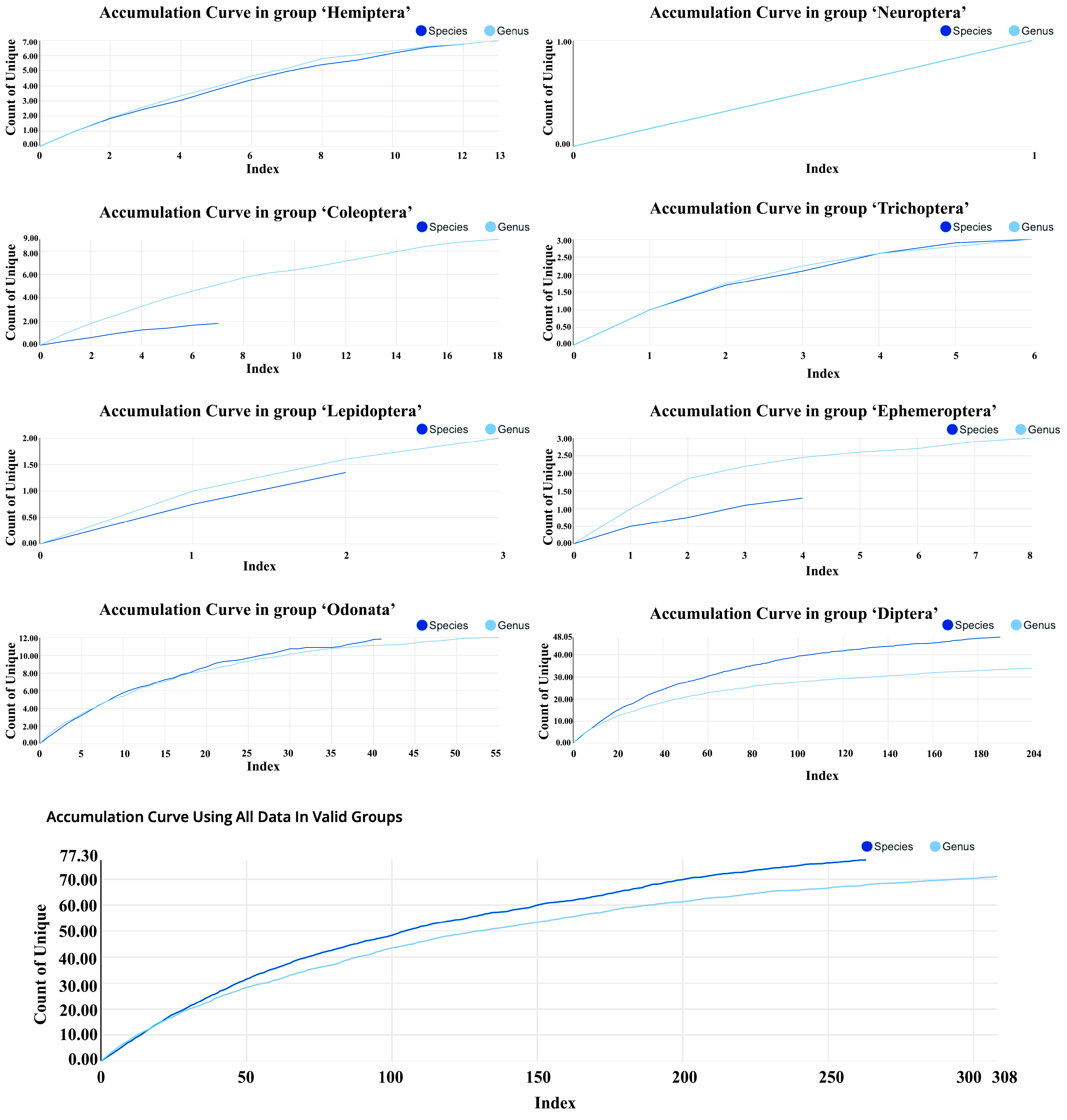
3.4. Sampling Sufficiency and Accumulation Curves
4. Discussion
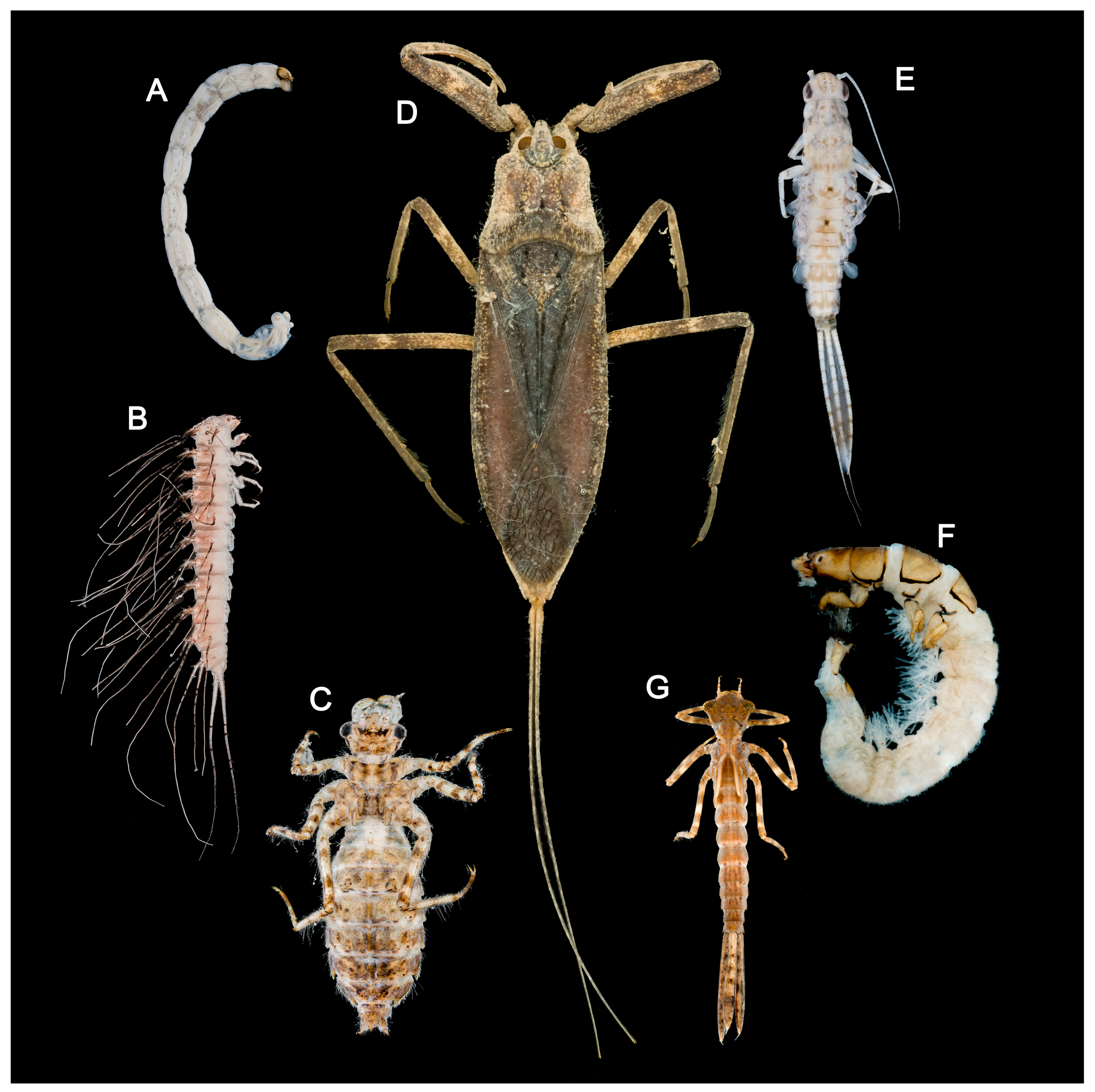
4.1. Species Diversity and Community Characteristics
4.2. Effectiveness of DNA Barcoding and Phylogenetic Patterns
4.3. Genetic Differentiation and the Application Value of the Barcode Gap
4.4. Sampling Adequacy and the Degree of Diversity Revealed
5. Conclusions
Supplementary Materials
Author Contributions
Funding
Data Availability Statement
Conflicts of Interest
Appendix A

| Protocol | Reagent | Volume |
|---|---|---|
| PCR Reaction Mixture | 2× Es Taq Master Mix (Dye) | 25 µL |
| LCO Primer (10 μmol·L−1) | 2 µL | |
| HCO Primer (10 μmol·L−1) | 2 µL | |
| ddH2O | 16 µL | |
| Template DNA | 5 µL |
| Step | Temperature | Purpose | Time | Cycle(s) |
|---|---|---|---|---|
| Pre-denaturation | 94 °C | Initial Denaturation | 1 min | 1 |
| Cycling 1 | 5 | |||
| 94 °C | Denaturation | 1 min | ||
| 45 °C | Annealing | 90 s | ||
| 72 °C | Extension | 90 s | ||
| Cycling 2 | 35 | |||
| 94 °C | Denaturation | 1 min | ||
| 51 °C | Annealing | 90 s | ||
| 72 °C | Extension | 1 min | ||
| Final Extension | 72 °C | Final Extension | 5 min | 1 |
| Hold | 4 °C | Storage | Forever | 1 |
References
- Tockner, K. Freshwaters: Global Distribution, Biodiversity, Ecosystem Services, and Human Pressures. In Handbook of Water Resources Management: Discourses, Concepts and Examples, 1st ed.; Bogardi, J.J., Gupta, J., Nandalal, K.D.W., Salamé, L., van Nooijen, R.R.P., Kumar, N., Tingsanchali, T., Bhaduri, A., Kolechkina, A.G., Eds.; Springer International Publishing: Cham, Switzerland, 2021; pp. 489–501. [Google Scholar]
- Reid, A.J.; Carlson, A.K.; Creed, I.F.; Eliason, E.J.; Gell, P.A.; Johnson, P.T.J.; Kidd, K.A.; MacCormack, T.J.; Olden, J.D.; Ormerod, S.J.; et al. Emerging threats and persistent conservation challenges for freshwater biodiversity. Biol. Rev. Camb. Philos. Soc. 2019, 94, 849–873. [Google Scholar] [CrossRef] [PubMed]
- Brondizio, E.S.; Settele, J.; Díaz, S.; Ngo, H.T. Global Assessment Report on Biodiversity and Ecosystem Services of the Intergovernmental Science-Policy Platform on Biodiversity and Ecosystem Services. IPBES Secretariat, 4 May 2019. [Google Scholar] [CrossRef]
- Dudgeon, D.; Arthington, A.H.; Gessner, M.O.; Kawabata, Z.-I.; Knowler, D.J.; Lévêque, C.; Naiman, R.J.; Prieur-Richard, A.-H.; Soto, D.; Stiassny, M.L. Freshwater biodiversity: Importance, threats, status and conservation challenges. Biol. Rev. 2006, 81, 163–182. [Google Scholar] [CrossRef] [PubMed]
- Balian, E.V.; Segers, H.; Lévèque, C.; Martens, K. The Freshwater Animal Diversity Assessment: An overview of the results. Hydrobiologia 2008, 595, 627–637. [Google Scholar] [CrossRef]
- UNEP. Continuing Loss of Wetlands. Available online: https://geo6.gridw.pl/9/6/1 (accessed on 6 September 2025).
- Basooma, A.; Nakiyende, H.; Olokotum, M.; Balirwa, J.S.; Nkalubo, W.; Musinguzi, L.; Natugonza, V. A novel index to aid in prioritizing habitats for site-based conservation. Ecol. Evol. 2022, 12, e8762. [Google Scholar] [CrossRef] [PubMed]
- Strayer, D.L.; Dudgeon, D. Freshwater biodiversity conservation: Recent progress and future challenges. J. N. Am. Benthol. 2010, 29, 344–358. [Google Scholar] [CrossRef]
- UNEP. Progress on Water-Related Ecosystems: Mid-Term Status of SDG Indicator 6.6.1 and Acceleration Needs, with a Special Focus on Biodiversity. Available online: https://unepdhi.org/wp-content/uploads/sites/2/2024/09/SDG661_2024_Progress-report_FINAL-_WEB_EN.pdf (accessed on 11 September 2025).
- UNESCO. The United Nations World Water Development Report 2020: Water and Climate Change. Available online: https://klimatycznabazawiedzy.org/wp-content/uploads/2022/11/The-United-Nations-world-water-development-report-2020-water-and-climate-change.pdf (accessed on 11 September 2025).
- Ma, L.; Yang, Y.M.; Yang, Y.H.; Xiao, D.P.; Bi, S.J. The distribution and driving factors of irrigation water requirements in the North China Plain. J. Remote Sens. 2011, 15, 324–339. [Google Scholar] [CrossRef]
- Jiang, L.G.; Lv, P.Y.; Feng, Z.M.; Liu, Y. Where Should the Start Zone Be Located for Xiong’an New Area? A Land Use Perspective. J. Resour. Ecol. 2018, 9, 374–381. [Google Scholar] [CrossRef]
- Hu, G.C.; Dai, J.Y.; Mai, B.X.; Luo, X.J.; Cao, H.; Wang, J.S.; Li, F.C.; Xu, M.Q. Concentrations and Accumulation Features of Organochlorine Pesticides in the Baiyangdian Lake Freshwater Food Feb of North China. Arch. Environ. Contam. Toxicol. 2010, 58, 700–710. [Google Scholar] [CrossRef]
- Zhao, C.P.; Gong, J.G.; Zeng, Q.H.; Yang, M.; Wang, Y. Landscape Pattern Evolution Processes and the Driving Forces in the Wetlands of Lake Baiyangdian. Sustainability 2021, 13, 9747. [Google Scholar] [CrossRef]
- Chen, H.; Ma, L.K.; Guo, W.; Yang, Y.; Guo, T.; Feng, C. Linking Water Quality and Quantity in Environmental Flow Assessment in Deteriorated Ecosystems: A Food Web View. PLoS ONE 2013, 8, e70537. [Google Scholar] [CrossRef]
- Wang, G.W.; Lv, C.C.; Gu, C.K.; Yu, Y.; Yang, Z.L.; Zhang, Z.X.; Tang, C.Y. Pollutants Source Assessment and Load Calculation in Baiyangdian Lake Using Multi-Model Statistical Analysis. Water 2022, 14, 3386. [Google Scholar] [CrossRef]
- Zhao, Y.W.; Xu, M.J.; Xu, F.; Wu, S.R.; Yin, X.A. Development of a zoning-based environmental–ecological coupled model for lakes: A case study of Baiyangdian Lake in northern China. Hydrol. Earth Syst. Sci. 2014, 18, 2113–2126. [Google Scholar] [CrossRef]
- Yan, S.J.; Sun, T.; Wang, X.; Liu, D.; Zhang, Y.L.; Yang, Z.F. Responses of Macroinvertebrate Community Temporal Dissimilarity and Abundance to the Water Level Fluctuation Range in a Shallow Lake. Water 2021, 13, 3380. [Google Scholar] [CrossRef]
- Li, Y.K.; Wang, L.Y.; Zheng, H.; Jin, H.; Xu, T.W.; Yang, P.L.; Tijiang, X.K.; Yan, Z.C.; Ji, Z.H.; Lu, J.L. Evolution characteristics for water eco-environment of Baiyangdian lake with 3s technologies in the past 60 years. In Proceedings of the International Conference on Computer and Computing Technologies in Agriculture, Beijing, China, 29 October 2011; pp. 434–460. [Google Scholar]
- Wang, Y.B.; Wang, Y.; Zhang, W.J.; Yao, X.; Wang, B.; Wang, Z. Spatiotemporal changes of eutrophication and heavy metal pollution in the inflow river system of Baiyangdian after the establishment of Xiongan New Area. PeerJ 2022, 10, e13400. [Google Scholar] [CrossRef]
- Xinhua. Baiyangdian’s Remarkable Ecological Revival in North China’s Xiong’an. Available online: https://english.news.cn/20240509/ac8f59ed75d34796adb1b2137657124f/c.html (accessed on 6 September 2025).
- Wu, H.T.; Yang, M.Y.; Lu, K.L.; Batzer, D.P. Effects of Ecological Restoration on Trophic Dynamics in Estuarine Wetlands. Wetlands 2021, 41, 10. [Google Scholar] [CrossRef]
- Pei, G.; Han, B. China’s New Record Species: Discovery of Baetis majus in Baiyangdian, Xiong’an New Area. Available online: https://www.163.com/dy/article/JT6B0RFV0514R9OJ.html (accessed on 6 September 2025).
- Tiunova, T.M.; Semenchenko, A.A.; Tong, X. Baetis majus sp. nov., new species of mayfly (Ephemeroptera: Baetidae) from Far East of Russia. Zootaxa 2021, 4965, 541–557. [Google Scholar] [CrossRef]
- Hebert, P.D.N.; Ratnasingham, S.; De Waard, J.R. Barcoding animal life: Cytochrome c oxidase subunit 1 divergences among closely related species. Proc. R. Soc. Lond. Ser. B 2003, 270, S96–S99. [Google Scholar] [CrossRef] [PubMed]
- Oliver, T.H.; Heard, M.S.; Isaac, N.J.; Roy, D.B.; Procter, D.; Eigenbrod, F.; Freckleton, R.; Hector, A.; Orme, C.D.L.; Petchey, O.L. Biodiversity and Resilience of Ecosystem Functions. Trends Ecol. Evol. 2015, 30, 673–684. [Google Scholar] [CrossRef] [PubMed]
- Medhi, J.; Dutta, J.; Kalita, M.C. Biomonitoring Ecosystem: Modelling Relationship with Arthropods. In Arthropods: Are They Beneficial for Mankind, 1st ed.; IntechOpen: London, UK, 2021; Volume 113, p. 232. [Google Scholar]
- Hebert, P.D.N.; Cywinska, A.; Ball, S.L. Biological identifications through DNA barcodes. Proc. R. Soc. Lond. Ser. B 2003, 270, 313–321. [Google Scholar] [CrossRef]
- Ratnasingham, S.; Hebert, P.D.N. A DNA-Based Registry for All Animal Species: The Barcode Index Number (BIN) System. PLoS ONE 2013, 8, e66213. [Google Scholar] [CrossRef] [PubMed]
- Deiner, K.; Bik, H.M.; Mächler, E.; Seymour, M.; Lacoursière-Roussel, A.; Altermatt, F.; Creer, S.; Bista, I.; Lodge, D.M.; De Vere, N. Environmental DNA metabarcoding: Transforming how we survey animal and plant communities. Mol. Ecol. 2017, 26, 5872–5895. [Google Scholar] [CrossRef] [PubMed]
- Bruce, K.; Blackman, R.; Bourlat, S.J.; Hellström, A.M.; Bakker, J.; Bista, I.; Bohmann, K.; Bouchez, A.; Brys, R.; Clark, K.; et al. A Practical Guide to DNA-Based Methods for Biodiversity Assessment, 1st ed.; Pensoft Publishers: Sofia, Bulgaria, 2021; Volume 1, p. 90. [Google Scholar]
- Lim, S.J.; Thompson, L.R. Mitohelper: A mitochondrial reference sequence analysis tool for fish eDNA studies. Environ. DNA 2021, 3, 706–715. [Google Scholar] [CrossRef]
- Koch, F.; Blum, P.; Korbel, K.; Menberg, K. Global overview on groundwater fauna. Ecohydrology 2024, 17, e2607. [Google Scholar] [CrossRef]
- Chen, K.; Fang, C.C.; Wu, Z.G.; Xiong, F.; Yu, D.; Cui, Y.D.; Zhang, Q.; Wang, B.Q.; Jiang, C.Q.; Song, L.R. AeDNA: Aquatic Environmental DNA Database. Acta Hydrobiol. Sin. 2022, 46, 1741–1747. [Google Scholar] [CrossRef]
- Weigand, H.; Beermann, A.J.; Čiampor, F.; Costa, F.O.; Csabai, Z.; Duarte, S.; Geiger, M.F.; Grabowski, M.; Rimet, F.; Rulik, B. DNA barcode reference libraries for the monitoring of aquatic biota in Europe: Gap-analysis and recommendations for future work. Sci. Total Environ. 2019, 678, 499–524. [Google Scholar] [CrossRef]
- Magoga, G.; Forni, G.; Brunetti, M.; Meral, A.; Spada, A.; De Biase, A.; Montagna, M. Curation of a reference database of COI sequences for insect identification through DNA metabarcoding: COins. Database 2022, 2022, baac055. [Google Scholar] [CrossRef]
- Gullan, P.J.; Cranston, P.S. The Insects: An Outline of Entomology, 5th ed.; John Wiley & Sons: Malden, MA, USA, 2014; p. 624. [Google Scholar]
- Sæther, O.A. Some Nearctic Podonominae, Diamesinae, and Orthocladiinae (Diptera: Chironomidae). Bull. Fish. Res. Board Can. 1969, 170, 1–154. [Google Scholar]
- Stibick, J.N. Classification of the Elateridae (Coleoptera). Relationships and classification of the subfamilies and tribes. Pac. Insects 1979, 20, 145–186. [Google Scholar]
- Cai, C.; Tihelka, E.; Pisani, D.; Donoghue, P.C.J. Data curation and modeling of compositional heterogeneity in insect phylogenomics: A case study of the phylogeny of Dytiscoidea (Coleoptera: Adephaga). Mol. Phylogenet. Evol. 2020, 147, 106782. [Google Scholar] [CrossRef]
- Kirby, W.F. Elementary Text-Book of Entomology, 2nd ed.; Sonnenschein: London, UK, 1892; p. 334. [Google Scholar]
- MacKenzie, R.A. Northern Range Extension for Goeldichironomus Devineyae (Insecta: Diptera). Northeast. Nat. 2003, 10, 465–467. [Google Scholar] [CrossRef]
- Riek, E.F. The Classification of the Ephemeroptera, 1st ed.; EJ Brill: Leiden, The Netherlands, 1970; pp. 160–178. [Google Scholar]
- Schuh, R.T.; Slater, J.A. True Bugs of the World (Hemiptera: Heteroptera): Classification and Natural History, 1st ed.; Cornell University Press: New York, NY, USA, 1995; p. 336. [Google Scholar]
- Kellogg, V.L. The classification of the Lepidoptera. Am. Nat. 1895, 29, 248–257. [Google Scholar] [CrossRef]
- Pessacq, P.; Muzon, J.; Neiss, U.G. Order Odonata. In Thorp and Covich’s Freshwater Invertebrates, 4th ed.; Elsevier: Amsterdam, The Netherlands, 2018; pp. 355–366. [Google Scholar]
- Aspöck, U. Phylogeny of the Neuropterida (Insecta: Holometabola). Zool. Scr. 2002, 31, 51–55. [Google Scholar] [CrossRef]
- Thomson, R.E. Catalog of the Hydroptilidae (Insecta, Trichoptera), 1st ed.; 2023; Volume 1140, p. 499. [Google Scholar]
- Folmer, O.; Black, M.; Hoeh, W.; Lutz, R.; Vrijenhoek, R. DNA primers for amplification of mitochondrial cytochrome c oxidase subunit I from diverse metazoan invertebrates. Mol. Mar. Biol. Biotechnol. 1994, 3, 294–299. [Google Scholar] [PubMed]
- Lin, X.-L.; Stur, E.; Ekrem, T. DNA barcodes and morphology reveal unrecognized species in Chironomidae (Diptera). Insect Syst. Evol. 2018, 47, 329–398. [Google Scholar] [CrossRef]
- Ratnasingham, S.; Hebert, P.D.N. BOLD: The Barcode of Life Data System. Mol. Ecol. Notes 2007, 7, 355–364. [Google Scholar] [CrossRef]
- Kearse, M.; Moir, R.; Wilson, A.; Stones-Havas, S.; Cheung, M.; Sturrock, S.; Buxton, S.; Cooper, A.; Markowitz, S.; Duran, C. Geneious Basic: An integrated and extendable desktop software platform for the organization and analysis of sequence data. Bioinformatics 2012, 28, 1647–1649. [Google Scholar] [CrossRef] [PubMed]
- Edgar, R.C. MUSCLE: Multiple sequence alignment with high accuracy and high throughput. Nucleic Acids Res. 2004, 32, 1792–1797. [Google Scholar] [CrossRef]
- Kumar, S.; Stecher, G.; Suleski, M.; Sanderford, M.; Sharma, S.; Tamura, K. MEGA12: Molecular Evolutionary Genetic Analysis Version 12 for Adaptive and Green Computing. Mol. Biol. Evol. 2024, 41, msae263. [Google Scholar] [CrossRef]
- Kimura, M. A simple method for estimating evolutionary rates of base substitutions through comparative studies of nucleotide sequences. J Mol. Evol. 1980, 16, 111–120. [Google Scholar] [CrossRef]
- Rambaut, A. FigTree, a Graphical Viewer of Phylogenetic Trees. Available online: https://tree.bio.ed.ac.uk/software/figtree/ (accessed on 6 September 2025).
- Djitli, Y.; Boix, D.; Milla, A.; Marniche, F.; Tornero, I.; Cunillera-Montcusí, D.; Sala, J.; Gascón, S.; Quintana, X.D.; Daoudi-Hacini, S. Annual cycle of water quality and macroinvertebrate composition in Algerian wetlands: A case study of lake Réghaïa (Algeria). Limnetica 2021, 40, 399–415. [Google Scholar] [CrossRef]
- Zarges, C.V.; Fierro, P.; Olmos, V. Freshwater invertebrates of southwestern South America: Diversity, biogeography, and threats. In Inland Waters, Dynamics and Ecology, 1st ed.; Devlin, A.T., Pan, J., Shah, M.M., Eds.; IntechOpen: London, UK, 2021; pp. 223–252. [Google Scholar]
- Chowdhury, S.; Dubey, V.K.; Choudhury, S.; Das, A.; Jeengar, D.; Sujatha, B.; Kumar, A.; Kumar, N.; Semwal, A.; Kumar, V. Insects as bioindicator: A hidden gem for environmental monitoring. Front. Environ. Sci. 2023, 11, 1146052. [Google Scholar] [CrossRef]
- Devlin, A.; Pan, J.; Shah, M.M.; Nuhu, A.A. Inland Waters: Dynamics and Ecology, 1st ed.; IntechOpen: London, UK, 2021; p. 264. [Google Scholar]
- Rivera, S.F.; Vasselon, V.; Mary, N.; Monnier, O.; Rimet, F.; Bouchez, A. Exploring the capacity of aquatic biofilms to act as environmental DNA samplers: Test on macroinvertebrate communities in rivers. Sci. Total Environ. 2021, 763, 144208. [Google Scholar] [CrossRef] [PubMed]
- Tubić, B.; Andjus, S.; Zorić, K.; Vasiljević, B.; Jovičić, K.; Čanak Atlagić, J.; Paunović, M. Aquatic insects (Ephemeroptera, Plecoptera and Trichoptera) Metric as an Important Tool in Water Quality Assessment in Hilly and Mountain Streams. Water 2024, 16, 849. [Google Scholar] [CrossRef]
- Zhou, X.; Kjer, K.M.; Morse, J.C. Associating larvae and adults of Chinese Hydropsychidae caddisflies (Insecta: Trichoptera) using DNA sequences. J. N. Am. Benthol. Soc. 2007, 26, 719–742. [Google Scholar] [CrossRef]
- Gajski, D.; Wolff, J.O.; Melcher, A.; Weber, S.; Prost, S.; Krehenwinkel, H.; Kennedy, S.R. Facilitating taxonomy and phylogenetics: An informative and cost-effective protocol integrating long amplicon PCRs and third-generation sequencing. Mol. Phylogenet. Evol. 2024, 192, 107988. [Google Scholar] [CrossRef]
- Savolainen, V.; Cowan, R.S.; Vogler, A.P.; Roderick, G.K.; Lane, R. Towards writing the encyclopaedia of life: An introduction to DNA barcoding. Philos. Trans. R. Soc. B 2005, 360, 1805–1811. [Google Scholar] [CrossRef] [PubMed]
- Hebert, P.D.; Penton, E.H.; Burns, J.M.; Janzen, D.H.; Hallwachs, W. Ten species in one: DNA barcoding reveals cryptic species in the neotropical skipper butterfly Astraptes fulgerator. Proc. Natl. Acad. Sci. USA 2004, 101, 14812–14817. [Google Scholar] [CrossRef]
- Koblmüller, S. DNA Barcodes for Evolution and Eiodiversity. Diversity 2023, 15, 1003. [Google Scholar] [CrossRef]
- Lawley, J.W.; Gamero-Mora, E.; Maronna, M.M.; Chiaverano, L.M.; Stampar, S.N.; Hopcroft, R.R.; Collins, A.G.; Morandini, A.C. The importance of molecular characters when morphological variability hinders diagnosability: Systematics of the moon jellyfish genus Aurelia (Cnidaria: Scyphozoa). PeerJ 2021, 9, e11954. [Google Scholar] [CrossRef]
- Talavera, G.; Lukhtanov, V.; Pierce, N.E.; Vila, R. DNA Barcodes Combined with Multilocus Data of Representative Taxa Can Generate Reliable Higher-Level Phylogenies. Syst. Biol. 2022, 71, 382–395. [Google Scholar] [CrossRef]
- Watanabe, S.; Masamura, N.; Satoh, S.-y.; Hirao, T. Evaluating the Effectiveness of DNA Barcoding for Insect Identification: A Comprehensive Review. Entomol. Lett. 2024, 4, 34–41. [Google Scholar] [CrossRef]
- Ramadan, H.; Baeshen, N.A. Biological Identifications through DNA barcodes. In Biodiversity Conservation and Utilization in a Diverse World, 1st ed.; InTech: Rijeka, Croatia, 2012; pp. 109–128. [Google Scholar]
- Zhang, H.G.; Bu, W.J. Exploring Large-Scale Patterns of Genetic Variation in the COI Gene among Insecta: Implications for DNA Barcoding and Threshold-Based Species Delimitation Studies. Insects 2022, 13, 425. [Google Scholar] [CrossRef]
- Mason, N.A.; Fletcher, N.K.; Gill, B.A.; Funk, W.C.; Zamudio, K.R. Coalescent-based species delimitation is sensitive to geographic sampling and isolation by distance. Syst. Biodivers. 2020, 18, 269–280. [Google Scholar] [CrossRef]
- Odah, M.A.A. Unlocking the genetic code: Exploring the potential of DNA barcoding for biodiversity assessment. AIMS Mol. Sci. 2023, 10, 263–294. [Google Scholar] [CrossRef]
- Nyberg, B.; Sayre, R.; Luijendijk, E. Increasing seasonal variation in the extent of rivers and lakes from 1984 to 2022. Hydrol. Earth Syst. Sci. 2024, 28, 1653–1663. [Google Scholar] [CrossRef]


Disclaimer/Publisher’s Note: The statements, opinions and data contained in all publications are solely those of the individual author(s) and contributor(s) and not of MDPI and/or the editor(s). MDPI and/or the editor(s) disclaim responsibility for any injury to people or property resulting from any ideas, methods, instructions or products referred to in the content. |
© 2026 by the authors. Licensee MDPI, Basel, Switzerland. This article is an open access article distributed under the terms and conditions of the Creative Commons Attribution (CC BY) license.
Share and Cite
Qiao, Y.-J.; Wang, Z.-P.; Lv, M.-Y.; Su, P.-D.; Wu, T.; Xu, H.-F.; Li, Y.-F.; Lin, X.-L.; Zhang, C.-H. Decoding Biodiversity in Baiyangdian Lake: A DNA Barcode Reference Library for Aquatic Insects. Insects 2026, 17, 60. https://doi.org/10.3390/insects17010060
Qiao Y-J, Wang Z-P, Lv M-Y, Su P-D, Wu T, Xu H-F, Li Y-F, Lin X-L, Zhang C-H. Decoding Biodiversity in Baiyangdian Lake: A DNA Barcode Reference Library for Aquatic Insects. Insects. 2026; 17(1):60. https://doi.org/10.3390/insects17010060
Chicago/Turabian StyleQiao, Ya-Jun, Ze-Peng Wang, Meng-Yu Lv, Pei-Dong Su, Tong Wu, Hai-Feng Xu, Yu-Fan Li, Xiao-Long Lin, and Chun-Hui Zhang. 2026. "Decoding Biodiversity in Baiyangdian Lake: A DNA Barcode Reference Library for Aquatic Insects" Insects 17, no. 1: 60. https://doi.org/10.3390/insects17010060
APA StyleQiao, Y.-J., Wang, Z.-P., Lv, M.-Y., Su, P.-D., Wu, T., Xu, H.-F., Li, Y.-F., Lin, X.-L., & Zhang, C.-H. (2026). Decoding Biodiversity in Baiyangdian Lake: A DNA Barcode Reference Library for Aquatic Insects. Insects, 17(1), 60. https://doi.org/10.3390/insects17010060