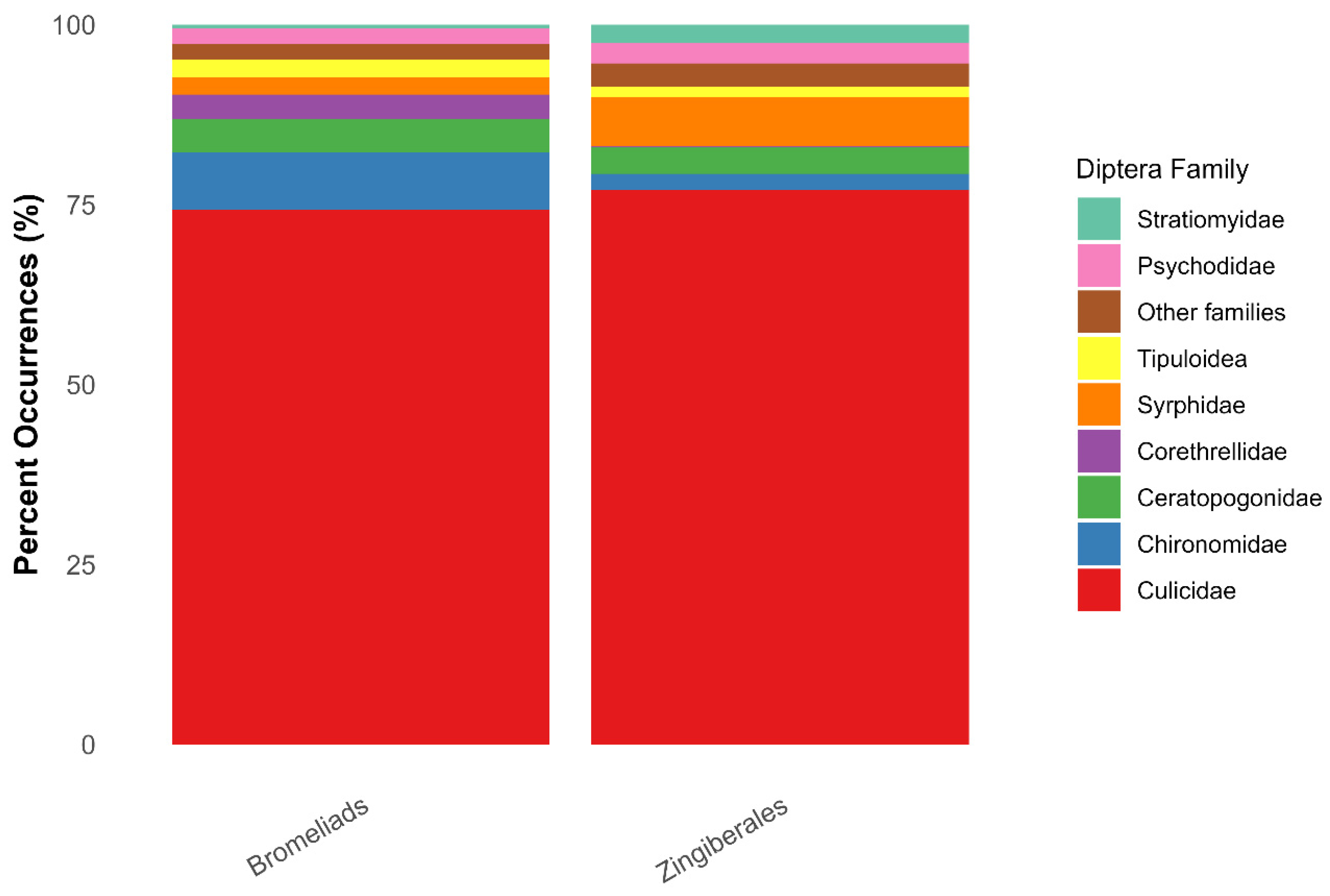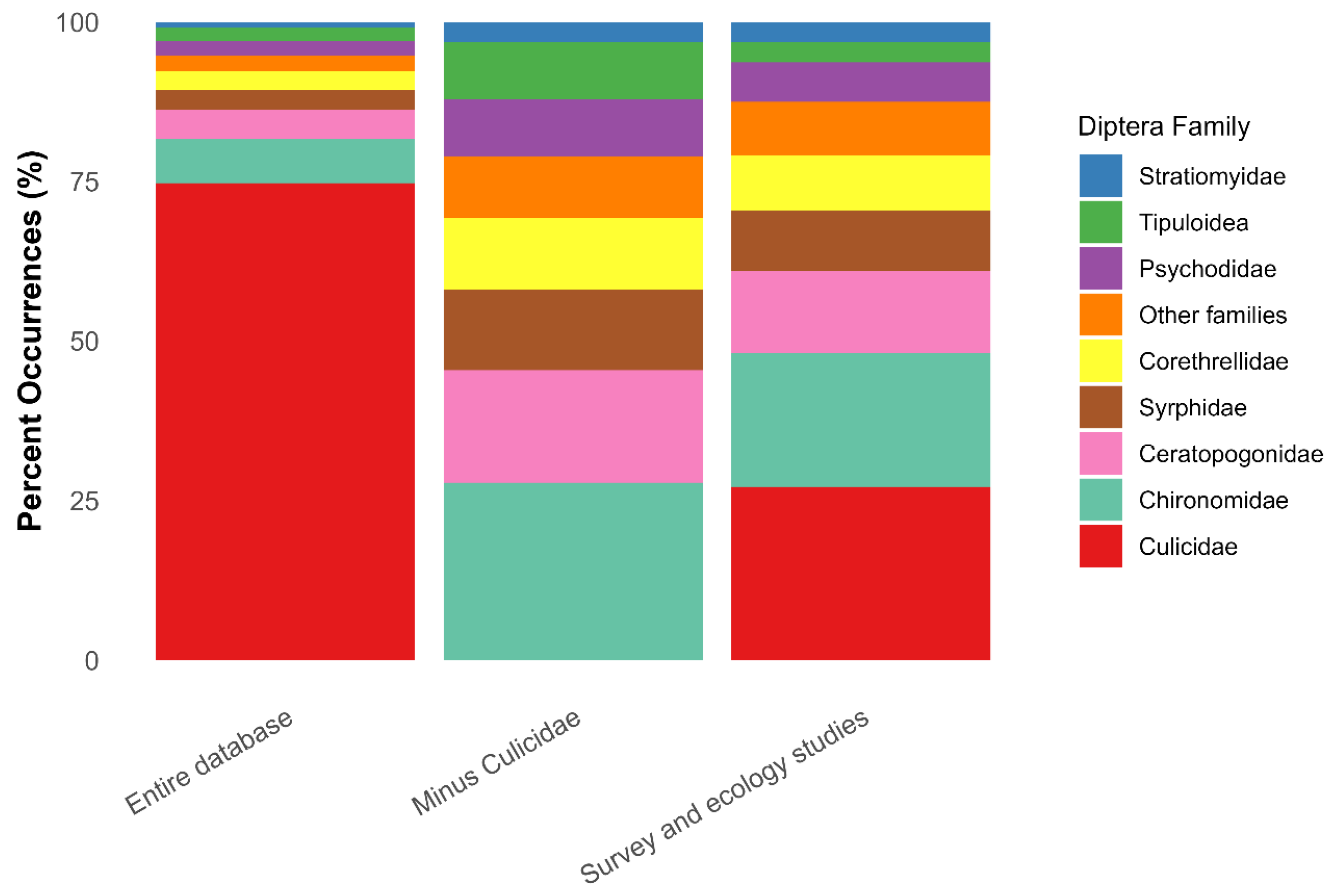
Aquatic Diptera in Phytotelmata of Bromeliaceae and Zingerberales

Simple Summary
Abstract
1. Introduction
2. Methods
2.1. Data Assembly
2.2. Data Extraction
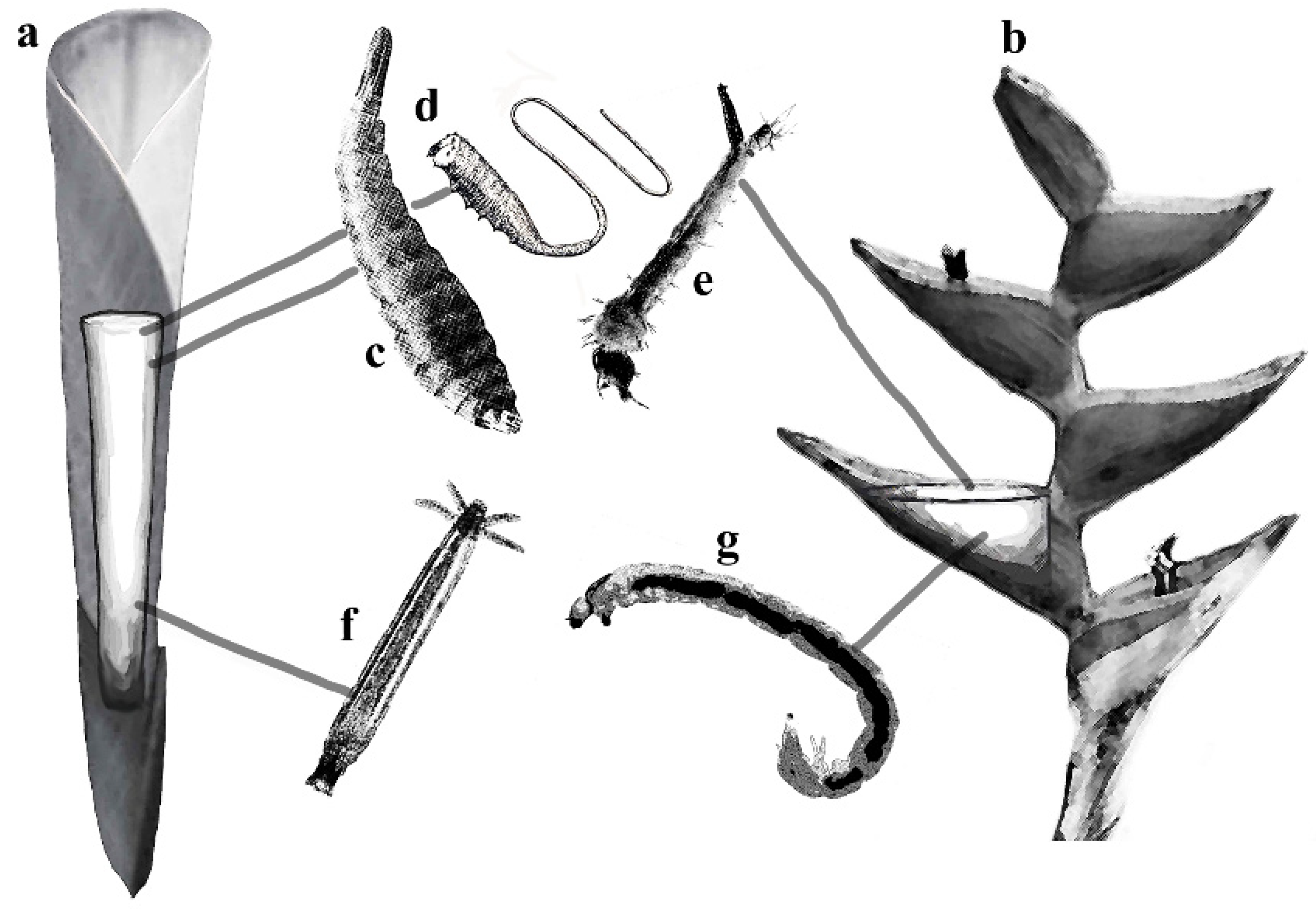
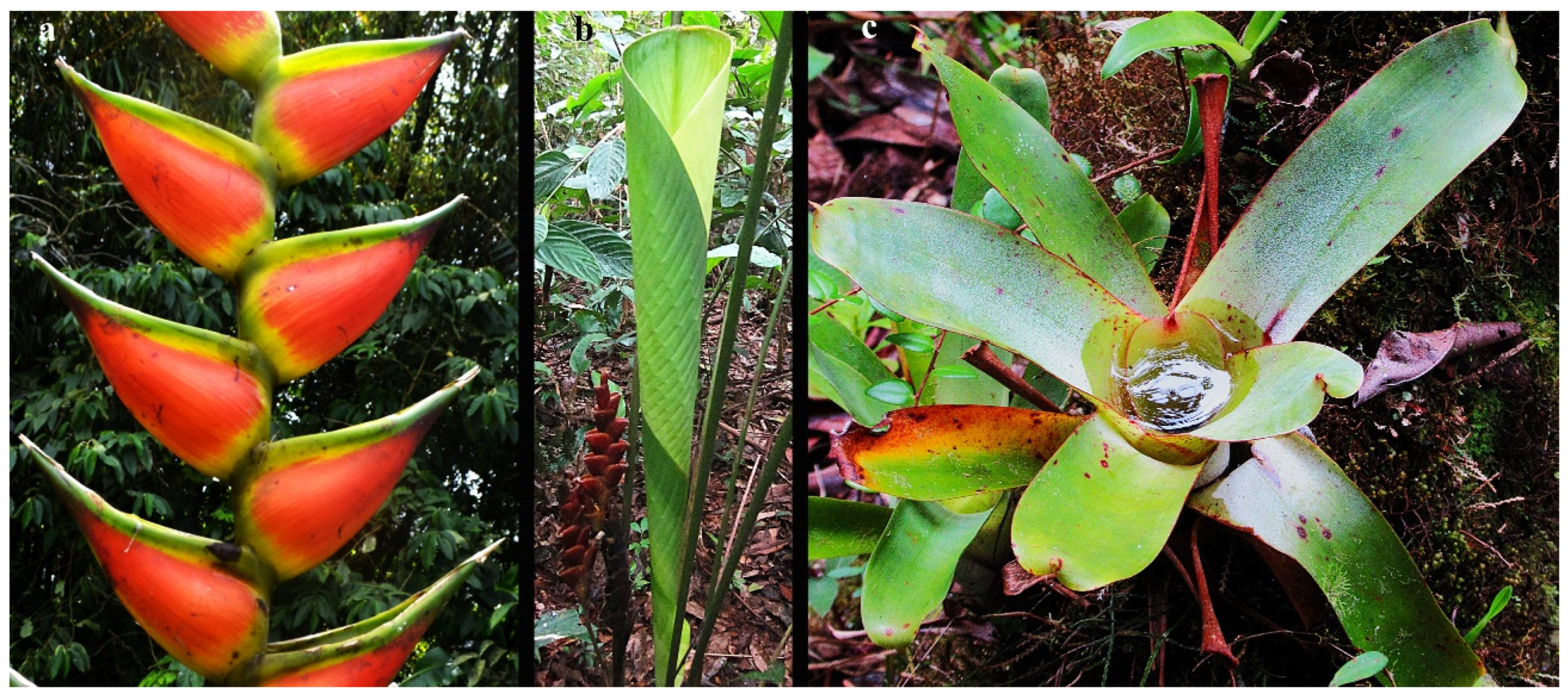
- Bract—a modified leaf (scale-like or petal-like) subtending the flowers (or, later, the fruits). It is on the inflorescence (for an individual flower or a group of flowers) and may still persist on the infructescence.
- Inflorescence—a group of flowers.
- Infrutescence—a group of fruits, the next stage after pollinating the inflorescence.
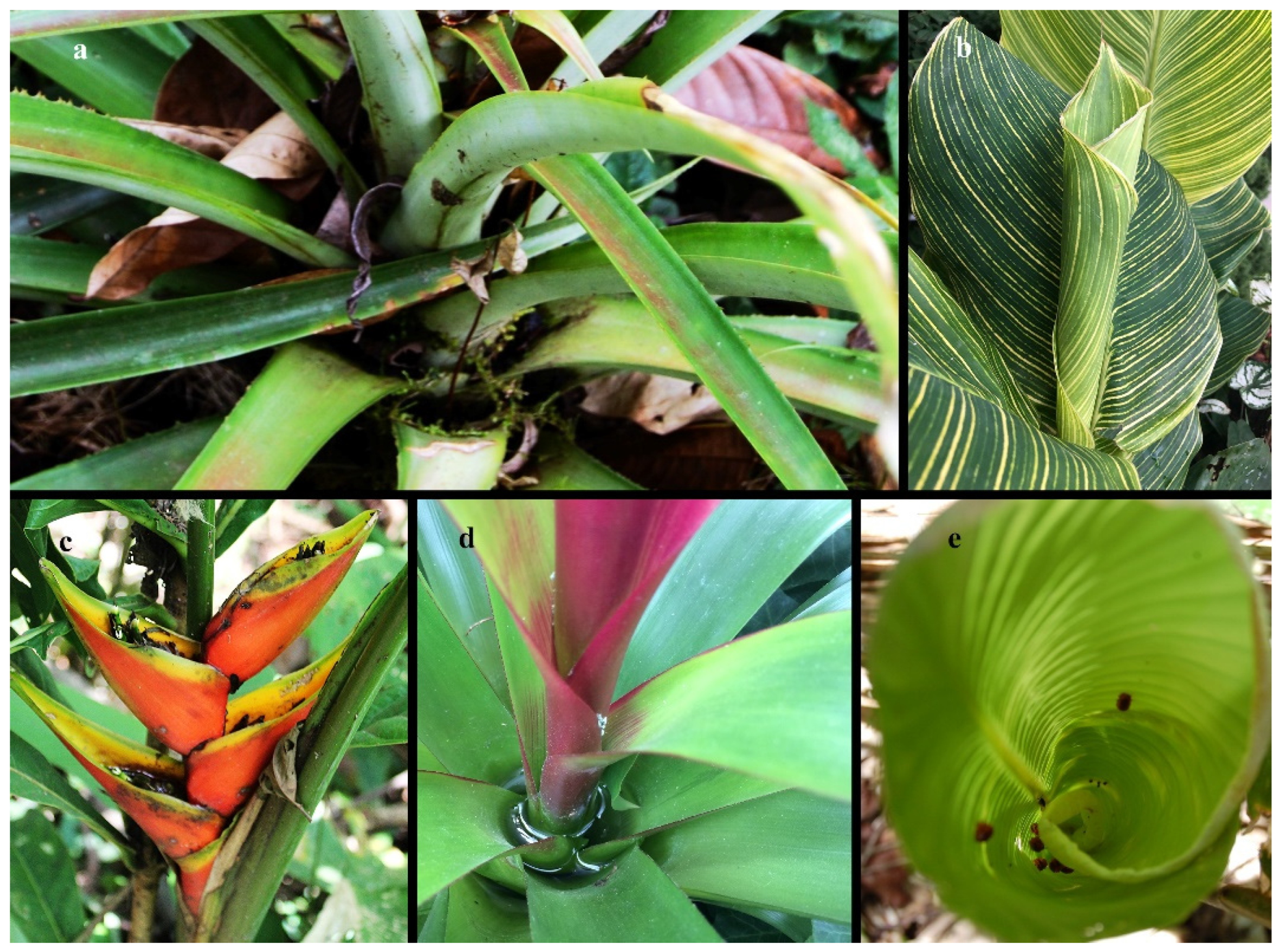
- Leaf axil—the cavity created by the leaf petiole or stalk that attaches the lamina to the stem.
- Leaf roll—the flat photosynthetic leaf lamina, which is rolled into a cone when immature and holds water.
- Leaf rosette or tank—water reservoir at the base of the leaves (Figure 3).
2.3. Database Construction
2.4. Data Standardization
2.5. Taxonomic Updates
2.6. Location Updates
2.7. Quality Assurance Protocols
2.8. Vector Analysis
2.9. Data Analysis and Visualization
3. Results and Discussion
3.1. Literature Review
3.2. Surveys
3.3. Ecology
3.4. Taxonomy
3.4.1. Plant Taxonomy
3.4.2. Diptera Taxonomy
3.5. Conservation
4. Discussion
4.1. Taxonomy
- Coordinate surveys across large geographic scales (countries, ecoregions, and biogeographic regions) and address geographic gaps. The Mongolian Aquatic Insect Survey [184] is an exemplary model of coordinated taxonomic experts documenting biodiversity and describing associated ecological conditions.
- Collect exhaustively, as collecting for a single taxon may miss diversity. Phytotelmata sampling can be destructive, so we ought to collect comprehensively for future research.
- Make greater efforts to identify specimens to the species level by rearing larvae to adults and/or using molecular techniques such as DNA barcoding or meta barcoding.
- Compile keys to larvae and species descriptions, many cited in this paper.
- Engage taxonomic expertise for non-target taxa as needed (see more below).
- A posteriori analyses must accept that original researchers identified both host plant and inhabiting organisms accurately; thus, we recommend that research that includes species descriptions, even in ecological work, be accompanied by the creation of voucher records and the deposition of vouchers in museums and other biodiversity depositories.
4.2. Ecology
- List taxa used in tables, appendices, and Supplementary Materials and include plant names, phytotelmata type (e.g., leaf axils, leaf rosettes, leaf rolls, bracts), and geographic coordinates.
- Include taxonomic specialists in research teams to provide genus- and species-level identifications.
- Consult taxonomic expertise, such as those with Systema Dipterorum [70].
- When possible, ecological research in which taxa are identified should be accompanied by the creation of a voucher collection and the deposition of vouchers in museums and other biodiversity depositories.
- Use standardized data formats and metadata conventions to facilitate data sharing and synthesis across studies (e.g., [18]).
4.3. Plant/Insect Interactions
- Include both botanists and entomologists in surveys and ecological research for accurate identifications or consult experts post-sampling.
- Record and report the location of phytotelmata in each plant in tables, appendices, and Supplementary Materials.
- Investigate community variation across sub-habitats within phytotelmata (e.g., outer versus inner whirls of leaf rolls and leaf rosettes).
4.4. Threats and Conservation
- Analyze phytotelmata communities for vector prevalence and explore possible community management of vector mosquitoes to avoid the destruction of phytotelma plants, particularly bromeliads.
- Communicate the ecosystem services of Diptera from phytotelma habitat (e.g., pollination, aquatic to terrestrial energy subsidies) to support conserving bromeliad and Zingiberales phytotelmata.
- Work with or establish local citizen science programs to monitor phytotelma insect communities, thereby increasing awareness of the joy and wonder of these unique aquatic ecosystems.
5. Conclusions and Future Directions
Supplementary Materials
Author Contributions
Funding
Data Availability Statement
Acknowledgments
Conflicts of Interest
References
- Petermann, J.S.; Gossner, M.M. Aquatic islands in the sky: 100 years of research on water-filled tree holes. Ecol. Evol. 2022, 12, e9206. [Google Scholar] [CrossRef]
- Strayer, D.L.; Dudgeon, D. Freshwater biodiversity conservation: Recent progress and future challenges. J. N. Am. Benthol. Soc. 2010, 29, 344–358. [Google Scholar] [CrossRef]
- Reid, A.J.; Carlson, A.K.; Creed, I.F.; Eliason, E.J.; Gell, P.A.; Johnson, P.T.J.; Kidd, K.A.; MacCormack, T.J.; Olden, J.D.; Ormerod, S.J.; et al. Emerging threats and persistent conservation challenges for freshwater biodiversity. Biol. Rev. 2019, 94, 849–873. [Google Scholar] [CrossRef]
- Zacharias, I.; Zamparas, M. Mediterranean temporary ponds. A disappearing ecosystem. Biodivers. Conserv. 2010, 19, 3827–3834. [Google Scholar] [CrossRef]
- Picado, C. Les broméliacées épiphytes considérées comme milieu biologique. Bull. Sci. Fr. Belg. 1913, 47, 215–360. [Google Scholar]
- Thienemann, A. Eine gesteinsbildende chironomide. [Lithotanytarsus emarginatus (Goethgebuer)]. Z. Morphol. Okol. Der Tiere 1934, 28, 480–496. [Google Scholar] [CrossRef]
- Kitching, R.L. Food Webs and Container Habitats: The Natural History and Ecology of Phytotelmata; Cambridge University Press: Cambridge, UK, 2000. [Google Scholar]
- Greeney, H.F. The insects of plant-held waters: A review and bibliography. J. Trop. Ecol. 2001, 17, 241–260. [Google Scholar] [CrossRef]
- Frank, J.H.; Lounibos, L.P. Insects and allies associated with bromeliads: A review. Terr. Arthropod Rev. 2009, 1, 125–153. [Google Scholar] [CrossRef]
- Campos, R.E. Eryngium (Apiaceae) phytotelmata and their macro-invertebrate communities, including a review and bibliography. Hydrobiologia 2010, 652, 311–328. [Google Scholar] [CrossRef]
- Teixeira, A.P.; Silva, P.F.R.S.; de Souza, J.P.F.; Alves, N.L.; Guimarães, A.; Carneiro, F.M. Trends in the scientific production on aquatic microhabitats phytotelmata: A scientometric study. Acta Sci. Biol. Sci. 2018, 40, 2–9. [Google Scholar] [CrossRef]
- Varga, L. Ein interessanter biotop der biocönose von wasserorganismen. Biol. Zentralblatt. 1928, 48, 143–162. [Google Scholar]
- Knab, F. New moth-flies (Psychodidae) bred from Bromeliaceae and other plants. Proc. United States Natl. Mus. 1914, 46, 103–106. [Google Scholar] [CrossRef]
- Scott, H. The fauna of “reservoir plants”. Zoologist 2014, 18, 183–195. Available online: https://www.biodiversitylibrary.org/item/127221 (accessed on 25 February 2026).
- Frank, J.H.; Lounibos, L.P. Phytotelmata: Terrestrial Plants as Hosts for Aquatic Insect Communities; Plexus: Medford, NJ, USA, 1983. [Google Scholar]
- Laessle, A.M. A micro-limnological study of Jamaican bromeliads. Ecology 1961, 42, 499–517. [Google Scholar] [CrossRef]
- LeCraw, R.M.; Srivastava, D.S.; Romero, G.Q. Metacommunity size influences aquatic community composition in a natural mesocosm landscape. Oikos 2014, 123, 903–911. [Google Scholar] [CrossRef]
- Petermann, J.S.; Farjalla, V.F.; Jocque, M.; Kratina, P.; MacDonald, A.A.M.; Marino, N.A.C.; de Omena, P.M.; Piccoli, G.C.O.; Richardson, B.A.; Richardson, M.J.; et al. Dominant predators mediate the impact of habitat size on trophic structure in bromeliad invertebrate communities. Ecology 2015, 96, 428–439. [Google Scholar] [CrossRef]
- Dendi, D.; Förster, T.; Chaboo, C.S. Arthropod diversity in phytotelmata of Calathea capitata (Zingiberales; Marantaceae) host plants from Peru. Rev. Peru Biol. 2023, 30, e25654. [Google Scholar] [CrossRef]
- Seifert, R.P.; Seifert, F.H. Natural history of insects living in inflorescences of two species of Heliconia. J. N. Y. Entomol. Soc. 1976, 84, 233–242. [Google Scholar]
- Srivastava, D.S. Habitat structure, trophic structure and ecosystem function: Interactive effects in a bromeliad–insect community. Oecologia 2006, 149, 493–504. [Google Scholar] [CrossRef] [PubMed]
- Srivastava, D.S.; Trzcinski, M.K.; Richardson, B.A.; Gilbert, B. Why Are Predators More Sensitive to Habitat Size than Their Prey? Insights from Bromeliad Insect Food Webs. Am Nat. 2008, 172, 761–771. [Google Scholar] [CrossRef][Green Version]
- Amundrud, S.L.; Srivastava, D.S. Drought sensitivity predicts habitat size sensitivity in an aquatic ecosystem. Ecology 2015, 96, 1957–1965. [Google Scholar] [CrossRef] [PubMed]
- Maguire, B. Phytotelmata: Biota and community structure determination in plant-held waters. Annu. Rev. Ecol. Syst. 1971, 2, 439–464. [Google Scholar] [CrossRef]
- Frank, J.H.; Sreenivasan, S.; Benshoff, P.J.; Deyrup, M.A.; Edwards, G.B.; Halbert, S.E.; Hamon, A.B.; Lowman, M.D.; Mockford, E.L.; Scheffrahn, R.H.; et al. Invertebrate animals extracted from native Tillandsia (Bromeliales: Bromeliaceae) in Sarasota county, Florida. Fla. Entomol. 2004, 87, 176–185. [Google Scholar] [CrossRef]
- Mestre, L.A.M.; Aranha, J.M.R.; Esper, M.D.L.P. Macroinvertebrate fauna associated to the bromeliad Vriesea inflata of the Atlantic Forest (Paraná State, Southern Brazil). Braz. Arch. Biol. Technol. 2001, 44, 89–94. [Google Scholar] [CrossRef]
- Frank, J.H.; Curtis, G.A.; O’Meara, G.F. On the bionomics of bromeliad-inhabiting mosquitoes, X. Toxorhynchites r. rutilus as a predator of Wyeomyia vanduzeei (Diptera: Culicidae). J. Med. Entomol. 1984, 21, 149–158. [Google Scholar] [CrossRef]
- Seifert, R.P. Clumps of Heliconia Inflorescences as Ecological Islands. Ecology 1975, 56, 1416–1422. [Google Scholar] [CrossRef]
- Seifert, R.P. Neotropical Heliconia Insect Communities. Q. Rev. Biol. 1982, 57, 1–28. [Google Scholar] [CrossRef]
- Wagner, R.; Barták, M.; Borkent, A.; Courtney, G.; Goddeeris, B.; Haenni, J.P.; Knutson, L.; Pont, A.; Rotheray, G.E.; Rozkošný, R.; et al. Global diversity of dipteran families (Insecta Diptera) in freshwater (excluding Simulidae, Culicidae, Chironomidae, Tipulidae and Tabanidae). Hydrobiologia 2008, 595, 489–519. [Google Scholar] [CrossRef]
- Courtney, G.W.; Pape, T.; Skevington, J.H.; Sinclair, B.J. Biodiversity of Diptera. In Insect Biodiversity, 1st ed.; Foottit, R.G., Adler, P.H., Eds.; Wiley: Hoboken, NJ, USA, 2017; pp. 229–278. [Google Scholar]
- Courtney, G.W. Aquatic Diptera. In An Introduction to the Aquatic Insects of North America, 5th ed.; Merritt, R.W., Cummins, K.W., Berg, M.B., Eds.; Kendall Hunt Publishing Company: Dubuque, IA, USA, 2019; pp. 925–1022. [Google Scholar]
- Pajot, F.X. Contribution à l’étude écologique d’Aedes (Stegomyia) simpsoni (Theobald, 1905) (Diptera, Culicidae). Etude Gites Larvaires En Répub Centrafr. Cah. ORSTOM Ser. Entomol. Medicale Parasitol. 1975, 13, 135–164. [Google Scholar]
- Pajot, F.X. Phytotelmata and mosquito vectors of sylvatic yellow fever in Africa. In Phytotelmata: Terrestrial Plants as Hosts for Aquatic Insect Communities; Frank, J.H., Lounibos, L.P., Eds.; Plexus: Medford, NJ, USA, 1983; pp. 79–99. [Google Scholar]
- Frank, J.H.; O’Meara, G.F. The bromeliad Catopsis berteroniana traps terrestrial arthropods but harbors Wyeomyia larvae (Diptera: Culicidae). Fla. Entomol. 1984, 67, 418–424. [Google Scholar] [CrossRef]
- Frank, J.H.; Stewart, J.P.; Watson, D.A. Mosquito larvae in axils of the imported bromeliad Billbergia pyramidalis in southern Florida. Fla. Entomol. 1988, 71, 33–43. [Google Scholar] [CrossRef]
- Marques, T.C.; Bourke, B.P.; Laporta, G.Z.; Sallum, M.A.M. Mosquito (Diptera: Culicidae) assemblages associated with Nidularium and Vriesea bromeliads in Serra do Mar, Atlantic Forest, Brazil. Parasit Vectors 2012, 5, 41. [Google Scholar] [CrossRef]
- Alarcón-Elbal, P.M.; Sosa, M.A.R.; Tiburcio, J.C.; Sevilla, J.R.; Van Ee, B.W. Diversity of Aquatic Macroinvertebrates Associated with Bromeliaceae Plants in Jarabacoa, Dominican Republic. Caribb. J. Sci. 2024, 54, 369–406. [Google Scholar] [CrossRef]
- Merritt, R.W.; Cummins, K.W.; Berg, M.B. An Introduction to the Aquatic Insects of North America, 5th ed.; Kendall Hunt Publishing Company: Dubuque, IA, USA, 2019. [Google Scholar]
- Adler, P.H.; Courtney, G.W. Ecological and societal services of aquatic Diptera. Insects 2019, 10, 70. [Google Scholar] [CrossRef]
- Gratton, C.; Vander Zanden, M.J. Flux of aquatic insect productivity to land: Comparison of lentic and lotic ecosystems. Ecology 2009, 90, 2689–2699. [Google Scholar] [CrossRef] [PubMed]
- Murail, C.; Baude, M.; Bergerot, B.; Geslin, B.; Legay, N.; Villalta, I.; Greulich, S. From Stream to Bloom: Exploring the Potential Role of Aquatic Insects for Pollination in Wetland Environments. J. Appl. Entomol. 2025, 149, 711–724. [Google Scholar] [CrossRef]
- Downs, W.G.; Pittendrigh, C.S. Bromeliad malaria in Trinidad, British West Indies. Am. J. Trop. Med. 1946, 26, 47–66. [Google Scholar] [CrossRef]
- Pittendrigh, C.S. The bromeliad-Anopheles-malaria complex in Trinidad; The bromeliad flora. Evolution 1948, 2, 58–89. [Google Scholar] [PubMed]
- Pittendrigh, C.S. The quantitative evaluation of Kerteszia breeding grounds. Am. J. Trop. Med. 1950, s1-30, 457–468. [Google Scholar] [CrossRef]
- Hay, S.I.; Sinka, M.E.; Okara, R.M.; Kabaria, C.W.; Mbithi, P.M.; Tago, C.C.; Benz, D.; Gething, P.W.; Howes, R.E.; Patil, A.P.; et al. Developing global maps of the dominant Anopheles vectors of human malaria. PLoS Med. 2010, 7, e1000209. [Google Scholar] [CrossRef] [PubMed]
- Laporta, G.Z.; Linton, Y.M.; Wilkerson, R.C.; Bergo, E.S.; Nagaki, S.S.; Sant’Ana, D.C.; Sallum, M.A.M. Malaria vectors in South America: Current and future scenarios. Parasit Vectors 2015, 8, 426. [Google Scholar] [CrossRef]
- Sallum, M.A.M.; Obando, R.G.; Carrejo, N.; Wilkerson, R.C. Identification keys to the Anopheles mosquitoes of South America (Diptera: Culicidae). II. Fourth-instar larvae. Parasit Vectors 2020, 13, 582. [Google Scholar] [CrossRef]
- Buchwalter, D.B.; Resh, V.H.; Lamberti, G.A.; Verberk, W. Aquatic insect respiration. In An Introduction to Aquatic Insects of North America, 5th ed.; Merritt, R.W., Cummins, K.W., Berg, M.B., Eds.; Kendall Hunt Publishing Company: Dubuque, IA, USA, 2019; pp. 43–63. [Google Scholar]
- Wallace, J.R. Culicidae. In An Introduction to the Aquatic Insects of North America, 5th ed.; Merritt, R.W., Cummins, K.W., Berg, M.B., Eds.; Kendall Hunt Publishing Company: Dubuque, IA, USA, 2019; pp. 1071–1096. [Google Scholar]
- Belkin, J.N.; Heinemann, S.J. Collection records of the project “Mosquitoes of Middle America” Southern Lesser Antilles: Barbados (BAR), Dominica (DOM), Grenada (GR, GRR), St. Lucia (LU), St. Vincent (VT). Mosq. Syst. 1976, 8, 237–297. [Google Scholar]
- Heinemann, S.J.; Belkin, J.N. Collection records of the project “Mosquitoes of Middle America”. Costa Rica (CR). Mosq. Syst. 1977, 9, 237–287. [Google Scholar]
- World Health Organization. Vector Borne Disease. 2025. Available online: https://www.who.int/news-room/fact-sheets/detail/vector-borne-diseases#cms (accessed on 30 December 2025).
- Fish, D. Phytotelmata: Flora and fauna. In Phytotelmata: Terrestrial Plants as Hosts for Aquatic Insect Communities; Frank, J.H., Lounibos, L.P., Eds.; Plexus: Medford, NJ, USA, 1983; pp. 1–27. [Google Scholar]
- Jalinsky, J.R.; Wertenberger, R.A.; Radocy, T.A.; Chaboo, C.S. Insects inhabiting two host plants, Heliconia stricta Huber (Heliconiaceae) and Calathea lutea Schult (Marantaceae), in southeastern Peru. J. Kans. Entomol. Soc. 2014, 87, 299–311. [Google Scholar] [CrossRef]
- Darby, M.; Chaboo, C.S. Phytotelmatrichis, a new genus of Acrotrichinae (Coleoptera: Ptiliidae) associated with the phytotelmata of Zingiberales plants in Peru. Zootaxa 2015, 4052, 96–106. [Google Scholar] [CrossRef]
- Hayford, B.; Förster, T.; Patel, V.N.; Chaboo, C.S. Aquatic flies (Diptera) in phytotelmata of Neotropical Zingiberales plants. J. Nat. Hist. 2020, 54, 2815–2838. [Google Scholar] [CrossRef]
- Kress, W.J.; Specht, C.D. The evolutionary and biogeographic origin and diversification of the tropical monocot order Zingiberales. Aliso J. Syst. Florist. Bot. 2006, 22, 621–632. [Google Scholar] [CrossRef]
- Seifert, R.P.; Seifert, F.H. A Community Matrix Analysis of Heliconia Insect Communities. Am. Nat. 1976, 110, 461–483. [Google Scholar] [CrossRef]
- Elliott, T.L.; Spalink, D.; Larridon, I.; Zuntini, A.R.; Escudero, M.; Hackel, J.; Barrett, R.L.; Martín-Bravo, S.; Márquez-Corro, J.I.; Mendoza, C.G.; et al. Global analysis of Poales diversification–parallel evolution in space and time into open and closed habitats. New Phytol. 2024, 242, 727–743. [Google Scholar] [CrossRef] [PubMed]
- WFO Plant List. 2025. Available online: https://wfoplantlist.org/ (accessed on 31 December 2025).
- Gradstein, S.R. Epiphytes of tropical montane forests-impact of deforestation and climate change. Gött. Cent. Biodivers. Ecol. Biodivers. Ecol. Ser. 2008, 2, 51–65. [Google Scholar]
- Cooper, T.M.; Frank, J.H.; Cave, R.D. Loss of phytotelmata due to an invasive bromeliad-eating weevil and its potential effects on faunal diversity and biogeochemical cycles. Acta Oecologica 2014, 54, 51–56. [Google Scholar] [CrossRef]
- Richardson, M.J.; Richardson, B.A.; Srivastava, D.S. The Stability of Invertebrate Communities in Bromeliad Phytotelmata in a Rain Forest Subject to Hurricanes. Biotropica 2015, 47, 201–207. [Google Scholar] [CrossRef]
- Pires, A.P.F.; Marino, N.A.C.; Srivastava, D.S.; Farjalla, V.F. Predicted rainfall changes disrupt trophic interactions in a tropical aquatic ecosystem. Ecology 2016, 97, 2750–2759. [Google Scholar] [CrossRef]
- Frank, J.H.; Curtis, G.A. Bionomics of the bromeliad-inhabiting mosquito Wyeomyia vanduzeei and its nursery plant Tillandsia utriculata. Fla. Entomol. 1981, 64, 491–506. [Google Scholar] [CrossRef]
- GBIF Occurrence Download. Available online: https://www.gbif.org (accessed on 16 December 2019).
- Catalogue of Craneflies of the World. 2025. Available online: http://ccw.naturalis.nl/detail.php (accessed on 10 June 2020).
- Catalogue of Life (COL). 2025. Available online: https://www.catalogueoflife.org/ (accessed on 10 August 2025).
- Evenhuis, N.L.; Pape, T. Systema Dipterorum. 2025. Available online: http://diptera.org (accessed on 15 October 2025).
- Mosquito Taxonomic Inventory (MTI). 2025. Available online: https://mosquito-taxonomic-inventory.myspecies.info (accessed on 29 December 2025).
- Pape, T.; Blagoderov, V.; Mostovski, M.B. Order Diptera Linnaeus, 1758. In: Zhang ZQ, editor. Animal biodiversity: An outline of high-er-level classification and survey of taxonomic richness. Zootaxa 2011, 3148, 222–229. [Google Scholar]
- Brown, B.V.; Borkent, A.; Cumming, J.M.; Wood, D.M.; Woodley, N.E.; Zumbado, M.A. Manual of Central American Diptera; National Research Council Press: Ottawa, ON, Canada, 2009; Volume I. [Google Scholar]
- Gelhaus, J.K.; Podeniene, V. Tipuloidea. In An Introduction to the Aquatic Insects of North America; Kendall/Hunt Publishing Company: Dubuque, IA, USA, 2019; pp. 1023–1070. [Google Scholar]
- Escovar, J.E.; González, R.; Quiñones, M.L.; Wilkerson, R.C.; Ruiz, F.; Harrison, B.A. Morphology of the larvae, male genitalia and DNA sequences of Anopheles (Kerteszia) pholidotus (Diptera: Culicidae) from Colombia. Mem. Inst. Oswaldo Cruz 2014, 109, 473–479. [Google Scholar] [CrossRef] [PubMed][Green Version]
- Marcondes, C.B.; Contigiani, M.; Gleiser, R.M. Emergent and reemergent arboviruses in South America and the Caribbean: Why so many and why now? J. Med. Entomol. 2017, 54, 509–532. [Google Scholar] [CrossRef] [PubMed]
- Lounibos, L.P.; Frank, J.H.; Machado-Allison, C.E.; Ocanto, P.; Navarro, J.C. Survival, development and predatory effects of mosquito larvae in Venezuelan phytotelmata. J. Trop. Ecol. 1987, 3, 221–242. [Google Scholar] [CrossRef]
- Trpis, M. Breeding of Aedes aegypti and, A. simpsoni under the escarpment of the Tanzanian plateau. Bull. World Health Organ. 1972, 47, 77. [Google Scholar]
- Torales, G.J.; Hack, W.H.; Turn, B. Criaderos de culícidos en bromeliáceas del NW de Corrientes. Acta Zool. Lilloana 1972, 29, 293–308. [Google Scholar]
- Machado-Allison, C.E.; Rodriguez, D.J.; Barrera, R.; Cova, C.G. The insect community associated with inflorescences of Heliconia caribaea Lamarck in Venezuela. In Phytotelmata: Terrestrial Plants as Hosts for Aquatic Insect Communities; Plexus: Medford, NJ, USA, 1983; pp. 247–270. [Google Scholar]
- Zavortink, T.J. The occurrence of Runchomyia frontosa in carnivorous bromeliads in Venezuela, with notes on the biology of its immatures (Diptera, Culicidae, Sabethini). Wasmann J. Biol. 1986, 44, 127–129. [Google Scholar]
- O’Meara, G.F.; Cutwa, M.M.; Evans, L.F. Bromeliad-inhabiting mosquitoes in south Florida: Native and exotic plants differ in species composition. J. Vector Ecol. 2003, 28, 37–46. [Google Scholar]
- Müller, G.A.; Marcondes, C.B. Bromeliad-associated mosquitoes from Atlantic forest in Santa Catarina Island, southern Brazil (Diptera, Culicidae), with new records for the State of Santa Catarina. Iheringia Sér. Zool. 2006, 96, 315–319. [Google Scholar] [CrossRef]
- Torreias, S.R.d.S.; Ferreira-Keppler, R.L.; Godoy, B.S.; Hamada, N. Mosquitoes (Diptera, Culicidae) inhabiting foliar tanks of Guzmania brasiliensis Ule (Bromeliaceae) in central Amazonia, Brazil. Rev. Bras. Entomol. 2010, 54, 618–623. [Google Scholar] [CrossRef]
- Rogers, D.C.; Cruz-Rivera, E. A preliminary survey of the inland aquatic macroinvertebrate biodiversity of St. Thomas, US Virgin Islands. J. Nat. Hist. 2021, 55, 799–850. [Google Scholar] [CrossRef]
- Munirathinam, A.; Krishnamoorthi, R.; Baskaran, G.; Govindarajan, R.; Venkatesh, A.; Tyagi, B.K. Mosquito species biodiversity in Phytotelmata from Western Ghats, south India. Halteres 2014, 5, 56–63. [Google Scholar]
- Seifert, R.P. Mosquito fauna of Heliconia aurea. J. Anim. Ecol. 1980, 49, 687–697. [Google Scholar] [CrossRef]
- Suaza-Vasco, J.; López-Rubio, A.; Galeano, J.; Uribe, S.; Vélez, I.; Porter, C. The sabethines of northern Andean coffee-growing regions of Colombia. J. Am. Mosq. Control. Assoc. 2015, 31, 125–134. [Google Scholar] [CrossRef]
- Chadee, D.D.; Ward, R.A.; Novak, R.J. Natural habitats of Aedes Aegypti in the Caribbean–a review. J. Am. Mosq. Control. Assoc. 1998, 14, 5–11. [Google Scholar] [PubMed]
- Heinemann, S.J.; Belkin, J.N. Collection records of the project “Mosquitoes of Middle America.” Introduction; Dominican Republic (RDO). Mosq. Syst. 1973, 5, 201–220. [Google Scholar]
- Belkin, J.N.; Heinemann, S.J. Collection records of the project “Mosquitoes of Middle America”. Puerto Rico (PR, PRA, PRX) and Virgin Is. (VI, VIA). Mosq. Syst. 1975, 7, 269–296. [Google Scholar]
- Heinemann, S.J.; Belkin, J.N. Collection records of the project “Mosquitoes of Middle America”. South America: Brazil (BRA, BRAP, BRB), Ecuador (ECU), Peru (PER), Chile,(CH). Mosq. Syst. 1979, 11, 61–118. [Google Scholar]
- Heinemann, S.J.; Aitken, T.H.G.; Belkin, J.N. Collection records of the project “Mosquitoes of Middle America”. Trinidad and Tobago (TR, TRM, TOB). Mosq. Syst. 1980, 12, 179–284. [Google Scholar]
- Wirth, W.W.; Blanton, F.S. A revision of the Neotropical biting midges of the hylas group of Culicoides (Diptera, Ceratopogonidae). Fla. Entomol. 1968, 51, 201–215. [Google Scholar] [CrossRef]
- Chan, K.L.; LeRoux, E.J. Nine new species of Forcipomyia (Diptera: Ceratopogonidae) described in all stages. Can. Entomol. 1971, 103, 729–762. [Google Scholar] [CrossRef]
- Fish, D.; Soria, S.d.J. Water-holding plants (Phytotelmata) as larval habitats for ceratopogonid pollinators of cacao in Bahia, Brazil. Revista Theobroma 1978, 8, 133–146. [Google Scholar]
- De Meillon, B.; Wirth, W.W. A taxonomic review of the subgenus phytohelea of Forcipomyia (Diptera: Ceratopogonidae). Proc. Entomol. Soc. Wash. 1979, 81, 178–206. [Google Scholar]
- Vitale, G.C.; Wirth, W.W.; Aitken, T.H.G. New species and records of Culicoides reared from arboreal habitats in Panama, with a synopsis of the debilipalpis group (Diptera: Ceratopogonidae). Proc. Entomol. Soc. Wash. 1981, 83, 140–159. [Google Scholar]
- Freeman, P. Some Chironomidae (Diptera) from French West-Africa. Bull. Inst. Fr. Afr. Noire 1956, 18, 93–96. [Google Scholar]
- Miller, A.C. Observations on the Chironomidae (Diptera) inhabiting the leaf axils of two species of Bromeliaceae on St. John, US Virgin Islands. Can. Entomol. 1971, 103, 391–396. [Google Scholar] [CrossRef]
- Cranston, P.S.; Judd, D.D. Metriocnemus (Diptera: Chironomidae): An ecological survey and description of a new species. J. New York Entomol. Soc. 1987, 95, 534–546. [Google Scholar]
- Roback, S.S. The larval stage of Monopelopia tillandsia Beck and Beck (Diptera: Chironomidae: Tanypodinae). Not. Naturae 1987, 467, 1–3. [Google Scholar]
- Epler, J.H.; Janetzky, W.J. A new species of Monopelopia (Diptera: Chironomidae) from phytotelmata in Jamaica, with preliminary ecological notes. J. Kans. Entomol. Soc. 1998, 71, 216–225. [Google Scholar]
- Judd, D.D. Review of a bromeliad-ovipositing lineage in Wyeomyia and the resurrection of Hystatomyia (Diptera: Culicidae). Ann. Entomol. Soc. Am. 1998, 91, 572–589. [Google Scholar] [CrossRef]
- Epler, J.H. Phytotelmatocladius, a new genus from bromeliads in Florida and Brazil (Diptera: Chironomidae: Orthocladiinae). In Proceedings of the XV International Symposium on Chironomidae, 2010; pp. 285–293. Available online: https://johnepler.com/PhytotelmatocladiusEpler2010.pdf (accessed on 25 February 2026).
- Sodré, V.M.; Rocha, O.; Messias, M.C. Chironomid larvae inhabiting bromeliad phytotelmata in a fragment of the Atlantic Rainforest in Rio de Janeiro State. Braz. J. Biol. 2010, 70, 587–592. [Google Scholar] [CrossRef][Green Version]
- Bello, O.C.; Torres, Y. Monopelopia tillandsia, (Diptera: Chironomidae: Tanypodinae), primer registro para Cuba y el Neotrópico. Rev. Colomb. Entomol. 2011, 37, 162–163. [Google Scholar] [CrossRef]
- Mendes, H.F.; Andersen, T.; Jocque, M. A new species of Polypedilum Kieffer from bromeliads in Parque Nacional Cusuco, honduras (Chironomidae: Chironominae). Zootaxa 2011, 3062, 46–54. [Google Scholar] [CrossRef][Green Version]
- Smith, K.G.V. The larva of Chrysochlorina vespertilio (Dipt., Stratiomyiidae). Entomol. Mon. Mag. 1976, 112, 41–43. [Google Scholar]
- Goodwin, J.T.; Murdoch, W.P. A study of some immature Neotropical Tabanidae (Diptera). Ann. Entomol. Soc. Am. 1974, 67, 85–133. [Google Scholar] [CrossRef]
- Rotheray, G.E.; Hancock, E.G.; Macros-García, M.A. Neotropical Copestylum (Diptera, Syrphidae) breeding in bromeliads (Bromeliaceae) including 22 new species. Zool. J. Linn. Soc. 2007, 150, 267–317. [Google Scholar] [CrossRef]
- Morales, M.N.; Marinoni, L. Immature stages and redescription of Lejops barbiellinii (Ceresa) (Diptera, Syrphidae) found in bromeliads in Brazil. Zootaxa 2008, 1830, 37–46. [Google Scholar] [CrossRef]
- Ricarte, A.; Marcos-García, M.Á.; Hancock, E.G.; Rotheray, G.E. Revision of the New World genus Quichuana Knab, 1913 (Diptera: Syrphidae), including descriptions of 24 new species. Zool. J. Linn. Soc. 2012, 166, 72–131. [Google Scholar] [CrossRef]
- Ricarte, A.; Marcos-García, M.A.; Hancock, E.G.; Rotheray, G.E. Neotropical Copestylum Macquart (Diptera: Syrphidae) Breeding in Fruits and Flowers, Including 7 New Species. PLoS ONE 2015, 10, e0142441. [Google Scholar] [CrossRef] [PubMed]
- Zillikens, A.; de Sousa Gorayeb, I.; Steiner, J.; Marcondes, C.B. Aquatic larvae and pupae of Fidena (Laphriomyia) rufopilosa (Ricardo) (Diptera: Tabanidae) developing in bromeliad phytotelmata in the Atlantic forest of southern Brazil. J. Kans. Entomol. Soc. 2005, 78, 381–386. [Google Scholar] [CrossRef]
- Jabiol, J.; Corbara, B.; Dejean, A.; Céréghino, R. Structure of aquatic insect communities in tank-bromeliads in a East-Amazonian rainforest in French Guiana. For. Ecol. Manag. 2009, 257, 351–360. [Google Scholar] [CrossRef]
- Richardson, B.A.; Hull, G.A. Insect colonisation sequences in bracts of Heliconia caribaea in Puerto Rico. Ecol. Entomol. 2000, 25, 460–466. [Google Scholar] [CrossRef]
- Alexander, C.P. A bromeliad-inhabiting crane fly (Tipulidae: Dipt.). Entomol. News 1911, 23, 415–417. [Google Scholar]
- Alexander, C.P. A second bromeliad-inhabiting crane-fly (Tipulidae, Diptera). Entomol. News 1915, 26, 29–30. [Google Scholar]
- Cranston, P.S. A new species for a bromeliad phytotelm-dwelling Tanytarsus (Diptera: Chironomidae). Ann. Entomol. Soc. Am. 2007, 100, 617–622. [Google Scholar] [CrossRef]
- Borkent, A.R.T.; Brown, B.V.; Adler, P.H.; Amorim, D.D.S.; Barber, K.; Bickel, D.; Boucher, S.; Brooks, S.E.; Burger, J.; Burington, Z.; et al. Remarkable fly (Diptera) diversity in a patch of Costa Rican cloud forest: Why inventory is a vital science. Zootaxa 2018, 4402, 53–90. [Google Scholar] [CrossRef] [PubMed]
- Richardson, B.A. The Bromeliad Microcosm and the Assessment of Faunal Diversity in a Neotropical Forest. Biotropica 1999, 31, 321–336. [Google Scholar] [CrossRef]
- Jocque, M.; Field, R. Aquatic invertebrate communities in tank bromeliads: How well do classic ecological patterns apply? Hydrobiologia 2014, 730, 153–166. [Google Scholar] [CrossRef]
- Dézerald, O.; Talaga, S.; Leroy, C.; Carrias, J.F.; Corbara, B.; Dejean, A.; Céréghino, R. Environmental determinants of macroinvertebrate diversity in small water bodies: Insights from tank-bromeliads. Hydrobiologia 2014, 723, 77–86. [Google Scholar] [CrossRef]
- Zahl, P.A. Hidden worlds in the heart of a plant. Natl. Geogr. 1975, 147, 389–397. [Google Scholar]
- Thienemann, A. Chironomus. leben, Verbreitung und wirtschaftliche Bedeutung der Chironomiden. Binnengewässer 1954, 20, 1–834. [Google Scholar]
- Amundrud, S.L.; Srivastava, D.S. Trophic interactions determine the effects of drought on an aquatic ecosystem. Ecology 2016, 97, 1475–1483. [Google Scholar] [CrossRef]
- Frank, J.H.; Curtis, G.A.; Evans, H.T. On the bionomics of bromeliad-inhabiting mosquitoes. II. The relationship of bromeliad size to the number of immature Wyeomyia vanduzeei and Wy. medioalbipes. Mosq. News 1977, 37, 180–192. [Google Scholar]
- Rosa, C.D.; Antunes, T.J.; Pereira, I.K.; Tardivo, R.C.; Nuvoloni, F.M. Habitat size and anthropic threatens: The role of conservation areas on macroinvertebrates from tank bromeliads. Acta Bras. 2021, 5, 76–82. [Google Scholar] [CrossRef]
- Richardson, B.A.; Rogers, C.; Richardson, M.J. Nutrients, diversity, and community structure of two phytotelm systems in a lower montane forest, Puerto Rico. Ecol. Entomol. 2000, 25, 348–356. [Google Scholar] [CrossRef]
- Srivastava, D.S.; Bell, T. Reducing horizontal and vertical diversity in a foodweb triggers extinctions and impacts functions. Ecol. Lett. 2009, 12, 1016–1028. [Google Scholar] [CrossRef]
- Starzomski, B.M.; Suen, D.; Srivastava, D.S. Predation and facilitation determine chironomid emergence in a bromeliad-insect food web. Ecol. Entomol. 2010, 35, 53–60. [Google Scholar] [CrossRef]
- Séguigne, M.; Leroy, C.; Carrias, J.F.; Corbara, B.; Rota, T.; Céréghino, R. Influence of isolation on the resilience of tank bromeliad ecosystems to drought in a Neotropical rainforest. Hydrobiologia 2025, 852, 249–264. [Google Scholar] [CrossRef]
- García-Robledo, C.; Kuprewicz, E.K.; Staines, C.L.; Erwin, T.L.; Kress, W.J. Limited tolerance by insects to high temperatures across tropical elevational gradients and the implications of global warming for extinction. Proc. Natl. Acad. Sci. USA 2015, 113, 680–685. [Google Scholar] [CrossRef]
- Everly, J.; Yee, D. Influence of a simulated hurricane on aquatic insect recolonization in the phytotelma of Heliconia caribaea (Heliconiacaea). Biotropica 2023, 55, 866–876. [Google Scholar] [CrossRef]
- Srivastava, D.S.; Céréghino, R.; Trzcinski, M.K.; MacDonald, A.A.M.; Marino, N.A.C.; Mercado, D.A.; Leroy, C.; Corbara, B.; Romero, G.Q.; Farjalla, V.F.; et al. Ecological response to altered rainfall differs across the Neotropics. Ecology 2020, 101, e02984. [Google Scholar] [CrossRef]
- Poff, N.L.; Olden, J.D.; Vieira, N.K.M.; Finn, D.S.; Simmons, M.P.; Kondratieff, B.C. Functional trait niches of North American lotic insects: Traits-based ecological applications in light of phylogenetic relationships. J. North Am. Benthol. Soc. 2006, 25, 730–755. [Google Scholar] [CrossRef]
- Ferrington, L., Jr.; Berg, M.B. Chironomidae. In An Introduction to Aquatic Insects of North America, 5th ed; Merritt, R.W., Cummins, K.W., Berg, M.B., Eds.; Kendall/Hunt Publishing Company: Dubuque, IA, USA, 2019; pp. 1119–1274. [Google Scholar]
- Pinho, L.C.; Mendes, H.F.; Marcondes, C.B. A new Brazilian species of Stenochironomus Kieffer mining decayed leaves in bromeliads (Diptera: Chironomidae). Zootaxa 2005, 1046, 37–47. [Google Scholar] [CrossRef]
- Prince, L.M. Phylogenetic relationships and species delimitation in Canna (Cannaceae). In Diversity, Phylogeny, and Evolution in the Monocotyledons; Aarhus University Press: Aarhus, Denmark, 2010; pp. 307–331. [Google Scholar]
- Schultes, R.E. Calathea lutea (Marantaceae), a potential domesticate and source of high-grade wax. Econ Bot. 1989, 43, 509–510. [Google Scholar]
- Bronstein, J.L. The origin of bract liquid in a neotropical Heliconia species. Biotropica 1986, 18, 111–114. [Google Scholar] [CrossRef]
- Naeem, S. Resource heterogeneity and community structure: A case study in Heliconia imbricata Phytotelmata. Oecologia 1990, 84, 29–38. [Google Scholar] [CrossRef] [PubMed]
- Aristizábal, L.F.; Ospina, K.A.; Vallejo, U.A.; Henao, E.R.; Salgado, M.; Arthurs, S.P. Entomofauna associated with Heliconia spp. (Zingiberales: Heliconiaceae) grown in the central area of Colombia. Fla. Entomol. 2013, 96, 112–119. [Google Scholar] [CrossRef]
- Wirth, W.W.; Soria, S.d.J. Two Culicoides biting midges reared from inflorescences of Calathea in Brazil and Colombia, and a key to the species of the discrepans group (Diptera: Ceratopogonidae). Rev. Theobroma 1981, 11, 107–117. [Google Scholar]
- Castañeda Niño, J.P.; Mina Hernandez, J.H.; Valadez González, A. Potential uses of Musaceae wastes: Case of application in the development of bio-based composites. Polymers 2021, 13, 1844. [Google Scholar] [CrossRef]
- Zou, F.; Tan, C.; Zhang, B.; Wu, W.; Shang, N. The valorization of banana by-products: Nutritional composition, bioactivities, applications, and future development. Foods 2022, 11, 3170. [Google Scholar] [CrossRef]
- Loudon, J.C. An Encyclopedia of Plants: Comprising the Specific Culture, History, Application in the Arts, and Every Other Desirable Particular Respecting all the Plants Indigenous, CULTIVATED in, or introduced to Britain: Combining much of the Information Contained; Longman: London, UK, 1829. [Google Scholar]
- Chattopadhyay, I.; Biswas, K.; Bandyopadhyay, U.; Banerjee, R.K. Turmeric and curcumin: Biological actions and medicinal applications. Curr. Sci. 2004, 87, 44–53. [Google Scholar]
- Gómez-Betancur, I.; Benjumea, D. Traditional use of the genus Renealmia and Renealmia alpinia (Rottb.) Maas (Zingiberaceae)—A review in the treatment of snakebites. Asian Pac. J. Trop. Med. 2014, 7, S574–S582. [Google Scholar] [CrossRef]
- Yanoviak, S.P.; Paredes, J.E.R.; Lounibos, L.P.; Weaver, S.C. Deforestation alters phytotelm habitat availability and mosquito production in the Peruvian Amazon. Ecol. Appl. 2006, 16, 1854–1864. [Google Scholar] [CrossRef]
- Winder, J.A.; Silva, P. Cacao pollination: Microdiptera of cacao plantations and some of their breeding places. Bull. Entomol. Res. 1972, 61, 651–655. [Google Scholar] [CrossRef]
- Vandromme, M.; Trekels, H.; Sepúlveda Ruiz, N.; Somarriba, E.; Vanschoenwinkel, B. Exploring the suitability of bromeliads as aquatic breeding habitats for cacao pollinators. Hydrobiologia 2019, 828, 327–337. [Google Scholar] [CrossRef]
- Kettle, D.S. Biology and Bionomics of Bloodsucking Ceratopogonids. Annu. Rev. Entomol. 1977, 22, 33–51. [Google Scholar] [CrossRef]
- Brendonck, L.; Lanfranco, S.; Timms, B.; Vanschoenwinkel, B. Invertebrates in Rock Pools. In Invertebrates in Freshwater Wetlands; Batzer, D., Boix, D., Eds.; Springer International Publishing: Cham, Switzerland, 2016; pp. 25–53. [Google Scholar]
- Courtney, G.W. Systema Dipterorum. 2025. Available online: http://diptera.org (accessed on 30 October 2025).
- Sæther, O.A.; Andersen, T.; Pinho, L.C.; Mendes, H.F. The problems with Polypedilum Kieffer (Diptera: Chironomidae), with the description of Probolum subgen. n. Zootaxa 2010, 2497, 1–36. [Google Scholar] [CrossRef]
- Ferrington, L.C. Global diversity of non-biting midges (Chironomidae; Insecta-Diptera) in freshwater. Hydrobiologia 2008, 595, 447. [Google Scholar] [CrossRef]
- Frouz, J.; Matena, J.; Ali, A. Survival strategies of chironomids (Diptera: Chironomidae) living in temporary habitats: A review. Eur. J. Entomol. 2003, 100, 459–466. [Google Scholar] [CrossRef]
- Pinder, L.C.V. Biology of Freshwater Chironomidae. Annu. Rev. Entomol. 1986, 31, 1–23. [Google Scholar] [CrossRef]
- Borkent, A. A new species of Corethrella Coquillett (Diptera: Corethrellidae) from Death Valley, California, United States of America. Can. Entomol. 2024, 156, e14. [Google Scholar] [CrossRef]
- Wood, D.M.; Borkent, A. Phylogeny and classification of the Nenatocera. In Manual of Nearctic Diptera; Research Branch, Agriculture Canada: Ottawa, ON, Canada, 1989; pp. 1333–1370. [Google Scholar]
- Borkent, A. The frog-biting midges of the world (Corethrellidae: Diptera). Zootaxa 2008, 1804, 1–456. [Google Scholar] [CrossRef]
- Rueda, L.M. Global diversity of mosquitoes (Insecta: Diptera: Culicidae) in freshwater. Hydrobiologia 2008, 595, 477–487. [Google Scholar] [CrossRef]
- Vinogradov, D.D.; Sinev, A.Y.; Tiunov, A.V. Predators as Control Agents of Mosquito Larvae in Micro-Reservoirs (Review). Inland Water Biol. 2022, 15, 39–53. [Google Scholar] [CrossRef] [PubMed]
- Multini, L.C.; de Souza, A.L.d.S.; Marrelli, M.T.; Wilke, A.B.B. The influence of anthropogenic habitat fragmentation on the genetic structure and diversity of the malaria vector Anopheles cruzii (Diptera: Culicidae). Sci. Rep. 2020, 10, 18018. [Google Scholar] [CrossRef]
- Bravo, F.; Lopes, P.S.; Bastos, S. A new Brazilian species of Psychoda Latreille, 1796 (Diptera, Psychodidae) collected in a bromeliad. Biota Neotropica 2010, 10, 167–169. [Google Scholar] [CrossRef]
- Wagner, R.; Hribar, L.J. A new species of moth fly (Diptera, Psychodidae, Psychodinae) collected from Bromeliads in Florida. Zootaxa 2010, 2662, 66–68. [Google Scholar] [CrossRef]
- Bravo, F.; Cordeiro, D.; Jocque, M. A new genus of Psychodinae (Diptera, Psychodidae) from phytotelmata in a Honduran cloud forest. Zootaxa 2014, 3841, 418–428. [Google Scholar] [CrossRef] [PubMed][Green Version]
- Brues, C.T. Studies on the Fauna of Hot Springs in the Western United States and the Biology of Thermophilous Animas; American Academy of Arts and Sciences: Cambridge, MA, USA, 1928. [Google Scholar]
- Stark, J.D.; Fordyce, R.E.; Winterbourn, M.J. An ecological survey of the hot springs area, Hurunui River, Canterbury, New Zealand. Mauri Ora 1976, 4, 35–52. [Google Scholar]
- Williams, D.D. Invertebrates in Groundwater Springs and Seeps. In Invertebrates in Freshwater Wetlands; Batzer, D., Boix, D., Eds.; Springer International Publishing: Cham, Switzerland, 2016; pp. 357–409. [Google Scholar]
- Oosterbroek, P. Catalogue of the Craneflies of the World (Diptera, Tipuloidea: Pediciidae, Limoniidae, Cylindrotomidae, Tipulidae). 2025. Available online: http://ccw.naturalis.nl/index.php (accessed on 30 October 2025).
- de Jong, H.; Oosterbroek, P.; Gelhaus, J.; Reusch, H.; Young, C. Global diversity of craneflies (Insecta, Diptera: Tipulidea or Tipulidae sensu lato) in freshwater. Hydrobiologia 2008, 595, 457–467. [Google Scholar] [CrossRef]
- Fáveri, S.B.; Vasconcelos, H.L.; Dirzo, R. Effects of Amazonian forest fragmentation on the interaction between plants, insect herbivores, and their natural enemies. J. Trop. Ecol. 2008, 24, 57–64. [Google Scholar] [CrossRef]
- Benítez-Malvido, J.; Martínez-Falcón, A.P.; Dáttilo, W.; Del Val, E. Diversity and network structure of invertebrate communities associated to Heliconia species in natural and human disturbed tropical rain forests. Glob. Ecol. Conserv. 2014, 2, 107–117. [Google Scholar] [CrossRef]
- Winder, J.A. Cocoa Flower Diptera; Their Identity, Pollinating Activity and Breeding Sites. PANS 1978, 24, 5–18. [Google Scholar] [CrossRef]
- Dejean, A.; Olmstead, I.; Snelling, R.R. Tree-epiphyte-ant relationships in the low inundated forest of Sian Ka’an Biosphere Reserve, Quintana Roo, Mexico. Biotropica 1995, 27, 57–70. [Google Scholar] [CrossRef]
- Hammill, E.; Atwood, T.B.; Corvalan, P.; Srivastava, D.S. Behavioural responses to predation may explain shifts in community structure. Freshw. Biol. 2015, 60, 125–135. [Google Scholar] [CrossRef]
- Ladino, G.; Ospina-Bautista, F.; Estévez Varón, J.; Jerabkova, L.; Kratina, P. Ecosystem services provided by bromeliad plants: A systematic review. Ecol. Evol. 2019, 9, 7360–7372. [Google Scholar] [CrossRef] [PubMed]
- Ceretti-Junior, W.; Medeiros-Sousa, A.R.; de Paula, M.B.; Evangelista, E.; Barrio-Nuevo, K.M.; Wilk-da-Silva, R.; Oliveira-Christe, R.; Marrelli, M.T. Species Composition and Ecological Aspects of Immature Mosquitoes (Diptera: Culicidae) in Phytotelmata in Cantareira State Park, São Paulo, Brazil. Insects 2025, 16, 376. [Google Scholar] [CrossRef] [PubMed]
- Pinho, L.C.; Mendes, H.F.; Andersen, T.; Marcondes, C.B. Bromelicolous Polypedilum Kieffer from South Brazil (Diptera: Chironomidae). Zootaxa 2013, 3652, 569–581. [Google Scholar] [CrossRef]
- Lopes Filho, D.R.; Mantovano, T.; Neves, G.P.; da Silva, N.J.; dos Santos Miranda, V.B.; Lansac-Tôha, F.A. Bromeliad phytotelmata: The first scientometric study. Limnetica 2023, 42, 143–154. [Google Scholar] [CrossRef]
- Gelhaus, J.; Hayford, B.; Morse, J.; Nelson, C.R.; Suvdtsetseg, C.; Oyunchuluun, Y.; Sanaa, E. The Mongolian Aquatic Insect Survey (MAIS): Progress and future projects. In Proceedings of the International Conference, Fundamental and Applied Issues of Ecology and Evolutionary Biology; National University: Ulaanbaatar, Mongolia, 2008; pp. 53–60. [Google Scholar]
- The Bromeliad Working Group. 2025. Available online: https://www.zoology.ubc.ca/~srivast/bwg/ (accessed on 30 December 2025).
- Wambold, L.J.; Chan, D.O.; Therriault, T.W.; Kolasa, J. Abiotic factors controlling species richness, diversity, and abundance in the bromeliad Hohenbergia polycephala (Bromeliaceae). Ecotropica 2011, 17, 91–101. [Google Scholar]
- Rangel, J.V.; Araújo, R.E.; Casotti, C.G.; Costa, L.C.; Kiffer, W.P., Jr.; Moretti, M.S. Assessing the role of canopy cover on the colonization of phytotelmata by aquatic invertebrates: An experiment with the tank-bromeliad Aechmea lingulata. J. Limnol. 2017, 76, 230–239. [Google Scholar] [CrossRef]
- Alencar, J.; De Mello, C.F.; Serra-Freire, N.M.; Guimarães, A.É.; Gil-Santana, H.R.; Gleiser, R.M. Biodiversity and temporal distribution of immature Culicidae in the Atlantic Forest, Rio de Janeiro State, Brazil. PLoS ONE 2016, 11, e0159240. [Google Scholar] [CrossRef] [PubMed]
- Bass, C.M.; Bass, D. Aquatic invertebrate community structure in water-filled bracts of Heliconia caribaea (Heliconiaceae) on Saba, West Indies. Living World J. Trinidad Tobago Field Nat. Club 2011, 60–65. [Google Scholar]
- Beck, W.; Beck, E. Chironomidae (Diptera) of Florida: Pentaneurini (Tanypodinae). Bull. Fla. Mus. Nat. Hist. 1966, 10, 305–379. [Google Scholar] [CrossRef]
- Belkin, J.N.; Heinemann, S.J. Collection records of the project “Mosquitoes of Middle America”. French West Indies: Guadeloupe (FWI) and Martinique (FWIM, MAR). Mosq. Syst. 1976, 8, 163–193. [Google Scholar]
- Belkin, J.N.; Heinemann, S.J.; Page, W.A. Mosquito studies (Diptera, Culicidae). XXI. The Culicidae of Jamaica. Contrib. Am. Entomol. Inst. 1970, 6, 1–458. [Google Scholar]
- Bersosa, F.; Simbaña, W.; Moreno, S. Invertebrados asociados Brácteas de Heliconia rostrata y Heliconia spathocircinata (Heliconiaceae) en la Estación Biológica Jatun Sacha, Provincia de Napo: Un análisis preliminar. La Granja Rev. De Cienc. De La Vida 2014, 20, 20–28. [Google Scholar] [CrossRef]
- Cardoso, C.A.; Lourenço-de-Oliveira, R.; Codeço, C.T.; Motta, M.A. Mosquitoes in bromeliads at ground level of the Brazilian Atlantic Forest: The relationship between mosquito fauna, water volume, and plant type. Ann. Entomol. Soc. Am. 2015, 108, 449–458. [Google Scholar] [CrossRef]
- Ceretti-Junior, W.; de Oliveira Christe, R.; Rizzo, M.; Strobel, R.C.; de Matos Junior, M.O.; de Mello, M.H.; Fernandes, A.; Medeiros-Sousa, A.R.; de Carvalho, G.C.; Marrelli, M.T. Species composition and ecological aspects of immature mosquitoes (Diptera: Culicidae) in bromeliads in urban parks in the city of São Paulo, Brazil. J. Arthropod-Borne Dis. 2015, 10, 102. [Google Scholar]
- de Almeida, N.M.; Dias, R.F.; Alves, D.C.; Machado, S.L.; Silva, J.D.; de Mello, C.F.; Alencar, J. Mosquito fauna (Diptera: Culicidae) in phytotelmata environments of the Guapiaçu Ecological Reserve, Cachoeiras de Macacu, Rio de Janeiro, Brazil. Front. Ecol. Evol. 2025, 13, 1525202. [Google Scholar] [CrossRef]
- De Oliveira, T.R.S.; Sena, D.C.D.A.; Loges, V.; Da Camara, C.A.G.; Reis, A.C. Insetos (Arthropoda, Insecta) em inflorescências de Heliconia bihai (L.) L. (Heliconiaceae). Ornam. Hortic. 2010, 16, 174–178. [Google Scholar] [CrossRef][Green Version]
- Dezerald, O.; Leroy, C.; Corbara, B.; Dejean, A.; Talaga, S.; Céréghino, R. Environmental drivers of invertebrate population dynamics in Neotropical tank bromeliads. Freshw. Biol. 2017, 62, 229–242. [Google Scholar] [CrossRef]
- Docile, T.N.; Figureueiró, R.; Honório, N.A.; Baptista, D.F.; Pereira, G.; Dos Santos, J.A.; Codeco, C.T. Frequency of Aedes sp. Linnaeus (Diptera: Culicidae) and associated entomofauna in bromeliads from a forest patch within a densely urbanized area. Neotrop. Entomol. 2017, 46, 613–621. [Google Scholar] [CrossRef] [PubMed]
- Echeverry, A.; Souza, D.D.; Marinoni, L. Description of the immature stages, biology and DNA-barcoding of Quichuana pogonosa (Diptera: Syrphidae) collected in Bromeliaceae in Paraná, Brazil. Zoologia 2021, 38, e21004. [Google Scholar] [CrossRef]
- Epler, J.H. Biosystematics of the genus Dicrotendipes Kieffer, 1913 (Diptera: Chironomidae: Chironominae) of the World. Mem. Am. Ent. Soc. 1988, 36, 1–214. [Google Scholar]
- Fanning, I.; Crisp, G.; Mottram, P. Bromeliads as breeding sites for mosquitoes in south-east Queensland. Arbovirus Res. Aust. 1997, 7, 82–83. [Google Scholar]
- Fish, D. Structure and Composition of the Aquatic Invertebrate Community Inhabiting Epiphytic Bromeliads in South Florida and the Discovery of an Insectivorous Bromeliad. Ph.D. Thesis, University of Florida, Gainesville, EL, USA, 1976. [Google Scholar]
- Flores, G.C.; Peralta, R.D.; Leon, R.; Duque, P.L.; Molina, G.; Liria-Salazar, J.; Campos, R.E.; Juri, M.J. New occurrences of phytotelmata-inhabiting mosquitoes species in Northwestern Argentina. J. Am. Mosq. Control. Assoc. 2025, 41, 30–33. [Google Scholar] [CrossRef]
- Gilbert, B.; Srivastava, D.S.; Kirby, K.R. Niche partitioning at multiple scales facilitates coexistence among mosquito larvae. Oikos 2008, 117, 944–950. [Google Scholar] [CrossRef]
- Gonzalez, J.M.; Jaffe, K.; Michelangeli, F. Competition for prey between the carnivorous Bromeliaceae Brocchinia reducta and Sarraceneacea Heliamphora nutans. Biotropica 1991, 23, 602–604. [Google Scholar] [CrossRef]
- Grogan, W.L.; Hribar, L.J. The bromeliad-inhabiting biting midge, Forcipomyia (Phytohelea) bromelicola (Lutz), new to the fauna of the United States (Diptera: Ceratopogonidae). Entomol. News 2006, 117, 319–322. [Google Scholar] [CrossRef]
- Guzman, L.M.; Srivastava, D.S. Genomic variation among populations provides insight into the causes of metacommunity survival. Ecology 2020, 101, e03182. [Google Scholar] [CrossRef]
- Guzman, L.M.; Vanschoenwinkel, B.; Farjalla, V.F.; Poon, A.; Srivastava, D.S. A precipitation gradient drives change in macroinvertebrate composition and interactions within bromeliads. PLoS ONE 2018, 13, e0200179. [Google Scholar] [CrossRef]
- Hall, D.W.; Anthony, D.W. Coelomomyces sp. (Phycomycetes: Blastocladiales) from the mosquito Wyeomyia vanduzeei (Diptera: Culicidae). J. Med. Entomol. 1979, 16, 84. [Google Scholar] [CrossRef]
- Heinemann, S.J.; Belkin, J.N. Collection records of the project “Mosquitoes of Middle America” Mexico (MEX, MF, MT, MX). Mosq. Syst. 1977, 9, 483–535. [Google Scholar]
- Heinemann, S.J.; Belkin, J.N. Collection records of the project “Mosquitoes of Middle America”. Panama, including Canal Zone (PA, GG). Mosq. Syst. 1978, 10, 119–196. [Google Scholar]
- Heinemann, S.J.; Belkin, J.N. Collection records of the project “Mosquitoes of Middle America”. Venezuela (VZ); Guianas: French Guiana (FG, FGC), Guyana (GUY), Surinam (SUR). Mosq. Syst. 1978, 10, 365–459. [Google Scholar]
- Heinemann, S.J.; Belkin, J.N. Collection records of the project “Mosquitoes of Middle America”. Colombia (COA, COB, COL, COM). Mosq. Syst. 1978, 10, 493–539. [Google Scholar]
- Ikhsan, M.; Hadi, U.K.; Soviana, S. Diversity and distribution bromeliads plants as breeding habitat for mosquito larvae (Diptera: Culicidae) in Bogor, Indonesia. Biodiversitas J. Biol. Divers. 2020, 21, 3494–3498. [Google Scholar] [CrossRef]
- Illingworth, J.F. Life history and habits of Apelma brevis Johannsen (Chironomidae). Proceeding Hawaii. Entomol. Soc. 1934, 8, 541–543. [Google Scholar]
- Jacome, L.; Liria, J.; Wilkerson, R.C. Species diversity and spatial distribution of mosquitoes (Diptera: Culicidae) from La Isla Amazon Park, Napo Province, Ecuador. Rev. De Biol. Trop. 2023, 71, e55184. [Google Scholar] [CrossRef]
- Júnior, P.; Rosa, B.F.; Alves, R.G.; Divino, A.C. Aquatic invertebrates associated with bromeliads in Atlantic Forest fragments. Biota Neotrop. 2017, 17, e20160188. [Google Scholar]
- Kariyawasam, C.S.; Wegiriya, H.C. Species diversity and coexistence of mosquito larvae breeding in phytotelmata microhabitats; a cross-sectional study from Kalutara district, Western Province, Sri Lanka. Ceylon J. Sci. 2022, 51, 63. [Google Scholar] [CrossRef]
- Kitching, R.L. Foodwebs from phytotelmata in Madang, Papua New Guinea. Entomologist 1990, 109, 153–164. [Google Scholar]
- Laviski, B.F.; Monteiro, I.D.; de Pinho, L.C.; Baptista, R.L.; Mayhé-Nunes, A.J.; Racca-Filho, F.; Nunes-Freitas, A.F. Bromeliad habitat regulates the richness of associated terrestrial and aquatic fauna. Austral Ecol. 2021, 46, 860–870. [Google Scholar] [CrossRef]
- Lichtwardt, R.W. Trichomycete fungi living in the guts of Costa Rican phytotelm larvae and other lentic dipterans. Rev. De Biol. Trop. 1994, 42, 31–48. [Google Scholar]
- Liria, J. Fauna fitotelmata en las bromelias Aechmea fendleri André y Hohenbergia stellata Schult del Parque Nacional San Esteban, Venezuela. Rev. Peru. De Biol. 2007, 14, 33–38. [Google Scholar] [CrossRef][Green Version]
- Lounibos, L.P.; Machado-Allison, C.E. Field test of mosquito ovipositional cues from Venezuelan phytotelmata. Fla. Entomol. 1993, 76, 593–599. [Google Scholar] [CrossRef]
- Lounibos, L.P.; O’meara, G.F.; Nishimura, N.; Escher, R.L. Interactions with native mosquito larvae regulate the production of Aedes albopictus from bromeliads in Florida. Ecol. Entomol. 2003, 28, 551–558. [Google Scholar] [CrossRef]
- Lucas, K.E. Tank Bromeliads and Their Macrofauna from Cloud Forests of Chiapas, Mexico. Master’s Thesis, San Francisco State University, San Francisco, CA, USA, 1975. [Google Scholar]
- Machado-Allison, C.E.; Barrera, R.R.; Frank, J.H.; Delgado, L.; Gomez-Cova, C. Mosquito communities in Venezuelan phytotelmata. In Ecology of Mosquitoes: Proceedings of a Workshop; Lounibos, L.P., Rey, J.R., Frank, J.H., Eds.; Florida Medical Entomology Laboratory: Vero Beach, FL, USA, 1985; pp. 79–93. [Google Scholar]
- Medeiros, Í.L.; de Melo, A.L.; de Melo, M. Aquatic invertebrate diversity in tank bromeliads in an enclaved wet forest in Brazil’s semiarid region. Stud. Neotrop. Fauna Environ. 2024, 59, 84–98. [Google Scholar] [CrossRef]
- Mendes, H.F.; Andersen, T. A review of Antillocladius Sæther and Litocladius Mendes, Andersen et Sæther, with the description of two new Neotropical genera (Diptera, Chironomidae, Orthocladiinae). Zootaxa 2008, 1887, 1–75. [Google Scholar] [CrossRef]
- Mendes, H.F.; Marcondes, C.B.; De Pinho, L.C. A new phytotelmic species of Monopelopia Fittkau, 1962 (Insecta: Diptera: Chironomidae: Tanypodinae) from south Brazil. Zootaxa 2003, 262, 1–10. [Google Scholar] [CrossRef][Green Version]
- Miyagi, I.; Toma, T.; Okazawa, T.; Wong, S.F. Description of a new species Topomyia (Topomyia) sarawakensis (Diptera: Culicidae) from Lanjak-Entimau Wildlife Sanctuary, Sarawak, Malaysia. Med. Entomol. Zool. 2021, 72, 189–197. [Google Scholar] [CrossRef]
- Miyagi, I.; Toma, T.; Okazawa, T.; Wong, S.F. A new species of the genus Topomyia Leicester (Diptera: Culicidae) from Sarawak, Malaysia. Med. Entomol. Zool. 2023, 74, 139–145. [Google Scholar] [CrossRef]
- Montero, G.; Feruglio, C.; Barberis, I.M. The phytotelmata and foliage macrofauna assemblages of a bromeliad species in different habitats and seasons. Insect Conserv. Divers. 2010, 3, 92–102. [Google Scholar] [CrossRef]
- Montero, G.; Klekailo, G.; Freire, R.; Torres, P.; Cococcioni, A.; Barberis, I. Infructescence size has a larger effect than light environment on the abundance of different arthropod feeding guilds dwelling on the infructescences of a terrestrial bromeliad in a xerophytic forest. Stud. Neotrop. Fauna Environ. 2017, 52, 216–227. [Google Scholar] [CrossRef]
- Morcillo, C.A.; Martínez-Sánchez, E.T.; Ospina-Bautista, F.; González, R.; Rivera-Páez, F.A.; Estévez-Varón, J. Mosquitoes (Diptera: Culicidae) Associated with Tillandsia elongata (Bromeliaceae) in an Agroecosystem of the Colombian Andes. Boletín Científico. Centro de Museos. Mus. De Hist. Nat. 2023, 27, 167–177. [Google Scholar] [CrossRef]
- Naeem, S. Patterns of the distribution and abundance of competing species when resources are heterogeneous. Ecology 1990, 71, 1422–1429. [Google Scholar] [CrossRef]
- Navarro, J.C.; Liria, J.; Pinango, H.; Barrera, R. Biogeographic area relationships in Venezuela: A parsimony analysis of Culicidae-Phytotelmata distribution in National Parks. Zootaxa 2007, 1547, 1–19. [Google Scholar] [CrossRef]
- Navarro, J.C.; Duque, P.L.; Liria, J.; Enríquez, S.; Moyano, F.V.; Salazar, J.G. A new phytotelm plant for Ecuador, Ananas comosus, L. Merr. (Bromeliaceae) and its Wyeomyia species inhabitant (Diptera, Culicidae). Cienc. Rev. De Divulg. Científica De La Univ. Tecnológica Indoamérica 2018, 7, 71–85. [Google Scholar] [CrossRef]
- Ochoa, M.G.; Lavin, M.C.; Ayala, F.C.; Perez, A.J. Arthropods associated with Bromelia hemisphaerica (Bromeliales: Bromeliaceae) in Morelos, Mexico. Florida Entomologist 1993, 76, 616–621. [Google Scholar] [CrossRef]
- O’Meara, G.F.; Evans, L.F., Jr. Discovery of a bromeliad-inhabiting Culex (Micraedes) sp. in south Florida. J. Am. Mosq. Control. Assoc. 1997, 13, 208–210. [Google Scholar]
- O’Meara, G.F.; Evans, L.J.; Gettman, A.D.; Patteson, A.W. Exotic tank bromeliads harboring immature Aedes albopictus and Aedes bahamensis (Diptera: Culicidae) in Florida. J. Vector Ecol. 1995, 20, 216–224. [Google Scholar]
- Paul, L.; Ghorai, N.; Roy, S. Dynamics of Mosquito Populations in Natural and Artificial Phytotelmata from Southern West Bengal, India. Uttar Pradesh J. Zool. 2025, 46, 121–132. [Google Scholar] [CrossRef]
- Porter, C.H. Wyeomyia (Hystatomyia) baltae, a new species of Sabethini (Diptera: Culicidae) from Peru. Proc. Entomol. Soc. Wash. 2009, 111, 807–825. [Google Scholar] [CrossRef]
- Porter, C.H. Wyeomyia (Nunezia) paucartamboensis, a new species of Sabethini (Diptera: Culicidae) from the Peruvian Andes with a diagnosis of the subgenus Nunezia. Proc. Entomol. Soc. Wash. 2014, 116, 311–338. [Google Scholar] [CrossRef]
- Ramadhanti, S.; Rosa, E.; Rustiati, E.L.; Tugiyono, T. The Number of (Aedes sp.) Eggs Laying on Differences Type and Species of Phytotelmata in Area of Lampung University. J. Ilm. Biol. Eksperimen Dan Keanekaragaman Hayati (J-BEKH) 2020, 7, 25–31. [Google Scholar] [CrossRef]
- Reid, J.W.; Janetzky, W. Colonization of Jamaican bromeliads by Tropocyclops jamaicensis n. sp. (Crustacea: Copepoda: Cyclopoida). Invertebr. Biol. 1996, 115, 305–320. [Google Scholar] [CrossRef]
- Saunders, L.G. Revision of the genus Forcipomyia based on characters of all stages (Diptera, Ceratopogonidae). Can. J. Zool. 1956, 34, 657–705. [Google Scholar] [CrossRef]
- Silva, Y.K.; Moser, A.D.; Ceneviva-Bastos, M.; Affonso, A.L. Record of aquatic invertebrates associated with the bromeliads Aechmea ornata (Baker) and Aechmea recurvata (Klotzsch) LB Sm in two Atlantic Rainforest fragments of south Brazil. Acta Limnol. Bras. 2021, 33, e25. [Google Scholar] [CrossRef]
- Siri, A.; Donato, M. Monopelopia caraguata (Chironomidae: Tanypodinae: Pentaneurini) and Phytotelmatocladius delarosai (Chironomidae: Orthocladiinae): Two phytotelmatous chironomids distributed from Florida to Argentina. Fla. Entomol. 2014, 97, 1226–1231. [Google Scholar] [CrossRef]
- Siri, A.; Donato, M. Parapentaneura (Diptera: Chironomidae: Tanypodinae) breeding in phytotelmata and the conflictive phylogenetic relationship with Pentaneura and Hudsonimyia. Zool. Anz. 2018, 277, 65–74. [Google Scholar] [CrossRef]
- Siri, A.; Campos, R.E.; Donato, M. A new species of Larsia Fittkau, 1962 (Diptera: Chironomidae: Tanypodinae) from phytotelmata of Aechmea distichantha Lemaire, 1853 (Bromeliaceae) in Argentina. Aquat. Insects 2014, 36, 125–134. [Google Scholar] [CrossRef]
- Smart, J. Note on the insect fauna of the bromeliad Brocchinia micrantha (Baker) Mez of British Guyana. Entomol. Monogr. 1938, 74, 198–200. [Google Scholar]
- Stein, M.; Juri, M.J.; Oria, G.I.; Ramirez, P.G. Aechmea distichantha (Bromeliaceae) epiphytes, potential new habitat for Aedes aegypti and Culex quinquefasciatus (Diptera: Culicidae) collected in the province of Tucumán, northwestern Argentina. Fla. Entomol. 2013, 96, 1202–1206. [Google Scholar] [CrossRef]
- Torreias, S.R.S. Macroinvertebradosassociados a Vriesea splitgerberi (Mez.) L.B. Sm. And Pitten. (1953) (Bromeliaceae) em uma Floresta de Campinarana na Reserva Florestal Adolpho Ducke, Amazônia Central. Master’s Thesis, Instituto Nacional de Pesquisas da Amazônia, Universidade Federal do Amazonas, Manaus, Brazil, 2008; 92p. [Google Scholar]
- Torreias, S.R.; Ferreira-Keppler, R.L. Macroinvertebrates inhabiting the tank leaf terrestrial and epiphyte bromeliads at Reserva Adolpho Ducke, Manaus, Amazonas. Braz. Arch. Biol. Technol. 2011, 54, 1193–1202. [Google Scholar] [CrossRef][Green Version]
- Trzcinski, M.K.; Srivastava, D.S.; Corbara, B.; Dezerald, O.; Leroy, C.; Carrias, J.F.; Dejean, A.; Cereghino, R. The effects of food web structure on ecosystem function exceeds those of precipitation. J. Anim. Ecol. 2016, 85, 1147–1160. [Google Scholar] [CrossRef]
- Veggiani Aybar, C.A.; Rossi, G.C. Mosquitoes (Diptera: Culicidae) of the meridian zone of the subtropical mountainous rainforest of Argentina: Update on the fauna and geographical distribution. Check List. 2017, 13, 1–13. [Google Scholar] [CrossRef]
- Wahidah, F.F. Analysis of Phytotelmata as Breeding Site Aedes spp. in Sidoarjo East Java. Risenologi 2021, 6, 107–111. [Google Scholar] [CrossRef]
- Weathered, J.; Hammill, E. Adaptation to agricultural pesticides may allow mosquitoes to avoid predators and colonize novel ecosystems. Oecologia 2019, 190, 219–227. [Google Scholar] [CrossRef]
- Wilke, A.B.; Vasquez, C.; Mauriello, P.J.; Beier, J.C. Ornamental bromeliads of Miami-Dade County, Florida are important breeding sites for Aedes aegypti (Diptera: Culicidae). Parasites Vectors 2018, 11, 283. [Google Scholar] [CrossRef] [PubMed]
- Williams, R.W. Observations on habitats of Culicoides larvae in Trinidad, WI (Diptera: Ceratopogonidae). Ann. Entomol. Soc. Am. 1964, 57, 462–466. [Google Scholar] [CrossRef]
- Winder, J.A. Some organic substrates which serve as insect breeding sites in Bahian cocoa plantations. Rev. Bras. De Biol. 1977, 37, 351–356. [Google Scholar]
- Wirth, W.W. The cacao-pollinating midges of Forcipomyia argenteola group (Diptera: Ceratopogonidae). Proc. Entomol. Soc. Wash. 1982, 84, 568–585. [Google Scholar]



| Topic | Number of Papers |
|---|---|
| Ecology (28%) | |
| Biodiversity, climate change, conservation | 6 |
| Descriptive | 29 |
| Experimental and theoretical | 14 |
| Survey (46%) | |
| Community | 32 |
| Taxa | 47 |
| Taxonomy (21%) | |
| New species and species lists | 26 |
| Revisions, phylogenetics, biogeography | 11 |
| Other (5%) | |
| Parasite, endosymbiont associations, oviposition biology | 8 |
| Country | Continent/Region | Country | Continent/Region |
|---|---|---|---|
| Afrotropical (0.3%) | Neotropical (95%) | ||
| Central African Republic | Africa | St Vincent/Grenadines | Caribbean |
| Nigeria | Africa | St. Lucia | Caribbean |
| Tanzania | Africa | Trinidad and Tobago | Caribbean |
| Uganda | Africa | UK: Montserrat | Caribbean |
| South Africa | Africa | USA: Puerto Rico | Caribbean |
| Oriental (1.2%) | USA: Virgin Islands | Caribbean | |
| India | Asia | Costa Rica | Central America |
| Sri Lanka | Asia | Guatemala | Central America |
| Malaysia | Asia | Honduras | Central America |
| Singapore | Asia | Jamaica | Central America |
| Indonesia | Asia | Mexico | Central America |
| Australasian (0.2%) | Panama | Central America | |
| Australia | Australia | Argentina | South America |
| Papau New Guinea | Oceana | Brazil | South America |
| Neotropical (95%) | Bolivia | South America | |
| Antigua and Barbuda | Caribbean | Colombia | South America |
| Bahamas | Caribbean | Ecuador | South America |
| Cuba | Caribbean | Peru | South America |
| Dominica | Caribbean | France: French Guiana | South America |
| Dominican Republic | Caribbean | Guyana | South America |
| France: Guadeloupe | Caribbean | Suriname | South America |
| France: Martinique | Caribbean | Venezuela | South America |
| Grenada | Caribbean | Nearctic (3.4%) | |
| Netherlands: Saba | Caribbean | USA | North America |
| Plant Family | Number of Genera | Number of Named Species |
|---|---|---|
| Bromeliaceae | 26 | 117 |
| Cannaceae | 1 | 0 |
| Heliconiaceae | 1 | 15 |
| Marantaceae | 3 | 7 |
| Musaceae | 1 | 1 |
| Strelitziaceae | 1 | 1 |
| Zingiberaceae | 3 | 3 |
| Total | Bromeliaceae | Zingiberales | ||||
|---|---|---|---|---|---|---|
| Family | Number of Genera | Number of Species | Number of Genera | Number of Species | Number of Genera | Number of Species |
| Ceratopogonidae | 7 | 31 | 7 | 23 | 3 | 8 |
| Chironomidae | 26 | 37 | 26 | 37 | 3 | 3 |
| Corethrellidae | 1 | 5 | 1 | 5 | 1 | U |
| Culicidae (20 vectors) | 21 | 227 | 20 | 203 | 17 | 72 |
| Dolichopodidae | 1 | U | U | U | 1 | U |
| Empididae | U | U | U | U | U | U |
| Ephydridae | U | U | U | U | U | U |
| Muscidae | 1 | U | 1 | 1 | U | U |
| Psychodidae | 7 | 13 | 7 | 10 | 4 | 6 |
| Stratiomyidae | 4 | 5 | 2 | 2 | 3 | 3 |
| Syrphidae | 7 | 46 | 6 | 37 | 4 | 11 |
| Tabanidae | 2 | 4 | 2 | 4 | U | U |
| Tipuloidea * | U | U | U | U | U | U |
| Limoniidae | 2 | 3 | 2 | 3 | 2 | 2 |
| Tipulidae | 1 | U | 1 | U | 0 | 0 |
| Mosquito Vector Species | Proportion of All Aquatic Diptera | Proportion for Only Mosquito Records |
|---|---|---|
| Aedes (Fredwardsius) vittatus (Bigot) | 0.06 | 0.08 |
| Aedes (Protomacleaya) triseriatus (Say) | 0.04 | 0.05 |
| Aedes (Rampamyia) notoscriptus (Skuse) | 0.02 | 0.03 |
| Aedes (Stegomyia) aegypti (Linnaeus) | 1.14 | 1.53 |
| Aedes (Stegomyia) albopictus (Skuse) | 0.82 | 1.10 |
| Aedes (Stegomyia) simpsoni Theobald | 0.16 | 0.21 |
| Aedes mediovittatus (Coquillett) | 0.02 | 0.03 |
| Anopheles (Anopheles) pseudopunctipennis (Theobald) | 0.02 | 0.03 |
| Anopheles (Kerteszia) bellator Dyar & Knab | 1.16 | 1.56 |
| Anopheles (Kerteszia) cruzii Dyar & Knab | 0.20 | 0.27 |
| Anopheles (Kerteszia) homunculus Komp | 0.70 | 0.94 |
| Anopheles (Kerteszia) neivai Dyar & Knab | 0.76 | 1.02 |
| Anopheles (Kerteszia) pholidotus Zavortink | 0.02 | 0.03 |
| Anopheles (Kerteszia) Theobald | 0.12 | 0.16 |
| Anopheles (Nyssorhynchus) argyritarsis (Robineau-Desvoidy) | 0.10 | 0.13 |
| Anopheles (Stethomyia) kompi Edwards | 0.04 | 0.05 |
| Culex (Culex) annulirostris Skuse | 0.02 | 0.03 |
| Culex (Culex) coronator Dyar & Knab | 0.12 | 0.16 |
| Culex (Culex) quinquefasciatus Say | 0.46 | 0.62 |
| Total | 6.01 | 8.03 |
Disclaimer/Publisher’s Note: The statements, opinions and data contained in all publications are solely those of the individual author(s) and contributor(s) and not of MDPI and/or the editor(s). MDPI and/or the editor(s) disclaim responsibility for any injury to people or property resulting from any ideas, methods, instructions or products referred to in the content. |
© 2026 by the authors. Licensee MDPI, Basel, Switzerland. This article is an open access article distributed under the terms and conditions of the Creative Commons Attribution (CC BY) license.
Share and Cite
Hayford, B.L.; Jurotich, M.M.; Malik, H.; Chaboo, C.S. Aquatic Diptera in Phytotelmata of Bromeliaceae and Zingerberales. Insects 2026, 17, 280. https://doi.org/10.3390/insects17030280
Hayford BL, Jurotich MM, Malik H, Chaboo CS. Aquatic Diptera in Phytotelmata of Bromeliaceae and Zingerberales. Insects. 2026; 17(3):280. https://doi.org/10.3390/insects17030280
Chicago/Turabian StyleHayford, Barbara L., Marcella M. Jurotich, Heera Malik, and Caroline S. Chaboo. 2026. "Aquatic Diptera in Phytotelmata of Bromeliaceae and Zingerberales" Insects 17, no. 3: 280. https://doi.org/10.3390/insects17030280
APA StyleHayford, B. L., Jurotich, M. M., Malik, H., & Chaboo, C. S. (2026). Aquatic Diptera in Phytotelmata of Bromeliaceae and Zingerberales. Insects, 17(3), 280. https://doi.org/10.3390/insects17030280