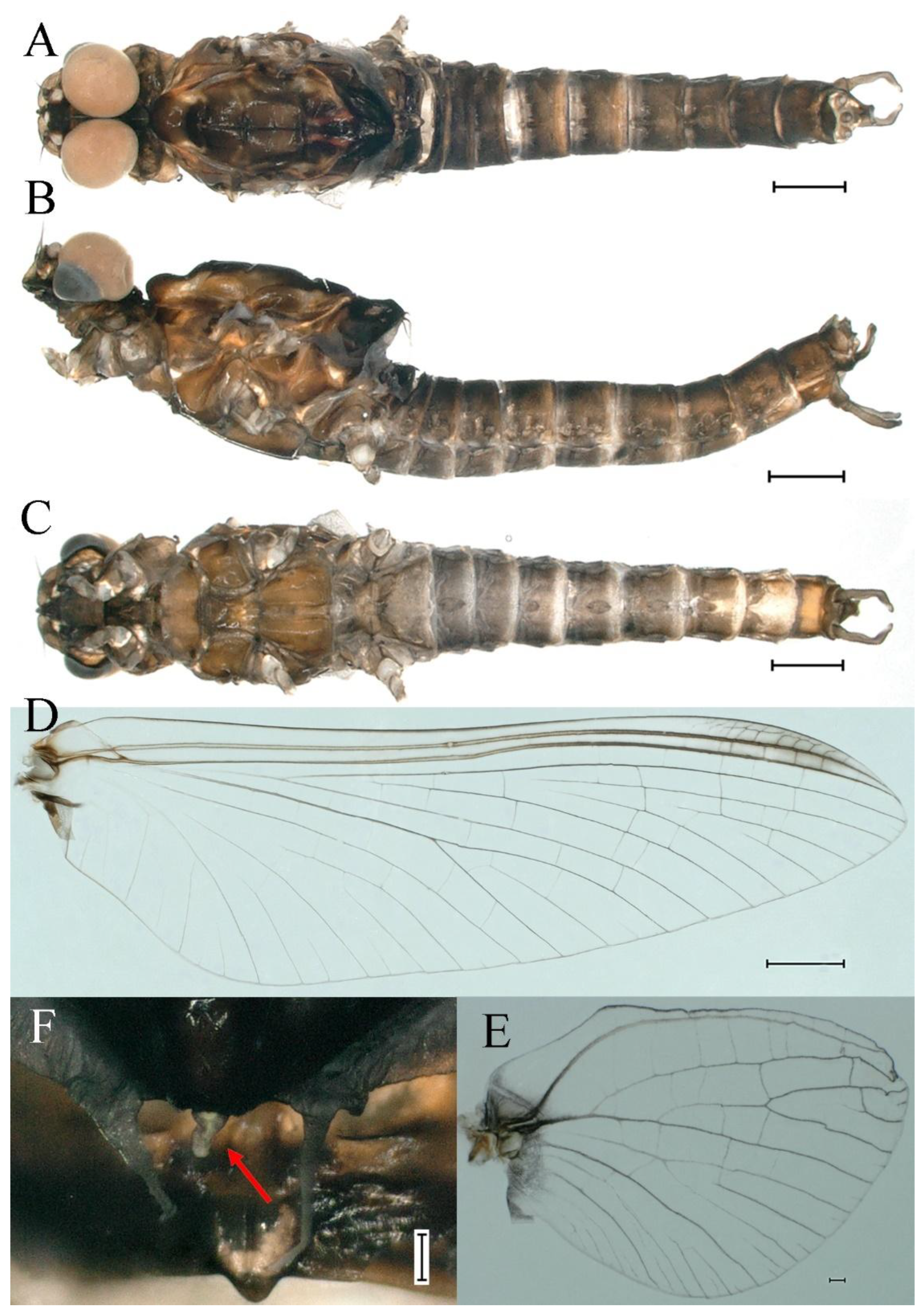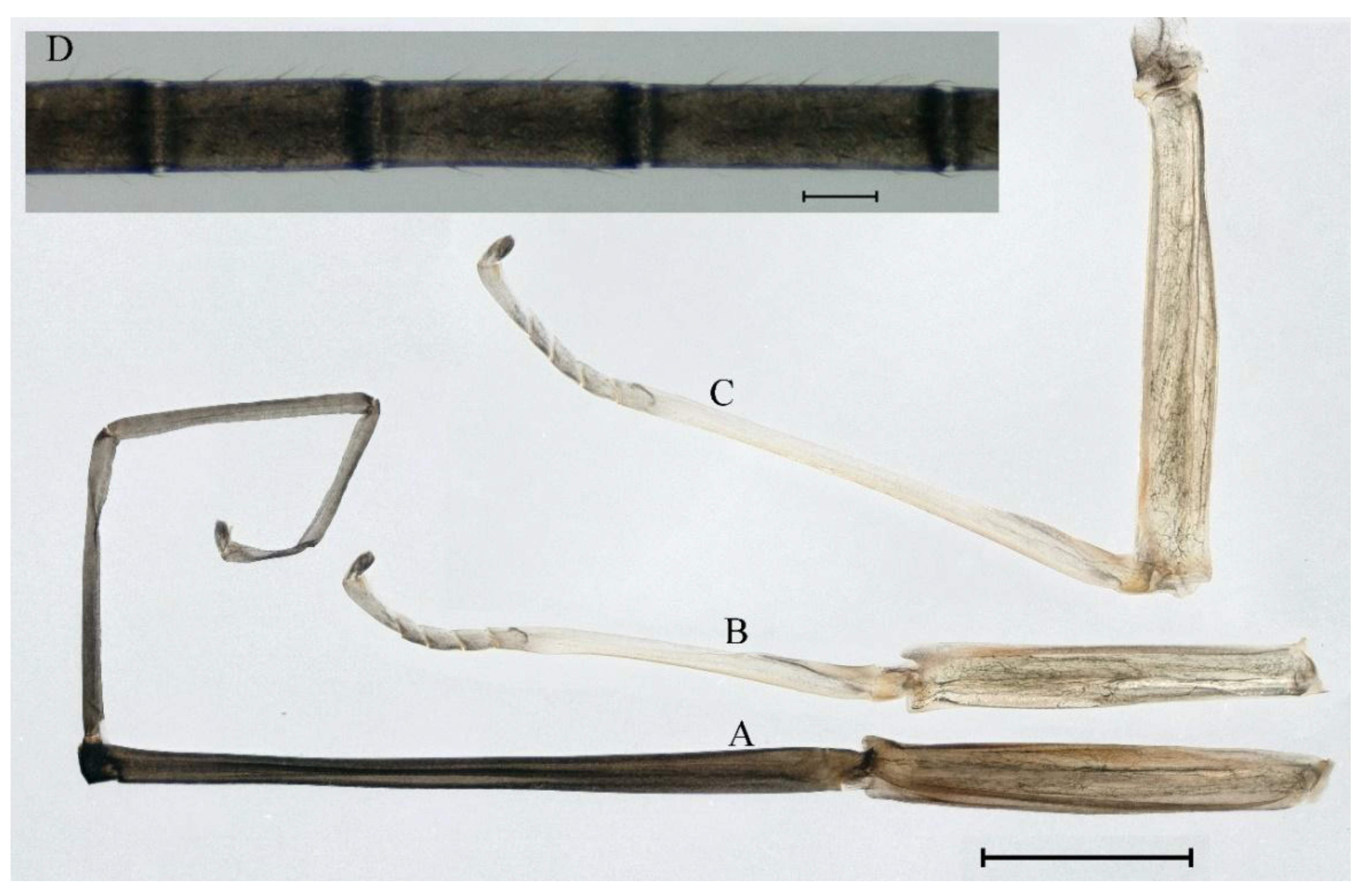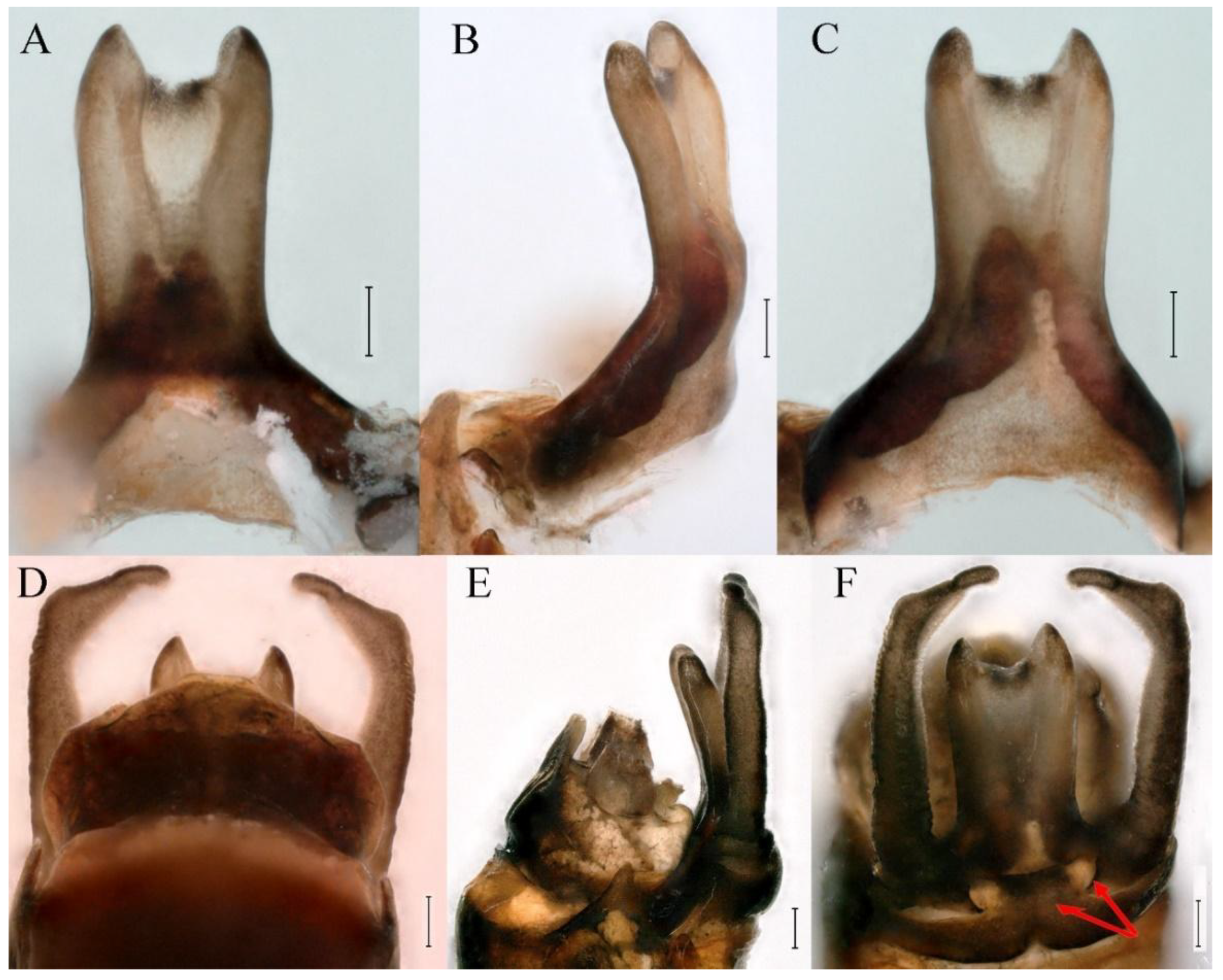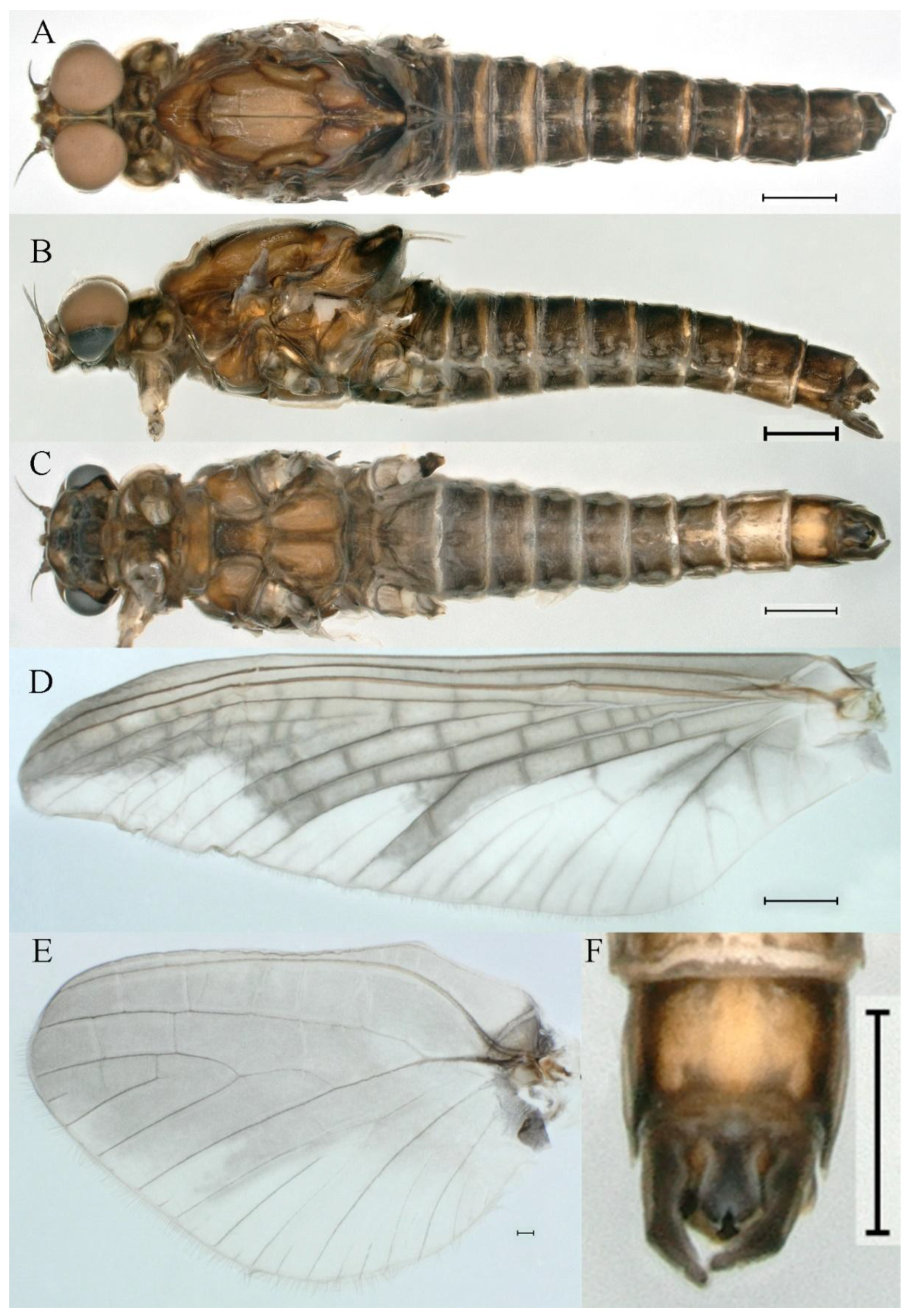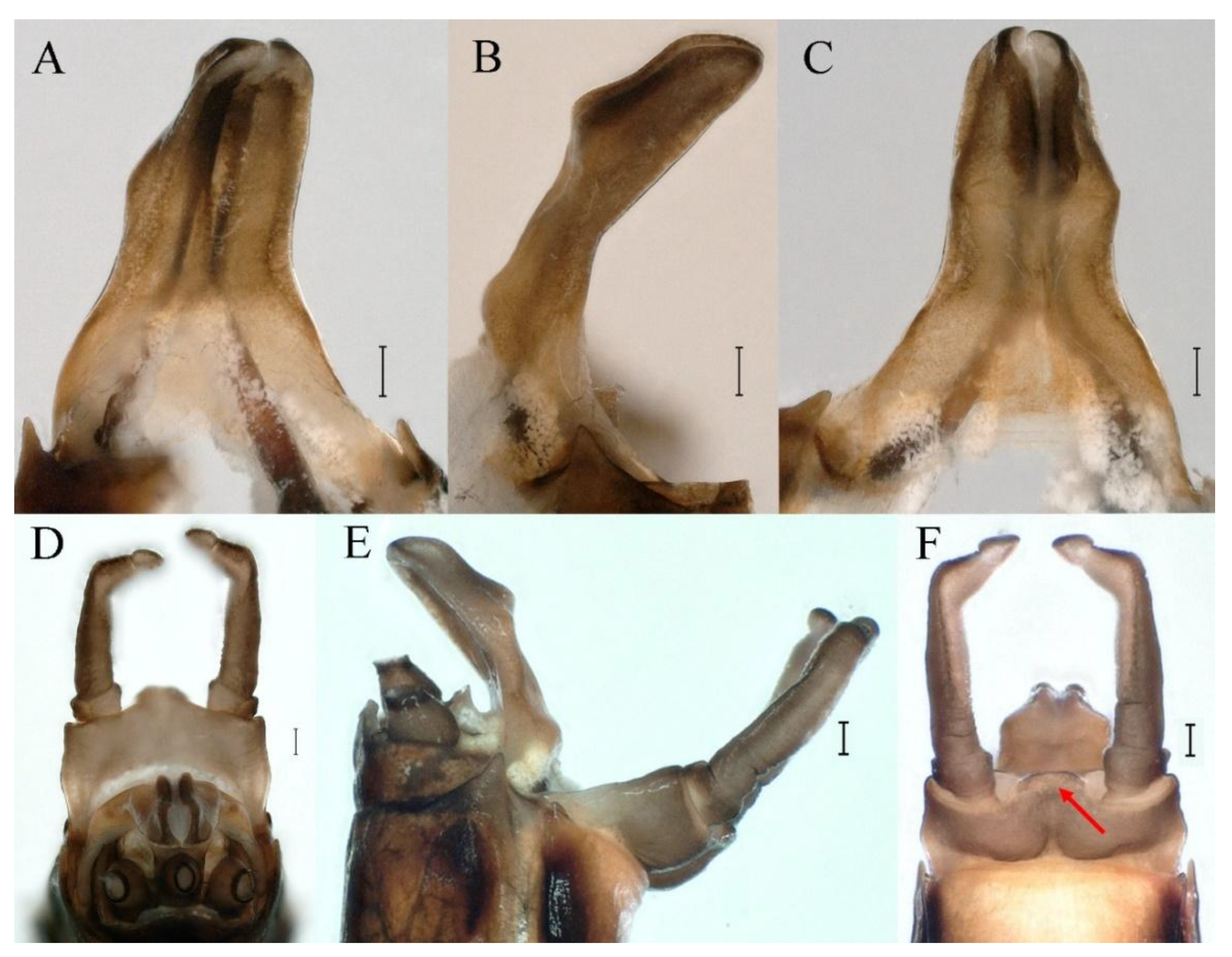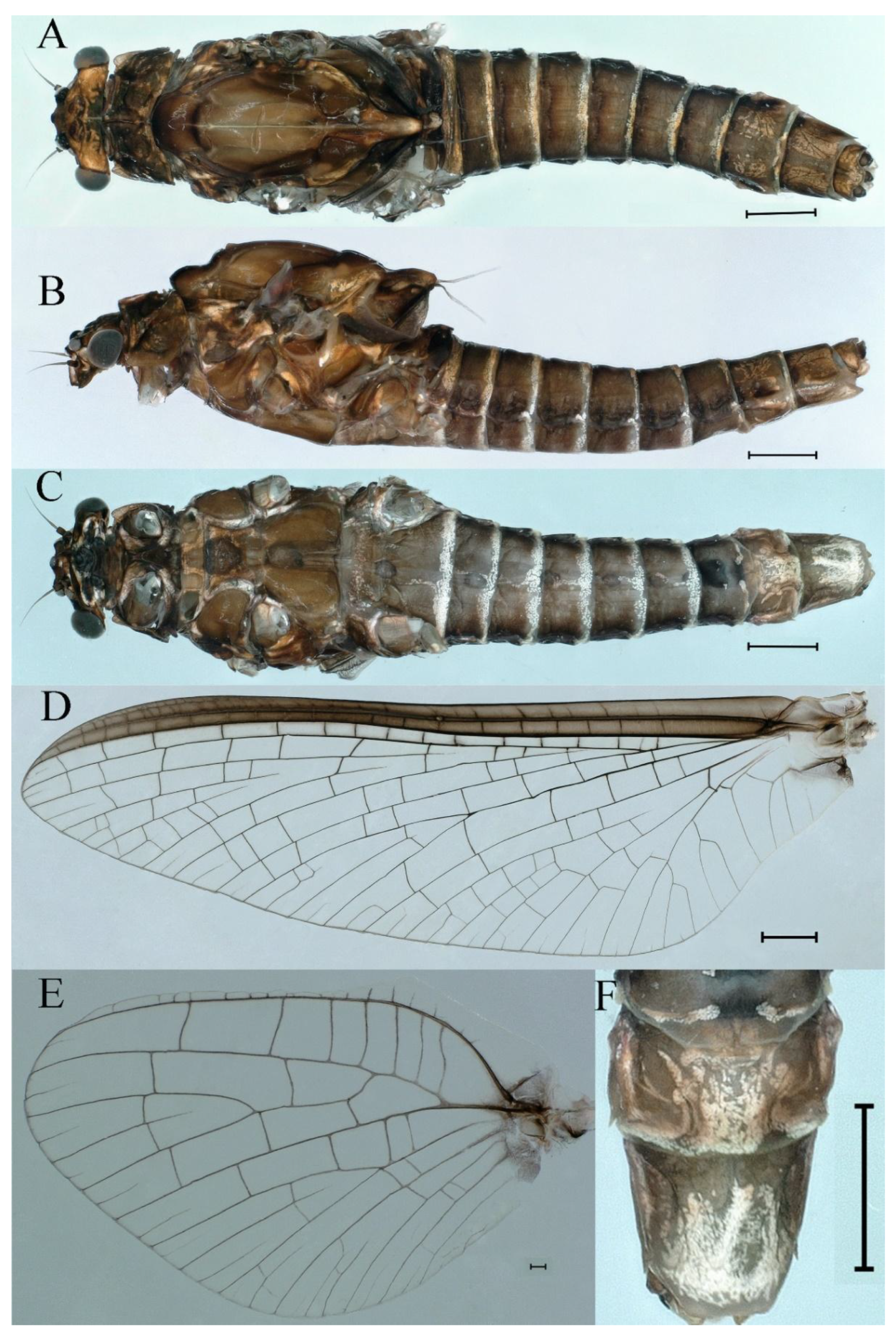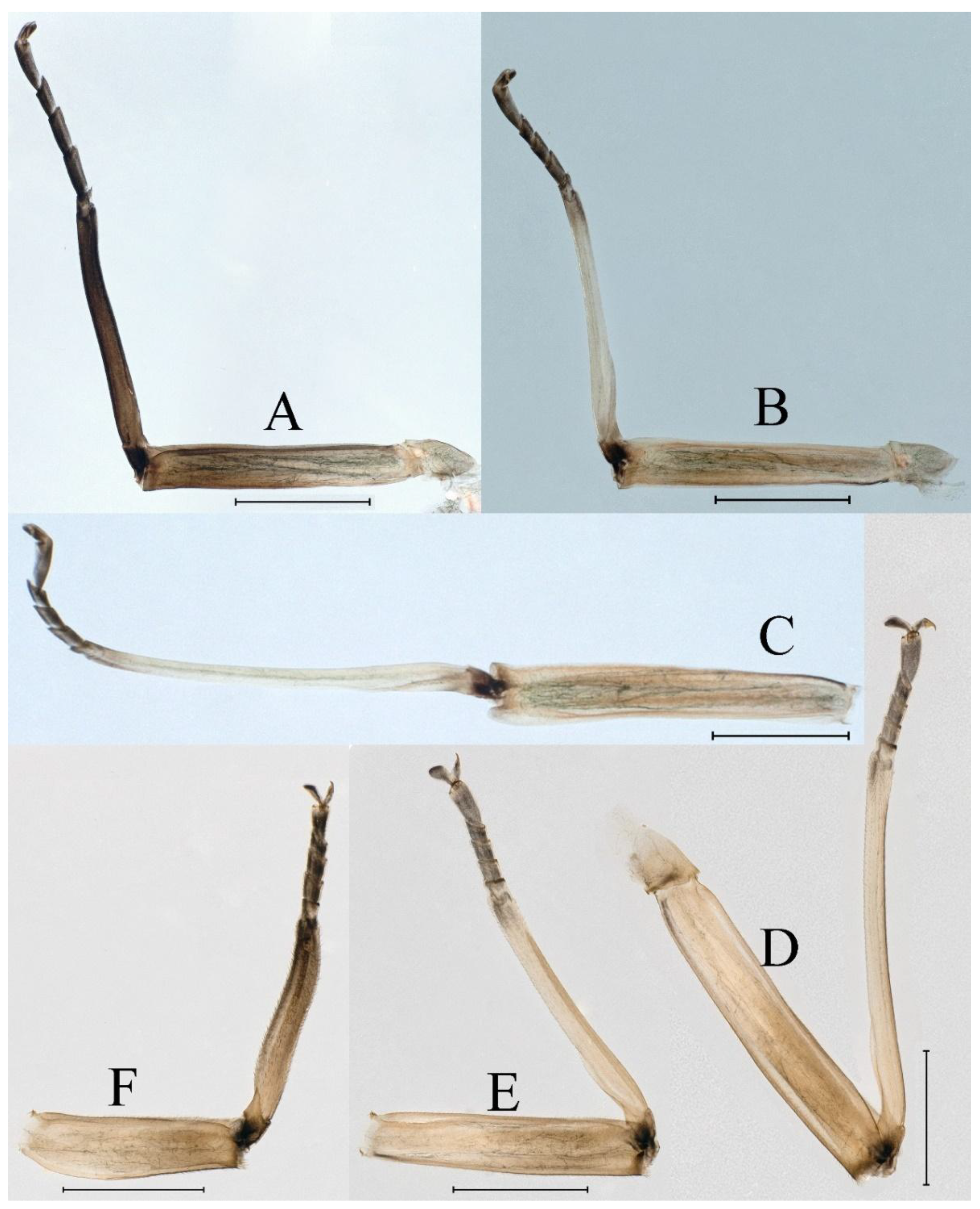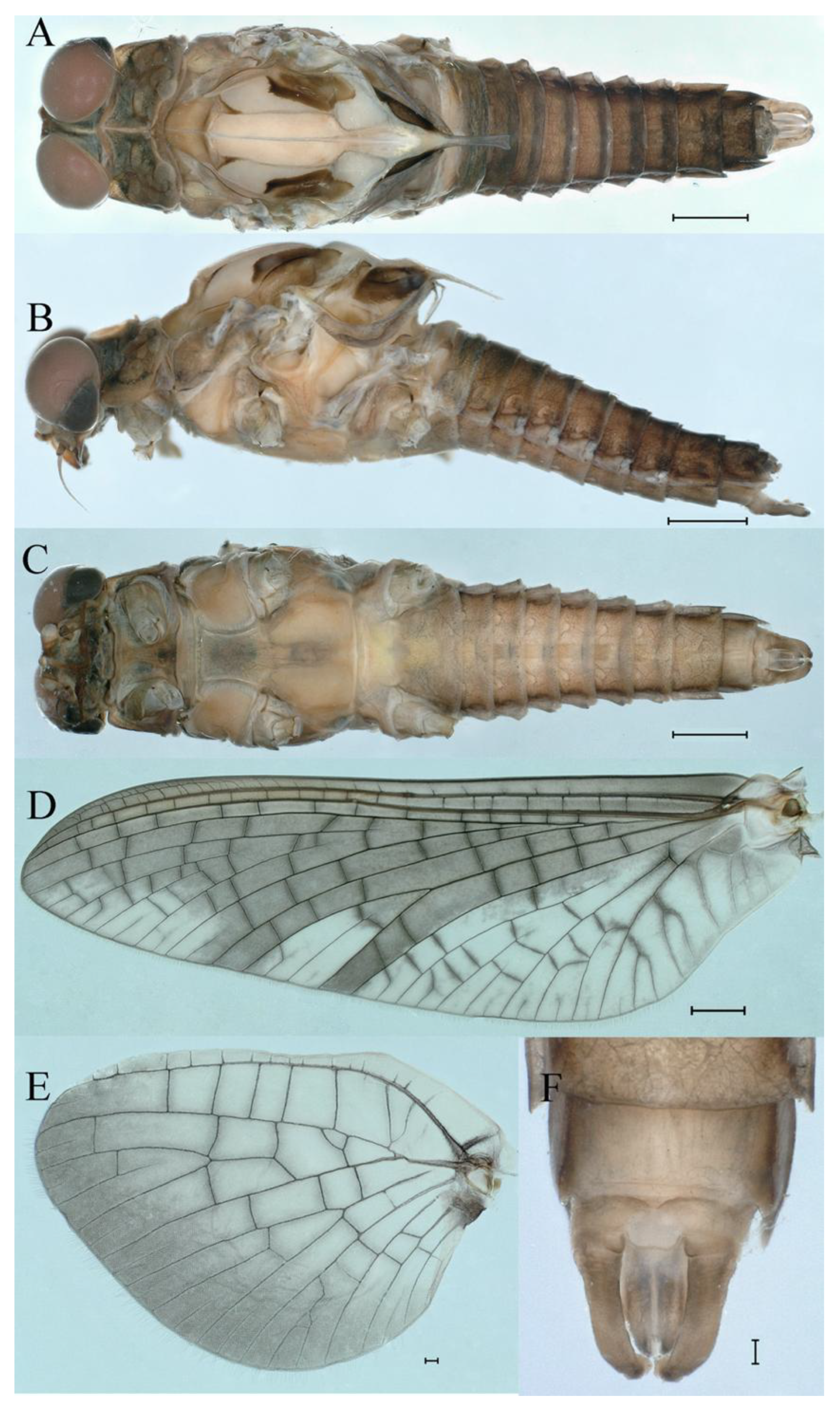
Two New Species and First Stage Associations for Two Other Species of the Cincticostella nigra (Uéno, 1928) Complex (Ephemeroptera, Ephemerellidae) from Yunnan, China, with Discussion About Cincticostella Allen, 1971 Species Complexes Based on Winged Stages †
 , and
, and
Simple Summary
Abstract
1. Introduction
2. Materials and Methods
2.1. Specimen Sampling, Morphological Observation, and Storage
2.2. Molecular Study
3. Results
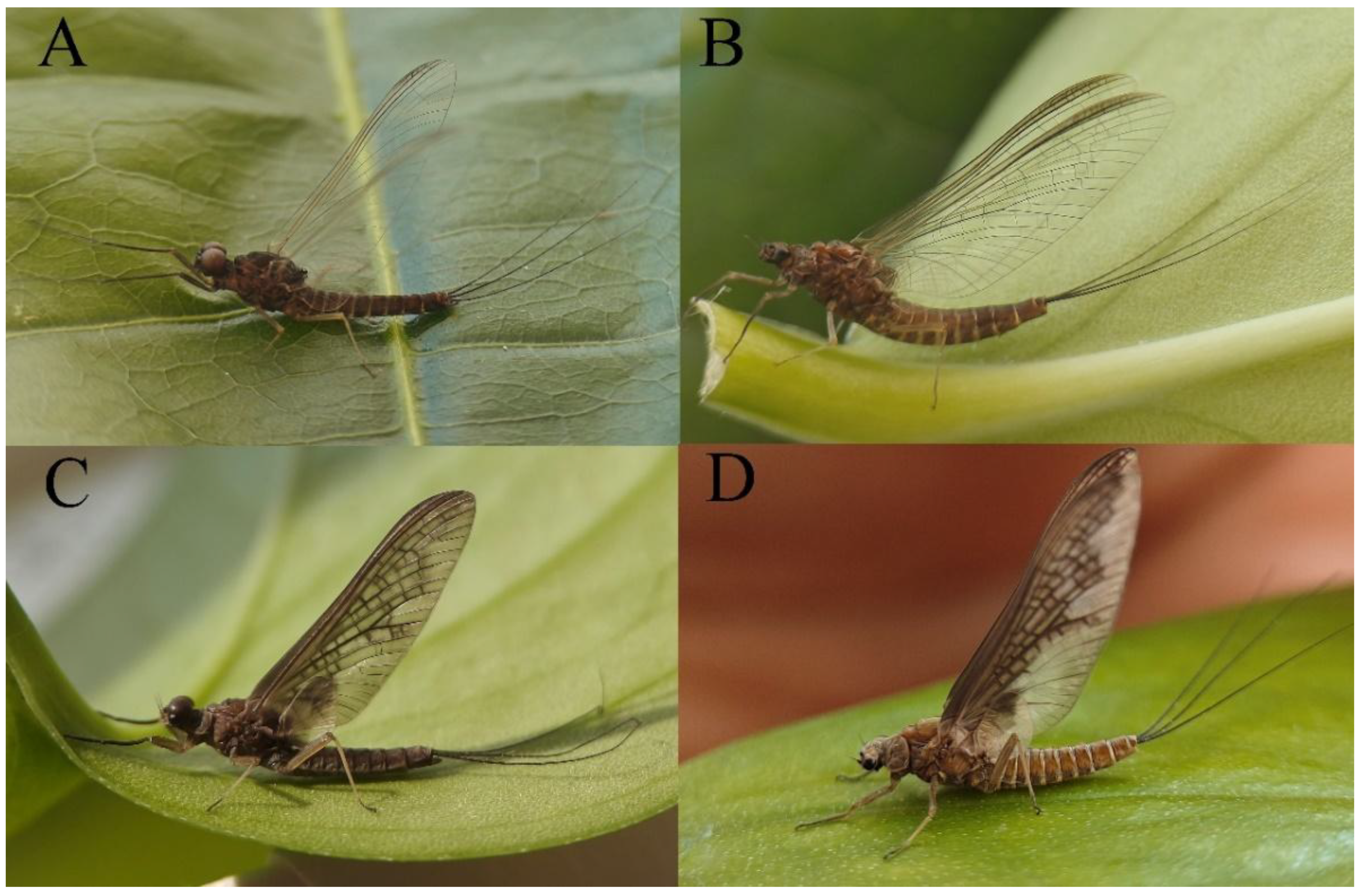
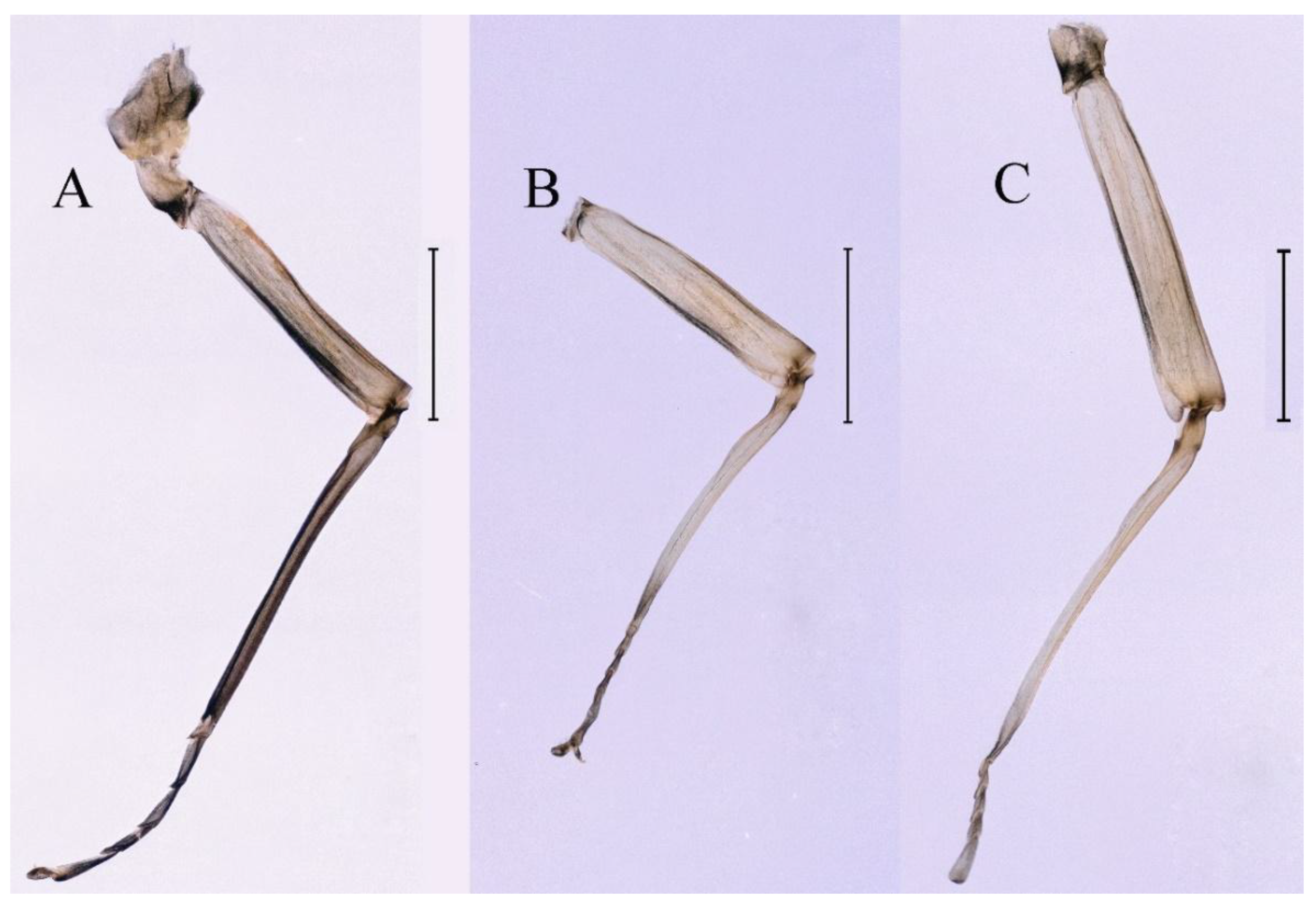
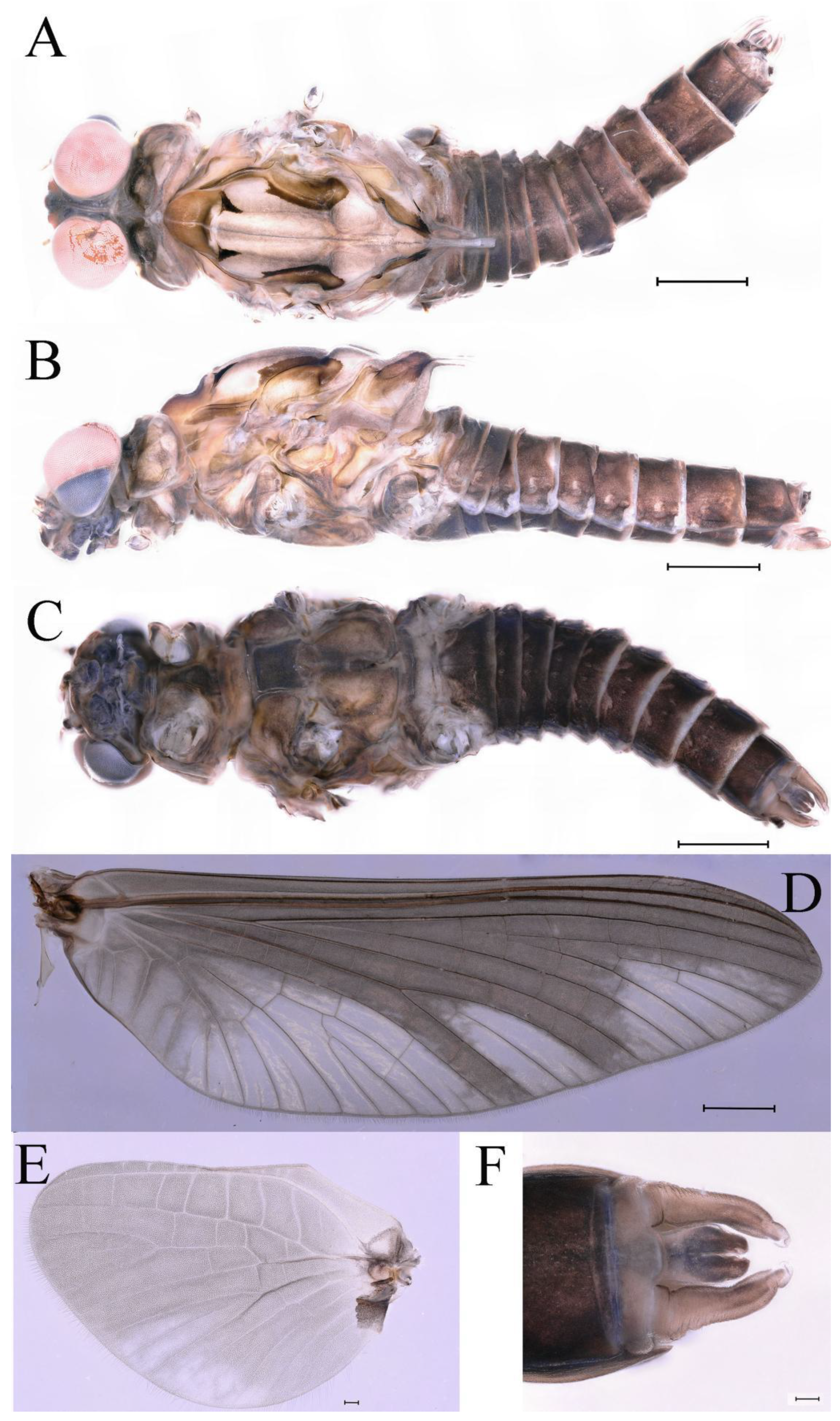
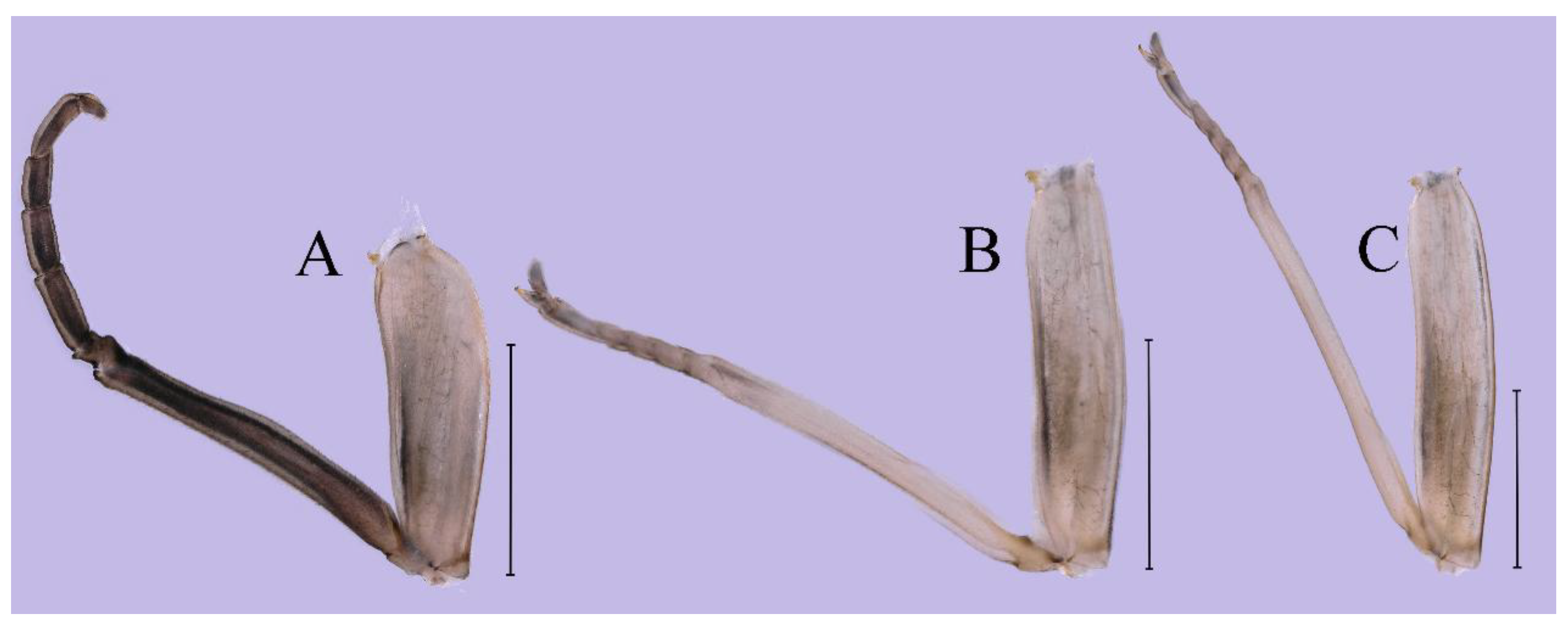
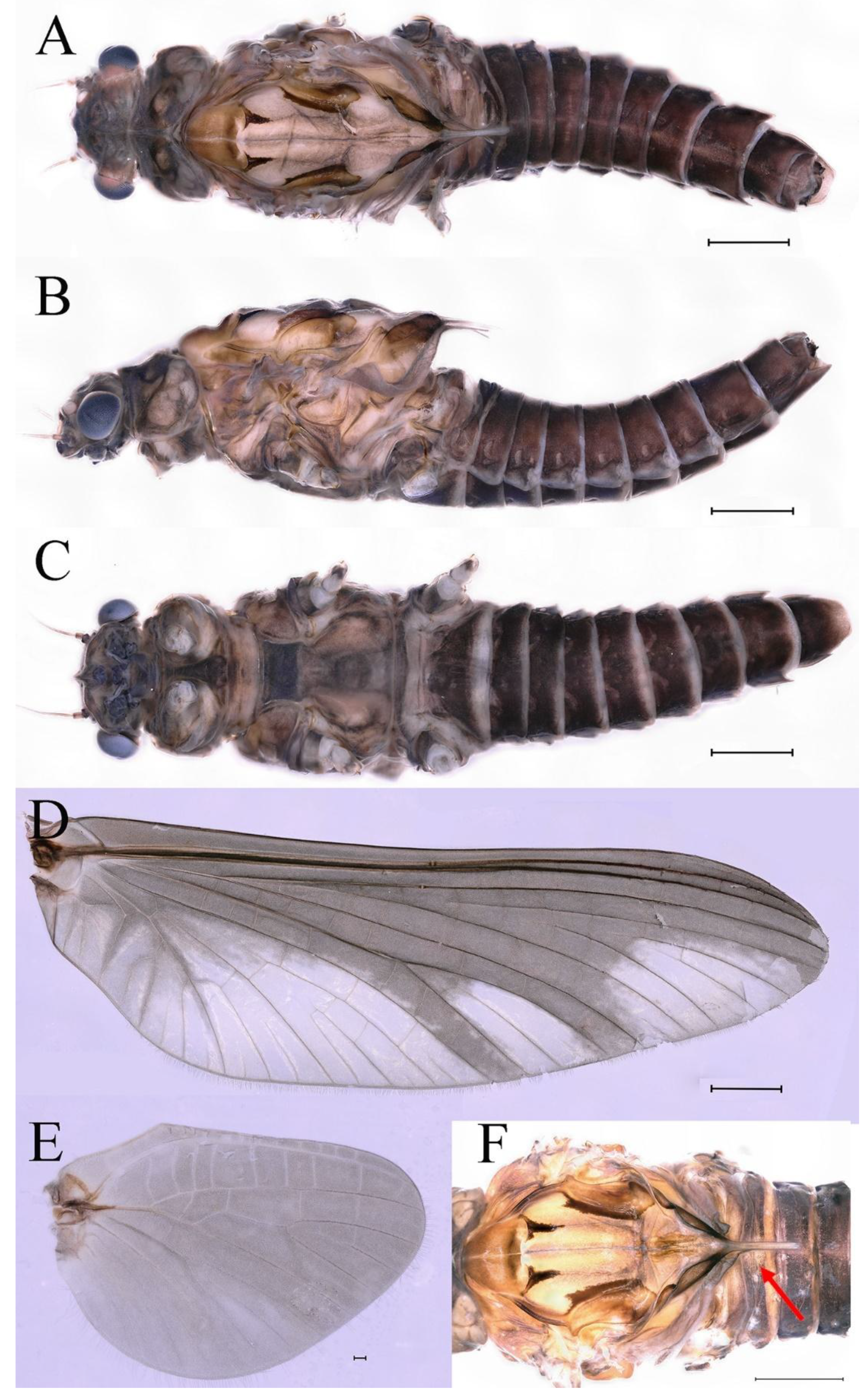
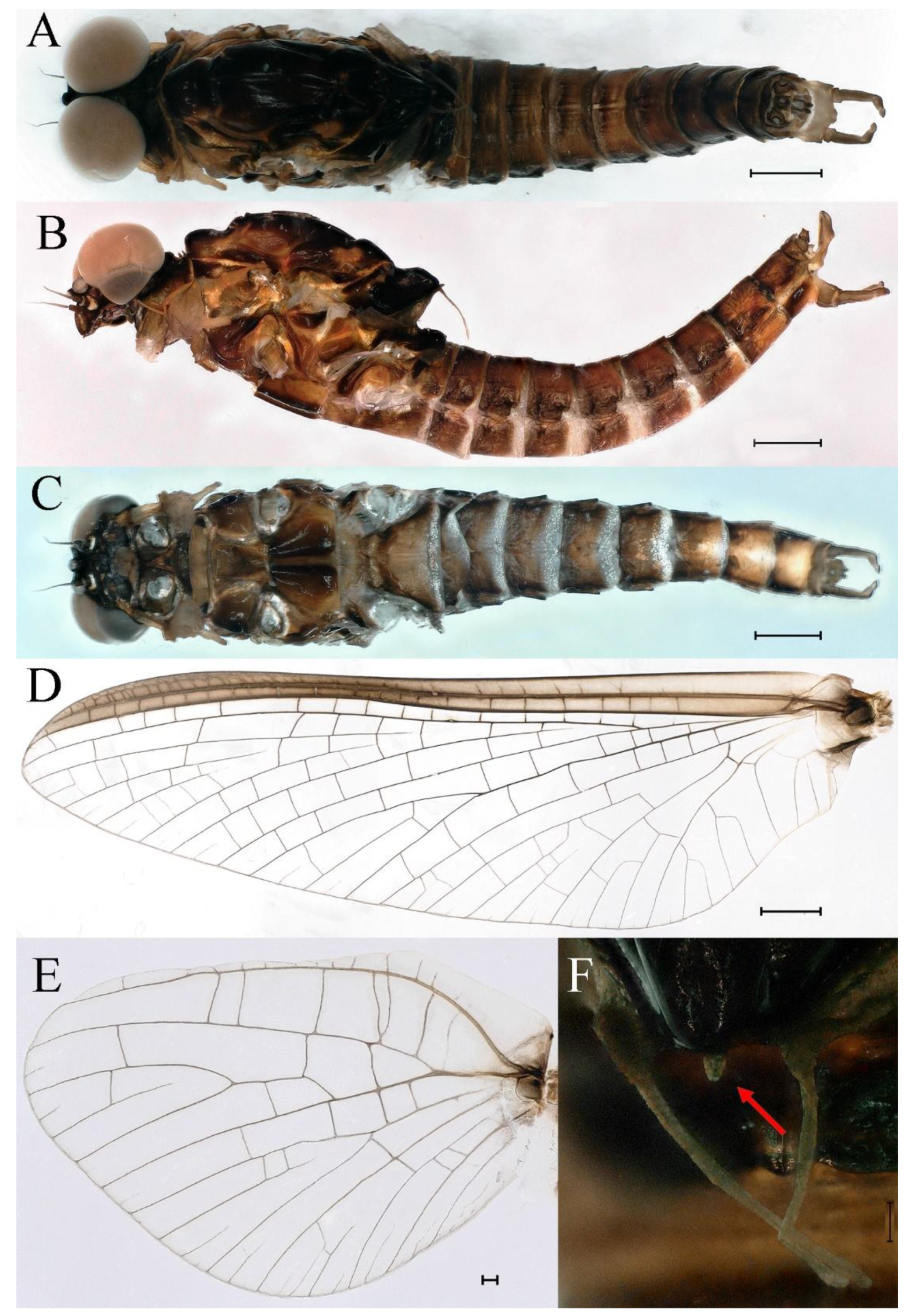
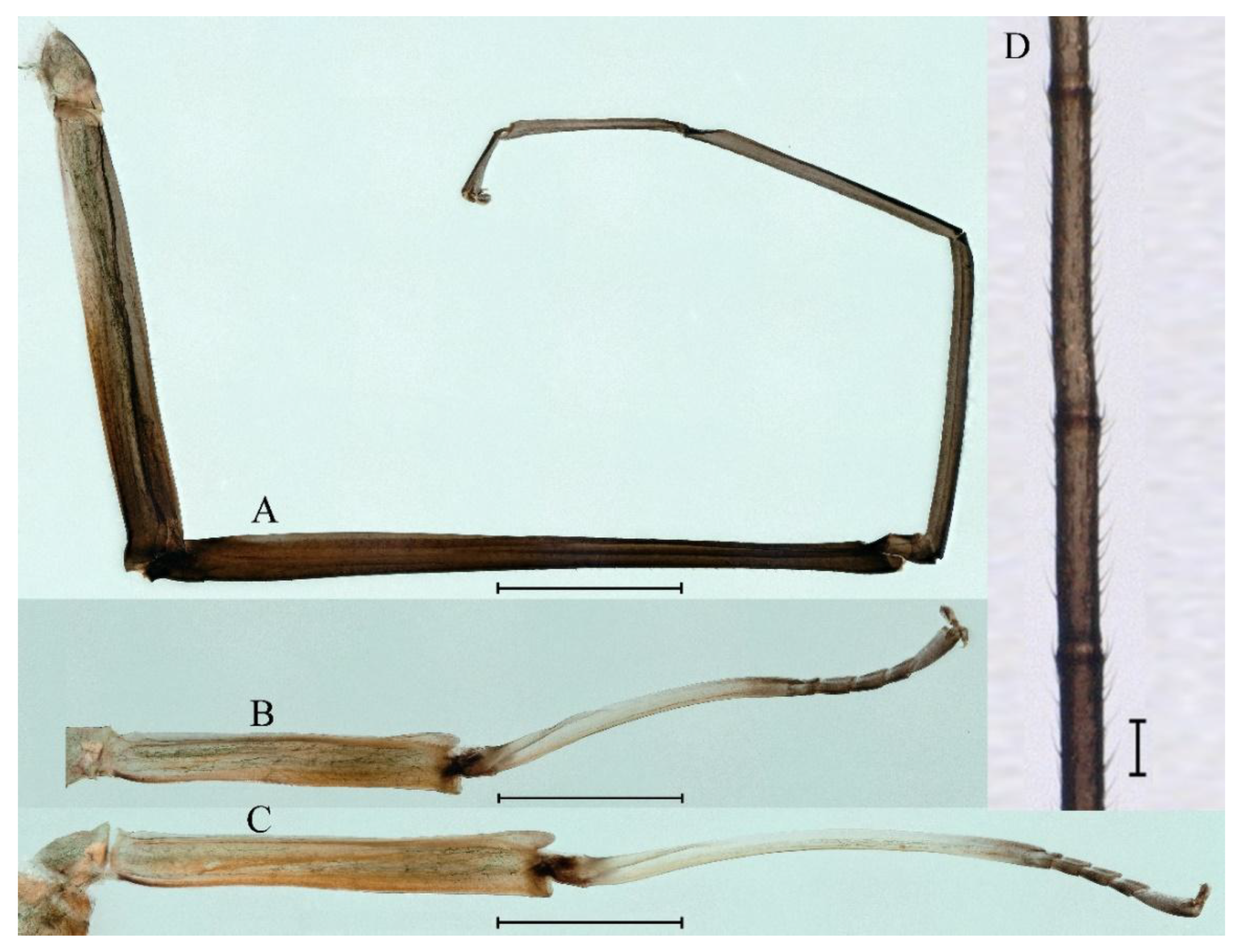
3.1. Cincticostella wangi Selvakumar, Martynov & Subramanian, 2021
3.2. Cincticostella funki Martynov, Selvakumar, Palatov & Vasanth, 2021
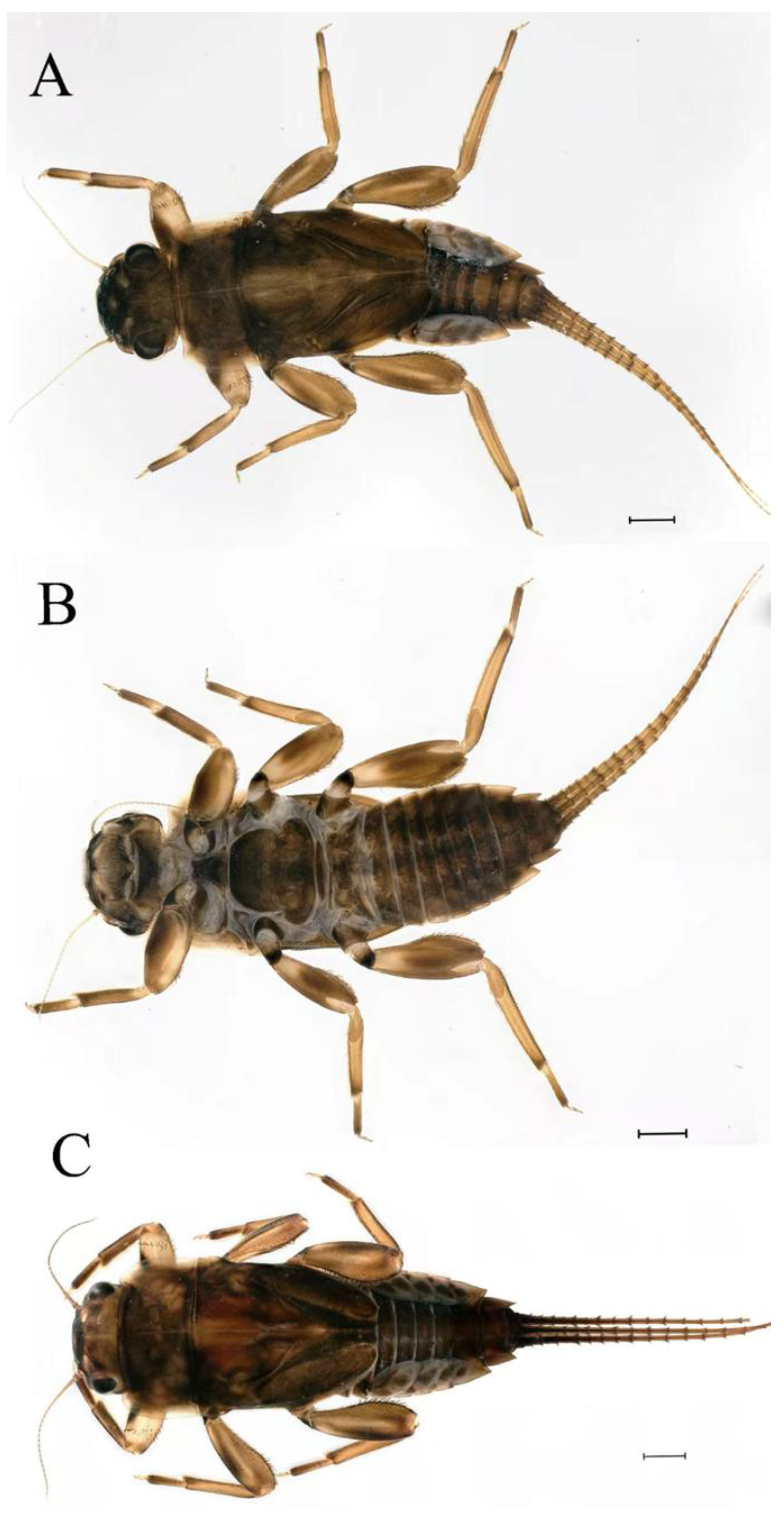
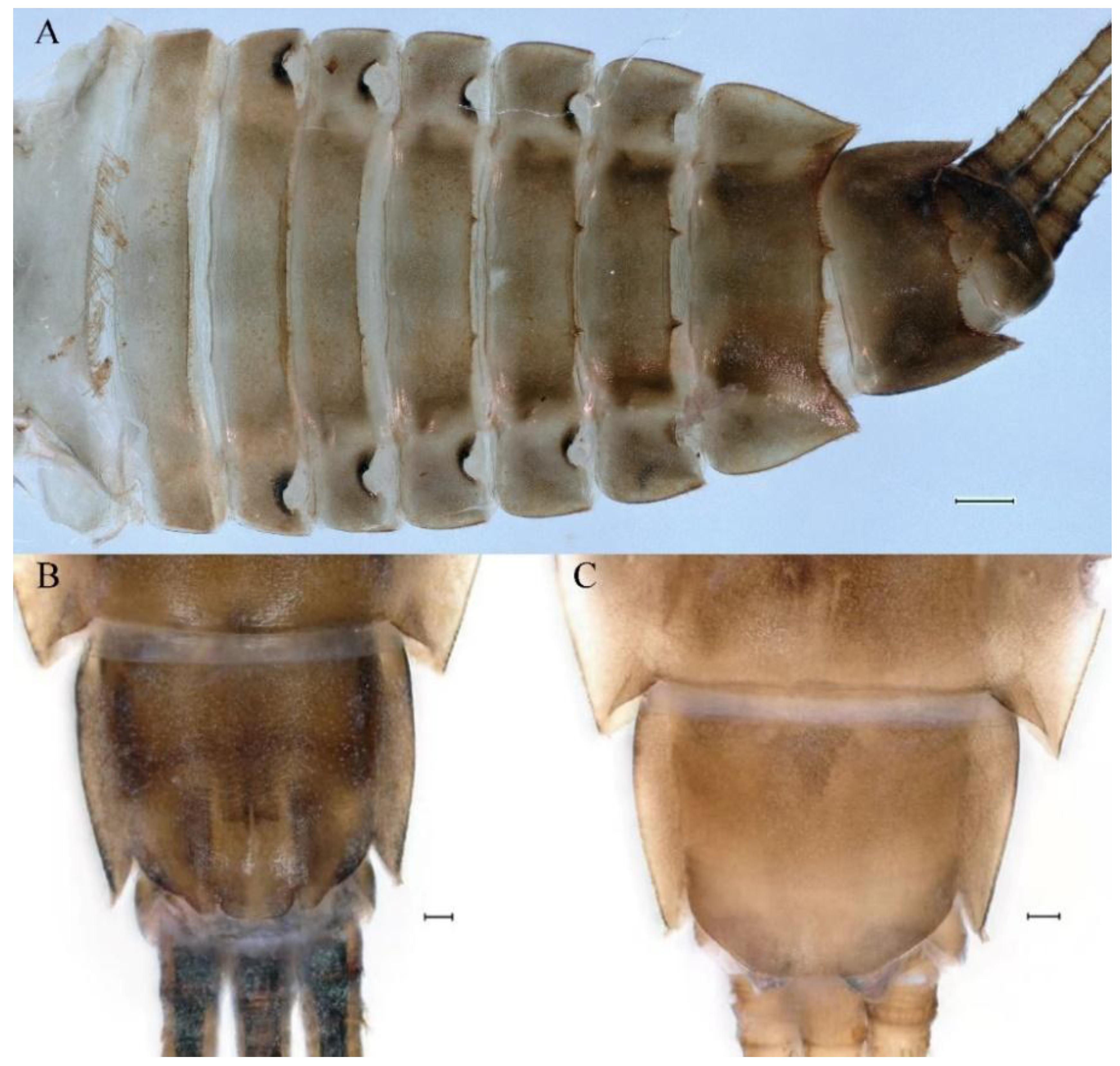
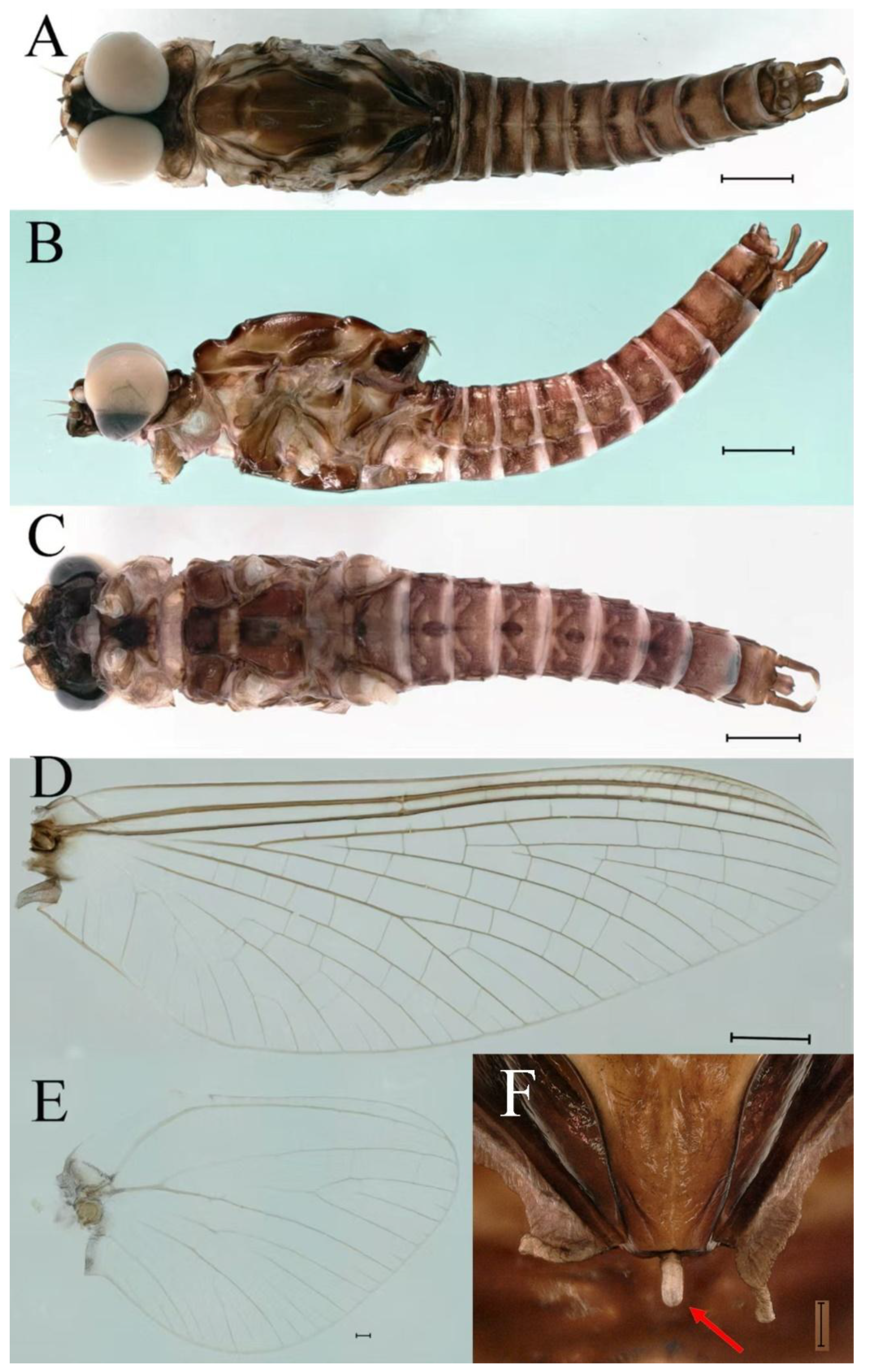
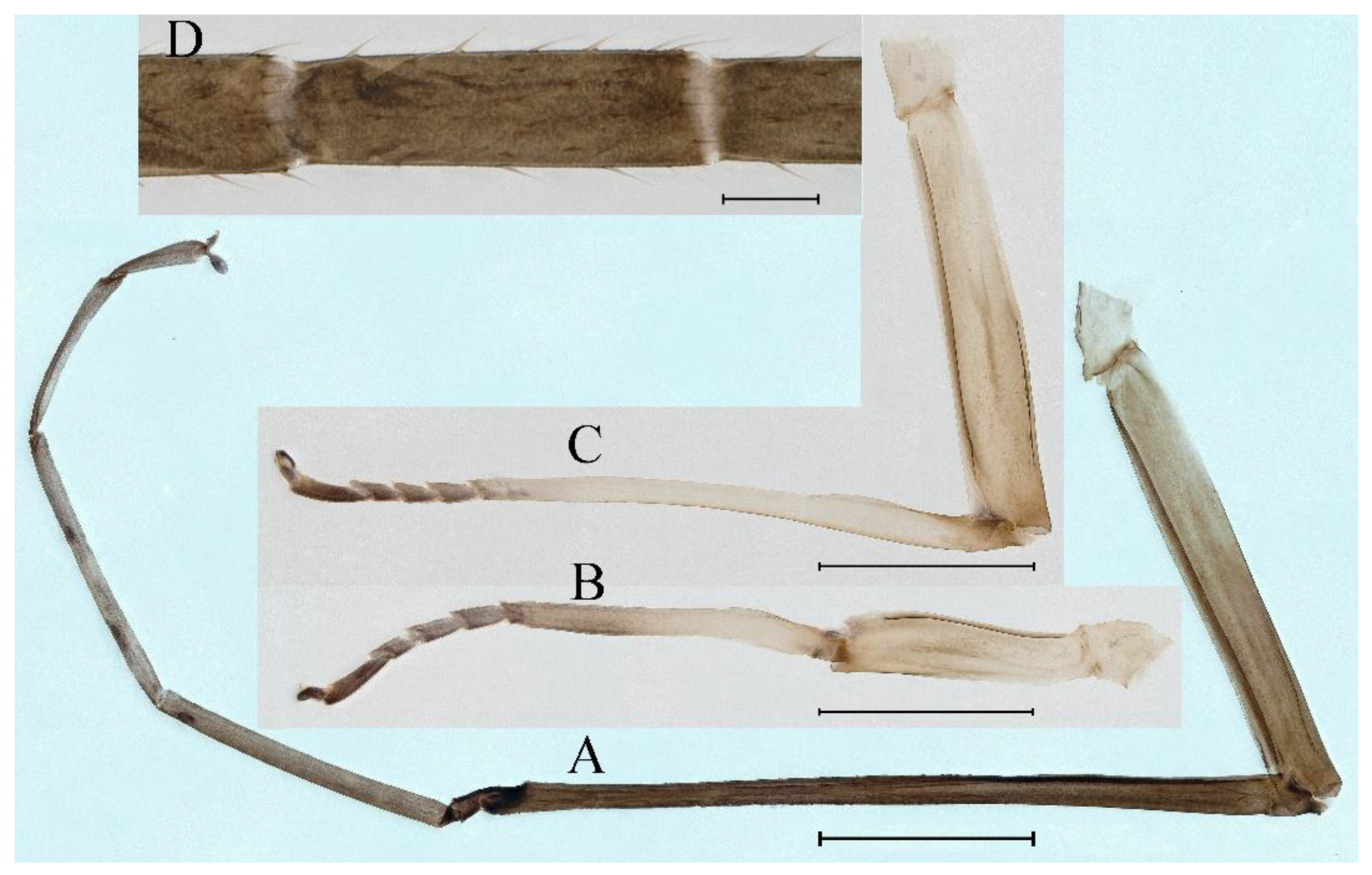
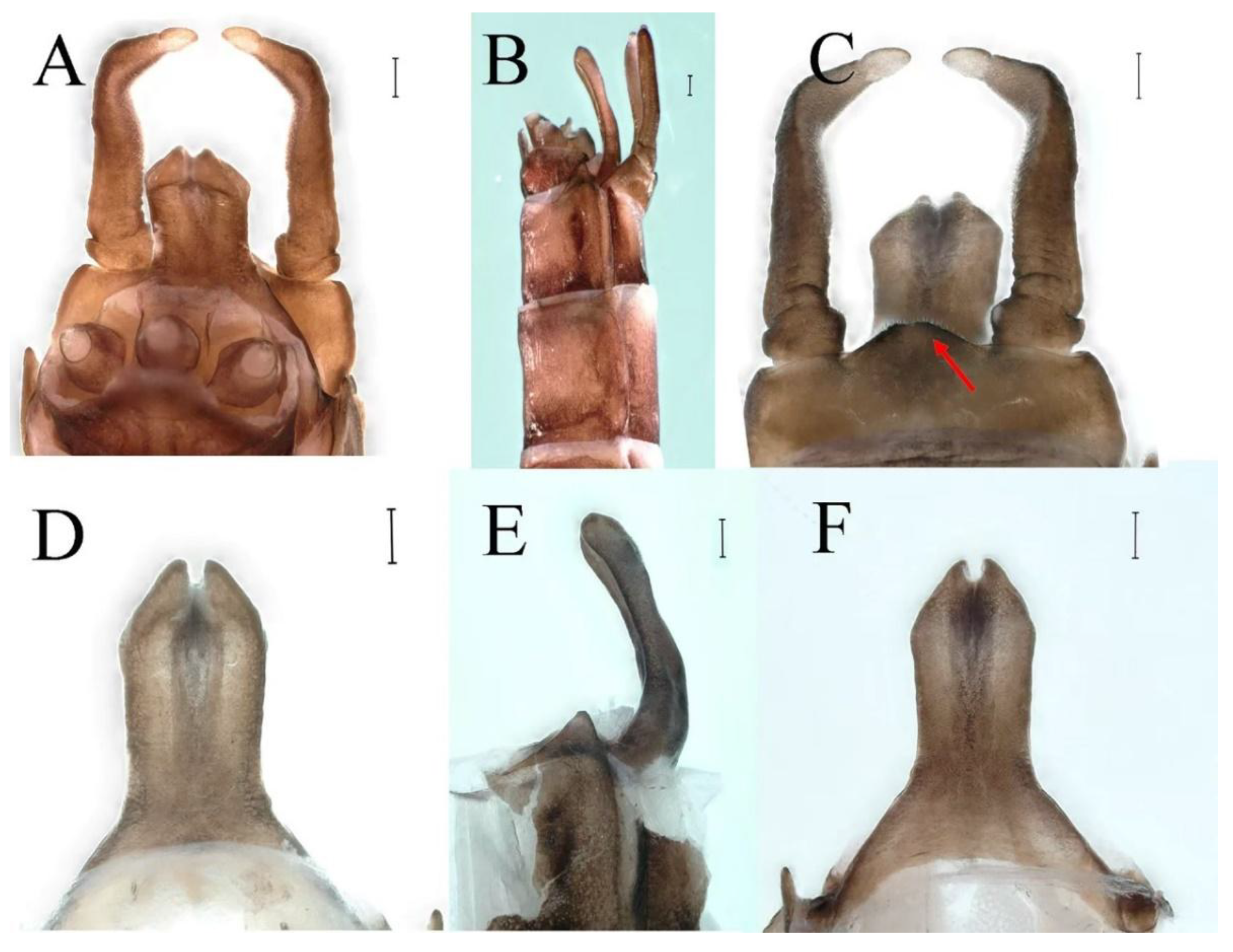
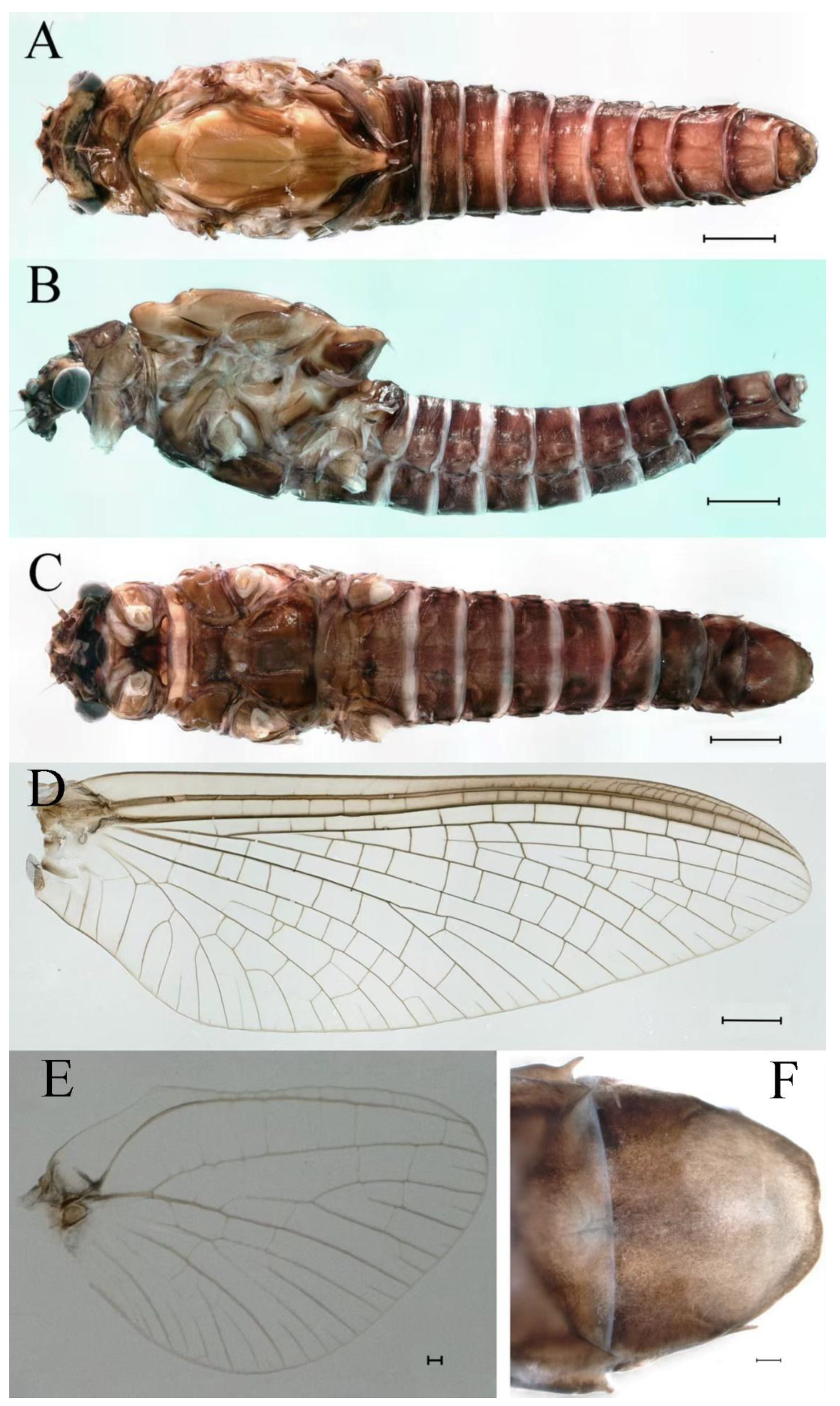
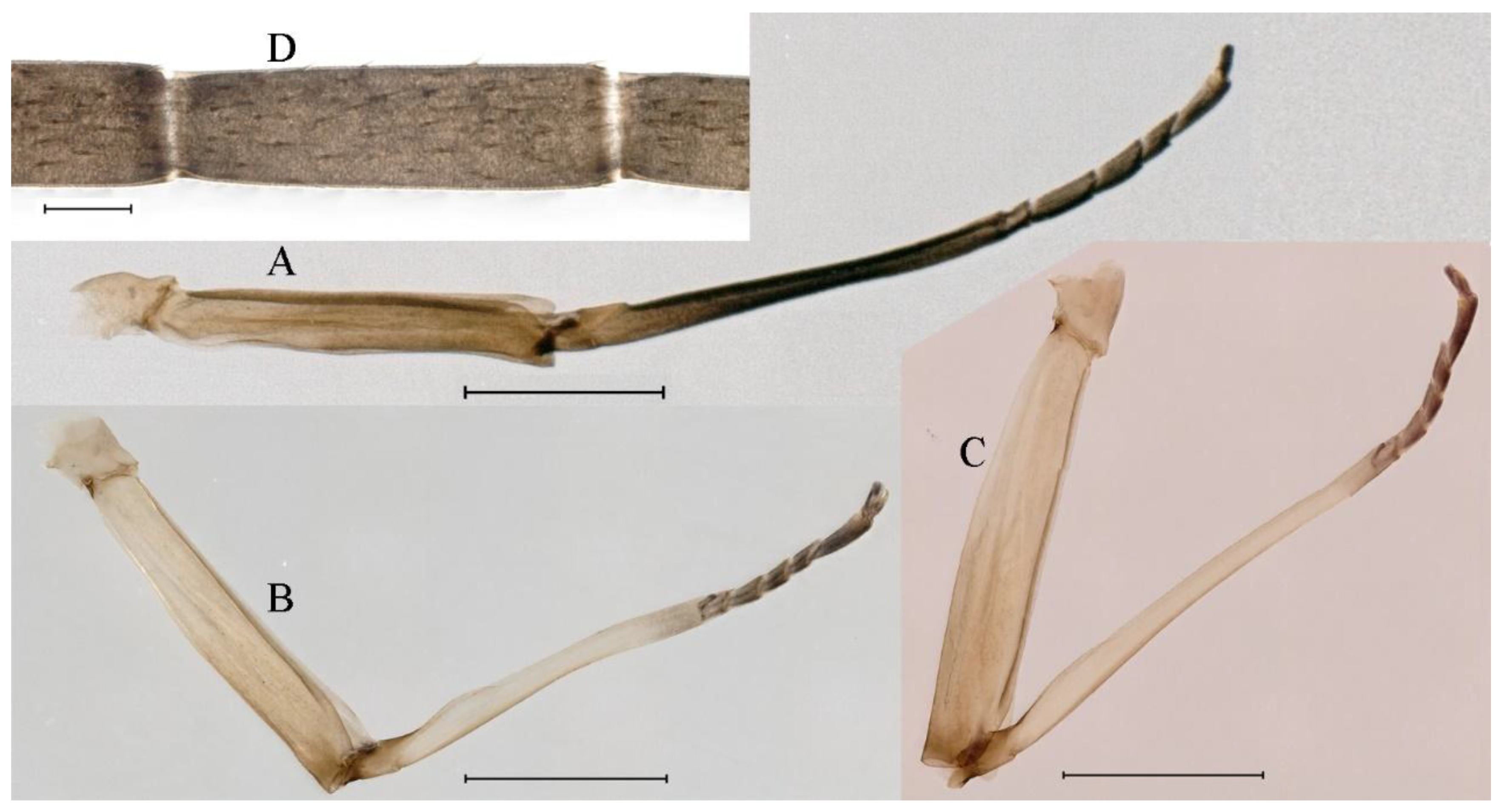
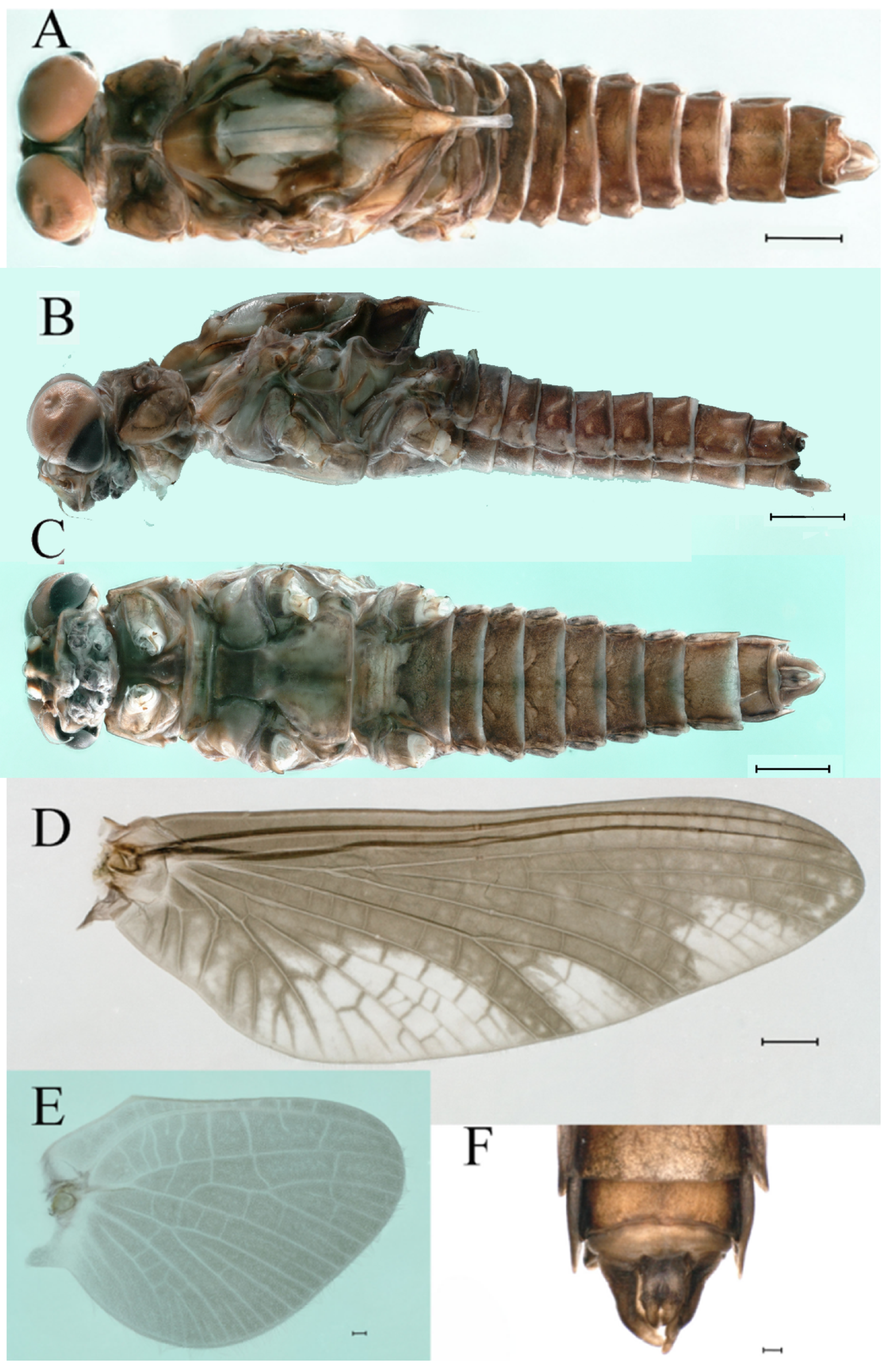
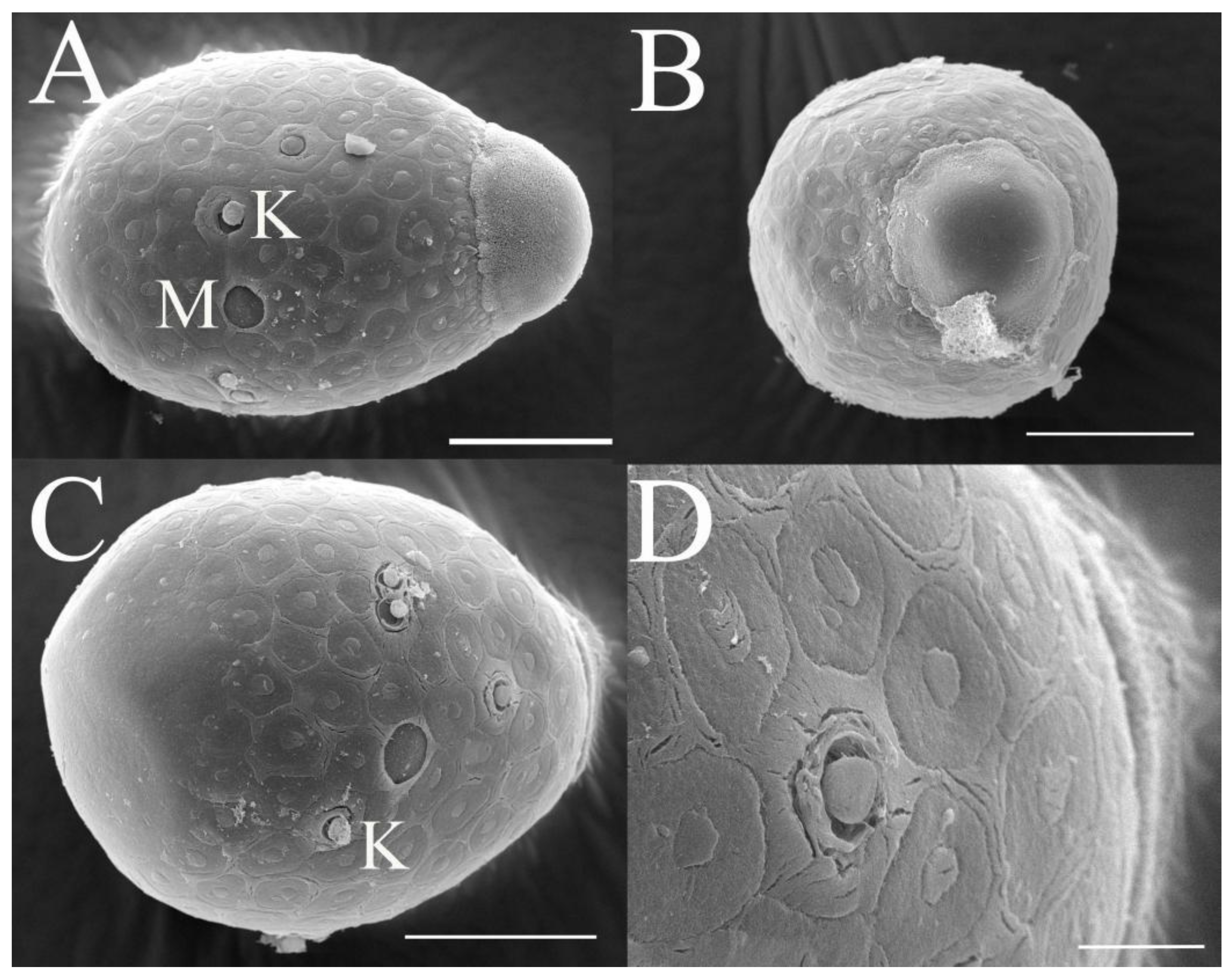
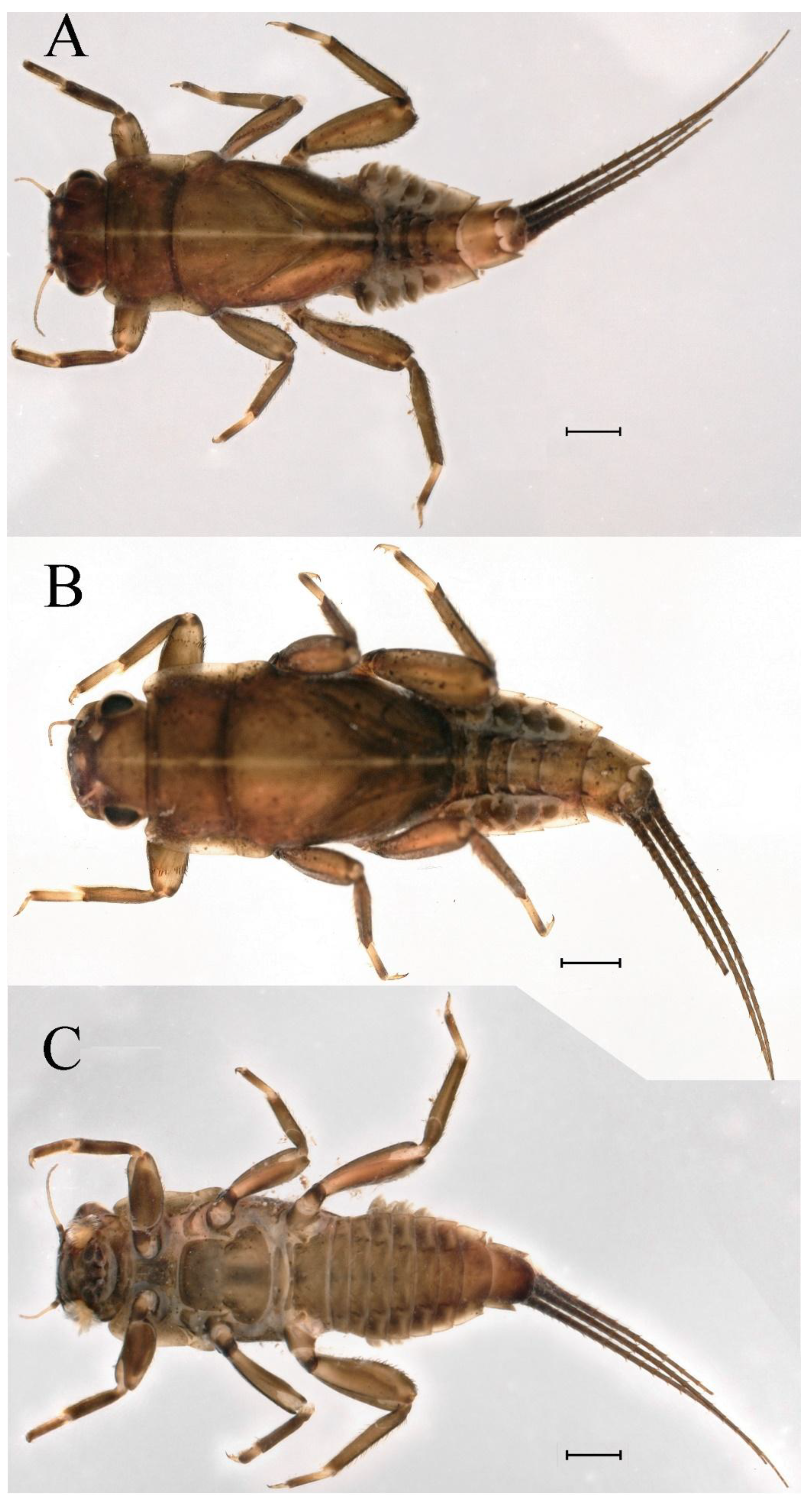
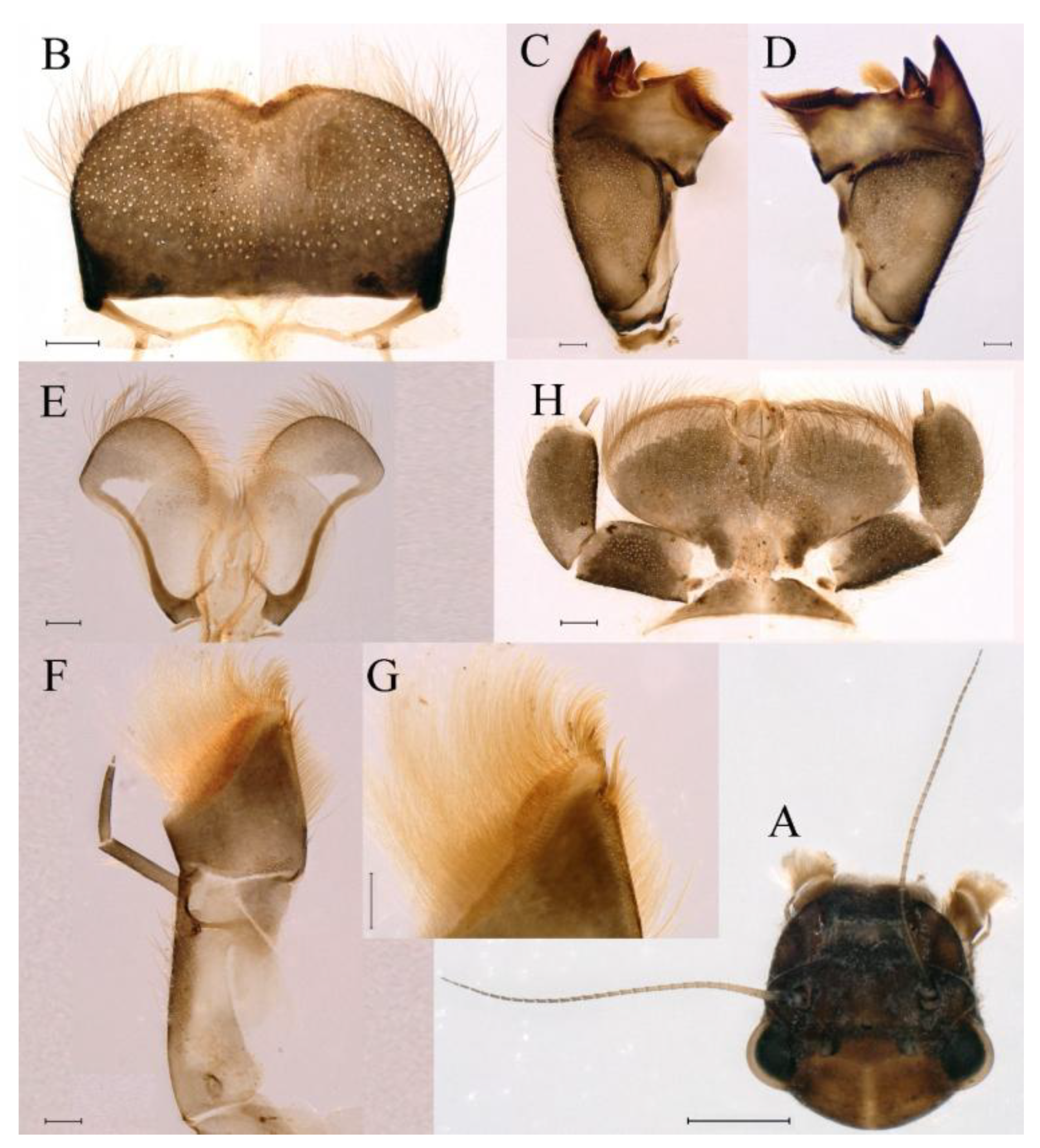
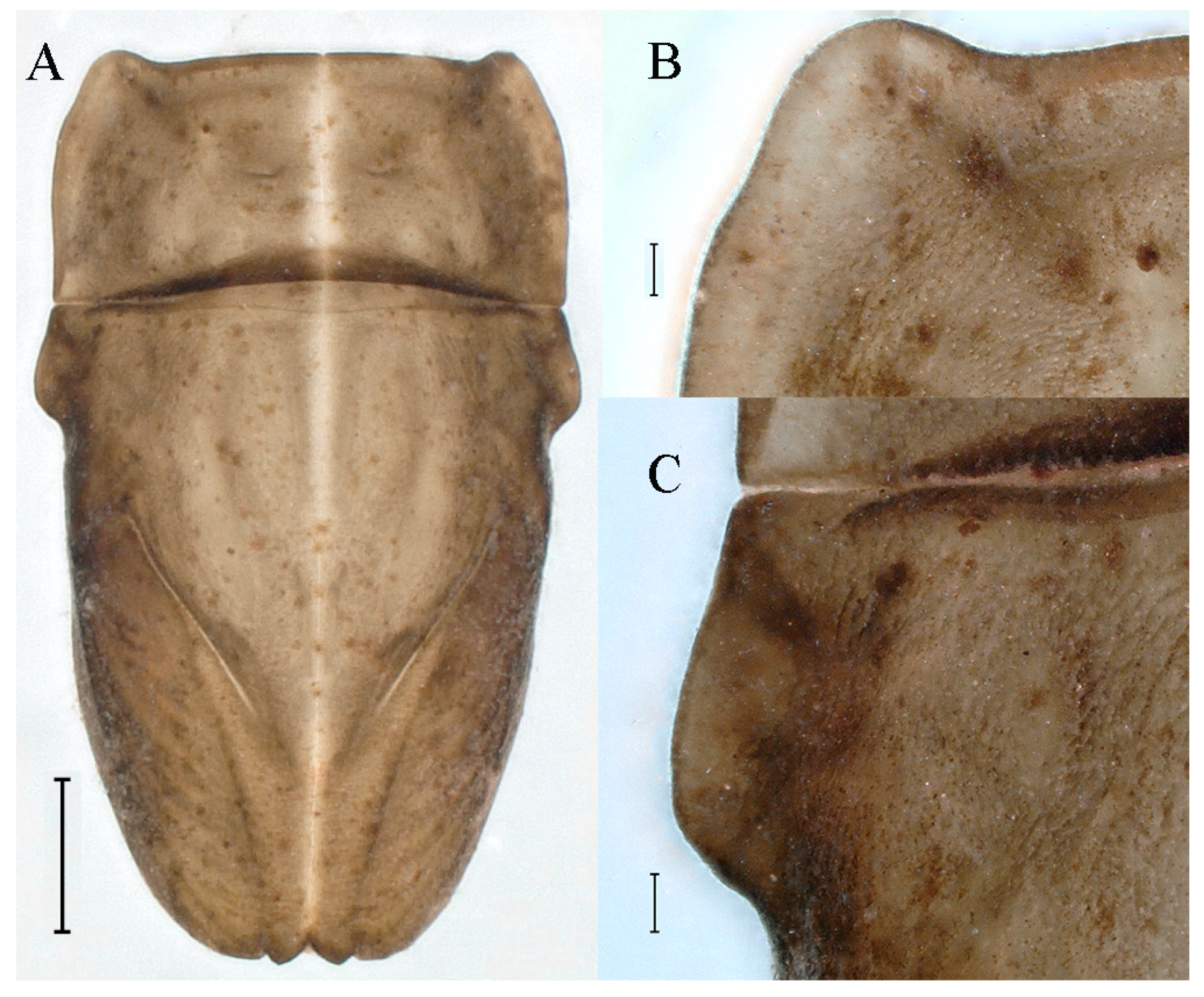
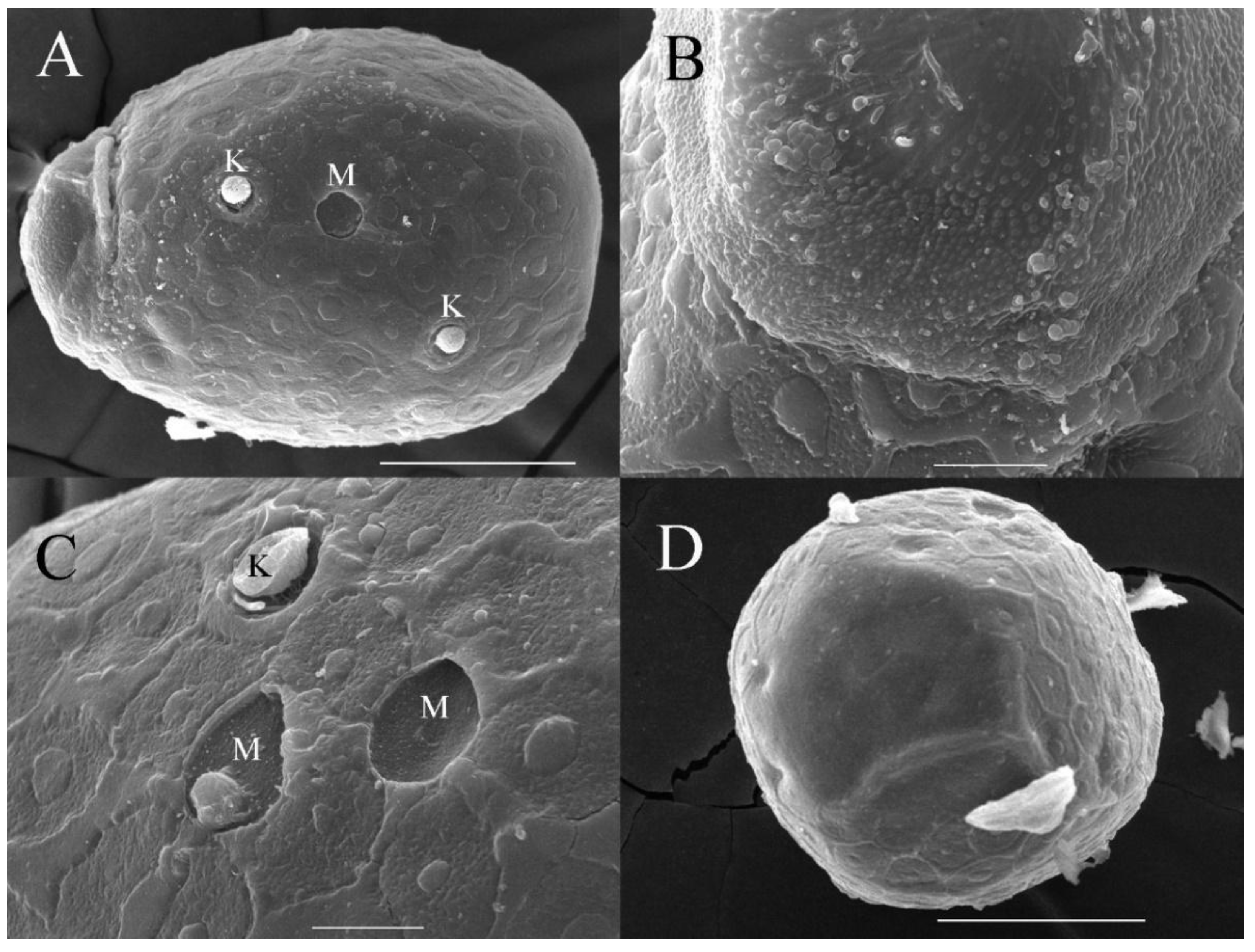
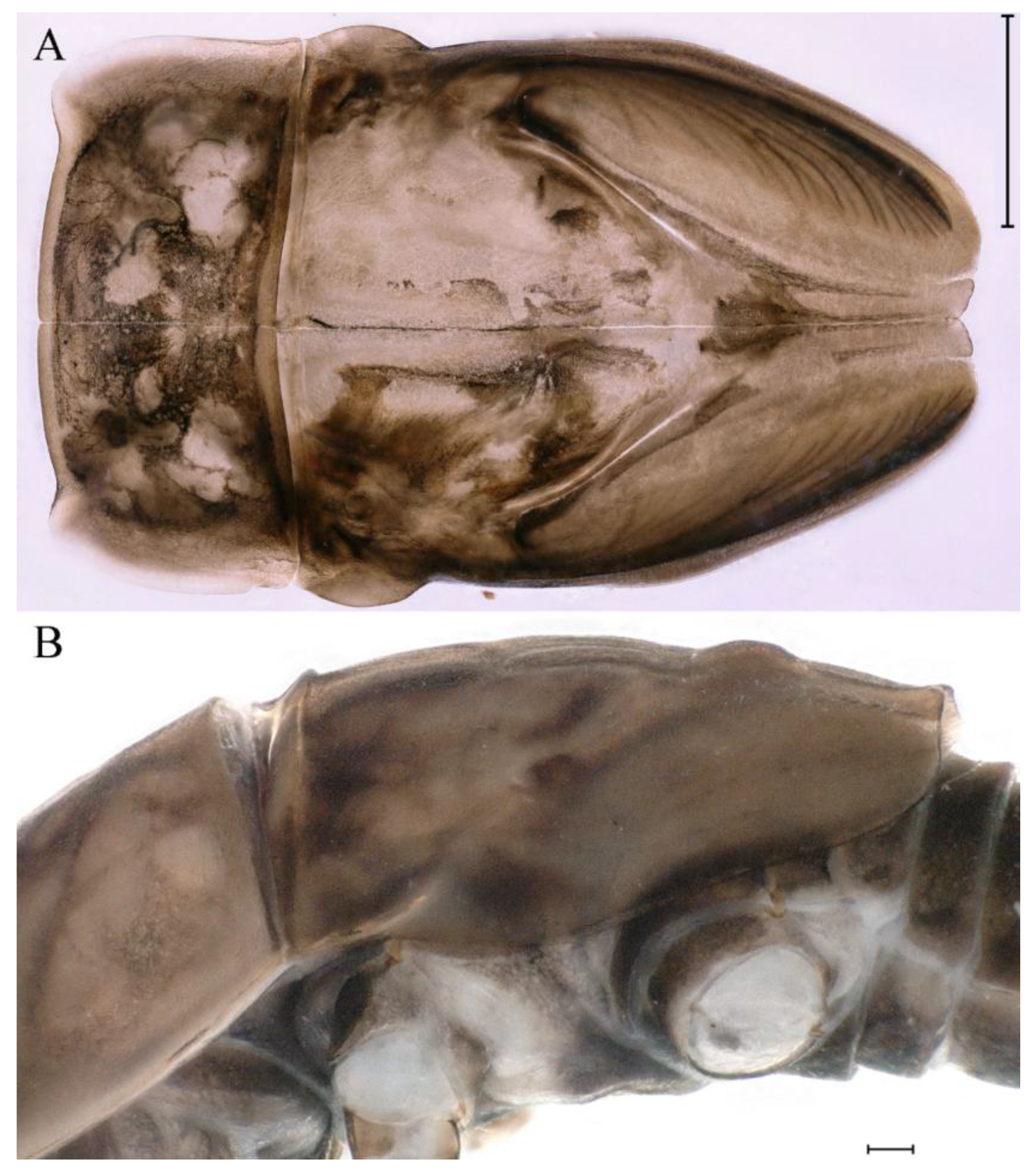
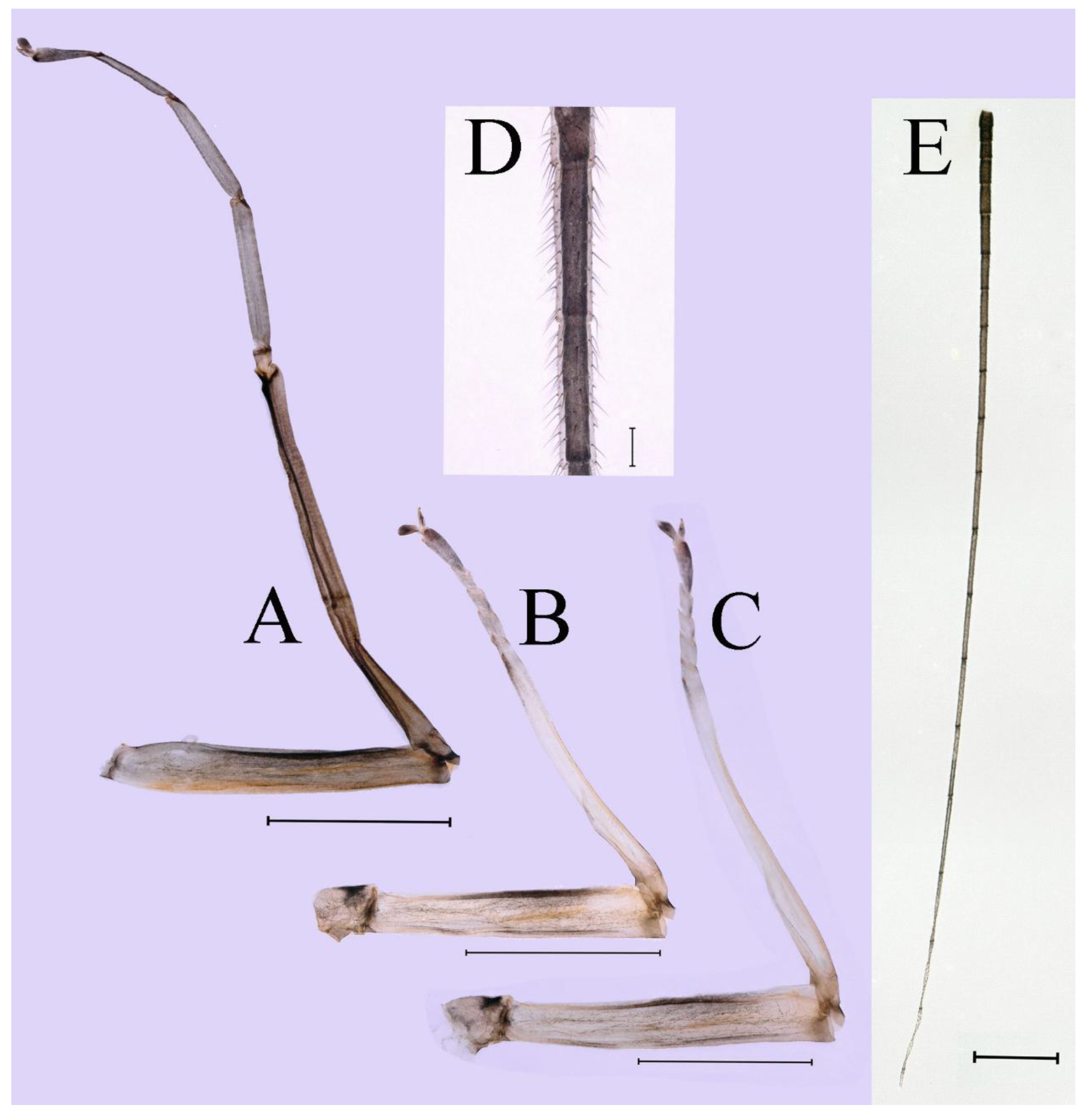
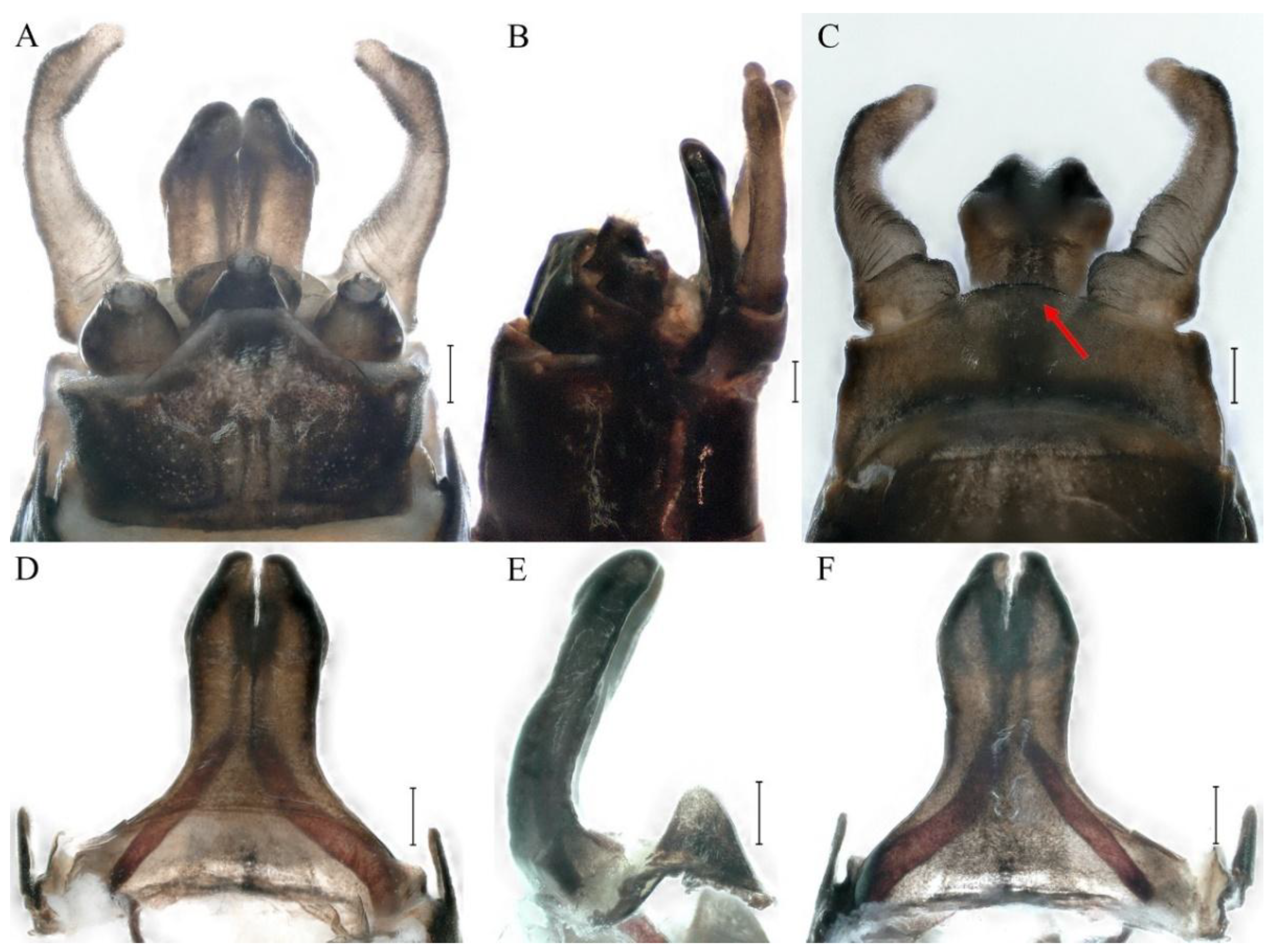
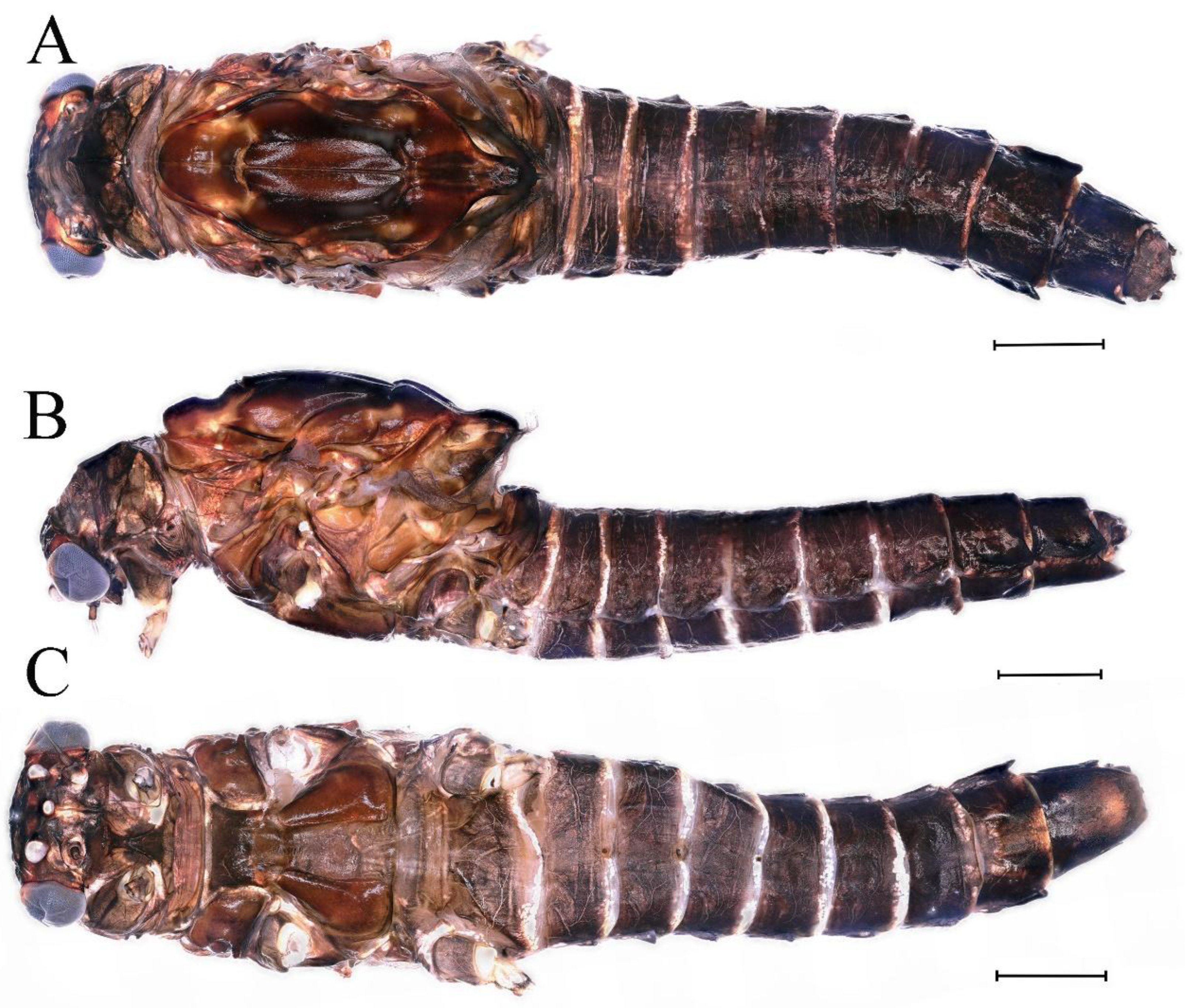
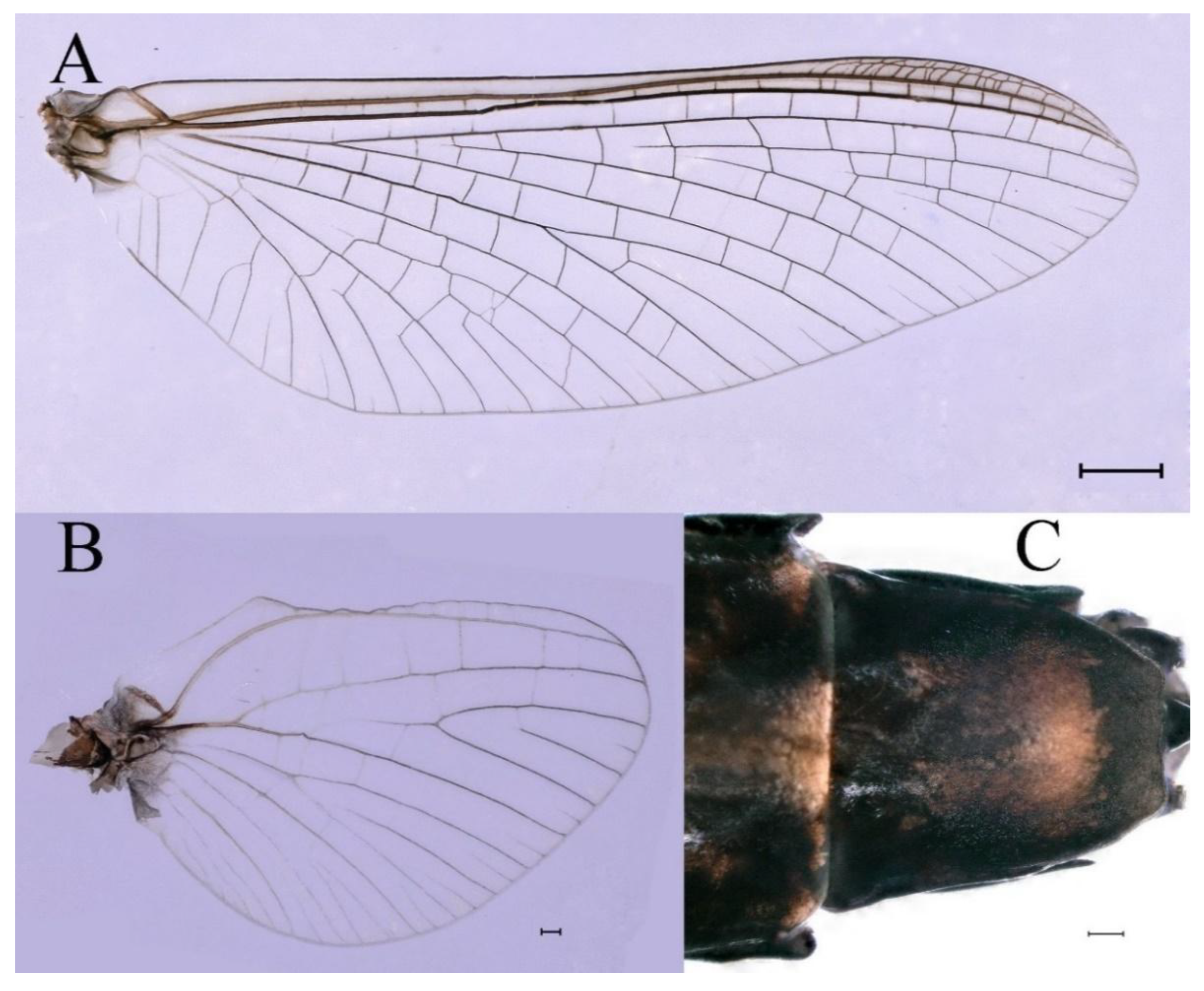
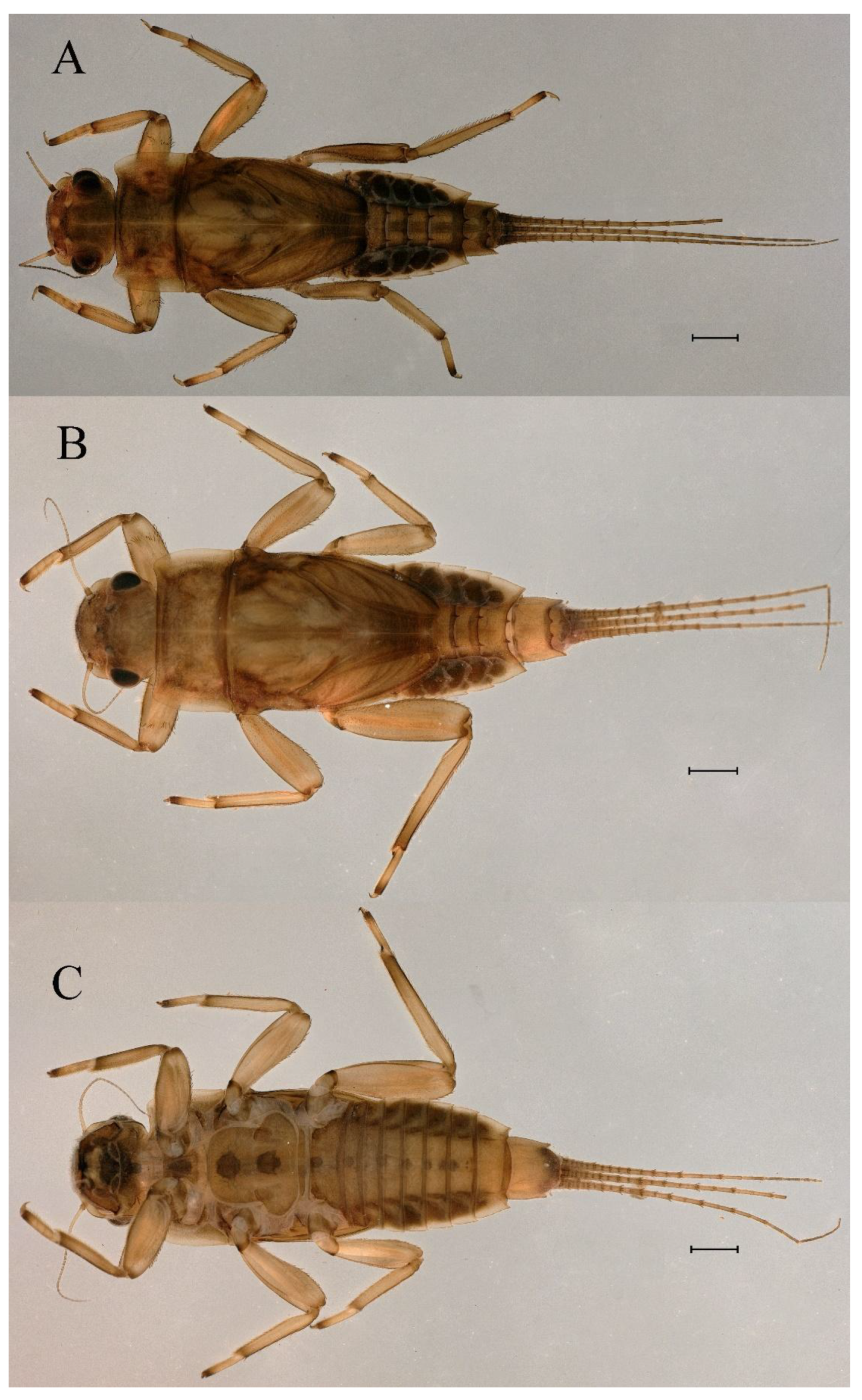
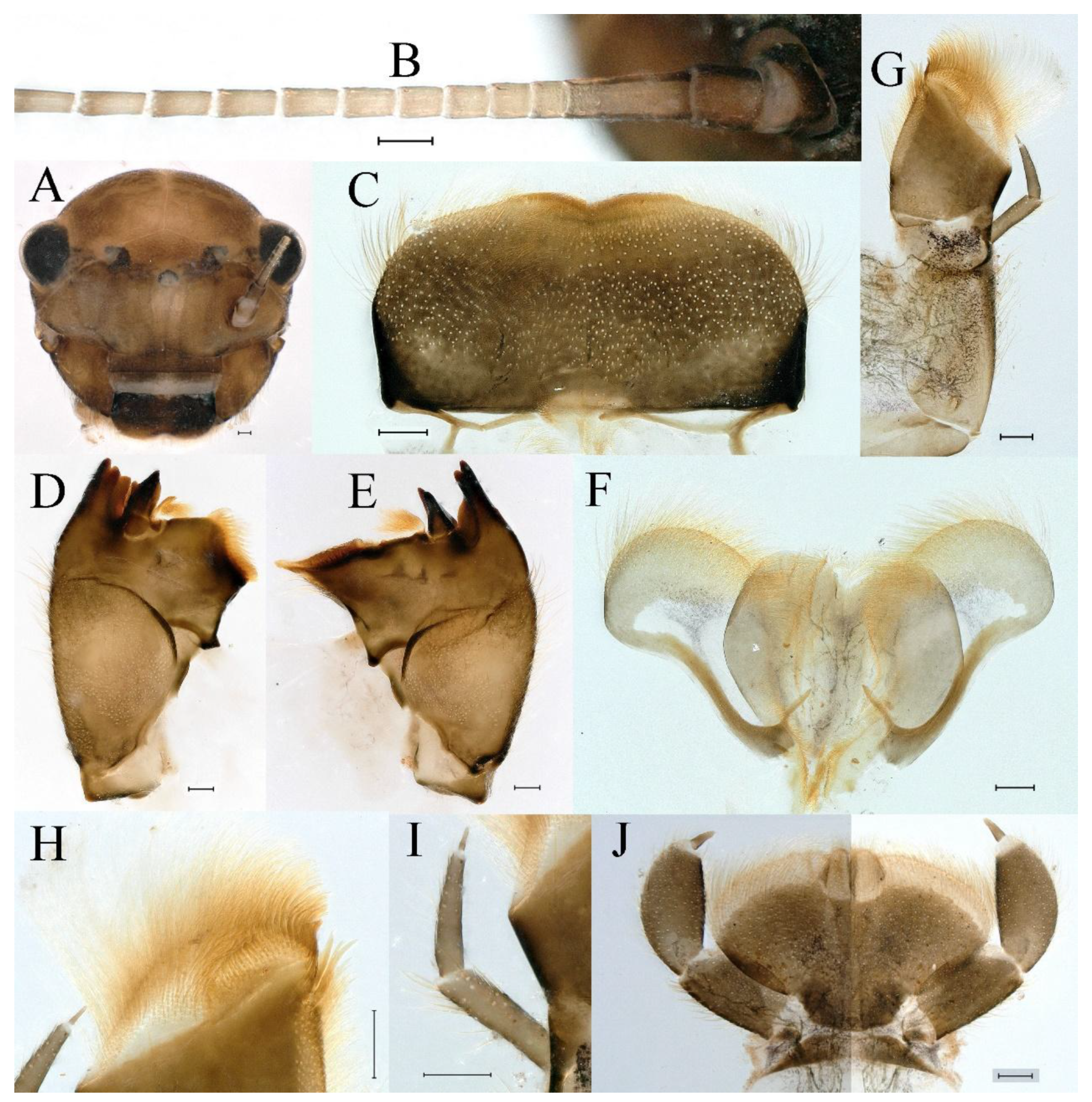
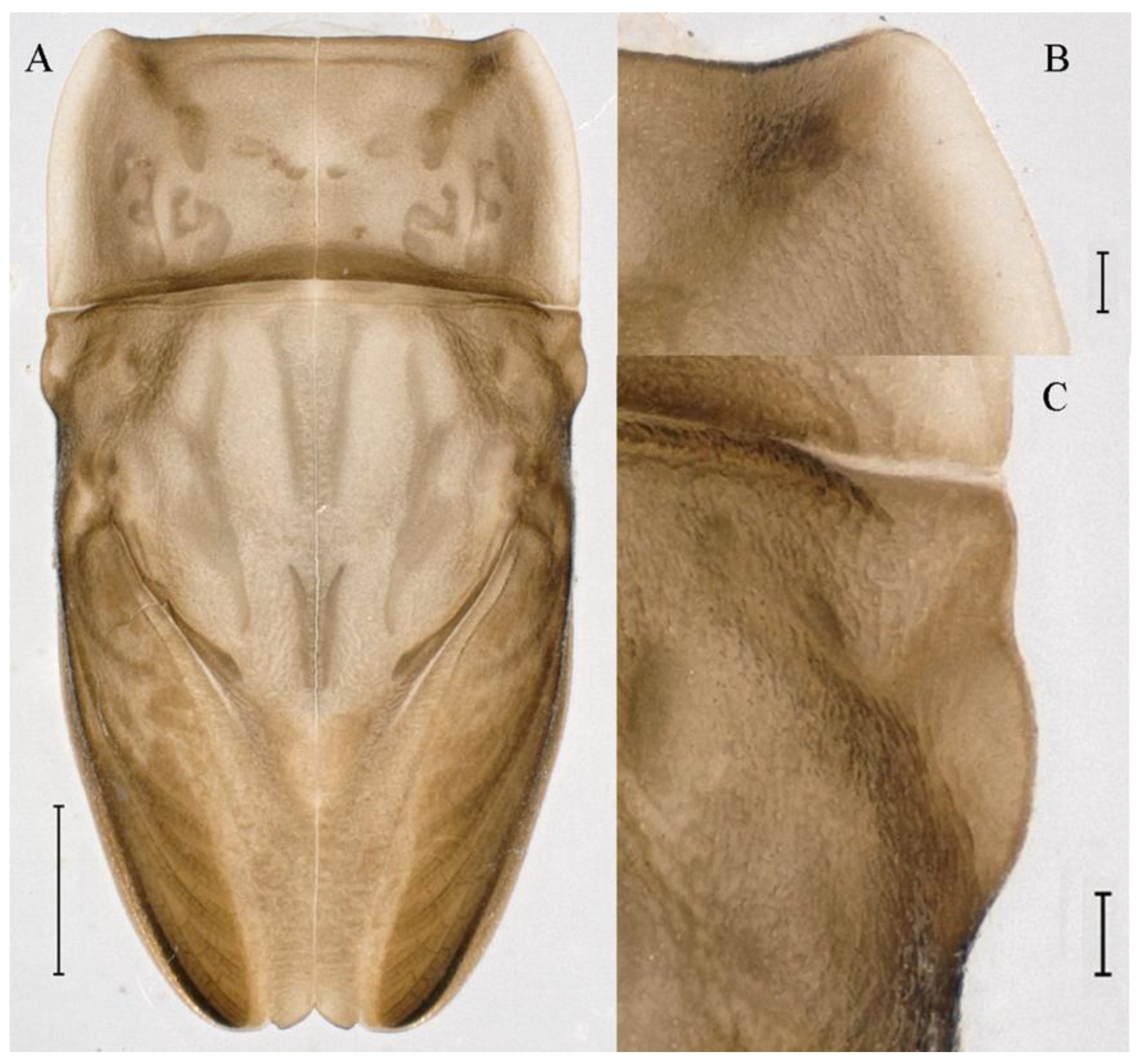
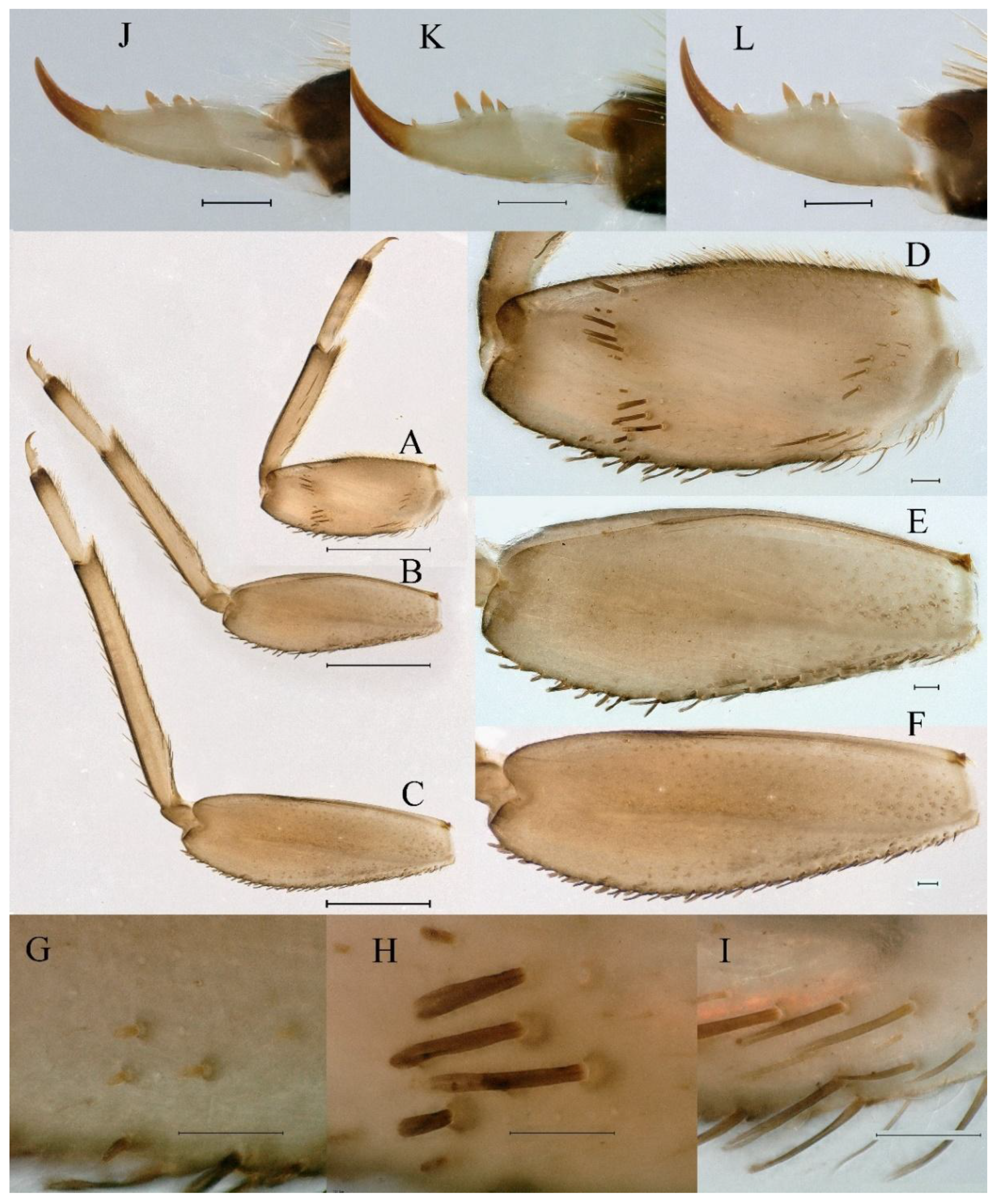
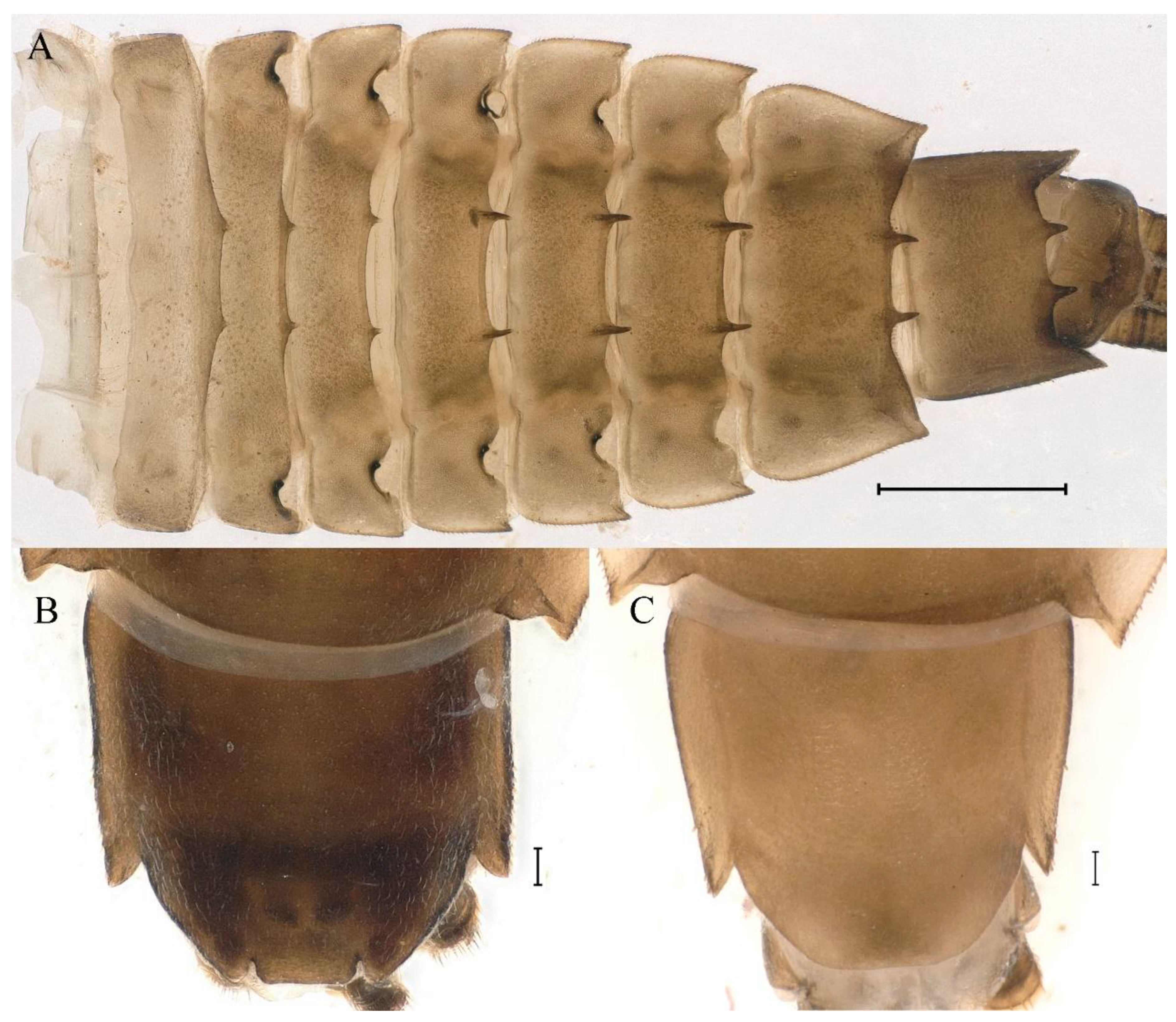
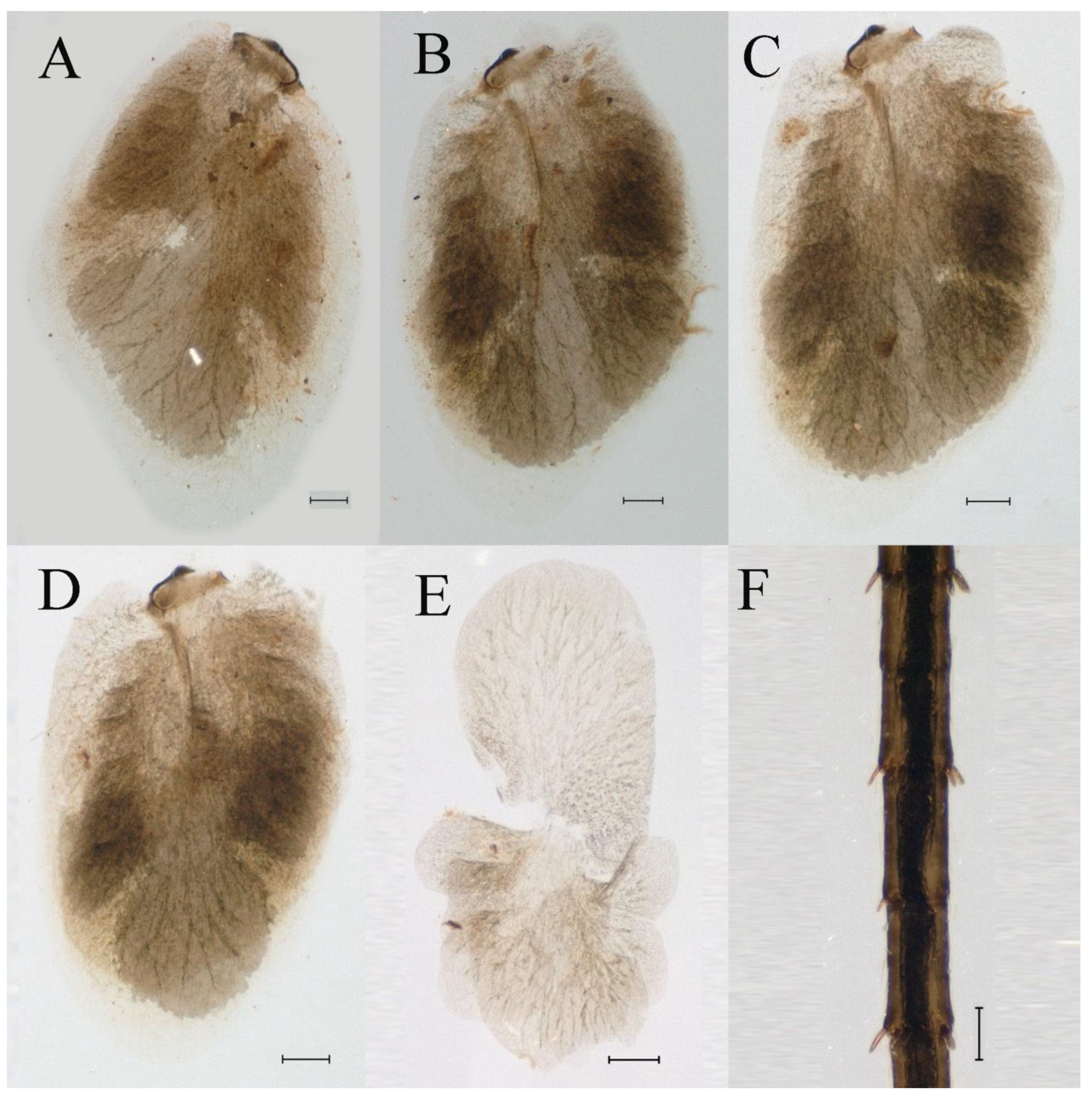
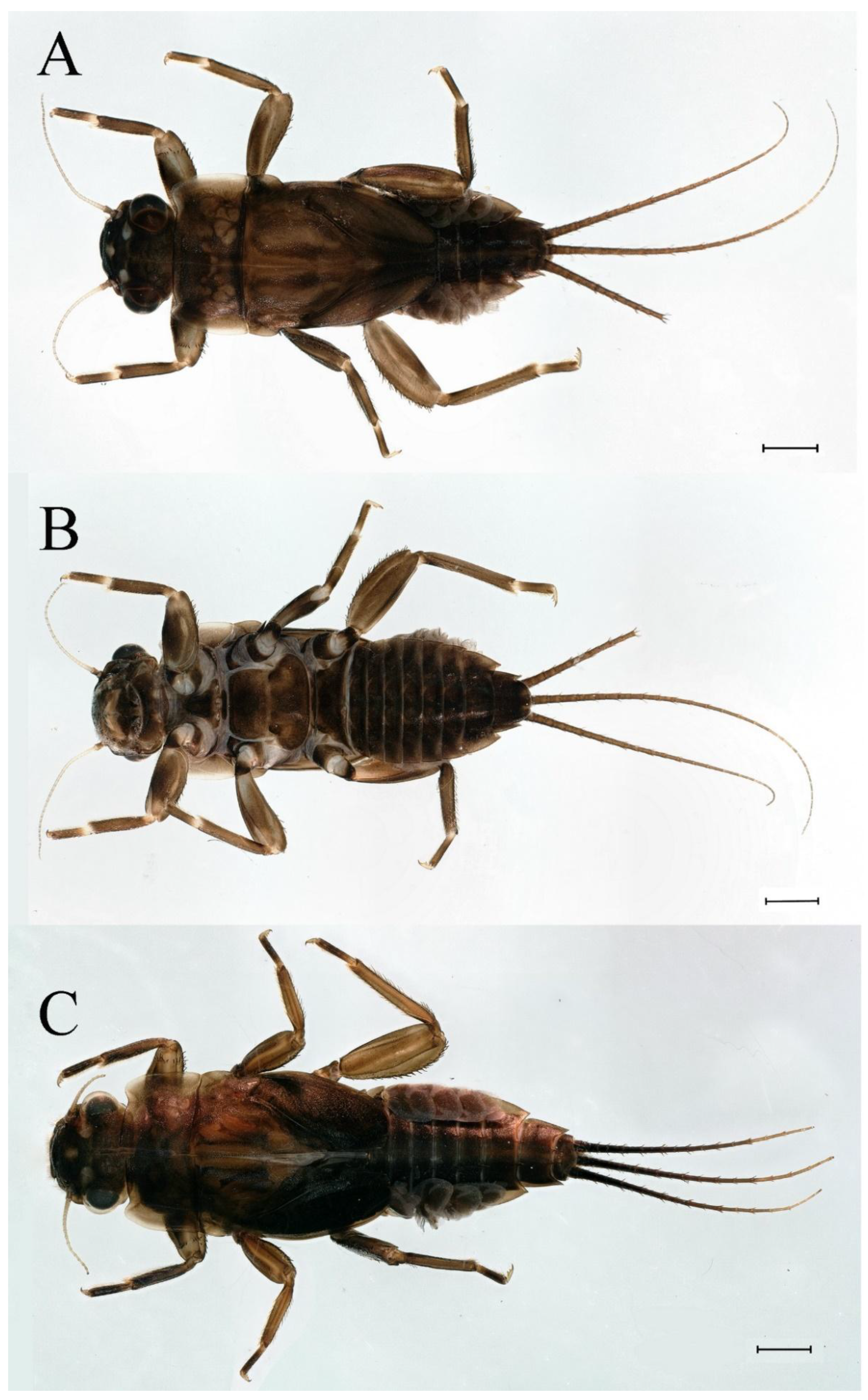
3.3. Cincticostella xiazhi Zi, Li & Jacobus, sp. nov.
3.4. Cincticostella yushui Zi, Li & Jacobus, sp. nov.
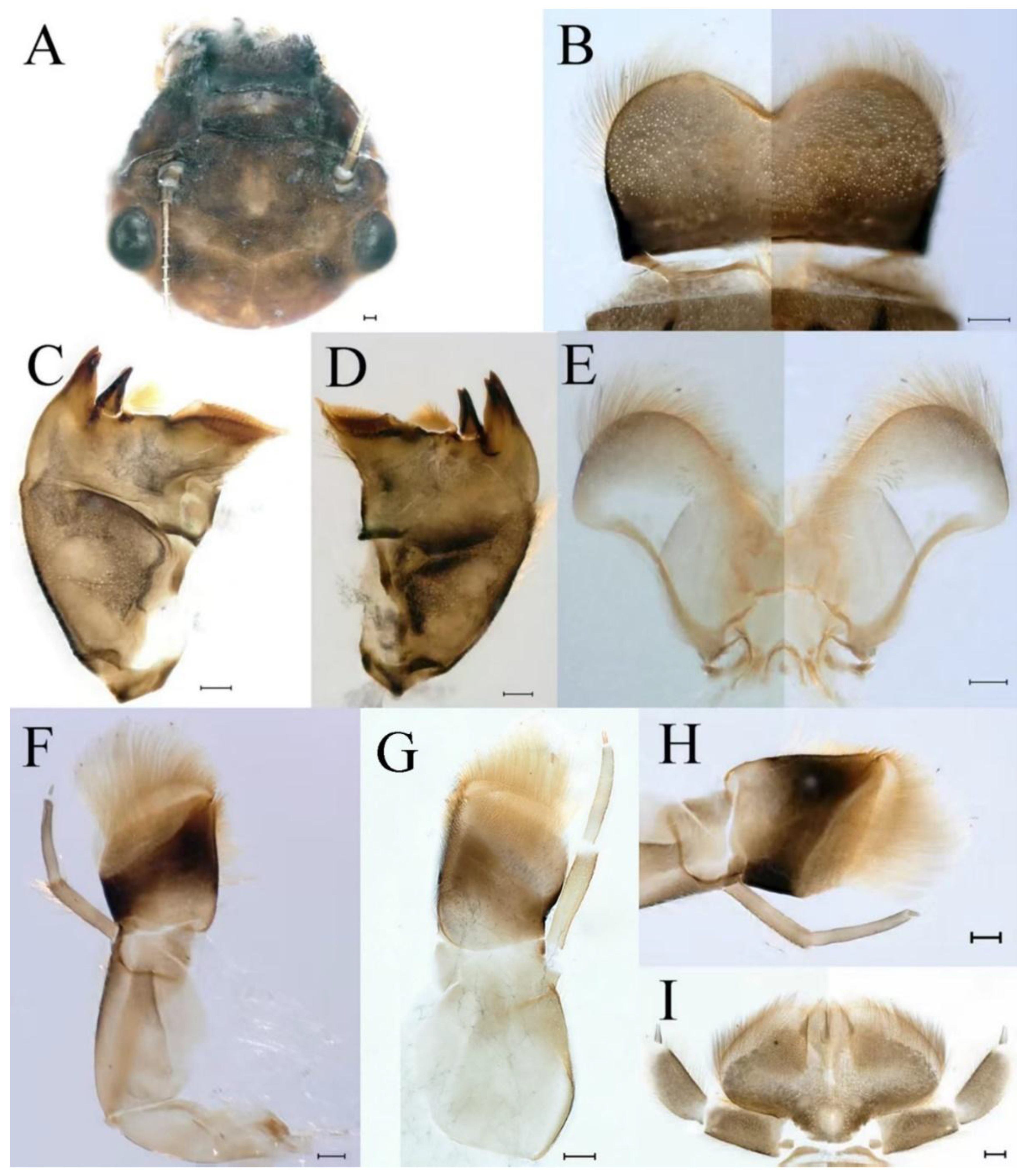
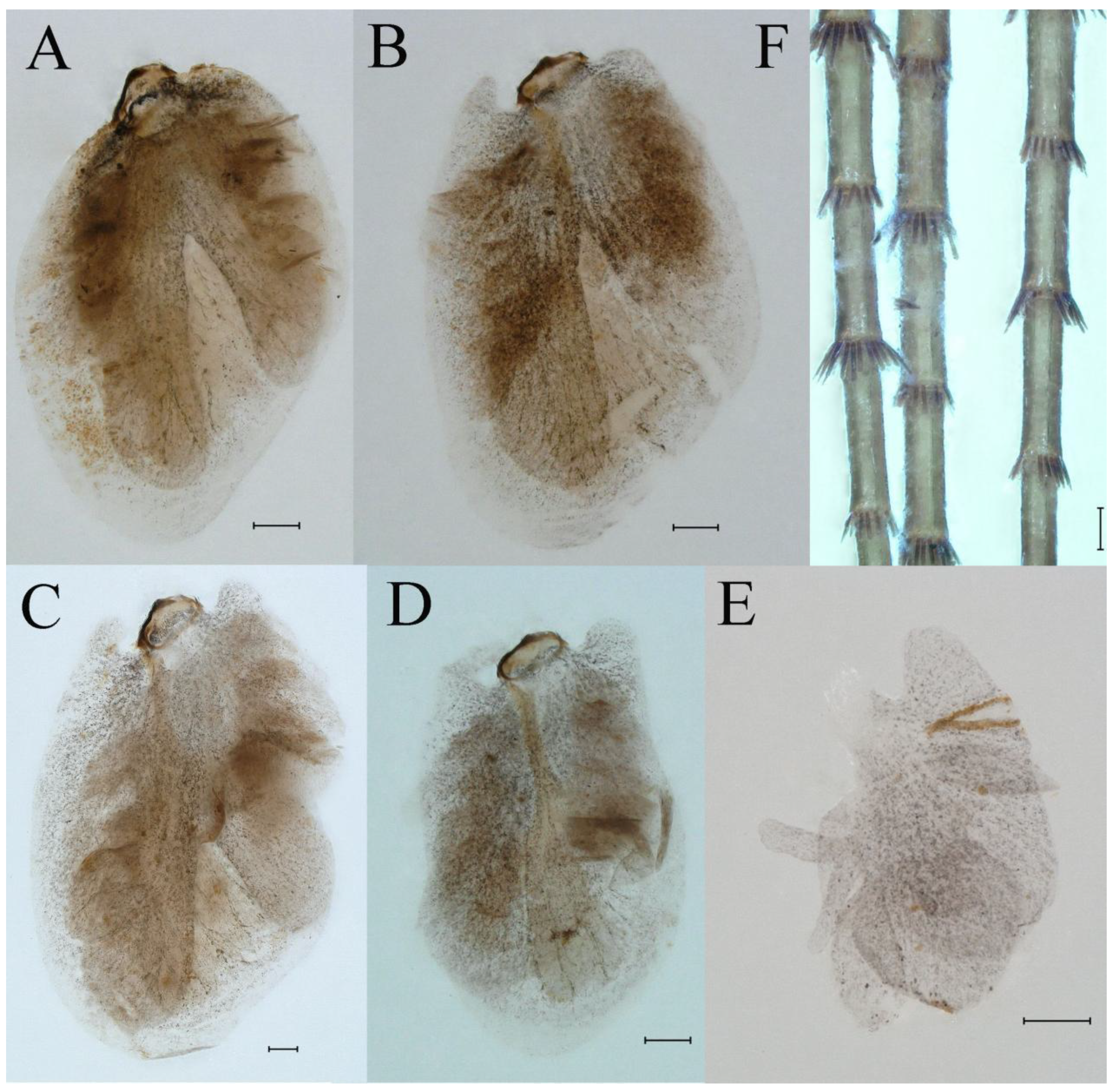
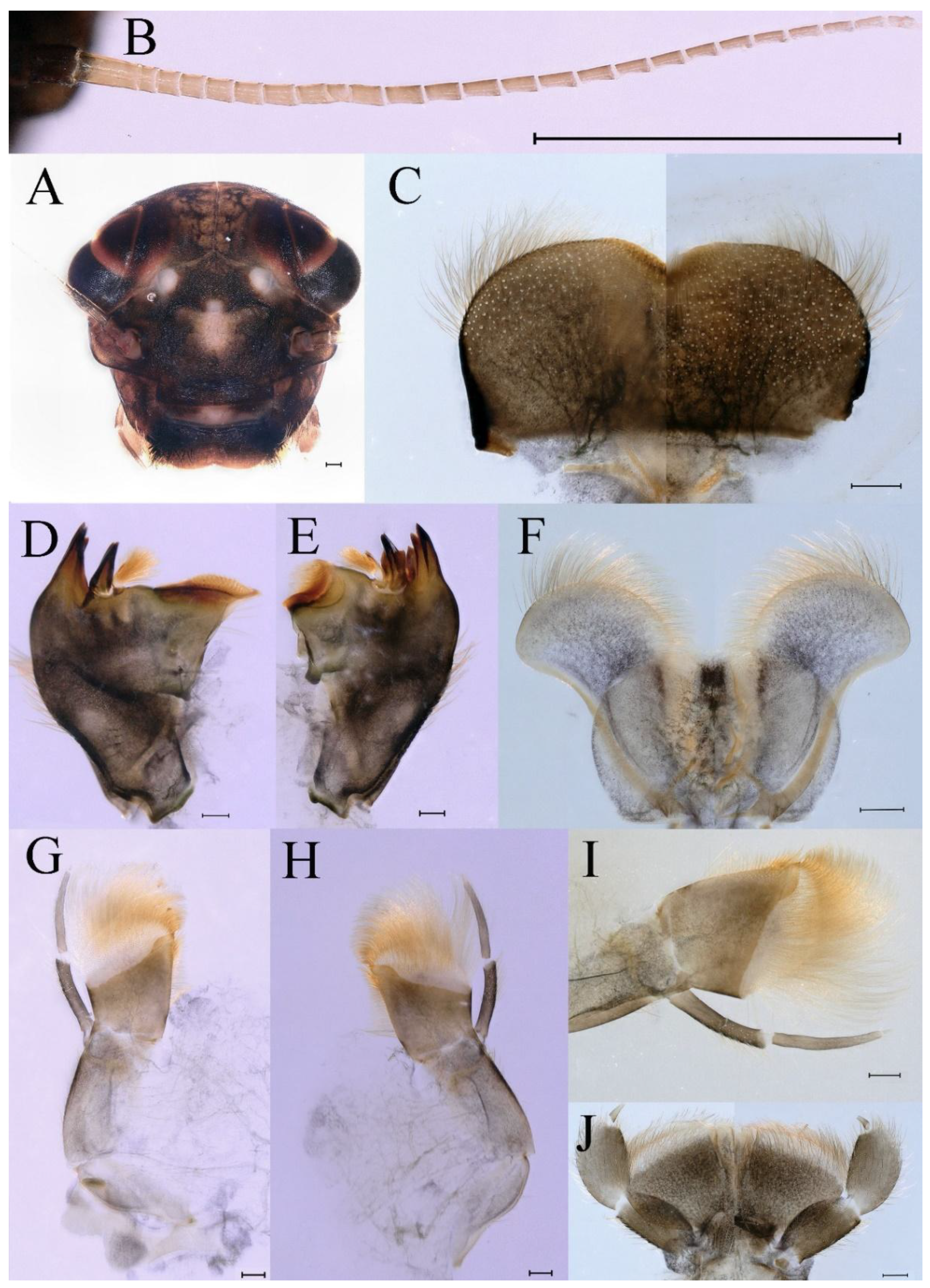
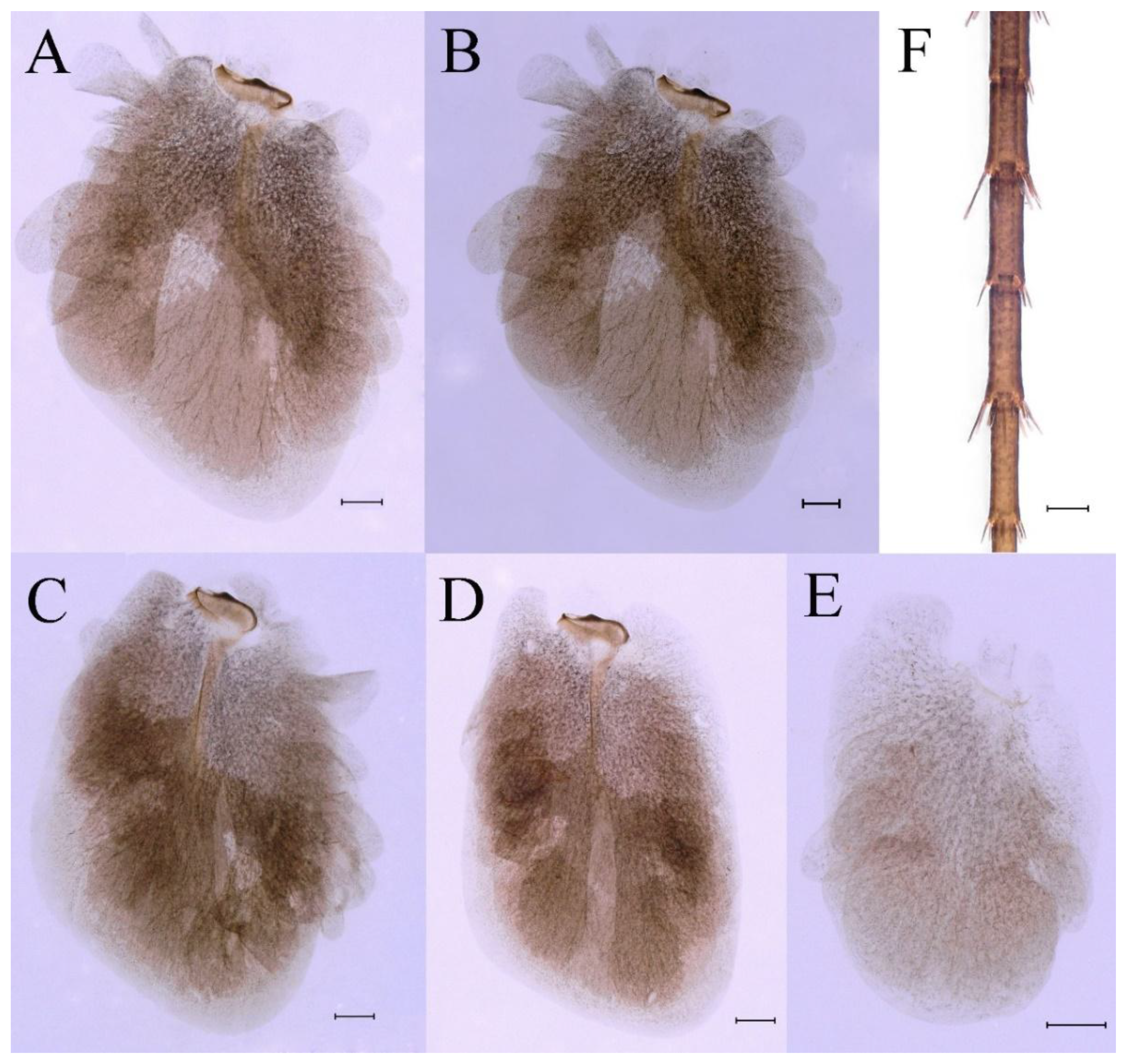
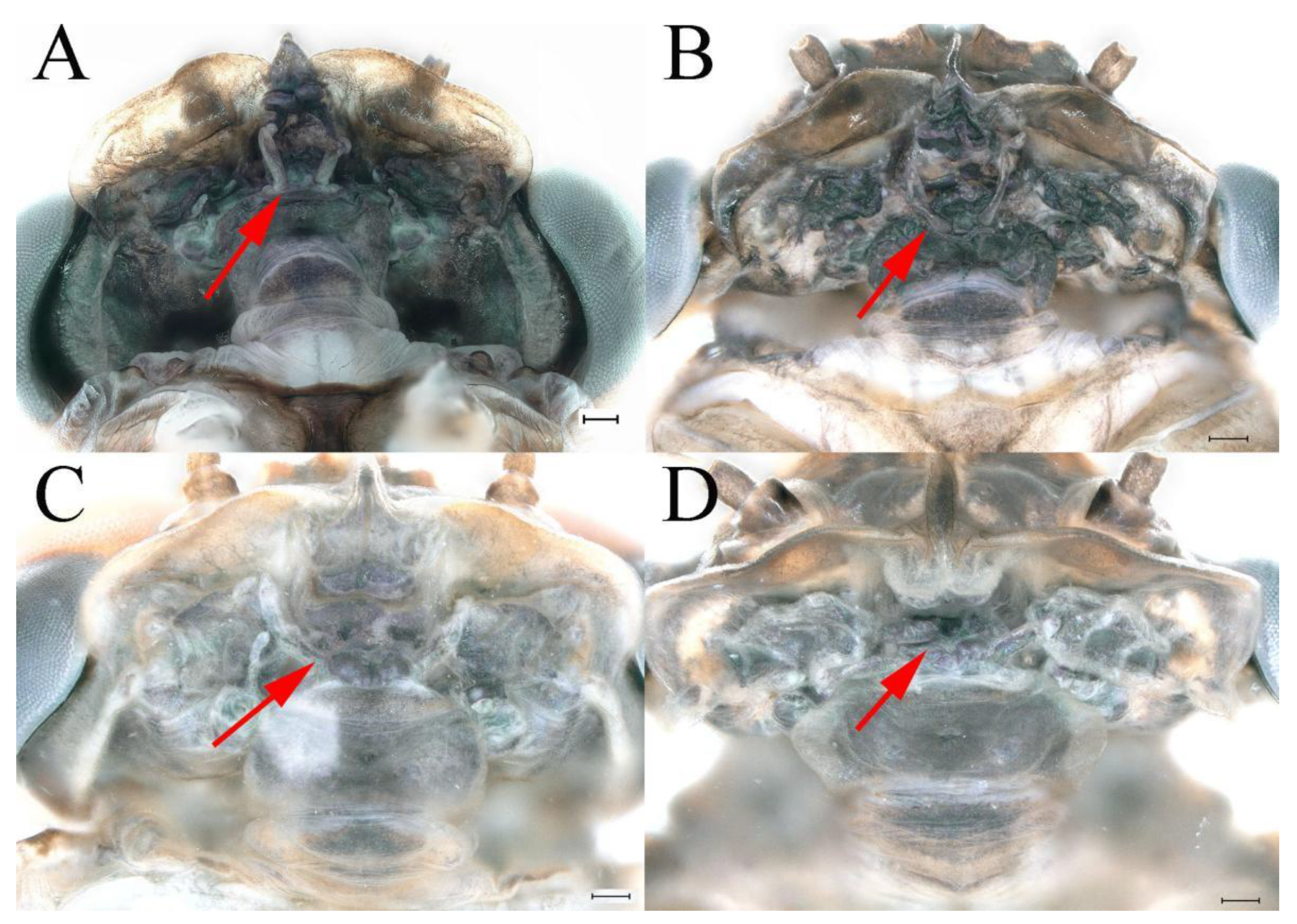
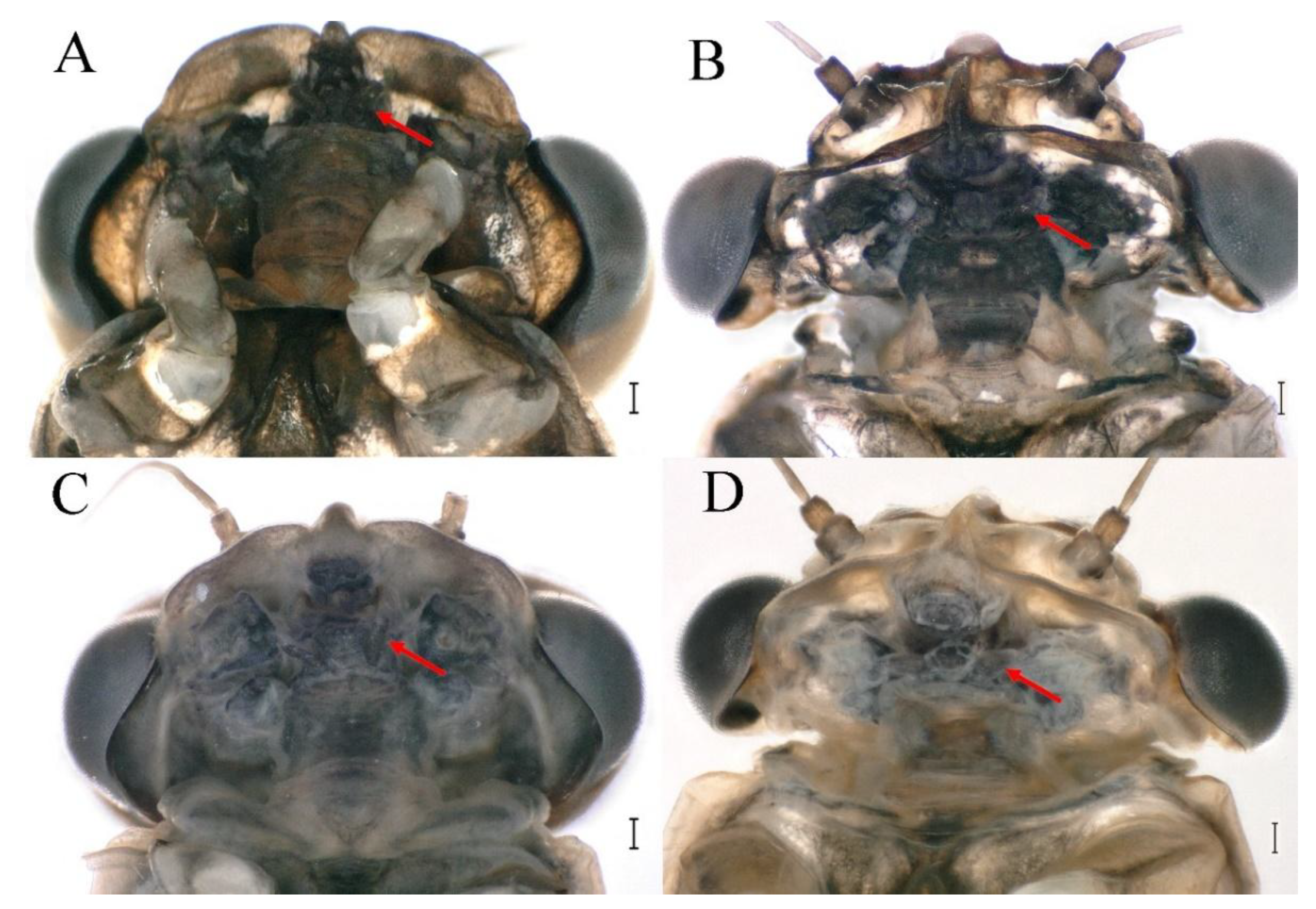
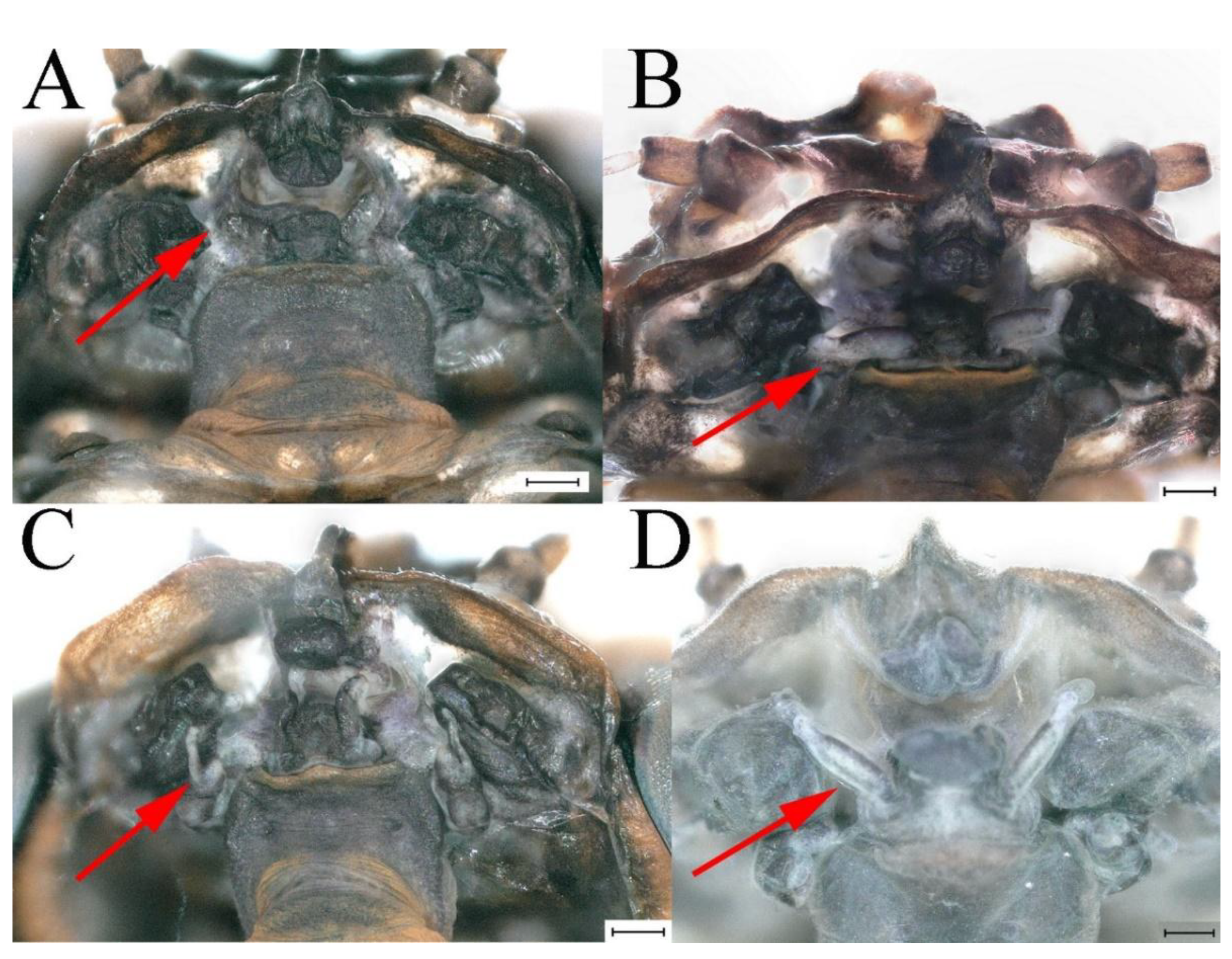
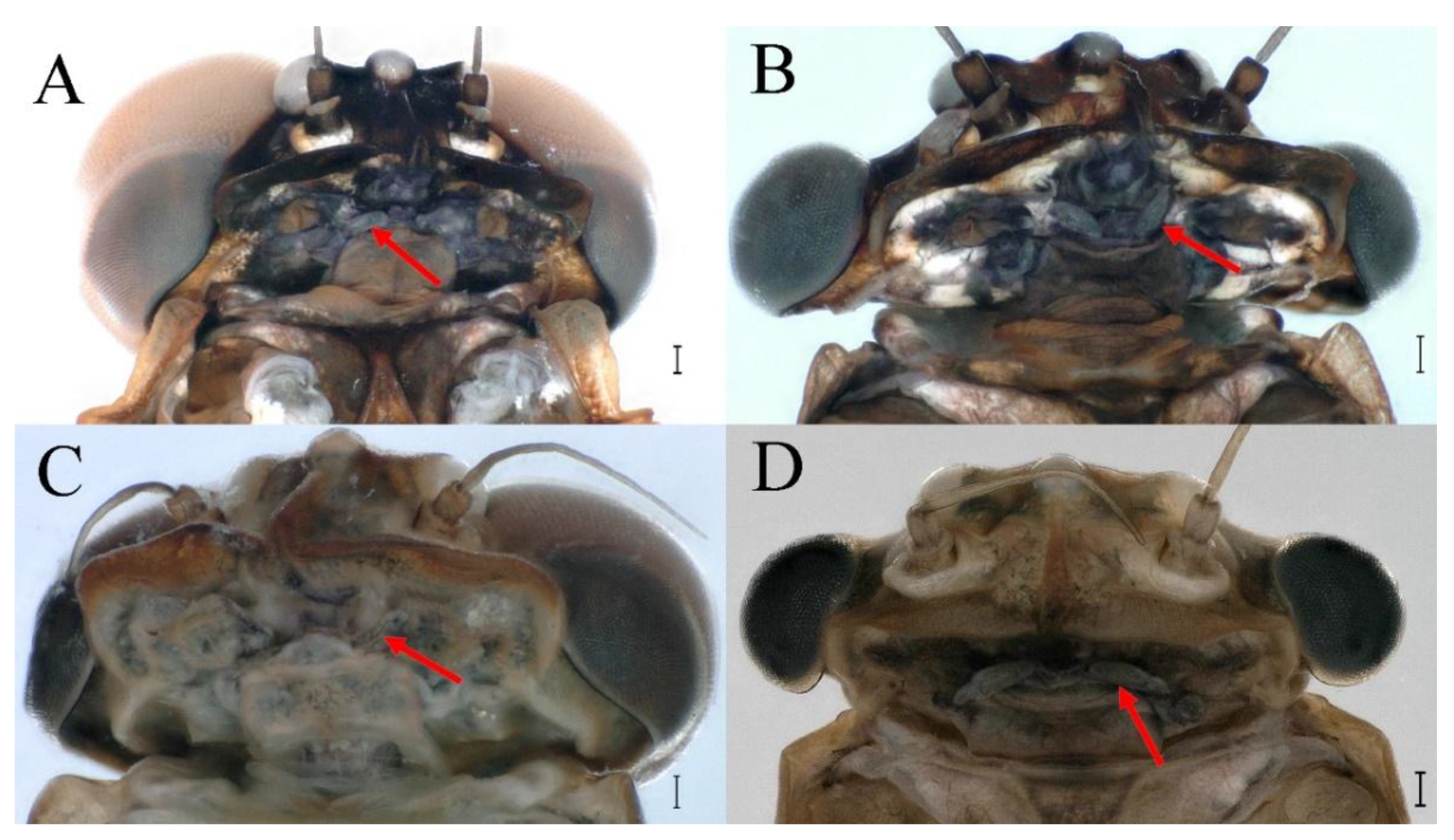
3.5. Remnant Mouthparts of Winged Stages
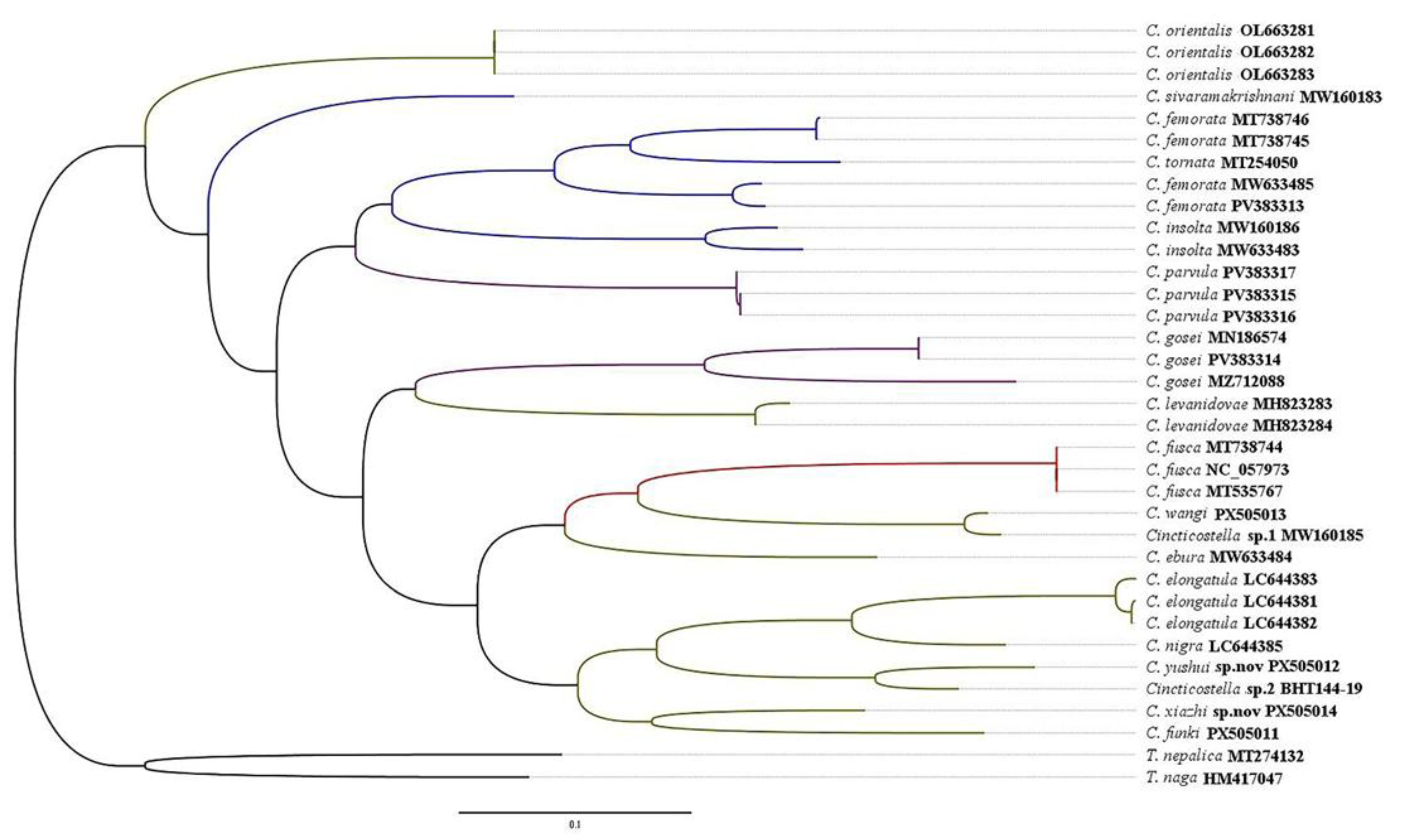
3.6. Results of DNA Analysis
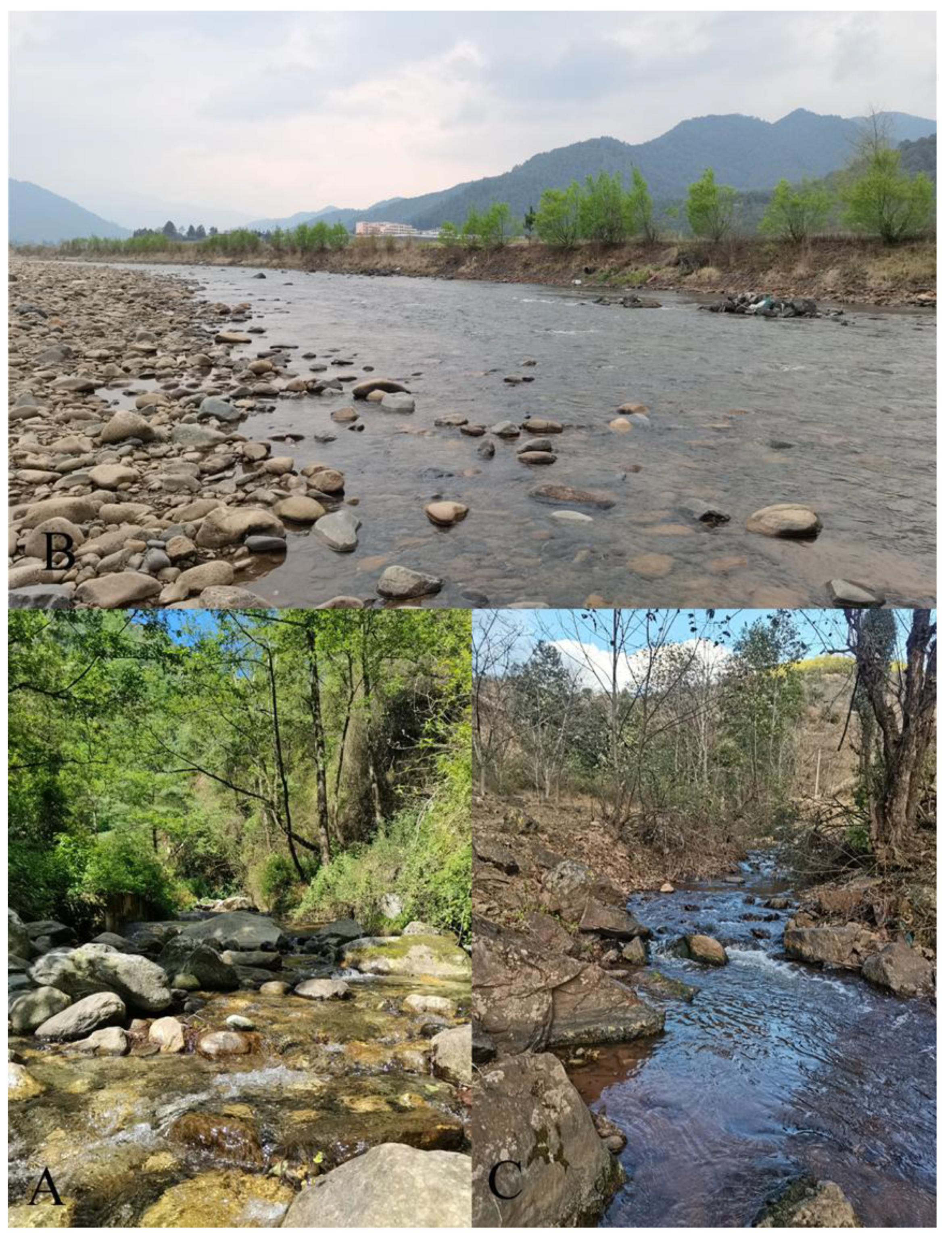
3.7. Ecology
4. Discussion
4.1. Plasticity and Stability of Morphological Characteristics in Cincticostella
4.2. Key to Final Nymphal Instars of the Cincticostella nigra Complex
Key to Final Nymphal Instars of C. nigra Complex
- 1. Abdominal terga without paired posteromedian projections (e.g., Xie et al.: figure 14A,B) [15]………………………...…………………....……………....…......Cincticostella szechuanensis
- 1′. Abdominal terga with paired posteromedian projections…………………...…...............2
- 2. Each posteromedian projection relatively weakly developed (e.g., Figure 5A)…....….....3
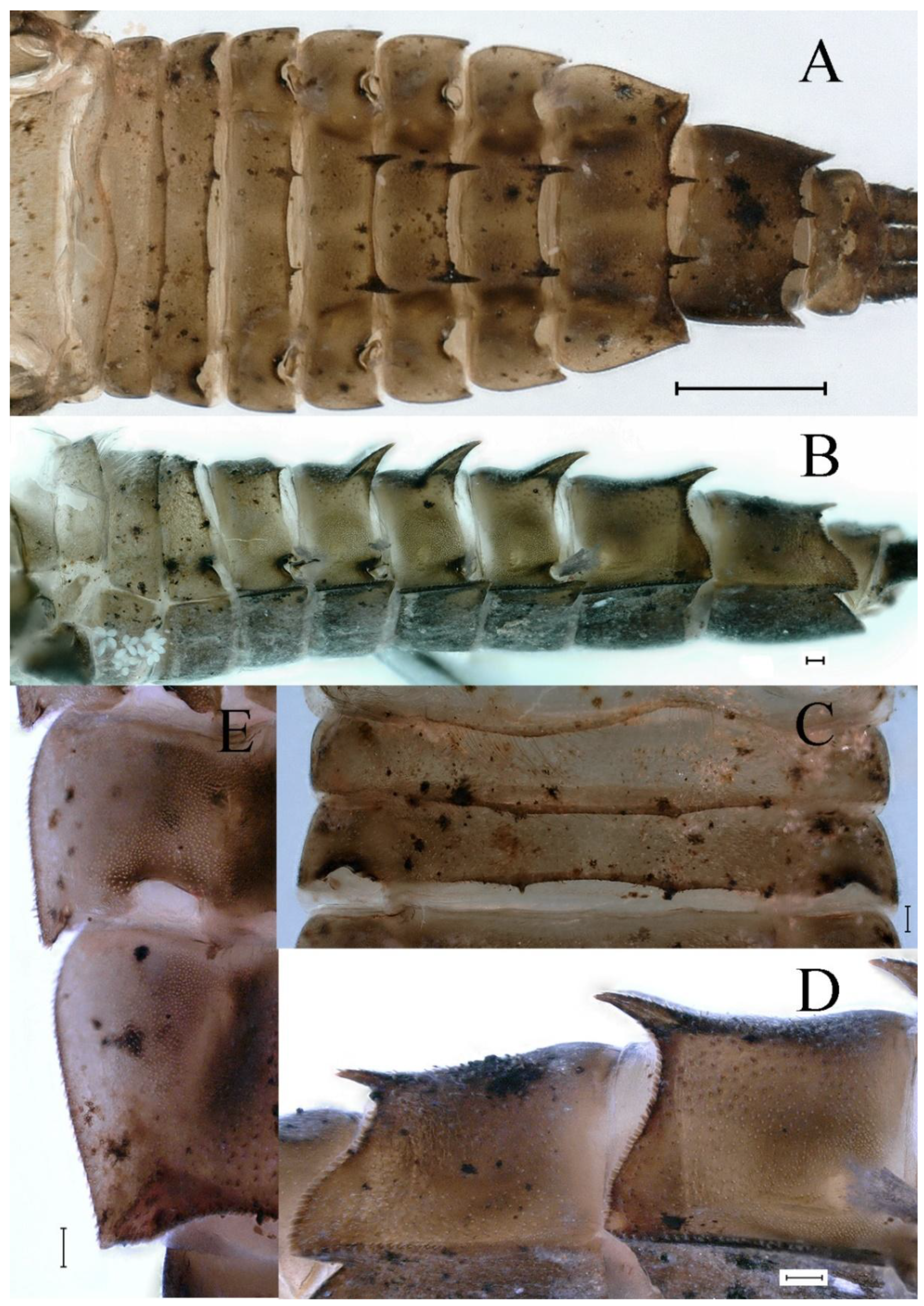
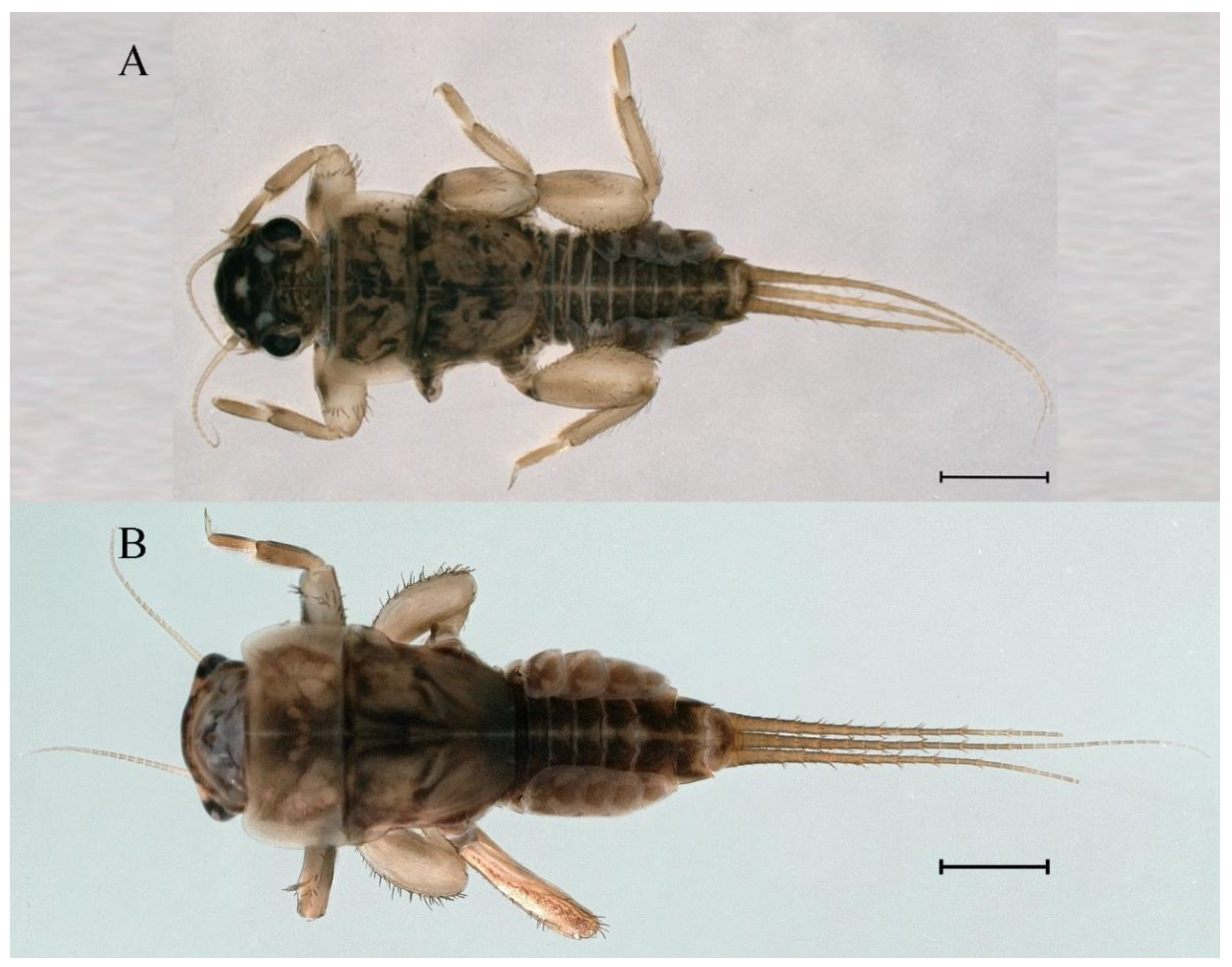
- 2′. At least some abdominal terga with relatively well-developed posteromedian projections (e.g., Figure 22A).…………………………….…………….…………......…......................5
- ..............................................…………………………….……........................Cincticostella colossa
- 4. Anterolateral projections of mesothorax poorly developed, projections on terga VI–VIII strongest (e.g., Martynov et al.: figures 5B,C and 8A–D) [3]................Cincticostella corpulenta
- 5. Anteriormost relatively well-developed posteromedian projections occur on tergum IV (e.g., Auychinda et al.: 1b) [4]…........…………............…..............................Cincticostella ebura
- 5′. Anteriormost relatively well-developed posteromedian projections occur on terga posterior to tergum IV (e.g., Figure 58A) …........…….....……............…..........................................6
- 6. Anteriormost relatively well-developed posteromedian projections on tergum VI; eastern Palearctic…........…………...........……….....................…...................Cincticostella orientalis
- 6′. Anteriormost relatively well-developed posteromedian projections on tergum V; Palearctic and Indomalayan….........…………............………...........….............…............................7
- 7. Posteromedian projections on terga V–VIII relatively well-developed, small on tergum IX; eastern Palearctic…........…………......................…..............…......Cincticostella levanidovae
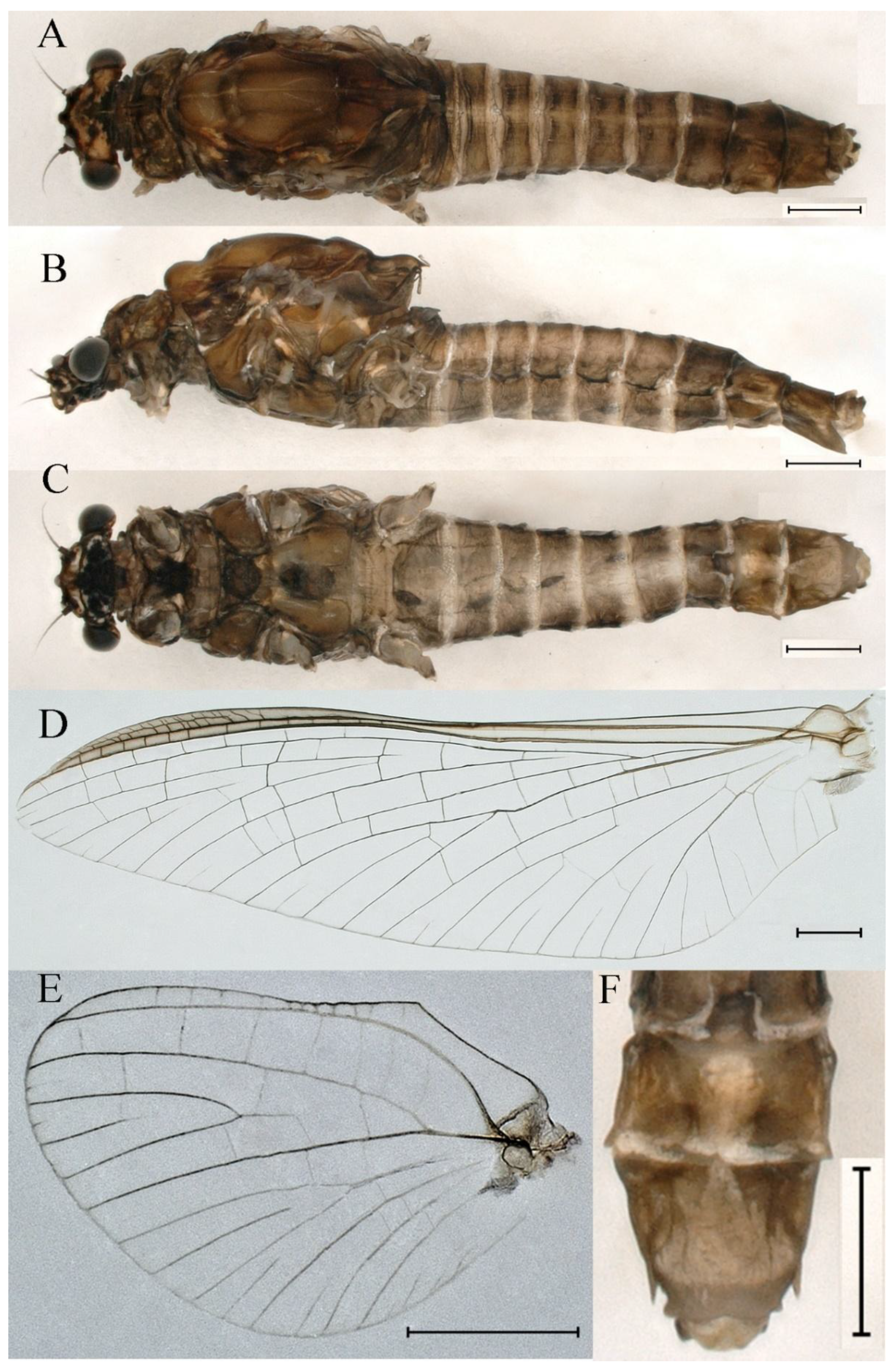
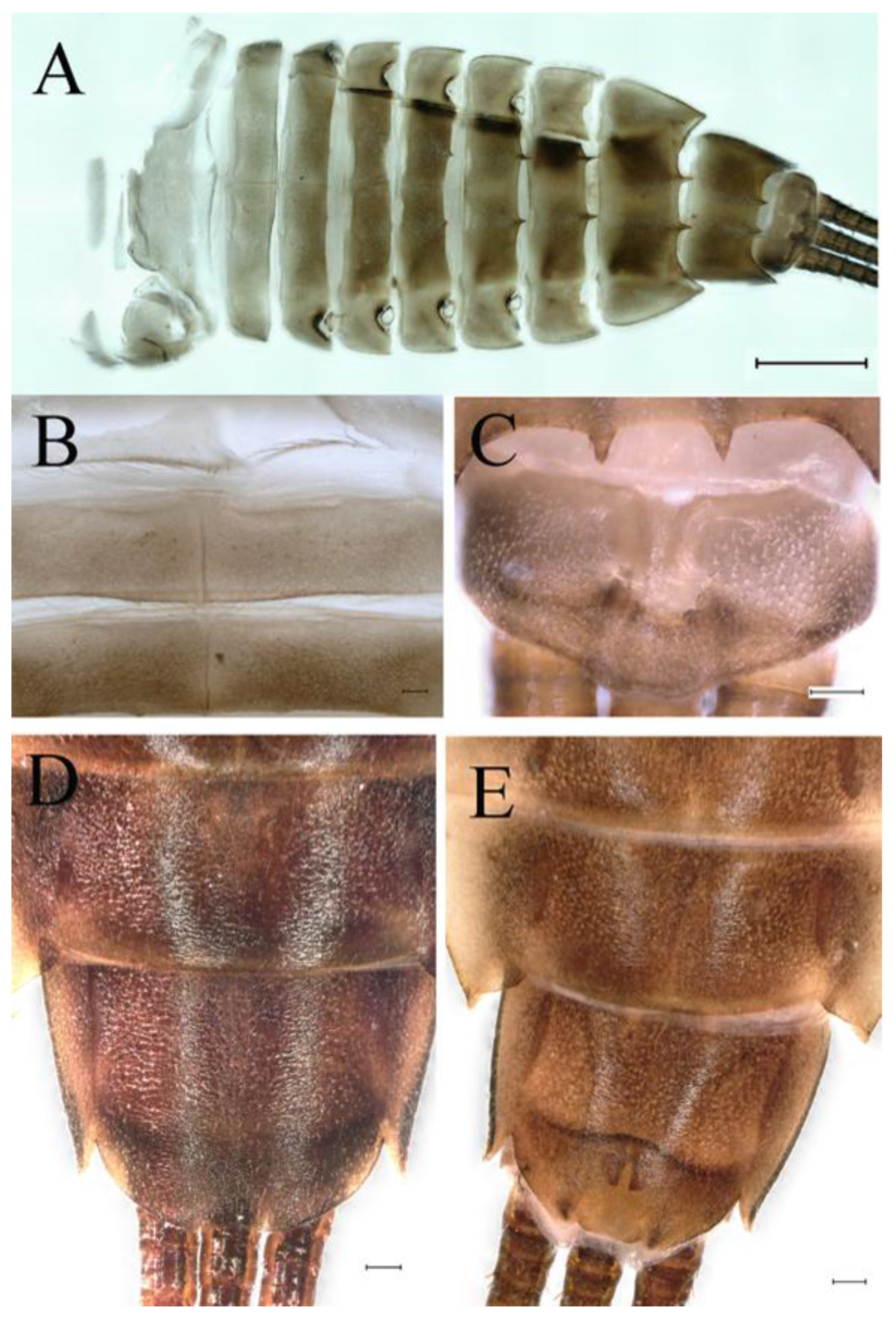
- 7′. Posteromedian projections on terga V–IX relatively well-developed (e.g., Figure 22A,B); eastern Palearctic and Indomalayan.................................................….......................................8
- 8. Tergum X with pair of posteromedian projections (e.g., Martynov et al.: figure 4A,C) [3]; Indomalayan…........................................................................….................Cincticostella changfai
- 8′. Posterior margin of tergum X without paired projections (e.g., Figure 22A); Palearctic and Indomalayan............................................................................................…...........................9
- 9′. Tarsal claw with more than one denticle, labrumanteromedian emargination shallow and narrow (e.g., Figure 55C); eastern Palearctic and Indomalayan.….....…..............…....10
- 10. Tarsal claw with more than four denticles (e.g., Allen: figure 6) [2]; eastern Palearctic....….....…...........................….......................….........................………......…..........................11
- 10′. Tarsal claw with two to four denticles; Indomalayan....…...................................…......12
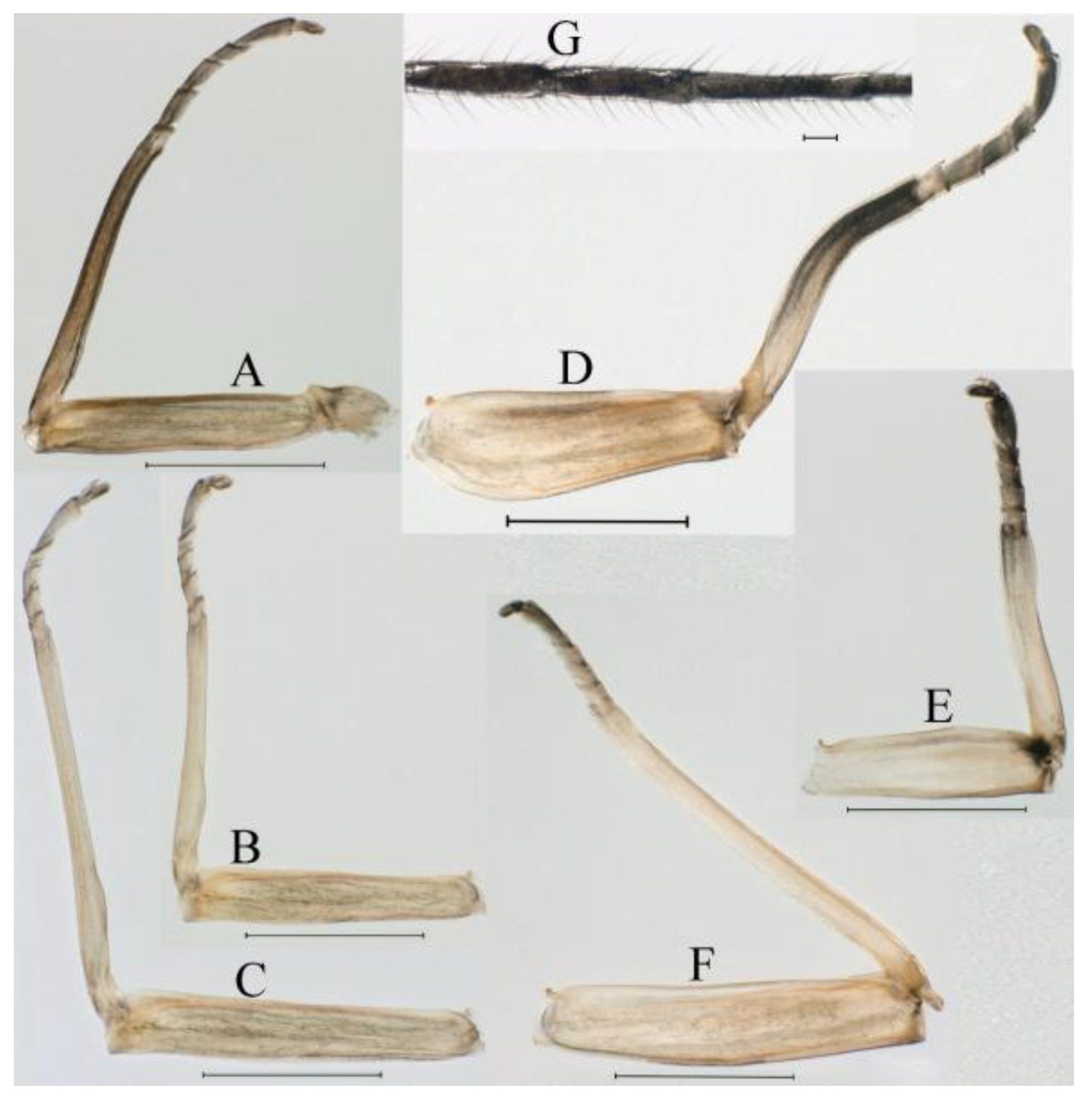
- 11. Dorsal surface of femora with short, dense clavate setae (e.g., Ishiwata: figure 50A) [9]…......…......…......…..........….......…………....................….................Cincticostella elongatula
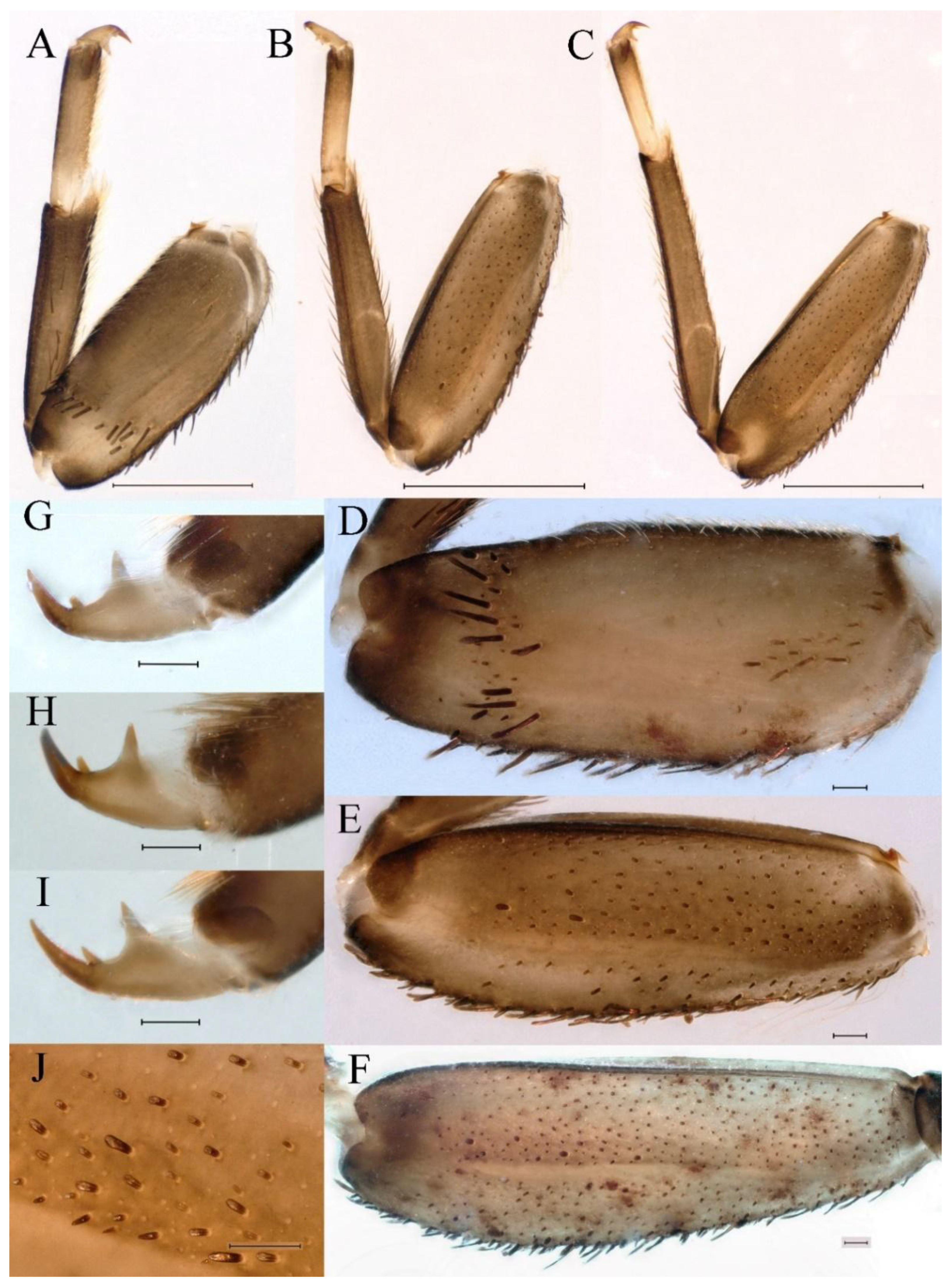
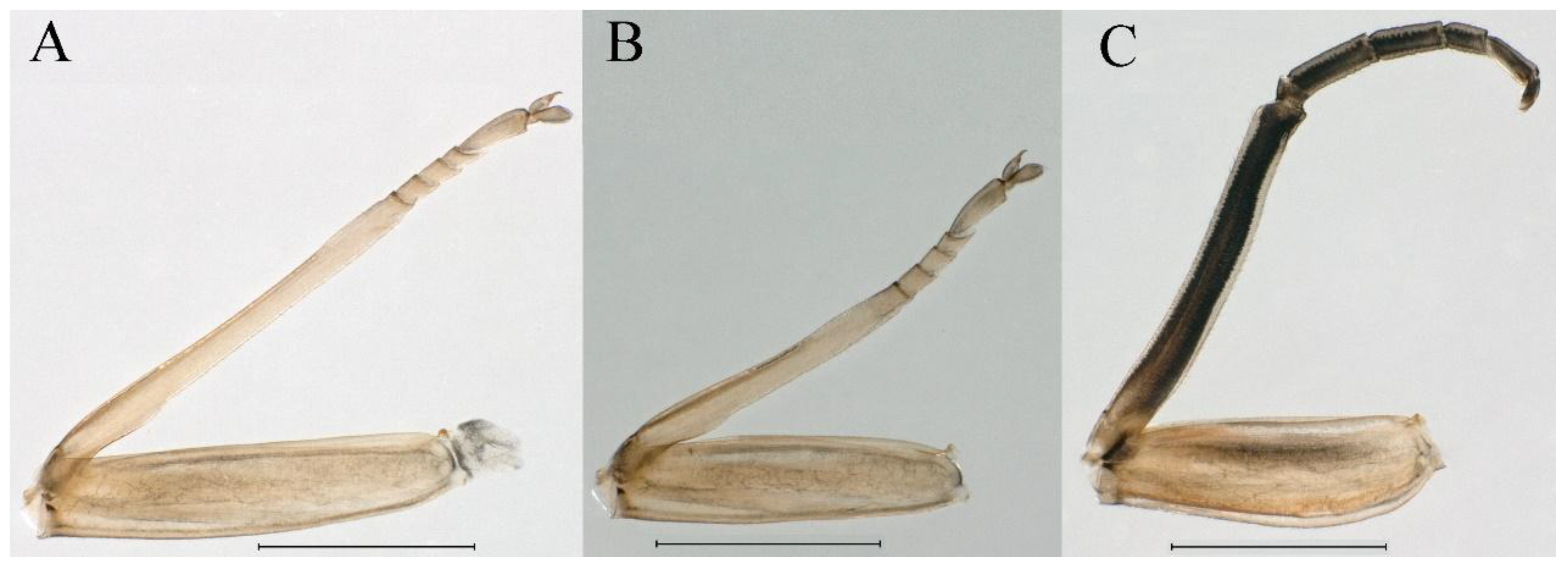
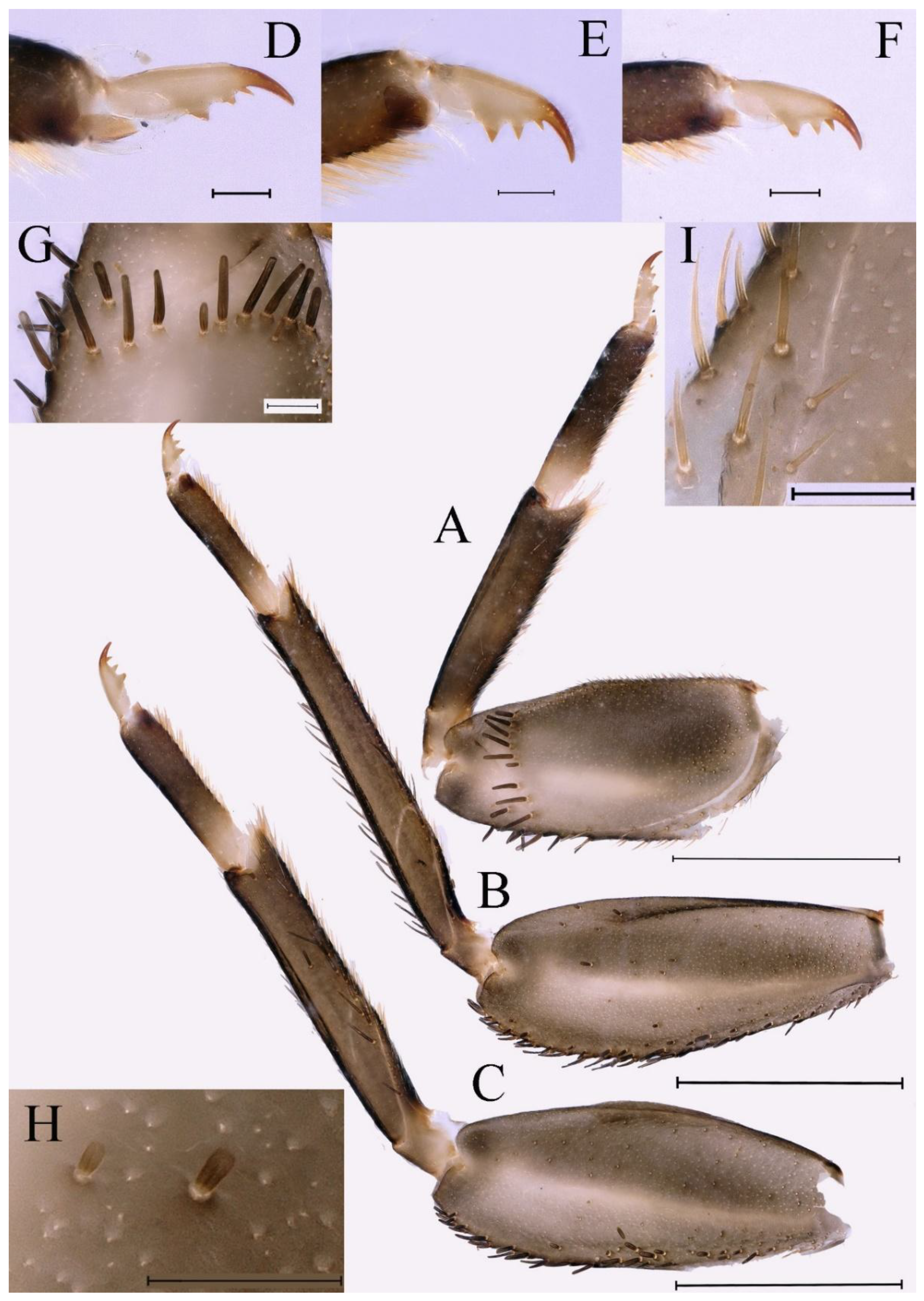
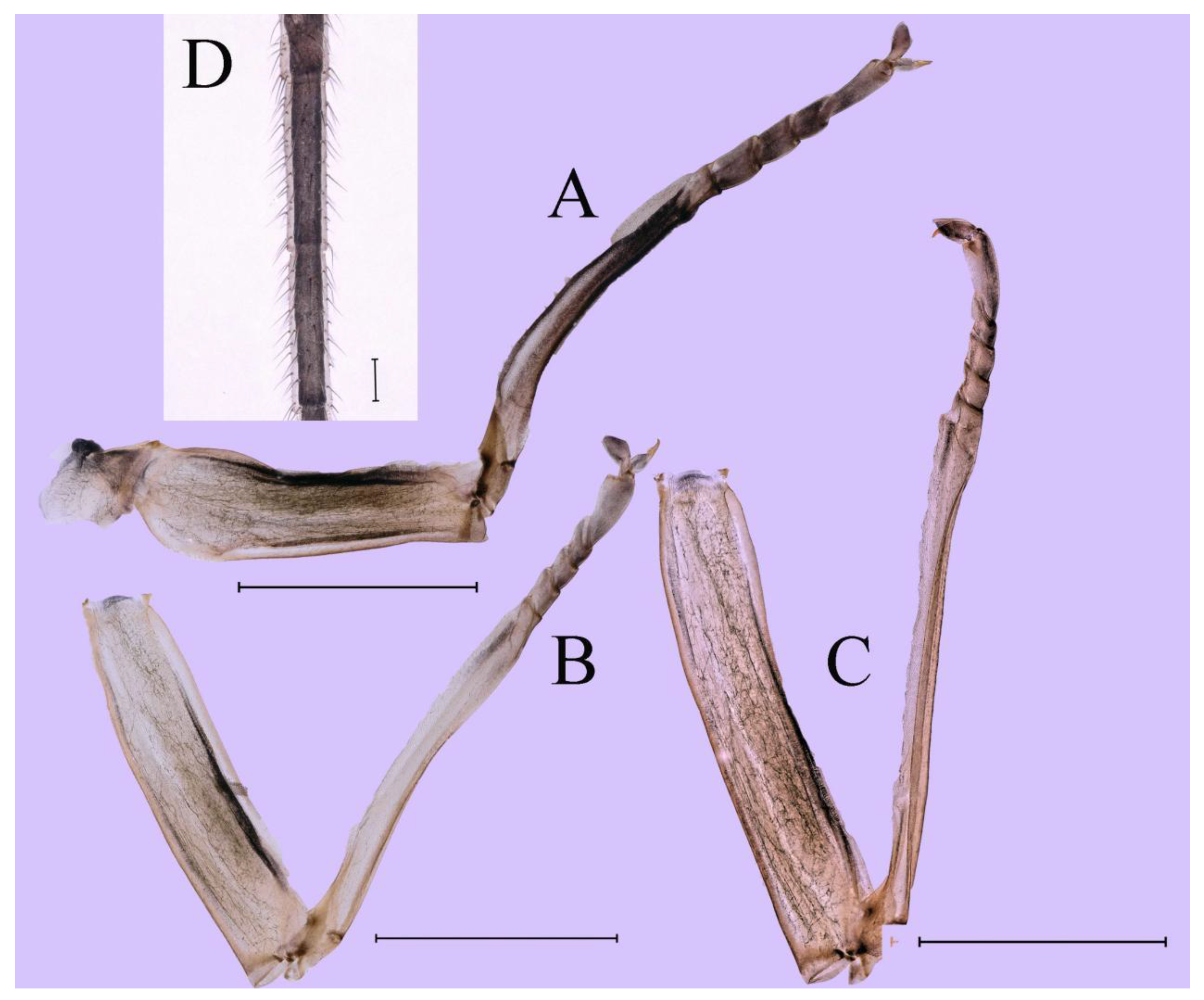
- 12. Tarsal claw with four denticles (e.g., Figure 57J–L); body yellow brown without a dorsal, median pale line....….....….....….....….…......….....…...............Cincticostella yushui sp. nov.
- 12′. Tarsal claw with two or three denticles; body black with a dorsal, median pale line....….....….....….....….................….....…........…………...........…….........….........................13
4.3. Species Complexes and Distinguishing Nymphal Characters of Cincticostella
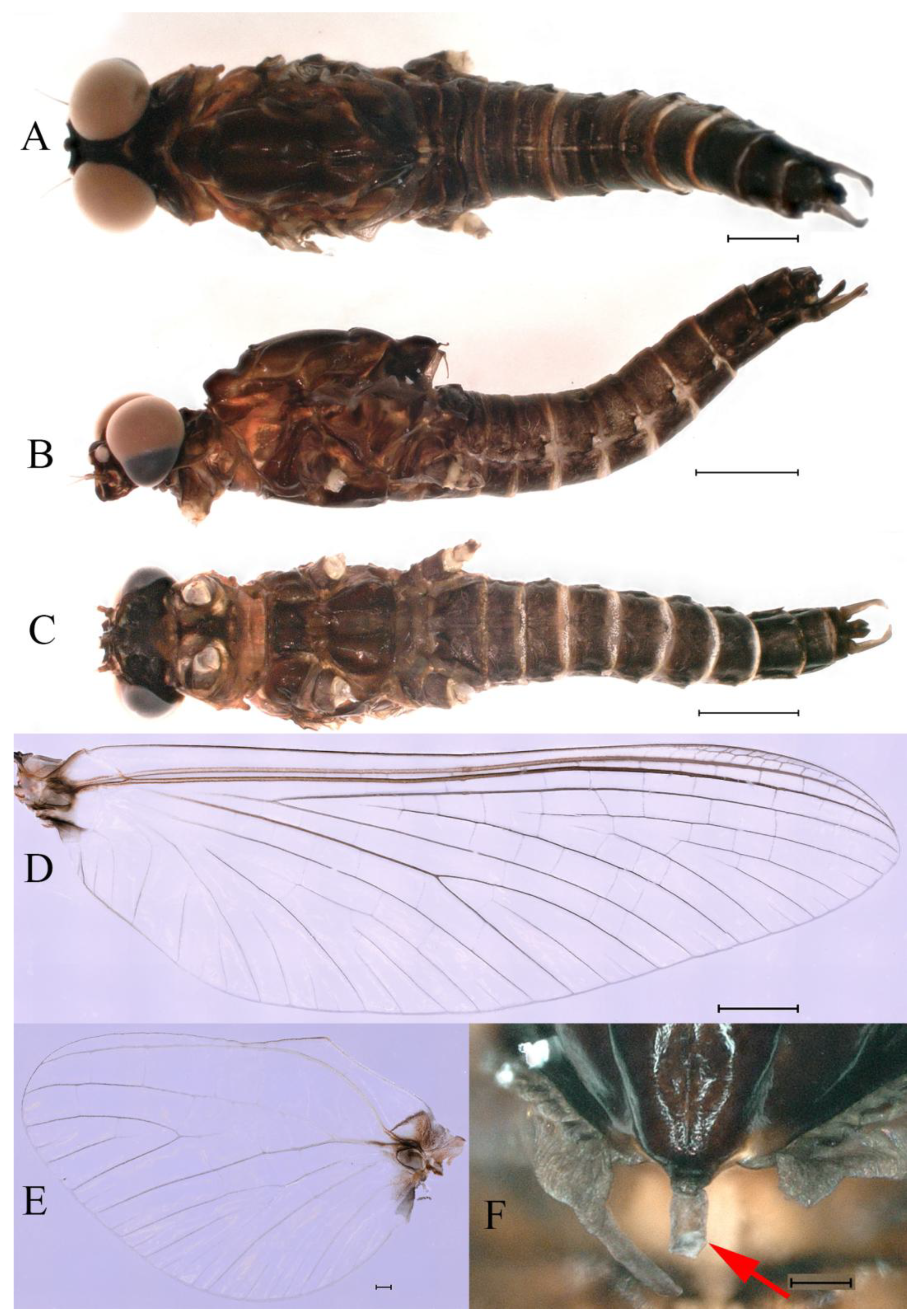
4.4. Distinguishing Winged Stages of Cincticostella
4.5. Research Prospects for Cincticostella
Author Contributions
Funding
Data Availability Statement
Acknowledgments
Conflicts of Interest
References
- Jacobus, L.M.; McCafferty, W.P. Revision of Ephemerellidae genera (Ephemeroptera). Trans. Am. Entomol. Soc. 2008, 134, 185–274. [Google Scholar] [CrossRef]
- Allen, R.K. New Asian Ephemeroptera with notes (Ephemeroptera: Ephemerellidae). Can. Entomol. 1971, 103, 512–528. [Google Scholar] [CrossRef]
- Martynov, A.V.; Selvakumar, C.; Palatov, D.M.; Subramanian, K.A.; Sivaramakrishnan, K.G.; Vasanth, M.; Jacobus, L.M. Overview of Indian and Nepali representatives of the Cincticostella nigra (Ueno, 1928) complex (Ephemeroptera, Ephemerellidae). ZooKeys 2021, 1040, 123–166. [Google Scholar] [CrossRef] [PubMed]
- Auychinda, C.; Sartori, M.; Boonsoong, B. Cincticostella ebura sp. nov., a new species of mayfly (Ephemeroptera, Ephemerellidae) from Thailand. ZooKeys 2022, 1130, 191–204. [Google Scholar] [CrossRef]
- Sun, Y.-K.; Yang, R.-L.; Tan, Z.-W.; Li, X.-F.; Jacobus, L.M. A new species of Cincticostella Allen, 1971 (Ephemeroptera, Ephemerellidae) from Yunnan, China and establishment of a new species complex. ZooKeys 2024, 1205, 349–371. [Google Scholar] [CrossRef]
- Auychinda, C.; Buchawongpiwat, N.; Sartori, M.; Boonsoong, B. A new species of Cincticostella Allen, 1971 (Ephemeroptera: Ephemerellidae) from Thailand. Aquat. Insects 2025, in press. [CrossRef]
- Allen, R.K. Ephemerella (Cincticostella): A revision of the nymphal stages (Ephemeroptera: Ephemerellidae). Pan-Pac. Entomol. 1975, 51, 16–22. [Google Scholar]
- Zheng, X.; Zhou, C. First detailed description of adults and nymph of Cincticostella femorata (Tshernova, 1972) (Ephemeroptera: Ephemerellidae). Aquat. Insects 2021, 42, 23–36. [Google Scholar] [CrossRef]
- Ishiwata, S. A revision of the genus Cincticostella (Insecta: Ephemeroptera: Ephemerellidae) from Japan. Species Divers 2003, 8, 311–346. [Google Scholar] [CrossRef][Green Version]
- Uéno, M. Some Japanese mayfly nymphs. Mem. Coll. Sci. Kyoto Imp. Univ. Ser. B 1928, 4, 19–63. [Google Scholar]
- Tshernova, O.A. Mayflies of the Amur River Basin and nearby waters and their role in the nutrition of Amur fishes. Tr. Amur Ikhtiol. Eksped. 1952, 3, 229–360. (In Russian) [Google Scholar]
- Zhang, M.; Li, W.J.; Ying, X.L.; Zhou, C.F. The imaginal characters of Cincticostella gosei (Allen, 1975) linking the genus Cincticostella Allen, 1971 to Ephacerella Paclt, 1994 (Ephemeroptera: Ephemerellidae). Zootaxa 2021, 5081, 131–140. [Google Scholar] [CrossRef]
- Zhang, W.; Han, N.; Zhang, M.; Wang, Y.F.; Zhou, C.F. The imaginal and detailed nymphal characters of Cincticostella fusca (Kang & Yang, 1995) (Ephemeroptera: Ephemerellidae). Zootaxa 2020, 4729, 277–285. [Google Scholar] [CrossRef]
- Kang, S.C.; Yang, C.T. Ephemerellidae of Taiwan (Insecta, Ephemeroptera). Bull. Natl. Mus. Nat. Sci. 1995, 5, 95–116. [Google Scholar]
- Xie, H.; Jia, Y.Y.; Chen, P.; Jacobus, L.M.; Zhou, C.F. Two new Cincticostella species from China with a larval key to species of the genus (Ephemeroptera: Ephemerellidae). Zootaxa 2009, 2299, 53–61. [Google Scholar] [CrossRef]
- Quan, Y.T.; Bae, Y.J.; Jung, J.C.; Lee, J.W. Ephemeroptera (Insecta) fauna of Northeast China. Insecta Koreana 2002, 19, 241–269. [Google Scholar]
- Yu, L. A key on nymphs of new record species and subspecies of family Ephemerellidae (Ephemeroptera) from Changbai Mountain in China. Acta Entomol. Sin. 1998, 41, 435–437. (In Chinese) [Google Scholar]
- Bae, Y.J.; Hwang, J.M. Checklist of the Korean Ephemeroptera. Entomol. Res. Bull. 2010, 26, 69–76. [Google Scholar]
- Kluge, N.J. The Phylogenetic System of Ephemeroptera; Kluwer Academic Publishers: Dordrecht, The Netherlands, 2004. [Google Scholar]
- Li, X.; Luo, Y.; Jiang, J.; Wang, L.; Tong, X. Description of a new species of the genus Ameletus Eaton, 1885 (Ephemeroptera, Ameletidae) from Yunnan, China. ZooKeys 2021, 1021, 37–51. [Google Scholar] [CrossRef]
- Li, X.-F.; Sun, Y.-K.; Liu, Z.-Y.; Jacobus, L.M.; Xiao, W. A new species of Notacanthella Jacobus & McCafferty, 2008 (Ephemeroptera, Ephemerellidae) from Yunnan, China. ZooKeys 2022, 1103, 25–44. [Google Scholar] [CrossRef]
- Yang, K.; Li, X.F.; Tong, X.L.; Cai, Q.H. A new species of Siphlonurus Eaton, 1868 (Ephemeroptera, Siphlonuridae) from Yunnan, China. ZooKeys 2023, 1166, 121–139. [Google Scholar] [CrossRef]
- Astrin, J.J.; Stüeben, P.E. Phylogeny in cryptic weevils: Molecules, morphology and new genera of western Palaearctic Cryptorhynchinae (Coleoptera: Curculionidae). Invertebr. Syst. 2008, 22, 503–522. [Google Scholar] [CrossRef]
- Wesener, T. No millipede endemics north of the Alps? DNA-Barcoding reveals Glomeris malmivaga Verhoef, 1921 as a synonym of G. ornate Koch, 1847 (Diplopoda, Glomerida, Glomeridae). Zootaxa 2015, 3999, 571–580. [Google Scholar] [CrossRef][Green Version]
- Xiang, C.-Y.; Gao, F.-L.; Jakovlic, I.; Lei, H.-P.; Hu, Y.; Zhang, H.; Zou, H.; Wang, G.-T.; Zhang, D. Using PhyloSuite for molecular phylogeny and tree-based analyses. Imeta 2023, 2, e87. [Google Scholar] [CrossRef]
- Kumar, S.; Stecher, G.; Suleski, M.; Sanderford, M.; Sharma, S.; Tamura, K. MEGA12: Molecular evolutionary genetics analysis version 12 for adaptive and green. Mol. Biol. Evol. 2024, 41, 1–9. [Google Scholar] [CrossRef]
- Jacobus, L.M.; Zhou, C.-F.; McCafferty, W.P. Revisionary contributions to the genus Torleya (Ephemeroptera: Ephemerellidae). J. N. Y. Entomol. Soc. 2004, 112, 153–175. [Google Scholar] [CrossRef]
- Allen, R.K. New and little known Ephemerellidae from southern Asia, Africa and Madagascar (Ephemeroptera). Pac. Insects 1963, 89, 213–244. [Google Scholar]
- Li, B.; Shi, W.; Li, X.; Tong, X. Two new species of the genus Nigrobaetis Kazlauskas (in Novikova & Kluge), 1987 (Ephemeroptera: Baetidae) from Southwest China. Zootaxa 2023, 5315, 131–149. [Google Scholar] [CrossRef] [PubMed]
- Funk, D.J.; Omland, K.E. Species-level paraphyly and polyphyly: Frequency, causes, and consequences, with insights from animal mitochondrial DNA. Annu. Rev. Ecol. Evol. Syst. 2003, 34, 397–423. [Google Scholar] [CrossRef]
- Bocek, M.; Motyka, M.; Kusy, D.; Bocak, L. Genomic and mitochondrial data identify different species boundaries in aposematically polymorphic eniclases net-winged beetles (Coleoptera: Lycidae). Insects 2019, 10, 295. [Google Scholar] [CrossRef] [PubMed]
- Duran, D.P.; Laroche, R.A.; Gough, H.M.; Gwiazdowski, R.A.; Knisley, C.B.; Herrmann, D.P.; Roman, S.J.; Egan, S.P. Geographic life history differences predict genomic divergence better than mitochondrial barcodes or phenotype. Genes 2020, 11, 265. [Google Scholar] [CrossRef]
- Ulmer, G. Newly recorded Ephemeroptera from China, with overview of the known species. Peking Nat. Hist. Bull. 1936, 10, 201–215. (In German) [Google Scholar]
- Allen, R.K. Mayflies of Vietnam: Acerella and Drunella (Ephemeroptera: Ephemerellidae). Pan-Pac. Entomol. 1986, 62, 301–302. [Google Scholar]
- Brodsky, K.A. Zur Kenntnis der mittelasiatischen Ephemeropteren. I. (Imagines). Zool. Jahrb. Syst. 1930, 59, 681–720. [Google Scholar]
- Jacobus, L.M.; McCafferty, W.P. Revisions to the genus Crinitella (Ephemeroptera: Ephemerellidae). J. N. Y. Entomol. Soc. 2003, 111, 48–50. [Google Scholar] [CrossRef]
- Ali, S.R. Certain mayfly nymphs (order: Ephemeroptera) of Azad Kashmir and Swat. Pak. J. Sci. 1971, 23, 209–214. [Google Scholar]
- Webb, J.M.; Jacobus, L.M.; Sullivan, S.P. The state of systematics of North American Baetis Leach, 1815 (Ephemeroptera: Baetidae), with recommendations for identification of larvae. Zootaxa 2018, 4394, 105–127. [Google Scholar] [CrossRef]





| Species | Code | Collection Locality | Collector | Date | GenBank Accession Number |
|---|---|---|---|---|---|
| Cincticostella funki | CfLC01 | Tengchong City | Yan-Chang Zi | 4 February 2025 | PX505011 |
| Cincticostella xiazhi sp. nov. | CxQB01 | Dali City | Xian-Fu Li | 21 June 2024 | PX505014 |
| Cincticostella wangi | CwQB01 | Dali City | Xian-Fu Li | 12 May 2025 | PX505013 |
| Cincticostella yushui sp. nov. | CySB01 | Yunlong County | Xian-Fu Li | 22 February 2025 | PX505012 |
| Species | 1 | 2 | 3 | 4 | 5 | 6 | 7 | 8 | 9 | 10 | 11 | 12 | 13 | 14 | 15 |
|---|---|---|---|---|---|---|---|---|---|---|---|---|---|---|---|
| K2P Genetic Distances | |||||||||||||||
| 1. C. ebura | |||||||||||||||
| 2. C. elongatula | 0.25 | ||||||||||||||
| 3. C. femorata | 0.25 | 0.23 | |||||||||||||
| 4. C. funki | 0.22 | 0.25 | 0.26 | ||||||||||||
| 5. C. fusca | 0.22 | 0.24 | 0.25 | 0.25 | |||||||||||
| 6. C. gosei | 0.25 | 0.28 | 0.25 | 0.26 | 0.27 | ||||||||||
| 7. C. insolta | 0.23 | 0.25 | 0.23 | 0.24 | 0.25 | 0.25 | |||||||||
| 8. C. levanidovae | 0.25 | 0.26 | 0.24 | 0.25 | 0.25 | 0.27 | 0.27 | ||||||||
| 9. C. nigra | 0.24 | 0.15 | 0.25 | 0.22 | 0.24 | 0.26 | 0.27 | 0.23 | |||||||
| 10. C. orientalis | 0.28 | 0.26 | 0.25 | 0.25 | 0.24 | 0.27 | 0.25 | 0.24 | 0.26 | ||||||
| 11. C. parvula | 0.28 | 0.23 | 0.23 | 0.25 | 0.23 | 0.25 | 0.24 | 0.26 | 0.25 | 0.24 | |||||
| 12. C. sivaramakrishnani | 0.23 | 0.26 | 0.22 | 0.25 | 0.25 | 0.25 | 0.23 | 0.24 | 0.27 | 0.21 | 0.23 | ||||
| 13. C. tornata | 0.25 | 0.28 | 0.15 | 0.25 | 0.24 | 0.24 | 0.22 | 0.25 | 0.28 | 0.24 | 0.23 | 0.23 | |||
| 14. C. wangi | 0.20 | 0.22 | 0.25 | 0.22 | 0.24 | 0.27 | 0.27 | 0.24 | 0.22 | 0.26 | 0.28 | 0.23 | 0.26 | ||
| 15. C. xiazhi sp. nov. | 0.18 | 0.22 | 0.25 | 0.18 | 0.22 | 0.27 | 0.25 | 0.25 | 0.21 | 0.26 | 0.24 | 0.25 | 0.26 | 0.23 | |
| 16. C. yushui sp. nov. | 0.22 | 0.22 | 0.26 | 0.21 | 0.27 | 0.24 | 0.24 | 0.25 | 0.22 | 0.24 | 0.25 | 0.23 | 0.27 | 0.23 | 0.19 |
| C. insolta Complex | C. nigra Complex |
|---|---|
| C. bifurcata Xie, Jia, Chen, Jacobus & Zhou, 2009 | C. changfai Martynov & Palatov, 2021 |
| C. braaschi Jacobus & McCafferty, 2008 | C. colossa Kang & Yang, 1995 |
| C. femorata Tshernova, 1972 | C. corpulenta Braasch, 1981 |
| C. insolta Allen, 1971 | C. elongatula McLachlan, 1875 |
| C. ranga Selvakumar & Subramanian, 2019 | C. funki Martynov, Selvakumar, Palatov & Vasanth, 2021 |
| C. richardi Martynov & Palatov, 2019 | C. ebura Auychinda, Sartori & Boonsoong, 2022 |
| C. sivaramakrishnani Martynov & Palatov, 2019 | C. levanidovae Tshernova, 1952 * |
| C. tornata Auychinda & Gattolliat, 2020 | C. nigra Uéno, 1928 |
| C. gosei complex | C. orientalis Tshernova, 1952 * |
| C. gosei Allen, 1975 | C. shinichii Martynov & Palatov, 2021 |
| C. parvula Auychinda, Buchawongpiwat, Sartori & Boonsoong, 2025 | C. szechuanensis Xie, Jia, Chen, Jacobus & Zhou, 2009 * |
| C. jianchuan complex | C. wangi Selvakumar, Martynov & Subramanian, 2021 |
| C. fusca Kang & Yang, 1995 | C. xiazhi Zi, Li & Jacobus sp. nov. |
| C. jianchuan Sun, Tan, Li & Jacobus, 2024 | C. yushui Zi, Li & Jacobus sp. nov. |
| Cincticostella sp. A Martynov et al. [3] |
| Characters | C. insolta Complex | C. nigra Complex | C. gosei Complex | C. jianchuan Complex | |
|---|---|---|---|---|---|
| 1 | Two pairs of suboccipital tubercles | present | absent | absent | absent |
| 2 | Serration of margins of middle and hind femora | present | absent | absent | absent |
| 3 | Presence of numerous large, rounded scale sockets on body surface | present | absent | present | absent |
| 4 | Rate of anterolateral emargination of labrum | shallow | from shallow to deep | moderate | absent |
| 5 | Maxillary palp | reduced, articulations of segments not distinct, especially between segments I and II | mainly well-developed, articulations of all segments distinct | absent or reduced, articulations of segments not distinct, especially between segments I and II | mainly well-developed, articulations of all segments distinct |
| 6 | Segments I and II of labial palp | wide | wide | relatively narrow, elongated | wide |
| 7 | Stout setae on outer margin of fore femur | several stout setae only | numerous stout setae | several stout setae only | numerous stout setae |
| 8 | Stout setae on dorsal surface of middle and hind femora | absent or up to several stout setae in basal area | surface with numerous stout setae | absent | surface with numerous stout setae |
| 9 | Shape of hind femur | strongly or moderately widened | moderately widened | moderately widened | moderately widened |
| 10 | Stout setae on dorsal surface of abdominal terga and paired projections | absent | present | absent | present or absent |
| 11 | Body size | moderate | moderate | small | large |
| 12 | Mesothoracic anterolateral projections | not notched | not notched | not notched | notched |
| 13 | subapical bands of transverse setae | absent | present | present | absent |
Disclaimer/Publisher’s Note: The statements, opinions and data contained in all publications are solely those of the individual author(s) and contributor(s) and not of MDPI and/or the editor(s). MDPI and/or the editor(s) disclaim responsibility for any injury to people or property resulting from any ideas, methods, instructions or products referred to in the content. |
© 2025 by the authors. Licensee MDPI, Basel, Switzerland. This article is an open access article distributed under the terms and conditions of the Creative Commons Attribution (CC BY) license (https://creativecommons.org/licenses/by/4.0/).
Share and Cite
Feng, Y.-F.; Zi, Y.-C.; Zhao, C.-F.; Mu, Y.; Li, X.-F.; Jacobus, L.M. Two New Species and First Stage Associations for Two Other Species of the Cincticostella nigra (Uéno, 1928) Complex (Ephemeroptera, Ephemerellidae) from Yunnan, China, with Discussion About Cincticostella Allen, 1971 Species Complexes Based on Winged Stages. Insects 2025, 16, 1221. https://doi.org/10.3390/insects16121221
Feng Y-F, Zi Y-C, Zhao C-F, Mu Y, Li X-F, Jacobus LM. Two New Species and First Stage Associations for Two Other Species of the Cincticostella nigra (Uéno, 1928) Complex (Ephemeroptera, Ephemerellidae) from Yunnan, China, with Discussion About Cincticostella Allen, 1971 Species Complexes Based on Winged Stages. Insects. 2025; 16(12):1221. https://doi.org/10.3390/insects16121221
Chicago/Turabian StyleFeng, Yi-Fei, Yan-Chang Zi, Cheng-Fa Zhao, Yuan Mu, Xian-Fu Li, and Luke M. Jacobus. 2025. "Two New Species and First Stage Associations for Two Other Species of the Cincticostella nigra (Uéno, 1928) Complex (Ephemeroptera, Ephemerellidae) from Yunnan, China, with Discussion About Cincticostella Allen, 1971 Species Complexes Based on Winged Stages" Insects 16, no. 12: 1221. https://doi.org/10.3390/insects16121221
APA StyleFeng, Y.-F., Zi, Y.-C., Zhao, C.-F., Mu, Y., Li, X.-F., & Jacobus, L. M. (2025). Two New Species and First Stage Associations for Two Other Species of the Cincticostella nigra (Uéno, 1928) Complex (Ephemeroptera, Ephemerellidae) from Yunnan, China, with Discussion About Cincticostella Allen, 1971 Species Complexes Based on Winged Stages. Insects, 16(12), 1221. https://doi.org/10.3390/insects16121221