Demography and Behaviour of Teinopodagrion oscillans (Odonata: Megapodagrionidae) in a Protected Area of the Colombian Andean Region
by
 ,
,
Fredy Palacino-Rodríguez
1,2,* ,
,
Diego Andres Palacino
2,
Andrea Penagos Arevalo
2 and
Adolfo Cordero-Rivera
3
1
Etology Section, Faculty of Sciences, Republic University, Montevideo 11200, Uruguay
2
Research Group on Odonata and Other Arthropods in Colombia and the Neotropics (GINOCO), Sesquilé 251057, Colombia
3
ECOEVO Lab, E. E. Forestal, Campus Universitario A Xunqueira s/n, Universidade de Vigo, 36005 Pontevedra, Spain
*
Author to whom correspondence should be addressed.
Insects 2024, 15(2), 125; https://doi.org/10.3390/insects15020125
Submission received: 13 January 2024
/
Revised: 5 February 2024
/
Accepted: 7 February 2024
/
Published: 9 February 2024
(This article belongs to the Special Issue Aquatic Insects: Diversity, Ecology and Evolution)
Simple Summary
Basic information on the ecology and behaviour of many aquatic insects is lacking because of the absence of studies. Here, we investigated whether demographic aspects such as survival, sex ratio, and population size are different between sexes and individuals of different ages of Teinopodagrion oscillans, a damselfly species endemic to the Andean region, living in a protected area. We also recorded the behaviour of this species and the area frequented by the adults near the water. Survival, recapture, and lifespan (14.1 ± 0.59 days) were similar for both sexes and all age groups. Mature males were larger, while the distance from the water where animals perched was similar for all individuals. Weather variations affected the demography of this population in a significant way. Individuals perch on any available support (≤0.1–12 m high) and show high fidelity to their perch site, with mature males making short flights from the perch to intercept other individuals and to hunt prey. The tandem position was formed on macrophytes, and females lay eggs by submersion of their abdomen. Our results provide crucial information for short- and long-term conservation decisions of the biodiversity in ecosystems of the Andean region.
Abstract
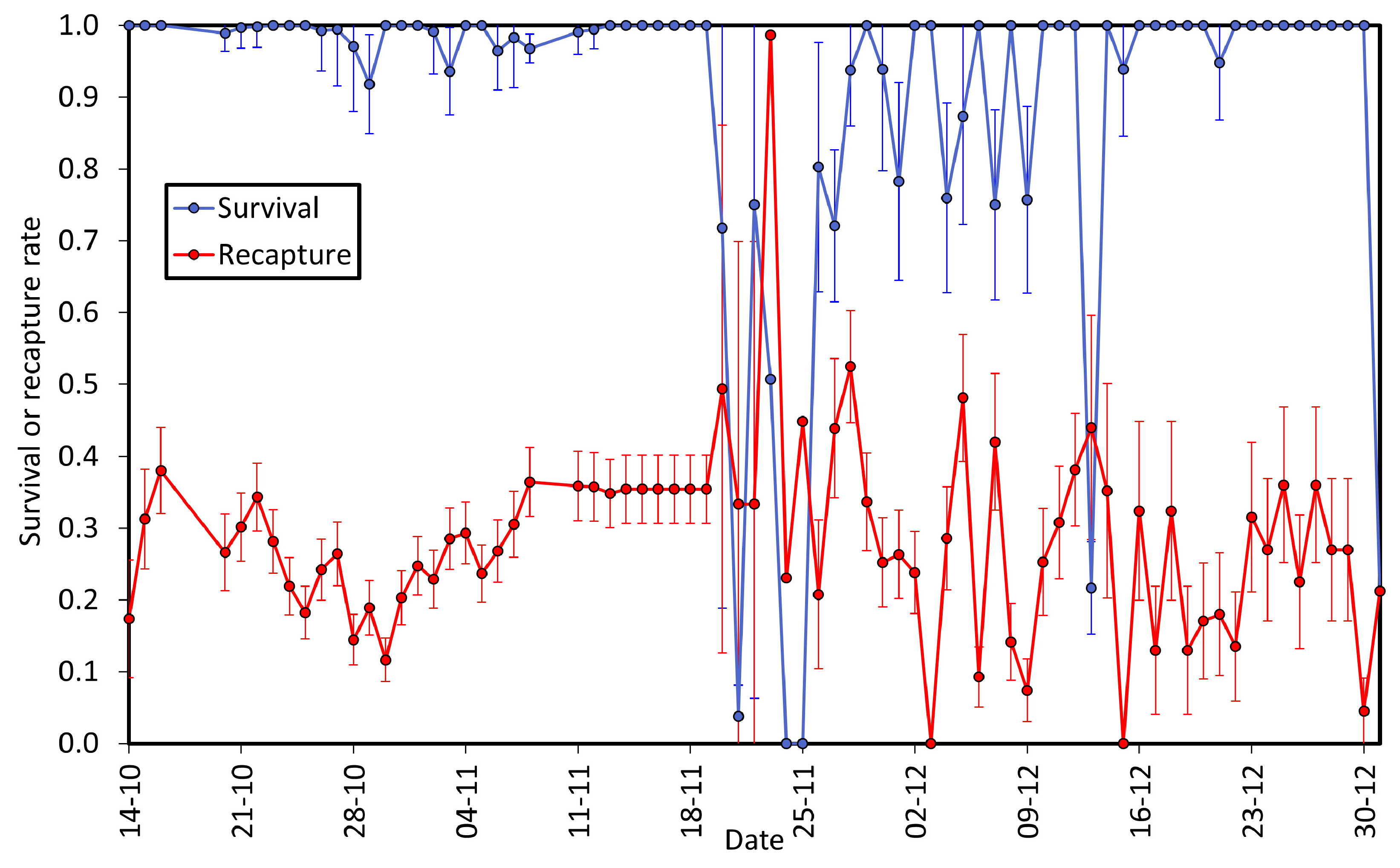
The demography and behaviour of Teinopodagrion oscillans was studied in a protected area in the Andean region of Colombia. Adult damselflies were individually marked, and using their recapture histories, we estimated survival, longevity, sex ratio, and population size using Cormack-Jolly-Seber models. Other aspects of their behaviour were recorded. Survival, recapture, and lifespan (14.1 ± 0.59 days) were similar for both sexes and all age groups. Mature males were larger, and the distance from the water was similar for all individuals. The most supported model was the time-dependent model for survival and recapture. This suggests that weather variations affect the demography of this population in a significant way. Individuals exhibited high fidelity to their site perch, perching with open wings near water on a variety of perches. Mature males make short flights from the perch to intercept conspecific and interspecific males and to hunt prey. The tandem position was formed on macrophytes, and then the pair flew away. Oviposition lasted for 11.23 min on average, with the females ovipositing by abdomen submersion. Our results offer insights into the demographic characteristics and behaviour of this species, providing crucial information for the short- and long-term, from the demography of one species to the conservation of ecosystems of the Andean region.
Keywords:
damselfly; dragonfly; aquatic insects; mark-recapture; Neotropics; Zygoptera