
Fitness Costs and Incomplete Resistance Associated with Delayed Evolution of Practical Resistance to Bt Crops


Department of Entomology, University of Arizona, Tucson, AZ 85721, USA
*
Author to whom correspondence should be addressed.
Insects 2023, 14(3), 214; https://doi.org/10.3390/insects14030214
Submission received: 25 January 2023
/
Revised: 11 February 2023
/
Accepted: 16 February 2023
/
Published: 21 February 2023
(This article belongs to the Special Issue Resistance of Pests to Insecticidal Proteins from Bacillus thuringiensis (Bt))
Simple Summary
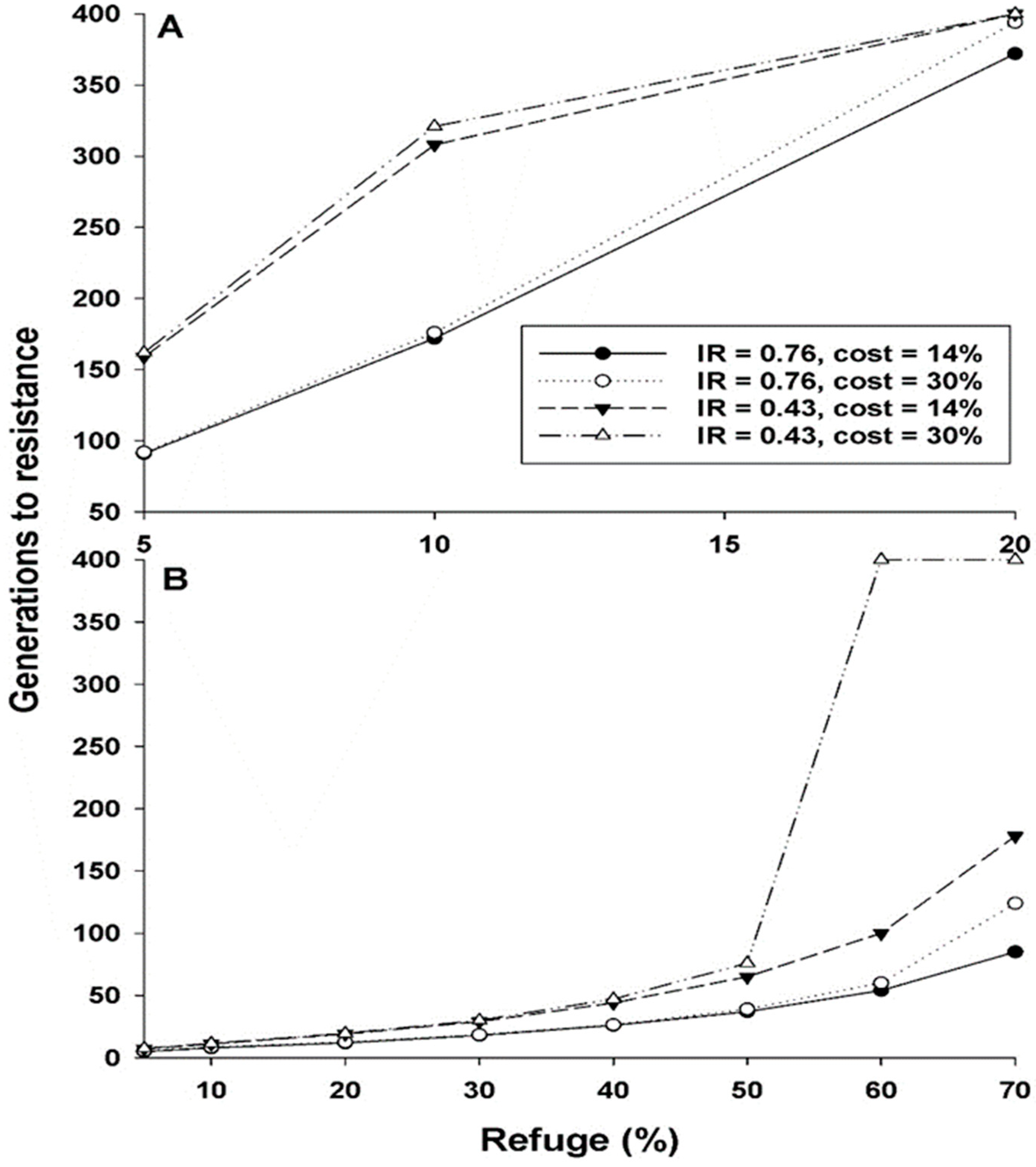
Crops genetically engineered to produce insect-killing proteins from the soil bacterium Bacillus thuringinsis (Bt) have been used since 1996 to improve pest control. Intensive use of Bt crops has resulted in the evolution of practical resistance in some pests, which reduces the efficacy of Bt crops and has detrimental practical consequences for pest management. To better understand factors underlying this evolutionary response, we analyzed data from the literature to evaluate the association with the evolution of practical resistance for two pest traits: fitness costs and incomplete resistance. Fitness costs are negative effects of resistance alleles on pest fitness in the absence of Bt toxins. Incomplete resistance is the reduced fitness of resistant insects on Bt plants relative to non-Bt plants. Our results show that lower fitness costs and the higher survival of resistant pests on Bt plants relative to non-Bt plants are associated with the evolution of practical resistance. Together with previous studies showing that nonrecessive inheritance is associated with practical resistance, the results here identify a syndrome associated with the evolution of practical resistance to Bt crops. Further research to characterize this resistance syndrome and determine its evolutionary consequences could be useful to sustain the efficacy of Bt crops.
Abstract
Insect pests are increasingly evolving practical resistance to insecticidal transgenic crops that produce Bacillus thuringiensis (Bt) proteins. Here, we analyzed data from the literature to evaluate the association between practical resistance to Bt crops and two pest traits: fitness costs and incomplete resistance. Fitness costs are negative effects of resistance alleles on fitness in the absence of Bt toxins. Incomplete resistance entails a lower fitness of resistant individuals on a Bt crop relative to a comparable non-Bt crop. In 66 studies evaluating strains of nine pest species from six countries, costs in resistant strains were lower in cases with practical resistance (14%) than without practical resistance (30%). Costs in F1 progeny from crosses between resistant and susceptible strains did not differ between cases with and without practical resistance. In 24 studies examining seven pest species from four countries, survival on the Bt crop relative to its non-Bt crop counterpart was higher in cases with practical resistance (0.76) than without practical resistance (0.43). Together with previous findings showing that the nonrecessive inheritance of resistance is associated with practical resistance, these results identify a syndrome associated with practical resistance to Bt crops. Further research on this resistance syndrome could help sustain the efficacy of Bt crops.