

The Effect of Bean Seed Treatment with Entomopathogenic Fungus Metarhizium robertsii on Soil Microarthropods (Acari, Collembola)
by
 , ,
, ,
Tatiana Novgorodova
1,
Natalia Vladimirova
1,*,
Irina Marchenko
1,
Tatyana Sadokhina
2,
Maksim Tyurin
1,
Lyudmila Ashmarina
2,
Dmitry Bakshaev
2,
Georgy Lednev
3 and
Viktor Danilov
2 1
Institute of Systematics and Ecology of Animals, Siberian Branch, Russian Academy of Sciences, Frunze 11, 630091 Novosibirsk, Russia
2
Siberian Federal Scientific Center of Agro-BioTechnologies, Russian Academy of Sciences, Central 2b, 630501 Krasnoobsk, Russia
3
All-Russian Institute of Plant Protection, Podbelskogo 3, 196608 St. Petersburg, Russia
*
Author to whom correspondence should be addressed.
Insects 2022, 13(9), 807; https://doi.org/10.3390/insects13090807
Submission received: 27 July 2022
/
Revised: 28 August 2022
/
Accepted: 31 August 2022
/
Published: 5 September 2022
(This article belongs to the Special Issue Practices to Conserve Pollinators and Natural Enemies in Agro-Ecosystems)
Simple Summary
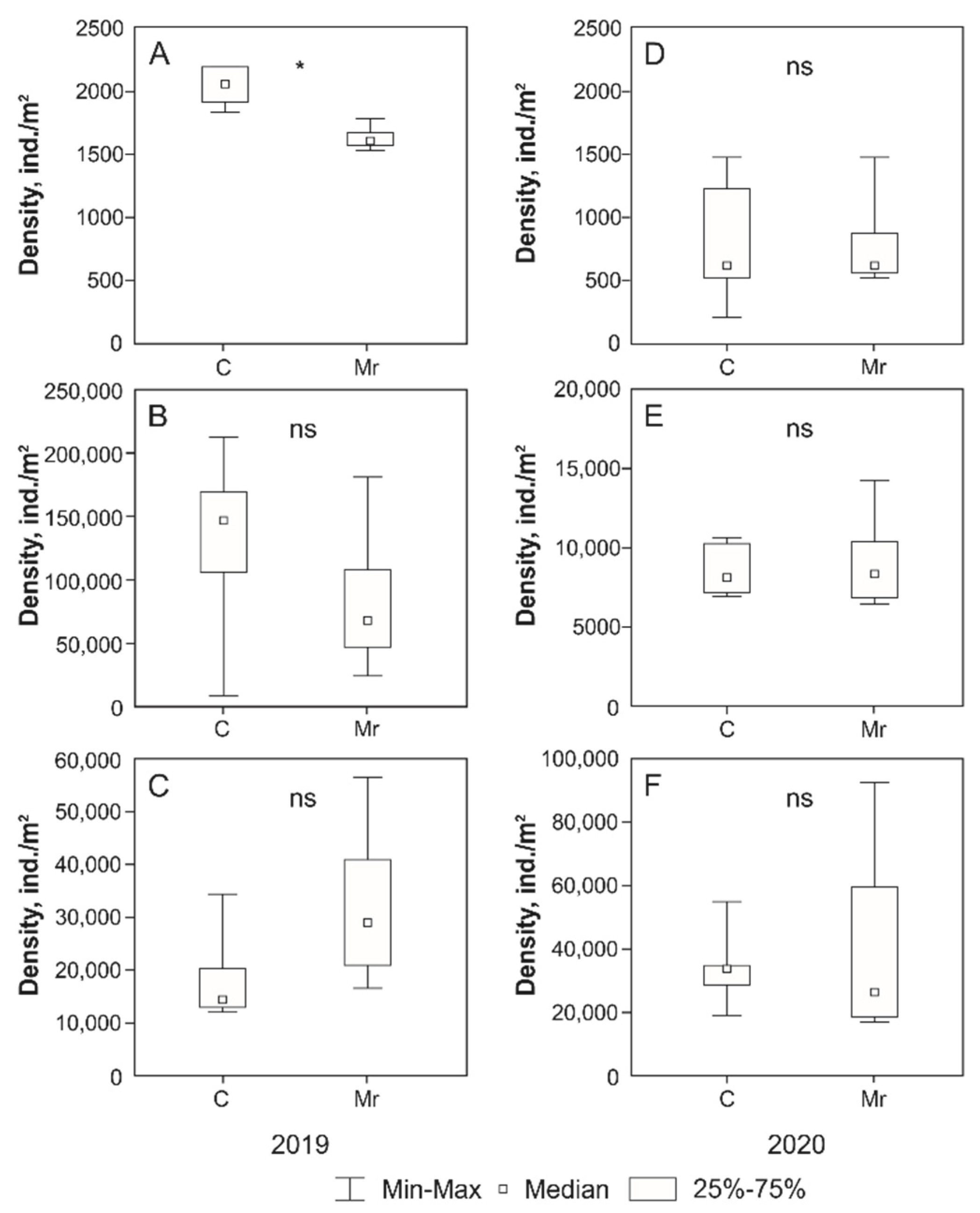
Plant pest control is essential for agriculture. The treatment of agricultural crops with entomopathogenic fungi protects plants against pests and can also increase plant growth, but at the same time may disturb the community structure of non-target beneficial invertebrates, in particular soil microarthropods. This can have a negative impact on soil fertility and ultimately on crop yields. The effect of the treatment of broad bean (Vicia faba L.) seeds, with the entomopathogenic fungus Metarhizium robertsii, on the abundance and structure of soil microarthropod communities in the rhizosphere was assessed. Compared with the control, no adverse effect was revealed on both the abundance of soil microarthropods, including mites (Mesostigmata, Oribatida, Astigmata, Prostigmata) and springtails (Collembola), and the structure of microarthropod communities. Therefore, dressing seeds with a conidial suspension for plant inoculation, with entomopathogenic fungi (at least M. robertsii), can be assumed as a potentially safe method of plant protection for soil microarthropods.
Abstract
The treatment of agricultural crops with entomopathogenic fungi may disturb the structure of soil microarthropod communities, which can have an adverse impact on soil fertility and, ultimately, on the yield. The effect of the treatment of broad bean (Vicia faba L.) seeds, with the entomopathogenic fungus Metarhizium robertsii, on the abundance and community structure of soil microarthropods in the rhizosphere was assessed in different phases of plant vegetation in a two-year experiment. Under the conditions of the gradually decreased abundance of M. robertsii both in the soil cenoses and in the plants during summer, no adverse effect was revealed of the bean seed treatment, with the entomopathogenic fungus, on the abundance of soil microarthropods (Acari: Mesostigmata, Prostigmata, Oribatida and Astigmata; Collembola) and the structure of their communities. Similar results were obtained in the analysis, taking into account the positive colonization of plants. Some changes in the microarthropod community structure were explained primarily by the spatial heterogeneity of the field, the hydrothermal regime, and the features of the microarthropod life cycles. The results indicate the possibility of using dressing seeds with conidial suspension for plant inoculation with entomopathogenic fungus (at least M. robertsii) as a potentially safe plant protection method for non-target soil microarthropods.