Sex-Specific Regulatory Systems for Dopamine Production in the Honey Bee


Graduate School of Agriculture, Tamagawa University, Machida, Tokyo 194-8610, Japan
*
Author to whom correspondence should be addressed.
Insects 2022, 13(2), 128; https://doi.org/10.3390/insects13020128
Submission received: 24 December 2021
/
Revised: 20 January 2022
/
Accepted: 24 January 2022
/
Published: 25 January 2022
(This article belongs to the Special Issue Biogenic Amines and Behavior)
Simple Summary
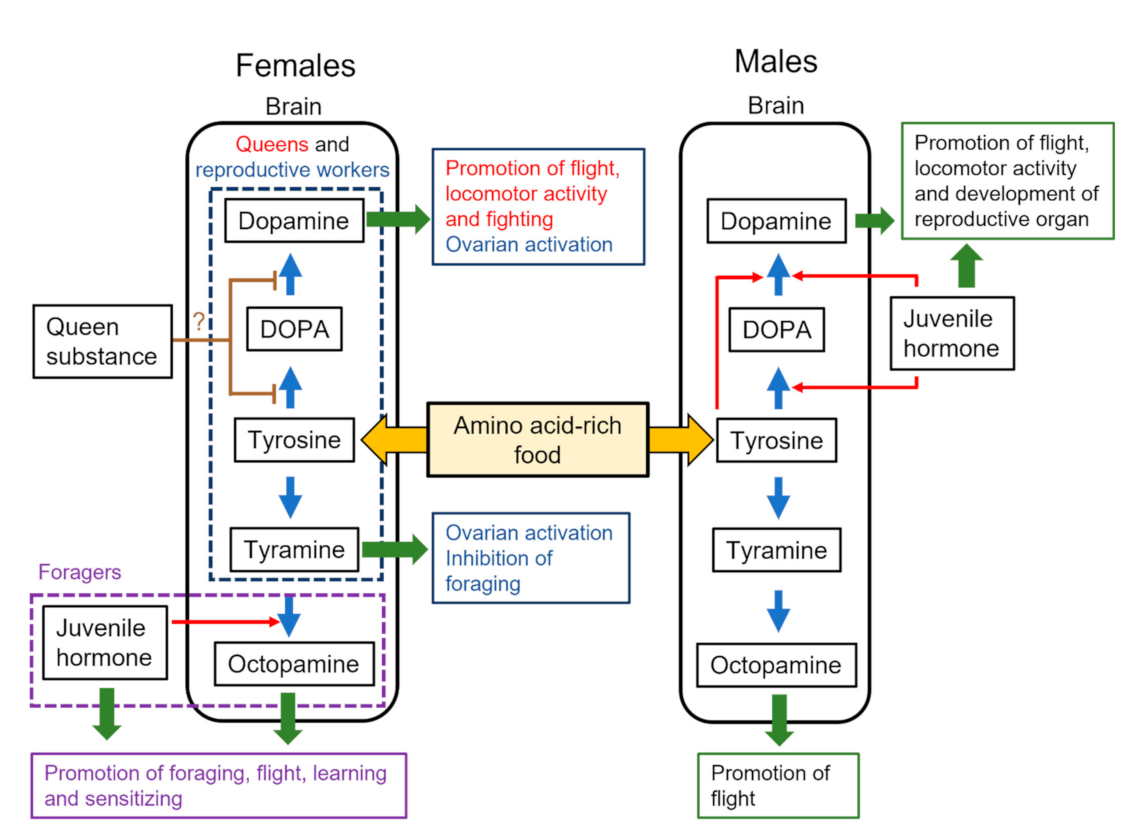
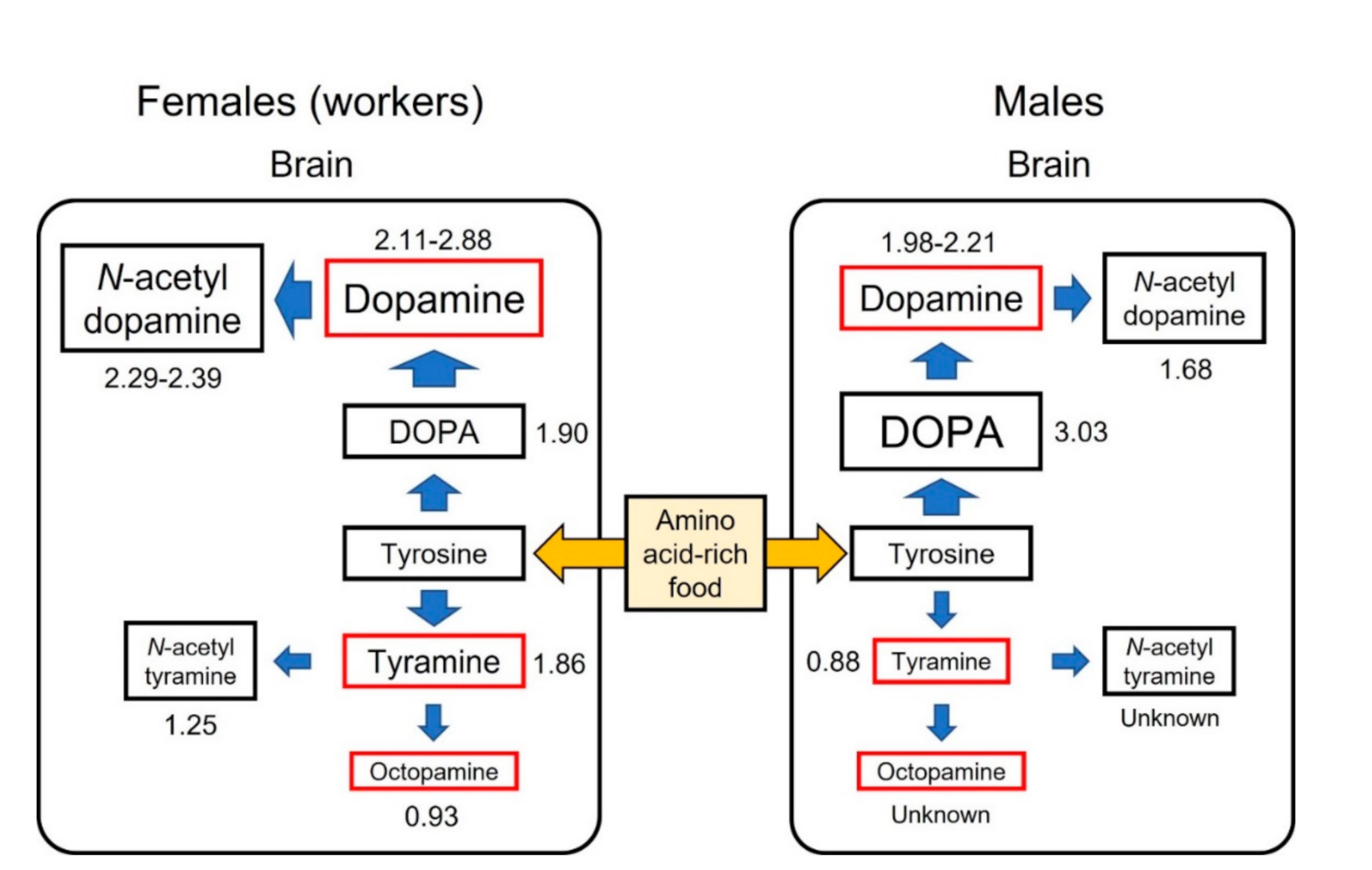
In this review, we describe sex-specific differences in the regulatory systems for dopamine production in the brains of social insects, focusing on the honey bee. Dopamine has a crucial role in the promotion of reproduction in both sexes of the honey bee and is a key substance for understanding the mechanisms underlying the reproductive division of labor in females. Studies associated with dopamine regulation have been performed mainly in females, with less of a focus on its regulation in males. In social insects, males are specialized for reproduction and do not exhibit division of labor; however, they have evolved to adapt their social system and have acquired/discarded physiological and behavioral characteristics. Therefore, studies exploring the dopaminergic system in males can contribute to our understanding of social adaptation in males. We integrate findings related to dopamine in both honey bee sexes and provide insights into the physiology involved in dopaminergic systems in social insects.
Abstract
Dopamine has multiple functions in the modulation of social behavior and promotion of reproduction in eusocial Hymenoptera. In the honey bee, there are sex-specific differences in the regulation of dopamine production in the brain. These different dopaminergic systems might contribute to the maintenance of sex-specific behaviors and physiology. However, it is still not fully understood how the dopaminergic system in the brain is regulated by endocrinal factors and social stimuli in the colony. In this review, we focus on the regulation of dopamine production in queens, workers, and males in the honey bee. Dopamine production can be controlled by queen substance, juvenile hormone, and exogenous tyrosine from food. Queens can control dopamine production in workers via queen substance, whereas workers can manipulate the supply of tyrosine, a precursor of dopamine, to queens and males. The regulation of dopamine production through social interaction might affect the reproductive states of colony members and maintain sex-specific behaviors in unpredictable environments.
Keywords:
Apis mellifera; biogenic amine; brain; dopamine; male; reproduction; sex; social insect