Compass Cue Integration and Its Relation to the Visual Ecology of Three Tribes of Ball-Rolling Dung Beetles

1
Lund Vision Group, Department of Biology, Lund University, Sölvegatan 35, 223 62 Lund, Sweden
2
School of Animal, Plant and Environmental Sciences, University of the Witswatersrand, 1 Jan Smuts Avenue, Braamfontein, Johannesburg 2000, South Africa
*
Author to whom correspondence should be addressed.
Insects 2021, 12(6), 526; https://doi.org/10.3390/insects12060526
Submission received: 9 May 2021
/
Revised: 1 June 2021
/
Accepted: 3 June 2021
/
Published: 6 June 2021
(This article belongs to the Collection Insect Sensory Biology)
Simple Summary
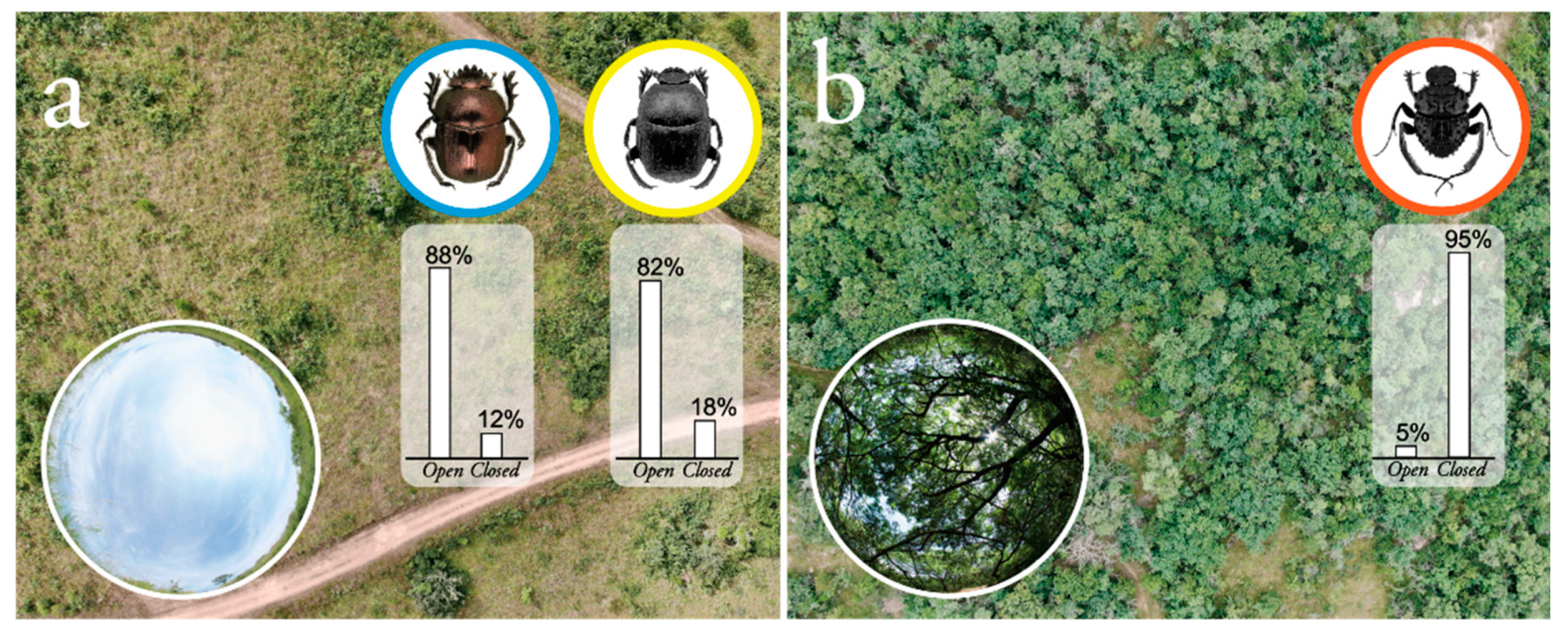
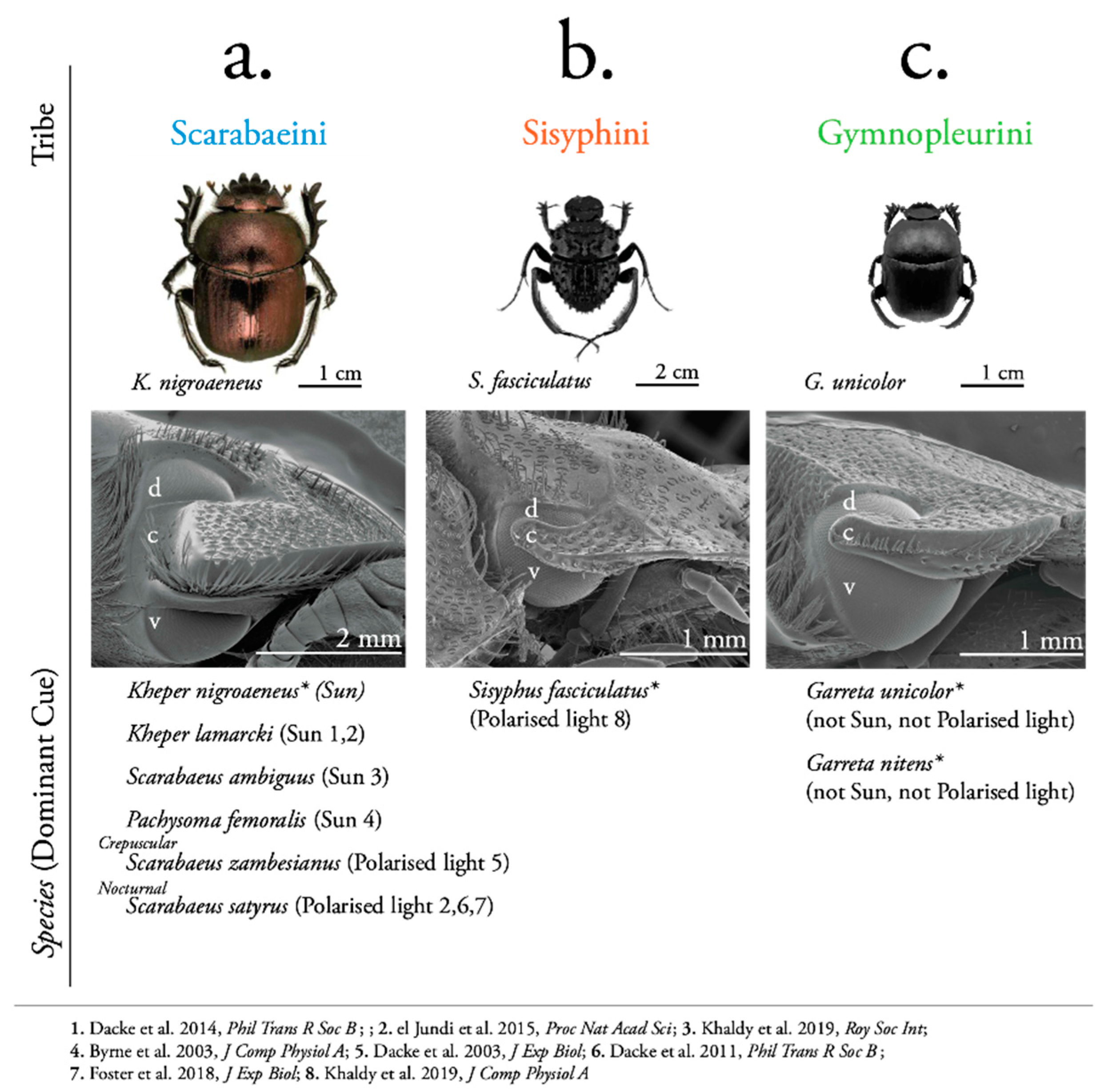
To escape competition for food at the dung pat, ball-rolling dung beetles shape a piece of dung into a sphere and roll it away. To maintain their bearing, these beetles integrate directional information from a range of celestial cues. For the majority of diurnal dung beetles living in open habitats, the most dominant of these cues is the sun. It has recently been demonstrated that beetles living in closed habitats, with closely spaced trees and tall grass, rely predominantly on directional information provided by polarised skylight rather than the sun. Taken together, these findings suggests that the orientation strategy of the beetle is influenced by the animal’s visual ecology. To further investigate the relative weighting of cues in the orientation system of beetles, and its relation to their visual ecology, we investigated the orientation strategy of ball-rollers from three different dung beetle tribes, all present within the same savanna biome. We find that species within a tribe share the same orientation strategy, but that this strategy differs across tribes. We conclude that, despite dramatic intertribal differences in body size and external eye design, the dynamic heading direction network of the South African ball-rolling dung beetles is well adapted to guide the foraging insect in the habitat that it normally traverses.
Abstract
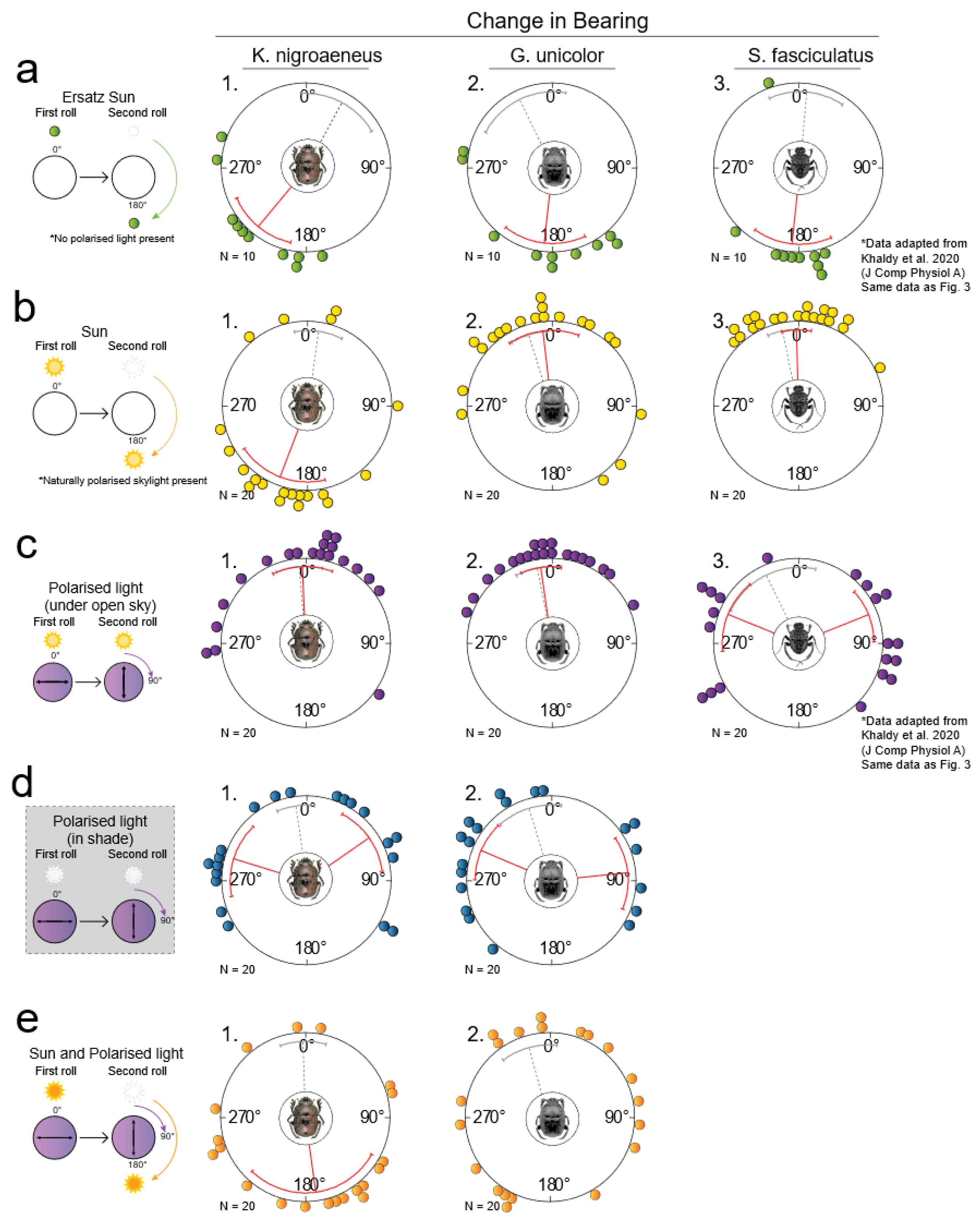
To guide their characteristic straight-line orientation away from the dung pile, ball-rolling dung beetles steer according to directional information provided by celestial cues, which, among the most relevant are the sun and polarised skylight. Most studies regarding the use of celestial cues and their influence on the orientation system of the diurnal ball-rolling beetle have been performed on beetles of the tribe Scarabaeini living in open habitats. These beetles steer primarily according to the directional information provided by the sun. In contrast, Sisyphus fasciculatus, a species from a different dung-beetle tribe (the Sisyphini) that lives in habitats with closely spaced trees and tall grass, relies predominantly on directional information from the celestial pattern of polarised light. To investigate the influence of visual ecology on the relative weight of these cues, we studied the orientation strategy of three different tribes of dung beetles (Scarabaeini, Sisyphini and Gymnopleurini) living within the same biome, but in different habitat types. We found that species within a tribe share the same orientation strategy, but that this strategy differs across the tribes; Scarabaeini, living in open habitats, attribute the greatest relative weight to the directional information from the sun; Sisyphini, living in closed habitats, mainly relies on directional information from polarised skylight; and Gymnopleurini, also living in open habitats, appear to weight both cues equally. We conclude that, despite exhibiting different body size, eye size and morphology, dung beetles nevertheless manage to solve the challenge of straight-line orientation by weighting visual cues that are particular to the habitat in which they are found. This system is however dynamic, allowing them to operate equally well even in the absence of the cue given the greatest relative weight by the particular species.
Keywords:
orientation; orientation strategy; visual ecology; dung beetle; compass cues