


Bemisia tabaci on Vegetables in the Southern United States: Incidence, Impact, and Management


 ,
, 

Simple Summary
Abstract
1. Introduction
2. Identification
3. Biology
4. Hosts and Plant Damage
5. Incidence and Impact of B. tabaci on Vegetables in the Southern United States
5.1. Florida
5.2. Georgia
5.3. Texas
5.4. Arkansas
5.5. Kentucky
5.6. Tennessee
5.7. South Carolina
5.8. Other States
6. Management
6.1. Monitoring and Sampling
6.2. Cultural Control
6.3. Host-Plant Resistance
6.4. Chemical Control
6.4.1. Neonicotinoid Insecticides
6.4.2. Insect Growth Regulators
6.4.3. Ketoenols
6.4.4. Diamides
6.4.5. Soaps and Oils
6.4.6. Plant-Based Products
6.5. Insecticide Resistance and Its Management
6.6. Biological Control
6.6.1. Predators
6.6.2. Parasitoids
6.6.3. Entomopathogens
7. Future Challenges and Opportunities
Author Contributions
Funding
Institutional Review Board Statement
Data Availability Statement
Acknowledgments
Conflicts of Interest
References
- Mound, L.A.; Halsey, S.H. Whitefly of the World; Wiley: New York, NY, USA, 1978; p. 340. [Google Scholar]
- Bink-Moenen, R.M. Whiteflies: Diversity, biosystematics and evolutionary patterns. In Whiteflies: Their Bionomics, Pest Status and Management; Gerling, D., Ed.; Intercept Ltd.: Andover, UK, 1990; pp. 1–11. [Google Scholar]
- Martin, J.H.; Mound, L.A. An Annotated Check List of the World’s Whiteflies (Insecta: Hemiptera: Aleyrodidae); Magnolia Press: Aukland, New Zealand, 2007. [Google Scholar]
- Martin, J.H. Whiteflies of Belize (Hemiptera: Aleyrodidae). Part 1 introduction and account of the subfamily Aleurodicinae Quaintance & Baker. Zootaxa 2004, 681, 1–119. [Google Scholar] [CrossRef]
- Nauen, R.; Ghanim, M.; Ishaaya, I. Whitefly special issue organized in two parts. Pest Manag. Sci. 2014, 70, 1438–1439. [Google Scholar] [CrossRef]
- Hodges, G.S.; Evans, G.A. An identification guide to the whiteflies (Hemiptera: Aleyrodidae) of the Southeastern United States. Fla. Entomol. 2005, 88, 518–534. [Google Scholar] [CrossRef]
- Henneberry, T.J.; Castle, S.J. Bemisia: Pest status, economics, biology, and population dynamics. In Virus Insect Plant Interactions, 1st ed.; Harris, K.F., Smith, O.P., Duffus, J.E., Eds.; Academic Press: San Diego, CA, USA, 2001; pp. 247–278. [Google Scholar]
- Byrne, D.N.; Bellows, T.S., Jr. Whitefly biology. Annu. Rev. Entomol. 1991, 36, 431–457. [Google Scholar] [CrossRef]
- Robertson, J.L.; Stansly, P.A.; Naranjo, S.E. Bemisia: Bionomics and management of a global pest. J. Econ. Entomol. 2014, 107, 482. [Google Scholar] [CrossRef][Green Version]
- Hamon, A.B.; Salguero, V. Bemisia tabaci, Sweetpotato Whitefly, in Florida (Homoptera: Aleyrodidae: Aleyrodinae); Entomology Circular 292; Division of Plant Industry, Florida Department of Agriculture and Consumer Services: Tallshassee, FL, USA, 1987. [Google Scholar]
- Hoelmer, K.A.; Osborne, L.S.; Yokomi, R.K. Foliage disorders in Florida associated with feeding by sweetpotato whitefly, Bemisia tabaci. Fla. Entomol. 1991, 74, 162. [Google Scholar] [CrossRef]
- Schuster, D.J.; Price, J.F.; Kring, J.B.; Everett, P.H. Integrated Management of the Sweetpotato Whitefly on Commercial Tomato; Bradenton GCREC Research Report BRA1989-12; Institute of Food and Agricultural Sciences, University of Florida: Gainesville, FL, USA, 1989. [Google Scholar]
- Henneberry, T.J.; Faust, R.M. Introduction. In Classical Biological Control of Bemisia Tabaci in the United States, 1st ed.; Gould, J., Hoelmer, K., Goolsby, J., Eds.; Springer: Dordrecht, The Netherlands, 2008; Volume 4, pp. 1–16. [Google Scholar]
- Schuster, D.J.; Stansly, P.A.; Polston, J.E. Expressions of plant damage by Bemisia. In Bemisia 1995: Taxonomy, Biology, Damage Control and Management; Gerling, D., Mayer, R.T., Eds.; Intercept Ltd.: Andover, UK, 1996; pp. 153–165. [Google Scholar]
- Duffus, J.E.; Larsen, R.C.; Liu, H.Y. Lettuce infectious yellows virus—A new type of whitefly transmitted virus. Phytopathology 1986, 76, 97–100. [Google Scholar] [CrossRef]
- Miller, G.L.; Jensen, A.S.; Nakahara, S.; Carlson, R.W.; Miller, D.R.; Stoezel, M.B. The Whitefly Web Page. Systematic Entomology Laboratory World Wide Web Site. 2001. Available online: https://www.ars.usda.gov/research/publications/publication/?seqNo115=124357 (accessed on 13 September 2020).
- Evans, G. The Whiteflies (Hemiptera: Aleyrodidae) of the World and Their Host Plants and Natural Enemies. 2007. Available online: http://keys.lucidcentral.org/keys/v3/whitefly/PDF_PwP%20ETC/world-whitefly-catalog-Evans.pdf (accessed on 13 September 2020).
- Natwick, E.; Stoddard, C.; Zalom, F.; Trumble, J.; Miyao, G.; Stapleton, J. UC IPM Pest Management Guidelines: Tomato; UC ARN Publication 3470; UC ANR Statewide IPM Program: Davis, CA, USA, 2016. [Google Scholar]
- Gennadius, P. Disease of tobacco plantations in the Trikonia. The aleurodid of tobacco. Ellenike Ga. 1889, 5, 1–3. [Google Scholar]
- Dinsdale, A.; Cook, L.G.; Riginos, C.; Buckley, Y.M.; De Barro, P. Refined global analysis of Bemisia tabaci (Hemiptera: Sternorrhyncha: Aleyrodoidea: Aleyrodidae) mitochondrial cytochrome oxidase 1 to identify species level genetic boundaries. Ann. Entomol. Soc. Am. 2010, 103, 196–208. [Google Scholar] [CrossRef]
- Tay, W.T.; Evans, G.A.; Boykin, L.M.; De Barro, P.J. Will the real Bemisia tabaci please stand up? PLoS ONE 2012, 7, e50550. [Google Scholar] [CrossRef] [PubMed]
- Brown, J.K.; Frohlich, D.R.; Rosell, R.C. The sweetpotato or silverleaf whiteflies: Biotypes of Bemisia tabaci or a species complex? Annu. Rev. Entomol. 1995, 40, 511–534. [Google Scholar] [CrossRef]
- Perring, T.M. The Bemisia tabaci species complex. Crop Prot. 2001, 20, 725–737. [Google Scholar] [CrossRef]
- Xu, J.; De Barro, P.J.; Liu, S.S. Reproductive incompatibility among genetic groups of Bemisia tabaci supports the proposition that the whitefly is a cryptic species complex. Bull. Entomol. Res. 2010, 100, 359–366. [Google Scholar] [CrossRef] [PubMed]
- Bedford, I.D.; Briddon, R.W.; Brown, J.K.; Rosell, R.C.; Markham, P.G. Geminivirus transmission and biological characterisation of Bemisia tabaci (Gennadius) biotypes from diferent geographic regions. Ann. Appl. Biol. 1994, 125, 311–325. [Google Scholar] [CrossRef]
- Costa, H.S.; Brown, J.K.; Sivasupramaniam, S.; Bird, J.S. Regional distribution, insecticide resistance, and reciprocal crosses between the A and B biotypes of Bemisia tabaci. Int. J. Trop. Insect Sci. 1993, 14, 255–266. [Google Scholar] [CrossRef]
- Kontsedalov, S.; Zchori-Fein, E.; Chiel, E.; Gottlieb, Y.; Inbar, M.; Ghanim, M. The presence of Rickettsia is associated with increased susceptibility of Bemisia tabaci (Homoptera: Aleyrodidae) to insecticides. Pest Manag. Sci. 2008, 64, 789–792. [Google Scholar] [CrossRef]
- Watanabe, L.F.M.; Bello, V.H.; De Marchi, B.R.; Da Silva, F.B.; Fusco, L.M.; Sartori, M.M.; Pavan, M.A.; Krause-Sakate, R. Performance and competitive displacement of Bemisia tabaci MEAM1 and MED cryptic species on different host plants. Crop Prot. 2019, 124, 104860. [Google Scholar] [CrossRef]
- Boykin, L.M.; Shatters, R.G., Jr.; Rosell, R.C.; McKenzie, C.L.; Bagnall, R.N.; De Barro, P.; Frohlich, D.R. Global relationships of Bemisia tabaci (Hemiptera: Aleyrodidae) revealed using Bayesian analysis of mitochondrial COI DNA sequences. Mol. Phylogenet. Evol. 2007, 44, 1306–1319. [Google Scholar] [CrossRef] [PubMed]
- Hu, J.; Zhang, X.; Jiang, Z.; Zhang, F.; Liu, Y.; Li, Z.; Zhang, Z. New putative cryptic species detection and genetic network analysis of Bemisia tabaci (Hempitera: Aleyrodidae) in China based on mitochondrial COI sequences. Mitochondrial DNA Part A 2017, 29, 474–484. [Google Scholar] [CrossRef]
- De Barro, P.J.; Liu, S.-S.; Boykin, L.M.; Dinsdale, A.B. Bemisia tabaci: A statement of species status. Annu. Rev. Entomol. 2011, 56, 1–19. [Google Scholar] [CrossRef]
- Horowitz, A.R.; Denholm, I.; Gorman, K.; Cenis, J.; Kontsedalov, S.; Ishaaya, I. Biotype Q of Bemisia tabaci identified in Israel. Phytoparasitica 2003, 31, 94. [Google Scholar] [CrossRef]
- Chu, D.; Wan, F.H.; Zhang, Y.J.; Brown, J.K. Change in the biotype composition of Bemisia tabaci in Shandong Province of China from 2005 to 2008. Environ. Entomol. 2010, 39, 1028–1036. [Google Scholar] [CrossRef]
- Boykin, L.M.; De Barro, P.J. A practical guide to identifying members of the Bemisia tabaci species complex: And other morphologically identical species. Front. Ecol. Evol. 2014, 2, 45. [Google Scholar] [CrossRef]
- Walker, G.P.; Perring, T.M.; Freeman, T.P. Life history, functional anatomy, feeding and mating behavior. In Bemisia: Bionomics and Management of a Global Pest; Stansly, P.A., Naranjo, S.E., Eds.; Springer: Dordrecht, The Netherlands, 2009; pp. 109–160. [Google Scholar]
- Gill, R.J. The morphology of whiteflies. In Whiteflies: Their Bionomics, Pest Status and Management; Gerling, D., Ed.; Intercept Ltd.: Andover, UK, 1990; pp. 13–46. [Google Scholar]
- CABI—Center for Agriculture and Biosciences International. Invasive Species Compendium. Bemisia tabaci (Tobacco Whitefly). 2019. Available online: http://www.cabi.org/isc/datasheet/8927 (accessed on 13 September 2020).
- Quaintance, A.L.; Baker, A.C. Classification of the Aleyrodidae Part I; Bureau of Entomology U.S. Department of Agriculture: Washington, DC, USA, 1913; pp. 1–93. [Google Scholar]
- Simmons, A.M. Settling of crawlers of Bemisia tabaci (Homoptera: Aleyrodidae) on selected vegetables. Ann. Entomol. Soc. Am. 2002, 95, 493–497. [Google Scholar] [CrossRef]
- Gelman, D.B.; Blackburn, M.B.; Hu, J.S.; Gerling, D. The nymphal-adult molt of the silverleaf whitefly (Bemisia argentifolii): Timing, regulation, and progress. Arch. Insect Biochem. Physiol. 2002, 51, 67–79. [Google Scholar] [CrossRef] [PubMed]
- Perring, T.M.; Stansly, P.A.; Liu, T.X.; Smith, H.A.; Andreason, S.A. Whiteflies: Biology, ecology, and management. In Sustainable Management of Arthropod Pests of Tomato, 1st ed.; Wakil, W., Brust, G.E., Perring, T.M., Eds.; Academic Press: Cambridge, MA, USA, 2018; pp. 73–110. [Google Scholar]
- Simmons, A.M.; Mahroof, R.M. Response of Bemisia tabaci (Hemiptera: Aleyrodidae) to vapor pressure deficit: Oviposition, immature survival, and body size. Ann. Entomol. Soc. Am. 2011, 104, 928–934. [Google Scholar] [CrossRef]
- Wang, K.; Tsai, J.H. Temperature effect on development and reproduction of silverleaf whitefly (Homoptera: Aleyrodidae). Ann. Entomol. Soc. Am. 1996, 89, 375–384. [Google Scholar] [CrossRef]
- Xie, M.; Wan, F.-H.; Chen, Y.-H.; Wu, G. Effects of temperature on the growth and reproduction characteristics of Bemisia tabaci B-biotype and Trialeurodes vaporariorum. J. Appl. Entomol. 2011, 135, 252–257. [Google Scholar] [CrossRef]
- Guo, J.-Y.; Cong, L.; Wan, F.-H. Multiple generation effects of high temperature on the development and fecundity of Bemisia tabaci (Gennadius) (Hemiptera: Aleyrodidae) biotype B. Insect Sci. 2012, 20, 541–549. [Google Scholar] [CrossRef] [PubMed]
- Powell, D.A.; Bellows, T.S., Jr. Adult longevity, fertility and population growth rates for Bemisia tabaci (Genn.) (Hom., Aleyrodidae) on two host plant species. J. Appl. Entomol. 1992, 113, 68–78. [Google Scholar] [CrossRef]
- Nava-Camberos, U.; Riley, D.G.; Harris, M.K. Temperature and host plant effects on development, survival, and fecundity of Bemisia argentifolii (Homoptera: Aleyrodidae). Environ. Entomol. 2001, 30, 55–63. [Google Scholar] [CrossRef]
- Muñiz, M.; Nombela, G. Differential variation in development of the B- and Q-biotypes of Bemisia tabaci (Homoptera: Aleyrodidae) on sweet pepper at constant temperatures. Environ. Entomol. 2001, 30, 720–727. [Google Scholar] [CrossRef]
- Powell, D.A.; Bellows, T.S., Jr. Preimaginal development and survival of Bemisia tabaci on cotton and cucumber. Environ. Entomol. 1992, 21, 359–363. [Google Scholar] [CrossRef]
- Naranjo, S.E.; Castle, S.; De Barro, P.J.; Liu, S.-S. Population dynamics, demography, dispersal and spread of Bemisia tabaci. In Bemisia: Bionomics and Management of a Global Pest; Stansly, P.A., Naranjo, S.E., Eds.; Springer: Dordrecht, The Netherlands, 2009; pp. 185–226. [Google Scholar]
- Kakimoto, K.; Inoue, H.; Yamaguchi, T.; Ueda, S.; Honda, K.-I.; Yano, E. Host plant effect on development and reproduction of Bemisia argentifolii Bellows et Perring (B. tabaci [Gennadius] B-biotype) (Homoptera: Aleyrodidae). Appl. Entomol. Zool. 2007, 42, 63–70. [Google Scholar] [CrossRef]
- Ghahari, H.; Abd-Rabou, S.; Zahradnik, J.; Ostovan, H. Annotated catalogue of whiteflies (Hemiptera: Sternorrhyncha: Aleyrodidae) from Arasbaran, Northwestern Iran. J. Entomol. Nematol. 2013, 1, 42–52. [Google Scholar] [CrossRef]
- Cuthbertson, A.G.S.; Vänninen, I. The importance of maintaining protected zone status against Bemisia tabaci. Insects 2015, 6, 432–441. [Google Scholar] [CrossRef]
- Simmons, A.M.; Harrison, H.F.; Ling, K.-S. Forty-nine new host plant species for Bemisia tabaci (Hemiptera: Aleyrodidae). Entomol. Sci. 2008, 11, 385–390. [Google Scholar] [CrossRef]
- Bird, J.; Maramorosch, K. Viruses and virus diseases associated with whiteflies. Adv. Appl. Microbiol. 1978, 22, 55–110. [Google Scholar] [CrossRef]
- Abd-Rabou, S.; Simmons, A.M. Survey of reproductive host plants of Bemisia tabaci (Hemiptera: Aleyrodidae) in Egypt, including new host records. Entomol. News 2010, 121, 456–465. [Google Scholar] [CrossRef]
- McKenzie, C.L.; Kumar, V.; Palmer, C.L.; Oetting, R.D.; Osborne, L.S. Chemical class rotations for control of Bemisia tabaci (Hemiptera: Aleyrodidae) on poinsettia and their effect on cryptic species population composition. Pest Manag. Sci. 2014, 70, 1573–1587. [Google Scholar] [CrossRef]
- Oliveira, M.; Henneberry, T.; Anderson, P. History, current status, and collaborative research projects for Bemisia tabaci. Crop Prot. 2001, 20, 709–723. [Google Scholar] [CrossRef]
- Horowitz, A.R.; Ghanim, M.; Roditakis, E.; Nauen, R.; Ishaaya, I. Insecticide resistance and its management in Bemisia tabaci species. J. Pest Sci. 2020, 93, 893–910. [Google Scholar] [CrossRef]
- Da Silva, A.G.; Junior, A.L.B.; Farias, P.R.D.S.; De Souza, B.H.S.; Rodrigues, N.E.L.; Carbonell, S.A.M. Common bean resistance expression to whitefly in winter and rainy seasons in Brazil. Sci. Agric. 2019, 76, 389–397. [Google Scholar] [CrossRef]
- Gangwar, R.K.; Charu, G. Lifecycle, distribution, nature of damage and economic importance of whitefly, Bemisia tabaci (Gennadius). Acta Sci. Agric. 2018, 2, 36–39. [Google Scholar]
- Naranjo, S.E.; Ellsworth, P.C.; Chu, C.C.; Henneberry, T.J. Conservation of predatory arthropods in cotton: Role of action thresholds for Bemisia tabaci (Homoptera: Aleyrodidae). J. Econ. Entomol. 2002, 95, 682–691. [Google Scholar] [CrossRef] [PubMed]
- Abd-Raboou, S.; Ahmed, N. Seasonal incidence of scale insects, whiteflies and psyllids (Hemiptera) of olive and their natural enemies in Egypt. Egypt. Acad. J. Biol. Sci. A Entomol. 2011, 4, 59–74. [Google Scholar] [CrossRef]
- Jones, D.R. Plant viruses transmitted by whiteflies. Eur. J. Plant Pathol. 2003, 109, 195–219. [Google Scholar] [CrossRef]
- Hogenhout, S.A.; Ammar, E.-D.; Whitfield, A.E.; Redinbaugh, M.G. Insect vector interactions with persistently transmitted viruses. Annu. Rev. Phytopathol. 2008, 46, 327–359. [Google Scholar] [CrossRef]
- Gilbertson, R.L.; Batuman, O.; Webster, C.G.; Adkins, S. Role of the insect supervectors Bemisia tabaci and Frankliniella occidentalis in the emergence and global spread of plant viruses. Annu. Rev. Virol. 2015, 2, 67–93. [Google Scholar] [CrossRef]
- Polston, J.E.; De Barro, P.; Boykin, L.M. Transmission specificities of plant viruses with the newly identified species of the Bemisia tabaci species complex. Pest Manag. Sci. 2014, 70, 1547–1552. [Google Scholar] [CrossRef]
- Duffus, J.E. Whitefly transmission of plant viruses. In Current Topics in Vector Research; Harris, K., Ed.; Springer: New York, NY, USA, 1986; Volume 4, pp. 73–91. [Google Scholar]
- Picó, B.; Díez, M.J.; Nuez, F. Viral diseases causing the greatest economic losses to the tomato crop. II. The Tomato yellow leaf curl virus—A review. Sci. Hortic. 1996, 67, 151–196. [Google Scholar] [CrossRef]
- Mccollum, T.; Stoffella, P.; Powell, C.; Cantliffe, D.; Hanif-Khan, S. Effects of silverleaf whitefly feeding on tomato fruit ripening. Postharvest Biol. Technol. 2004, 31, 183–190. [Google Scholar] [CrossRef]
- Maynard, D.N.; Cantliffe, D.J. Squash Silverleaf and Tomato Irregular Ripening: New Vegetable Disorders in Florida; IFAS VC-37; Florida Cooperative Extension Service: Gainesville, FL, USA, 1989; p. 4. [Google Scholar]
- Schuster, D.; Mueller, T.; Kring, J.; Price, J. Relationship of the sweetpotato whitefly to a new tomato fruit disorder in Florida. HortScience 1990, 25, 1618–1620. [Google Scholar] [CrossRef]
- Yokomi, R.K.; Hoelmer, K.A.; Osborne, L.S. Relationship between the sweetpotato whitefly and the squash silverleaf disorder. Phytopathology 1990, 80, 895–900. [Google Scholar] [CrossRef]
- Summers, C.G.; Estrada, D. Chlorotic streak of bell pepper: A new toxicogenic disorder induced by feeding of silverleaf whitefly, Bemisia argentifolli. Plant Dis. 1996, 80, 822. [Google Scholar] [CrossRef]
- Schuster, D.J. Relationship of silverleaf whitefly population density to severity of irregular ripening of tomato. HortScience 2001, 36, 1089–1090. [Google Scholar] [CrossRef]
- Stansly, P.A.; Natwick, E.T. Integrated systems for managing Bemisia tabaci in protected and open field agriculture. In Bemisia: Bionomics and Management of a Global Pest; Stansly, P.A., Naranjo, S.E., Eds.; Springer: Dordrecht, The Netherlands, 2009; pp. 467–497. [Google Scholar]
- Simmons, A.M.; Elsey, K.D. Overwintering and cold tolerance of Bemisia argentifolii (Homoptera: Aleyrodidae) in coastal South Carolina. J. Entomol. Sci. 1995, 30, 497–506. [Google Scholar] [CrossRef]
- Quaintance, A.L. Contributions toward a monograph of the American Aleurodidae. Tech. Ser. Div. Ent. U.S.D.A. 1900, 8, 9–64. [Google Scholar] [CrossRef][Green Version]
- Price, J.F.; Schuster, D.; Short, D. Managing sweetpotato whitefly. Greenh. Grow. 1986, 55–57. [Google Scholar]
- Gonzalez, R.; Goldman, G.; Natwick, E.; Rosenberg, H.; Grieshop, J.; Sutter, S.; Funakoshi, T.; Davila-Garcia, S. Whitefly invasion in Imperial Valley costs growers, workers millions in losses. Calif. Agric. 1992, 46, 7–8. [Google Scholar] [CrossRef]
- Perring, T.; Cooper, A.; Kazmer, D.J.; Shields, C.; Shields, J. New strain of sweetpotato whitefly invades California vegetables. Calif. Agric. 1991, 45, 10–12. [Google Scholar] [CrossRef]
- Perring, T.M.; Cooper, A.; Kazmer, D.J. Identification of the poinsettia strain of Bemisia tabaci (Homoptera: Aleyrodidae) on broccoli by electrophoresis. J. Econ. Entomol. 1992, 85, 1278–1284. [Google Scholar] [CrossRef]
- Perring, T.M.; Cooper, A.D.; Russell, R.J.; Farrar, C.A.; Bellows, T.S., Jr. Identification of a whitefly species by genomic and behavioral studies. Science 1993, 259, 74–77. [Google Scholar] [CrossRef]
- Cohen, S.; Harpaz, I. Periodic, rather than continual acquisition of a new tomato virus by its vector, the tobacco whitefly (Bemisia tabaci gennadius). Entomol. Exp. Appl. 1964, 7, 155–166. [Google Scholar] [CrossRef]
- Cohen, S.; Nitzany, F.E. Transmission and host range of the Tomato yellow leaf curl virus. Phtyopathology 1966, 56, 1127–1131. [Google Scholar]
- Czosnek, H.; Morin, S.; Friedmann, M.; Zeidan, V.; Ghanim, M. Tomato yellow leaf curl virus: A disease sexually transmitted by whiteflies. In Virus Insect Plant Interactions; Harris, K.F., Smith, O.P., Duffus, J.E., Eds.; Academic Press: San Diego, CA, USA, 2001; pp. 1–23. [Google Scholar]
- Czosnek, H. Tomato yellow leaf curl virus (geminiviridae). In Encyclopedia of Virology, 3rd ed.; Mahy, B.W.J., van Regenmortel, M.H.V., Eds.; Elsevier: Amsterdam, The Netherlands, 2008; Volume 5, pp. 138–145. [Google Scholar]
- Isakeit, T.; Idris, A.M.; Sunter, G.; Black, M.C.; Brown, J.K. Tomato yellow leaf curl virus in tomato in Texas, originating from transplant facilities. Plant Dis. 2007, 91, 466. [Google Scholar] [CrossRef]
- Moriones, E.; Navas-Castillo, J. Tomato yellow leaf curl disease epidemics. In Bemisia: Bionomics and Management of a Global Pest; Stansly, P.A., Naranjo, S.E., Eds.; Springer: Dordrecht, The Netherlands, 2009; pp. 259–282. [Google Scholar]
- Polston, J.E.; McGovern, R.J.; Brown, L.G. Introduction of Tomato yellow leaf curl virus in Florida and implications for the spread of this and other geminiviruses of tomato. Plant Dis. 1999, 83, 984–988. [Google Scholar] [CrossRef]
- Smith, H.A.; Stansly, P.A.; Seal, D.R.; McAvoy, E.; Polston, J.E.; Gilreath, P.R.; Schuster, D.J. Management of Whiteflies, Whitefly-Transmitted Plant Virus, and Insecticide Resistance for Tomato Production in Southern Florida; ENY-735, IFAS Extension; University of Florida: Gainesville, FL, USA, 2007. [Google Scholar]
- McAuslane, H.J.; Smith, H.A. Sweetpotato Whitefly B Biotype, Bemisia tabaci (Gennadius) (Insecta: Hemiptera: Aleyrodidae); EENY-129, IFAS Extension; University of Florida: Gainesville, FL, USA, 2000. [Google Scholar]
- Schuster, D.J. Newsletter of work group on Bemisia tabaci. Newsletter 1992, 5, 1–3. [Google Scholar]
- Little, E.L. 2016 Georgia Plant Disease Loss Estimates; Annual Publication 102-9; University of Georgia Cooperative Extension: Athens, GA, USA, 2019. [Google Scholar]
- Little, E.L. 2017 Georgia Plant Disease Loss Estimates; Annual Publication 102-10; University of Georgia Cooperative Extension: Athens, GA, USA, 2019. [Google Scholar]
- Norman, J.W., Jr.; Riley, D.G.; Stansly, P.A.; Ellsworth, P.C.; Toscano, N.C. Management of Silverleaf Whitefly: A Comprehensive Manual on the Biology, Economic Impact and Control Tactics. Available online: https://ucanr.edu/sites/CottonIPM/files/181441.pdf (accessed on 14 September 2020).
- McLeod, P. Identification, Biology and Management of Insects Attacking Vegetables in Arkansas; Sirena Press: Santa Cruz, Bolivia, 2006. [Google Scholar]
- Bessin, R. Silverleaf Whitefly on Tomato; Entfact-320; Cooperative Extension Service; University of Kentucky: Lexington, KY, USA, 2019. [Google Scholar]
- Crop Profile for Tomatoes in Tennessee. 2014. Available online: https://ipmdata.ipmcenters.org/documents/cropprofiles/TNtomato2014.pdf (accessed on 10 August 2020).
- Attaway, D. Cucurbit Leaf Crumple Virus Found in South Carolina Cucurbit Crops. 2019. Available online: https://newsstand.clemson.edu/cucurbit-leaf-crumple-virus-found-in-south-carolina-cucurbit-crops/ (accessed on 11 September 2020).
- Lynch, R.E.; Simmons, A.M. Distribution of immatures and monitoring of adult sweetpotato whitefly, Bemisia tabaci (Gennadius) (Homoptera: Aleyrodidae), in peanut, Arachis hypogaea. Environ. Entomol. 1993, 22, 375–380. [Google Scholar] [CrossRef]
- Sparks, A.; Roberts, P.; Barman, A.; Riley, D.; Toews, M. Cross-Commodity Management of Silverleaf Whitefly in Georgia; Circular 1141; University of Georgia Cooperative Extension: Athens, GA, USA, 2018. [Google Scholar]
- Dutta, B.; Myers, B.; Coolong, T.; Srinivasan, B.; Sparks, A. Whitefly-transmitted Plant Viruses in Southern Georgia; Bulletin 1507; University of Georgia Cooperative Extension: Athens, GA, USA, 2018. [Google Scholar]
- Bogran, C.E.; Heinz, K.M. Whiteflies; E-432; Texas A&M Agrilife Extension Service; Texas A&M University: College Station, TX, USA, 2020. [Google Scholar]
- Bessin, R. Silverleaf Whitefly on Squash; Entfact-319; Cooperative Extension Service; University of Kentucky: Lexington, KY, USA, 2019. [Google Scholar]
- Lacey, L.A.; Fransen, J.J.; Carruthers, R.I. Global distribution of naturally occurring fungi of Bemisia, their biologies and use as biological control agents. In Bemisia: 1995 Taxonomy, Biology, Damage, Control and Management; Gerling, D., Mayer, R.T., Eds.; Intercept Ltd.: Andover, UK, 1996; pp. 401–433. [Google Scholar]
- Diehl, J.W.; Ellsworth, P.C.; Naranjo, S.E. Evaluation of a leaf-turn method for sampling whiteflies in cotton. Cotton Coll. Agric. Rep. 1995, 241–246. Available online: https://repository.arizona.edu/handle/10150/210317 (accessed on 26 February 2021).
- Pedigo, L.P.; Rice, M.E. Entomology and Pest Management, 5th ed.; Pearson: New Jersey, NJ, USA, 2006. [Google Scholar]
- Arnó, J.; Albajes, R.; Gabarra, R. Within-plant distribution and sampling of single and mixed infestations of Bemisia tabaci and Trialeurodes vaporariorum (Homoptera: Aleyrodidae) in winter tomato crops. J. Econ. Entomol. 2006, 99, 331–340. [Google Scholar] [CrossRef]
- Gusmao, M.R.; Picanco, M.C.; Zanuncio, J.C.; Silva, D.J.H.; Barrigossi, J.A.F. Standardized sampling plan for Bemisia tabaci (Homoptera: Aleyrodidae) in outdoor tomatoes. Sci. Hortic. 2005, 103, 403–412. [Google Scholar] [CrossRef]
- Gusmão, M.R.; Picanço, M.C.; Guedes, R.N.C.; Galvan, T.L.; Pereira, E.J.G. Economic injury level and sequential sampling plan for Bemisia tabaci in outdoor tomato. J. Appl. Entomol. 2006, 130, 160–166. [Google Scholar] [CrossRef]
- Song, J.H.; Lee, K.J.; Yang, Y.T.; Lee, S.C. Sampling plan for Bemisia tabaci adults by using yellow-color sticky traps in tomato greenhouses. Korean J. Appl. Entomol. 2014, 53, 375–380. [Google Scholar] [CrossRef]
- Sun, Y.; Yuan, Y.D.; Yang, Y.Z.; Jie, L.; Zou, L.L.; Wang, D.S. Distribution of Bemisia tabaci in summer tomato plants. Acta Agric. Shanghai 2010, 26, 92–95. [Google Scholar]
- De Moura, M.F.; Picanco, M.C.; da Silva, E.M.; Guedes, R.N.C.; Pereira, J.L. Sampling plan for B-biotype of Bemisia tabaci in cucumber crop. Pesqui. Agro. Brasil. 2003, 38, 1357–1363. [Google Scholar]
- Lima, C.H.; Sarmento, R.A.; Pereira, P.S.; Galdino, T.V.; Santos, F.A.; Silva, J.; Picanço, M.C. Feasible sampling plan for Bemisia tabaci control decision-making in watermelon fields. Pest Manag. Sci. 2017, 73, 2345–2352. [Google Scholar] [CrossRef] [PubMed]
- Shen, B.B.; Ren, S.X.; Musa, P.D.; Zhou, J.H. The spatial distribution pattern of Bemisia tabaci adults. Chin. Bull. Entomol. 2005, 42, 544–546. [Google Scholar]
- Lima, C.H.O.; Sarmento, R.A.; Pereira, P.S.; Ribeiro, A.V.; Souza, D.J.; Picanço, M.C. Economic injury levels and sequential sampling plans for control decision-making systems of Bemisia tabaci biotype B adults in watermelon crops. Pest Manag. Sci. 2018, 75, 998–1005. [Google Scholar] [CrossRef]
- Thiago, L.; Costa, R.A.; Sarmento, T.A.; Araújo, P.S.; Pereira, R.S.; Silva, M.C.; Lopes, M.C.; Picanço, M.C. Economic injury levels and sequential sampling plans for Bemisia tabaci (Hemiptera: Aleyrodidae) biotype B on open-field melon crops. Crop Prot. 2019, 125, 104887. [Google Scholar]
- De Macêdo, R.V.B.T.; Sarmento, R.A.; Pereira, P.S.; Lima, C.H.O.; De Deus, T.L.L.B.; Ribeiro, A.V.; Picanço, M.C. Sampling plan for Bemisia tabaci (Hemiptera: Aleyrodidae) in melon crops. Fla. Entomol. 2019, 102, 16–23. [Google Scholar] [CrossRef]
- Pereira, M.F.A.; Boiça, A.L., Jr.; Barbosa, J.C. Sequential sampling (presence-absence) for Bemisia tabaci (Genn.) biotype B (Hemiptera: Aleyrodidae) in the common bean (Phaseolus vulgaris L.). Neotrop. Entomol. 2004, 33, 499–504. [Google Scholar] [CrossRef]
- Pereira, M.F.A.; Boiça, A.L., Jr.; Barbosa, J.C. Spatial distribution of Bemisia tabaci (Genn.) biotype B (Hemiptera: Aleyrodidae) on bean crop (Phaseolus vulgaris L.). Neotrop. Entomol. 2004, 33, 493–498. [Google Scholar] [CrossRef]
- Chung, B.-K.; Xia, C.; Song, Y.-H.; Lee, J.-M.; Li, Y.; Kim, H.; Chon, T.-S. Sampling of Bemisia tabaci adults using a pre-programmed autonomous pest control robot. J. Asia-Pac. Entomol. 2014, 17, 737–743. [Google Scholar] [CrossRef]
- Ekbom, B.S.; Rumei, X. Sampling and spatial patterns of whiteflies. In Whiteflies: Their Bionomics, Pest Status and Management; Gerling, D., Ed.; Intercept Ltd.: Andover, UK, 1996; pp. 107–121. [Google Scholar]
- Böckmann, E.; Hommes, M.; Meyhöfer, R. Yellow traps reloaded: What is the benefit for decision making in practice? J. Pest Sci. 2015, 88, 439–449. [Google Scholar] [CrossRef]
- Pinto-Zevallos, D.M.; Vänninen, I. Yellow sticky traps for decision-making in whitefly management: What has been achieved? Crop Prot. 2013, 47, 74–84. [Google Scholar] [CrossRef]
- Carruthers, R.I. Sampling. In Sweetpotato Whitefly: 1993 Supplement to the 5-Year National Research and Action Plan, Tempe, Arizona, USA, January 18–21, 1993; Henneberry, T.J., Ed.; Forgotten Books: London, UK, 1993; p. 11, No. 112. [Google Scholar]
- Bauch, C.; Rath, T. Prototype of a vision based system for measurements of white fly infestation. Acta Hortic. 2005, 2, 773–780. [Google Scholar] [CrossRef]
- Wang, Z.; Wang, K.; Zhang, S.; Liu, Z.; Mu, C. Whiteflies counting with K-means clustering and ellipse fitting. Trans. Chin. Soc. Agric. Eng. 2014, 30, 105–112. [Google Scholar]
- Yang, X.; Liu, M.; Xu, J.; Zhao, L.; Wei, S.; Li, W.; Chen, M.; Li, M. Image segmentation and recognition algorithm of greenhouse whitefly and thrip adults for automatic monitoring device. Trans. Chin. Soc. Agric. Eng. 2018, 34, 164–170. [Google Scholar]
- Dent, D. Insect Pest Management, 1st ed.; CABI: Iver, UK, 1991. [Google Scholar]
- Athar, H.-U.-R.; Bhatti, A.R.; Bashir, N.; Zafar, Z.U.; Abida; Farooq, A. Modulating infestation rate of white fly (Bemicia tabaci) on okra (Hibiscus esculentus L.) by nitrogen application. Acta Physiol. Plant 2010, 33, 843–850. [Google Scholar] [CrossRef]
- Abd-Rabou, S.; Simmons, A.M. Effect of three irrigation methods on incidences of Bemisia tabaci (Hemiptera: Aleyrodidae) and some whitefly-transmitted viruses in four vegetable crops. Trends Entomol. 2012, 8, 21–26. [Google Scholar]
- Idriss, M.H.; El-Meniawi, F.A.; Rawash, I.A.; Soliman, A.M. Effects of different fertilization levels of tomato plants on population density and biometrics of the cotton whitefly, Bemisia tabaci (Gennadius) (Hemiptera: Sternorrhyncha: Aleyrodidae) under greenhouse conditions. Middle East J. Appl. Sci. 2015, 5, 759–786. [Google Scholar]
- Žanić, K.; Dumičić, G.; Urlić, B.; Vuletin Selak, G.; Goreta Ban, S. Bemisia tabaci (Gennadius) population density and pupal size are dependent on rootstock and nitrogen in hydroponic tomato crop. Agric. For. Entomol. 2017, 19, 42–51. [Google Scholar] [CrossRef]
- Togni, P.H.B.; Marouelli, W.A.; Inoue-Nagata, A.K.; Pires, C.S.S.; Sujii, E.R. Integrated cultural practices for whitefly management in organic tomato. J. Appl. Entomol. 2018, 142, 998–1007. [Google Scholar] [CrossRef]
- Žanić, K.; Dumičić, G.; Škaljac, M.; Goreta Ban, S.; Urlić, B. The effects of nitrogen rate and the ratio of NO3–:NH4+ on Bemisia tabaci populations in hydroponic tomato crops. Crop Prot. 2011, 30, 228–233. [Google Scholar] [CrossRef]
- Simmons, A.M.; Abd-Rabou, S. Population of the sweetpotato whitefly in response to different rates of three sulfur-containing fertilizers on ten vegetable crops. Int. J. Veg. Sci. 2008, 15, 57–70. [Google Scholar] [CrossRef]
- Ellsworth, P.C.; Martinez-Carrillo, J.L. IPM for Bemisia tabaci: A case study from North America. Crop Prot. 2001, 20, 853–869. [Google Scholar] [CrossRef]
- Hilje, L.; Costa, H.S.; Stansly, P.A. Cultural practices for managing Bemisia tabaci and associated viral diseases. Crop Prot. 2001, 20, 801–812. [Google Scholar] [CrossRef]
- Mohamed, M. Impact of planting dates, spaces and varieties on infestation of cucumber plants with whitefly, Bemisia tabaci (Genn.). J. Basic Appl. Zool. 2012, 65, 17–20. [Google Scholar] [CrossRef]
- Ahsan, M.I.; Hossain, M.S.; Parvin, S.; Karim, Z. Effect of varieties and planting dates on the incidence of aphid and white fly attack on tomato. Int. J. Sustain. Agric. Technol. 2005, 1, 26–30. [Google Scholar]
- Abd-Rabou, S.; Simmons, A.M. Some cultural strategies to help manage Bemisia tabaci (Hemiptera: Aleyrodidae) and whitefly-transmitted viruses in vegetable crops. Afr. Entomol. 2012, 20, 371–379. [Google Scholar] [CrossRef]
- Simmons, A.M.; Kousik, C.S.; Levi, A. Combining reflective mulch and host plant resistance for sweetpotato whitefly (Hemiptera: Aleyrodidae) management in watermelon. Crop Prot. 2010, 29, 898–902. [Google Scholar] [CrossRef]
- Rajasri, M.; Vijaya lakshmi, K.; Prasada Rao, R.D.V.J.; Loka Reddy, K. Effect of different mulches on the incidence of Tomato leaf curl virus and its vector whitefly Bemisia tabaci in tomato. Acta Hort. 2011, 914, 215–221. [Google Scholar] [CrossRef]
- Hilje, L.; Stansly, P.A. Living ground covers for management of Bemisia tabaci (Gennadius) (Homoptera: Aleyrodidae) and Tomato yellow mottle virus (ToYMoV) in Costa Rica. Crop Prot. 2008, 27, 10–16. [Google Scholar] [CrossRef]
- Nyoike, T.W.; Liburd, O.E. Effect of living (buckwheat) and UV reflective mulches with and without imidacloprid on whiteflies, aphids and marketable yields of zucchini squash. Int. J. Pest Manag. 2009, 56, 31–39. [Google Scholar] [CrossRef]
- Nyoike, T.W.; Liburd, O.E.; Webb, S.E. Suppression of whiteflies, Bemisia tabaci (Hemiptera: Aleyrodidae) and incidence of cucurbit leaf crumple virus, a whitefly-transmitted virus of zucchini squash new to Florida, with mulches and imidacloprid. Fla. Entomol. 2008, 91, 460–465. [Google Scholar] [CrossRef]
- Manandhar, R.; Cerruti, R.; Hooks, R.; Wright, M.G. Influence of cover crop and intercrop systems on Bemisia argentifolli (Hemiptera: Aleyrodidae) infestation and associated Squash silverleaf disorder in zucchini. Environ. Entomol. 2009, 38, 442–449. [Google Scholar] [CrossRef] [PubMed]
- Smith, H.A.; Koenig, R.L.; McAuslane, H.J.; McSorley, R. Effect of silver reflective mulch and a summer squash trap crop on densities of immature Bemisia argentifolii (Homoptera: Aleyrodidae) on organic bean. J. Econ. Entomol. 2000, 93, 726–731. [Google Scholar] [CrossRef] [PubMed]
- Riley, D.G.; Srinivasan, R. Integrated management of Tomato yellow leaf curl virus and its whitefly vector in tomato. J. Econ. Entomol. 2019, 112, 1526–1540. [Google Scholar] [CrossRef]
- Polston, J.E.; Lapidot, M. Management of Tomato yellow leaf curl virus: US and Israel perspectives. In Tomato Yellow Leaf Curl Virus Disease; Czosnek, H., Ed.; Springer: Dordrecht, The Netherlands, 2007; pp. 251–262. [Google Scholar]
- Hanafi, A.; Bouharroud, R.; Amouat, S.; Miftah, S. Efficiency of insect nets in excluding whiteflies and their impact on some natural biological control agents. Acta Hortic. 2007, 747, 383–388. [Google Scholar] [CrossRef]
- Teitel, M.; Barak, M.; Berlinger, M.J.; Lebiush-Mordechai, S. Insect proof screens: Their effect on roof ventilation and insect penetration. Acta Hortic. 1999, 507, 29–37. [Google Scholar] [CrossRef]
- Tanaka, N.; Matsuda, Y.; Kato, E.; Kokabe, K.; Furukawa, T.; Nonomura, T.; Honda, K.-I.; Kusakari, S.-I.; Imura, T.; Kimbara, J.; et al. An electric dipolar screen with oppositely polarized insulators for excluding whiteflies from greenhouses. Crop Prot. 2008, 27, 215–221. [Google Scholar] [CrossRef]
- Kakutani, K.; Matsuda, Y.; Nonomura, T.; Toyoda, H.; Kimbara, J.; Osamura, K.; Kusakari, S. Practical application of an electric field screen to an exclusion of flying insect pests and airborne fungal conidia from greenhouses with a good air penetration. J. Agric. Sci. 2012, 4, p51. [Google Scholar] [CrossRef]
- Nonomura, T.; Matsuda, Y.; Kakutani, K.; Kimbara, J.; Osamura, K.; Kusakari, S.-I.; Toyoda, H. An electric field strongly deters whiteflies from entering window-open greenhouses in an electrostatic insect exclusion strategy. Eur. J. Plant Pathol. 2012, 134, 661–670. [Google Scholar] [CrossRef]
- Nonomura, T.; Matsuda, Y.; Kakutani, K.; Takikawa, Y.; Kimbara, J.; Osamura, K.; Kusakari, S.-I.; Toyoda, H. Prevention of whitefly entry from a greenhouse entrance by furnishing an airflow-oriented pre-entrance room guarded with electric field screens. J. Agric. Sci. 2014, 6, 172–184. [Google Scholar] [CrossRef]
- Takikawa, Y.; Matsuda, Y.; Nonomura, T.; Kakutani, K.; Okada, K.; Morikawa, S.; Shibao, M.; Kusakari, S.-I.; Toyoda, H. An electrostatic nursery shelter for raising pest and pathogen free tomato seedlings in an open-window greenhouse environment. J. Agric. Sci. 2016, 8, 13. [Google Scholar] [CrossRef][Green Version]
- Takikawa, Y.; Kakutani, K.; Matsuda, Y.; Nonomura, T.; Kusakari, S.-I.; Toyoda, H. A promising physical pest-control system demonstrated in a greenhouse equipped with simple electrostatic devices that excluded all insect pests: A review. J. Agric. Sci. 2019, 11, 1. [Google Scholar] [CrossRef]
- Antignus, Y.; Mor, N.; Ben Joseph, R.; Lapidot, M.; Cohen, S. Ultraviolet-absorbing plastic sheets protect crops from insect pests and from virus diseases vectored by insects. Environ. Entomol. 1996, 25, 919–924. [Google Scholar] [CrossRef]
- Antignus, Y. Manipulation of wavelength-dependent behaviour of insects: An IPM tool to impede insects and restrict epidemics of insect-borne viruses. Virus Res. 2000, 71, 213–220. [Google Scholar] [CrossRef]
- Antignus, Y.; Nestel, D.; Cohen, S.; Lapidot, M. Ultraviolet-deficient greenhouse environment affects whitefly attraction and flight-behavior. Environ. Entomol. 2001, 30, 394–399. [Google Scholar] [CrossRef]
- Kumar, P.; Poehling, H.-M. Uv-blocking plastic films and nets influence vectors and virus transmission on greenhouse tomatoes in the humid tropics. Environ. Entomol. 2006, 35, 1069–1082. [Google Scholar] [CrossRef]
- VanderMeer, J.H. The Ecology of Intercropping; Cambridge University Press: Cambridge, UK, 1989. [Google Scholar]
- Schuster, D.J. Preference of Bemisia argentifolii (Homoptera: Aleyrodidae) for selected vegetable hosts. J. Agric. Urban Entomol. 2003, 20, 59–67. [Google Scholar]
- Choi, Y.; Seo, J.; Whang, I.; Kim, G.; Choi, B.; Jeong, T. Effects of eggplant as a trap plant attracting Bemisia tabaci Genn. (He-miptera: Aleyrodidae) adults available on tomato greenhouses. Korean J. Appl. Entomol. 2015, 54, 311–316. [Google Scholar] [CrossRef]
- Choi, Y.-S.; Hwang, I.-S.; Lee, G.-J.; Kim, G.-J. Control of Bemisia tabaci Genn. (Hemiptera: Aleyrodidae) adults on tomato plants using trap plants with systemic insecticide. Korean J. Appl. Entomol. 2016, 55, 109–117. [Google Scholar] [CrossRef]
- Rajasri, M.; Lakshmi, K.V.; Reddy, K.L. Management of whitefly transmitted Tomato leaf curl virus using guard crops in tomato. Indian J. Plant Prot. 2009, 37, 101–103. [Google Scholar]
- Musa, A.-A. Incidence, economic importance, and control of Tomato yellow leaf curl in Jordan. Plant Dis. 1982, 66, 561–563. [Google Scholar] [CrossRef]
- Smith, H.A.; McSorley, R. Potential of field corn as a barrier crop and eggplant as a trap crop for management of Bemisia argentifolii (Homoptera: Aleyrodidae) on common bean in North Florida. Fla. Entomol. 2000, 83, 145. [Google Scholar] [CrossRef]
- Togni, P.H.B.; Laumann, R.A.; Medeiros, M.A.; Sujii, E.R. Odour masking of tomato volatiles by coriander volatiles in host plant selection of Bemisia tabaci biotype b. Entomol. Exp. Appl. 2010, 136, 164–173. [Google Scholar] [CrossRef]
- Schuster, D.J. Squash as a trap crop to protect tomato from whitefly-vectored Tomato yellow leaf curl. Int. J. Pest Manag. 2004, 50, 281–284. [Google Scholar] [CrossRef]
- El-Serwiy, S.A.; Ali, A.A.; Razoki, I.A. Effect of intercropping of some host plants with tomato on population density of tobacco whitefly, Bemisia tabaci (Genn.), and the incidence of Tomato yellow leaf curl virus (TYLCV) in plastic houses. J. Agric. Water Resour. Res. 1987, 6, 79–81. [Google Scholar]
- Fargalla, F.; Taha, A.; Fahim, M. Epidemiology of Tomato yellow leaf curl virus in relation to intercropping and insecticidal spray effects on the Bemisia tabaci under field conditions. Acta Hortic. 2011, 914, 331–336. [Google Scholar] [CrossRef]
- Verma, A.K.; Mitra, P.; Saha, A.K.; Ghatak, S.S.; Bajpai, A.K. Effect of trap crops on the population of the whitefly Bemisia tabaci (Genn.) and the diseases transmitted by it. Bull. Indian Aca. Seri. 2011, 15, 99–106. [Google Scholar]
- Afifi, F.M.L.; Haydar, M.F.; Omar, H.I.H. Effect of different intercropping systems on tomato infestation with major insect pests; Bemisia tabaci (Genn.) (Hemiptera: Aleyrodidae), Myzus persicae Sulzer (Homoptera: Aphididae) and Phthorimaea operculella Zeller (Lepidoptera: Gelechiidae). Bull. Fac. Agric. 1990, 41, 885–900. [Google Scholar]
- Asawalam, E.F.; Chukwu, E.U. The effect of intercropping okra with ginger on the population of flea beetle (Podagrica sjostedti Jacoby Coleoptera: Chrysomelidae) and whitefly (Bemisia tabaci Genn Homoptera: Aleyrodidae) and the yield of okra in Umudike Abia State, Nigeria. J. Agric. Biol. Sci. 2012, 3, 300–304. [Google Scholar]
- Sharma, A.; Neupane, K.R.; Regmi, R.; Neupane, R.C. Effect of intercropping on the incidence of jassid (Amrasca biguttula biguttula Ish.) and whitefly (Bemesia tabaci Guen.) in okra (Abelmoschus esculentus L. Moench). J. Agric. Nat. Resour. 2018, 1, 179–188. [Google Scholar] [CrossRef]
- Yang, Z.; Ma, C.; Wang, X.; Long, H.; Liu, X.; Yang, X. Preference of Bemisia tabaci (Gennadius) (Homoptera: Aleyrodidae) to four vegetable hosts. Acta Entomol. Sin. 2004, 47, 612–627. [Google Scholar]
- Berlinger, M. Host plant resistance to Bemisia tabaci. Agric. Ecosyst. Environ. 1986, 17, 69–82. [Google Scholar] [CrossRef]
- Nombela, G.; Beitia, F.; Muñiz, M. Variation in tomato host response to Bemisia tabaci (Hemiptera: Aleyrodidae) in relation to acyl sugar content and presence of the nematode and potato aphid resistance gene Mi. Bull. Entomol. Res. 2000, 90, 161–167. [Google Scholar] [CrossRef] [PubMed]
- Nombela, G.; Beitia, F.J.; Muniz, M. A differential interaction study of Bemisia tabaci Q-biotype on commercial tomato varieties with or without the Mi resistance gene, and comparative host responses with the B-biotype. Entomol. Exp. Appl. 2001, 98, 339–344. [Google Scholar] [CrossRef]
- Li, Q.; Xie, Q.-G.; Smith-Becker, J.; Navarre, D.A.; Kaloshian, I. Mi-1-mediated aphid resistance involves salicylic acid and mitogen-activated protein kinase signaling cascades. Int. Soc. Mol. Plant Microbe Interact. 2006, 19, 655–664. [Google Scholar] [CrossRef]
- Nombela, G.; Williamson, V.M.; Muñiz, M. The root-knot nematode resistance gene Mi-1.2 of tomato is responsible for resistance against the whitefly Bemisia tabaci. Int. Soc. Mol. Plant Microbe Interact. 2003, 16, 645–649. [Google Scholar] [CrossRef] [PubMed]
- Setiawati, W.; Udiarto, B.K.; Gunaeni, N. Preference and infestation pattern of Bemisia tabaci (Genn.) on some tomato varieties and its effect on Gemini virus infestation. Indones. J. Agric. 2009, 2, 57–64. [Google Scholar]
- Snyder, J.C.; Simmons, A.M.; Thacker, R.R. Attractancy and ovipositional response of adult Bemisia argentifolii (Homoptera: Aleyrodidae) to type IV trichome density on leaves of Lycopersicon hirsutum grown in three day-length regimes. J. Entomol. Sci. 1998, 33, 270–281. [Google Scholar] [CrossRef]
- Heinz, K.M.; Zalom, F.G. Variation in trichome-based resistance to Bemisia argentifolii (Homoptera: Aleyrodidae) oviposition on tomato. J. Econ. Èntomol. 1995, 88, 1494–1502. [Google Scholar] [CrossRef]
- Toscano, L.C.; Boiça, A.L., Jr.; Maruyama, W.I. Nonpreference of whitefly for oviposition in tomato genotypes. Sci. Agric. 2002, 59, 677–681. [Google Scholar] [CrossRef]
- Smith, H.A.; Nagle, C.A.; MacVean, C.M.; Vallad, G.E.; Van Santen, E.; Hutton, S.F. Comparing host plant resistance, repellent mulches, and at-plant insecticides for management of Bemisia tabaci MEAM1 (Hemiptera: Aleyrodidae) and Tomato yellow leaf curl virus. J. Econ. Entomol. 2018, 112, 236–243. [Google Scholar] [CrossRef]
- Rakha, M.; Hanson, P.; Ramasamy, S. Identification of resistance to Bemisia tabaci Genn. in closely related wild relatives of cultivated tomato based on trichome type analysis and choice and no-choice assays. Genet. Resour. Crop Evol. 2017, 64, 247–260. [Google Scholar] [CrossRef]
- Bleeker, P.M.; Mirabella, R.; Diergaarde, P.J.; VanDoorn, A.; Tissier, A.; Kant, M.R.; Prins, M.; De Vos, M.; Haring, M.A.; Schuurink, R.C. Improved herbivore resistance in cultivated tomato with the sesquiterpene biosynthetic pathway from a wild relative. Proc. Natl. Acad. Sci. USA 2012, 109, 20124–20129. [Google Scholar] [CrossRef] [PubMed]
- Firdaus, S.; Van Heusden, A.W.; Hidayati, N.; Supena, E.D.J.; Visser, R.G.F.; Vosman, B. Resistance to Bemisia tabaci in tomato wild relatives. Euphytica 2012, 187, 31–45. [Google Scholar] [CrossRef]
- Muigai, S.G.; Bassett, M.J.; Schuster, D.J.; Scott, J.W. Greenhouse and field screening of wild Lycopersicon germplasm for resistance to the whitefly Bemisia argentifolii. Phytoparasitica 2003, 31, 27. [Google Scholar] [CrossRef]
- Simmons, A.M.; Jarret, R.L.; Cantrell, C.L.; Levi, A. Citrullus ecirrhosus: Wild source of resistance against Bemisia tabaci (Hemiptera: Aleyrodidae) for cultivated watermelon. J. Econ. Entomol. 2019, 112, 2425–2432. [Google Scholar] [CrossRef]
- Chhabra, K.K.; Kooner, B.S. Response of some promising mungbean genotypes towards whitefly, jassids and Mungbean yellow mosaic virus. J. Insect Sci. 1993, 6, 215–218. [Google Scholar]
- Khaliq, N.; Koul, V.; Shankar, U.; Ganai, S.A.; Sharma, S.; Norboo, T. Screening of mungbean (Vigna radiata (L.) Wilczek) varieties against whitefly (Bemisia tabaci Genn.) and mungbean yellow mosaic virus (MYMV). Int. J. Curr. Microbiol. Appl. Sci. 2017, 6, 129–132. [Google Scholar] [CrossRef]
- Jeevanandham, N.; Marimuthu, M.; Natesan, S.; Gandhi, K.; Appachi, S. Plant resistance in Chillies capsicum spp. against whitefly, Bemisia tabaci under field and greenhouse condition. J. Entomol. Zool. Stud. 2018, 6, 1904–1914. [Google Scholar]
- Jeevanandham, N.; Marimuthu, M.; Natesan, S.; Mukkaiyah, S.; Appachi, S. Levels of plant resistance in chillies Capsicum spp against whitefly, Bemisia tabaci. Int. J. Curr. Microbiol. Appl. Sci. 2018, 7, 1419–1441. [Google Scholar] [CrossRef]
- Yadav, R.K.; Jayanthi, P.K.; Kumar, M.; Kumar, P.S.; Rao, V.K.; Reddy, K.M. Screening chilli genotypes for whitefly (Bemisia tabaci Genn.) resistance: A vector for chilli leaf curl virus. Int. J. Chem. Stud. 2020, 8, 971–979. [Google Scholar] [CrossRef]
- Pantoja, K.F.C.; Rocha, K.C.G.; Melo, A.M.T.; Marubayashi, J.M.; Baldin, E.L.L.; Bentivenha, J.P.F.; Gioria, R.; Kobori, R.F.; Pavan, M.A.; Krause-Sakate, R. Identification of Capsicum accessions tolerant to Tomato severe rugose virus and resistant to Bemisia tabaci Middle East-Asia Minor 1 (MEAM1). Trop. Plant Pathol. 2018, 43, 138–145. [Google Scholar] [CrossRef]
- Jackson, D.M.; Farnham, M.W.; Simmons, A.M.; Van Giessen, W.A.; Elsey, K.D. Effects of planting pattern of collards on resistance to whiteflies (Homoptera: Aleyrodidae) and on parasitoid abundance. J. Econ. Entomol. 2000, 93, 1227–1236. [Google Scholar] [CrossRef]
- Domingos, G.M.; Baldin, E.L.L.; Canassa, V.F.; Silva, I.F.; Lourenção, A.L. Resistance of collard green genotypes to Bemisia tabaci biotype B: Characterization of antixenosis. Neotrop. Entomol. 2018, 47, 560568. [Google Scholar] [CrossRef]
- Dutta, B.; (University of Georgia, Tifton, GA, USA). Personal communication, 2020.
- Brunetti, A.; Tavazza, M.; Noris, E.; Caciagli, P.; Ancora, G.; Crespi, S.; Accotto, G.P. High expression of truncated viral rep protein confers resistance to Tomato yellow leaf curl virus in transgenic tomato plants. Int. Soc. Mol. Plant Microbe Interact. 1997, 10, 571–579. [Google Scholar] [CrossRef]
- Kunik, T.; Salomon, R.; Zamir, D.; Navot, N.; Zeidan, M.; Michelson, I.; Gafni, Y.; Czosnek, H. Transgenic tomato plants expressing the Tomato yellow leaf curl virus capsid protein are resistant to the virus. Bio/Technology 1994, 12, 500–504. [Google Scholar] [CrossRef]
- Kunik, T.; Gafni, Y.; Citovsky, V.; Czosnek, H. Transgenic tomato plants expressing Tylcv capsid protein are resistant to the virus: The role of the nuclear localization signal (Nls) in the resistance. Acta Hortic. 1997, 447, 387–392. [Google Scholar] [CrossRef]
- Tashkandi, M.; Ali, Z.; Aljedaani, F.; Shami, A.; Mahfouz, M.M. Engineering resistance against Tomato yellow leaf curl virus via the CRISPR/Cas9 system in tomato. Plant Signal. Behav. 2018, 13, e1525996-7. [Google Scholar] [CrossRef]
- Yang, Y.; Sherwood, T.A.; Patte, C.P.; Hiebert, E.; Polston, J.E. Use of Tomato yellow leaf curl virus (TYLCV) rep gene sequences to engineer TYLCV resistance in tomato. Phytopathology 2004, 94, 490–496. [Google Scholar] [CrossRef]
- Fuentes, A.; Ramos, P.L.; Fiallo, E.; Callard, D.; Sánchez, Y.; Peral, R.; Rodríguez, R.; Pujol, M.; Fiallo-Olivé, E. Intron–hairpin RNA derived from replication associated protein C1 gene confers immunity to Tomato yellow leaf curl virus infection in transgenic tomato plants. Transgenic Res. 2006, 15, 291–304. [Google Scholar] [CrossRef] [PubMed]
- Van Vu, T.; Choudhury, N.R.; Mukherjee, S.K. Transgenic tomato plants expressing artificial microRNAs for silencing the pre-coat and coat proteins of a begomovirus, Tomato leaf curl New Delhi virus, show tolerance to virus infection. Virus Res. 2013, 172, 35–45. [Google Scholar] [CrossRef]
- Bonfim, K.; Faria, J.C.; Nogueira, E.O.P.L.; Mendes, É.A.; Aragão, F.J.L. RNAi-mediated resistance to Bean golden mosaic virus in genetically engineered common bean (Phaseolus vulgaris). Int. Soc. Mol. Plant Microbe Interact. 2007, 20, 717–726. [Google Scholar] [CrossRef] [PubMed]
- Aragão, F.; Ribeiro, S.; Barros, L.; Brasileiro, A.; Maxwell, D.; Rech, E.; Faria, J. Transgenic beans (Phaseolus vulgaris L.) engineered to express viral antisense RNAs show delayed and attenuated symptoms to bean golden mosaic geminivirus. Mol. Breed. 1998, 4, 491–499. [Google Scholar] [CrossRef]
- De Paula, N.T.; De Faria, J.C.; Aragão, F.J. Reduction of viral load in whitefly (Bemisia tabaci Gen.) feeding on RNAi-mediated bean golden mosaic virus resistant transgenic bean plants. Virus Res. 2015, 210, 245–247. [Google Scholar] [CrossRef] [PubMed]
- Ibrahim, A.B.; Monteiro, T.R.; Cabral, G.B.; Aragão, F.J.L. RNAi-mediated resistance to whitefly (Bemisia tabaci) in genetically engineered lettuce (Lactuca sativa). Transgenic Res. 2017, 26, 613–624. [Google Scholar] [CrossRef] [PubMed]
- Yamamoto, I. Nicotine to nicotinoids: 1962 to 1997. In Nicotinoid Insecticides and the Nicotinic Acetylcholine Receptor; Yamamoto, I., Casida, J.E., Eds.; Springer: Tokyo, Japan, 1999; pp. 3–27. [Google Scholar]
- Mullins, J.W. Imidacloprid: A new nitroguanidine insecticide. Am. Chem. Soc. Symp. 1993, 524, 183–198. [Google Scholar]
- Stansly, P.A. Seasonal abundance of silverleaf whitefly in southwest Florida vegetable fields. Proc. Fla. State Hort. Soc. 1996, 108, 234–242. [Google Scholar]
- Stansly, P.A.; Liu, T.X.; Vavrina, C.V. Response of Bemisia argentifolii (Homoptera: Aleyrodidae) in bioassay, greenhouse tomato transplants and field plants of tomato and eggplant. J. Econ. Entomol. 1998, 91, 686–692. [Google Scholar] [CrossRef]
- Riley, D.G. Insecticide control of sweetpotato whitefly in south Texas. Subtrop. Plant Sci. 1994, 46, 45–49. [Google Scholar]
- Liu, T.X.; Meister, C.W. Managing Bemisia argentifolii on spring melons with insect growth regulators, entomopathogens and imidacloprid in south Texas. Subtrop. Plant Sci. 2001, 53, 44–48. [Google Scholar]
- Liu, T.-X.; Stansly, P.A. Effects of pyriproxyfen on three species of Encarsia (Hymenoptera: Aphelinidae), endoparasitoids of Bemisia argentifolii (Homoptera: Aleyrodidae). J. Econ. Entomol. 1997, 90, 404–411. [Google Scholar] [CrossRef]
- Ishaaya, I.; Horowitz, A.R. Novel phenoxy juvenile hormone analog (Pyriproxyfen) suppresses embryogenesis and adult emergence of sweetpotato whitefly (Homoptera: Aleyrodidae). J. Econ. Entomol. 1992, 85, 2113–2117. [Google Scholar] [CrossRef]
- Dennehy, T.J.; Williams, L., III. Management of resistance in Bemisia in Arizona cotton. Pestic. Sci. 1997, 51, 398–406. [Google Scholar] [CrossRef]
- Bretschneider, T.; Fischer, R.; Nauen, R. Inhibitors of lipid synthesis (acetyl-CoA-carboxylase inhibitors). In Modern Crop Pro-tection Compounds; Krämer, W., Schirmer, U., Eds.; Wiley-VCH: Weinheim, Germany, 2007; Volume 1, Chapter 28; pp. 909–925. [Google Scholar]
- Bretschneider, T.; Benet-Buchholz, J.; Fischer, R.; Nauen, R. Spirodiclofen and Spiromesifen—novel acaricidal and insecticidal tetronic acid derivatives with a new mode of action. Chim. Int. J. Chem. 2003, 57, 697–701. [Google Scholar] [CrossRef]
- Sparks, T.C.; Nauen, R. IRAC: Mode of action classification and insecticide resistance management. Pestic. Biochem. Physiol. 2015, 121, 122–128. [Google Scholar] [CrossRef] [PubMed]
- Xie, W.; Wu, Q.J.; Xu, B.Y.; Wang, S.L.; Zhang, Y.J. Evaluation on the effect of spirotetramat on controlling Bemisia tabaci. China Veg. 2011, 14, 69–73. [Google Scholar]
- Liu, T.-X. Toxicity and efficacy of spiromesifen, a tetronic acid insecticide, against sweetpotato whitefly (Homoptera: Aleyrodidae) on melons and collards. Crop Prot. 2004, 23, 505–513. [Google Scholar] [CrossRef]
- Guthrie, F.; Denholm, I.; Devine, G.J.; Nauen, R. Biological evaluation of spiromesifen against Bemisia tabaci and an assessment of resistance risks. In Proceedings of the BCPC International Congress-Crop Science and Technology, BCPC, Glasgow, UK, 10–12 November 2003; pp. 795–800. [Google Scholar]
- Brück, E.; Elbert, A.; Fischer, R.; Krueger, S.; Kühnhold, J.; Klueken, A.M.; Nauen, R.; Niebes, J.-F.; Reckmann, U.; Schnorbach, H.-J.; et al. Movento®, an innovative ambimobile insecticide for sucking insect pest control in agriculture: Biological profile and field performance. Crop Prot. 2009, 28, 838–844. [Google Scholar] [CrossRef]
- Nauen, R.; Reckmann, U.; Thomzik, J.; Thielert, W. Biological profile of spirotetramat (Movento®)—a new two-way systemic (ambimobile) insecticide against sucking pest species. Bayer Cropsci. J. 2008, 61, 245–278. [Google Scholar]
- Nauen, R.; Steinbach, D. Resistance to diamide insecticides in lepidopteran pests. In Advances in Insect Control and Resistance Management; Horowitz, A.R., Ishaaya, I., Eds.; Springer: Berlin, Germany, 2016; pp. 219–240. [Google Scholar]
- Selby, T.P.; Lahm, G.P.; Stevenson, T.M.; Hughes, K.A.; Cordova, D.; Annan, I.B.; Barry, J.D.; Benner, E.A.; Currie, M.J.; Pahutski, T.F. Discovery of cyantraniliprole, a potent and selective anthranilic diamide ryanodine receptor activator with cross-spectrum insecticidal activity. Bioorganic Med. Chem. Lett. 2013, 23, 6341–6345. [Google Scholar] [CrossRef] [PubMed]
- Sattelle, D.B.; Cordova, D.; Cheek, T.R. Insect ryanodine receptors: Molecular targets for novel pest control chemicals. Invertebr. Neurosci. 2008, 8, 107–119. [Google Scholar] [CrossRef]
- Govindappa, M.R.; Bhemanna, M.; Arunkumar, H.; Ghante, V.N. Bio-efficacy of newer insecticides against Tomato leaf curl virus disease and its vector whitefly (Bemisia tabaci) in tomato. Int. J. Appl. Biol. Pharm. Technol. 2013, 4, 226–231. [Google Scholar]
- Smith, H.A.; Giurcanu, M.C. Residual effects of new insecticides on egg and nymph densities of Bemisia tabaci (Hemiptera: Aleyrodidae). Fla. Entomol. 2013, 96, 504–511. [Google Scholar] [CrossRef]
- Barry, J.D.; Portillo, H.E.; Annan, I.B.; Cameron, R.A.; Clagg, D.G.; Dietrich, R.F.; Watson, L.J.; Leighty, R.M.; Ryan, D.L.; McMillan, J.A.; et al. Movement of cyantraniliprole in plants after foliar applications and its impact on the control of sucking and chewing insects. Pest Manag. Sci. 2014, 71, 395–403. [Google Scholar] [CrossRef] [PubMed]
- Caballero, R.; Schuster, D.J.; Peres, N.A.; Mangandi, J.; Hasing, T.; Trexler, F.; Kalb, S.; Portillo, H.E.; Marçon, P.C.; Annan, I.B. Effectiveness of cyantraniliprole for managing Bemisia tabaci (Hemiptera: Aleyrodidae) and interfering with transmission of Tomato yellow leaf curl virus on tomato. J. Econ. Entomol. 2015, 108, 894–903. [Google Scholar] [CrossRef]
- Gouvêa, M.M.; Freitas, D.M.S.; Rezende, J.A.M.; Watanabe, L.F.M.; Lourenção, A.L. Bioassay of insecticides on mortality of Bemisia tabaci biotype B and transmission of Tomato severe rugose virus (ToSRV) on tomatoes. Phytoparasitica 2017, 45, 95–101. [Google Scholar] [CrossRef]
- Wade, J.S.; Metcalf, C.L.; Flint, W.P.; Metcalf, R.L. Destructive and useful insects: Their habits and control. Am. Midl. Nat. 1953, 49, 938. [Google Scholar] [CrossRef]
- Stansly, P.A.; Liu, T.X.; Schuster, D.J.; Dean, D.E. Role of biorational insecticides in management of Bemisia. In Bemisia: Taxonomy, Biology, Damage Control and Management; Gerling, D., Mayer, R.T., Jr., Eds.; Intercept Ltd.: Andover, UK, 1996; pp. 605–615. [Google Scholar]
- Schuster, D.J.; Thompson, S.; Ortega, L.D.; Polston, J.E. Laboratory evaluation of products to reduce settling of sweetpotato whitefly adults. J. Econ. Entomol. 2009, 102, 1482–1489. [Google Scholar] [CrossRef]
- Butler, G.D., Jr.; Henneberry, T.J.; Stansly, P.A.; Schuster, D.J. Insecticidal effects of selected soaps, oils and detergents on the sweetpotato whitefly: (Homoptera: Aleyrodidae). Fla. Entomol. 1993, 76, 161–167. [Google Scholar] [CrossRef]
- Liu, T.-X.; Stansly, P.A. Toxicity of biorational insecticides to Bemisia argentifolii (Homoptera: Aleyrodidae) on tomato leaves. J. Econ. Entomol. 1995, 88, 564–568. [Google Scholar] [CrossRef]
- Liu, T.-X.; Stansly, P.A. Toxicity and repellency of some biorational insecticides to Bemisia argentifolii on tomato plants. Èntomol. Exp. Appl. 1995, 74, 137–143. [Google Scholar] [CrossRef]
- Liu, T.X.; Stansly, P.A. Insecticidal activity of surfactants and oils against silverleaf whitefly (Bemisia argentifolii) nymphs (Homoptera: Aleyrodidae) on collards and tomato. Pest Manag. Sci. 2000, 56, 861–866. [Google Scholar] [CrossRef]
- Vavrina, C.; Stansly, P.; Liu, T. Household detergent on tomato: Phytotoxicity and toxicity to silverleaf whitefly. HortScience 1995, 30, 1406–1409. [Google Scholar] [CrossRef]
- Sieburth, P.J.; Schroeder, W.J.; Mayer, R.T. Effects of oil and oil-surfactant combinations on silverleaf whitefly nymphs (Homoptera: Aleyroididae) on collards. Fla. Entomol. 1998, 81, 446. [Google Scholar] [CrossRef]
- Liang, G.; Liu, T.-X. Repellency of a kaolin particle film, Surround, and a mineral oil, Sunspray oil, to silverleaf whitefly (Homoptera: Aleyrodidae) on melon in the laboratory. J. Econ. Entomol. 2002, 95, 317–324. [Google Scholar] [CrossRef] [PubMed]
- Hussein, H.S.; Salem, M.Z.M.; Soliman, A.M. Repellent, attractive, and insecticidal effects of essential oils from Schinus terebinthifolius fruits and Corymbia citriodora leaves on two whitefly species, Bemisia tabaci, and Trialeurodes ricini. Sci. Hortic. 2017, 216, 111–119. [Google Scholar] [CrossRef]
- Vite-Vallejo, O.; Barajas-Fernández, M.G.; Saavedra-Aguilar, M.; Cardoso-Taketa, A. Insecticidal effects of ethanolic extracts of Chenopodium ambrosioides, Piper nigrum, Thymus vulgaris, and Origanum vulgare against Bemisia tabaci. Southwest. Entomol. 2018, 43, 383–393. [Google Scholar] [CrossRef]
- Chavan, R.; Yeotikar, S.; Gaikwad, B.; Dongarjal, R. Management of major pests of tomato with biopesticides. J. Entomol. Res. 2015, 39, 213. [Google Scholar] [CrossRef]
- Asmita, S.; Ukey, S.P. Seed treatment with botanicals against tomato jassids and whiteflies. Indian J. Entomol. 2016, 78, 229–232. [Google Scholar]
- El-Shafe, H.A.F.; Abdelraheem, B.A. Field evaluation of three biopesticides for integrated management of major pests of tomato, Solanum lycopersicum L. in Sudan. Agric. Biol. J. North Am. 2012, 3, 340–344. [Google Scholar] [CrossRef]
- Kumar, P.; Poehling, H.M. Effects of azadirachtin, abamectin, and spinosad on sweetpotato whitefly (Homoptera: Aleyrodidae) on tomato plants under laboratory and greenhouse conditions in the humid tropics. J. Econ. Entomol. 2007, 100, 411–420. [Google Scholar] [CrossRef]
- Kumar, P.; Borgemeister, C.; Poehling, H.-M. Effects of different application methods of azadirachtin against sweetpotato whitefly Bemisia tabaci Gennadius (Hom., Aleyrodidae) on tomato plants. J. Appl. Entomol. 2005, 129, 489–497. [Google Scholar] [CrossRef]
- Asaduzzaman, M.; Shim, J.K.; Lee, S.; Lee, K.Y. Azadirachtin ingestion is lethal and inhibits expression of ferritin and thioredoxin peroxidase genes of the sweetpotato whitefly Bemisia tabaci. J. Asia Pac. Entomol. 2016, 19, 1–4. [Google Scholar] [CrossRef]
- Lynn, O.M.L.; Song, W.-G.; Shim, J.-K.; Kim, J.-E.; Lee, K.-Y. Effects of azadirachtin and neem-based formulations for the control of sweetpotato whitefly and root-knot nematode. J. Korean Soc. Appl. Biol. Chem. 2010, 53, 598–604. [Google Scholar] [CrossRef]
- Barati, R.; Golmohammadi, G.; Ghajarie, H.; Zarabi, M.; Mansouri, R. Efficiency of some herbal pesticides on reproductive parameters of silverleaf whitefly, Bemisia tabaci (Gennadius) (Hemiptera: Aleyrodidae). Arch. Phytopathol. Plant Prot. 2013, 47, 212–221. [Google Scholar] [CrossRef]
- Diabate, D.; Gnago, J.A.; Koffi, K.; Tano, Y. The effect of pesticides and aqueous extracts of Azadirachta indica (A. Juss) and Jatropha carcus L. on Bemisia tabaci (Gennadius) (Homoptera: Aleyrididae) and Helicoverpa armigera (Hübner) (Lepidoptera: Noctuidae) found on tomato plants in Côte d’Ivoire. J. Appl. Biosci. 2014, 80, 7132. [Google Scholar] [CrossRef]
- Nzanza, B.; Mashela, P.W. Control of whiteflies and aphids in tomato (Solanum lycopersicum L.) by fermented plant extracts of neem leaf and wild garlic. Afr. J. Biotechnol. 2012, 11, 16077–16082. [Google Scholar] [CrossRef]
- Kumar, P.; Poehling, H.-M. Persistence of soil and foliar azadirachtin treatments to control sweetpotato whitefly Bemisia tabaci Gennadius (Homoptera: Aleyrodidae) on tomatoes under controlled (laboratory) and field (netted greenhouse) conditions in the humid tropics. J. Pest Sci. 2006, 79, 189–199. [Google Scholar] [CrossRef]
- Baldin, E.L.L.; Crotti, A.E.M.; Wakabayashi, K.A.L.; Silva, J.P.G.F.; Aguiar, G.P.; Souza, E.S.; Veneziani, R.C.S.; Groppo, M. Plant-derived essential oils affecting settlement and oviposition of Bemisia tabaci (Genn.) biotype B on tomato. J. Pest Sci. 2012, 86, 301–308. [Google Scholar] [CrossRef]
- Baldin, E.L.L.; Aguiar, G.P.; Fanela, T.L.M.; Soares, M.C.E.; Groppo, M.; Crotti, A.E.M. Bioactivity of Pelargonium graveolens essential oil and related monoterpenoids against sweet potato whitefly, Bemisia tabaci biotype B. J. Pest Sci. 2014, 88, 191–199. [Google Scholar] [CrossRef]
- Kim, S.-I.; Chae, S.-H.; Youn, H.-S.; Yeon, S.-H.; Ahn, Y.-J. Contact and fumigant toxicity of plant essential oils and efficacy of spray formulations containing the oils against B- and Q-biotypes of Bemisia tabaci. Pest Manag. Sci. 2011, 67, 1093–1099. [Google Scholar] [CrossRef] [PubMed]
- Fanela, T.L.M.; Baldin, E.L.L.; Pannuti, L.E.R.; Cruz, P.L.; Crotti, A.E.M.; Takeara, R.; Kato, M.J. Lethal and inhibitory activities of plant-derived essential oils against Bemisia tabaci Gennadius (Hemiptera: Aleyrodidae) biotype B in tomato. Neotrop. Entomol. 2015, 45, 201–210. [Google Scholar] [CrossRef]
- Wagan, T.A.; Cai, W.; Hua, H. Repellency, toxicity, and anti-oviposition of essential oil of Gardenia jasminoides and its four major chemical components against whiteflies and mites. Sci. Rep. 2018, 8, 9375. [Google Scholar] [CrossRef] [PubMed]
- Yang, N.-W.; Li, A.-L.; Wan, F.-H.; Liu, W.-X.; Johnson, D. Effects of plant essential oils on immature and adult sweetpotato whitefly, Bemisia tabaci biotype B. Crop Prot. 2010, 29, 1200–1207. [Google Scholar] [CrossRef]
- Deletre, E.; Chandre, F.; Barkman, B.; Menut, C.; Martin, T. Naturally occurring bioactive compounds from four repellent essential oils against Bemisia tabaci whiteflies. Pest Manag. Sci. 2015, 72, 179–189. [Google Scholar] [CrossRef] [PubMed]
- Horowitz, A.R.; Denholm, I.; Morin, S. Resistance to insecticides in the TYLCV vector, Bemisia tabaci. In Tomato Yellow Leaf Curl Virus Disease: Management, Molecular Biology, Breeding for Resistance; Czosnek, H., Ed.; Springer: Dordrecht, The Netherlands, 2007; pp. 305–325. [Google Scholar]
- Arnó, J.; Gabarra, R.; Liu, T.-X.; Simmons, A.M.; Gerling, D. Natural enemies of Bemisia tabaci: Predators and parasitoids. In Bemisia: Bionomics and Management of a Global Pest; Stansly, P.A., Naranjo, S.E., Eds.; Springer: Berlin/Heidelberg, Germany, 2009; pp. 385–421. [Google Scholar]
- David, V. The Whitefly or Mealywing Bugs—Bio-ecology, Host Specificity and Management, 1st ed.; Lambert Academic Publishing: Saarbrücken, Germany, 2012; p. 411. [Google Scholar]
- Gerling, D.; AlOmar, Ò.; Arnò, J. Biological control of Bemisia tabaci using predators and parasitoids. Crop Prot. 2001, 20, 779–799. [Google Scholar] [CrossRef]
- Naranjo, S.E. Conservation and evaluation of natural enemies in IPM systems for Bemisia tabaci. Crop Prot. 2001, 20, 835–852. [Google Scholar] [CrossRef]
- Liu, T.-X.; Stansly, P.A.; Gerling, D. Whitefly parasitoids: Distribution, life history, bionomics, and utilization. Annu. Rev. Entomol. 2015, 60, 273–292. [Google Scholar] [CrossRef] [PubMed]
- Faria, M.; Wraight, S.P. Biological control of Bemisia tabaci with fungi. Crop Prot. 2001, 20, 767–778. [Google Scholar] [CrossRef]
- Tan, X.; Hu, N.; Zhang, F.; Ramirez-Romero, R.; Desneux, N.; Wang, S.; Ge, F. Mixed release of two parasitoids and a polyphagous ladybird as a potential strategy to control the tobacco whitefly Bemisia tabaci. Sci. Rep. 2016, 6, 28245. [Google Scholar] [CrossRef] [PubMed][Green Version]
- Heinz, K.M.; Zalom, F.G. Performance of the predator Delphastus pusillus on Bemisia resistant and susceptible tomato lines. Entomol. Exp. Appl. 1996, 81, 345–352. [Google Scholar] [CrossRef]
- Simmons, A.M.; Legaspi, J.C. Ability of Delphastus catalinae (Coleoptera: Coccinellidae), a predator of whiteflies (Homoptera: Aleyrodidae), to survive mild winters. J. Entomol. Sci. 2007, 42, 163–173. [Google Scholar] [CrossRef]
- AlOmar, O.; Riudavets, J.; Castañe, C. Macrolophus caliginosus in the biological control of Bemisia tabaci on greenhouse melons. Biol. Control 2006, 36, 154–162. [Google Scholar] [CrossRef]
- Calvo, J.; Bolckmans, K.; Stansly, P.A.; Urbaneja, A. Predation by Nesidiocoris tenuis on Bemisia tabaci and injury to tomato. BioControl 2008, 54, 237–246. [Google Scholar] [CrossRef]
- Calvo, F.J.; Bolckmans, K.; Belda, J.E. Development of a biological control-based integrated pest management method for Bemisia tabaci for protected sweet pepper crops. Entomol. Exp. Appl. 2009, 133, 9–18. [Google Scholar] [CrossRef]
- Moreno-Ripoll, R.; Agusti, N.; Berruezo, R.; Gabarra, R. Conspecifc and heterospecific interactions between two omnivorous predators on tomato. Biol. Control 2012, 62, 189–196. [Google Scholar] [CrossRef]
- Karut, K.; Kazak, C.; Döker, I. Potential of single and combined releases of Eretmocerus mundus and Macrolophus melanotoma to suppress Bemisia tabaci in protected eggplant. Biol. Control 2018, 126, 1–6. [Google Scholar] [CrossRef]
- Legaspi, J.C.; Correa, J.A.; Carruthers, R.I.; Legaspi, B.C., Jr.; Nordlund, D.A. Effect of short-term releases of Chrysoperla rufilabris (Neuroptera: Chrysopidae) against silverleaf whitefly (Homoptera: Aleyrodidae) in field cages. J. Entomol. Sci. 1996, 31, 102–111. [Google Scholar] [CrossRef]
- Rehman, H. Use of Chrysoperla carnea larvae to control whitefly (Aleyrodidea: Hemiptera) on tomato plant in greenhouse. Pure Appl. Biol. 2020, 9, 2128–2137. [Google Scholar] [CrossRef]
- Alghamdi, A.; Al-Otaibi, S.; Sayed, S.M. Field evaluation of indigenous predacious insect, Chrysoperla carnea (Steph.) (Neuroptera: Chrysopidae), fitness in controlling aphids and whiteflies in two vegetable crops. Egypt. J. Biol. Pest Control 2018, 28, 20. [Google Scholar] [CrossRef]
- Adly, D. Use of predators for controlling the whitefly, Bemisia tabaci Genn. and the two spotted spider mite, Tetranychus urticae Koch., in cucumber greenhouses in Egypt. Egypt. J. Biol. Pest Control 2016, 26, 701–706. [Google Scholar]
- Horowitz, A.R.; Antignus, Y.; Gerling, D. Management of Bemisia tabaci whiteflies. In the Whitefly, Bemisia tabaci (Homoptera: Aleyrodidae) Interaction with Geminivirus-Infected Host Plants: Bemisia tabaci, Host Plants and Geminiviruses; Thompson, W.M.O., Ed.; Springer: Amsterdam, The Netherlands, 2011; pp. 293–322. [Google Scholar]
- Calvo, J.; Fernández, P.; Bolckmans, K.; Belda, J.E. Amblyseius swirskii (Acari: Phytoseiidae) as a biological control agent of the tobacco whitefly Bemisia tabaci (Hom.: Aleyrodidae) in protected sweet pepper crops in Southern Spain. IOBC-WPRS Bull. 2006, 29, 77–82. [Google Scholar]
- Calvo, F.; Bolckmans, K.; Belda, J. Biological control-based IPM in sweet pepper greenhouses using Amblyseius swirskii (Acari: Phytoseiidae). Biocontrol Sci. Technol. 2012, 22, 1398–1416. [Google Scholar] [CrossRef]
- Bouagga, S.; Urbaneja, A.; Pérez-Hedo, M. Combined use of predatory mirids with Amblyseius swirskii (Acari: Phytoseiidae) to enhance pest management in sweet pepper. J. Econ. Entomol. 2018, 111, 1112–1120. [Google Scholar] [CrossRef]
- Cheng, C.; Junqi, J.; Xiaofei, X.; Ying, W.; Guiting, L. Predatory mites control Bemisia tabaci on tomato plants in greenhouse. J. Anhui Agric. Univ. 2014, 41, 685–689. [Google Scholar]
- Döker, I.; Hernandez, Y.V.; Mannion, C.; Carrillo, D. First report of Amblyseius tamatavensis (Acari: Phytoseiidae) in the United States of America. Int. J. Acarol. 2018, 44, 101–104. [Google Scholar] [CrossRef]
- Cavalcante, A.C.C.; Mandro, M.E.A.; Paes, E.R.; De Moraes, G.J. Amblyseius tamatavensis Blommers (Acari: Phytoseiidae) a candidate for biological control of Bemisia tabaci (Gennadius) biotype B (Hemiptera: Aleyrodidae) in Brazil. Int. J. Acarol. 2016, 43, 10–15. [Google Scholar] [CrossRef]
- Ibrahim, E.G. Evaluation of release patterns of the parasitoids Eretmocerus mondus and Encarsia formosa (Hymenoptera: Aphelinidae) to control the whitefly (Homoptera: Alyerodidae) on sweet potato plants. A.S.E.J. 2009, 30, 1–6. [Google Scholar] [CrossRef]
- Hoddle, M.S. Biological control of whiteflies on ornamental crops. In Biocontrol in Protected Culture; Heinz, K., Van Driesche, R.G., Parrella, M.P., Eds.; Ball Publishing: Batavia, NY, USA, 2004; pp. 149–170. [Google Scholar]
- Stansly, P.; Sánchez, P.; Rodríguez, J.; Cañizares, F.; Nieto, A.; Leyva, M.; Fajardo, M.; Suárez, V.; Urbaneja, A. Prospects for biological control of Bemisia tabaci (Homoptera, Aleyrodidae) in greenhouse tomatoes of southern Spain. Crop Prot. 2004, 23, 701–712. [Google Scholar] [CrossRef]
- Stansly, P.A.; Calvo, J.; Urbaneja, A. Augmentative biological control of Bemisia tabaci biotype “Q” in greenhouse pepper using Eretmocerus spp. (Hym. Aphelinidae). Crop Prot. 2005, 24, 829–835. [Google Scholar] [CrossRef]
- Stansly, P.A.; Calvo, J.; Urbaneja, A. Release rates for control of Bemisia tabaci (Homoptera: Aleyrodidae) biotype “Q” with Eretmocerus mundus (Hymenoptera: Aphelinidae) in greenhouse tomato and pepper. Biol. Control 2005, 35, 124–133. [Google Scholar] [CrossRef]
- Kumar, V.; Houben, K.; McKenzie, C.L.; Osborne, L.S. Efficacy of Eretmocerus eremicus and flupyradifurone on Bemisia tabaci (MED whitefly), 2017. Arthropod Manag. Tests 2017, 42, tsx128. [Google Scholar] [CrossRef]
- Kumar, V.; Houben, K.; McKenzie, C.L.; Osborne, L.S. Efficacy of Eretmocerus eremicus and cyantraniliprole on Bemisia tabaci (MED whitefly), 2017. Arthropod Manag. Tests 2017, 42, tsx116. [Google Scholar] [CrossRef]
- Gabarra, R.; Zapata, R.; Castañé, C.; Riudavets, J.; Arnó, J. Releases of Eretmocerus mundus and Macrolophus caliginosus for controlling Bemisia tabaci on spring and autumn greenhouse tomato crops. IOBC-WPRS Bull. 2006, 29, 71–76. [Google Scholar]
- López, S.N.; Andorno, A.V. Evaluation of the local population of Eretmocerus mundus (Hymenoptera: Aphelinidae) for biological control of Bemisia tabaci biotype B (Hemiptera: Aleyrodidae) in greenhouse peppers in Argentina. Biol. Control 2009, 50, 317–323. [Google Scholar] [CrossRef]
- Fuxa, J.R. Ecological considerations for the use of entomopathogens in IPM. Ann. Rev. Entomol. 1987, 32, 225–251. [Google Scholar] [CrossRef]
- Grewal, P.S.; Ehlers, R.U.; Shapiro-Ilan, D.I. Nematodes as Biocontrol Agents; CABI: New York, NY, USA, 2005. [Google Scholar]
- Sandhu, S.S.; Sharma, A.K.; Beniwal, V.; Goel, G.; Batra, P.; Kumar, A.; Jaglan, S.; Malhotra, S. Myco-biocontrol of insect pests: Factors involved, mechanism, and regulation. J. Pathog. 2012, 2012, 1–10. [Google Scholar] [CrossRef]
- Leger, R.S.; Screen, S. Prospects for strain improvement of fungal pathogens of insects and weeds. In Fungi as Biocontrol Agents: Progress, Problems and Potential; Butt, T.M., Jackson, C., Magan, N., Eds.; CAB International: Wallingford, UK, 2001; pp. 219–238. [Google Scholar]
- Akhurst, R.; Smith, K. Regulation and safety. In Entomopathogenic Nematology; Gaugler, R., Ed.; CABI: New York, NY, USA, 2002; pp. 311–332. [Google Scholar]
- Li, Y.; Cloyd, R.A.; Bello, N.M. Effect of integrating the entomopathogenic fungus (Hypocreales: Cordycipitaceae) and the rove beetle (Coleoptera: Staphylinidae) in suppressing western flower thrips (Thysanoptera: Thripidae) populations under green-house conditions. J. Econ. Entomol. 2019, 112, 2085–2093. [Google Scholar] [CrossRef]
- Shapiro-Ilan, D.I.; Gouge, D.H.; Koppenhöfer, A.M. Factors affecting commercial success: Case studies in cotton, turf and citrus. In Entomopathogenic Nematology; Gaugler, R., Ed.; CABI: New York, NY, USA, 2002; pp. 333–356. [Google Scholar]
- Shapiro-Ilan, D.I.; Hazir, S.; Glazer, I. Advances in use of entomopathogenic nematodes in IPM. In Integrated Management of Insect Pests: Current and Future Developments; Kogan, M., Heinrichs, E.A., Eds.; Burleigh Dodds Science Publishing: Cambridge, UK, 2020; pp. 649–678. [Google Scholar]
- Kaya, H.K.; Gaugler, R. Entomopathogenic nematodes. Annu. Rev. Entomol. 1993, 38, 181–206. [Google Scholar] [CrossRef]
- Cuthbertson, A.G.; Head, J.; Walters, K.F.; Gregory, S.A. The efficacy of the entomopathogenic nematode, Steinernema feltiae, against the immature stages of Bemisia tabaci. J. Invertebr. Pathol. 2003, 83, 267–269. [Google Scholar] [CrossRef]
- Cuthbertson, A.; Head, J.; Walters, K.; Murray, A. The integrated use of chemical insecticides and the entomopathogenic nematode, Steinernema feltiae, for the control of sweetpotato whitefly, Bemisia tabaci. Nematology 2003, 5, 713–720. [Google Scholar] [CrossRef]
- Cuthbertson, A.; Walters, K.; Northing, P.; Luo, W. Efficacy of the entomopathogenic nematode, Steinernema feltiae, against sweetpotato whitefly Bemisia tabaci (Homoptera: Aleyrodidae) under laboratory and glasshouse conditions. Bull. Entomol. Res. 2007, 97, 9–14. [Google Scholar] [CrossRef]
- Cuthbertson, A.G.S.; Mathers, J.J.; Northing, P.; Luo, W.; Walters, K.F.A. The susceptibility of immature stages of Bemisia tabaci to infection by the entomopathogenic nematode Steinernema carpocapsae. Russ. J. Nematol. 2007, 15, 153–156. [Google Scholar]
- Cuthbertson, A.G.S.; Mathers, J.J.; Northing, P.; Prickett, A.J.; Walters, K.F.A. The integrated use of chemical insecticides and the entomopathogenic nematode, Steinernema carpocapsae (Nematoda: Steinernematidae), for the control of sweetpotato whitefly, Bemisia tabaci (Hemiptera: Aleyrodidae). Insect Sci. 2008, 15, 447–453. [Google Scholar] [CrossRef]
- Meza-García, J.L.; Elías-Santos, M.; Cortez-Mondaca, E.; Guerrero-Olazarán, M.; Viader-Salvadó, J.M.; Luna-Olvera, H.A.; Maldonado-Blanco, M.G.; Zapata, I.Q.; Pereyra-Alferez, B. Evaluation of Heterorhabditis indica (Rhabditida: Heterorhabditidae) nematode strain from Sinaloa, Mexico, against Bemisia tabaci immatures under laboratory conditions. Southwest. Entomol. 2014, 39, 727–738. [Google Scholar] [CrossRef]
- Ruiz-Platt, A.L.; Cabello, T. Efficacy of nematodes for biological control of the whitefly Bemisia tabaci (Hem.: Aleyrodidae) in a pepper crop. IOBC-WPRS Bull. 2009, 49, 97–101. [Google Scholar]
- Head, J.; Lawrence, A.J.; Walters, K.F.A. Efficacy of the entomopathogenic nematode, Steinernema feltiae, against Bemisia tabaci in relation to plant species. J. Appl. Entomol. 2004, 128, 543–547. [Google Scholar] [CrossRef]
- Hafiza, T.G.; Shafqat, S.; Fawad, Z.A.K. Entomopathogenic fungi as effective insect pest management tactic: A review. Appl. Sci. Bus. Econ. 2014, 1, 10–18. [Google Scholar]
- Mbata, G.N.; Shapiro-Ilan, D.I. The potential for controlling Pangaeus bilineatus (Say) (Heteroptera: Cydnidae) using a combination of entomopathogens and an insecticide. J. Econ. Entomol. 2013, 106, 2072–2076. [Google Scholar] [CrossRef] [PubMed]
- Mbata, G.N.; Ivey, C.; Shapiro-Ilan, D. The potential for using entomopathogenic nematodes and fungi in the management of the maize weevil, Sitophilus zeamais (Motschulsky) (Coleoptera: Curculionidae). Biol. Control 2018, 125, 39–43. [Google Scholar] [CrossRef]
- Harris-Shultz, K.; Knoll, J.; Punnuri, S.; Niland, E.; Ni, X. Evaluation of strains of Beauveria bassiana and Isaria fumosorosea to control sugarcane aphids on grain sorghum. A.G.E. 2020, 3, 20047. [Google Scholar] [CrossRef]
- Fransen, J.J. Natural enemies of whiteflies: Fungi. In Whiteflies: Their Bionomics, Pest Status and Management; Gerling, D., Ed.; Intercept Ltd.: Andover, UK, 1990; pp. 187–210. [Google Scholar]
- Steenberg, T.; Humber, R. Entomopathogenic potential of Verticillium lecanii and Acremonium species (Deuteromycotina: Hyphomycetes). J. Invertebr. Pathol. 1999, 1, 309–314. [Google Scholar] [CrossRef]
- Santiago-Álvarez, C.; Maranhao, E.A.; Maranhao, E.; Quesada-Moraga, E. Host plant influences pathogenicity of Beauveria bassiana to Bemisia tabaci and its sporulation on cadavers. BioControl 2006, 51, 519–532. [Google Scholar] [CrossRef]
- Olleka, A.; Mandour, N.; Ren, S. Effect of host plant on susceptibility of whitefly Bemisia tabaci (Homoptera: Aleyrodidae) to the entomopathogenic fungus Beauveria bassiana (Ascomycota: Hypocreales). Biocontrol Sci. Technol. 2009, 19, 717–727. [Google Scholar] [CrossRef]
- Wraight, S.; Carruthers, R.; Jaronski, S.; Bradley, C.; Garza, C. Evaluation of the entomopathogenic fungi Beauveria bassiana and Paecilomyces fumosoroseus for microbial control of the silverleaf whitefly, Bemisia argentifolii. Biol. Control 2000, 17, 203–217. [Google Scholar] [CrossRef]
- Mascarin, G.M.; Kobori, N.N.; Quintela, E.D.; Delalibera, ĺ., Jr. The virulence of entomopathogenic fungi against Bemisia tabaci biotype B (Hemiptera: Aleyrodidae) and their conidial production using solid substrate fermentation. BioControl 2013, 66, 209–218. [Google Scholar] [CrossRef]
- Mascarin, G.M.; Kobori, N.N.; Quintela, E.D.; Arthurs, S.P.; Delalibera, ĺ., Jr. Toxicity of non-ionic surfactants and interactions with fungal entomopathogens toward Bemisia tabaci biotype B. BioControl 2014, 59, 111–123. [Google Scholar] [CrossRef]
- Cuthbertson, A.G.S.; Walters, K.F.A. Pathogenicity of the entomopathogenic fungus, Lecanicillium muscarium, against the sweet potato whitefly Bemisia tabaci, under laboratory and glasshouse conditions. Mycopathologia 2005, 160, 315–319. [Google Scholar] [CrossRef]
- Cuthbertson, A.G.S.; Walters, K.F.A.; Deppe, C. Compatibility of the entomopathogenic fungus Lecanicillium muscarium and insecticides for eradication of sweetpotato whitefly, Bemisia tabaci. Mycopathologia 2005, 160, 35–41. [Google Scholar] [CrossRef]
- Cuthbertson, A.G.S.; Walters, K.F.A.; Northing, P. The susceptibility of immature stages of Bemisia tabaci to the entomopath-ogenic fungus Lecanicillium muscarium on tomato and verbena foliage. Mycopathologia 2005, 159, 23–29. [Google Scholar] [CrossRef]
- James, R.R. Combining azadirachtin and Paecilomyces fumosoroseus (Deuteromycotina: Hyphomycetes) to control Bemisia argentifolii (Homoptera: Aleyrodidae). J. Econ. Entomol. 2003, 96, 25–30. [Google Scholar] [CrossRef]
- Dos Santos, T.T.M.; Quintela, E.D.; Mascarin, G.M.; Santana, M.V. Enhanced mortality of Bemisia tabaci nymphs by Isaria javanica combined with sublethal doses of chemical insecticides. J. Appl. Entomol. 2018, 142, 598–609. [Google Scholar] [CrossRef]
- James, R.R.; Elzen, G.W. Antagonism between Beauveria bassiana and imidacloprid when combined for Bemisia argentifolii (Homoptera: Aleyrodidae) control. J. Econ. Èntomol. 2001, 94, 357–361. [Google Scholar] [CrossRef]
- Dutcher, J.D. A review of resurgence and replacement causing pest outbreaks in IPM. In General Concepts in Integrated Pest and Disease Management; Ciancio, A., Mukerji, K.G., Eds.; Springer: Dordrecht, The Netherlands, 2007; pp. 27–43. [Google Scholar]
- Chandler, D.; Bailey, A.S.; Tatchell, G.M.; Davidson, G.; Greaves, J.; Grant, W.P. The development, regulation and use of biopesticides for integrated pest management. Philos. Trans. R. Soc. B Biol. Sci. 2011, 366, 1987–1998. [Google Scholar] [CrossRef]
- Guo, J.-Y.; Cong, L.; Zhou, Z.-S.; Wan, F.-H. Multi-generation life tables of Bemisia tabaci (Gennadius) biotype B (Hemiptera: Aleyrodidae) under high-temperature stress. Environ. Entomol. 2012, 41, 1672–1679. [Google Scholar] [CrossRef] [PubMed]
- Xia, C.; Chon, T.-S.; Ren, Z.; Lee, J.-M. Automatic identification and counting of small size pests in greenhouse conditions with low computational cost. Ecol. Inform. 2015, 29, 139–146. [Google Scholar] [CrossRef]
- Hannon, G.J. RNA interference. Nature 2002, 418, 244–251. [Google Scholar] [CrossRef] [PubMed]
- Baulcombe, D.C. RNA silencing in plants. Nature 2004, 431, 356–363. [Google Scholar] [CrossRef] [PubMed]
- Kennerdell, J.R.; Carthew, R.W. Use of dsRNA-mediated genetic interference to demonstrate that frizzled and frizzled 2 act in the wingless pathway. Cell 1998, 95, 1017–1026. [Google Scholar] [CrossRef]
- Vermehren, A.; Qazi, S.; Trimmer, B.A. The nicotinic α subunit MARA1 is necessary for cholinergic evoked calcium transients in Manduca neurons. Neurosci. Lett. 2001, 313, 113–116. [Google Scholar] [CrossRef]
- Paskewitz, S.M.; Andreev, O.; Shi, L. Gene silencing of serine proteases affects melanization of Sephadex beads in Anopheles gambiae. Insect Biochem. Mol. Biol. 2006, 36, 701–711. [Google Scholar] [CrossRef]
- Ghanim, M.; Kontsedalov, S.; Czosnek, H. Tissue-specific gene silencing by RNA interference in the whitefly Bemisia tabaci (Gennadius). Insect Biochem. Mol. Biol. 2007, 37, 732–738. [Google Scholar] [CrossRef]
- Luan, J.-B.; Li, J.-M.; Varela, N.; Wang, Y.-L.; Li, F.-F.; Bao, Y.-Y.; Zhang, C.-X.; Liu, S.-S.; Wang, X.-W. Global analysis of the transcriptional response of whitefly to Tomato yellow leaf curl China virus reveals the relationship of coevolved adaptations. J. Virol. 2011, 85, 3330–3340. [Google Scholar] [CrossRef]
- Vyas, M.; Raza, A.; Ali, M.Y.; Ashraf, M.A.; Mansoor, S.; Shahid, A.A.; Brown, J.K. Knock down of whitefly gut gene expression and mortality by orally delivered gut gene-specific dsRNAs. PLoS ONE 2017, 12, e0168921. [Google Scholar] [CrossRef]
- Malik, H.J.; Raza, A.; Amin, I.; Scheffler, J.A.; Scheffler, B.E.; Brown, J.K.; Mansoor, S. RNAi-mediated mortality of the whitefly through transgenic expression of double-stranded RNA homologous to acetylcholinesterase and ecdysone receptor in tobacco plants. Sci. Rep. 2016, 6, 38469. [Google Scholar] [CrossRef]
- Luan, J.-B.; Ghanim, M.; Liu, S.-S.; Czosnek, H. Silencing the ecdysone synthesis and signaling pathway genes disrupts nymphal development in the whitefly. Insect Biochem. Mol. Biol. 2013, 43, 740–746. [Google Scholar] [CrossRef] [PubMed]
- Upadhyay, S.K.; Dixit, S.; Sharma, S.; Singh, H.; Kumar, J.; Verma, P.C.; Chandrashekar, K. siRNA machinery in whitefly (Bemisia tabaci). PLoS ONE 2013, 8, e83692. [Google Scholar] [CrossRef] [PubMed]
- Li, J.; Li, X.; Bai, R.; Shi, Y.; Tang, Q.; An, S.; Song, Q.; Yan, F. RNA interference of the P450CYP6CM1gene has different efficacy in B and Q biotypes of Bemisia tabaci. Pest Manag. Sci. 2015, 71, 1175–1181. [Google Scholar] [CrossRef] [PubMed]
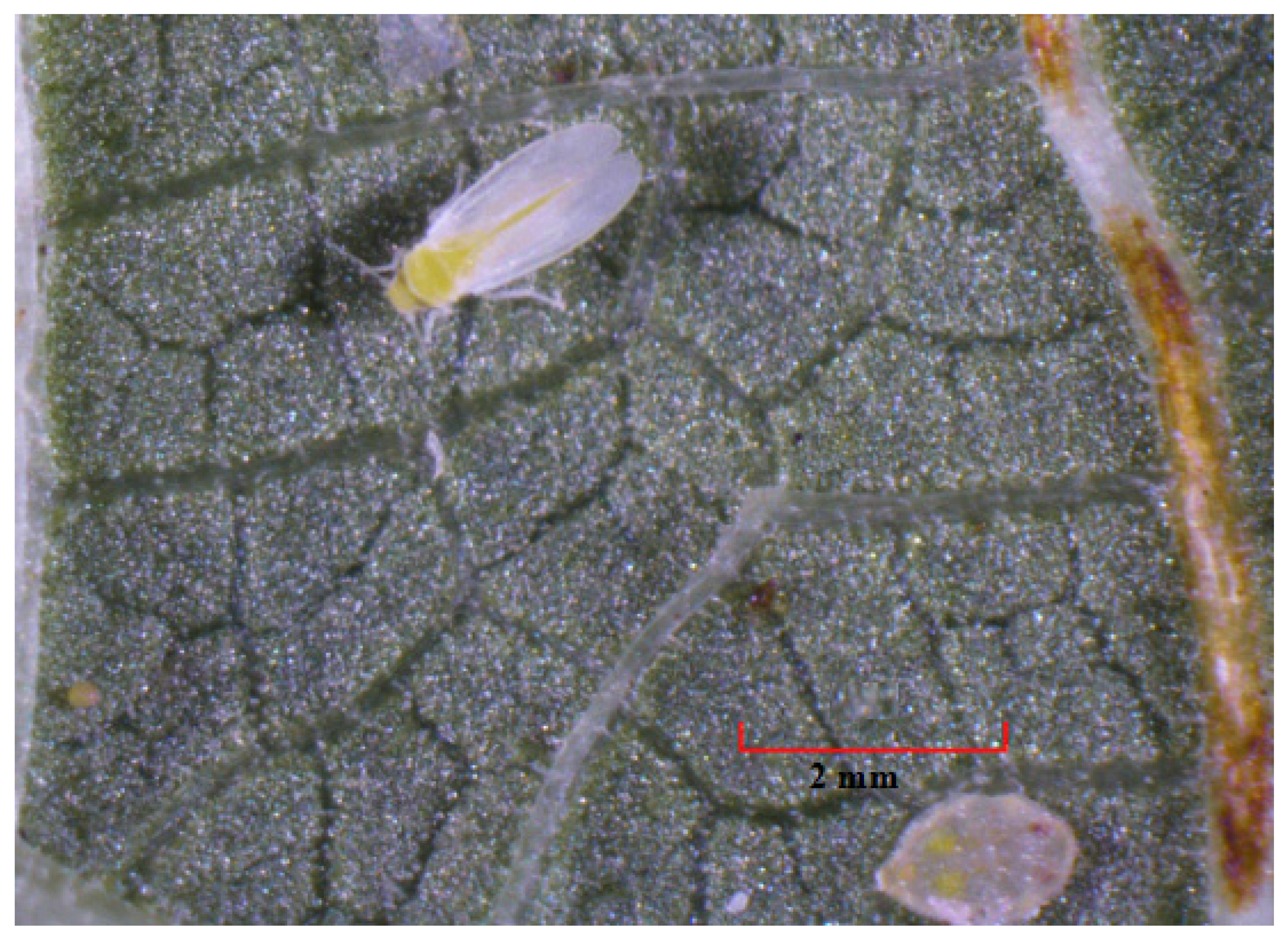
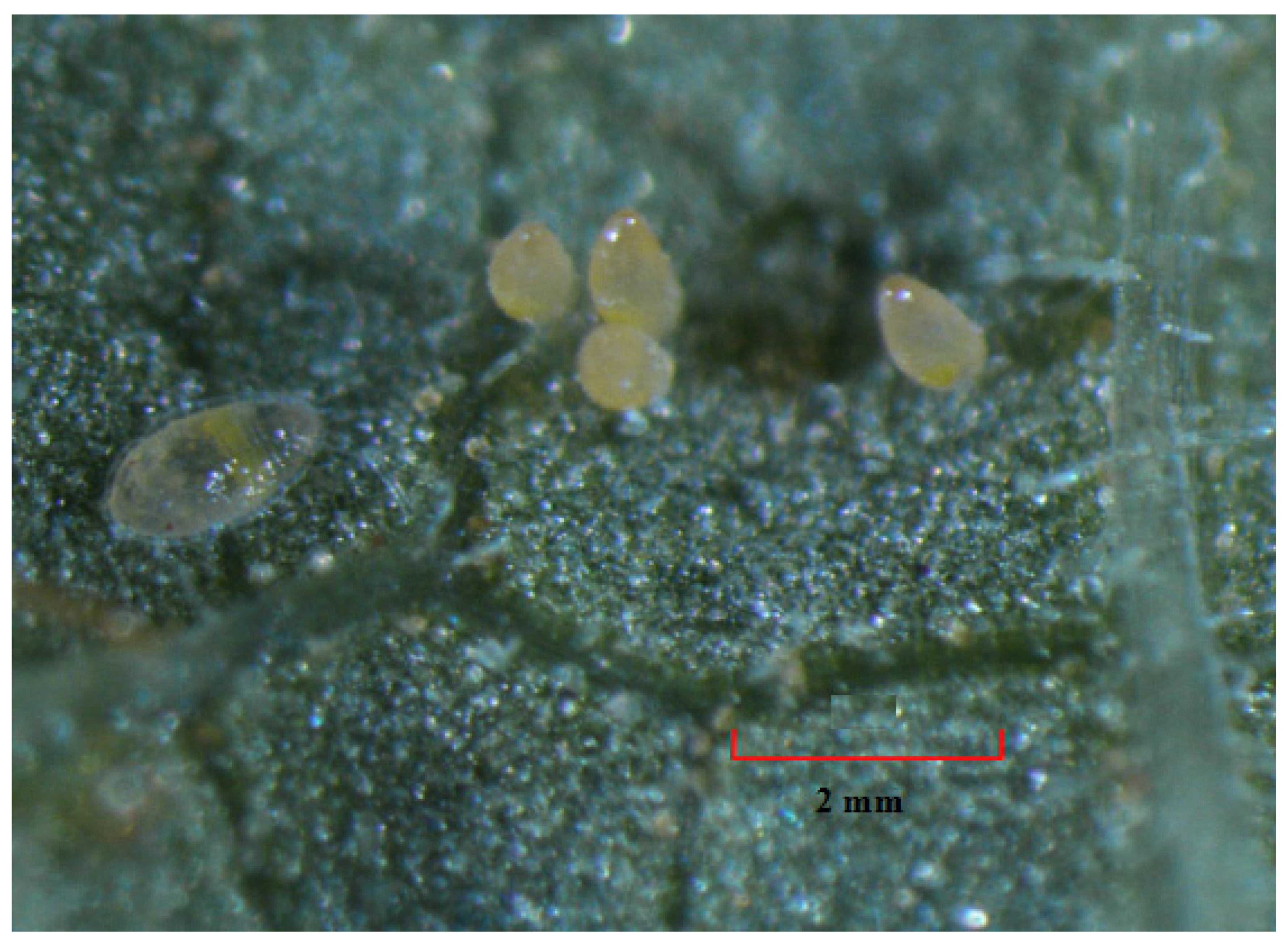

| Southern States | Time Frames | Vegetable Crops | Losses | Sources | |
|---|---|---|---|---|---|
| USD (Millions) | % of Crop | ||||
| Florida | 1991 | Tomato | >125 | [93] | |
| 1990–1991 | Tomato | 141 | [14] | ||
| Georgia | 2016 | Tomato, snap bean, most cucurbit | 132.3 | [94,95] | |
| 2017 | Tomato, snap bean, most cucurbit | 161.2 | [94,95] | ||
| 2017 | Snap bean | 45 | [94,95] | ||
| 2017 | Squash | 35 | [94,95] | ||
| Texas | 1991 | Vegetables | 29 | [96] | |
| Arkansas | 2006 | Eggplant, okra, pepper | Problems were observed | [97] | |
| Kentucky | 2007 | Tomato | Problems were observed | [98] | |
| Tennessee | 2014 | Tomato | Sporadic in the field | [99] | |
| South Carolina | 2017 | Vegetables | Unusually severe and widespread | [100] | |
Publisher’s Note: MDPI stays neutral with regard to jurisdictional claims in published maps and institutional affiliations. |
© 2021 by the authors. Licensee MDPI, Basel, Switzerland. This article is an open access article distributed under the terms and conditions of the Creative Commons Attribution (CC BY) license (http://creativecommons.org/licenses/by/4.0/).
Share and Cite
Li, Y.; Mbata, G.N.; Punnuri, S.; Simmons, A.M.; Shapiro-Ilan, D.I. Bemisia tabaci on Vegetables in the Southern United States: Incidence, Impact, and Management. Insects 2021, 12, 198. https://doi.org/10.3390/insects12030198
Li Y, Mbata GN, Punnuri S, Simmons AM, Shapiro-Ilan DI. Bemisia tabaci on Vegetables in the Southern United States: Incidence, Impact, and Management. Insects. 2021; 12(3):198. https://doi.org/10.3390/insects12030198
Chicago/Turabian StyleLi, Yinping, George N. Mbata, Somashekhar Punnuri, Alvin M. Simmons, and David I. Shapiro-Ilan. 2021. "Bemisia tabaci on Vegetables in the Southern United States: Incidence, Impact, and Management" Insects 12, no. 3: 198. https://doi.org/10.3390/insects12030198
APA StyleLi, Y., Mbata, G. N., Punnuri, S., Simmons, A. M., & Shapiro-Ilan, D. I. (2021). Bemisia tabaci on Vegetables in the Southern United States: Incidence, Impact, and Management. Insects, 12(3), 198. https://doi.org/10.3390/insects12030198

