The Common Fruit-Piercing Moth in the Pacific Region: A Survey of the Current State of a Significant Worldwide Economic Pest, Eudocima phalonia (Lepidoptera: Erebidae), with a Focus on New Caledonia



1
Équipe ARBOREAL: “AgricultuRe BiOdiveRsité Et vALorisation”, Laboratoire d’Entomologie Appliquée, Station de Recherches Fruitières de Pocquereux, IAC, Institut Agronomique néo-Calédonien, P.O. Box 32, 98880 La Foa, New Caledonia
2
ISEA: Institut des Sciences Exactes et Appliquées, Universiteé de la Nouvelle-Calédonie, BP R4, 98851 Nouméa CEDEX, New Caledonia
*
Authors to whom correspondence should be addressed.
Insects 2021, 12(2), 117; https://doi.org/10.3390/insects12020117
Submission received: 22 December 2020
/
Revised: 5 January 2021
/
Accepted: 7 January 2021
/
Published: 29 January 2021
Simple Summary
Fruit-piercing moths have long been cited as important pests in tropical and subtropical countries but genus as Eudocima, has recently gained in significance, and more specifically Eudocima phalonia (Linneaus). An overview of the current pest control proposed in the literature pointed the lack of sustainable integrated pest management. A synthesis of available data opens the research per-spectives that need to be encouraged in the ecological transition of our agricultural models.
Abstract
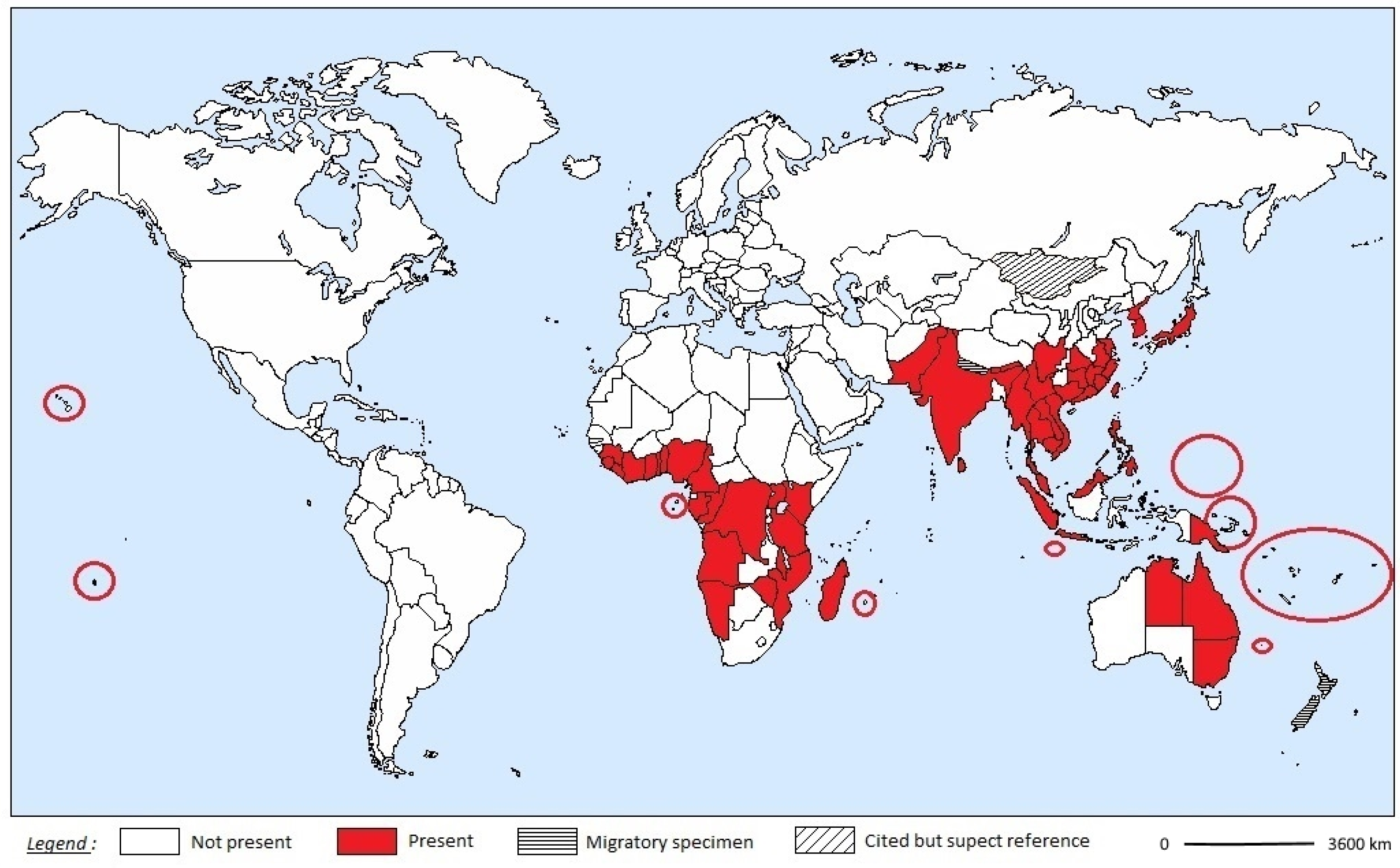
When referring to fruit-piercing moths, the genus Eudocima, and more specifically Eudocima phalonia (Linneaus), is cited as a worldwide crop pest. Damages associated with this pest are substantial on more than 100 fruit species, wherever it is encountered. In New Caledonia, the once occasional pest has become a serious threat to the current fruit arboriculture. Particularly devastating during outbreak periods, it has become an urgent need to find a suitable solution able to support farmers in the ecological transition of our agricultural models. This review proposes a synthesis of the existing data and publications on E. phalonia, worldwide and especially in New Caledonia, with recent observations. The assessment of this knowledge and the dynamics of the species in the territory of New Caledonia provide key information for a better prospect of adapted solutions.