Opinion

The Probing Behavior Component of Disease Transmission in Insect-Transmitted Bacterial Plant Pathogens


Department of Entomology and Nematology, Citrus Research and Education Center, University of Florida, IFAS, 700 Experiment Station Road, Lake Alfred, FL 33850, USA
Insects 2019, 10(7), 212; https://doi.org/10.3390/insects10070212

Submission received: 22 May 2019 / Revised: 8 July 2019 / Accepted: 15 July 2019 / Published: 19 July 2019

Abstract

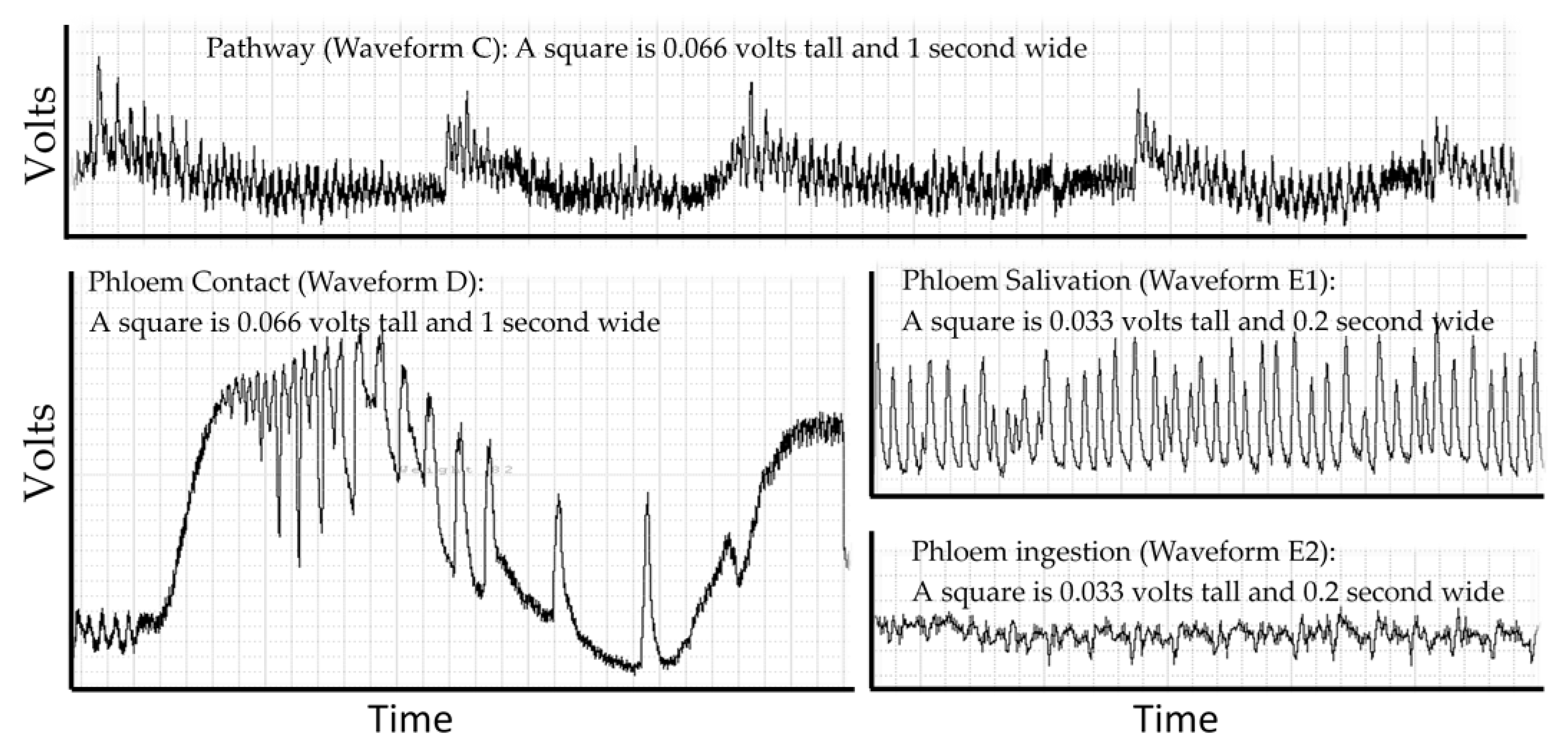
Insects can be effective vectors of plant diseases and this may result in billions of dollars in lost agricultural productivity. New, emerging or introduced diseases will continue to cause extensive damage in afflicted areas. Understanding how the vector acquires the pathogen and inoculates new hosts is critical in developing effective management strategies. Management may be an insecticide applied to kill the vector or a host plant resistance mechanism to make the host plant less suitable for the vector. In either case, the tactic must act before the insect performs the key behavior(s) resulting in either acquisition or transmission. This requires knowledge of the timing of behaviors the insect uses to probe the plant and commence ingestion. These behaviors are visualized using electropenetrography (EPG), wherein the plant and insect become part of an electrical circuit. With the tools to define specific steps in the probing process, we can understand the timing of acquisition and inoculation. With that understanding comes the potential for more relevant testing of management strategies, through insecticides or host plant resistance. The primary example will be Candidatus Liberibacter asiaticus transmitted by Diaphorina citri Kuwayama in the citrus agroecosystem, with additional examples used as appropriate.
Keywords: EPG; electropenetrography; electrical penetration graph; citrus EPG; electropenetrography; electrical penetration graph; citrus