
Chemical-Mechanical Impact of Nanoparticles and pH Effect of the Slurry on the CMP of the Selective Layer Surfaces

Abstract
1. Introduction
2. Experimental Details
3. Results and Discussion
3.1. Technological and Technical Issues
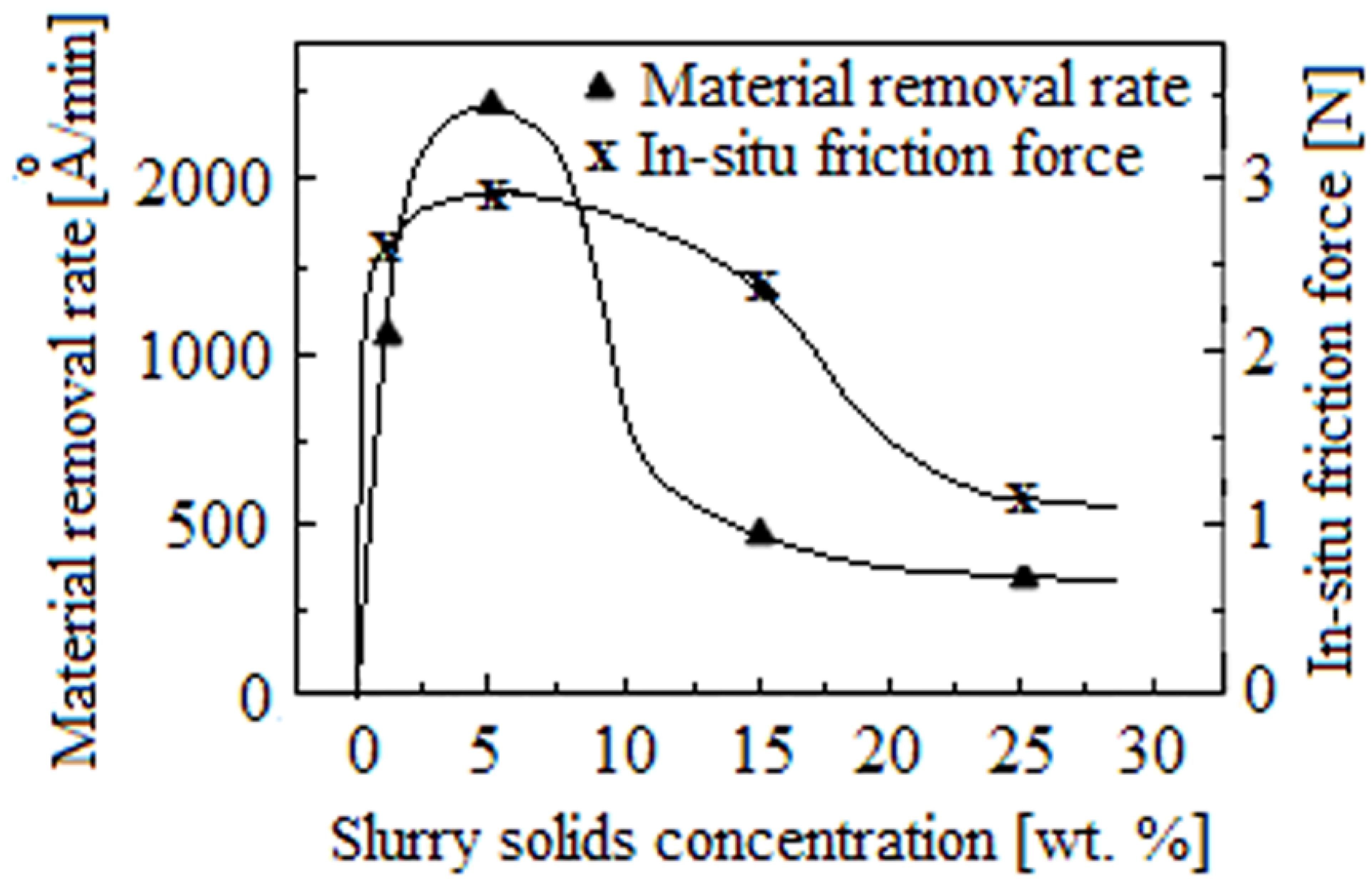
3.2. Effect of the Slurry Nanoparticle Size and Concentration
3.3. Slurry Nanoparticle Size Distribution
3.4. Stabilization of CMP Slurries
4. Conclusions
Acknowledgments
Author Contributions
Conflicts of Interest
References
- Ilie, F. Studytribological of Thin Superficial Layers Formed in the Friction Couples Through Selective Transfer; Technical Publishing House: Bucharest, Romania, 2002. [Google Scholar]
- Ilie, F.; Tita, C. Comparative analysis of tribological performances of materials that can achieve thin layers from selective transfer. J. BalkanicalTribol. Assoc. 2006, 12, 404–411. [Google Scholar]
- Garkunov, D.N. Tribotechnology (Wear and Non-Wear); Publishing House MSKHA: Moscow, Russia, 2001. (In Russian) [Google Scholar]
- Ilie, F. Tribochemical interaction between nanoparticles and surfaces of selective layer during chemical mechanical polishing. J. Nanopart. Res. 2013, 15, 1997. [Google Scholar] [CrossRef] [Scilit]
- Ilie, F. Models of nanoparticles movement, collision, and friction in chemical mechanical polishing (CMP). J. Nanopart. Res. 2012, 14, 752–759. [Google Scholar] [CrossRef] [Scilit]
- Armini, S.; Whelan, C.M.; Moinpour, M.; Maex, K. Copper CMP with Composite Polymer Core−Silica Shell Abrasives: A Defectivity Study. J. Electrochem. Soc. 2009, 156, H18–H26. [Google Scholar] [CrossRef] [Scilit]
- Nolan, L.; Cadien, K. Chemical Mechanical Polish for Nanotechnology. In Nanolubrification; Stepanova, M., Dew, S., Eds.; Springer: Vienna, NY, USA, 2012. [Google Scholar]
- Guo, D.; Xie, G.; Luo, J. Mechanical properties of nanoparticles: Basics and applications. J. Phys. D 2014, 47, 1–25. [Google Scholar] [CrossRef] [Scilit]
- Dubin, V.M. Copper Electroplating for On-Chip Metalization. In Advanced Interconnects for ULSI Technology; Baklanov, M.R., Ho, S., Zschech, E., Eds.; Jhon Wiley and Sons Ltd.: West Sussex, UK, 2012. [Google Scholar]
- Luo, J.; Dornfeld, D.A. Material removal mechanism in chemical mechanical polishing: Theory and modeling. IEEE Trans. Semicond. Manuf. 2001, 14, 112–133. [Google Scholar]
- Gopal, T.J.; Talbot, J.B. Use of Slurry Colloidal Behavior in Modeling of Material Removal Rates for copper MP. J. Electrochem. Soc. 2007, 154, H507–H512. [Google Scholar] [CrossRef] [Scilit]
- Ihnfeldt, R.; Talbot, J.B. Modeling of Copper CMP Using the Colloidal Behavior of an Alumina Slurry with Copper Nanoparticles. J. Electrochem. Soc. 2007, 154, H1018–H1026. [Google Scholar] [CrossRef] [Scilit]
- Pirayesh, H.; Cadien, K. The Effect of Slurry Properties on the CMP Removal Rate of Boron Doped Polysilicon. ECS J. Solid State Sci. Technol. 2016, 5, P233–P238. [Google Scholar] [CrossRef] [Scilit]
- Ihnfeldt, R.; Talbot, J.B. The Effects of Copper CMP Slurry Chemistry on the Colloidal Behavior of Alumina Abrasives. J. Electrochem. Soc. 2006, 153, G948–G955. [Google Scholar] [CrossRef] [Scilit]
- Ihnfeldt, R.; Talbot, J.B. Modeling Material Removal Rates for Copper CMP Using Copper Nanohardness and Etch Rates. J. Electrochem. Soc. 2008, 155, H582–H588. [Google Scholar] [CrossRef] [Scilit]
- Luo, J.; Dornfeld, D.A. Effects of Abrasive Size Distribution in Chemical Mechanical Planarization: Modeling and Verification. IEEE Trans. Semicond. Manuf. 2003, 16, 469. [Google Scholar]
- Chen, H.; Guo, D.; Xie, G.; Pan, G. Mechanical model of nanoparticles for material removal in chemical mechanical polishing process. Friction 2016, 4, 153–164. [Google Scholar] [CrossRef] [Scilit]
- Banerjee, G. Chemical Mechanical Planarization for Cu-Low-k Integration. In Advanced Interconnects for ULSI Technology; Baklanov, M.R., Ho, S., Zschech, E., Eds.; Jhon Wiley and Sons Ltd.: West Sussex, UK, 2012. [Google Scholar]
- Choi, S.; Doyle, F.M.; Dornfeld, D.A. Material Removal Mechanism during Copper Chemical Mechanical Planarization Based on Nano-Scale Material Behavior. ECS J. Solid State Sci. Technol. 2017, 6, P235–P242. [Google Scholar] [CrossRef] [Scilit]
- Basim, G.B.; Moudgil, B.M. Effect of Soft Agglomerates on CMP Slurry Performance. J. Colloid Interface Sci. 2002, 256, 137–142. [Google Scholar] [CrossRef] [Scilit]
- Brahma, N.A. Effects of Slurry Chemistry on the Rate of Agglomeration of Alumina Nanoparticles for Chemical Mechanical Planarization. Ph.D. Thesis, University of California, San Diego, CA, USA, 2013. [Google Scholar]
- Jindal, A.; Babu, S.V. Effect of pH on CMP of Copper and Tantalum. J. Electrochem. Soc. 2004, 151, G709–G716. [Google Scholar] [CrossRef] [Scilit]
- Du, T.; Desai, V. The pH Effect on Chemical Mechanical Planarization of Copper. Proc. MRS 2003, 767. [Google Scholar] [CrossRef] [Scilit]
- Wang, Y.G.; Zhang, L.C.; Biddut, A. Chemical effect on the material removal rate in the CMP of silicon wafers. Wear 2011, 270, 312–316. [Google Scholar] [CrossRef] [Scilit]
- Bielman, M. Chemical Mechanical Polishing of Tungsten. Master’s Thesis, University of Florida, Gainesville, FL, USA, 1998. [Google Scholar]
- Jiang, L.; He, Y.; Yang, Y.; Luo, J. Chemical Mechanical Polishing of Stainless Steel as Solar Cell Substrate. ECS J. Solid State Sci. Technol. 2015, 4, P162–P170. [Google Scholar] [CrossRef] [Scilit]
- Kao, M.J.; Hsu, F.C.; Peng, D.X. Synthesis and Characterization of SiO2 Nanoparticles and Their Efficacy in Chemical Mechanical Polishing Steel Substrate. Adv. Mater. Sci. Eng. 2014, 2014, 691967. [Google Scholar]
- Deshpande, S.; Kuiry, S.C.; Klimov, M.; Obeng, Y.; Seal, S. Chemical Mechanical Planarization of Copper: Role of Oxidants and Inhibitors. J. Electrochem. Soc. 2004, 151, G788–G794. [Google Scholar] [CrossRef] [Scilit]
- Eom, D.H.; Kim, I.K.; Han, J.H.; Park, J.G. The Effect of Hydrogen Peroxide in a Citric Acid Based Copper Slurry on Cu Polishing. J. Electrochem. Soc. 2007, 154, D38–D44. [Google Scholar] [CrossRef] [Scilit]
- Kim, I.K.; Kang, Y.J.; Kim, T.G.; Park, J.G. Effect of Corrosion Inhibitor, Benzotriazole, in Cu Slurry on Cu Polishing. Jpn. J. Appl. Phys. 2008, 47, 108–112. [Google Scholar] [CrossRef] [Scilit]
- Aksu, S.; Wang, L.; Doyle, F. Effect of Hydrogen Peroxide on Oxidation of Copper in CMP Slurries Containing Glycine. J. Electrochem. Soc. 2003, 150, G718. [Google Scholar] [CrossRef] [Scilit]
- Du, T.; Vijayakumar, A.; Desai, V. Effect of hydrogen peroxide on oxidation of copper in CMP slurries containing glycine and Cu ions. Electrochim. Acta 2004, 49, 4505–4512. [Google Scholar] [CrossRef] [Scilit]
- Jiang, L.; He, Y.; Liang, H.; Li, Y.; Luo, J. Effect of Potassium Ions on Tantalum Chemical Mechanical Polishing in H2O2-Based Alkaline Slurries. ECS J. Solid State Sci. Technol. 2016, 5, P100–P111. [Google Scholar] [CrossRef] [Scilit]
- Xie, Y.; Bhushan, B. Effects of particle size, polishing pad and contact pressure in free abrasive polishing. Wear 1996, 200, 281. [Google Scholar] [CrossRef] [Scilit]
- Cook, L.M. Chemical Mechanical Planarization of Microelectronic Materials. J. Non-Cryst. Solids. 1990, 120, 152. [Google Scholar] [CrossRef] [Scilit]
- Brown, N.J.; Baker, P.C.; Maney, R.T. A new model for surface roughness evolution in the Chemical Mechanical Polishing Process. Proc. SPIE 1981, 306, 42. [Google Scholar]
- Trogolo, J.A.; Rajan, K. Near surface modification of the silica structure induced by chemical/mechanical polishing. J. Mater. Sci. 1994, 29, 4554–4558. [Google Scholar] [CrossRef] [Scilit]
- Basim, G.B.; Adler, J.J.; Mahajan, U.; Singh, R.K. Effect of particle size of chemical mechanical polishing slurries for enhanced polishing with minimal defects. J. Electrochem. Soc. 2000, 147, 3523–3528. [Google Scholar] [CrossRef] [Scilit]
- Sivaram, S.; Bath, M.H.M.; Lee, E.; Leggett, R.; Tolles, R. Chemical Mechanical Polishing of Inter-level Dielectrics: Models for Removal Rate and Planarity. In MRS Proceedings; Cambridge University Press: Cambridge, UK, 1992. [Google Scholar]
- Basim, G.B.; Vakarelski, I.U.; Brown, S.; Moudgil, B.M. Strategies for the Optimization of Chemical Mechanical Polishing (CMP) Slurries. J. Dispers. Sci. Technol. 2003, 24, 499–515. [Google Scholar] [CrossRef] [Scilit]
- Xu, X.; Luo, J.; Lu, X.; Zhang, C. Effect of Nanoparticle Impact on Material Removal. J. Tribol. Trans. 2008, 51, 718–722. [Google Scholar] [CrossRef] [Scilit]
- Scarfo, A.M.; Manno, V.P.; Rogers, C.B.; Anjur, S.; Moinpour, M. In-Situ Measurement of Pressure and Friction During CMP of Contoured Wafers. J. Electrochem. Soc. 2005, 152, G477–G481. [Google Scholar] [CrossRef] [Scilit]
- Khanna, A.J. Quantification of Particle Agglomeration during Chemical Mechanical Polishing of Metals and Dielectrics. Ph.D. Thesis, University of Florida, Gainesville, FL, USA, 2010. [Google Scholar]
- Mcintyre, N.S.; Sunder, S.; Shoesmith, D.W.; Stanchell, F.W. Chemical information from XPS—Applications to the analysis of electrode surfaces. J. Vac. Sci. Technol. 1981, 18, 714. [Google Scholar] [CrossRef] [Scilit]
- Colic, M.; Fuerstenau, D.W. Influence of the dielectric constant of the media on oxide stability in surfactant solutions. Langmuir 1997, 13, 6644. [Google Scholar] [CrossRef] [Scilit]
- Solomon, M.J.; Saeki, T.; Wan, M.; Scales, P.J.; Boger, D.V.; Usui, H. Effect of adsorbed surfactants on the rheology of colloidal zirconia suspensions. Langmuir 1999, 15, 20. [Google Scholar] [CrossRef] [Scilit]
- Koopal, L.K.; Goloub, T.; deKaiser, A.; Sidorova, M.P. The effect of cationic surfactants on wetting, colloid stability and flotation of silica. Colloids Surf. 1999, 151, 15. [Google Scholar] [CrossRef] [Scilit]
- Bremmel, K.E.; Jameson, G.J.; Biggs, S. Adsorption of ionic surfactants in particulate system: Flotation, stability, and interaction forces. Colloids Surf. 1999, 146, 755. [Google Scholar] [CrossRef] [Scilit]
- Evanko, C.R.; Dzombak, D.A.; Novak, J.W. Influence of surfactant addition on the stability of concentrated alumina dispersions in water. Colloids Surf. 1996, 110, 219. [Google Scholar] [CrossRef] [Scilit]
- Adler, J.J.; Singh, P.K.; Patist, A.; Rabinovich, Y.I.; Shah, D.O.; Moudgil, B.M. Correlation of particulate dispersion stability with the strength of self-assembled surfactant films. Langmuir 2000, 16, 7255–7262. [Google Scholar] [CrossRef] [Scilit]
- Basim, G.B.; Vakarelski, I.U.; Moudgil, B.M. Role of interaction forces in controlling the stability and polishing performance of CMP slurries. J. Colloid Interface Sci. 2003, 263, 506–515. [Google Scholar] [CrossRef] [Scilit]
- Bozkaya, D.; Müftü, S. Effects of Surface Forces on Material Removal Rate in Chemical Mechanical Planarization. J. Electrochem. Soc. 2010, 157, H287–H296. [Google Scholar] [CrossRef] [Scilit]



© 2017 by the authors. Licensee MDPI, Basel, Switzerland. This article is an open access article distributed under the terms and conditions of the Creative Commons Attribution (CC BY) license (http://creativecommons.org/licenses/by/4.0/).
Share and Cite
Ilie, F.; Ipate, G. Chemical-Mechanical Impact of Nanoparticles and pH Effect of the Slurry on the CMP of the Selective Layer Surfaces. Lubricants 2017, 5, 15. https://doi.org/10.3390/lubricants5020015
Ilie F, Ipate G. Chemical-Mechanical Impact of Nanoparticles and pH Effect of the Slurry on the CMP of the Selective Layer Surfaces. Lubricants. 2017; 5(2):15. https://doi.org/10.3390/lubricants5020015
Chicago/Turabian StyleIlie, Filip, and George Ipate. 2017. "Chemical-Mechanical Impact of Nanoparticles and pH Effect of the Slurry on the CMP of the Selective Layer Surfaces" Lubricants 5, no. 2: 15. https://doi.org/10.3390/lubricants5020015
APA StyleIlie, F., & Ipate, G. (2017). Chemical-Mechanical Impact of Nanoparticles and pH Effect of the Slurry on the CMP of the Selective Layer Surfaces. Lubricants, 5(2), 15. https://doi.org/10.3390/lubricants5020015