1. Introduction
Tribological research has been fundamentally reshaped by the global pursuit of carbon neutrality. A transition is being driven from green tribology, where biodegradability and sustainability are prioritised [
1,
2], towards resilient tribology [
3,
4,
5]. This paradigm shift is necessitated by the emergence of alternative propulsion technologies, particularly hydrogen internal combustion engines (H
2ICEs) [
6,
7,
8], which are associated with more demanding lubrication conditions, including potential exposure to oxidative and water-rich environments. These emerging systems highlight the need for more effective and efficient lubricant formulation strategies, particularly under boundary-dominated conditions, where conventional design approaches remain largely empirical. More generally, changes in the operating environment, such as the presence of moisture or reactive species, can alter interfacial interactions between lubricant molecules and solid surfaces, thereby influencing tribological response.
To address green and sustainability challenges, Organic Friction Modifiers (OFMs), such as Glycerol Monooleate (GMO), have increasingly been relied upon in lubricant formulations [
9,
10]. While the friction-reducing capabilities of OFMs have been well established [
11], their behaviour in chemically aggressive, water-rich environments, which may arise in applications such as H
2ICEs, remains a subject of critical debate. It is indicated by recent studies that OFM efficacy is not solely dependent on concentration; rather, complex competitive adsorption and self-assembly behaviour may be involved, in which lubrication behaviour can be influenced by the presence of water molecules [
12,
13]. It has been suggested that the tribological performance of GMOs is influenced by the solvent environment [
12,
14]. These effects have been associated with changes in molecular organisation and interaction at the interface [
9,
13].
A significant methodological challenge arises in characterising these molecular-level interactions. Molecular Dynamics (MD) simulations have been utilised for the elucidation of adsorption phenomena, by which the Work of Adhesion (
) is calculated, and adsorption isotherms are extracted [
9,
15]. Yet, despite their mechanistic depth, MD simulations are considered computationally expensive and time-intensive, rendering them impractical for the routine screening in emerging lubrication applications [
16,
17,
18]. Similarly, the traditional “trial-and-error” approach is regarded as insufficient for rapid development cycles [
19]. Consequently, a critical need is identified for a more efficient, accessible screening methodology that bridges the gap between atomic-level theory and macroscopic application. Such a methodology is particularly valuable in enabling systematic evaluation of formulation sensitivity to interfacial changes that may arise in varying operating environments.
This scalable alternative is offered by interfacial thermodynamics, quantified via goniometry and surface energy analysis. By the utilisation of the Owens–Wendt–Kaelble (OWK) method, total surface energy (
) can be conceptually divided into dispersive (
) and polar (
) components, by which a fundamental lens for screening is provided without the computational cost of MD. The thermodynamic affinity between an additive, such as a GMO, and a specific metallurgical surface can be rapidly assessed using this approach [
20,
21]. Empirical studies have reported correlations between surface energy characteristics and tribological performance [
9,
22,
23]. Thus, surface energy analysis can be utilised as a practical proxy for interpreting tribological response under boundary lubrication conditions, thereby providing a more accessible alternative to exhaustive molecular simulations.
Despite the widespread use of surface energy analysis in tribology and materials science, its application remains largely qualitative. It is often confined to static wettability interpretation via contact angle measurements, with its link to friction and wear under combined load and sliding conditions remaining limited. Consequently, the role of interfacial energetics in influencing tribological response remains not fully resolved, and the relationship between dispersive and polar interactions and lubrication performance remains unclear.
The present study addresses this gap by proposing a surface energy-tuning framework that links interfacial energetics to tribological performance in OFM systems. Rather than relying solely on wettability descriptors, the approach extends surface energy analysis to interpret friction and wear behaviour across varying operating conditions. Additional descriptors are introduced to evaluate shear-induced changes in tribological response and liquid–solid energetic compatibility, providing a comparative basis for formulation screening.
In this study, tribological response serves as a functional indicator of lubrication behaviour, rather than direct structural characterisation of boundary films. It is emphasised that the present study does not directly address water-induced degradation or oxidation effects but instead focuses on isolating the role of interfacial energetics under controlled conditions. The proposed framework, therefore, provides a controlled platform for evaluating interfacial effects and may be extended in future work to assess formulation sensitivity to environmental factors, such as moisture contamination. The framework is developed in a general context and may be extended to emerging propulsion systems that face similar lubrication challenges.
2. Methodology
2.1. Materials and Blend Preparation
The polyalphaolefin-4 (PAO4, Durasyn 16X PAO, Chevron Phillips Chemical Company LP, The Woodlands, TX, USA) used in the present study was supplied by DNA Petrochem Sdn Bhd (Selangor, Malaysia). It was used as the base oil without further purification. The glycerol monooleate (GMO, Product No. 49960, CAS No. 111-03-5, purity > 90%) was purchased from Sigma-Aldrich Malaysia and used as the OFM.
GMO was blended with PAO4 at 1–10 wt% using magnetic stirring at 500 rpm for 10 min at 60 °C. To enhance molecular dispersion, the mixture was ultrasonicated at 60 °C for two hours (40 kHz bath frequency). All prepared samples were stored in airtight glass vials to maintain shelf stability and to prevent moisture absorption before characterisation.
2.2. Viscosity and Density Measurement
The dynamic viscosity () of the prepared samples was measured using the Brookfield DV2T rotational viscometer with digital temperature control at 25, 40, and 100 °C. Each sample was equilibrated for 10 min at the set temperature. To maintain measurement accuracy, an appropriate spindle was selected based on the expected viscosity range. Five viscosity measurements were recorded for each condition, yielding repeatability within ±2%.
Density (
) measurements for the blends were determined at 25 and 40 °C using a calibrated glass pycnometer and an analytical balance (0.1 mg resolution). The pycnometer was pre-calibrated with deionised water at each test temperature. From these mass and volume data, the density was calculated over three replicates. Kinematic viscosity (
) was subsequently estimated from the dynamic viscosity (
) using the estimated density at the corresponding temperature. Lastly, the viscosity index (VI) was determined following ASTM D2270 [
24].
2.3. Friction and Wear Testing
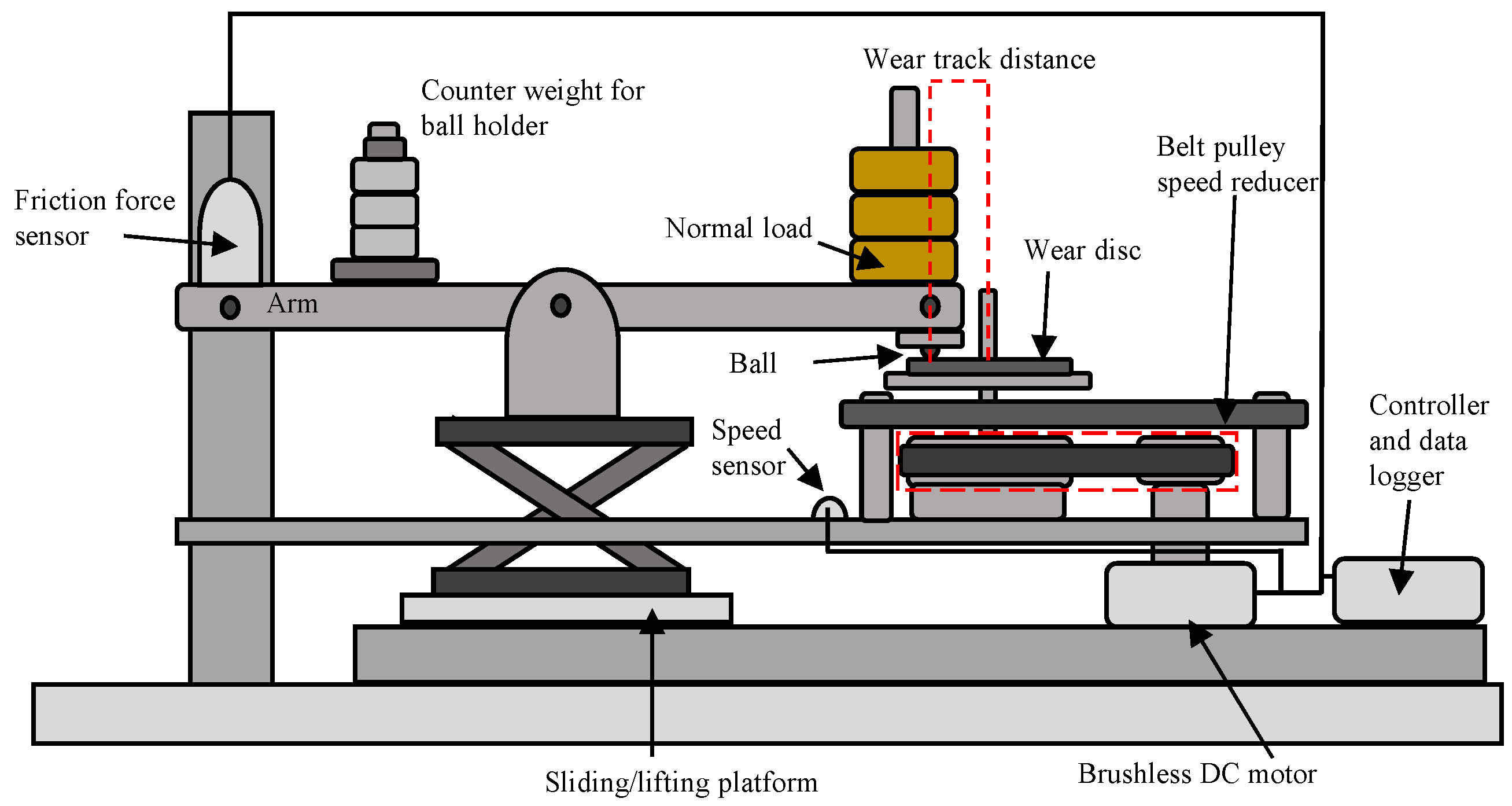
Friction and wear behaviour were evaluated using a custom-built ball-on-disk tribometer (see
Figure 1) configured following ASTM G99 procedures [
25]. The friction pair consisted of an AISI 52100 bearing steel ball, Shandong Foison International Trade Co., Ltd., Tai’an, China (6 mm diameter, hardness 60–65 HRC) sliding against an AISI 304 stainless steel disk (50 mm diameter, thickness
mm).
The arithmetic surface roughness (
) of the ball and disk was measured as 0.15 and 0.30 µm, respectively, using a digital contact surface profilometer. Before testing, the specimens were sequentially cleaned with laboratory-grade detergent and deionised water, followed by ultrasonication in acetone and ethanol for 15 min each. The specimens were air-dried under ambient conditions. The tested normal loads ranged from 0.6 to 1.4 N in increments of 0.2 N. Rotational speeds were varied from 250 to 2500 rpm, corresponding to sliding velocities of 0.39 to 3.93 m/s at a track radius of 15 mm. The maximum Hertzian contact pressure ranged from 0.50 to 0.73 GPa, with the effective elastic modulus (
) calculated as
where
and
are the Young’s moduli of the disk and ball, and
and
are their Poisson’s ratios. Catalogue values of
GPa and
were used for both materials.
Before each test, 0.5 mL of lubricant was applied to the disk surface by spin coating at 3500 rpm for 30 s to ensure uniform coverage, following reference [
26]. Friction and wear measurements were repeated three times. The standard deviation was typically below 3% of the mean. Wear scar diameters on the balls were measured using optical microscopy in three orthogonal directions and averaged.
The minimum film thickness (
) was estimated using the Hamrock–Dowson equation for circular point contacts under isothermal conditions [
27]:
where the dimensionless parameters are defined as
Here,
R is the ball radius,
u is the sliding velocity,
w is the applied normal load,
is the dynamic viscosity at test temperature (25 °C), and
is the viscosity-pressure coefficient. The ellipticity parameter
k was taken as unity for the ball-on-flat configuration. The liquid viscosity–pressure coefficient (
) was estimated using the free-volume theory proposed by Wu et al. [
28]:
where
is the dynamic viscosity (mPa·s) at temperature
T (K), and
is obtained from the regression:
Here,
and
represent the slope and intercept of the logarithmic correlation between viscosity and temperature. This free-volume-based approach enables estimation of
from experimentally measured viscosity–temperature behaviour without direct high-pressure testing. The lubrication regime was subsequently assessed using the
ratio:
where
represents the composite RMS surface roughness of the ball and disk. This approach enables evaluation of lubrication behaviour across boundary-to-mixed regimes under varying operating conditions. As a first approximation, the film thickness is calculated under the assumption of isothermal Newtonian flow. In the present study, the resulting
values are used primarily to indicate the lubrication regime rather than to directly characterise boundary film behaviour as surface-active additives may modify the effective pressure–viscosity response within the contact.
2.4. Contact Angle Measurement
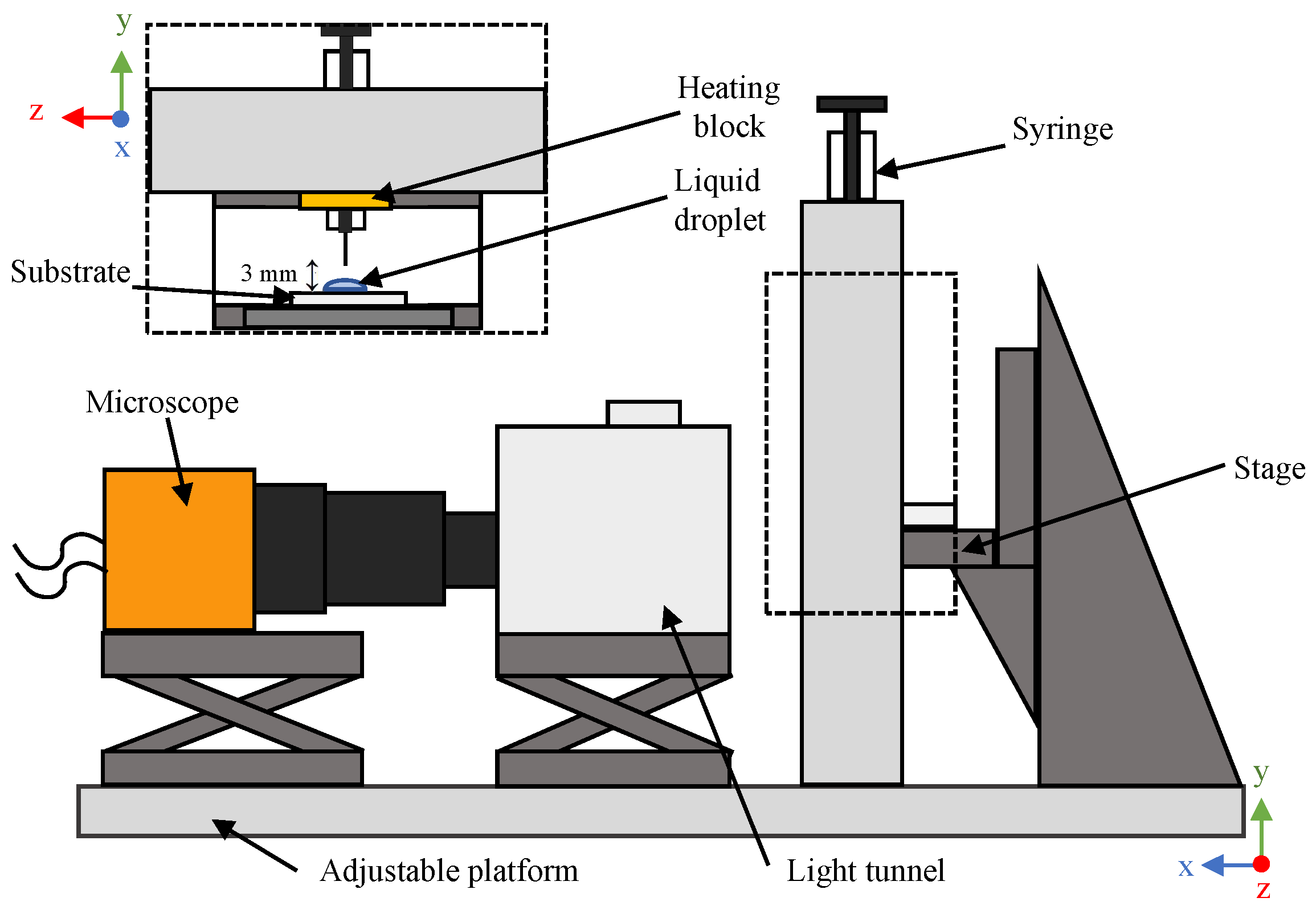
The present study measured the static contact angle using a custom-built goniometer, as illustrated in
Figure 2. The goniometer is described in reference [
20] and was developed in accordance with ASTM D7334 procedures [
29]. For each measurement, approximately 10 µL of droplet was dispensed onto the substrate surface using a Hamilton microsyringe with a 100 µL capacity. During dispensing, the needle tip was maintained 3 mm above the substrate surface. To account for evaporation and spreading, droplet images were captured within 20 s of deposition.
The study used AISI 304 stainless steel (the same as the wear disk) and soda-lime glass slides as substrates, which were cleaned with acetone then ethanol and air-dried before testing. For each sample, measurements were repeated six times at different locations, with the average values being reported. Droplet profiles were analysed using ImageJ, version 1.54n with active contour fitting. The left- and right-contact angles of the droplets were averaged to reduce geometric bias.
2.5. Surface Energy Analysis
Surface energy components were determined using the Owens–Wendt–Kaelble (OWK) method [
30], which decomposes the total surface energy into dispersive (
) and polar (
) contributions. The OWK framework relates the contact angle of a liquid on a solid surface to the interfacial energy components through
where
is the intrinsic Young contact angle,
and
represent liquid and solid surface energies, and superscripts
d and
p denote dispersive and polar components, respectively. The total surface energy is expressed as
.
The contact angle measurements were analysed under the assumption of thermodynamic equilibrium at the three-phase contact line. To ensure internal consistency of the OWK analysis, a closure check was performed by comparing the left-hand side (LHS) and right-hand side (RHS) of the OWK relation using the measured contact angles. For the reference liquids (deionised water and diiodomethane), agreement between LHS and RHS was achieved within experimental uncertainty, indicating that the measured contact angles adequately approximated the intrinsic Young angles. Therefore, no roughness correction was applied in determining the substrate surface energy components.
In lubricant systems with stronger wetting behaviour, apparent contact angles may be influenced by surface roughness. In such cases, a roughness-induced correction based on the Wenzel model [
31] was applied to obtain intrinsic Young contact angles prior to evaluating surface energy parameters. According to Wenzel’s relation,
where
is the measured contact angle,
is the intrinsic Young contact angle, and
r is the surface roughness factor (
). The intrinsic angle was obtained as
Solid surface energy components were calculated from contact angles measured with two reference liquids of known surface energy parameters: deionised water (polar) and diiodomethane (non-polar). The reference liquid parameters (OWK inputs), measured contact angles on steel and glass substrates, and the calculated substrate surface energy components obtained from simultaneous solution of the OWK equations are summarised in
Table 1.
In this study, two probe liquids (deionised water and diiodomethane) were selected to represent the polar and dispersive components, respectively, consistent with common practice in Owens–Wendt–Kaelble (OWK) analysis. This combination provides a reliable basis for decomposing surface energy into its respective components and enables consistent comparative evaluation across formulations. While the inclusion of additional probe liquids may refine the absolute accuracy of surface energy values, the present approach is sufficient for capturing relative trends in interfacial energetics, which is the primary focus of this study.
The Young–Dupré equation was used to estimate the thermodynamic work of adhesion:
All measurements in the present study were conducted at ambient laboratory temperature (25 °C). The OWK method assumes chemical homogeneity and thermodynamic equilibrium at the three-phase contact line. Although the substrates were mechanically polished and ultrasonically cleaned to minimise heterogeneity, potential roughness effects were evaluated through the Wenzel framework to ensure consistent interpretation of intrinsic wetting behaviour. To evaluate the role of interfacial thermodynamics in governing GMO’s tribological performance under sliding conditions, the resulting surface energy parameters were subsequently correlated with friction and wear behaviour.
The OWK method is applied in the present study as a thermodynamic descriptor to evaluate liquid–solid interfacial interactions. While the approach is based on equilibrium assumptions, it provides a practical means to assess relative changes in dispersive and polar contributions. The consistency of the analysis was verified through closure between the left-hand and right-hand sides of the OWK equation within experimental uncertainty.
3. Results and Discussion
3.1. Viscosity Characteristics and Lubrication Regime Analysis
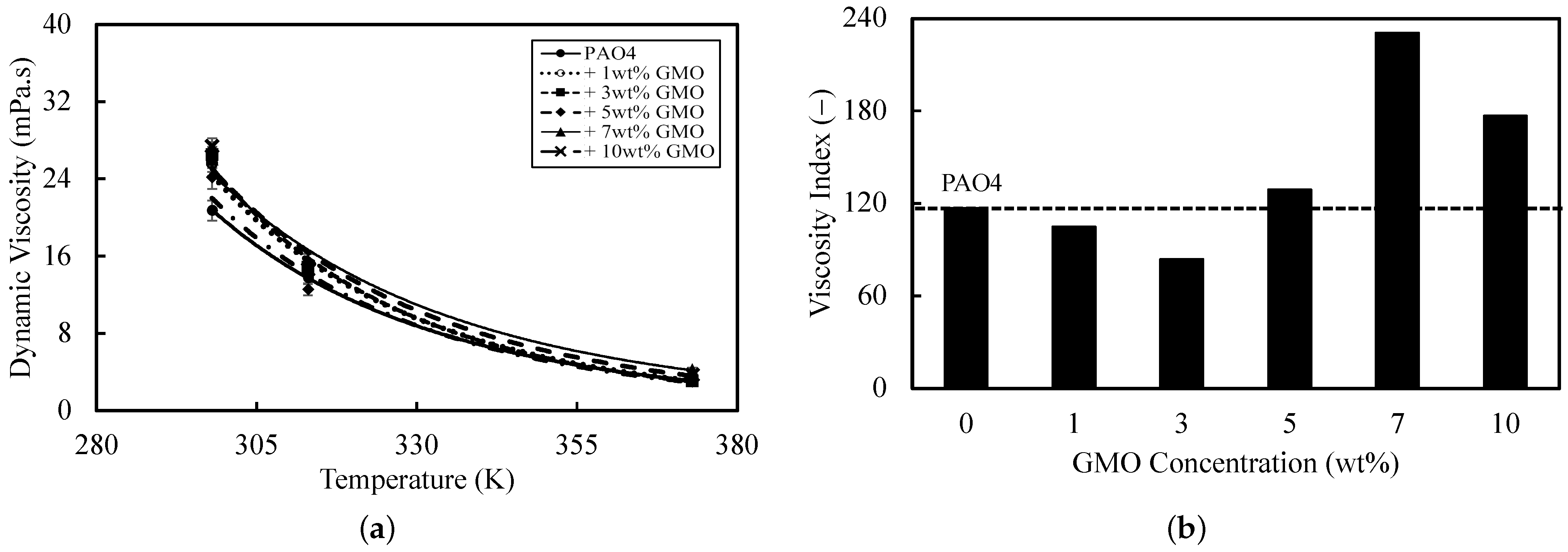
Figure 3a presents the dynamic viscosity of PAO4-GMO mixtures as a function of temperature, while
Figure 3b shows the calculated viscosity index (VI) for each formulation. The viscosity index was determined according to ASTM D2270 based on the kinematic viscosity values measured at 40 °C and 100 °C. The viscosity of all mixtures decreases with increasing temperature. It can be observed that adding GMO thickened the base oil across the entire temperature range, with the 10 wt% blend approximately 32% more viscous than neat PAO4 at 25 °C. This increase in viscosity could be attributed to GMO’s larger molecular structure and polar functional groups, which facilitate stronger intermolecular interactions [
10]. Interestingly, while the 1–5 wt% blends converged with neat PAO4 at 100 °C, the 7 wt% blend maintained 37% higher viscosity.
The viscosity index (VI) trends shown in
Figure 3b indicate that adding GMO also increases VI, reaching the highest VI at 7 wt%. The higher VI indicates that GMO can stabilise PAO4 against temperature fluctuations, which is advantageous for maintaining consistent lubrication behaviour across varying operating temperatures. However, beyond 7 wt%, the VI trend reverses. The drop-off may reflect saturation effects at higher additive concentrations [
32], potentially diminishing the temperature–viscosity response.
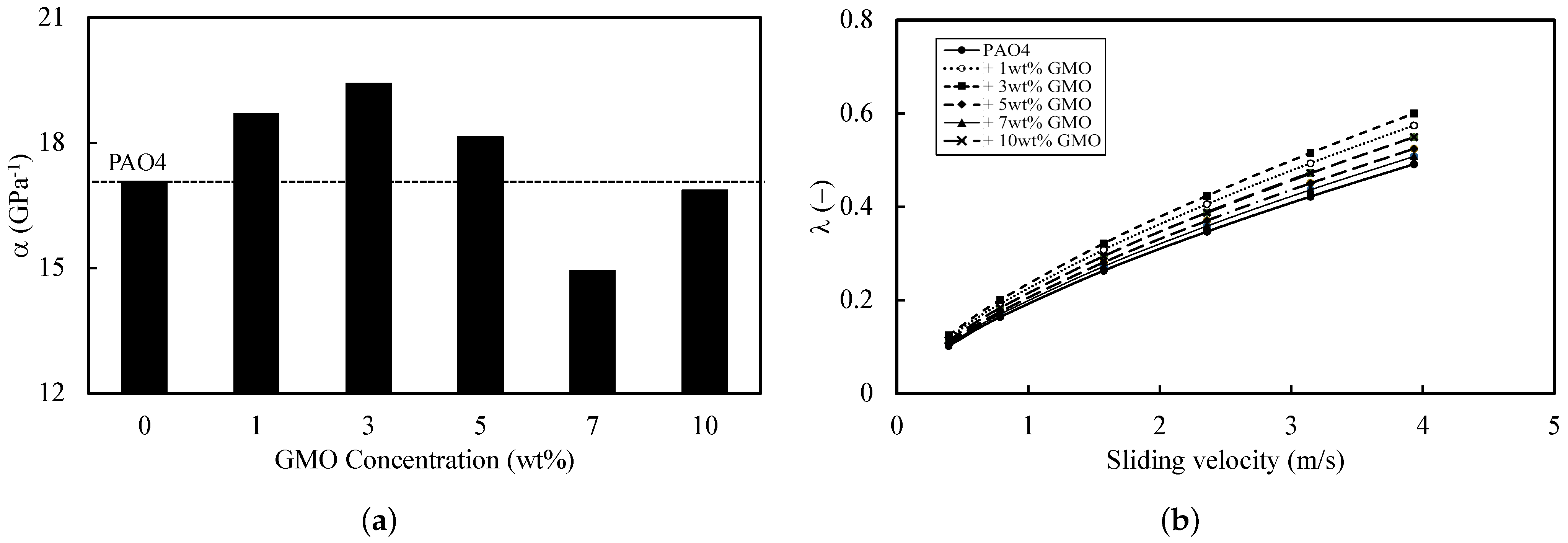
Figure 4a shows the viscosity-pressure coefficient (
), while
Figure 4b presents the calculated lambda ratio (
) for PAO4 with different GMO concentrations. Although bulk viscosity increases with GMO concentration, the viscosity-pressure coefficient reaches a minimum at 7 wt%, indicating reduced pressure-induced increase in viscosity. The elastohydrodynamic film thickness depends on both viscosity and
. Thus, the reduced
could offset the increase in bulk viscosity, resulting in lower predicted lambda ratios than for other blends. It is observed that all calculated lambda values remain below unity across the studied velocity range, indicating that the friction and wear tests were performed within the mixed-to-boundary lubrication regime.
A notable observation is that the viscosity–pressure coefficient () reaches a minimum at 7 wt% GMO despite increased bulk viscosity. Since the minimum film thickness depends on both viscosity and pressure response, this combination yields a lower predicted hydrodynamic film thickness than other blends. Thus, the observed tribological behaviour is consistent with boundary-dominated rather than classical hydrodynamic effects.
3.2. Friction and Wear Behaviour
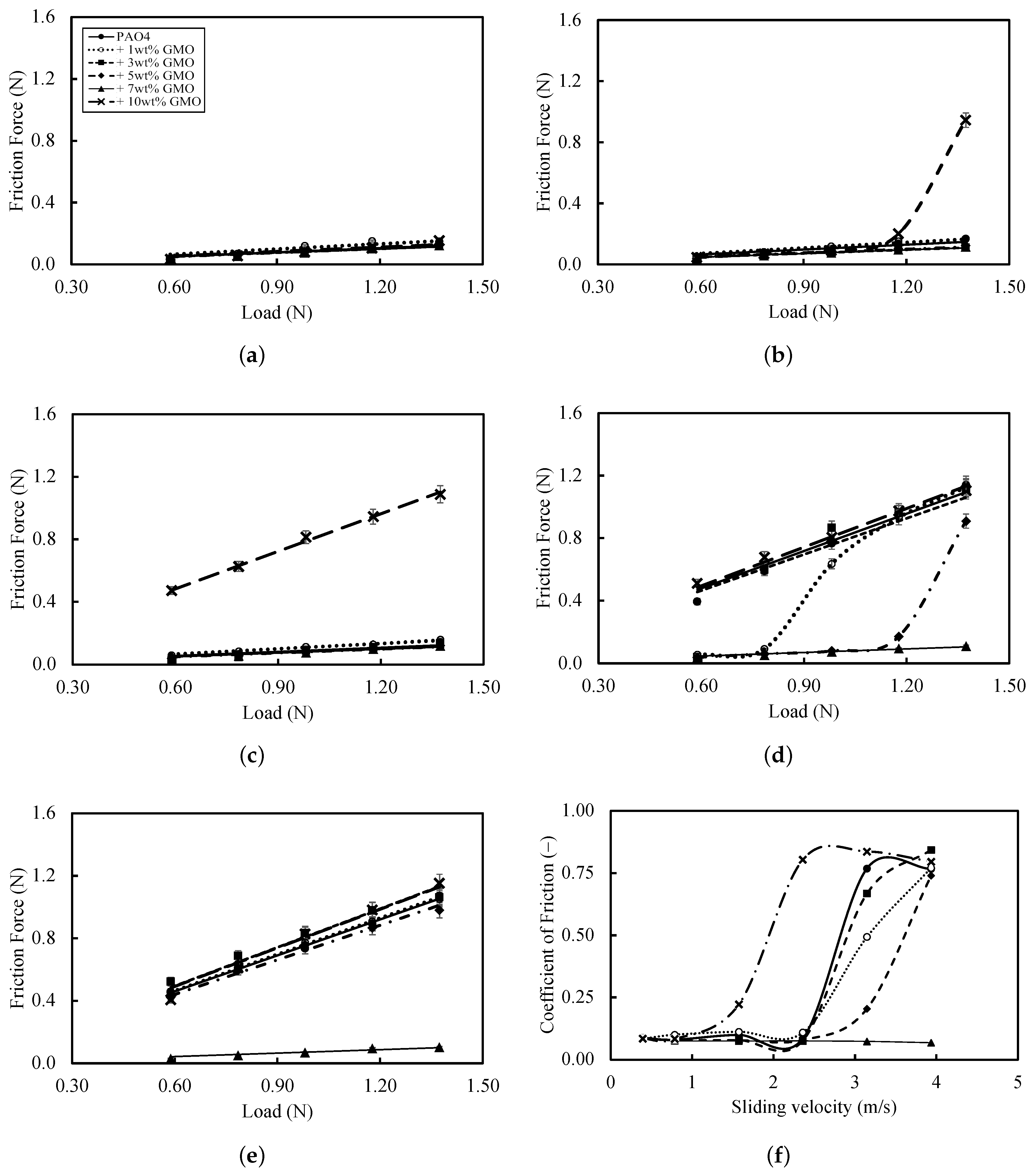
The frictional properties of PAO4 and GMO blends are shown in
Figure 5. These properties were measured at speeds ranging from 500 to 2500 rpm, equivalent to 0.79 to 3.39 m/s. It should be noted that the friction at 250 rpm (0.39 m/s) was measured but not included in
Figure 5 due to significant overlap with the data at 500 rpm.
When sheared at a lower velocity (500 rpm), the friction forces increase linearly with normal load across all formulations. The 7 wt% GMO sample generates lower friction than neat PAO4, suggesting improved tribological response under boundary-dominated conditions. The distinction between the blends became apparent at sliding velocities between 1000 and 1500 rpm. A deviation was observed in the 10 wt% GMO blend at higher loads, suggesting changes in tribological response under higher stress. In contrast, the blends containing 1–7 wt% GMO maintained more consistent friction behaviour. Even at high shear rates of 2000–2500 rpm, the 7 wt% GMO blend continued to exhibit lower friction. Despite the calculated lambda ratios remaining below unity (see
Figure 4) and the observed friction behaviour at increasing sliding velocity, this concentration could be associated with lower friction maintained with increasing sliding velocity.
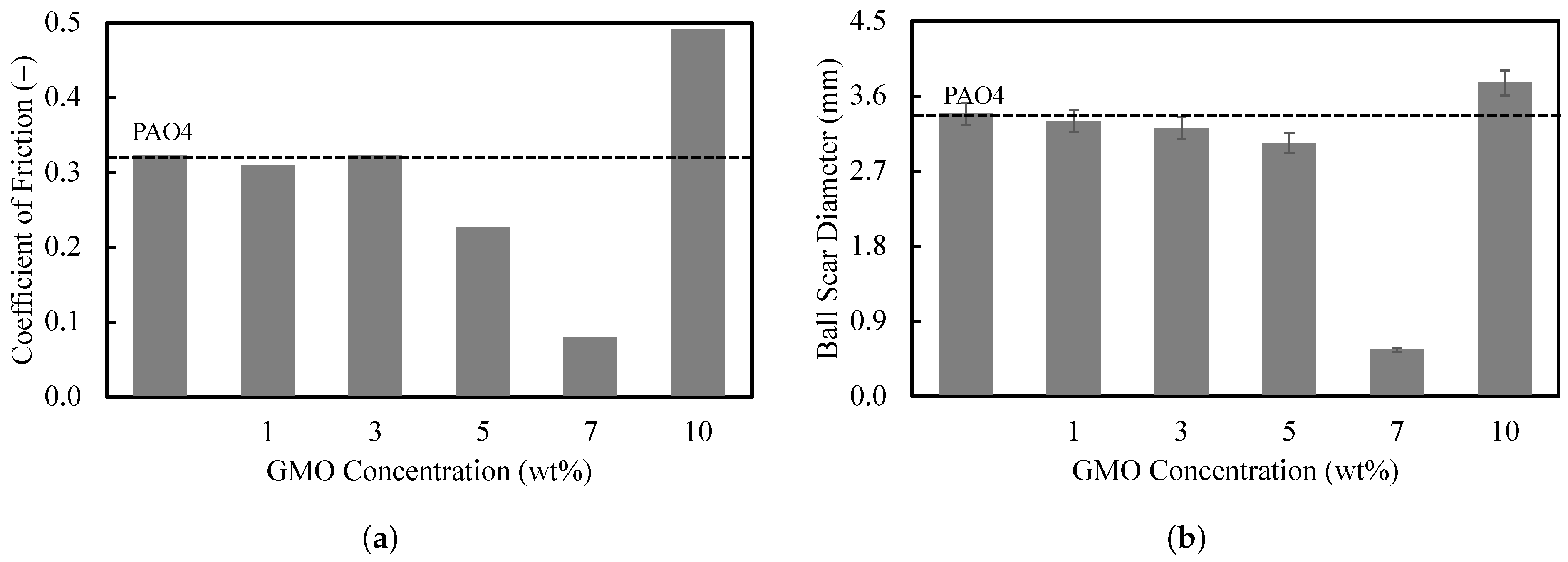
The average CoF values and their corresponding ball scar diameters are presented in
Figure 6. It should be noted that the average CoF represents the mean response across the investigated sliding velocity range. Error bars are not shown because variation across speeds reflects operating-condition dependence rather than measurement uncertainty. Friction and wear improved with increasing GMO concentration up to 7 wt%, after which performance began to deteriorate at 10 wt%. At the 7 wt% optimum, the CoF dropped to 0.076, approximately a fourfold reduction compared with neat PAO4 (0.315). More impressively, the minimum wear scar diameter (0.56 mm) was nearly six times smaller than that of the neat base oil (3.40 mm). These tribological improvements suggest that the 7 wt% GMO formulation exhibits the most favourable tribological response within the investigated concentration range, combining low friction with reduced wear.
3.3. Contact Angle and Surface Energy
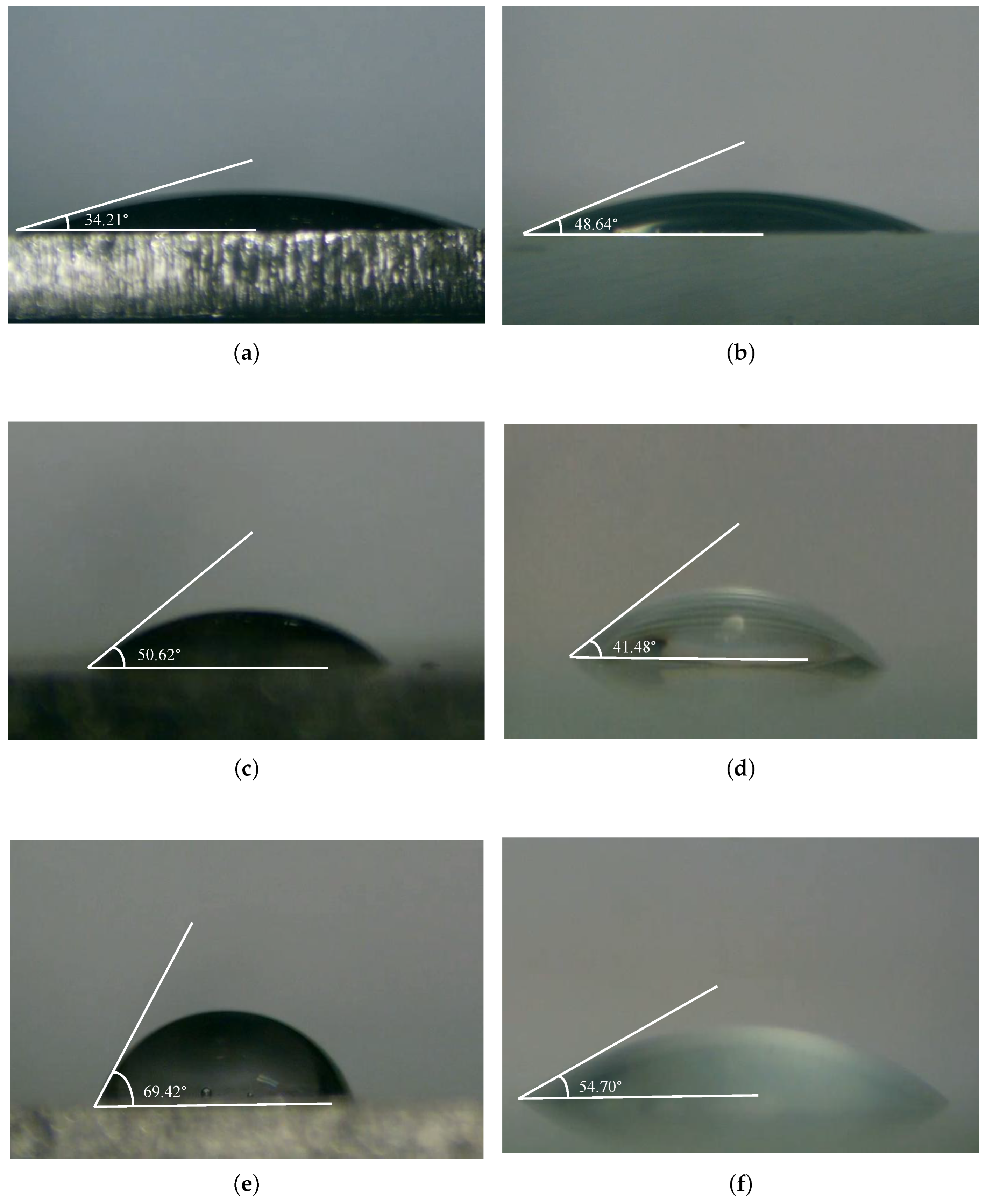
The measured contact angle images for reference liquids and PAO4-GMO blends are given in
Figure 7. The present study adopted the Owens–Wendt–Kaelble (OWK) approach (as given in Equation (
7)) to determine surface energy components. To account for the wetting effect arising from substrate roughness, an effective Wenzel correction factor of
was applied for the PAO4-GMO blends. This adjustment resolved the discrepancies in the work of adhesion between the LHS and RHS of the OWK equation. The contact angles and surface energy-related parameters are tabulated in
Table 2.
It is shown that the neat PAO4 exhibited limited wetting on both steel and glass, consistent with its weakly polar nature (5% polar fraction based on the liquid surface energy in
Table 2) [
33]. However, adding GMOs reduced the contact angle, promoting spreading. The minimum contact angle was reached at 7 wt% GMO. Concurrently, the dispersive component decreased while the polar component increased, potentially associated with increased interaction between the GMO-containing lubricant and the substrate surfaces. This is further supported by the decrease in the solid–liquid interfacial energy, suggesting that adding GMO makes interface formation more thermodynamically favourable.
3.4. Interpretation of Friction Force and Surface Energy Relationships
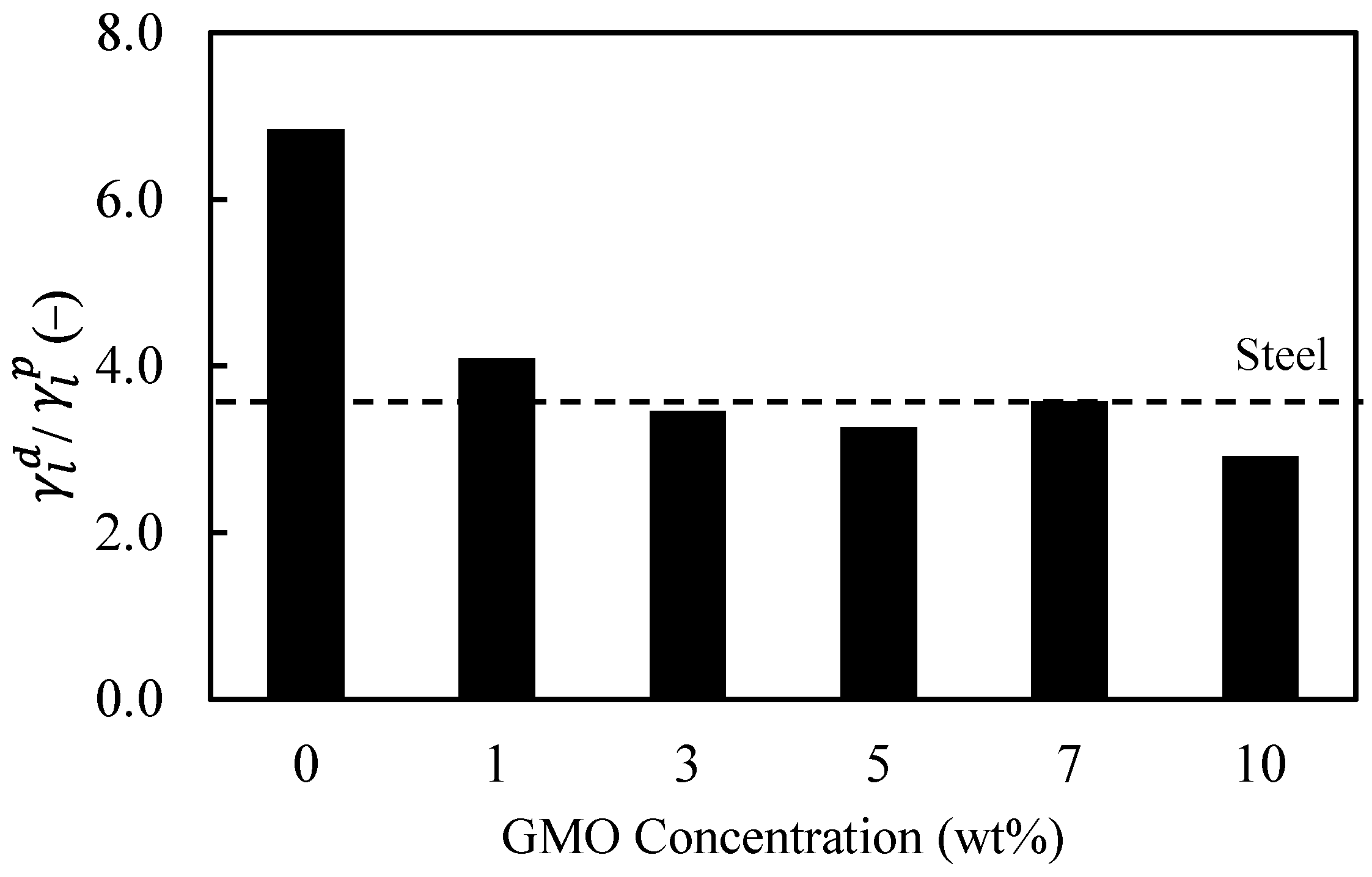
The relationship between interfacial thermodynamics and tribological performance was analysed within a comparative framework in which friction reduction is associated with the combined effects of dispersive compatibility, wettability, and balanced polar interactions. It should be noted that the present interpretation is based on tribological response and interfacial energetics, and does not directly resolve the chemical or structural nature of the boundary layer. The evolution of the dispersive-to-polar surface energy ratio with increasing GMO concentration is illustrated in
Figure 8. A shift from the dispersive-dominated behaviour of neat PAO4 towards enhanced polarity was observed upon addition of GMO to the base oil.
Figure 8 illustrates that the dispersive-to-polar ratio approaches that of the stainless steel substrate when GMO was added up to 7 wt%. This observation is consistent with dispersive–polar energetic characteristics closer to those of the steel substrate. The balanced dispersive and polar contributions from the PAO4-GMO blends and the steel substrate may be associated with a closer energetic match at the liquid–solid interface. This interpretation is supported by the reduction in contact angle and solid–liquid interfacial energy (
), which together indicate improved wettability, possibly associated with the lower friction and wear observed under the investigated conditions.
The superior performance observed near 7 wt% may be associated with improved wetting behaviour. The calculated lambda ratios remained below unity across the investigated velocity range (see
Figure 4), confirming that the system operated predominantly within mixed-to-boundary lubrication regimes, where hydrodynamic film formation is limited. Based on the observed friction behaviour, the persistence of low friction at elevated sliding velocities is not fully explained by hydrodynamic film thickening or bulk rheological behaviour. Instead, this observation is consistent with the lower friction maintained at increasing sliding velocity.
To characterise this behaviour quantitatively, a rupture parameter was defined as the operating condition at which the first abrupt increase in friction was observed during the friction-and-wear tests. This parameter, defined as the product of the applied load and sliding velocity (Load × Vel), serves as an operational indicator of delayed transitions in tribological response with increasing operating severity. It is used here to describe the onset of a change in tribological response, rather than to directly confirm boundary film failure. In this study, the resulting parameter serves as an indicator of resistance to shear-induced changes in tribological behaviour.
A surface-matching parameter () was also introduced to evaluate the relative dispersive–polar energetic relationship between liquid and solid substrate. This parameter is estimated from the logarithmic ratio of the lubricant’s dispersive-to-polar surface energy components to those of the stainless steel substrate. The degree of similarity between the dispersive–polar characteristics of the liquid and the energetic characteristics of the solid surface can thus be assessed, with values approaching unity indicating similar dispersive–polar energetic characteristics relative to the substrate.
The rupture parameter and the surface-matching parameter were subsequently analysed, together with friction and wear performance, to determine the relationships associated with the observed tribological behaviour. A bivariate correlation analysis was performed using IBM SPSS (version 30.0.0.0 (172))Statistics with Spearman’s rank correlation coefficient (
). The two-tailed tests of significance were applied, and the results are summarised in
Table 3.
The Spearman analysis shows that the surface matching parameter exhibits a strong negative correlation with the rupture threshold defined by Load × Vel (, ). The rupture threshold itself is strongly negatively correlated with friction (Load × Velocity vs. CoF: , ), while friction is strongly positively correlated with wear (CoF vs. Wear: , ). In addition, exhibits a strong positive correlation with wear (, ).
Given the limited dataset and exploratory nature of the correlation analysis, these observations are interpreted primarily as comparative phenomenological trends rather than definitive mechanistic relationships. The Spearman analysis is therefore intended mainly to identify associations between interfacial energetic characteristics and tribological response under the investigated conditions.
Taken together, the observed correlations suggest that variations in dispersive–polar energetic characteristics may be associated with changes in tribological response under combined load and sliding conditions. Closer dispersive–polar energetic matching between solid and liquid appears associated with delayed transitions towards undesirable tribological behaviour, while increases in friction are accompanied by increased wear. Within the investigated concentration range, the 7 wt% formulation exhibited the most favourable combination of low friction and reduced wear under the present test conditions.
Although the present analysis does not directly establish molecular-level mechanisms, the observed trends may still be discussed within the broader context of interfacial energetics and boundary lubrication behaviour reported in the literature. Boundary-active additives have previously been reported to form low-shear-strength adsorbed films, whose effectiveness depends on molecular organisation and packing at the interface [
20,
34]. While the present study does not directly characterise such films, the observed friction and wear behaviour may plausibly be interpreted in terms of balanced polar and dispersive contributions at the liquid–solid interface. In this context, polar contributions may be associated with increased tendencies for solid–liquid interactions under the tested conditions, while dispersive interactions may plausibly contribute to the lower friction observed experimentally. The observed behaviour is therefore consistent with the selected 7 wt% GMO concentration providing reduced friction and wear without the adverse effects observed at higher concentrations, as in the 10 wt% blend.
4. Conclusions
This study suggests that boundary tribological performance in PAO4-GMO blends is influenced by interfacial energetics as the calculated lambda ratios remained below unity across all investigated conditions. The observed reduction in friction is associated with boundary-dominated lubrication behaviour rather than hydrodynamic effects. Among the investigated formulations, the 7 wt% GMO formulation consistently produced the lowest friction and wear across all operating velocities, despite having a lower estimated elastohydrodynamic film thickness than other formulations. This suggests that interfacial interactions may play an important role in the observed tribological behaviour under the tested conditions.
Surface energy analysis revealed that increasing GMO concentration shifts the lubricant’s dispersive-polar balance, thereby altering the measured dispersive-polar characteristics relative to the stainless steel substrate. The results suggest that the most favourable tribological response within the investigated concentration range is associated with a balanced interfacial interaction. The observed trends may be interpreted as balanced polar and dispersive interactions at the interface, with polar contributions plausibly associated with an increased tendency for solid–liquid interaction, while dispersive interactions may facilitate interfacial sliding. This highlights the potential influence of interfacial energetics on tribological response and supports extending surface energy analysis beyond conventional wettability interpretation.
The correlation analysis suggests potential associations between interfacial compatibility and tribological response under combined load and sliding conditions. The surface-matching parameter () is associated with the rupture threshold (Load × Vel), which in turn correlates with friction behaviour and subsequent wear progression. These relationships suggest that interfacial energy compatibility may influence the lubricant system’s response under shear conditions.
The reported findings suggest that interfacial energy tuning can serve as a practical strategy for screening lubricant formulations under varying operating conditions. More importantly, the results highlight that changes in the lubrication environment, such as the presence of moisture or reactive species, can alter interfacial interactions, thereby potentially affecting tribological performance. The ability to systematically evaluate and tune interfacial energetics provides a useful platform for assessing formulation sensitivity to environmental variations. The proposed framework provides a practical basis for interpreting interfacial energetics in relation to tribological performance. The framework is not limited to a specific application and can be extended to emerging propulsion systems that require improved formulation strategies. Future work may incorporate complementary surface-sensitive techniques to provide additional insight into surface modifications associated with the observed tribological response.