Article

A Highly Transparent, Self-Healing, and Durable Anti-Fogging Coating for Extreme Environments

1
Department of Chemistry, Capital Normal University, Beijing 100048, China
2
Shandong Zhongsheng Coatings Co., Ltd., Dezhou 253010, China
*
Author to whom correspondence should be addressed.
Lubricants 2026, 14(3), 111; https://doi.org/10.3390/lubricants14030111
Submission received: 31 December 2025 / Revised: 15 February 2026 / Accepted: 16 February 2026 / Published: 4 March 2026

Abstract

Condensation of water vapor into discrete droplets on the surface of transparent optical devices-commonly known as fogging-severely degrades their optical performance. To address this issue, a highly transparent, self-healing, and durable polymer-based anti-fogging coating was developed via a facile one-pot copolymerization of 2-acrylamido-2-methylpropanesulfonic acid (AMPS), acrylic acid (AA), and vinyltrimethoxysilane (VTMOS). The chemical structure and composition were thoroughly characterized. The introduction of VTMOS constructs a hydrophilic-hydrophobic microphase structure through in situ formation of a Si–O–Si network, which significantly enhances the mechanical stability and water resistance. The polymer coating can maintain high transparency (>90%) under extreme conditions (85 °C steam and −40 °C freezing), exhibits long-term anti-frosting performance for 180 days, and demonstrates rapid water-assisted self-healing within 30 s. Differential scanning calorimetry (DSC) analysis reveals that each polymer unit binds approximately seven water molecules, elucidating the mechanism behind its exceptional anti-frosting capability. This work presents a practical strategy for designing high-performance, long-lasting anti-fogging coatings suitable for extreme environment applications.

1. Introduction

Friction is ubiquitous in both daily life and industrial operations, contributing substantially to global energy consumption and imposing significant economic costs. Although pure water is widely employed as a liquid lubricant, its utility is severely limited in cold environments due to surface fogging and frosting phenomena, which critically degrade lubrication performance [1]. Fogging arises when warm, humid air contacts a surface below the dew point, triggering rapid condensation of water vapor into submillimeter droplets that coalesce into an optically scattering, opaque layer [2]. Upon further cooling, these droplets freeze into dendritic or granular frost crystals, resulting in severe visual impairment or even total obscuration of transparent surfaces [3,4]. Practical manifestations include fogged camera lenses during winter photography in cold climates, compromising image capture and workflow efficiency; condensation on the inner visors of cyclists’ helmets in northern winters, which reduces visibility and elevates accident risk [5,6]. Analogous challenges on automotive windshields, aircraft cabin windows, train cab glazing, and maritime portholes. In high-speed or safety-critical transportation systems, even transient or localized visual degradation can precipitate hazardous situations. Crucially, fog and frost formation not only impair optical clarity but also elevate interfacial friction and adhesion, undermining both the lubricating function and the structural integrity of optical components. Therefore, the development of anti-fogging coatings that are simultaneously efficient, durable, and broadly compatible across diverse substrates and environmental conditions is essential to sustain reliable lubrication performance under extreme thermal and humidity regimes.
Anti-fogging coatings are primarily hydrophilic types based on their working mechanisms [7]. Hydrophilic coatings operate via surface-anchored, strongly polar functional groups, including hydroxyl (–OH), carboxyl (–COOH), sulfonic acid (–SO3H), or ether moieties, which exhibit high affinity for water molecules through robust hydrogen bonding [8,9,10]. This interaction significantly reduces the solid-liquid interfacial energy and suppresses droplet nucleation. Upon condensation of water vapor on a sub-dew-point surface, capillary forces and strong interfacial hydration drive rapid lateral spreading of condensed water, yielding a continuous, optically homogeneous, and thermodynamically stable ultrathin film (<100 nm) [11]. Such a film eliminates discrete droplet interfaces—thereby minimizing Mie scattering and preserving high optical transmittance (>95% across the visible spectrum) and visual clarity [12,13]. Critically, the hydrated interface also facilitates low-shear interfacial slip, thereby enhancing lubrication performance under humid or cryogenic conditions [14,15,16,17,18]. For example, polyethylene glycol with an enhanced hydrogen-bonding network structure can achieve superlubricity [19]. This hydrogen-bonding mediated lubricity system exhibits an ultra-low friction coefficient of 0.003 under contact pressures up to 700 MPa, an extended service life of 16 h (corresponding to a sliding distance of 7.23 km), and an extremely low wear rate of 5.93 × 10⁻⁹ mm3·N−1·m−1 on a –C:H film surfaces. Furthermore, the strong hydrogen bond interaction between polyethylene glycol and phytic acid could greatly improves the bearing capacity of the lubricant, which showed outstanding lubricating properties (μ ≈ 0.006) for Si3N4/glass friction pairs with an ultrashort running-in period (~1 s) under high Hertzian contact pressure of ~758 MPa. More importantly, even after up to 12 h (~700 m of travel), only about 100 nm deep wear scars were found on the surface of the glass sheet (wear rate = 2.51 × 10⁻⁹ mm3 N−1 m−1) [20]. Consequently, hydrophilic coatings with robust hydrogen-bonds offer superior reliability, operational stability, and environmental resilience in applications involving prolonged high humidity, frequent thermal shocks, or demanding tribological requirements.
Recent research on hydrophilic anti-fogging coatings has centered on water-soluble polymers and ionic monomers [7]. Representative water-soluble polymers include poly(vinyl alcohol) (PVA) [21], poly(vinyl pyrrolidone) (PVP) [22], poly(acrylic acid) (PAA) [23], and poly(ethylenimine) (PEI) [24]. Typical ionic monomers used in such coatings are [2-(methacryloyloxy)ethyl]dimethyl-(3-sulfopropyl)ammonium hydroxide (SBMA) and 2-acrylamido-2-methylpropanesulfonic acid (AMPS) [25,26]. For example, Zhou et.al [27] constructed a kind of zwitterionic hydrophilic polymer brush coating on active silanized glass, fabricated by UV-induced grafting polymerization of SBMA monomer. As the hydrophilic polymer brushes poly(SBMA) (pSBMA) covalently attached to the glass surface, the glasses could render a series of excellent performances, including underwater superoleophobicity, anti-fogging, anti-frosting, abrasion resistance, self-cleaning and antibacterial adhesion, and especially high stability even after being immersed in water for 20 days. In this work, we report a novel poly(VTMOS–AA–AMPS) copolymer coating synthesized via a one-step thermal polymerization using AMPS, acrylic acid (AA), and vinyltrimethoxysilane (VTMOS) as precursors. Unlike conventional AMPS/AA-based systems, the incorporation of VTMOS not only reinforces the coating through a hydrolytically stable Si–O–Si network but also induces a distinctive hydrophilic-hydrophobic microphase-separated architecture, thereby markedly enhancing both chemical stability and long-term mechanical durability. Moreover, the coating rapidly forms a uniform, ultrathin water film upon exposure to moisture, substantially reducing interfacial friction between water and the substrate; this ensures optical clarity, stable imaging, and reliable device performance under humid or condensing conditions. Furthermore, we systematically investigate the state of bound water within the coating using differential scanning calorimetry (DSC), providing mechanistic insights into its exceptional long-term anti-frosting capability. This study provides insights for durable, multifunctional anti-fogging coatings under extreme environmental conditions.

2. Materials and Methods

2.1. Materials

2-Acrylamido-2-methyl-1-propanesulfonic acid (AMPS, 98%) and ammonium persulfate (APS, 99.99%) were purchased from Aladdin Biochemical Technology Co., Ltd. (Shanghai, China) Acrylic acid (AA, 99%), vinyl trimethoxy silane (VTMOS, 98%), and N,N’-methylenebisacrylamide (MBA) were purchased from Beijing InnoChem Science & Technology Co., Ltd. (Beijing, China).

2.2. Synthesis of Poly(VTMOS–AA–AMPS)

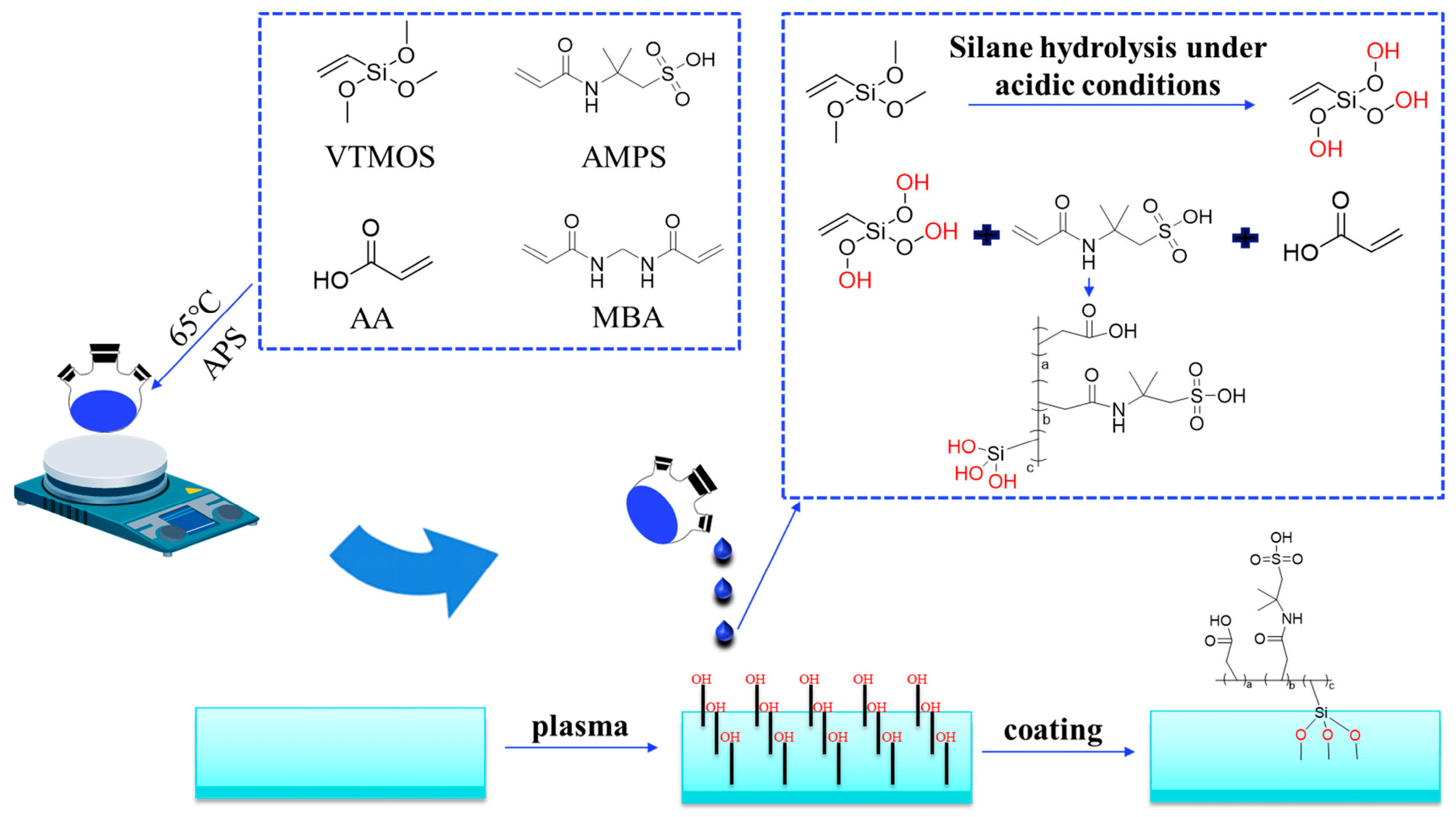
In a typical synthesis, 4.5 g of AMPS and 0.5 g of AA were dissolved in 50 g of deionized water. To this solution, VTMOS (0.5 wt% relative to total monomer mass) and the crosslinker MBA (0.6 wt% relative to total monomer mass) were added. The mixture was then transferred to a three-neck flask, and ammonium persulfate (APS, 1 wt% relative to total monomer mass) was introduced as the initiator. After adding a magnetic stir bar, the reaction was carried out at 65 °C for 8 h in a water bath under a continuous nitrogen atmosphere (Figure 1).

2.3. Preparation of Poly(VTMOS–AA–AMPS) Coatings

Glass slides measuring 25.4 mm × 76.2 mm with a thickness of 1–1.2 mm were used as substrates. Prior to coating, the slides were cleaned by ultrasonication in ethanol or isopropanol for 10 min and then dried under a stream of compressed air. Subsequently, a second ultrasonication was performed in deionized water for 10 min, followed by drying under a nitrogen stream. The slides were then activated by oxygen-plasma treatment for 20 min. Finally, the coating solution was applied uniformly via drop-casting, and the samples were cured in an oven at 100 °C for 2 h.

2.4. Characterization

Proton nuclear magnetic resonance spectroscopy (1H NMR, Bruker AVANCE III 600 MHz, Billerica, MA, USA) spectrometer using D2O as the solvent was used to characterize the composition of polymer coatings. Fourier transform infrared spectroscopy (FTIR, Nicolet IS50, Waltham, MA, USA) was used to characterize the functional group sin the range of 4000–500 cm−1 with a resolution of 4 cm−1 and 32 scans. Surface wettability was assessed by measuring the water contact angle (CA) at room temperature using a video-based optical contact angle goniometer (OCA25, DataPhysics Instruments GmbH, Filderstadt, Germany). A 2 µL droplet was deposited at random locations on the substrate via a microsyringe, and the average CA was calculated from at least three independent measurements. Optical transmittance across the visible spectrum (400–800 nm) was recorded on a UV–8000A ultraviolet-visible spectrophotometer (Shanghai Metash Instrument Co., Ltd., Shanghai, China). Surface morphology and elemental composition were examined using a Hitachi S-4800 scanning electron microscope (SEM) equipped with energy-dispersive X-ray spectroscopy (EDS) (Hitachi, Tokyo, Japan). Prior to imaging, samples were sputter-coated with gold and observed at an accelerating voltage of 5 kV. During EDS analysis, the presence of the sputtered gold layer was accounted for by including Au in the element quantification routine, thereby avoiding any interference with the compositional determination of the coating elements. Atomic force microscopy (AFM) was performed on dried samples at room temperature with a scanning probe microscope operated in tapping mode (scan frequency: 1 Hz; scan area: 30 µm × 30 µm, Bruker Nano Inc., MultiMode 8, Santa Barbara, CA, USA). The arithmetic average roughness (Ra) was automatically calculated by the AFM instrument software (NanoScope Analysis, version 1.40R2) from the topography image acquired over a 30 µm × 30 µm area after standard flattening procedures. For thermal analysis, three sample compositions were prepared in sealed aluminum crucibles after complete drying of the coating: pure polymer, polymer with 10 wt% added water, and polymer with 30 wt% added water. Their low-temperature thermal behavior was investigated by differential scanning calorimetry (DSC, Q2000, TA Instruments, New Castle, DE, USA) under a nitrogen flow of 50 mL/min, cooling from 25 °C to −40 °C at 5 °C/min. The melting enthalpy (ΔH) of free water was obtained by integrating the endothermic peak near 0 °C using the TA Universal Analysis software(version 4.5A). Baseline correction was applied consistently across all samples. The proportion of free water was determined by comparing the measured enthalpy to the theoretical enthalpy of pure water (334 J/g). The bound water content (including freezable and non-freezable) was then derived from mass balance calculations. Abrasion resistance was evaluated using a rough polypropylene melt blown nonwoven fabric as the friction medium under an applied normal force of 1.0 N (corresponding to a pressure of ~10 kPa, controlled with standard weights), a sliding speed of 5 cm/s, over 300 back-and-forth cycles.

2.5. Anti-Fogging and Anti-Frosting Performance Testing

The anti-fogging performance was evaluated by placing coated and uncoated blank glass samples 5 cm above a hot water bath generating a saturated or near saturated steam environment and maintained at 85 °C for 120 s. Photographs and light transmittance data were recorded immediately after removing the samples from the steam environment. For the anti-frosting test, glass slides were first cooled at −40 °C for 30 min in a freezer, then transferred to ambient conditions (~25 °C, 40% RH) for observation. To quantify the anti-fogging and anti-frosting properties, light transmittance of the tested samples was measured and compared with that of unmodified plain glass slides (control group) subjected to the same procedures. All tests were repeated three times with consistent results.

3. Results

3.1. Chemical Structures

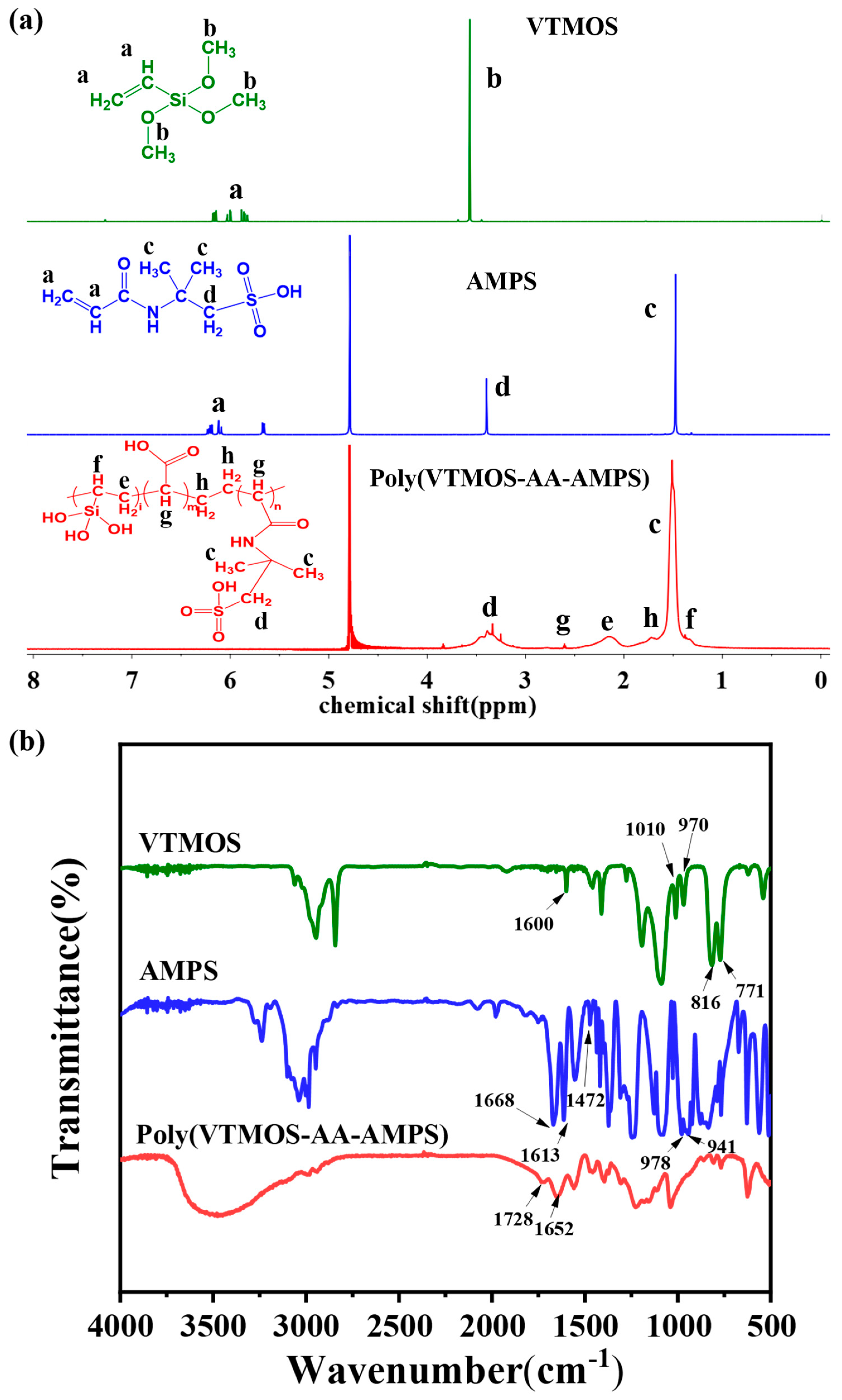
The copolymer poly(VTMOS–AA–AMPS) was synthesized via facile thermal-initiated free-radical polymerization. Its chemical structures were confirmed by 1H NMR and FTIR spectroscopy. Figure 2a presents the 1H NMR spectra of the monomers VTMOS, AMPS, as well as that of the resulting poly(VTMOS–AA–AMPS). In the spectrum of VTMOS, the signals between δ = 5.8 to 6.2 ppm correspond to the protons of CH2=CH with an integration ratio of 1:1:1. The terminal alkene protons (=CH2) appear as a doublet, whereas the silicon-bound alkene proton (Si–CH=) resonates as a multiplet due to trans-coupling with the terminal vinyl protons. The three equivalent methoxy (CH3O–) groups-chemically identical and lacking adjacent protons-give rise to a sharp singlet at δ = 3.5–3.6 ppm [28]. In the AMPS spectrum, the vinyl protons (CH2=CH) also appear in the range of δ = 5.6–6.3 ppm. Additional signals at δ = 1.35 ppm and δ = 3.26 ppm are assigned to the methyl (–CH3) and methylene (–CH2–) protons of the sulfopropyl side chain, respectively. In the spectrum of the polymeric anti-fog coating, all resonances associated with carbon–carbon double bonds have completely disappeared, confirming quantitative monomer conversion into polymer. Moreover, the absence of the methoxy signal confirms complete hydrolysis of the silane moiety to Si–OH [29]. Figure 2b shows the FTIR spectra of VTMOS, AMPS, and poly(VTMOS–AA–AMPS). The VTMOS spectrum exhibits characteristic absorption bands at 2850 cm−1 (C–H stretch of CH3), 1600 cm−1 (C=C stretch of the vinyl group), 816 cm−1 and 771 cm−1 (Si–O–C asymmetric stretching) [12,28]. Similarly, the AMPS spectrum displays distinct signals at 3000 cm−1 (–CH3), 1613 cm−1 ((vinyl C=C)) and 1668 cm−1 (C=O stretch of the –NHC=O group). In contrast, the spectrum of the synthesized poly(VTMOS–AA–AMPS) reveals pronounced structural changes [30]. Notably, the characteristic vinyl C=C stretching bands from both VTMOS and AMPS monomers are completely absent, confirming their consumption during copolymerization. Moreover, a broad and intense absorption band dominates the 3200–3600 cm−1 region, corresponding to the –OH stretching vibration, arising from both hydrolyzed silanol groups (Si–OH) and carboxylic acid moieties (–COOH) of acrylic acid (AA). A strong C=O stretching band centered at ~1700 cm−1, characteristic of the carboxylic acid functionality, further corroborates the successful incorporation of AA into the polymer backbone. Collectively, the FTIR and 1H NMR data provide conclusive evidence that VTMOS and AMPS underwent hydrolysis and subsequent copolymerization with AA, yielding the target polymer coating.

3.2. Microstructure and Phase Composition

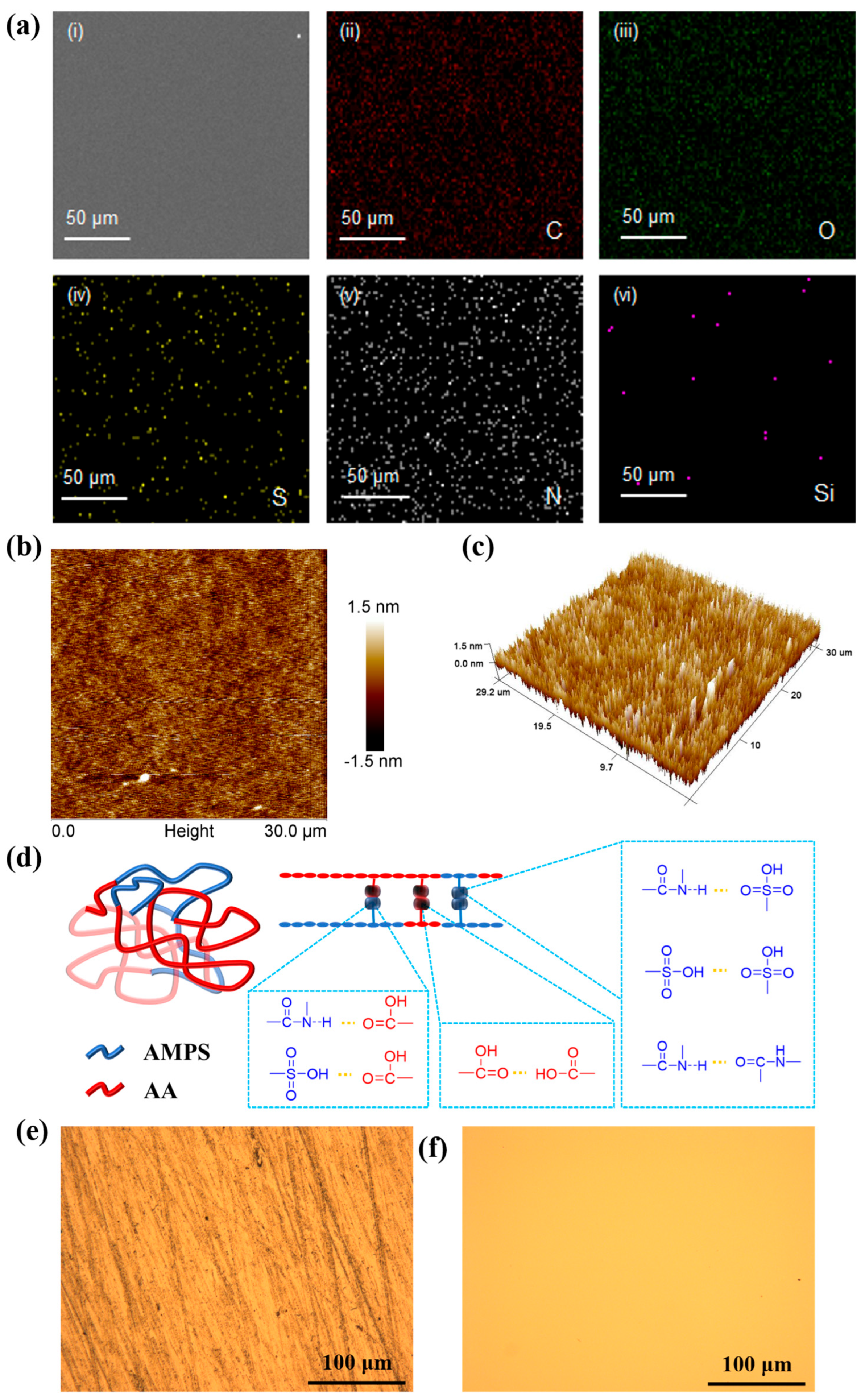
The microstructure and phase composition of the polymer coating were systematically characterized. Scanning electron microscopy (SEM) images revealed a smooth and continuous surface morphology (Figure 3a), while energy-dispersive X-ray spectroscopy (EDS) confirmed the presence of C, N, O, S, and Si elements in the coating, consistent with the designed composition. X-ray diffraction (XRD) analysis over the 2θ range of 5–60° yielded only a broad halo peak centered at approximately 20° (Figure S1), confirming the amorphous nature of the polymer and its random-coil chain conformation—features that promote full exposure and accessibility of functional groups. Atomic force microscopy (AFM) was performed in tapping mode at room temperature to assess surface topography. As shown in Figure 3b,c, the AFM images demonstrate a highly uniform surface, with a height variation of ~1.5 nm and an arithmetic average roughness (Ra) of 0.329 nm. The rational structural design of the polymer coating imparts pronounced dynamic behavior and intrinsic self-healing capability. As illustrated in Figure 3d, the sulfonic acid (–SO3H) and amide (–CONH2) groups in AMPS, together with the carboxyl (–COOH) groups in AA, serve as both hydrogen-bond donors and acceptors. This facilitates the formation of abundant intra- and intermolecular hydrogen bonds-not only between AMPS and AA segments but also within the semi-interpenetrating network formed via hydrolysis-condensation of siloxane precursors into robust Si–O–Si linkages. Such a multi-hydrogen-bond cross-linked architecture significantly enhances the mechanical integrity and structural stability of the coating. Moreover, owing to its dynamic and reversible nature, the network endows the coating with excellent water-mediated self-healing capability [31,32,33]. As shown in Figure 3e, clear scratches were observed under an optical microscope after 300 rubbing cycles. Upon application of a small water droplet to the damaged area, the coating fully self-healed within 30 s, driven by hydrogen-bonding interactions (Figure 3f). This rapid repair arises from water-promoted reversible dissociation and reformation of hydrogen bonds, which effectively reconnect polymer chains across the damaged interface [34,35]. The scratch-and-heal cycle was repeated three times on the same region of the coating, and complete visual recovery was consistently achieved after each cycle-demonstrating the robust repeatability of the self-healing behavior. Thus, the dense hydrogen-bond network within the coating not only ensures favorable mechanical properties but also enables efficient, water-assisted self-healing through dynamic structural reconstruction, which is capable of dynamically repairing surface defects during friction [36,37].

3.3. Anti-Fogging Performance

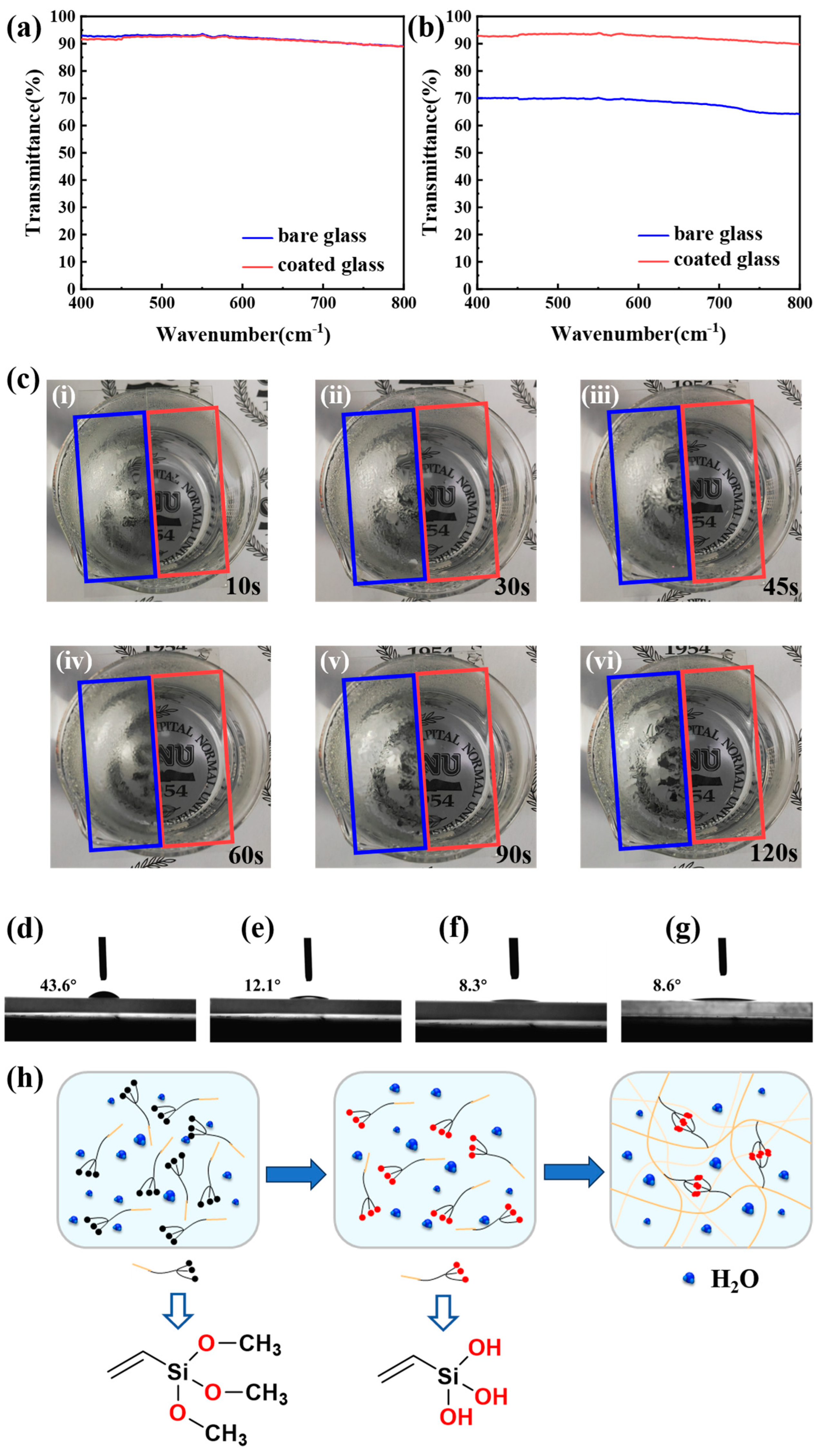
To evaluate the anti-fogging performance of poly(VTMOS–AA–AMPS) coating, it was uniformly deposited onto glass substrates via drop-casting. As shown in Figure 4a, both coated and bare glass samples exhibited initial UV-vis transmittance exceeding 90%, confirming that the coating preserves the intrinsic optical transparency of the substrate without significant compromise. Under a saturated steam environment at 85 °C, the transmittance of the bare glass dropped rapidly to ~70% within seconds, whereas the coated glass maintained a stable transmittance above 90% throughout the test, demonstrating its superior anti-fogging capability (Figure 4b). Time-resolved photographic analysis further elucidated the dynamic fogging behavior (Figure 4c): visible water condensation appeared on the uncoated surface within 10 s of exposure to 80 °C steam, and fogging progressively intensified thereafter. In stark contrast, the coated glass retained high optical clarity over the entire 120 s observation period, with no discernible droplet formation or surface haze. The water contact angle (WCA) of the coating was monitored dynamically to assess its wetting kinetics (Figure 4d–g). The WCA decreased from an initial value of 43.6° to 12.1° after 120 s and further declined to 8.3° after 300 s, indicating rapid and sustained surface hydration-consistent with excellent anti-fogging potential. Notably, even after prolonged immersion in water for 80 h, the WCA remained at 8.6°, underscoring the coating’s robust hydrophilicity and strong interfacial adhesion to the glass substrate [38,39]. This exceptional durability arises from the dual functionality of vinylsiloxane within the coating architecture, as illustrated in Figure 4h. Specifically, the vinyl groups undergo copolymerization with hydrophilic monomers/polymers, while the hydrolyzed Si–OH moieties undergo condensation to form a covalent Si–O–Si network. The resulting semi-interpenetrating polymer network (SIPN) synergistically enhances both interfacial adhesion and mechanical stability [40]. The hydrophobic Si–O–Si domains further establish a delicate hydrophilic-hydrophobic balance within the coating, enabling effective anti-fogging performance via rapid water spreading, while simultaneously conferring robust water resistance to ensure long-term durability [41,42]. Collectively, these results demonstrate that the polymer coating efficiently suppresses hot-moisture condensation on glass surfaces without compromising high optical transparency—thereby delivering significant and durable anti-fogging functionality.

3.4. Anti-Frosting Capability

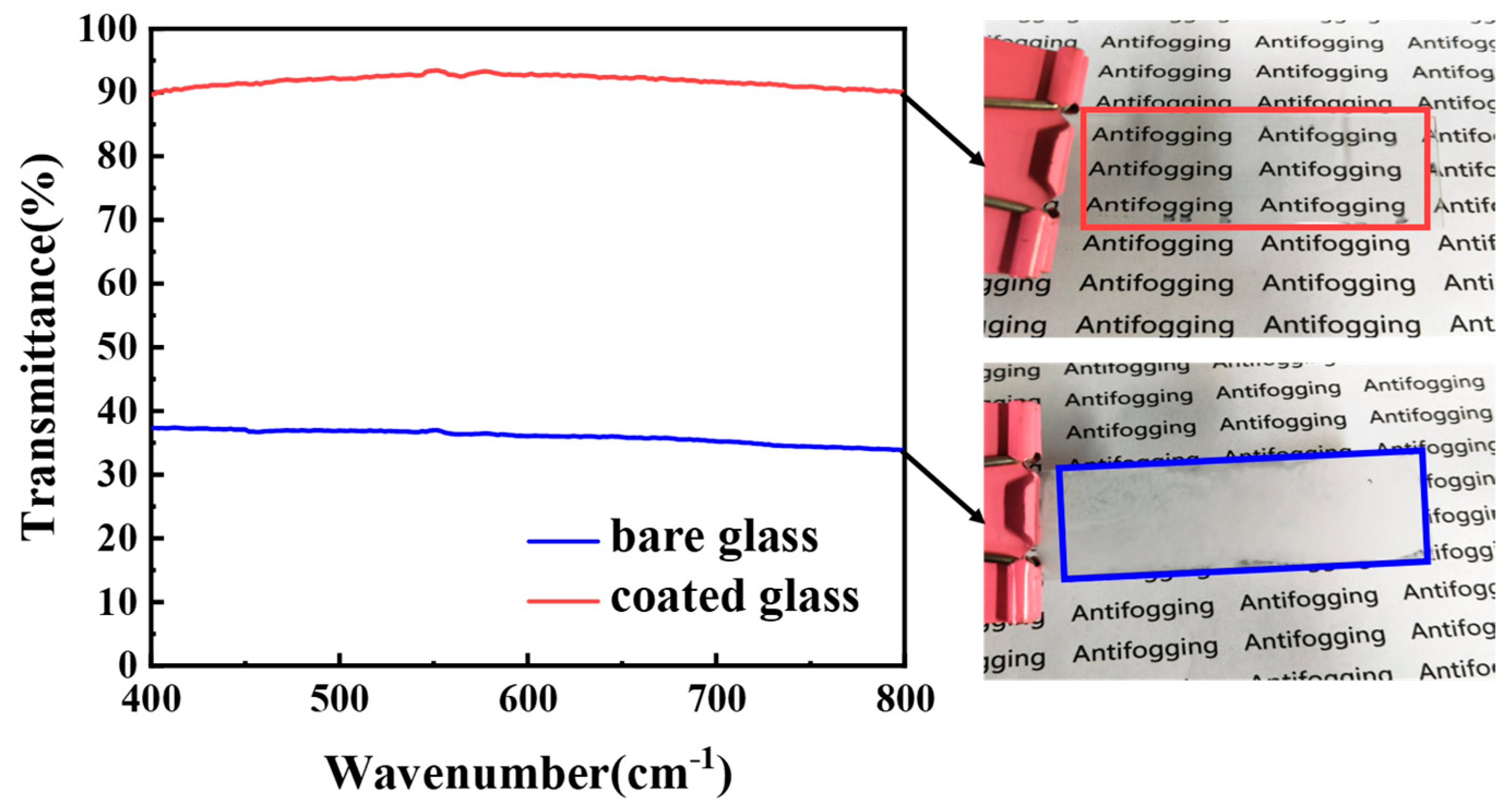
In addition to its anti-fogging functionality, the coating’s resistance to frost formation under low-temperature conditions is critically important for maintaining the visibility and optical performance of transparent substrates. To assess anti-frosting performance, coated and uncoated glass slides were placed in a freezer at −40 °C for 30 min and subsequently evaluated both visually and optically. As shown in Figure 5, the coated glass retained a transmittance exceeding 90%, whereas the transmittance of the uncoated glass plummeted to approximately 37%. This marked contrast demonstrates that the coating effectively suppresses frost nucleation and growth, thereby preserving optical clarity even under extreme sub-zero conditions. The visual comparison in Figure 5 further corroborates this finding: the bare glass became completely opaque owing to dense, uniform frost coverage, while the coated sample remained highly transparent with no discernible visual obstruction. Collectively, these results indicate that the polymer coating not only prevents fogging in warm, humid environments but also delivers outstanding anti-frosting performance under freezing conditions-sustaining high light transmittance and visual clarity where conventional glass surfaces fail.

3.5. Long-Term Anti-Frosting Performance

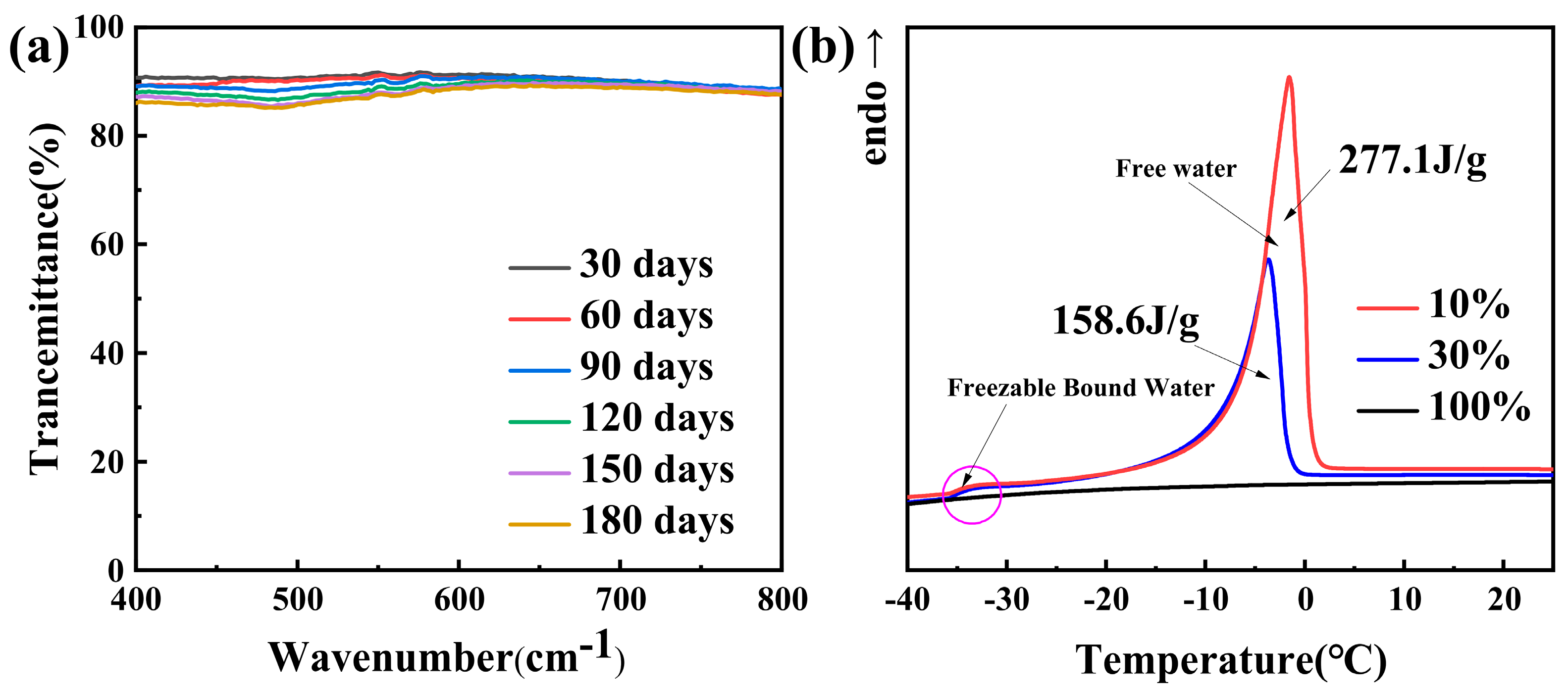
To further investigate the long-term anti-frosting performance of the polymer coating and elucidate its underlying mechanism, we systematically evaluated the coating’s durability under extreme low-temperature conditions and its interaction with water. As shown in Figure 6a, glass substrates coated with the polymer and stored continuously at −40 °C retained a UV-vis transmittance exceeding 85% even after 180 days-significantly outperforming uncoated substrates, whose transmittance declined rapidly due to frost accumulation. These results demonstrate that the coating not only delivers immediate anti-frosting efficacy under harsh subzero conditions but also maintains its functionality over extended periods, underscoring its exceptional long-term durability. This sustained anti-frosting capability is intrinsically linked to the unique water-binding properties of the polymer network within the coating. Since the 1980s, differential scanning calorimetry (DSC) has been widely employed to study the state of water in polymeric systems [43]. Building upon this established methodology, we performed a comprehensive DSC analysis to characterize the nature and distribution of bound water in the coating polymer. Prior to analysis, the polymer sample was thoroughly dried under vacuum. Subsequently, polymer-water blends with varying mass ratios were prepared for comparative evaluation: 10:0 (pure polymer), 3:7 (30 wt% polymer), and 1:9 (10 wt% polymer). As shown in Figure 6b, an endothermic peak near 0 °C corresponds to the melting of free water, with its enthalpy denoted as Aendo. In the 10 wt% polymer sample, the proportion of free water was higher, yielding an Aendo value of 277.1 J/g, which is greater than that of the sample with 30 wt% polymer (158.6 J/g). Moreover, a small endothermic peak centered at approximately −35 °C appeared in the DSC thermograms of both hydrated samples. This peak is attributed to the melting of freezable bound water residing within the polymer matrix [44]. This observation clearly indicates that strong interactions between water molecules and polar functional groups (such as sulfonic acid, amide, and carboxyl groups) on the polymer chains can significantly depress the freezing point of a fraction of the water molecules to approximately −35 °C.

4. Discussion

Based on classical theory, water in polymeric systems can be classified into two primary categories: free water (thermodynamic and physical behavior analogous to bulk water) and bound water (whose thermodynamic properties are altered through hydrogen bonding). Bound water is further subdivided into freezable bound water (with a depressed freezing point but remains capable of crystallization) and non-freezable bound water (with no crystallize even at very low temperatures) [45,46]. The melting enthalpy of pure water (ΔHpure) is 334 J/g. According to the literature [26], the weight fraction of free water (Wfree) and bound water (Wbound) within the 10 wt% polymer blend sample can be calculated as follows:
W f r e e % = A e n d o Δ H p u r e × 100 % = 277.1 334 = 83 %
W b o u n d % = W w a t e r % W f r e e % = 90 % 83 % = 7 %
The average number (k) of bound water molecules which interact with polymer unit is calculated by:
k = n b o u n d n p o l y = W b o u n d / M w a t e r W p o l y / M p o l y = 7 / 18 10 / 173.5 7
where nbound and npoly are the molar numbers of bounded water and polymer units, respectively; Mwater and Mpoly are the relative molecular weights of water and polymer, respectively. As for 30 wt% polymer blend sample, the average number (k) of bound water molecules is calculated as follows:
W f r e e % = A e n d o Δ H p u r e × 100 % = 158.6 334 = 47.5 %
W b o u n d % = W w a t e r % W f r e e % = 70 % 47.5 % = 22.5 %
k = n b o u n d n p o l y = W b o u n d / M w a t e r W p o l y / M p o l y = 22.5 / 18 30 / 173.5 7 .
Based on the above calculation results, it can be concluded that one polymer structural unit can bind seven water molecules, which can maintain good transparency at −40 °C. As a result, the freezing point of these bound water molecules is lowered, achieving an anti-frost effect.
The microphase-structured coating developed in this work preserves the fundamental fog-suppression mechanism of hydrophilic surfaces while its long-term durability is significantly enhanced by a robust siloxane network. Moreover, the inherent lubricity conferred by a hydrogen-bond-facilitated aqueous film provides a more reliable strategy for maintaining optical clarity under condensing conditions-contrasting sharply with the inherently unstable air-cushion effect commonly observed on superhydrophobic surfaces [19]. The integrated performance of the poly(VTMOS–AA–AMPS) coating stems from a synergistic chemical design that carefully balances hydrophilicity, mechanical robustness, and dynamic interfacial behavior. Specifically, the incorporation of VTMOS and its subsequent condensation into a Si–O–Si network establishes a durable, cross-linked framework that ensures strong substrate adhesion as well as resistance to physical abrasion and water erosion [47,48]. This hydrophobic scaffold is interpenetrated by hydrophilic polymer chains bearing abundant sulfonic acid (–SO3H), amide (–CONH2), and carboxyl (–COOH) groups. These polar functionalities drive rapid water adsorption and spontaneous spreading, enabling the formation of a uniform, transparent aqueous film–the essential structural basis for both anti-fogging and anti-frosting functionality. Critically, these polar groups collectively establish a dense, dynamic hydrogen-bonding network [49]. This network not only facilitates rapid, water-assisted self-healing, but, more importantly, governs the lubrication behavior at the water-coating interface. Hydrogen-bonding interactions between the polymer surface and water molecules stabilize a low-shear aqueous film, which functions effectively as a boundary lubricant [50]. More importantly, the calculated value (~7 water molecules bound per polymer repeat unit) indicates a substantial population of non-freezable water under the tested conditions (−40 °C). This tightly bound, non-freezable water layer functions as a dynamic interfacial shield. First, it inherently resists crystallization, thereby maintaining a liquid-like interfacial layer at the coating surface even below 0 °C. Second, this high-surface-energy, lubricious layer thermodynamically promotes the rapid, uniform spreading of incoming condensing moisture into a thin, continuous film, rather than acting as nucleation sites for discrete ice crystals [51]. This mechanism transcends passive barrier effects and constitutes an active interfacial management strategy for frost prevention [52].

5. Conclusions

In summary, a durable, hygroscopic polymer coating exhibiting long-term anti-fogging and anti-frosting performance was developed via a facile one-pot synthesis. The coating was fabricated through thermally initiated copolymerization of 2-acrylamido-2-methylpropanesulfonic acid (AMPS), acrylic acid (AA), and vinyltrimethoxysilane (VTMOS). It demonstrates exceptional fog resistance under continuous exposure to 85 °C steam and retains robust hydrophilicity even after 80 h of immersion in water. Moreover, it maintains effective anti-frosting functionality for over 180 days at −40 °C. Notably, the coating possesses rapid self-healing capability, fully restoring both optical clarity and surface functionality within minutes following mechanical damage. Differential scanning calorimetry (DSC) analysis reveals that each structural unit of the polymer can coordinate approximately seven water molecules, providing mechanistic insight into its sustained anti-frosting performance under extreme low-temperature conditions. This work provides insights for hydrophilic anti-fogging coatings by integrating a siloxane-reinforced, hydrophilic-hydrophobic microphase-separated architecture. This strategy successfully decouples the conventional trade-off between high hydrophilicity and poor mechanical/chemical durability, delivering an integrated solution with persistent, multifunctional performance under harsh environmental conditions.

Supplementary Materials

The following supporting information can be downloaded at: https://www.mdpi.com/article/10.3390/lubricants14030111/s1, Figure S1: XRD pattern of poly(VTMOS–AA–AMPS).

Author Contributions

Conceptualization, X.M. and G.J.; Methodology, J.H.; Software, R.Z.; Validation, J.H. and Y.F.; Formal analysis, J.H.; Investigation, J.H.; Resources, G.J.; Data curation, J.H.; Writing—original draft preparation, J.H.; Writing—review and editing, X.M.; Visualization, J.H.; Supervision, X.M.; Project administration, G.J.; Funding acquisition, X.M. All authors have read and agreed to the published version of the manuscript.

Funding

This research was funded by Key R&D Program of Shandong Province (Shandong Province Science and Technology SMEs Innovation Capability Enhancement Project), grant number 2025TSGCCZZB0923.

Data Availability Statement

The original contributions presented in this study are included in the article. Further inquiries can be directed to the corresponding author.

Acknowledgments

We would like to express our sincere gratitude to Jie Jin for his invaluable contributions, whose pioneering work laid the foundation for this study.

Conflicts of Interest

Author Gang Ji was employed by the company Shandong Zhongsheng Coatings Co., Ltd. The remaining authors declare that the research was conducted in the absence of any commercial or financial relationships that could be construed as a potential conflict of interest.

References

  1. Durán, I.R.; Laroche, G. Current trends, challenges, and perspectives of anti-fogging technology: Surface and material design, fabrication strategies, and beyond. Prog. Mater. Sci. 2019, 99, 106–186. [Google Scholar] [CrossRef]
  2. Durán, I.R.; Laroche, G. Water drop-surface interactions as the basis for the design of anti-fogging surfaces: Theory, practice, and applications trends. Adv. Colloid Interface Sci. 2019, 263, 68–94. [Google Scholar] [CrossRef] [PubMed]
  3. Li, C.; Li, X.; Tao, C.; Ren, L.; Zhao, Y.; Bai, S.; Yuan, X. Amphiphilic antifogging/anti-icing coatings containing POSS-PDMAEMA-b-PSBMA. ACS Appl. Mater. Interfaces 2017, 9, 22959–22969. [Google Scholar] [CrossRef]
  4. Yoon, J.; Zhang, X.; Ryu, M.; Kim, W.H.; Ihm, K.; Lee, J.W.; Li, W.; Lee, H. Tailoring the hydrophilicity for delayed condensation frosting in antifogging coatings. ACS Appl. Mater. Interfaces 2022, 14, 35064–35073. [Google Scholar] [CrossRef]
  5. Di Mundo, R.; d’Agostino, R.; Palumbo, F. Long-lasting antifog plasma modification of transparent plastics. ACS Appl. Mater. Interfaces 2014, 6, 17059–17066. [Google Scholar] [CrossRef]
  6. Chevallier, P.; Turgeon, S.; Sarra-Bournet, C.; Turcotte, R.; Laroche, G. Characterization of multilayer anti-fog coatings. ACS Appl. Mater. Interfaces 2011, 3, 750–758. [Google Scholar] [CrossRef]
  7. Gong, X.; Yu, H.; Wang, L.; Liu, X.; Ren, S.; Huang, Y.; Huang, Z. Recent progress in the mechanisms, preparations and applications of polymeric antifogging coatings. Adv. Colloid Interface Sci. 2022, 309, 102794. [Google Scholar] [CrossRef]
  8. Wang, S.; Wang, H.; Fan, Z.; Yang, H.; Wang, Q.; Cai, Z. Facile preparation of a high-transparency anti-fogging/frost-resisting poly(AMPS–co–AA) coating with self-healing property. Prog. Org. Coat. 2021, 151, 106053. [Google Scholar] [CrossRef]
  9. Bai, S.; Li, X.; Zhao, Y.; Ren, L.; Yuan, X. Antifogging/antibacterial coatings constructed by N-hydroxyethylacrylamide and quaternary ammonium-containing copolymers. ACS Appl. Mater. Interfaces 2020, 12, 12305–12316. [Google Scholar] [CrossRef]
  10. Bai, S.; Li, X.; Zhang, R.; Li, C.; Zhu, K.; Sun, P.; Zhao, Y.; Ren, L.; Yuan, X. Enhancing antifogging/frost-resisting performances of amphiphilic coatings via cationic, zwitterionic or anionic polyelectrolytes. Chem. Eng. J. 2019, 357, 667–677. [Google Scholar] [CrossRef]
  11. Coplan, M.; Gürsoy, M.; Karaman, M. Anti-fogging surfaces produced by plasma polymerization of acrylic acid. Prog. Org. Coat. 2024, 188, 108232. [Google Scholar] [CrossRef]
  12. Liu, Z.; Tu, P.; Ji, Y.; Cai, Z.; Wu, H.; Xu, B. An eco-friendly and durable anti-fogging coating based on sulfobetaines and silicones. Prog. Org. Coat. 2023, 177, 107413. [Google Scholar] [CrossRef]
  13. Zou, W.; Fan, Z.; Zhai, S.; Wang, S.; Xu, B.; Cai, Z. A multifunctional anti-fog, anti-frost, and self-cleaning zwitterionic polymer coating based on poly(SBMA–co–AA). J. Coat. Technol. Res. 2020, 17, 765–776. [Google Scholar] [CrossRef]
  14. Lin, H.; Rauf, A.; Severin, N.; Sokolov, I.M.; Rabe, J.P. Influence of interface hydration on sliding of graphene and molybdenum-disulfide single-layers. J. Colloid Interface Sci. 2019, 540, 142–147. [Google Scholar] [CrossRef]
  15. Li, X.; Wu, B.; Sun, S.; Wu, P. Making sticky-slippery switchable fluorogels through self-adaptive bicontinuous phase separation. Adv. Mater. 2024, 36, 2411273. [Google Scholar] [CrossRef]
  16. Du, C.; Yu, T.; Wu, Z.; Zhang, L.; Shen, R.; Li, X.; Feng, M.; Feng, Y.; Wang, D. Achieving macroscale superlubricity with ultra-short running-in period by using polyethylene glycol-tannic acid complex green lubricant. Friction 2023, 11, 748–762. [Google Scholar] [CrossRef]
  17. Du, C.; Yu, T.; Zhang, L.; Shen, R.; Wu, Z.; Li, X.; He, X.; Feng, Y.; Wang, D. Robust and universal macroscale superlubricity with natural phytic acid solutions. Tribol. Int. 2023, 183, 108387. [Google Scholar] [CrossRef]
  18. Miao, X.; Wang, Y.; Zhang, K.; Li, Z.; Hou, K.; Wang, J.; Yang, S. A general strategy for developing eco-friendly, harsh condition adaptive, and friction tunable supramolecular gel lubricants via hydrogen bonding interaction. Chem. Eng. J. 2024, 499, 156190. [Google Scholar] [CrossRef]
  19. Zhu, Y.; Jiang, L.; Yang, P.; Gao, H.; Kaindl, R.; Zhang, B. Macroscale robust superlubricity endowed by hydrogen-bonding network structure on GCr15 steel with a-C:H films. Tribol. Int. 2026, 214, 111338. [Google Scholar] [CrossRef]
  20. Du, C.; Yu, T.; Zhang, L.; Deng, H.; Shen, R.; Li, X.; Feng, Y.; Wang, D. Macroscale superlubricity with ultralow wear and ultrashort running-in period (∼1 s) through phytic acid-based complex green liquid lubricants. ACS Appl. Mater. Interfaces 2023, 15, 10302–10314. [Google Scholar] [CrossRef]
  21. Guo, H.; Xu, T.; Zhang, J.; Zhao, W.; Zhang, J.; Lin, C.; Zhang, L. A multifunctional anti-fog, antibacterial, and self-cleaning surface coating based on poly(NVP-co-MA). Chem. Eng. J. 2018, 351, 409–417. [Google Scholar] [CrossRef]
  22. Cheng, Y.; Feng, F.; Zhu, T.; Zheng, Y.; Gou, Y.; Yang, D.; Huang, J.; Lai, Y.; Jiang, Z. Robust multifunctional PVA–PAAM hydrogel-based anti-fogging membrane via the construction of active sites. Chem. Eng. J. 2025, 504, 158421. [Google Scholar] [CrossRef]
  23. Ren, J.; Kong, R.; Gao, Y.; Zhang, L.; Zhu, J. Bioinspired adhesive coatings from polyethylenimine and tannic acid complexes exhibiting antifogging, self-cleaning, and antibacterial capabilities. J. Colloid Interface Sci. 2021, 602, 406–414. [Google Scholar] [CrossRef]
  24. Yang, H.; Jin, K.; Wang, H.; Fan, Z.; Zhang, T.; Liu, Z.; Cai, Z. Facile preparation of a high-transparency zwitterionic anti-fogging poly(SBMA–co–IA) coating with self-healing property. Prog. Org. Coat. 2022, 165, 106764. [Google Scholar] [CrossRef]
  25. Zhao, J.; Lu, P.; Song, L.; Tian, L.; Ming, W.; Ren, L. Highly efficient antifogging and frost-resisting acrylic coatings from one-step thermal curing. Colloid. Surf. Physicochem. Eng. Asp. 2020, 585, 124160. [Google Scholar] [CrossRef]
  26. Zhou, J.; Tang, L. Fabrication of a robust zwitterionic coating on glass with anti-fogging, anti-frosting, self-cleaning and antibacterial properties via UV-induced grafting polymerization. Prog. Org. Coat. 2024, 189, 108342. [Google Scholar] [CrossRef]
  27. Zheng, Z.; Liu, Y.; Wang, L.; Yu, L.; Cen, Y.; Zhu, T.; Yu, D.; Chen, C. A novel organic-inorganic zwitterionic acrylate polymer for high-performance anti-fog coating. Prog. Org. Coat. 2020, 142, 105578. [Google Scholar] [CrossRef]
  28. Liu, Q.; Cui, J.; Kaneko, T.; Dong, W.; Chen, M.; Luo, J.; Shi, D. High and long-lasting antifogging performance of silane based hydrophilic polymer coating. Prog. Org. Coat. 2024, 196, 108690. [Google Scholar] [CrossRef]
  29. Ren, M.; Liu, Z.; Ji, Y.; Xie, Y.; Cai, Z.; Xu, B. UV-cured organic-inorganic hybrid networks for durable antifogging coating. Prog. Org. Coat. 2024, 186, 108012. [Google Scholar] [CrossRef]
  30. Shi, J.; Xu, L.; Qiu, D. Effective antifogging coating from hydrophilic/hydrophobic polymer heteronetwork. Adv. Sci. 2022, 9, 2200072. [Google Scholar] [CrossRef] [PubMed]
  31. Hu, J.Y.; Jiao, D.; Hao, X.P.; Kong, X.; Zhang, X.N.; Du, M.; Zheng, Q.; Wu, Z.L. A facile strategy to fabricate tough and adhesive elastomers by in situ formation of coordination complexes as physical crosslinks. Adv. Funct. Mater. 2023, 33, 2307402. [Google Scholar] [CrossRef]
  32. Xu, F.; Li, X.; Li, Y.; Sun, J. Oil-repellent antifogging films with water-enabled functional and structural healing ability. ACS Appl. Mater. Interfaces 2017, 9, 27955–27963. [Google Scholar] [CrossRef]
  33. Liang, B.; Zhong, Z.; Jia, E.; Zhang, G.; Su, Z. Transparent and scratch-resistant antifogging coatings with rapid self-healing capability. ACS Appl. Mater. Interfaces 2019, 11, 30300–30307. [Google Scholar] [CrossRef]
  34. Xu, X.; Zhu, T.; Zheng, W.; Xian, C.; Huang, J.; Chen, Z.; Cai, W.; Zhang, W.; Lai, Y. A robust and transparent hydrogel coating for sustainable antifogging with excellent self-cleaning and self-healing ability. Chem. Eng. J. 2022, 451, 137879. [Google Scholar] [CrossRef]
  35. Zeng, L.; Li, X.; Chen, Y.; Yu, H.; Cai, Z. One-step preparation of green hydrophilic anti-fogging coating with excellent frost resistance. Prog. Org. Coat. 2025, 198, 108898. [Google Scholar] [CrossRef]
  36. Li, Y.; Liu, J.; Zhang, Q.; Hu, N.; Jiang, Z.; Kan, Q.; Kang, G. Growth of double-network tough hydrogel coatings by surface-initiated polymerization. ACS Appl. Mater. Interfaces 2024, 16, 10822–10831. [Google Scholar] [CrossRef]
  37. Fromel, M.; Sweeder, D.M.; Jang, S.; Williams, T.A.; Kim, S.H.; Pester, C.W. Superhydrophilic polymer brushes with high durability and anti-fogging activity. ACS Appl. Polym. Mater. 2021, 3, 5291–5301. [Google Scholar] [CrossRef]
  38. Zheng, W.; Xu, X.; Gou, Y.; Zhu, T.; Cai, W.; Huang, J.; Lai, Y. Rational construction of multifunctional hydrophilic coatings with sustainable anti-fogging, UV-shielding and anti-freezing abilities. Chem. Eng. J. 2023, 459, 141605. [Google Scholar] [CrossRef]
  39. Zhu, Y.; Guo, G.; Lu, J.; Ye, C.; Xie, Y.; Lu, Y.; Tu, S. A transparent hydrophilic coating for long-lasting anti-fogging with self-cleaning and antibacterial properties. Chem. Eng. J. 2024, 496, 153773. [Google Scholar] [CrossRef]
  40. Hu, Y.; Zhang, J.; Zhang, F.; Xu, K.; Yang, H.; Yang, Z.; Lin, M.; Dong, Z. Transparent composite-structure antifogging coating with mechanical abrasion resistance and environmental durability. Ceram. Int. 2024, 50, 54698–54706. [Google Scholar] [CrossRef]
  41. Jeon, Y.; Nagappan, S.; Li, X.-H.; Lee, J.-H.; Shi, L.; Yuan, S.; Lee, W.-K.; Ha, C.-S. Highly transparent, robust hydrophobic, and amphiphilic organic-inorganic hybrid coatings for antifogging and antibacterial applications. ACS Appl. Mater. Interfaces 2021, 13, 6615–6630. [Google Scholar] [CrossRef] [PubMed]
  42. Wiggins, P.M. Water structure in polymer membranes. Prog. Polym. Sci. 1988, 13, 1–35. [Google Scholar] [CrossRef]
  43. Zhou, J.; Xu, H.; Tang, L. Facile fabrication of high performance hydrophilic anti-icing polyurethane methacrylate coatings cured via UV irradiation. Prog. Org. Coat. 2023, 182, 107657. [Google Scholar] [CrossRef]
  44. Yao, X.; Liu, J.; Yang, C.; Yang, X.; Wei, J.; Xia, Y.; Gong, X.; Suo, Z. Hydrogel paint. Adv. Mater. 2019, 31, 1903062. [Google Scholar] [CrossRef]
  45. Yuan, Y.; Zhang, Q.; Lin, S.; Li, J. Water: The soul of hydrogels. Prog. Mater. Sci. 2025, 148, 101378. [Google Scholar] [CrossRef]
  46. Zhao, J.; Zou, X.; Pan, J.; Wang, B.; Jin, Z.; Xu, G.; He, X.; Sun, Z.; Yan, F. Efficient transport of active species in triple-phase boundary through “paddle-effect” of ionomer for alkaline fuel cells. Chem. Eng. J. 2023, 452, 139498. [Google Scholar] [CrossRef]
  47. Hu, L.; Yang, Y.; Yu, W.; Xu, L. Hydrogels for lubrication: Synthesis, properties, mechanism, and challenges. Lubricants 2024, 12, 186. [Google Scholar] [CrossRef]
  48. Cheng, Y.; Tang, L.; Fu, X. Investigation on self-healing, anti-fogging and anti-frosting performances of silica sol modified waterborne polyurethane coatings. Prog. Org. Coat. 2022, 172, 107118. [Google Scholar] [CrossRef]
  49. Donadei, V.; Koivuluoto, H.; Sarlin, E.; Niemelä-Anttonen, H.; Varis, T.; Vuoristo, P. The effect of mechanical and thermal stresses on the performance of lubricated icephobic coatings during cyclic icing/deicing tests. Prog. Organ. Coat. 2022, 163, 106614. [Google Scholar] [CrossRef]
  50. Wang, W.; Lu, P.; Fan, Y.; Tian, L.; Niu, S.; Zhao, J.; Ren, L. A facile antifogging/frost-resistant coating with self-healing ability. Chem. Eng. J. 2019, 378, 122173. [Google Scholar] [CrossRef]
  51. Chen, J.; Dou, R.; Cui, D.; Zhang, Q.; Zhang, Y.; Xu, F.; Zhou, X.; Wang, J.; Song, Y.; Jiang, L. Robust prototypical anti-icing coatings with a self-lubricating liquid water layer between ice and substrate. ACS Appl. Mater. Interfaces 2013, 5, 4026–4030. [Google Scholar] [CrossRef] [PubMed]
  52. Jiang, S.; Diao, Y.; Yang, H. Recent advances of bio-inspired anti-icing surfaces. Adv. Colloid Interface Sci. 2022, 308, 102756. [Google Scholar] [CrossRef] [PubMed]
Figure 1. Scheme of the synthesis process for the poly(VTMOS-AA-AMPS) coating.
Lubricants 14 00111 g001
Figure 2. (a) 1H NMR spectra and (b) FTIR spectra of the monomers VTMOS, AMPS, and poly(VTMOS–AA–AMPS).
Lubricants 14 00111 g002
Figure 3. (a) Morphology and elemental mapping of poly(VTMOS–AA–AMPS): (i) SEM image and corresponding EDS elemental maps of (ii) C, (iii) O, (iv) S, (v) N, and (vi) Si. (b,c) AFM height images of polymer coating. (d) Schematic illustration of hydrogen-bonding interactions among the hydrophilic groups (from AMPS and AA) within the coating. (e) Optical micrograph of the coating after scratching with rough polypropylene melt-blown nonwoven fabric. (f) Optical micrograph of the scratched region after applying a water droplet and allowing self-healing for 30 s.
Lubricants 14 00111 g003
Figure 4. (a) UV-vis transmittance of coated and bare glass slides measured at room temperature prior to fogging tests; (b) Transmittance comparison under an 85 °C steam environment; (c) Photographs of fogging evolution over time: (ivi) represent the fogging from 10 s to 120 s (the blue frame indicates the uncoated glass slides, and the red frame indicates the coated glass slides. (dg) Water contact angle (WCA) of the coating: (d) initial state, (e) after 120 s, (f) after 300 s, and (g) after 80 h of water immersion. (h) Schematic illustration of the hydrolysis of VTMOS in acidic solution.
Lubricants 14 00111 g004
Figure 5. UV-vis transmittance and photographs of the coated (top) and bare (bottom) glass slides under a −40 °C freezing condition.
Lubricants 14 00111 g005
Figure 6. (a) Transmittance changes of glass coated with the polymer coating at different time intervals under a −40 °C environment. (b) DSC curves of samples with polymer contents of 10%, 30%, and 100% over the temperature range of −40 °C to 25 °C.
Lubricants 14 00111 g006
Disclaimer/Publisher’s Note: The statements, opinions and data contained in all publications are solely those of the individual author(s) and contributor(s) and not of MDPI and/or the editor(s). MDPI and/or the editor(s) disclaim responsibility for any injury to people or property resulting from any ideas, methods, instructions or products referred to in the content.