Multi-Scale Modeling of Aerostatic Spindles Based on Shape Error Harmonic Analysis and Static Characteristic Evaluation


Abstract
1. Introduction
2. Extraction and Harmonic Analysis of Rotor Surface Topography Characteristics
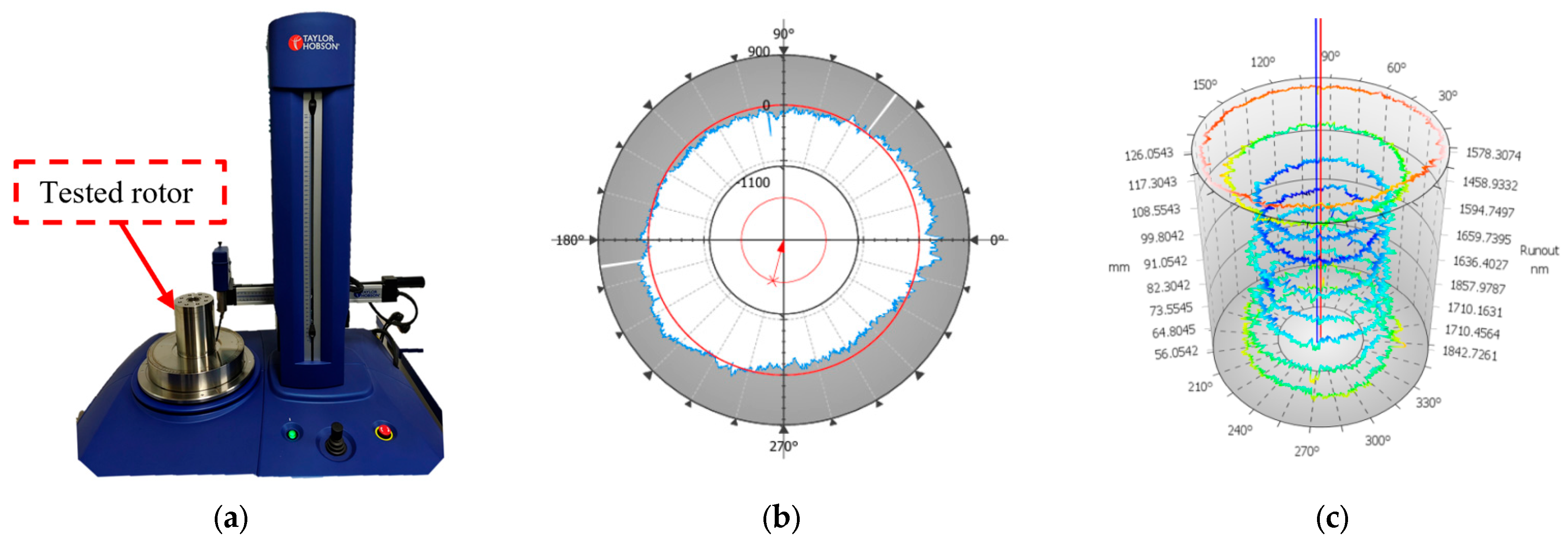
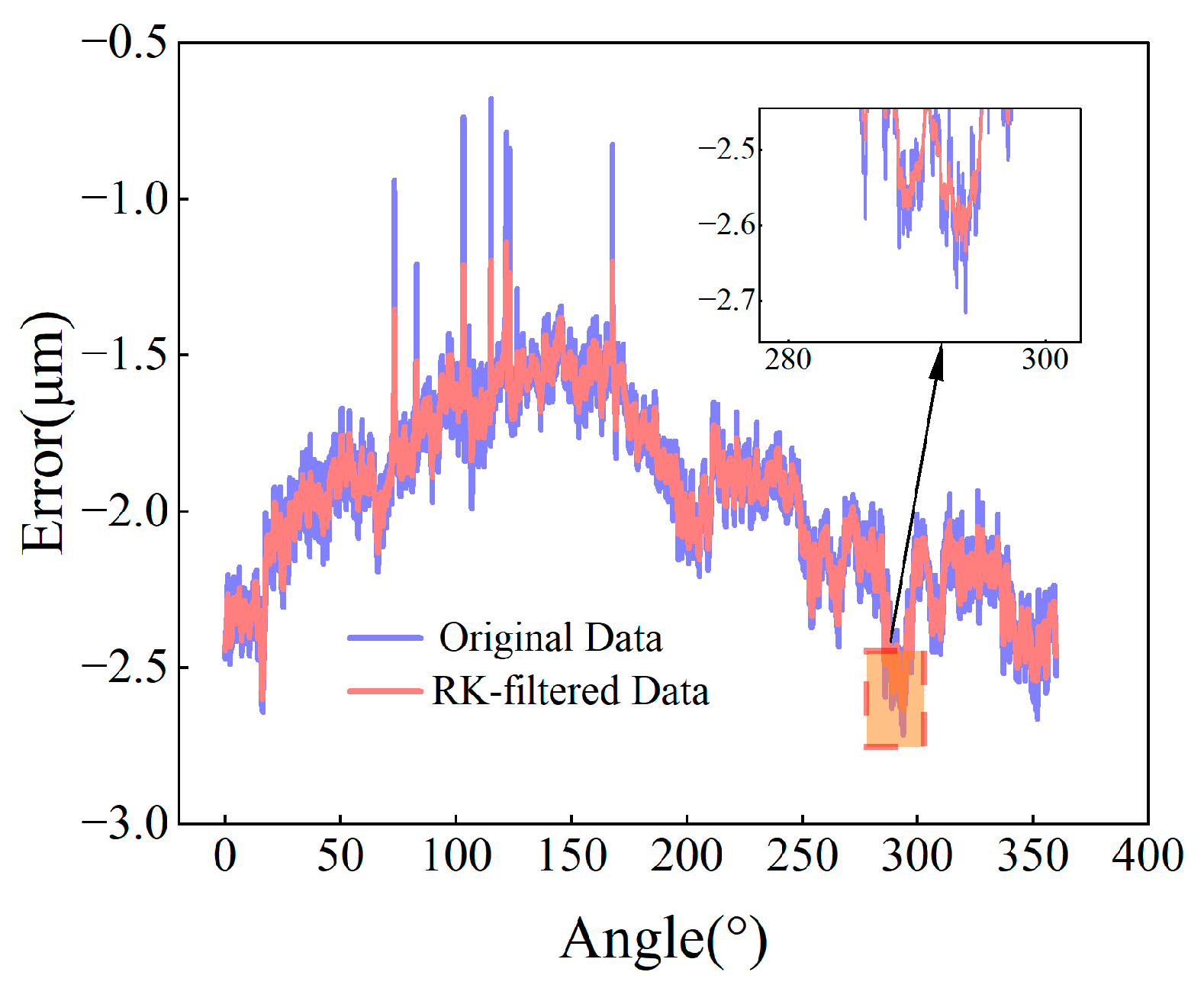
2.1. Equipment and Methods for Feature Extraction
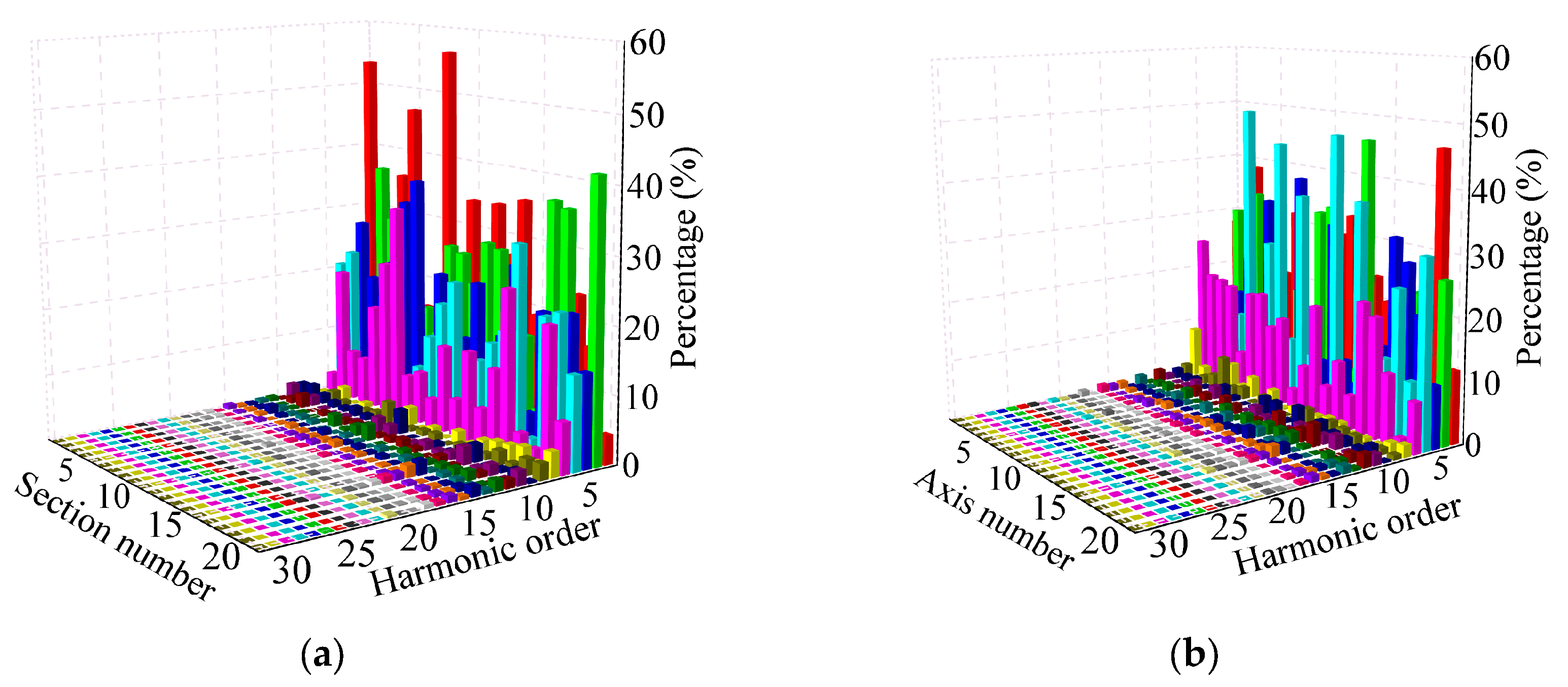
2.2. Harmonic Analysis of Rotor Surface Topography Characteristics
3. Establishment of Rotor Machining Error Model Based on Harmonic Analysis of Surface Topography
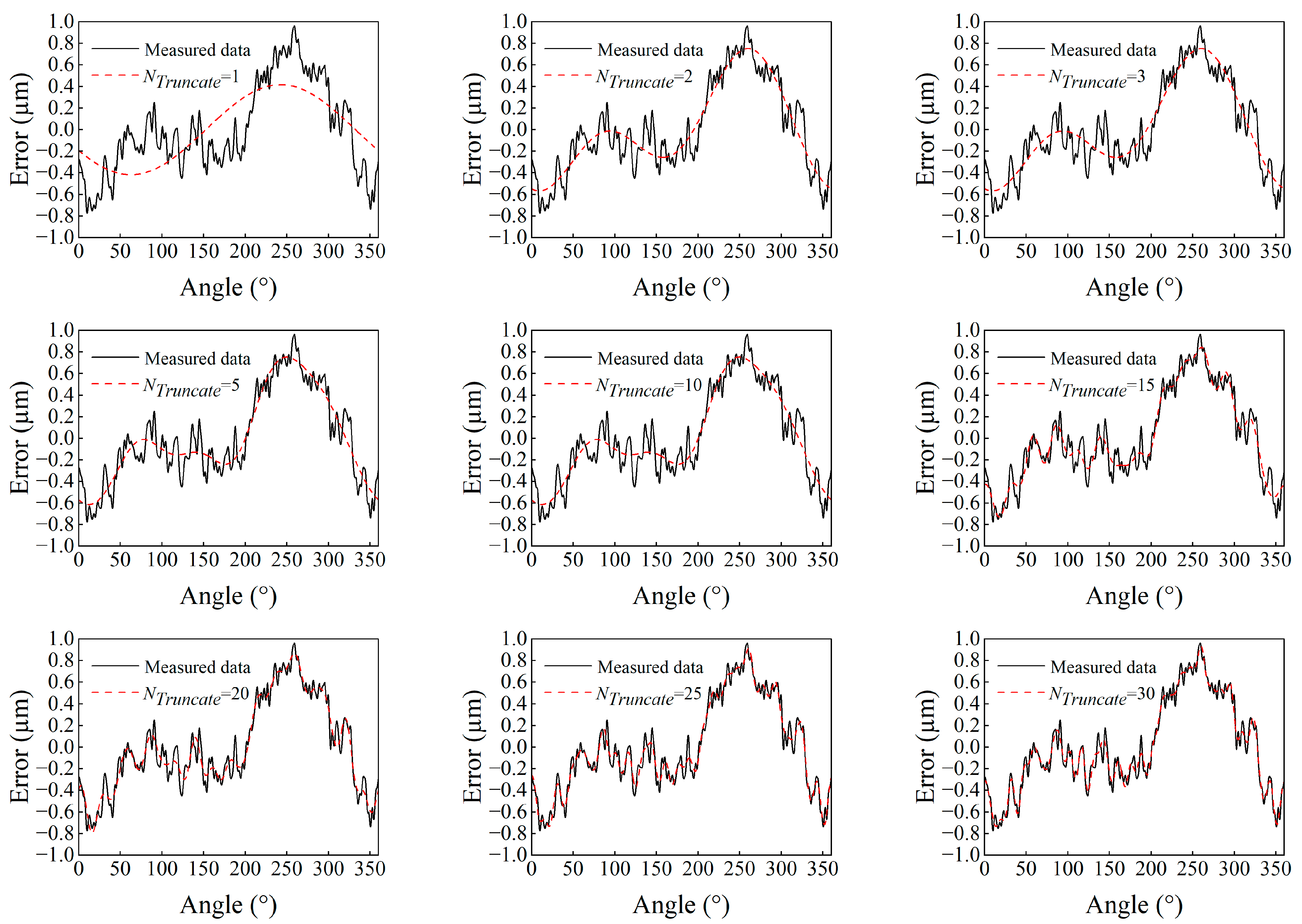
3.1. Rotor Topography Reconstruction Based on Harmonic Analysis
3.2. Boundary Characterization of Rotor Machining Errors Based on Harmonic Statistical Features
3.3. Construction of Rotor Machining Error Model with Random Characteristics
4. Calculation of Static Characteristics of Aerostatic Spindles Based on Rotor Machining Errors
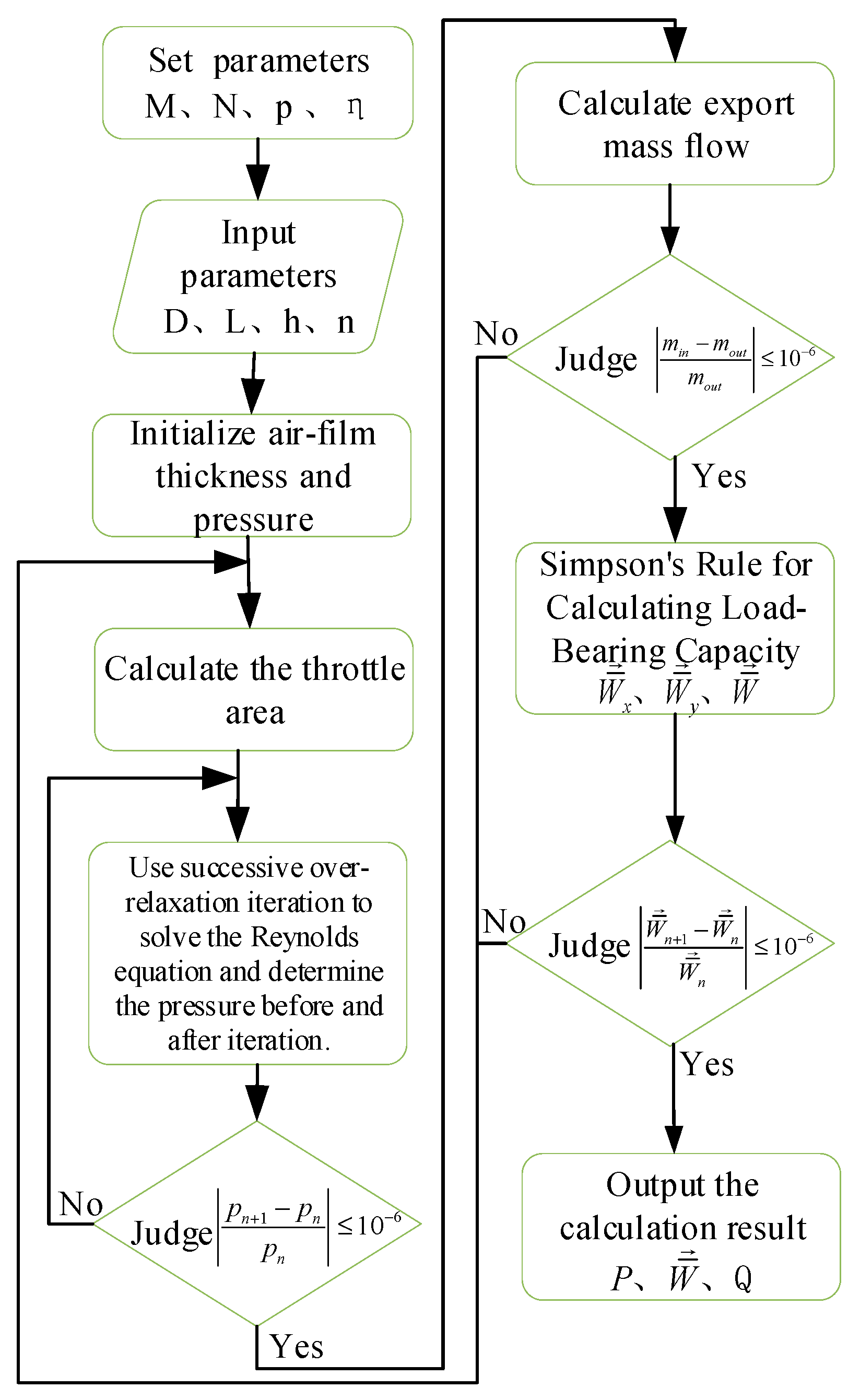
4.1. Numerical Solution of the Reynolds Equation for Orifice-Controlled Gas Bearings
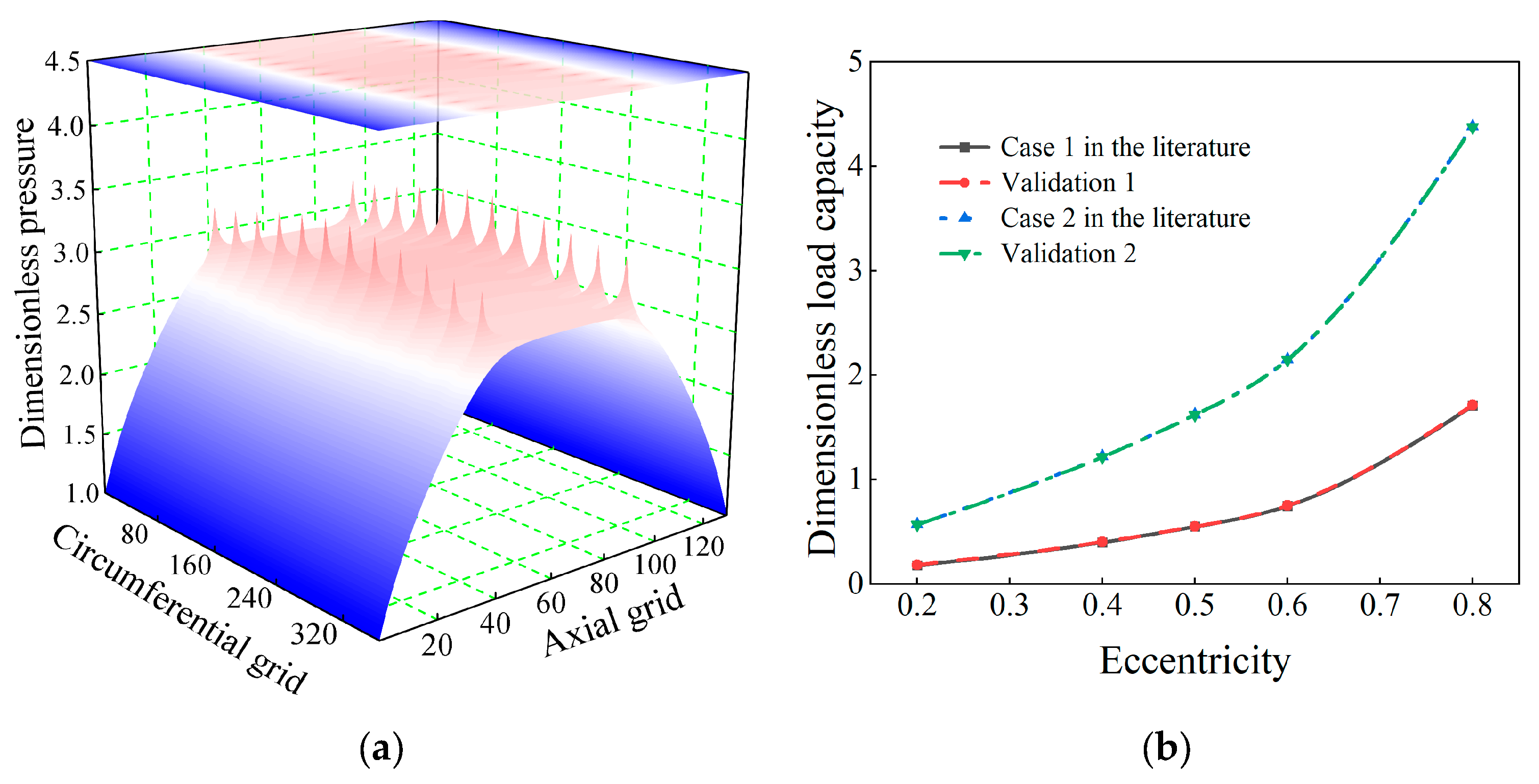
4.2. Simulation Parameter Setting and Model Validation
5. Results and Discussion
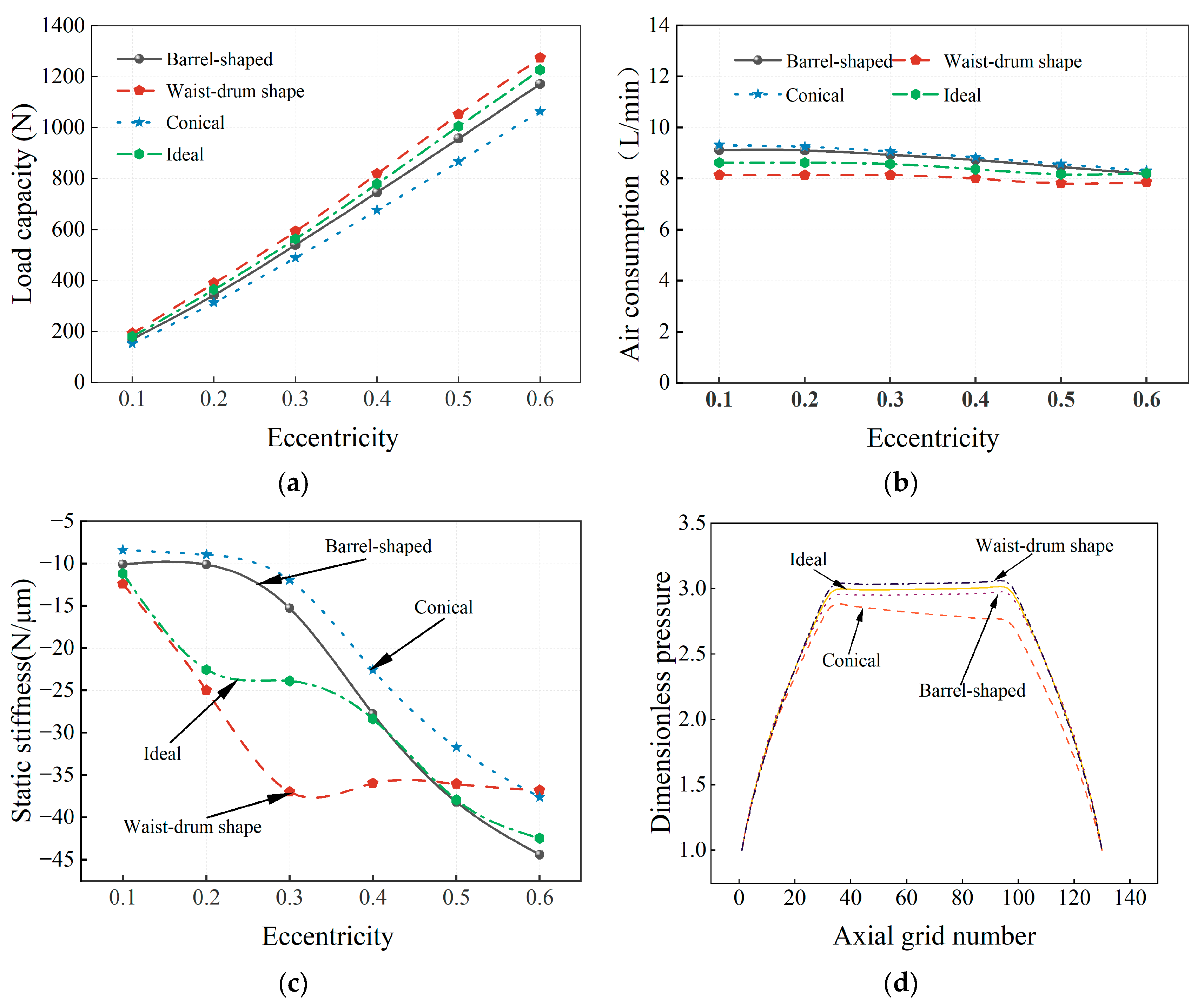
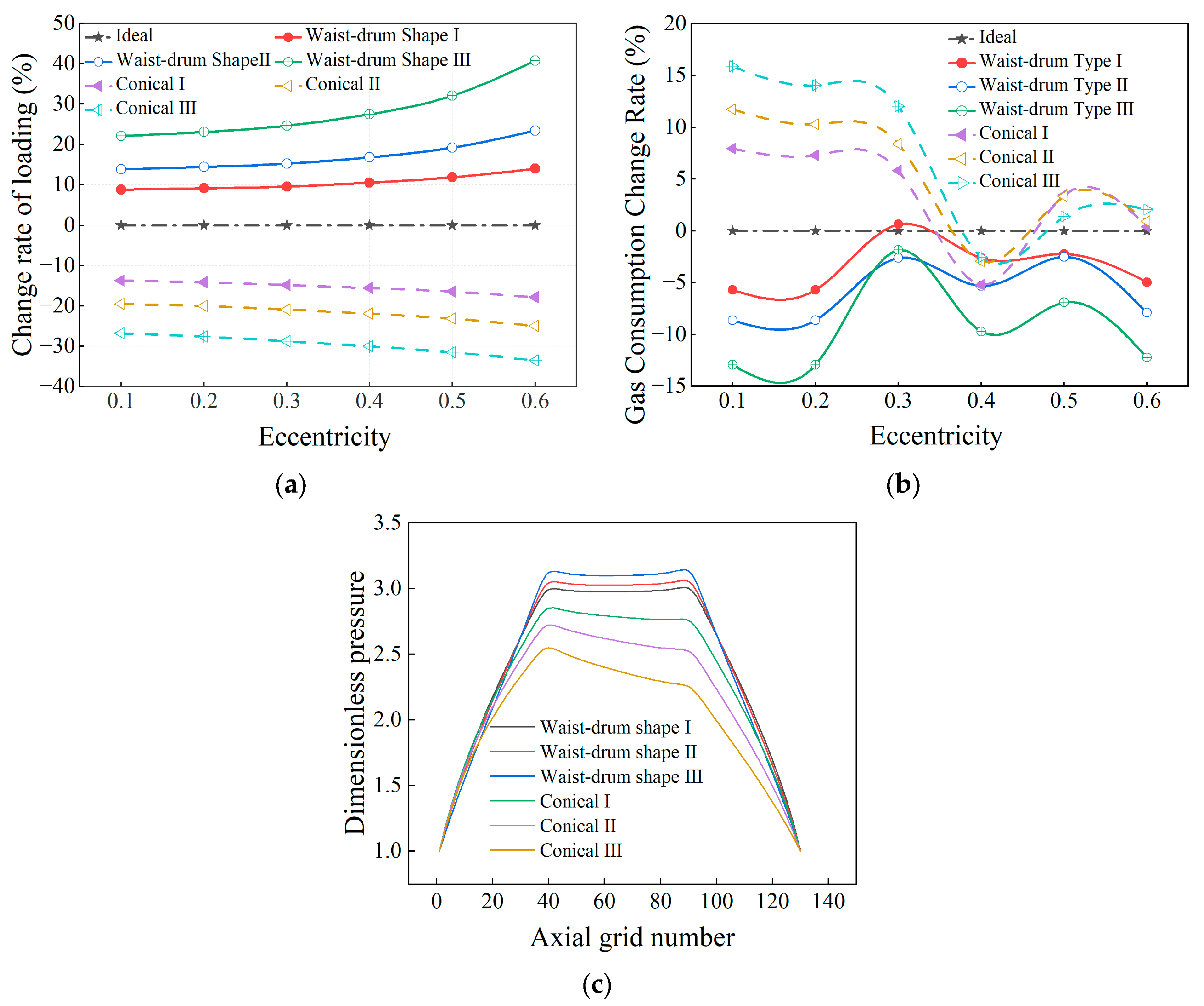
5.1. Influence of the Coupling Between Machining Errors and Eccentricity Ratio on the Static Performance of the Spindle
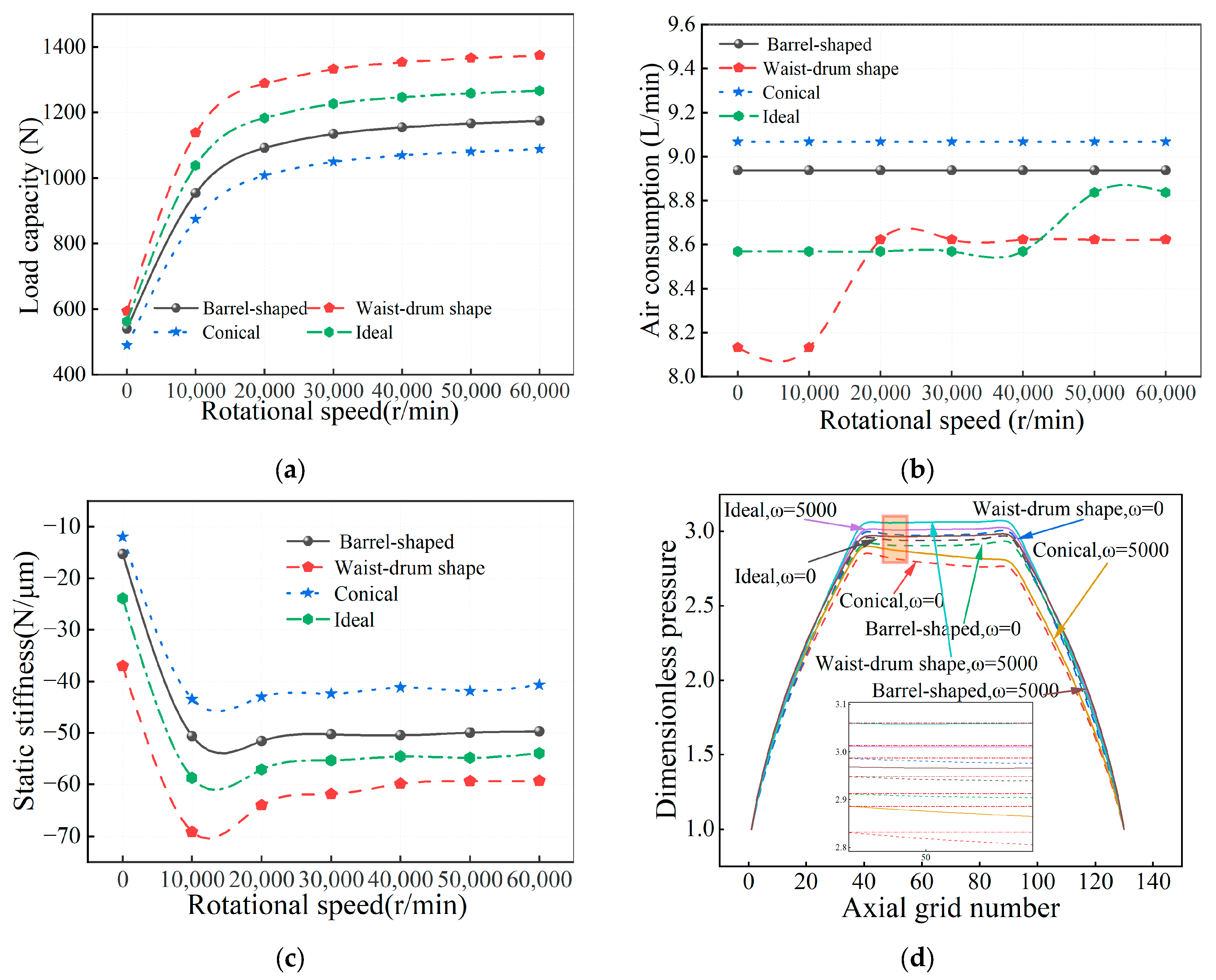
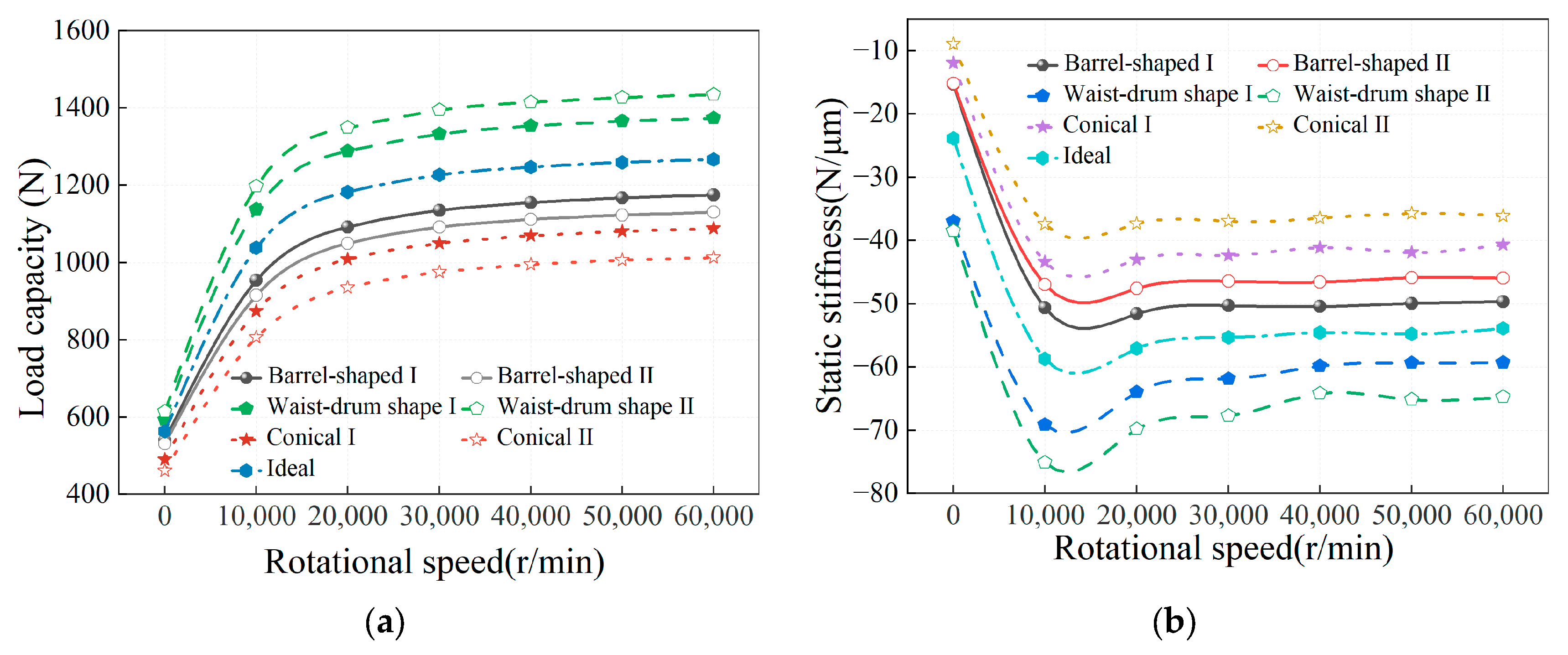
5.2. Influence of the Coupling Between Machining Errors and Rotational Speed on the Static Performance of the Spindle
5.3. Influence of the Coupling Between Machining Errors and Supply Parameters on the Static Performance of the Spindle
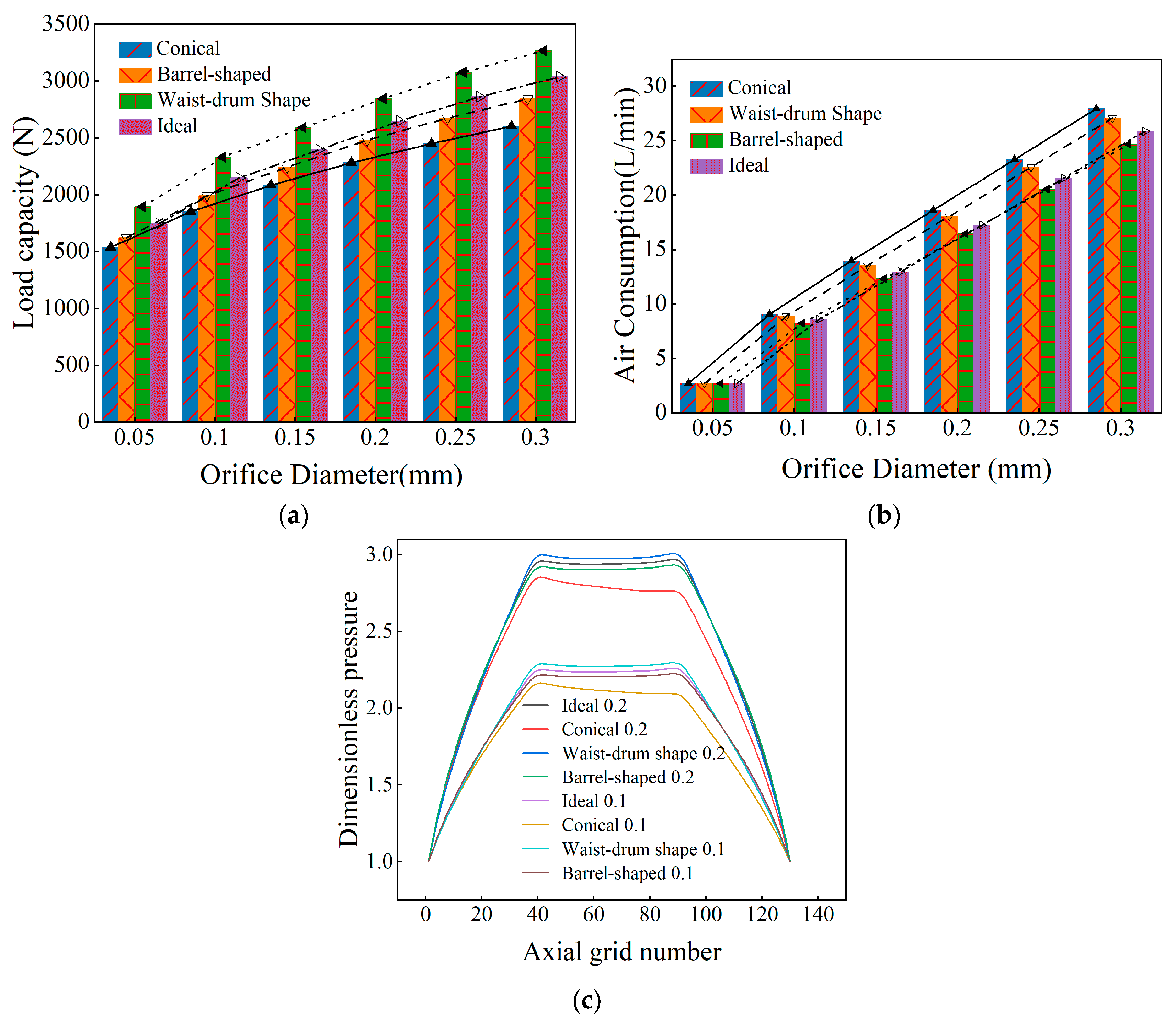
5.3.1. Influence of the Coupling Between Machining Errors and Orifice Diameter on the Static Performance of the Spindle
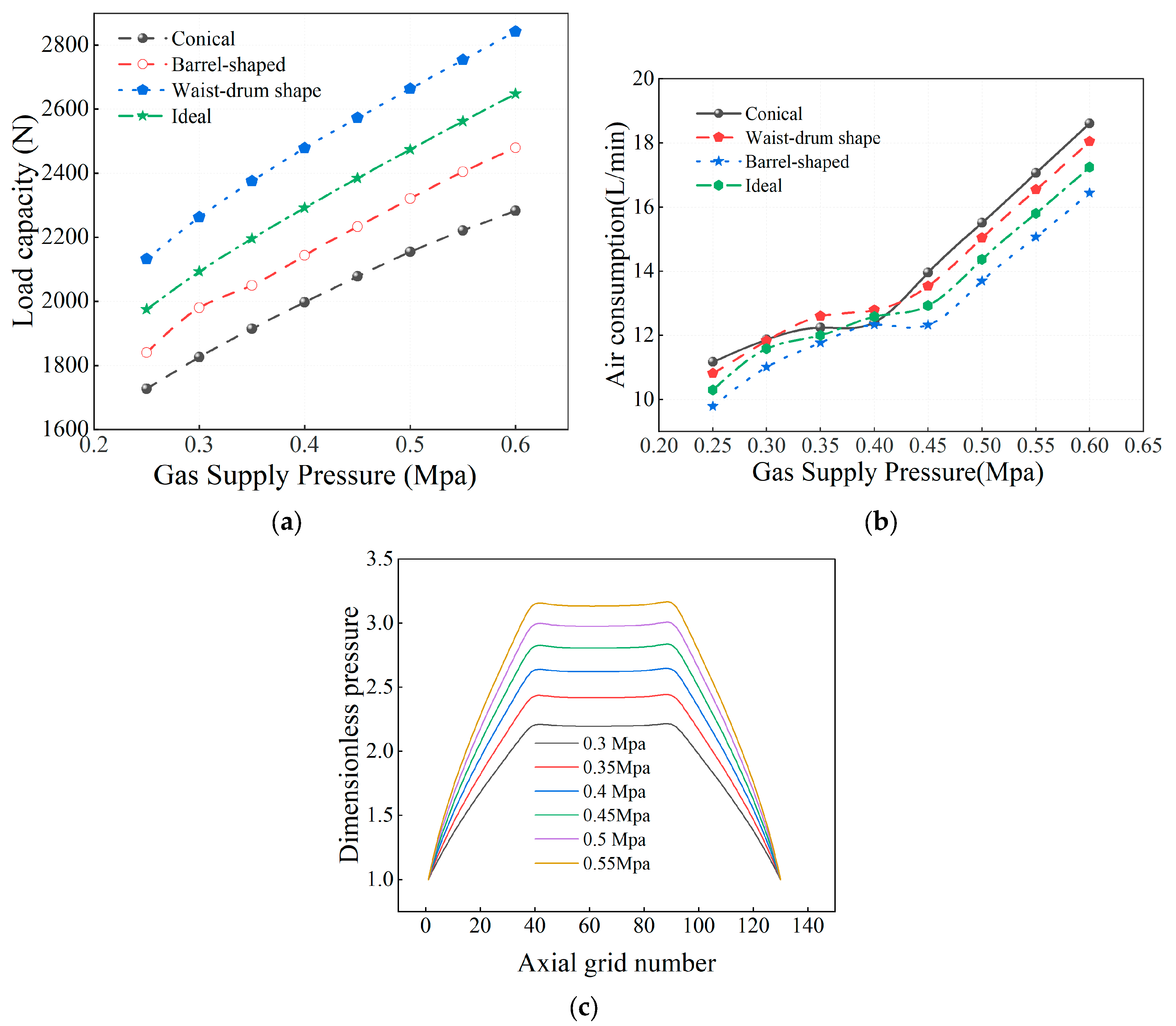
5.3.2. Influence of the Coupling Between Machining Errors and Supply Pressure on the Static Performance of the Spindle
5.4. Quantitative Analysis of the Attenuation of Spindle Static Performance by the Ratio of Error Amplitude to Gas Film Thickness
6. Conclusions
- (1)
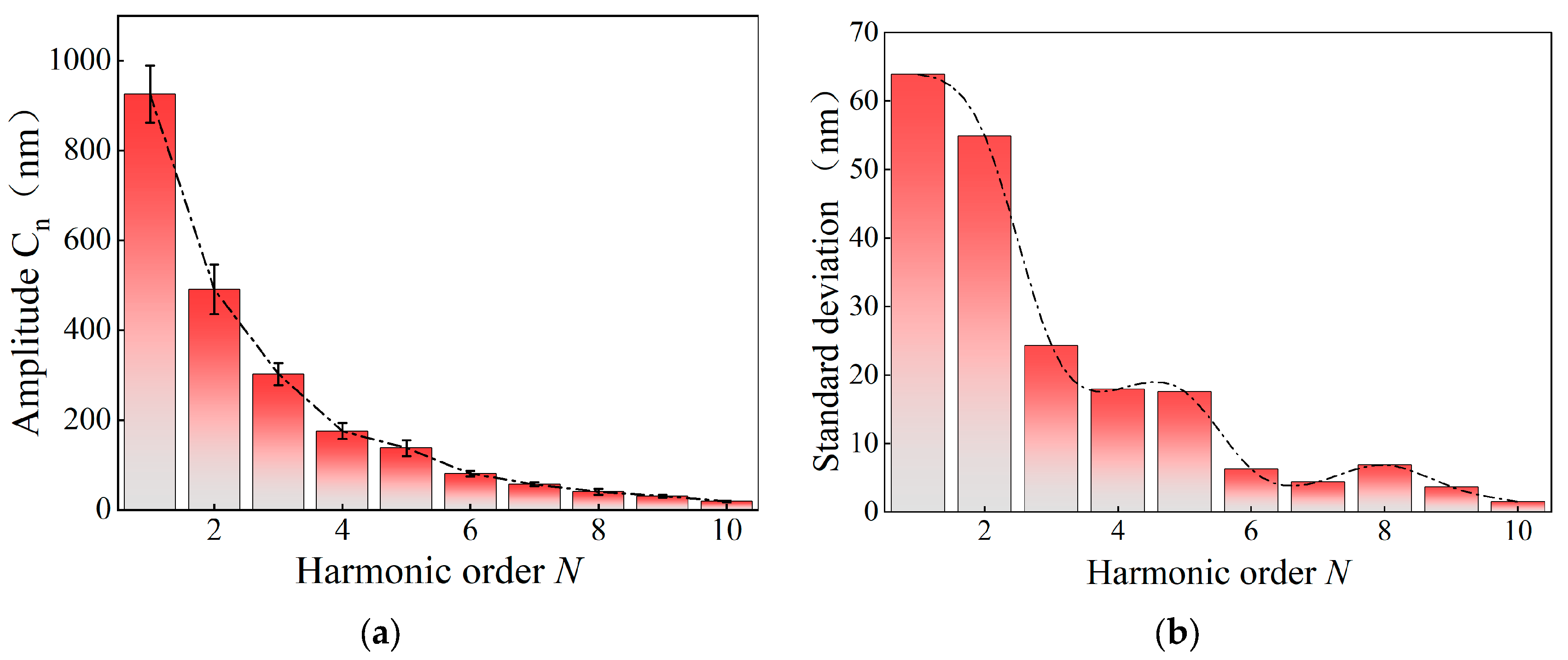
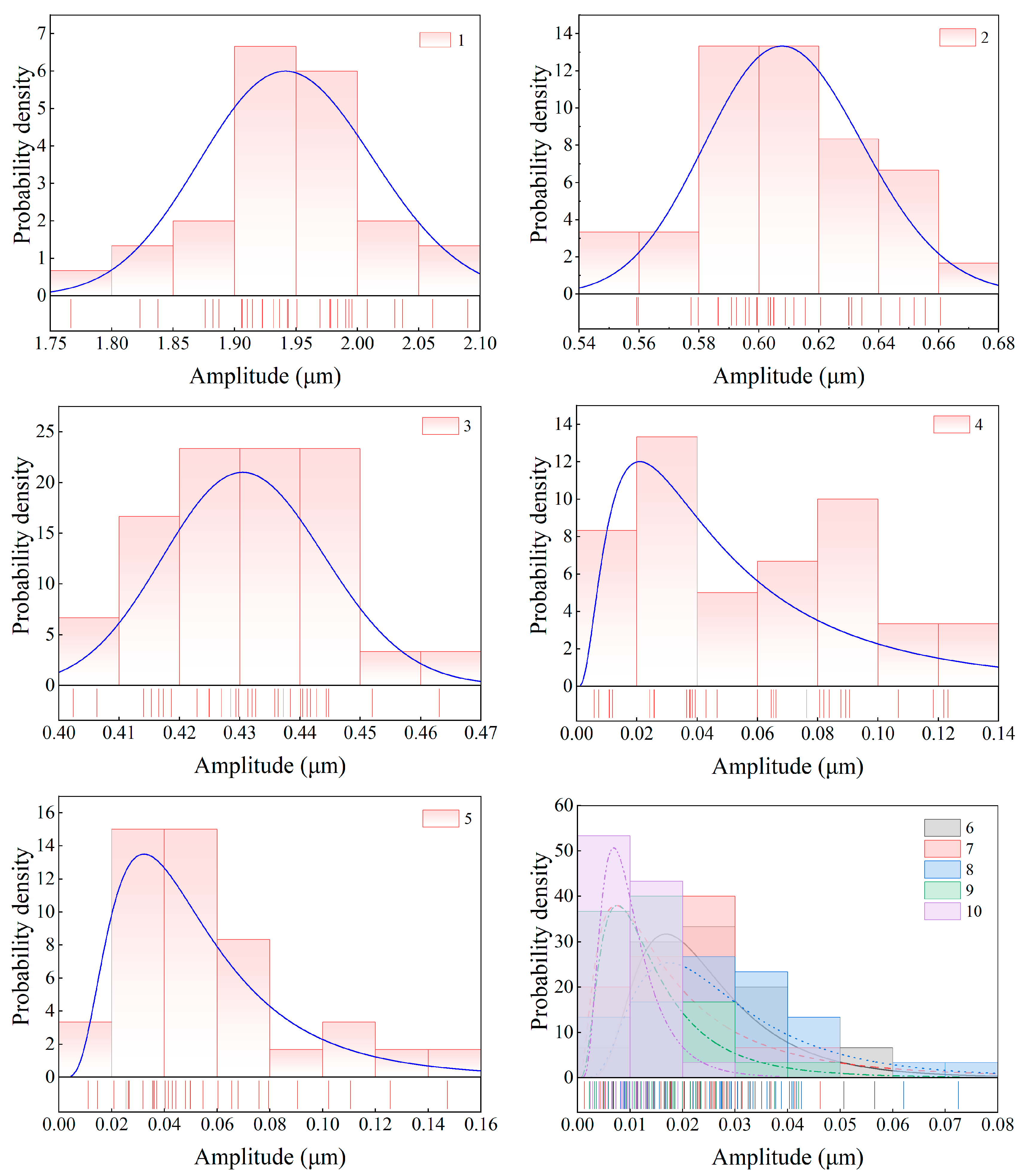
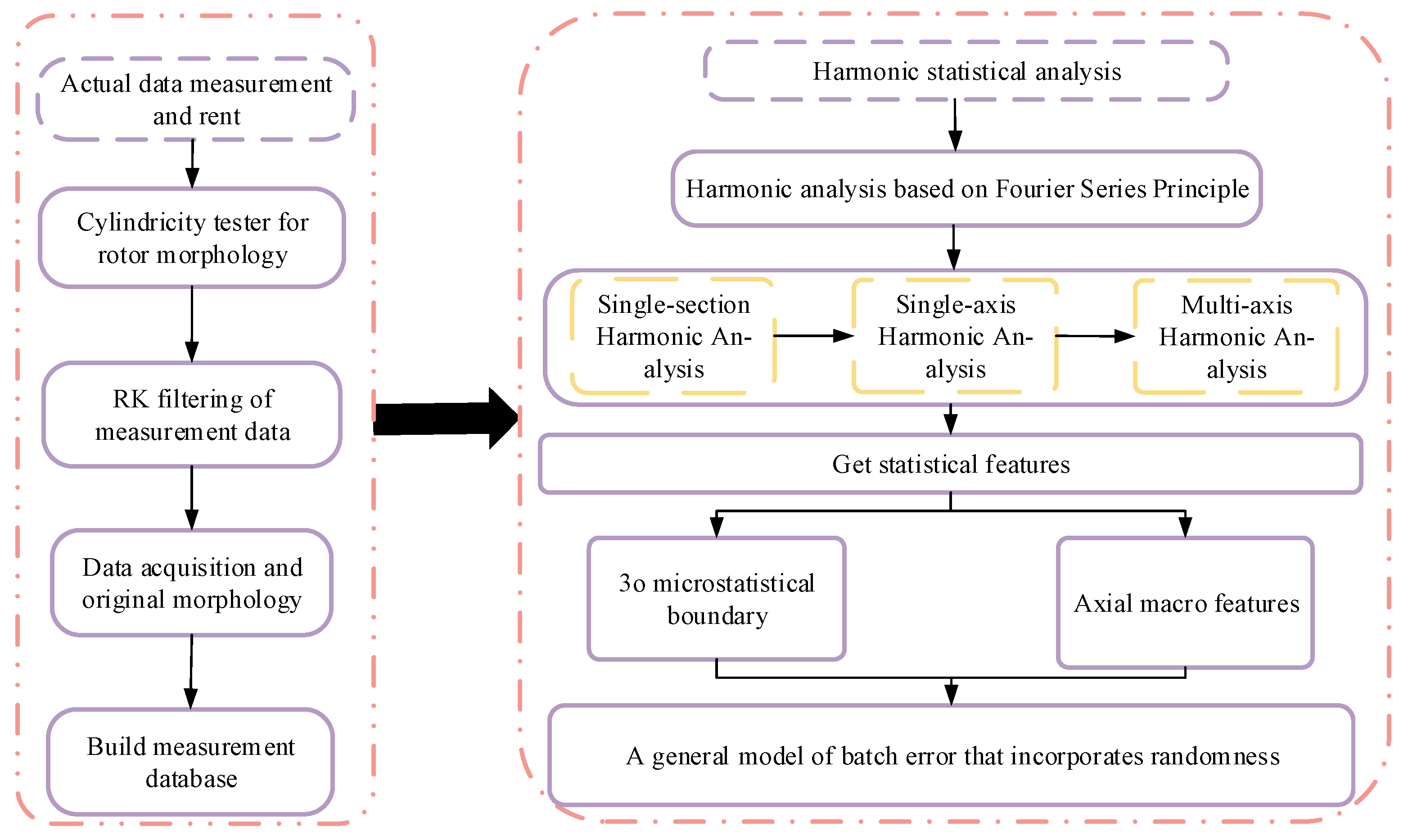
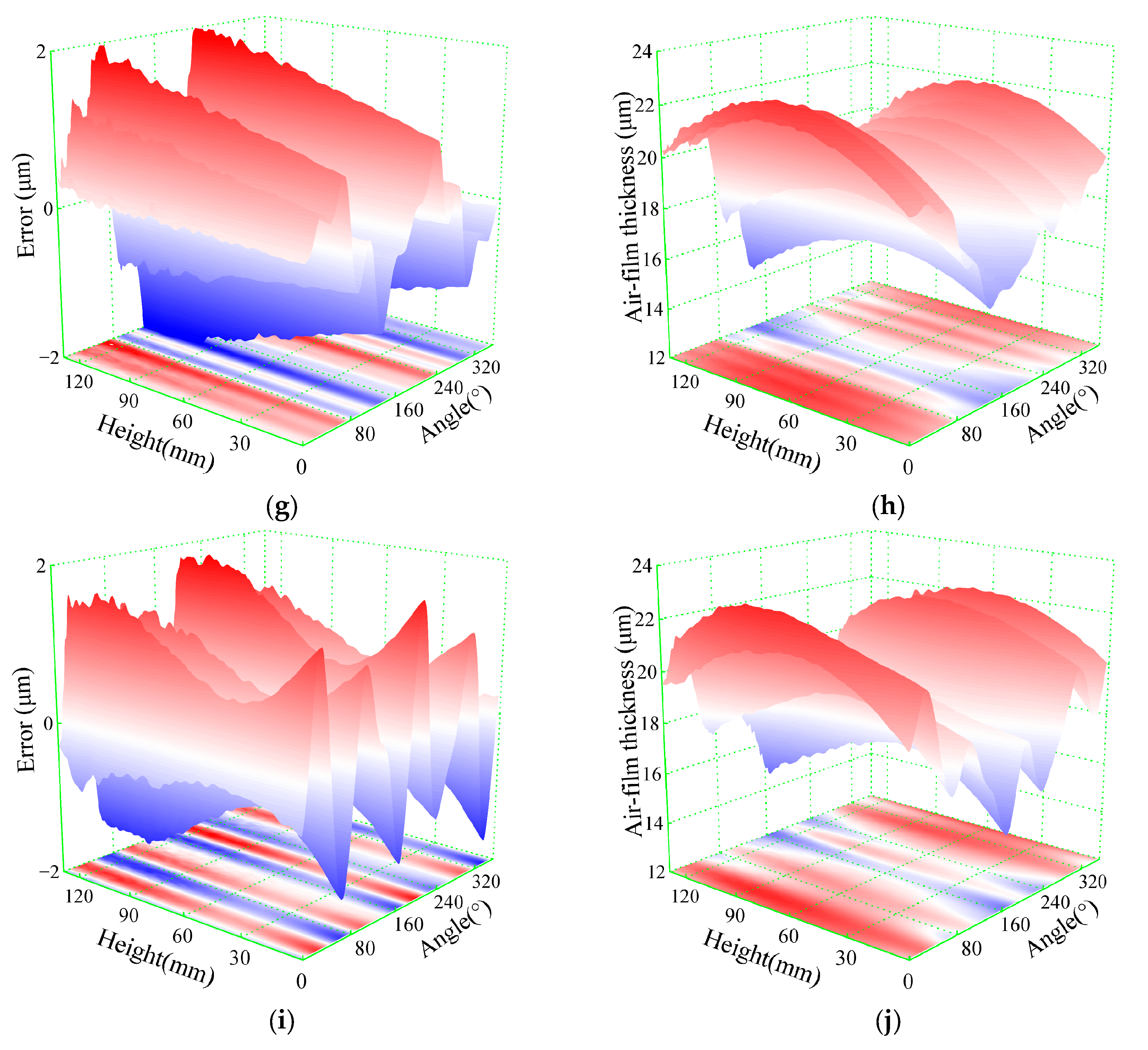
- Fourier harmonic decomposition of measured rotor topography revealed that low-order harmonics (1st–5th) dominate cylindricity errors, and their amplitudes follow a log-normal distribution. A 3σ statistical envelope was established to characterize manufacturing variability, providing a probabilistic basis for tolerance analysis and design.
- (2)
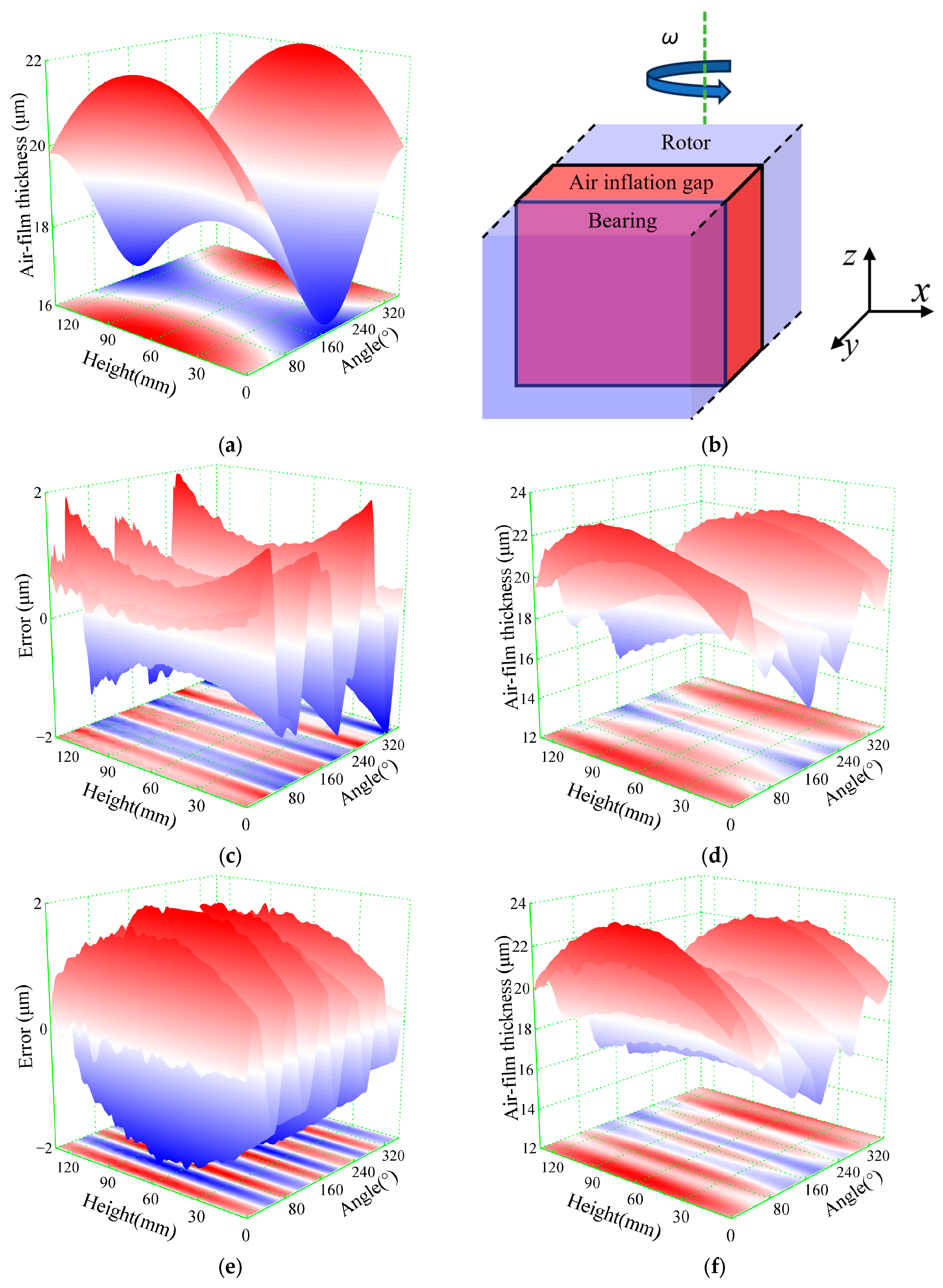
- A multi-scale rotor error model incorporating macroscopic errors and microscopic stochastic surface errors was developed and incorporated into a modified Reynolds equation. The results show that geometric errors significantly alter gas film thickness and pressure distribution, leading to changes in load capacity and static stiffness.
- (3)
- The eccentricity range of ε = 0.3–0.5 was identified as an error-sensitive operating regime in which machining errors have the strongest influence on spindle performance. At high rotational speeds, low-frequency harmonic errors are amplified by hydrodynamic effects, forming an error-excited speed window. Supply pressure and orifice diameter were found to strongly couple with geometric errors, affecting both performance and sensitivity.
- (4)
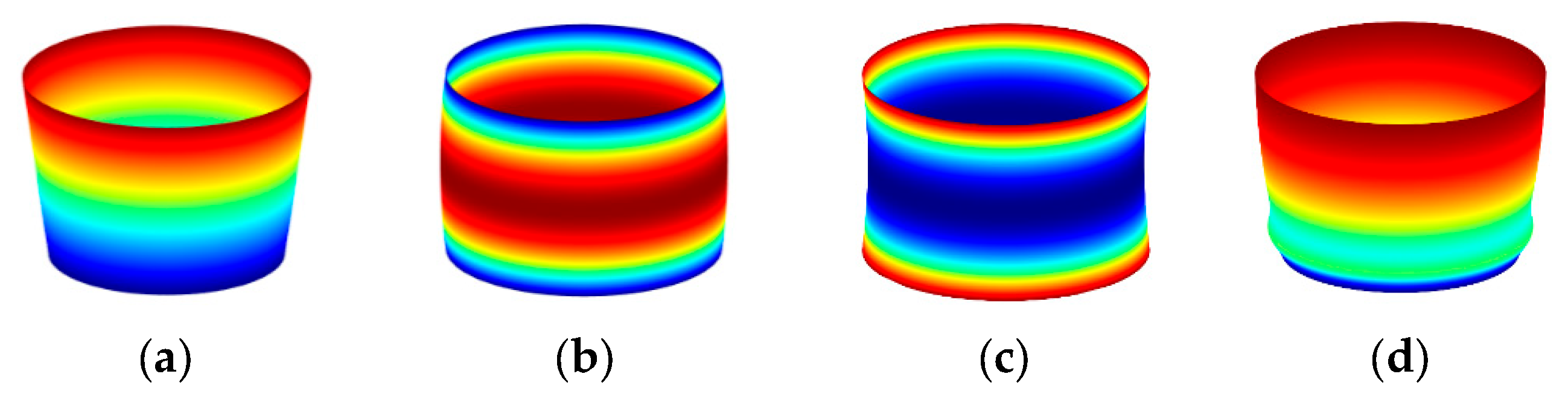
- The ratio of error amplitude to gas film clearance was identified as a key parameter governing performance degradation. Conical errors have the most detrimental impact, whereas waist-drum-shaped errors exhibit a self-stabilizing tendency under small deviations. These findings provide quantitative guidance for tolerance allocation, spindle design optimization, and operating parameter selection.
Author Contributions
Funding
Data Availability Statement
Conflicts of Interest
References
- Chen, D.; Du, X.; Fan, J.; Pan, R.; Sun, K.; Wang, H. A Study of the Influence of Speed Effect on the Kinematic Behavior of Aerostatic Spindles. Mech. Syst. Signal Process. 2025, 224, 112224. [Google Scholar] [CrossRef]
- Chen, D.; Li, S.; Fan, J. A Novel 5-DOFs Dynamic Model of Aerostatic Spindle Considering the Effect of Process Damping in Ultra-Precision Machining. J. Mech. Sci. Technol. 2022, 36, 4339–4352. [Google Scholar] [CrossRef]
- Wang, L.; Han, J.; Tang, Z.; Zhang, Y.; Wang, D.; Li, X. Geometric Accuracy Design of High Performance CNC Machine Tools: Modeling, Analysis, and Optimization. Chin. J. Mech. Eng. 2025, 38, 87. [Google Scholar] [CrossRef]
- Tao, H.; Liu, Y.; Zhao, D.; Lu, X. Effects of Wheel Spindle Vibration on Surface Formation in Wafer Self-Rotational Grinding Process. Int. J. Mech. Sci. 2022, 232, 107620. [Google Scholar] [CrossRef]
- Yin, T.; Du, H.; Zhang, G.; Hang, W.; To, S. Theoretical and Experimental Investigation into the Formation Mechanism of Surface Waviness in Ultra-Precision Grinding. Tribol. Int. 2023, 180, 108269. [Google Scholar] [CrossRef]
- Pande, S.S.; Somasundaram, S. Effect of Manufacturing Errors on the Performance of Aerostatic Journal Bearings. Wear 1981, 66, 145–156. [Google Scholar] [CrossRef]
- Lin, J.-R. Surface Roughness Effect on the Dynamic Stiffness and Damping Characteristics of Compensated Hydrostatic Thrust Bearings. Int. J. Mach. Tools Manuf. 2000, 40, 1671–1689. [Google Scholar] [CrossRef]
- Stout, K.J. The Effect of Manufacturing Variations on the Performance of Externally Pressurized Gas-Lubricated Journal Bearings. Proc. Inst. Mech. Eng. Part C Mech. Eng. Sci. 1985, 199, 299–309. [Google Scholar] [CrossRef]
- Yu, R.; Li, P.; Chen, W. Study of Grease Lubricated Journal Bearing with Partial Surface Texture. Ind. Lubr. Tribol. 2016, 68, 149–157. [Google Scholar] [CrossRef]
- Cappa, S.; Reynaerts, D.; Al-Bender, F. Reducing the Radial Error Motion of an Aerostatic Journal Bearing to a Nanometre Level: Theoretical Modelling. Tribol. Lett. 2014, 53, 27–41. [Google Scholar] [CrossRef]
- Zhuang, H.; Ding, J.; Chen, P.; Chang, Y.; Zeng, X.; Yang, H.; Liu, X.; Wei, W. Effect of Surface Waviness on the Performances of an Aerostatic Thrust Bearing with Orifice-Type Restrictor. Int. J. Precis. Eng. Manuf. 2021, 22, 1735–1759. [Google Scholar] [CrossRef]
- Zhang, J.; Yu, F.; Zou, D.; Ta, N.; Rao, Z. Comparison of the Characteristics of Aerostatic Journal Bearings Considering Misalignment under Pure-Static and Hybrid Condition. Proc. Inst. Mech. Eng. Part J J. Eng. Tribol. 2019, 233, 769–781. [Google Scholar] [CrossRef]
- Wang, X.; Xu, Q.; Huang, M.; Zhang, L.; Peng, Z. Effects of Journal Rotation and Surface Waviness on the Dynamic Performance of Aerostatic Journal Bearings. Tribol. Int. 2017, 112, 1–9. [Google Scholar] [CrossRef]
- Wang, X.; Zhou, L.; Huang, M.; Yue, X.; Xu, Q. Numerical Investigation of Journal Misalignment on the Static and Dynamic Characteristics of Aerostatic Journal Bearings. Measurement 2018, 128, 314–324. [Google Scholar] [CrossRef]
- Chen, C.-H.; Tsai, T.-H.; Yang, D.-W.; Kang, Y.; Chen, J.-H. The Comparison in Stability of Rotor-Aerostatic Bearing System Compensated by Orifices and Inherences. Tribol. Int. 2010, 43, 1360–1373. [Google Scholar] [CrossRef]
- Sun, F.; Zhang, X.; Wang, X.; Su, Z.; Wang, D. Effects of Shaft Shape Errors on the Dynamic Characteristics of a Rotor-Bearing System. J. Tribol. 2019, 141, 101701. [Google Scholar] [CrossRef]
- Chen, P.; Ding, J.; Zhuang, H.; Chang, Y. A Novel Method for Studying Fluid-Solid Interaction Problems of the Rotor System in Air Bearings with Manufacturing Errors. Mech. Syst. Signal Process. 2023, 202, 110709. [Google Scholar] [CrossRef]
- Michalec, M.; Polnický, V.; Foltýn, J.; Svoboda, P.; Šperka, P.; Hurník, J. The Prediction of Large-Scale Hydrostatic Bearing Pad Misalignment Error and Its Compensation Using Compliant Support. Precis. Eng. 2022, 75, 67–79. [Google Scholar] [CrossRef]
- Lee, S.M.; Lee, D.W.; Ha, Y.H.; Lee, S.J.; Hwang, J.H.; Choi, Y.H. A Study on the Influence of Waviness Error to a Hydrostatic Bearing for a Crankshaft Pin Turner. Tribol. Trans. 2013, 56, 1077–1086. [Google Scholar] [CrossRef]
- Kim, M.; Lee, S.M.; Lee, D.W.; Park, S.; Kim, S. Tribological Effects of a Rough Surface Bearing Using an Average Flow Analysis with a Contact Model of Asperities. Int. J. Precis. Eng. Manuf. 2017, 18, 99–107. [Google Scholar] [CrossRef]
- Ning, Y.; Li, Y.; Zhang, D. The Effect of Manufacturing Errors on the Performance of a Gas-Dynamic Bearing Gyroscope. Machines 2022, 10, 1010. [Google Scholar] [CrossRef]
- Mallya, R.; Shenoy, S.B.; Pai, R. Static Characteristics of Misaligned Multiple Axial Groove Water-Lubricated Bearing in the Turbulent Regime. Proc. Inst. Mech. Eng. Part J J. Eng. Tribol. 2017, 231, 385–398. [Google Scholar] [CrossRef]
- Sharma, S.C.; Phalle, V.M.; Jain, S.C. Combined Influence of Wear and Misalignment of Journal on the Performance Analysis of Three-Lobe Three-Pocket Hybrid Journal Bearing Compensated With Capillary Restrictor. J. Tribol. 2012, 134, 011703. [Google Scholar] [CrossRef]
- Ronsin, S.; Biermé, H.; Moisan, L. The Billard Theorem for Multiple Random Fourier Series. J. Fourier Anal. Appl. 2017, 23, 207–228. [Google Scholar] [CrossRef]
- Denis, S.A.; Samuel, G.L. Harmonic-Analysis-Based Method for Separation of Form Error during Evaluation of High-Speed Spindle Radial Errors. Proc. Inst. Mech. Eng. Part B J. Eng. Manuf. 2012, 226, 837–852. [Google Scholar] [CrossRef]
- Yu, H.; Fan, G.; Zhang, G.; Wang, W.; Li, Y.; Zhang, S.; Li, B. Regression Model of Rotor Shape Errors Based on the ISSA-BP Neural Network. J. Mech. Sci. Technol. 2024, 38, 1925–1938. [Google Scholar] [CrossRef]
- Zhang, S.J.; To, S.; Cheung, C.F.; Wang, H.T. Dynamic Characteristics of an Aerostatic Bearing Spindle and Its Influence on Surface Topography in Ultra-Precision Diamond Turning. Int. J. Mach. Tools Manuf. 2012, 62, 1–12. [Google Scholar] [CrossRef]
- Zhang, Z.; Jiang, F.; Luo, M.; Wu, B.; Zhang, D.; Tang, K. Geometric Error Measuring, Modeling, and Compensation for CNC Machine Tools: A Review. Chin. J. Aeronaut. 2024, 37, 163–198. [Google Scholar] [CrossRef]
- Wang, W.; Liu, M.; Yu, H.; Li, B.; Zhang, G. Analysis of the Dynamic Response of Aerostatic Bearings Based on the Dynamic Equilibrium Position Method. Proc. Inst. Mech. Eng. Part J J. Eng. Tribol. 2025, 239, 861–874. [Google Scholar] [CrossRef]
- Yu, L.; Qi, S.M.; Geng, H.P. Compressible Gas Lubrication and Elastic Foil Gas Bearing Technology; Science Press: Beijing, China, 2011. [Google Scholar]



| Parameter | Value |
|---|---|
| Position resolution | 0.02° |
| Positioning accuracy | ±0.2° |
| Cylindricity measurement range | 50~500 mm |
| Minimum positioning angle | 0.1° |
| Radial error | ±(0.02 + 0.0003 μm/mm) × R μm |
| Axial error | ±(0.02 + 0.0003 μm/mm) × H μm |
| NTruncate | RMSN (nm) | PVN (nm) | NTruncate | RMSN (nm) | PVN (nm) |
|---|---|---|---|---|---|
| 1 | 586.1 | 2450.8 | 10 | 235.84 | 1265.8 |
| 2 | 289.98 | 1483.6 | 15 | 194.49 | 927.14 |
| 3 | 289.98 | 1483.7 | 20 | 175.72 | 1069.3 |
| 5 | 266.35 | 1283.8 | 30 | 124.2 | 790.97 |
| Harmonic Order N | Average Amplitude (nm) | Standard Deviation (nm) | Engineering Relevance |
|---|---|---|---|
| 1 | 925.14 | 63.936 | Dominated by eccentricity error |
| 2 | 491.54 | 54.949 | Ellipticity |
| 3 | 302.57 | 24.284 | Triangular roundness |
| 4 | 176.06 | 17.958 | Quadrilateral roundness |
| 5 | 137.57 | 17.626 | Process system vibration |
| 6 | 80.891 | 6.2839 | Microscopic machining textures and high-frequency characteristics of machine tool systems |
| 7 | 57.388 | 4.435 | |
| 8 | 40.318 | 6.874 | |
| 9 | 30.51 | 3.6627 | |
| 10 | 19.06 | 1.5499 |
| Harmonic Order | ||||||
|---|---|---|---|---|---|---|
| 1 | 0.8045 | 0.0835 | 1.7692 | 0.0686 | 1.9452 | 0.0703 |
| 2 | 0.4499 | 0.0274 | 0.4103 | 0.0251 | 0.6094 | 0.0265 |
| 3 | 0.2519 | 0.0147 | 0.3945 | 0.0131 | 0.4311 | 0.0134 |
| 4 | 0.0103 | 0.0491 | 0.0111 | 0.0449 | 0.0573 | 0.0357 |
| 5 | 0.0171 | 0.0397 | −0.0024 | 0.0480 | 0.0547 | 0.0330 |
| 6 | −0.0020 | 0.0169 | 0.0027 | 0.0219 | 0.0248 | 0.0119 |
| 7 | −0.006 | 0.0139 | −0.002 | 0.0188 | 0.0201 | 0.0115 |
| 8 | 0.0023 | 0.0263 | 0.003 | 0.0195 | 0.0288 | 0.0151 |
| 9 | −0.0029 | 0.0113 | −0.0031 | 0.0134 | 0.0151 | 0.0094 |
| 10 | 0.0007 | 0.0080 | −0.0091 | 0.0084 | 0.0104 | 0.0053 |
| Name | Value | Name | Value |
|---|---|---|---|
| D | 100 mm | Ps | 0.5 Mpa |
| L | 130 mm | Num_O | 2 |
| h | 20 μm | Num_Single_O | 12 |
| d0 | 0.2 mm | OL | 0.5 mm |
| Error amplitude/air-film gap (%) | 8 | 12.15 | 18.2 | |
| waist-drum shape error (%) | Load | 8.7 | 13.9 | 22.1 |
| Air consumption | 5.7 | 8.6 | 12.9 | |
| Conical error (%) | Load | 15.3 | 21.5 | 28.7 |
| Air consumption | 7.9 | 11.73 | 15.9 | |
Disclaimer/Publisher’s Note: The statements, opinions and data contained in all publications are solely those of the individual author(s) and contributor(s) and not of MDPI and/or the editor(s). MDPI and/or the editor(s) disclaim responsibility for any injury to people or property resulting from any ideas, methods, instructions or products referred to in the content. |
© 2026 by the authors. Licensee MDPI, Basel, Switzerland. This article is an open access article distributed under the terms and conditions of the Creative Commons Attribution (CC BY) license.
Share and Cite
Wang, W.; Hou, L.; Wang, G.; Zhang, G.; Yu, H. Multi-Scale Modeling of Aerostatic Spindles Based on Shape Error Harmonic Analysis and Static Characteristic Evaluation. Lubricants 2026, 14, 105. https://doi.org/10.3390/lubricants14030105
Wang W, Hou L, Wang G, Zhang G, Yu H. Multi-Scale Modeling of Aerostatic Spindles Based on Shape Error Harmonic Analysis and Static Characteristic Evaluation. Lubricants. 2026; 14(3):105. https://doi.org/10.3390/lubricants14030105
Chicago/Turabian StyleWang, Wenbo, Longhang Hou, Guangzhou Wang, Guoqing Zhang, and Hechun Yu. 2026. "Multi-Scale Modeling of Aerostatic Spindles Based on Shape Error Harmonic Analysis and Static Characteristic Evaluation" Lubricants 14, no. 3: 105. https://doi.org/10.3390/lubricants14030105
APA StyleWang, W., Hou, L., Wang, G., Zhang, G., & Yu, H. (2026). Multi-Scale Modeling of Aerostatic Spindles Based on Shape Error Harmonic Analysis and Static Characteristic Evaluation. Lubricants, 14(3), 105. https://doi.org/10.3390/lubricants14030105