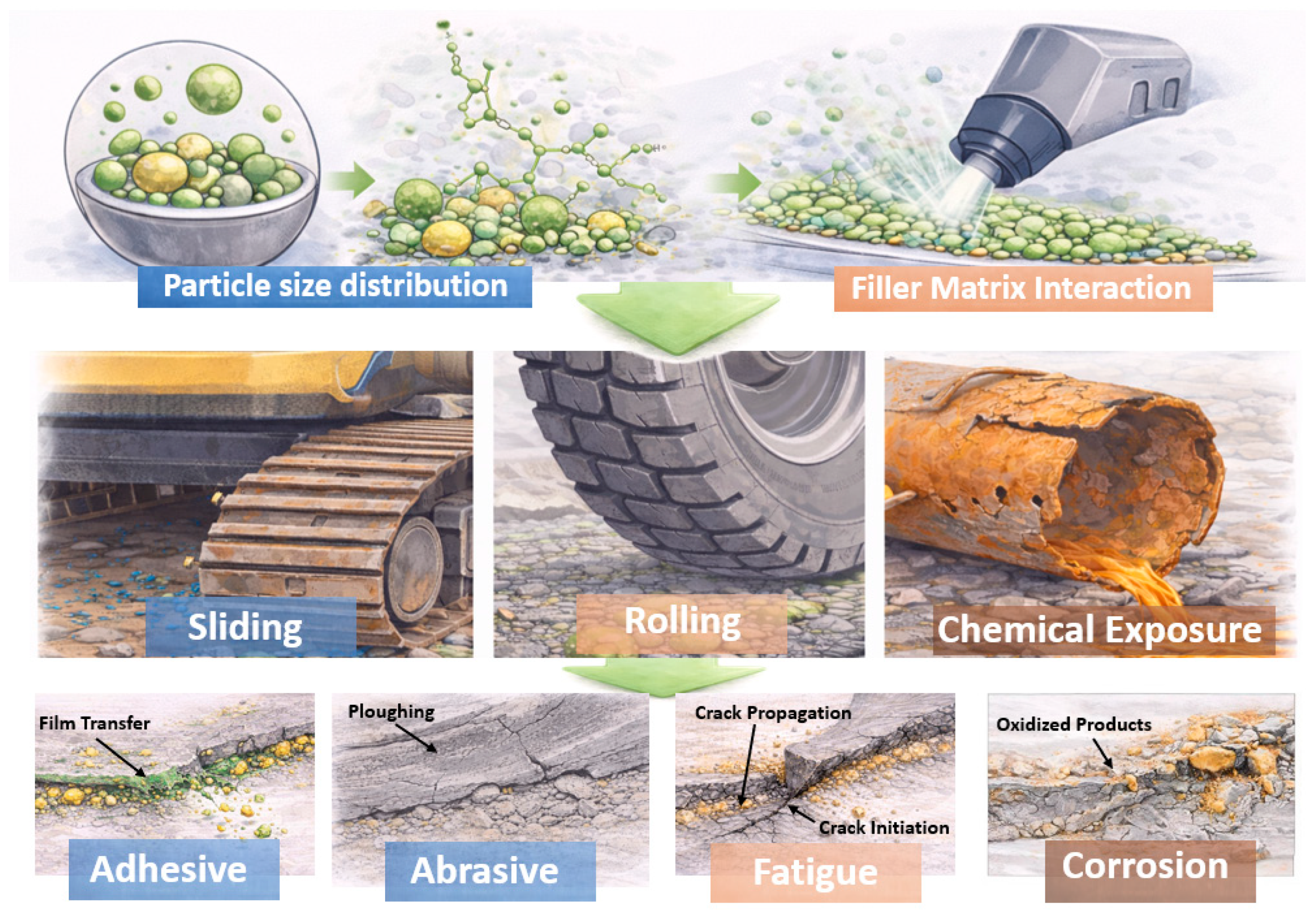
Tribological Applications of Recycled and Waste Materials: A Review of Recent Advances and Future Directions




Abstract
1. Introduction
2. Fundamentals of Recycled Material Integration
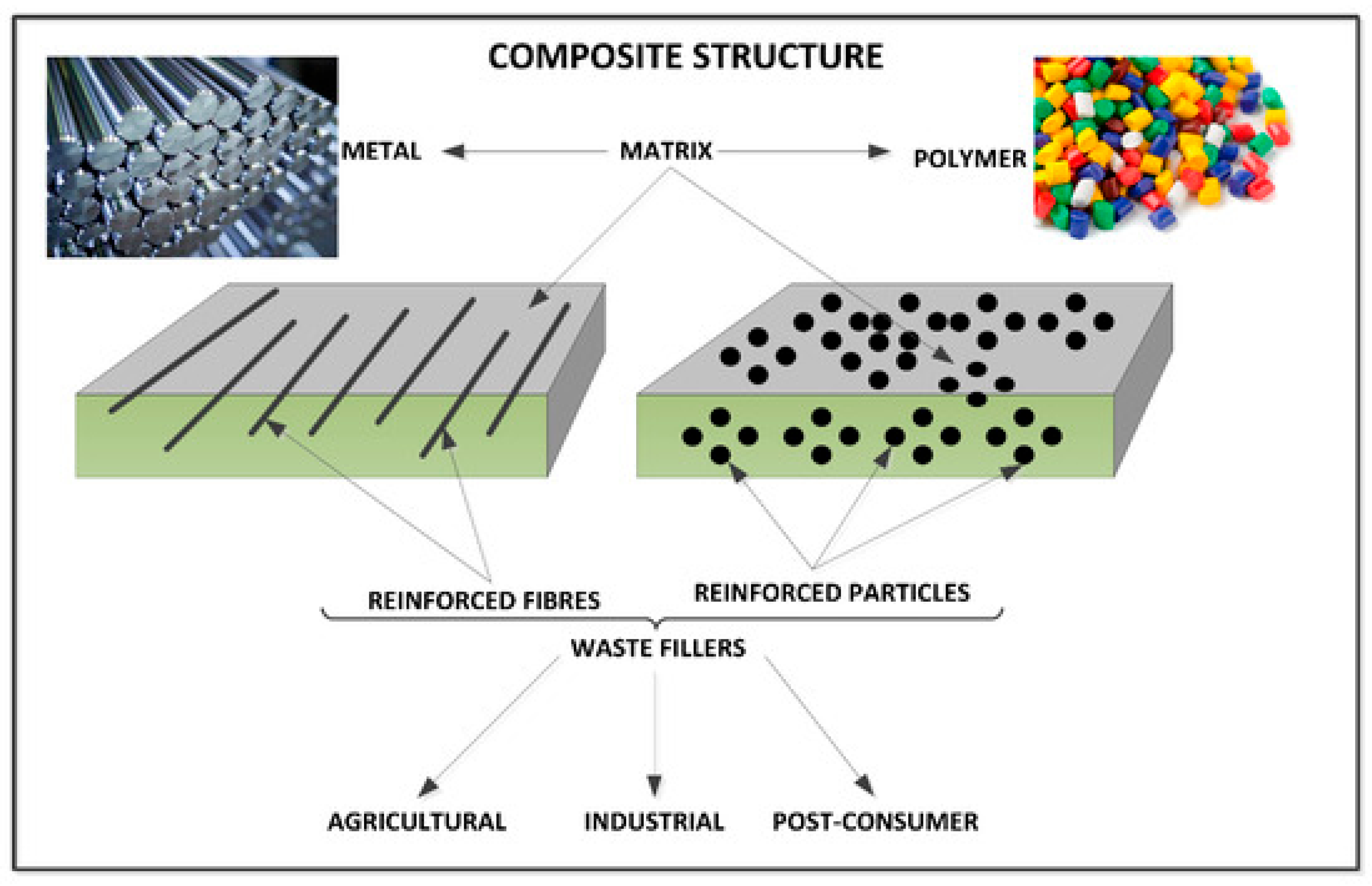
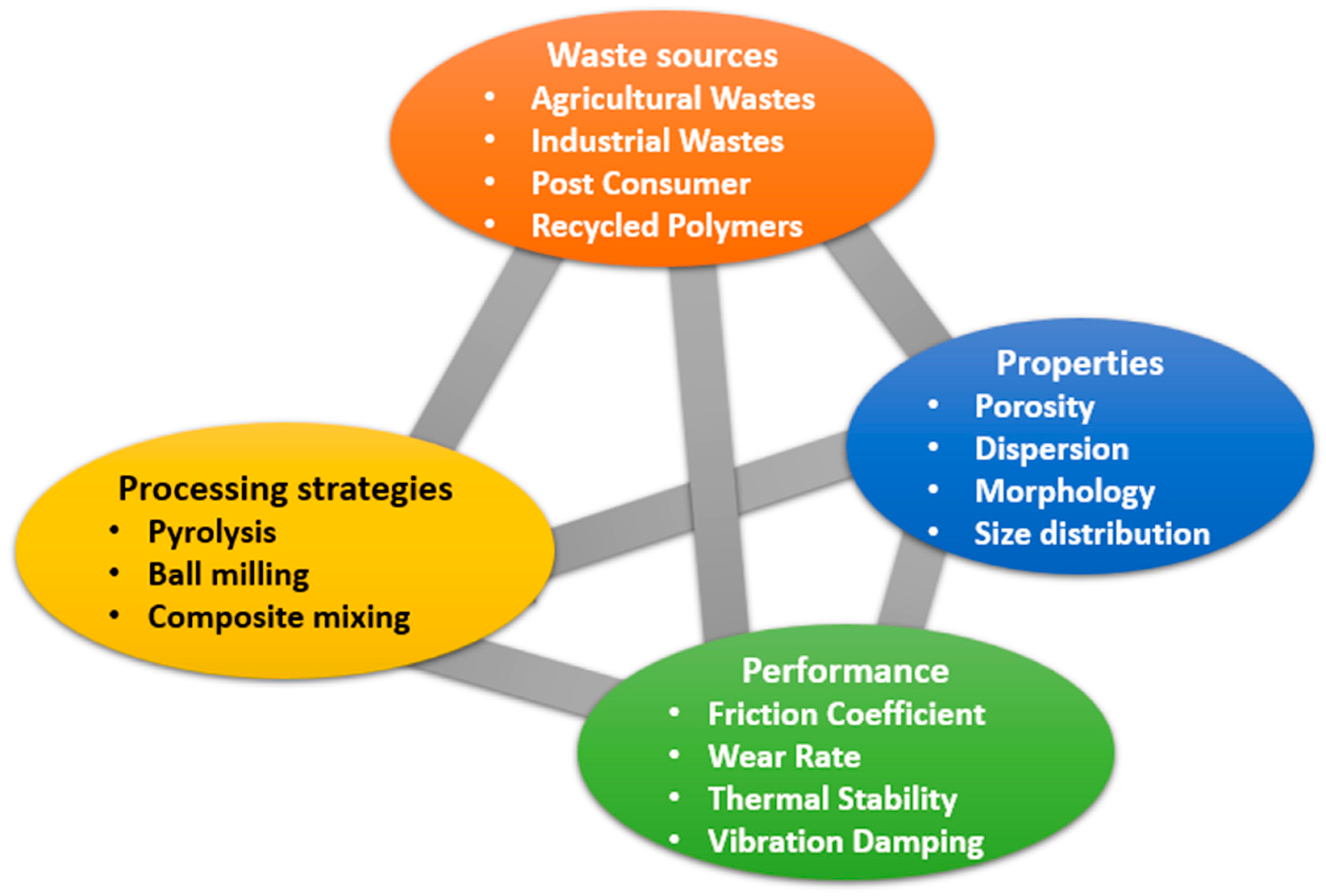
- Agricultural wastes such as rice husk ash, coconut shell powder, and banana peel char are used as biogenic fillers in bio-based or thermoplastic composites [13,14]. When properly treated, they demonstrate improved abrasion resistance, better heat dispersion, and in some cases, self-lubricating properties through carbonaceous phases [15,16].
- Industrial by-products like fly ash, red mud, steel slag, and aluminum dross are being incorporated into polymer and resin-based tribo-composites [17,18,19]. These fillers can significantly improve dry sliding performance by enhancing surface hardness and resisting thermal softening during extended contact cycles [20].
- Post-industrial rubber waste, including tire crumb and pyrolyzed carbon black, has also been studied as a tribological additive. These materials exhibit morphology-dependent friction behavior; smaller particles typically yield more uniform reinforcement and energy dissipation, while larger particles can introduce abrasive micro-cutting effects [21].
- Recycled polymers like polyethylene (PE), polypropylene (PP), and polyethylene terephthalate (PET) can be reused directly or as matrices for composite formation. Their tribological performance is often enhanced through the addition of fine mineral or carbon-based waste particles, yielding improved wear resistance and lower COF values under dry and lubricated conditions [22,23,24,25].
3. Advancements in Waste Materials
3.1. Agricultural Residues
3.2. Industrial Wastes
3.3. Post-Consumer Materials
3.4. Recycled Polymers
4. System-Level Enhancements for Waste Material Tribology
4.1. Interface Engineering and Compatibility
4.2. Hybridization and Multi-Scale Reinforcement
4.3. Advanced Processing and Morphological Control
4.4. Functionalization for Multi-Performance Targets
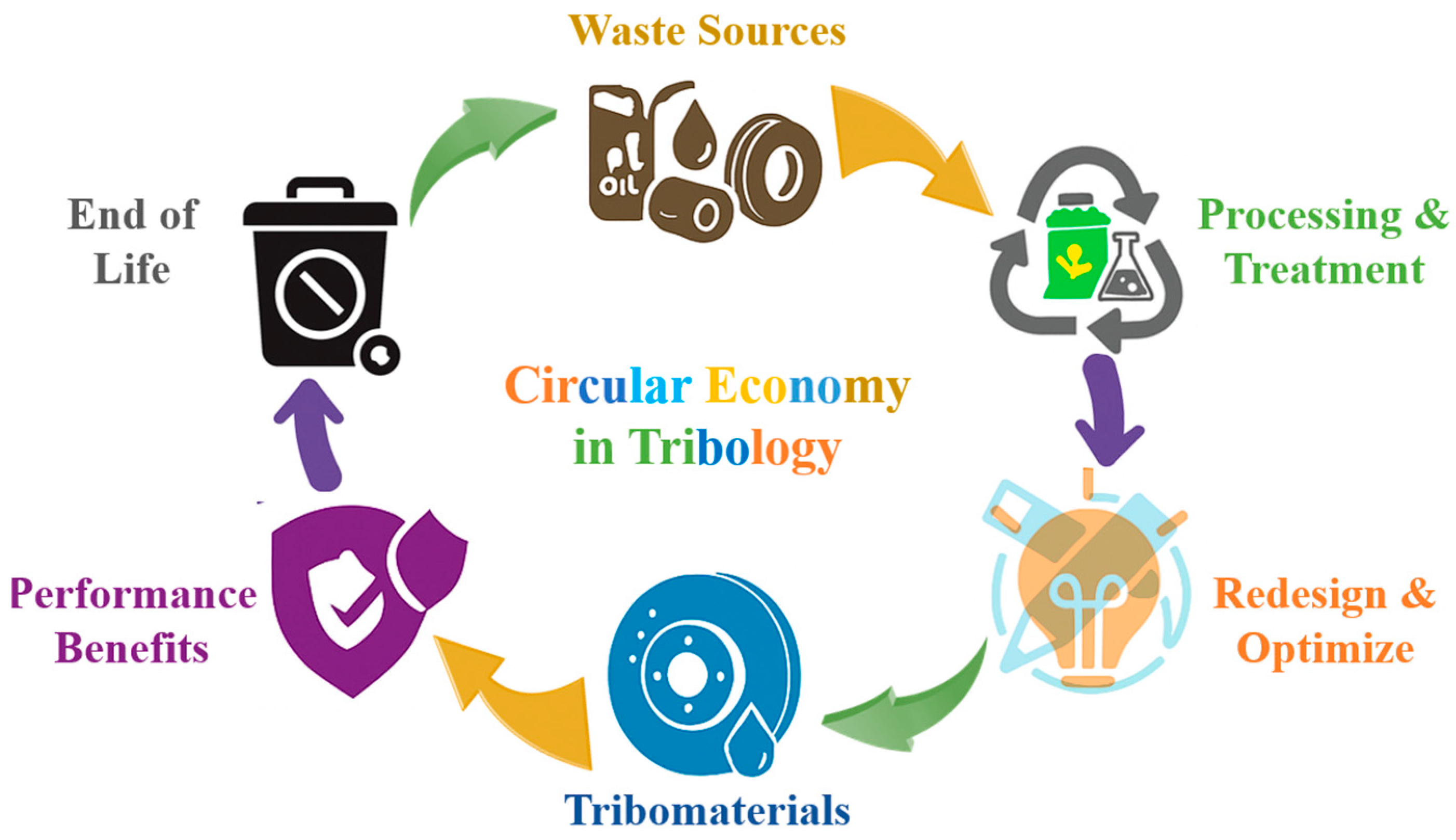
4.5. Integration into Circular Economy Frameworks
5. Optimization and Smart Design of Waste-Based Tribomaterials
6. Applications
6.1. Automotive Braking Systems
6.2. Carbon Black Substitution from Tire Recycling
6.3. Acoustic and Vibration Damping
6.4. Advanced Coatings and Surface Engineering
6.5. Circular Economy in Polymer Systems
7. Future Challenges and Directions
8. Conclusions
Author Contributions
Funding
Data Availability Statement
Conflicts of Interest
Abbreviations
| 3D | Three-dimensional |
| AA | Aluminum alloy |
| AHP | Analytic Hierarchy Process |
| AM | Additive manufacturing |
| ANOVA | Analysis of variance |
| APS | Atmospheric plasma spraying |
| BFS | Blast furnace slag |
| BR | Butadiene rubber |
| CB | Carbon black |
| CBp | Pyrolytic carbon black |
| CNT | Carbon nanotube(s) |
| CO2 | Carbon dioxide |
| COF | Coefficient of friction |
| CoCoSo | Combined Compromise Solution |
| CPK | Carbonized palm kernel bunch |
| CSP | Coconut shell powder |
| DES | Deep eutectic solvent(s) |
| DGTR | Devulcanized ground tire rubber |
| DLw | Weighted reduction of impact sound level |
| ECE R90 | Economic Commission for Europe Regulation No. 90 |
| ELT | End-of-life tire(s) |
| EPDM | Ethylene propylene diene monomer rubber |
| FA | Fly ash |
| GBFS | Granulated blast furnace slag |
| GO | Graphene oxide |
| GTR | Ground tire rubber |
| HQL | High-quality liquid (lubricant) |
| HRC | Rockwell hardness C scale |
| HSS | High-speed steel |
| LCA | Life cycle assessment |
| LLDPE | Linear low-density polyethylene |
| ML | Machine learning |
| NR | Natural rubber |
| PAO | Polyalphaolefin(s) |
| PAO10 | Polyalphaolefin base oil (ISO VG ~10) |
| PCB | Pyrolytic carbon black |
| PE | Polyethylene |
| PE-HD/HDPE | High-density polyethylene |
| PE-UHMW/UHMWPE | Ultra-high molecular weight polyethylene |
| PET | Poly(ethylene terephthalate) |
| PP | Polypropylene |
| PPTA | Poly(p-phenylene terephthalamide) |
| PTFE | Polytetrafluoroethylene |
| PV (pv) | Pressure–velocity factor |
| rCB | Recovered carbon black |
| rCF | Recycled carbon fiber |
| R-PET | Recycled poly(ethylene terephthalate) |
| RM | Red mud |
| SAW | Submerged arc welding |
| SEM | Scanning electron microscopy |
| SFS | Steel furnace slag |
| SiC | Silicon carbide |
| TEA | Techno-economic analysis |
| TiB2 | Titanium diboride |
| TOPSIS | Technique for Order Preference by Similarity to Ideal Solution |
| VIKOR | VlseKriterijumska Optimizacija I Kompromisno Resenje |
| WSV | Wear scar volume |
| XRD | X-ray diffraction |
| ZA-27 | Zinc–aluminum alloy (ZA-27 grade) |
| ZnO | Zinc oxide |
References
- Sydow, Z.; Sydow, M.; Wojciechowski, Ł.; Bieńczak, K. Tribological Performance of Composites Reinforced with the Agricultural, Industrial and Post-Consumer Wastes: A Review. Materials 2021, 14, 1863. [Google Scholar] [CrossRef] [Scilit]
- Rahmani, A.; Razavi, H.K.; Dehghani-Soufi, M. Green tribology assessment: A Comprehensive review of bio-lubricants and nano enhancers. Energy Convers. Manag. X 2024, 24, 100794. [Google Scholar] [CrossRef] [Scilit]
- Kalali, E.N.; Lotfian, S.; Shabestari, M.E.; Khayatzadeh, S.; Zhao, C.; Nezhad, H.Y. A critical review of the current progress of plastic waste recycling technology in structural materials. Curr. Opin. Green Sustain. Chem. 2023, 40, 100763. [Google Scholar] [CrossRef] [Scilit]
- Freschi, M.; Paniz, A.; Cerqueni, E.; Colella, G.; Dotelli, G. The Twelve Principles of Green Tribology: Studies, research, and Case Studies—A Brief Anthology. Lubricants 2022, 10, 192. [Google Scholar] [CrossRef] [Scilit]
- Choubey, M.; Mishra, S.; Deshwal, D. Recent Advances in Tribology: A Review. J. Mol. Eng. Mater. 2025, 13, 2430005. [Google Scholar] [CrossRef] [Scilit]
- Takele, Y.F.; Woldeyohannes, A.D. Optimal material selection for high temperature tribological application: An integrated multi criteria decision study. Discov. Mater. 2025, 5, 33. [Google Scholar] [CrossRef] [Scilit]
- Saxena, S.; Moharil, M.P.; Jadhav, P.V.; Ghodake, B.; Deshmukh, R.; Ingle, A.P. Transforming waste into wealth: Leveraging nanotechnology for recycling agricultural byproducts into value-added products. Plant Nano Biol. 2025, 11, 100127. [Google Scholar] [CrossRef] [Scilit]
- Acevedo-Sánchez, B.; Gallardo-Hernández, E.A.; Hernández-Aguilar, C.; Bravo-Díaz, B.; Vite-Torres, M. Friciton coefficient of cardboard packing samples. Proc. Inst. Mech. Eng. Part J J. Eng. Tribol. 2025, 239, 1194–1203. [Google Scholar] [CrossRef] [Scilit]
- Jabu, M.A.; Aa, A.; Nz, N. A Review of the Potential Applications of Composites from Agricultural Waste. Int. J. Eng. Trends Technol. 2025, 73, 183–191. [Google Scholar] [CrossRef] [Scilit]
- Alazemi, A.A.; Buarki, F.; Alajmi, A.F. Tribological Impact of Carbon Black Nanoparticles Obtained From Recycled Waste Tires as Additive to Motor Oil. J. Tribol. 2025, 147, 044601. [Google Scholar] [CrossRef] [Scilit]
- Costa, S.M.R.; Fowler, D.; Carreira, G.A.; Portugal, I.; Silva, C.M. Production and Upgrading of Recovered Carbon Black from the Pyrolysis of End-of-Life Tires. Materials 2022, 15, 2030. [Google Scholar] [CrossRef] [Scilit] [PubMed]
- Kader, S.; Gratchev, I.; Michael, R.N. Recycled waste substrates: A systemic review. Sci. Total Environ. 2024, 953, 176029. [Google Scholar] [CrossRef] [Scilit] [PubMed]
- Soni, A.; Das, P.K.; Yusuf, M.; Ridha, S.; Kamyab, H.; Chelliapan, S.; Kirpichnikova, I.; Mussa, Z.H. Valorization of Post-Consumers Plastics and Agro-Waste in Sustainable Polymeric Composites for Tribological Applications. Waste Biomass Valorization 2024, 15, 1739–1755. [Google Scholar] [CrossRef] [Scilit]
- Soni, A.; Das, P.K.; Kumar, S. Selection of waste plastics for incorporation in agro-waste as sustainable building construction materials concerning circular economy: An integrated MCDM approach. Clean. Technol. Environ. Policy 2023, 25, 2929–2949. [Google Scholar] [CrossRef] [Scilit]
- Prabhu, R.; Devaraju, A. Recent review of tribology, rheology of biodegradable and FDM compatible polymers. Mater. Today Proc. 2021, 39, 781–788. [Google Scholar] [CrossRef] [Scilit]
- Kumar, S.; Saha, A. Effects of particle size on structural, physical, mechanical and tribology behaviour of agricultural waste (corncob micro/nano-filler) based epoxy biocomposites. J. Mater. Cycles Waste Manag. 2022, 24, 2527–2544. [Google Scholar] [CrossRef] [Scilit]
- Pandita, N.; Dhull, U.; Nain, S.; Ahlawat, V. Tribo-performance assessment of brake friction composites prepared from agro-industrial-sea wastes using pin-on-disc. Polym. Compos. 2024, 45, 7602–7614. [Google Scholar] [CrossRef] [Scilit]
- Sutar, H.; Roy, D.; Mishra, S.C.; Mrmu, R.R. Sliding Wear Performance Evaluation of Red Mud (RM), RM + Fly Ash (FA) and RM + FA + Al Coatings on Mild Steel. Indian J. Mater. Sci. 2016, 2015, 296324. [Google Scholar] [CrossRef]
- Jayashree, P.; Straffelini, G. The influence of the addition of aluminum anodizing waste on the friction and emission behavior of different kinds of friction material formulations. Tribol. Int. 2022, 173, 107676. [Google Scholar] [CrossRef] [Scilit]
- Kasar, A.K.; Jose, S.A.; D’Souza, B.; Menezes, P.L. Fabrication of Trioblogical Preformance and Self-Lubricating Porous Materials and Composites: A Review. Materials 2024, 17, 3448. [Google Scholar] [CrossRef] [Scilit]
- Mahesh, V. Influence of Rubber Crumb Particle Size on Abrasive Behavior of Rubber Crumb Modified Epoxy Composites. Tribol. Ind. 2025, 47, 250–259. [Google Scholar] [CrossRef] [Scilit]
- Raghuram, H.; Roitner, J.; Jones, M.P.; Archodoulaki, V.-M. Recycling of polyethylene: Tribology assessment. Resour. Conserv. Recycl. 2023, 192, 106925. [Google Scholar] [CrossRef] [Scilit]
- Cardona-Ramírez, J.; Paredes-Mogica, E.A.; Guevara-Morales, A.; Figueroa-López, U. Recycling Automotive Plastic Waste: Residual Polyvinyl Butyral (rPVB) as Solid Lubricant in Polyoxymethylene (POM) Blends. Tribol. Trans. 2024, 67, 359–369. [Google Scholar] [CrossRef] [Scilit]
- Nassef, M.G.A.; Hassan, H.S.; Nassef, G.A.; Nassef, B.G.; Soliman, M.; Elkady, M.F. Activated Carbon Nano-Particles from Recycled Polymers Waste as a Novel Nano-Additive to Grease Lubrication. Lubricants 2022, 10, 214. [Google Scholar] [CrossRef] [Scilit]
- Martín-Alfonso, J.E.; Valencia, C.; Sánchez, M.C.; Franco, J.M.; Gallegos, C. Rheological Modification of Lubricating Greases with Recycled Polymers from Different Plastics Waste. Ind. Eng. Chem. Res. 2009, 48, 4136–4144. [Google Scholar] [CrossRef] [Scilit]
- Alaneme, K.K.; Olubambi, P.A. Corrosion and wear behaviour of rice husk ash—Alumina reinforced Al–Mg–Si alloy matrix hybrid composites. J. Mater. Res. Technol. 2013, 2, 188–194. [Google Scholar] [CrossRef] [Scilit]
- Bisht, P.C.; Gope, N. Advances in Materials Engineering and Manufacturing Processes; Singh, I., Bajpai, P.K., Panwar, K.L., Eds.; Springer: Singapore, 2020; pp. 51–57. [Google Scholar]
- Alshahrani, H.; Prakash, V.R.A. Thermal, mechanical and barrier properties of rice husk ash biosilica toughened epoxy biocomposite coating for structural application. Prog. Org. Coat. 2022, 172, 107080. [Google Scholar] [CrossRef] [Scilit]
- Marques, B.; António, J.; Almeida, J.; Tadeu, A.; de Brito, J.; Dias, S.; Pedro, F.; Sena, J.D. Vibro-acoustic behaviour of polymer-based composite materials produced with rice husk and recycled rubber granules. Constr. Build. Mater. 2020, 264, 120221. [Google Scholar] [CrossRef] [Scilit]
- Borges, J.K.; Pacheco, F.; Tutikian, B.; de Oliveira, M.F. An experimental study on the use of waste aggregate for acoustic attenuation: EVA and rice husk composites for impact noise reduction. Constr. Build. Mater. 2018, 161, 501–508. [Google Scholar] [CrossRef] [Scilit]
- Shete, H.V.; Jadhav, P.S. Effects of Combined Coconut Shell and Pistachio Shell as Filler and Frictional Additive on the Properties of Particulate Type of Green Friction Composites. Eng. Trans. 2024, 72, 327–341. [Google Scholar]
- Kuş, H.; Avcu, A.; Sugözü, İ. Red mud ratio effects on the tribological performance of fly-ash-reinforced bronze matrix brake pad material. J. Mater. Eng. Perform. 2025, 34, 11042–11060. [Google Scholar] [CrossRef] [Scilit]
- Kumar, R.; Bairwa, K.N.; Vemanaboina, H.; Naidu, B.V.; Shoush, K.A.; Pushkarna, M.; Tuka, M.B.; Ghoneim, S.S.M. Enhancing wear resistance of aluminum 6061 composites with fly ash: A sustainable approach for industrial applications. Adv. Mech. Eng. 2024, 16, 16878132241290912. [Google Scholar] [CrossRef] [Scilit]
- Adsoy, A.; Kurt, S.; Topuz, A. Influence of fly ash and waste tire rubber particles on mechanical and tribological properties of composite brake linings. Polym. Compos. 2025, 46, 5759–5772. [Google Scholar] [CrossRef] [Scilit]
- Dobrotă, D.; Dimulescu, C.S.; Stăncioiu, A. Reusability of Scrap Rubber, Tire Shredding, Recycled PVC and Fly Ash for Development of Composites with Vibration Damping Ability. Polymers 2024, 16, 2167. [Google Scholar] [CrossRef] [Scilit]
- Devadiga, U.; Fernandes, P.; Buradi, A.; Emma, A.F. Significance of addition of carbon nanotubes and fly ash on the wear and frictional performance of aluminum metal matrix composites. Eng. Rep. 2025, 6, e12865. [Google Scholar] [CrossRef] [Scilit]
- Jayaprakash, H.V.; Veeraiah, M.K.; Krupakara, P.V. Red Mud Metal Matrix Composites with respect to Corrosion Properties. Mater. Today Proc. 2018, 5, 12956–12962. [Google Scholar] [CrossRef] [Scilit]
- Rita, D.A.; Nogueira, A.P.G.; de Cecca, C.; Straffelini, G. A comparative analysis of ladle furnace slag and electric arc furnace slag as abrasives in a friction material formulation: Friction and particulate emission behaviour. Wear 2025, 582–583, 206311. [Google Scholar] [CrossRef] [Scilit]
- Pathak, S.; Choudhary, R.; Kumar, A.; Pattanaik, M.L. Friction characteristics of open graded asphalt friction courses with BOF and EAF steel slag aggregates. J. Mater. Civ. Eng. 2022, 34, 04022087. [Google Scholar] [CrossRef] [Scilit]
- Yang, C.; Huang, Z.; Wu, S.; He, X.; Su, Y.; Zhao, Z.; Xu, H.; Wang, F.; Zhang, L. Recycling steel slag as aggregate in developing an ultra-thin friction course with high comprehensive road performance. Constr. Build. Mater. 2024, 449, 138539. [Google Scholar] [CrossRef] [Scilit]
- Wang, H.L.; Qian, J.S.; Liu, J.; Nan, X.L.; Qu, S.Z.; Li, X.M.; Liu, Y. Wear resistance analysis of steel slag aggregates based on morphology characteristics. Constr. Build. Mater. 2023, 409, 133649. [Google Scholar] [CrossRef] [Scilit]
- Xu, J.; Yu, J.; He, W.; Huang, J.; Xu, J.; Li, G. Replacing commercial carbon black by pyrolytic residue from waste tire for tire processing: Technically feasible and economically reasonable. Sci. Total Environ. 2021, 793, 148597. [Google Scholar] [CrossRef] [Scilit]
- Araujo-Morera, J.; Verdejo, R.; López-Manchado, M.A.; Santana, M.H. Sustainable mobility: The route of tires through the circular economy model. Waste Manag. 2021, 126, 309–322. [Google Scholar] [CrossRef] [Scilit]
- Czarna-Juszkiewicz, D.; Kunecki, P.; Cader, J.; Wdowin, M. Review in Waste Tire Management—Potential Applications in Mitigating Environmental Pollution. Materials 2023, 16, 5771. [Google Scholar] [CrossRef] [Scilit]
- Jiang, G.; Pan, J.; Deng, W.; Sun, Y.; Guo, J.; Che, K.; Yang, Y.; Lin, Z.; Sun, Y.; Huang, C.; et al. Recovery of high pure pyrolytic carbon black from waste tires by dual acid treatment. J. Clean. Prod. 2022, 374, 133893. [Google Scholar] [CrossRef] [Scilit]
- Nguyen, H.T.; Crittenden, K.; Weiss, L.; Bardaweel, H. Recycle of waste tire rubber in a 3D printed composite with enhanced damping properties. J. Clean. Prod. 2022, 368, 133085. [Google Scholar] [CrossRef] [Scilit]
- Laithong, T.; Nampitch, T.; Ourapeepon, P.; Phetyim, N. Quality improvement of recycled carbon black from waste tire pyrolysis for replacing carbon black N330. Sci. Rep. 2025, 15, 23726. [Google Scholar] [CrossRef] [Scilit]
- Karabork, F. Investigation of the mechanical, tribological and corrosive properties of epoxy composite coatings reinforced with recycled waste tire products. Express Polym. Lett. 2022, 16, 1114–1127. [Google Scholar] [CrossRef] [Scilit]
- Joseph, T.M.; Azat, S.; Ahmadi, Z.; Jazani, O.M.; Esmaeili, A.; Kianfar, E.; Haponiuk, J.; Thomas, S. Polyethylene terephthalate (PET) recycling: A review. Case Stud. Chem. Environ. Eng. 2024, 9, 100673. [Google Scholar] [CrossRef] [Scilit]
- Volpe, V.; Lanzillo, M.S.; Molaro, A.; Affinita, G.; Pantani, R. Characterization of Recycled/Virgin Polyethylene Terephthalate Composite Reinforced with Glass Fiber for Automotive Applications. J. Compos. Sci. 2022, 6, 59. [Google Scholar] [CrossRef] [Scilit]
- Jan, P.; Matkovič, S.; Bek, M.; Perše, L.S.; Kalin, M. Tribological behaviour of green wood-based unrecycled and recycled polypropylene composites. Wear 2023, 524–525, 204826. [Google Scholar] [CrossRef] [Scilit]
- Raghuram, H.; Seier, M.; Koch, T.; Jones, M.P.; Archodoulaki, V.-M. Smart design choices provide new applications for recycled polypropylene: The case for tribology. Sustain. Mater. Technol. 2023, 38, e00745. [Google Scholar] [CrossRef] [Scilit]
- Smoleń, J.; Stępień, K.; Mikuśkiewicz, M.; Myalska-Głowacka, H.; Kozioł, M.; Godzierz, M.; Janeczek, H.; Czakiert, J. Tribological Properties of Composites Based on Single-Component Powdered Epoxy Matrix Filled with Graphite. Materials 2024, 17, 3054. [Google Scholar] [CrossRef] [Scilit]
- Pranay, V.; Ojha, S.; Raghavendra, G.; Dheeraj, G.; Anjali, A. Evaluation of Mechanical and Tribological Properties of Biowaste and Biowaste Based Silica Particulate Epoxy Composites. Silicon 2022, 14, 4367–4374. [Google Scholar] [CrossRef] [Scilit]
- Adeyemi, O.I.; Kirwan, K.; Tuersley, I.; Coles, S.R. Comparative assessment of the performance of friction materials based on different agricultural wastes. Tribol. Int. 2024, 191, 109130. [Google Scholar] [CrossRef] [Scilit]
- Abdulazim, A.A. Production of Lubricant Grease from Waste Palm Fruit Bunch and Plantain Peel. SSRN 2024. [Google Scholar] [CrossRef] [Scilit]
- Ratan, J.K.; Sahu, D.; Pandhare, N.N.; Bhavanam, A. Advances in Chemical, Bio and Environmental Engineering; Springer International Publishing: Cham, Switzerland, 2022; pp. 471–479. [Google Scholar]
- Kumar, S.; Mer, K.K.S.; Gangil, B.; Patel, K. Synergy of rice-husk filler on physico-mechanical and tribological properties of hybrid Bauhinia-vahlii/sisal fiber reinforced epoxy composites. J. Mater. Res. Technol. 2019, 8, 2070–2082. [Google Scholar] [CrossRef] [Scilit]
- Jayashree, P.; Matějka, V.; Leonardi, M.; Straffelini, G. The influence of the addition of different kinds of slags on the friction and emission behavior of a commercially employed friction material formulation. Wear 2023, 522, 204705. [Google Scholar] [CrossRef] [Scilit]
- Matějka, V.; Jayashree, P.; Leonardi, M.; Vlček, J.; Sabovčík, T.; Straffelini, G. Utilization of Metallurgical Slags in Cu-free Friction Material Formulations. Lubricants 2022, 10, 219. [Google Scholar] [CrossRef] [Scilit]
- Dias, D.; Bons, J.; Kumar, A.; Kabir, M.H.; Liang, H. Forever Chemicals, Per-and Polyfluoroalkyl Substances (PFAS), in Lubrication. Lubricants 2024, 12, 114. [Google Scholar] [CrossRef] [Scilit]
- Bendikiene, R.; Ciuplys, A.; Kavaliauskiene, L. Circular economy practice: From industrial metal waste to production of high wear resistant coatings. J. Clean. Prod. 2019, 229, 1225–1232. [Google Scholar] [CrossRef] [Scilit]
- Alazemi, A.A.; Alajmi, A.F.; Al-Salem, S.M. Investigation of Chemical, Physical, and Tribological Properties of Pyrolysis Oil Derived from End-of-Life Tires (ELTs) against Conventional Engine Oil. Lubricants 2024, 12, 188. [Google Scholar] [CrossRef] [Scilit]
- Güney, B. Investigation of physical and chemical properties of particulate matter caused by vehicle tire wear. Int. J. Environ. Sci. Tech. 2024, 21, 1805–1816. [Google Scholar] [CrossRef] [Scilit]
- Hackler, R.A.; Vyavhare, K.; Kennedy, R.M.; Celik, G.; Kanbur, U.; Griffin, P.J.; Sadow, A.D.; Zang, G.; Elgowainy, A.; Sun, P.; et al. Synthetic Lubricants Derived from Plastic Waste and their Tribological Performance. ChemSusChem 2021, 14, 4181–4189. [Google Scholar] [CrossRef] [Scilit]
- Wang, H.; Qi, X.; Liang, L.; Wang, Y.; Zhang, J.; Meng, X. Tribological properties of graphene oxide reinforced PPTA/PTFE composites. J. Mater. Res. Technol. 2023, 23, 3505–3514. [Google Scholar] [CrossRef] [Scilit]
- Balla, V.K.; Kate, K.H.; Satyavolu, J.; Singh, P.; Tadimeti, J.G.D. Additive manufacturing of natural fiber reinforced polymer composites: Processing and prospects. Compos. B Eng. 2019, 174, 106956. [Google Scholar] [CrossRef] [Scilit]
- Veeranaath, V.; Sahu, R.K.; Priya, I.M. Effect of blending duration on physical, mechanical and tribological behavior of aluminum matrix composites: An experimental analysis. Mater. Today Proc. 2024, 98, 47–53. [Google Scholar] [CrossRef] [Scilit]
- Dhakal, N.; Wang, X.; Espejo, C.; Morina, A.; Emami, N. Impact of processing defects on microstructure, surface quality, and tribological performance in 3D printed polymers. J. Mater. Res. Technol. 2023, 23, 1252–1272. [Google Scholar] [CrossRef] [Scilit]
- Yan, H.; Tan, J.; Chen, H.; He, T.; Zeng, D.; Zhang, L. Machine Learning-Based Prediction of Tribological Properties of Epoxy Composite Coating. Polymers 2025, 17, 282. [Google Scholar] [CrossRef] [Scilit] [PubMed]
- Kumar, R.; Channi, A.S.; Kaur, R.; Sharma, S.; Grewal, J.S.; Singh, S.; Verma, A.; Haber, R. Exploring the intricacies of machine learning-based optimization of electric discharge machining on squeeze cast TiB2/AA6061 composites: Insights from morphological, and microstructural aspects in the surface structure analysis of recast layer formation and worn-out analysis. J. Mater. Res. Technol. 2023, 26, 8569–8603. [Google Scholar]
- Supriyanto, E.; Yudha, N.K.; Nugroho, A.D.; Muflikhun, M.A. Characteristics and evaluation of recycled waste PVCs as a filler in composite structures: Validation through simulation and experimental methods. Compos. Part C Open Access 2024, 15, 100525. [Google Scholar] [CrossRef] [Scilit]
- Dirisu, J.O.; Okokpujie, I.P.; Apiafi, P.B.; Oyedepo, S.O.; Tartibu, L.K.; Omotosho, O.A.; Ogunkolati, E.O.; Oyeyemi, E.O.; Uwaishe, J.O. Development of eco-friendly brake pads using industrial and agro-waste materials. J. Eng. Appl. Sci. 2024, 71, 55. [Google Scholar] [CrossRef] [Scilit]
- Singh, T.; da Silva Gehlen, G.; Singh, V.; Ferreira, N.F.; de Barros, L.Y.; Lasch, G.; Poletto, J.C.; Ali, S.; Neis, P.D. Selection of automotive brake friction composites reinforced by agro-waste and natural fiber: An integrated multi-criteria decision-making approach. Results Eng. 2024, 22, 102030. [Google Scholar] [CrossRef] [Scilit]
- Rajan, R.; Tyagi, Y.K.; Pruncu, C.I.; Kulshreshtha, S.; Ranakoti, L.; Singh, T. Tribological performance evaluation of slag waste filled phenolic composites for automotive braking applications. Polym. Compos. 2022, 43, 7118–7129. [Google Scholar] [CrossRef] [Scilit]
- Güney, B. Microstructure and Chemical Analysis of Vehicle Brake Wear Particle Emissions. Eur. J. Sci. Tech. 2020, 19, 633–642. [Google Scholar] [CrossRef] [Scilit]
- Kılıç, H. Performance assessment of agricultural waste based eco-friendly brake friction composites. Polym. Compos. 2024, 45, 16317–16334. [Google Scholar] [CrossRef] [Scilit]
- Karger-Kocsis, J.; Mousa, A.; Major, Z.; Békési, N. Dry friction and sliding wear of EPDM rubbers against steel as a function of carbon black content. Wear 2008, 264, 359–367. [Google Scholar] [CrossRef] [Scilit]
- Martínez, L.; Nevshupa, R.; Felhös, D.; de Segovia, J.L.; Román, E. Influence of friction on the surface characteristics of EPDM elastomers with different carbon black contents. Tribol. Int. 2011, 44, 996–1003. [Google Scholar] [CrossRef] [Scilit]
- Aderikha, V.N.; Shapovalov, V.A. Effect of filler surface properties on structure, mechanical and tribological behavior of PTFE-carbon black composites. Wear 2010, 268, 1455–1464. [Google Scholar] [CrossRef] [Scilit]
- Dwivedi, C.; Manjare, S.; Rajan, S.K. Recycling of waste tire by pyrolysis to recover carbon black: Alternative & environment-friendly reinforcing filler for natural rubber compounds. Compos. B Eng. 2020, 200, 108346. [Google Scholar]
- Bogdahn, S.; Malek, C.; Koch, E.; Katrakova-Krüger, D. Production and Characterization of Recovered Carbon Black (rCB) by Waste Tire Pyrolysis as a Potential Carbon Black (CB) Substitute. Adv. Mater. Sustain. Manuf. 2025, 2, 10007. [Google Scholar] [CrossRef] [Scilit]
- Sharma, S.; Sudhakara, P.; Singh, J.; Singh, S.; Singh, G. Emerging progressive developments in the fibrous composites for acoustic applications. J. Manuf. Process 2023, 102, 443–477. [Google Scholar] [CrossRef] [Scilit]
- Buddhacosa, N.; Galos, J.; Das, R.; Khatibi, A.; Kandare, E. Vibration damping and acoustic properties of syntactic foam incorporating waste tyre-derived rubber particles. Sustain. Mater. Technol. 2024, 41, e01013. [Google Scholar] [CrossRef] [Scilit]
- Yao, C.-W.; Lian, I. Nanoscale Insights into the Mechanical and Tribological Properties of a Nanocomposite Coating. Nanomaterials 2025, 15, 1280. [Google Scholar] [CrossRef] [Scilit]
- Erdoğan, A.; Gök, M.S.; Koç, V.; Günen, A. Friction and wear behavior of epoxy composite filled with industrial wastes. J. Clean. Prod. 2019, 237, 117588. [Google Scholar] [CrossRef] [Scilit]
- Ventura, A.M.; Kneissl, L.M.; Nunes, S.; Emami, N. Recycled carbon fibers as an alternative reinforcement in UHMWPE composite. Circular economy within polymer tribology. Sustain. Mater. Technol. 2022, 34, e00510. [Google Scholar] [CrossRef] [Scilit]
- Lin, L.; Schlarb, A.K. Recycled carbon fibers as reinforcements for hybrid PEEK composites with excellent friction and wear performance. Wear 2019, 432–433, 202928. [Google Scholar] [CrossRef] [Scilit]
- Khattab, A.A.; Ali, W.Y. ABRASION RESISTANCE OF RECYCLED POLYMERIC COATING. J. Eng. Sci. (JEST) 2010, 7, 14–25. [Google Scholar]
- Ali, S.; Kumar, N.; Grewal, J.S.G.; Thakur, V.; Chau, K.W.; Kumar, M. Coconut waste fiber used as brake pad reinforcement polymer composite and compared to standard Kevlar-based brake pads to produce an asbestos free brake friction material. Polym. Compos. 2022, 43, 1518–1525. [Google Scholar] [CrossRef] [Scilit]
- Nandiyanto, A.B.D.; Al Husaeni, D.F.; Ragadhita, R.; Kurniawan, T. Resin-based brake pad from rice husk particles: From literature review of brake pad from agricultural waste to the techno-economic analysis. Automot. Exp. 2021, 4, 131–149. [Google Scholar] [CrossRef] [Scilit]
- Kholil, A.; Dwiyati, S.T.; Wirawan, R. Brake Pad Characteristics of Natural Fiber Composites from Coconut Fibre and Wood Powder. J. Phys. Conf. Ser. 2021, 2019, 012068. [Google Scholar] [CrossRef] [Scilit]
- Irawan, A.P.; Fitriyana, D.F.; Tezara, C.; Siregar, J.P.; Laksmidewi, D.; Baskara, G.D.; Abdullah, M.Z.; Junid, R.; Hadi, A.E.; Hamdan, M.H.M. Overview of the important factors influencing the performance of eco-friendly brake pads. Polymers 2022, 14, 1180. [Google Scholar] [CrossRef] [Scilit]
- Nogueira, A.P.G.; da Silva Gehlen, G.; Neis, P.D.; Ferreira, N.F.; Gialanella, S.; Straffelini, G. Rice husk as a natural ingredient for brake friction material: A pin-on-disc investigation. Wear 2022, 494, 204272. [Google Scholar] [CrossRef] [Scilit]
- Anggraeni, S.; Anshar, A.N.; Maulana, A.; Nurazizah, S.; Nurjihan, Z.; Putri, S.R.; Nandiyanto, A.B.D. Mechanical properties of sawdust and rice husk brake pads with variation of composition and particle size. J. Eng. Sci. Technol. 2022, 17, 2390–2401. [Google Scholar]
- Sunday, A.V. Unveiling the frictional properties of brake pads developed from silver nanoparticles modified carbon nanotubes derived from rice husks. Tribol. Int. 2024, 192, 109270. [Google Scholar] [CrossRef] [Scilit]
- Khafidh, M.; Putera, F.P.; Yotenka, R.; Fitriyana, D.F.; Widodo, R.D.; Ismail, R.; Irawan, A.P.; Cionita, T.; Siregar, J.P.; Ismail, N.H. A study on characteristics of brake pad composite materials by varying the composition of epoxy. Automot. Exp. 2023, 6, 303–319. [Google Scholar] [CrossRef] [Scilit]
- Nandiyanto, A.B.D.; Hofifah, S.N.; Girsang, G.C.S.; Putri, S.R.; Budiman, B.A.; Triawan, F.; Al-Obaidi, A.S.M. The effects of rice husk particles size as a reinforcement component on resin-based brake pad performance: From literature review on the use of agricultural waste as a reinforcement material, chemical polymerization reaction of epoxy resin, to experiments. Automot. Exp. 2021, 4, 68–82. [Google Scholar] [CrossRef] [Scilit]
- Yigrem, M.; Fatoba, O.; Tensay, S. Tribological and mechanical properties of banana peel hybrid composite for brake-pad application. Mater. Today Proc. 2022, 62, 2829–2838. [Google Scholar] [CrossRef] [Scilit]
- Ragadhita, R.; Al Husaeni, D.F.; Nandiyanto, A.B.D. Techno-economic evaluation of the production of resin-based brake pads using agricultural wastes: Comparison of eggshells/banana peels brake pads and commercial asbestos brake pads. ASEAN J. Sci. Eng. 2023, 3, 243–250. [Google Scholar] [CrossRef] [Scilit]
- Nandiyanto, A.B.D.; Ragadhita, R.; Fiandini, M.; Al Husaeni, D.F.; Al Husaeni, D.N.; Fadhillah, F. Domestic waste (eggshells and banana peels particles) as sustainable and renewable resources for improving resin-based brakepad performance: Bibliometric literature review, techno-economic analysis, dual-sized reinforcing experiments, to comparison. Commun. Sci. Technol. 2022, 7, 50–61. [Google Scholar] [CrossRef] [Scilit]
- Siregar, J.P.; Rejab, M.R.M.; Cionita, T.; Hadi, A.E.; Jaafar, J.; Fitriyana, D.F.; Dewi, R. Opportunities and challenges in the sustainable integration of natural fibers and particles in friction materials for eco-friendly brake pads. Mech. Eng. Soc. Ind. 2024, 4, 337–367. [Google Scholar] [CrossRef] [Scilit]
- Manoharan, S.; Krishnan, G.S.; Babu, L.G.; Singaravelu, D.L. Synergistic effect of red mud-iron sulfide particles on fade-recovery characteristics of non-asbestos organic brake friction composites. Mater. Res. Express 2019, 6, 105311. [Google Scholar] [CrossRef] [Scilit]
- Chandradass, J.; Surabhi, M.A.; Sethupathi, P.B.; Jawahar, P. Development of low cost brake pad material using asbestos free sugarcane bagasse ash hybrid composites. Mater. Today Proc. 2021, 45, 7050–7057. [Google Scholar] [CrossRef] [Scilit]
- Ahlawat, V.; Kajal, S.; Anuradha, P. Tribo-performance assessment of milled fly ash brake friction composites. Polym. Compos. 2020, 41, 707–718. [Google Scholar] [CrossRef] [Scilit]
- Yılmaz, A.C. Effects of fly ash introduction on friction and wear characteristics of brake pads. Int. J. Automot. Eng. Technol. 2022, 11, 96–103. [Google Scholar] [CrossRef] [Scilit]
- Mohanty, S.; Chugh, Y.P. Development of fly ash-based automotive brake lining. Tribol. Int. 2007, 40, 1217–1224. [Google Scholar] [CrossRef] [Scilit]
- Kanagaraj, M.; Babu, S.; Jonah, N.; Christy, T.V. Influence of ground granulated blast furnace slag on the tribological characteristics of automotive brake friction materials. Ind. Lubr. Tribol. 2022, 74, 837–843. [Google Scholar] [CrossRef] [Scilit]
- Sagiroglu, S.; Akdogan, K. The effect of the addition of blast furnace slag on the wear behavior of heavy transport polymer-based brake pads. Tribol. Int. 2023, 189, 108845. [Google Scholar] [CrossRef] [Scilit]
- Mutlu, I.; Sugözü, İ.; Keskin, A. The effects of porosity in friction performance of brake pad using waste tire dust. Polímeros 2015, 25, 440–446. [Google Scholar] [CrossRef] [Scilit]
- Tamayo, A.; Rubio, F.; Pérez-Aparicio, R.; Saiz-Rodríguez, L.; Rubio, J. Preparation and properties of sustainable brake pads with recycled end-of-life tire rubber particles. Polymers 2021, 13, 3371. [Google Scholar] [CrossRef] [Scilit]
- Pai, A.; Subramanian, S.; Sood, T. Tribological response of waste tire rubber as micro-fillers in automotive brake lining materials. Friction 2020, 8, 1153–1168. [Google Scholar] [CrossRef] [Scilit]
- Guo, W.; Bai, S.; Ye, Y.; Zhu, L.; Li, S. A new strategy for high-value reutilization of recycled carbon fiber: Preparation and friction performance of recycled carbon fiber felt-based C/C-SiC brake pads. Ceram. Int. 2019, 45, 16545–16553. [Google Scholar] [CrossRef] [Scilit]
- Gbadeyan, O.J.; Kanny, K. Tribological behaviors of polymer-based hybrid nanocomposite brake pad. J. Tribol. 2018, 140, 032003. [Google Scholar] [CrossRef] [Scilit]
- Chopngam, K.; Luengchavanon, M.; Khangkhamano, M.; Chetpattananondh, K.; Limbut, W. Coating activated carbon from coconut shells with Co3O4/CeO2 for high-performance supercapacitor applications: An experimental study. Bioresources 2021, 16, 8022. [Google Scholar] [CrossRef] [Scilit]
- Faisal, M.; Abubakar, Y.; Desvita, H. Antibacterial properties of edible coatings from chitosan and young coconut shell liquid smoke. IOP Conf. Ser. Earth Environ. Sci. 2024, 1377, 012038. [Google Scholar] [CrossRef] [Scilit]
- Faisal, M.M.A.; Djuned, F.M.; Abubakar, Y.; Desvita, H. Chikuwa preservation by edible coating from a combination of young coconut shell liquid smoke and chitosan. S. Afr. J. Chem. Eng. 2024, 50, 135–142. [Google Scholar] [CrossRef] [Scilit]
- Basri, M.S.M.; Yek, T.H.; Talib, R.A.; Tawakkal, I.S.M.A.; Kamarudin, S.H.; Mazlan, N.; Maidin, N.A.; Rahman, M.H.A. Rice husk ash/silicone rubber-based binary blended geopolymer coating composite: Fire retardant, moisture absorption, optimize composition, and microstructural analysis. Polymers 2021, 13, 985. [Google Scholar] [CrossRef] [Scilit] [PubMed]
- Wang, X.; Du, K.; Jia, Y.; Zhao, W.; Duan, K.; Wang, X.; Beadham, I.; Hu, J.; Zhang, C.; Deng, Y. A simplified preparation of silica aerogel/epoxy composite coating based on rice husk ash for enhancing corrosion resistance. Clean. Technol. Environ. Policy 2025, 27, 3295–3310. [Google Scholar] [CrossRef] [Scilit]
- Rahmadhani, D.; Yuliani, K.D.; Frida, E.; Taufiq, A. Hydrophobic and antibacterial properties of textiles using nanocomposite chitosan and SiO2 from rice husk ash as-coating. S. Afr. J. Chem. Eng. 2024, 48, 366–374. [Google Scholar]
- Abdullah, M.N.; Mustapha, F.; Ahmad, K.A.; Mustapha, M.; Khan, T.; Singh, B.; Sebaey, T.A. Effect of different pre-treatment on the microstructure and intumescent properties of rice husk ash-based geopolymer hybrid coating. Polymers 2022, 14, 2252. [Google Scholar] [CrossRef] [Scilit]
- Dhongde, N.R.; Das, N.K.; Banerjee, T.; Rajaraman, P.V. Synthesis of carbon quantum dots from rice husk for anti-corrosive coating applications: Experimental and theoretical investigations. Ind. Crops Prod. 2024, 212, 118329. [Google Scholar] [CrossRef] [Scilit]
- Geng, J.; O’Dell, J.; Stark, N.; Kitin, P.; Zhang, X.; Zhu, J.Y. Microfibrillated cellulose (MFC) barrier coating for extending banana shelf life. Food Hydrocoll. 2024, 150, 109671. [Google Scholar] [CrossRef] [Scilit]
- Mahardiani, L.; Larasati, R.; Susilowati, E.; Hastuti, B.; Azizah, N.L. Potential edible coating of pectin obtained from banana peel for fruit preservation. J. Phys. Conf. Ser. 2021, 1912, 012019. [Google Scholar] [CrossRef] [Scilit]
- Fu, Y.; Weng, M.; Cai, C.; Xu, W. Flame-retardant coatings on wood surface fabricated by chitosan and banana peels waste via facile layer-by-layer self-assembly. Wood Mater. Sci. Eng. 2025, 1–12. [Google Scholar] [CrossRef] [Scilit]
- Yang, N.; Xue, S.; Ahmad, M.R.; Xuan, Q.; Kai, M.-F.; Dai, J.-G. Development of red mud-modified geopolymer coating with radiative cooling effect for footway application. J. Clean. Prod. 2024, 450, 141915. [Google Scholar] [CrossRef] [Scilit]
- Feng, J.; Liu, S.; Hwang, J.-Y.; Mo, W.; Su, X.; Ma, S.; Wei, Z. A novel humidity self-regulating interior wall coating composite based on red mud derived from alumina production. Constr. Build Mater. 2022, 349, 128755. [Google Scholar] [CrossRef] [Scilit]
- Turk, B.; Kazak, O.; Akkaya, G.K.; Tor, A. A simple and green preparation of red mud-coated membrane for efficient separation of oil-in-water emulsions. J. Environ. Chem. Eng. 2022, 10, 106928. [Google Scholar] [CrossRef] [Scilit]
- Tomar, A.S.; Gupta, R.; Singh, A.; Salammal, S.T.; Khan, M.A.; Mishra, D. Evaluation of corrosion protective properties of fly ash-red mud based geopolymer coating material for mild steel. Mater. Today Proc. 2022, 68, 181–186. [Google Scholar] [CrossRef] [Scilit]
- Collazo, A.; Covelo, A.; Nóvoa, X.R.; Pérez, C. Corrosion protection performance of sol–gel coatings doped with red mud applied on AA2024-T3. Prog. Org. Coat. 2012, 74, 334–342. [Google Scholar] [CrossRef] [Scilit]
- Özcan, M.; Birol, B.; Kaya, F. Investigation of photocatalytic properties of TiO2 nanoparticle coating on fly ash and red mud based porous ceramic substrate. Ceram. Int. 2021, 47, 24270–24280. [Google Scholar] [CrossRef] [Scilit]
- Song, H.; Tang, M.; Lei, X.; Feng, Z.; Cheng, F. Preparation of ultrafine fly ash-based superhydrophobic composite coating and its application to foam concrete. Polymers 2020, 12, 2187. [Google Scholar] [CrossRef] [Scilit]
- Temuujin, J.; Minjigmaa, A.; Rickard, W.; Lee, M.; Williams, I.; van Riessen, A. Fly ash based geopolymer thin coatings on metal substrates and its thermal evaluation. J. Hazard. Mater. 2010, 180, 748–752. [Google Scholar] [CrossRef] [Scilit]
- Wang, M.; Wang, W.; Li, S.; Liu, H.; Fan, X.; Wang, Z. A fly ash-derived polybenzoxazine/zeolite A bilayer coating with excellent superhydrophobicity and corrosion resistance. Prog. Org. Coat. 2022, 171, 107043. [Google Scholar] [CrossRef] [Scilit]
- Zheng, W.; Xu, W.; Zhang, H.; Zheng, H.; Wang, L.; Cheng, Z.; Ye, Y.; Lin, J.; Long, H. Preparation and properties of silane coupling agent modified steel slag as functional filler for anti-corrosion coating. J. Iron Steel Res. Int. 2023, 30, 708–716. [Google Scholar] [CrossRef] [Scilit]
- Cui, P.; Zhou, X.; Xiao, Y.; Wang, F. Enhanced environmental and self-healing performance of asphalt mixture using steel slag as the substrate of functional coatings. Constr. Build. Mater. 2025, 489, 142427. [Google Scholar] [CrossRef] [Scilit]
- Liu, X.; Wang, Q.; Zhang, X.; Cao, T.; Wu, Z. Synergistic improvement on temperature and moisture stability of asphalt mixture with steel slag aggregate coated by waterborne polyurethane. Constr. Build. Mater. 2025, 472, 140847. [Google Scholar] [CrossRef] [Scilit]
- Deng, G.; He, Y.; Lu, L.; Wang, F.; Hu, S. A preliminary study on the efficiency of the steel slag-based spraying carbonation layer in improving the durability of cement-based products. Cem. Concr. Compos. 2023, 136, 104899. [Google Scholar] [CrossRef] [Scilit]
- Adesina, A.Y.; Zainelabdeen, I.H.; Dalhat, M.A.; Mohammed, A.S.; Sorour, A.A.; Al-Badour, F.A. Influence of micronized waste tire rubber on the mechanical and tribological properties of epoxy composite coatings. Tribol. Int. 2020, 146, 106244. [Google Scholar] [CrossRef] [Scilit]
- Akhtar, A.Y.; Tsang, H.-H. Dynamic leaching assessment of recycled polyurethane-coated tire rubber for sustainable engineering applications. Chem. Eng. J. 2024, 495, 153351. [Google Scholar] [CrossRef] [Scilit]
- Ghaleh, M.B.; Asadi, P.; Eftekhar, M.R. Enhancing mechanical performance of waste tire concrete with surface double pre-coating by resin and micro-silica. J. Build. Eng. 2022, 50, 104084. [Google Scholar] [CrossRef] [Scilit]
- Zhang, B.; Liang, G.; Hou, B. Rubber running track inspired ultra-robust superhydrophobic coating armored with recycled tire rubber (RTR) particles for sustained corrosion resistance. Chem. Eng. J. 2025, 522, 167434. [Google Scholar] [CrossRef] [Scilit]
- Zou, Y.; Hsieh, J.S.; Mehnert, E.; Kokoszka, J. The study of PET recyclable polymers as paper coatings. Prog. Org. Coat. 2007, 60, 127–131. [Google Scholar] [CrossRef] [Scilit]
- Kawamura, C.; Ito, K.; Nishida, R.; Yoshihara, I.; Numa, N. Coating resins synthesized from recycled PET. Prog. Org. Coat. 2002, 45, 185–191. [Google Scholar] [CrossRef] [Scilit]
- Ghosal, K.; Nayak, C. Recent advances in chemical recycling of polyethylene terephthalate waste into value added products for sustainable coating solutions–hope vs. hype. Mater. Adv. 2022, 3, 1974–1992. [Google Scholar] [CrossRef] [Scilit]
- Cirisano, F.; Ferrari, M. Superhydrophobicity and durability in recyclable polymers coating. Sustainability 2021, 13, 8244. [Google Scholar] [CrossRef] [Scilit]
- Le, D.K.; Ng, G.N.; Koh, H.W.; Zhang, X.; Thai, Q.B.; Phan-Thien, N.; Duong, H.M. Methyltrimethoxysilane-coated recycled polyethylene terephthalate aerogels for oil spill cleaning applications. Mater. Chem. Phys. 2020, 239, 122064. [Google Scholar] [CrossRef] [Scilit]
- Saleem, J.; Moghal, Z.K.B.; McKay, G. Prolonged Lifespan of Superhydrophobic Thin Films and Coatings Using Recycled Polyethylene. Polymers 2024, 16, 1791. [Google Scholar] [CrossRef] [Scilit]
- Paramasivam, N.; Idris, R.; Tan, C.W.; Chong, W.W.F.; Mong, G.R.; Asik, J.A.; Ali, A.; Aidy, N.W.F.; Tamiri, F.M.; Hashim, S.R.M. Microwaved-induced co-pyrolysis of used engine lubricant and palm empty fruit bunch for alternative fuel recovery. Carbon Resour. Convers. 2025, 8, 100300. [Google Scholar] [CrossRef] [Scilit]
- Hu, E.; Su, E.; Chen, Y.; Subedi, A.; Wang, J.; Hu, K.; Hu, X.; Tang, L. Preparation and tribological behaviors of modified rice husk carbon/MoS2 composite particles as a functional additive in polyethylene glycol. Tribol. Trans. 2022, 65, 564–577. [Google Scholar] [CrossRef] [Scilit]
- Yoon, B.; Kim, S.; Lang, A.; Egelkamp, C.; Meier, J.; Giese, U.; Kim, B.; Kim, J.H.; Bae, J.W.; Um, G.Y. Friction behaviors of rice husk silica-reinforced elastomer composites in contact with rough self-affine surfaces. Polym. Test 2022, 116, 107764. [Google Scholar] [CrossRef] [Scilit]
- Ju, G.; Zhang, X.; Cao, J.; Wu, Y.; Zheng, H.; Gao, G. Mechanical and Tribological Properties of Rice Husk Biochar-Reinforced Glass Fiber/Ultra-High Molecular Weight Polyethylene Composites for Water-Lubricated Bearings. Polym. Compos. 2025, 47, 3618–3637. [Google Scholar] [CrossRef] [Scilit]
- Liang, X.; Han, M.; Xu, Z.; Wang, R.; Yang, Z. Insight into the tribological performances of coconut shells as a potential natural water lubrication material. Wear 2024, 546, 205350. [Google Scholar] [CrossRef] [Scilit]
- Bui, T.A.; Le, D.-D.; Tran, D.-T.; Nguyen, M.-T.; Tran, V.-T.; Bui, N.-T. Analyzing the Impact of Fly Ash Additive Ratio on Lubricant Properties. Eng. Technol. Appl. Sci. Res. 2023, 13, 11547–11554. [Google Scholar] [CrossRef] [Scilit]
- Cao, Z.; Xia, Y. Study on the preparation and tribological properties of fly ash as lubricant additive for steel/steel pair. Tribol. Lett. 2017, 65, 104. [Google Scholar] [CrossRef] [Scilit]
- Salah, N.; Abdel-wahab, M.S.; Habib, S.S.; Khan, Z.H. Lubricant additives based on carbon nanotubes produced from carbon-rich fly ash. Tribol. Trans. 2017, 60, 166–175. [Google Scholar] [CrossRef] [Scilit]
- Salah, N.; Abdel-Wahab, M.S.; Alshahrie, A.; Alharbi, N.D.; Khan, Z.H. Carbon nanotubes of oil fly ash as lubricant additives for different base oils and their tribology performance. RSC Adv. 2017, 7, 40295–40302. [Google Scholar] [CrossRef] [Scilit]
- Bui, T.-A.; Nguyen, M.-T.; Le, D.-D. Effect of varying fly ash additive ratios on viscosity variation of lubricating oil at different temperatures. Int. J. Mod. Phys. B 2024, 38, 2440021. [Google Scholar] [CrossRef] [Scilit]
- Salah, N.; Alshahrie, A.; Alharbi, N.D.; Abdel-wahab, M.S.; Khan, Z.H. Nano and micro structures produced from carbon rich fly ash as effective lubricant additives for 150SN base oil. J. Mater. Res. Technol. 2019, 8, 250–258. [Google Scholar] [CrossRef] [Scilit]
- Richard, S.; SelwinRajadurai, J.; Manikandan, V.; Thanu, M.C.; Arumugaprabu, V.; Johnson, R.D.J. Study of tribological properties of nano-sized red mud particle-reinforced polyester composites. Trans. Indian Inst. Met. 2019, 72, 2417–2431. [Google Scholar] [CrossRef] [Scilit]
- Alazemi, A.A.; Alajmi, A.F.; Al-Salem, S.M. Viable Use of Tire Pyrolysis Oil as an Additive to Conventional Motor Oil: A Tribological and Physical Study. Lubricants 2025, 13, 64. [Google Scholar] [CrossRef] [Scilit]
- Al-Salem, S.M. Slow pyrolysis of end of life tyres (ELTs) grades: Effect of temperature on pyro-oil yield and quality. J. Environ. Manag. 2022, 301, 113863. [Google Scholar] [CrossRef] [Scilit]
- Miller, S.J.; Shah, N.; Huffman, G.P. Conversion of waste plastic to lubricating base oil. Energy Fuels 2005, 19, 1580–1586. [Google Scholar] [CrossRef] [Scilit]
- Cui, Y.; Zhang, Y.; Cui, L.; Liu, Y.; Li, B.; Liu, W. Microwave-assisted pyrolysis of polypropylene plastic for liquid oil production. J. Clean. Prod. 2023, 411, 137303. [Google Scholar] [CrossRef] [Scilit]
- De Souza, A.S.; Ferreira, P.G.; de Jesus, I.S.; de Oliveira, R.P.R.F.; de Carvalho, A.S.; Futuro, D.O.; Ferreira, V.F. Recent Progress in Polyolefin Plastic: Polyethylene and Polypropylene Transformation and Depolymerization Techniques. Molecules 2024, 30, 87. [Google Scholar] [CrossRef] [Scilit]
- BH, M.P.; Gouda, P.S.S.; Manjunatha, T.S.; Edacheriane, A.; Umarfarooq, M.A. Prominence of quantitative fiber loading on free vibration, damping behavior, inter-laminar shear strength, fracture toughness, thermal conductivity, and flammability properties of jute–banana hybrid fiber phenol-formaldehyde composites. Polym. Compos. 2022, 43, 3313–3325. [Google Scholar]
- Abhilash, S.S.; Jeesmon, K.C.; Singaravelu, D.L. Influence of rice husk particles on mechanical and vibration damping characteristics of roto-molded polyethylene composites. Fibers Polym. 2023, 24, 355–359. [Google Scholar] [CrossRef] [Scilit]
- Cong, X.; Tang, Z.; Lu, S.; Tan, Y.; Wang, C.; Yang, L.; Shi, X. Effect of rice husk ash surface modification by silane coupling agents on damping capacity of cement-based pastes. Constr. Build. Mater. 2021, 296, 123730. [Google Scholar] [CrossRef] [Scilit]
- Ubi, P.A.; Ademoh, N.A.; Anosike-Francis, E.N.; Salawu, A.A.; Adeleke, A.A.; Okoro, U.G.; Abdullahi, A.A.; Ngolemasango, F. Rice husk silica blended fillers for engine mount application. Sci. Rep. 2024, 14, 3055. [Google Scholar] [CrossRef] [Scilit] [PubMed]
- Wang, L.; Xiao, X.; Ji, W.; Ishimwe, A.; Wang, B.; Sun, K. Dynamic properties of the mucky clay improved with the steel slag and the rubber particles. Constr. Build. Mater. 2021, 294, 123489. [Google Scholar] [CrossRef] [Scilit]
- Wang, L.; Zhang, B.; Xiao, X.; Liu, T.; Ishimwe, A.; Wang, B.; Zhang, L. Dynamic shear modulus and damping ratio of marine silt improved with wasted steel slag. Mar. Georesour. Geotechnol. 2024, 42, 385–394. [Google Scholar] [CrossRef] [Scilit]
- Kalusuraman, G.; Kumaran, S.T.; Balamurugan, K.; Sivashanmugam, N.; Sivaprakasam, P.; Kurniawan, R.; Ezhilmaran, V. Vibration studies on fiber reinforced composites—A review. J. Nat. Fibers 2023, 20, 2157361. [Google Scholar] [CrossRef] [Scilit]
- Liu, H.; Wang, C.; Wu, D.; Liu, X. Deformation properties of red mud-reinforced volcanic ash under long-term cyclic loading. Acta Geotech. 2025, 20, 5159–5184. [Google Scholar] [CrossRef] [Scilit]
- Liu, P.; Yin, S.; Zheng, S.; Zhang, X.; Wang, Z.; Li, X. Study on dynamic characteristics of cement-modified red mud-based silty soil under traffic load. Soil Dyn. Earthq. Eng. 2025, 198, 109650. [Google Scholar] [CrossRef] [Scilit]
- Hao, Y.; Wang, H.; Qin, L.; Hou, Y.; Shi, Y. Dynamic characteristics and response analysis of a new type of prefabricated fly ash foam concrete structure. Structures 2023, 57, 105074. [Google Scholar] [CrossRef] [Scilit]
- Li, C.; Zhang, S.; Man, X.; Yue, H.; Lei, L.; Zhu, Q.; Jiang, W.; Zhang, Y. Investigation on the mechanical and vibration isolation properties of rubber particle-flowable fly ash subgrade prepared with waste tires. Constr. Build. Mater. 2024, 411, 134419. [Google Scholar] [CrossRef] [Scilit]
- Mo, J.; Ren, F.; Feng, W.; Tian, S.; Guo, S.; Lu, H.; Lai, C.; Xiong, J.; Zhou, W. Enhancing of damping capacity in crumb rubber concrete at various damage levels: Effects of fly ash and ground granulated blast furnace slag. J. Build. Eng. 2024, 92, 109739. [Google Scholar] [CrossRef] [Scilit]
- Long, W.-J.; Li, H.-D.; Mei, L.; Li, W.; Xing, F.; Khayat, K.H. Damping characteristics of PVA fiber-reinforced cementitious composite containing high-volume fly ash under frequency-temperature coupling effects. Cem. Concr. Compos. 2021, 118, 103911. [Google Scholar] [CrossRef] [Scilit]
- Roche, N.; Ichchou, M.N.; Salvia, M.; Chettah, A. Dynamic damping properties of thermoplastic elastomers based on EVA and recycled ground tire rubber. J. Elastomers Plast. 2011, 43, 317–340. [Google Scholar] [CrossRef] [Scilit]
- Diego, S.; Casado, J.A.; Carrascal, I.; Ferreño, D.; Cardona, J.; Arcos, R. Numerical and experimental characterization of the mechanical behavior of a new recycled elastomer for vibration isolation in railway applications. Constr. Build. Mater. 2017, 134, 18–31. [Google Scholar] [CrossRef] [Scilit]
- Hou, Y.; Wu, H.; Wu, Q.; Wu, J. Recyclable elastomers with high mechanical performance and vibration-damping property via triple dynamic bonds. Polymer 2024, 304, 127161. [Google Scholar] [CrossRef] [Scilit]
- Bolat, Ç.; Çebi, A.; Maraş, S.; Ergene, B. An experimental and numerical effort on the vibration behavior of additively manufactured recycled polyethylene terephthalate glycol components. Polym. Eng. Sci. 2024, 64, 5815–5830. [Google Scholar] [CrossRef] [Scilit]
- Colorado, H.A.; Saldarriaga, L.; Rendón, J.; Correa-Ochoa, M.A. Polymer composite material fabricated from recycled polyethylene terephthalate (PET) with polyurethane binder for potential noise control applications. J. Mater. Cycles Waste Manag. 2022, 24, 466–476. [Google Scholar] [CrossRef] [Scilit]
- Güney, B. Microstructural analysis of liquefied petroleum gas vehicle emissions, one of the anthropogenic environmental pollutants. Int. J. Environ. Sci. Technol. 2022, 19, 249–260. [Google Scholar] [CrossRef] [Scilit]





| Category | Examples | Role | Tribological Effect | Processing Sensitivities | References |
|---|---|---|---|---|---|
| Agricultural Waste | Rice husk ash, coconut shell powder, banana peel/biochar | Biogenic filler in bio-based or thermoplastic matrices | Increase wear resistance; improved heat dispersion; occasional self-lubrication | Benefit depends on ash/carbon content, particle size, and surface activation; moisture removal and de-ashing help | [26,27,28,29,30,31] |
| Industrial Byproducts | Fly ash, red mud, steel slag, aluminum dross | Ceramic/mineral filler in polymer/resin tribo-composites | Decrease dry sliding wear via increased hardness; better thermal stability | Uniform dispersion and interface coupling are critical; high loadings may embrittle the matrix | [18,32,33,34,35,36,37,38,39,40,41] |
| Post-industrial Rubber Waste | Tire crumb, pyrolyzed carbon black | Solid particles or nano-carbon additive | Morphology-dependent friction: finer particles mean smoother reinforcement & energy dissipation | Control particle size/surface chemistry to avoid abrasive wear and agglomeration | [10,11,42,43,44,45,46,47,48] |
| Recycled Polymers | PE, PP, PET (often with mineral/carbon waste fillers) | Matrix polymers, sometimes hybridized | Decrease COF, decrease wear; can match or exceed virgin grades | Performance hinges on filler dispersion, compatibilization, and recycling history | [22,49,50,51,52] |
| Application Sector | Agricultural Waste | Industrial Waste | Post-Consumer Waste | Recycled Polymers |
|---|---|---|---|---|
| Brake Pads | High-wear resistance, low friction [31,90,91,92,93,94,95,96,97,98,99,100,101] | Anti-wear behavior, low cost [32,102,103,104,105,106,107,108,109] | Brake lining, recycled tire particles [110,111,112] | Hybrid composites, Resin-based composite [91,93,113,114] |
| Coatings | Bio-derived coating, thermal barrier, flame retardant, antibacterial, anticorrosion behavior [28,115,116,117,118,119,120,121,122,123,124,125] | Anti-corrosion, hydrophobic, geopolymer, oil-in-water emulsion, humidity controller [126,127,128,129,130,131,132,133,134,135,136,137,138] | Tire-derived particles in epoxy coatings, sustainable engineering, hydrophobic [139,140,141,142] | Resin coating, oil spill cleaning, Hydrophobic [143,144,145,146,147,148] |
| Lubricants | Frictional additives, composites, Grease, water lubricant [31,56,149,150,151,152,153] | Additives, carbon-based nano-additives, viscosity modification [154,155,156,157,158,159,160] | Pyrolysis oil from ELTs as an engine oil and motor oil substitute [63,161,162] | High-quality base liquid lubricants [163,164,165] |
| Vibration Damping | Damping capacity, engine mount [166,167,168,169] | Dynamic properties, road construction [35,170,171,172,173,174,175,176,177,178] | Ground tire rubber, EVA waste composites [46,179] | Elastomer-based composite, noise control [180,181,182,183,184] |
Disclaimer/Publisher’s Note: The statements, opinions and data contained in all publications are solely those of the individual author(s) and contributor(s) and not of MDPI and/or the editor(s). MDPI and/or the editor(s) disclaim responsibility for any injury to people or property resulting from any ideas, methods, instructions or products referred to in the content. |
© 2026 by the authors. Licensee MDPI, Basel, Switzerland. This article is an open access article distributed under the terms and conditions of the Creative Commons Attribution (CC BY) license.
Share and Cite
Shah, R.; Marussich, K.; Kabir, M.H.; Liang, H. Tribological Applications of Recycled and Waste Materials: A Review of Recent Advances and Future Directions. Lubricants 2026, 14, 104. https://doi.org/10.3390/lubricants14030104
Shah R, Marussich K, Kabir MH, Liang H. Tribological Applications of Recycled and Waste Materials: A Review of Recent Advances and Future Directions. Lubricants. 2026; 14(3):104. https://doi.org/10.3390/lubricants14030104
Chicago/Turabian StyleShah, Raj, Kate Marussich, M. Humaun Kabir, and Hong Liang. 2026. "Tribological Applications of Recycled and Waste Materials: A Review of Recent Advances and Future Directions" Lubricants 14, no. 3: 104. https://doi.org/10.3390/lubricants14030104
APA StyleShah, R., Marussich, K., Kabir, M. H., & Liang, H. (2026). Tribological Applications of Recycled and Waste Materials: A Review of Recent Advances and Future Directions. Lubricants, 14(3), 104. https://doi.org/10.3390/lubricants14030104