1. Introduction
As traditional pieces of powder preparation equipment, grinding mills are extensively utilized in foundational industries of the national economy, including mining, metallurgy, construction, and chemical engineering. Particularly within the metallurgical sector, grinding mills hold a crucial position [
1,
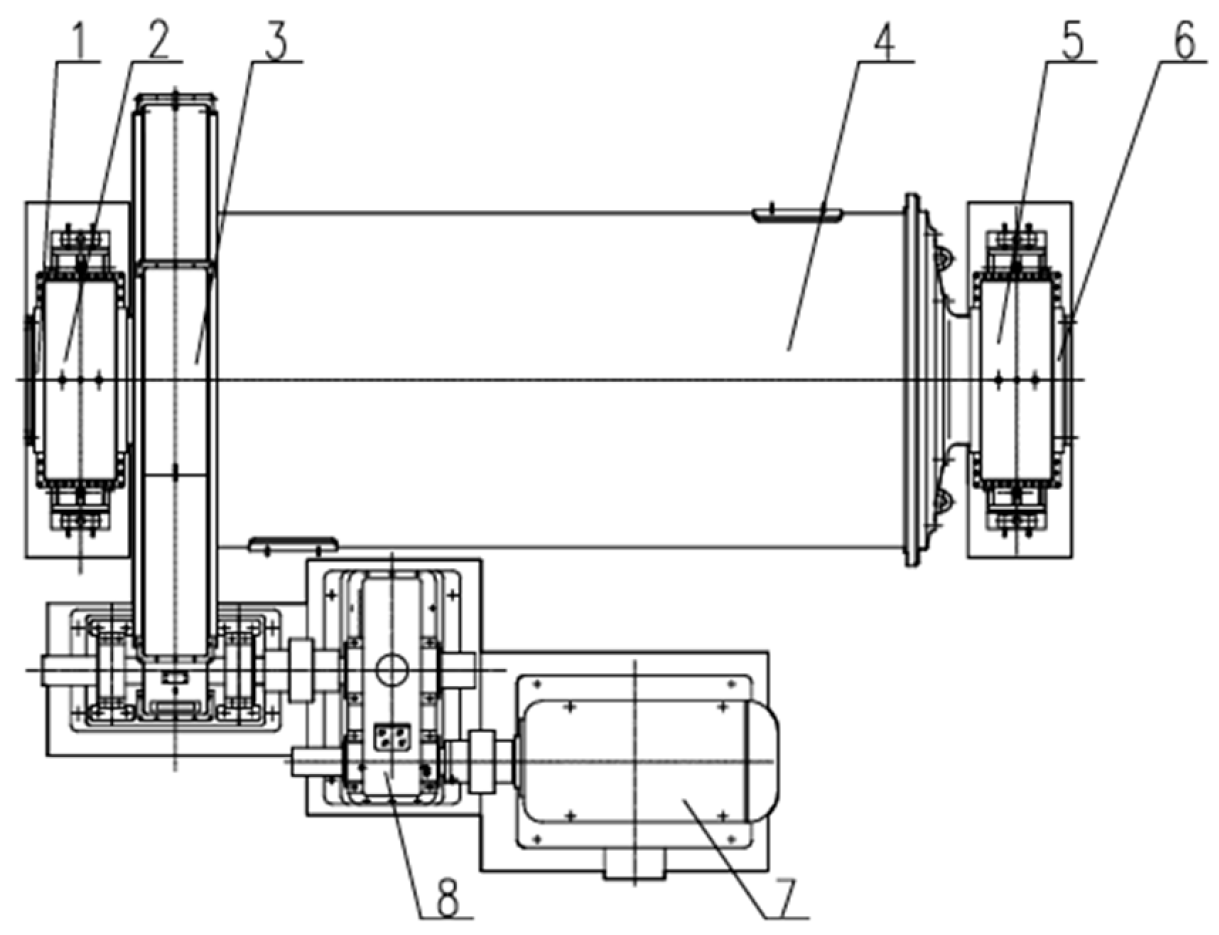
2]. The grinding mill assembly is primarily composed of a cylinder, a hollow shaft, sliding shoe bearings (positioned at the fixed and free ends), a drive ring gear, a drive motor, and a reducer, as illustrated in
Figure 1. During operation, torque is transmitted from the motor through the reducer to the drive ring gear attached to the cylinder. Consequently, the hollow shaft and cylinder, supported by the sliding shoe bearings, are made to rotate about their longitudinal axis. This rotation induces a cascading motion of the ore and grinding media within the cylinder, resulting in impact and attrition forces that facilitate the required comminution and refining of the ore [
3,
4].
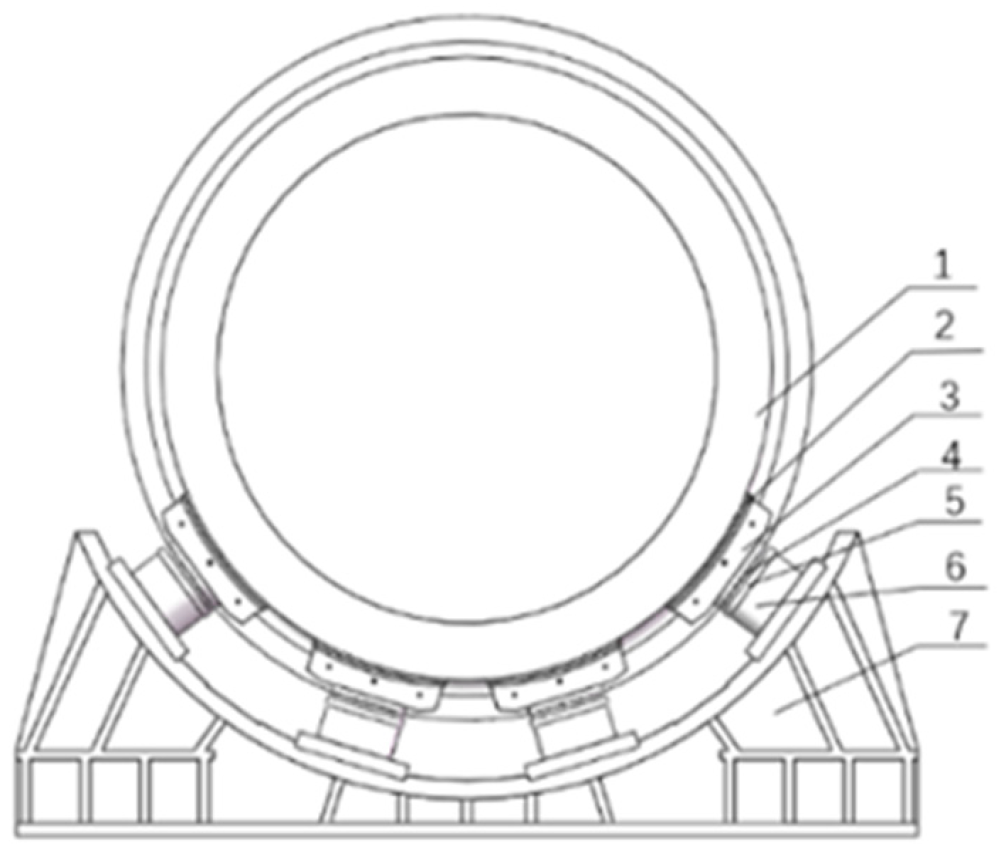
Sliding shoe bearings function as critical load-bearing and tribological support elements for large grinding mills. The operational principle is based on the hollow shafts at both ends of the mill cylinder forming a rotating contact pair with the stationary shoes of the bearing assembly. Multiple oil recesses of varying geometries are machined into the working surface of the sliding shoes. Lubricating oil is supplied to these recesses at a controlled pressure via a hydraulic pump. The lubricant flows axially and circumferentially within the narrow radial clearance between the hollow shaft and the shoes, establishing a lubricating oil film with a distinct pressure distribution. This film effectively levitates the hollow shaft, thereby supporting external loads and providing the required load-carrying capacity for the sliding shoe bearing [
5], as illustrated in
Figure 2 and
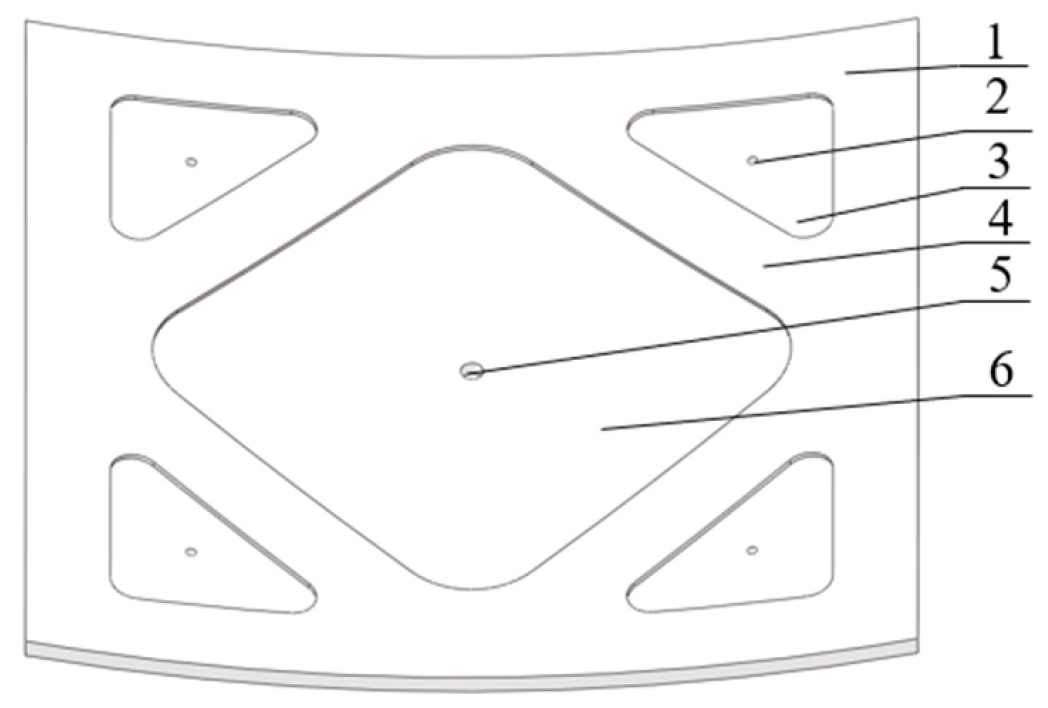
Figure 3. The load-bearing capacity and tribological performance of sliding shoe bearings are governed by the uniformity and stability of the high-pressure oil film thickness. However, even minute radial deformations on the surfaces of the shoe and hollow shaft can disrupt this uniformity, thereby compromising the overall performance of the sliding shoe bearing. To address this issue, this study is dedicated to investigating large-scale grinding mill sliding shoe bearings featuring a multi-recess configuration. Through the establishment of a bidirectional fluid–structure interaction (FSI) model between the high-pressure oil film and the hollow shaft, the deformation characteristics of the hollow shaft under typical low-speed and heavy-load operating conditions are systematically analyzed. The findings provide theoretical insights and practical references for the optimization design and analysis of large grinding mill sliding shoe bearings.
The sliding shoe bearing employed in grinding mills represents a classic form of hydrostatic bearing. Consequently, it has been the subject of extensive investigation by researchers worldwide. Fedorynenko et al. [
6] analyzed the dynamic characteristics of hydrostatic bearings using both the transfer matrix method and experimental approaches. They found that oil supply pressure and radial clearance significantly affect the bearing capacity of the spindle system; however, the two-way coupling effect of shaft deformation on oil film pressure was not addressed. Kadda et al. [
7] examined the elastic deformation of sliding shoe bearings through the finite element method, revealing that the rotation speed of these bearings significantly influences their elastic deformation. Inacio et al. [
8] proposed a method for the dynamic identification of hollow shaft ovalization deformation based on a multi-layer perceptron neural network, offering a novel perspective for the fault diagnosis of sliding bearings, although they did not consider the dynamic coupling effect of hollow shaft deformation on oil film pressure. Mehd et al. [
9] investigated the impact of the geometric shape of the hydrostatic bearing oil chamber on both the static and dynamic characteristics of the bearing. Their findings indicated that both the dynamic and static characteristics improve with an increase in high-pressure oil flow rate in the oil chamber and a decrease in groove area. Zhuang et al. [
10] investigated the effect of fluid–structure interaction on the static performance of hydrostatic bearings, with a particular focus on the load-carrying capacity. The findings demonstrated that the static load-carrying capacity of the bearing decreases significantly when accounting for the structural deformation induced by the fluid–structure interaction effect. Sun et al. [
11] utilized the finite element difference method to solve the pressure distribution of the hydrostatic bearing and analyzed the impact of eccentricity caused by the deformation of the shaft diameter on the bearing capacity. Their research revealed that the deformation of the shaft diameter is dependent on system parameters such as the length–diameter ratio and the static load of the bearing.
In summary, most existing research literature on sliding shoe bearings primarily focuses on bearing characteristics under single bearing bush, single oil cavity, or simplified working conditions. However, there has been limited research on the deformation of hollow shafts in multi-oil-chamber sliding shoe bearings when subjected to low-speed, heavy-load conditions. Consequently, this study investigates the sliding shoe bearing of a large grinding mill, with a specific focus on the multi-recess configuration. A numerical model based on fluid–structure interaction (FSI) was developed for this bearing system. The simulated recess pressures and radial displacements of the hollow shaft were experimentally validated using a custom-built single-shoe oil pressure test rig. By utilizing the validated numerical model, the complex coupling effects among the hollow shaft, the sliding shoe, and the lubricant film were systematically investigated. The effects of key parameters, including the recess area ratio, radial load, secondary recess supply pressure, and diameter of the primary recess supply orifice, were specifically examined.
2. Fluid–Structure Interaction Model for Sliding Shoe Bearings
2.1. Fluid–Structure Interaction
Fluid–structure interaction (FSI), an important method for multi-physics analysis, aims to elucidate the dynamic coupling mechanism between fluid pressure-induced structural deformation and structural deformation-induced reactions in the fluid domain [
12,
13]. Fluid–solid coupling can be categorized into unidirectional and bidirectional types. Unidirectional fluid–solid coupling considers only the one-way effect of the flow field on the structural components, while bidirectional fluid–solid coupling accounts for data exchange between the flow field and the solid field [
14]. In the case of sliding shoe bearings in mills, the oil film thickness typically ranges from 0.2 to 0.3 mm. Since unidirectional fluid–solid coupling solely analyzes the load transfer from the fluid to the structural components and neglects the reverse influence of structural deformation on the oil film shape, it is challenging to accurately describe the multi-field coupling characteristics of sliding shoe bearings during actual operation. Therefore, a bidirectional fluid-solid coupling analysis method should be employed to investigate the hollow shaft deformation of the mill’s sliding shoe bearings.
2.2. Governing Equation
2.2.1. Fluid Domain Control Equation
The fluid flow adheres to the principles of mass, momentum, and energy conservation. For general incompressible Newtonian fluids, these conservation laws are articulated through the following governing equations [
15].
Mass conservation equation:
Momentum conservation equation:
where
ρf is the fluid density, kg/m
3,
t denotes time, s, ▽ is the divergence operator,
v is the fluid velocity vector, m/s, τ
f is the shear force tensor, N/m
2,
ff is the volume force vector, N/m
3,
p is the fluid pressure, Pa,
μ is the dynamic viscosity, pa·s, and
is the velocity stress tensor, s
−1.
2.2.2. Solid Domain Control Equation
The conservation equation for the solid structure is derived from Newton’s second law:
where ρ
s is the solid density, kg/m
3,
is the local acceleration vector in the solid domain, m/s
2, σ
s is the Cauchy stress tensor, Pa, and
fs is the volume force vector, N/m
3.
2.2.3. Fluid–Structure Coupling Control Equation
Fluid–structure coupling calculations fundamentally involve an iterative process of interaction and solution between fluid and solid multi-physics fields. Consequently, the conditions for displacement and stress equilibrium must be satisfied at the fluid–structure coupling interface.
where d is the displacement vector, f denotes the stress vector, the subscript f indicates the fluid, and s indicates the solid.
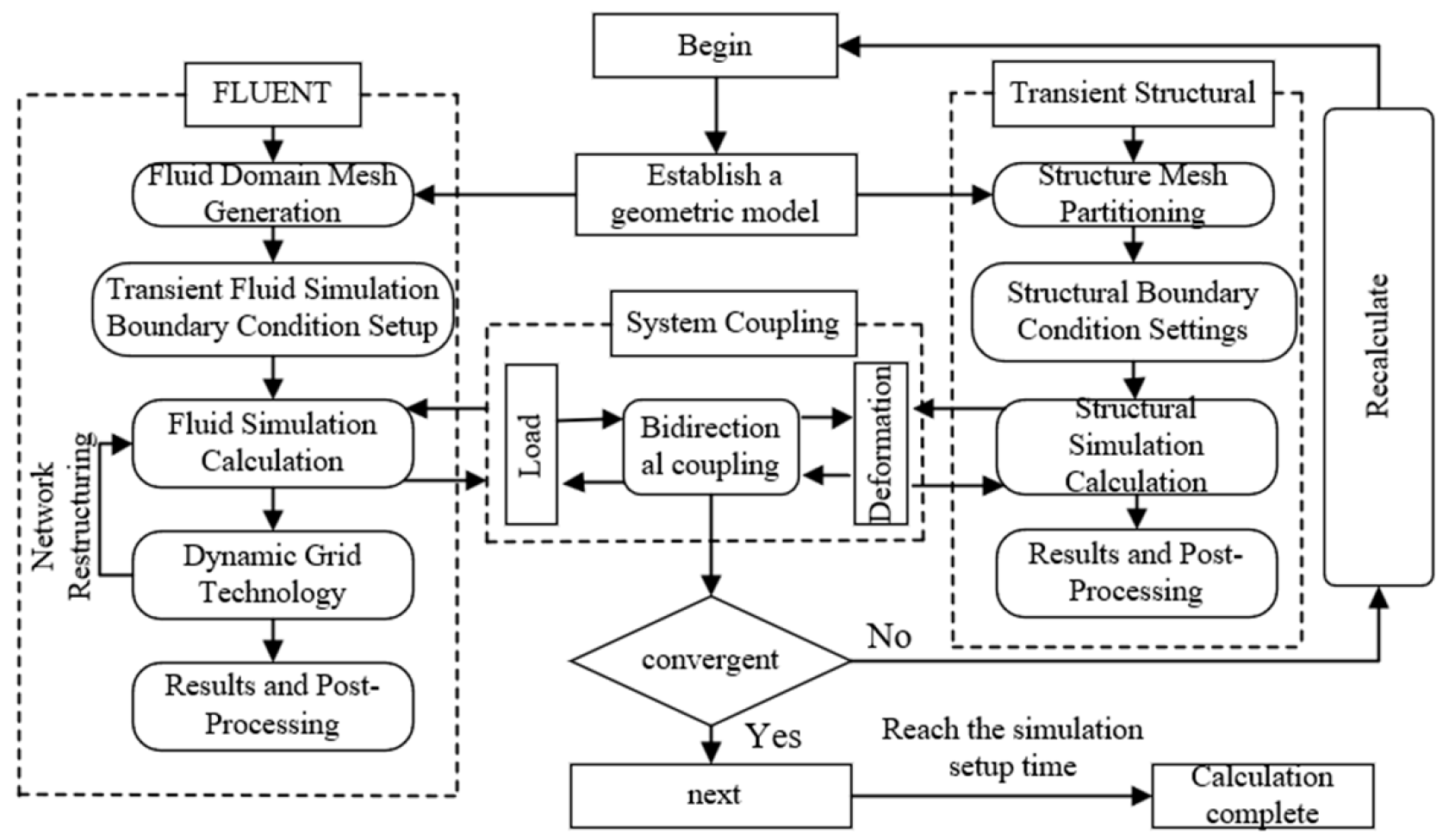
Simulation analysis was conducted using ANSYS (version:2022.R1), addressing both the fluid and solid domains within the fluid–structure interaction model through the Fluid Flow and Transient Structural modules, respectively. Cross-domain data iteration was facilitated via the System Coupling module. This computation represents a transient analysis, necessitating convergence through the iterative interaction of multi-physics data. The specific solution workflow is depicted in
Figure 4.
2.3. Structure and Related Parameters of Sliding Shoe Bearings
The sliding shoe bearing system of the grinding mill investigated in this study comprises a hollow shaft, sliding shoes, shaft liners, spherical pivots, adjustment bolts, hydraulic cylinders, and a base (
Figure 2). During operation, the hollow shaft exhibits elliptical deformation in its radial cross-section due to the combined weight loads of the ore, grinding media, and the cylinder structure. By adjusting the bolts on the four sliding shoes, uniform pressure is maintained within the oil chamber of each shoe, thereby effectively offsetting the elliptical deformation of the hollow shaft’s radial cross-section. Additionally, axial bending deformation of the hollow shaft is automatically compensated for by the spherical pivots located at the connection between the sliding shoes and the hydraulic cylinders. This design effectively mitigates eccentric loads along the axial contact length between the hollow shaft and the shoes caused by such bending deformation [
16,
17]. Consequently, this study focuses exclusively on the coupled elastic deformation occurring within the high-pressure oil film contact zone between the hollow shaft and the sliding shoe. The working surface of the sliding shoe incorporates a multi-oil-chamber configuration, comprising one primary oil chamber and four secondary oil chambers. These oil chambers are demarcated by throttling lands and are connected to their respective primary and secondary oil supply ports, as depicted in
Figure 3. The primary oil chamber (operating at pressure P) serves as the principal load-bearing component, while the secondary oil chambers (operating at approximately 0.6 P) function primarily to enhance operational stability. Furthermore, both the primary and secondary oil chambers are isolated by sealing lands to maintain pressure integrity. The main structural parameters of the sliding shoe bearing are presented in
Table 1, while the type and parameters of the lubricating oil are shown in
Table 2, and the material parameters of the hollow shaft and bearing bush are listed in
Table 3.
2.4. Geometric Modeling and Mesh Generation
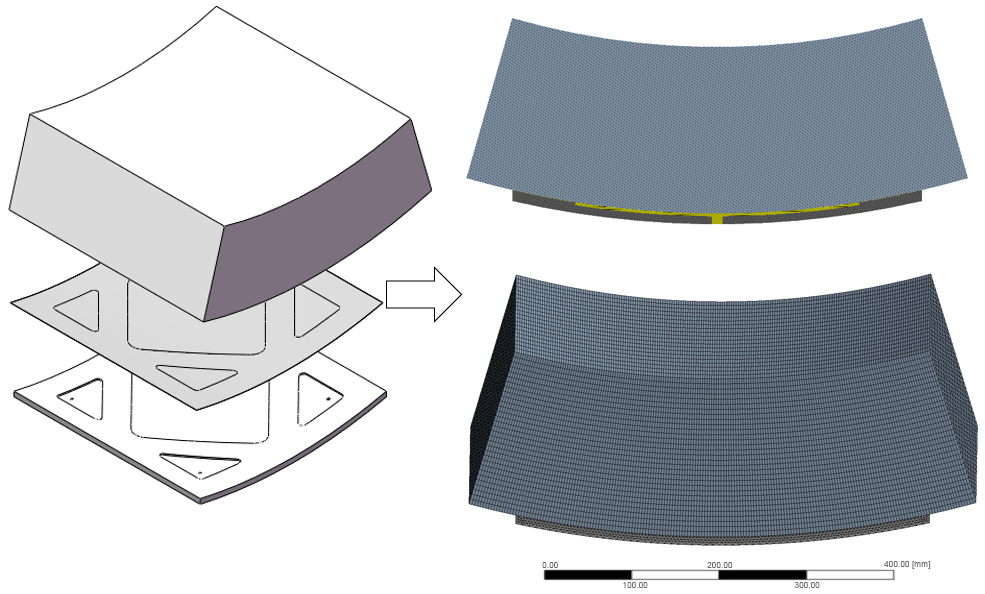
A three-dimensional solid model of the multi-oil-chamber sliding shoe bearing was constructed using SolidWorks (version:2016) design software. To facilitate the analysis and ensure computational efficiency, the bearing system was simplified into three primary components: the hollow shaft, the sliding shoe, and the fluid domain, as illustrated in
Figure 5. Components such as the bearing base, hydraulic cylinder, and shaft liner possess significantly higher stiffness; thus, their deformations are considered negligible compared to those of the sliding shoe, oil film, and hollow shaft. However, to ensure the fidelity of the contact simulation, a rigid body computational domain was generated to model the interface between the shaft liner and the sliding shoe.
The sliding shoe bearing model is divided into distinct regions, with appropriate mesh types selected based on the unique characteristics of each region. Structural details, such as chamfers and fillets, which have a negligible impact on simulation results, are omitted. The simplified model is then meshed. Due to the distribution of oil cavities on the inner surface of the bearing bush and variations in oil supply pressure, the flow of high-pressure lubricating oil in the gap between the bearing bush and the hollow shaft exhibits complex behavior. To ensure computational efficiency and result accuracy, mesh independence verification is required. The hollow shaft is a regular revolving structure with uniform geometry and no complex topological features. To balance computational efficiency and simulation accuracy, hexahedral elements are generated using sweep meshing technology. Hexahedral meshes offer low distortion rates, high computational efficiency, and excellent field quantity interpolation accuracy, which effectively reduces numerical discretization errors. The meshed hollow shaft model is shown in
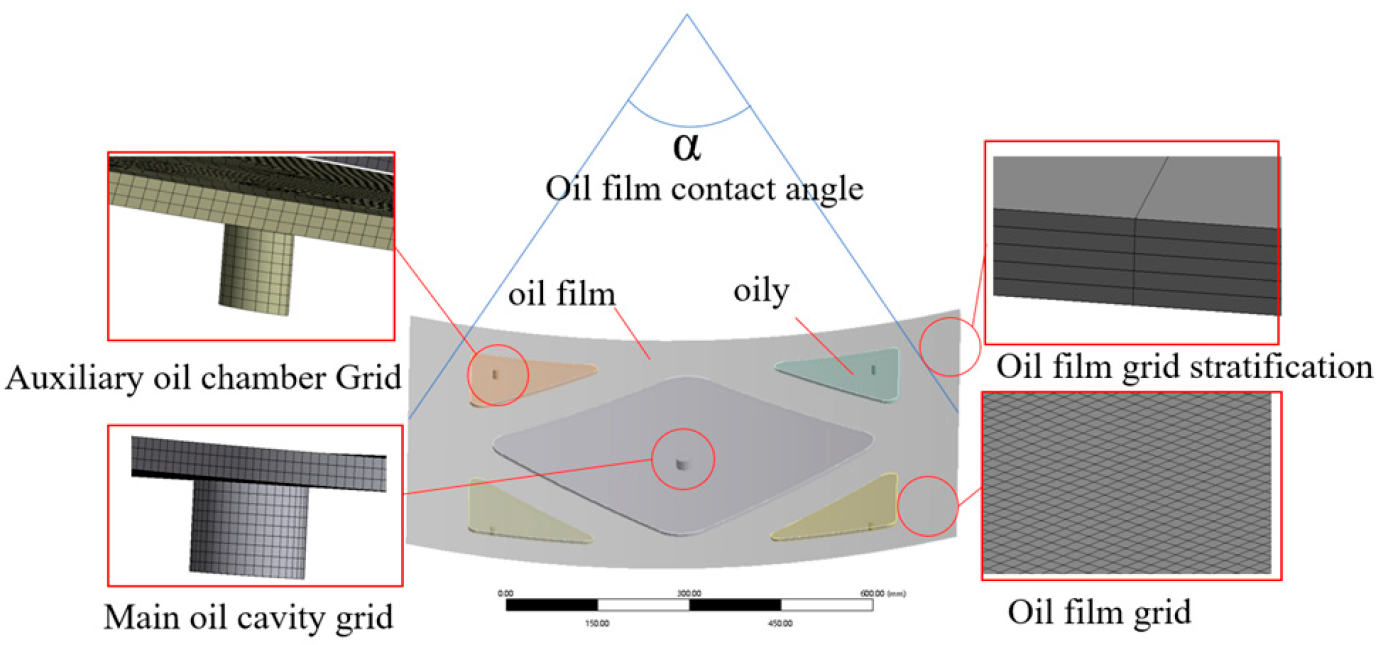
Figure 5. The oil cavity has an irregular geometry, so tetrahedral meshing is adopted to adapt to the complex shape of the oil cavity, avoiding mesh distortion or collapse. The fluid domain is divided into two regions: the oil film region and the oil cavity region. The oil film region is relatively thin to avoid “floating-point exceptions and negative volumes,” and the fluid domain is meshed using a multi-region approach with edge size adjustment [
18]. The meshing results are shown in
Figure 6.
2.5. Boundary Conditions and Computational Settings
2.5.1. Flow Validation and Throttling Methods
To determine the fluid flow state within the lubricating oil supply pipeline of the sliding shoe bearing, a quantitative analysis was conducted based on the maximum design flow rate (
Q = 70 L/min) and the inner diameter of the supply pipeline (
dc = 20 mm). The Reynolds number was subsequently calculated. The average flow velocity (
v) and Reynolds number were computed as follows:
The calculated Reynolds number,
Re = 337.3, is less than the critical Reynolds number of 2300, which signifies the transition from laminar to turbulent flow. This indicates that the fluid flow within the lubricating oil supply pipeline is in a laminar state. Consequently, the following flow formula was adopted to describe the relationship between the flow rate, Qin, and the pressure difference within the lubricating oil supply pipeline:
where
Qin is the oil supply flow rate;
dc and
lc are the diameter and length of the capillary restrictor, mm;
Ps is the supply oil pressure, Pa; and
Pr is the oil chamber pressure, Pa.
2.5.2. Calculation Boundary Condition Settings
This study employs a decoupled solution strategy, constructing separate simulation models for the fluid domain in ANSYS Fluent and the solid domain in the Transient Structural module. Data interaction across multiple physics fields is facilitated through the System Coupling module, which adheres to the bidirectional data transfer framework based on the theoretical principles of fluid–structure interaction (FSI) [
15,
19].
In this study, fluid domain boundary conditions are established to ensure accurate simulation of the lubrication system. Given that lubricating oil is continuously pumped into the oil cavities, a pressure inlet boundary condition is implemented at the oil inlet. This approach ensures that the flow characteristics are appropriately captured, facilitating a more realistic representation of the lubrication process. The bearing oil cavity system employs a primary and secondary oil cavity design, separated by a throttling boundary to establish a pressure gradient. The primary oil cavities serve as the main load-bearing areas, with their pressure set to P (10.5 MPa), while the secondary oil cavities are set to 0.6 P. The outlet boundary is defined as standard atmospheric pressure to simulate an open flow environment. To address mesh deformation in the fluid domain induced by hollow shaft deformation and oil film pressure fluctuations, a dynamic mesh system is established using the spring-based smoothing and local remeshing algorithms. To determine the fluid state, the Reynolds number was calculated using the formula
[
20]. Based on the relevant data presented in
Table 2, a Reynolds number of
Re = 2.86 was obtained, which is below the critical threshold of 2300. Consequently, the laminar flow model was selected for the fluid flow calculations within the relative clearance between the hollow shaft and the bearing bush.
Table 4 lists the solution algorithms and spatial discretization methods for fluid models.
2.6. Grid Independence Verification
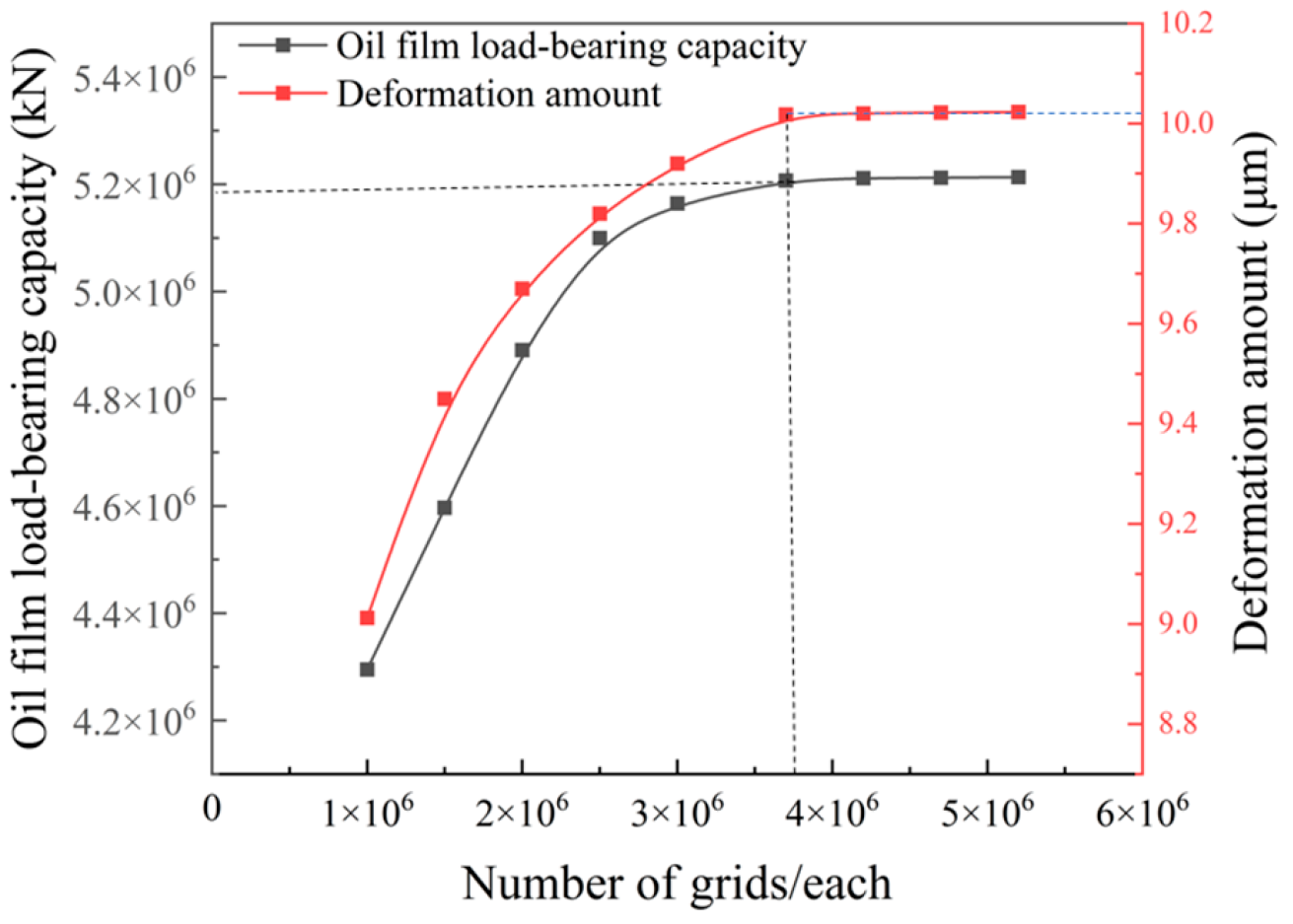
To mitigate the impact of mesh density on the accuracy of deformation simulations for hollow shafts in sliding shoe bearings, a surface load of 4900 kN was applied to the inner surface of the hollow shaft model. Under steady-state numerical simulation conditions, the main oil chamber was set to an inlet pressure of 10.5 MPa, the secondary oil chamber to an inlet pressure of 6.3 MPa, and the outlet pressure to 0.1 MPa (one atmosphere). A steady-state numerical simulation was conducted on the fluid domain, and mesh independence was verified by comparing the oil film bearing capacities. Using the control variable method, the model grid size was adjusted to vary the number of grid cells within the range of 1 × 10
6 to 5 × 10
6. This adjustment aimed to obtain the changes in oil film bearing capacity and the maximum deformation of the hollow shaft under different grid cell counts, as illustrated in
Figure 7. The mesh independence verification results in
Figure 7 indicate that the computational results have essentially converged when the number of mesh elements reaches 3,723,155. Further refinement of the mesh has little effect on enhancing computational accuracy but significantly reduces computational efficiency. Therefore, after careful consideration, the mesh partitioning scheme with 3,723,155 elements was ultimately adopted.
2.7. Oil Film Pressure Simulation Results
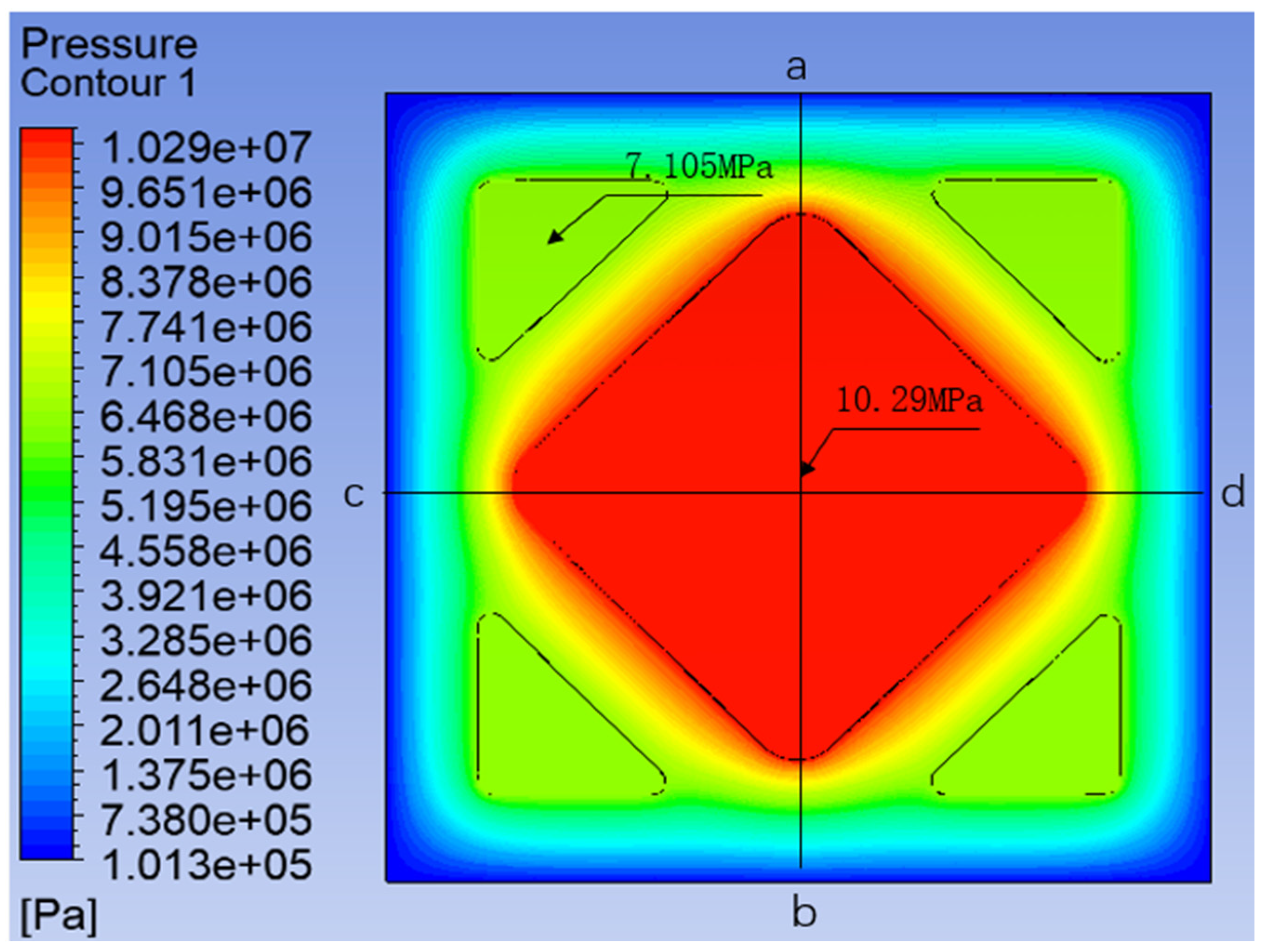
Through numerical simulations of the two-way fluid–structure interaction in the grinding mill’s sliding shoe bearing, the oil film pressure distribution contour at the contact interface between the bearing shell and hollow shaft was obtained, as shown in
Figure 8.
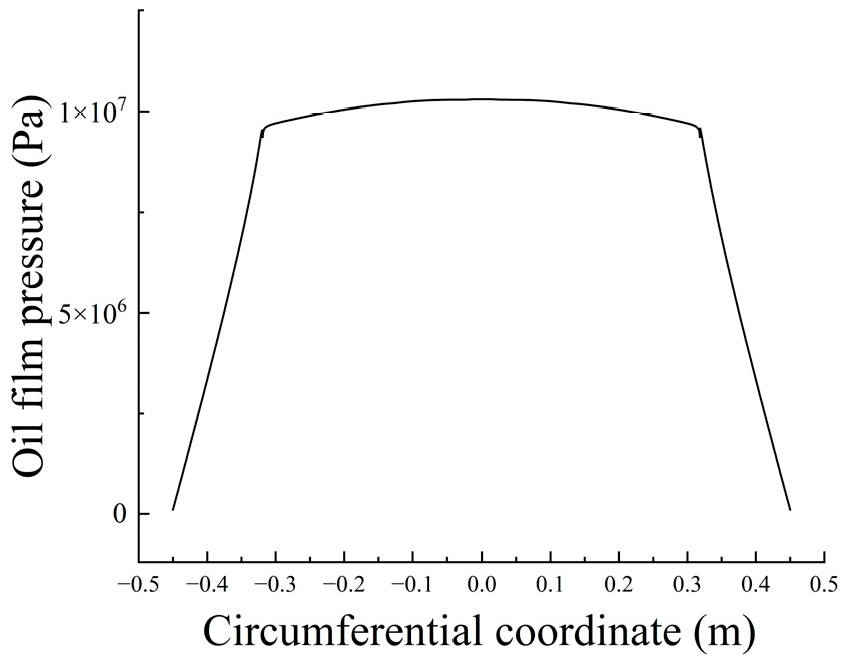
Figure 8 illustrates a significant high-pressure concentration phenomenon in the core region of the main oil chamber of the bearing bush, with a peak pressure value of 10.29 MPa. This reflects a 2% pressure loss compared to the supply inlet pressure of 10.5 MPa. The pressure loss is primarily attributed to the throttling effect as high-pressure oil from the main oil chamber flows through the supply pipe inlet towards the periphery of the bearing bush. The four symmetrically distributed auxiliary oil chambers were set to a supply pressure of 6.3 MPa, which is equivalent to 60–70% of the main chamber’s supply pressure. However, simulation results indicated that the auxiliary chamber pressure increased to 7.105 MPa, representing a 12.7% rise compared to the set value. This phenomenon arises from significant cross-flow between the main and auxiliary chambers, where high-pressure lubricant flows from the main chamber into the auxiliary chambers through throttling edge gaps. Based on the principle of energy conservation, the kinetic energy of the high-pressure oil in this cross-flow is converted into pressure energy within the auxiliary chambers, resulting in a localized pressure superposition effect. A continuous, uniform blue low-pressure zone exists around the sealing edge of the bearing shell, maintaining a stable pressure of 0.1013 MPa—slightly higher than standard atmospheric pressure. This indicates no high-pressure leakage at the sealing edge, but rather stable seepage, confirming that the high-pressure oil film has a stable load-bearing capacity.
In
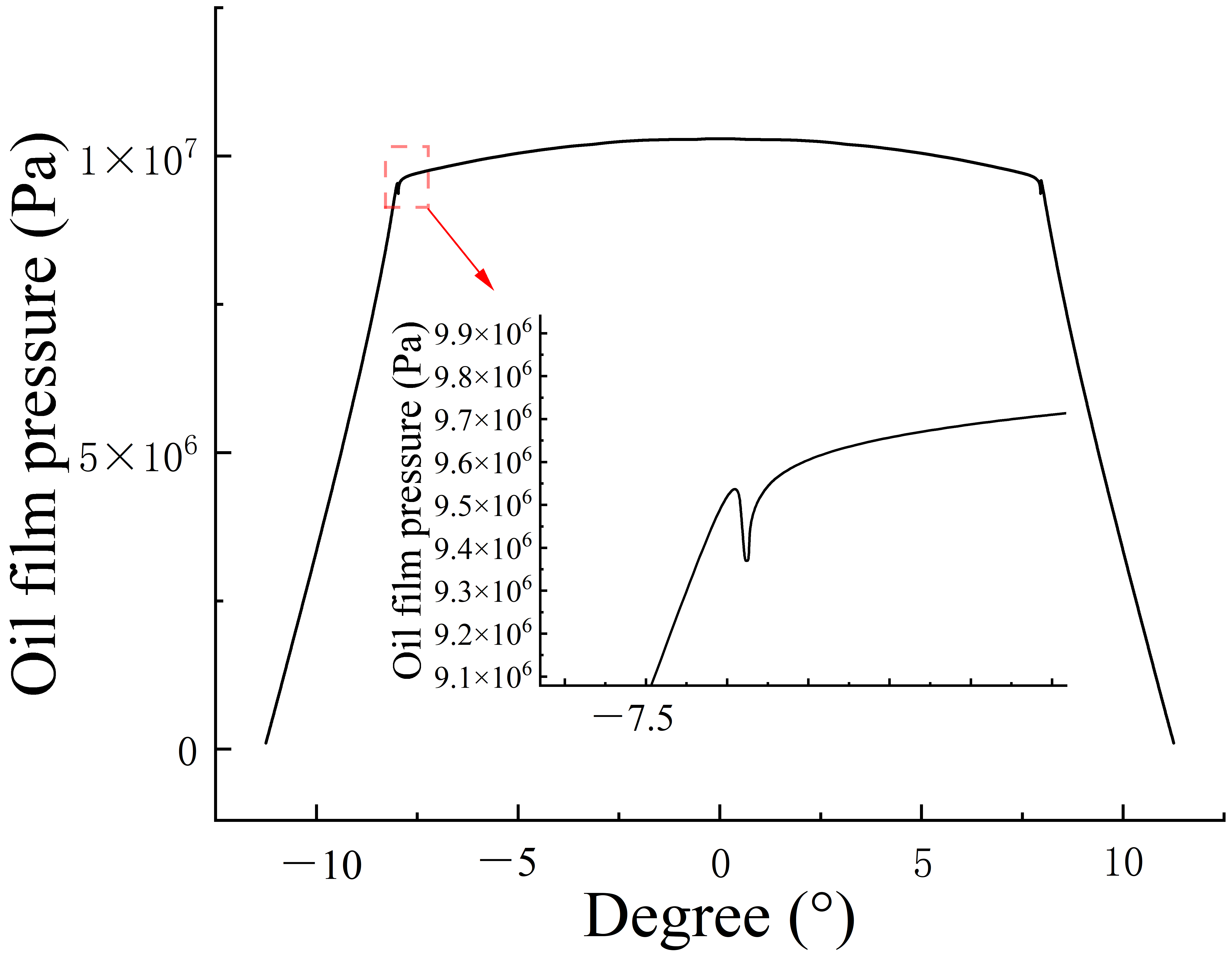
Figure 8, the axial symmetry line (ab) and the circumferential symmetry line (cd) of the bearing shell are extracted. The oil film pressure distribution curves along these two symmetry lines are shown in
Figure 9 and
Figure 10, where
Figure 8 illustrates the axial oil film pressure distribution. Overall, the oil film pressure distribution along the axial direction demonstrates good symmetry. The maximum oil film pressure occurs at the main oil chamber, gradually decreasing from the chamber edge towards the sealing edge region at the bearing edge, ultimately dropping to standard atmospheric pressure (1 atm). This pressure decay occurs because the lubricating oil flows through the sealing edge gap driven by the pressure difference. According to Bernoulli’s equation, the flow velocity increases proportionally to the decrease in the flow cross-sectional area. To maintain energy conservation, the pressure consequently decreases.
Figure 10 presents the circumferential oil film pressure distribution curve of the bearing shell. A pressure fluctuation with an amplitude of 0.3 MPa is observed at the junction between the main oil chamber and the sealing edge. This phenomenon arises from the reduction in the fluid flow interface, which causes fluctuations in the velocity field and local pressure.
3. Partial Validation
3.1. Test Equipment and Procedures
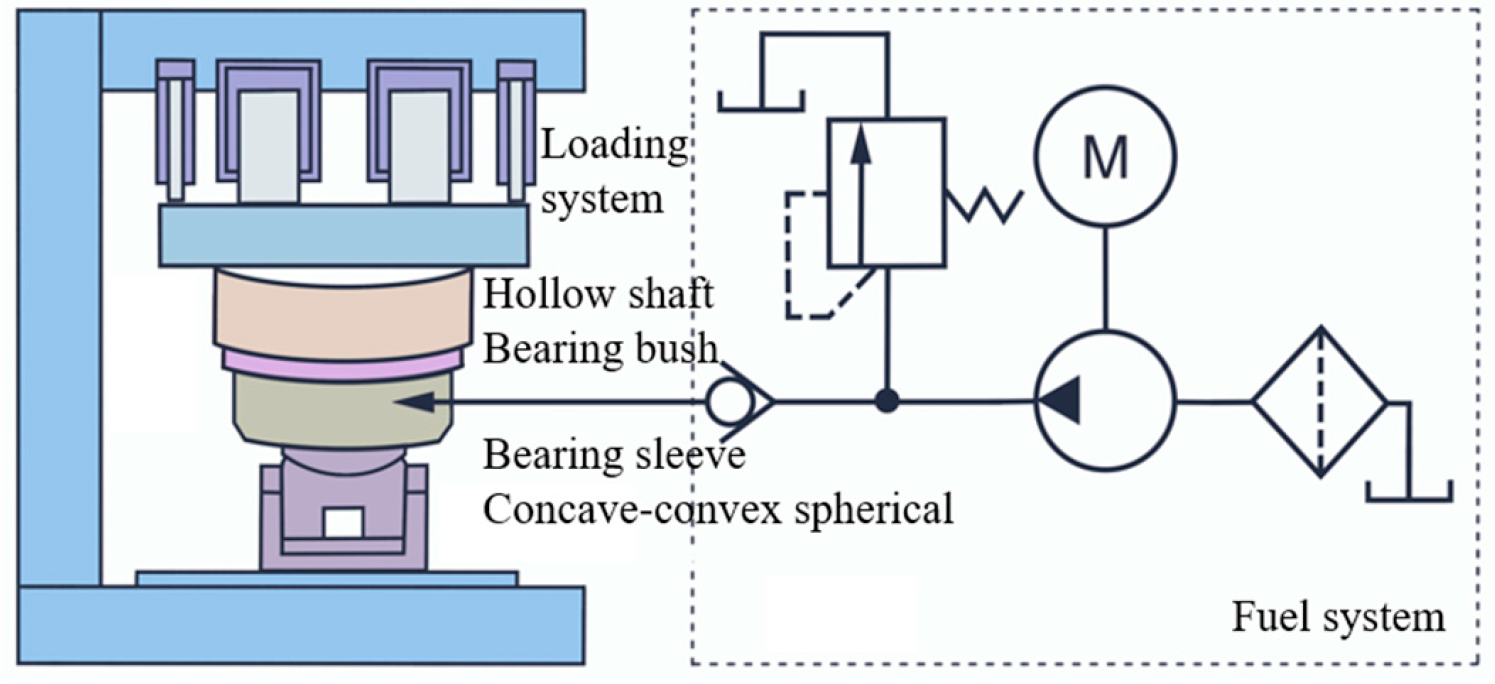
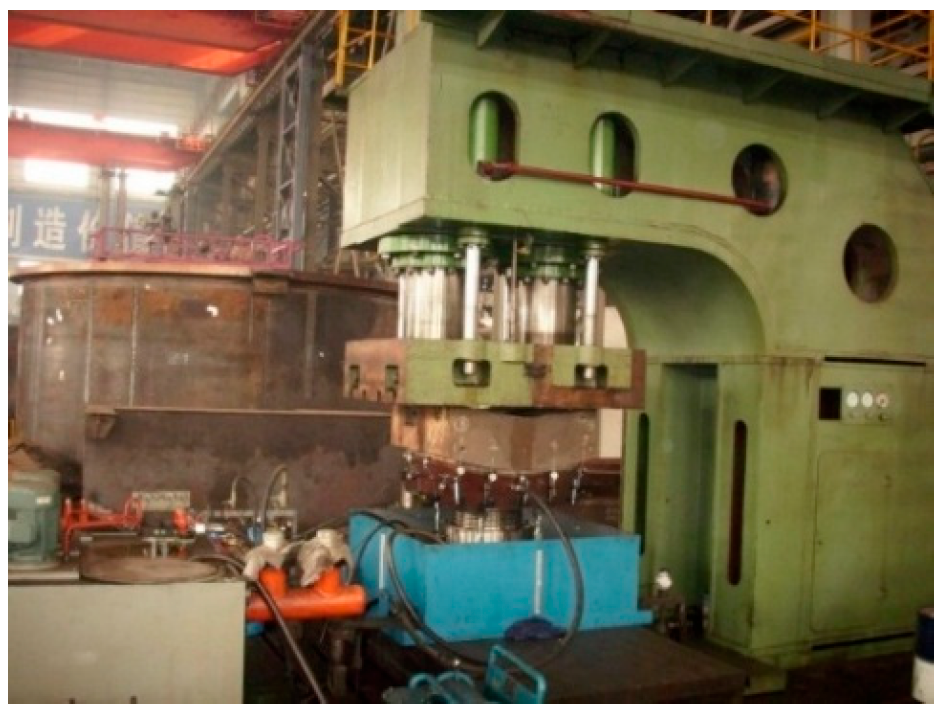
To validate the fidelity of the bidirectional fluid–structure interaction (FSI) model developed for the sliding shoe bearings of grinding mills, a custom-built single-shoe test rig was assembled using a dedicated industrial hydraulic press. Given the spatial constraints and the minute deformation of the hollow shaft within the ultra-thin oil film, the direct installation of displacement sensors in the contact zone was impractical. Consequently, the FSI model was indirectly validated by monitoring the oil film pressure distribution on the sliding shoe and the overall radial displacement of the hollow shaft under varying load conditions. Given the excessive diameter of the mill hollow shaft, direct testing on a single bearing press was impractical. An arc-shaped pressure plate with constant curvature was used to simulate the hollow shaft. Controlled loads were applied to this plate via the hydraulic press to replicate the testing conditions. Simultaneously, a metered pump continuously supplied high-pressure lubricating oil to the bearing oil cavity. This setup formed a stable oil film with load-bearing capacity in the gap between the curved pressure plate (simulating the hollow shaft) and the bearing bushing, thus enabling the simulated hollow shaft to achieve a stable suspended operating state. The testing principle and experimental setup are illustrated in
Figure 11 and
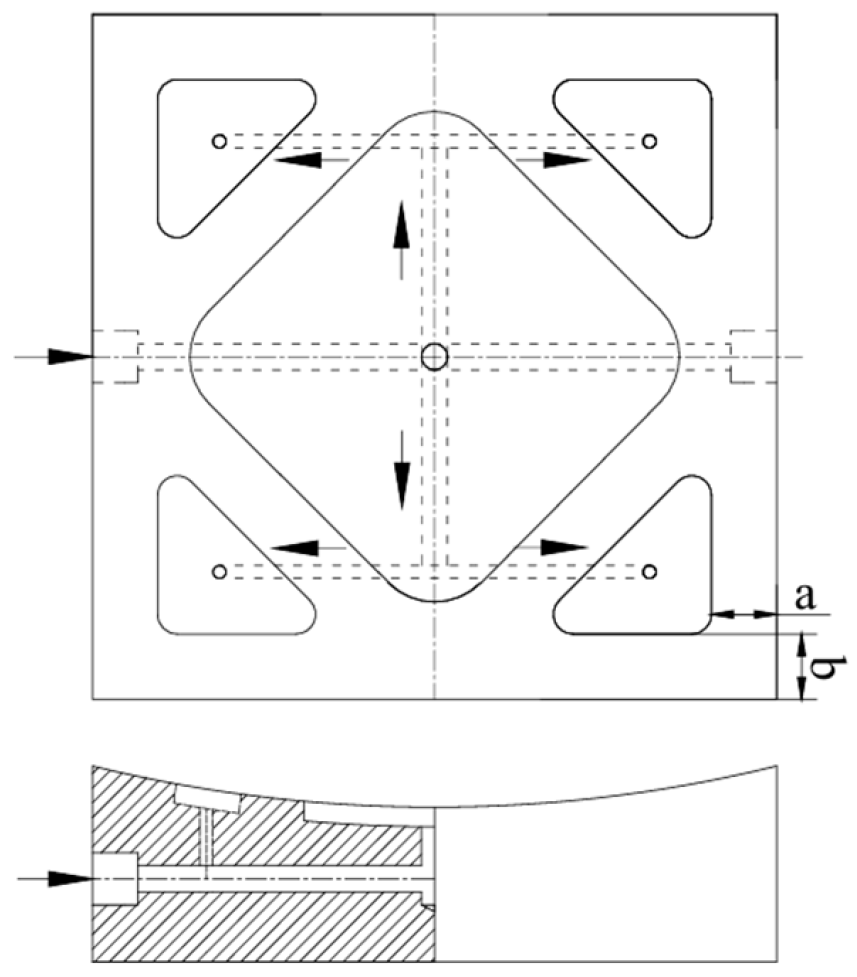
Figure 12. The oil supply paths for the main and auxiliary oil chambers are shown in
Figure 13.
The test apparatus comprises a loading system and a measurement system. The loading is applied through a high-precision, closed-loop controlled hydraulic press, with an output load range of 3.92 × 10
3 to 5.88 × 10
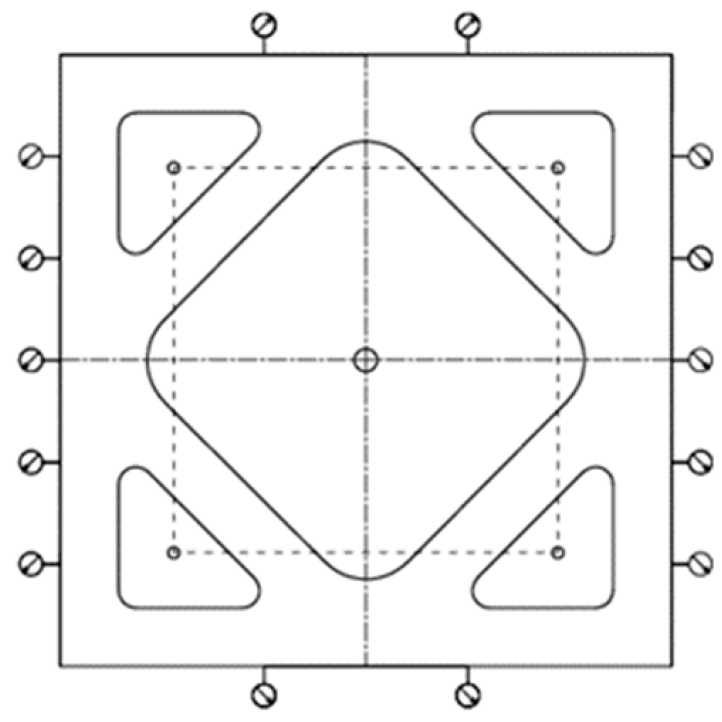
3 kN. The oil supply system delivers pressurized lubricating oil into the bearing oil cavity, thereby forming a high-pressure oil film. Data measurements encompass oil cavity pressure and oil film thickness. Oil cavity pressure is monitored in real time by connecting the oil circuits to pressure gauges. Oil film thickness is assessed using a total of 14 measurement points: two dial indicators (accuracy: 0.01 mm) positioned on each axial side of the bearing shell and five on each radial side, as shown in
Figure 14. This multi-point measurement accurately determines the lift of the hollow shaft, which corresponds to the thickness of the high-pressure oil film.
This study utilized a bearing shell with a 45% oil cavity ratio, defined as the ratio of the oil cavity area for clarity, as the test specimen. The lubrication station maintained an oil supply pressure of 10.5 MPa. To investigate the impact of applied load on the performance of the bearing shell, five distinct load conditions were established. The applied loads under these five conditions were as follows: 3.92 × 10³ kN, 4.14 × 10³ kN, 4.90 × 10³ kN, 5.39 × 10³ kN, and 5.88 × 10³ kN.
3.2. Comparative Analysis of Experimental and Numerical Results
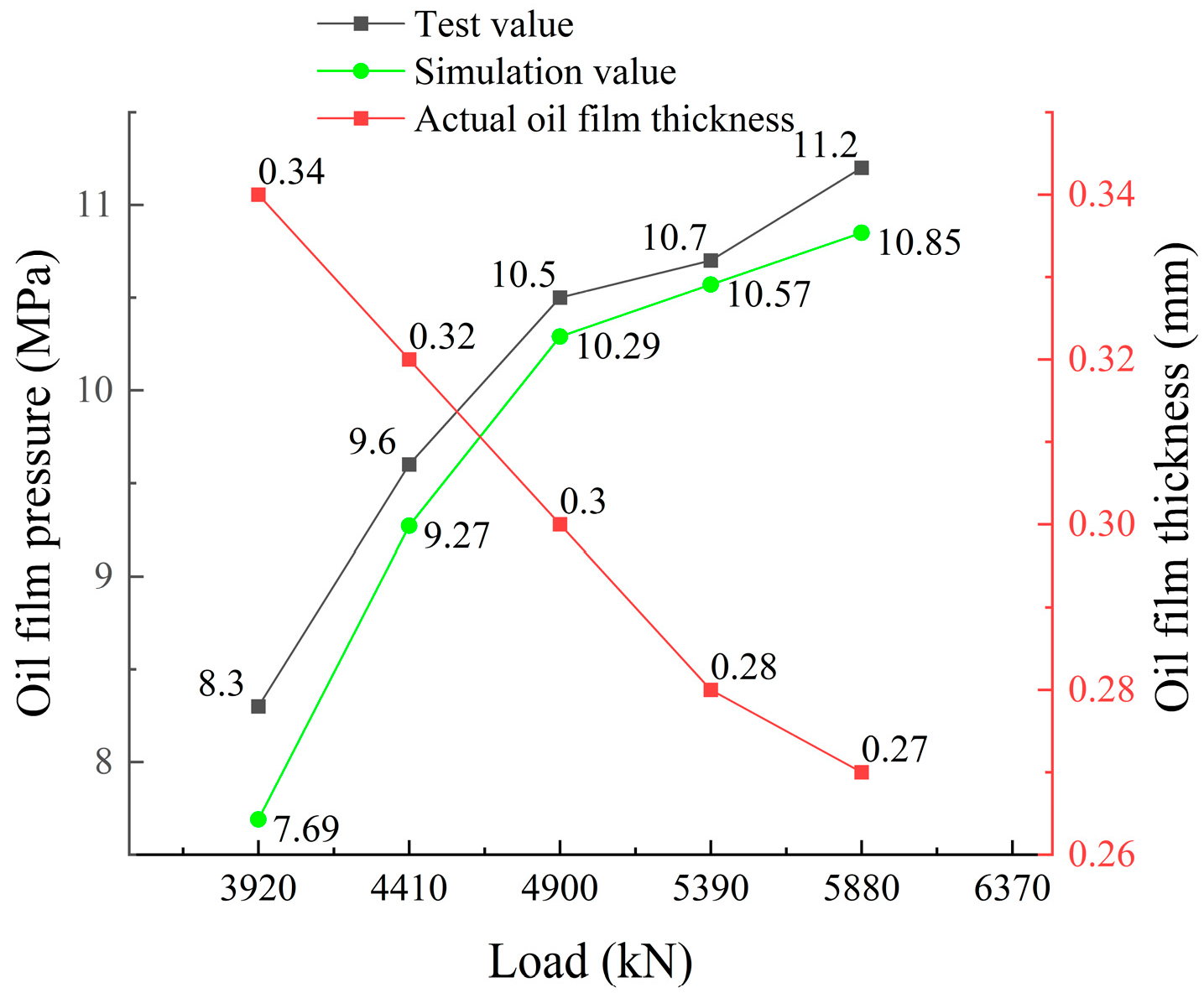
Based on the aforementioned test conditions, experimental data on the average oil film pressure and thickness in the main oil chamber of the sliding shoe bearing, which is consistent with the study object, were obtained under varying loads. The experimental results for oil film thickness and main oil chamber pressure were plotted alongside the simulation results in the same coordinate system, as shown in
Figure 15.
Figure 15 indicates that the main oil chamber pressure increased progressively with the load applied to the hollow shaft, and the trends of the experimental and simulated values were generally consistent. The oil film thickness exhibited a decreasing trend with increasing load, varying from 0.27 to 0.34 mm, which is essentially consistent with the model’s designed clearance of 0.3 mm. The deviation between the simulation results and experimental data primarily stemmed from differences in initial conditions and boundary constraints between the simulation and testing. During modeling, simplifications were applied to the actual oil chamber structure and fluid flow, neglecting minor geometric imperfections on the oil chamber walls and the viscosity-temperature dependence of the lubricating oil. These simplified or neglected factors exerted a non-negligible impact on the experimental results. During testing, fluctuations in the lubricating oil flow occurred due to variations in equipment operation and pressure losses along the pipeline, leading to differences in initial and boundary conditions between the simulation and experiment, which in turn caused deviations between the simulation and experimental results. The largest deviation between the simulation and test results for oil film pressure occurred at an applied load of 3920 kN, with a maximum error of 7.35%. The validity of the developed fluid–structure interaction (FSI) model for the sliding shoe bearing was confirmed, with results falling within an acceptable margin of error.
4. Numerical Analysis of Hollow Shaft Deformation and Key Influencing Factors
Based on the previously validated two-way fluid–structure interaction model, a simulation analysis was conducted to explore the deformation characteristics of the hollow shaft. By integrating the characteristics of oil film pressure distribution, the deformation features of the hollow shaft and the gradient distribution of deformation displacement in relation to the oil film pressure field were analyzed. This analysis elucidated the feedback mechanism of structural response to the load-bearing characteristics of the oil film.
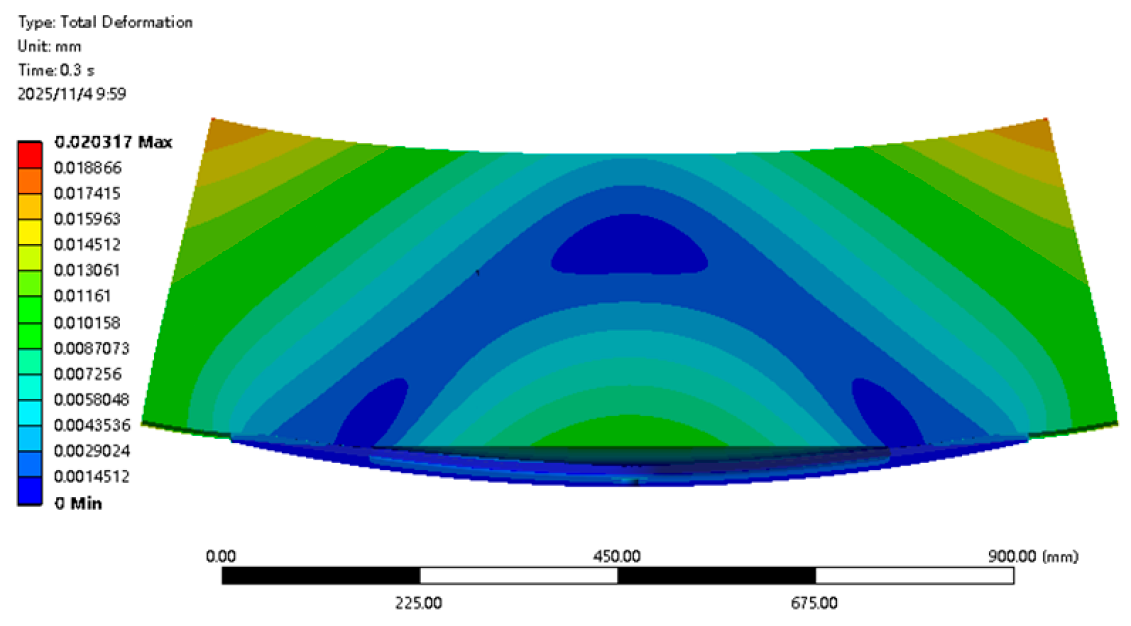
The deformation contour map of the hollow shaft is presented in
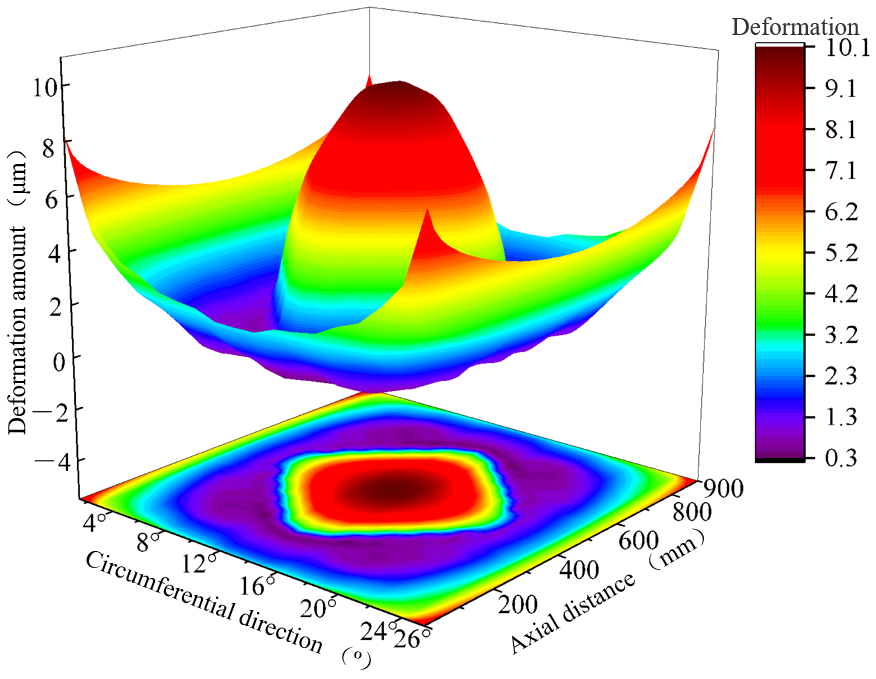
Figure 16. Based on the characteristics of the oil film pressure distribution, the main oil chamber region exhibited upward bulging deformation, driven by the high pressure of the oil film. In the auxiliary oil chamber region, the distribution of the oil film pressure field varies due to the cross-flow effect, resulting in a noticeable difference in the deformation of the hollow shaft between the auxiliary and main oil chambers. The axial deformation distribution of the hollow shaft is illustrated in
Figure 17, displaying a typical feature of “central bulge with concave ends”. Analyzing this in conjunction with the oil film pressure distribution revealed that the deformation peaked at the hollow shaft position corresponding to the bearing’s main oil cavity. The deformation extends radially outward from the center of the main oil cavity, gradually diminishing toward the periphery. This pattern is directly correlated with the oil film pressure distribution: the highest oil film pressure at the main oil cavity exerts the greatest normal force on the hollow shaft, driving the deformation to its peak. As the oil film pressure decreases radially outward from the main oil cavity, the deformation correspondingly diminishes. In the oil film exit region near the bearing edge, localized increases in deformation occur due to the “edge effect” of the oil film pressure field, where lubricant outflow alters the rate of pressure decay. Consequently, the hollow shaft at the bearing edge experiences secondary deformation adjustments under the influence of the load. Furthermore, the deformation curve in
Figure 17 displays an approximately horizontal transition zone between the peak and trough regions. This phenomenon arises because, during the decay of the oil film pressure, the oil film pressure field and the external load field reach a temporary equilibrium in this region, resulting in a “plateau-like” feature in the deformation curve. A further comparison of the circumferential and axial deformations of the hollow shaft in
Figure 17 indicates that the circumferential deformation at the bearing edge surpasses the axial deformation.
4.1. Comparative Analysis of FSI Models and Rigid Bearing Models
To quantitatively elucidate the impact of hollow shaft deformation on bearing performance, a comparative analysis was conducted between the proposed fluid–structure interaction (FSI) model and a conventional rigid bearing model.
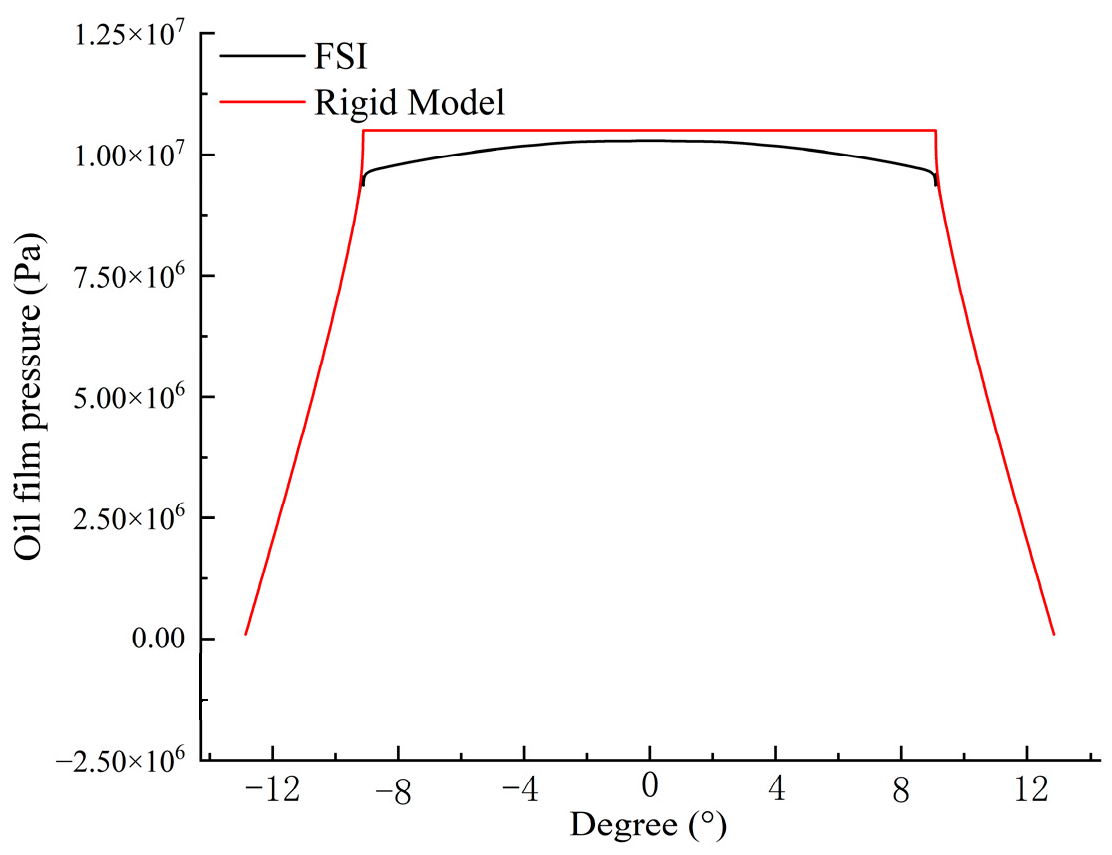
Figure 18 illustrates the circumferential pressure distributions for both models under identical operating conditions (Load: 4900 kN; Supply Pressure: 10.5 MPa). This comparison highlights a pronounced phenomenon of ‘pressure attenuation’ induced by structural deformation. In contrast, the rigid model exhibits a highly concentrated pressure distribution characterized by steep gradients. In contrast, the FSI model exhibits a smoother pressure profile, with the peak pressure reduced to 10.29 MPa, representing a decrease of approximately 2%. This deviation is fundamentally attributed to the bidirectional coupling between the fluid and solid domains. As the oil film pressure intensifies, it induces a radial expansion of the hollow shaft, consistent with the deformation profile depicted in
Figure 17. This expansion results in a localized enlargement of the oil film gap within the primary load-bearing zone. According to lubrication theory, this increase in film thickness leads to a reduction in the generated hydrodynamic pressure (P). Consequently, the flexible hollow shaft acts as a self-regulating mechanism, effectively attenuating pressure peaks and redistributing the load across a broader circumferential span. This deformation-induced pressure redistribution has profound implications for the system’s overall performance. On one hand, it enhances operational reliability by mitigating stress concentrations and averting the risk of high-pressure spikes that could exceed the yield strength of the Babbitt alloy liner, as might be predicted by rigid theory. On the other hand, the structural compliance alters the stiffness characteristics of the bearing system. This ‘softening’ effect implies that the actual load-carrying capacity per unit displacement is marginally lower than the predictions made by rigid models. Therefore, neglecting these deformations during the design phase may lead to an overestimation of bearing stiffness, resulting in potential miscalculations regarding the safety margins of the bearing material.
The elastic deformation of the hollow shaft in a sliding shoe bearing, which aligns with the study’s focus, is a crucial factor influencing both the stability of oil film thickness and the bearing’s load-bearing capacity. Under actual operating conditions, the deformation of the hollow shaft is affected by the combined influence of several factors, including the applied load, oil supply pressure in the auxiliary oil chamber, the area ratio of the oil chamber, and the inner diameter of the oil supply orifice in the main oil chamber. Building on the comprehensive analysis of hollow shaft deformation presented above, the subsequent discussion will concentrate exclusively on the circumferential deformation of the hollow shaft.
4.2. Effect of Oil Cavity Area Ratio on Hollow Shaft Deformation
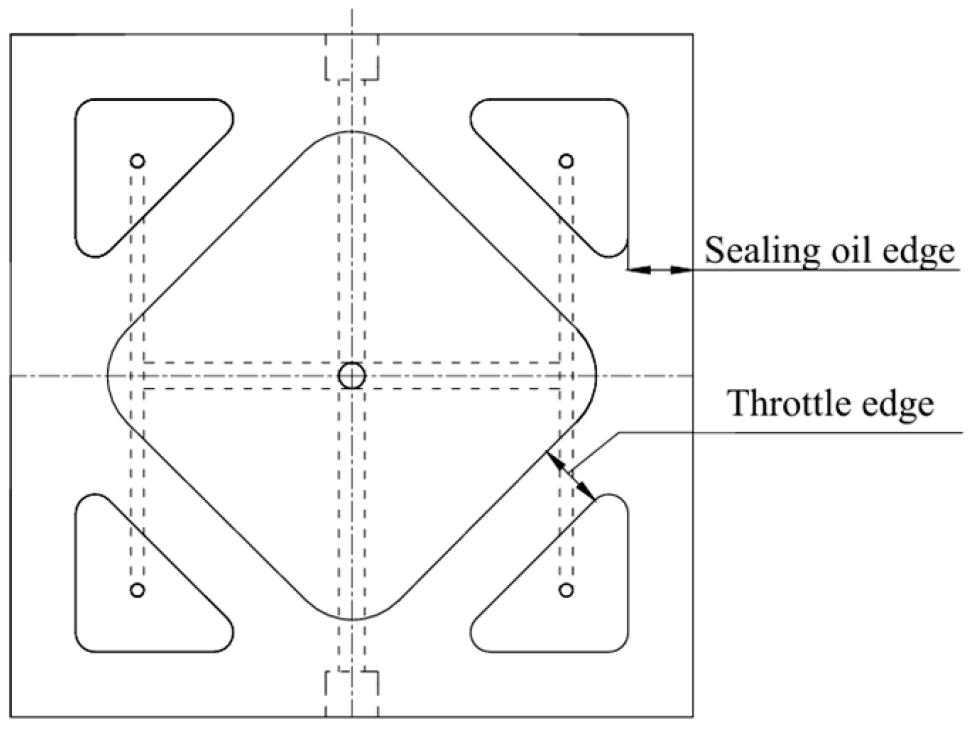
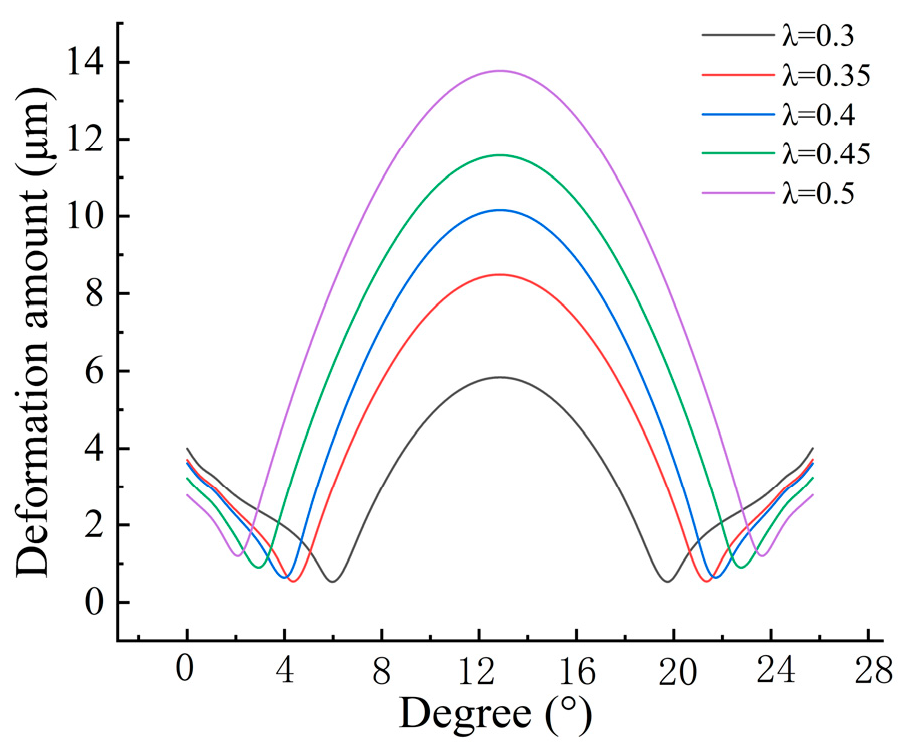
The oil cavity ratio, defined as the ratio of the oil cavity area to the total bearing shell area, directly affects oil flow and pressure distribution by altering both the sealing edge and throttling edge of the bearing shell. This, in turn, influences the deformation characteristics of the hollow shaft. To investigate the impact of the oil cavity ratio on hollow shaft deformation, this study established five models with varying oil cavity ratios: 0.3, 0.35, 0.4, 0.45, and 0.5, as shown in
Figure 19. The geometric parameters of the oil cavity under different oil cavity area ratios are shown in
Table 5.
Figure 20 displays the circumferential deformation curves of the hollow shaft under five different oil cavity area ratios. The figure illustrates that as the oil cavity area ratio λ increases from 0.3 to 0.5, the deformation of the hollow shaft shows a significant upward trend, accompanied by an increase in the circumferential width of the deformation curve. The maximum circumferential deformation in the main oil cavity region of the hollow shaft rises from 5.85 μm to 13.7 μm with the increase in the oil cavity area ratio, representing a 134.18% increase. The peak-to-trough difference of the deformation curve increases from 5.48 μm to 12.8 μm, reflecting a 133.57% increase in deformation magnitude. Analysis indicates that as λ increases, the effective load-bearing area of the bearing expands, which reduces the areas of the throttling edge and sealing edge of the bearing shell. This amplifies the oil film pressure gradient, causing the width of the peak zone to widen with an increasing oil cavity area ratio. Changes in the oil cavity area ratio directly impact the bearing’s load-bearing capacity and oil film pressure distribution.
4.3. Analysis of the Effect of Different Loads on Hollow Shaft Deformation
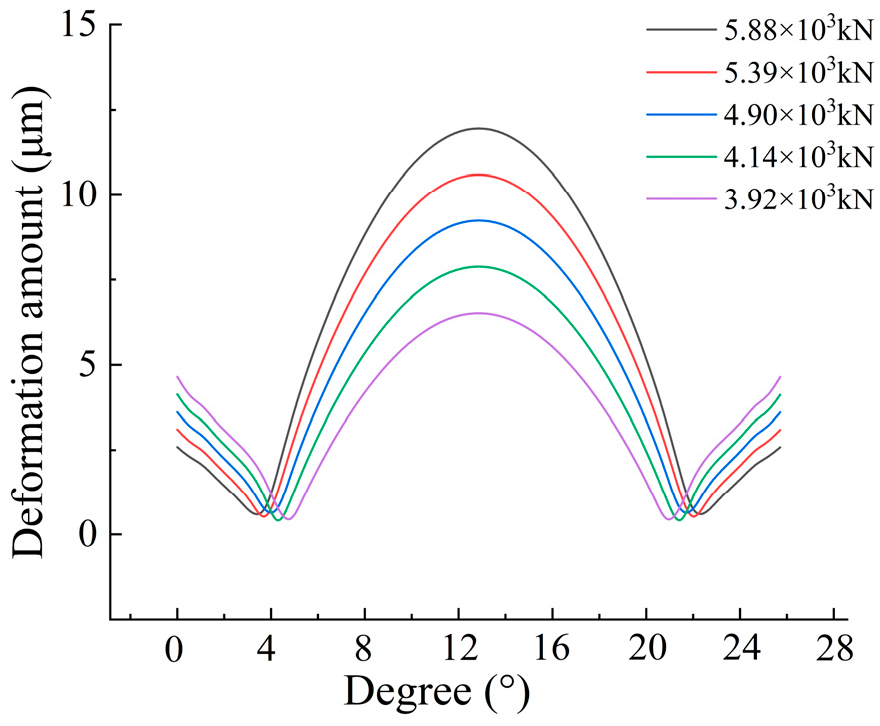
During mill operation, external loads are the direct cause of hollow shaft deformation, with their magnitudes directly affecting the oil film’s load-bearing characteristics and the hollow shaft’s deformation. To investigate the effect of load on hollow shaft deformation, five distinct load conditions were established: 3.92 × 10³ kN, 4.14 × 10³ kN, 4.90 × 10³ kN, 5.39 × 10³ kN, and 5.88 × 10³ kN.
Figure 21 displays the circumferential deformation curves of the hollow shaft under five different load conditions. It is evident that as the load increases, the deformation in the main oil chamber region of the hollow shaft shows a significant upward trend, with the peak zone width gradually widening in response to the increasing load. When the load increases from 3.92 × 10
3 kN to 5.88 × 10
3 kN, the peak circumferential deformation of the hollow shaft’s main oil chamber rises from 6.53 μm to 12 μm, representing an 83.76% increase. Similarly, the peak-to-trough difference in the deformation curve expands from 6.3 μm to 11 μm, indicating a 74.60% increase in deformation magnitude. This phenomenon primarily results from the combined interaction between the oil film pressure on the hollow shaft surface and the external load. The oil film pressure provides an elastic support effect to the hollow shaft, while the external load serves as the driving force for deformation, leading to elastic deformation in the hollow shaft. The combined effect of these two factors determines the spatial distribution and magnitude of the deformation. The increase in peak-to-trough width occurs because, as the load increases, the oil film thickness decreases during the circumferential flow of high-pressure oil in the main oil chamber. This reduction diminishes the decay rate of the oil film pressure at the interface between the main oil chamber and the sealing edge. Further comparison of the deformation curves under different loads reveals that the main oil chamber region consistently exhibits peak deformation. The overall trend of the deformation curves (in shape) remains consistent across all load conditions, with only the deformation magnitude showing an increasing trend. The increase in the maximum circumferential deformation of the hollow shaft indicates that rising external loads significantly affect the circumferential deformation of the hollow shaft.
4.4. Effect of Auxiliary Oil Chamber Supply Pressure on Hollow Shaft Deformation
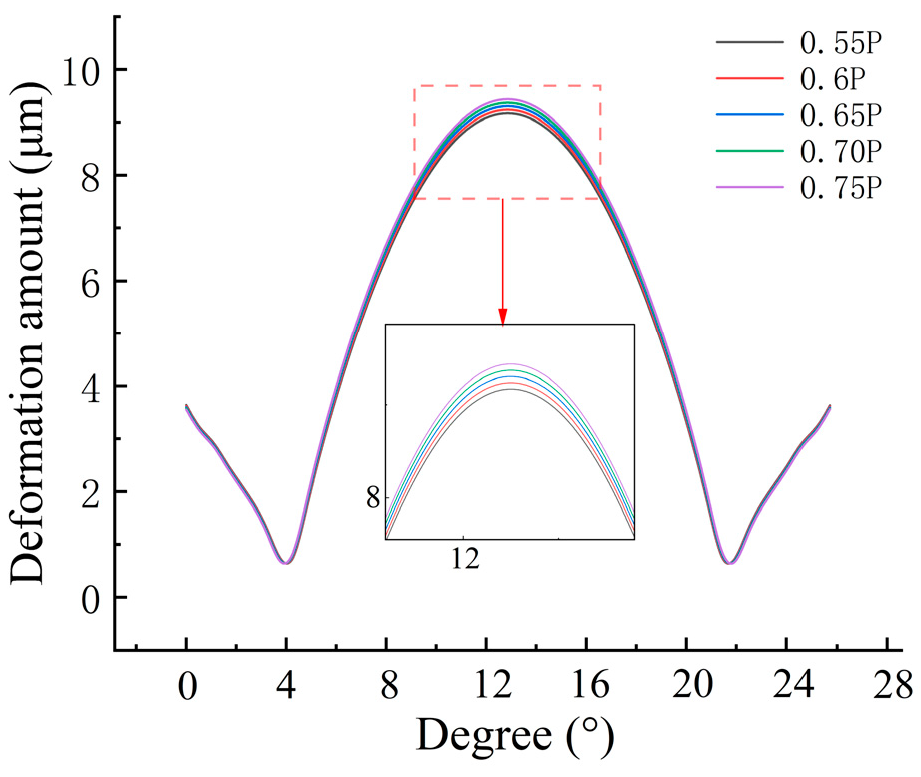
During the operation of the sliding shoe bearing, the oil supply pressure in the auxiliary oil chamber serves as a critical control parameter. Its dynamic interaction with the main oil chamber pressure directly determines the stability of the overall oil film pressure field, thereby influencing the deformation characteristics of the hollow shaft. To investigate the effect of the auxiliary oil chamber supply pressure on hollow shaft deformation, five distinct auxiliary oil chamber supply pressure conditions were established: 0.55 P, 0.60 P, 0.65 P, 0.70 P, and 0.75 P (where P = 10.5 MPa, the supply pressure of the main oil chamber).
Changes in the supply pressure of the auxiliary oil chamber affect the stability of the oil film flow field by regulating the pressure gradient between the main and auxiliary oil chambers.
Figure 22 illustrates the circumferential deformation of the hollow shaft under varying auxiliary oil chamber supply pressures. As the supply pressure increases from 0.55 P to 0.75 P, the deformation in the main oil chamber region shows a distinct upward trend. Specifically, the maximum circumferential deformation rises from 9.18 μm to 9.45 μm, indicating a 2.94% increase. Correspondingly, the peak-to-trough amplitude expands from 8.6 μm to 8.9 μm, reflecting a 3.48% increase in deformation magnitude. Mechanistically, the increase in auxiliary supply pressure reduces the inter-chamber pressure gradient. This suppression of cross-flow diminishes kinetic energy loss and enhances pressure retention in the main chamber, thereby intensifying shaft deformation. Consequently, the cross-flow effect between the chambers diminishes, resulting in less kinetic energy and weakening the pressure superposition effect in the auxiliary oil chamber. When the auxiliary oil chamber is at low pressure, its balancing effect is insufficient, and the cross-flow effect between the two chambers becomes significant. Poor pressure retention in the main oil chamber results in minimal deformation of the hollow shaft. Conversely, when the auxiliary oil chamber is at high pressure, the cross-flow effect between the two chambers becomes negligible. Enhanced pressure retention in the main oil chamber leads to greater deformation of the hollow shaft. An analysis of the increase in maximum circumferential deformation indicates that variations in the auxiliary oil chamber supply pressure have minimal influence on the hollow shaft’s deformation.
4.5. Effect of the Inner Diameter of the Main Oil Chamber Supply Hole on Hollow Shaft Deformation
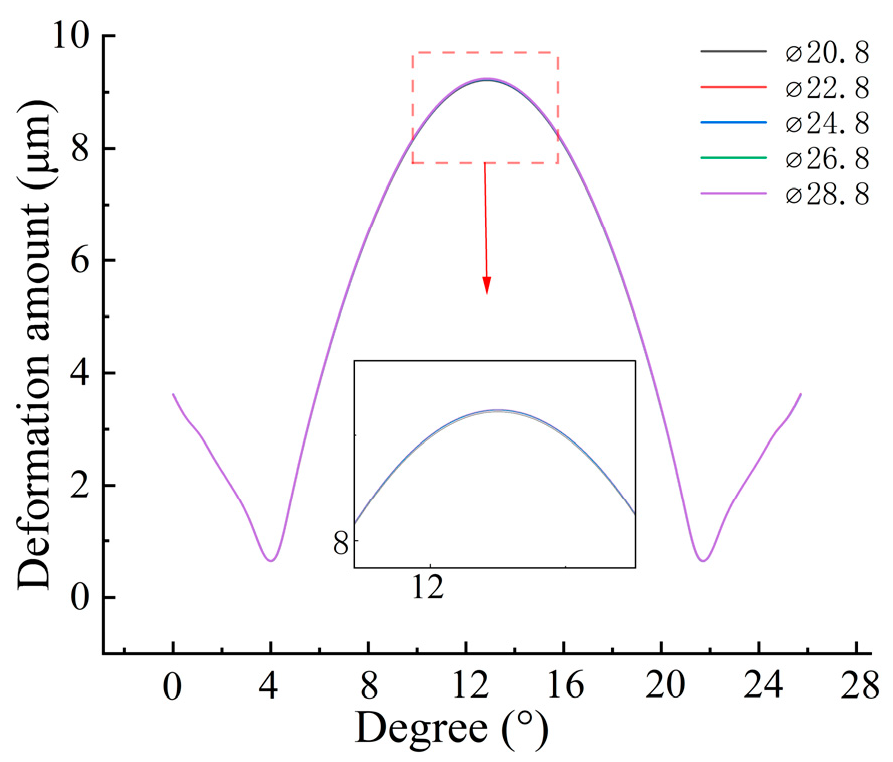
The diameter of the main oil chamber supply pipe affects the flow and pressure distribution within the chamber by altering the lubricant flow allocation. To investigate the effect of different main oil chamber supply hole diameters on hollow shaft deformation, five simulation conditions were established with main oil chamber supply hole inner diameters of
20.8,
22.8,
24.8,
26.8, and
28.8 mm. The simulation results are shown in
Figure 23.
As shown in the circumferential deformation curves of the hollow shaft under different inner diameters of the oil supply holes (
Figure 23), the inner diameter of the main oil chamber supply hole did not significantly affect the amplitude of circumferential elastic deformation of the hollow shaft within the inner diameter range of
20.8 to
28.8 mm. Increasing the diameter of the oil supply hole enhanced the lubricant flow rate; however, the main oil chamber forms a pressure gradient with the auxiliary oil chamber via the sealing edge, causing excess lubricant to drain naturally through the bearing edge. This mechanism maintains a dynamic equilibrium of flow rate and pressure within the oil chamber. Consequently, variations in the oil supply hole diameter within the
20.8 to
28.8 mm range exert a negligible influence on the lubricant’s flow rate, velocity, and friction loss. This ensures the preservation of the high-pressure concentration feature in the main oil chamber region and a stable pressure decay pattern from the main oil chamber to the bearing edge. The magnitude and distribution of the oil film normal force acting on the hollow shaft remained stable. Changes in the supply hole diameter of the main oil chamber within the
20.8 to
28.8 mm range had almost no effect on the hollow shaft’s deformation.
5. Conclusions
Using the two-way fluid–structure interaction model, which has been previously validated experimentally, this study analyzes the deformation characteristics of the hollow shaft in the sliding shoe bearing of a grinding mill. The following conclusions are drawn:
The constructed bidirectional fluid–structure interaction model effectively simulates the dynamic characteristics of a sliding shoe bearing, aligning with the study’s objectives. Validation through dimensional tests on a single bearing shell revealed that the numerical simulation results exhibit a maximum error of 7.35% for the maximum oil film pressure compared to the experimental data. The oil film thickness varies from 0.27 mm to 0.34 mm, which is in close agreement with the model’s designed clearance of 0.3 mm, further confirming the accuracy of the model.
The hollow shaft exhibits nonlinear deformation characterized by a central bulge and concave ends. The region aligned with the main oil cavity experiences the most significant deformation, and its deformation pattern is directly related to the distribution of oil film pressure. The oil film pressure is highly concentrated within the main oil cavity, reaching a peak of 10.29 MPa. This value is slightly lower than the supply pressure of 10.5 MPa, which can be attributed to viscous pressure losses occurring at the inlet and across the throttling edges. From the main oil cavity to the outer edge of the sealing oil zone, the pressure decreases rapidly due to a sharp increase in flow velocity caused by gap contraction.
Among the studied factors, the oil cavity ratio (0.3–0.5) exerts the most significant influence on hollow shaft deformation, leading to a 134.18% increase in maximum deformation. An increased oil cavity ratio promotes greater deformation of the hollow shaft by expanding the effective load-bearing area and increasing the oil film pressure gradient. Additionally, the external load (3.92 × 10³–5.88 × 10³ kN) significantly impacts hollow shaft deformation, resulting in an 83.76% increase in maximum deformation, as higher external loads directly induce more substantial deformation of the hollow shaft. In contrast, the supply pressure of the auxiliary oil chamber (0.55–0.75 P) has a negligible effect on hollow shaft deformation. A reduced pressure difference between the main and auxiliary oil chambers weakens the cross-flow effect, diminishing the pressure superposition effect of the auxiliary oil chamber and resulting in minimal variation in the pressure retention capability of the main oil chamber. Furthermore, the inner diameter of the main oil chamber supply orifice (20.8–28.8 mm) does not significantly affect hollow shaft deformation. Within this range, variations in the orifice’s inner diameter primarily alter the lubricant flow rate. However, the main oil chamber maintains dynamic pressure equilibrium with the auxiliary oil chamber through the sealing edge, ensuring a stable distribution of the overall oil film pressure field.
The limitations of this study include: (1) the reliance on static replacement plates instead of rotating hollow shafts for experimental validation, and (2) a focus on steady-state operation. Future work will incorporate fluid–structure interaction and transient dynamic analysis.
Author Contributions
Conceptualization, Y.Z. and L.L.; methodology, L.L.; software, Y.Z. and Y.R.; data curation, J.Z.; writing—original draft preparation, Y.Z. and L.L.; project administration, Y.X.; funding acquisition, H.W. All authors have read and agreed to the published version of the manuscript.
Funding
This research was funded by the Henan Provincial Major Science and Technology Special Project Research and Industrialization of Key Technologies for Ultra-Large Green Intelligent Mineral Grinding Machines (Grant No.: 241100220300).
Data Availability Statement
The datasets used and analysed during the current study are available from the corresponding author on reasonable request.
Conflicts of Interest
The authors have no relevant financial or nonfinancial interests to disclose.
Abbreviations
The following abbreviations are used in this manuscript:
| FSI | Fluid–Structure Interaction |
References
- Matsanga, N.; Nheta, W.; Chimwani, N. A review of the grinding media in ball mills for mineral processing. Minerals 2023, 13, 1373. [Google Scholar] [CrossRef]
- Yu, X.; Wang, Y.; Wang, J.; Zhou, W.; Bi, H.; Wu, G.; Gao, W. Review of research on hydrostatic bearings. Recent Pat. Mech. Eng. 2021, 14, 276–288. [Google Scholar] [CrossRef]
- Zhang, S.; Yang, D.; Li, G.; Cheng, Y.; Chen, G.; Zhang, Z.; Li, J. Carrying capacity of spherical hydrostatic bearings including elastic deformation. Lubricants 2024, 12, 97. [Google Scholar] [CrossRef]
- Yin, Z.; Wang, N.; Li, T.; Peng, Y. Experimental investigation of the impact breakage characteristics between grinding media and iron ore particle in ball mills. Adv. Powder Technol. 2023, 34, 103982. [Google Scholar] [CrossRef]
- Ma, H.; Zhang, T.; Yang, C.; Liu, Z.; Zhao, Y. Research on the supporting mechanism of internal feedback hydrostatic hybrid bearing considering flow rate correction. Proc. Inst. Mech. Eng. Part J J. Eng. Tribol. 2024, 238, 1593–1609. [Google Scholar] [CrossRef]
- Fedorynenko, D.; Kirigaya, R.; Nakao, Y. Dynamic characteristics of spindle with water-lubricated hydrostatic bearings for ultra-precision machine tools. Precis. Eng. 2020, 63, 187–196. [Google Scholar] [CrossRef]
- Kadda, M.; Nadia, B.; Zohra, K.F.; Habib, B.M.; Imene, B.; Hadja, K. Behavior of an aerodynamic sliding bearing with textured surface under turbulent conditions. J. Mech. 2024, 40, 185–202. [Google Scholar] [CrossRef]
- Inacio, M.V.; Cavalca, K.L.; Daniel, G.B. Identification of non-circular profiles in hydrodynamic journal bearings. Mech. Mach. Theory 2024, 203, 105819. [Google Scholar] [CrossRef]
- Mehdi, S.M.; Jeong, S.Y.; Kim, T.H. Influence of recess dimensions and jacking oil flow rate on the performance of tilting pad journal bearings with jacking oil mechanism. Tribol. Trans. 2022, 65, 405–420. [Google Scholar] [CrossRef]
- Zhuang, H.; Ding, J.; Chen, P.; Chang, Y. Two-way steady and transient fluid-structure interaction analysis for aerostatic thrust bearings. Precis. Eng. 2025, 97, 851–878. [Google Scholar] [CrossRef]
- Sun, X.; Liu, Y.; Chocholaty, B.; Marburg, S. Influence of deformation-induced misalignment on the performance of hydrodynamic bearings: A comparison between rigid and flexible journal results. Ind. Lubr. Tribol. 2024, 76, 688–702. [Google Scholar] [CrossRef]
- Takahashi, T.; Lin, M.C. A Geometrically Consistent Viscous Fluid Solver with Two-Way Fluid-Solid Coupling; Computer Graphics Forum, 2019; Wiley Online Library: Hoboken, NJ, USA, 2019; pp. 49–58. [Google Scholar] [CrossRef]
- Jung, S.; Godoy-Diana, R. bioinspired fluid-structure interaction. Bioinspir. Biomim. 2023, 18, 30401. [Google Scholar] [CrossRef] [PubMed]
- Wu, Z.; Guo, L. A phase field-immersed boundary-lattice Boltzmann coupling method for fluid-structure interaction analysis. Ocean. Eng. 2024, 301, 117564. [Google Scholar] [CrossRef]
- Zhao, X.; Liu, X.; Li, J. Convergence analysis and error estimate of finite element method of a nonlinear fluid-structure interaction problem. AIMS Math. 2020, 5, 5240–5260. [Google Scholar] [CrossRef]
- Michalec, M.; Svoboda, P.; Křupka, I.; Hartl, M. A review of the design and optimization of large-scale hydrostatic bearing systems. Eng. Sci. Technol. Int. J. 2021, 24, 936–958. [Google Scholar] [CrossRef]
- Zhang, Y.; Zhang, Z.; Kong, X.; Li, R.; Jiang, H. Application of dynamic mesh technology in the oil film flow simulation for hydrostatic bearing. Ind. Lubr. Tribol. 2019, 71, 146–153. [Google Scholar] [CrossRef]
- Schwentner, T.; Fries, T.P. Fully Coupled, Higher-Order, Block-Structured Mesh Generation in Fluid–Structure Interaction. Int Int. J. Numer. Methods Fluids 2025, 97, 359–377. [Google Scholar] [CrossRef]
- Nair, A.G.; Douglass, S.B.; Arya, N. Network-theoretic modeling of fluid–structure interactions. Theor. Comput. Fluid Dyn. 2023, 37, 707–723. [Google Scholar] [CrossRef]
- Jialei, D.U.; Liang, G. Dynamic coefficients and stability analysis of a water-lubricated hydrostatic bearing by solving the uncoupled Reynolds equation. Chin. J. Aeronaut. 2020, 33, 2110–2122. [Google Scholar] [CrossRef]
Figure 1.
Simplified diagram of mill structure. 1. Fixed-end hollow shaft. 2. Fixed-end sliding shoe bearing. 3. Large gear ring. 4. Mill cylinder. 5. Free-end sliding shoe bearing. 6. Free-end hollow shaft. 7. Drive motor. 8. Reducer.
Figure 1.
Simplified diagram of mill structure. 1. Fixed-end hollow shaft. 2. Fixed-end sliding shoe bearing. 3. Large gear ring. 4. Mill cylinder. 5. Free-end sliding shoe bearing. 6. Free-end hollow shaft. 7. Drive motor. 8. Reducer.
Figure 2.
Schematic diagram of the sliding shoe bearing structure. 1. Hollow shaft. 2. Bearing liner. 3. Bearing bush. 4. Convex sphere. 5. Adjusting nut. 6. Hydraulic cylinder. 7. Bearing housing.
Figure 2.
Schematic diagram of the sliding shoe bearing structure. 1. Hollow shaft. 2. Bearing liner. 3. Bearing bush. 4. Convex sphere. 5. Adjusting nut. 6. Hydraulic cylinder. 7. Bearing housing.
Figure 3.
Bearing bush model. 1. Sealing oil edge. 2. Auxiliary oil supply port. 3. Auxiliary oil chamber. 4. Throttle edge. 5. Main oil supply hole. 6. Main oil chamber.
Figure 3.
Bearing bush model. 1. Sealing oil edge. 2. Auxiliary oil supply port. 3. Auxiliary oil chamber. 4. Throttle edge. 5. Main oil supply hole. 6. Main oil chamber.
Figure 4.
Solution Process of Two-Way Fluid–Structure Interaction Model.
Figure 4.
Solution Process of Two-Way Fluid–Structure Interaction Model.
Figure 5.
Single-shaft bearing model and mesh generation.
Figure 5.
Single-shaft bearing model and mesh generation.
Figure 6.
Fluid domain mesh generation.
Figure 6.
Fluid domain mesh generation.
Figure 7.
Oil film load-bearing capacity and maximum deformation of hollow shafts under different mesh counts.
Figure 7.
Oil film load-bearing capacity and maximum deformation of hollow shafts under different mesh counts.
Figure 8.
Contour plot of pressure distribution on the upper surface of the oil film.
Figure 8.
Contour plot of pressure distribution on the upper surface of the oil film.
Figure 9.
Axial oil film pressure.
Figure 9.
Axial oil film pressure.
Figure 10.
Oil film pressure in the circumferential direction.
Figure 10.
Oil film pressure in the circumferential direction.
Figure 11.
Testing principle of the single-shaft bearing sliding shoe bearing.
Figure 11.
Testing principle of the single-shaft bearing sliding shoe bearing.
Figure 12.
Single-shaft bearing sliding shoe bearing test apparatus.
Figure 12.
Single-shaft bearing sliding shoe bearing test apparatus.
Figure 13.
Oil supply path between the main oil chamber and the auxiliary oil chamber. a: Circumferential sealing oil edge. b: Axial sealing oil edge.
Figure 13.
Oil supply path between the main oil chamber and the auxiliary oil chamber. a: Circumferential sealing oil edge. b: Axial sealing oil edge.
Figure 14.
Schematic diagram of dial gauge placement for measuring oil film thickness.
Figure 14.
Schematic diagram of dial gauge placement for measuring oil film thickness.
Figure 15.
Comparison of simulation and experimental results under different loads.
Figure 15.
Comparison of simulation and experimental results under different loads.
Figure 16.
Deformation contour of the bearing pad-hollow shaft structure.
Figure 16.
Deformation contour of the bearing pad-hollow shaft structure.
Figure 17.
Deformation curves of hollow shaft along axial and circumferential directions.
Figure 17.
Deformation curves of hollow shaft along axial and circumferential directions.
Figure 18.
Comparison of Circumferential Oil Film Pressure Distribution.
Figure 18.
Comparison of Circumferential Oil Film Pressure Distribution.
Figure 19.
Bearing shell structural diagram.
Figure 19.
Bearing shell structural diagram.
Figure 20.
Circumferential deformation curves of a hollow shaft under different oil cavity proportions.
Figure 20.
Circumferential deformation curves of a hollow shaft under different oil cavity proportions.
Figure 21.
Circumferential deformation curves of hollow shafts under different loads.
Figure 21.
Circumferential deformation curves of hollow shafts under different loads.
Figure 22.
Circumferential deformation curves of a hollow shaft under different supply pressures.
Figure 22.
Circumferential deformation curves of a hollow shaft under different supply pressures.
Figure 23.
Circumferential deformation curves of a hollow shaft with different diameters of oil supply holes.
Figure 23.
Circumferential deformation curves of a hollow shaft with different diameters of oil supply holes.
Table 1.
Structural parameters of the sliding shoe bearing.
Table 1.
Structural parameters of the sliding shoe bearing.
| Parameters | Unit | Value |
|---|
| Hollow shaft inner diameter/d | mm | 3270 |
| Hollow shaft outer diameter/D | mm | 3999.7 |
| Number of bearing shells/z | block | 4 |
| Bearing bush wrap angle/α | ° | 26 |
| Bearing bush inner diameter/dw | mm | 4000.3 |
| Bearing bush outer diameter/Dw | mm | 4046 |
| Bearing shell width/T | mm | 900 |
| Oil cavity depth/h | mm | 6 |
| Bearing radial clearance/h0 | mm | 0.3 |
Table 2.
Lubricant parameters.
Table 2.
Lubricant parameters.
| Lubricant Type | Density/(kg/m3) | Viscosity/(kg/(ms)) | Temperature/(°C) |
|---|
| ISO VG220 | 900 | 0.198 | 45 |
Table 3.
Material parameters of the hollow shaft and bearing bush.
Table 3.
Material parameters of the hollow shaft and bearing bush.
| Name | Materials | Density/(kg/m3) | Modulus of Elasticity/(GPa) | Poisson Ratio |
|---|
| Hollow shaft | ASTMA216 WCA | 7850 | 206 | 0.29 |
| Bearing bush | ZSnSb11Cu6 | 7380 | 48 | 0.285 |
Table 4.
Fluid domain solution and spatial discretization settings.
Table 4.
Fluid domain solution and spatial discretization settings.
| Settings | Method |
|---|
| Calculation method | SIMPLEC |
| Gradient | Least Squares Cell Based |
| Pressure | Second Order |
| Momentum | Second Order Upwind |
| Time step/s | 1 × 10⁻³ |
| Convergence residual | 1 × 10⁻⁴ |
Table 5.
Geometric Parameters of Oil Cavities at Different Oil Cavity Area Ratios λ.
Table 5.
Geometric Parameters of Oil Cavities at Different Oil Cavity Area Ratios λ.
| Oil Cavity Area Ratio (λ) | Oil Cavity Area (mm2) | Throttle Edge (mm) | Sealing Oil Edge (mm) |
|---|
| 0.3 | 244,875.97 | 144 | 200 |
| 0.35 | 285,803.23 | 119 | 164 |
| 0.4 | 320,268.38 | 100 | 139 |
| 0.45 | 370,278.09 | 75 | 103 |
| 0.5 | 409,368.68 | 57 | 78 |
| Disclaimer/Publisher’s Note: The statements, opinions and data contained in all publications are solely those of the individual author(s) and contributor(s) and not of MDPI and/or the editor(s). MDPI and/or the editor(s) disclaim responsibility for any injury to people or property resulting from any ideas, methods, instructions or products referred to in the content. |