Article

ZDDP Tribofilm Formation from a Formulated Oil on Textured Cylinder Liners

by
Leonardo C. Dias
1,
Giuseppe Pintaude
2,
Alessandro A. O. F. Vittorino
3 and
Henara L. Costa
1,3,*
1
Laboratory of Surface Engineering, School of Engineering, Universidade Federal do Rio Grande, Rio Grande 96203 900, Brazil
2
Academic Department of Mechanics, Universidade Tecnológica Federal do Paraná, Curitiba 81280 340, Brazil
3
Laboratory of Tribology and Materials, Universidade Federal de Uberlândia, Uberlandia 38408 100, Brazil
*
Author to whom correspondence should be addressed.
Lubricants 2022, 10(6), 118; https://doi.org/10.3390/lubricants10060118

Submission received: 27 April 2022 / Revised: 9 May 2022 / Accepted: 2 June 2022 / Published: 7 June 2022
(This article belongs to the Special Issue Automotive Tribology II)

Abstract

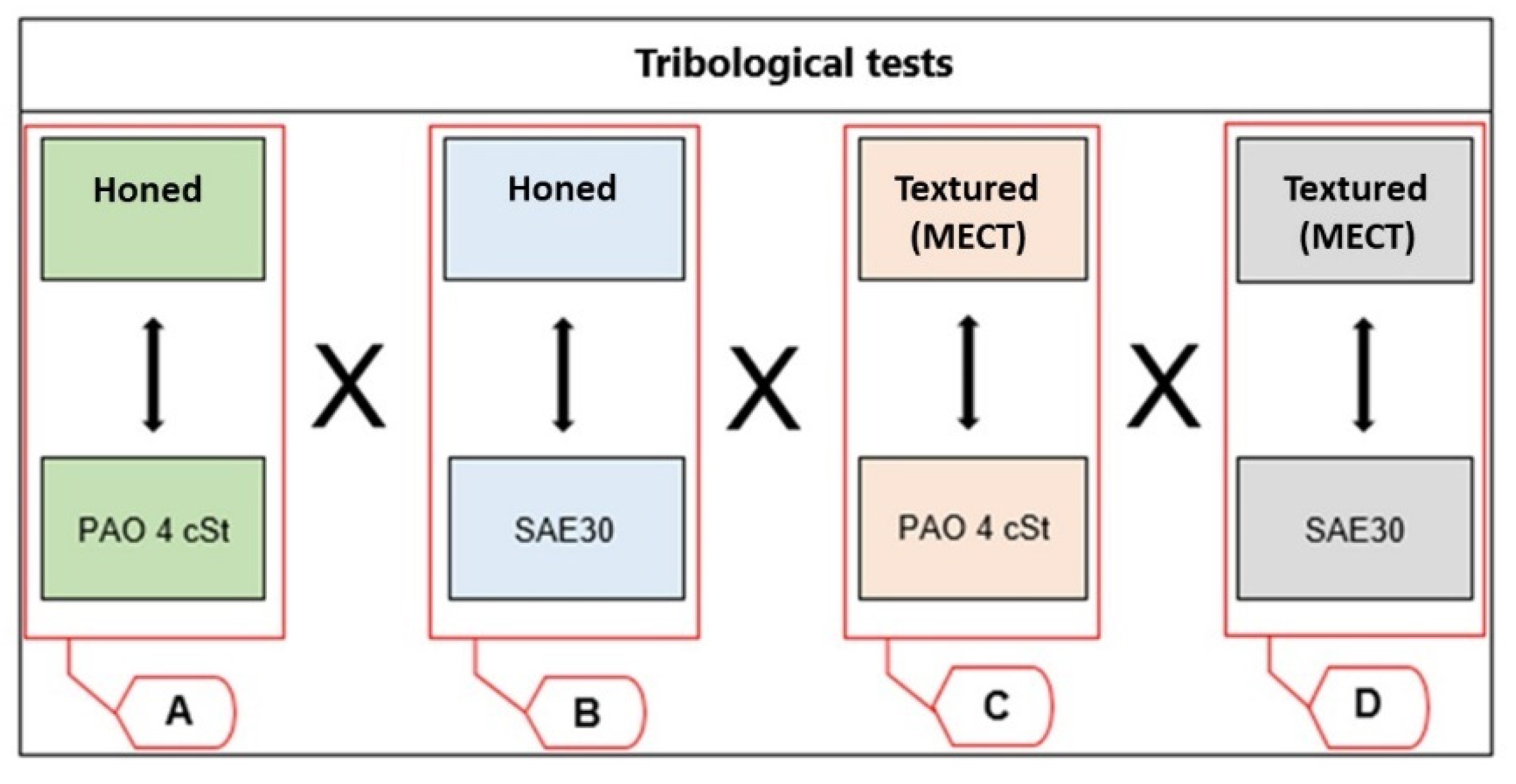
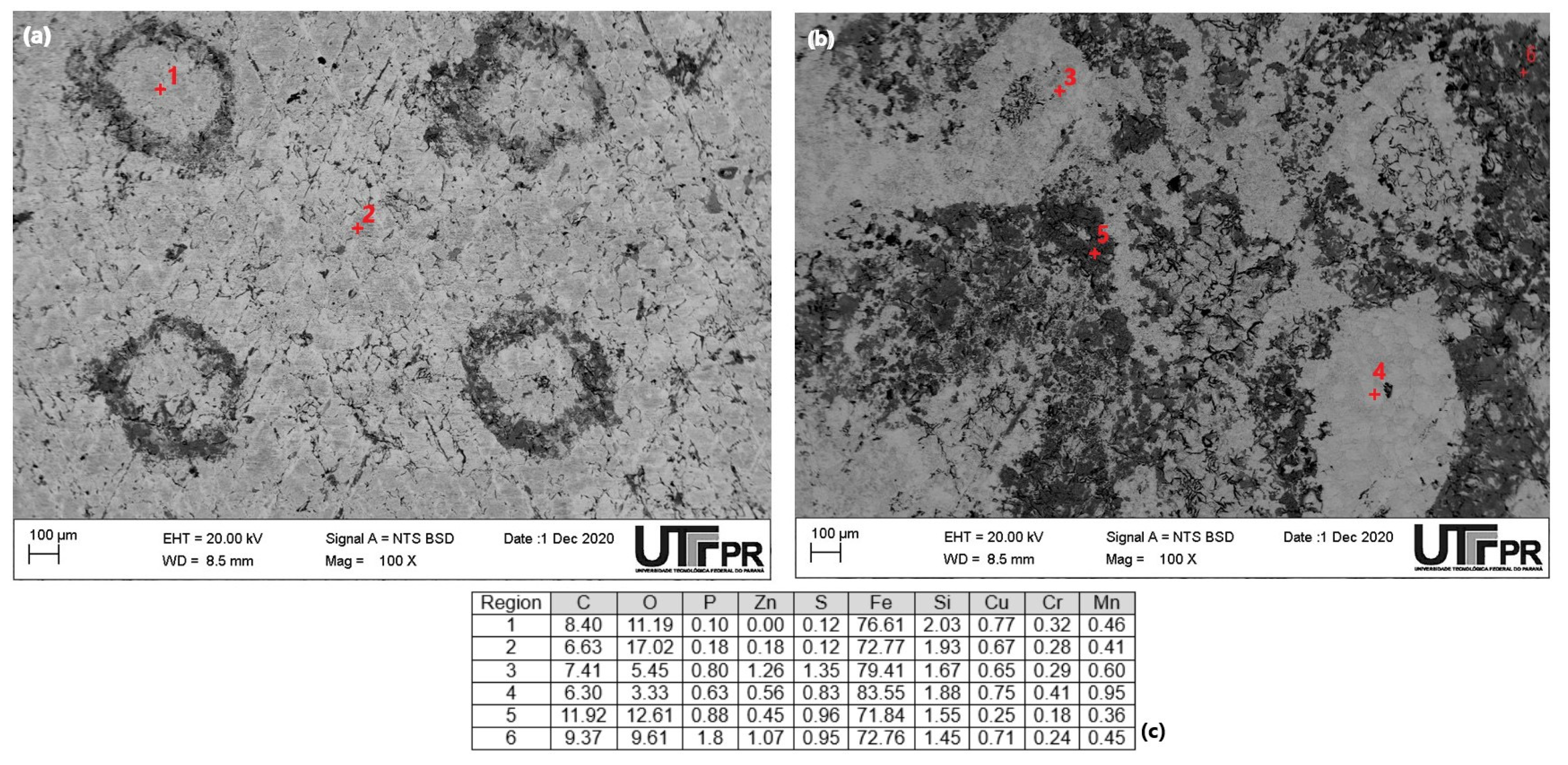
Surface texturing can improve lubrication and entrap wear debris but increases the effective roughness of the surfaces, which can induce higher contact pressures. On the one hand, this can be detrimental, but on the other hand, the increase in contact pressure could be used to activate the formation of a ZDDP tribofilm from fully-formulated lubricants. This work investigates the synergistic effect between surface texturing via Maskless Electrochemical Texturing (MECT) and ZDDP additive. The surface texture consisted of an array of annular pockets manufactured on a gray cast iron cylinder liner. These textured surfaces were evaluated by scanning electron microscope (SEM) and energy-dispersive X-ray spectroscopy (EDX). The results indicated that surface texturing via MECT changes the chemical composition of the surfaces, by inducing a preferential dissolution of the metal matrix. Consequently, it exposed the carbon present in the material. The tribological performance was evaluated by a ring-on-cylinder-liner tribometer in reciprocating sliding under boundary lubrication conditions using both a base oil and a commercial formulated oil containing ZDDP additive. For comparison, a commercially honed liner was also tested. After the tribological tests, the surfaces were evaluated by white light interferometry and SEM/EDX. Although the textured surfaces showed higher friction, they induced more ZDDP-tribofilm formation than conventional cylinder liner finish.
Keywords: surface texturing; MECT; ZDDP; piston-liner; tribofilm surface texturing; MECT; ZDDP; piston-liner; tribofilm