
Article

Effects of Multiple Spiral Arm Patterns on the Abundance Gradients of Heavy Elements

by
Emanuele Spitoni
1,2,*,
Gabriele Cescutti
1,3,4,
Ivan Minchev
5 and
Francesca Matteucci
1,3,4
1
I.N.A.F. Osservatorio Astronomico di Trieste, via G.B. Tiepolo 11, 34143 Trieste, Italy
2
IFPU—Institute for Fundamental Physics of the Universe, Via Beirut 2, 34151 Trieste, Italy
3
Dipartimento di Fisica, Sezione di Astronomia, Università di Trieste, Via G. B. Tiepolo 11, 34143 Trieste, Italy
4
INFN Sezione di Trieste, via Valerio 2, 34134 Trieste, Italy
5
Leibniz-Institut für Astrophysik Potsdam, An der Sternwarte 16, 14482 Potsdam, Germany
*
Author to whom correspondence should be addressed.
Galaxies 2026, 14(4), 66; https://doi.org/10.3390/galaxies14040066

Submission received: 13 February 2026 / Revised: 12 June 2026 / Accepted: 30 June 2026 / Published: 2 July 2026
(This article belongs to the Special Issue Neutron Capture Processes in the Universe)

Abstract

Understanding how spiral structures influence the chemical evolution of the Galactic disc remains a key issue in Galactic archaeology. Recent advances in two-dimensional chemical evolution modeling allow us to account for the impact of multiple spiral arm patterns, each characterized by different pattern speeds, on the redistribution of elements throughout the Galaxy. In this work, we explore the influence of multi-pattern spiral arms on the radial abundance gradients of heavy elements in the Galactic disc. We focus on a scenario in which, during the most recent stage of evolution, corotation spans the entire disc. Our results indicate that the observed dispersion in the abundance gradients of O, Fe, Eu, and Ba, as traced by Cepheids, can be successfully reproduced if all galactocentric radii have effectively acted as corotation regions over the past 1–3 Gyr. We also note that such an extended phase has previously been identified as necessary to explain the azimuthal abundance variations reported in Gaia DR3 and Gaia-ESO survey data along local and inner spiral arms.

1. Introduction

In the field of Galactic Archaeology using chemical evolution models [1,2,3], understanding the role of spiral arm perturbations is becoming increasingly important. Several investigations have interpreted the Milky Way’s spiral structure as arising from multiple overlapping spiral perturbations, each with a distinct pattern speed (e.g., [4,5]). Building on this perspective, ref. [6] employed the two-dimensional Galactic chemical evolution model originally introduced by [7], in which the spiral pattern is represented as three separate segments, each rotating at its own angular velocity. Their findings indicate that the passage of spiral arms locally boosts star formation, producing spatial variations in elemental abundances. The magnitude of these variations is closely linked to the element production timescales: elements formed by short-lived stars show rapid, significant fluctuations, whereas those released over longer periods exhibit smoother and less pronounced variations. This methodology was later applied by [8] to study the two-dimensional distribution of the short-lived radionuclide 26Al. Some hydrodynamic simulations and gravity-only N-body models support a picture of spiral structure in which spiral arms are transient features that continuously form, dissipate, and re-form rather than remaining steady over time (e.g., [9,10,11,12]). In this framework, individual arms dissipate on dynamical timescales, while new ones continuously form, maintaining a long-lived overall spiral pattern. For example, studies such as [9,13] show that spiral arms in idealised N-body simulations behave as transient features that co-rotate with the stellar component at all radii, often referred to as dynamic or co-rotating spirals. These structures are thought to arise through a process similar to swing amplification [14,15,16], where the combined effects of differential rotation, stellar epicyclic motion, and self-gravity amplify local density perturbations. Hence, ref. [6] considered scenarios in which spiral arms act as transient features corotating with the Galactic disc across a broad radial range, consistent with predictions from the above-mentioned numerical simulations. In the present study, we investigate the combined influence of multiple spiral patterns under the assumption that, in the latest stages of Galactic evolution, corotation occurs across all radii. We particularly focus on how this setup affects the radial abundance gradients of heavy elements in the Galactic disc and assess whether the observed scatter in Cepheid measurements can be accounted for by these models.
In particular, the original contribution of this work lies in exploring a scenario in which corotation extends across the entire Galactic disc during the last 3 Gyr of Galactic evolution (Model C3; Section 2.2). The results for the last 1 Gyr and 0.3 Gyr are adapted from [6]. In addition, the comparison with Cepheid observations using a running-median analysis is presented here for the first time in the context of scenarios in which corotation spans the entire Galactic disc over the last 0.3, 1, and 3 Gyr, respectively.

2. Chemical Evolution Model in the Presence of Multiple Spiral Arm Patterns

2.1. Gas Accretion and Inside-Out Formation of the Thin Disc

The Galactic thin disc, as in [6], is assumed to form through the gradual accretion of primordial gas, following the classical chemical evolution framework of [17]. We adopt the inside-out formation scenario originally proposed by [17] and further developed by [18], in which the accretion timescale increases with Galactocentric radius as τ ( R ) = 1.033 R [ kpc ] 1.27 Gyr . This assumption is consistent with cosmological zoom-in simulations [19,20,21,22,23] and is essential to reproduce observed abundance gradients. The current total surface density in the solar neighborhood is taken as Σ = 54 M pc−2 [18,24,25,26], with a radial profile described by Σ D ( R , t G ) = Σ e ( R R ) / R D , where t G is the present Galactic age and R D = 3.5 kpc is the disc scale length. Finally, we assume a spatially and temporally invariant stellar initial mass function (IMF), adopting the formulation of [27].

2.2. Modeling Multiple Spiral Patterns

Expanding on the approach introduced by [7], ref. [6] incorporated multiple spiral patterns into a multi-zone two-dimensional Galactic chemical evolution model, examining their effects on elements synthesised on different timescales, such as oxygen, iron, europium, and barium. We partitioned the disc into concentric radial shells, each 1 kpc wide. Every shell was further subdivided into 36 angular sectors, each spanning 10o, resulting in 36 distinct zones at any given Galactocentric radius. Following [28], the spiral structure is represented as a combination of localized features, each characterized by its own pattern speed.
The spiral-induced, time-dependent surface density perturbation adopted from [6] is defined as Σ S ( R , ϕ , t ) = χ ( R , t G ) j = 1 N M j ( γ j ) , where the present-day spiral amplitude is χ ( R , t G ) = Σ S , 0 exp [ ( R R 0 ) / R S ] . The term M j ( γ j ) is modulation function of the j-th spiral component [29]:
M j ( γ j ) = 8 3 π cos γ j + 1 2 cos ( 2 γ j ) + 8 15 π cos ( 3 γ j ) · 1 [ R j , min , R j , max ] ,
where the indicator function limits each pattern to the radial interval [ R j , min , R j , max ] . The phase angle is given by:
γ j ( R , ϕ , t ) = m j ϕ + Ω s , j t ϕ p ( R 0 ) ln ( R / R 0 ) tan α ,
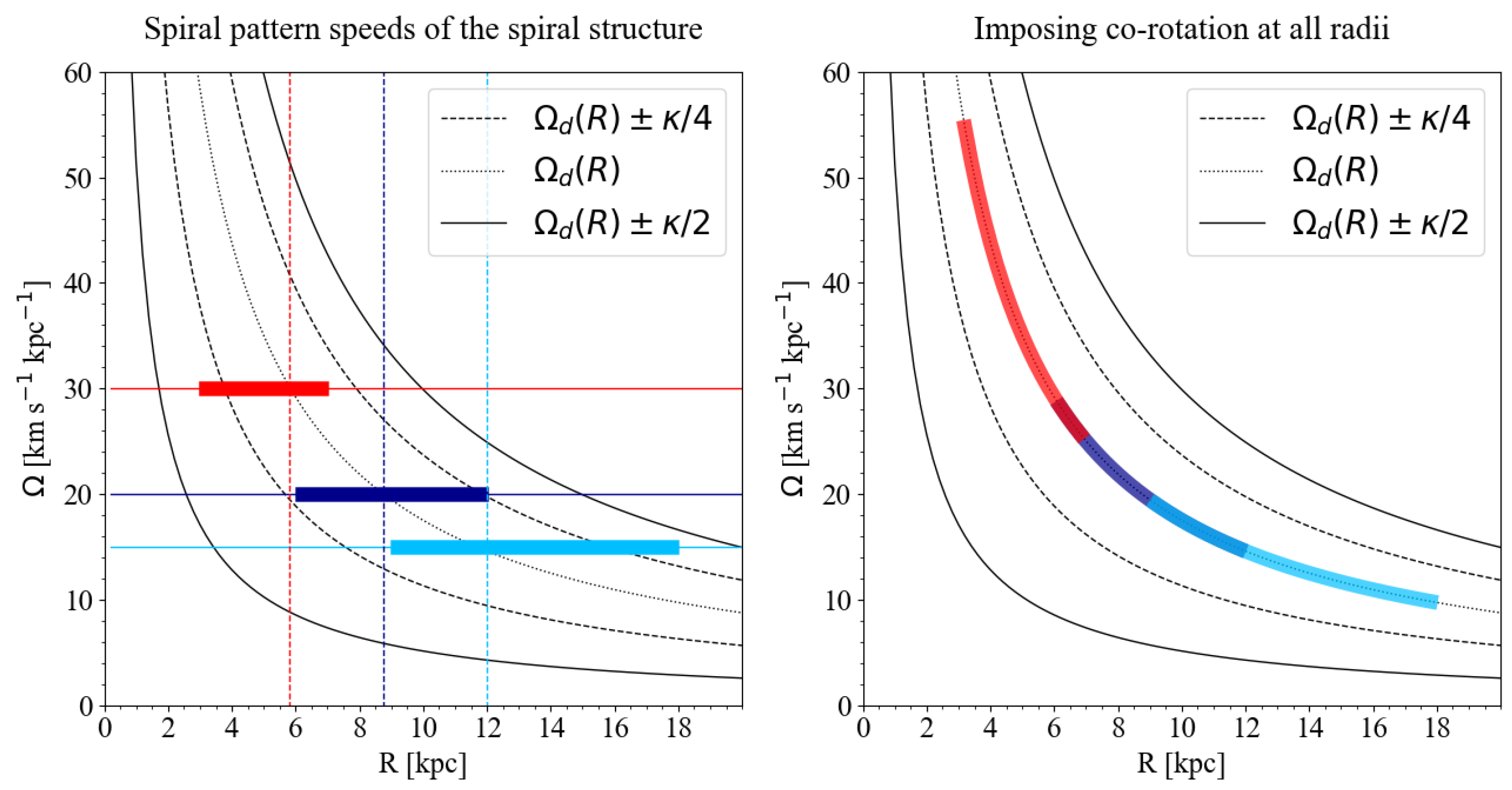
with m j being the arm multiplicity, α = 15 the pitch angle, and Ω s , j the pattern speed. A more detailed description of the model can be found in [6]. Figure 1 (left panel) illustrates the adopted spiral configuration (Model A in Table 1), consisting of three segments with multiplicity m = 2 , each characterized by a distinct Ω s , j and radial extent. The disc angular velocity Ω d ( R ) follows [30]. In addition, N-body simulations of barred galaxies [9] suggest that spiral structures are transient, recurrent, and exhibit pattern speeds decreasing with radius toward corotation with the stellar disc. Following [6], we therefore assume that at recent times Ω s , j ( R ) = Ω d ( R ) for all spiral components (Models C0_3, C1, and C3 in Table 1). This prescription is necessary to reproduce the azimuthal abundance variations observed in Gaia DR3 [31] and Gaia-ESO data [32].
Figure 1 (left panel) shows the spiral structure adopted in this work: with multiplicity m = 2, comprising three spiral segments, each rotating at a different pattern speed Ω s , j and confined to a specific radial range (Model A in Table 1). The disc angular velocity Ω d ( R ) is taken from [30], with the central pattern speed set to Ω s , 2 = 20 km s−1 kpc−1. Spiral density waves are generally limited by their principal resonances, the ILR and OLR. Moreover, N-body simulations of barred galaxies [9] indicate that spiral arms are transient and recurrent, with pattern speeds that decrease with radius and tend to corotate with the stellar disc. To approximate this behavior, [6] assumed that, at recent times, the spiral pattern speeds follow the disc rotation curve. Consistently, in this work we adopt at most recent evolutionary times the condition Ω s , j ( R ) = Ω d ( R ) for all radii and spiral components (Models C0_3, C1, and C3 listed in Table 1), an assumption that has proven essential to reproducing the azimuthal abundance variations observed in Gaia DR3 [31] and Gaia-ESO data [32].

3. Nucleosynthesis Prescriptions

3.1. Oxygen and Iron

Following several previous chemical evolution studies (e.g., [1,33,34,35,36,37,38]), we adopt the nucleosynthesis prescriptions of [39] for oxygen and iron. In their work, the authors identified the sets of stellar yields that provide the best match to observational data (we refer the reader to [39] for full details on the datasets used). For Type II supernovae (SNe II), ref. [39] determined that the yields from [40] offer the best agreement with observations. Specifically, iron yields computed for solar metallicity require no adjustments, while oxygen yields are better reproduced when calculated as functions of metallicity. For Type Ia supernovae (SNe Ia), we adopt the theoretical yields from [41], and for single low- and intermediate-mass stars, we follow the prescriptions of [42].

3.2. Europium and Barium

Neutron star mergers (NSMs) are considered a primary site for europium production in our analysis. Following the approaches of [43,44], we define the realization probability of double neutron star systems (i.e., the fraction of massive stars that ultimately merge) as α NSM . For each event, we adopt an Eu yield of 2 × 10⁻⁶ M, consistent with the range suggested by [45], which estimates that NSMs can produce between 10−7 and 10−5 M of Eu per merger. It is further assumed that a fixed fraction of massive stars in the 10–30 M range serve as NSM progenitors. To reproduce the observed Galactic NSM rate of R NSM = 83 66 + 209 Myr−1 [46], the parameter α NSM is set to 0.05. Observations of GW170817 provide supporting evidence for this rate [2,47].
We assume a constant coalescence timescale of 1 Myr for all NSM events, following [43,44]. While this simplification neglects the distribution of merger timescales that is likely present in nature, similar to the delay-time distribution for Type Ia supernovae [48,49], the short, fixed delay is compatible with other potential r-process sources, such as magneto-rotationally driven (MRD) SNe [50,51] and collapsars [52]. For the s-process contribution, we adopt the yields from [53,54] for low-mass AGB stars (1.3–3 M), which primarily impact barium production in our model. We use the non-rotating stellar yields, which tend to overestimate s-process element production at solar metallicity; yields from rotating AGB stars, in contrast, produce insufficient neutron-capture elements. Following the approach of [55], we reduce the non-rotating yields by a factor of 2 to better match observational constraints at solar metallicity. Additionally, s-process production from rotating massive stars is included, using the updated nucleosynthesis prescriptions of [56], as detailed in Table 3 of [55], building on earlier work by [44,57,58,59].

4. Results

In this section, we explore how the presence of multiple spiral arm patterns influences the abundance gradients of different chemical elements. All spiral structures follow the evolution of Model A (see Table 1) for the majority of the Galactic disk’s lifetime. In the final stages, we explore three scenarios in which corotation extends across all radii during the last 0.3, 1, and 3 Gyr of Galactic evolution (models C0_3, C1, and C3, respectively). Previous studies indicate that maintaining corotation across all Galactic radii for an extended period of 1–3 Gyr is required to reproduce the azimuthal abundance variations observed in Gaia DR3 and Gaia-ESO data along local and inner spiral arms [31,32]. However, these timescales have not yet been directly tested against radial abundance gradients measured from Cepheids, especially for neutron-capture elements. Notably, the abundance gradients for model C3 (period of 3 Gyr where all radii are corotations) were not considered in [6] nor have its predictions for heavy elements been presented before.
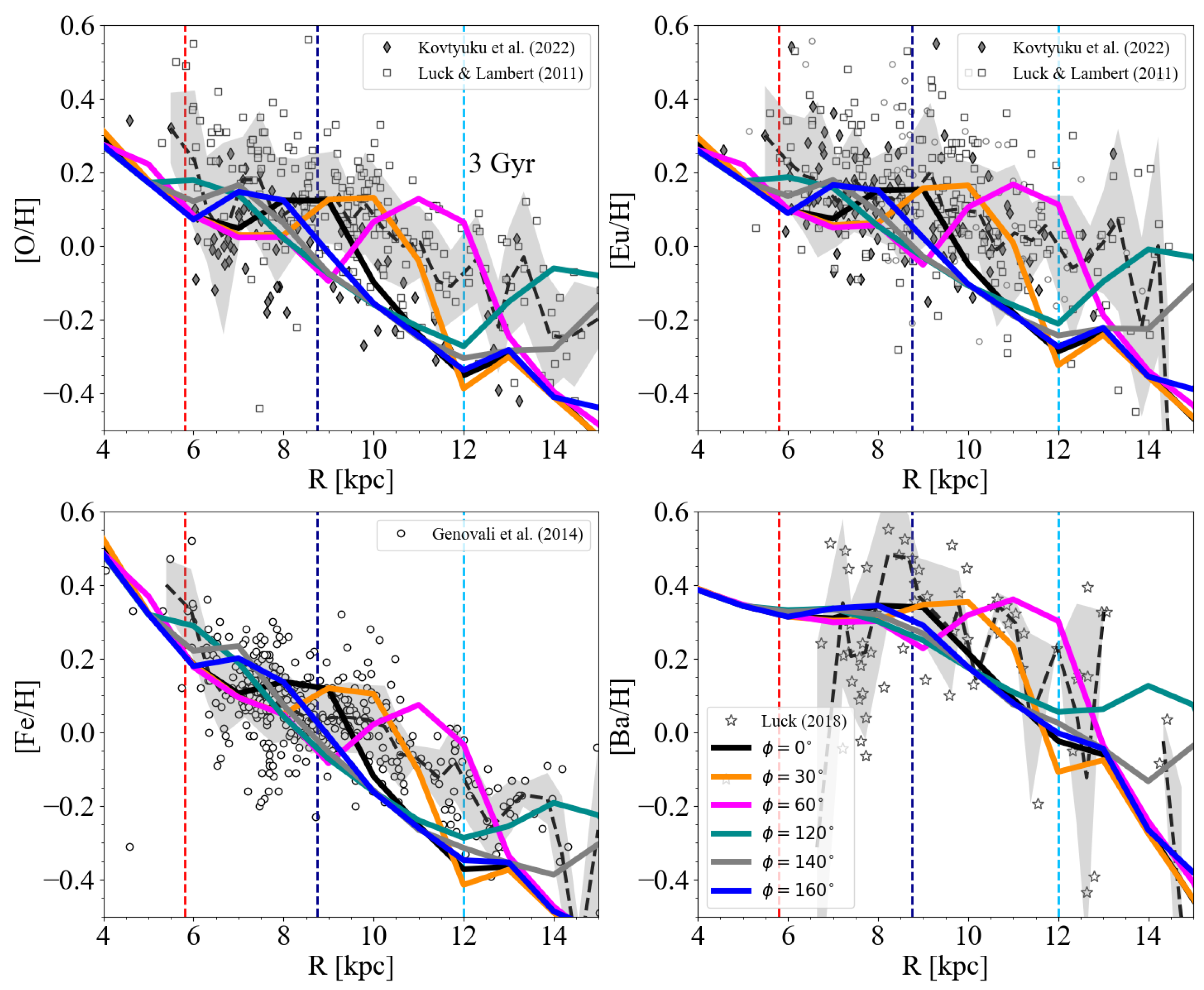
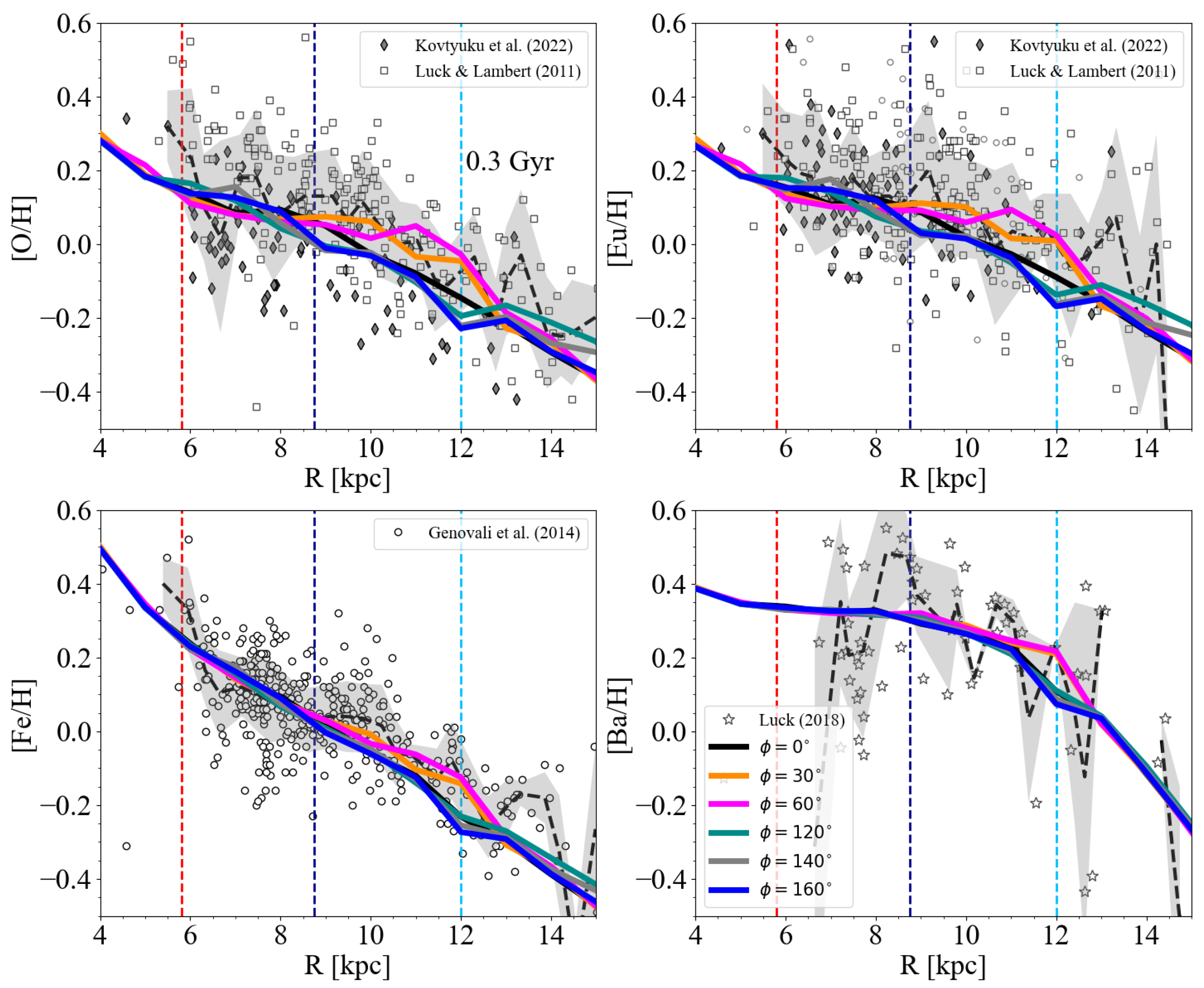
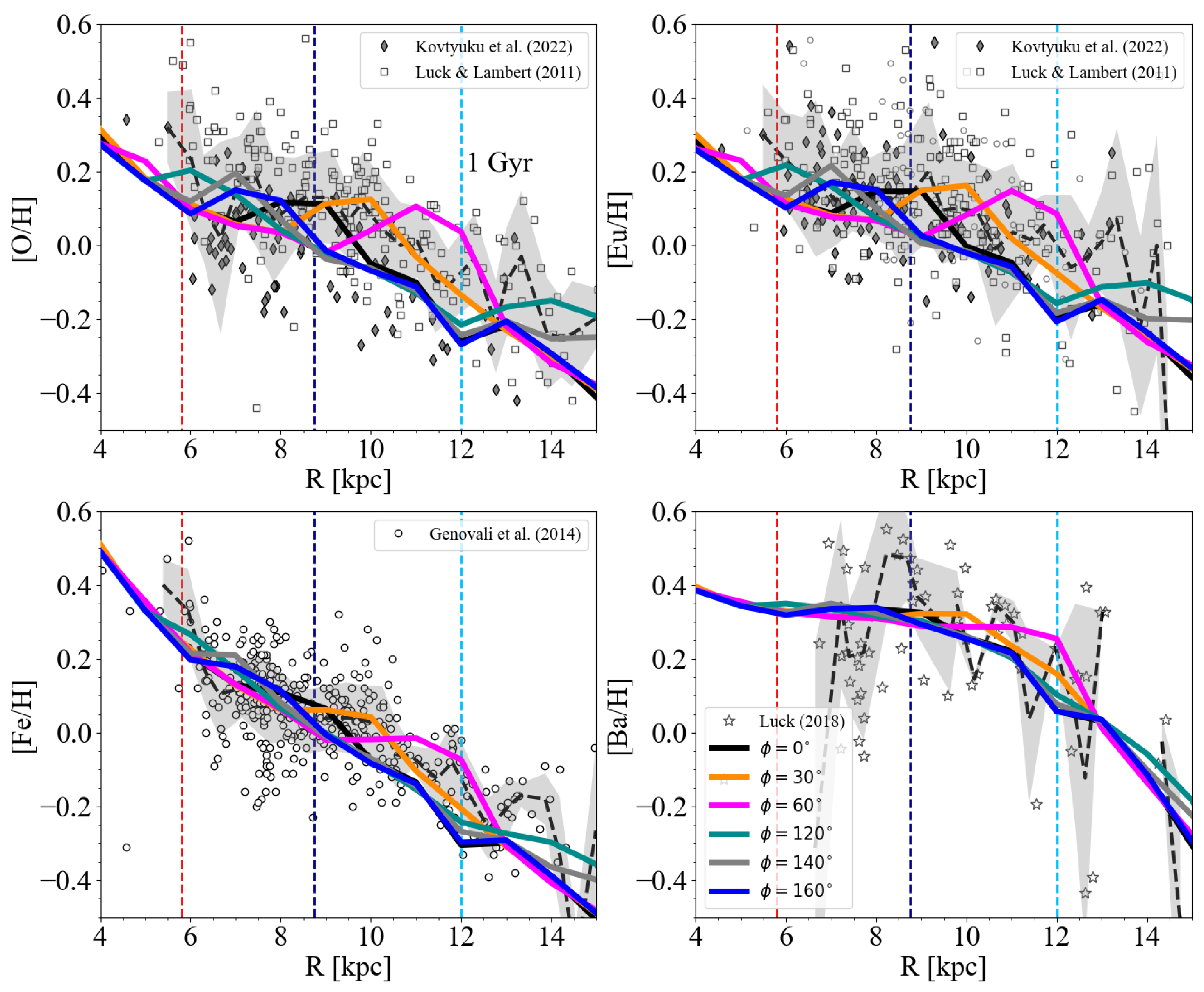
In Figure 2, Figure 3 and Figure 4, we present the abundance gradients predicted by our models at six different azimuthal angles for oxygen, europium, iron, and barium. In this study, we focus in particular on how the spread varies with Galactocentric distance, as generated by the six different abundance gradients predicted at these azimuthal angles. These predictions are obtained under the assumption that corotation extends across all Galactic radii during the last 0.3, 1, and 3 Gyr of Galactic evolution. The model results are compared with observed abundance gradients derived from Cepheids: oxygen and europium from [60,61], iron from [62], and barium from [63]. To enable a quantitative comparison between model predictions and observations, we computed the running median of the data in radial bins of 0.5 kpc, adopting a 40% overlap between consecutive bins. We required a minimum of two stars per bin for O, Fe, and Eu, while for Ba, given the more limited dataset, we allowed bins with at least one star. The corresponding standard deviations were also calculated and included in the analysis to quantify the data dispersion.
Figure 2 shows that the observed dispersion in the data cannot be reproduced if corotation across all radii is assumed to have occurred only during the last 0.3 Gyr. Nevertheless, elements synthesized on relatively short timescales, such as oxygen and europium, display a larger spread, especially near the radii where corotation was previously confined before extending throughout the disk, in qualitative agreement with the observations. In contrast, Figure 3 and Figure 4 show a significantly improved agreement with the data. In particular, in the 3 Gyr scenario, the model is able to account for nearly the entire observed dispersion in the abundance gradients, indicating that spiral arm effects can largely explain the observed spread. However, we highlight that the observed dispersion appears to be more uniform and nearly constant across different radii, whereas the model predicts a more variable radial behaviour. Another caveat is that the model predictions for oxygen and europium appear to underestimate the observed abundances.
Finally, in Table 2 we compare the abundance gradient slopes, derived from linear fits, between observations and model predictions for oxygen, iron, and europium (barium is excluded due to the limited availability of observational data). In the models, the slopes are obtained from the median elemental abundances [X/H], averaged over all azimuthal coordinates as a function of Galactocentric distance. We find that models C0_3 and C1 predict very similar slopes, closely matching the observations. Model C3 improves the agreement for oxygen, but slightly overestimates the steepness of the gradients for Fe and Eu compared to the data.

5. Discussion

Our findings indicate that the presence of multiple spiral arm patterns has a significant impact on the abundance gradients of several elements, including neutron-capture species. We investigated scenarios in which corotation extends across the entire Galactic disc over the last 0.3, 1, and 3 Gyr. The shortest timescale (0.3 Gyr; Figure 2) is insufficient to reproduce the observed dispersion in the data. In contrast, longer durations of extended corotation (1–3 Gyr; Figure 3 and Figure 4) progressively improve the agreement with observations, with the 3 Gyr case accounting for nearly the full extent of the observed spread. This suggests that a long-lived corotation pattern spanning all Galactic radii plays a key role in generating azimuthal variations in chemical abundances. However, a fraction of the present-day dispersion is likely attributable to stellar radial migration, which is not included in our model. This process redistributes stars throughout the Galactic disk, thereby contributing to the observed spread in combination with spiral arm effects [64,65,66]. Overall, while corotation driven by spiral structure can explain a large part of the observed abundance patterns, a comprehensive interpretation requires accounting for both spiral dynamics and stellar migration within chemical evolution models. On the other hand, if future studies rule out the presence of co-rotation at all radii for such an extended evolutionary time as a viable scenario, then the observed spread in the abundance gradients cannot be attributed to the effects of spiral arms.

Author Contributions

Conceptualization, E.S., G.C., I.M. and F.M.; methodology, E.S., G.C., I.M. and F.M.; software, E.S., G.C., I.M. and F.M.; investigation, E.S., G.C., I.M. and F.M.; writing—original draft preparation, E.S.; and writing—review and editing, G.C., I.M. and F.M. All authors have read and agreed to the published version of the manuscript.

Funding

E.S., G.C. and F.M. thank I.N.A.F. for the 1.05.24.07.02 Mini Grant—LEGARE “Linking the chemical Evolution of Galactic discs AcRoss diversE scales: from the thin disc to the nuclear stellar disc” (PI E. Spitoni). E.S and G.C. thank I.N.A.F. for the 1.05.23.01.09 Large Grant—Beyond metallicity: Exploiting the full POtential of CHemical elements (EPOCH) (ref. Laura Magrini). This work was also partially supported by the European Union (ChETEC-INFRA, project number 101008324) and by the Italian Research Center on High Performance Computing Big Data and Quantum Computing (ICSC), project funded by European Union—NextGenerationEU—National Recovery and Resilience Plan (NRRP)—Mission 4 Component 2 within the activities of Spoke 3 (Astrophysics and Cosmos Observations). I.M. acknowledges support by the Deutsche Forschungsgemeinschaft under the grant MI 2009/2-1.

Data Availability Statement

Dataset available on request from the authors: The raw data supporting the conclusions of this article will be made available by the authors upon request.

Conflicts of Interest

The authors declare no conflicts of interest. The funders had no role in the design of the study; in the collection, analyses, or interpretation of data; in the writing of the manuscript; or in the decision to publish the results.

References

  1. Spitoni, E.; Verma, K.; Silva Aguirre, V.; Calura, F. Galactic archaeology with asteroseismic ages. II. Confirmation of a delayed gas infall using Bayesian analysis based on MCMC methods. Astron. Astrophys. Astron. Astrophys. 2020, 635, A58. [Google Scholar] [CrossRef]
  2. Matteucci, F. Modelling the chemical evolution of the Milky Way. Astron. Astrophys. Rev. 2021, 29, 5. [Google Scholar] [CrossRef]
  3. Spitoni, E.; Schultheis, M.; Matteucci, F.; Ryde, N.; Cescutti, G.; Saro, A.; Sormani, M.C.; Thorsbro, B. The LEGARE Project: I. Chemical evolution model of the Nuclear Stellar Disc in a Bayesian framework. Astron. Astrophys. 2026, 707, A202. [Google Scholar] [CrossRef]
  4. Tagger, M.; Sygnet, J.F.; Athanassoula, E.; Pellat, R. Nonlinear Coupling of Galactic Spiral Modes. Astrophys. J. Lett. 1987, 318, L43. [Google Scholar] [CrossRef]
  5. Minchev, I.; Famaey, B.; Quillen, A.C.; Di Matteo, P.; Combes, F.; Vlajić, M.; Erwin, P.; Bland -Hawthorn, J. Evolution of galactic discs: Multiple patterns, radial migration, and disc outskirts. Astron. Astrophys. 2012, 548, A126. [Google Scholar] [CrossRef]
  6. Spitoni, E.; Cescutti, G.; Recio-Blanco, A.; Minchev, I.; Poggio, E.; Palicio, P.A.; Matteucci, F.; Peirani, S.; Barbillon, M.; Vasini, A. 2D chemical evolution models. II. Effects of multiple spiral arm patterns on O, Eu, Fe, and Ba abundance gradients. Astron. Astrophys. 2023, 680, A85. [Google Scholar] [CrossRef]
  7. Spitoni, E.; Cescutti, G.; Minchev, I.; Matteucci, F.; Silva Aguirre, V.; Martig, M.; Bono, G.; Chiappini, C. 2D chemical evolution model: The impact of Galactic disc asymmetries on azimuthal chemical abundance variations. Astron. Astrophys. 2019, 628, A38. [Google Scholar] [CrossRef]
  8. Vasini, A.; Spitoni, E.; Matteucci, F.; Cescutti, G.; Della Valle, M. Tracing the Milky Way spiral arms with 26Al: The role of nova systems in the 2D distribution of 26Al. Astron. Astrophys. 2025, 693, A37. [Google Scholar] [CrossRef]
  9. Grand, R.J.J.; Kawata, D.; Cropper, M. The dynamics of stars around spiral arms. Mon. Not. RAS 2012, 421, 1529–1538. [Google Scholar] [CrossRef]
  10. Baba, J.; Saitoh, T.R.; Wada, K. Dynamics of Non-steady Spiral Arms in Disk Galaxies. Astrophys. J. 2013, 763, 46. [Google Scholar] [CrossRef]
  11. Sellwood, J.A.; Carlberg, R.G. Transient Spirals as Superposed Instabilities. Astrophys. J. 2014, 785, 137. [Google Scholar] [CrossRef]
  12. Hunt, J.A.S.; Bub, M.W.; Bovy, J.; Mackereth, J.T.; Trick, W.H.; Kawata, D. Signatures of resonance and phase mixing in the Galactic disc. Mon. Not. RAS 2019, 490, 1026–1043. [Google Scholar] [CrossRef]
  13. Wada, K.; Baba, J.; Saitoh, T.R. Interplay between Stellar Spirals and the Interstellar Medium in Galactic Disks. Astrophys. J. 2011, 735, 1. [Google Scholar] [CrossRef]
  14. Goldreich, P.; Lynden-Bell, D. II. Spiral arms as sheared gravitational instabilities. Mon. Not. RAS 1965, 130, 125. [Google Scholar] [CrossRef]
  15. Julian, W.H.; Toomre, A. Non-Axisymmetric Responses of Differentially Rotating Disks of Stars. Astrophys. J. 1966, 146, 810. [Google Scholar] [CrossRef] [PubMed]
  16. Toomre, A. What amplifies the spirals. In Proceedings of the Structure and Evolution of Normal Galaxies; Fall, S.M., Lynden-Bell, D., Eds.; ADS: Cambridge, MA, USA, 1981; pp. 111–136. [Google Scholar]
  17. Matteucci, F.; Francois, P. Galactic chemical evolution: Abundance gradients of individual elements. Mon. Not. RAS 1989, 239, 885–904. [Google Scholar] [CrossRef]
  18. Chiappini, C.; Matteucci, F.; Romano, D. Abundance Gradients and the Formation of the Milky Way. Astrophys. J. 2001, 554, 1044–1058. [Google Scholar] [CrossRef]
  19. Kobayashi, C.; Nakasato, N. Chemodynamical Simulations of the Milky Way Galaxy. Astrophys. J. 2011, 729, 16. [Google Scholar] [CrossRef]
  20. Brook, C.B.; Stinson, G.S.; Gibson, B.K.; Kawata, D.; House, E.L.; Miranda, M.S.; Macciò, A.V.; Pilkington, K.; Roškar, R.; Wadsley, J.; et al. Thin disc, thick disc and halo in a simulated galaxy. Mon. Not. RAS 2012, 426, 690–700. [Google Scholar] [CrossRef]
  21. Bird, J.C.; Kazantzidis, S.; Weinberg, D.H.; Guedes, J.; Callegari, S.; Mayer, L.; Madau, P. Inside out and Upside down: Tracing the Assembly of a Simulated Disk Galaxy Using Mono-age Stellar Populations. Astrophys. J. 2013, 773, 43. [Google Scholar] [CrossRef]
  22. Martig, M.; Minchev, I.; Flynn, C. Dissecting simulated disc galaxies - I. The structure of mono-age populations. Mon. Not. RAS 2014, 442, 2474–2486. [Google Scholar] [CrossRef]
  23. Vincenzo, F.; Kobayashi, C. Stellar migrations and metal flows - Chemical evolution of the thin disc of a simulated Milky Way analogous galaxy. Mon. Not. RAS 2020, 496, 80–94. [Google Scholar] [CrossRef]
  24. Romano, D.; Karakas, A.I.; Tosi, M.; Matteucci, F. Quantifying the uncertainties of chemical evolution studies. II. Stellar yields. Astron. Astrophys. 2010, 522, A32. [Google Scholar] [CrossRef]
  25. Vincenzo, F.; Matteucci, F.; Spitoni, E. A simple and general method for solving detailed chemical evolution with delayed production of iron and other chemical elements. Mon. Not. RAS 2017, 466, 2939–2947. [Google Scholar] [CrossRef]
  26. Palicio, P.A.; Spitoni, E.; Recio-Blanco, A.; Matteucci, F.; Peirani, S.; Greggio, L. Analytic solution of chemical evolution models with Type Ia supernovae—I. Disc bimodality in the [versus [Fe/H] plane and other applications. Astron. Astrophys. 2023, 678, A61. [Google Scholar] [CrossRef]
  27. Scalo, J.M. The stellar initial mass function. Fund. Cosm. Phys. 1986, 11, 1–278. [Google Scholar]
  28. Minchev, I. Constraining the Milky Way assembly history with Galactic Archaeology. Ludwig Biermann Award Lecture 2015. Astron. Nachrichten 2016, 337, 703. [Google Scholar] [CrossRef]
  29. Cox, D.P.; Gómez, G.C. Analytical Expressions for Spiral Arm Gravitational Potential and Density. Astrophys. J. Suppl. 2002, 142, 261–267. [Google Scholar] [CrossRef]
  30. Roca-Fàbrega, S.; Antoja, T.; Figueras, F.; Valenzuela, O.; Romero-Gómez, M.; Pichardo, B. A novel method to bracket the corotation radius in galaxy discs: Vertex deviation maps. Mon. Not. RAS 2014, 440, 1950–1963. [Google Scholar] [CrossRef][Green Version]
  31. Barbillon, M.; Recio-Blanco, A.; Poggio, E.; Palicio, P.A.; Spitoni, E.; de Laverny, P.; Cescutti, G. Constraints on the history of Galactic spiral arms revealed by Gaia GSP-Spec α-elements. Astron. Astrophys. 2025, 693, A3. [Google Scholar] [CrossRef]
  32. Viscasillas Vázquez, C.; Magrini, L.; Spitoni, E.; Cescutti, G.; Tautvaišienė, G.; Vasini, A.; Randich, S.; Sacco, G.G. The Galactic inner spiral arms revealed by the Gaia ESO Survey chemical abundances: Metallicity and [Mg/Fe] ratios. Astron. Astrophys. 2025, 698, A91. [Google Scholar] [CrossRef]
  33. Spitoni, E.; Silva Aguirre, V.; Matteucci, F.; Calura, F.; Grisoni, V. Galactic Archaeology with asteroseismic ages: Evidence for delayed gas infall in the formation of the Milky Way disc. Astron. Astrophys. 2019, 623, A60. [Google Scholar] [CrossRef]
  34. Spitoni, E.; Verma, K.; Silva Aguirre, V.; Vincenzo, F.; Matteucci, F.; Vaičekauskaitė, B.; Palla, M.; Grisoni, V.; Calura, F. APOGEE DR16: A multi-zone chemical evolution model for the Galactic disc based on MCMC methods. Astron. Astrophys. 2021, 647, A73. [Google Scholar] [CrossRef]
  35. Spitoni, E.; Recio-Blanco, A.; de Laverny, P.; Palicio, P.A.; Kordopatis, G.; Schultheis, M.; Contursi, G.; Poggio, E.; Romano, D.; Matteucci, F. Beyond the two-infall model. I. Indications for a recent gas infall with Gaia DR3 chemical abundances. Astron. Astrophys. 2023, 670, A109. [Google Scholar] [CrossRef]
  36. Spitoni, E.; Aguirre Børsen-Koch, V.; Verma, K.; Stokholm, A. Disc dichotomy signature in the vertical distribution of [Mg/Fe] and the delayed gas infall scenario. Astron. Astrophys. 2022, 663, A174. [Google Scholar] [CrossRef]
  37. Spitoni, E.; Matteucci, F.; Gratton, R.; Ratcliffe, B.; Minchev, I.; Cescutti, G. (Re)mind the gap: A hiatus in star formation history unveiled by APOGEE DR17. Astron. Astrophys. 2024, 690, A208. [Google Scholar] [CrossRef]
  38. Vincenzo, F.; Spitoni, E.; Calura, F.; Matteucci, F.; Silva Aguirre, V.; Miglio, A.; Cescutti, G. The Fall of a Giant. Chemical evolution of Enceladus, alias the Gaia Sausage. Mon. Not. RAS 2019, 487, L47–L52. [Google Scholar] [CrossRef]
  39. François, P.; Matteucci, F.; Cayrel, R.; Spite, M.; Spite, F.; Chiappini, C. The evolution of the Milky Way from its earliest phases: Constraints on stellar nucleosynthesis. Astron. Astrophys. 2004, 421, 613–621. [Google Scholar] [CrossRef]
  40. Woosley, S.E.; Weaver, T.A. The Evolution and Explosion of Massive Stars. II. Explosive Hydrodynamics and Nucleosynthesis. Astrophys. J. Suppl. 1995, 101, 181. [Google Scholar] [CrossRef]
  41. Iwamoto, K.; Brachwitz, F.; Nomoto, K.; Kishimoto, N.; Umeda, H.; Hix, W.R.; Thielemann, F.K. Nucleosynthesis in Chandrasekhar Mass Models for Type IA Supernovae and Constraints on Progenitor Systems and Burning-Front Propagation. Astrophys. J. Suppl. 1999, 125, 439–462. [Google Scholar] [CrossRef]
  42. van den Hoek, L.B.; Groenewegen, M.A.T. New theoretical yields of intermediate mass stars. Astron. Astrophys. Suppl. 1997, 123, 305–328. [Google Scholar] [CrossRef]
  43. Matteucci, F.; Romano, D.; Arcones, A.; Korobkin, O.; Rosswog, S. Europium production: Neutron star mergers versus core-collapse supernovae. Mon. Not. RAS 2014, 438, 2177–2185. [Google Scholar] [CrossRef]
  44. Cescutti, G.; Romano, D.; Matteucci, F.; Chiappini, C.; Hirschi, R. The role of neutron star mergers in the chemical evolution of the Galactic halo. Astron. Astrophys. 2015, 577, A139. [Google Scholar] [CrossRef]
  45. Korobkin, O.; Rosswog, S.; Arcones, A.; Winteler, C. On the astrophysical robustness of the neutron star merger r-process. Mon. Not. RAS 2012, 426, 1940–1949. [Google Scholar] [CrossRef]
  46. Kalogera, V.; Kim, C.; Lorimer, D.R.; Burgay, M.; D’Amico, N.; Possenti, A.; Manchester, R.N.; Lyne, A.G.; Joshi, B.C.; McLaughlin, M.A.; et al. The Cosmic Coalescence Rates for Double Neutron Star Binaries. Astrophys. J. Lett. 2004, 601, L179–L182. [Google Scholar] [CrossRef] [PubMed]
  47. Molero, M.; Romano, D.; Reichert, M.; Matteucci, F.; Arcones, A.; Cescutti, G.; Simonetti, P.; Hansen, C.J.; Lanfranchi, G.A. Evolution of neutron capture elements in dwarf galaxies. Mon. Not. RAS 2021, 505, 2913–2931. [Google Scholar] [CrossRef]
  48. Simonetti, P.; Matteucci, F.; Greggio, L.; Cescutti, G. A new delay time distribution for merging neutron stars tested against Galactic and cosmic data. Mon. Not. RAS 2019, 486, 2896–2909. [Google Scholar] [CrossRef]
  49. Molero, M.; Simonetti, P.; Matteucci, F.; della Valle, M. Predicted rates of merging neutron stars in galaxies. Mon. Not. RAS 2021, 500, 1071–1086. [Google Scholar] [CrossRef]
  50. Winteler, C.; Käppeli, R.; Perego, A.; Arcones, A.; Vasset, N.; Nishimura, N.; Liebendörfer, M.; Thielemann, F.K. Magnetorotationally Driven Supernovae as the Origin of Early Galaxy r-process Elements? Astrophys. J. Lett. 2012, 750, L22. [Google Scholar] [CrossRef]
  51. Nishimura, N.; Takiwaki, T.; Thielemann, F.K. The r-process Nucleosynthesis in the Various Jet-like Explosions of Magnetorotational Core-collapse Supernovae. Astrophys. J. 2015, 810, 109. [Google Scholar] [CrossRef]
  52. Siegel, D.M.; Barnes, J.; Metzger, B.D. Collapsars as a major source of r-process elements. Nature 2019, 569, 241–244. [Google Scholar] [CrossRef] [PubMed]
  53. Cristallo, S.; Straniero, O.; Gallino, R.; Piersanti, L.; Domínguez, I.; Lederer, M.T. Evolution, Nucleosynthesis, and Yields of Low-Mass Asymptotic Giant Branch Stars at Different Metallicities. Astrophys. J. 2009, 696, 797–820. [Google Scholar] [CrossRef]
  54. Cristallo, S.; Piersanti, L.; Straniero, O.; Gallino, R.; Domínguez, I.; Abia, C.; Di Rico, G.; Quintini, M.; Bisterzo, S. Evolution, Nucleosynthesis, and Yields of Low-mass Asymptotic Giant Branch Stars at Different Metallicities. II. The FRUITY Database. Astrophys. J. Suppl. 2011, 197, 17. [Google Scholar] [CrossRef]
  55. Rizzuti, F.; Cescutti, G.; Matteucci, F.; Chieffi, A.; Hirschi, R.; Limongi, M. The contribution from rotating massive stars to the enrichment in Sr and Ba of the Milky Way. Mon. Not. RAS 2019, 489, 5244–5255. [Google Scholar] [CrossRef]
  56. Frischknecht, U.; Hirschi, R.; Pignatari, M.; Maeder, A.; Meynet, G.; Chiappini, C.; Thielemann, F.K.; Rauscher, T.; Georgy, C.; Ekström, S. s-process production in rotating massive stars at solar and low metallicities. Mon. Not. RAS 2016, 456, 1803–1825. [Google Scholar] [CrossRef]
  57. Cescutti, G.; Chiappini, C.; Hirschi, R.; Meynet, G.; Frischknecht, U. The s-process in the Galactic halo: The fifth signature of spinstars in the early Universe? Astron. Astrophys. 2013, 553, A51. [Google Scholar] [CrossRef]
  58. Cescutti, G.; Chiappini, C. Explaining the Ba, Y, Sr, and Eu abundance scatter in metal-poor halo stars: Constraints to the r-process. Astron. Astrophys. 2014, 565, A51. [Google Scholar] [CrossRef]
  59. Frischknecht, U.; Hirschi, R.; Thielemann, F.K. Non-standard s-process in low metallicity massive rotating stars. Astron. Astrophys. 2012, 538, L2. [Google Scholar] [CrossRef]
  60. Kovtyukh, V.; Lemasle, B.; Bono, G.; Usenko, I.A.; da Silva, R.; Kniazev, A.; Grebel, E.K.; Andronov, I.L.; Shakun, L.; Chinarova, L. The MAGIC project—III. Radial and azimuthal Galactic abundance gradients using classical Cepheids. Mon. Not. RAS 2022, 510, 1894–1901. [Google Scholar] [CrossRef]
  61. Luck, R.E.; Lambert, D.L. The Distribution of the Elements in the Galactic Disk. III. A Reconsideration of Cepheids from l = 30° to 250°. Astron. J. 2011, 142, 136. [Google Scholar] [CrossRef]
  62. Genovali, K.; Lemasle, B.; Bono, G.; Romaniello, M.; Fabrizio, M.; Ferraro, I.; Iannicola, G.; Laney, C.D.; Nonino, M.; Bergemann, M.; et al. On the fine structure of the Cepheid metallicity gradient in the Galactic thin disk. Astron. Astrophys. 2014, 566, A37. [Google Scholar] [CrossRef]
  63. Luck, R.E. Cepheid Abundances: Multiphase Results and Spatial Gradients. Astron. J. 2018, 156, 171. [Google Scholar] [CrossRef]
  64. Minchev, I.; Chiappini, C.; Martig, M. Chemodynamical evolution of the Milky Way disk. I. The solar vicinity. Astron. Astrophys. 2013, 558, A9. [Google Scholar] [CrossRef]
  65. Minchev, I.; Famaey, B.; Combes, F.; Di Matteo, P.; Mouhcine, M.; Wozniak, H. Radial migration in galactic disks caused by resonance overlap of multiple patterns: Self-consistent simulations. Astron. Astrophys. 2011, 527, A147. [Google Scholar] [CrossRef]
  66. Spitoni, E.; Palla, M.; Magrini, L.; Matteucci, F.; Danielski, C.; Tsantaki, M.; Sozzetti, A.; Molero, M.; Fontani, F.; Romano, D.; et al. Shaping Galactic habitability: Impact of stellar migration and gas giants. Astron. Astrophys. 2025, 700, A58. [Google Scholar] [CrossRef]
Figure 1. Pattern speeds of the adopted spiral structures. (Left panel): The three spiral pattern speeds— Ω s , 1 ( R ) , Ω s , 2 ( R ) , and Ω s , 3 ( R ) —for Model A (see Table 1) are represented by horizontal colored segments (red, dark blue, and light blue, respectively). The radial extent of the inner and outer regions of each spiral mode is highlighted with thick lines. The disk angular rotation curve, Ω d ( R ) , taken from [30], is shown as a dotted line. The locations of the inner and outer Lindblad resonances (ILR and OLR) for the 2:1 and 4:1 cases are indicated by solid and dashed black curves, respectively. These resonances are defined by Ω p , 2 ( R ) = Ω d ( R ) ± κ / 2 and Ω p , 4 ( R ) = Ω d ( R ) ± κ / 4 , where κ is the epicyclic frequency. Vertical dashed lines mark the corotation radii corresponding to each spiral pattern speed. (Adapted from [6].) (Right panel): Pattern speeds of the three spiral components under the assumption that corotation extends over the entire disk, for Models C0_3, C1, and C3 listed in Table 1.
Galaxies 14 00066 g001
Figure 2. The present-day radial abundance distributions of oxygen (top left), europium (top right), iron (bottom left), and barium (bottom right) are displayed for different azimuthal angles, as predicted by model A+ C0_3. In this model, all radii are assumed to be in corotation during the final 0.3 Gyr of evolution. In each panel, coloured vertical dashed lines indicate the corotation radii corresponding to the three spiral-arm patterns prior to this phase, each defined by a distinct pattern speed (Model A). The model predictions are compared with observational data from Cepheids: oxygen and europium abundances from [60,61], iron measurements from [62], and barium data from [63]. Observed trends, shown as black dashed lines, are derived using a running median computed in bins of 0.5 kpc with a 40% overlap. A minimum of two stars per bin is required for O, Fe, and Eu, while at least one star is allowed for Ba due to the more limited dataset. The shaded areas represent the associated standard deviations. For visualization purposes, only the range −0.5 ≤ [X/H] ≤ 0.6 dex is shown, and Cepheids with [Ba/H] values exceeding 0.6 dex are excluded. (Adapted from [6].)
Galaxies 14 00066 g002
Figure 3. As in Figure 2, but for the model A+ C1 where all radii corotation condition is extended to the last 1 Gyr of evolution. (Adapted from [6].)
Galaxies 14 00066 g003
Figure 4. As in Figure 2, but for the model A+ C3 where the all radii corotation condition is extended to the last 3 Gyr of evolution.
Galaxies 14 00066 g004
Table 1. Summary of the main characteristics of the models considered in this study. For each model, we list the pattern speed ( Ω s , j ), the radial extent of each spiral component ( R min to R max ), and the associated corotation radius R j , cor . . All spiral structures follow the evolution of Model A (see [6]) for the majority of the Galactic disk’s lifetime. In the final stages, we explore three scenarios in which corotation extends across all radii, i.e., Ω s , j ( R ) = Ω d ( R ) : for the last 0.3 Gyr (Model C0_3), 1 Gyr (Model C1), and 3 Gyr (Model C3) (see [6,31,32]). All models share the same global parameters: a radial scale length for the decrease in the spiral arm density amplitude of R S = 7 kpc, a disk scale length of R D = 3.5 kpc, and a reference spiral arm surface density at R 0 = 8 kpc of Σ S , 0 = 20 M pc−2. In addition, a star formation efficiency of ν = 1.1 Gyr−1 and a multiplicity parameter m = 2 are adopted throughout.
Models M MS , 1 ( γ 1 ) M MS , 2 ( γ 2 ) M MS , 3 ( γ 3 )
Ω s , 1 R 1 , min R 1 , max R 1 , cor . Ω s , 2 R 2 , min R 2 , max R 2 , cor . Ω s , 3 R 3 , min R 3 , max R 3 , cor .
[ km s kpc ] [kpc] [kpc] [kpc] [ km s kpc ] [kpc] [kpc] [kpc] [ km s kpc ] [kpc] [kpc] [kpc]
A30.03.07.06.020.06.012.08.715.09.018.012.0
C0_3 Ω d 3.07.0[3–7] Ω d 6.012.0[6–12] Ω d 9.018.0[9–18]
(last 0.3 Gyr)
C1 Ω d 3.07.0[3–7] Ω d 6.012.0[6–12] Ω d 9.018.0[9–18]
(last 1 Gyr)
C3 Ω d 3.07.0[3–7] Ω d 6.012.0[6–12] Ω d 9.018.0[9–18]
(last 3 Gyr)
Table 2. Comparison of the abundance gradient slopes computed between 4 and 15 kpc (derived from linear fits), between observations and model predictions for oxygen, iron, and europium. In the models, the slopes are obtained from the median elemental abundances [X/H], averaged over all azimuthal coordinates as a function of the Galactocentric distance. For the observational data, the slopes are computed from median abundance values evaluated in radial bins of 1 kpc.
Gradient Slope Δ[X/H]/ΔR [dex/kpc]DATAModel C0_3Model C1Model C3
X = O−0.057−0.051−0.051−0.055
X = Fe−0.072−0.079−0.080−0.082
X = Eu−0.038−0.045−0.045−0.049
Disclaimer/Publisher’s Note: The statements, opinions and data contained in all publications are solely those of the individual author(s) and contributor(s) and not of MDPI and/or the editor(s). MDPI and/or the editor(s) disclaim responsibility for any injury to people or property resulting from any ideas, methods, instructions or products referred to in the content.