
Review

Neutron Capture in Evolved Red Giants: A Review
by
Maurizio Maria Busso
1,2
1
Department of Physics and Geology, Univrsity of Perugia, 06125 Perugia, Italy
2
Section of Perugia of Istituto Nazionale di Fisica Nucleare (INFN), 06125 Perugia, Italy
Galaxies 2026, 14(3), 58; https://doi.org/10.3390/galaxies14030058
Submission received: 17 April 2026 / Revised: 20 May 2026 / Accepted: 25 May 2026 / Published: 1 June 2026
(This article belongs to the Special Issue Neutron Capture Processes in the Universe)

Abstract

This review traces how our understanding of low- and intermediate-mass stars (hereafter LMS and IMS, respectively) evolved in time, in parallel with our knowledge of slow neutron-capture phenomena (the s-process). I shall focus in particular on the main component of this nucleosynthesis phenomenon, occurring in the above-mentioned stars close to the end of their lifetimes. They start ascending the Asymptotic Giant Branch (AGB), where both H- and He-shells exist, burning alternatively during the phases most relevant to our discussion: the so-called thermal pulses (hence, the name of TP-AGB stages for the final evolutionary period of these stars). I shall outline how such final stages were discovered to be a crucial source for neutron captures. Finally, I will briefly discuss what observational constraints and nuclear measurements have taught us about the status of our theoretical models in this field of nuclear and stellar physics.

1. Introduction

The most abundant nuclei, those dominating the solar composition, are produced by fusion reactions, which at the same time supply the energy that fuels stellar evolution. The earliest exploration of these processes, in the 1950s, founded the field now known as nuclear astrophysics.
This story actually began much earlier, perhaps at the invention of the mass spectrometer by the British chemist Francis William Aston (Nobel Prize for Physics in 1922) [1]. He discovered that a helium nucleus weighs less than four separate protons, implying that the mass excess could be transformed into energy. This observation prompted Eddington [2] and Perrin [3], independently, to propose that the Sun’s luminosity would arise from hydrogen fusion, the resulting mass deficit being released as radiation.
Subsequent investigations by [4,5] about the Coulomb barrier and the tunneling effect required to surmount it were fundamental for the first practical suggestions on how nuclear fusion could occur at the solar temperature [6,7,8]. Over these foundations, Fred Hoyle later constructed his comprehensive theory of stellar nucleosynthesis [9,10].

1.1. The Way to Neutron Captures

For nuclei heavier than the iron group, the average binding energy decreases with atomic mass. Because of this, producing the heaviest nuclides via the same fusion chains that operate for lighter elements is impossible: those reactions become endothermic and would also need unrealistically high temperatures to overcome the large Coulomb barriers.
Until the fifties, 56Fe was thought to possess the maximum nuclear binding energy B, but works by [11] later showed that the highest value was actually owned by 62Ni, closely followed by the stable 58Fe nucleus. Beyond nickel, the downward slope of the binding energy curve implies that processes different than thermonuclear fusion of charged nuclei must be at work. A first suggestion by Al Cameron in [12], attributing several abundance signatures in evolved stars to the occurrence of the 13C(α,n)16O neutron source, thus anticipating modern discoveries, raised little echo at that epoch. The subsequent landmark paper by E.M. Burbidge et al. (1957) [13] (afterwards known by the shorthand B2FH) is therefore still considered as the first work showing that the very heavy elements from Fe to actinides originate mainly through neutron capture reactions. Two limiting regimes were defined:
  • r-process (rapid captures, on average faster than β decays along the nuclear path);
  • s-process (slow captures, on average slower than β decays along the nuclear path).
At the start of the 1960s, Donald Clayton and co-workers undertook the first quantitative treatment of these capture chains [14,15]. The analysis performed in their work [14] (the celebrated CFHZ paper) provided a solution to a simplified s-process equation, based on an exponential distribution of neutron exposures (see later, Equation (4)).

1.2. Early Theoretical Developments

The idea advanced by [14,15] inspired a sequence of follow-up studies that validated and extended it, culminating in the synthesis paper by Seeger et al. [16]. This work produced a comprehensive description of neutron capture nucleosynthesis, fitting the solar σ i N s , i curve. That is the distribution, built for nuclei i heavier than 56Fe, of the neutron-capture cross section σ i times the s-process fraction N s , i of their solar number abundance. Those nuclei that derive exclusively from slow neutron captures have therefore N s , i / N i = 1, and are called “s only” isotopes. The authors adopted for their model the already-mentioned exponential distribution of neutron exposures. These findings, illustrated in detail in Clayton’s classic textbook [17], remain a cornerstone of this field.
In examining the alternative reaction paths through strontium or rubidium isotopes, Seeger et al. also introduced a first discussion of branching reactions, occurring at the locations along the s-process trajectory where β decay and neutron capture would proceed at comparable rates, splitting the nucleosynthetic flow.

1.3. From Phenomenology to Stellar Models

Near the end of the 1960s, quantitative stellar calculations had begun to appear. The discovery, at the surfaces of red giants (type S), of the unstable element technetium (Tc), with a number of protons Z = 43 and lifetimes of its isotopes all much shorter than the stellar evolutionary lifetime [18], demonstrated that slow neutron captures do indeed operate within such evolved stars.
Early attempts to simulate the complex structure of these objects, especially in the work by Schwarzschild & Härm [19], revealed that their energy production arises from two burning shells (of H and He), prone to recurrent instabilities, later called thermal pulses (TPs). The corresponding evolutionary phase thus became known as the Thermally Pulsing Asymptotic Giant Branch ( T P A G B ) stage.
In the following sections, I shall trace, more or less in chronological order, how the field progressed from phenomenological treatments to the first self-consistent AGB evolutionary models, beginning with the deductions drawn purely from nuclear systematics.

2. The Phenomenological Approach

As mentioned earlier, the first formal mathematical framework describing the s-process was introduced by [14,16].
That treatment, now customarily called the phenomenological approach, applied elementary nuclear reasoning to reproduce the chain of slow neutron captures that links adjacent stable nuclei. They consider sequential neutron captures on two stable nuclei with atomic masses ( A 1 ) and ( A ) . In their treatment, the time variation in the abundance N ( A ) of the heavier isotope can be written as:
d N ( A ) d t = N ( A 1 ) n n < σ ( A 1 ) v > N ( A ) n n < σ ( A ) v >
where the brackets indicate the Maxwellian averaged product of cross section and particle velocity, and n n is the neutron density.
In order to quantify the cumulative neutron fluence, one then defines the integrated neutron exposure, τ , as:
τ = 0 t n n v T d t
where v T in the thermal velocity and the integral is extended over the duration t of the exposure. When a system reaches a steady state of continuous neutron flow ( d N / d τ = 0), then the previous expression yields the simple relation:
< σ v > = c o n s t .
Thus, when s-processing proceeds at equilibrium, the product σ N should stay roughly constant for neighboring isotopes.
The above empirical rule is indeed verified (at least approximately) for the nuclei in the solar system deriving from slow neutron captures, except near nuclear regions of exceptional stability, as predicted by the shell model of the nucleus, where in fact the closure of neutron shells produces abrupt changes in nuclear size and exceptionally low capture cross sections.
Such regions of stability are characterized by specific numbers of neutrons (called magic neutron numbers; they are N = 2, 8, 20, 28, 50, 82, 126) and mark discontinuities in the σ N distribution. Isotopes possessing these numbers also appear as abundance peaks: they are abundant because their cross sections are much smaller (only a few millibarns) than in adjacent plateaus.
To reproduce the observed solar σ N pattern, ref. [16] noted that a distribution of neutron exposures should contribute (rather than a single value). Any function decreasing with increasing exposure τ might, in principle, fit the data. The above authors adopted a simple exponential representation:
ϱ ( τ ) = G N 56 τ 0 e τ τ 0
where G is the fraction of the solar N 56 exposed to neutron fluences and τ 0 is a free parameter (called the m e a n neutron exposure). The value that best reproduces the known products of cross sections and solar abundances must be chosen.
Building on the above assumptions, Clayton and Ward [20] derived an explicit analytical solution for the s-process abundance fractions N s ( A ) ) of the solar abundances:
σ ( A ) N ( A ) = G N 56 τ 0 i = 56 A ( 1 + 1 σ i τ 0 ) 1
As it became clear that a single exposure distribution could not circumvent the “bottlenecks” created by magic nuclei, the data were better reproduced by three combined components, each characterized by its own τ 0 :
  • Weak component, responsible for nuclides up to Sr ( N 50);
  • Main component, for species between Sr and Pb (50 N 126);
  • Strong component, required mainly to account for the doubly magic 208Pb.
Today, it is recognized that the weak component is ascribed to massive stars ( M 10   M ) in their phases of combustion of He and C [21,22,23,24,25,26], while the rest is mostly due to lower mass stars ( M 4   M ) of different metallicities in their TP-AGB stage [27,28,29,30,31,32].
Following earlier hints by [16], a full theoretical treatment of branching point positions along the capture chain, where β decays compete with neutron captures, was provided by [33]. Abundances around such branchings allow one to estimate the physical conditions at the site of nucleosynthesis (neutron density n n and temperature, T), via a branching ratio ( f ):
f = λ ( β ) λ ( β ) + λ n
where λ ( β ) = 1 / τ β is the β decay rate, λ n = n n σ v is the neutron capture rate.
Since many β -decay rates vary with temperature, the combination of nuclear data and the four parameters G , τ 0 , n n , and T offered practical diagnostics for comparing theoretical conditions with stellar observations.
These quantities acted as the first bridge between pure nuclear physics and astrophysical modeling, guiding later efforts to identify the actual stellar environments where the s-process takes place. These will be discussed in Section 3.

3. Nucleosynthesis Models for AGB Stars

Soon after [16] proposed exponential distributions of neutron exposures, stellar evolution models were extended to the late phases of low- and intermediate-mass stars. It quickly became clear that the AGB stage, powered simultaneously by H- and He-burning shells, has a distinct behavior, which strongly affects s-process nucleosynthesis.

3.1. The Thin Shell Instability

In a seminal work, Schwarzschild and Härm [19] identified the mentioned key feature in what they called the thin shell instability. Consider, in spherical symmetry, a shell of constant mass ( Δ m ) located at radius r with a small thickness l ( r ) , so that Δ m 4 π ρ r 2 × l . For such a configuration, in hydrostatic equilibrium:
d P P = 4 d r r
Then, noticing that the expression of Δ m implies that the density, for a fixed radius, is proportional to 1 / l , one gets:
d ρ ρ = d l l d r l = r d r l r .
This permits to express Equation (7) in the new form:
d P P = 4 l d ρ r ρ
Within a stellar plasma, an equation of state holds. In general, if α and β are constant parameters, we can then assume, for this equation of state:
d P P = α d ρ ρ + β d T T
So that, finally:
( 4 l r α ) d ρ ρ = β d T T
However, for thermal stability, one would require:
4 l r > α
that, for very thin shells (l/r –> 0) may not be always satisfied, creating an unstable situation.
If the shell expands and the hydrostatic pressure decreases more rapidly with radius than it would decrease due to the expansion, the layer continues to expand and cool, moving away from equilibrium. If instead the temperature rises, a thermonuclear runaway occurs, sharply increasing luminosity before the system relaxes again. See, e.g., ref. [34] for a discussion.

3.2. The Double Shell Structure and the Thermal Pulses

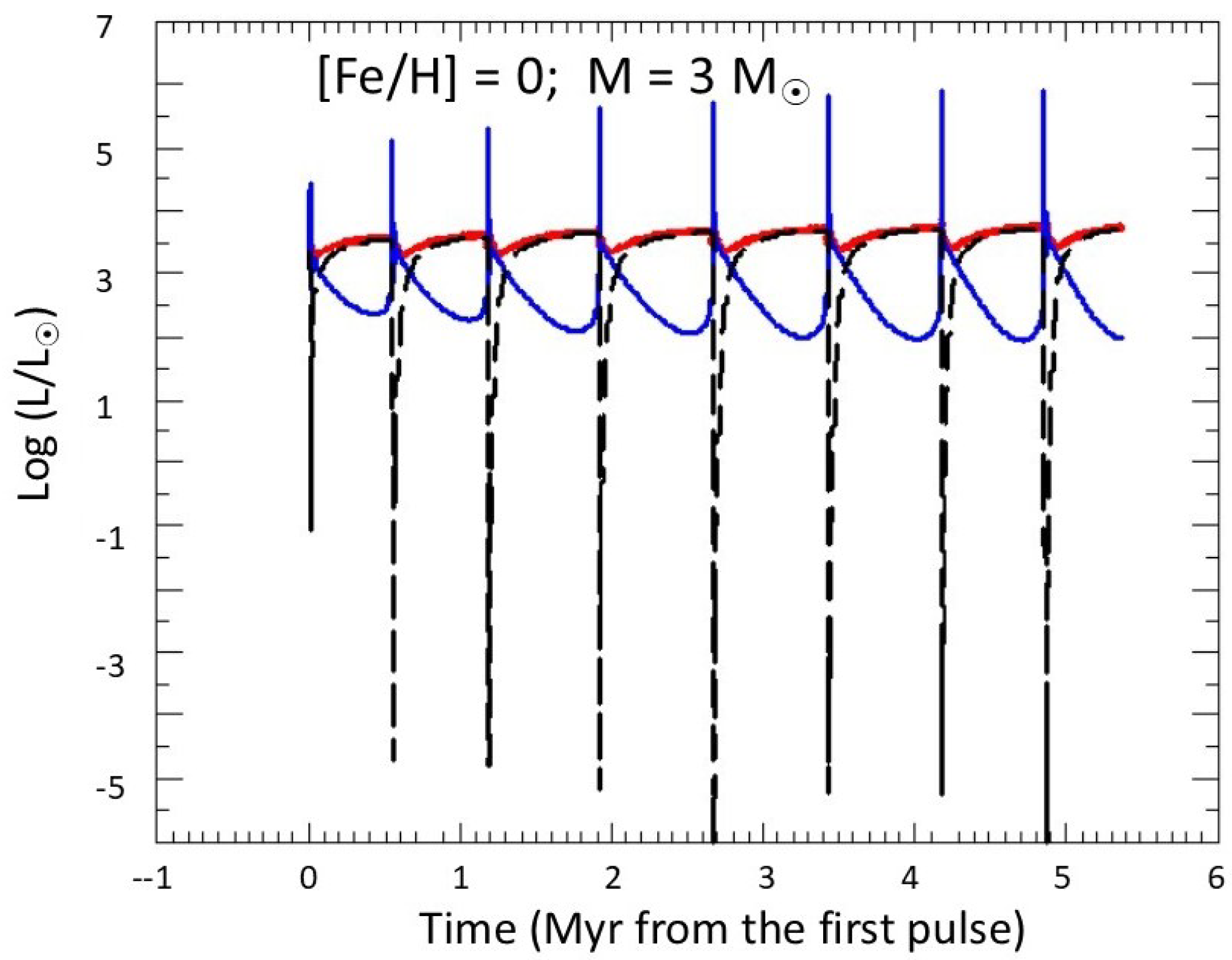
Repeated instabilities of the kind mentioned above shape the last stages of evolution in AGB stars. As an example, in models of a 3   M star with solar metallicity, the luminosity of the He-shell shows recurrent sharp peaks up to almost 10 7   L , while the H-shell luminosity declines (see Figure 1 from reference [35]).
Each episode, known today, as already mentioned, as a thermal pulse (TP), creates a convective zone extending over most of the inter-shell structure, whose initial composition is dominated by He, left behind by H-shell burning. As these events recur, He burning operates above the degenerate C-O core (the adjective indicating that its physics is that of a quantum Fermi gas). This burning is very peculiar. The star experiences sudden He f l a s h e s , separated by quiescent intervals where H burning dominates the energy production (see again Figure 1). When He burns (after accumulating enough fuel during the preceding quiescent phase), the local temperature surges from ≃ 1.5 × 10 8 K up to 2.8–3.5 × 10 8 K , the exact value depending mainly on the stellar mass.
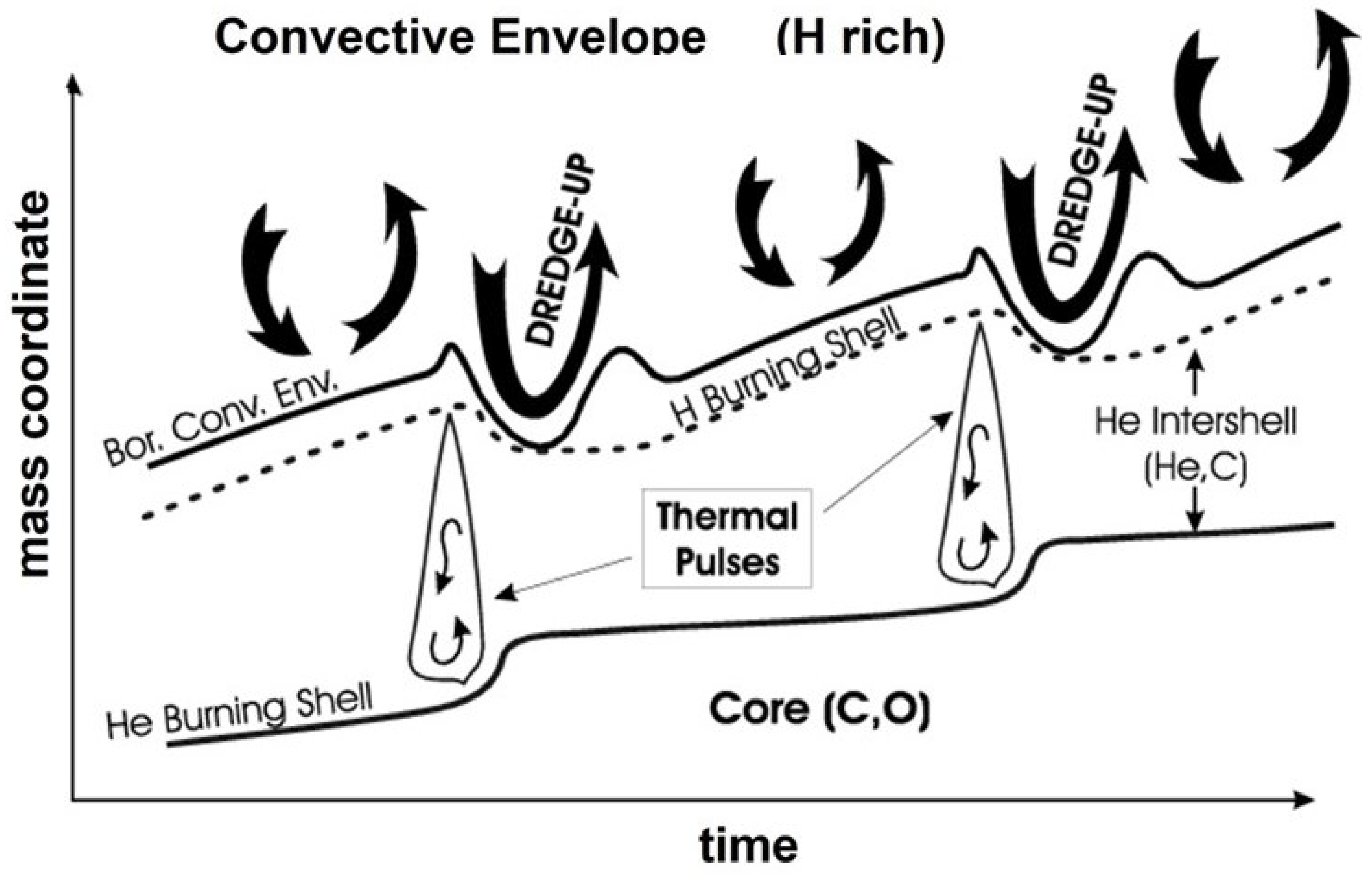
The enormous energy release in a thermal pulse triggers an intermediate convective zone ( I C Z ) that mixes the products of He burning, including C- and n-capture nuclei, throughout the inter-shell region. In the following expansion and cooling, H burning stops temporarily, and in the phase that follows, the convective envelope penetrates inward, crossing the H–He discontinuity. This is the so-called third dredge up (TDU) phenomenon, carrying He-burning ashes, especially newly created carbon and s-elements, to the surface. (This is illustrated schematically in the cartoon of Figure 2.)
Despite the occurrence of dredge up, the large envelope mass prevents stars of mass larger than 4–5 M to become C rich at the point where C dominates the photospheric composition leading to the formation of C-based molecules. These more massive stars and the efforts made to obtain from them a full description of the s-process will be addressed in Section 4.1.
For stars in the mass range 1.5 to 3–4 M , instead, the TDU can raise the C/O ratio above unity, producing the so-called carbon stars [27]. At the base of each I C Z , temperatures between 2.8 × 10 8 and 3.5 × 10 8 K enable several α captures to occur. Apart from the 3 α -process, α captures occur mainly on the abundant 14N, left behind by the CNO cycle. This initiates the reaction chain:
N 14 ( α , γ ) F 18 ( β + ν ) O 18 ( α , γ ) Ne 22
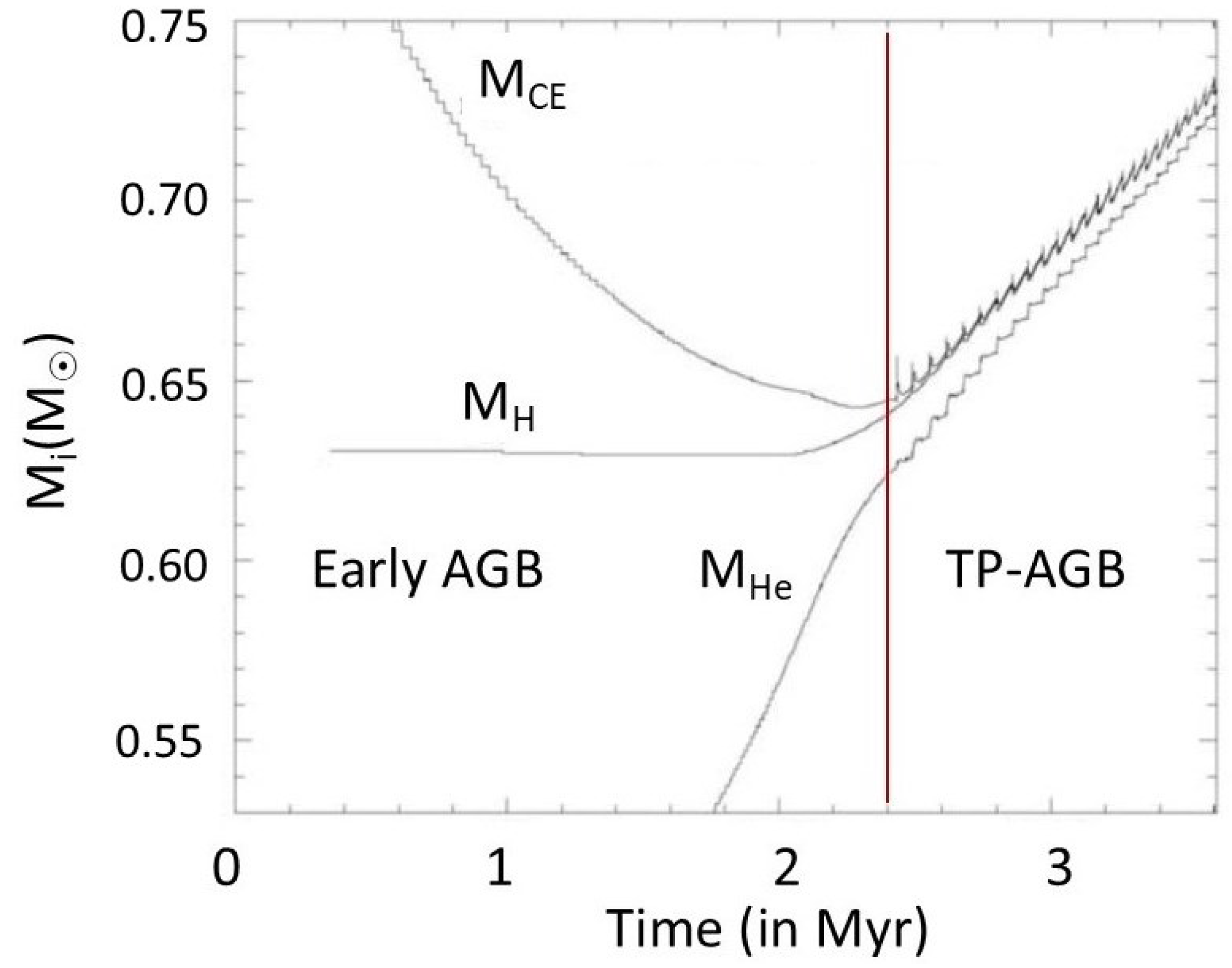
While the luminosìty undergoes the mentioned variations, the position in mass of the layers where H and He are burning and of the bottom edge of the convective envelope vary accordingly in a rather peculiar manner, sharply changing the behavior previously displayed after the end of core He-burning. The whole evolution of the internal structure during the second ascent to the RGB branch for a 3 M stellar model of 1/3 solar metallicity, computed with the code FRANEC (Fasacati Raphson–Newton Evolutionary Code; see, e.g., [36]), is shown in Figure 3. Two different stages of evolution are clearly visible, and are currently referred to as early-AGB stage (the first part of Figure 3, to the left of the continuous vertical red line), where the H-shell is almost extinguished, and the He-shell grows in mass, producing the bulk of the energy) and the already-mentioned TP-AGB phase (the second part of Figure 3, on the right side of the plot, with the stepwise growth of the He-shell in correspondence with the shell flashes).

4. The Long Search for a Suitable Neutron Source

The series of reactions (13), when the temperature at the base of the ICZs becomes T 2.8 × 10 8 K , can be followed by the two alternative processes:
Ne 22 ( α , γ ) Mg 26 ,
and
Ne 22 ( α , n ) Mg 25 ,
At around 300 MK , the ratio of reaction rates σ v ( α , n ) / σ v ( α , γ ) is close to 3, making reaction (15) the dominant channel and releasing neutrons in the plasma. For roughly two decades, this process, occurring naturally for sufficiently high values of the temperature, was therefore assumed to be at the origin of slow neutron captures in AGB stars, accounting for the detection of technetium [18], whose isotope 99Tc lies directly on the foreseen path of neutron captures and beta decays for the s-process.

4.1. The Research on the 22Ne Source Activation

The above interpretation received an apparent confirmation from [37], who showed how an exponentially decreasing distribution of neutron exposures (as proposed by [16]) could arise directly by a series of helium shell flashes.
The properties of TP-AGB stars undergoing the thin shell instabilities discussed so far were investigated analytically by [38,39] in the early 1970s. In this way, relations connecting basic evolutionary quantities (such as the interpulse period, the total luminosity, and the advancement rate of the H-burning shell) to the hydrogen-exhausted core mass M H were established. Because the thermal pulse properties depend mainly on such a core mass, different evolutionary models agree in showing a convergence toward a narrow range of parameters. This convergence reflects the common structure of low- and intermediate-mass stars: a thin active layer sitting above a degenerate C–O core of mass below the Chandrasekhar limit.
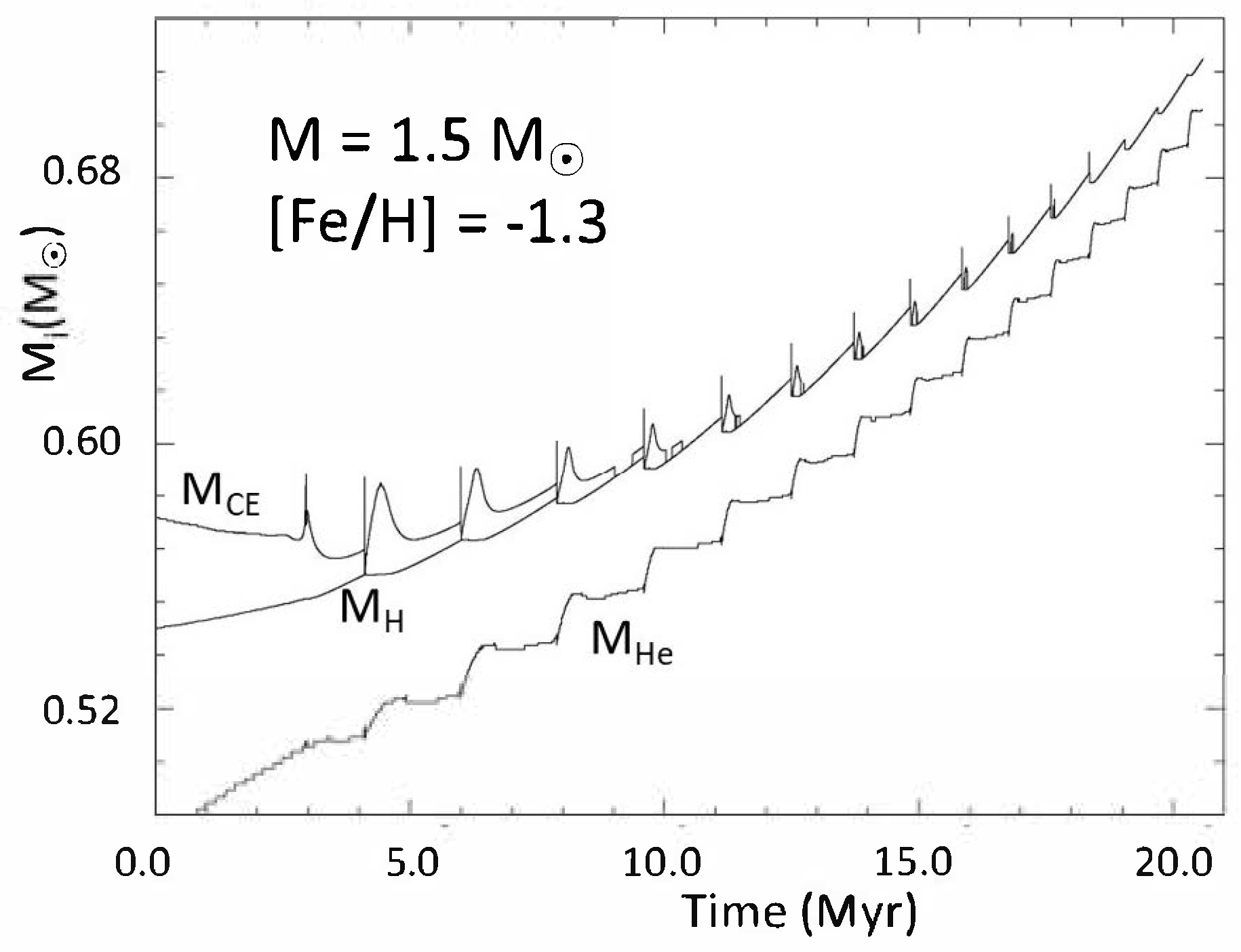
The phenomenon of the third dredge up is more easily found at low metallicities, at least for the stars of mass lower than 2 M . An example of this is shown in Figure 4, again taken from the outputs of the FRANEC code and representing a star of 1.5 M and a metallicity of 1/20th that of the Sun. After every thermal pulse, the envelope penetrates deeper (the TDU), while the H-burning shell advances outward. Outside, there is the huge convective envelope, with a photospheric temperature quite low for stars ( T 3500 K). The envelope loses mass at increasing rates through radiation pressure exerted on circumstellar dust grains.
Until the end of the XXth century, computing a full evolutionary sequence for a relatively low-mass star, with dredge up and nucleosynthesis, was extremely time consuming, so that semi-analytical models became rather popular. They could provide a workable approximation to the real TP-AGB behavior and useful yield estimates, with a larger efficiency than by running full stellar models. For examples of these approaches see, e.g., [40,41,42].
During the seventies and the eighties, AGBs were assumed to have the same structure described above up to 7–8 M . As the neutron source shown in relation (15) requires rather high temperature ( T 3.3 3.5 × 10 8 K), which is experienced only by stars above about at least 4 M (i.e., the so-called intermediate-mass stars, or IMSs) most theoretical work dedicated to study the Main Component of s-processing (88 A 208) were concentrated on IMSs and on specifying the rate of what became commonly known as the “22Ne neutron source”. In these studies, a particularly important role was played by the groups in Urbana-Champaign and Chicago, led by Icko Iben and Jim Truran (see, e.g., [43,44,45,46]).
A problem arose, however, when AGB stars enriched in s-process elements were shown observationally to be low-mass objects, conflicting with the high temperatures required for the 22Ne(α,n) source.
The above fact was pointed out, especially by David Lambert and his coworkers (see, e.g., [47,48,49]). Early on, Icko Iben [50] recognized the discrepancy and, with A. Renzini [51], proposed that the neutron production could instead originate from the alternative reaction 13C(α,n)16O source, operating at a low temperature ( T 8–9 × 10 7 K). This idea initiated a new line of inquiry, which would dominate subsequent research.

4.2. Emergence of the 13C Neutron Source

During the interpulse phase, the reaction 13C(α,n)16O becomes active in the inter shell region because, as mentioned, it requires a relatively low temperature to occur. However, the small amount of 13C left behind by shell-H burning is largely insufficient to promote any noticeable neutron flux, also because it comes with a dominant concentration of 14N, which is an efficient neutron absorber. Hence, in normal conditions, only a marginal number of the Fe nuclei would experience neutron captures, and this was the main reason why the neutron production from α captures on 13C was not considered important for nearly thirty years after the work by [14,16], mentioned in Section 2. In fact, obtaining abundant 13C requires special mixing phenomena to add protons into the He layers, something not generally considered in standard stellar evolution codes.
At the end of the 1980s, however, the existence of similar extra mixing processes had been shown to be needed, starting from the RGB phase, by several observational works, indicating especially anomalous carbon isotopic ratios and Li abundances [52,53,54].
A large spectroscopic evidence also accumulated for the surface enrichment of s-process elements in AGB stars (of spectral types MS, S, SC, and C(N)). Most of them pointed to low masses for the parent stars.
The above findings also strengthened the conclusion that repeated dredge-up events during the TP-AGB phase were at the origin of the appearance at the surface of heavy elements synthesized in the interior [34,55,56]. It soon became indisputable that s-element-rich AGB stars were low-mass objects, meaning that their neutron production could not result primarily from the 22Ne source, whose activation requires, as mentioned, quite high temperatures.
A few years after the early suggestions by Iben and Renzini [51], the research group directed by R. Gallino in Torino verified the inadequacy of 22Ne as a neutron source, indicating that it would have provided both an insufficient exposure and an excessive neutron density, incompatible with solar abundance ratios near the neutron magic nuclei [57]. Soon after, this group demonstrated, with detailed network calculations [58], that neutron fluxes provided by the 13C neutron source were instead potentially suitable to satisfy these two fundamental constraints. This suggestion was carefully controlled and confirmed later by [59], with a detailed analysis of reaction branchings along the s-process path.
The above analysis clarified that the 22Ne source remains, in any case, of considerable importance, because a few reaction branchings require that a second burst of neutrons occurs, at neutron densities higher than those from 13C burning. Therefore, the full reproduction of s-element abundances needs an interplay between the two neutron sources mentioned thus far, with 13C dominating the scene but not being sufficient to account for all the details of the distribution.
Since the 22Ne source becomes really efficient at rather high temperatures, it remains, in any case, the dominant source in the most massive AGB stars leaving white dwarf remnants, as well as in other specific astrophysical conditions involving giant stars in the AGB stage [60,61,62]. However, the real quantitative relevance of massive AGB star contributions remains difficult to estimate because of two main problems. First of all, due to the fact that 22Ne derives primarily from 14N produced by H burning in the same star, its products are of secondary nature, i.e., would become abundant in the Galaxy only in very recent populations of stars, making the statistics poor: see, e.g., [63]. Secondly, massive AGB stars lose various solar masses through stellar winds, mostly emitting at still poorly known far-infrared wavelengths, so that we do not know how and when the majority of their mass is lost, and hence, how relevant their contribution is to TP-AGB s-processing phases.

4.3. Some Details on How the New Neutron Source Is Activated

In TP-AGB stars, the repeated mixing of the outer convection zone into deeper layers (the already-mentioned TDU) not only carries processed material to the surface, but also sets the stage for the main s-process neutron source. During a TDU event, the hydrogen-rich convective envelope momentarily reaches down into the He- and C-rich intershell region left by He-shell burning. At this moment, the H-burning shell is dormant, so if a small number of protons diffuses into the adjacent zone where 12C is abundant, these protons undergo the capture reactions:
C 12 ( p , γ ) 13 N
followed by the inverse β decay of 13N into 13C. The result is a thin layer, in the He-rich zone, with enhanced 13C, just below the envelope. This localized enhancement of 13C (sometimes called the 13C pocket) becomes crucial because, during the long quiescent period between thermal pulses, temperatures overcome 7–9 × 10 7 K and the reaction:
C 13 ( α , n ) 16 O
begins releasing free neutrons [64,65]. This supply of neutrons under radiative conditions at relatively low neutron density provides the bulk of the neutron exposure that builds heavy elements via slow neutron captures in low-mass AGB stars.
Exactly how that pocket forms is still a debated question, although specific models for that have already been presented, with very encouraging quantitative results [66].
The simplest ingredient is the behavior of convection near the H-He interface. During TDU, when the convective envelope intrudes into the hydrogen-exhausted region, there is a steep drop in hydrogen abundance, causing a sharp change in the opacity and temperature gradient. In this situation, the exact boundary between convective and stable layers becomes blurred, and even a small overshoot of material beyond the formal convective border can mix protons into the radiative zone. Stellar models that include a smoothly declining convective velocity beyond the Schwarzschild boundary naturally produce a gradual hydrogen profile. After TDU, as H-burning resumes, this gradient allows just enough proton captures on 12C to build up 13C in a thin transition layer. Under favorable conditions, this layer can contain ≃ 10 5 to 10 4   M of 13C, i.e., enough fuel to produce the neutron fluence needed for the main s-process component.
Beyond this basic convective overshoot picture, more effective physical processes have been proposed to contribute to the required mixing. Presently, two seem most promising:
  • Internal gravity waves: Convective turbulence at the base of the envelope generates gravity waves that propagate into the stable layers. Under certain conditions, these waves can induce shear and turbulence that transport protons downward during TDU. This gravity wave-induced mixing offers a physically plausible way to naturally seed the 13C pocket without relying purely on ad hoc overshoot prescriptions [67,68].
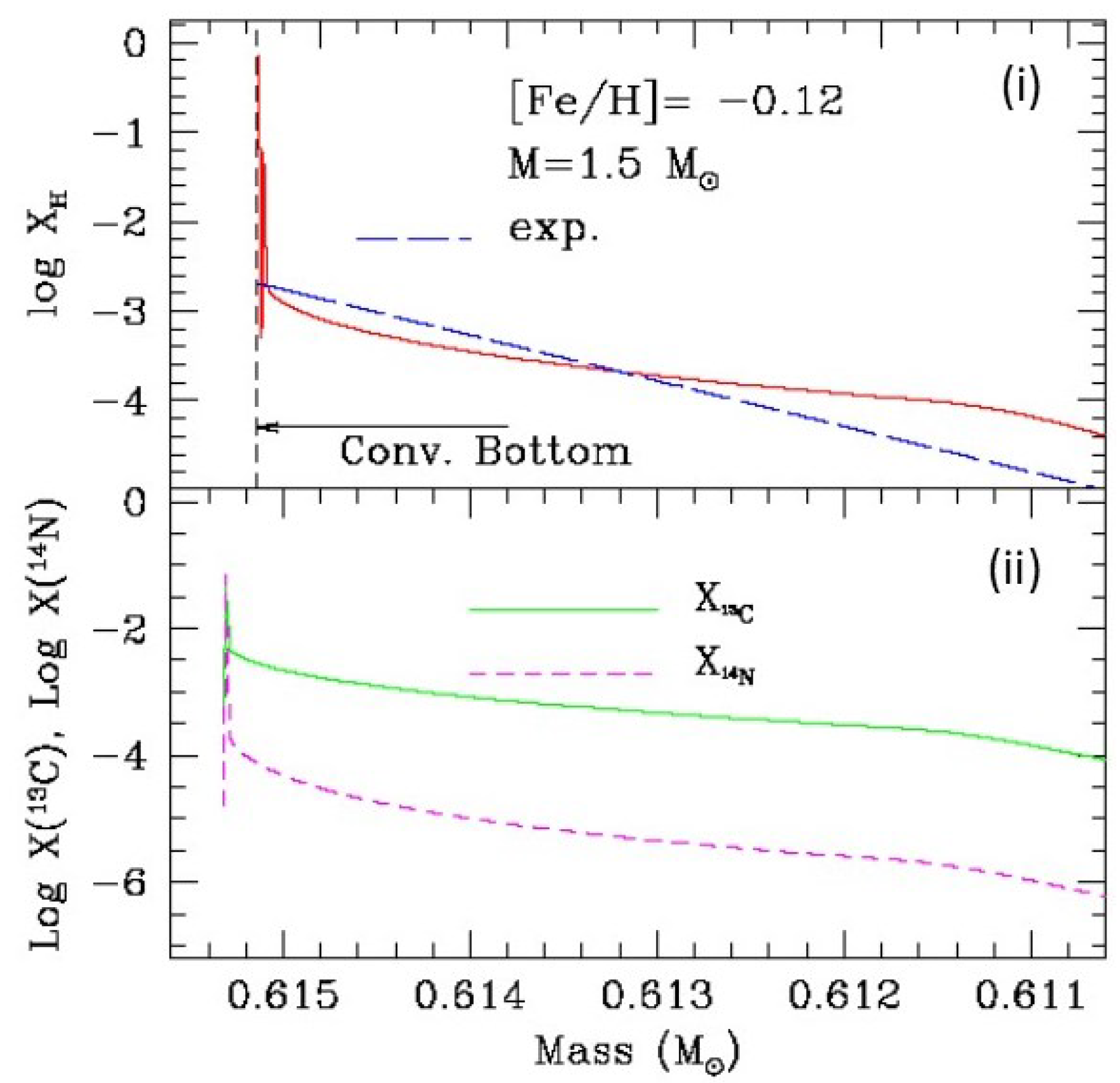
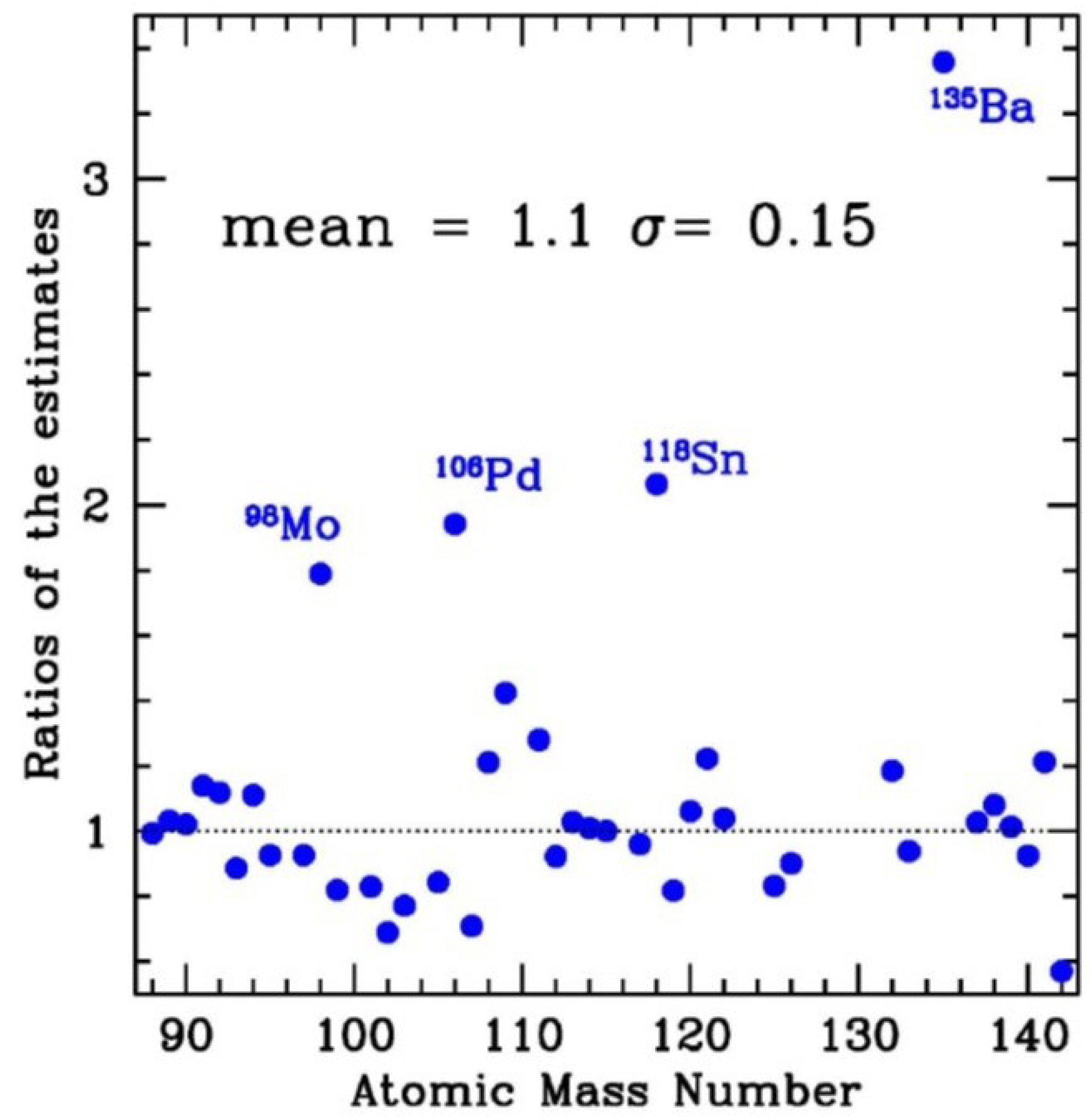
  • Magnetic mixing: Observations and theoretical studies now indicate that magnetic fields, buried in the deep convective envelope, can produce buoyancy-driven motions and circulation patterns at the H-He interface. Magneto-hydrodynamic (MHD) effects can drive sustained mixing of proton-rich material into the underlying radiative region during TDU, leading to the formation of rather large 13C reservoirs with very low (if any) 14N abundances (see, e.g., refs. [66,69] for detailed MHD models in this scenario). This kind of magnetic mixing induces the formation of 13C pockets with a distinguished abundance pattern (see Figure 5) and their repetiton at every pulse has been successfully shown to be able to explain the heavy element enrichment in AGB stars and in post-AGB sources, as well as to interpret various isotopic patterns in stellar ejecta and pre-solar grains [70,71,72,73]. It also provided the most accurate separation so far available of the s and r components in the solar distribution [74]. For this last test, see Figure 6.

5. The Observational Evidence

A large database has been accumulated in the last thirty years, confirming the indication that the right neutron source had been identified. It is not in the scope of this review to enter into too many details about the observations. We refer interested readers to the recent work by Domínguez et al. [75], where this topic is discussed more accurately. We briefly summarize the main points below.

5.1. Observations of Normal AGB Stars

Spectroscopic studies of AGB stars have been fundamental in confirming theoretical ideas about internal mixing and neutron capture nucleosynthesis. These stars have extremely complex, crowded spectra, and deriving detailed abundances requires careful modeling of stellar atmospheres. Despite these challenges, hundreds of s-process element measurements have been obtained over the last decades.
A classical and unambiguous signature of in situ neutron capture is the mentioned detection of technetium (Tc) in AGB star spectra. Since Tc has no stable isotopes and its longest-lived isotopes decay on timescales much shorter than stellar lifetimes, its presence requires recent internal production and dredge up, which are clear markers of active s-process nucleosynthesis.
Observations of O-rich AGB stars (spectral types MS, S) show enhanced abundances of s-process elements such as Sr, Y, Zr, Ba, and Nd. These enhancements align well with model predictions in which the 13C(α,n)16O neutron source operates at relatively low neutron density [56]. Measurements of elements around branch points in the s-process—in particular, rubidium (Rb), relative to other light s-elements—provide constraints on neutron density and confirm that the dominant neutron source in these stars is 13C, consistent with low-mass AGB progenitors. Carbon-rich AGB stars (C stars, spectral type N) also show s-process enhancements at levels comparable to those in S stars, and spectroscopic data demonstrate that these enhancements correlate with decreasing stellar metallicity. A ratio such as [hs/ls], a symbol indicating the relative enhancement of second peak ( hs , or heavy s) to first peak ( ls , or light s) nuclei, increases with decreasing metallicity, as expected if the same amount of neutrons (from 13C) is available for any metal content, so that for a lower abundance of iron seeds, the neutrons captured per nucleus increase [76,77]. A large observed dispersion in [hs/ls] at any given metallicity indicates variations in the size of the pocket, and hence, in the mixing efficiency between different stars.

5.2. Post-AGB Stars

Post-AGB stars, objects that have left the TP-AGB but not yet become white dwarfs, often show a significant overabundance of both light and heavy s-process elements. Models predict that the s-process should drive increasingly large lead (Pb) enhancements at lower metallicities, but many observed post-AGB stars show upper limits on Pb abundances that are lower than model expectations [78]. Reconciling these discrepancies and matching abundances across the s-process third peak remains a challenge for current models and may involve revisiting neutron capture paths, branchings, and potential alternative neutron density regimes, such as the intermediate neutron capture process, or i-process [79,80,81].

5.3. Pre-Solar Grains

Pre-solar grains are microscopic dust particles found in primitive meteorites that retain the isotopic signatures of the stellar winds where they formed. Silicon carbide (SiC) grains thought to originate in C-rich AGB star outflows show isotopic enrichments in elements like Sr, Zr, Mo, Ru and Ba that reflect neutron capture conditions in their parent stars [82]. Because these isotopic measurements can be extremely precise, they provide some of the strongest constraints on the extent of the 13C pocket and the mixing processes that formed it. Models that include physical mixing mechanisms (especially MHD-induced pocket formation) can reproduce the spread and shapes of isotopic ratios seen in these grains much more faithfully than purely parametric mixing approaches [72].

Funding

This research was funded by INFN through its project n_TOF.

Data Availability Statement

All the data used or quoted here come from international publications already widely available through the quoted references. No new computed or observed data were used.

Acknowledgments

I thank the organizers for their invitation to present this talk and many colleagues (with special emphasis on Sara Palmerini, Diego Vescovi, Sergio Cristallo and Oscar Straniero) for enjoying the kind of studies reviewed here for decades with me. I am grateful to the INFN, section of Perugia, for supporting this visit of mine and for many other forms of kindness, shown especially after my retirement. For the text and content of this review, I am indebted to two anonymous referees for extremely useful and accurate suggestions.

Conflicts of Interest

No conflict of interest applies to this work. The funders had no role in the design of the study; in the collection, analyses, or interpretation of data; in the writing of the manuscript; or in the decision to publish the results.

References

  1. Aston, F.W. The Constitution of the Elements. Nature 1919, 104, 393. [Google Scholar] [CrossRef]
  2. Eddington, A.S. The sources of stellar energy. Observatory 1919, 42, 371–376. [Google Scholar]
  3. Perrin, J. Matière et lumière. Ann. Phys. 1919, 9, 5–108. [Google Scholar] [CrossRef]
  4. Gamow, G. Zur Quantentheorie des Atomkernes. Z. Phys. 1928, 51, 204–212. [Google Scholar] [CrossRef]
  5. Atkinson, R.D.E.; Houtermans, F.G. Zur Frage der Aufbaumöglichkeit der Elemente in Sternen. Z. Phys. 1929, 54, 656–665. [Google Scholar] [CrossRef]
  6. Atkinson, R.d. Atomic Synthesis and Stellar Energy. III. Astrophys. J. 1936, 84, 73. [Google Scholar] [CrossRef]
  7. Bethe, H.A.; Critchfield, C.L. On the Formation of Deuterons by Proton Combination. Phys. Rev. 1938, 54, 862. [Google Scholar] [CrossRef]
  8. von Weizsäcker, C.F. Erwiderung zu der Bemerkung von Herrn v. Wisniewski. Naturwissenschaften 1939, 27, 277–278. [Google Scholar] [CrossRef]
  9. Hoyle, F. The synthesis of the elements from hydrogen. Mon. Not. R. Astron. Soc. 1946, 106, 343. [Google Scholar] [CrossRef]
  10. Hoyle, F. On Nuclear Reactions Occuring in Very Hot STARS.I. the Synthesis of Elements from Carbon to Nickel. Astrophys. J. Suppl. 1954, 1, 121. [Google Scholar] [CrossRef]
  11. Fewell, M.P. The atomic nuclide with the highest mean binding energy. Am. J. Phys. 1995, 63, 653–658. [Google Scholar] [CrossRef]
  12. Cameron, A.G.W. Origin of Anomalous Abundances of the Elements in Giant Stars. Astrophys. J. 1955, 121, 144. [Google Scholar] [CrossRef] [PubMed]
  13. Burbidge, E.M.; Burbidge, G.R.; Fowler, W.A.; Hoyle, F. Synthesis of the Elements in Stars. Rev. Mod. Phys. 1957, 29, 547–650. [Google Scholar] [CrossRef]
  14. Clayton, D.D.; Fowler, W.A.; Hull, T.E.; Zimmerman, B.A. Neutron capture chains in heavy element synthesis. Ann. Phys. 1961, 12, 331–408. [Google Scholar] [CrossRef]
  15. Clayton, D.D. Chronology of the Galaxy. Science 1964, 143, 1281–1286. [Google Scholar] [CrossRef] [PubMed]
  16. Seeger, P.A.; Fowler, W.A.; Clayton, D.D. Nucleosynthesis of Heavy Elements by Neutron Capture. Astrophys. J. Suppl. 1965, 11, 121. [Google Scholar] [CrossRef]
  17. Clayton, D.D. Principles of Stellar Evolution and Nucleosynthesis; University of Chicago Press: Chicago, IL, USA, 1968. [Google Scholar]
  18. Merrill, P.W. Technetium in the stars. Science 1952, 115, 484. [Google Scholar] [CrossRef]
  19. Schwarzschild, M.; Härm, R. Hydrogen Mixing by Helium-Shell Flashes. Astrophys. J. 1967, 150, 961. [Google Scholar] [CrossRef]
  20. Clayton, D.D.; Ward, R.A. S-Process Studies: Exact Evaluation of an Exponential Distribution of Exposures. Astrophys. J. 1974, 193, 397–400. [Google Scholar] [CrossRef]
  21. Raiteri, C.M.; Gallino, R.; Busso, M.; Neuberger, D.; Kaeppeler, F. The Weak s-Component and Nucleosynthesis in Massive Stars. Astrophys. J. 1993, 419, 207. [Google Scholar] [CrossRef]
  22. Pignatari, M.; Gallino, R.; Reifarth, R. The s process in massive stars, a benchmark for neutron capture reaction rates. Eur. Phys. J. A 2023, 59, 302. [Google Scholar] [CrossRef]
  23. Pumo, M.L.; Costa, V.; Bonanno, A.; Belvedere, G.; Pizzone, R.G.; Tumino, A.; Spitaleri, C.; Cherubini, S.; La Cognata, M.; Lamia, L.; et al. The role of overshooting treatment in the s-process weak component efficiency. Mem. Della Soc. Astron. Ital. Suppl. 2006, 9, 263. [Google Scholar]
  24. Costa, V.; Pumo, M.L.; Bonanno, A.; Zappalà, R.A. The s-process weak component: Uncertainties due to convective overshooting. Astron. Astrophys. 2006, 447, 641–647. [Google Scholar] [CrossRef][Green Version]
  25. Li, Q.L.; Song, H.F.; Meynet, G.; Shi, J.; Zhang, R.; Qin, Y.; Qi, S.T.; Han, Z.; Zhong, W.L. S-process Nucleosynthesis and the Evolution of Massive Rotating Stars with Low Metallicity during Core Helium Burning. Res. Astron. Astrophys. 2026, 26, 055017. [Google Scholar] [CrossRef]
  26. Xin, W.; Yip, C.M.; Nomoto, K.; Zhang, X.; Bi, S. The impact of new (α, n) reaction rates on the weak s-process in metal-poor massive stars. arXiv 2025, arXiv:2504.13766. [Google Scholar] [CrossRef]
  27. Busso, M.; Gallino, R.; Wasserburg, G.J. Nucleosynthesis in Asymptotic Giant Branch Stars: Relevance for Galactic Enrichment and Solar System Formation. Annu. Rev. Astron. Astrophys. 1999, 37, 239–309. [Google Scholar] [CrossRef]
  28. Herwig, F. Evolution of Asymptotic Giant Branch Stars. Annu. Rev. Astron. Astrophys. 2005, 43, 435–479. [Google Scholar] [CrossRef]
  29. Lattanzio, J.C. S-process nucleosynthesis on the asymptotic giant branch. Publ. Astron. Soc. Aust. 1992, 10, 99–103. [Google Scholar] [CrossRef]
  30. Church, R.P.; Cristallo, S.; Lattanzio, J.C.; Stancliffe, R.J.; Straniero, O.; Cannon, R.C. montage: AGB Nucleosynthesis with Full s-Process Calculations. Publ. Astron. Soc. Aust. 2009, 26, 217–224. [Google Scholar] [CrossRef]
  31. Lugaro, M.; Herwig, F.; Lattanzio, J.C.; Gallino, R.; Straniero, O. s-Process Nucleosynthesis in Asymptotic Giant Branch Stars: A Test for Stellar Evolution. Astrophys. J. 2003, 586, 1305–1319. [Google Scholar] [CrossRef]
  32. Buntain, J.F.; Doherty, C.L.; Lugaro, M.; Lattanzio, J.C.; Stancliffe, R.J.; Karakas, A.I. Partial mixing and the formation of 13C pockets in AGB stars: Effects on the s-process elements. Mon. Not. R. Astron. Soc. 2017, 471, 824–838. [Google Scholar] [CrossRef]
  33. Ward, R.A.; Newman, M.J. s-process studies: The effect of a pulsed neutron flux. Astrophys. J. 1978, 219, 195–212. [Google Scholar] [CrossRef]
  34. Straniero, O.; Abia, C.; Domínguez, I. The carbon star mystery: 40 years later: Theory and observations. Eur. Phys. J. A 2023, 59, 17. [Google Scholar] [CrossRef]
  35. Halabi, G.M. Study of the Thermal Pulsation of AGB Stars. arXiv 2014, arXiv:1410.1682. [Google Scholar] [CrossRef]
  36. Straniero, O.; Chieffi, A.; Limongi, M.; Busso, M.; Gallino, R.; Arlandini, C. Evolution and Nucleosynthesis in Low-Mass Asymptotic Giant Branch Stars. I. Formation of Population I Carbon Stars. Astrophys. J. 1997, 478, 332–339. [Google Scholar] [CrossRef]
  37. Ulrich, R.K. The s-Process in Stars. In Proceedings of Explosive Nucleosynthesis; Schramm, D.N., Arnett, W.D., Eds.; The University of Texas Press: Austin, TX, USA, 1973; p. 139. [Google Scholar]
  38. Paczyński, B. The Formation of Planetary Nebulae. Astrophys. Lett. 1971, 9, 33. [Google Scholar]
  39. Paczynski, B. Core mass-interflash period relation for double shell source stars. Astrophys. J. 1975, 202, 558–560. [Google Scholar] [CrossRef] [PubMed]
  40. Wagenhuber, J.; Groenewegen, M.A.T. New input data for synthetic AGB evolution. Astron. Astrophys. 1998, 340, 183–195. [Google Scholar] [CrossRef]
  41. Marigo, P. The Initial-Final Mass Relation of White Dwarfs: A Tool to Calibrate the Third Dredge-Up. Universe 2022, 8, 243. [Google Scholar] [CrossRef]
  42. Marigo, P.; Bossini, D.; Trabucchi, M.; Addari, F.; Girardi, L.; Cummings, J.D.; Pastorelli, G.; Dal Tio, P.; Costa, G.; Bressan, A. A Fresh Look at AGB Stars in Galactic Open Clusters with Gaia: Impact on Stellar Models and the Initial-Final Mass Relation. Astrophys. J. Suppl. 2022, 258, 43. [Google Scholar] [CrossRef]
  43. Iben, I., Jr. Thermal pulses: P-capture, alpha -capture, s-process nucleosynthesis; and convective mixing in a star of intermediate mass. Astrophys. J. 1975, 196, 525–547. [Google Scholar] [CrossRef]
  44. Truran, J.W.; Iben, I., Jr. On s-process nucleosynthesis in thermally pulsing stars. Astrophys. J. 1977, 216, 797–810. [Google Scholar] [CrossRef]
  45. Iben, I., Jr.; Truran, J.W. On the surface composition of thermally pulsing stars of high luminosity and on the contribution of such stars to the element enrichment of the interstellar medium. Astrophys. J. 1978, 220, 980–995. [Google Scholar] [CrossRef]
  46. Becker, S.A.; Iben, I., Jr. The asympiotic giant branch evolution of intermediate-mass stars as a function of mass and composition. II. Through the first major thermal pulse and the consequences of convective dredge-up. Astrophys. J. 1980, 237, 111–129. [Google Scholar] [CrossRef] [PubMed]
  47. Smith, V.V.; Lambert, D.L. The chemical composition of red giants. I. Dredge-up in the M and MS stars. Astrophys. J. 1985, 294, 326–338. [Google Scholar] [CrossRef]
  48. Smith, V.V.; Lambert, D.L. The Chemical Composition of Red Giants. II. Helium Burning and the s-Process in the MS and S Stars. Astrophys. J. 1986, 311, 843. [Google Scholar] [CrossRef]
  49. Smith, V.V.; Lambert, D.L. The Chemical Composition of Red Giants. III. Further CNO Isotopic and s-Process Abundances in Thermally Pulsing Asymptotic Giant Branch Stars. Astrophys. J. Suppl. 1990, 72, 387. [Google Scholar] [CrossRef] [PubMed]
  50. Iben, I., Jr. On intermediate-mass single stars and accreting white dwarfs as sources of neutron-rich isotopes. Astrophys. J. 1981, 243, 987–993. [Google Scholar] [CrossRef]
  51. Iben, I., Jr.; Renzini, A. On the formation of carbon star characteristics and the production of neutron-rich isotopes in asymptotic giant branch stars of small core mass. Astrophys. J. 1982, 263, L23–L27. [Google Scholar] [CrossRef]
  52. Gilroy, K.K. Carbon Isotope Ratios and Lithium Abundances in Open Cluster Giants. Ph.D. Thesis, University of Texas, Austin, TX, USA, 1988. [Google Scholar]
  53. Gilroy, K.K. More About 12C/13C Ratios in Cluster Giants &Subgiants. In Bulletin of the American Astronomical Society; American Astronomical Society: Washington, DC, USA, 1989; Volume 21, p. 790. [Google Scholar]
  54. Gilroy, K.K.; Brown, J.A. Carbon Isotope Ratios along the Giant Branch of M67. Astrophys. J. 1991, 371, 578. [Google Scholar] [CrossRef]
  55. Gustafsson, B. Towards a Satisfactory Understanding of AGB-Star Atmospheres? In Why Galaxies Care About AGB Stars: Their Importance as Actors and Probes; Kerschbaum, F., Charbonnel, C., Wing, R.F., Eds.; Astronomical Society of the Pacific: San Francisco, CA, USA, 2007; Volume 378, p. 60. [Google Scholar]
  56. Lambert, D.L.; Smith, V.V.; Busso, M.; Gallino, R.; Straniero, O. The Chemical Composition of Red Giants. IV. The Neutron Density at the s-Process Site. Astrophys. J. 1995, 450, 302. [Google Scholar] [CrossRef] [PubMed]
  57. Busso, M.; Picchio, G.; Gallino, R.; Chieffi, A. Are s-Elements Really Produced during Thermal Pulses in Intermediate-Mass Stars? Astrophys. J. 1988, 326, 196. [Google Scholar] [CrossRef]
  58. Gallino, R.; Busso, M.; Picchio, G.; Raiteri, C.M.; Renzini, A. On the Role of Low-Mass Asymptotic Giant Branch Stars in Producing a Solar System Distribution of s-Process Isotopes. Astrophys. J. 1988, 334, L45. [Google Scholar] [CrossRef]
  59. Kaeppeler, F.; Gallino, R.; Busso, M.; Picchio, G.; Raiteri, C.M. S-Process Nucleosynthesis: Classical Approach and Asymptotic Giant Branch Models for Low-Mass Stars. Astrophys. J. 1990, 354, 630. [Google Scholar] [CrossRef]
  60. Karakas, A.I.; Lugaro, M.A.; Wiescher, M.; Görres, J.; Ugalde, C. The Uncertainties in the 22Ne+α-Capture Reaction Rates and the Production of the Heavy Magnesium Isotopes in Asymptotic Giant Branch Stars of Intermediate Mass. Astrophys. J. 2006, 643, 471–483. [Google Scholar] [CrossRef]
  61. Karakas, A.; Lugaro, M. The uncertainties in the 22Ne + α-capture reactions and magnesium production in intermediate-mass AGB stars. Nucl. Phys. A 2005, 758, 489–492. [Google Scholar] [CrossRef]
  62. Gallino, R.; Bisterzo, S.; Husti, L.; Käppeler, F.; Cristallo, S.; Straniero, O. 22Ne a primary source of neutron for the s-process and a major neutron poison in CEMP AGB stars. In International Symposium on Nuclear Astrophysics—Nuclei in the Cosmos; Mengoni, A., Cederkall, J., D’Auria, J., Fraile, L., Fynbo, H., Hass, M., Jeanne, M.M., Hjorth Jensen, M., Kaeppeler, F., Kratz, K.L., et al., Eds.; CERN: Geneva, Switzerland, 2006; p. 100.1. [Google Scholar] [CrossRef][Green Version]
  63. Ernandes, H.; Barbuy, B.; Friaça, A.C.S.; Hill, V.; Zoccali, M.; Minniti, D.; Renzini, A.; Ortolani, S. Cobalt and copper abundances in 56 Galactic bulge red giants. Astron. Astrophys. 2020, 640, A89. [Google Scholar] [CrossRef]
  64. Straniero, O.; Gallino, R.; Busso, M.; Chieffi, A.; Raiteri, C.M.; Limongi, M.; Salaris, M. Radiative 13C Burning in Asymptotic Giant Branch Stars and s-Processing. Astrophys. J. 1995, 440, L85. [Google Scholar] [CrossRef]
  65. Gallino, R.; Arlandini, C.; Busso, M.; Lugaro, M.; Travaglio, C.; Straniero, O.; Chieffi, A.; Limongi, M. Evolution and Nucleosynthesis in Low-Mass Asymptotic Giant Branch Stars. II. Neutron Capture and the S-Process. Astrophys. J. 1998, 497, 388–403. [Google Scholar] [CrossRef]
  66. Nucci, M.C.; Busso, M. Magnetohydrodynamics and Deep Mixing in Evolved Stars. I. Two- and Three-dimensional Analytical Models for the Asymptotic Giant Branch. Astrophys. J. 2014, 787, 141. [Google Scholar] [CrossRef]
  67. Denissenkov, P.A.; Tout, C.A. Partial mixing and formation of the 13C pocket by internal gravity waves in asymptotic giant branch stars. Mon. Not. R. Astron. Soc. 2003, 340, 722–732. [Google Scholar] [CrossRef]
  68. Battino, U.; Lederer-Woods, C.; Cseh, B.; Denissenkov, P.; Herwig, F. Mixing Uncertainties in Low-Metallicity AGB Stars: The Impact on Stellar Structure and Nucleosynthesis. Universe 2021, 7, 25. [Google Scholar] [CrossRef]
  69. Trippella, O.; Busso, M.; Palmerini, S.; Maiorca, E.; Nucci, M.C. s-Processing in AGB Stars Revisited. II. Enhanced 13C Production through MHD-induced Mixing. Astrophys. J. 2016, 818, 125. [Google Scholar] [CrossRef]
  70. Vescovi, D.; Cristallo, S. Modeling the formation of the 13C neutron source in AGB stars. In Journal of Physics Conference Series; IOP Publishing: Bristol, UK, 2020; Volume 1668, p. 012047. [Google Scholar] [CrossRef]
  71. Busso, M.; Vescovi, D.; Palmerini, S.; Cristallo, S.; Antonuccio-Delogu, V. s-processing in AGB Stars Revisited. III. Neutron Captures from MHD Mixing at Different Metallicities and Observational Constraints. Astrophys. J. 2021, 908, 55. [Google Scholar] [CrossRef]
  72. Palmerini, S.; Busso, M.; Vescovi, D.; Naselli, E.; Pidatella, A.; Mucciola, R.; Cristallo, S.; Mascali, D.; Mengoni, A.; Simonucci, S.; et al. Presolar Grain Isotopic Ratios as Constraints to Nuclear and Stellar Parameters of Asymptotic Giant Branch Star Nucleosynthesis. Astrophys. J. 2021, 921, 7. [Google Scholar] [CrossRef]
  73. Vescovi, D.; Cristallo, S.; Palmerini, S. Magnetic-buoyancy-induced mixing in AGB stars: Fluorine nucleosynthesis at different metallicities. Astron. Astrophys. 2021, 652, A100. [Google Scholar] [CrossRef]
  74. Busso, M.M.; Kratz, K.L.; Palmerini, S.; Akram, W.; Antonuccio-Delogu, V. Production of solar abundances for nuclei beyond Sr: The s- and r-process perspectives. Front. Astron. Space Sci. 2022, 9, 956633. [Google Scholar] [CrossRef]
  75. Domínguez, I.; Abia, C.; Busso, M.; Palmerini, S.; Straniero, O. s-process nucleosynthesis in low-mass AGB stars by the 13C(α,n)16O neutron source. Eur. Phys. J. A 2026, 62, 53. [Google Scholar] [CrossRef]
  76. Abia, C.; Wallerstein, G. Heavy-element abundances in seven SC stars and several related stars. Mon. Not. R. Astron. Soc. 1998, 293, 89–106. [Google Scholar] [CrossRef]
  77. Abia, C.; de Laverny, P.; Cristallo, S.; Kordopatis, G.; Straniero, O. Properties of carbon stars in the solar neighbourhood based on Gaia DR2 astrometry. Astron. Astrophys. 2020, 633, A135. [Google Scholar] [CrossRef]
  78. De Smedt, K.; Van Winckel, H.; Kamath, D.; Siess, L.; Goriely, S.; Karakas, A.I.; Manick, R. Detailed homogeneous abundance studies of 14 Galactic s-process enriched post-AGB stars: In search of lead (Pb). Astron. Astrophys. 2016, 587, A6. [Google Scholar] [CrossRef]
  79. Spyrou, A.; Mücher, D.; Denissenkov, P.A.; Herwig, F.; Good, E.C.; Balk, G.; Berg, H.C.; Bleuel, D.L.; Clark, J.A.; Dembski, C.; et al. First Study of the 139Ba (n,γ)140Ba Reaction to Constrain the Conditions for the Astrophysical i Process. Phys. Rev. Lett. 2024, 132, 202701. [Google Scholar] [CrossRef]
  80. Choplin, A.; Siess, L.; Goriely, S.; Eggenberger, P.; Moyano, F.D. The intermediate neutron capture process: VI. Proton ingestion and i-process in rotating magnetic asymptotic giant branch stars. Astron. Astrophys. 2026, 706, A44. [Google Scholar] [CrossRef]
  81. Riyas, A.M.; Karinkuzhi, D.; Van Eck, S.; Choplin, A.; Goriely, S.; Siess, L.; Keerthy, M.V.; Jorissen, A.; Merle, T. Abundance of Heavy r-process Elements in CEMP-rs Stars: The Role of the i-process. Astrophys. J. 2026, 997, 44. [Google Scholar] [CrossRef]
  82. Liu, N.; Savina, M.R.; Gallino, R.; Davis, A.M.; Bisterzo, S.; Gyngard, F.; Käppeler, F.; Cristallo, S.; Dauphas, N.; Pellin, M.J.; et al. Correlated Strontium and Barium Isotopic Compositions of Acid-cleaned Single Mainstream Silicon Carbides from Murchison. Astrophys. J. 2015, 803, 12. [Google Scholar] [CrossRef]
Figure 1. The variation in the luminosity from H-shell and He-shell burning in a modern model of a 3 M AGB star. Note the peaks in correspondence with He-shell flashes. The blue line represents the He-shell luminosity, the black line is that of the H-shell, and the red line is the resulting stellar luminosity (lower than that at the peaks, because the expansion and cooling of the envelope at thermal pulses largely absorbs this last). Taken, with modifications, from Halabi [35].
Galaxies 14 00058 g001
Figure 2. A schematic view of the internal structure of the two-shell region in an AGB star, experiencing thermal pulses, ICZs creation and the third dredge up. The plot was made by the author and originally published in [27].
Galaxies 14 00058 g002
Figure 3. The plot shows the evolution in mass of the layers where He-burning, H-burning, and the bottom of the convective envelope are sited for a star of 3.0 M and a metallicity of one third solar. At the left of the red continuous vertical line is the early-AGB stage, at the right of it the TP-AGB phase, near the end of which the envelope penetrates below the H-He discontinuity, bringing to the surface C- and s-elements.
Galaxies 14 00058 g003
Figure 4. The position in mass of the convective envelope bottom ( M C E ), of the H-exhausted core ( M H ) and of the He-exhausted core ( M H e ) in a 1.5 M model star with a metallicity 1/20th solar. Even for the low-mass model shown, the low metallicity permits the occurrence of the TDU. At the end of the evolution (right panel) the lines representing the H and He shells and the one representing the convective envelope seem to merge. This indicates how thin the differences in mass are, so that only modern evolutionary codes can properly address the problems early noticed by [19]. (Here, as usual, [ Fe / H ] = (Log Fe/H) – (Log Fe/H)).
Galaxies 14 00058 g004
Figure 5. An example of the typical pockets obtained through magnetic buoyancy at TDU, inducing proton penetration with a peculiar pattern. (i) (Top panel). When H burning restarts, the extended concentration of protons (red line) reacts with 12C, producing 13C. (For comparison, the dashed line shows what would be the (on average higher) number of protons for a simple exponential-law penetration). (ii) (Bottom panel). As there are very few protons, mainly 13C is produced (red line) and very little 14N (blue dashed line) during H burning. This drastically reduces the possible products of 14N burning, in particular 19F. This difference clarifies how low the resulting abundance of 13C is in this new approach [73].
Galaxies 14 00058 g005
Figure 6. The few remaining discrepancies between the estimates of the s-process components at the era of the solar formation, as provided by the galactic chemical evolution (GCE) of TP-AGB products (with magnetically induced mixing for the s-process) and by estimates of the required ( s = 1 r ) fractions, derived by a model-independent approach to the r-process (see [74] for details). The vertical axis in this figure represents the ratio between the estimates of the two approaches and shows that some problems do remain for a series of nuclei (135Ba in particular). However, so far, no other attempt has ever reached such an agreement on all the other isotopes.
Galaxies 14 00058 g006
Disclaimer/Publisher’s Note: The statements, opinions and data contained in all publications are solely those of the individual author(s) and contributor(s) and not of MDPI and/or the editor(s). MDPI and/or the editor(s) disclaim responsibility for any injury to people or property resulting from any ideas, methods, instructions or products referred to in the content.