1. Introduction
The question of what fundamentally defines a galaxy continues to occupy a central place in modern astrophysics. Since the earliest attempts at classification, astronomers have sought a physical principle capable of organising the wide diversity of observed stellar systems. Jeans [
1,
2] proposed evolutionary sequences of nebulae within the nebular-hypothesis framework, ideas that later influenced the conceptual basis from which the modern Hubble sequence emerged [
3]. Despite their historical importance, such morphological taxonomies remain largely descriptive and do not supply a single physical quantity that captures a galaxy’s structural maturity, dynamical state, or stellar-population age.
A long-standing difficulty in galaxy studies is that many low-mass stellar systems occupy an ambiguous regime in which Newtonian gravity and baryonic matter alone cannot account for the observed kinematics, complicating attempts at a crisp operational definition of a “galaxy”. As emphasised by Willman and Strader [
4], a physically meaningful definition should reflect whether a system’s dynamics require physics beyond baryons and Newtonian gravity. Several works have therefore argued for definitions based on the underlying dynamical state rather than morphology alone, for example using relaxation time, size, or stellar-population complexity as discriminants [
5]. These approaches highlight that galaxies and star clusters form a continuum rather than two cleanly separated classes.
More physically motivated definitions have focused on dynamical criteria. A widely discussed operational distinction identifies galaxies as collisionless stellar systems with two-body relaxation times exceeding the Hubble time, as emphasised by Kroupa [
6,
7]. In this picture, massive globular clusters and ultra-compact dwarfs (UCDs) lie close to the boundary between collisional and collisionless behaviour, whereas dwarf galaxies, spirals, and ellipticals all behave effectively collisionlessly. The degree of virialisation is likewise important: pressure-supported early-type galaxies (ETGs) generally lie close to virial equilibrium (Binney and Tremaine [
8]), whereas rotationally supported disks may span a broader range of dynamical maturity. However, neither relaxation time nor virialisation uniquely maps onto stellar age, gas fraction, baryonic compactness, or surface-brightness structure. Dwarf irregulars, low-surface-brightness (LSB) disks, high-surface-brightness (HSB) spirals, and ETGs can exhibit overlapping dynamical timescales despite following distinct evolutionary pathways.
Observational surveys have revealed strong empirical connections between galaxy mass, structural concentration, and stellar-population age. The downsizing phenomenon in which massive ETGs assemble early and quench rapidly is well established (Cowie et al. [
9], Thomas et al. [
10], Recchi et al. [
11], Thomas et al. [
12], McDermid et al. [
13], Yan et al. [
14], Eappen et al. [
15], Gjergo and Kroupa [
16]). In contrast, many gas-rich dwarf galaxies remain dynamically and chemically unevolved, exhibiting extended star-formation histories and predominantly young stellar populations (Weisz et al. [
17], McQuinn et al. [
18], Haslbauer et al. [
19]). These trends imply a deep connection between stellar age, surface density, and baryonic structure. Yet, they remain fundamentally descriptive: no single scalar quantity predicts a system’s position along this evolutionary continuum, and conventional structural parameters (such as Sersic index, effective radius and rotational support) do not unify the full diversity of galaxy types.
From a dynamical perspective, the crossing time and characteristic acceleration provide partial insight. Diffuse galaxies with long crossing times, such as ultra-diffuse or LSB systems are expected to be less dynamically evolved than dense ETGs, which achieve virial equilibrium more rapidly (van Dokkum et al. [
20]). However, within the standard
CDM framework, baryonic structure does not directly encode dynamical depth: halo concentration, feedback-driven expansion, angular-momentum exchange, and merger history obscure any simple mapping (Bullock and Boylan-Kolchin [
21]). In standard dark-matter models, baryonic structure and total dynamical depth are not uniquely coupled, since baryons and dark matter are dynamically distinct components whose relation depends on assembly history and feedback.
Modified Newtonian Dynamics (MOND), originally proposed by Milgrom [
22], offers a different perspective. MOND introduces a universal acceleration scale,
, which underpins the baryonic Tully–Fisher relation [
23], the radial-acceleration relation [
24], and the tight correspondence between baryonic distributions and galaxy kinematics [
25]. In its non-relativistic formulation (Bekenstein and Milgrom [
26], Milgrom [
27]), MOND modifies the Poisson equation such that
where
is the total gravitational potential,
the baryonic density, and
an interpolation function satisfying
for
(Newtonian regime) and
for
(deep-MOND regime), becoming the
p = 3 Laplacian field equation, see Scherer et al. [
28]. For spherical systems this reduces to the algebraic MOND relation
where
g is the true gravitational acceleration and
is the Newtonian value. In the deep-MOND limit (
), this yields the space-time scale-invariant form
The appearance of the acceleration constant
implies a characteristic MOND radius
(discussed in
Section 2, Equation (
8), see Milgrom [
29]), beyond which internal accelerations fall below
and deep-MOND dynamics dominates. Defined purely by the baryonic mass and a universal constant, this radius delimits the onset of deep-MOND collapse behaviour: compact systems with most of their baryons interior to
evolve rapidly and become dense and old, whereas diffuse systems with most baryons beyond
evolve slowly and remain dynamically young.
These considerations suggest the possibility of a single, physically motivated scalar quantity derived solely from the baryonic distribution relative to the MOND radius that could act as a structural or dynamical ‘clock’ for galaxies. In this work, we develop such an index, which we refer to as the MOND depth index (
). While its formal definition is presented in
Section 2, the basic concept is intuitive: the fraction of a system’s baryons lying in the deep-MOND regime encodes its dynamical depth, collapse history, and likely stellar age. Compact, high-acceleration systems are expected to lie predominantly within
and correspond to old, virialised, quenched galaxies, while diffuse, low-acceleration systems reside deep in the MOND regime and correspond to younger, gas-rich, dynamically unevolved systems. Unlike in
CDM, MOND’s universal acceleration scale makes this mapping physically meaningful and potentially predictive.
The purpose of this paper is twofold. First, we introduce a set of physically motivated, MOND-based dynamical diagnostics—, , and . Each of these depends only on the observed baryonic mass distribution and the characteristic MOND acceleration . Second, we investigate whether these quantities collectively organise diverse stellar systems, including ETGs from the ATLAS3D survey, HSB and LSB spirals, gas-rich dwarfs, and compact clusters/UCDs, into a continuous sequence of structural and dynamical maturity. By comparing , , and with stellar ages, gas fractions, internal accelerations, and morphological class, we assess whether a unified, baryonic set of MOND-based diagnostics can reproduce the observed hierarchy of galaxy evolution and simultaneously provide a novel, purely empirical test of MOND itself.
2. Dynamical Framework and Definitions
To compare galaxies and stellar clusters within a unified dynamical context, we employ a set of physically motivated quantities that characterize internal timescales, gravitational depth in terms of the degree to which a system resides in the Newtonian or deep-MOND regime (Note: Dwarf satellite galaxies of the Milky Way are in the deep-MOND regime but are not isolated systems: they have typically lost their gas through environmental processes such as ram-pressure or tidal stripping. For this reason, the dynamical indices introduced here are primarily valid for non-satellite galaxies). All quantities are defined using only observable baryonic masses, characteristic radii, and velocity scales, ensuring that the analysis remains baryon-based.
The first fundamental quantity is the dynamical or crossing time, which measures the characteristic time for an object to traverse the system. For pressure-supported systems, we adopt
where
R is a representative radius (typically the half-light or effective radius; see Hernquist [
30], Cappellari et al. [
31]) and
is the line-of-sight velocity dispersion. For rotationally supported systems we analogously define
using the circular velocity
measured at a characteristic radius (e.g., Lelli et al. [
32]). Compact systems therefore exhibit short crossing times and rapid internal evolution, while diffuse galaxies have long dynamical times and evolve slowly.
Another fundamental time scale characterizing gravitationally bound stellar systems is the classical median two-body relaxation time, which quantifies the timescale on which stellar encounters redistribute energy. For a system of
N equal-mass stars with characteristic stellar mass
and half-mass radius
, we adopt the standard approximation (Binney and Tremaine [
33])
Following the arguments of Kroupa [
6], Dabringhausen et al. [
34] and with
being the Hubble time, systems with
behave effectively as collisionless galaxies, while systems with
are collisional and dynamically evolve as star clusters. Relaxation and virialisation must be clearly distinguished: a system may satisfy the virial theorem,
after only a few crossing times, yet still possess a relaxation time far exceeding the Hubble time. Galaxies are therefore virialised but collisionless objects, whereas globular clusters and some UCDs can be both virialised and older than one median two-body relaxation time (Meylan and Heggie [
35]).
A central element of our analysis is the internal gravitational acceleration compared to the ubiquitous MOND acceleration constant
discovered by Milgrom [
22]. MOND introduces a characteristic scale that marks the transition between Newtonian and scale-invariant deep-MOND dynamics. For a system of baryonic mass
, one may define a MOND radius by equating the Newtonian acceleration
with
:
This radius, implicit in Milgrom’s original formulation and made explicit in later MOND analyses (e.g., Famaey and McGaugh [
36]), identifies the scale beyond which internal accelerations fall below
and deep-MOND behaviour dominates. Systems whose baryonic mass lies predominantly inside
are expected to undergo rapid early collapse and become dynamically compact and old, whereas systems with a large fraction of their baryons outside
evolve in the low-acceleration regime and therefore are expected to collapse more slowly (e.g., Sanders [
37], Kroupa et al. [
38]).
To quantify how deeply a system resides in the MOND regime, we introduce the
MOND depth index
where
is the baryonic mass enclosed within the MOND radius. In this work, the enclosed mass is computed from analytic profiles matched to each galaxy type: for ETGs we assume a Hernquist profile [
30] with scale length
, where
is the effective radius, while for rotationally supported SPARC disks and dwarfs we adopt an exponential disk with scale length
. The quantity
ranges from
for compact, Newtonian-like systems to
for diffuse, deep-MOND systems. Because
depends solely on the baryonic mass distribution and the universal constant
, it provides an observationally accessible measure of gravitational depth and structural maturity applicable across all galaxy types (e.g., Haslbauer et al. [
19], Lelli et al. [
24]).
A second key quantity is the dimensionless dynamical maturity index,
which measures the number of internal dynamical cycles a system has experienced over the age of the Universe. Systems with
have undergone many internal dynamical cycles and are dynamically old (e.g., ETGs), while systems with
approaching unity have experienced only a few crossing times and remain dynamically young (e.g., LSB disks and diffuse dwarfs).
is well defined for both pressure-supported and rotationally supported systems, making it particularly well suited to the broad comparative analysis pursued here.
A long-standing dynamical criterion is that galaxies should behave as collisionless stellar systems, with two-body relaxation times exceeding the Hubble time [
5] (see their discussion on using relaxation time as a galaxy-defining property). This motivates the inclusion of the dynamical collisionality index
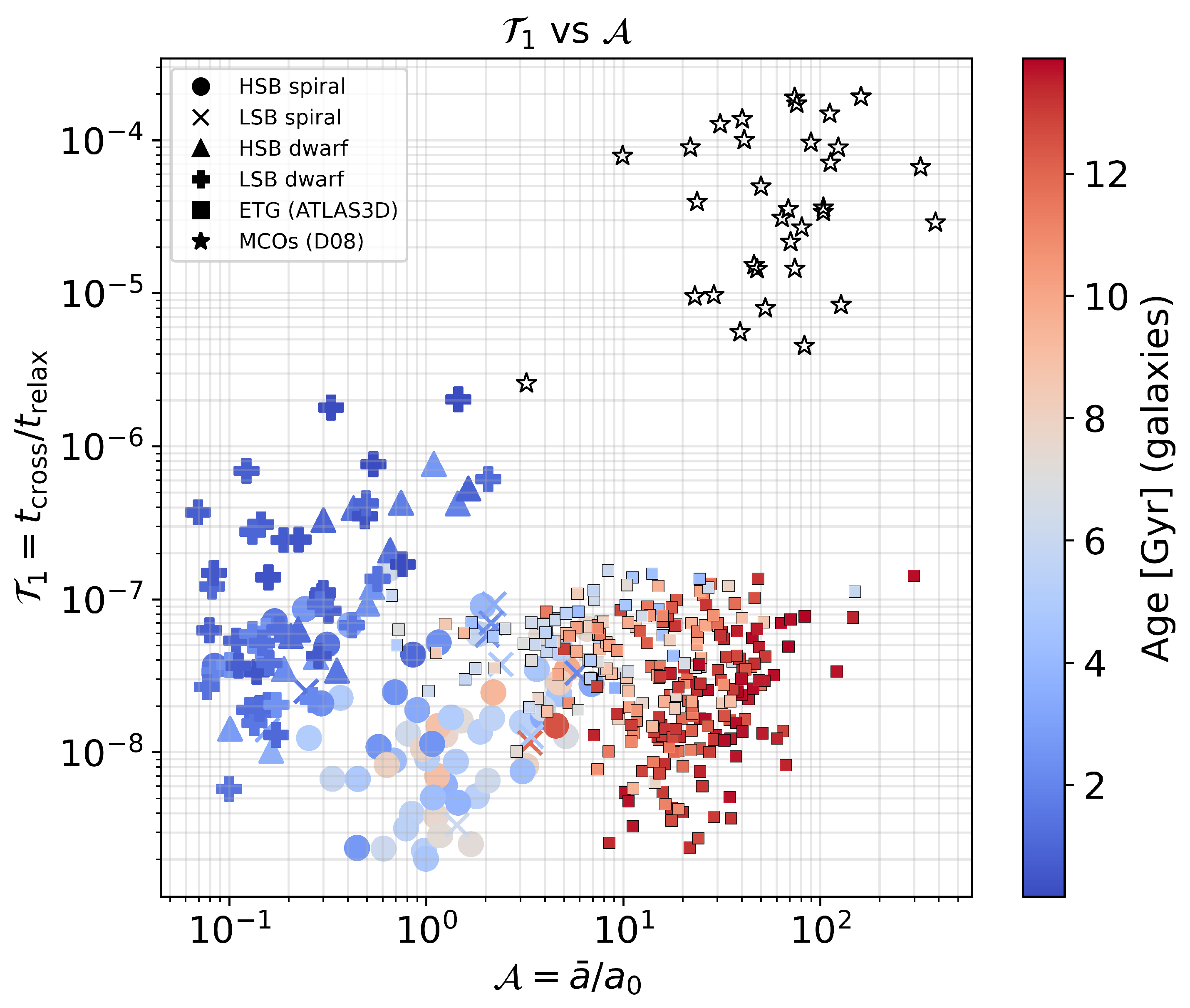
which measures how many crossing times occur per relaxation time in our diagnostic framework. This ratio therefore provides a convenient, morphology independent description between galaxies (collisionless) and star clusters (collisional), complementing earlier work by Kroupa [
6], Dabringhausen et al. [
34].
Finally, to characterise gravitational depth in a morphology-independent manner, we define a mean internal acceleration
and normalise it by the MOND acceleration constant to form another dimensionless index which we define as the acceleration index,
Large values of
correspond to compact, dynamically deep systems that lie predominantly inside
, whereas small values identify diffuse systems operating well within the deep-MOND regime (e.g., Famaey and McGaugh [
36], Kroupa et al. [
38], McGaugh and Milgrom [
39]).
Together, these indices
,
,
, and
provide a coherent and fully baryonic set of dynamical descriptors applicable across the entire hierarchy of stellar systems. These indices form the basis for the diagnostic planes introduced in
Section 4, where they reveal a continuous dynamical sequence connecting star clusters, dwarfs, spirals, and ETGs.
3. Data and Sample Selection
To assess whether the
provides a unified dynamical description across the full hierarchy of stellar systems, we assemble a heterogeneous but well characterized sample drawn from major observational surveys and literature catalogs. The combined dataset spans ETGs, HSB and LSB spirals and dwarfs, compact stellar systems, including globular clusters and UCDs. The inclusion of compact stellar systems is particularly important because UCDs and massive globular clusters extend smoothly into the parameter space of dwarf galaxies, forming a continuous size–mass sequence [
40]. This structural continuity reinforces the need for a unified dynamical diagnostic applicable across the full hierarchy of stellar systems. A summary of the datasets and the key quantities used in our analysis is provided in
Table 1. For every system we compile baryonic masses, characteristic radii, velocity scales, and, where possible, stellar-population ages. These observables allow a homogeneous computation of the dynamical quantities defined in
Section 2, including crossing times, relaxation times, internal accelerations, MOND radii, and the
.
The ETG component is drawn primarily from the ATLAS
3D survey (Cappellari et al. [
31]), which provides homogeneous integral-field spectroscopy, photometry, and dynamical modelling for 260 nearby ETGs. For the present analysis, we select those ETGs with published luminosity-weighted stellar ages from McDermid et al. [
13], ensuring a consistent treatment of stellar populations. Effective radii, stellar masses, and velocity dispersions are taken from Cappellari et al. [
41], providing the necessary inputs for computing
,
, and
under the baryonic framework adopted here.
Rotationally supported spirals and dwarfs are taken from the SPARC database [
32], which provides high-quality rotation curves and H
i measurements for 175 galaxies covering the full range of disk morphologies and surface brightnesses, from HSB spirals to extremely diffuse, gas-rich dwarfs. From SPARC we adopt stellar masses, gas masses (multiplied by 1.33 to include helium; McGaugh and de Blok [
42]), exponential disk scale lengths, and characteristic circular velocities
.
We use the sample of Massive Compact Objects (MCOs) from Tables 1 and 2 of Dabringhausen et al. [
34] (also referred to as D08), which includes globular clusters, UCDs, and intermediate compact systems with published dynamical mass estimates, half-light radii, and internal velocity dispersions. Following their classification, we treat all these objects uniformly as MCOs. Although such systems are collisional on long timescales (Meylan and Heggie [
35]), their inclusion enables us to test whether
can connect collisional star clusters and collisionless galaxies along a single continuous dynamical sequence as an extension of the traditional relaxation-based classifications (Forbes and Kroupa [
5], Kroupa [
6]).
For the SPARC galaxies we estimate a simple gas-consumption age rather than adopting literature stellar ages, which are not homogeneously available for the full sample. Conceptually, a gas-consumption timescale may be written as
(e.g., Kennicutt [
43]). In practice, we lack SFR measurements for many SPARC galaxies, so we approximate
using the global gas fraction,
and assume an exponential gas-depletion law with a characteristic depletion timescale
, consistent with typical values for nearby star-forming disks (Haslbauer et al. [
19], Leroy et al. [
44]). Under these assumptions the gas fraction evolves as
, which implies for the time to reach a fraction
of
We compute this quantity for all SPARC galaxies with , and clip the resulting ages at the Hubble time . All systems considered are local (); thus, we adopt the present-day Hubble time. A redshift-dependent would not alter the qualitative ordering. These values should not be interpreted as physical stellar ages; they serve only as relative indicators of evolutionary state (e.g., young, gas-rich dwarfs versus older, gas-poor spirals). Importantly, they play no role in the computation of the dynamical quantities , , or . These toy ages are used purely for visual colour-coding and do not enter any dynamical computation.
The same SPARC catalogue is used to divide galaxies into four broad morphological surface brightness classes: HSB spirals, LSB spirals, HSB dwarfs, and LSB dwarfs. We use the de Vaucouleurs
T-type to distinguish dwarfs from spirals, adopting
(Sd, Sm, Im, Blue Compact Dwarf) as dwarfs and
as spirals, and we classify discs as LSB when
, corresponding to a central surface brightness of
(see Lelli et al. [
32]). Galaxies with non-finite
values are conservatively assigned to the LSB class. This four-way division is used for plotting and for visualising where different morphological families lie in the diagnostic planes.
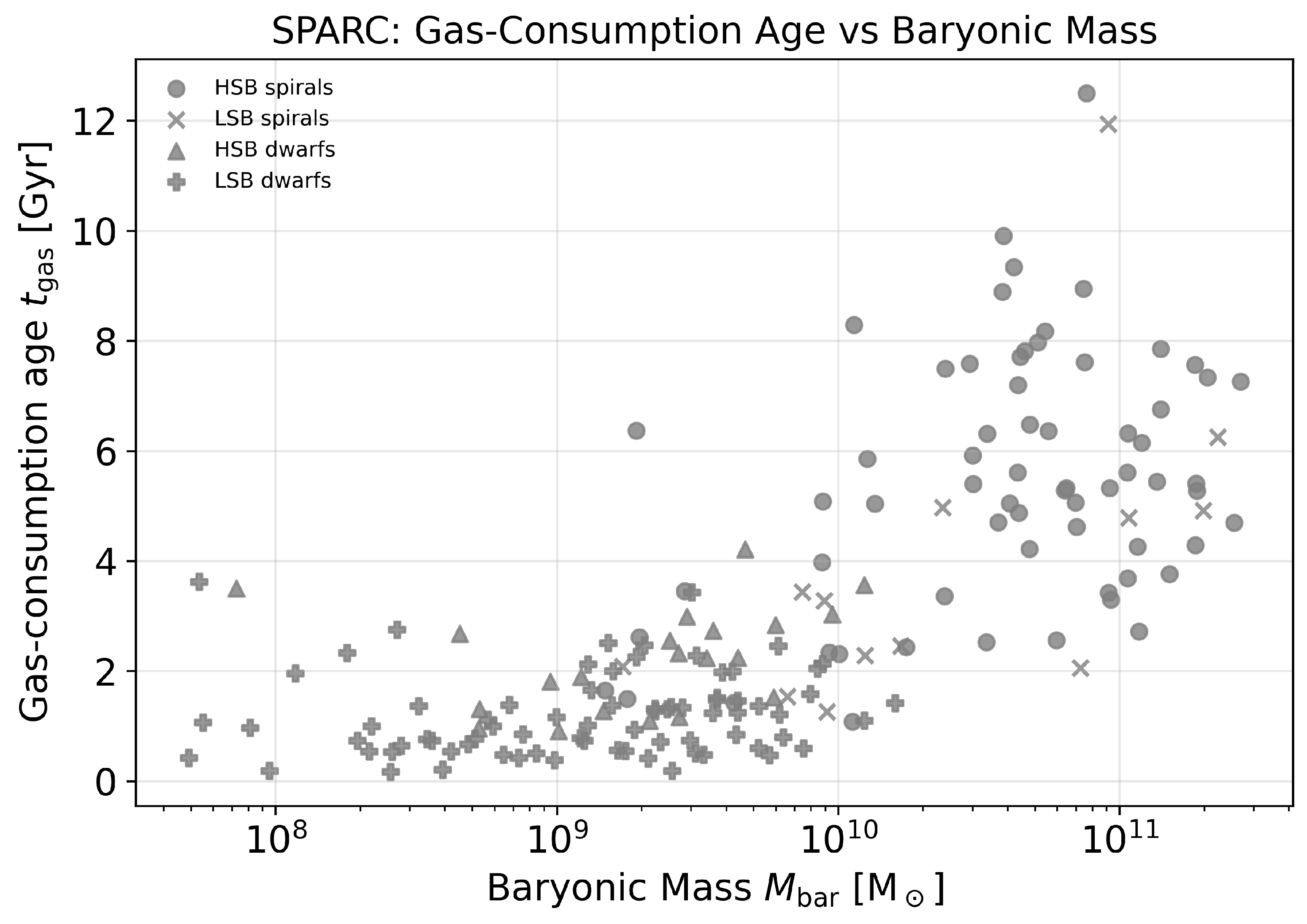
Figure 1 illustrates the distribution of the gas-consumption ages,
, as a function of baryonic mass for the SPARC galaxies. Low-mass and LSB dwarfs typically have
, reflecting their high gas fractions and slow, prolonged star-formation histories and youth (Haslbauer et al. [
19], McGaugh and de Blok [
42], Hunter and Elmegreen [
45], Weisz et al. [
46]). HSB spirals, by contrast, exhibit substantially older gas-consumption ages, often 6–
, consistent with more evolved stellar populations, higher stellar-to-gas ratios, and earlier formation epochs (Bell and de Jong [
47], Gallazzi et al. [
48], Leroy et al. [
44]). These trends are in line with the broader picture that diffuse, low-acceleration galaxies remain chemically and dynamically unevolved, whereas massive disks form the bulk of their stars at earlier cosmic times.
Stellar ages for ETGs are taken directly from McDermid et al. [
13], who provide luminosity-weighted ages derived from full spectral fitting. For SPARC galaxies we rely exclusively on the gas-consumption ages described above; we do not mix these with heterogeneous stellar ages from the literature. For MCOs we do not compute ages explicitly; instead, they are treated as old systems with typical ages
–
(Dabringhausen et al. [
34]) and are shown in the diagnostic planes with a fixed symbol that is not tied to the colour-coded age scale.
All radii, masses, and velocities are homogenized through consistent unit conversions and, where necessary, matched definitions across the heterogeneous sample. For each object in the combined catalogue we compute the crossing time, relaxation time, mean acceleration, MOND radius, and all the dynamical indices introduced in this paper using the definitions in
Section 2. The final sample spans nearly eight orders of magnitude in baryonic mass and covers the full observed range of surface brightnesses. This broad dynamical baseline makes it ideally suited to testing whether the
defined entirely from baryonic quantities captures the structural and evolutionary organisation of stellar systems across the entire mass spectrum. The final combined sample contains
= 258 ETGs,
= 175 SPARC galaxies, and
= 32 MCOs.
5. Discussion
The diagnostic planes presented in
Section 4 demonstrate that self-gravitating stellar systems across the full observable hierarchy from diffuse dwarfs and LSB disks to massive ETGs, HSB spirals and MCOs populate a remarkably continuous and physically interpretable set of sequences. Despite spanning eight orders of magnitude in baryonic mass, and exhibiting a wide range of structural and kinematic properties, these systems align in a manner that is naturally organised by
,
,
, and
. Taken together, these relations define an empirical dynamical backbone that links structural depth, collapse history, and stellar age across all classes of stellar systems. The continuous behaviour seen in our MOND-based diagnostic planes reflects the structural continuity long recognised between MCOs (which includes massive globular clusters and UCDs) and dwarf galaxies [
40]. This supports the view that these systems trace a single underlying sequence rather than representing sharply distinct classes.
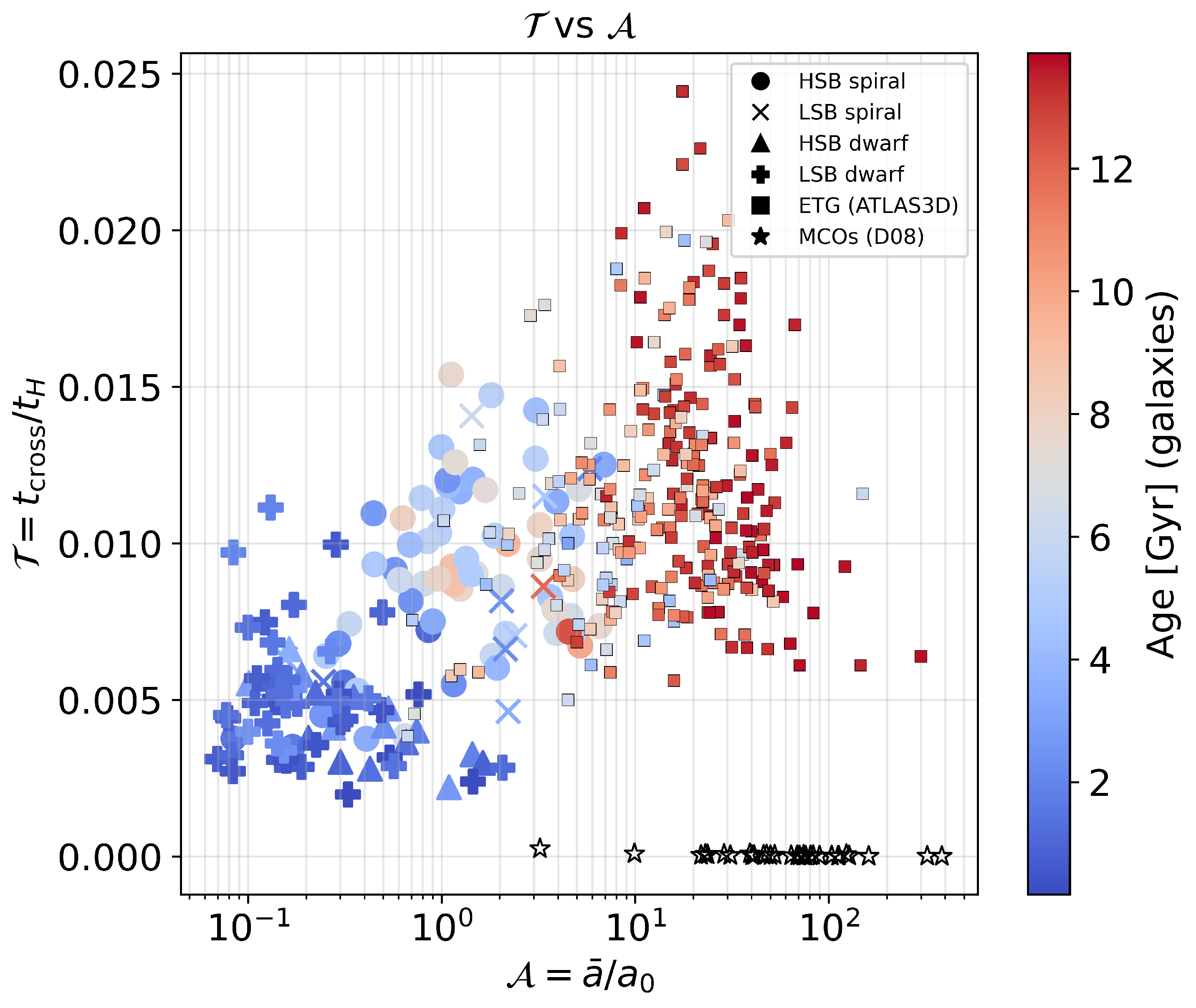
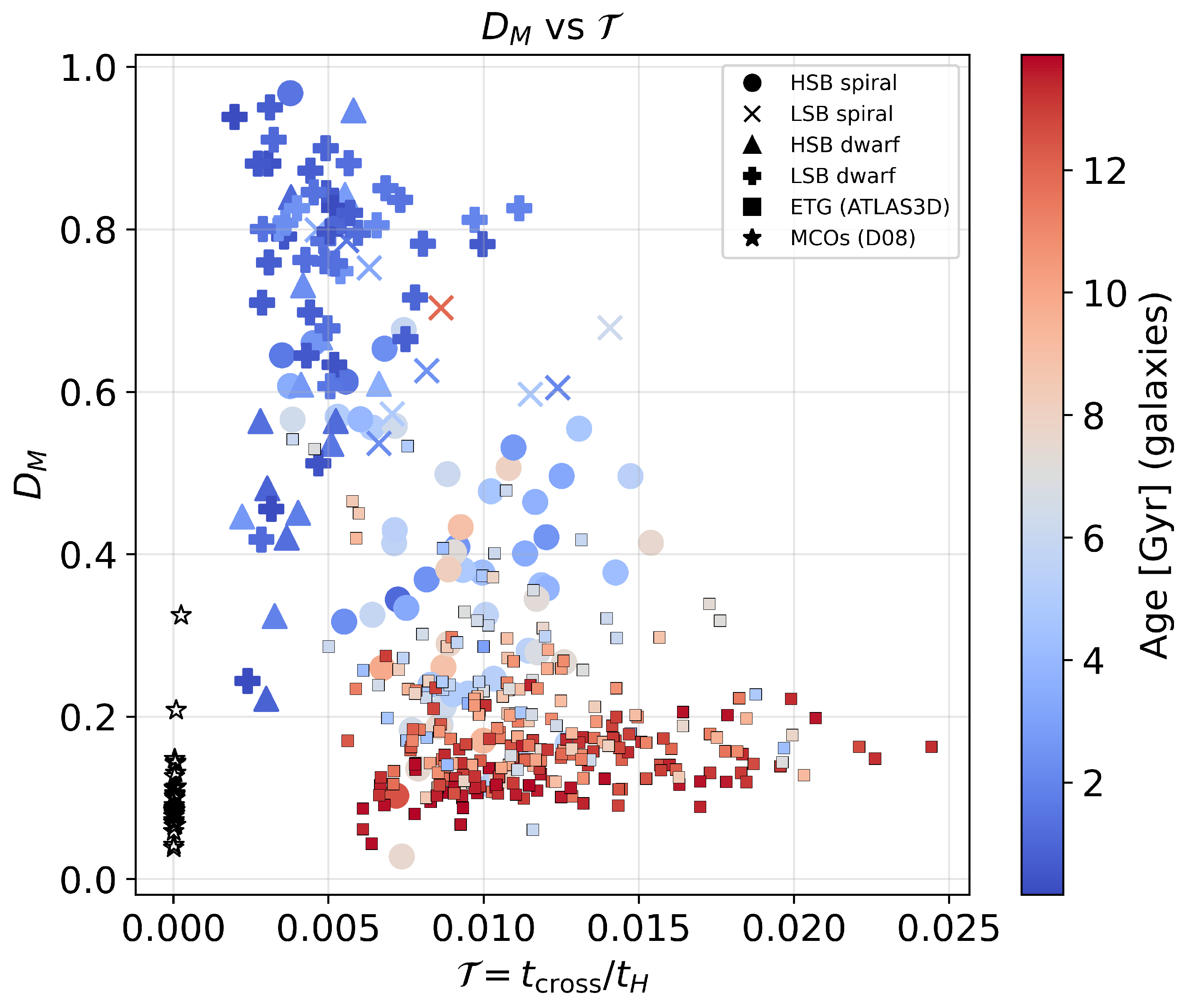
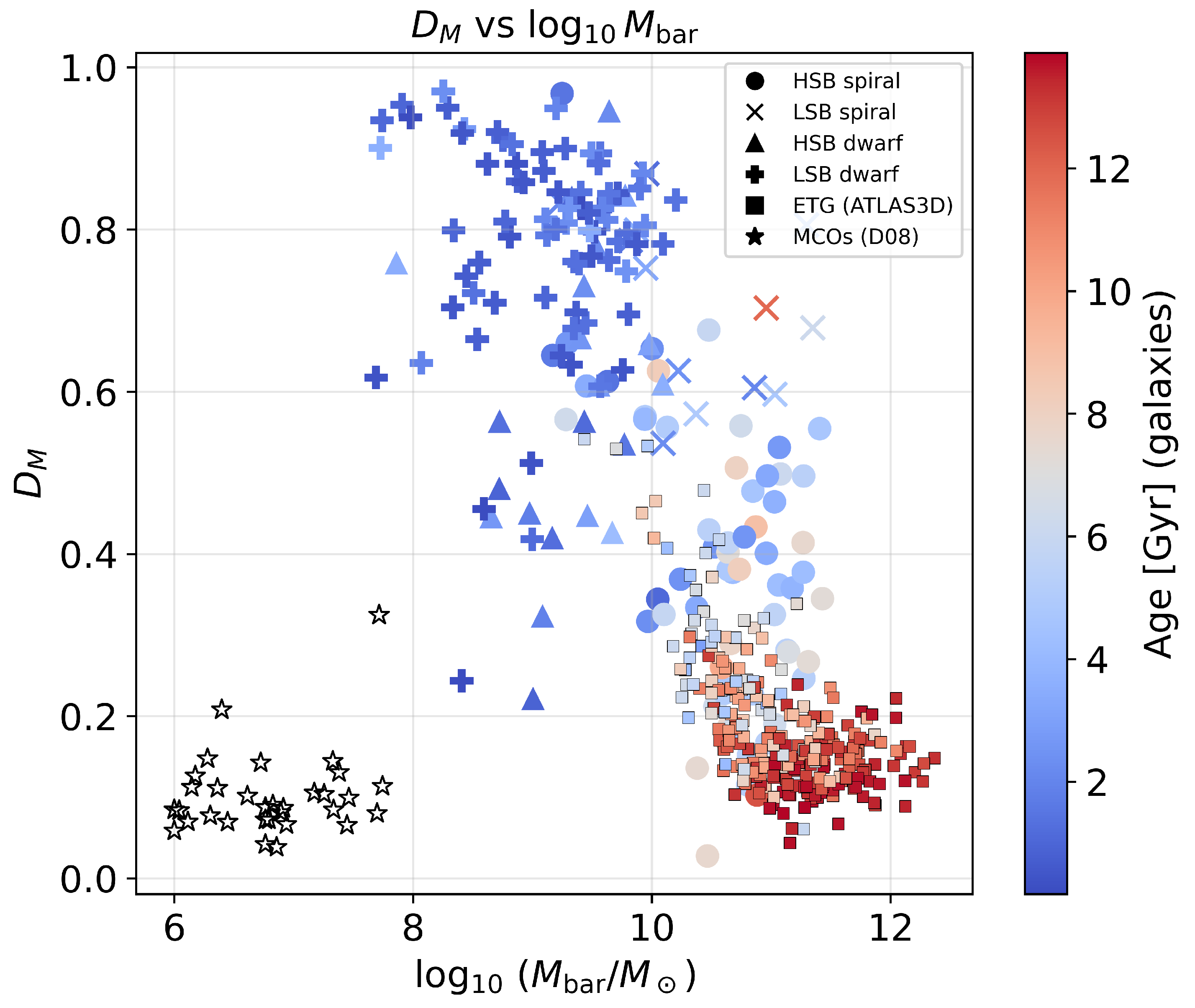
A central result is that galaxies and MCOs form a unified dynamical sequence when expressed in the
plane. Low-
systems (ETGs and MCOs) exhibit short crossing times, high accelerations, and old stellar populations, consistent with early and rapid collapse (e.g., Thomas et al. [
10], McDermid et al. [
13], Yan et al. [
14], Eappen et al. [
15], van Dokkum et al. [
49]). At the opposite extreme, diffuse dwarfs and LSB spirals reside at large
and large
, reflecting their shallow potentials, slow collapse, and young or extended star-formation histories (e.g. Haslbauer et al. [
19]). HSB spirals bridge these two populations with intermediate MOND depths and dynamical ages, forming the central spine of the overall sequence.
The colour-coding by stellar population age further shows that this dynamical sequence is simultaneously an evolutionary sequence: dynamically deep systems are predominantly old, while dynamically shallow systems are young. In this sense, the
provides a physical underpinning for the well-established phenomenon of downsizing (Cowie et al. [
9], Thomas et al. [
10], Yan et al. [
14], Eappen et al. [
15]), long recognised in observational studies of galaxy evolution. Within the MOND framework, this behaviour emerges naturally from the scaling of the MOND radius
and from the sensitivity of collapse times to internal acceleration: massive galaxies collapse within
, achieving high accelerations and quickly quenching, whereas low-mass, diffuse systems form and evolve in the deep-MOND regime with prolonged dynamical and star-forming timescales (Sanders [
37], Kroupa et al. [
38], Banik and Zhao [
50]). In standard dark-matter based models, the relation between baryonic structure and total dynamical depth depends on halo concentration, assembly history, and baryon–halo coupling, which introduce additional degrees of freedom and scatter (e.g. Disney et al. [
51]).
In addition to dark-matter based and MOND frameworks, a number of purely Newtonian models that explicitly account for realistic galaxy geometry (e.g., disk or oblate mass distributions) have been explored in the literature (e.g., Feng [
52], Hofmeister and Criss [
53,
54]). These studies consider whether detailed Newtonian force balance using baryonic mass distributions alone can reproduce aspects of observed rotation curves, and we include this acknowledgment here for completeness.
The
versus
plane recovers, with modern data, the classical collisionless–collisional divide originally emphasised by Kroupa [
6] and extended in Dabringhausen et al. [
34]. MCOs occupy the collisional regime, while all galaxies irrespective of morphology or mass lie securely within the collisionless domain. The addition of the MOND acceleration axis sharpens this boundary by showing that high-acceleration, compact stellar systems approach the relaxation threshold from above, whereas diffuse galaxies remain far below it. ETGs likely reach quasi-equilibrium via rapid collective processes such as violent relaxation and dissipative gas collapse, rather than via two-body relaxation.
Several systematic uncertainties must be acknowledged. The definition of the characteristic radius differs somewhat across ETGs, spirals, and dwarfs; while these choices follow standard practice (e.g., Cappellari et al. [
31], Lelli et al. [
32]), they introduce scatter in both
and
. Stellar ages for gas-rich dwarfs are uncertain and often spatially variable, which may blur the age–dynamics correspondence at low mass. The computation of
relies on Hernquist or exponential approximations that, while reasonable, cannot capture all structural diversity, especially for disturbed or composite systems. Finally, some MCOs may host massive central black holes (Seth et al. [
55]) or sub-clusters of stellar-mass black holes (Mahani et al. [
56]), which could influence their internal accelerations. Yet despite these uncertainties, the observed dynamical sequences remain strikingly well defined, suggesting that the key physical trends are robust.
The dynamical diagnostic planes introduced in this work occupy a conceptual role somewhat analogous to that of the Hertzsprung–Russell (HR) diagram for stars (Hertzsprung [
57], Russell [
58]). The classical HR diagram provides a unified framework in which stars populate distinct, physically interpretable sequences whose positions reflect their internal structure and evolutionary state. In an analogous, though not identical, manner our diagnostic planes show that galaxies and stellar clusters do not populate the dynamical indices space randomly: HSB and LSB spirals and dwarfs, ETGs and MCOs all occupy well-defined and contiguous regions in the planes defined by
,
,
, and
. The location of a system in these planes encodes its dynamical maturity, internal acceleration regime, compactness, and collisional state, thereby offering a unified classification scheme across the full hierarchy of stellar systems. Extending this framework to galaxy groups and clusters would provide an important test, particularly given the known residual mass discrepancy in MOND at cluster scales has recently been amended [
59].
The emergence of continuous sequences from deep-MOND, dynamically old ETGs to diffuse, dynamically young LSB disks, and further to relaxation-dominated MCOs demonstrates that these planes provide a useful structural–dynamical analogue to the HR diagram. They thus offer a new way to characterise galaxies in terms of their dynamical state and evolutionary maturity within the MOND framework. Overall, the and together provide a simple, baryon-based, and physically grounded framework for understanding the internal dynamics, structural maturity, and evolutionary pathways of stellar systems. The continuity of the sequences uncovered here indicates that galaxies and MCOs form a dynamically ordered family rather than a set of disjoint morphological categories. In this sense, and together define a physically motivated dynamical classification framework that organises stellar systems across a wide range of mass and morphology.
6. Conclusions
In this work we have introduced a new, physically motivated dynamical index, , defined purely from the baryonic mass distribution and the universal MOND acceleration scale . Together with , and , these indices provide a compact description of dynamical depth, collapse history, and internal gravitational regime for stellar systems across the full mass spectrum.
Using a combined sample of ETGs from ATLAS
3D, spirals and dwarfs from SPARC and compact stellar systems from Dabringhausen et al. [
34], we have shown that stellar systems occupy a continuous dynamical sequence in the primary diagnostic planes defined by
,
, and
(A supplementary structural trend between
and total baryonic mass is presented in
Appendix A). Dynamically deep systems with small
(ETGs and compact stellar systems) are universally old, while dynamically shallow systems with high
(LSB disks and diffuse dwarfs) are young and gas-rich. This provides a baryonic dynamical framework consistent with the observed downsizing phenomenon (Cowie et al. [
9], Thomas et al. [
10,
12], McDermid et al. [
13], Yan et al. [
14]), linking stellar-population age directly to
,
and
.
The
plane naturally recovers the classical “galaxy versus star-cluster” boundary proposed by Kroupa [
6] and extended by Dabringhausen et al. [
34]: all galaxies occupy the collisionless regime with
, while MCOs lie in the collisional regime. The MOND radius
provides a physically meaningful collapse scale: systems with most of their baryons inside
tend to exhibit short dynamical times and old stellar populations, whereas systems with most of their baryons outside
evolve more slowly in the deep-MOND regime.
Taken together, these findings demonstrate that , , and provide a powerful and unified framework for understanding structural evolution, dynamical evolution, and stellar-population age across the full spectrum of stellar systems. The coherence of the resulting sequences, and their connection to stellar ages, illustrate how the MOND framework provides a natural context for organising structural and dynamical trends across stellar systems. Future work should extend this analysis to larger and higher-redshift samples, including JWST galaxies, ultra-diffuse systems in diverse environments, and massive compact objects, in order to test the robustness and universality of the -based dynamical classification proposed here.