Factors Facilitating Adoption of Pharmacogenetic Testing by Prescribers of Antidepressants in Four US Health Systems: A Multi-Site Cross-Sectional PGx Implementation Science Study

 ,
,  , , ,
, , ,  ,
, 
Abstract
1. Introduction
2. Materials and Methods
3. Results
3.1. CNA Model Selection
3.2. Qualitative Evidence Supporting Model Selection
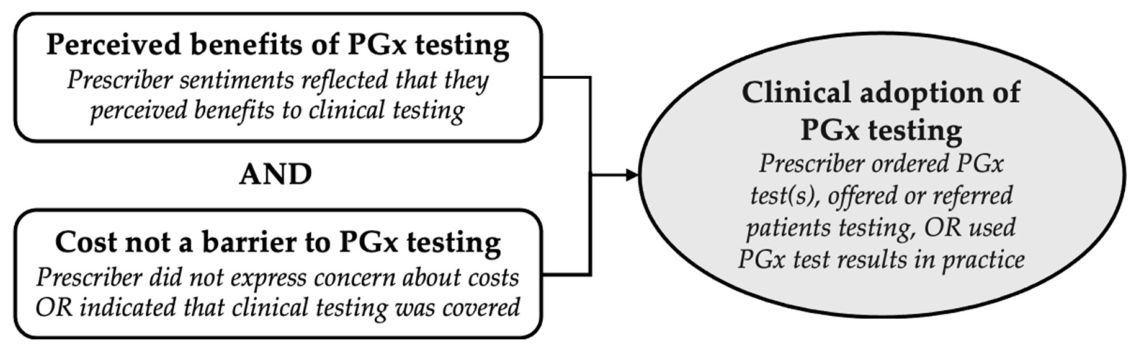
- Less suffering for patients when it takes less time to achieve a therapeutic benefit;
- More objective information to select best-fit medications for individuals;
- Positive consequences consisted of engaging patients with medication selection;
- Improved access to mental health medications through primary care.
“Yes, cost is always an issue…When [the health system] stopped offering [a health system covered test], I wasn’t sure if I ordered a panel if the person’s insurance will pay for it or if they will pay out-of-pocket. I actually partnered with a pharmacist to figure out if Medicare would pay for those tests…they were just going to submit it to Medicare and see if Medicare would cover it, but if they don’t the system was going to write it off for them…I would want to make sure it’s being covered by insurance and the patient will not have to pay at least a substantial amount out-of-pocket”.
3.3. Patient Perspectives on Costs and Benefits
“…my mom had a number of problems with arthritis, pain medications, with high blood pressure, and with statins. And it just seemed like a lot of times with the high blood pressure meds., they put her on one med. It wouldn’t work, so then they’d keep her on that med. and add another med. And it just seemed such a trial and error. And it was so frustrating to me because then you were kind of worrying is it some side effects from other ones happening when her potassium was going low. And just all these different things.And so, I had made a vow to myself that before I started a med, I wanted to find out if it was good for my body or not. And is there a way to do that? Well, because I was in my parent’s … chart because I was their liaison and I had permission to go in their chart, I saw that you were offering … genetic testing. And the price that they had on there—I had talked to another friend who had some genetic testing that was very expensive through California, so I was very excited… I was so happy to hear it was $40. To me, that was nothing to find out this information.”
4. Discussion
4.1. Study Limitations
4.2. Future Directions
5. Conclusions
Author Contributions
Funding
Institutional Review Board Statement
Informed Consent Statement
Data Availability Statement
Conflicts of Interest
Abbreviations
| ADR | Adverse Drug Reaction |
| CNA | Coincidence Analysis |
| CYP2C19 | Cytochrome P450, Subfamily IIC, Polypeptide 19 |
| CYP2D6 | Cytochrome P450, Subfamily IID, Polypeptide 6 |
| EMA | European Medicines Agency |
| FDA | United States Food and Drug Administration |
| HCSC | Health Canada/Santé Canada |
| PGx | Pharmacogenetics |
| US | United States |
References
- GENDEP Investigators; MARS Investigators; STAR*D Investigators. Common genetic variation and antidepressant efficacy in major depressive disorder: A meta-analysis of three genome-wide pharmacogenetic studies. Am. J. Psychiatry 2013, 170, 207–217. [Google Scholar] [CrossRef] [Scilit] [PubMed]
- Elmarasi, M.; Fuehrlein, B. US Medicaid program: An analysis of the spending and utilization patterns for antidepressants from 2017 to 2021. Explor. Res. Clin. Soc. Pharm. 2023, 13, 100392. [Google Scholar] [CrossRef] [Scilit] [PubMed]
- Nagappan, A.; Miller, A.; Jain, S.; Oakes, A.H. Stimulant, antidepressant, and opioid telehealth prescription trends between 2019 and 2022. JAMA Netw. Open 2024, 7, e2433334. [Google Scholar] [CrossRef] [Scilit] [PubMed]
- Sperber, N.R.; Roberts, M.C.; Gonzales, S.; Bendz, L.M.; Cragun, D.; Haga, S.B.; Wu, R.R.; Omeogu, C.; Kaufman, B.; Petry, N.J.; et al. Pharmacogenetic testing in primary care could bolster depression treatment: A value proposition. Clin. Transl. Sci. 2024, 17, e13837. [Google Scholar] [CrossRef] [Scilit] [PubMed]
- Lemke, A.A.; Hulick, P.J.; Wake, D.T.; Wang, C.; Sereika, A.W.; Yu, K.D.; Glaser, N.S.; Dunnenberger, H.M. Patient perspectives following pharmacogenomics results disclosure in an integrated health system. Pharmacogenomics 2018, 19, 321–331. [Google Scholar] [CrossRef] [Scilit] [PubMed]
- Allen, J.D.; Pittenger, A.L.; Bishop, J.R. A scoping review of attitudes and experiences with pharmacogenomic testing among patients and the general public: Implications for patient counseling. J. Pers. Med. 2022, 12, 425. [Google Scholar] [CrossRef] [Scilit] [PubMed]
- Virelli, C.R.; Ebrahimi, M.; Mohiuddin, A.G.; Tomasi, J.; Lisoway, A.J.; Herbert, D.; Marshe, V.S.; Kidd, S.A.; Ferenbok, J.; Kennedy, J.L. User experiences of pharmacogenomic testing and opinions among psychiatry patients. J. Pers. Med. 2023, 14, 22. [Google Scholar] [CrossRef] [Scilit] [PubMed]
- Cernat, A.; Samaan, Z.; Abelson, J.; Ramdyal, A.; Shaikh, H.; Vanstone, M. Patient perspectives on pharmacogenomic (PGx) testing for antidepressant prescribing in primary care: A qualitative description study. J. Community Genet. 2024, 15, 293–309. [Google Scholar] [CrossRef] [Scilit] [PubMed]
- Popejoy, A.B. Diversity in precision medicine and pharmacogenetics: Methodological and conceptual considerations for broadening participation. Pharmgenomics Pers. Med. 2019, 12, 257–271. [Google Scholar] [CrossRef] [Scilit] [PubMed]
- Loftus, J.; Levy, H.P.; Stevenson, J.M. Documentation of results and medication prescribing after combinatorial psychiatric pharmacogenetic testing: A case for discrete results. Genet. Med. 2024, 26, 101056. [Google Scholar] [CrossRef] [Scilit] [PubMed]
- Zhou, Y.; Tremmel, R.; Schaeffeler, E.; Schwab, M.; Lauschke, V.M. Challenges and opportunities associated with rare-variant pharmacogenomics. Trends Pharmacol. Sci. 2022, 43, 852–865. [Google Scholar] [CrossRef] [Scilit] [PubMed]
- Swen, J.J.; van der Wouden, C.H.; Manson, L.E.; Abdullah-Koolmees, H.; Blagec, K.; Blagus, T.; Böhringer, S.; Cambon-Thomsen, A.; Cecchin, E.; Cheung, K.C.; et al. A 12-gene pharmacogenetic panel to prevent adverse drug reactions: An open-label, multicentre, controlled, cluster-randomised crossover implementation study. Lancet 2023, 401, 347–356. [Google Scholar] [CrossRef] [Scilit] [PubMed]
- Skokou, M.; Karamperis, K.; Koufaki, M.I.; Tsermpini, E.E.; Pandi, M.T.; Siamoglou, S.; Ferentinos, P.; Bartsakoulia, M.; Katsila, T.; Mitropoulou, C.; et al. Clinical implementation of preemptive pharmacogenomics in psychiatry. eBioMedicine 2024, 101, 105009. [Google Scholar] [CrossRef] [Scilit] [PubMed]
- Bousman, C.A.; Arandjelovic, K.; Mancuso, S.G.; Eyre, H.A.; Dunlop, B.W. Pharmacogenetic tests and depressive symptom remission: A meta-analysis of randomized controlled trials. Pharmacogenomics 2019, 20, 37–47. [Google Scholar] [CrossRef] [Scilit] [PubMed]
- Oslin, D.W.; Lynch, K.G.; Shih, M.C.; Ingram, E.P.; Wray, L.O.; Chapman, S.R.; Kranzler, H.R.; Gelernter, J.; Pyne, J.M.; Stone, A.; et al. Effect of pharmacogenomic testing for drug-gene interactions on medication selection and remission of symptoms in major depressive disorder: The PRIME Care randomized clinical trial. JAMA 2022, 328, 151–161. [Google Scholar] [CrossRef] [Scilit] [PubMed]
- Chenchula, S.; Atal, S.; Uppugunduri, C.R.S. A review of real-world evidence on preemptive pharmacogenomic testing for preventing adverse drug reactions: A reality for future health care. Pharmacogenomics J. 2024, 24, 9. [Google Scholar] [CrossRef] [Scilit] [PubMed]
- Shriver, S.P.; Adams, D.; McKelvey, B.A.; McCune, J.S.; Miles, D.; Pratt, V.M.; Ashcraft, K.; McLeod, H.L.; Williams, H.; Fleury, M.E. Overcoming barriers to discovery and implementation of equitable pharmacogenomic testing in oncology. J. Clin. Oncol. 2024, 42, 1181–1192. [Google Scholar] [CrossRef] [Scilit] [PubMed]
- Xu, L.; Li, L.; Wang, Q.; Pan, B.; Zheng, L.; Lin, Z. Effect of pharmacogenomic testing on the clinical treatment of patients with depressive disorder: A randomized clinical trial. J. Affect. Disord. 2024, 359, 117–124. [Google Scholar] [CrossRef] [Scilit] [PubMed]
- Caudle, K.E.; Klein, T.E.; Hoffman, J.M.; Muller, D.J.; Whirl-Carrillo, M.; Gong, L.; McDonagh, E.M.; Sangkuhl, K.; Thorn, C.F.; Schwab, M.; et al. Incorporation of pharmacogenomics into routine clinical practice: The Clinical Pharmacogenetics Implementation Consortium (CPIC) guideline development process. Curr. Drug Metab. 2014, 15, 209–217. [Google Scholar] [CrossRef] [Scilit] [PubMed]
- Peruzzi, E.; Roncato, R.; De Mattia, E.; Bignucolo, A.; Swen, J.J.; Guchelaar, H.J.; Toffoli, G.; Cecchin, E. Implementation of pre-emptive testing of a pharmacogenomic panel in clinical practice: Where do we stand? Br. J. Clin. Pharmacol. 2025, 91, 270–282. [Google Scholar] [CrossRef] [Scilit] [PubMed]
- Li, D.; Pain, O.; Fabbri, C.; Wong, W.L.E.; Lo, C.W.H.; Ripke, S.; Cattaneo, A.; Souery, D.; Dernovsek, M.Z.; Henigsberg, N.; et al. Metabolic activity of CYP2C19 and CYP2D6 on antidepressant response from 13 clinical studies using genotype imputation: A meta-analysis. Transl. Psychiatry 2024, 14, 296. [Google Scholar] [CrossRef] [Scilit] [PubMed]
- Borden, B.A.; Galecki, P.; Wellmann, R.; Danahey, K.; Lee, S.M.; Patrick-Miller, L.; Sorrentino, M.J.; Nanda, R.; Koyner, J.L.; Polonsky, T.S.; et al. Assessment of prescriber-perceived barriers to clinical use of pharmacogenomics during participation in an institutional implementation study. Pharmacogenetics Genom. 2019, 29, 31–38. [Google Scholar] [CrossRef] [Scilit] [PubMed]
- van der Drift, D.; Simoons, M.; Koch, B.C.P.; Brufau, G.; Bindels, P.; Matic, M.; van Schaik, R.H.N. Implementation of pharmacogenetics in first-line care: Evaluation of its use by general practitioners. Genes 2023, 14, 1841. [Google Scholar] [CrossRef] [Scilit] [PubMed]
- Abdullah-Koolmees, H.; van Keulen, A.M.; Nijenhuis, M.; Deneer, V.H.M. Pharmacogenetics guidelines: Overview and comparison of the DPWG, CPIC, CPNDS, and RNPGx guidelines. Front. Pharmacol. 2021, 11, 595219. [Google Scholar] [CrossRef] [Scilit] [PubMed]
- Sperber, N.R.; Cragun, D.; Roberts, M.C.; Bendz, L.M.; Ince, P.; Gonzales, S.; Haga, S.B.; Wu, R.R.; Petry, N.J.; Ramsey, L.; et al. A mixed-methods protocol to identify best practices for implementing pharmacogenetic testing in clinical settings. J. Pers. Med. 2022, 12, 1313. [Google Scholar] [CrossRef] [Scilit] [PubMed]
- Ambuehl, M.; Baumgartner, M.; Epple, R.; Parkkinen, V.P.; Thiem, A. cna: Causal Modeling with Coincidence Analysis, version 4.0.3; R Package; CRAN: Vienna, Austria, 2025; Available online: https://CRAN.R-project.org/package=cna (accessed on 5 July 2026).
- Whitaker, R.G.; Sperber, N.; Baumgartner, M.; Thiem, A.; Cragun, D.; Damschroder, L.; Miech, E.J.; Slade, A.; Birken, S. Coincidence analysis: A new method for causal inference in implementation science. Implement. Sci. 2020, 15, 108. [Google Scholar] [CrossRef] [Scilit] [PubMed]
- Atkins, L.; Francis, J.; Islam, R.; O’Connor, D.; Patey, A.; Ivers, N.; Foy, R.; Duncan, E.M.; Colquhoun, H.; Grimshaw, J.M.; et al. A guide to using the Theoretical Domains Framework of behaviour change to investigate implementation problems. Implement. Sci. 2017, 12, 77. [Google Scholar] [CrossRef] [Scilit] [PubMed]
- Damschroder, L.J.; Aron, D.C.; Keith, R.E.; Kirsh, S.R.; Alexander, J.A.; Lowery, J.C. Fostering implementation of health services research findings into practice: A consolidated framework for advancing implementation science. Implement. Sci. 2009, 4, 50. [Google Scholar] [CrossRef] [Scilit] [PubMed]
- Damschroder, L.J.; Reardon, C.M.; Widerquist, M.A.O.; Lowery, J. The updated Consolidated Framework for Implementation Research based on user feedback. Implement. Sci. 2022, 17, 75. [Google Scholar] [CrossRef] [Scilit] [PubMed]
- Proctor, E.; Silmere, H.; Raghavan, R.; Hovmand, P.; Aarons, G.; Bunger, A.; Griffey, R.; Hensley, M. Outcomes for implementation research: Conceptual distinctions, measurement challenges, and research agenda. Adm. Policy Ment. Health 2011, 38, 65–76. [Google Scholar] [CrossRef] [Scilit] [PubMed]
- Weiner, B.J.; Lewis, C.C.; Stanick, C.; Powell, B.J.; Dorsey, C.N.; Clary, A.S.; Boynton, M.H.; Halko, H. Psychometric assessment of three newly developed implementation outcome measures. Implement. Sci. 2017, 12, 108. [Google Scholar] [CrossRef] [Scilit] [PubMed]
- Parkkinen, V.P.; Baumgartner, M.; Ambuehl, M. frscore: Functions for Calculating Fit-Robustness of CNA-Solutions, version 0.5.2; R Package; CRAN: Vienna, Austria, 2025; Available online: https://cran.r-project.org/web/packages/frscore/frscore.pdf (accessed on 5 July 2026). [CrossRef] [Scilit]
- Parkkinen, V.P.; Baumgartner, M. Robustness and model selection in configurational causal modeling. Sociol. Methods Res. 2023, 52, 176–208. [Google Scholar] [CrossRef] [Scilit]
- Hsieh, H.-F.; Shannon, S.E. Three approaches to qualitative content analysis. Qual. Health Res. 2005, 15, 1277–1288. [Google Scholar] [CrossRef] [Scilit] [PubMed]
- Caudle, K.E.; Hoffman, J.M.; Gammal, R.S. Pharmacogenomics implementation: “A little less conversation, a little more action, please”. Pharmacogenomics 2023, 24, 183–186. [Google Scholar] [CrossRef] [Scilit] [PubMed]
- Whirl-Carrillo, M.; Huddart, R.; Gong, L.; Sangkuhl, K.; Thorn, C.F.; Whaley, R.; Klein, T.E. An evidence-based framework for evaluating pharmacogenomics knowledge for personalized medicine. Clin. Pharmacol. Ther. 2021, 110, 563–572. [Google Scholar] [CrossRef] [Scilit] [PubMed]
- Jessel, C.D.; Al Maruf, A.; Oomen, A.; Arnold, P.D.; Bousman, C.A. Pharmacogenetic testing knowledge and attitudes among pediatric psychiatrists and pediatricians in Alberta, Canada. J. Can. Acad. Child Adolesc. Psychiatry 2022, 31, 18–27. [Google Scholar] [PubMed]
- Apellaniz-Ruiz, M.; Barrachina, J.; Castro-Sanchez, P.; Comes-Raga, A.; García-González, X.; Gil-Rodriguez, A.; Lopez-Lopez, E.; Maroñas, O.; Morón, R.; Muriel, J.; et al. Status of the implementation of pharmacogenetics in clinical practice in Spain: From regional to national initiatives. Drug Metab. Pers. Ther. 2024, 39, 183–199. [Google Scholar] [CrossRef] [Scilit] [PubMed]
- Kaur, G.; Nwabufo, C.K. Healthcare prescriber and patient perspectives on the implementation of pharmacogenetic-guided treatment in routine clinical practice. Pharmacogenetics Genom. 2024, 34, 236–245. [Google Scholar] [CrossRef] [Scilit] [PubMed]
- Medwid, S.; Kim, R.B. Implementation of pharmacogenomics: Where are we now? Br. J. Clin. Pharmacol. 2024, 90, 1763–1781. [Google Scholar] [CrossRef] [Scilit] [PubMed]
- Mosch, R.; van der Lee, M.; Guchelaar, H.J.; Swen, J.J. Pharmacogenetic panel testing: A review of current practice and potential for clinical implementation. Annu. Rev. Pharmacol. Toxicol. 2025, 65, 91–109. [Google Scholar] [CrossRef] [Scilit] [PubMed]
- Li, L.J.; Legeay, S.; Gagnon, A.L.; Frigon, M.P.; Tessier, L.; Tremblay, K. Moving towards the implementation of pharmacogenetic testing in Quebec. Front. Genet. 2024, 14, 1295963. [Google Scholar] [CrossRef] [Scilit] [PubMed]
- Wiss, F.M.; Jakober, D.; Lampert, M.L.; Allemann, S.S. Overcoming barriers: Strategies for implementing pharmacist-led pharmacogenetic services in Swiss clinical practice. Genes 2024, 15, 862. [Google Scholar] [CrossRef] [Scilit] [PubMed]
- Roberts, B.; Cooper, Z.; Landery, G.; Stanley, S.; Majda, B.T.; Collins, K.R.L.; Akkari, P.A.; Hood, S.D.; Rodger, J. Exploring perceived barriers and attitudes in young adults towards antidepressant pharmacotherapy, including the implementation of pharmacogenetic testing to optimize prescription practices. Front. Pharmacol. 2025, 15, 1526101. [Google Scholar] [CrossRef] [Scilit]
- Cooper, J.; Pratt, J.; Park, J.; Fahim, C.; Lovnicki, J.M.; Groeneweg, G.S.S.; Carleton, B.; Straus, S. Implementation of pharmacogenetic testing in pediatric oncology: Barriers and facilitators assessment at eight Canadian academic health centres. Pharmacogenomics J. 2024, 24, 36. [Google Scholar] [CrossRef] [Scilit] [PubMed]
- Meli, B.A.; Fenech, A.G.; Cordina, M.; Ellul, B.; Agius, E. Challenges in public policy for the implementation of pharmacogenetic tests in Europe. BioSocieties 2025, 20, 400–417. [Google Scholar] [CrossRef] [Scilit]
- Rim, J.H.; Kim, Y.G.; Kim, S.; Choi, R.; Lee, J.S.; Park, S.; Lee, W.; Song, E.Y.; Lee, S.Y.; Chun, S.; et al. Clinical pharmacogenetic testing and application: 2024 updated guidelines by the Korean Society for Laboratory Medicine. Ann. Lab. Med. 2025, 45, 121–132. [Google Scholar] [CrossRef] [Scilit] [PubMed]
- Manolio, T.A.; Rider, R.; Bult, C.J.; Chisholm, R.L.; Deverka, P.A.; Ginsburg, G.S.; Green, E.D.; Jarvik, G.P.; Mensah, G.A.; Narula, J.; et al. Advancing the science of genomic learning healthcare systems. Learn. Health Syst. 2025, 9, e70027. [Google Scholar] [CrossRef] [Scilit] [PubMed]
- California Department of Health Care Services. Policy Information for Biomarker and Pharmacogenomic Testing Coverage. Available online: https://mcweb.apps.prd.cammis.medi-cal.ca.gov/news/33051 (accessed on 24 February 2025).
- Melendez, K.; Gutierrez-Meza, D.; Gavin, K.L.; Alagoz, E.; Sperber, N.; Wu, R.R.; Silva, A.; Pati, B.; Voora, D.; Hung, A.; et al. Patient perspectives of barriers and facilitators for the uptake of pharmacogenomic testing in Veterans Affairs’ Pharmacogenomic Testing for the Veterans (PHASER) Program. J. Pers. Med. 2023, 13, 1367. [Google Scholar] [CrossRef] [Scilit] [PubMed]
- Pjevac, M. The application of pharmacogenetic testing in psychiatry for treatment-resistant disorders: Optimal timing and implementation, a literature review. Eur. Psychiatry 2024, 67, S690. [Google Scholar] [CrossRef] [Scilit]


| Regulatory Agencies | Genes | Drugs |
|---|---|---|
| FDA | CYP2C19 | citalopram |
| HCSC | ||
| Swissmedic | ||
| FDA | CYP2D6 | dextromethorphan hydrobromide combined with bupropion hydrochloride |
| FDA | CYP2D6 | fluoxetine |
| FDA | CYP2D6 | fluoxetine |
| olanzapine | ||
| FDA | CYP2D6 | fluvoxamine |
| HCSC | ||
| Swissmedic | ||
| EMA | CYP2D6 | vortioxetine |
| FDA | ||
| Swissmedic |
| System-level (Institutional) Factors | |||||
| Study Site Id | 1 | 2 | 3 | 4 | Total |
| Distribution of Study Participants (N, % Total) | |||||
| Patients Interviewed | 5 (50%) | 0 (0%) | 0 (0%) | 5 (50%) | 10 |
| Prescribers Included | 4 (13.8%) | 8 (27.6%) | 5 (17.2%) | 12 (41.4%) | 29 |
| Healthcare Setting | |||||
| Regional system reaching rural areas | X | X | 2 | ||
| Urban academic medical center | X | X | 2 | ||
| NIH Clinical Genomics Network (Member or Affiliate) | |||||
| eMERGE | X | X | 2 | ||
| IGNITE | X | X | X | 3 | |
| Program Stage (Institutional Level) | |||||
| Exploration | X | 1 | |||
| Preparation | X | 1 | |||
| Implementation (preemptive) | X | 1 | |||
| Expansion (preemptive and reactive) | X | 1 | |||
| Individual-level (Prescriber) Factors | |||||
| STUDY SITE ID | 1 | 2 | 3 | 4 | Total |
| Practice Setting (N, % Total) | |||||
| Inpatient | 1 (50%) | 0 (0%) | 1 (50%) | 0 (0%) | 2 |
| Outpatient | 3 (11.1%) | 8 (29.7%) | 4 (14.8%) | 12 (44.4%) | 27 |
| Prescriber Degree Type (N, % Total) | |||||
| MD | 4 (16.7%) | 6 (25.0%) | 5 (20.8%) | 9 (37.5%) | 24 |
| PA or NP | 0 (0%) | 1 (25.0%) | 0 (0%) | 3 (75.0%) | 4 |
| PharmD | 0 (0%) | 1 (100%) | 0 (0%) | 0 (0%) | 1 |
| PGx Exposure (N, % Total) | |||||
| Received Training (Med School/Residency/CME) | 2 (10%) | 7 (35.0%) | 3 (15.0%) | 8 (40.0%) | 20 |
| No Training Reported | 2 (22.2%) | 1 (11.1%) | 2 (22.2%) | 4 (44.4%) | 9 |
| PGx Adoption (N, % Total) | |||||
| Adopters | 2 (12.5%) | 1 (6.25%) | 3 (18.8%) | 7 (43.8%) | 16 |
| Non-Adopters | 2 (15.4%) | 7 (53.9%) | 2 (15.4%) | 2 (15.4%) | 13 |
| Factor (Abbreviation) | Description | Initial Coding | Final Calibration |
|---|---|---|---|
| Benefits | Beliefs about positive consequences and relative advantages of PGx | 1 = negative effects 2 = mixed (positive and negative) 3 = only positive | 0 = no benefits perceived (absence of positive) 1 = at least some perceived benefits (presence of positive beliefs) |
| Ability | Skills, procedural knowledge, or confidence about how to use pharmacogenetic testing in daily practice | Calibrated separately for each of 3 concepts as 1 = none 2 = moderate 3 = high | 0 = low ability (did not have any skills, procedural knowledge, or confidence) 1 = some ability present (had any skills, procedural knowledge, or confidence) |
| Evidence strength and quality (Evidence) | Belief about the state of the evidence regarding use of pharmacogenetics in mental health | 1 = negative (evidence favors not offering PGx testing) 2 = neutral 3 = positive (evidence is in favor of PGx testing) | 0 = neutral or negative beliefs (evidence insufficient to support genetic testing for prescribing) 1 = positive beliefs about evidence |
| Cost barrier | Reported cost barrier at the time of PGx testing | 1 = yes 2 = no | 0 = neutral or cost was not reported as a barrier at the time of testing 1 = cost reported as a barrier at the time of testing |
| Institutional support (Support) | Presence of institutional or organizational support for PGx testing (e.g., financial subsidies, training, clinical PGx research) | 1 = low 2 = moderate 3 = high | 0 = no support 1 = at least some support |
| Acceptability (Accept) | Belief that pharmacogenetic testing is agreeable, palatable, or satisfactory | 1 = disagree 2 = neutral 3 = agree | 0 = disagree or neutral 1 = agree PGx is acceptable |
| Appropriateness (Approp) | Perceived fit of pharmacogenetic testing for setting or problem | 1 = disagree 2 = neutral 3 = agree | 0 = disagree or neutral 1 = agree (PGx is or may be appropriate) |
| Feasibility (Feas) | Belief that PGx testing can be successfully used or carried out within a given agency or setting | 1 = disagree 2 = neutral 3 = agree | 0 = disagree/neutral 1 = agree (pharmacogenetic testing is clearly feasible) |
| Outcome | Support | Ability | Cost Barrier | Benefits | Evidence | Appropriateness | Acceptability | Feasibility |
|---|---|---|---|---|---|---|---|---|
| 0 | 1 | 0 | 1 | 0 | 0 | 0 | 0 | 1 |
| 0 | 0 | 0 | 1 | 1 | 1 | 1 | 1 | 0 |
| 0 | 1 | 1 | 1 | 0 | 0 | 0 | 0 | 1 |
| 0 | 1 | 0 | 1 | 1 | 1 | 1 | 0 | 0 |
| 0 | 0 | 0 | 1 | 1 | 0 | 1 | 1 | 1 |
| 0 | 0 | 0 | 1 | 1 | 0 | 1 | 1 | 0 |
| 0 | 0 | 1 | 1 | 0 | 0 | 0 | 0 | 1 |
| 0 | 0 | 0 | 1 | 1 | 1 | 1 | 1 | 1 |
| 0 | 0 | 0 | 0 | 0 | 1 | 0 | 0 | 1 |
| 0 | 1 | 0 | 1 | 0 | 0 | 0 | 0 | 1 |
| 0 | 1 | 1 | 0 | 1 | 0 | 0 | 0 | 1 |
| 0 | 1 | 1 | 0 | 0 | 0 | 0 | 0 | 1 |
| 0 | 1 | 1 | 1 | 1 | 1 | 1 | 1 | 1 |
| 1 | 0 | 1 | 0 | 1 | 1 | 1 | 1 | 1 |
| 1 | 1 | 0 | 0 | 1 | 0 | 1 | 1 | 0 |
| 1 | 0 | 0 | 0 | 1 | 1 | 1 | 1 | 1 |
| 1 | 1 | 1 | 0 | 1 | 1 | 1 | 1 | 1 |
| 1 | 1 | 1 | 0 | 1 | 1 | 1 | 1 | 1 |
| 1 | 1 | 1 | 0 | 1 | 1 | 1 | 1 | 1 |
| 1 | 1 | 0 | 0 | 1 | 0 | 1 | 1 | 1 |
| 1 | 1 | 1 | 0 | 1 | 1 | 1 | 1 | 1 |
| 1 | 1 | 1 | 0 | 1 | 1 | 1 | 1 | 1 |
| 1 | 1 | 1 | 0 | 1 | 1 | 1 | 1 | 1 |
| 1 | 1 | 1 | 0 | 1 | 1 | 1 | 1 | 1 |
| 1 | 1 | 1 | 0 | 1 | 1 | 1 | 1 | 1 |
| 1 | 1 | 1 | 0 | 1 | 1 | 1 | 1 | 1 |
| 1 | 1 | 0 | 0 | 1 | 1 | 1 | 0 | 1 |
| 1 | 1 | 1 | 0 | 1 | 0 | 1 | 0 | 1 |
| 1 | 1 | 1 | 0 | 1 | 1 | 1 | 1 | 1 |
| Model | Consistency AA-Con|c-Con | Coverage AA-Cov|c-Cov | Faithfulness | Complexity | Fit-Robustness Score | ||
|---|---|---|---|---|---|---|---|
| APPROP <-> OUTCOME | 0.786 | 0.538 | 1.0 | 1.0 | 0.667 | 1 | 1.0 |
| cost_barrier <-> OUTCOME | 0.864 | 0.769 | 1.0 | 1.0 | 0.667 | 1 | 0.935 |
| ACCEPT <-> OUTCOME | 0.752 | 0.615 | 0.787 | 0.80 | 0.50 | 1 | 0.731 |
| cost_barrier * EVIDENCE <-> OUTCOME | 0.918 | 0.923 | 0.823 | 0.80 | 0.667 | 2 | 0.666 |
| BENEFITS <-> OUTCOME | 0.767 | 0.462 | 1.0 | 1.0 | 0.667 | 1 | 0.547 |
| SUPPORT * ACCEPT <-> OUTCOME | 0.907 | 0.923 | 0.787 | 0.750 | 0.571 | 2 | 0.50 |
| cost_barrier * BENEFITS <-> OUTCOME | 0.944 | 0.923 | 1.0 | 1.000 | 0.80 | 2 | 0.352 |
| ABILITY * APPROP <-> OUTCOME | 0.907 | 0.923 | 0.787 | 0.750 | 0.667 | 2 | 0.337 |
| APPROP * FEAS <-> OUTCOME | 0.845 | 0.769 | 0.902 | 0.909 | 0.60 | 2 | 0.337 |
| SUPPORT * cost_barrier * EVIDENCE <-> OUTCOME | 1.0 | 1.000 | 0.783 | 0.722 | 0.778 | 3 | 0.328 |
Disclaimer/Publisher’s Note: The statements, opinions and data contained in all publications are solely those of the individual author(s) and contributor(s) and not of MDPI and/or the editor(s). MDPI and/or the editor(s) disclaim responsibility for any injury to people or property resulting from any ideas, methods, instructions or products referred to in the content. |
© 2026 by the authors. Licensee MDPI, Basel, Switzerland. This article is an open access article distributed under the terms and conditions of the Creative Commons Attribution (CC BY) license.
Share and Cite
Popejoy, A.B.; Cragun, D.; Roberts, M.C.; Bendz, L.M.; Gonzales, S.; Haga, S.B.; Wu, R.R.; Petry, N.J.; Ramsey, L.B.; Uber, R.; et al. Factors Facilitating Adoption of Pharmacogenetic Testing by Prescribers of Antidepressants in Four US Health Systems: A Multi-Site Cross-Sectional PGx Implementation Science Study. J. Pers. Med. 2026, 16, 411. https://doi.org/10.3390/jpm16080411
Popejoy AB, Cragun D, Roberts MC, Bendz LM, Gonzales S, Haga SB, Wu RR, Petry NJ, Ramsey LB, Uber R, et al. Factors Facilitating Adoption of Pharmacogenetic Testing by Prescribers of Antidepressants in Four US Health Systems: A Multi-Site Cross-Sectional PGx Implementation Science Study. Journal of Personalized Medicine. 2026; 16(8):411. https://doi.org/10.3390/jpm16080411
Chicago/Turabian StylePopejoy, Alice B., Deborah Cragun, Megan C. Roberts, Lisa M. Bendz, Sarah Gonzales, Susanne B. Haga, R. Ryanne Wu, Natasha J. Petry, Laura B. Ramsey, Ryley Uber, and et al. 2026. "Factors Facilitating Adoption of Pharmacogenetic Testing by Prescribers of Antidepressants in Four US Health Systems: A Multi-Site Cross-Sectional PGx Implementation Science Study" Journal of Personalized Medicine 16, no. 8: 411. https://doi.org/10.3390/jpm16080411
APA StylePopejoy, A. B., Cragun, D., Roberts, M. C., Bendz, L. M., Gonzales, S., Haga, S. B., Wu, R. R., Petry, N. J., Ramsey, L. B., Uber, R., Momin, K., & Sperber, N. R. (2026). Factors Facilitating Adoption of Pharmacogenetic Testing by Prescribers of Antidepressants in Four US Health Systems: A Multi-Site Cross-Sectional PGx Implementation Science Study. Journal of Personalized Medicine, 16(8), 411. https://doi.org/10.3390/jpm16080411