
Expanded Indications for Hybrid Spinal Fixation Systems; Combined Percutaneous Pedicle Screw Fixation and Open Approaches

 , , ,
, , ,
Abstract
1. Introduction
2. Materials and Methods
3. Results
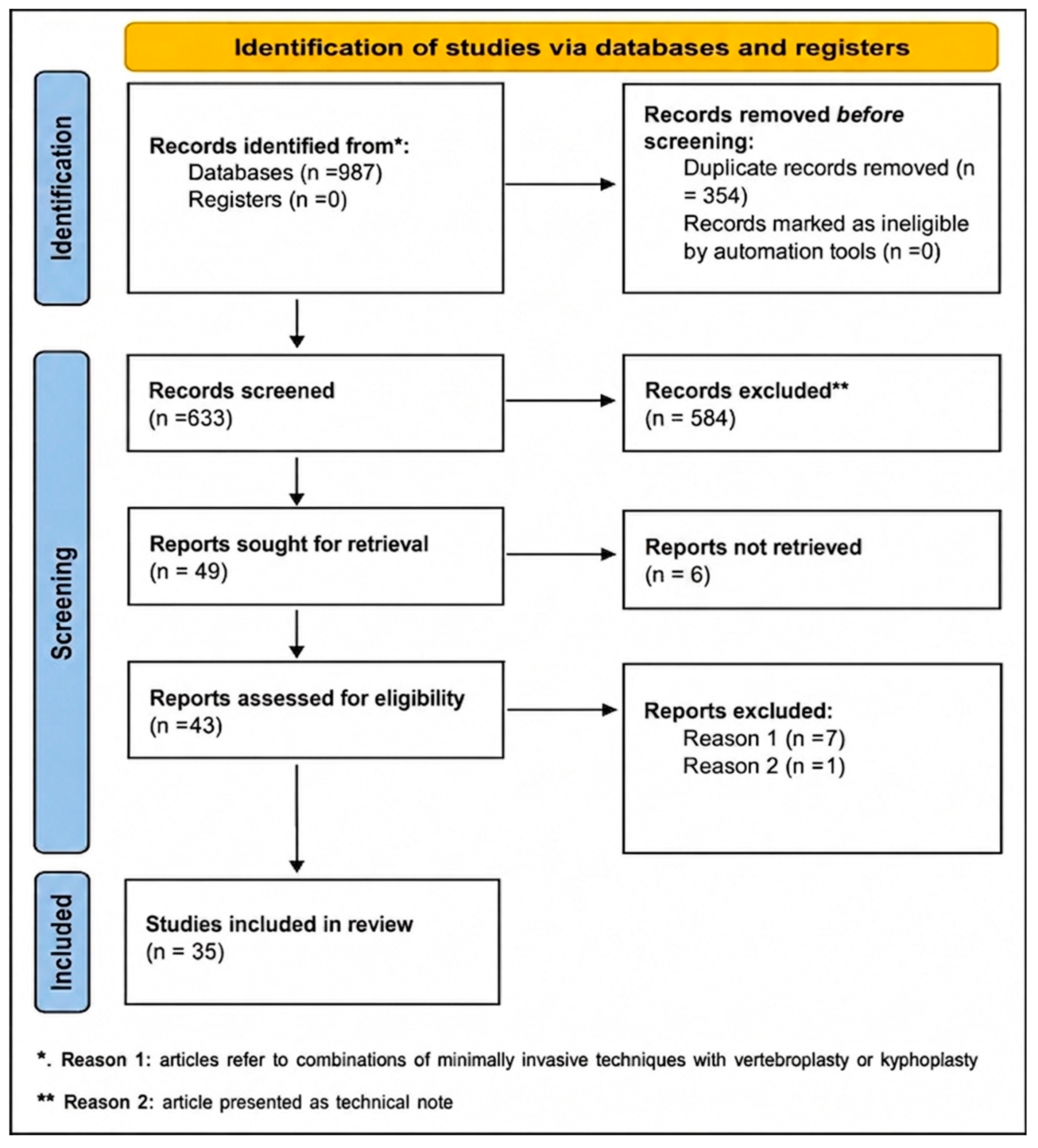
3.1. Included Studies
3.2. Quality Assessment
4. Discussion
4.1. Applications of PPSF Combined with Open Procedures in Degenerative Spine Pathologies and Deformities
4.2. Applications of Hybrid Methods on Trauma Cases or Post-Traumatic Deformities
4.3. Application in Infectious Spinal Pathologies
4.4. Applications of Hybrid Method in Metastatic Spine Disease
4.5. Limitations of Minimally Invasive Spine Surgery (MISS) and Potential Benefits of Robot-Assisted and Image-Guided Navigation Systems
4.6. Strengths and Limitations
5. Conclusions
Author Contributions
Funding
Institutional Review Board Statement
Informed Consent Statement
Data Availability Statement
Conflicts of Interest
References
- Momin, A.A.; Steinmetz, M.P. Evolution of Minimally Invasive Lumbar Spine Surgery. World Neurosurg. 2020, 140, 622–626. [Google Scholar] [CrossRef] [PubMed]
- Mobbs, R.J.; Sivabalan, P.; Li, J. Technique, Challenges and Indications for Percutaneous Pedicle Screw Fixation. J. Clin. Neurosci. 2011, 18, 741–749. [Google Scholar] [CrossRef] [PubMed]
- Oppenheimer, J.; DeCastro, I.; McDonnell, D. Minimally Invasive Spine Technology and Minimally Invasive Spine Surgery: A Historical Review. Neurosurg. Focus 2009, 27, E9. [Google Scholar] [CrossRef] [PubMed]
- Magerl, F.P. Stabilization of the Lower Thoracic and Lumbar Spine with External Skeletal Fixation. Clin. Orthop. Relat. Res. 1984, 189, 125–141. [Google Scholar] [CrossRef]
- Leu, H.; Hauser, R.; Schreiber, A. Percutaneous Lumbar Spine Fusion. Acta Orthop. Scand. 1993, 251, 116–119. [Google Scholar] [CrossRef]
- Hsieh, P.C.; Koski, T.R.; Sciubba, D.M.; Moller, D.J.; O’shaughnessy, B.A.; Li, K.W.; Gokaslan, Z.L.; Ondra, S.L.; Fessler, R.G.; Liu, J.C. Maximizing the Potential of Minimally Invasive Spine Surgery in Complex Spinal Disorders. J. Neurosurg. 2008, 25, 2–11. [Google Scholar] [CrossRef] [PubMed]
- Smith, J.S.; Ogden, A.T.; Fessler, R.G. Minimally Invasive Posterior Thoracic Fusion. J. Neurosurg. 2008, 25, E9. [Google Scholar] [CrossRef] [PubMed]
- German, J.W.; Adamo, M.A.; Hoppenot, R.G.; Blossom, J.H.; Nagle, H.A. Perioperative Results Following Lumbar Discectomy: Comparison of Minimally Invasive Discectomy and Standard Microdiscectomy. J. Neurosurg. 2008, 25, E20. [Google Scholar] [CrossRef] [PubMed]
- Ryang, Y.; Oertel, M.F.; Mayfrank, L.; Gilsbach, J.M.; Rohde, V. Standard Open Microdiscectomy versus Minimal Access Trocar Microdiscectomy: Results of a Prospective Randomized Study. Neurosurgery 2008, 62, E1209. [Google Scholar] [CrossRef] [PubMed]
- Katayama, Y.; Matsuyama, Y.; Yoshihara, H. Comparison of Surgical Outcomes Between Macro Discectomy and Micro Discectomy for Lumbar Disc Herniation: A Prospective Randomized Study with Surgery Performed by the Same Spine Surgeon. J. Spinal Disord. Tech. 2006, 19, 344–347. [Google Scholar] [CrossRef] [PubMed]
- Näther, P.; Kersten, J.F.; Kaden, I.; Irga, K.; Nienhaus, A. Distribution Patterns of Degeneration of the Lumbar Spine in a Cohort of 200 Patients with an Indication for Lumbar MRI. Int. J. Environ. Res. Public Health 2022, 19, 3721. [Google Scholar] [CrossRef] [PubMed]
- Pennington, Z.; Cottrill, E.; Westbroek, E.M.; Goodwin, M.L.; Lubelski, D.; Ahmed, A.K.; Sciubba, D.M. Evaluation of Surgeon and Patient Radiation Exposure by Imaging Technology in Patients Undergoing Thoracolumbar Fusion: Systematic Review of the Literature. Spine J. 2019, 19, 1397–1411. [Google Scholar] [CrossRef] [PubMed]
- Kouyoumdjian, P.; Combe, G.G.; Grelat, M.; Fuentes, S.; Blondel, B.; Tropiano, P.; Zairi, F.; Beaurain, J.; Charles, Y.P.; Dhenin, A.; et al. Surgeon’s and Patient’s Radiation Exposure during Percutaneous Thoracolumbar Pedicle Screw Fixation: A Prospective Multicenter Study of 100 Cases. Inter. Bloc. 2021, 40, 110–117. [Google Scholar] [CrossRef]
- Kam, J.K.T.; Gan, C.; Dimou, S.; Awad, M.; Kavar, B.; Nair, G.; Morokoff, A. Learning Curve for Robot-Assisted Percutaneous Pedicle Screw Placement in Thoracolumbar Surgery. Asian Spine J. 2019, 13, 920–927. [Google Scholar] [CrossRef] [PubMed]
- Mohamed, A.A.; Alshaibi, R.; Faragalla, S.; Flynn, G.; Khan, A.; Sargent, E.; Mohamed, Y.; Moriconi, C.; Williams, C.; Karve, Z.; et al. Less Is More: Evaluating the Benefits of Minimally Invasive Spinal Surgery. Life 2025, 15, 8. [Google Scholar] [CrossRef] [PubMed]
- Colangeli, S.; Capanna, R.; Bandiera, S.; Ghermandi, R. Is Minimally-Invasive Spinal Surgery a Reliable Treatment Option in Symptomatic Spinal Metastasis? Eur. Rev. Med. Pharmacol. Sci. 2020, 12, 6526–6532. [Google Scholar]
- Lee, S.; Choi, W.; Lim, S. Minimally Invasive Anterior Lumbar Interbody Fusion Followed by Percutaneous Pedicle Screw Fixation for Isthmic Spondylolisthesis. Spine J. 2004, 4, 644–649. [Google Scholar] [CrossRef] [PubMed]
- Eck, J.C. Minimally Invasive Corpectomy and Posterior Stabilization for Lumbar Burst Fracture. Spine J. 2011, 11, 904–908. [Google Scholar] [CrossRef] [PubMed]
- Sebastian, A.S.; Fogelson, J.L.; Dekutoski, M.B.; Nassr, A.N. Multiple Noncontiguous Spinal Fractures and Occipitocervical Dislocation in a Patient with Ankylosing Spondylitis Treated with a Hybrid Open and Percutaneous Spinal Fixation Technique: A Case Report. Spine J. 2015, 15, e1–e5. [Google Scholar] [CrossRef] [PubMed]
- Kim, J.; Moon, B.J.; Kim, S.; Lee, J. Minimal Invasive Nonfusion Technique for the Treatment of Noncontiguous Lumbar Burst Fractures in Young Age Patient. Medicine 2018, 10, 10–13. [Google Scholar] [CrossRef] [PubMed]
- Park, S.; Kim, S.; Ju, B.; Lee, S.; Lee, J. Short Segment Percutaneous Pedicle Screw Fixation after Direct Spinal Canal Decompression in Thoracolumbar Burst Fractures: An Alternative Option. J. Clin. Neurosci. 2018, 23, 530–537. [Google Scholar] [CrossRef] [PubMed]
- Ushijima, T.; Kawaguchi, K.; Matsumoto, T.; Takagi, M.; Kondoh, T. Double Non-Contiguous Fractures in a Patient with Spondylo-Epiphyseal Dysplasia with Spinal Ankylosis Treated with Open and Percutaneous Spinal Fixation Technique: A Case Report. BMC Res. Notes 2018, 11, 106. [Google Scholar] [CrossRef] [PubMed]
- Erichsen, C.J.; Heyde, C.; Josten, C.; Gonschorek, O.; Panzer, S.; Von Rüden, C.; Spiegl, U.J. Percutaneous versus Open Posterior Stabilization in AOSpine Type A3 Thoracolumbar Fractures. BMC Musculoskelet. Disord. 2020, 21, 74. [Google Scholar] [CrossRef] [PubMed]
- Huang, Z.; Hu, C.; Tong, Y.; Fan, Z.; Liu, K.; Yang, B.; Zhao, C. Percutaneous Pedicle Screw Fixation Combined with Transforaminal Endoscopic Spinal Canal Decompression for the Treatment of Thoracolumbar Burst Fracture with Severe Neurologic Deficit A. Medicine 2020, 99, e20276. [Google Scholar] [CrossRef] [PubMed]
- Todeschi, J.; Ganau, M.; Zaed, I.; Bozzi, M.T.; Mallereau, C.; Gallinaro, P.; Cebula, H.; Ollivier, I.; Spatola, G.; Chaussemy, D.; et al. Managing Incomplete and Complete Thoracolumbar Burst Fractures (AOSpine A3 and A4). Results from a Prospective Single-Center Study Comparing Posterior Percutaneous Instrumentation plus Mini-Open Anterolateral Fusion versus Single-Stage Posterior Instrumen. World Neurosurg. 2021, 150, 657–667. [Google Scholar] [CrossRef]
- Zhang, B.; Zhou, Y.; Zou, H.; Lu, Z.; Wang, X.; Ao, J. A Comparative Study on Efficacies of Posterior Microscopic Mini-Open and Open Technique for Thoracolumbar Burst Fractures with Severe Traumatic Spinal Stenosis. J. Orthop. Surg. Res. 2022, 17, 518. [Google Scholar] [CrossRef] [PubMed]
- Bai, G.; Qiu, X.; Wei, G.; Jing, X.; Hu, Q. Unilateral Biportal Endoscopic Decompression Combined with Percutaneous Pedicle Screw Fixation Offers New Treatment Option for Thoracolumbar Burst Fractures with Secondary Spinal Stenosis. Sci. Rep. 2025, 15, 877. [Google Scholar] [CrossRef] [PubMed]
- Anderson, D.G.; Sayadipour, A.; Shelby, K.; Albert, T.J.; Vaccaro, A.R.; Weinstein, M.S. Anterior Interbody Arthrodesis with Percutaneous Posterior Pedicle Fixation for Degenerative Conditions of the Lumbar Spine. Eur. Spine J. 2011, 20, 1323–1330. [Google Scholar] [CrossRef] [PubMed]
- Bravo, O.; Luna, J.; Barros, T.; Izquierdo, G.; Novoa, F.; Valencia, M. Unique Hybrid Vertebral Shortening Technique to Treat Acute Traumatic Thoracic Spondyloptosis. Surg. Neurol. Int. 2025, 16, 278. [Google Scholar] [CrossRef] [PubMed]
- Kandwal, P.; Garg, B.; Budhadev, U.B.; Jayaswal, C. Outcome of Minimally Invasive Surgery in the Management of Tuberculous Spondylitis. Indian. J. Orthop. 2012, 46, 159–164. [Google Scholar] [CrossRef] [PubMed]
- Garg, N.; Vohra, R. Minimally Invasive Surgical Approaches in the Management of Tuberculosis of the Thoracic and Lumbar Spine. Clin. Relat. Res. 2014, 472, 1855–1867. [Google Scholar] [CrossRef] [PubMed][Green Version]
- Lin, T.; Tsai, T.; Lu, M.; Niu, C.; Hsieh, M.; Fu, T.; Lai, P.; Chen, L.; Chen, W. Comparison of Two-Stage Open versus Percutaneous Pedicle Screw Fixation in Treating Pyogenic Spondylodiscitis. BMC Musculoskelet. Disord. 2014, 18, 443. [Google Scholar] [CrossRef] [PubMed][Green Version]
- Lin, Y.; Li, F.; Chen, W.; Zeng, H.; Chen, A.; Xiong, W. Single-Level Lumbar Pyogenic Spondylodiscitis Treated with Mini-Open Anterior Debridement and Fusion in Combination with Posterior Percutaneous Fixation via a Modified Anterior Lumbar Interbody Fusion Approach. J. Neurosurg. Spine 2015, 23, 747–753. [Google Scholar] [CrossRef] [PubMed]
- Wang, Q.; Huang, M.; Ou, D.; Xu, Y.; Dong, J.; Yin, H.; Chen, W.; Rong, L. One-Stage Extreme Lateral Interbody Fusion and Percutaneous Pedicle Screw Fixation in Lumbar Spine Tuberculosis. J. Musculoskelet. Neuronal Interact. 2017, 17, 450–455. [Google Scholar] [PubMed]
- Zhang, C.H.; Bchir, M.B.; Zaidman, N.; Russo, V. Hybrid Minimally Invasive Technique for Treatment of Thoracolumbar Spondylodiscitis and Vertebral Osteomyelitis. World Neurosurg. 2020, 141, e752–e762. [Google Scholar] [CrossRef] [PubMed]
- Lin, F.; Yamaguchi, U.; Matsunobu, T.; Kobayashi, E.; Nakatani, F.; Kawai, A.; Chuman, H. Minimally Invasive Solid Long Segmental Fi Xation Combined with Direct Decompression in Patients with Spinal Metastatic Disease. Int. J. Surg. 2013, 11, 173–177. [Google Scholar] [CrossRef] [PubMed][Green Version]
- Rao, P.J.; Thayaparan, G.K.; Fairhall, J.M.; Mobbs, R.J. Minimally Invasive Percutaneous Fixation Techniques for Metastatic Spinal Disease. Orthop. Surg. 2014, 3, 187–195. [Google Scholar] [CrossRef] [PubMed]
- Kumar, N.; Orth, F.; Orth, D.M.; Malhotra, R.; Maharajan, K.; Zaw, A.S.; Wu, P.H.; Makandura, M.C.; Ka, G.; Liu, P.; et al. Metastatic Spine Tumor Surgery. Clin. Spine Surg. 2017, 30, 1015–1021. [Google Scholar] [CrossRef] [PubMed]
- Kim, H.S.; Park, K.H.; Ju, C.I.; Kim, S.W.; Lee, S.M.; Shin, H. Minimally Invasive Multi-Level Posterior Lumbar Interbody Fusion Using a Percutaneously Inserted Spinal Fixation System: Technical Tips, Surgical Outcomes. J. Korean Neurosurg. Soc. 2011, 5, 441–445. [Google Scholar] [CrossRef] [PubMed]
- Miscusi, M.; Polli, F.M.; Forcato, S.; Ricciardi, L.; Frati, A.; Cimatti, M.; Martino, L.D.; Ramieri, A.; Raco, A. Comparison of Minimally Invasive Surgery with Standard Open Surgery for Vertebral Thoracic Metastases Causing Acute Myelopathy in Patients with Short- or Mid-Term Life Expectancy: Surgical Technique and Early Clinical Results. J. Neurosurg. Spine 2015, 22, 518–525. [Google Scholar] [CrossRef] [PubMed]
- Hamad, A.; Vachtsevanos, L.; Cattell, A.; Balain, B. Minimally Invasive Spinal Surgery for the Management of Symptomatic Spinal Metastasis Metastasis. Br. J. Neurosurg. 2017, 31, 526–530. [Google Scholar] [CrossRef] [PubMed]
- Dhamija, B.; Batheja, D.; Balain, B.S. Journal of Clinical Orthopaedics and Trauma A Systematic Review of MIS and Open Decompression Surgery for Spinal Metastases in the Last Two Decades. J. Clin. Orthop. Trauma 2021, 22, 101596. [Google Scholar] [CrossRef] [PubMed]
- Luo, B.; Chen, H.; Zou, M.; Yan, Y.; Ouyang, X.; Wang, C. Advances in the Clinical Diagnosis and Treatment of Multiple-Level Noncontiguous Spinal Fractures. Front. Neurol. 2024, 15, 1469425. [Google Scholar] [CrossRef] [PubMed]
- Sadh, P.; Sheth, S.; Greenberg, M.; Khan, Z.; Tripathi, P.; Khan, N.; Basques, B. Open Versus Percutaneous Posterior Fixation Following Anterior or Lateral Lumbar Interbody Fusion: A Systematic Review and Meta-Analysis. Spine 2026, 51, 243–253. [Google Scholar] [CrossRef] [PubMed]
- Kotani, Y.; Abumi, K. Mid-Term Clinical Results of Minimally Invasive Decompression and Posterolateral Fusion with Percutaneous Pedicle Screws versus Conventional Approach for Degenerative Spondylolisthesis with Spinal Stenosis. Eur. Spine J. 2012, 21, 1171–1177. [Google Scholar] [CrossRef] [PubMed]
- Barbagallo, G.M.V.; Certo, F.; Visocchi, M.; Sciacca, G.; Piccini, M.; Albanese, V. Multilevel Mini-Open TLIFs and Percutaneous Pedicle Screw Fixation: Description of a Simple Technical Nuance Used to Increase Intraoperative Safety and Improve Workflow. Tips and Tricks and Review of the Literature. Neurosurg. Rev. 2014, 38, 343–354. [Google Scholar] [CrossRef] [PubMed]
- Ulutaş, M.; Seçer, M.; Çelik, S.E. Minimally Invasive Mini Open Split-Muscular Percutaneous Pedicle Screw Fixation of the Thoracolumbar Spine. Orthop. Rev. 2015, 7, 5661. [Google Scholar] [CrossRef] [PubMed]
- Wang, M.Y.; Bordon, G. Mini-Open Pedicle Subtraction Osteotomy as a Treatment for Severe Adult Spinal Deformities: Case Series with Initial Clinical and Radiographic Outcomes. J. Neurosurg. Spine 2016, 24, 769–776. [Google Scholar] [CrossRef] [PubMed]
- Heo, D.; Jang, J.; Lee, J.; Park, C. Slippage Reduction of Lumbar Spondylolisthesis Using Percutaneous Pedicle Screw with Reduction Fixation System after Interbody Fusion: A Comparison with Traditional Open Fusion and Pedicle Screw Fixation. J. Clin. Neurosci. 2019, 67, 156–162. [Google Scholar] [CrossRef] [PubMed]
- Liu, W.; Zhao, Y.; Yuan, S.; Tian, Y.; Liu, X. Modified Mini-Open SRS-Schwab Grade 4 Osteotomy Combined with Percutaneous Pedicle Screws Fixation in Post-Traumatic Thoracolumbar Kyphosis. Musculoskelet. Disord. 2020, 21, 638. [Google Scholar] [CrossRef] [PubMed]
- Noriega, D.C.; Hernández-ramajo, R.; Milano, F.R.; Sanchez-lite, I.; Toribio, B.; Ardura, F.; Torres, R.; Corredera, R.; Kruger, A. Risk-Benefit Analysis of Navigation Techniques for Vertebral Transpedicular Instrumentation: A Prospective Study. Spine J. 2016, 17, 70–75. [Google Scholar] [CrossRef] [PubMed]
- Wu, T.; Chen, Y.; Huang, Y.; Meng, F.; Lu, J.; Liu, D. Ultrasound-Guided Jamshidi Needle Puncture to Reduce Radiation Exposure during Percutaneous Pedicle Screw Placement: Study Protocol for a Randomised Controlled Trial. BMJ Open 2023, 13, e064838. [Google Scholar] [CrossRef] [PubMed]
- Patel, T.T.K.; Mannion, R.F.R.J. Spinal Navigation for Minimally Invasive Thoracic and Lumbosacral Spine Fixation: Implications for Radiation Exposure, Operative Time, and Accuracy of Pedicle Screw Placement. Eur. Spine J. 2018, 27, 1918–1924. [Google Scholar] [CrossRef] [PubMed]
- Liu, P.; Hu, J.; Zhang, W.; Lin, S.; Yu, Y.; Tang, L.; Wang, F. Robot-Assisted Percutaneous Pedicle Screw Fixation in Thoracolumbar Burst Fractures: A Comparative Study. Sci. Rep. 2025, 15, 23175. [Google Scholar] [CrossRef] [PubMed]
- Yang, J.; He, B.; Tian, F.; Liu, T.; Liu, P.; Zhang, J.; Liu, S.; Tuo, Y.; Chu, L.; Hao, D. Accuracy of Robot-Assisted Percutaneous Pedicle Screw Placement for Treatment of Lumbar Spondylolisthesis: A Comparative Cohort Study. Med. Sci. Monit. 2019, 25, 2479–2487. [Google Scholar] [CrossRef] [PubMed]


| Study | Type of Study | Number of Patients | Aim of Study/Spine Pathology | Type of Intervention | Outcomes | Level of Evidence (Oxford CEBM) |
|---|---|---|---|---|---|---|
| Lee et al. 2004 [17] | Retrospective study | 73 | To evaluate one stage minimally invasive anterior lumbar interbody fusion (mini-ALIF) with posterior percutaneous pedicle screw fixation (PPSF) without decompression; symptomatic spondylolisthesis | Mini-ALIF combined with PPSF | Less muscle injury, no epidural scar or blood transfusion, good pain control and early discharge | III |
| Anderson et al. 2011 [28] | Retrospective study | 50 | To estimate anterior lumbar interbody fusion (ALIF) with PPSF; degenerative diseases of lumbar spine | One stage procedure; primary anterior lumbar fusion (ALIF with rhBMP-2 and allograft) and PPSF | Safe method, high fusion rate. Statistically significant results regarding pain scores. | III |
| Kim et al. 2011 [39] | Retrospective study | 42 | To describe hybrid surgical method of multilevel PPSF; instability, spondylolisthesis or stenosis. | Foraminal mini decompression with multilevel PPSF | Less iatrogenic muscle injury, postoperative blood loss and back pain | III |
| Kotani et al. 2012 [45] | Prospective cohort study | 80 (43 with minimally invasive lumbar decompression with posterolateral fusion (MIS-PLF) vs. open | To compare outcomes of MIS-PLF with open posterolateral fusion; degenerative spondylolisthesis | PPSF and MIS-PLF vs. open fusion | Better pain/function, lower complication rate (3.8%) | II |
| Barbagallo et al. 2014 [46] | Clinical series | 13 | To describe mini transforaminal lumbar interbody fusion (TLIF) with PPSF; multilevel degenerative diseases | Mini open TLIF and PPSF | Safe technique, no neurological deficits or re-operations. | IV |
| Ulutaş et al. 2015 [47] | Prospective study | 35 with MISS and 35 with conventional pedicle screw fixation | To estimate safety and efficiency of MISS; thoracic and lumbar spine degenerative pathologies | Microdiscectomy and cage insertion (TLIF) through midline incision, combined with PPSF | Good sagittal correction, no major complications | II |
| Wang and Bordon 2016 [48] | Retrospective study | 16 patients | To report results from hybrid pedicle subtraction osteotomy and PPSF; coronal and sagittal plane deformities | L2–L3 subtraction osteotomy with PPSF and facet joint or interbody fusion | Reduced soft tissue damage, good alignment | III |
| Heo et al. 2019 [49] | Comparative study | 65 (33 with open transpendicular fixation and 32 with PPSF and posterior lumbar interbody fusion-PLIF) | To study efficiency of PPSF with reduction system in lumbar spondylolisthesis | Open transpendicular fixation and PLIF vs. PPSF with reduction system and PLIF (open laminectomy) | Better lordosis and segmental angle maintenance with PPSF | III |
| Liu et al. 2020 [50] | Case–control study | 34 | To present results of the combined Schwab grade 4 osteotomy with PPSF; posttraumatic thoracolumbar kyphosis | Grade 4 osteotomy (egg-shell technique) through mini–open approach combined with PPSF | Less blood loss and low back pain. Similar misplacement rate. No implant loosening, fracture or correction loss reported. | III |
| Study | Type of Study | Number of Patients | Aim of Study/Spine Pathology | Type of Intervention | Outcomes | Level of Evidence (Oxford CEBM) |
|---|---|---|---|---|---|---|
| Eck. 2011 [18] | Case report | 1 | To present minimally invasive anterior and posterior fixation; L3 burst fracture | One stage L3 corpectomy with L2–L4 fusion and PPSF | Neurological improvement, less morbidity and blood loss. | IV |
| Sebastian et al. 2015 [19] | Case report | 1 | To present a hybrid method for multiple non-contiguous fractures in ankylosis | Open occipitocervical fusion and PPSF T5–L1 | Effective in complex trauma | IV |
| Kim et al. 2018 [20] | Case report | 1 | To present treatment of non-contiguous burst lumbar spine fractures (L2 and L5 with neurological impairment) | PPSF (short-segment) and posterior mini decompression | Motion preservation, good clinical outcome | IV |
| Park et al. 2018 [21] | Retrospective study | 27 | To evaluate PPSF and spinal decompression; single-level burst fracture of thoracolumbar junction (T11–L2) with neurological Deficits | Mini posterior decompression and PPSF | No neurological deterioration, good correction. | III |
| Ushijima et al. 2018 [22] | Case report | 1 | To present treatment of non-contiguous fractures of cervicothoracic and thoracolumbar zone in spinal ankylosis and spondylo-epiphyseal dysplasia | Hybrid open + percutaneous fixation | Solid fusion, stable construct | IV |
| Erichsen et al. 2020 [23] | Retrospective analysis | 87 (open vs. PPSF, subgroup of 25 with second stage anterior fusion) | To compare treatment of AOSpine type A3 spines (T11 and L2) | PPSF and thoracoscopic anterior fusion (Mc Cormack Scores ≥ 6 and disk pathology) | Less reduction loss, shorter operating room time | III |
| Huang et al. 2020 [24] | Case report | 1 | To present hybrid method of PPSF with transforaminal endoscopic spinal canal decompression; thoracolumbar burst fractures with neurologic deficits | PPSF and transforaminal endoscopic spinal cord decompression (5 patients with persistent neurological deficit) | Safe prosedure, neurologic improvement reported | IV |
| Todeschi et al. 2021 [25] | Prospective study | 110 (66 with PPSF with or without mini-open decompression and staged interbody fusion vs. open instrumentation) | To compare two-stage procedure with PPSF and interbody fusion versus one stage open posterior fusion; thoracolumbar spine fractures (A3 and A4 AOSpine) | PPSF with or without mini-open approach and staged fusion vs. open surgery | Higher fusion rate, better long-term clinical in hybrid group. | II |
| Zhang et al. 2022 [26] | Retrospective comparative study | 64 | To compare results from posterior mini-open microscopic decompression and PPSF vs. open treatment; traumatic spinal canal stenosis after AOSpine A3 or A4 fractures | PPSF and mini-open microscopic decompression | Less blood loss, better pain control | III |
| Bai et al. 2025 [27] | Retrospective study | 16 | To present PPSF and unilateral biportal endoscopic decompression; thoracolumbar burst fractures with spinal stenosis | Unilateral biportal endoscopic decompression and PPSF | Satisfying deformity correction, good short and mid-term outcomes | III |
| Bravo et al. 2025 [29] | Case report | 1 | To present hybrid vertebral shortening method; acute traumatic thoracic spondyloptosis (T9 spinal cord injury, T4–T5 compression fracture and T8–T9–T10 fracture) | PPSF (T6–T12) and a mini T9 vertebrectomy with T8–T10 decompression | No neurologic recovery (delayed treatment) | IV |
| Study | Type of Study | Number of Patients | Aim of Study/Spine Pathology | Type of Intervention | Outcomes | Level of Evidence (Oxford CEBM) |
|---|---|---|---|---|---|---|
| Kandwal et al. 2012 [30] | Retrospective analysis | 38 (23 video thoracoscopic surgery (VATS), anterior debridement and fusion, 15 with PPSF and mini open and fusion) | To analyze outcomes from MISS; infections-especially tuberculous | VATS and anterior fusion vs. PPSF and mini-open debridement | Good fusion, less blood loss, better kyphosis correction | III |
| Garg and Vohra. 2014 [31] | Retrospective study | 22 (posterior only treatment vs. anterior debridement and ventral column reconstruction) | To assess outcomes of MISS (extended vertebral body destruction); spine tuberculosis. | Transpendicular debridement and PPSF (vertebral body heights preserved) PPSF with ventral decompression and fusion (not preserved) | Neurological improvement, deformity control | III |
| Lin et al. 2014 [32] | Retrospective study | 45 (20 of them with PPSF vs. open approach) | To compare MISS and open approach; pyogenic spondylodiscitis | Two stages procedure; Anterior debridement, fusion and PPSF vs. open posterior fixation | Less blood loss, better pain control, no recurrence | III |
| Lin et al. 2015 [33] | Retrospective study | 22 | To evaluate hybrid method (mini open anterior debridement with lumbar interbody fusion (ALIF) and PPSF; one level lumbar pyogenic spondylodiscitis | Mini-open anterior debridement and ALIF and PPSF | Safe, low complications, reduced tissue trauma | III |
| Wang et al. 2017 [34] | Retrospective study | 22 | To evaluate one stage procedure: extreme lateral channel interbody fusion (XLIF) and PPSF; lumbar spine tuberculosis | Debridement, fusion (XLIF) and PPSF | Shorter stay, faster recovery, less blood loss, infections and complications. | III |
| Zhang et al. 2020 [35] | Retrospective study | 13 (11 with pyogenic spondylodiscitis and 2 with spine tuberculosis) | To present hybrid method: PPSF and mini-open approach; thoracolumbar spondylodiscitis | PPSF and mini open debridement and neural decompression | Less blood loss, surgical duration and better pain management | III |
| Study | Type of Study | Number of Patients | Aim of Study/Spine Pathology | Type of Intervention | Outcomes | Level of Evidence (Oxford CEBM) |
|---|---|---|---|---|---|---|
| Lin et al. 2013 [36] | Retrospective study | 25 | To estimate long PPSF with decompression; metastatic disease | PPSF with open decompression (midline approach) | Safe, efficient, improves pain and neurological recovery | III |
| Rao et al. 2014 [37] | Retrospective study | 8 | To present a stratification system on use of MISS for metastatic spine disease | Stratified MISS: mini-open decompression and PPSF (short survival), mini-open vertebrectomy and PPSF (medium), open decompression and PPSF (long) | 1/8 morbidity (wound infection), no perioperative mortality, operative duration and blood loss similar to other MISS | IV |
| Miscusi et al. 2015 [40] | Comparative study | 42 patients (23 PPSF and minimally invasive laminotomy/laminectomy vs. 19 open procedure) | To compare MISS and open surgery; thoracic vertebral metastasis with myelopathy | PPSF and minimally invasive laminoto my/laminectomy vs. open decompression and instrumentation | Similar neurological recovery; MISS reduced length of stay, transfusions, opioid use | III |
| Hammad et al. 2017 [41] | Prospective study | 51 (26 with PPSF and mini decompression) | To evaluate PPSF with or without mini decompression; symptomatic spinal metastasis | PPSF alone if no compression, PPSF and mini decompression if compression | Safe, maintains or improves functional outcome | III |
| Kumar et al. 2017 [38] | Prospective comparative study | 45 (27 with MISS and 28 with open) | To compare results from MISS and open approaches; symptomatic metastatic spine disease | PPSF with midline microscopy-assisted decompression vs. open procedure | Comparable pain control, neurological and functional outcomes; earlier recovery | ΙII |
| Colangeli et al. 2020 [16] | Retrospective case series | 52 (29 patients PPSF and mini spinal decompression and 23 PPSF only) | To assess MISS; spine metastasis | PPSF with/or without mini decompression | Similar neurological improvement and pain relief, fewer complications and shorter hospital stay | III |
| Study | Type of Study | Number of Patients | Aim of Study/Spine Pathology | Type of Intervention | Outcomes | Level of Evidence (Oxford CEBM) |
|---|---|---|---|---|---|---|
| Dhamija et al. 2021 [42] | Systematic review | 31 studies | MISS and decompression in spinal metastasis | PPSF with mini decompression | Low complication rate and improved pain and neurological status | I |
| Luo et al. 2024 [43] | Narrative review article | - | To study treatment of with non-continuous multilevel spinal fractures | Hybrid open posterior fusion and PPSF | Early recovery, personalized approach | V |
| Sadh et al. 2026 [44] | Systematic review and meta-analysis | 13 studies (912 patients, including 454 with open and 458 with percutaneous procedures) | To compare open vs. PPSF and lateral or anterior lumbar interbody fusion (LLIF or ALIF); spondylolysis, degenerative disk diseases or spondylolisthesis | PPSF and LLIF/ALIF vs. open posterior instrumentation | MISS better perioperative outcomes; open better deformity correction | I |
| Pathology Group | Study | Study Design | Patients | Intervention | Main Outcomes |
|---|---|---|---|---|---|
| Degenerative/Spondylolisthesis | Lee et al., 2004 [17] | Retrospective | 73 | Mini-ALIF + PPSF | Less muscle injury, early discharge, good pain control |
| Anderson et al., 2011 [28] | Retrospective | 50 | ALIF + PPSF | High fusion rate, significant pain improvement | |
| Kim et al., 2011 [39] | Retrospective | 42 | Mini decompression + multilevel PPSF | Less blood loss, improved outcomes | |
| Kotani et al., 2012 [45] | Prospective comparative | 80 | MIS-PLF + PPSF vs. open | Better function, lower complications | |
| Ulutaş et al., 2015 [47] | Prospective | 70 | TLIF through midline incision + PPSF | Good sagittal correction and absence of major complications | |
| Wang and Bordon, 2016 [48] | Retrospective | 16 | Pedicle subtraction osteotomy + PPSF | Reduced soft-tissue damage and satisfactory spinal alignment | |
| Barbagallo et al., 2014 [46] | Case series | 13 | TLIF + PPSF | Safe, no neurological deficits | |
| Heo et al., 2019 [49] | Comparative | 65 | PPSF + PLIF vs. open | Better alignment, improved outcomes | |
| Liu et al., 2020 [50] | Case–control | 34 | Osteotomy + PPSF | Less blood loss, similar correction | |
| Trauma/Fractures/Kyphosis | Eck 2011 [18] | Case report | 1 | Lateral corpectomy + PPSF | Neurological improvement |
| Sebastian et al., 2015 [19] | Case report | 1 | Hybrid long fusion + PPSF | Effective in complex trauma | |
| Kim et al., 2018 [20] | Case report | 1 | PPSF + mini decompression | Motion preservation, good outcome | |
| Park et al., 2018 [21] | Retrospective | 27 | PPSF + decompression | No neuro deterioration | |
| Ushijima et al., 2018 [22] | Case report | 1 | Open + percutaneous fixation | Successful multilevel fusion | |
| Erichsen et al., 2020 [23] | Retrospective | 87 | PPSF + anterior fusion | Less reduction loss, shorter surgery | |
| Todeschi et al., 2021 [25] | Prospective | 110 | PPSF ± staged fusion | Higher fusion rates | |
| Zhang et al., 2022 [26] | Comparative | 64 | PPSF + mini decompression | Less blood loss, good outcomes | |
| Bai et al., 2025 [27] | Retrospective | 16 | PPSF + endoscopic decompression | Good short-term outcomes | |
| Bravo et al., 2025 [29] | Case report | 1 | PPSF + vertebrectomy | Stabilization achieved | |
| Infection (Spondylodiscitis/TB) | Kandwal et al., 2012 [30] | Retrospective | 38 | PPSF + debridement | Good fusion, less blood loss |
| Garg and Vohra, 2014 [31] | Retrospective | 22 | PPSF + debridement | Neuro improvement | |
| Lin et al., 2014 [32] | Retrospective | 45 | ALIF + PPSF | Less pain, faster recovery | |
| Lin et al., 2015 [33] | Retrospective | 22 | Mini ALIF + PPSF | Safe, less complications | |
| Wang et al., 2017 [34] | Retrospective | 22 | XLIF + PPSF | Early recovery | |
| Zhang et al., 2020 [35] | Retrospective | 13 | PPSF + mini debridement | Less blood loss | |
| Metastatic disease | Lin et al., 2013 [36] | Retrospective | 25 | PPSF + decompression | Pain relief, neuro recovery |
| Rao et al., 2014 [37] | Retrospective | 8 | Stratified PPSF Approaches | Safe, low morbidity | |
| Miscusi et al., 2015 [40] | Comparative | 42 | PPSF + decompression | Less morbidity vs. open | |
| Hamad et al., 2017 [41] | Prospective | 51 | PPSF ± decompression | Safe, functional improvement | |
| Kumar et al., 2017 [38] | Prospective comparative | 45 | PPSF vs. open | Comparable outcomes | |
| Colangeli et al., 2020 [16] | Case series | 52 | PPSF ± decompression | Less complications | |
| Review articles | Dhamija et al., 2021 [42] | Systematic review | 31 studies | PPSF + decompression | Improved outcomes |
| Luo et al., 2024 [43] | Narrative review | – | Hybrid fixation | Supports personalized surgery | |
| Sadh et al., 2026 [44] | Meta-analysis | 912 patients | PPSF vs. open | MISS better perioperative outcomes |
| Pathology | Full MIS | Hybrid PPSF | Open Surgery |
|---|---|---|---|
| Degenerative disease/spondylolisthesis | Isolated instability, limited fusion requirements | Need for decompression, interbody fusion, multilevel disease, moderate deformity correction | Severe deformity, major coronal/sagittal imbalance, complex revision surgery |
| Traumatic fractures | Stable fractures without neurological compression | Burst fractures with canal compromise, post-traumatic kyphosis, anterior column reconstruction | Highly unstable injuries, fracture-dislocations, extensive vertebral destruction |
| Infectious spondylodiscitis | Limited disease without instability | Debridement plus stabilization, neurological compression, moderate vertebral destruction | Extensive destruction requiring major reconstruction |
| Metastatic disease | Stabilization alone without significant compression | Mechanical instability with focal compression requiring limited decompression | Long survival expectancy, major vertebral body involvement, extensive tumor resection |
Disclaimer/Publisher’s Note: The statements, opinions and data contained in all publications are solely those of the individual author(s) and contributor(s) and not of MDPI and/or the editor(s). MDPI and/or the editor(s) disclaim responsibility for any injury to people or property resulting from any ideas, methods, instructions or products referred to in the content. |
© 2026 by the authors. Licensee MDPI, Basel, Switzerland. This article is an open access article distributed under the terms and conditions of the Creative Commons Attribution (CC BY) license.
Share and Cite
Repantis, T.; Lianou, I.; Papaioannou, I.; Papathanasiou, M.; de Jager, L.; Filippopoulos, A.; Baikousis, A. Expanded Indications for Hybrid Spinal Fixation Systems; Combined Percutaneous Pedicle Screw Fixation and Open Approaches. J. Pers. Med. 2026, 16, 387. https://doi.org/10.3390/jpm16070387
Repantis T, Lianou I, Papaioannou I, Papathanasiou M, de Jager L, Filippopoulos A, Baikousis A. Expanded Indications for Hybrid Spinal Fixation Systems; Combined Percutaneous Pedicle Screw Fixation and Open Approaches. Journal of Personalized Medicine. 2026; 16(7):387. https://doi.org/10.3390/jpm16070387
Chicago/Turabian StyleRepantis, Thomas, Ioanna Lianou, Ioannis Papaioannou, Maria Papathanasiou, Lexi de Jager, Andreas Filippopoulos, and Andreas Baikousis. 2026. "Expanded Indications for Hybrid Spinal Fixation Systems; Combined Percutaneous Pedicle Screw Fixation and Open Approaches" Journal of Personalized Medicine 16, no. 7: 387. https://doi.org/10.3390/jpm16070387
APA StyleRepantis, T., Lianou, I., Papaioannou, I., Papathanasiou, M., de Jager, L., Filippopoulos, A., & Baikousis, A. (2026). Expanded Indications for Hybrid Spinal Fixation Systems; Combined Percutaneous Pedicle Screw Fixation and Open Approaches. Journal of Personalized Medicine, 16(7), 387. https://doi.org/10.3390/jpm16070387