1. Introduction
Cardiovascular diseases constitute the most significant health burden globally, responsible for nearly one in three deaths worldwide and representing the leading cause of mortality across all demographic groups. The World Health Organisation reports that CVD accounts for an estimated 19.8 million deaths annually (2022 estimate, representing approximately 32% of all global deaths), with coronary heart disease and stroke comprising the majority of cases [
1]. This staggering mortality rate, coupled with the substantial economic burden, estimated at over €282 billion annually in the European Union alone, underscores the urgent need for innovative approaches to cardiovascular disease prevention, early detection, and management strategies that extend beyond traditional healthcare delivery models [
2].
The conventional paradigm of cardiovascular monitoring relies predominantly on episodic clinical encounters, typically occurring during scheduled appointments or emergency presentations. This approach presents fundamental limitations in capturing the dynamic nature of cardiovascular physiology, particularly transient arrhythmic events, asymptomatic episodes, and the gradual progression of chronic conditions such as heart failure [
3]. Ambulatory monitoring solutions, including 24–48 h Holter monitors and event recorders, whilst valuable, provide only brief snapshots of cardiac function and often fail to detect infrequent but clinically significant abnormalities [
4].
The emergence of wearable technology has fundamentally transformed the landscape of health monitoring, offering unprecedented opportunities for continuous, real-time physiological surveillance in naturalistic environments [
5]. Modern wearable devices, ranging from consumer-grade smartwatches to medical-grade cardiac patches, incorporate sophisticated sensor arrays capable of capturing high-fidelity cardiovascular signals, including electrocardiography, photoplethysmography, accelerometry, and emerging biosensor modalities [
6]. These devices generate continuous streams of physiological data, providing comprehensive insights into cardiovascular function during daily activities, sleep cycles, and various physiological states that were previously inaccessible through conventional monitoring approaches [
7].
Artificial intelligence, particularly machine learning and deep learning methodologies, has emerged as the critical enabler for extracting meaningful clinical insights from the vast quantities of data generated by wearable devices [
8]. Advanced AI algorithms can process complex, multi-dimensional physiological signals in real-time, identifying subtle patterns and anomalies that may indicate developing cardiovascular pathology [
9]. In selected diagnostic tasks and controlled validation settings, these computational approaches have achieved performance comparable to, or in some cases exceeding, expert interpretation; however, such results are highly dependent on dataset quality, validation design, device type, study population, and clinical context, and should therefore be interpreted with appropriate caution. The integration of AI with wearable technology thus represents a convergence of technological innovation with clinical necessity [
10].
Several narrative reviews have addressed aspects of AI-enhanced wearable cardiovascular monitoring; however, most focus primarily on algorithm performance metrics or specific device categories in isolation [
7,
8]. The present review distinguishes itself by providing an integrated, multi-dimensional appraisal that encompasses technological performance, clinical validation hierarchies, global regulatory frameworks, real-world implementation barriers, edge computing potentials, and health equity considerations. Critically, this review foregrounds the translational gap between laboratory-validated technologies and real-world deployment, offering concrete recommendations for bridging this divide. Given the disproportionate burden of CVD in low- and middle-income countries and among ethnically diverse populations, this review additionally addresses global geographic and ethnic disparities in algorithm development and validation, an aspect that remains underrepresented in the existing literature.
Despite the remarkable potential demonstrated by AI-enhanced wearable cardiovascular monitoring systems, considerable challenges remain in translating these technological capabilities into clinical practice. The problem lies not merely in technological limitations, but in the complex interplay of data quality, algorithm validation, regulatory frameworks, clinical integration, and healthcare economics. The rationale for this review stems from the need to synthesise current evidence, identify key challenges, and establish a roadmap for future development in this rapidly evolving field. The novelty of this review lies in its integrated examination of both technological and clinical perspectives, providing a balanced assessment of current capabilities and future potential. The aim is to provide a thorough analysis of AI-enhanced wearable cardiovascular monitoring, with specific objectives including: (1) evaluating current wearable device technologies and their cardiovascular monitoring capabilities, (2) examining AI methodologies employed in cardiovascular data analysis, (3) assessing clinical applications and validation evidence, (4) identifying current limitations and challenges, (5) examining global regulatory landscapes beyond the US/EU context, (6) addressing geographic and ethnic equity in algorithm development, and (7) proposing future directions for research and clinical implementation.
2. Methods
2.1. Search Strategy and Data Sources
This narrative review employed a comprehensive literature search strategy to identify relevant studies on the integration of wearable devices and artificial intelligence in cardiovascular monitoring. Multiple electronic databases were systematically searched, including PubMed/MEDLINE, Embase, IEEE Xplore Digital Library, Cochrane Library, and Web of Science Core Collection. The search was conducted from database inception through January 2026 to capture the most current evidence in this rapidly evolving field.
The search strategy utilised a combination of Medical Subject Headings (MeSH) terms and free-text keywords related to three main concept areas: (1) wearable devices and sensors, (2) artificial intelligence and machine learning, and (3) cardiovascular monitoring and diseases. Key search terms included: “wearable device*”, “smartwatch*”, “fitness tracker*”, “biosensor*”, “artificial intelligence”, “machine learning”, “deep learning”, “cardiovascular monitoring”, “heart rate variability”, “arrhythmia detection”, “atrial fibrillation”, “electrocardiogram”, “photoplethysmography”, and related terminology. Boolean operators (AND, OR) were used to combine search terms appropriately.
Additional sources were identified through reference-list screening of included studies, grey-literature searches of relevant conference proceedings (including IEEE Engineering in Medicine and Biology Society, Computing in Cardiology, and American Heart Association Scientific Sessions), and manual searches of key journals in the field, including Nature Medicine, Journal of the American College of Cardiology, Circulation, and IEEE Transactions on Biomedical Engineering.
2.2. Inclusion and Exclusion Criteria
Studies were included if they met the following criteria: (1) involved wearable devices capable of cardiovascular monitoring, (2) employed artificial intelligence, machine learning, or advanced signal processing algorithms for data analysis, (3) reported on clinical applications, validation studies, or technical performance, (4) were published in English, and (5) represented original research, clinical trials, validation studies, or comprehensive technical reviews. Both peer-reviewed journal articles and high-quality conference proceedings were considered for inclusion.
Exclusion criteria included: (1) studies focusing solely on invasive or implantable devices without wearable components, (2) research limited to basic heart rate monitoring without advanced AI analytics, (3) purely theoretical or simulation studies without real-world validation, (4) case reports or small case series with fewer than 10 participants, (5) studies published in languages other than English, and (6) duplicate publications or preliminary reports subsequently published in full.
Given the narrative review format, no formal quality assessment tools were applied, but preference was given to studies with larger sample sizes, rigorous methodologies, and validation in diverse populations. Particular attention was paid to including landmark studies that have shaped the field and recent publications representing current state-of-the-art approaches.
2.3. Study Selection and Data Extraction
Study selection was performed in two stages. Initial screening involved reviewing titles and abstracts to identify potentially relevant studies based on the inclusion criteria. Full-text review was then conducted for selected studies to determine final inclusion. Given the narrative review approach, study selection emphasised breadth of coverage across different aspects of AI-enhanced wearable cardiovascular monitoring rather than exhaustive inclusion of all available studies.
Data extraction focused on key study characteristics, including population demographics, device types and specifications, AI algorithms employed, clinical applications, performance metrics, and main findings. Particular attention was paid to extracting information about validation methodologies, regulatory approvals, clinical outcomes, and implementation challenges. Technical specifications of devices and algorithms were recorded when available to enable comparison across different approaches.
For clinical validation studies, specific outcome measures were extracted, including sensitivity, specificity, positive predictive value, negative predictive value, area under the curve, and clinical endpoints such as hospitalisation rates and adverse events. Economic data, including cost-effectiveness analyses and healthcare utilisation impacts, were extracted when reported.
2.4. Data Synthesis and Analysis Approach
Given the heterogeneity of study designs, populations, devices, and outcome measures in this rapidly evolving field, a narrative synthesis approach was employed rather than quantitative meta-analysis. Studies were grouped thematically according to device types, AI methodologies, clinical applications, and implementation considerations. Within each thematic area, findings were synthesised to identify common patterns, discrepancies, and knowledge gaps.
The synthesis process emphasised identifying converging evidence across multiple studies whilst acknowledging limitations and conflicting findings. Particular attention was paid to distinguishing between laboratory validation studies and real-world clinical implementations, as performance often differs between controlled and naturalistic settings. The review also considered the evolution of technologies over time, recognising that earlier studies may not reflect current capabilities.
Critical analysis was applied to assess the strength of evidence for different applications, considering factors such as sample sizes, study populations, validation methodologies, and reproducibility across different research groups. The review aimed to provide balanced coverage of both promising developments and significant challenges facing the field.
2.5. Review Type and Scope of the Literature Search
To avoid any ambiguity regarding the nature of this work, we wish to clarify explicitly that this manuscript is a narrative review and is not intended to be a systematic review or a scoping review. Although a structured, multi-database search strategy was used (
Section 2.1), this strategy was employed to inform a structured narrative synthesis rather than to support a formal systematic appraisal. Accordingly, the search was not designed to be exhaustive, no formal protocol was registered, and dual independent screening was not undertaken. The structured search was used principally to ensure breadth of coverage and to reduce the risk of omitting landmark and recent studies, rather than to identify every eligible record.
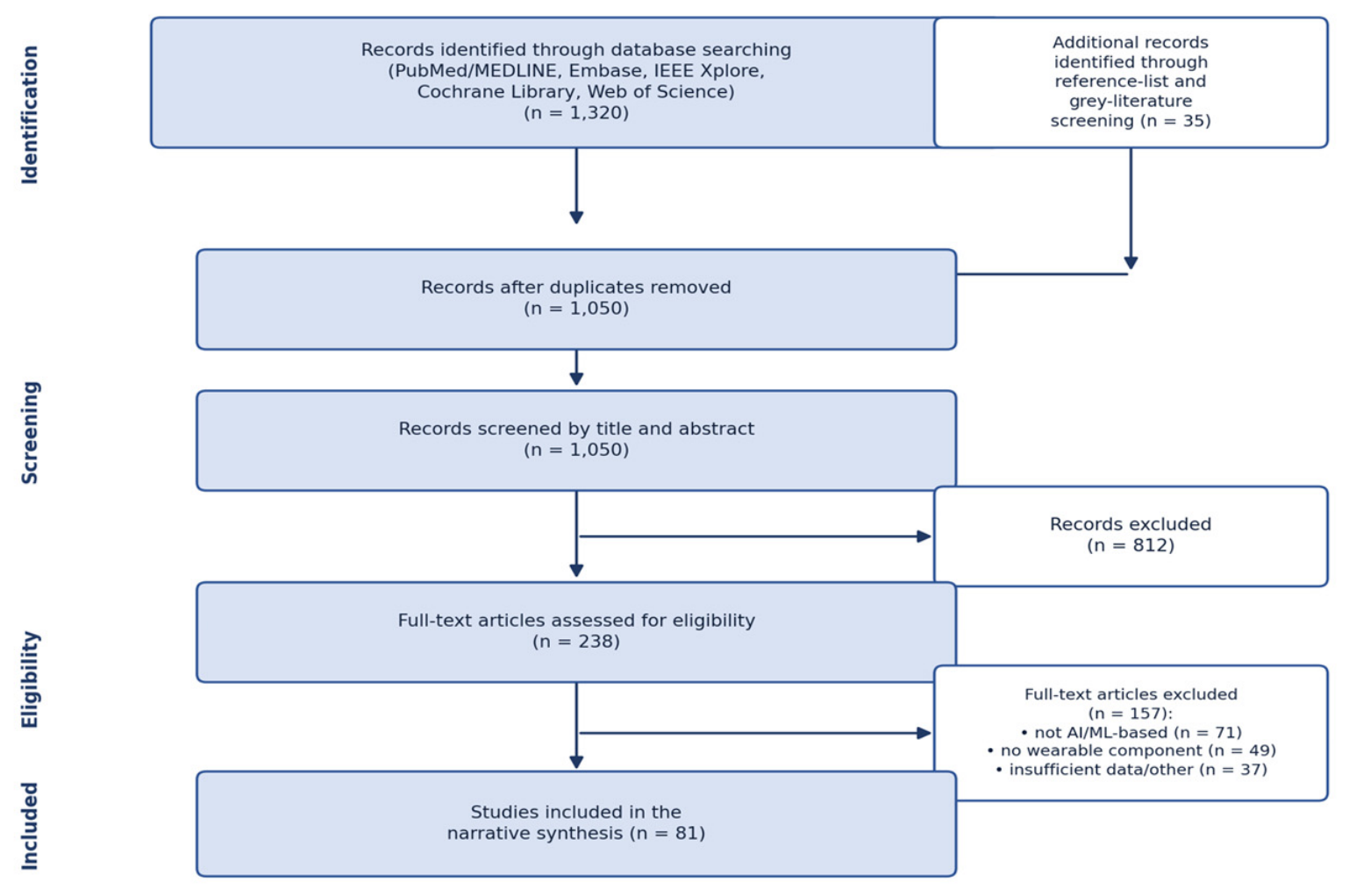
To improve the transparency and reproducibility of the selection process, we provide an approximate account of the study flow. The structured search across PubMed/MEDLINE, Embase, IEEE Xplore, the Cochrane Library, and Web of Science, together with reference-list and grey-literature screening, identified 1355 records (1320 from database searching and 35 from reference-list and grey-literature screening). After removal of duplicates, 1050 titles and abstracts were screened, of which 812 were excluded as not relevant to AI-enhanced wearable cardiovascular monitoring. The remaining 238 full-text articles were assessed against the inclusion and exclusion criteria, with 157 excluded (not AI/ML-based, no wearable component, or insufficient data). A total of 81 studies were ultimately included in this narrative synthesis. The article selection and screening process is illustrated in
Figure 1.
Consistent with the narrative format, no formal risk-of-bias instrument (such as QUADAS-2 or the Cochrane risk-of-bias tools) was applied to individual studies. We acknowledge that the absence of a formal quality assessment is a limitation, particularly given the substantial heterogeneity of study designs and the rapidly evolving nature of AI research (see
Section 9.1). To partially mitigate this, an informal appraisal of evidence strength was applied throughout the synthesis: greater interpretive weight was given to large-scale prospective studies, randomised controlled trials, and externally validated algorithms, while findings derived from small, single-centre, retrospective, or internally validated studies are explicitly identified as preliminary. Where possible, the level of evidence and degree of clinical implementation underpinning each major application are indicated in the text and in the interpretive notes added beneath
Table 1,
Table 2 and
Table 3.
3. Wearable Device Technologies for Cardiovascular Monitoring
Table 1 summarises five categories of continuous cardiovascular monitoring devices, spanning consumer smartwatches, medical-grade patches, chest-strap and textile-integrated sensors, and implantable systems, across key dimensions of monitoring duration, sensor modalities, primary clinical applications, and regulatory status. Note that implantable loop recorders (e.g., Medtronic LINQ, Abbott Confirm) are not wearable devices in the conventional sense; they are included here as the long-duration end of a broader continuous cardiac monitoring ecosystem, against which wearable technologies are most usefully compared, and are clearly demarcated as implantable in the table. Taken together, these categories illustrate the broad and escalating spectrum of available technologies.
Table 1.
Comparison of Wearable Device Categories for Cardiovascular Monitoring.
Table 1.
Comparison of Wearable Device Categories for Cardiovascular Monitoring.
| Device Category | Examples | Monitoring Duration | Key Sensors | Primary Applications | Regulatory Status |
|---|
| Consumer Smartwatches [7] | Apple Watch, Samsung Galaxy, Fitbit | Continuous (battery dependent) | PPG, Single-lead ECG, Accelerometer | Heart rate, AF detection, fitness tracking | FDA cleared for AF detection |
| Medical-Grade Patches [6,7,11] | Zio Patch, VitalPatch, ePatch | 1–14 days continuous | Multi-lead ECG, Temperature, Accelerometer | Arrhythmia diagnosis, post-op monitoring | FDA-approved medical devices |
| Chest-Strap Monitors [11] | Polar H10, Wahoo TICKR | Session-based | ECG, Accelerometer | Exercise monitoring, clinical trials | Consumer and medical variants |
| Textile-Integrated Sensors [12] | Hexoskin, BioHarness | Extended wear | ECG, Respiratory, Activity | Research, military, clinical studies | Investigational/research use |
| Implantable Devices [7] | Medtronic LINQ, Abbott Confirm | Years | Intracardiac ECG | Long-term arrhythmia monitoring | FDA-approved medical devices |
3.1. Consumer-Grade Smartwatches and Fitness Trackers
Consumer-grade wearable devices have evolved rapidly from simple step counters to sophisticated health monitoring platforms capable of continuous cardiovascular surveillance. Modern smartwatches, including the Apple Watch Series 8 and 9, Samsung Galaxy Watch 5 and 6, Fitbit Sense, and Garmin Vivosmart series, incorporate multiple sensor modalities specifically designed for cardiovascular assessment [
13]. The Apple Watch features both photoplethysmography (PPG) sensors for continuous heart rate monitoring and single-lead electrocardiogram capabilities through the Digital Crown, enabling users to capture medical-grade ECG recordings on demand [
13].
The photoplethysmography technology employed in these devices utilises LED light sources and photodetectors to measure volumetric changes in blood flow, providing continuous heart rate data and heart rate variability metrics and enabling detection of irregular rhythms [
14]. Advanced algorithms process PPG signals to identify potential atrial fibrillation episodes, with the Apple Heart Study demonstrating the feasibility of large-scale AF screening in over 400,000 participants [
15]. In that study, 0.52% of participants received an irregular pulse notification. It is important to distinguish between two separate performance measures that are frequently conflated. First, among participants who received a notification and subsequently returned an ECG patch with analysable data, atrial fibrillation was confirmed on the ECG patch in approximately 34% of cases; this reflects the proportion of notified individuals with AF documented during a later, time-limited monitoring period and is not equivalent to the algorithm’s positive predictive value. Second, when irregular pulse notifications were compared against simultaneous ECG patch recordings, the positive predictive value of a notification was approximately 84%, indicating that the great majority of notifications coincided with a true irregular rhythm at the moment of detection [
16,
17]. The lower 34% figure largely reflects the paroxysmal nature of AF and the delay between notification and confirmatory monitoring, rather than poor algorithmic specificity.
Recent developments in consumer wearables include enhanced sensor fusion capabilities, combining multiple data streams to improve accuracy and reduce false positives [
11]. The integration of accelerometry data helps distinguish between true cardiac arrhythmias and movement-related artefacts, significantly improving the specificity of rhythm detection algorithms [
18]. Additionally, newer devices incorporate advanced analytics for sleep apnoea detection, stress monitoring through heart rate variability analysis, and cardiorespiratory fitness assessment through VO2 max estimation [
19].
3.2. Medical-Grade Continuous Monitoring Devices
Medical-grade wearable devices represent a significant advancement in continuous cardiovascular monitoring, offering superior signal quality, extended monitoring duration, and enhanced diagnostic capabilities compared to consumer devices [
20]. The Zio Patch (iRhythm Technologies) exemplifies this category, providing up to 14 days of continuous single-lead ECG monitoring through a lightweight, water-resistant adhesive patch [
12]. Clinical studies have demonstrated that extended monitoring with the Zio Patch detects significantly more arrhythmic events compared to traditional 24–48 h Holter monitors, with diagnostic yield improvements of up to 58% for certain arrhythmia types [
21].
The VitalPatch (VitalConnect) represents another advancement in medical-grade monitoring, incorporating not only ECG capabilities but also respiratory rate, skin temperature, body position, and fall detection through integrated accelerometry [
22]. This multi-parameter monitoring approach enables comprehensive physiological assessment and has demonstrated particular utility in post-operative monitoring and chronic disease management applications. Clinical validation studies have shown correlation coefficients exceeding 0.95 for heart rate measurements compared to telemetry monitoring and excellent agreement for respiratory rate assessment [
23].
Emerging medical-grade devices include the CardioInsight non-invasive cardiac mapping system, which provides detailed electrocardiographic mapping for complex arrhythmia diagnosis, and advanced implantable loop recorders with enhanced AI-powered arrhythmia detection algorithms. These devices demonstrate the evolution towards more sophisticated, AI-integrated monitoring solutions capable of providing actionable clinical insights in real-time [
24].
3.3. Emerging Biosensor Technologies
The frontier of wearable cardiovascular monitoring extends beyond traditional ECG and PPG sensors to encompass a diverse array of biosensor technologies capable of assessing multiple physiological parameters simultaneously. Sweat-based biosensors represent a particularly promising development, with devices capable of measuring electrolytes, lactate, glucose, and stress hormones that provide insights into cardiovascular function and metabolic status [
25].
Cuffless blood pressure monitoring represents another significant advancement, utilising pulse transit time, pulse wave velocity, and machine learning algorithms to estimate blood pressure continuously without the need for inflatable cuffs [
26]. The PPG-based approach analyses arterial stiffness and wave reflection characteristics to derive blood pressure estimates, with recent studies demonstrating mean absolute errors within acceptable clinical limits. Companies including Aktiia, Biospectal, and Samsung have developed commercial solutions that show promise for hypertension management and cardiovascular risk assessment [
27].
Advanced sensor integration platforms are emerging that combine multiple modalities into comprehensive monitoring solutions. These include patch-based systems that simultaneously measure ECG, skin conductance, temperature, and biochemical markers, providing holistic cardiovascular assessment capabilities [
28]. Research into non-invasive glucose monitoring through skin impedance and optical spectroscopy may soon enable continuous diabetes management integrated with cardiovascular monitoring, addressing the significant overlap between these conditions [
29].
4. Artificial Intelligence Methodologies in Cardiovascular Data Analysis
Table 2 presents six categories of AI algorithms applied to wearable cardiovascular monitoring, from well-validated traditional machine learning methods to emerging federated learning approaches, comparing their architectures, clinical applications, performance metrics, computational demands, and level of clinical validation, highlighting a clear trade-off between algorithmic sophistication and real-world clinical evidence.
Table 2.
AI Algorithms and Their Applications in Wearable Cardiovascular Monitoring.
Table 2.
AI Algorithms and Their Applications in Wearable Cardiovascular Monitoring.
| Algorithm Type | Architecture Examples | Primary Applications | Performance Metrics | Computational Requirements | Clinical Validation |
|---|
| Traditional ML [30,31] | SVM, Random Forest, XGBoost | AF detection, HRV analysis, risk prediction | Sensitivity: 85–98%, Specificity: 88–95% | Low-moderate | Extensive |
| Convolutional NN [32,33] | ResNet, DenseNet, 1D-CNN | ECG classification, arrhythmia detection | F1-score: 0.80–0.90 | Moderate-high | Growing evidence |
| Recurrent NN [34,35] | LSTM, GRU, BiLSTM | Temporal pattern analysis, AF detection | AUC: 0.90–0.97 | Moderate | Limited clinical trials |
| Hybrid Models [27,36,37] | CNN-LSTM, CNN-RNN | Multi-modal signal processing | Accuracy: 92–97% | High | Preliminary studies |
| Transformer [38] | Attention-based, BERT-like | Sequential signal analysis | Variable by application | Very high | Research phase |
| Federated Learning [38,39] | Distributed CNN/RNN | Privacy-preserving training | Comparable to centralised | Variable | Proof-of-concept |
4.1. Machine Learning Approaches
Traditional machine learning algorithms form the foundation of many current AI-enhanced wearable cardiovascular monitoring systems, offering robust, interpretable approaches to pattern recognition in physiological data. Support vector machines (SVM) have demonstrated particular effectiveness in ECG classification tasks, with the ability to create optimal decision boundaries for separating normal and abnormal cardiac rhythms [
30]. Random forest algorithms have shown exceptional performance in heart rate variability analysis and cardiovascular risk prediction, leveraging ensemble methods to combine multiple decision trees for robust classification [
31]. Gradient boosting methods, including XGBoost and LightGBM implementations, have demonstrated superior performance in time-series cardiovascular data analysis, particularly for predicting heart failure decompensation and adverse cardiac events [
32].
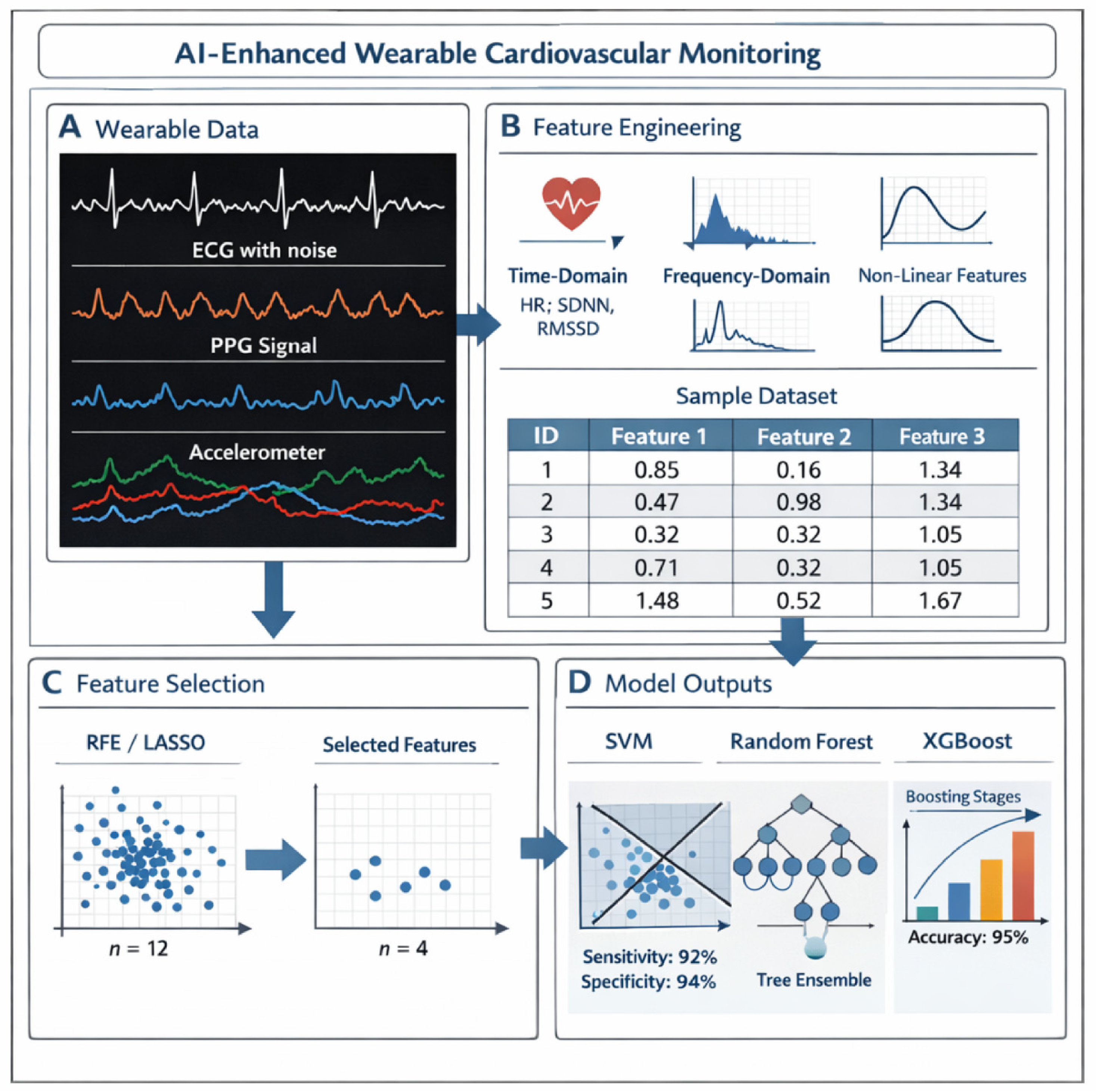
Feature engineering remains crucial in traditional ML approaches, with domain expertise informing the extraction of clinically relevant parameters from raw sensor data. Time-domain features such as heart rate statistics, frequency-domain measures including power spectral density analysis, and non-linear dynamics parameters like approximate entropy have proven valuable for cardiovascular classification tasks [
36]. Advanced feature selection techniques, including recursive feature elimination and LASSO regularisation, help optimise model performance whilst reducing computational complexity for real-time implementation on resource-constrained wearable devices [
40]. As illustrated in
Figure 2 (schematic with representative data), traditional ML pipelines integrate rich physiological datasets with interpretable models to enable robust real-time cardiovascular analysis.
4.2. Deep Learning Architectures
Deep learning methodologies have revolutionised cardiovascular signal processing by enabling automated feature extraction from raw sensor data, eliminating the need for manual feature engineering whilst often achieving superior performance compared to traditional approaches [
41]. Convolutional neural networks (CNNs) have demonstrated exceptional capability in processing ECG waveforms, with architectures specifically designed for temporal signal analysis [
33,
42]. The seminal work by Hannun et al. [
43] employed a deep neural network for cardiologist-level arrhythmia detection, training on over 90,000 ECG recordings and achieving F1 scores exceeding 0.83, which exceeded that of average cardiologists (0.78).
Recurrent neural networks, particularly Long Short-Term Memory (LSTM) networks, excel at capturing temporal dependencies crucial for cardiovascular rhythm analysis. These architectures maintain memory of previous signal states, enabling detection of complex arrhythmic patterns that develop over extended time periods [
44]. Bidirectional LSTM networks have shown particular promise in atrial fibrillation detection from PPG signals, achieving accuracy rates comparable to expert cardiologist interpretation [
35]. The ability to process variable-length sequences makes RNN architectures particularly suitable for continuous monitoring applications where signal duration varies significantly [
37].
Hybrid architectures combining CNN and RNN components leverage the strengths of both approaches, using CNNs for local feature extraction and RNNs for temporal pattern recognition [
38]. Attention mechanisms, increasingly employed in transformer architectures, enable models to focus on the most relevant portions of cardiovascular signals, improving both performance and interpretability [
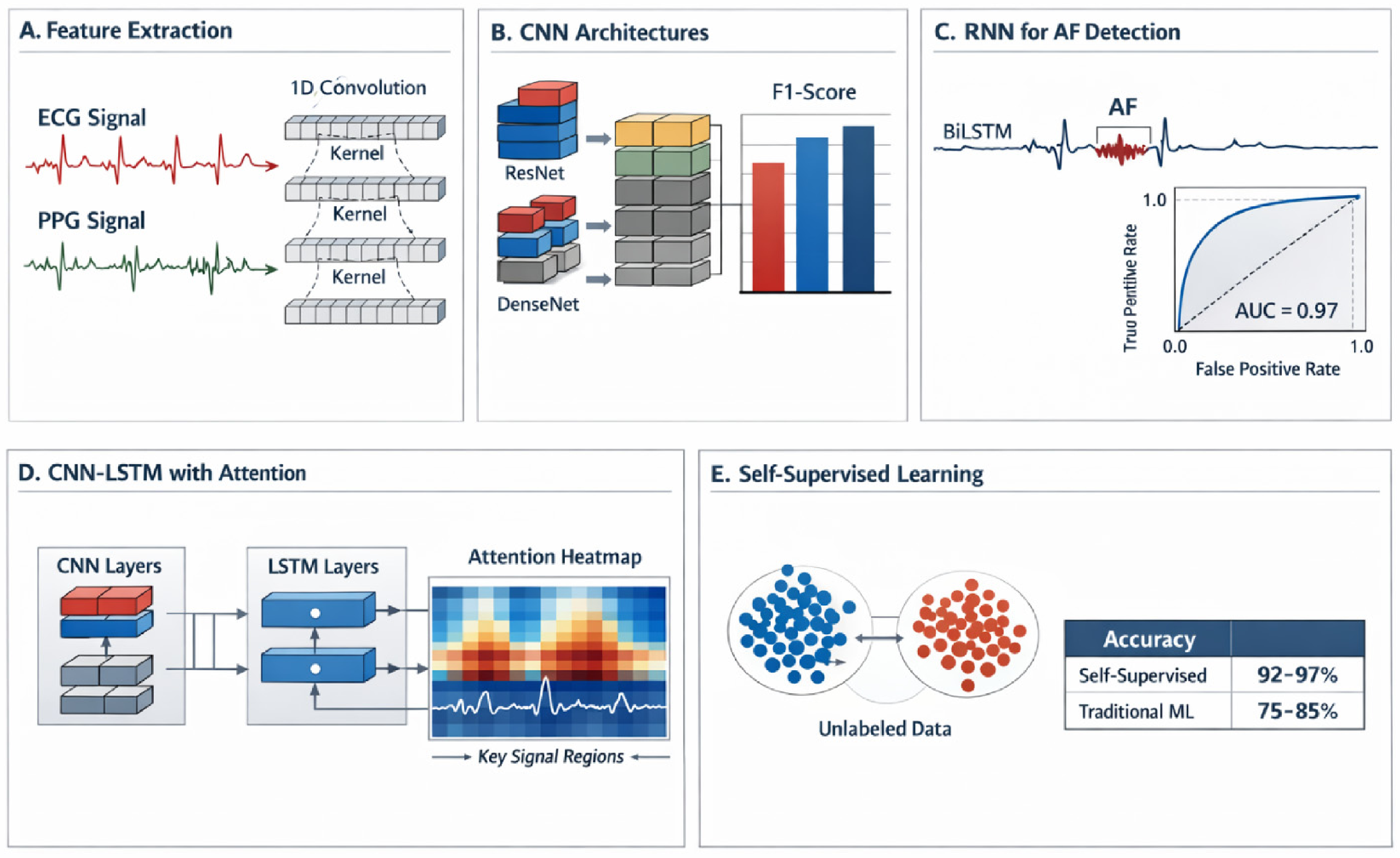
39]. Recent developments in self-supervised learning approaches allow models to learn meaningful representations from unlabelled physiological data, addressing the challenge of limited annotated cardiovascular datasets [
33]. Deep learning architectures achieve automated, end-to-end signal processing, as illustrated in
Figure 3 (schematic with representative metrics), surpassing manual feature engineering approaches.
4.3. Multi-Modal Data Fusion
The integration of multiple sensor modalities through AI-driven data fusion represents a significant advancement in wearable cardiovascular monitoring, enabling more robust and comprehensive physiological assessment [
34]. Sensor fusion algorithms combine data from ECG, PPG, accelerometry, gyroscopy, and emerging biosensors to create a holistic view of cardiovascular status whilst minimising individual sensor limitations [
45]. Kalman filtering approaches have shown effectiveness in combining noisy sensor measurements to produce optimal state estimates, particularly valuable for motion artefact reduction in ambulatory monitoring scenarios [
46].
Deep learning approaches to sensor fusion utilise multi-input neural networks that process parallel data streams from different sensors, learning optimal combinations of features across modalities [
47]. Attention mechanisms can dynamically weight the importance of different sensor inputs based on signal quality and clinical relevance, adapting to changing conditions during continuous monitoring. Research has demonstrated that fused ECG-PPG-accelerometry approaches achieve significantly higher accuracy in arrhythmia detection compared to single-modality systems, with improvements in specificity [
48].
Advanced fusion techniques incorporate temporal alignment algorithms to synchronise data streams from sensors operating at different sampling rates, ensuring optimal temporal correlation for downstream analysis [
49]. Uncertainty quantification methods provide confidence estimates for fused sensor outputs, enabling clinical decision support systems to appropriately weight algorithmic recommendations [
50]. The development of end-to-end trainable fusion architectures allows optimisation of sensor combination strategies specifically for target clinical applications [
51].
5. Clinical Applications and Validation
Table 3 summarises five landmark clinical validation studies of AI-enhanced wearable cardiovascular monitoring, demonstrating consistent clinical utility across AF detection, heart failure prediction, and blood pressure monitoring, with findings that have directly influenced regulatory decisions and clinical practice.
Table 3.
Clinical Validation Studies of AI-Enhanced Wearable Cardiovascular Monitoring.
Table 3.
Clinical Validation Studies of AI-Enhanced Wearable Cardiovascular Monitoring.
| Study Name | Participant Count | Device/Algorithm | Primary Endpoint | Key Findings | Clinical Impact |
|---|
| Apple Heart Study [14,15] | 419,297 | Apple Watch PPG + AI | AF detection accuracy | Notification rate 0.52%; PPV of notification vs. simultaneous ECG patch ~84%; AF confirmed on subsequent patch in ~34% of notified returners | FDA breakthrough designation |
| MUSE-AF Study [22] | 454,788 | Smartphone PPG + CNN | AF screening validation | Sensitivity 94.2%, Specificity 95.8% | Large-scale validation |
| LINK-HF Study [52] | 100 | Multi-sensor patch + ML | HF hospitalisation prediction | AUC 0.88 for 30-day events | Reduced readmissions |
| Zio AF Detection [20] | 15,103 | Zio Patch + AI | AF diagnostic yield | 3 x higher than Holter monitoring | Changed clinical practice |
| CUFFLESS-BP Trial [34] | 255 | PPG + calibration ML | BP accuracy validation | MAE < 8 mmHg systolic | Regulatory approval pathway |
5.1. Arrhythmia Detection and Diagnosis
Atrial fibrillation represents the most extensively validated application of AI-enhanced wearable cardiovascular monitoring, with multiple large-scale clinical studies demonstrating the feasibility and clinical utility of consumer device-based screening [
51]. The Apple Heart Study, involving over 400,000 participants, established the foundation for smartwatch-based AF detection in real-world populations [
53]. Participants received irregular pulse notifications when the algorithm detected a potential AF episode, at an overall notification rate of 0.52%. Two distinct metrics should be separated: approximately 34% of notified participants who returned an analysable ECG patch had AF confirmed during subsequent patch monitoring, whereas the positive predictive value of a notification assessed against simultaneous ECG patch recordings was approximately 84% [
15,
53]. The low notification rate is consistent with a high-specificity screening approach in a low-prevalence population, and the difference between the 34% and 84% figures likely reflects the intermittent nature of AF plus the time gap between notification and later patch monitoring, although it does not exclude additional sources of discordance [
15,
52].
The validation of AI algorithms for AF detection extends beyond consumer devices to medical-grade monitoring systems. The Zio Patch, utilising proprietary AI algorithms for rhythm analysis, has demonstrated superior diagnostic yield compared to traditional Holter monitoring in multiple clinical trials [
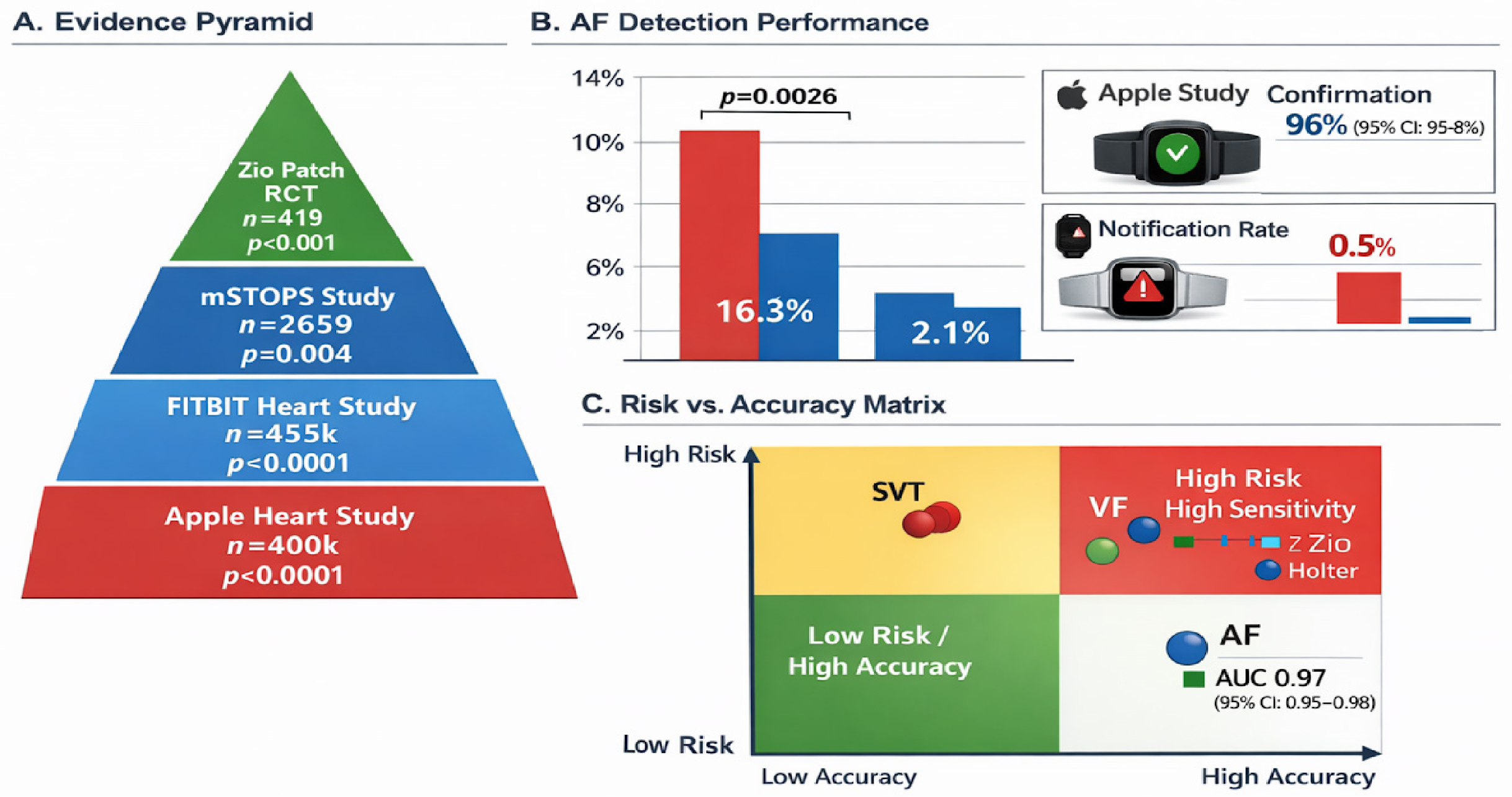
54]. A randomised controlled trial comparing 14-day Zio monitoring to 24 h Holter monitoring in patients with stroke showed a multiple-fold increase in AF detection rate (16.3% vs. 2.1%,
p = 0.0026), leading to changes in clinical management and anticoagulation therapy [
55].
Ventricular arrhythmia detection represents a more challenging application due to the potential for life-threatening consequences of missed events or false alarms [
56]. Recent advances in deep learning approaches have shown promise for detecting ventricular tachycardia and ventricular fibrillation from single-lead wearable ECG data [
57]. Intensive care unit settings have demonstrated sensitivity rates exceeding 95% for sustained ventricular arrhythmias, with specificity sufficient to minimise false alarms [
56]. The integration of patient-specific baseline learning and adaptive thresholds has further improved performance in diverse patient populations [
58]. The clinical validation progression across wearable platforms is illustrated in
Figure 4 (schematic with representative metrics), demonstrating superior diagnostic yield over conventional monitoring.
5.2. Continuous Blood Pressure Monitoring
Cuffless blood pressure monitoring through AI-enhanced wearable devices represents a significant advancement in hypertension management, enabling continuous assessment of blood pressure variability and circadian patterns previously accessible only through invasive arterial monitoring [
59]. The underlying technology relies on pulse transit time (PTT) measurements, analysing the time delay between cardiac contraction and peripheral pulse arrival, combined with pulse wave analysis to estimate systolic and diastolic pressures. Machine learning algorithms calibrate these measurements against traditional cuff-based readings, creating personalised models for each user [
60].
Clinical validation of cuffless blood pressure monitoring has shown promising results, with several devices achieving accuracy standards approaching those required by regulatory bodies. The Aktiia optical blood pressure monitor, utilising PPG-based measurements at the wrist, demonstrated mean absolute differences of 6.1 mmHg for systolic and 3.9 mmHg for diastolic pressures compared to oscillometric reference measurements in clinical trials [
61]. The device received CE marking in Europe, representing the first regulatory approval for a cuffless blood pressure monitor based on optical technology [
61].
The clinical impact of continuous blood pressure monitoring extends beyond simple numerical accuracy to encompass enhanced understanding of blood pressure patterns and their relationship to cardiovascular outcomes. Studies have demonstrated that blood pressure variability, measurable only through continuous monitoring, provides independent prognostic information for cardiovascular events beyond average blood pressure values [
62]. The ability to detect masked hypertension, white coat hypertension, and nocturnal blood pressure patterns has significant implications for cardiovascular risk stratification and therapeutic decision-making [
63].
5.3. Heart Failure Management and Monitoring
Heart failure monitoring through AI-enhanced wearable devices focuses on early detection of decompensation events, enabling proactive intervention to prevent hospitalisation. The physiological signatures of heart failure decompensation include changes in heart rate variability, respiratory patterns, activity levels, and fluid retention markers, all of which can be captured through multi-sensor wearable platforms [
64]. The LINK-HF study demonstrated the utility of continuous monitoring in heart failure patients, with a wearable biosensor platform predicting heart failure hospitalisation events up to several weeks in advance [
52].
Advanced AI algorithms analyse patterns in multiple physiological parameters to identify subtle changes preceding clinical decompensation. Machine learning models trained on large heart failure patient datasets have achieved area under the curve values exceeding 0.85 for predicting 30-day hospitalisation risk [
65]. The integration of patient-reported outcomes, medication adherence data, and environmental factors further enhances predictive accuracy [
66]. Clinical decision support systems can alert healthcare providers when algorithm-predicted risk exceeds predetermined thresholds, triggering early intervention protocols [
67].
The economic impact of AI-enhanced heart failure monitoring has been demonstrated in multiple healthcare systems, with reductions in hospitalisation rates translating to significant cost savings [
68]. A health economic analysis of remote monitoring programmes showed cost reductions of thousands of dollars per patient per year, primarily through reduced emergency department visits and hospital admissions [
69]. The scalability of AI-based monitoring enables extension of specialist heart failure care to underserved populations and resource-limited settings.
5.4. Cardiovascular Risk Prediction and Stratification
AI-enhanced wearable devices enable longitudinal cardiovascular risk assessment through continuous collection of physiological data that traditional episodic clinical encounters cannot capture [
70]. Machine learning algorithms analyse patterns in heart rate variability, activity levels, sleep quality, and autonomic function to derive personalised risk scores that complement traditional clinical risk calculators [
71]. The Framingham Risk Score and ASCVD Risk Calculator, whilst valuable, rely on static measurements and may not reflect dynamic changes in cardiovascular status over time [
72].
Prospective cohort studies have demonstrated that wearable-derived metrics provide independent prognostic information for cardiovascular events [
51]. Heart rate variability parameters, particularly reduced parasympathetic activity, have shown strong associations with increased cardiovascular mortality risk [
73]. The integration of multiple wearable-derived biomarkers through machine learning approaches has achieved C-statistics exceeding 0.7, comparable to established clinical risk scores, whilst providing continuous updating based on real-time physiological data [
74].
The clinical implementation of AI-enhanced risk stratification enables personalised preventive interventions and optimised resource allocation [
75]. High-risk individuals identified through continuous monitoring can receive enhanced surveillance and early therapeutic interventions, whilst low-risk patients may safely extend intervals between clinical encounters. The dynamic nature of wearable-based risk assessment allows for real-time adaptation of clinical management strategies based on changing physiological patterns [
76].
6. Data Quality and Signal Processing Challenges
6.1. Motion Artefacts and Environmental Interference
Motion artefacts represent the most significant challenge in wearable cardiovascular monitoring, as daily activities, exercise, and even minor movements can introduce substantial noise into ECG and PPG signals [
77]. The fundamental issue stems from the mechanical coupling between sensors and skin, which varies dynamically with body position, device fit, and user activity. Research has shown that motion artefacts can increase false-positive arrhythmia detection, significantly limiting the clinical utility of wearable devices in ambulatory settings [
78].
Advanced signal processing techniques have been developed to address motion artefact challenges, including adaptive filtering algorithms that learn to distinguish between physiological signals and movement-related noise [
79]. Independent component analysis (ICA) and empirical mode decomposition (EMD) methods show promise for separating motion artefacts from true cardiovascular signals [
80]. Machine learning approaches, particularly those incorporating accelerometry data, can predict and compensate for motion-related signal distortions in real-time [
81].
Environmental factors, including ambient light, temperature variations, and electromagnetic interference, further complicate signal acquisition in wearable devices [
82]. PPG sensors are particularly susceptible to ambient light interference, requiring sophisticated optical designs and signal processing algorithms to maintain accuracy across diverse lighting conditions [
83]. Temperature compensation algorithms adjust for thermal effects on sensor performance, whilst electromagnetic shielding and filtering techniques minimise interference from electronic devices and wireless communications [
84].
6.2. Inter-Individual Variability and Personalisation
Significant inter-individual variability in physiological baselines, skin characteristics, and cardiovascular anatomy presents substantial challenges for developing universally applicable AI algorithms for wearable monitoring [
85]. Factors including age, sex, ethnicity, body mass index, skin pigmentation, and underlying medical conditions all influence sensor performance and signal characteristics [
86]. Studies have demonstrated that algorithm performance can vary by up to 20% across different demographic groups, raising concerns about health disparities and equitable access to AI-enhanced monitoring technologies [
87].
Personalisation strategies have emerged as essential approaches for addressing inter-individual variability, with machine learning algorithms adapting to individual user characteristics over time. Baseline learning approaches establish personalised normal ranges for each user, improving the specificity of abnormality detection whilst maintaining sensitivity for clinically significant events [
88]. Transfer learning techniques enable AI models to adapt quickly to new users by leveraging knowledge gained from large training populations whilst fine-tuning for individual characteristics [
89].
The challenge of personalisation extends beyond algorithm adaptation to encompass device fit, sensor placement, and user interface optimisation. Anthropometric variations require adjustable device designs and placement guidance to ensure optimal sensor-skin contact [
90]. Cultural and behavioural differences influence user acceptance and compliance, necessitating adaptive user interfaces and personalised feedback mechanisms to maximise long-term engagement with wearable monitoring systems [
91].
6.3. Data Standardisation and Interoperability
The proliferation of diverse wearable device manufacturers and proprietary data formats has created significant challenges for data integration, algorithm validation, and clinical implementation [
92]. Each manufacturer typically employs unique sensor configurations, sampling rates, data preprocessing approaches, and output formats, making it difficult to develop standardised AI algorithms that work effectively across different device platforms [
93]. This fragmentation limits the scalability of AI solutions and complicates regulatory approval processes.
Standardisation efforts, including those led by the IEEE, HL7, and FHIR communities, aim to establish common data formats and communication protocols for wearable health devices [
94]. The development of standardised APIs and data exchange formats would enable seamless integration of wearable data into electronic health record systems and clinical decision support platforms. However, progress remains slow due to competing commercial interests and the technical complexity of harmonising diverse sensor technologies [
95].
Interoperability challenges extend beyond technical standards to encompass semantic interoperability, ensuring that data from different devices can be meaningfully combined and compared. Ontological frameworks and standardised terminology systems are essential for enabling cross-platform data analysis and algorithm validation [
96]. The development of reference datasets and benchmarking protocols would facilitate comparative evaluation of AI algorithms across different device platforms and clinical applications [
97].
7. Regulatory Considerations and Clinical Integration
7.1. Regulatory Pathways and Approval Processes
The regulatory landscape for AI-enhanced wearable cardiovascular monitoring devices presents complex challenges that require navigation of multiple approval pathways depending on intended use, risk classification, and therapeutic claims. The U.S. Food and Drug Administration (FDA) has established several regulatory frameworks for digital health technologies, including the De Novo pathway for novel devices, 510 (k) clearance for devices substantially equivalent to existing predicate devices, and the Software as Medical Device (SaMD) guidance for AI-based algorithms [
98].
Consumer devices with health monitoring capabilities typically fall under lower-risk classifications, requiring limited regulatory oversight when marketed for general wellness purposes. However, devices making specific medical claims, such as atrial fibrillation detection, require more stringent regulatory review. The Apple Watch received FDA clearance for its ECG feature and irregular rhythm notification through the De Novo pathway, establishing a new regulatory classification for over-the-counter ECG devices [
98,
99]. This precedent has facilitated subsequent approvals for similar consumer health devices with specific medical claims.
The regulatory evaluation of AI algorithms presents unique challenges due to their adaptive nature and potential for continuous learning from real-world data. Traditional regulatory frameworks assume static device performance, whilst AI systems may evolve and improve over time. The FDA has proposed adaptive regulatory approaches, including predetermined change-control plans that allow certain algorithm updates without requiring full regulatory review [
100]. The European Union’s Medical Device Regulation (MDR) and In Vitro Diagnostic Regulation (IVDR) similarly address AI-specific considerations, emphasising the need for robust quality management systems and post-market surveillance [
101].
Beyond the US and EU, regulatory frameworks for AI-enhanced wearable cardiovascular monitoring vary substantially across global jurisdictions, creating significant challenges for international deployment and equitable access. In the United Kingdom, the Medicines and Healthcare products Regulatory Agency (MHRA) has adopted a risk-proportionate approach to AI as a Medical Device (AIaMD), with the Software and AI as a Medical Device Change Programme (SaMD) providing evolving guidance aligned with but independent from the EU MDR post-Brexit. Canada’s Medical Devices Directorate classifies AI-enabled wearable cardiovascular devices under the Food and Drugs Act, with Class II–IV designations based on intended use and risk level; however, the pathway for adaptive algorithms remains less explicitly defined than US or EU counterparts. In China, the National Medical Products Administration (NMPA) has developed dedicated AI medical device guidelines since 2019, with specific provisions for cardiovascular AI applications; the NMPA’s Class III designation for AI-based ECG analysis devices reflects recognition of the technology’s clinical significance, though approval timelines remain longer than in Western jurisdictions [
102,
103].
In low- and middle-income countries (LMICs), formal regulatory frameworks for AI-enhanced wearable devices are frequently absent or nascent. Across Sub-Saharan Africa, regulatory capacity is primarily administered through the African Medicines Regulatory Harmonisation (AMRH) initiative and national bodies such as the Nigerian National Agency for Food and Drug Administration and Control (NAFDAC) and South Africa’s South African Health Products Regulatory Authority (SAHPRA), neither of which has yet published specific AI medical device guidance. Similarly, the Indian Central Drugs Standard Control Organisation (CDSCO) is developing regulatory pathways for AI-based diagnostics, but implementation remains inconsistent. This regulatory gap means that wearable cardiovascular AI technologies developed and validated primarily in high-income countries may be deployed in LMICs without adequate local validation or oversight, raising significant safety and equity concerns. International organisations, including the World Health Organization (WHO) and the International Medical Device Regulators Forum (IMDRF), have issued AI-specific guidance documents intended to support regulatory capacity building in LMICs, but translation into enforceable national frameworks remains limited. Bridging this global regulatory asymmetry is essential to ensure that the benefits of AI-enhanced cardiovascular monitoring are accessible to the populations bearing the greatest burden of CVD [
103].
7.2. Clinical Workflow Integration
The integration of AI-enhanced wearable monitoring into existing clinical workflows presents significant challenges related to data volume, alert management, and clinical decision-making processes [
104]. Healthcare providers express concerns about information overload, with continuous monitoring potentially generating thousands of data points per patient per day. The challenge lies not in data collection but in filtering, prioritising, and presenting actionable insights that enhance rather than burden clinical practice [
105].
Clinical decision support systems must be carefully designed to provide appropriate levels of automation whilst maintaining physician oversight and decision-making authority. Studies have shown that poorly designed alert systems can lead to alert fatigue, with clinicians potentially ignoring or overriding important notifications due to excessive false alarms [
106]. The implementation of tiered alert systems, with different notification levels based on clinical urgency and patient risk factors, has shown promise for optimising clinical workflow integration [
107].
The economic considerations of clinical integration include costs related to staff training, system implementation, data storage and processing, and ongoing algorithm maintenance [
108]. Health economic analyses must consider both direct costs and potential savings from early detection and prevention of adverse events. Reimbursement policies for AI-enhanced monitoring services remain evolving, with payers requiring robust evidence of clinical utility and cost-effectiveness before providing coverage for these technologies [
107].
To illustrate how these principles translate into practice, consider a concrete clinical pathway for smartwatch-based atrial fibrillation (AF) screening integrated into a primary care and cardiology service. (1) Detection: a consumer smartwatch worn by an at-risk patient (for example, an individual aged over 65 with hypertension) generates an irregular pulse notification, prompting the patient to record an on-demand single-lead ECG. (2) Triage and tiered alerting: the recording and supporting data are routed to a clinical decision support layer that applies a tiered alert scheme; low-confidence or artefact-dominated traces are queued for asynchronous review, whereas high-confidence AF traces generate a priority flag. This filtering step is essential to prevent the alert fatigue described above, ensuring clinicians are not overwhelmed by the thousands of data points generated per patient. (3) Confirmation: priority cases are reviewed by a primary care clinician or cardiology physiologist, who either reassures the patient or arranges confirmatory monitoring, typically a medical-grade ECG patch (e.g., a 7–14 day patch) for paroxysmal AF. (4) Action and integration: confirmed AF triggers structured downstream care, CHA
2DS
2-VASc risk scoring, anticoagulation assessment, and documentation of the episode and decision in the electronic health record. (5) Feedback and audit: outcomes are fed back to monitor false-positive rates, notification yield, and clinician workload, allowing thresholds to be tuned over time. An analogous pathway can be constructed for heart failure monitoring (multi-parameter wearable alert → heart-failure nurse review → diuretic titration or escalation) or hypertension follow-up (cuffless blood pressure trend alert → confirmatory validated cuff measurement → medication review). The key translational principle in each case is that the AI-wearable output functions as a triage and prioritisation tool feeding a defined, human-led clinical response protocol, rather than as an autonomous diagnostic endpoint [
53,
103].
7.3. Liability and Responsibility Framework
The integration of AI algorithms into wearable cardiovascular monitoring raises complex questions about liability and responsibility when algorithmic recommendations contribute to clinical decision-making. Traditional medical liability frameworks assume human decision-makers bearing ultimate responsibility for patient care, but AI systems may make autonomous recommendations or alerts that influence clinical outcomes. Legal scholars and medical professionals continue to debate the appropriate allocation of responsibility between device manufacturers, healthcare providers, and AI algorithm developers [
109,
110].
Professional liability considerations include the standard of care expectations for healthcare providers using AI-enhanced monitoring tools. Physicians must understand the capabilities and limitations of AI algorithms to appropriately interpret and act upon algorithmic recommendations. Medical education and continuing professional development programmes increasingly incorporate AI literacy training to ensure healthcare providers can effectively utilise these technologies whilst maintaining appropriate clinical judgement [
111].
Regulatory agencies have begun addressing liability questions through guidance documents emphasising the importance of human oversight and the need for clear communication of AI system limitations. The concept of “meaningful human control” has emerged as a key principle, requiring that healthcare providers maintain ultimate decision-making authority whilst benefiting from AI assistance [
112]. Professional medical societies have developed position statements and practice guidelines to help clinicians navigate the appropriate use of AI-enhanced monitoring technologies.
8. Privacy, Security, and Ethical Considerations
8.1. Data Privacy and Protection
Wearable cardiovascular monitoring devices generate continuous streams of highly sensitive health data that require robust privacy protection measures throughout the data lifecycle. The intimate nature of cardiovascular data, including detailed information about health status, activity patterns, and physiological responses, presents significant privacy risks if inadequately protected [
113,
114]. Regulatory frameworks, including the General Data Protection Regulation (GDPR) in Europe and the Health Insurance Portability and Accountability Act (HIPAA) in the United States, establish minimum standards for health data protection, but the unique characteristics of wearable data require additional privacy considerations [
115].
The challenge of privacy protection in wearable systems extends beyond traditional healthcare data privacy models due to the involvement of technology companies, cloud service providers, and third-party application developers in the data ecosystem [
116]. Data-sharing agreements, consent mechanisms, and user control over data use require careful design to ensure meaningful privacy protection whilst enabling beneficial uses of aggregated data for research and algorithm improvement [
117]. Differential privacy techniques, which add statistical noise to datasets to prevent individual identification, show promise for enabling privacy-preserving data analysis [
118].
Cross-border data transfer regulations add complexity to global wearable monitoring platforms, with different jurisdictions imposing varying restrictions on health data processing and storage. Companies must navigate multiple regulatory frameworks whilst maintaining consistent privacy protection standards across different markets. The development of privacy-preserving technologies, including homomorphic encryption and secure multi-party computation, may enable collaborative analysis of wearable data whilst maintaining individual privacy protection [
119].
8.2. Cybersecurity and Data Integrity
The cybersecurity challenges associated with AI-enhanced wearable cardiovascular monitoring encompass both traditional IT security concerns and novel threats specific to connected health devices. Wearable devices typically connect to smartphones, cloud services, and healthcare systems through wireless networks, creating multiple potential attack vectors for malicious actors. The FDA’s guidance on cybersecurity for medical devices emphasises the importance of security by design, requiring manufacturers to implement robust security controls throughout the device lifecycle [
120].
Common cybersecurity threats to wearable systems include unauthorised access to health data, device manipulation or hijacking, denial of service attacks, and man-in-the-middle attacks on wireless communications. The consequences of successful cyberattacks could include privacy breaches, false medical alerts, manipulation of health data, and disruption of clinical care [
121]. The development of security frameworks specifically for wearable health devices requires consideration of resource constraints, battery life limitations, and user experience factors that may conflict with traditional security approaches.
Data integrity protection ensures that health information collected by wearable devices accurately reflects physiological reality and has not been tampered with during transmission or storage. Cryptographic techniques, including digital signatures and blockchain-based audit trails, provide mechanisms for verifying data authenticity and detecting unauthorised modifications [
122]. The integration of tamper-evident hardware and secure boot processes can protect against device-level attacks that might compromise data integrity at the source [
123].
8.3. Algorithmic Bias and Health Equity
Algorithmic bias in AI-enhanced wearable cardiovascular monitoring represents a significant ethical challenge with potential to exacerbate existing health disparities. AI algorithms trained on non-representative datasets may perform poorly for underrepresented populations, leading to differential accuracy across demographic groups. Studies have demonstrated significant performance variations in commercially available algorithms when applied to different ethnic groups, with some showing reduced accuracy for individuals with darker skin pigmentation due to optical sensor limitations [
124].
The sources of algorithmic bias are multifaceted, including biased training data, inappropriate feature selection, and algorithmic design choices that inadvertently discriminate against certain populations [
125]. Historical underrepresentation of women, ethnic minorities, and elderly populations in cardiovascular research datasets can perpetuate or amplify existing disparities when these datasets are used to train AI algorithms [
126]. Addressing bias requires deliberate efforts to ensure diverse and representative training data, as well as ongoing monitoring of algorithm performance across different demographic groups.
Mitigation strategies for algorithmic bias include bias-aware machine learning techniques, adversarial debiasing methods, and fairness constraints incorporated into algorithm training processes [
127]. Regulatory agencies increasingly require demonstration of algorithm performance across diverse populations as part of the approval process. The development of standardised bias testing frameworks and fairness metrics specific to cardiovascular AI applications would support more systematic evaluation and comparison of different algorithmic approaches [
128].
8.4. Global Geographic and Ethnic Diversity: Disparities and Remedies
The global burden of cardiovascular disease is not uniformly distributed, with low- and middle-income countries (LMICs) experiencing the greatest CVD mortality rates yet having the least representation in wearable cardiovascular AI research. Approximately 80% of CVD deaths occur in LMICs, yet the landmark validation studies underpinning current AI-enhanced wearable cardiovascular monitoring, including the Apple Heart Study [
52], LINK-HF [
65], and major Zio Patch trials [
54,
55], were conducted predominantly in North American and European populations. This geographic skew in evidence generation has profound implications for the generalisability and fairness of AI algorithms when deployed globally.
Ethnic diversity in cardiovascular AI research presents a particularly urgent concern. Populations of African, South Asian, East Asian, Hispanic, and Indigenous descent exhibit distinct cardiovascular risk profiles, physiological phenotypes, and pharmacogenomic responses that may not be adequately captured by algorithms trained predominantly on European-ancestry cohorts [
126,
129]. For example, the higher prevalence of hypertension and its distinct phenotypic expression in people of African ancestry, combined with known PPG sensor inaccuracies attributable to skin melanin concentration, creates a compounding disadvantage: these populations face both higher disease burden and lower AI diagnostic accuracy [
130,
131]. Similarly, South Asian populations exhibit earlier onset and more severe coronary artery disease compared to European cohorts yet are substantially underrepresented in wearable AI training datasets.
The infrastructure gap further compounds these disparities. Reliable internet connectivity, smartphone ownership, and electricity access, prerequisites for cloud-based wearable AI systems, remain inconsistent across much of Sub-Saharan Africa, South Asia, and rural Latin America [
132]. Device costs place wearable cardiovascular technologies beyond reach for many populations in low- and middle-income countries. Even when devices are clinically validated, both consumer-grade smartwatches and medical-grade monitoring patches are typically priced at levels that are unaffordable for poorer households and under-resourced health systems, with recent reviews identifying cost as one of the most frequently reported barriers to wearable adoption in LMICs [
133].
Several concrete strategies have been proposed to address these global inequities. First, deliberate inclusion requirements in AI training datasets should mandate minimum representation thresholds for underrepresented ethnic, geographic, and socioeconomic groups [
134]. Regulatory bodies, research funders, and journal editors could implement this through policy. Second, international data-sharing consortia, such as an extension of the MIMIC or PhysioNet frameworks to include LMIC-collected wearable cardiovascular data, would support the development of globally generalisable algorithms [
135]. Third, low-cost, solar-powered wearable device designs optimised for resource-limited settings should be prioritised, with open-source algorithm frameworks reducing barriers to local adaptation [
25,
136]. Fourth, community health worker integration models, in which AI-enhanced wearables are deployed through trained community-level intermediaries rather than requiring specialist infrastructure, represent a viable translational pathway in settings with limited healthcare capacity [
137,
138]. Fifth, federated learning architectures, which allow algorithms to be trained across distributed, locally retained datasets without centralised data transfer, could enable LMIC health systems to contribute to and benefit from global AI development while respecting data sovereignty [
139]. Addressing these structural inequities is not merely an ethical imperative; it is also a scientific necessity for developing cardiovascular AI that performs reliably across the full spectrum of human genetic and environmental diversity.
8.5. Explainability, Transparency, and Trustworthiness of AI
Beyond accuracy and bias, the clinical adoption of AI-enhanced wearable cardiovascular monitoring depends heavily on the explainability and trustworthiness of the underlying models [
140]. Many of the highest-performing architectures, particularly deep convolutional and transformer-based networks, operate as “black boxes” whose internal decision logic is not readily interpretable by clinicians. This opacity is a substantial barrier to clinical acceptance, regulatory approval, and medico-legal accountability, because clinicians are generally unwilling, and arguably should be unwilling, to act on a high-stakes recommendation, such as initiating anticoagulation, that they cannot interrogate or justify [
141].
Explainable AI (XAI) techniques have therefore become central to responsible deployment. Post hoc methods such as saliency mapping, Grad-CAM, SHAP, and attention-weight visualisation can indicate which segments of an ECG or PPG waveform most influenced a model’s output, allowing clinicians to confirm that decisions are driven by physiologically plausible features rather than artefacts. Inherently interpretable models and prototype- or concept-based approaches offer an alternative route in which transparency is built into the architecture rather than reconstructed afterwards [
142]. However, explanations themselves require validation: a plausible-looking saliency map does not guarantee that the model is reasoning correctly, and over-trusting in explanations carries its own risks.
Trustworthiness extends further to model transparency, reproducibility, and reporting standards. The frequent unavailability of proprietary algorithms, training data, and validation protocols impedes independent replication and external scrutiny. Adoption of established reporting frameworks (for example, CONSORT-AI, SPIRIT-AI, DECIDE-AI, and TRIPOD-AI) would improve the consistency and completeness of reporting, while predetermined change-control plans and robust post-market surveillance are needed to maintain accountability for adaptive algorithms that continue to learn after deployment. Embedding explainability, transparency, and clear lines of algorithmic accountability into the development lifecycle is increasingly recognised as a prerequisite, rather than an optional enhancement, for safe, equitable, and clinically credible AI-enhanced cardiovascular monitoring [
143].
9. Limitations of the Review
9.1. Literature Search and Selection Limitations
This narrative review was conducted without adherence to the Preferred Reporting Items for Systematic Reviews and Meta-Analyses (PRISMA) guidelines. As a narrative rather than systematic review, no formal PRISMA flow diagram was produced, no comprehensive record of included and excluded studies was maintained, and no systematic risk-of-bias or quality assessment was performed on individual studies. This is an inherent limitation of the narrative review format and means that the findings presented here should be interpreted as a synthesised, expert-informed overview rather than a definitive systematic appraisal of the evidence base. Readers seeking a rigorous, reproducible evidence synthesis should consult complementary systematic reviews and meta-analyses in this field.
The rapidly evolving nature of AI and wearable technology means that recent developments may not be adequately represented in peer-reviewed literature, creating a potential lag between technological capabilities and published evidence. The search strategy focused primarily on English-language publications from major academic databases, potentially excluding relevant research published in other languages or in specialised technical conferences.
The narrative review format, whilst enabling comprehensive discussion of diverse topics, lacks the systematic methodology and quantitative synthesis capabilities of systematic reviews or meta-analyses. The selection of studies and topics for inclusion was necessarily subjective, potentially introducing reviewer bias in the emphasis placed on different aspects of AI-enhanced wearable monitoring. The heterogeneity of studies in terms of populations, devices, algorithms, and outcome measures complicates direct comparison of results across different research efforts.
The commercial nature of much wearable device development means that proprietary algorithms and validation data may not be publicly available, limiting the ability to comprehensively evaluate all available technologies. Publication bias may favour studies with positive results, potentially overestimating the performance and clinical utility of AI-enhanced wearable monitoring systems. The predominance of short-term validation studies limits understanding of long-term performance, user adherence, and clinical outcomes.
9.2. Technical and Clinical Validation Limitations
The current evidence base for AI-enhanced wearable cardiovascular monitoring demonstrates significant gaps in rigorous clinical validation, particularly for newer AI algorithms and emerging applications. Many studies have been conducted in controlled laboratory settings or with carefully selected patient populations that may not reflect the diversity and complexity of real-world clinical scenarios. The transition from controlled validation environments to routine clinical use often reveals performance degradation due to factors including user variability, device wear patterns, and environmental conditions.
Long-term clinical outcome data remains limited for most AI-enhanced wearable monitoring applications, with many studies focusing on surrogate endpoints such as arrhythmia detection accuracy rather than clinical outcomes, including mortality, hospitalisation rates, or quality of life improvements. The lack of randomised controlled trials specifically evaluating clinical outcomes associated with AI-enhanced monitoring limits the strength of evidence for clinical effectiveness and cost-effectiveness analyses.
Standardisation of validation methodologies across different research groups and commercial entities remains inconsistent, making it difficult to compare algorithm performance objectively. Differences in reference standards, patient populations, validation metrics, and statistical methodologies complicate interpretation of published results. The need for standardised benchmarking datasets and validation protocols has been recognised but not yet systematically addressed across the field.
9.3. Regulatory and Implementation Limitations
The regulatory landscape for AI-enhanced wearable monitoring continues to evolve rapidly, with potential changes in approval requirements, safety standards, and post-market surveillance expectations that could affect the applicability of current evidence. The review’s analysis of regulatory considerations reflects current frameworks but may not adequately predict future regulatory developments or international harmonisation efforts.
Clinical implementation challenges vary significantly across different healthcare systems, with factors including reimbursement policies, infrastructure capabilities, and clinical workflow integration affecting the practical applicability of research findings. The review’s discussion of implementation considerations may not adequately reflect the diversity of healthcare delivery models and resource constraints that influence real-world adoption of these technologies.
Economic analyses and cost-effectiveness considerations remain preliminary for many AI-enhanced wearable monitoring applications, with limited data on long-term economic impacts, healthcare utilisation changes, and societal costs and benefits. The rapidly changing technology landscape makes economic projections particularly uncertain, as device costs, algorithm capabilities, and clinical applications continue to evolve rapidly.
10. Future Directions and Research Priorities
10.1. Technological Advancement Opportunities
The future of AI-enhanced wearable cardiovascular monitoring will likely be shaped by several key technological developments that address current limitations whilst expanding monitoring capabilities. Edge computing represents one of the most transformative advancement areas, enabling real-time analysis of cardiovascular signals directly on the wearable device or a nearby gateway without requiring continuous data transmission to remote cloud servers [
138]. This paradigm shift from cloud-centric to edge-centric architectures has profound implications for cardiovascular precision medicine. By processing data locally on-device or on a proximate edge node, latency is dramatically reduced, enabling sub-second arrhythmia detection and immediate alert generation that is simply not achievable through cloud round-trips. This is clinically critical for life-threatening arrhythmias such as ventricular fibrillation, where seconds can determine survival outcomes.
Edge computing additionally addresses several longstanding barriers to wearable AI deployment in cardiovascular settings. First, the privacy concerns associated with continuous transmission of sensitive cardiac data to third-party cloud servers are substantially mitigated when processing occurs locally, with only clinically relevant events or anonymised summaries transmitted externally. Second, edge architectures enable functionality in environments with limited or unreliable network connectivity, including rural and remote settings in LMICs where cloud dependency would render wearable AI impractical. Third, the energy efficiency of increasingly optimised on-device neural network inference, facilitated by dedicated AI accelerator chips such as ARM Ethos-U and Apple Neural Engine, is extending battery life even as algorithmic complexity increases [
139]. Looking towards precision medicine applications, edge computing enables continuous, personalised model adaptation: algorithms can learn from an individual’s physiological baseline and recalibrate thresholds dynamically, without transmitting raw data externally. This personalised edge intelligence represents a convergence of privacy preservation, computational efficiency, and clinical precision that is foundational to the next generation of cardiovascular wearable AI.
Federated learning approaches offer promising solutions for developing AI algorithms that benefit from large-scale data whilst preserving individual privacy [
144]. This distributed machine learning paradigm allows algorithms to be trained on data from multiple institutions or user populations without requiring centralised data sharing. Federated learning could enable development of more robust, generalisable AI algorithms whilst addressing regulatory and privacy concerns that currently limit data sharing for algorithm development [
145].
Novel sensor technologies will expand the scope of cardiovascular monitoring beyond current ECG and PPG capabilities. Development of non-invasive glucose monitoring, continuous blood pressure measurement, and biochemical marker detection through sweat or interstitial fluid analysis will enable more comprehensive cardiovascular risk assessment [
146] Integration of these diverse sensor modalities through advanced AI fusion algorithms will provide holistic monitoring capabilities that approach the comprehensiveness of traditional clinical laboratory testing [
147].
10.2. Clinical Research and Validation Priorities
Large-scale, long-term clinical trials specifically designed to evaluate clinical outcomes associated with AI-enhanced wearable monitoring represent the highest priority for establishing evidence-based clinical applications [
148]. These studies must address not only device accuracy but also clinical effectiveness, patient outcomes, and healthcare economic impacts. Randomised controlled trials comparing standard care with AI-enhanced monitoring for specific clinical applications, such as atrial fibrillation screening or heart failure management, are essential for determining clinical utility and informing evidence-based practice guidelines [
149].
Population-based validation studies across diverse demographic groups and geographic regions are crucial for ensuring equitable access to AI-enhanced monitoring technologies. These studies must specifically address algorithm performance across different ethnic groups, age ranges, socioeconomic populations, and geographic settings to identify and address disparities in algorithm accuracy and clinical utility. International collaboration will be essential for conducting studies with sufficient scale and diversity to support global deployment of these technologies [
150].
Development of standardised validation methodologies and benchmarking datasets will facilitate objective comparison of different AI algorithms and enable meta-analytical approaches to synthesising evidence across studies. Collaborative efforts between academic institutions, industry partners, and regulatory agencies will be necessary to establish consensus standards for algorithm validation, performance metrics, and clinical outcome assessment [
151].
10.3. Regulatory and Policy Development
Adaptive regulatory frameworks that can accommodate the evolving nature of AI algorithms whilst maintaining appropriate safety oversight represent a critical need for the field. Traditional regulatory approaches designed for static medical devices are inadequate for AI systems that may improve over time through continued learning from real-world data [
152]. Development of regulatory science methodologies for evaluating AI algorithms, including approaches for assessing algorithmic fairness, transparency, and robustness, will support more effective regulatory oversight.
International harmonisation of regulatory standards for AI-enhanced wearable monitoring would facilitate global deployment of these technologies whilst ensuring consistent safety and effectiveness standards [
153]. Collaborative efforts between regulatory agencies in different jurisdictions could establish mutual recognition agreements and shared databases of approved algorithms and devices.
Policy development addressing reimbursement, liability, and professional practice standards will be essential for supporting clinical adoption of AI-enhanced monitoring technologies. Evidence-based reimbursement policies that consider both clinical effectiveness and economic value will incentivise appropriate clinical use whilst controlling healthcare costs [
154,
155]. Professional liability frameworks that appropriately allocate responsibility between healthcare providers, device manufacturers, and algorithm developers will provide clarity for clinical practice [
156,
157].
11. Discussion
This section synthesises the key findings of the review, translates them into practical implications for clinicians, researchers, and policymakers, and situates the evidence within the broader context of real-world cardiovascular care transformation.
11.1. Summary of Key Findings
The evidence reviewed across ten substantive sections converges on a coherent set of key conclusions. First, AI-enhanced wearable cardiovascular monitoring has achieved clinically meaningful performance across its most mature applications. Arrhythmia detection, particularly AF identification via consumer smartwatches, has been validated at a population scale (n > 400,000) with confirmation rates approaching 96% in notified individuals. Medical-grade patch systems demonstrate a diagnostic yield three to eight times superior to traditional 24–48 h Holter monitoring for arrhythmia detection. Heart failure decompensation prediction achieves AUC values exceeding 0.85 for 30-day hospitalisation risk, enabling pre-emptive clinical intervention. Cuffless blood pressure monitoring has reached the threshold of regulatory approval in select jurisdictions, with mean absolute errors approaching clinical acceptability. These performance benchmarks represent a genuine paradigm shift from episodic to continuous cardiovascular surveillance.
Second, the technological infrastructure supporting these capabilities is rapidly maturing. Deep learning architectures, including 1D-CNNs, LSTM networks, and hybrid attention-based models, have achieved cardiologist-equivalent or superior performance in specific diagnostic tasks. Multi-modal sensor fusion, incorporating ECG, PPG, accelerometry, and emerging biochemical sensing, is increasingly enabling holistic cardiovascular phenotyping from a single wearable platform. The emergence of edge computing architectures is beginning to resolve the tension between real-time clinical responsiveness, data privacy, and network dependency that has constrained earlier cloud-centric implementations.
Third, substantial translational gaps persist between laboratory-validated performance and real-world clinical impact. Most clinical evidence derives from carefully selected populations in controlled settings; performance degradation in diverse, ambulatory, real-world contexts is well-documented but incompletely characterised. Long-term outcome data, beyond arrhythmia detection accuracy, including mortality, hospitalisation rates, and quality of life improvements attributable to wearable AI monitoring, remain sparse. Alert fatigue, clinician workflow disruption, and the absence of clear reimbursement pathways represent practical barriers that have limited uptake even where technology readiness is high.
Fourth, algorithmic bias and global health equity represent the most ethically consequential and scientifically urgent challenges facing the field. The predominance of European-ancestry, high-income country populations in training datasets, combined with demonstrated sensor inaccuracies in individuals with higher skin melanin concentrations, creates a risk that AI-enhanced cardiovascular monitoring will systematically underperform for the populations bearing the greatest global CVD burden.
11.2. Implications for Real-World Translational Applications
For clinicians, the evidence supports selective, evidence-guided integration of AI-enhanced wearable monitoring into cardiovascular care pathways. Specifically, extended ECG patch monitoring using medical-grade AI-enabled devices (such as the Zio Patch) is now appropriate as a first-line investigation for cryptogenic stroke, unexplained syncope, and palpitation assessment, where superiority over Holter monitoring is robustly evidenced. Consumer smartwatch AF detection can appropriately serve as a population-screening adjunct for high-risk individuals, with positive notifications triggering confirmatory clinical assessment. AI-enhanced heart failure remote monitoring programmes are appropriate for high-risk patients with recent hospitalisation or refractory symptoms, with the caveat that programmes must incorporate structured clinical response protocols to translate AI alerts into timely interventions.
For healthcare system leaders and policymakers, investment in the clinical informatics infrastructure required to integrate continuous wearable data streams into electronic health records and clinical workflows is foundational. Without structured data integration and clinician-facing decision support, the potential of AI-enhanced monitoring cannot be realised, and alert fatigue risk increases substantially. Reimbursement frameworks should be developed that reward demonstrable clinical outcomes (stroke prevention, hospitalisation reduction) attributable to AI-enhanced monitoring, rather than device uptake alone. Commissioning standards should mandate minimum diversity requirements for AI algorithm validation datasets as a condition of procurement.
For researchers and technology developers, the priority gap between technological sophistication and clinical evidence is stark. Investment in large-scale, randomised, clinical outcome trials, particularly in underserved and ethnically diverse populations, is urgently needed. Open-source algorithm frameworks and federated learning consortia should be established to pool data across institutions and jurisdictions without centralised data transfer, accelerating the development of globally generalisable models. Device manufacturers should be incentivised to develop lower-cost, energy-efficient, edge-computing-enabled wearable platforms appropriate for deployment in LMICs, where the unmet need is greatest.
12. Conclusions
The integration of artificial intelligence with wearable devices represents a transformative development in cardiovascular healthcare, offering unprecedented opportunities for continuous monitoring, early detection, and personalised therapeutic interventions. This comprehensive review has demonstrated that current AI-enhanced wearable monitoring systems achieve clinically meaningful performance across multiple applications, including arrhythmia detection with sensitivity rates exceeding 95%, continuous blood pressure monitoring with accuracy approaching clinical standards, and predictive modelling for heart failure decompensation with area under the curve values above 0.85.
The technological foundation for AI-enhanced wearable monitoring continues to evolve rapidly, with advances in sensor technology, machine learning algorithms, and edge computing capabilities addressing many current limitations. Consumer-grade devices have achieved regulatory approval for specific medical applications, whilst medical-grade systems demonstrate superior performance for comprehensive cardiovascular assessment. The convergence of multiple sensor modalities through sophisticated AI fusion algorithms provides holistic monitoring capabilities that were previously accessible only through invasive or resource-intensive clinical procedures.
Despite remarkable technological progress, significant challenges remain in translating AI-enhanced wearable monitoring into routine clinical practice. Data quality concerns, algorithmic bias, global regulatory fragmentation, and clinical workflow integration present ongoing obstacles that require systematic attention from researchers, clinicians, regulators, and technology developers. The persistent underrepresentation of globally diverse populations in algorithm development and validation represents both a scientific limitation and an ethical imperative that must be urgently addressed if AI-enhanced wearable cardiovascular monitoring is to fulfil its promise equitably.
The evidence presented in this review supports the conclusion that AI-enhanced wearable cardiovascular monitoring has the potential to fundamentally transform healthcare delivery from reactive treatment paradigms towards predictive, preventive, and personalised medicine approaches. However, realising this potential requires continued investment in clinical validation, globally inclusive regulatory framework development, and systematic approaches to addressing implementation challenges. The future of cardiovascular healthcare will likely be characterised by seamless integration of continuous monitoring, AI-driven insights, edge computing intelligence, and traditional clinical expertise to optimise patient outcomes whilst improving healthcare efficiency and accessibility.
The path forward requires unprecedented collaboration between diverse stakeholders, including technology companies, healthcare providers, regulatory agencies, academic researchers, and patient advocacy groups. Success will be measured not merely by technological sophistication but by demonstrated improvements in patient outcomes, reduction in global health disparities, particularly across geographic and ethnic divides, and enhancement of healthcare value for individuals and populations worldwide. As this field continues to evolve, maintaining focus on clinical utility, patient safety, and equitable access will be essential for ensuring that AI-enhanced wearable monitoring fulfils its promise to improve cardiovascular health outcomes globally.
Author Contributions
Conceptualisation, A.O., M.D., and D.B.O.; methodology, A.O., I.J.O., and M.D.; validation, M.D., and S.B.; formal analysis, D.B.O. and I.J.O.; investigation, M.D., A.O. and D.B.O.; writing—original draft preparation, D.B.O., M.D. and A.O.; writing—review and editing, M.D., I.J.O., A.O. and S.B.; visualisation, D.B.O. and A.O.; supervision, D.B.O. and S.B.; and project administration, D.B.O. All authors have read and agreed to the published version of the manuscript.
Funding
This research received no external funding.
Institutional Review Board Statement
Not applicable.
Informed Consent Statement
Not applicable.
Data Availability Statement
No new data were created or analyzed in this study. Data sharing is not applicable to this article.
Conflicts of Interest
The authors declare no conflicts of interest.
Abbreviations
AF—atrial fibrillation; AI—artificial intelligence; AIaMD—artificial intelligence as a medical device; ASCVD—atherosclerotic cardiovascular disease; AUC—area under the curve; BiLSTM—bidirectional long short-term memory; CDSCO—Central Drugs Standard Control Organisation; CE—Conformité Européenne; CNN—convolutional neural network; CVD—cardiovascular disease; ECG—electrocardiogram; HER—electronic health record; EMD—empirical mode decomposition; FDA—Food and Drug Administration; FHIR—Fast Healthcare Interoperability Resources; GDPR—General Data Protection Regulation; GRU—gated recurrent unit; HF—heart failure; HIPAA—Health Insurance Portability and Accountability Act; HL7—Health Level Seven; HRV—heart rate variability; ICA—independent component analysis; IMDRF—International Medical Device Regulators Forum; IVDR—In Vitro Diagnostic Regulation; LASSO—least absolute shrinkage and selection operator; LED—light-emitting diode; LMIC—low- and middle-income country; LSTM—long short-term memory; MAE—mean absolute error; MDR—Medical Device Regulation; MeSH—Medical Subject Headings; MHRA—Medicines and Healthcare Products Regulatory Agency; ML—machine learning; NAFDAC—National Agency for Food and Drug Administration and Control; NMPA—National Medical Products Administration; PPG—photoplethysmography; PPV—positive predictive value; PRISMA—Preferred Reporting Items for Systematic Reviews and Meta-Analyses; PTT—pulse transit time; RCT—randomised controlled trial; RFE—recursive feature elimination; RNN—recurrent neural network; SaMD—software as a medical device; SAHPRA—South African Health Products Regulatory Authority; SHAP—SHapley Additive exPlanations; SVM—support vector machine; VO2 max—maximal oxygen uptake; WHO—World Health Organization; XAI—explainable artificial intelligence; XGBoost—extreme gradient boosting.
References
- Gaziano, T.A. Cardiovascular Diseases Worldwide; CRC Press eBooks: Boca Raton, FL, USA, 2022; pp. 8–18. [Google Scholar]
- Luengo-Fernández, R.; Walli-Attaei, M.; Gray, A.; Torbica, A.; Maggioni, A.P.; Huculeci, R.; Bairami, F.; Aboyas, V.; Timmis, A.D.; Vardas, P.; et al. Economic burden of cardiovascular diseases in the European Union: A population-based cost study. Eur. Heart J. 2023, 44, 4752–4767. [Google Scholar] [CrossRef] [PubMed]
- Roger, V.L. Epidemiology of Heart Failure: A Contemporary Perspective. Circ. Res. 2021, 128, 1421–1434. [Google Scholar] [CrossRef] [PubMed]
- Sharma, A.N.; Baranchuk, A. Ambulatory External Electrocardiography Monitoring: Holter, Extended Holter, Mobile Cardiac Telemetry Monitoring. Card. Electrophysiol. Clin. 2021, 13, 427–438. [Google Scholar] [CrossRef] [PubMed]
- Nur, S. The Role of Digital Health Technologies and Sensors in Revolutionizing Wearable Health Monitoring Systems. Int. J. Innov. Res. Comput. Sci. Technol. 2024, 12, 69–80. [Google Scholar] [CrossRef]
- Auepanwiriyakul, C.; Waibel, S.; Songa, J.; Bentley, P.; Faisal, A.A. Accuracy and Acceptability of Wearable Motion Tracking for Inpatient Monitoring Using Smartwatches. Sensors 2020, 20, 7313. [Google Scholar] [CrossRef] [PubMed]
- Bayoumy, K.; Gaber, M.; Elshafeey, A.; Mhaimeed, O.; Dineen, E.H.; Marvel, F.A.; Martin, S.S.; Muse, E.D.; Turakhia, M.P.; Tarakji, K.G.; et al. Smart wearable devices in cardiovascular care: Where we are and how to move forward. Nat. Rev. Cardiol. 2021, 18, 581–599. [Google Scholar] [CrossRef] [PubMed]
- Olyanasab, A.; Annabestani, M. Leveraging Machine Learning for Personalized Wearable Biomedical Devices: A Review. J. Pers. Med. 2024, 14, 203. [Google Scholar] [CrossRef] [PubMed]
- Ekundayo, F.; Nyavor, H. AI-Driven Predictive Analytics in Cardiovascular Diseases: Integrating Big Data and Machine Learning for Early Diagnosis and Risk Prediction. Int. J. Res. Publ. Rev. 2024, 5, 1240–1256. [Google Scholar] [CrossRef]
- Xie, Y.; Lu, L.; Gao, F.; He, S.; Zhao, H.; Fang, Y.; Yang, J.; An, Y.; Ye, Z.; Dong, Z. Integration of Artificial Intelligence, Blockchain, and Wearable Technology for Chronic Disease Management: A New Paradigm in Smart Healthcare. Curr. Med. Sci. 2021, 41, 1123–1133. [Google Scholar] [CrossRef] [PubMed]
- King, R.C.; Villeneuve, E.; White, R.J.; Sherratt, R.S.; Holderbaum, W.; Harwin, W.S. Application of data fusion techniques and technologies for wearable health monitoring. Med. Eng. Phys. 2017, 42, 1–12. [Google Scholar] [CrossRef] [PubMed]
- Lobodzinski, S.S. ECG Patch Monitors for Assessment of Cardiac Rhythm Abnormalities. Prog. Cardiovasc. Dis. 2013, 56, 224–229. [Google Scholar] [CrossRef] [PubMed]
- Jena, N.; Singh, P.; Chandramohan, D.; Garapati, H.N.; Gummadi, J.; Mylavarapu, M.; Shaik, B.F.; Nanjundappa, A.; Apala, D.R.; Toquica, C.; et al. Wearable Technology in Cardiology: Advancements, Applications, and Future Prospects. Rev. Cardiovasc. Med. 2025, 26, 39025. [Google Scholar] [CrossRef] [PubMed]
- Kim, K.B.; Baek, H.J. Photoplethysmography in wearable devices: A comprehensive review of technological advances, current challenges, and future directions. Electronics 2023, 12, 2923. [Google Scholar] [CrossRef] [PubMed]
- Vyas, R.; Jain, S.; Thakre, A.; Thotamgari, S.R.; Raina, S.; Brar, V.; Sengupta, P.; Agrawal, P. Smart watch applications in atrial fibrillation detection: Current state and future directions. J. Cardiovasc. Electrophysiol. 2024, 35, 2474–2482. [Google Scholar] [CrossRef] [PubMed]
- Turakhia, M.P.; Desai, M.; Hedlin, H.; Rajmane, A.; Talati, N.; Ferris, T.; Desai, S.; Nag, D.; Patel, M.; Kowey, P.; et al. Rationale and design of a large-scale, app-based study to identify cardiac arrhythmias using a smartwatch: The Apple Heart Study. Am. Heart J. 2019, 207, 66–75. [Google Scholar] [CrossRef] [PubMed]
- Perez, M.V.; Mahaffey, K.W.; Hedlin, H.; Rumsfeld, J.S.; Garcia, A.; Ferris, T.; Balasubramanian, V.; Russo, A.M.; Rajmane, A.; Cheung, L.; et al. Large-Scale Assessment of a Smartwatch to Identify Atrial Fibrillation. N. Engl. J. Med. 2019, 381, 1909–1917. [Google Scholar] [CrossRef] [PubMed]
- Zheng, X.; Liu, Z.; Liu, J.; Hu, C.; Du, Y.; Li, J.; Pan, Z.; Ding, K. Advancing Sports Cardiology: Integrating Artificial Intelligence with Wearable Devices for Cardiovascular Health Management. ACS Appl. Mater. Interfaces 2025, 17, 17895–17920. [Google Scholar] [CrossRef] [PubMed]
- O’Mahony, A.M.; Garvey, J.F.; McNicholas, W.T. Technologic advances in the assessment and management of obstructive sleep apnoea beyond the apnoea-hypopnoea index: A narrative review. J. Thorac. Dis. 2020, 12, 5020–5038. [Google Scholar] [CrossRef] [PubMed]
- Hughes, A.; Shandhi, M.M.H.; Master, H.; Dunn, J.; Brittain, E. Wearable Devices in Cardiovascular Medicine. Circ. Res. 2023, 132, 652–670. [Google Scholar] [CrossRef] [PubMed]
- Yenikomshian, M.; Jarvis, J.; Patton, C.; Yee, C.; Mortimer, R.; Birnbaum, H.; Topash, M. Cardiac arrhythmia detection outcomes among patients monitored with the Zio patch system: A systematic literature review. Curr. Med. Res. Opin. 2019, 35, 1659–1670. [Google Scholar] [CrossRef] [PubMed]
- Angelucci, A.; Greco, M.; Cecconi, M.; Aliverti, A. Wearable devices for patient monitoring in the intensive care unit. Intensiv. Care Med. Exp. 2025, 13, 26. [Google Scholar] [CrossRef] [PubMed]
- Petroni, A.; Cuomo, F.; Scarano, G.; Francia, P.; Pediconi, M.; Colonnese, S. MUSE: MUlti-lead Sub-beat ECG for remote AI based atrial fibrillation detection. J. Netw. Comput. Appl. 2023, 212, 103544. [Google Scholar] [CrossRef]
- Osorio-Jaramillo, E.; Klenk, S.; Angleitner, P.; Rudziński, P.N.; Laufer, G.; Ad, N.; Ehrlich, M.P. Non-invasive mapping of persistent atrial fibrillation and dextroposition of the heart. IJC Heart Vasc. 2020, 30, 100640. [Google Scholar] [CrossRef] [PubMed]
- Anbuselvam, B.; Gunasekaran, B.M.; Srinivasan, S.; Ezhilan, M.; Rajagopal, V.; Nesakumar, N. Wearable biosensors in cardiovascular disease. Clin. Chim. Acta 2024, 561, 119766. [Google Scholar] [CrossRef] [PubMed]
- Zhao, L.; Liang, C.; Huang, Y.; Zhou, G.; Xiao, Y.; Ji, N.; Zhang, Y.T.; Zhao, N. Emerging sensing and modeling technologies for wearable and cuffless blood pressure monitoring. npj Digit. Med. 2023, 6, 93. [Google Scholar] [CrossRef] [PubMed]
- Stergiou, G.S.; Mukkamala, R.; Avolio, A.; Kyriakoulis, K.G.; Mieke, S.; Murray, A.; Parati, G.; Schutte, A.E.; Sharman, J.E.; Asmar, R.; et al. Cuffless blood pressure measuring devices: Review and statement by the European Society of Hypertension Working Group on Blood Pressure Monitoring and Cardiovascular Variability. J. Hypertens. 2022, 40, 1449–1460. [Google Scholar] [CrossRef] [PubMed]
- Islam, S.M.S.; Chow, C.K.; Daryabeygikhotbehsara, R.; Subedi, N.; Rawstorn, J.; Tegegne, T.; Karmakar, C.; Siddiqui, M.U.; Lambert, G.; Maddison, R. Wearable Cuffless Blood Pressure Monitoring Devices: A Systematic Review and Meta-Analysis. Eur. Heart J.-Digit. Health 2022, 3, 323–337. [Google Scholar] [CrossRef] [PubMed]
- Bader, H. Invasive and Non-Invasive Glucose Monitoring Systems: A Review and Comparative Study. Prz. Elektrotechniczny 2023, 1, 116–122. [Google Scholar] [CrossRef]
- Dou, Y.; Liu, J.; Meng, W.; Zhang, Y. Comparative analysis of supervised learning algorithms for prediction of cardiovascular diseases. Technol. Health Care 2024, 32, 241–251. [Google Scholar] [CrossRef] [PubMed]
- Salvi, M.; Acharya, M.R.; Seoni, S.; Faust, O.; Tan, R.; Barua, P.D.; García, S.; Molinari, F.; Acharya, U.R. Artificial intelligence for atrial fibrillation detection, prediction, and treatment: A systematic review of the last decade (2013–2023). WIREs Data Min. Knowl. Discov. 2024, 14, e1530. [Google Scholar] [CrossRef]
- Xiong, Z.; Nash, M.P.; Cheng, E.; Fedorov, V.V.; Stiles, M.K.; Zhao, J. ECG signal classification for the detection of cardiac arrhythmias using a convolutional recurrent neural network. Physiol. Meas. 2018, 39, 094006. [Google Scholar] [CrossRef] [PubMed]
- Jeong, D.U.; Lim, K.M. Convolutional neural network for classification of eight types of arrhythmia using 2D time–frequency feature map from standard 12-lead electrocardiogram. Sci. Rep. 2021, 11, 20396. [Google Scholar] [CrossRef] [PubMed]
- Ping, Y.; Chen, C.; Wu, L.; Wang, Y.; Shu, M. Automatic Detection of Atrial Fibrillation Based on CNN-LSTM and Shortcut Connection. Healthcare 2020, 8, 139. [Google Scholar] [CrossRef] [PubMed]
- Xiong, Z.; Stiles, M.K.; Gillis, A.M.; Zhao, J. Enhancing the detection of atrial fibrillation from wearable sensors with neural style transfer and convolutional recurrent networks. Comput. Biol. Med. 2022, 146, 105551. [Google Scholar] [CrossRef] [PubMed]
- Daydulo, Y.D.; Thamineni, B.L.; Dawud, A.A. Cardiac arrhythmia detection using deep learning approach and time frequency representation of ECG signals. BMC Med. Inform. Decis. Mak. 2023, 23, 232. [Google Scholar] [CrossRef] [PubMed]
- Bouktif, S.; Fiaz, A.; Ouni, A.; Serhani, M.A. Multi-Sequence LSTM-RNN Deep Learning and Metaheuristics for Electric Load Forecasting. Energies 2020, 13, 391. [Google Scholar] [CrossRef]
- Mahmoud, A.; Mohammed, A. Leveraging Hybrid Deep Learning Models for Enhanced Multivariate Time Series Forecasting. Neural Process. Lett. 2024, 56, 223. [Google Scholar] [CrossRef]
- Lai, T. Interpretable Medical Imagery Diagnosis with Self-Attentive Transformers: A Review of Explainable AI for Health Care. BioMedInformatics 2024, 4, 113–126. [Google Scholar] [CrossRef]
- Wasimuddin, M.; Elleithy, K.; Abuzneid, A.; Faezipour, M.; Abuzaghleh, O. Stages-Based ECG Signal Analysis from Traditional Signal Processing to Machine Learning Approaches: A Survey. IEEE Access 2020, 8, 177782–177803. [Google Scholar] [CrossRef]
- Alqahtani, H.; Aldehim, G.; Alruwais, N.; Assiri, M.; Alneil, A.A.; Mohamed, A. Leveraging electrocardiography signals for deep learning-driven cardiovascular disease classification model. Heliyon 2024, 10, e35621. [Google Scholar] [CrossRef] [PubMed]
- Yıldırım, Ö.; Pławiak, P.; Tan, R.S.; Acharya, U.R. Arrhythmia detection using deep convolutional neural network with long duration ECG signals. Comput. Biol. Med. 2018, 102, 411–420. [Google Scholar] [CrossRef] [PubMed]
- Hannun, A.Y.; Rajpurkar, P.; Haghpanahi, M.; Tison, G.H.; Bourn, C.; Turakhia, M.P.; Ng, A.Y. Cardiologist-level arrhythmia detection and classification in ambulatory electrocardiograms using a deep neural network. Nat. Med. 2019, 25, 65–69. [Google Scholar] [CrossRef] [PubMed]
- Alharbi, N.S.; Jahanshahi, H.; Yao, Q.; Bekiros, S.; Moroz, I. Enhanced Classification of Heartbeat Electrocardiogram Signals Using a Long Short-Term Memory–Convolutional Neural Network Ensemble: Paving the Way for Preventive Healthcare. Mathematics 2023, 11, 3942. [Google Scholar] [CrossRef]
- Fuadah, Y.N.; Lim, K.M. Advances in cardiovascular signal analysis with future directions: A review of machine learning and deep learning models for cardiovascular disease classification based on ECG, PCG, and PPG signals. Biomed. Eng. Lett. 2025, 15, 619–660. [Google Scholar] [CrossRef] [PubMed]
- Hostettler, R.; Lumikari, T.; Palva, L.; Nieminen, T.; Sarkka, S. Motion Artifact Reduction in Ambulatory Electrocardiography Using Inertial Measurement Units and Kalman Filtering. In Proceedings of the 2018 21st International Conference on Information Fusion (FUSION), Cambridge, UK, 10–13 July 2018; pp. 1–8. Available online: https://ieeexplore.ieee.org/abstract/document/8455698 (accessed on 5 May 2026).
- Vielzeuf, V.; Lechervy, A.; Pateux, S.; Jurie, F. Multi-Level Sensor Fusion with Deep Learning. arXiv 2018, arXiv:1811.02447. [Google Scholar] [CrossRef]
- Saarinen, H.J.; Joutsen, A.; Korpi, K.; Halkola, T.; Nurmi, M.; Hernesniemi, J.; Vehkaoja, A. Wrist-worn device combining PPG and ECG can be reliably used for atrial fibrillation detection in an outpatient setting. Front. Cardiovasc. Med. 2023, 10, 1100127. [Google Scholar] [CrossRef] [PubMed]
- Kang, D.Y.; DeYoung, P.N.; Tantiongloc, J.; Coleman, T.P.; Owens, R.L. Statistical uncertainty quantification to augment clinical decision support. npj Digit. Med. 2021, 4, 142. [Google Scholar] [CrossRef] [PubMed]
- Ates, H.C.; Nguyen, P.Q.; Gonzalez-Macia, L.; Morales-Narváez, E.; Güder, F.; Collins, J.J.; Dincer, C. End-to-end design of wearable sensors. Nat. Rev. Mater. 2022, 7, 887–907. [Google Scholar] [CrossRef] [PubMed]
- Duncker, D.; Ding, W.Y.; Etheridge, S.; Noseworthy, P.A.; Veltmann, C.; Yao, X.; Bunch, T.J.; Gupta, D. Smart wearables for cardiac monitoring—Real-world use beyond atrial fibrillation. Sensors 2021, 21, 2539. [Google Scholar] [CrossRef] [PubMed]
- Stehlik, J.; Schmalfuss, C.; Bozkurt, B.; Nativi-Nicolau, J.; Wohlfahrt, P.; Wegerich, S.; Rose, K.; Ray, R.; Schofield, R.; Deswal, A.; et al. Continuous Wearable Monitoring Analytics Predict Heart Failure Hospitalization. Circ. Heart Fail. 2020, 13, e006513. [Google Scholar] [CrossRef] [PubMed]
- Gill, S.; Bunting, K.V.; Sartini, C.; Cardoso, V.R.; Ghoreishi, N.; Uh, H.W.; Williams, J.A.; Suzart-Woischnik, K.; Banerjee, A.; Asselbergs, F.W.; et al. Smartphone detection of atrial fibrillation using photoplethysmography: A systematic review and meta-analysis. Heart 2022, 108, 1600–1607. [Google Scholar] [CrossRef] [PubMed]
- Fung, E.; Jã¤rvelin, M.R.; Doshi, R.N.; Shinbane, J.S.; Carlson, S.K.; Grazette, L.P.; Chang, P.M.; Sangha, R.S.; Huikuri, H.V.; Peters, N.S. Electrocardiographic patch devices and contemporary wireless cardiac monitoring. Front. Physiol. 2015, 6, 149. [Google Scholar] [CrossRef] [PubMed]
- Kaura, A.; Sztriha, L.; Chan, F.K.; Aeron-Thomas, J.; Gall, N.; Piechowski-Jozwiak, B.; Teo, J.T. Early prolonged ambulatory cardiac monitoring in stroke (EPACS): An open-label randomised controlled trial. Eur. J. Med. Res. 2019, 24, 25. [Google Scholar] [CrossRef] [PubMed]
- Fallet, S.; Yazdani, S.; Vesin, J. False arrhythmia alarms reduction in the intensive care unit: A multimodal approach. Physiol. Meas. 2016, 37, 1217–1232. [Google Scholar] [CrossRef] [PubMed]
- Wang, Y.C.; Xu, X.; Hajra, A.; Apple, S.; Kharawala, A.; Duarte, G.; Liaqat, W.; Fu, Y.; Li, W.; Chen, Y.; et al. Current advancement in diagnosing atrial fibrillation by utilizing wearable devices and AI. Diagnostics 2022, 12, 689. [Google Scholar] [CrossRef] [PubMed]
- Krasteva, V.; Jekova, I.; Leber, R.; Schmid, R.; Abächerli, R. Real-time arrhythmia detection with supplementary ECG quality and pulse wave monitoring. Physiol. Meas. 2016, 37, 1273–1297. [Google Scholar] [CrossRef] [PubMed]
- Faezi, A.; Alinezhad, B. AI-enhanced health tools for revolutionizing hypertension management. InfoSci. Trends 2024, 1, 67–72. [Google Scholar] [CrossRef]
- Turki, A.F. Assessing the efficacy of various machine learning algorithms in predicting blood pressure using pulse transit time. Diagnostics 2025, 15, 261. [Google Scholar] [CrossRef] [PubMed]
- Vybornova, A.; Polychronopoulou, E.; Wurzner-Ghajarzadeh, A.; Fallet, S.; Sola, J.; Wuerzner, G. Blood pressure from the optical Aktiia Bracelet: A 1-month validation study. Blood Press. Monit. 2021, 26, 305–311. [Google Scholar] [CrossRef] [PubMed]
- Parati, G.; Ochoa, J.E.; Lombardi, C.; Bilo, G. Assessment and management of blood-pressure variability. Nat. Rev. Cardiol. 2013, 10, 143–155. [Google Scholar] [CrossRef] [PubMed]
- Wang, M.C.; Lloyd-Jones, D.M. Cardiovascular risk assessment in hypertensive patients. Am. J. Hypertens. 2021, 34, 569–577. [Google Scholar] [CrossRef] [PubMed]
- Odeh, V.A.; Chen, Y.; Wang, W.; Ding, X. Recent advances in the wearable devices for monitoring and management of heart failure. Rev. Cardiovasc. Med. 2024, 25, 386. [Google Scholar] [CrossRef] [PubMed]
- Golas, S.B.; Shibahara, T.; Agboola, S.; Otaki, H.; Sato, J.; Nakae, T.; Hisamitsu, T.; Kojima, G.; Felsted, J.; Kakarmath, S.; et al. A machine learning model to predict the risk of 30-day readmissions in patients with heart failure. BMC Med. Inform. Decis. Mak. 2018, 18, 44. [Google Scholar] [CrossRef] [PubMed]
- Jordan Nelson, H.L. Patient-Centric Models: Incorporating Patient-Reported Outcomes in AI Algorithms for Heart Failure Prediction. 2025. Available online: https://www.researchgate.net/profile/Jordan-Nelson-15/publication/391456571_Patient-Centric_Models_Incorporating_Patient-_Reported_Outcomes_in_AI_Algorithms_for_Heart_Failure_Prediction/links/6818f6a2bd3f1930dd6c8dd2/Patient-Centric-Models-Incorporating-Patient-Reported-Outcomes-in-AI-Algorithms-for-Heart-Failure-Prediction.pdf (accessed on 11 May 2026).
- Graafsma, J.; Murphy, R.M.; van de Garde, E.M.W.; Karapinar-Carkit, F.; Derijks, H.J.; Hoge, R.H.L.; Klopotowska, J.E.; van den Bemt, P.M.L.A. The use of artificial intelligence to optimize medication alerts. J. Am. Med. Inform. Assoc. 2024, 31, 1411–1422. [Google Scholar] [CrossRef] [PubMed]
- Zaki Zadeh, A.; Olama, E.; Vosoughi, M.; Zahedi, A.; Soltanzadeh, A.; Mirjani, M.; Fereydooni, I. Economic Impact, Clinical Outcomes, and Implementation Challenges of AI Solutions in Cardiac Care: A Systematic Literature Review. InfoSci. Trends 2025, 2, 57–70. [Google Scholar] [CrossRef]
- Ong, M.K.; Romano, P.S.; Edgington, S.; Aronow, H.U.; Auerbach, A.D.; Black, J.T.; Marco, T.D.; Escarce, J.J.; Evangelista, L.S.; Hanna, B.; et al. Effectiveness of remote patient monitoring after discharge of hospitalized patients with heart failure: Better Effectiveness After Transition–Heart Failure (BEAT-HF) Randomized Clinical Trial. JAMA Intern. Med. 2016, 176, 310–318. [Google Scholar] [CrossRef] [PubMed]
- Gaoudam, N.; Sakhamudi, S.K.; Kamal, B.; Addla, N.; Reddy, E.P.; Ambala, M.; Lavanya, K.; Palaparthi, E.C.; Bhattam, A.; Periasamy, P.; et al. Wearable Devices and AI-Driven Remote Monitoring in Cardiovascular Medicine: A Narrative Review. Cureus 2025, 17, e90208. [Google Scholar] [CrossRef] [PubMed]
- Liu, T.; Krentz, A.; Lu, L.; Curcin, V. Machine Learning Based Prediction Models for Cardiovascular Disease Risk Using Electronic Health Records data: Systematic Review and meta-analysis. Eur. Heart J.-Digit. Health 2024, 6, 7–22. [Google Scholar] [CrossRef] [PubMed]
- Rout, A.; Duhan, S.; Umer, M.; Li, M.; Kalra, D. Atherosclerotic cardiovascular disease risk prediction: Current state-of-the-art. Heart 2024, 110, 1005–1014. [Google Scholar] [PubMed]
- Thayer, J.F.; Yamamoto, S.S.; Brosschot, J.F. The relationship of autonomic imbalance, heart rate variability and cardiovascular disease risk factors. Int. J. Cardiol. 2010, 141, 122–131. [Google Scholar] [CrossRef] [PubMed]
- Ballinger, B.; Hsieh, J.; Singh, A.; Sohoni, N.; Wang, J.; Tison, G.; Marcus, G.; Sanchez, J.; Maguire, C.; Olgin, J.; et al. Deep Heart: Semi-Supervised Sequence Learning for Cardiovascular Risk Prediction. Proc. AAAI Conf. Artif. Intell. 2018, 32. [Google Scholar] [CrossRef]
- Hassan, E.; Omenogor, C.E. AI powered predictive healthcare: Deep learning for early diagnosis, personalized treatment, and disease prevention. Int. J. Sci. Res. Arch. 2025, 14, 806–823. [Google Scholar] [CrossRef]
- Stan, I.E.; DAuria, D.; Napoletano, P. A Systematic Literature Review of Innovations, Challenges, and Future Directions in Telemonitoring and Wearable Health Technologies. IEEE J. Biomed. Health Inform. 2025, 30, 2630–2645. [Google Scholar]
- Salehizadeh, S.M.A. Motion and Noise Artifact Detection and Vital Signal Reconstruction in ECG/PPG Based Wearable Devices. Ph.D. Thesis, 2015. Available online: https://digitalcommons.lib.uconn.edu/dissertations/980/ (accessed on 11 May 2026).
- Sana, F.; Isselbacher, E.M.; Singh, J.P.; Heist, E.K.; Pathik, B.; Armoundas, A.A. Wearable devices for ambulatory cardiac monitoring: JACC state-of-the-art review. J. Am. Coll. Cardiol. 2020, 75, 1582–1592. [Google Scholar] [CrossRef] [PubMed]
- Laleg, T.M. Motion Artifact Removal from EEG Signals Using the Motion-Net Deep Learning Algorithm. Biomed. Signal Process. Control 2026, 113, 108877. [Google Scholar] [CrossRef]
- Pinheiro, E.; Postolache, O.; Girão, P. Empirical mode decomposition and principal component analysis implementation in processing non-invasive cardiovascular signals. Measurement 2012, 45, 175–181. [Google Scholar] [CrossRef]
- Staszak, K.; Tylkowski, B.; Staszak, M. From data to diagnosis: How machine learning is changing heart health monitoring. Int. J. Environ. Res. Public Health 2023, 20, 4605. [Google Scholar] [CrossRef] [PubMed]
- Salamone, F.; Masullo, M.; Sibilio, S. Wearable devices for environmental monitoring in the built environment: A systematic review. Sensors 2021, 21, 4727. [Google Scholar] [CrossRef] [PubMed]
- Chettri, N.; Aprile, A.; Bonizzoni, E.; Malcovati, P. Advances in PPG sensors data acquisition with light-to-digital converters. IEEE Sens. J. 2024, 24, 25261–25274. [Google Scholar] [CrossRef]
- Rajeswari, D.S.; Simha, A.L.; Subhani, M.N.; BG, S.; Yatnalli, V. A review on remote health monitoring sensors and their filtering techniques. Glob. Transit. Proc. 2021, 2, 392–401. [Google Scholar] [CrossRef]
- Rentz, L.E.; Ulman, H.K.; Galster, S.M. Deconstructing commercial wearable technology: Contributions toward accurate and free-living monitoring of sleep. Sensors 2021, 21, 5071. [Google Scholar] [CrossRef] [PubMed]
- Rodriguez, A.J.; Boonya-Ananta, M.T.; Gonzalez, M.; Le, V.N.D.; Fine, J.; Palacios, C.; McShane, M.J.; Coté, G.L.; Ramella-Roman, J.C. Skin optical properties in the obese and their relation to body mass index: A review. J. Biomed. Opt. 2022, 27, 030902. [Google Scholar] [CrossRef] [PubMed]
- Rajkomar, A.; Hardt, M.; Howell, M.D.; Corrado, G.; Chin, M.H. Ensuring fairness in machine learning to advance health equity. Ann. Intern. Med. 2018, 169, 866–872. [Google Scholar] [CrossRef] [PubMed]
- Belure, O.; Landge, K.; Mansuke, A.; Jain, A.; Kale, D.A. Adaptive Baseline Modeling for Personalized Cardiovascular Anomaly Detection. Int. J. Inven. Eng. Sci. 2026, 13, 17–19. [Google Scholar] [CrossRef]
- Iman, M.; Rasheed, K.; Arabnia, H.R. A review of deep transfer learning and recent advancements. Technologies 2023, 11, 40. [Google Scholar] [CrossRef]
- Yu, Q.; Zhang, Y.; Jiang, L.; Li, L.; Li, X.; Zhao, J. Flexible Optical Fiber Sensor for Non-Invasive Continuous Monitoring of Human Physiological Signals. Small Methods 2025, 9, e2401368. [Google Scholar] [CrossRef] [PubMed]
- Khamaj, A.; Ali, A.M. Adapting user experience with reinforcement learning. Alex. Eng. J. 2024, 95, 164–173. [Google Scholar] [CrossRef]
- Canali, S.; Schiaffonati, V.; Aliverti, A. Challenges and Recommendations for Wearable Devices in digital health: Data quality, interoperability, health equity, fairness. PLoS Digit. Health 2022, 1, e0000104. [Google Scholar] [CrossRef] [PubMed]
- Phatak, A.A.; Wieland, F.; Vempala, K.; Volkmar, F.; Memmert, D. Artificial intelligence based body sensor network framework—Narrative review. Sports Med.-Open 2021, 7, 79. [Google Scholar] [CrossRef] [PubMed]
- Osamika, D.; Adelusi, B.S.; Kelvin-Agwu, M.T.C.; Mustapha, A.Y.; Forkuo, A.Y.; Ikhalea, N. A Critical Review of Health Data Interoperability Standards: FHIR, HL7, and Beyond. World Sci. News 2025, 203, 194–233. [Google Scholar]
- Jayaratne, M.; Nallaperuma, D.; De Silva, D.; Alahakoon, D.; Devitt, B.; Webster, K.E.; Chilamkurti, N. A data integration platform for patient-centered e-healthcare and clinical decision support. Future Gener. Comput. Syst. 2019, 92, 996–1008. [Google Scholar] [CrossRef]
- Stapić, Z. A Proposal of an Ontology-Based Methodological Framework for Multi-Platform Mobile Applications Development. Ph.D. Thesis, Sveučilište u Zagrebu, Sveučilište u Zagrebu Fakultet Organizacije i Informatike, Varazdin, Croatia, 2014. [Google Scholar]
- Karargyris, A.; Umeton, R.; Sheller, M.J.; Aristizabal, A.; George, J.; Wuest, A.; Pati, S.; Kassem, H.; Zenk, M.; Baid, U.; et al. Federated benchmarking of medical artificial intelligence with MedPerf. Nat. Mach. Intell. 2023, 5, 799–810. [Google Scholar] [CrossRef]
- Aboy, M.; Crespo, C.; Stern, A. Beyond the 510(k): The regulation of novel moderate-risk medical devices. npj Digit. Med. 2024, 7, 29. [Google Scholar] [CrossRef]
- Armoundas, A.A.; Ahmad, F.S.; Bennett, D.A.; Chung, M.K.; Davis, L.L.; Dunn, J.; Narayan, S.M.; Slotwiner, D.J.; Wiley, K.K.; Khera, R. Data interoperability for ambulatory monitoring of cardiovascular disease: A Scientific Statement From the American Heart Association. Circ. Genom. Precis. Med. 2024, 17, e000095. [Google Scholar] [CrossRef] [PubMed]
- Gilbert, S.; Fenech, M.; Hirsch, M.; Upadhyay, S.; Biasiucci, A.; Starlinger, J. Algorithm change protocols in the regulation of adaptive machine learning–based medical devices. J. Med. Internet Res. 2021, 23, e30545. [Google Scholar] [CrossRef] [PubMed]
- Çubukçu, H.C.; Boursier, G.; Linko, S.; Bernabeu-Andreu, F.A.; Meško Brguljan, P.; Tosheska-Trajkovska, K.; Brugnoni, D.; Milinkovic, N.; Padoan, A.; Thelen, M. Regulating the future of laboratory medicine: European regulatory landscape of AI-driven medical device software. Clin. Chem. Lab. Med. 2025, 63, 1891–1914. [Google Scholar] [CrossRef] [PubMed]
- Han, Y.; Ceross, A.; Bergmann, J. Regulatory Frameworks for AI-Enabled Medical Device Software in China: Comparative Analysis and Review of Implications for Global Manufacturer. JMIR AI 2024, 3, e46871. [Google Scholar] [CrossRef] [PubMed]
- van Steijn, N.J.; Blommestijn, I.S.; Blok, S.; Pepplinkhuizen, S.; Somsen, G.A.; Knops, R.E.; Breukel, L.; Tijssen, J.G.P.; Tulevski, I.I.; Croon, P.M.; et al. Enhanced Detection and Prompt Diagnosis of Atrial Fibrillation Using Apple Watch: A Randomized Controlled Trial. J. Am. Coll. Cardiol. 2026, 87, 1714–1728. [Google Scholar] [CrossRef] [PubMed]
- Ghadi, Y.Y.; Shah, S.F.A.; Waheed, W.; Mazhar, T.; Ahmad, W.; Saeed, M.M.; Hamam, H. Integration of wearable technology and artificial intelligence in digital health for remote patient care. J. Cloud Comput. 2025, 14, 39. [Google Scholar] [CrossRef]
- Goldenberg, J.N. The breadth and burden of data collection in clinical practice. Neurol. Clin. Pract. 2016, 6, 81–86. [Google Scholar] [CrossRef] [PubMed]
- Joseph, A.L.; Borycki, E.M.; Kushniruk, A.W. Alert fatigue and errors caused by technology: A scoping review. Knowl. Manag. E-Learn. 2021, 13, 500. [Google Scholar] [CrossRef]
- Olakotan, O.O.; Mohd Yusof, M. The appropriateness of clinical decision support systems alerts. Health Inform. J. 2021, 27, 14604582211007536. [Google Scholar] [CrossRef]
- Nwosu, N.T. Reducing operational costs in healthcare through advanced BI tools and data integration. World J. Adv. Res. Rev. 2024, 22, 1144–1156. [Google Scholar] [CrossRef]
- Price, W.N., II; Gerke, S.; Cohen, I.G. Liability for use of artificial intelligence in medicine1. In Research Handbook on Health, AI and the Law; Solaiman, B., Cohen, I., Eds.; Edward Elgar Publishing: Cheltenham, UK, 2024; pp. 150–166. Available online: https://www.elgaronline.com/edcollchap-oa/book/9781802205657/ch09.xml (accessed on 25 June 2026).
- Schönberger, D. Artificial intelligence in healthcare: A critical analysis of the legal and ethical implications. Int. J. Law Inf. Technol. 2019, 27, 171–203. [Google Scholar] [CrossRef]
- Chan, K.S.; Zary, N. Applications and challenges of implementing artificial intelligence in medical education. JMIR Med. Educ. 2019, 5, e13930. [Google Scholar] [CrossRef] [PubMed]
- Sadiddin, S. Human-AI Interaction in Fitness and Nutrition Mobile Applications. 2025. Available online: https://www.diva-portal.org/smash/record.jsf?pid=diva2%3A1983248&dswid=-1170 (accessed on 11 May 2026).
- Bekbolatova, M.; Mayer, J.; Ong, C.W.; Toma, M. Transformative potential of AI in healthcare. Healthcare 2024, 12, 125. [Google Scholar] [CrossRef] [PubMed]
- Hille, E.M.; Hummel, P.; Braun, M. Meaningful Human Control over AI for Health? A Review. J. Med. Ethics 2023, 52, e50–e58. [Google Scholar] [CrossRef] [PubMed]
- Bakare, S.S.; Adeniyi, A.O.; Akpuokwe, C.U.; Eneh, N.E. Data privacy laws and compliance: A comparative review of the EU GDPR and USA regulations. Comput. Sci. IT Res. J. 2024, 5, 528–543. [Google Scholar] [CrossRef]
- Banerjee, S.; Hemphill, T.; Longstreet, P. Wearable devices and healthcare: Data sharing and privacy. Inf. Soc. 2018, 34, 49–57. [Google Scholar]
- Danezis, G.; Domingo-Ferrer, J.; Hansen, M.; Hoepman, J.; Le Métayer, D.; Tirtea, R.; Schiffner, S. Privacy and data protection by design-from policy to engineering. arXiv 2015, arXiv:1501.03726. [Google Scholar]
- Razi, Q.; Piyush, R.; Chakrabarti, A.; Singh, A.; Hassija, V.; Chalapathi, G.S.S. Enhancing Data Privacy: A Comprehensive Survey of Privacy-Enabling Technologies. IEEE Access 2025, 13, 40354–40385. [Google Scholar] [CrossRef]
- Gowda, S.D. Secure Multiparty Computation: Protocols, Collaborative Data Processing. In Cloud Security; Chapman and Hall/CRC: Boca Raton, FL, USA, 2024; pp. 160–182. [Google Scholar]
- Schwartz, S.; Ross, A.; Carmody, S.; Chase, P.; Coley, S.C.; Connolly, J.; Petrozzino, C.; Zuk, M. The evolving state of medical device cybersecurity. Biomed. Instrum. Technol. 2018, 52, 103–111. [Google Scholar] [CrossRef] [PubMed]
- Bhosale, K.S.; Nenova, M.; Liev, G.A. study of cyber attacks: In the healthcare sector. In Proceedings of the IEEE Sixth Junior Conference on Lighting, Gabrovo, Bulgaria, 23–25 September 2021; pp. 1–6. [Google Scholar]
- Nweje, U. Blockchain Technology for Secure Data Integrity and Transparent Audit Trails in Cybersecurity. Int. J. Res. Publ. Rev. 2024, 5, 4902–4916. [Google Scholar] [CrossRef]
- Ahanger, A.S.; Masoodi, F.; Khanam, A.; Ashraf, W. Managing and securing information storage in the Internet of Things. In Internet of Things Vulnerabilities and Recovery Strategies; Auerbach Publications: Boca Raton, FL, USA, 2024; pp. 102–151. [Google Scholar]
- Marasco, E.; Cruz, L.B. Pigment-Aware: Understanding Skin Tone Variations in Digital Image Analysis. IEEE Access 2025, 13, 132649–132658. [Google Scholar] [CrossRef]
- Gunn, L.J.; Asokan, N.; Ekberg, J.E.; Liljestrand, H.; Nayani, V.; Nyman, T. Hardware Platform Security for Mobile Devices. Found. Trends Priv. Secur. 2022, 3, 214–394. [Google Scholar]
- Osorio-Sanchez, L.; May, J.M.; Kyriacou, P. Evaluation of skin pigmentation effect on photoplethysmography signals using a vascular finger phantom with tunable optical and mechanical properties. J. Biomed. Opt. 2025, 30, 117002. [Google Scholar] [CrossRef] [PubMed]
- Maulana, M. Mitigating Bias in AI: A Review of Sources, Impacts, and Strategies. Break. Inf. Technol. 2025, 1, 16–30. [Google Scholar] [CrossRef]
- Sufian, M.A.; Alsadder, L.; Hamzi, W.; Zaman, S.; Sagar, S.; Hamzi, B. Mitigating Algorithmic Bias in AI-Driven Cardiovascular Imaging for Fairer Diagnostics. Diagnostics 2024, 14, 2675. [Google Scholar] [CrossRef] [PubMed]
- Kasim, S.; Rudin, P.N.; Kiew, X.N.; Ibrahim, N.; Nasir, N.M.; Feng, L.B.; Hamidi, H.; Ibrahim, K.S.; Raja Shariff, R.E.; Abdul-Razak, S.; et al. Enhancing cardiovascular risk prediction in Asian populations: A machine learning approach integrated with digital health platforms. Int. J. Cardiol. Cardiovasc. Risk Prev. 2025, 27, 200509. [Google Scholar] [CrossRef] [PubMed]
- Zilbermint, M.; Hannah-Shmouni, F.; Stratakis, C. Genetics of Hypertension in African Americans and Others of African Descent. Int. J. Mol. Sci. 2019, 20, 1081. [Google Scholar] [CrossRef] [PubMed]
- Roy, S.; Lartey, S.T.; Durneva, P.; Jha, N.; Ofori, M.A.; Zeba, Z.; Dockery, S.; Scarboro, N.S.; Taylor, M.; Joshi, A. Digital Health Technology Infrastructure Challenges to Support Health Equity in the United States: A Scoping Review. J. Med. Internet Res. 2025, 27, e70856. [Google Scholar] [CrossRef] [PubMed]
- Sachdeva, M.; Dugerdil, A.; Flahault, A.; Carrara, V. Are Wearables Effective in LMICs? Public Health Rev. 2025, 46, 1607940. [Google Scholar] [CrossRef] [PubMed]
- Cooper, R.S.; Forrester, T.E.; Plange-Rhule, J.; Bovet, P.; Lambert, E.V.; Dugas, L.R.; Cargill, K.E.; Durazo-Arvizu, R.A.; Shoham, D.A.; Tong, L. Elevated hypertension risk for African-origin populations in biracial societies. J. Hypertens. 2015, 33, 473–481. [Google Scholar] [CrossRef] [PubMed]
- Houngbonon, G.V.; Le Quentrec, E.; Rubrichi, S. Access to electricity and digital inclusion: Evidence from mobile call detail records. Humanit. Soc. Sci. Commun. 2021, 8, 170. [Google Scholar] [CrossRef]
- Sun, Y.; Li, Y.Z.; Yuan, M. Requirements, challenges, and novel ideas for wearables on power supply and energy harvesting. Nano Energy 2023, 115, 108715. [Google Scholar] [CrossRef]
- Páez-Montoro, A.; García-Valderas, M.; Olías-Ruíz, E.; López-Ongil, C. Solar Energy Harvesting to Improve Capabilities of Wearable Devices. Sensors 2022, 22, 3950. [Google Scholar] [CrossRef] [PubMed]
- Wong, A.K.C.; Bayuo, J.; Su, J.J.; Wong, F.K.Y.; Chow, K.K.S.; Wong, B.P.; Wong, S.M.; Hui, V. Effectiveness of the Support From Community Health Workers and Health Care Professionals on the Sustained Use of Wearable Monitoring Devices Among Community-Dwelling Older Adults: Feasibility Randomized Controlled Trial. J. Med. Internet Res. 2024, 26, e52435. [Google Scholar] [CrossRef] [PubMed]
- Shah, S.T.; Ali, Z.; Waqar, M.; Kim, A. Federated Learning in Public Health: A Systematic Review of Decentralized, Equitable, and Secure Disease Prevention Approaches. Healthcare 2025, 13, 2760. [Google Scholar] [CrossRef] [PubMed]
- Rodrigues, S. Digital Health-Enabled Community-Centered Care: A Scalable Model to Empower Future Community Health Workers utilizing Human-in-the-Loop Artificial Intelligence (Preprint). JMIR Form. Res. 2021, 6, e29535. [Google Scholar]
- Putra, K.T.; Arrayyan, A.Z.; Hayati, N.; Damarjati, C.; Bakar, A.; Chen, H.C. A review on the application of internet of medical things in wearable personal health monitoring. IEEE Access 2024, 12, 21437–21452. [Google Scholar] [CrossRef]
- Pazhani, A.A.J.; Vinodh, K.A. AI-Based ULP Microprocessors and Microcontrollers. In Self-Powered AIoT Systems; Apple Academic Press: Cambridge, MA, USA, 2025; pp. 219–238. [Google Scholar]
- Velandia, H.; Pardo, A.; Vera, M.I.; Vera, M. Systematic Review of Artificial Intelligence and Electrocardiography for Cardiovascular Disease Diagnosis. Bioengineering 2025, 12, 1248. [Google Scholar] [CrossRef] [PubMed]
- London, A.J. Artificial Intelligence and Black-Box Medical Decisions: Accuracy versus Explainability. Hastings Cent. Rep. 2019, 49, 15–21. [Google Scholar] [CrossRef] [PubMed]
- Taleban, A.; Sparapani, R.; Noffke, P.; Zlochiver, S.; Lu, Q.; Widlansky, M.E.; Luo, J. Explainable artificial intelligence in electrocardiography: A systematic review. Biomed. Signal Process. Control 2026, 114, 109325. [Google Scholar] [CrossRef] [PubMed]
- Hernandez-Boussard, T.; Bozkurt, S.; Ioannidis, J.P.A.; Shah, N.H. MINIMAR (MINimum Information for Medical AI Reporting): Developing reporting standards for artificial intelligence in health care. J. Am. Med. Inform. Assoc. 2020, 27, 2011–2015. [Google Scholar] [CrossRef] [PubMed]
- Li, Q.; Wen, Z.; Wu, Z.; Hu, S.; Wang, N.; Li, Y.; Liu, X.; He, B. A survey on federated learning systems: Vision, hype and reality. IEEE Trans. Knowl. Data Eng. 2021, 35, 3347–3366. [Google Scholar] [CrossRef]
- Moshawrab, M.; Adda, M.; Bouzouane, A.; Ibrahim, H.; Raad, A. Reviewing federated learning aggregation algorithms. Electronics 2023, 12, 2287. [Google Scholar] [CrossRef]
- Wang, M.; Zheng, J.; Zhang, G.; Lu, S.; Zhou, J. Wearable Electrochemical Glucose Sensors for Fluid Monitoring. Biosensors 2025, 15, 309. [Google Scholar] [CrossRef] [PubMed]
- Xu, X.; Li, J.; Zhu, Z.; Zhao, L.; Wang, H.; Song, C.; Chen, Y.; Zhao, Q.; Yang, J.; Pei, Y. A comprehensive review on synergy of multi-modal data and AI technologies in medical diagnosis. Bioengineering 2024, 11, 219. [Google Scholar] [CrossRef] [PubMed]
- Marko, J.G.O.; Neagu, C.D.; Anand, P.B. Examining inclusivity: The use of AI and diverse populations in health and social care: A systematic review. BMC Med. Inform. Decis. Mak. 2025, 25, 57. [Google Scholar] [CrossRef] [PubMed]
- Sourlos, N.; Vliegenthart, R.; Santinha, J.; Klontzas, M.E.; Cuocolo, R.; Huisman, M.; van Ooijen, P. Recommendations for the creation of benchmark datasets for reproducible artificial intelligence in radiology. Insights Into Imaging 2024, 15, 248. [Google Scholar] [CrossRef] [PubMed]
- Huang, G.; Chen, X.; Liao, C. AI-Driven Wearable Bioelectronics in Digital Healthcare. Biosensors 2025, 15, 410. [Google Scholar] [CrossRef] [PubMed]
- Jordan Nelson, H.L. Implementing AI-Enhanced Decision Support Systems in Clinical Practice for Managing Heart Failure Patients. 2025. Available online: https://www.researchgate.net/profile/Jordan-Nelson-15/publication/391456579_Implementing_AI-Enhanced_Decision_Support_Systems_in_Clinical_Practice_for_Managing_Heart_Failure_Patients/links/6818f993ded43315574266a7/Implementing-AI-Enhanced-Decision-Support-Systems-in-Clinical-Practice-for-Managing-Heart-Failure-Patients.pdf (accessed on 11 May 2026).
- Wellnhofer, E. Real-world and regulatory perspectives of artificial intelligence in cardiovascular imaging. Front. Cardiovasc. Med. 2022, 9, 890809. [Google Scholar] [CrossRef] [PubMed]
- Mason, J.; Eccles, M.; Freemantle, N.; Drummond, M. A framework for incorporating cost-effectiveness in evidence-based clinical practice guidelines. Health Policy 1999, 47, 37–52. [Google Scholar] [CrossRef] [PubMed]
- Singh, B.; Chandra, S. Strengthening Sensors and Wearable Technologies in Gauging Healthcare. In Cases on AI Innovations in Occupational Health and Safety; IGI Global Scientific Publishing: Hershey, PA, USA, 2025; pp. 289–308. [Google Scholar]
- Smith, H. Clinical AI: Opacity, accountability, responsibility and liability. AI Soc. 2021, 36, 535–545. [Google Scholar]
| Disclaimer/Publisher’s Note: The statements, opinions and data contained in all publications are solely those of the individual author(s) and contributor(s) and not of MDPI and/or the editor(s). MDPI and/or the editor(s) disclaim responsibility for any injury to people or property resulting from any ideas, methods, instructions or products referred to in the content. |




 ,
,