

Towards a Multidimensional Model of Neurocognitive Disorders (MOND Model): Integrating Evidence from a Critical Review into a Model for Future Research


Abstract
1. Introduction
1.1. Research Domain Criteria (RDoC)
1.2. Hierarchical Taxonomy of Psychopathology (HiTOP)
1.3. Combining RDoC and HiTOP Frameworks to ND
2. Method
3. Results
3.1. Critical Review
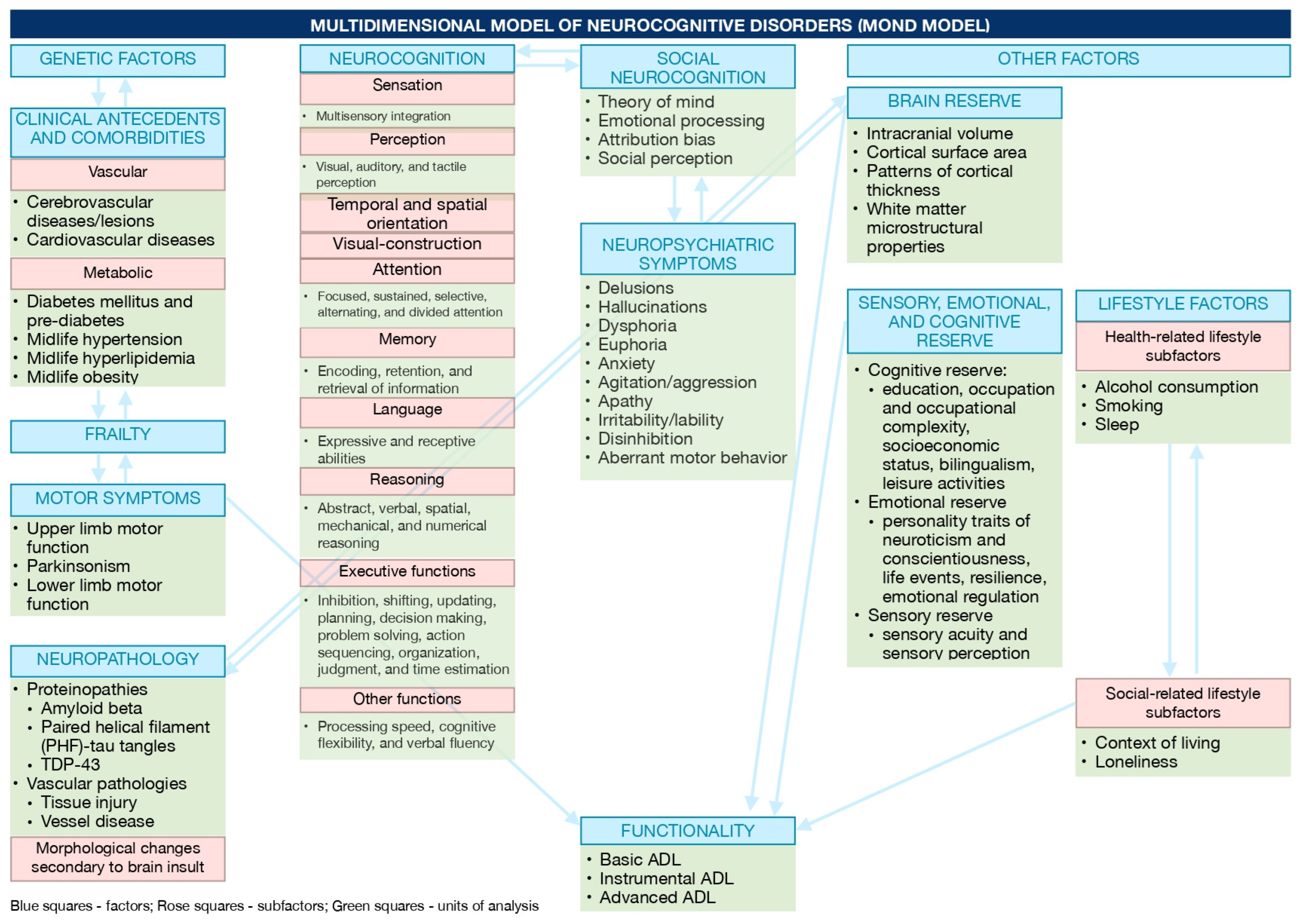
3.2. The MOND Model: A Multidimensional Model of ND
3.3. Guidelines for Translational Research with the MOND Model
4. Discussion
5. Conclusions
Author Contributions
Funding
Institutional Review Board Statement
Informed Consent Statement
Data Availability Statement
Conflicts of Interest
References
- World Health Organization. International Statistical Classification of Diseases and Related Health Problems, 11th ed.; World Health Organization: Geneva, Switzerland, 2019; Available online: https://icd.who.int/ (accessed on 1 January 2026).
- American Psychiatric Association. Diagnostic and Statistical Manual of Mental Disorders, 5th ed.; Text Revision (DSM-5-TR); American Psychiatric Association: Washington, DC, USA, 2022. [Google Scholar]
- National Institute for Health and Care Excellence. Dementia: Assessment, Management and Support for People Living with Dementia and Their Carers. 2018. Available online: https://www.nice.org.uk/guidance/ng97 (accessed on 1 January 2026).
- Keller, W.R.; Fischer, B.A.; Carpenter, W.T., Jr. Revisiting the diagnosis of schizophrenia: Where have we been and where are we going? CNS Neurosci. Ther. 2011, 17, 83–88. [Google Scholar] [CrossRef] [PubMed]
- Stein, D.J.; Szatmari, P.; Gaebel, W.; Berk, M.; Vieta, E.; Maj, M.; de Vries, Y.A.; Roest, A.M.; de Jonge, P.; Maercker, A.; et al. Mental, behavioral and neurodevelopmental disorders in the ICD-11: An international perspective on key changes and controversies. BMC Med. 2020, 18, 21. [Google Scholar] [CrossRef] [PubMed]
- Kozak, M.J.; Cuthbert, B.N. The NIMH Research Domain Criteria Initiative: Background, Issues, and Pragmatics. Psychophysiology 2016, 53, 286–297. [Google Scholar] [CrossRef] [PubMed]
- Kotov, R.; Krueger, R.F.; Watson, D.; Achenbach, T.M.; Althoff, R.R.; Bagby, R.M.; Brown, T.A.; Carpenter, W.T.; Caspi, A.; Clark, L.A.; et al. The Hierarchical Taxonomy of Psychopathology (HiTOP): A dimensional alternative to traditional nosologies. J. Abnorm. Psychol. 2017, 126, 454–477. [Google Scholar] [CrossRef] [PubMed]
- Caspi, A.; Houts, R.M.; Ambler, A.; Danese, A.; Elliott, M.L.; Hariri, A.; Harrington, H.; Hogan, S.; Poulton, R.; Ramrakha, S.; et al. Longitudinal Assessment of Mental Health Disorders and Comorbidities Across 4 Decades Among Participants in the Dunedin Birth Cohort Study. JAMA Netw. Open 2020, 3, e203221. [Google Scholar] [CrossRef] [PubMed]
- Cuthbert, B.N.; Insel, T.R. Toward the future of psychiatric diagnosis: The seven pillars of RDoC. BMC Med. 2013, 11, 126. [Google Scholar] [CrossRef] [PubMed]
- Michelini, G.; Palumbo, I.M.; DeYoung, C.G.; Latzman, R.D.; Kotov, R. Linking RDoC and HiTOP: A new interface for advancing psychiatric nosology and neuroscience. Clin. Psychol. Rev. 2021, 86, 102025. [Google Scholar] [CrossRef] [PubMed]
- Ross, C.A.; Margolis, R.L. Research Domain Criteria: Strengths, Weaknesses, and Potential Alternatives for Future Psychiatric Research. Mol. Neuropsychiatry 2019, 5, 218–236. [Google Scholar] [CrossRef] [PubMed]
- Kotov, R.; Krueger, R.F.; Watson, D.; Cicero, D.C.; Conway, C.C.; DeYoung, C.G.; Eaton, N.R.; Forbes, M.K.; Hallquist, M.N.; Latzman, R.D.; et al. The Hierarchical Taxonomy of Psychopathology (HiTOP): A Quantitative Nosology Based on Consensus of Evidence. Annu. Rev. Clin. Psychol. 2021, 17, 83–108. [Google Scholar] [CrossRef] [PubMed]
- Ramanan, S.; El-Omar, H.; Roquet, D.; Ahmed, R.M.; Hodges, J.R.; Piguet, O.; Ralph, M.A.; Irish, M. Mapping behavioural, cognitive and affective transdiagnostic dimensions in frontotemporal dementia. Brain Commun. 2023, 5, fcac344. [Google Scholar] [CrossRef] [PubMed]
- Murley, A.G.; Coyle-Gilchrist, I.; Rouse, M.A.; Jones, P.S.; Li, W.; Wiggins, J.; Lansdall, C.; Rodríguez, P.V.; Wilcox, A.; Tsvetanov, K.A.; et al. Redefining the multidimensional clinical phenotypes of frontotemporal lobar degeneration syndromes. Brain 2020, 143, 1555–1571. [Google Scholar] [CrossRef] [PubMed]
- Arevalo-Rodriguez, I.; Pedraza, O.L.; Rodríguez, A.; Sánchez, E.; Gich, I.; Solà, I.; Bonfill, X.; Alonso-Coello, P. Alzheimer’s Disease Dementia Guidelines for Diagnostic Testing: A Systematic Review. Am. J. Alzheimer’s Dis. Other Dement. 2013, 28, 111–119. [Google Scholar] [CrossRef] [PubMed]
- Blanco, K.; Salcidua, S.; Orellana, P.; Sauma-Pérez, T.; León, T.; Steinmetz, L.C.L.; Ibañez, A.; Duran-Aniotz, C.; De La Cruz, R. Systematic review: Fluid biomarkers and machine learning methods to improve the diagnosis from mild cognitive impairment to Alzheimer’s disease. Alzheimer’s Res. Ther. 2023, 15, 176. [Google Scholar] [CrossRef] [PubMed]
- Borchert, R.J.; Azevedo, T.; Badhwar, A.; Bernal, J.; Betts, M.; Bruffaerts, R.; Burkhart, M.C.; Dewachter, I.; Gellersen, H.M.; Low, A.; et al. Artificial intelligence for diagnostic and prognostic neuroimaging in dementia: A systematic review. Alzheimer’s Dement. J. Alzheimer’s Assoc. 2023, 19, 5885–5904. [Google Scholar] [CrossRef] [PubMed]
- Breton, A.; Casey, D.; Arnaoutoglou, N.A. Cognitive tests for the detection of mild cognitive impairment (MCI), the prodromal stage of dementia: Meta-analysis of diagnostic accuracy studies. Int. J. Geriatr. Psychiatry 2019, 34, 233–242. [Google Scholar] [CrossRef] [PubMed]
- Brigo, F.; Turri, G.; Tinazzi, M. 123I-FP-CIT SPECT in the differential diagnosis between dementia with Lewy bodies and other dementias. J. Neurol. Sci. 2015, 359, 161–171. [Google Scholar] [CrossRef] [PubMed]
- Carnero-Pardo, C.; Lopez-Alcalde, S.; Allegri, R.F.; Russo, M.J. A systematic review and meta-analysis of the diagnostic accuracy of the Phototest for cognitive impairment and dementia. Dement. Neuropsychol. 2014, 8, 141–147. [Google Scholar] [CrossRef] [PubMed]
- Catino, F.; Castellana, F.; Zupo, R.; Giannoccaro, V.; Lampignano, L.; Petrosillo, A.M.; Addabbo, F.; Sborgia, G.; Colacicco, G.; Santoro, C.; et al. Multimodal biomarker AI techniques for early neurocognitive disorder diagnosis: A systematic review. Artif. Intell. Med. 2026, 177, 103389. [Google Scholar] [CrossRef] [PubMed]
- Chan, J.Y.C.; Kwong, J.S.W.; Wong, A.; Kwok, T.C.Y.; Tsoi, K.K.F. Comparison of Computerized and Paper-and-Pencil Memory Tests in Detection of Mild Cognitive Impairment and Dementia: A Systematic Review and Meta-analysis of Diagnostic Studies. J. Am. Med. Dir. Assoc. 2018, 19, 748–756.e5. [Google Scholar] [CrossRef] [PubMed]
- Chan, J.Y.C.; Yau, S.T.Y.; Kwok, T.C.Y.; Tsoi, K.K.F. Diagnostic performance of digital cognitive tests for the identification of MCI and dementia: A systematic review. Ageing Res. Rev. 2021, 72, 101506. [Google Scholar] [CrossRef] [PubMed]
- Chan, J.Y.C.; Bat, B.K.K.; Wong, A.; Chan, T.K.; Huo, Z.; Yip, B.H.K.; Kowk, T.C.Y.; Tsoi, K.K.F. Evaluation of Digital Drawing Tests and Paper-and-Pencil Drawing Tests for the Screening of Mild Cognitive Impairment and Dementia: A Systematic Review and Meta-analysis of Diagnostic Studies. Neuropsychol. Rev. 2022, 32, 566–576. [Google Scholar] [CrossRef] [PubMed]
- Chen, H.-H.; Sun, F.-J.; Yeh, T.-L.; Liu, H.-E.; Huang, H.-L.; Kuo, B.I.-T.; Huang, H.-Y. The diagnostic accuracy of the Ascertain Dementia 8 questionnaire for detecting cognitive impairment in primary care in the community, clinics and hospitals: A systematic review and meta-analysis. Fam. Pract. 2018, 35, 239–246. [Google Scholar] [CrossRef] [PubMed]
- Chen, Y.-R.; Liang, C.-S.; Chu, H.; Voss, J.; Kang, X.L.; O’Connell, G.; Jen, H.-J.; Liu, D.; Shen Hsiao, S.-T.; Chou, K.-R. Diagnostic accuracy of blood biomarkers for Alzheimer’s disease and amnestic mild cognitive impairment: A meta-analysis. Ageing Res. Rev. 2021, 71, 101446. [Google Scholar] [CrossRef] [PubMed]
- Costa, R.Q.M.D.; Pompeu, J.E.; Viveiro, L.A.P.D.; Brucki, S.M.D. Spatial orientation tasks show moderate to high accuracy for the diagnosis of mild cognitive impairment: A systematic literature review. Arq. Neuro-Psiquiatr. 2020, 78, 713–723. [Google Scholar] [CrossRef] [PubMed]
- Custodero, C.; Ciavarella, A.; Panza, F.; Gnocchi, D.; Lenato, G.M.; Lee, J.; Mazzocca, A.; Sabbà, C.; Solfrizzi, V. Role of inflammatory markers in the diagnosis of vascular contributions to cognitive impairment and dementia: A systematic review and meta-analysis. GeroScience 2022, 44, 1373–1392. [Google Scholar] [CrossRef] [PubMed]
- Custodio, N.; Duque, L.; Montesinos, R.; Alva-Diaz, C.; Mellado, M.; Slachevsky, A. Systematic Review of the Diagnostic Validity of Brief Cognitive Screenings for Early Dementia Detection in Spanish-Speaking Adults in Latin America. Front. Aging Neurosci. 2020, 12, 270. [Google Scholar] [CrossRef] [PubMed]
- Dagher, R.; Arjmand, P.; Ozkara, B.B.; Radmard, M.; Gad, M.; Sheikhy, A.; Wintermark, M.; Yedavalli, V.; Sair, H.I.; Luna, L.P. Diagnostic Performance of ASL-MRI and FDG-PET in Frontotemporal Dementia: A Systematic Review and Meta-Analysis. Am. J. Neuroradiol. 2025, 46, 341–348. [Google Scholar] [CrossRef] [PubMed]
- Dattola, S.; Ielo, A.; Varone, G.; Cacciola, A.; Quartarone, A.; Bonanno, L. Frontotemporal dementia: A systematic review of artificial intelligence approaches in differential diagnosis. Front. Aging Neurosci. 2025, 17, 1547727. [Google Scholar] [CrossRef] [PubMed]
- Davison, C.M.; O’Brien, J.T. A comparison of FDG-PET and blood flow SPECT in the diagnosis of neurodegenerative dementias: A systematic review. Int. J. Geriatr. Psychiatry 2014, 29, 551–561. [Google Scholar] [CrossRef] [PubMed]
- Del Campo, M.; Zetterberg, H.; Gandy, S.; Onyike, C.U.; Oliveira, F.; Udeh-Momoh, C.; Lleó, A.; Teunissen, C.E.; Pijnenburg, Y. New developments of biofluid-based biomarkers for routine diagnosis and disease trajectories in frontotemporal dementia. Alzheimer’s Dement. 2022, 18, 2292–2307. [Google Scholar] [CrossRef] [PubMed]
- Dodich, A.; Crespi, C.; Santi, G.C.; Cappa, S.F.; Cerami, C. Evaluation of Discriminative Detection Abilities of Social Cognition Measures for the Diagnosis of the Behavioral Variant of Frontotemporal Dementia: A Systematic Review. Neuropsychol. Rev. 2021, 31, 251–266. [Google Scholar] [CrossRef] [PubMed]
- Donaghy, P.C.; Carrarini, C.; Ferreira, D.; Habich, A.; Aarsland, D.; Babiloni, C.; Bayram, E.; Kane, J.P.; Lewis, S.J.; Pilotto, A.; et al. Research diagnostic criteria for mild cognitive impairment with Lewy bodies: A systematic review and meta-analysis. Alzheimer’s Dement. 2023, 19, 3186–3202. [Google Scholar] [CrossRef] [PubMed]
- McKeith, I.G.; Ferman, T.J.; Thomas, A.J.; Blanc, F.; Boeve, B.F.; Fujishiro, H.; Kantarci, K.; Muscio, C.; O’Brien, J.T.; Postuma, R.B.; et al. Research criteria for the diagnosis of prodromal dementia with Lewy bodies. Neurology 2020, 94, 743–755. [Google Scholar] [CrossRef] [PubMed]
- Fabrizi, E.; Ancidoni, A.; Locuratolo, N.; Piscopo, P.; Della Gatta, F.; Salemme, S.; Pani, S.M.; Marconi, D.; Vignatelli, L.; Sagliocca, L.; et al. The Italian guideline on diagnosis and treatment of dementia and mild cognitive impairment. Age Ageing 2024, 53, afae250. [Google Scholar] [CrossRef] [PubMed]
- Fernandes, B.; Goodarzi, Z.; Holroyd-Leduc, J. Optimizing the diagnosis and management of dementia within primary care: A systematic review of systematic reviews. BMC Fam. Pract. 2021, 22, 166. [Google Scholar] [CrossRef] [PubMed]
- Forlenza, O.V.; Diniz, B.S.; Teixeira, A.L.; Stella, F.; Gattaz, W. Mild cognitive impairment (part 2): Biological markers for diagnosis and prediction of dementia in Alzheimer’s disease. Rev. Bras. Psiquiatr. 2013, 35, 284–294. [Google Scholar] [CrossRef] [PubMed]
- Fornari, C.; Fumagalli, G.G. Visual rating scales of brain atrophy in dementia: A systematic review of reliability and diagnostic accuracy. Rev. Neurosci. 2026, 37, 1–18. [Google Scholar] [CrossRef] [PubMed]
- Haidar, H.; Majzoub, R.E.; Hajeer, S.; Abbas, L.A. Arterial spin labeling (ASL-MRI) versus fluorodeoxyglucose-PET (FDG-PET) in diagnosing dementia: A systematic review and meta-analysis. BMC Neurol. 2023, 23, 385. [Google Scholar] [CrossRef] [PubMed]
- Harrison, J.K.; Fearon, P.; Noel-Storr, A.H.; McShane, R.; Stott, D.J.; Quinn, T.J. Informant Questionnaire on Cognitive Decline in the Elderly (IQCODE) for the diagnosis of dementia within a general practice (primary care) setting. Cochrane Database Syst. Rev. 2014, CD010771. [Google Scholar] [CrossRef] [PubMed]
- Harrison, J.K.; Fearon, P.; Noel-Storr, A.H.; McShane, R.; Stott, D.J.; Quinn, T.J. Informant Questionnaire on Cognitive Decline in the Elderly (IQCODE) for the diagnosis of dementia within a secondary care setting. Cochrane Database Syst. Rev. 2015, CD010772. [Google Scholar] [CrossRef] [PubMed]
- Harrison, J.K.; Stott, D.J.; McShane, R.; Noel-Storr, A.H.; Swann-Price, R.S.; Quinn, T.J. Informant Questionnaire on Cognitive Decline in the Elderly (IQCODE) for the early diagnosis of dementia across a variety of healthcare settings. Cochrane Database Syst. Rev. 2016, CD011333. [Google Scholar] [CrossRef] [PubMed]
- Howe, A.S.; Bani-Fatemi, A.; De Luca, V. The clinical utility of the auditory P300 latency subcomponent event-related potential in preclinical diagnosis of patients with mild cognitive impairment and Alzheimer’s disease. Brain Cogn. 2014, 86, 64–74. [Google Scholar] [CrossRef] [PubMed]
- Hsu, J.-H.; Liu, C.-C.; Chen, I.-W.; Wu, J.-Y.; Huang, P.-Y.; Liu, T.-H.; Hung, K.-C. Efficacy of the visual cognitive assessment test for mild cognitive impairment/mild dementia diagnosis: A meta-analysis. Front. Public Health 2023, 11, 1293710. [Google Scholar] [CrossRef] [PubMed]
- Huo, Z.; Lin, J.; Bat, B.K.K.; Chan, J.Y.C.; Tsoi, K.K.F.; Yip, B.H.K. Diagnostic accuracy of dementia screening tools in the Chinese population: A systematic review and meta-analysis of 167 diagnostic studies. Age Ageing 2021, 50, 1093–1101. [Google Scholar] [CrossRef] [PubMed]
- Hwang, A.B.; Boes, S.; Nyffeler, T.; Schuepfer, G. Validity of screening instruments for the detection of dementia and mild cognitive impairment in hospital inpatients: A systematic review of diagnostic accuracy studies. PLoS ONE 2019, 14, e0219569. [Google Scholar] [CrossRef] [PubMed]
- Ibrahim, B.; Suppiah, S.; Ibrahim, N.; Mohamad, M.; Hassan, H.A.; Nasser, N.S.; Saripan, M.I. Diagnostic power of resting-state fMRI for detection of network connectivity in Alzheimer’s disease and mild cognitive impairment: A systematic review. Hum. Brain Mapp. 2021, 42, 2941–2968. [Google Scholar] [CrossRef] [PubMed]
- Jafari, Z.; Andrew, M.K.; Rockwood, K.J. Diagnostic utility of speech-based biomarkers in mild cognitive impairment: A systematic review and meta-analysis. Age Ageing 2025, 54, afaf316. [Google Scholar] [CrossRef] [PubMed]
- Jiang, S.; Qu, C.; Wang, F.; Liu, Y.; Qiao, Z.; Qiu, X.; Yang, X.; Yang, Y. Using event-related potential P300 as an electrophysiological marker for differential diagnosis and to predict the progression of mild cognitive impairment: A meta-analysis. Neurol. Sci. 2015, 36, 1105–1112. [Google Scholar] [CrossRef] [PubMed]
- Jreige, M.; Kurian, G.K.; Perriraz, J.; Potheegadoo, J.; Bernasconi, F.; Stampacchia, S.; Blanke, O.; Alessandra, G.; Lejay, N.; Chiabotti, P.S.; et al. The diagnostic performance of functional dopaminergic scintigraphic imaging in the diagnosis of dementia with Lewy bodies: An updated systematic review. Eur. J. Nucl. Med. Mol. Imaging 2023, 50, 1988–2035. [Google Scholar] [CrossRef] [PubMed]
- Julio-Ramos, T.; Mora-Castelleto, V.; Foncea-González, C.; Adames-Valencia, C.; Cigarroa, I.; Méndez-Orellana, C.; Toloza-Ramirez, D. Neuropsychological differential diagnosis of Alzheimer’s disease and Lewy body dementia: A systematic review. Neurologia 2025, 40, 884–914. [Google Scholar] [CrossRef] [PubMed]
- Lees, R.; Selvarajah, J.; Fenton, C.; Pendlebury, S.T.; Langhorne, P.; Stott, D.J.; Quinn, T.J. Test Accuracy of Cognitive Screening Tests for Diagnosis of Dementia and Multidomain Cognitive Impairment in Stroke. Stroke 2014, 45, 3008–3018. [Google Scholar] [CrossRef] [PubMed]
- Lim, X.; Yeo, J.M.; Green, A.; Pal, S. The diagnostic utility of cerebrospinal fluid alpha-synuclein analysis in dementia with Lewy bodies—A systematic review and meta-analysis. Park. Relat. Disord. 2013, 19, 851–858. [Google Scholar] [CrossRef] [PubMed]
- Ling, Y.; Sun, J.; Hu, L.; Zhao, M.; Chen, J.; Zheng, Y. Diagnostic Value of Inflammatory Biomarkers in Differentiating Vascular Dementia from Alzheimer’s Disease: A Systematic Review and Meta-Analysis. Brain Behav. 2026, 16, e71341. [Google Scholar] [CrossRef] [PubMed]
- Maclin, J.M.A.; Wang, T.; Xiao, S. Biomarkers for the diagnosis of Alzheimer’s disease, dementia Lewy body, frontotemporal dementia and vascular dementia. Gen. Psychiatry 2019, 32, e100054. [Google Scholar] [CrossRef] [PubMed]
- Malek-Ahmadi, M.; Nikkhahmanesh, N. Meta-analysis of Montreal cognitive assessment diagnostic accuracy in amnestic mild cognitive impairment. Front. Psychol. 2024, 15, 1369766. [Google Scholar] [CrossRef] [PubMed]
- Martínez, G.; Vernooij, R.W.; Fuentes Padilla, P.; Zamora, J.; Bonfill Cosp, X.; Flicker, L. 18F PET with florbetapir for the early diagnosis of Alzheimer’s disease dementia and other dementias in people with mild cognitive impairment (MCI). Cochrane Database Syst. Rev. 2017, CD012216. [Google Scholar] [CrossRef] [PubMed]
- Martínez, G.; Vernooij, R.W.; Fuentes Padilla, P.; Zamora, J.; Flicker, L.; Bonfill Cosp, X. 18F PET with flutemetamol for the early diagnosis of Alzheimer’s disease dementia and other dementias in people with mild cognitive impairment (MCI). Cochrane Database Syst. Rev. 2017, CD012884. [Google Scholar] [CrossRef] [PubMed]
- Mavroudis, I.; Petridis, F.; Chatzikonstantinou, S.; Kazis, D. Alpha-synuclein Levels in the Differential Diagnosis of Lewy Bodies Dementia and Other Neurodegenerative Disorders: A Meta-analysis. Alzheimer Dis. Assoc. Disord. 2020, 34, 220–224. [Google Scholar] [CrossRef] [PubMed]
- Mavroudis, I.A.; Petridis, F.; Chatzikonstantinou, S.; Kazis, D. A meta-analysis on CSF neurogranin levels for the diagnosis of Alzheimer’s disease and mild cognitive impairment. Aging Clin. Exp. Res. 2020, 32, 1639–1646. [Google Scholar] [CrossRef] [PubMed]
- McCarthy, J.; Collins, D.L.; Ducharme, S. Morphometric MRI as a diagnostic biomarker of frontotemporal dementia: A systematic review to determine clinical applicability. NeuroImage Clin. 2018, 20, 685–696. [Google Scholar] [CrossRef] [PubMed]
- McCleery, J.; Morgan, S.; Bradley, K.M.; Noel-Storr, A.H.; Ansorge, O.; Hyde, C. Dopamine transporter imaging for the diagnosis of dementia with Lewy bodies. Cochrane Database Syst. Rev. 2015, CD010633. [Google Scholar] [CrossRef] [PubMed]
- McCleery, J.; Laverty, J.; Quinn, T.J. Diagnostic test accuracy of telehealth assessment for dementia and mild cognitive impairment. Cochrane Database Syst. Rev. 2021, CD013786. [Google Scholar] [CrossRef] [PubMed]
- McGovern, A.; Pendlebury, S.T.; Mishra, N.K.; Fan, Y.; Quinn, T.J. Test Accuracy of Informant-Based Cognitive Screening Tests for Diagnosis of Dementia and Multidomain Cognitive Impairment in Stroke. Stroke 2016, 47, 329–335. [Google Scholar] [CrossRef] [PubMed]
- Micanovic, C.; Pal, S. The diagnostic utility of EEG in early-onset dementia: A systematic review of the literature with narrative analysis. J. Neural Transm. 2014, 121, 59–69. [Google Scholar] [CrossRef] [PubMed]
- Miller, D.S.; Robert, P.; Ereshefsky, L.; Adler, L.; Bateman, D.; Cummings, J.; DeKosky, S.T.; Fischer, C.E.; Husain, M.; Ismail, Z.; et al. Diagnostic criteria for apathy in neurocognitive disorders. Alzheimer’s Dement. 2021, 17, 1892–1904. [Google Scholar] [CrossRef] [PubMed]
- Namkoong, S.; Roh, H. Function of the hand as a predictor of early diagnosis and progression of Alzheimer’s dementia: A systematic review. Technol. Health Care 2024, 32, 253–264. [Google Scholar] [CrossRef] [PubMed]
- Nassanga, R.; Nakasujja, N.; Mubuuke, A.G.; Lwere, K.; Kawooya, M.G.; Ocan, M.; Kaddumukasa, M. Utilisation of brain MRI for the diagnosis of dementia in low and middle-income countries: Systematic review and meta-analysis. BMJ Open 2026, 16, e114801. [Google Scholar] [CrossRef] [PubMed]
- Nihashi, T.; Ito, K.; Terasawa, T. Diagnostic accuracy of DAT-SPECT and MIBG scintigraphy for dementia with Lewy bodies: An updated systematic review and Bayesian latent class model meta-analysis. Eur. J. Nucl. Med. Mol. Imaging 2020, 47, 1984–1997. [Google Scholar] [CrossRef] [PubMed]
- Noel-Storr, A.H.; Flicker, L.; Ritchie, C.W.; Nguyen, G.H.; Gupta, T.; Wood, P.; Walton, J.; Desai, M.; Solomon, D.F.; Molena, E.; et al. Systematic review of the body of evidence for the use of biomarkers in the diagnosis of dementia. Alzheimer’s Dement. 2013, 9, e96–e105. [Google Scholar] [CrossRef] [PubMed]
- Ogonowski, N.; Salcidua, S.; Leon, T.; Chamorro-Veloso, N.; Valls, C.; Avalos, C.; Bisquertt, A.; Rentería, M.E.; Orellana, P.; Duran-Aniotz, C. Systematic Review: MicroRNAs as Potential Biomarkers in Mild Cognitive Impairment Diagnosis. Front. Aging Neurosci. 2022, 13, 807764. [Google Scholar] [CrossRef] [PubMed]
- Osei, G.N.; Bockarie, A.; Akpalu, A.; Adueming, P.O.; Antwi, M.H.; Appiah, F.; Kpelle, L.; Donkor, D.M.; Simpong, D.L. Diagnostic potential of near-infrared spectroscopy in mild cognitive impairment and neurodegenerative disorders: Implications for resource-limited settings. Alzheimer’s Dement. 2025, 21, e70769. [Google Scholar] [CrossRef] [PubMed]
- Ossenkoppele, R.; Hansson, O. Towards clinical application of tau PET tracers for diagnosing dementia due to Alzheimer’s disease. Alzheimer’s Dement. 2021, 17, 1998–2008. [Google Scholar] [CrossRef] [PubMed]
- Ozer, S.; Young, J.; Champ, C.; Burke, M. A systematic review of the diagnostic test accuracy of brief cognitive tests to detect amnestic mild cognitive impairment. Int. J. Geriatr. Psychiatry 2016, 31, 1139–1150. [Google Scholar] [CrossRef]
- Park, H.Y.; Suh, C.H.; Heo, H.; Shim, W.H.; Kim, S.J. Diagnostic performance of hippocampal volumetry in Alzheimer’s disease or mild cognitive impairment: A meta-analysis. Eur. Radiol. 2022, 32, 6979–6991. [Google Scholar] [CrossRef] [PubMed]
- Pelegrini, L.N.C.; Mota, G.M.P.; Ramos, C.F.; Jesus, E.; Vale, F.A.C. Diagnosing dementia and cognitive dysfunction in the elderly in primary health care: A systematic review. Dement. Neuropsychol. 2019, 13, 144–153. [Google Scholar] [CrossRef] [PubMed]
- Pemberton, H.G.; Zaki, L.A.M.; Goodkin, O.; Das, R.K.; Steketee, R.M.E.; Barkhof, F.; Vernooij, M.W. Technical and clinical validation of commercial automated volumetric MRI tools for dementia diagnosis—A systematic review. Neuroradiology 2021, 63, 1773–1789. [Google Scholar] [CrossRef] [PubMed]
- Piura, Y.D.; Corriveau-Lecavalier, N.; Abu Dabrh, A.M.; Geschwind, M.D.; Brigham, T.J.; Day, G.S. Identification and diagnosis of ultra-rapid progressive dementia: Evidence from a prospective cohort study and systematic literature review. J. Neurol. 2025, 272, 67. [Google Scholar] [CrossRef] [PubMed]
- Qu, Y.; Ma, Y.-H.; Huang, Y.-Y.; Ou, Y.-N.; Shen, X.-N.; Chen, S.-D.; Dong, Q.; Tan, L.; Yu, J.-T. Blood biomarkers for the diagnosis of amnestic mild cognitive impairment and Alzheimer’s disease: A systematic review and meta-analysis. Neurosci. Biobehav. Rev. 2021, 128, 479–486. [Google Scholar] [CrossRef] [PubMed]
- Ramusino, M.; Massa, F.; Festari, C.; Gandolfo, F.; Nicolosi, V.; Orini, S.; Nobili, F.; Frisoni, G.B.; Morbelli, S.; Garibotto, V.; et al. Diagnostic performance of molecular imaging methods in predicting the progression from mild cognitive impairment to dementia: An updated systematic review. Eur. J. Nucl. Med. Mol. Imaging 2024, 51, 1876–1890. [Google Scholar] [CrossRef] [PubMed]
- Ritchie, C.; Smailagic, N.; Noel-Storr, A.H.; Takwoingi, Y.; Flicker, L.; Mason, S.E.; McShane, R. Plasma and cerebrospinal fluid amyloid beta for the diagnosis of Alzheimer’s disease dementia and other dementias in people with mild cognitive impairment (MCI). Cochrane Database Syst. Rev. 2014, CD008782. [Google Scholar] [CrossRef] [PubMed]
- Ritchie, C.; Smailagic, N.; Noel-Storr, A.H.; Ukoumunne, O.; Ladds, E.C.; Martin, S. CSF tau and the CSF tau/ABeta ratio for the diagnosis of Alzheimer’s disease dementia and other dementias in people with mild cognitive impairment (MCI). Cochrane Database Syst. Rev. 2017, CD010803. [Google Scholar] [CrossRef] [PubMed]
- Rizzo, G.; Arcuti, S.; Copetti, M.; Alessandria, M.; Savica, R.; Fontana, A.; Liguori, R.; Logroscino, G. Accuracy of clinical diagnosis of dementia with Lewy bodies: A systematic review and meta-analysis. J. Neurol. Neurosurg. Psychiatry 2018, 89, 358–366. [Google Scholar] [CrossRef] [PubMed]
- Santos, F.; Cabreira, V.; Rocha, S.; Massano, J. Blood Biomarkers for the Diagnosis of Neurodegenerative Dementia: A Systematic Review. J. Geriatr. Psychiatry Neurol. 2023, 36, 267–281. [Google Scholar] [CrossRef] [PubMed]
- Schäfer, S.; Tröger, J.; Kray, J. Modern scores for traditional tests—Review of the diagnostic potential of scores derived from word list learning tests in mild cognitive impairment and early Alzheimer’s Disease. Neuropsychologia 2024, 201, 108908. [Google Scholar] [CrossRef] [PubMed]
- Seitz, D.P.; Chan, C.C.; Newton, H.T.; Gill, S.S.; Herrmann, N.; Smailagic, N.; Nikolaou, V.; Fage, B.A. Mini-Cog for the diagnosis of Alzheimer’s disease dementia and other dementias within a primary care setting. Cochrane Database Syst. Rev. 2018, CD011415. [Google Scholar] [CrossRef] [PubMed]
- Shahidi, R.; Baradaran, M.; Asgarzadeh, A.; Bagherieh, S.; Tajabadi, Z.; Farhadi, A.; Korani, S.S.; Khalafi, M.; Shobeiri, P.; Sadeghsalehi, H.; et al. Diagnostic performance of MRI radiomics for classification of Alzheimer’s disease, mild cognitive impairment, and normal subjects: A systematic review and meta-analysis. Aging Clin. Exp. Res. 2023, 35, 2333–2348. [Google Scholar] [CrossRef] [PubMed]
- Shi, M.; Cheung, G.; Shahamiri, S.R. Speech and language processing with deep learning for dementia diagnosis: A systematic review. Psychiatry Res. 2023, 329, 115538. [Google Scholar] [CrossRef] [PubMed]
- Smailagic, N.; Vacante, M.; Hyde, C.; Martin, S.; Ukoumunne, O.; Sachpekidis, C. 18F-FDG PET for the early diagnosis of Alzheimer’s disease dementia and other dementias in people with mild cognitive impairment (MCI). Cochrane Database Syst. Rev. 2015, CD010632. [Google Scholar] [CrossRef] [PubMed]
- Svensson, A.; Granvik, E.; Sjögren Forss, K. Performance of the Eight-item Informant Interview to Differentiate Aging and Dementia within a context similar to the Swedish primary healthcare sector: A systematic review of diagnostic test accuracy studies. Scand. J. Prim. Health Care 2020, 38, 454–463. [Google Scholar] [CrossRef] [PubMed]
- Tanwani, R.; Danquah, M.O.; Butris, N.; Saripella, A.; Yan, E.; Kapoor, P.; Englesakis, M.; Tang-Wai, D.F.; Tartaglia, M.C.; He, D.; et al. Diagnostic accuracy of Ascertain Dementia 8-item Questionnaire by participant and informant–A systematic review and meta-analysis. PLoS ONE 2023, 18, e0291291. [Google Scholar] [CrossRef] [PubMed]
- Tseriotis, V.-S.; Mavridis, T.; Eleftheriadou, K.; Konstantis, G.; Chlorogiannis, D.-D.; Pavlidis, P.; Pourzitaki, C.; Arnaoutoglou, M.; Spyridon, K. Loss of the “swallow tail sign” on susceptibility-weighted imaging in the diagnosis of dementia with Lewy bodies: A systematic review and meta-analysis. J. Neurol. 2024, 271, 3754–3763. [Google Scholar] [CrossRef] [PubMed]
- Verón, G.L.; Juantorena, G.E.; Keller, G.; Crivelli, L.; Kamienkowski, J.E. Eye tracking as a diagnostic tool in Alzheimer’s disease, mild cognitive impairment, and related dementias: A systematic review. Alzheimer’s Dement. Diagn. Assess. Dis. Monit. 2026, 18, e70238. [Google Scholar] [CrossRef] [PubMed]
- Wang, X.; Li, F.; Zhu, H.; Jiang, Z.; Niu, G.; Gao, Q. A Hierarchical Bayesian Latent Class Model for the Diagnostic Performance of Mini-Mental State Examination and Montreal Cognitive Assessment in Screening Mild Cognitive Impairment Due to Alzheimer’s Disease. J. Prev. Alzheimer’s Dis. 2022, 9, 589–600. [Google Scholar] [CrossRef] [PubMed]
- Wang, L.; Wang, Y.; Han, C.; Zhao, L.; He, L.; Li, J. Revolutionizing early Alzheimer’s disease and mild cognitive impairment diagnosis: A deep learning MRI meta-analysis. Arq. Neuro-Psiquiatr. 2024, 82, s00441788657. [Google Scholar] [CrossRef] [PubMed]
- Weissberger, G.H.; Strong, J.V.; Stefanidis, K.B.; Summers, M.J.; Bondi, M.W.; Stricker, N.H. Diagnostic Accuracy of Memory Measures in Alzheimer’s Dementia and Mild Cognitive Impairment: A Systematic Review and Meta-Analysis. Neuropsychol. Rev. 2017, 27, 354–388. [Google Scholar] [CrossRef] [PubMed]
- Xie, B.; Zhou, H.; Liu, W.; Yu, W.; Liu, Z.; Jiang, L.; Zhang, R.; Cui, D.; Shi, Z.; Xu, S. Evaluation of the diagnostic value of peripheral BDNF levels for Alzheimer’s disease and mild cognitive impairment: Results of a meta-analysis. Int. J. Neurosci. 2020, 130, 218–230. [Google Scholar] [CrossRef] [PubMed]
- Xing, W.; Gao, W.; Lv, X.; Xu, X.; Zhang, Z.; Yan, J.; Mao, G.; Bu, Z. The Diagnostic Value of Exosome-Derived Biomarkers in Alzheimer’s Disease and Mild Cognitive Impairment: A Meta-Analysis. Front. Aging Neurosci. 2021, 13, 637218. [Google Scholar] [CrossRef] [PubMed]
- Yeo, J.M.; Lim, X.; Khan, Z.; Pal, S. Systematic review of the diagnostic utility of SPECT imaging in dementia. Eur. Arch. Psychiatry Clin. Neurosci. 2013, 263, 539–552. [Google Scholar] [CrossRef] [PubMed]
- Zhang, S.; Smailagic, N.; Hyde, C.; Noel-Storr, A.H.; Takwoingi, Y.; McShane, R.; Feng, J. 11C-PIB-PET for the early diagnosis of Alzheimer’s disease dementia and other dementias in people with mild cognitive impairment (MCI). Cochrane Database Syst. Rev. 2014, CD010386. [Google Scholar] [CrossRef] [PubMed]
- Zhu, L.; Zhao, W.; Chen, J.; Li, G.; Qu, J. Systematic review and meta-analysis of diagnostic test accuracy (DTA) studies: The role of cerebral perfusion imaging in prognosis evaluation of mild cognitive impairment. Ann. Palliat. Med. 2022, 11, 673–683. [Google Scholar] [CrossRef] [PubMed]
- Spector, A.; Orrell, M. Using a biopsychosocial model of dementia as a tool to guide clinical practice. Int. Psychogeriatr. 2010, 22, 957–965. [Google Scholar] [CrossRef] [PubMed]
- Gal, J.; Katsumata, Y.; Zhu, H.; Srinivasan, S.; Chen, J.; Johnson, L.A.; Wang, W.X.; Golden, L.R.; Wilcock, D.M.; Jicha, G.A.; et al. Apolipoprotein E Proteinopathy Is a Major Dementia-Associated Pathologic Biomarker in Individuals with or without the APOE Epsilon 4 Allele. Am. J. Pathol. 2022, 192, 564–578. [Google Scholar] [CrossRef] [PubMed]
- Winblad, B.; Amouyel, P.; Andrieu, S.; Ballard, C.; Brayne, C.; Brodaty, H.; Cedazo-Minguez, A.; Dubois, B.; Edvardsson, D.; Feldman, H.; et al. Defeating Alzheimer’s disease and other dementias: A priority for European science and society. Lancet Neurol. 2016, 15, 455–532. [Google Scholar] [CrossRef] [PubMed]
- Iadecola, C. Revisiting atherosclerosis and dementia. Nat. Neurosci. 2020, 23, 691–692. [Google Scholar] [CrossRef] [PubMed]
- Kalaria, R.N. Cerebrovascular disease and mechanisms of cognitive impairment: Evidence from clinicopathological studies in humans. Stroke 2012, 43, 2526–2534. [Google Scholar] [CrossRef] [PubMed]
- Knopman, D.S. Cerebrovascular disease and dementia. Br. J. Radiol. 2007, 80, S121–S127. [Google Scholar] [CrossRef] [PubMed]
- Kuźma, E.; Lourida, I.; Moore, S.F.; Levine, D.A.; Ukoumunne, O.C.; Llewellyn, D.J. Stroke and dementia risk: A systematic review and meta-analysis. Alzheimer’s Dement. J. Alzheimer’s Assoc. 2018, 14, 1416–1426. [Google Scholar] [CrossRef] [PubMed]
- McGrath, E.R.; Beiser, A.S.; O’Donnell, A.; Himali, J.J.; Pase, M.P.; Satizabal, C.L.; Seshadri, S. Determining Vascular Risk Factors for Dementia and Dementia Risk Prediction Across Mid-to Later-Life: The Framingham Heart Study. Neurology 2022, 99, e142–e153. [Google Scholar] [CrossRef] [PubMed]
- Peixoto, B.; Graça, G.; Pimenta, P.; Andrade, A.; Silva, P.; Silva, M.; Pereira, E.; Rocha, A.; Sousa, D.; Andrade, J.P.; et al. Acute coronary syndrome and neurocognition: Determinants and moderators. Rev. Iberoam. Neuropsicol. 2022, 5, 1–9. [Google Scholar] [CrossRef]
- Song, R.; Pan, K.Y.; Xu, H.; Qi, X.; Buchman, A.S.; Bennett, D.A.; Xu, W. Association of cardiovascular risk burden with risk of dementia and brain pathologies: A population-based cohort study. Alzheimer’s Dement. J. Alzheimer’s Assoc. 2021, 17, 1914–1922. [Google Scholar] [CrossRef] [PubMed]
- von Cederwald, B.; Josefsson, M.; Wåhlin, A.; Nyberg, L.; Karalija, N. Association of Cardiovascular Risk Trajectory with Cognitive Decline and Incident Dementia. Neurology 2022, 98, e2013–e2022. [Google Scholar] [CrossRef] [PubMed]
- Machado-Fragua, M.D.; Fayosse, A.; Yerramalla, M.S.; van Sloten, T.T.; Tabak, A.G.; Kivimaki, M.; Sabia, S.; Singh-Manoux, A. Association of Metabolic Syndrome with Incident Dementia: Role of Number and Age at Measurement of Components in a 28-Year Follow-up of the Whitehall II Cohort Study. Diabetes Care 2022, 45, 2127–2135. [Google Scholar] [CrossRef] [PubMed]
- Petermann-Rocha, F.; Lyall, D.M.; Gray, S.R.; Esteban-Cornejo, I.; Quinn, T.J.; Ho, F.K.; Pell, J.P.; Celis-Morales, C. Associations between physical frailty and dementia incidence: A prospective study from UK Biobank. Lancet Healthy Longev. 2020, 1, e58–e68. [Google Scholar] [CrossRef] [PubMed]
- Fried, L.P.; Tangen, C.M.; Walston, J.; Newman, A.B.; Hirsch, C.; Gottdiener, J.; Seeman, T.; Tracy, R.; Kop, W.J.; Burke, G.; et al. Frailty in older adults: Evidence for a phenotype. J. Gerontol. Ser. A Biol. Sci. Med. Sci. 2001, 56, M146–M156. [Google Scholar] [CrossRef] [PubMed]
- Evans, N.R.; Todd, O.M.; Minhas, J.S.; Fearon, P.; Harston, G.W.; Mant, J.; Mead, G.; Hewitt, J.; Quinn, T.J.; Warburton, E.A. Frailty and cerebrovascular disease: Concepts and clinical implications for stroke medicine. Int. J. Stroke 2022, 17, 251–259. [Google Scholar] [CrossRef] [PubMed]
- Serra-Prat, M.; Papiol, M.; Vico, J.; Palomera, E.; Sist, X.; Cabré, M. Factors associated with frailty in community-dwelling elderly population. A cross-sectional study. Eur. Geriatr. Med. 2016, 7, 531–537. [Google Scholar] [CrossRef]
- Stewart, R. Cardiovascular Disease and Frailty: What Are the Mechanistic Links? Clin. Chem. 2019, 65, 80–86. [Google Scholar] [CrossRef] [PubMed]
- Sathyan, S.; Ayers, E.; Gao, T.; Milman, S.; Barzilai, N.; Rockwood, K.; Verghese, J. Frailty and Risk of Incident Motoric Cognitive Risk Syndrome. J. Alzheimer’s Dis. 2019, 71, S85–S93. [Google Scholar] [CrossRef] [PubMed]
- Kueper, J.K.; Speechley, M.; Lingum, N.R.; Montero-Odasso, M. Motor function and incident dementia: A systematic review and meta-analysis. Age Ageing 2017, 46, 729–738. [Google Scholar] [CrossRef] [PubMed]
- Dyer, A.H.; Lawlor, B.; Kennelly, S.P.; NILVAD Study Group. Gait speed, cognition and falls in people living with mild-to-moderate Alzheimer disease: Data from NILVAD. BMC Geriatr. 2020, 20, 117. [Google Scholar] [CrossRef] [PubMed]
- Buchman, A.S.; Boyle, P.A.; Leurgans, S.E.; Barnes, L.L.; Bennett, D.A. Cognitive function is associated with the development of mobility impairments in community-dwelling elders. Am. J. Geriatr. Psychiatry 2011, 19, 571–580. [Google Scholar] [CrossRef] [PubMed]
- Kaur, B.; Harvey, D.J.; Decarli, C.S.; Zhang, L.; Sabbagh, M.N.; Olichney, J.M. Extrapyramidal signs by dementia severity in Alzheimer disease and dementia with Lewy bodies. Alzheimer Dis. Assoc. Disord. 2013, 27, 226–232. [Google Scholar] [CrossRef] [PubMed]
- Schneider, J.A. Neuropathology of Dementia Disorders. Continuum 2022, 28, 834–851. [Google Scholar] [CrossRef] [PubMed]
- Stern, Y.; Arenaza-Urquijo, E.M.; Bartrés-Faz, D.; Belleville, S.; Cantilon, M.; Chetelat, G.; Ewers, M.; Franzmeier, N.; Kempermann, G.; Kremen, W.S.; et al. Whitepaper: Defining and investigating cognitive reserve, brain reserve, and brain maintenance. Alzheimer’s Dement. J. Alzheimer’s Assoc. 2020, 16, 1305–1311. [Google Scholar] [CrossRef] [PubMed]
- Jauny, G.; Eustache, F.; Hinault, T.T. M/EEG Dynamics Underlying Reserve, Resilience, and Maintenance in Aging: A Review. Front. Psychol. 2022, 13, 861973. [Google Scholar] [CrossRef] [PubMed]
- Verkhratsky, A.; Zorec, R. Neuroglia in cognitive reserve. Mol. Psychiatry 2024, 29, 3962–3967. [Google Scholar] [CrossRef] [PubMed]
- Pinto, J.O.; Peixoto, B.; Dores, A.R.; Barbosa, F. Proposal of a Common Terminology for the Neuropsychological Rehabilitation. J. Neuropsychol. 2023, 17, 431–449. [Google Scholar] [CrossRef] [PubMed]
- Sokolovič, L.; Hofmann, M.J.; Mohammad, N.; Kukolja, J. Neuropsychological differential diagnosis of Alzheimer’s disease and vascular dementia: A systematic review with meta-regressions. Front. Aging Neurosci. 2023, 15, 1267434. [Google Scholar] [CrossRef] [PubMed]
- Samra, K.; MacDougall, A.M.; Bouzigues, A.; Bocchetta, M.; Cash, D.M.; Greaves, C.V.; Convery, R.S.; van Swieten, J.C.; Seelaar, H.; Jiskoot, L.; et al. Language impairment in the genetic forms of behavioural variant frontotemporal dementia. J. Neurol. 2023, 270, 1976–1988. [Google Scholar] [CrossRef] [PubMed]
- Harvey, P.D.; Penn, D. Social cognition: The key factor predicting social outcome in people with schizophrenia? Psychiatry 2010, 7, 41–44. [Google Scholar] [PubMed]
- Setién-Suero, E.; Murillo-García, N.; Sevilla-Ramos, M.; Abreu-Fernández, G.; Pozueta, A.; Ayesa-Arriola, R. Exploring the relationship between deficits in social cognition and neurodegenerative dementia: A systematic review. Front. Aging Neurosci. 2022, 14, 778093. [Google Scholar] [CrossRef] [PubMed]
- Kessels, R.P.C.; Waanders-Oude Elferink, M.; van Tilborg, I. Social cognition and social functioning in patients with amnestic mild cognitive impairment or Alzheimer’s dementia. J. Neuropsychol. 2021, 15, 186–203. [Google Scholar] [CrossRef] [PubMed]
- Desmarais, P.; Lanctôt, K.L.; Masellis, M.; Black, S.E.; Herrmann, N. Social inappropriateness in neurodegenerative disorders. Int. Psychogeriatr. 2018, 30, 197–207. [Google Scholar] [CrossRef] [PubMed]
- Brodaty, H.; Connors, M.H. Pseudodementia, pseudo-pseudodementia, and pseudodepression. Alzheimer’s Dement. Diagn. Assess. Dis. Monit. 2020, 12, e12027. [Google Scholar] [CrossRef] [PubMed]
- Kiloh, L.G. Pseudo-dementia. Acta Psychiatr. Scand. 1961, 37, 336–351. [Google Scholar] [CrossRef] [PubMed]
- Jang, J.Y.; Ho, J.K.; Blanken, A.E.; Dutt, S.; Nation, D.A.; Alzheimer’s Disease Neuroimaging Initiative. Affective Neuropsychiatric Symptoms as Early Signs of Dementia Risk in Older Adults. J. Alzheimer’s Dis. JAD 2020, 77, 1195–1207. [Google Scholar] [CrossRef] [PubMed]
- García-Martín, V.; de Hoyos-Alonso, M.C.; Ariza-Cardiel, G.; Delgado-Puebla, R.; García-Domingo, P.; Hernández-Melo, E.; de Haro-de Torres, J.L.; Del Cura-González, I. Neuropsychiatric symptoms and subsyndromes in patients with different stages of dementia in primary care follow-up (NeDEM project): A cross-sectional study. BMC Geriatr. 2022, 22, 71. [Google Scholar] [CrossRef] [PubMed]
- Johnson, D.K.; Watts, A.S.; Chapin, B.A.; Anderson, R.; Burns, J.M. Neuropsychiatric profiles in dementia. Alzheimer Dis. Assoc. Disord. 2011, 25, 326–332. [Google Scholar] [CrossRef] [PubMed]
- Roberto, N.; Portella, M.J.; Marquié, M.; Alegret, M.; Hernández, I.; Mauleón, A.; Rosende-Roca, M.; Abdelnour, C.; de Antonio, E.E.; Gil, S.; et al. Neuropsychiatric profiles and conversion to dementia in mild cognitive impairment, a latent class analysis. Sci. Rep. 2021, 11, 6448. [Google Scholar] [CrossRef] [PubMed]
- Dubbelman, M.A.; Jutten, R.J.; Tomaszewski Farias, S.E.; Amariglio, R.E.; Buckley, R.F.; Visser, P.J.; Rentz, D.M.; Johnson, K.A.; Properzi, M.J.; Schultz, A.; et al. Decline in cognitively complex everyday activities accelerates along the Alzheimer’s disease continuum. Alzheimer’s Res. Ther. 2020, 12, 138. [Google Scholar] [CrossRef] [PubMed]
- Pinto, J.O.; Pontes, D.; Dores, A.R.; Peixoto, B.; Barbosa, F. Activities of Daily Living Inventory (ADLI): Proposal of a new instrument and preliminary data. Appl. Neuropsychol. Adult 2024. advance online publication. [Google Scholar] [CrossRef] [PubMed]
- Fieo, R.; Zahodne, L.; Tang, M.X.; Manly, J.J.; Cohen, R.; Stern, Y. The Historical Progression from ADL Scrutiny to IADL to Advanced ADL: Assessing Functional Status in the Earliest Stages of Dementia. J. Gerontol. Ser. A Biol. Sci. Med. Sci. 2018, 73, 1695–1700. [Google Scholar] [CrossRef] [PubMed]
- Marshall, G.A.; Amariglio, R.E.; Sperling, R.A.; Rentz, D.M. Activities of daily living: Where do they fit in the diagnosis of Alzheimer’s disease? Neurodegener. Dis. Manag. 2012, 2, 483–491. [Google Scholar] [CrossRef] [PubMed]
- Amanzio, M.; Palermo, S.; Stanziano, M.; D’Agata, F.; Galati, A.; Gentile, S.; Castellano, G.; Bartoli, M.; Cipriani, G.E.; Rubino, E.; et al. Investigating Neuroimaging Correlates of Early Frailty in Patients With Behavioral Variant Frontotemporal Dementia: A MRI and FDG-PET Study. Front. Aging Neurosci. 2021, 13, 637796. [Google Scholar] [CrossRef] [PubMed]
- Palermo, S.; Stanziano, M.; Nigri, A.; Civilotti, C.; Celeghin, A. Parkinson’s Disease, SARS-CoV-2, and Frailty: Is There a Vicious Cycle Related to Hypovitaminosis D? Brain Sci. 2023, 13, 528. [Google Scholar] [CrossRef] [PubMed]
- Livingston, G.; Huntley, J.; Sommerlad, A.; Ames, D.; Ballard, C.; Banerjee, S.; Brayne, C.; Burns, A.; Cohen-Mansfield, J.; Cooper, C.; et al. Dementia prevention, intervention, and care: 2020 report of the Lancet Commission. Lancet 2020, 396, 413–446, Erratum in Lancet 2020, 402, 1132. [Google Scholar] [CrossRef] [PubMed]
- Shenker, J.I.; Singh, G. Sleep and Dementia. Mo. Med. 2017, 114, 311–315. [Google Scholar] [PubMed]
- Wong, R.; Lovier, M.A. Sleep Disturbances and Dementia Risk in Older Adults: Findings From 10 Years of National U.S. Prospective Data. Am. J. Prev. Med. 2023, 64, 781–787. [Google Scholar] [CrossRef] [PubMed]
- Harmand, M.; Meillon, C.; Rullier, L.; Avila-Funes, J.A.; Bergua, V.; Dartigues, J.F.; Amieva, H. Cognitive decline after entering a nursing home: A 22-year follow-up study of institutionalized and noninstitutionalized elderly people. J. Am. Med. Dir. Assoc. 2014, 15, 504–508. [Google Scholar] [CrossRef] [PubMed]
- Setiyani, R.; Iskandar, A. Cognitive impairment among older adults living in the community and in nursing home in Indonesia: A pilot study. Dement. Neuropsychol. 2022, 16, 347–353. [Google Scholar] [CrossRef] [PubMed]
- Shi, J.; Liu, X.; Feng, Z. Age-friendly cities and communities and cognitive health among Chinese older adults: Evidence from the China Health and Retirement Longitudinal Studies. Cities 2023, 132, 104072. [Google Scholar] [CrossRef]
- Finlay, J.; Esposito, M.; Langa, K.M.; Judd, S.; Clarke, P. Cognability: An Ecological Theory of neighborhoods and cognitive aging. Soc. Sci. Med. 2022, 309, 115220. [Google Scholar] [CrossRef] [PubMed]
- Salinas, J.; Beiser, A.S.; Samra, J.K.; O’Donnell, A.; DeCarli, C.S.; Gonzales, M.M.; Aparicio, H.J.; Seshadri, S. Association of Loneliness with 10-Year Dementia Risk and Early Markers of Vulnerability for Neurocognitive Decline. Neurology 2022, 98, e1337–e1348. [Google Scholar] [CrossRef] [PubMed]
- Tao, Q.; Akhter-Khan, S.C.; Ang, T.F.A.; DeCarli, C.; Alosco, M.L.; Mez, J.; Killiany, R.; Devine, S.; Rokach, A.; Itchapurapu, I.S.; et al. Different loneliness types, cognitive function, and brain structure in midlife: Findings from the Framingham Heart Study. eClinicalMedicine 2022, 53, 101643. [Google Scholar] [CrossRef] [PubMed]
- Bartoli, M.; Palermo, S.; Cipriani, G.E.; Amanzio, M. A Possible Association Between Executive Dysfunction and Frailty in Patients with Neurocognitive Disorders. Front. Psychol. 2020, 11, 554307. [Google Scholar] [CrossRef] [PubMed]
- Pinto, J.O.; Peixoto, B.; Dores, A.R.; Barbosa, F. A model of sensory, emotional, and cognitive reserve. Appl. Neuropsychol. Adult 2023, 32, 1831–1833. [Google Scholar] [CrossRef] [PubMed]
- Graham, N.L.; Emery, T.; Hodges, J.R. Distinctive cognitive profiles in Alzheimer’s disease and subcortical vascular dementia. J. Neurol. Neurosurg. Psychiatry 2004, 75, 61–71. [Google Scholar] [PubMed]
- Malpu-Wiederhold, C.; Farías-Ulloa, C.; Méndez-Orellana, C.; Cigarroa, I.; Martella, D.; Foncea-González, C.; Julio-Ramos, T.; Méndez-Orellana, C.; Toloza-Ramírez, D. Cognitive-linguistic profiles in older people with Mild Cognitive Impairment, Vascular Dementia, Dementia with Lewy Bodies and Parkinson’s Disease. Rev. Ecuat. Neurol. 2022, 31, 69–85. [Google Scholar] [CrossRef]
- Reed, B.R.; Mungas, D.M.; Kramer, J.H.; Ellis, W.; Vinters, H.V.; Zarow, C.; Jagust, W.J.; Chui, H.C. Profiles of neuropsychological impairment in autopsy-defined Alzheimer’s disease and cerebrovascular disease. Brain 2007, 130, 731–739. [Google Scholar] [CrossRef] [PubMed]
- Moreira, I.; Peixoto, M.; Sousa, D.; Rocha, A.; Peixoto, B. Predictive model of neurocognitive functioning after acute coronary syndrome. A machine learning approach. J. Cardiovasc. Thorac. Res. 2025, 17, 181–187. [Google Scholar] [CrossRef] [PubMed]
- Kivimäki, M.; Livingston, G.; Singh-Manoux, A.; Mars, N.; Lindbohm, J.V.; Pentti, J.; Nyberg, S.T.; Pirinen, M.; Anderson, E.L.; Hingorani, A.D.; et al. Estimating Dementia Risk Using Multifactorial Prediction Models. JAMA Netw. Open 2023, 6, e2318132. [Google Scholar] [CrossRef] [PubMed]
- Rotstein, D.; Montalban, X. Reaching an evidence-based prognosis for personalized treatment of multiple sclerosis. Nat. Rev. Neurol. 2019, 15, 287–300. [Google Scholar] [CrossRef] [PubMed]
- Van Wijmeersch, B.; Hartung, H.P.; Vermersch, P.; Pugliatti, M.; Pozzilli, C.; Grigoriadis, N.; Alkhawajah, M.; Airas, L.; Linker, R.; Oreja-Guevara, C. Using personalized prognosis in the treatment of relapsing multiple sclerosis: A practical guide. Front. Immunol. 2022, 13, 991291. [Google Scholar] [CrossRef] [PubMed]
- Karantzoulis, S.; Galvin, J.E. Distinguishing Alzheimer’s disease from other major forms of dementia. Expert Rev. Neurother. 2011, 11, 1579–1591. [Google Scholar] [CrossRef] [PubMed]


| System | Pros | Cons |
|---|---|---|
| Diagnostic and Statistical Manual of Mental Disorders (DSM) |
|
|
| International Classification of Diseases (ICD) |
|
|
| Research Domain Criteria (RDoC) |
|
|
| Hierarchical Taxonomy of Psychopathology (HiTOP) |
|
|
| No. | First Author | Study Type | Population | Context/Setting | Diagnosis Criteria—Instruments/Measures | Main Results |
|---|---|---|---|---|---|---|
| 1 | Arevalo-Rodriguez [15] | Systematic review | AD | Clinical setting | Diagnostic recommendations on AD dementia Management of patients with dementia: A national clinical guideline Management of dementia Clinical practice guidelines about comprehensive care for people with Alzheimer’s disease and other dementias EFNS guidelines for the diagnosis and management of Alzheimer’s disease | Diagnostic AD dementia guidelines—methodological heterogeneity. Brief cognitive tests, particularly MMSE, were commonly recommended for initial assessment. Neuropsychological evaluation was recommended mainly when the diagnosis was unclear or when a differential diagnosis was needed. Most guidelines did not support routine use of biomarkers in clinical practice due to limited evidence and standardization concerns. Standardized, evidence-based diagnostic frameworks for AD dementia are needed. |
| 2 | Blanco [16] | Systematic review | MCI, AD | NA | CSF, blood, and saliva biomarkers combined with machine learning algorithms, neuroimaging, and neuropsychological measures. | Multimodal machine learning models integrating biomarkers and neuroimaging showed promise for improving diagnostic prediction of AD in MCI populations. |
| 3 | Borchert [17] | Systematic review | MCI, AD, PD, VaD, LBD, FTD, PSP, HD, CBD | Clinical setting, training dataset | Machine learning models applied to MRI, PET, SPECT, EEG, MEG, and ultrasound | Improved diagnostic accuracy when a combination of neuroimaging modalities was used. Findings suggest superior performance of discriminative models compared to algorithmic and generative classifiers for the classification of AD vs. healthy controls. Limitations of artificial intelligence—lack of sufficient algorithm development descriptions and standard definitions. |
| 4 | Breton [18] | Meta-analysis | MCI | Community and secondary care settings | Cognitive tests | ACE-R, CERAD, MoCA, and Qmci—similar diagnostic accuracy MMSE—lower sensitivity. Memory Alteration Test—highest sensitivity and equivalent specificity to the other tests. |
| 5 | Brigo [19] | Systematic review and meta-analysis | AD, FTD, LBD | NA | 123I-FP-CIT SPECT (DaTSCAN), visual and semiquantitative analyses | 123I-FP-CIT SPECT showed sensitivity and specificity values above 80% for differentiating DLB from other dementia syndromes, supporting its diagnostic utility. |
| 6 | Carnero-Pardo [20] | Systematic review and meta-analysis | Dementia | Different settings | Phototest | Phototest:
|
| 7 | Catino [21] | Systematic review | MCI, AD | Healthcare settings | Multimodal biomarker AI techniques—Diagnostic models (MCI/AD vs. normal), Prognostic models (MCI → AD conversion) MRI, PET, CSF, Plasma, Cognition, APOE, Retina imaging | Multimodal AI models (integrating two or more data types—neuroimaging, fluid biomarkers, retinal imaging, cognitive measures) generally outperformed unimodal models for early diagnosis and risk stratification of ND. MRI + CSF and MRI + PET combinations demonstrated particularly robust performance for AD/MCI classification. Limited external validation and methodological heterogeneity reduced generalizability and clinical translation. |
| 8 | Chan [22] | Systematic review and meta-analysis | MCI, AD | Any kind of setting | Verbal and visual memory tests, paper-and-pencil tests | Both verbal and visual computerized memory tests have comparable diagnostic performance to the paper-and-pencil tests. |
| 9 | Chan [23] | Systematic review | MCI, dementia | NA | Digital cognitive tests | Most digital cognitive tests demonstrated diagnostic performance comparable to traditional paper-and-pencil tests. Several tests showed good sensitivity and specificity for detecting MCI or dementia, supporting their utility for accessible and repeated cognitive screening. Digital tests—only had a few validation studies to verify their performance. |
| 10 | Chan [24] | Systematic review and meta-analysis | MCI, dementia | Clinical or community settings | Digital Drawing Tests and Paper-and-Pencil Drawing Tests | The digital clock drawing test—better diagnostic performance than paper-and-pencil format for MCI. Other types of digital drawing tests showed comparable performance with paper-and-pencil formats. Digital drawing tests can be used as an alternative tool for the screening of MCI and dementia. |
| 11 | Chen [25] | Systematic review and meta-analysis | MCI, dementia | Primary care setting | AD8 | AD8 score ≧ 2—highly suspected to have cognitive impairment, and a further definite diagnosis is needed. |
| 12 | Chen [26] | Meta-analysis | Amnestic MCI, AD | Research settings | Blood biomarkers | For differentiating patients with AD from the controls:
|
| 13 | Costa [27] | Systematic review | MCI | Clinical setting | Spatial orientation tasks, including questionnaires, paper-and-pencil tests, route learning, virtual reality, and computer-based tasks | Spatial orientation tasks—moderate-to-high diagnostic accuracy for distinguishing MCI from healthy ageing, with AUC values ranging from 0.77 to 0.99. |
| 14 | Custodero [28] | Systematic review and meta-analysis | VD | NA | Inflammatory markers—interleukin (IL)-6, C-reactive protein (CRP), tumour necrosis factor (TNF)-α] from blood or CSF | Blood IL-6 levels > people with VD compared to AD patients and controls—might represent a useful biomarker able to differentiate people with VD from those with AD |
| 15 | Custodio [29] | Systematic review | MCI or dementia | Latin America Spanish speaking population Different settings (memory clinic-based samples, adult day-care centre, primary care clinic, and community-based sample | Brief cognitive screening tools | Most studies used adequate diagnostic accuracy measures. Brief cognitive screening tools:
|
| 16 | Dagher [30] | Systematic review and meta-analysis | FTD | NA | ASL-MRI and FDG-PET | ASL MRI—sensitivity of 0.70 and specificity of 0.81 [18F]-FDG-PET—sensitivity of 0.88 and specificity of 0.89 |
| 17 | Dattola [31] | Systematic review | Frontotemporal dementia | NA | Artificial intelligence approaches in differential diagnosis | ML techniques—potential for improving FTD diagnosis. Support Vector Machines (SVMs)—applied to neuroimaging and electrophysiological data. Deep learning methods—high accuracy in distinguishing FTD from other dementias. Multimodal data, including neuroimaging, EEG signals, and neuropsychological assessments, enhance diagnostic accuracy. |
| 18 | Davison [32] | Systematic review | MCI, AD, LBD, FTD | NA | PET, SPECT | PET studies generally report higher accuracy for AD than SPECT—evidence based on direct PET and SPECT comparison studies is limited |
| 19 | del Campo [33] | Systematic review | FTD | NA | CSF and plasma biomarkers, NfL, TDP-43, tau biomarkers, genetic-related fluid biomarkers | The clinicopathological heterogeneity of FTD limits accurate diagnosis based only on clinical phenotype. Biofluid biomarkers—may improve diagnosis, disease staging, and prediction of underlying pathology. NfL—one of the most promising biomarkers of FTD |
| 20 | Dodich [34] | Systematic review | Behavioural variant of FTD | Clinical settings | Social cognition measures | Major risk of bias—lack of pathological confirmation. Evaluation of the accuracy of social cognition tasks in bvFTD—mainly focused on emotion recognition and ToM. Emotion recognition and ToM tasks—could be the best choice to ensure a high diagnostic accuracy in clinical settings. No recommendation concerning the use of a specific social task in bvFTD diagnosis can currently be provided |
| 21 | Donaghy [35] | Systematic review and meta-analysis | MCI with Lewy bodies | NA | Diagnostic criteria for mild cognitive impairment with Lewy bodies (McKeith et al. [36]) | The meta-analysis supported the inclusion of the current clinical features in the diagnostic criteria. Quantitative EEG and fluorodeoxyglucose PET—promise as diagnostic biomarkers. |
| 22 | Fabrizi [37] | Systematic review | MCI, AD, LBD, FTD, VD | Non-specialist and specialist clinical settings—Italy’s first National Guideline on dementia and MCI diagnosis | Non-specialist setting: clinical history (including informant history), physical examination, blood/urine tests, cognitive screening (10-CS, 6CIT, 6-IS, MIS, Mini-Cog, TYM, GPCOG), CT/MRI to exclude reversible or secondary causes. Specialist setting: neurological examination, neuropsychological assessment, validated subtype criteria [International consensus criteria for dementia with LBD; International FTD criteria for frontotemporal dementia (primary non-fluent aphasia and semantic dementia); International FTD Consortium criteria for behavioural variant FTD; NINDS-AIREN criteria for vascular dementia; NIA-AA criteria for Alzheimer’s disease; Movement Disorders Society criteria for Parkinson’s disease dementia; WHO and International criteria for Creutzfeldt–Jakob disease], further tests for Alzheimer’s disease (PET/perfusion SPECT, CSF biomarkers for suspected AD), further tests for dementia with LBD (I-FP-CIT SPECT, I-MIBG cardiac scintigraphy, polysomnography with EEG), further tests for frontotemporal dementia (F-FDG PET or perfusion SPECT), further tests for vascular dementia (MRI, if MRI is unavailable or contraindicated, use CT), distinguishing dementia from dementia with delirium or delirium alone (confusion assessment method (CAM); • 4-A’s Test (4AT). | The guideline recommends a stepwise diagnostic pathway, beginning with detection and exclusion of reversible causes in non-specialist settings, followed by specialist assessment for subtype diagnosis and tailored management. |
| 23 | Fernandes [38] | Systematic review of systematic reviews | Dementia | Primary care | Cognitive tests | Mini-Cog and MMSE—most widely studied cognitive screening tools. AMTS—high sensitivity 100%, specificity 82%, within the shortest amount of time, within primary care. |
| 24 | Forlenza [39] | Systematic review | MCI, AD | Research and clinical settings | CSF biomarkers, structural and functional neuroimaging, multimodal biomarkers. | Clinical-biological insights led to the identification of the AD signature in the CSF. Methodological limitations still restrict its widespread clinical application. |
| 25 | Fornari [40] | Systematic review | Dementia | Clinical and research settings | Visual rating scales of brain atrophy | All scales—fair to excellent level of inter- and intra-rater agreement. Negative correlations between the rating in each scale and brain volumetric measures. Discriminative abilities—variability according to the scale and the population comparisons. Visual rating scales of atrophy—a reliable method for distinguishing physiological ageing from pathological conditions, and among neurodegenerative forms. |
| 26 | Haidar [41] | Systematic review and meta-analysis | Dementia | NA | ASL-MRI versus FDG-PET | FDG-PET—better than ASL-MRI, with pooled sensitivity being significantly higher for FDG-PET |
| 27 | Harrison [42] | Systematic review | Dementia | General practice (primary care) setting | IQCODE | IQCODE Cut-off—3.2 sensitivity 100%, specificity 76%; Cut-off—3.7 sensitivity 75%, specificity 98%. It is not possible to give definitive guidance on the test accuracy of IQCODE for the diagnosis of dementia in a primary care setting based on the single study identified |
| 28 | Harrison [43] | Systematic review | Dementia | Secondary care setting | IQCODE | IQCODE:
|
| 29 | Harrison [44] | Systematic review | Dementia | A variety of healthcare settings | IQCODE | IQCODE:
|
| 30 | Howe [45] | Systematic review and meta-analysis | MCI and AD | Research setting | Auditory P300 latency | P300 latency—significantly prolonged in patients with AD (and MCI) compared to unaffected controls. Shortened P300 latencies were observed when comparing patients with MCI to patients with AD. Auditory P300 latency—a biological marker of prodromal AD. |
| 31 | Hsu [46] | Meta-analysis | MCI/mild dementia | Clinical setting | VCAT | VCAT:
|
| 32 | Huo [47] | Systematic review and meta-analysis | Dementia | Clinical setting (Chinese population) | Dementia screening tools | MMSE—sensitivity of 0.87 and specificity of 0.89 ACE-R—sensitivity of 0.96 and specificity of 0.96 MoCA—sensitivity of 0.93 and sensitivity of 0.90 GPCOG, Hasegawa’s Dementia Scale, and Cognitive Abilities Screening Instrument—performances comparable to that of the MMSE |
| 33 | Hwang [48] | Systematic review | MCI, AD, VD, LBD, FTD | Hospital setting | Six-Item Cognitive Impairment Test, Cognitive Performance Scale, Clock-Drawing Test, MMSE, and Time and Change test | There is insufficient evidence to recommend for or against the use of a specific test for screening for dementia or MCI in older hospital inpatients. Simple cognitive tests used in isolation are not reliable enough |
| 34 | Ibrahim [49] | Systematic review | MCI, AD | NA | Resting-state fMRI for detection of network connectivity | Multimodal support vector machine (SVM) algorithm—commonest form of ML method utilized. |
| 35 | Jafari [50] | Systematic review and meta-analysis | MCI | NA | Speech-based biomarkers using ASR technologies, NLP models, ML algorithms | Speech analysis—pooled accuracy 80%, sensitivity 80%, specificity 77%, and AUC 78% for distinguishing MCI from cognitively unimpaired individuals |
| 36 | Jiang [51] | Meta-analysis | MCI, AD | NA | ERP P300 | MCI—P300 latency differed from controls and AD. P300 latency—may be a sensitive indicator for early cognitive decline |
| 37 | Jreige [52] | Systematic review | DLB | NA | Functional dopaminergic scintigraphic imaging | Early diagnosis—could be facilitated by identifying the prodromes of LBD using dopaminergic scintigraphic imaging coupled with emphasis on clinical neuropsychiatric symptoms. |
| 38 | Julio-Ramos [53] | Systematic review | AD, LBD | Research setting | Neuropsychological assessment of memory, executive function, attention, visuospatial/visuoconstructive abilities, and verbal fluency, alongside neuroimaging correlates | Differential diagnosis between AD and DLB remains challenging. Specific neuropsychological markers combined with anatomical and functional correlates may improve diagnostic accuracy. |
| 39 | Lees [54] | Systematic review | Multidomain MCI and dementia in stroke | Clinical setting | MMSE; MoCA; ACE-R; Rotterdam-CAMCOG | Common cognitive screening tools—similar overall diagnostic accuracy for post-stroke dementia/multidomain cognitive impairment. MoCA—high sensitivity but lower specificity at standard cut-offs. ACE-RR (cut-off < 88/100): sensitivity 0.96, specificity 0.70. MMSE (cut-off < 27/30): sensitivity 0.71, specificity 0.85. MoCA (cut-off < 26/30): sensitivity 0.95, specificity 0.45; (cut-off < 22/30): sensitivity 0.84, specificity 0.78 Rotterdam-CAMCOG (cut-off < 33/49): sensitivity 0.57, specificity 0.92 No single screening test clearly outperformed the others. |
| 40 | Lim [55] | Systematic review and meta-analysis | AD, LBD, PDD | NA | CSF alpha-synuclein | Mean CSF alpha-synuclein concentration was significantly lower in DLB patients compared to those with AD. No significant difference was found between patients with DLB compared to PDD or other neurodegenerative conditions. CSF alpha synuclein—may be of diagnostic use in differentiating between DLB and AD. |
| 41 | Ling [56] | Systematic review and meta-analysis | AD, VD | NA | Inflammatory biomarkers | 1L-1β—promising candidate for differentiating AD from VD. Inflammatory pathways differ between dementias. |
| 42 | Maclin [57] | Systematic review | AD, VD, FD, LBD | Clinical setting | Biomarkers Neuroimaging | Neuroimaging with amyloid PET scanning surpasses what had been considered the dominant method of neuroimaging and MRI. |
| 43 | Malek-Ahmadi [58] | Meta-analysis | Amnestic MCI | General practice settings | Montreal Cognitive Assessment (MoCA) | MoCA:
|
| 44 | Martínez [59] | Systematic review | MCI, AD | Community, primary, secondary, and research centres | 18F-florbetapir PET, amyloid PET imaging, NINCDS-ADRDA, DSM-IV dementia criteria. | Because of the poor sensitivity and specificity, the limited number of included participants, and the limited data available in the literature, 18F-florbetapir PET cannot be recommended for routine use in clinical practice to predict the progression from MCI to any form of dementia. |
| 45 | Martínez [60] | Systematic review | MCI, AD | Secondary care | 18F PET with flutemetamol, NIA-AA criteria, NINCDS-ADRDA, and DSM-IV reference standards. | Evidence regarding 18F-flutemetamol PET accuracy in predicting progression from MCI to dementia remained limited and heterogeneous. |
| 46 | Mavroudis [61] | Meta-analysis | AD, PF, PSP, FTD, LBD | NA | CSF Alpha-synuclein Levels | CSF alpha-synuclein levels—different in LBD compared with AD, but no statistical difference was found between LBD and other dementias. Alpha-synuclein levels in the CSF can be used for the discrimination between LBD and AD. |
| 47 | Mavroudis [62] | Meta-analysis | MCI, AD, LBD | NA | CSF neurogranin levels | Neurogranin CSF levels
|
| 48 | McCarthy [63] | Systematic review | FTD | NA | Morphometric MRI | Good diagnostic accuracy—differentiating FTD from controls. Few machine learning algorithms have been tested in prospective replication. Studies are necessary before this method can be recommended for use clinically. |
| 49 | McCleery [64] | Systematic review | DLB | Secondary care | Dopamine transporter imaging | Only one study has used a neuropathological reference standard to assess the accuracy of DAT imaging for the diagnosis of DLB. |
| 50 | McCleery [65] | Systematic review | MCI, dementia | NA | Telehealth assessment | Telehealth assessment:
MCI—one study—sensitivity of 0.71 and specificity of 0.73 Low-certainty evidence Tendency for patients identified as cognitively healthy at face-to-face assessment to be diagnosed with MCI at telehealth assessment (but numbers were small). Telehealth assessment may be sensitive and specific for the diagnosis of all-cause dementia when assessed against a reference standard of conventional face-to-face assessment. However, the estimates are imprecise due to small sample sizes and between-study heterogeneity. It may be applied mainly to telehealth models that incorporate a considerable face-to-face contact. |
| 51 | McGovern [66] | Systematic review | MCI and dementia in stroke | Various settings | Informant-Based Cognitive Screening IQCODE) | IQCODE:
|
| 52 | Micanovic [67] | Systematic review | Early-onset dementia (AD, VD, FTD, LBD) | NA | EEG | EEG abnormalities—more severe in early-onset AD patients, independent of disease duration. Slow wave activity is common to all dementias, but is most prominent in DLB. Frontal intermittent rhythmic delta activity—supportive for the diagnosis of DLB. EEG—usually normal in FTD. Focal changes—advanced VAD. EEG—useful as an adjunct in the diagnosis of DLB and AD. |
| 53 | Miller [68] | Systematic review | MCI, AD, VD, FTD, DLB, PDD | NA | Diagnostic criteria for apathy in NCD | Apathy evaluation—keeping the cognitive and behavioural domains separate for NCD without introducing a social withdrawal domain. Consensus diagnostic criteria for apathy in ND are provided |
| 54 | Namkoong [69] | Systematic review | AD | NA | Handgrip strength, pegboard hand dexterity tasks, and complex hand movement evaluations | Hand dexterity—associated with cognitive performance. Pegboard tasks—differentiated healthy older adults from AD patients. Complex hand movement analyses may help predict progression from MCI to AD and from moderate to severe dementia. |
| 55 | Nassanga [70] | Systematic review and meta-analysis | Dementia | Countries classified as low-income or middle-income | Brain MRI | The pooled prevalence of dementia-relevant MRI abnormalities was 58%, with substantial heterogeneity. Structured visual ratings may add aetiologic specificity beyond cognitive screening, but pooled estimates should be interpreted as summaries of heterogeneous studies. |
| 56 | Nihashi [71] | Systematic review and meta-analysis | DLB | Research setting | DAT-SPECT and MIBG scintigraphy | Both imaging biomarkers have high diagnostic accuracy for detecting the hallmark pathology in the brain and for diagnosing the typical clinical syndrome. |
| 57 | Noel-Storr [72] | Systematic review | Dementia | NA | Biomarkers b-amyloid, tau, positron emission tomography (18F-fluoro- deoxyglucose or ligands for amyloid), MRI | The highest number of studies—structural MRI The body of evidence for biomarkers is not large and is variable across the different types of biomarkers. |
| 58 | Ogonowski [73] | Systematic review | MCI, AD | Clinical and research setting | miRNA | Several peripheral fluid miRNAs showed potential as early biomarkers for MCI and AD-related cognitive impairment—further validation is needed. |
| 59 | Osei [74] | Systematic review | MCI, AD, FTD, DLB, PD | Resource-limited settings | NIRS | NIRS—effectively assesses cognitive function, identifying reduced prefrontal connectivity in MCI and subjective cognitive decline. NIRS—decreased oxyhemoglobin levels in AD patients’ dorsolateral cortex. Combining NIRS with graph analysis, cognitive tasks, and machine learning boosts diagnostic accuracy. NIRS can differentiate between neurodegenerative diseases. NIRS’s potential to improve cognitive assessment and neurodegeneration diagnosis. |
| 60 | Ossenkoppele [75] | Systematic review | AD | Specialized clinics for the differential diagnosis of dementia | Tau PET | Tau PET tracers:
|
| 61 | Ozer [76] | Systematic review | Amnestic MCI | Secondary care settings, community, mixture of secondary care and community-based settings | Brief cognitive screening tests | Several brief cognitive tests demonstrated promising sensitivity for identifying aMCI. Evidence quality and predictive validity remained limited. |
| 62 | Park [77] | Meta-analysis | MCI, AD | NA | MRI hippocampal volumetry and entorhinal cortex volumetry | Hippocampal volumetry:
Entorhinal cortex volumetry:
|
| 63 | Pelegrini [78] | Systematic review | Dementia and cognitive dysfunction in the elderly | Primary healthcare, low-, middle-, and high-income countries | MCI and dementia criteria—based on experts’ recommendations and on the DSM and ICD-10
| High-income countries—conducted by general practitioners—diagnostic criteria and instruments for assessments (cognitive and functional). Some used complementary evaluations—blood tests and neuroimaging. Middle-income countries—cognitive assessment |
| 64 | Pemberton [79] | Systematic review | Dementia | Research and clinical settings | Quantitative volumetric MRI reports tools | Automated volumetric MRI tools—potential to improve objectivity and consistency in dementia diagnosis. Clinical validation and workflow integration studies remain limited. |
| 65 | Piura [80] | Systematic review | Ultra-rapid progressive dementia | Tertiary care centres | CDR, clinical history and neurological examination, MRI, EEG, CSF analyses, disease-associated antibodies, FDG-PET, cognitive tests (MoCA, MMSE), diagnostic criteria for AD, bvFTD, DLB, CJD, autoimmune encephalitis, and vascular cognitive impairment | The evaluation of patients with ultra-RPD should prioritize testing for vascular, autoimmune/inflammatory, toxic/metabolic, and structural/iatrogenic causes, with priority given to the detection of potentially treatment-responsive causes of rapid dementia. |
| 66 | Qu [81] | Systematic review and meta-analysis | Amnestic MCI, AD | NA | Blood biomarkers (T-tau, P-tau, NfL, AβPPr, Aβ42, Aβ42/Aβ40 ratio, P-tau 217) | Biomarkers—valid in identifying AD and aMCI |
| 67 | Ramusino [82] | Updated systematic review | MCI, dementia | NA | Molecular imaging methods (FDG-PET, Amyloid-PET, DaT-SPECT, Tau-PET, MIBG scintigraphy) | FDG-PET and amyloid-PET—the most accurate molecular imaging biomarker in predicting MCI conversion to dementia. DaT-SPECT and MIBG—the most accurate biomarkers in distinguishing synucleinopathies and AD. FDG-PET—useful biomarker in the differential diagnosis between bvFTD and other dementias or psychiatric conditions, albeit with lower sensitivity and specificity. Use of biomarkers in ND other than AD—careful and comprehensive interpretation by expert clinicians |
| 68 | Ritchie [83] | Systematic review | MCI, AD | Several settings | Plasma and cerebrospinal fluid amyloid beta | Abnormally low CSF Aß levels—little diagnostic benefit with likelihood ratios suggesting only marginal clinical utility. We conclude that when applied to a population of patients with MCI, CSF Aß levels cannot be recommended as an accurate test for AD. |
| 69 | Ritchie [84] | Systematic review | MCI, AD | Clinical setting | CSF tau and the CSF tau/ABeta ratio | CSF tau and the CSF tau/ABeta ratio have better sensitivity than specificity. Insufficiency and heterogeneity of research—these tests may have limited clinical value until uncertainties have been addressed |
| 70 | Rizzo [85] | Systematic review and meta-analysis | LBD | Clinical setting | McKeith’s 1996 and 2005 criteria | Diagnostic criteria—become more sensitive and less specific over time, without a substantial change in the accuracy. About 20% of DLB diagnoses are incorrect. |
| 71 | Santos [86] | Systematic review | AD, FTLD, and DLB | Clinical and research settings | Blood biomarkers | Biomarkers for AD versus FTLD—excellent discriminative accuracy for p-tau181, p-tau217, synaptophysin, synaptopodin, GAP43, and calmodulin. For AD versus DLB distinction—excellent accuracy for miR-21-5p and miR-451a |
| 72 | Schäfer [87] | Systematic review | MCI, AD | NA | Word list learning tests | aMCI and early AD were associated with reduced item acquisition, more intrusion errors, reduced strategy use, and impaired recall. Process-based memory scores provided a more detailed characterization of episodic memory dysfunction than traditional total recall scores. Learning-process measures may improve early detection of AD-related memory decline. |
| 73 | Seitz [88] | Systematic review | AD | Primary care | Mini-Cog | Mini-Cog: Sensitivity—varied between 0.76 and 1.00 Specificity—varied between 0.27 and 0.85 There is a limited number of studies evaluating the accuracy of the Mini-Cog for the diagnosis of dementia in primary care settings. There is insufficient evidence to recommend Mini-Cog as a screening test for dementia in primary care. |
| 74 | Shahidi [89] | Systematic review and meta-analysis | MCI, AD | Clinical settings | MRI radiomics features analyzed with computational/machine learning models | MRI radiomics:
|
| 75 | Shi [90] | Systematic review | Dementia | Clinical setting | Speech and language processing with deep learning | These technologies are promising in the diagnosis of dementia. |
| 76 | Smailagic [91] | Systematic review and meta-analysis | MCI, AD | Several settings | 18F-FDG PET imaging | 18F-FDG PET showed potential utility in predicting progression from MCI to AD dementia. Study heterogeneity and varying thresholds limited definitive conclusions regarding diagnostic accuracy. |
| 77 | Svensson [92] | Systematic review | Dementia | Community and primary healthcare settings—Asia and South America | Eight-item Informant Interview | Eight-item Informant Interview:
|
| 78 | Tanwani [93] | Systematic review and meta-analysis | Dementia | Healthcare setting | AD8 | Cut-off of >2/8
|
| 79 | Tseriotis [94] | Systematic review and meta-analysis | LBD | NA | Loss of DNH on iron-sensitive brain MRI | DNH loss on iron-sensitive MRI—might comprise a supportive biomarker for DLB detection |
| 80 | Verón [95] | Systematic review | MCI, AD, and related dementias | NA | Eye tracking | Antisaccade tasks consistently distinguished AD and MCI from healthy controls. |
| 81 | Wang [96] | Meta-analysis | MCI due to AD | NA | MMSE, MoCA | MoCA—superior diagnostic performance compared with MMSE for identifying MCI due to AD, showing higher sensitivity, specificity, and diagnostic odds ratio. MoCA—a more effective screening tool for early cognitive impairment. |
| 82 | Wang [97] | Meta-analysis | MCI, AD | Clinical setting | MRI-based deep learning diagnosis | Deep learning of MRI for the diagnosis of AD and MCI—good sensitivity and specificity |
| 83 | Weissberger [98] | Systematic review and meta-analysis | MCI, AD | Clinical setting | Neuropsychological memory measures—immediate and delayed verbal/visual recall, associative learning tasks, recognition memory tests | Neuropsychological measures of memory—valid cognitive biomarkers of AD. |
| 84 | Xie [99] | Meta-analysis | MCI, AD | Clinical setting | Peripheral BDNF levels | Deregulation of BDNF—a possible contributor to the pathology and symptoms of AD. AD or MCI—reduction in peripheral BDNF. ROC curve analysis—peripheral BDNF levels may not be an optimal biomarker for AD and MCI diagnosis. |
| 85 | Xing [100] | Meta-analysis | MCI, AD | NA | Exosome-derived biomarker | Exosome-derived biomarkers—high diagnostic value for AD and MCI. Sample type, type of exosomal content, and sample size impacted the biomarkers’ diagnostic value in AD and MCI. Present results could not distinguish between different stages of AD and MCI based solely on biomarker expression levels. |
| 86 | Yeo [101] | Systematic review | AD, FTD, VD | NA | SPECT
99mTc-ethylcysteine dimer | Pooled weighted sensitivity and specificity of 99mTc-HMPAO-SPECT in distinguishing:
|
| 87 | Zhang [102] | Systematic review and meta-analysis | MCI, AD | Several settings (secondary, tertiary, mixed) | 11C-PIB-PET, NINCDS-ADRDA, DSM-IV criteria | PIB-PET showed high sensitivity for predicting progression from MCI to AD dementia, but specificity was limited, and study heterogeneity was substantial. PIB-PET—should not yet be routinely recommended in clinical practice. |
| 88 | Zhu [103] | Systematic review and meta-analysis | MCI | NA | FDG-PET, SPECT, and MRI imaging | The sensitivity and specificity of FDG-PET imaging were significantly higher than those of SPECT and MRI imaging. Cerebral perfusion imaging—good prognostic value for patients with MCI. FDG-PET imaging—better predictive ability of the prognosis for patients with MCI. |
| Phase | Translational Step | Objective and Description | Expected Practical Output |
|---|---|---|---|
| I. Assessment formulation | 1. Tool identification | Select and validate specific instruments to assess MOND factors (e.g., Addenbrooke’s Cognitive Examination-III (ACE-III) for Neurocognition; Neuropsychiatric Inventory (NPI) for Neuropsychiatric Symptoms; Unified Parkinson’s Disease Rating Scale (UPDRS)/Kinematics for Motor Symptoms; Edinburgh Social Cognition Test (ESCoT) for Social Neurocognition; Inventory of sensory, emotional, and cognitive reserve (SECRI) for Cognitive, Emotional, and Sensory Reserve; Activities of Daily Living Inventory (ADLI) for Functionality). | Standardized multidimensional assessment battery. |
| 2. Multidisciplinary interview | Create a collaborative, semi-structured clinical interview framed around the MOND model (e.g., integrating neurology and neuropsychology). | Standardized clinical interview protocol. | |
| II. Empirical validation | 3. Preliminary testing | Apply the framework to participants to identify qualitative and quantitative patterns of functioning across ND severities and healthy ageing. | Baseline clinical dataset and pattern identification. |
| 4. Interaction analyses | Conduct mediation and moderation analyses to understand how factors (e.g., reserve, comorbidities) interact and influence ND progression. | Statistical interaction models and precise ND risk estimation algorithms. | |
| III. Clinical integration | 5. Model refinement | Iteratively adjust and refine the theoretical framework based on the empirical results of the moderation and mediation analyses. | Updated, evidence-based MOND framework. |
| 6. Clinical pathways | Define structured decision trees to guide diagnosis and prognosis based on the patient’s unique multidimensional profile. | Personalized prognoses, tailored treatment strategies, and clinical decision trees. |
Disclaimer/Publisher’s Note: The statements, opinions and data contained in all publications are solely those of the individual author(s) and contributor(s) and not of MDPI and/or the editor(s). MDPI and/or the editor(s) disclaim responsibility for any injury to people or property resulting from any ideas, methods, instructions or products referred to in the content. |
© 2026 by the authors. Licensee MDPI, Basel, Switzerland. This article is an open access article distributed under the terms and conditions of the Creative Commons Attribution (CC BY) license.
Share and Cite
Pinto, J.O.; Peixoto, B.; Dores, A.R.; Barbosa, F. Towards a Multidimensional Model of Neurocognitive Disorders (MOND Model): Integrating Evidence from a Critical Review into a Model for Future Research. J. Pers. Med. 2026, 16, 363. https://doi.org/10.3390/jpm16070363
Pinto JO, Peixoto B, Dores AR, Barbosa F. Towards a Multidimensional Model of Neurocognitive Disorders (MOND Model): Integrating Evidence from a Critical Review into a Model for Future Research. Journal of Personalized Medicine. 2026; 16(7):363. https://doi.org/10.3390/jpm16070363
Chicago/Turabian StylePinto, Joana O., Bruno Peixoto, Artemisa R. Dores, and Fernando Barbosa. 2026. "Towards a Multidimensional Model of Neurocognitive Disorders (MOND Model): Integrating Evidence from a Critical Review into a Model for Future Research" Journal of Personalized Medicine 16, no. 7: 363. https://doi.org/10.3390/jpm16070363
APA StylePinto, J. O., Peixoto, B., Dores, A. R., & Barbosa, F. (2026). Towards a Multidimensional Model of Neurocognitive Disorders (MOND Model): Integrating Evidence from a Critical Review into a Model for Future Research. Journal of Personalized Medicine, 16(7), 363. https://doi.org/10.3390/jpm16070363