Review

Clinical Significance of Non-Invasive Skin Autofluorescence Measurement and AI Applications in Patients with Diabetic Foot Ulcers: A Scoping Review


1
Department of Information Engineering, University of Florence, Via di Santa Marta 3, 50139 Florence, Italy
2
Department of Experimental and Clinical Biomedical Science, Viale Giovanni Battista Morgagni 50, 50134 Florence, Italy
3
Department of Diabetology, S.M. Annunziata Hospital of Bagno a Ripoli, Via Antella 58, 50012 Florence, Italy
4
Department of Internal Medicine, Diabetes Unit—San Jacopo Hospital of Pistoia, Via Ciliegiole 97, 51100 Pistoia, Italy
*
Author to whom correspondence should be addressed.
J. Pers. Med. 2026, 16(6), 285; https://doi.org/10.3390/jpm16060285
Submission received: 26 February 2026 / Revised: 17 April 2026 / Accepted: 21 May 2026 / Published: 26 May 2026
(This article belongs to the Special Issue Clinical Progress of Diabetic Foot)

Abstract

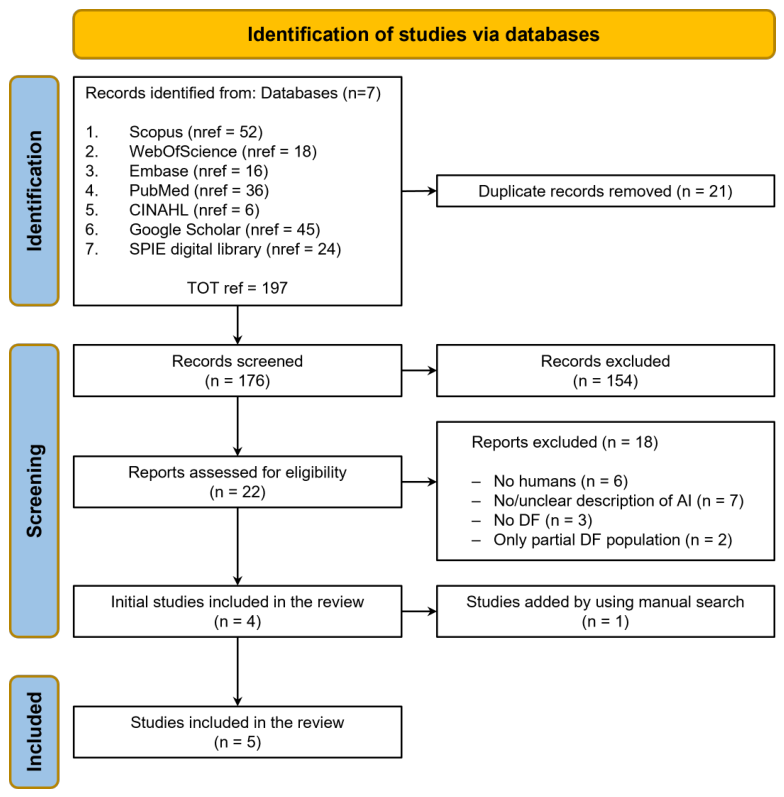
Emerging optical technologies may offer new opportunities for the non-invasive assessment of diabetic foot ulcers (DFUs), but the role of artificial intelligence (AI)-assisted autofluorescence-based approaches remains unclear. This scoping review aimed to map and summarise the published evidence on AI-assisted analysis of autofluorescence/fluorescence-based signals for DFU assessment and management. We searched Scopus, Web of Science, Embase, PubMed, CINAHL, Google Scholar, and the SPIE Digital Library, and also considered conference proceedings. We included English-language studies published between 2010 and October 2025. Of 197 records identified through database searching, 22 full-text articles were assessed for eligibility, and 5 studies met the inclusion criteria. Four studies focused on infection-related applications, specifically bacterial burden detection and Gram-type classification, whereas one study investigated tissue oxygenation estimation using a related optical imaging approach. All included studies were published between 2022 and 2025, were conducted in India, and four of the five evaluated the same device family or related variants. Overall, the evidence base was limited, geographically restricted, and technologically narrow. In addition, reporting of participant characteristics and AI methodology was often incomplete, with several studies relying on embedded proprietary or insufficiently described algorithmic components. Taken together, the available literature supports early proof-of-feasibility in restricted and largely device-specific evaluation settings rather than robust evidence of broad clinical validity, implementation readiness, or routine-care utility. Larger, more diverse, and independently validated studies with standardised acquisition procedures and more transparent AI reporting are needed before these approaches can be meaningfully evaluated for routine DFU care.
Keywords: diabetic foot ulcer; autofluorescence imaging; wound autofluorescence; artificial intelligence; machine learning; bacterial infection; multispectral imaging diabetic foot ulcer; autofluorescence imaging; wound autofluorescence; artificial intelligence; machine learning; bacterial infection; multispectral imaging