1. Introduction
The underlying cause of newly diagnosed thrombocytopenia at any age is more likely to be an acquired disease than a hereditary disorder [
1]. Hereditary thrombocytopenias are rare, heterogeneous disorders that can result in early-onset thrombocytopenia with varying degrees of bleeding. They are characterized by the presence of larger platelets in the blood smear, a positive family history, immunodeficiency, autoimmune symptoms, and splenomegaly [
2]. Patients typically respond less well to steroid treatment, immunoglobulin therapy (IVIG), and splenectomy. For this reason, clinical hematologists are forced to perform a wide range of tests to identify the cause of the disease so the patient can receive appropriate therapy. Algorithms and recommendations have changed as the roles of genome and exome sequencing have increased. However, these methods are time-consuming, difficult to access, and extremely expensive, so their use must be decided on an individual basis for each patient, while retaining the traditional methods previously used, such as platelet morphology examination with a light microscope, flow cytometry, and platelet function tests [
3].
2. Case Report
We detected moderate thrombocytopenia for the first time in a 7-year-old child at age 3.5 years (114 G/L). Her physical status is notable for widespread vitiligo and moderate splenomegaly. During observation, her platelet count was lower (20–50 G/L) on several occasions, but did not require high-dose immunoglobulin (IVIG) treatment. Therefore, following a bone marrow examination, she was treated with oral methylprednisolone (2 mg/kg), which caused her platelet count to rise. The bone marrow examination confirmed hematopoietic activity and ruled out malignancy. During steroid treatment, due to particularly severe thrombocytopenia (5 G/L), the patient was successfully treated with IVIG (1 g/kg) and a temporarily increased dose (4 mg/kg) of steroids (75 G/L). Further tests performed prior to the bone marrow test did not reveal any infection (cytomegalovirus, Epstein–Barr virus, Parvovirus B19, HIV, Toxoplasma, rubella, varicella, herpes simplex virus IgM negative). The autoimmune panel test showed no abnormalities, and immunoglobulin levels were within the normal range for her age (IgGAM). Anisocytosis was observed in the peripheral smear. To clarify the etiology, we initiated several diagnostic tests, including von Willebrand disease, Gaucher disease, hemolytic uremic syndrome, myelodysplasia, systemic lupus erythematosus, liver disease, and Helicobacter pylori infection, all of which were ruled out. Subsequently, due to chronic thrombocytopenia persisting despite the use of azathioprine supplementation, we initiated oral eltrombopag treatment (25 mg/day), which we administered in increasing doses (max. 50 mg/day). We were forced to suspend this treatment due to jaundice, vomiting, and extremely high serum iron levels (147.1 μmol/L), accompanied by an increasing platelet count (61 G/L). We then started subcutaneous romiplostim treatment, which, even at the maximum individualized dose, did not achieve the desired effect (max. 18 G/L). Avatrombopag treatment also proved ineffective. During this period, the child required low-dose steroid treatment (0.5 mg/kg) on several occasions and IVIG therapy (0.8 mg/kg) on four occasions; in all cases, we detected a marked increase in platelet count (80 G/L), but the effect was increasingly short-lived.
Given the progressive nature of the condition and the unclear etiology, we were unable to establish a precise diagnosis for the child based on detailed laboratory and hematological examinations. Since we had tried all the drugs registered for acute and chronic immune thrombocytopenia available in Hungary at the time, as well as combinations thereof, and the child showed a poor response, we performed exome sequencing as part of a personalized examination as the next diagnostic step.
3. WES Testing
The WES test was assessed using a virtual gene panel specialized for benign hematological diseases. This method allows us to identify pathogenic gene mutations confirming hereditary thrombocytopenia, which contradicts the diagnosis of chronic ITP due to severe therapy refractoriness and may inform therapeutic decisions in our patient. Furthermore, the increased risk of malignancy in hereditary thrombocytopenia, which is not identified in time, can lead to severe health damage. In many such cases, allogeneic bone marrow stem cell transplantation is a therapeutic alternative. Knowledge of the genetic disease and the specific genetic mutation is also of fundamental importance for the child’s future family planning.
4. Method
Next-generation sequencing (NGS) analysis of the entire coding region and splice sites in DNA extracted from peripheral blood samples was executed using the Illumina DNA Prep with Exome 2.5 Enrichment kit on the Illumina NextSeq 2000 instrument (Illumina, San Diego, CA, USA). We used the Dragen Enrichment v4.3.6 (Illumina) application for bioinformatic analysis. The identified nucleic acid sequences were aligned to the GRCh38 human reference genome. We annotated the variants we had found using the Nirvana (Illumina) software (version: v3.23.0). For the pathogenic classification of potential variants, we used the 2015 guidelines of the American College of Medical Genetics and Genomics (ACMG) [
4] and the following databases: NCBI-Clinvar, Varsome, and Franklin by Genoox.
5. Results
5.1. Presumed Pathogenic Variants
The genetic variants identified by the WES can be divided into two groups based on their likelihood of causing disease. The presumed pathogenic variants are shown in
Table 1, and variants with unknown clinical relevance are shown in
Table 2.
Table 2.
Variants identified by WES with unknown clinical reference.
Table 2.
Variants identified by WES with unknown clinical reference.
| Gene | Variant | Variant Identifier | Variant Type | Typical Gene-Related Diseases |
|---|
| NBEAL2 (NM_015175.3) | c.806G>A
p.(Arg269His)
VAF = 100%
germline mutation | ClinVar: - | VUS | Gray platelet sy, AR |
| VWF (NM_000552.5) | c.3692A>G
p.(Asn1231Ser)
VAF = 46.7%
germline mutation | ClinVar: 976,752 | VUS | von Willebrand disease, type 2A, 2B, 2M, 2N, AR/AD |
| PIGT (NM_015937.6) | c.563C>G
p.(Pro188Arg)
VAF = 45.1% | ClinVar: - | VUS | Paroxysmal nocturnal hemoglobinuria AD6Smu |
Figure 1.
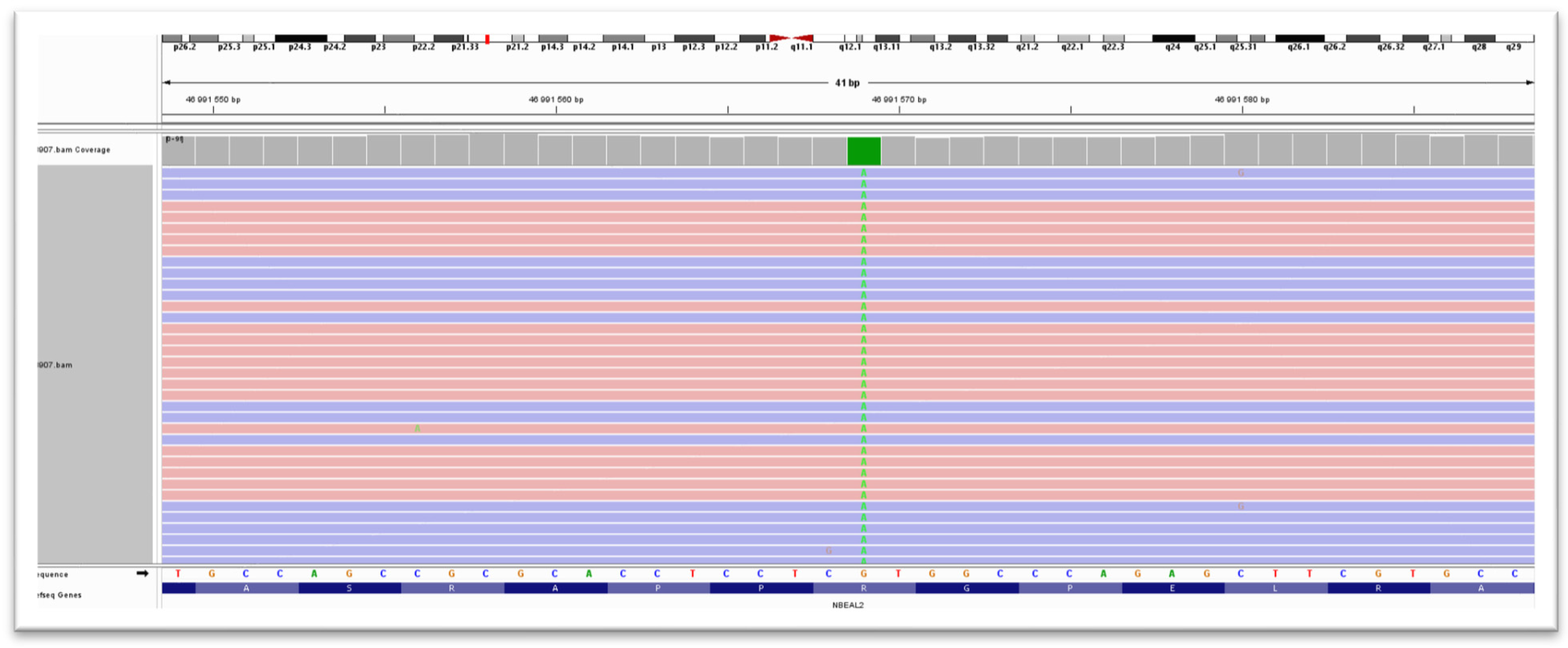
Visualizing the sequence reads and homozygous NBEAL2 p.(Arg269His) variant in Integrative Genomics Viewer (IGV). Red and blue colors represent strand information. The total coverage of the variants position is 81X (37+, 44−).
Figure 1.
Visualizing the sequence reads and homozygous NBEAL2 p.(Arg269His) variant in Integrative Genomics Viewer (IGV). Red and blue colors represent strand information. The total coverage of the variants position is 81X (37+, 44−).
5.2. Variants with Unknown Clinical Relevance
Following the WES test results, the child has been re-examined for all diseases suggested by the test. In the absence of clinical anemia or hemolysis, paroxysmal nocturnal hemoglobinuria was considered unlikely, and peripheral blood flow cytometry (FCM) did not confirm the disease (negative FCM for CD55 and CD59). Haemostasis testing showed antithrombin III and von Willebrand factor levels within the normal range (antithrombin III activity: 103.6%, von Willebrand factor activity: 64.4%, von Willebrand antigen: 69.7%, VIII clotting factor activity: 135.2%). Platelet function analysis (PFA-200) showed reduced responses to ADP, adenosine diphosphate (ADP), arachidonic acid, and ristocetin (ADP: 38%, arachidonic acid: 41%, ristocetin: 61%; normal range: 70–100%). However, in the setting of thrombocytopenia, prolonged closure time may reflect the low platelet count rather than intrinsic platelet dysfunction. In cases of thrombocytopenia, the PFA-200 cannot reliably distinguish whether the cause of bleeding is a low platelet count or platelet dysfunction [
5,
6].
The most likely disease-causing mutation was a variant in the
NBEAL2 gene (
Figure 2), which encodes a BEACH domain-containing protein involved in membrane dynamics and intracellular vesicle transport [
7]. Pathogenic variants in
NBEAL2 (neurobeachin-like 2) are known to cause gray platelet syndrome (GPS) [
3]. Gray platelet syndrome is a rare inherited disorder characterized by a mild to moderate bleeding tendency, moderate thrombocytopenia, and a significant reduction or absence of platelet alpha granules and the proteins they contain [
8]. They possess normal dense (δ) granules, lysosomes, mitochondria, and peroxisomes. Genome-wide association analysis mapped the GPS locus to a 9.4-megabase region on chromosome 3p21 [
9,
10,
11], which contains 197 protein-coding genes, of which 69 have been fully or partially sequenced [
11]. Many patients with gray platelet syndrome develop splenomegaly and myelofibrosis [
12].
Clinically apparent, inherited thrombocytopenia associated with
NBEAL2 gene mutations is most commonly seen in the form of biallelic (homozygous or compound heterozygous) mutations. Heterozygous carriers, who carry only one mutant allele, are generally not thrombocytopenic, although they may have mild platelet abnormalities. Overall, therefore, the form containing two mutant alleles underlies the classic, clinically pronounced form of GPS (
Table 3) [
10].
Cases suggestive of both autosomal dominant and autosomal recessive inheritance have been described, suggesting that GPS is likely a genetically heterogeneous disorder with multiple molecular causes. In Japan, Mori et al. Identified 24 affected patients in a single family. In at least one case, transmission from father to son was observed, which is consistent with autosomal dominant inheritance [
13].
In a study of 116 individuals with GPS conducted by Gunay-Aygun et al. [
10], the majority of patients developed bleeding symptoms in infancy. Thrombocytopenia is usually mild to moderate, but it becomes more severe with age. Myelofibrosis is rare in childhood but tends to appear and worsen in adulthood due to the continuous flow of growth hormones and cytokines into the bone marrow [
14]. Thrombocyte aggregation tests showed no abnormalities in the vast majority of cases. In addition to the genetic defect, the presence of large, pale thrombocytes on peripheral blood smear and the absence of alpha granules on electron microscopy were criteria for diagnosis in all cases [
10]. All reported cases were homozygous for the abnormalities on chromosome 3, but they considered only patients with a positive transmission electron microscopy (TEM) image as affected. In a 2022 study by Louzil et al., two patients heterozygous for the
NBEAL-2 gene were found to have GPS confirmed during clinical examinations [
3]. The variant we examined has not yet been reported in the international literature in individuals with GPS and is not listed in ClinVar. In contrast, they can be found in both heterozygous and homozygous forms in healthy population databases (allele frequency of 0.003% in the GnomAD database, with 1 homozygote—
Table 4 and
Table 5).
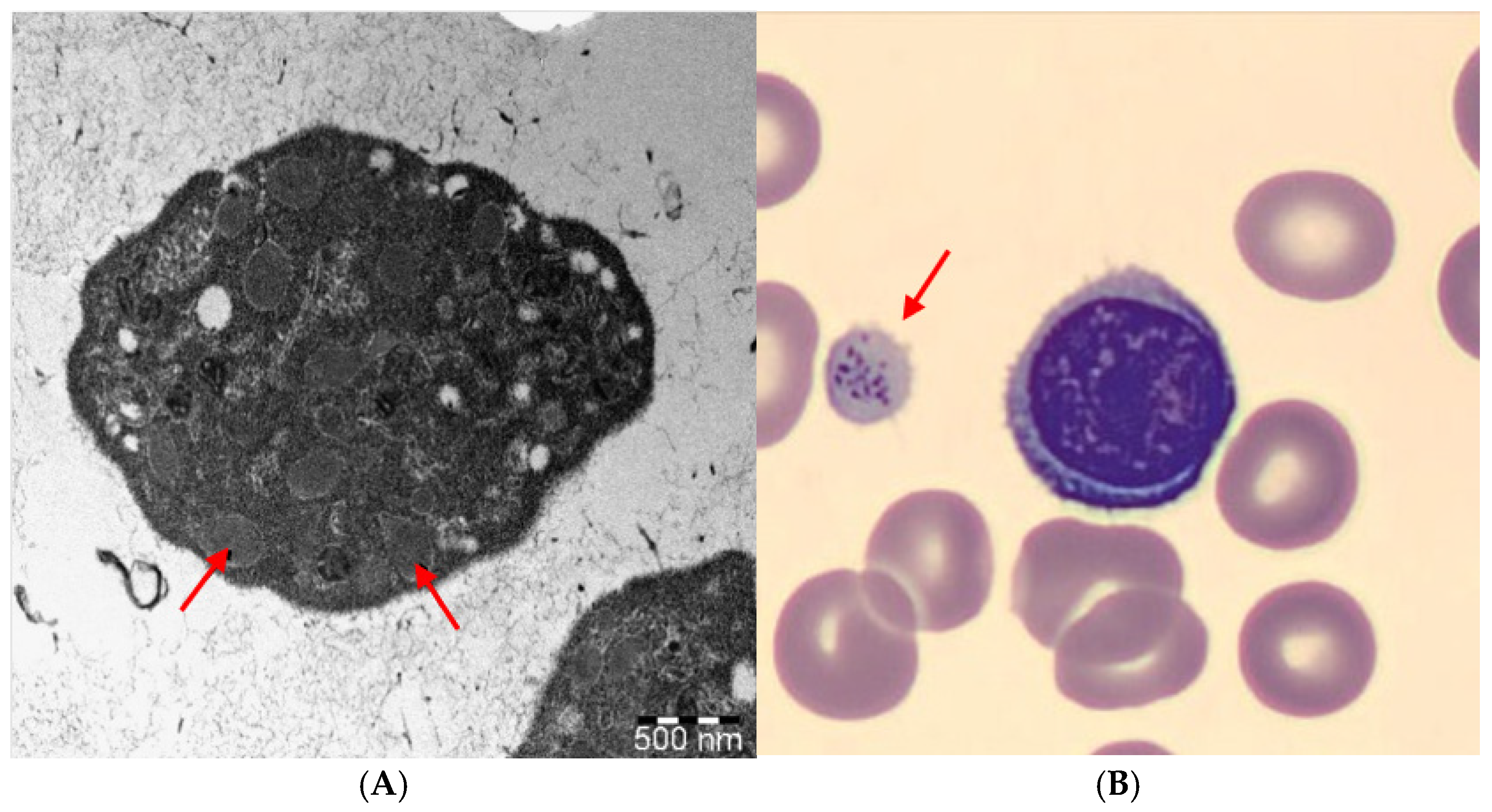
The variant is a missense mutation that replaces arginine at position 269 of the protein with histidine in exon 8 (out of 54 exons). The variant does not affect the functional protein domain defined by UNIPROT. Pathogenic missense variants are also known in the literature, but gene defects resulting in loss of function are generally identified in patients. Bioinformatic software Due to phenotypic overlap, we performed TEM of the child’s platelets, which did not confirm the presence of GPS (
Figure 3). We were unable to conduct a functional test, but given the negative TEM result, we do not currently consider the GPS justified. Based on the WES results and the additional tests performed, we believe that the
NBEAL2 mutation, which previously appeared to play the most significant pathogenic role, is a VUS; it may contribute to the unusual clinical course of the disease, but a definitive diagnosis cannot be established. Based on the article by Yao and Gorevitz published in 2023 and applying the new terminology, we believe that, in our patient’s case, the possibility exists that this is a genetically transitional disease (GTD) [
15].
6. Discussion
Hereditary platelet disorders (
Table 6) are increasingly recognized as an important cause of isolated thrombocytopenia in children, even though they occur at a much lower rate than acquired disorders. This possibility should be considered in patients with “refractory immune thrombocytopenia” if there is a family history of thrombocytopenia or leukemia, or if the platelet count has been low on multiple occasions throughout the child’s life and has occurred in isolation [
16,
17]. Many of these syndromes are associated with other disorders (immunodeficiency, kidney disease, and risk of malignant tumors). An accurate diagnosis is also important for genetic counseling and to avoid inappropriate interventions (immunosuppressive therapy in cases of presumed refractory ITP). Assessing platelet counts in children and their parents, determining the duration of bleeding symptoms, and identifying related findings in the medical history or physical examination can help distinguish between inherited and acquired causes. Most inherited platelet disorders result from genetic defects in the megakaryocyte lineage, leading to unregulated thrombopoiesis. The number of genetic variants reported to be associated with thrombocytopenia is large and continues to grow [
18,
19].
In the treatment of hereditary thrombocytopenia, thrombopoietin receptor agonists (TPO-RA) are expected to be effective, whereas IVIG is not [
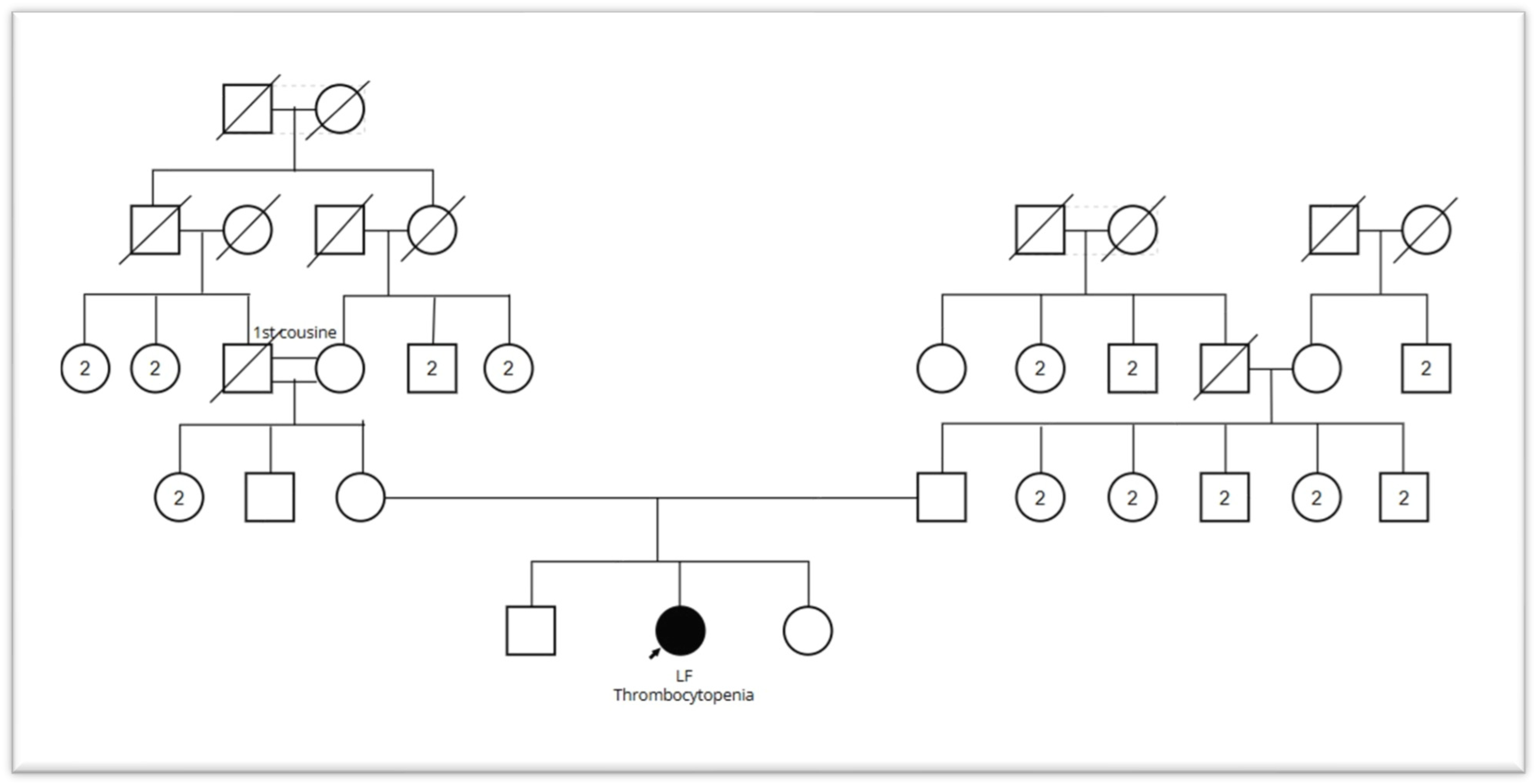
20]. In our patient’s case, the opposite pattern was observed, contradicting a diagnosis of hereditary thrombocytopenia. However, given the family history of consanguineous marriage (
Figure 4), vitiligo involving the entire body, mild splenomegaly, slightly grayer platelets observed on platelet morphology tests, and the increasingly poor response to IVIG, we considered it necessary to perform a WES test. Further testing was necessary due to the
NBEAL2 VUS being homozygous, as it is uncommon for a patient to be homozygous for a phenotype-relevant variant without clinical manifestation.
In our case, we want to highlight the important fact that although the WES tests available today are important, their significance should be assessed. With caution, patients often need to be re-examined (“reverse phenotyped”) based on potentially relevant abnormalities, and the causal role of genetic abnormalities of uncertain clinical significance must be proven. Not all detected gene mutations manifest as clinically apparent diseases. Unfortunately, this cannot always be proven, which can be psychologically stressful for both the family and the treating physicians. The anxiety caused by uncertainty can be reduced through pre-test genetic counseling, which should include informing the family about the possibility of identifying VUSs and that a negative genetic test result does not entirely rule out the possibility of a genetic etiology. All uncertain or inconclusive WES results should be reevaluated every 2–3 years, depending on the patient’s phenotype and clinical course. In this case, it became clear that the findings given to the parents or received on online “findings viewer” sites should only contain clinically relevant information explaining the basic symptoms. It is stressful for both the family and the clinical hematologist who communicates the report, as well as for the healthcare system financially, if the report lists a “multitude” of diseases as possible genetic defects. The question in each case is which genetic abnormality explains the patient’s underlying symptoms. In our opinion, if the complete pathological findings, including all genetic abnormalities, were first analyzed exclusively by the clinical hematologist and geneticist, and then, based on their opinion, the narrowed findings were given to the parents about the diseases that may be relevant as causes, it would be less stressful for the family, the healthcare system, and the clinician. The patient would then need to be clinically re-examined for the specified diseases, and the clinical manifestations of the genetic abnormality confirmed.
Accordingly, after evaluating the case and the series of extended tests performed on the child due to the WES findings, we changed the reporting strategy for WES tests evaluated with our virtual gene panel developed for targeted benign hematological diseases, and we now provide families with much narrower findings.
Author Contributions
Concept development: E.G., G.O. and G.B.; methodology: B.E., C.B., K.B.Á., H.Á., L.K. and B.R.; software: C.B. and B.R.; validation: E.G., C.B. and G.O.; formal analysis: G.O. and E.G.; investigation: E.G., G.B., L.K., B.E., C.B., K.B.Á., B.R., H.Á. and G.O.; resources: E.G.; data management: E.G., L.K., B.E., C.B., K.B.Á., B.R., H.Á. and G.O.; writing—preparation of the original draft: E.G., G.B., L.K., B.E., C.B., K.B.Á., B.R., H.Á. and G.O.; writing—review and editing, E.G., G.B., L.K., B.E., C.B., K.B.Á., B.R., H.Á. and G.O.; visualization, E.G., L.K. and H.Á.; supervision, G.O.; project administration, E.G. and G.O.; securing funding, G.O. All authors have read and approved the published version of the manuscript.
Funding
This research were funded by the National Research, Development and Innovation Office (NKFIH) (grant number: PD145889) and the Hungarian Pediatric Oncology Network.
Institutional Review Board Statement
Ethical approval is not required due to the determination of the Regional Research Ethics Committee of the Clinical Center of the University of Pécs that, according to Hungarian law (Act CLIV of 1997 on Health; Government Decree 235/2009. (X. 20.); Decree 23/2002. (V.9.) EüM), a research ethics permit is not required for the publication of this manuscript.
Informed Consent Statement
Written informed consent has been obtained from the patient to publish this paper.
Data Availability Statement
The data presented in this study are available on request from the corresponding authors (the data are not publicly available due to privacy and ethical restrictions, as they relate to a single patient, but may be available upon reasonable request and with appropriate approvals).
Acknowledgments
JEOL JEM-1400Flash TEM electron microscope was funded by the GINOP-2.3.3-15-2016-00026 (New generation electron microscope: 3D ultrastructure).
Conflicts of Interest
The authors declare no conflict of interest.
References
- Çiftçiler, R. Hereditary thrombocytopenias: The challenge of increasing frequency and differential diagnosis. Hematol. Transfus. Cell Ther. 2025, 48, 106076. [Google Scholar] [CrossRef] [PubMed]
- Drachman, J.G. Inherited thrombocytopenia: When a low platelet count does not mean ITP. Blood 2004, 103, 390–398. [Google Scholar] [CrossRef] [PubMed]
- Louzil, J.; Stikarova, J.; Provaznikova, D.; Hrachovinova, I.; Fenclova, T.; Musil, J.; Radek, M.; Kaufmanova, J.; Geierova, V.; Ceznerova, E.; et al. Diagnosing Czech Patients with Inherited Platelet Disorders. Int. J. Mol. Sci. 2022, 23, 14386. [Google Scholar] [CrossRef] [PubMed]
- Richards, S.; Aziz, N.; Bale, S.; Bick, D.; Das, S.; Gastier-Foster, J.; Grody, W.W.; Hegde, M.; Lyon, E.; Spector, E.; et al. Standards and guidelines for the interpretation of sequence variants: A joint consensus recommendation of the American College of Medical Genetics and Genomics and the Association for Molecular Pathology. Genet. Med. 2015, 17, 405–424. [Google Scholar] [CrossRef] [PubMed]
- Kerényi, A. The Use of a Global Platelet Function Test (PFA100 Closure Time) in the Diagnosis of Platelet Dysfunction. Ph.D. Thesis, University of Debrecen, Debrecen, Hungary, 2005. [Google Scholar]
- Favaloro, E.J. Clinical utility of closure times using the platelet function analyzer-100/200. Am. J. Hematol. 2017, 92, 398–404. [Google Scholar] [CrossRef] [PubMed]
- Rensing-Ehl, A.; Pannicke, U.; Zimmermann, S.-Y.; Lorenz, M.R.; Neven, B.; Fuchs, I.; Salzer, U.; Speckmann, C.; Strauss, A.; Maaβ, E.; et al. Gray platelet syndrome can mimic autoimmune lymphoproliferative syndrome. Blood 2015, 126, 1967–1969. [Google Scholar] [CrossRef] [PubMed]
- White, J.G. Use of the electron microscope for diagnosis of platelet disorders. Semin. Thromb. Hemost. 1998, 24, 163–168. [Google Scholar] [CrossRef] [PubMed]
- Fabbro, S.; Kahr, W.H.; Hinckley, J.; Wang, K.; Moseley, J.; Ryu, G.Y.; Nixon, B.; White, J.G.; Bair, T.; Schutte, B.; et al. Homozygosity mapping with SNP arrays confirms 3p21 as a recessive locus for gray platelet syndrome and narrows the interval significantly. Blood 2011, 117, 3430–3434. [Google Scholar] [CrossRef] [PubMed]
- Gunay-Aygun, M.; Zivony-Elboum, Y.; Gumruk, F.; Geiger, D.; Cetin, M.; Khayat, M.; Kleta, R.; Kfir, N.; Anikster, Y.; Chezar, J.; et al. Gray platelet syndrome: Natural history of a large patient cohort and locus assignment to chromosome 3p. Blood 2010, 116, 4990–5001. [Google Scholar] [CrossRef] [PubMed]
- Kahr, W.H.; Hinckley, J.; Li, L.; Schwertz, H.; Christensen, H.; Rowley, J.W.; Pluthero, F.G.; Urban, D.; Fabbro, S.; Nixon, B.; et al. Mutations in NBEAL2, encoding a BEACH protein, cause gray platelet syndrome. Nat. Genet. 2011, 43, 738–740. [Google Scholar] [CrossRef] [PubMed]
- Delage, L.; Carbone, F.; Riller, Q.; Zachayus, J.-L.; Kerbellec, E.; Buzy, A.; Stolzenberg, M.-C.; Luka, M.; de Cevins, C.; Kalouche, G.; et al. NBEAL2 deficiency in humans leads to low CTLA-4 expression in activated conventional T cells. Nat. Commun. 2023, 14, 3728. [Google Scholar] [CrossRef] [PubMed]
- Mori, K.; Suzuki, S.; Sugai, K. Electron Microscopic and Functional Studies on Platelets in Gray Platelet Syndrome. Tohoku J. Exp. Med. 1984, 143, 261–287. [Google Scholar] [CrossRef] [PubMed]
- Wang, Y.; Zuo, X. Cytokines frequently implicated in myeloproliferative neoplasms. Cytokine X 2019, 1, 100005. [Google Scholar] [CrossRef] [PubMed]
- Yao, Q.; Gorevic, P.; Shen, B.; Gibson, G. Genetically transitional disease: A new concept in genomic medicine. Trends Genet. 2022, 39, 98–108. [Google Scholar] [CrossRef] [PubMed]
- Al-Huniti, A.; Kahr, W.H. Inherited Platelet Disorders: Diagnosis and Management. Transfus. Med. Rev. 2020, 34, 277. [Google Scholar] [CrossRef] [PubMed]
- Kulmala, L.; Aarnivala, H.; Pokka, T.; Huurre, A.; Järvelä, L.; Palmu, S.; Pöyhönen, T.; Niinimäki, R. Immune or inherited thrombocytopenia? A population-based cohort study on children and adolescents presenting with a low platelet count. Pediatr. Blood Cancer 2024, 71, e31363. [Google Scholar] [CrossRef] [PubMed]
- Lambert, M.P. Updates in diagnosis of the inherited platelet disorders. Curr. Opin. Hematol. 2020, 27, 333. [Google Scholar] [CrossRef] [PubMed]
- Neunert, C. Causes of Thrombocytopenia in Children; UpToDate: Waltham, MA, USA, 2025. [Google Scholar]
- Siegal, D.; Crowther, M.; Cuker, A. Thrombopoietin Receptor Agonists in Primary ITP. Semin. Hematol. 2013, 50, S18–S21. [Google Scholar] [CrossRef] [PubMed]
| Disclaimer/Publisher’s Note: The statements, opinions and data contained in all publications are solely those of the individual author(s) and contributor(s) and not of MDPI and/or the editor(s). MDPI and/or the editor(s) disclaim responsibility for any injury to people or property resulting from any ideas, methods, instructions or products referred to in the content. |





 ,
,