


Abstract
Background/Objectives: Obesity has been associated with the development and severity of benign prostatic hyperplasia (BPH), yet its influence on outcomes following definitive surgical management, like holmium laser enucleation of the prostate (HoLEP), remains unclear. Furthermore, gradation of body mass index (BMI) severity has yet to discern personalized outcome stratification. We evaluated BMI’s influence on perioperative, immediate, short-term follow-up, and patient-reported outcomes for HoLEP patients. Methods: We performed a retrospective review of a prospectively maintained database of patients undergoing HoLEP for BPH at a single institution between January 2021 and August 2025. Outcomes included operative characteristics, post-operative complications, and validated symptom score changes. Analyses treated BMI as both a continuous and categorical variable. Multivariable linear and logistic regression models adjusted for common colinear confounders. Results: Among 1445 patients, BMI was not associated with most immediate, three-month, or patient-reported outcomes. Surgical complications were low across all BMI categories, and post-operative reported outcomes indicating high success rate for HoLEP. Higher BMI correlated with a modest increase in enucleation time (β = 0.197; p = 0.0132), increased odds of dysuria (OR = 1.084; p < 0.001), and change in American Urological Association Symptom Score (β = 0.211; p = 0.0334). All other operative metrics, complication rates, continence outcomes, and symptom scores (17 other total) were independent of BMI. Conclusions: After adjustment for relevant confounders, BMI does not meaningfully predict surgical safety, functional recovery, or patient-reported benefit following HoLEP. BMI alone should not influence candidacy or risk stratification for HoLEP in patients with BPH, instead favoring personalized, risk-stratified approaches.
1. Introduction
Obesity is a major risk factor in the development of benign prostatic hyperplasia (BPH) and associated lower urinary tract symptoms (LUTSs), a highly prevalent condition that affects over 80% of men 70 years old and older [1,2]. Studies have shown that elevated body mass index (BMI), a common calculation from height and mass used to classify body weight categories, increases likelihood of more intense and rapidly onsetting LUTS [3]. A variety of etiological explanations exist, including elevated intra-abdominal pressures increasing bladder pressure, an endocrine-hypogonadal dysfunction, and increased sympathetic activation and inflammation [3]. Since the global obesity epidemic, more patients are presenting with concomitant LUTS and elevated BMI. The literature suggests that obese patients are less likely to experience significant benefits from pharmaceutical therapy alone, and with further progression of symptoms, obese patients are often more inclined to receive surgical intervention for definitive treatment [4].
Patients with obesity who receive surgical treatment options have nuanced background profiles compared to other patients with BPH. In a study by Chen et al., patients with obesity undergoing Greenlight photo-vaporization of the prostate (PVP) were found to be younger with larger transition zones and total prostate volume [5]. However, this was not correlated to discrepancies in either surgical parameters or complications. When reviewing patients who received prostatectomies via either transhow resection of the prostate (TURP) or Greenlight laser selective PVP, surgical complications, such as retention of urine, bladder stones and diverticula formation, were not significantly different for overweight and obese patients [6]. Similar observations were noted for thulium laser vapoenucleation [7]. These studies, however, notably did not control for several other comorbidities which are also significantly more prevalent in patients with obesity. Thus, the many associated patient characteristics in patients with obesity and LUTS must be sufficiently accounted for when assessing BMI’s influence. Obesity commonly coexists with metabolic syndromes, particularly diabetes and neurologic diseases, which independently influence bladder function, LUTS, and recovery. Prior studies therefore often capture combined effects rather than BMI alone. Excluding these conditions can isolate BMI’s influence, enabling more precise, personalized risk stratification and interpretation.
Holmium laser enucleation of the prostate (HoLEP) is an American Urological Association (AUA)-recommended treatment option for LUTS and BPH, independent of prostate and gland size [8]. It has been employed in patients with elevated BMIs, who also typically have larger prostate volumes [9]. Obesity significance testing with post-operative complications has proven difficult, due to HoLEP’s low complication rate, but obesity has been correlated to longer operation times in prior studies [10]. One complication of note was higher incidence of open conversion for patients with elevated BMIs receiving HoLEP due to their body habitus and difficulty with scope manipulation [11]. However, the current body of literature has failed to control for colinear patient characteristics and has been performed on too small of a sample pool to aptly capture surgical complications and adverse events. We sought to address this gap by investigating the influence of BMI on an array of surgical characteristics and outcomes related to HoLEP.
2. Materials and Methods
Following IRB approval, we conducted a retrospective review of a prospectively maintained database of patients undergoing HoLEP surgery for BPH at our institution between January 2021 and August 2025. All HoLEP procedures were performed by one of two surgeons using high-powered pulse-modulated holmium laser technology. Exclusion criteria included patients with history of diabetes, neurological disease, urinary tract infections, prostatitis, urethral stricture, or radiation therapy. Diabetes and neurologic diseases have been previously correlated with worse surgical outcomes following HoLEP, and, given their higher prevalence in obese patients, were excluded (n = 342) [12]. Patients with intra-operative complications or receiving hemi-HoLEP (partial/half gland removal) totaled n = 81 and n = 8 respectively and were also excluded. Surgeries with intra-operative complications were removed given that this investigation studied outcome courses, all of which would be influenced by the complication itself instead of BMI alone. Post-operative survey responses, patient demographics, baseline health status, symptom scores, and urinary function; operative characteristics; immediate post-operative details; functional outcomes; and adverse event incidences were all collected for each participant in our study. Patients missing greater than 25% of this information were also excluded.
Analysis was performed with a set of six confounding variables. Patient’s age, pre-operative prostate volume, prostate-specific antigen level, American Society of Anesthesiologists (ASA) physical status classification, occurrence of a prior BPH surgery, and history of anticoagulation use at time of surgery. These potential confounders are all indicated to potentially influence peri- and post-operative characteristics and outcomes, and all could have been correlated to a patient’s BMI. To analyze patient BMI as the independent variable, while also accounting for clinical relevance of standard BMI categories, two series of statistics were performed in parallel. First, BMI was treated as a continuous variable. Subsequently, a BMI category of underweight, normal weight, overweight, and obese was assigned to each patient: buckets were under 18.5, 18.5 to 24.9, 25 to 29.9, and 30 or greater kg/m2, respectively. For categorical analyses, BMI was modeled using indicator (dummy) variables with the healthy BMI range as the reference category, allowing estimation of category-specific effects while preserving within-group variability. The underweight group was excluded from categorical analysis due to insufficient sample size (n = 2) for stable inference.
For continuous outcome variables, linear regressions were fit, accounting for confounders, between patient BMI and the outcome, and β values for the regression coefficient were recorded. For categorical variables, such as for the occurrence of an event, logistic regressions, also accounting for confounding variables, were employed, with odds ratios (ORs) calculated. For all outcome analyses, sample size varied by endpoint based on data availability. General statistics utilized all available data for each variable. In contrast, multivariable analyses were conducted using complete-case samples, such that the analytic denominator for each model includes only patients with non-missing BMI, covariates, and the outcome of interest. Accordingly, sample sizes differ across outcomes and models. For both β and OR, 95% confidence intervals (CIs) and p-values were derived. All analyses were conducted using Python 3.0 (Python Software Foundation, Wilmington, DE, USA). Statistical significance was defined as p < 0.05. Due to the exploratory nature of this work, p-value adjustments, such as a Bonferroni correction, were not employed.
3. Results
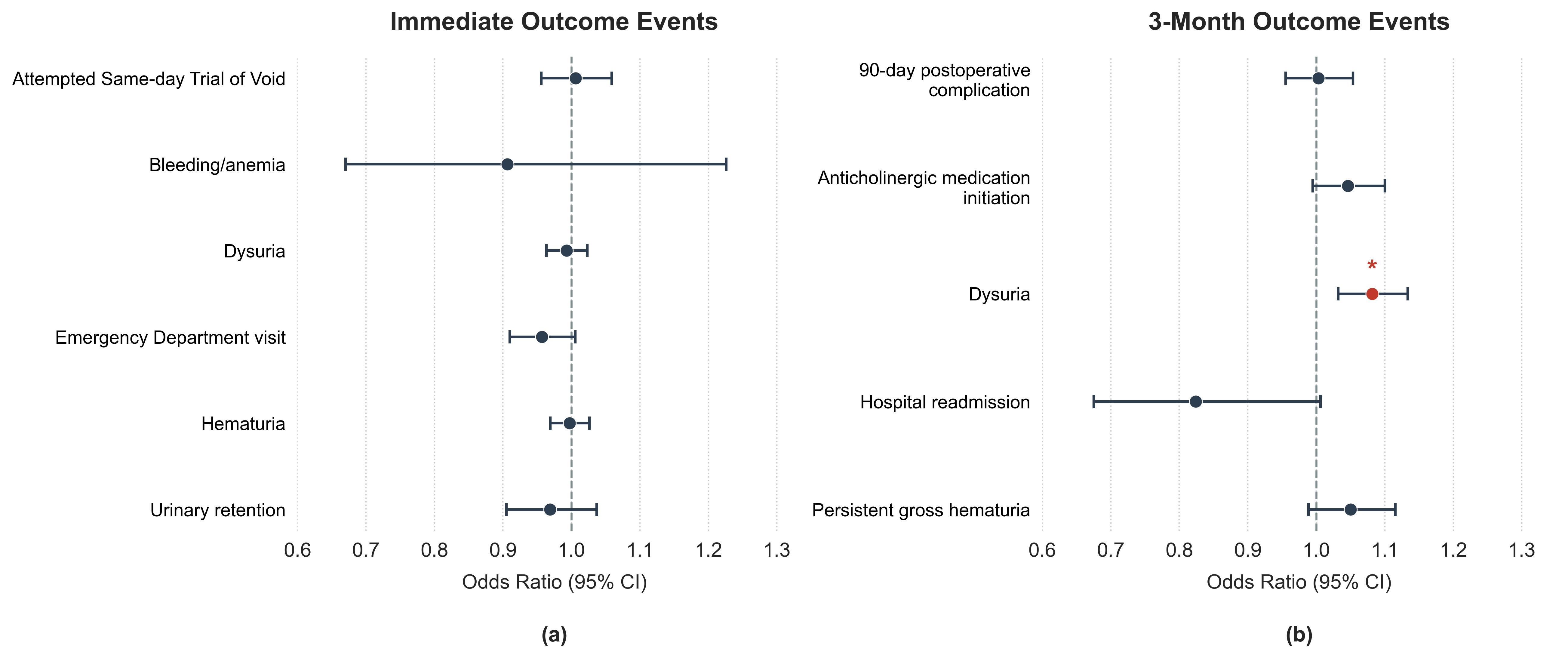
A total of 1445 patients who underwent HoLEP were included in this study (Table 1). Patients were on average 70.2 ± 8.0 years old, had an average prostate size of 113.0 ± 63.7 g and prostate-specific antigen (PSA) of 5.9 ± 7.6 ng/mL. A history of prior BPH surgery was present in 14.2% of patients and 13.8% were on anticoagulation at the time of surgery. A total of 70 patients were both excluded from the study due to intra-operative complications and had reported BMIs. Their respective BMI distribution was similar to that of the study cohort’s following a 2-sample Kolmogorov–Smirnov test (intra-operative complication cohort: 28.1 ± 4.1 kg/m2; study cohort: 27.6 ± 4.6 kg/m2; p = 0.405). Overall, only three of the twenty performed statistical tests crossed our predetermined α of 0.05—operative enucleation time, dysuria at 3 months post-operatively, and American Urological Association Symptom score (AUASS) change (Figure 1). Statistical significance and overall trends were largely mirrored between testing by BMI category and when viewing BMI as a continuous variable, thus the table below references only the latter (the former can be viewed in detail comparing healthy BMI range patients to either overweight or obese BMI range patients in Appendix A tables [Table A1, Table A2, Table A3, Table A4, Table A5 and Table A6]).
Table 1.
Demographics and intra-operative characteristics for the cohort and by BMI category.
Figure 1.
Forest Plot of odds ratio for outcome incidences based on BMI as a continuous value: (a) Immediate outcome events; (b) 3-month outcome events. Error bars depict 95% confidence intervals. Significance indicated by * and red color. CI, Confidence interval.
3.1. Immediate Post-Surgery Characteristics
Table 2 summarizes immediate post-operative outcomes and their associations with BMI; almost none of these outcomes depicted a significant relationship with BMI. Among continuous measures, BMI was not associated with operating room time, morcellation time, total laser energy delivered, or prostate specimen weight. Enucleation time was the sole exception, with a modest increase with increasing BMI (β 0.197; p = 0.0132). Binary post-operative events likewise demonstrated no significant associations, with odds ratios near unity and wide confidence intervals (p > 0.05 for all). Overall, immediate post-operative outcomes after HoLEP appeared largely independent of BMI, except for a small but statistically significant increase in enucleation time.
Table 2.
Immediate outcome events and characteristics with their correlation to BMI as a continuous variable.
3.2. 3-Month Post-Operative Characteristics
Table 3 details patients’ three-month post-operative outcomes and correlations to their BMI. Most outcomes again showed no statistically significant relationship with BMI. BMI lacked a significant correlation to 90-day post-operative complications or hospital readmissions. Dysuria was the only statistically significant three-month outcome; higher BMI correlated to increased odds of occurrence (11.6%; OR 1.084 [1.034–1.136]; p < 0.001). However, in aggregate, three-month post-operative outcomes, similarly to immediate outcomes, were largely independent of BMI.
Table 3.
Three-month outcome events with their correlation to BMI as a continuous variable.
3.3. Survey Score Changes
Changes in AUA symptom score (AUASS) and Michigan Incontinence Symptom Index (M-ISI) scores are documented in Table 4. These scores generally decreased following HoLEP, with AUASS dropping the most (decrease of 11.19 ± 9.13; β 0.211; p = 0.0334). This was the sole change significantly correlated to BMI.
Table 4.
Change in survey response scores with their correlation to BMI as a continuous variable.
4. Discussion
Results from our investigation suggest that BMI is not an independent predictor of perioperative, short-term follow-up, or patient-reported outcomes following HoLEP. This is following statistical control of clinically relevant confounders. This work mirrors findings from other prostate resection surgical techniques for BPH. In the Greenlight PVP literature, Chen et al. and Pierce et al. studied similar surgical outcomes, also noting BMI’s lack of influence [5,13]. Previous characterizations of obesity’s deleterious effect in BPH treatment have centered on increased waist circumference or BMI in the setting of metabolic syndrome [14]. These studies proceed to associate obesity with persistent storage LUTS following open prostatectomies and TURP; however, this contextually skews results, due to other metabolic syndrome comorbidities like diabetes or hypertension. Alternatively, we chose confounding variables based on their collinearity with obesity itself, to better segregate BMI’s effect. Further, we excluded neurological diseases and diabetes mellitus, often considered a large confounding comorbid condition in urology studies involving obesity [15]. While this limits the generalizability of the true clinical effect of an elevated BMI, omitting common sequalae, the purpose of this study was to investigate the influence of the BMI metric in isolation at risk stratification, necessitating removal of as much confounding as possible.
Three of our outcome variables were significantly correlated to BMI following confounder control: enucleation time, dysuria, and AUASS change. While we elected not to perform p-value adjustments due to this investigation’s exploratory nature, given we performed 20 comparisons, this is an inherent limitation. Particularly for AUASS change, which had a p-value of 0.0334, more caution is required when generalizing results. The significant difference in enucleation time is likely a reflection of larger prostates or more challenging tissue planes, which would result in longer time for enucleation. This has been similarly shown in the literature where Tamalunas et al. noted a twelve-minute increase in enucleation time from 31 to 43 min in patients with obesity (p < 0.01) [10]. Chen et al. similarly noted larger prostate sizes (p < 0.001) and transition zone volumes (p = 0.017) with BMI for patients receiving Greenlight PVP [5]. While our result was also significant (p = 0.0132), this would likely not remain following p-value adjustment, suggesting a small effect size or a side effect of our large sample cohort and high number of significance tests performed.
Dysuria was also significantly more common as patient BMI category increased (OR: 1.084; p-value < 0.001). This may be a factor of the patient’s BPH itself, where obesity and an elevated BMI have previously been correlated to increased LUTSs, including dysuria specifically [16]. In Greenlight PVP, Pierce et al. found that obese patients required higher energy utilization compared to normal BMI patients [13]. Higher energy utilization can lead to increased mucosal irritation and transient dysuria. In our study, we did not find high total energy utilization with increased BMI. However, other mechanistic explanations include delayed epithelial healing in metabolic disease, altered nociceptive signaling, and undiagnosed prediabetes/diabetes. Diabetes mellitus has been shown to significantly correlate to dysuria symptoms in men, due to diabetic autonomic neuropathy causing genitourinary disturbances [17,18]. While we excluded any patient with a diabetes diagnosis, given that it will be more prevalent in patients with obesity, this cohort is more likely to be prediabetic or have undiagnosed diabetes. This could explain the higher dysuria rate with increasing BMI category. Baseline hemoglobin A1c (HbA1c) was not available for these patients, preventing any subsequent analysis on its correlation. Lacking this or any other indication of prediabetes or uncontrolled glucose levels limits substantiating this assumption. While our study did not directly quantify prediabetes or HbA1c, a prior HoLEP study found no differences in outcomes after stratifying patients based on HbA1c levels [12].
It is worth noting that larger body habitus can make HoLEP technically challenging to perform, causing some surgeons to abort cases or convert to TURP and/or open surgery [19]. In our cohort, we were able to successfully perform HoLEPs on patients with BMIs up to 49.66 kg/m2 with zero conversions or case abortions. This success may be due, in part, to an adaptive surgical strategy that modifies our traditional “bottom-up” approach as needed. Specifically, if we are unable to enter the bladder neck initially, we create a posterior incision distally starting at the verumontanum and move proximally toward the bladder neck. The anterior plane of the prostate is generally shorter than the posterior plane, allowing for easier entry into the bladder. Once bladder entry is obtained through the anterior plane, the lateral margins of the bladder neck are opened dissected in a top-down approach. The high-powered holmium laser offers excellent hemostasis which minimizes bleeding risks that are otherwise amplified in obesity, making HoLEP an excellent choice for obese patients with LUTS [20,21]. The low complication rate of HoLEP may be a limitation in itself, due to sparse events limiting reliability of logistic regressions for subgroups. This is countered by our large sample size (n = 1445 patients), but generalizability concerns persist given how rare several of these events are.
Our study consists of several limitations due to its retrospective single-center nature. This includes establishing only correlations instead of causation, a low frequency of adverse events limiting the power of significance tests, and a lack of randomization. Although patients depicted a wide distribution of BMI values, other demographic variables may be more homogeneous given that they all received care from the same institution. These limitations are countered by our large overall sample size of 1445 patients, our uniform procedural, data collection, and statistical techniques, and our robust confounder control. Further, studying multiple outcomes from different temporal domains offered a broader, more inclusive depiction of surgical outcomes from HoLEP.
Our investigation suggests that patient BMI does not meaningfully influence surgical safety, functional recovery, or patient-perceived benefit following HoLEP, and thus should not be used as a sole determinant in clinical decision-making. Albeit via a retrospective investigation with clinically relevant exclusion criteria, this study suggests that specifically BMI may lack clinical utility. Given the lack of statistical correlation, patient BMI alone does not appear to be a deterrent for surgical operation, nor could it act as a surrogate for surgical risk. Categorizing patients as underweight, normal weight, overweight, or obese, albeit contributory to developing BPH in the first place, fails to establish insight into their surgical outcomes. Other patient demographics or comorbidities may contribute to a more complete characterization of HoLEP efficacy, but this research dissuades reliance on BMI alone. Suitability of this surgical procedure remains reliant on the shared decision-making and discretion of the urologist and patient.
5. Conclusions
BMI, both when utilized as a continuous numerical calculation and as a delineator for weight categories, fails to significantly influence most surgical outcomes and characteristics following HoLEP when controlling for other prevalent confounding variables. This counters previous dogmas on the risk factor of obesity or elevated BMI values alone for complications and adverse outcomes and instead insinuates the necessity to reframe clinical judgment unto other aspects of the patient’s health. While this does not comment on BMI’s influence on the occurrence of BPH itself, the significance of other prevalent comorbidities should be further investigated to similarly assess their impact on surgical outcomes following HoLEP. This supports a proposal for individualized risk stratification, composed of patients’ entire clinical profile, when identifying candidacy for and benefit from HoLEP.
Author Contributions
Conceptualization, J.T.P., J.N.G., A.P., P.X. and A.E.K.; investigation, J.T.P. and J.N.G.; data curation, J.T.P., J.N.G., A.P., N.K.; writing—original draft preparation, J.T.P.; writing—review and editing, J.T.P., J.N.G., A.P., N.K., P.X. and A.E.K. All authors have read and agreed to the published version of the manuscript.
Funding
This research received no external funding.
Institutional Review Board Statement
The study was conducted in accordance with the Declaration of Helsinki, and approved by the Institutional Review Board of Northwestern University Feinberg School of Medicine (protocol code STU00213284 and date of approval 24 August 2020).
Informed Consent Statement
Patient consent was waived due to the retrospective nature of the study and the use of de-identified data.
Data Availability Statement
Data availability is not applicable to this article, given that no new data was created or analyzed.
Conflicts of Interest
A.E.K. is a paid consultant for Storz, Boston Scientific, and Wolf. The remaining authors declare no conflicts of interest.
Abbreviations
The following abbreviations are used in this manuscript:
| BPH | Benign Prostatic Hyperplasia |
| HoLEP | Holmium Laser Enucleation of the Prostate |
| BMI | Body Mass Index |
| LUTS | Lower Urinary Tract Symptoms |
| PVP | Photo-Vaporization of the Prostate |
| TURP | Transurethral Resection of the Prostate |
| AUA | American Urological Association |
| ASA | American Society of Anesthesiologists |
| PSA | Prostate-Specific Antigen |
| HbA1c | Hemoglobin A1c |
| AUASS | American Urological Association Symptom Score |
| IPSS | International Prostate Symptom Score |
| M-ISI | Michigan Incontinence Symptom Index |
| QOL | Quality of Life |
| IRB | Institutional Review Board |
| TOV | Trial of Void |
| OR | Odds Ratio |
| CI | Confidence Interval |
Appendix A
Table A1.
Immediate outcome events and characteristics compared between healthy BMI range and overweight BMI range patients.
Table A2.
Immediate outcome events and characteristics compared between healthy BMI range and obese BMI range patients.
Table A3.
Three-month outcome events compared between healthy BMI range and overweight BMI range patients.
Table A4.
Three-month outcome events compared between healthy BMI range and obese BMI range patients.
Table A5.
Change in survey response scores compared between healthy BMI range and overweight BMI range patients.
Table A6.
Change in survey response scores compared between healthy BMI range and obese BMI range patients.
References
- Parsons, J.K.; Sarma, A.V.; McVary, K.; Wei, J.T. Obesity and Benign Prostatic Hyperplasia: Clinical Connections, Emerging Etiological Paradigms and Future Directions. J. Urol. 2013, 189, S102–S106. [Google Scholar] [CrossRef] [Scilit] [PubMed]
- Wei, J.T.; Calhoun, E.; Jacobsen, S.J. Urologic Diseases in America Project: Benign Prostatic Hyperplasia. J. Urol. 2005, 173, 1256–1261. [Google Scholar] [CrossRef] [Scilit] [PubMed]
- Parikesit, D.; Mochtar, C.A.; Umbas, R.; Hamid, A.R.A.H. The Impact of Obesity towards Prostate Diseases. Prostate Int. 2016, 4, 1–6. [Google Scholar] [CrossRef] [Scilit] [PubMed]
- Muller, R.L.; Gerber, L.; Moreira, D.M.; Andriole, G.; Hamilton, R.J.; Fleshner, N.; Parsons, J.K.; Freedland, S.J. Obesity Is Associated with Increased Prostate Growth and Attenuated Prostate Volume Reduction by Dutasteride. Eur. Urol. 2013, 63, 1115–1121. [Google Scholar] [CrossRef] [Scilit]
- Chen, P.-H.; Chang, R.-J.; Wang, H.-S.; Chang, Y.-H.; Liu, C.-Y.; Huang, L.-K.; Kan, H.-C.; Lin, P.-H.; Yu, K.-J.; Chuang, C.-K.; et al. Impact of Obesity on Clinical Presentation and Surgical Outcomes in Patients with Benign Prostate Hyperplasia Receiving Greenlight Laser Prostatectomy. Clin. Interv. Aging 2024, 19, 2071–2083. [Google Scholar] [CrossRef] [Scilit]
- Mosli, H.A.; Mosli, H.H. Influence of Body Mass Index on Benign Prostatic Hyperplasia-Related Complications in Patients Undergoing Prostatectomy. SpringerPlus 2013, 2, 537. [Google Scholar] [CrossRef] [Scilit]
- Carmignani, L.; Clementi, M.C.; Signorini, C.; Motta, G.; Nazzani, S.; Palmisano, F.; De Lorenzis, E.; Catellani, M.; Mistretta, A.F.; Conti, A.; et al. Safety and Feasibility of Thullium Laser Transurethral Resection of Prostate for the Treatment of Benign Prostatic Enlargement in Overweight Patients. Asian J. Urol. 2019, 6, 270–274. [Google Scholar] [CrossRef] [Scilit]
- Sandhu, J.S.; Bixler, B.R.; Dahm, P.; Goueli, R.; Kirkby, E.; Stoffel, J.T.; Wilt, T.J. Management of Lower Urinary Tract Symptoms Attributed to Benign Prostatic Hyperplasia (BPH): AUA Guideline Amendment 2023. J. Urol. 2024, 211, 11–19. [Google Scholar] [CrossRef] [Scilit]
- Batai, K.; Phung, M.; Bell, R.; Lwin, A.; Hynes, K.A.; Price, E.; Meiklejohn, K.M.; Bracamonte, E.R.; Funk, J.T. Correlation between Body Mass Index and Prostate Volume in Benign Prostatic Hyperplasia Patients Undergoing Holmium Enucleation of the Prostate Surgery. BMC Urol. 2021, 21, 88. [Google Scholar] [CrossRef] [Scilit]
- Tamalunas, A.; Westhofen, T.; Schott, M.; Keller, P.; Atzler, M.; Stief, C.G.; Magistro, G. How Obesity Affects the Benefits of Holmium Laser Enucleation of the Prostate for the Treatment of Male Lower Urinary Tract Symptoms. J. Clin. Urol. 2023, 16, 303–311. [Google Scholar] [CrossRef] [Scilit]
- Juvet, T.; Parikh, K.A.; Ball, C.T.; Dora, C.D. Morphologic Factors Associated with Open Conversion During Holmium Laser Enucleation of the Prostate. Urology 2020, 145, 258–261. [Google Scholar] [CrossRef] [Scilit]
- Guo, J.N.; Assmus, M.A.; Dean, N.S.; Lee, M.S.; Wong, C.; Rich, J.; Helon, J.; Huang, M.M.; Krambeck, A.E. Comparison of Outcomes in Patients with and without Neurologic Diseases Undergoing Holmium Laser Enucleation of the Prostate. Can. Urol. Assoc. J. 2024, 18, 255–261. [Google Scholar] [CrossRef] [Scilit]
- Pierce, H.; Goueli, R.; Al Hussein Al Awamlh, B.; Goel, S.; Meskawi, M.; Zorn, K.; Te, A.; Chughtai, B. Impact of Body Mass Index on Outcomes Following Anatomic GreenLight Laser Photoselective Vaporization of the Prostate. J. Endourol. 2021, 35, 39–45. [Google Scholar] [CrossRef] [Scilit] [PubMed]
- Gacci, M.; Sebastianelli, A.; Salvi, M.; De Nunzio, C.; Tubaro, A.; Vignozzi, L.; Corona, G.; McVary, K.T.; Kaplan, S.A.; Maggi, M.; et al. Central Obesity Is Predictive of Persistent Storage Lower Urinary Tract Symptoms (LUTS) after Surgery for Benign Prostatic Enlargement: Results of a Multicentre Prospective Study. BJU Int. 2015, 116, 271–277. [Google Scholar] [CrossRef] [Scilit] [PubMed]
- Daneshgari, F.; Liu, G.; Hanna-Mitchell, A.T. Path of Translational Discovery of Urological Complications of Obesity and Diabetes. Am. J. Physiol. Renal Physiol. 2017, 312, F887–F896. [Google Scholar] [CrossRef] [Scilit] [PubMed]
- Rehman, I.U.; Hussain, S.A.; Khan, H.; Habib, B.; Sheikh, R. The Association between Obesity and Prostate Volume in Patients with Benign Prostatic Hyperplasia. Pak. J. Med. Health Sci. 2021, 15, 1888–1891. [Google Scholar] [CrossRef] [Scilit]
- American Diabetes Association Professional Practice Committee. Retinopathy, Neuropathy, and Foot Care: Standards of Care in Diabetes—2026. Diabetes Care 2026, 49, S261–S276. [Google Scholar] [CrossRef] [Scilit]
- Tam, C.A.; Helfand, B.T.; Erickson, B.A. The Relationship Between Diabetes, Diabetes Severity, Diabetes Biomarkers, and the Presence of Lower Urinary Tract Symptoms: Findings from the National Health and Nutrition Examination Survey. Urology 2017, 105, 141–148. [Google Scholar] [CrossRef] [Scilit]
- Shvero, A.; Han, T.M.; Salib, A.; Shenot, P.J.; Das, A. Conversion of Holmium Laser Enucleation of Prostate to Open Prostatectomy. Urology 2022, 161, 100–104. [Google Scholar] [CrossRef] [Scilit]
- Tamalunas, A.; Westhofen, T.; Schott, M.; Keller, P.; Atzler, M.; Stief, C.G.; Magistro, G. Holmium Laser Enucleation of the Prostate: A Truly Size-Independent Method? Low. Urin. Tract Symptoms 2022, 14, 17–26. [Google Scholar] [CrossRef] [Scilit]
- Hu, H.; Chen, W.; Ma, W.; Yu, C.; He, Q.; Tang, J.; Yu, G. Optimizing Hemostasis in HoLEP Surgery: Retrospective Review of Selective Bipolar Plasmakinetic Technology Guided by Bladder Irrigation Fluid Color. World J. Urol. 2024, 42, 419. [Google Scholar] [CrossRef] [Scilit]

Disclaimer/Publisher’s Note: The statements, opinions and data contained in all publications are solely those of the individual author(s) and contributor(s) and not of MDPI and/or the editor(s). MDPI and/or the editor(s) disclaim responsibility for any injury to people or property resulting from any ideas, methods, instructions or products referred to in the content. |
© 2026 by the authors. Licensee MDPI, Basel, Switzerland. This article is an open access article distributed under the terms and conditions of the Creative Commons Attribution (CC BY) license.