
From Immunobiology to Clinical Application: Tumor-Infiltrating Lymphocytes in Melanoma


Abstract
1. Introduction
2. Materials and Methods
3. Immunobiology of TILs in Melanoma
3.1. Melanoma Neoantigens and Tumor Antigenicity
3.2. Composition of the TIL Compartment
3.3. Spatial Architecture of the Tumor Microenvironment
3.4. Functional States of TILs
3.5. Tumor-Resident Versus Blood-Borne T-Cell Clonotypes
3.6. Myeloid–T Cell Interactions and CD8+–Myeloid Networks
3.7. Tumor-Intrinsic Immune Resistance Pathways
4. TILs as Prognostic and Predictive Biomarkers for Personalized Management
4.1. Historical and Modern TIL Scoring Systems

| Approach | Method | Typical Readout | Strengths | Limitations | References |
|---|---|---|---|---|---|
| Classic histopathology (H&E) | Brisk/non-brisk/absent TIL pattern in the vertical growth phase (distribution and density; “diffuse/circumferential” vs. focal vs. none) | Ordinal categorical score (3-level) | Fast; no extra cost; historically validated; broadly understood; correlates with SLN status and melanoma-specific survival | Subjective; interobserver variability; limited granularity; may under-capture spatial compartmentalization and heterogeneity/sampling issues | [5,6] |
| Modern histopathology (H&E, semi-quantitative) | Semi-quantitative schemes incorporating density + distribution, often considering intratumoral vs. peritumoral/invasive-margin localization | Ordinal or semi-quantitative scale; sometimes separate compartment scores | Adds spatial nuance beyond classic brisk scoring; still feasible on routine slides | Non-standardized definitions across studies; ROI selection bias; still observer-dependent | [42,98,100,101,102] |
| Numerical H&E scoring | Numeric scoring systems designed to outperform 3-tier categorical scoring | Continuous or multi-level numeric score | Better risk stratification potential vs. brisk/non-brisk/absent; preserves more information | Manual scoring burden; training/standardization needed; adoption remains variable | [104] |
| Single-marker IHC (manual/semi-quantitative) | IHC quantification of CD3 and/or CD8, with emphasis on invasive margin and/or intratumoral compartments | Density (cells/mm2) or counts/HPF; % positive; high vs. low by cutoff | More objective subset-specific assessment than H&E; mechanistically interpretable; invasive-margin CD8 can be strongly prognostic | Antibody/platform variability; ROI selection (hotspots vs. whole section); inconsistent cutoffs across studies; tissue/scanner effects | [42,98,100,101,102] |
| Regulatory T-cell IHC/ratio metrics | IHC for FOXP3 (Tregs) and balance metrics such as CD8/FOXP3 ratio | FOXP3 density; CD8/FOXP3 ratio; high vs. low categories | Captures suppressive component; may improve prognostic discrimination beyond CD8 alone | Ratio performance depends on ROI definition and cutoffs; FOXP3 is an imperfect proxy for suppressive function; spatial context often not fully integrated | [42,98,99,100,101,102] |
| Digital pathology (H&E or IHC)—automated quantification | Automated measurement of TIL density and spatial localization (intratumoral vs. stromal vs. invasive margin) | Continuous density maps; distance-to-tumor metrics; standardized compartment densities | Scalable and reproducible once validated; enables spatial features difficult to score manually | Requires QC and external validation; domain shift (scanner/stain/site); annotation burden; clinical deployment/regulatory hurdles | [42,100,103,104,105,106] |
| AI/deep learning on whole-slide images | Deep learning to quantify TILs and characterize spatial organization (neighborhoods/clusters/phenotypes) | Learned spatial features; immune distribution phenotypes; correlations with outcomes/molecular programs | Captures complex non-linear spatial patterns; whole-slide scalability | Interpretability; generalizability across cohorts; hidden confounding (tissue artifacts/stain); requires diverse training data | [105] |
| Composite Immunoscore-like digital IHC | Composite score combining densities in intratumoral + invasive margin regions (e.g., CD8 +/− CD3), conceptually aligned with Immunoscore framework | Composite category (e.g., low/intermediate/high) based on densities in defined regions | Often improves prognostic signal vs. single-region scoring; operationalizes immune contexture | In melanoma, not uniformly standardized; region definitions/thresholds vary; needs prospective validation | [103,106] |
| Transcriptomic immune signatures (adjunct to histology) | Bulk-expression immune signatures (incl. IFN-γ-related gene sets) complementing morphologic TIL assessment | Continuous signature score; inflamed vs. non-inflamed categories | Quantitative; integrates multiple immune pathways; may detect immune activation not obvious morphologically | Bulk mixing (tumor + stroma); limited spatial localization; platform standardization and cost/access issues | [107,108,109] |
4.2. Intratumoral Versus Peritumoral TILs
4.3. TIL Subsets and Survival Correlations
4.4. TILs as Predictors of Response to Immune Checkpoint Inhibitors
4.5. TILs in the Neoadjuvant Setting
5. TIL-Based Adoptive Cell Therapy in Melanoma
5.1. Principles of TIL Therapy
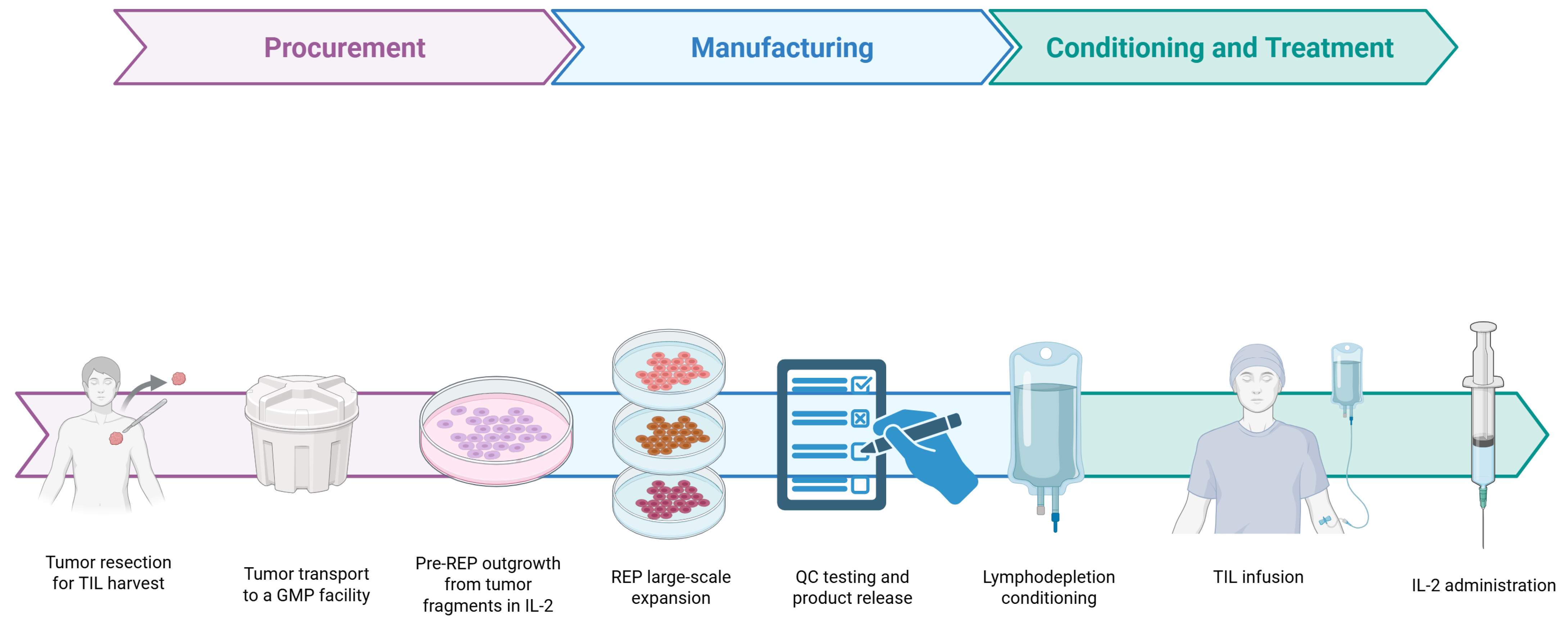
5.2. TIL Isolation, Expansion, and Reinfusion
5.3. Product Composition and Quality Attributes
5.4. Comparison of Traditional and Centralized Manufacturing Platforms
5.5. Lymphodepletion and IL-2 Support
5.6. Clinical Implementation and Logistics
6. Clinical Efficacy of TIL Therapy in Melanoma
6.1. Academic Single-Center Experiences
6.2. Multicenter Trials and Standardized TIL Products
6.3. Subgroup Analyses and Special Melanoma Subtypes
6.4. Durability of Response and Long-Term Outcomes
6.5. Comparison with Other Systemic Therapies and Treatment Sequencing
7. Safety and Toxicity of TIL Therapy
7.1. Safety Profile and Patient-Reported Burden
7.2. Strategies to Mitigate Toxicity and Patient Selection
8. Towards Personalized Application of TIL Therapy
8.1. Patient-Related Determinants
8.2. Tumor-Related Determinants
8.3. TIL Product Characteristics as Biomarkers
8.4. Spatial Biomarkers and Microenvironmental Context
8.5. Integrating Biomarkers into Clinical Decision-Making
| Biomarker Class | Candidate Determinant | How Assessed (Examples) | Association/Interpretation | Evidence Level in TIL Therapy | Clinical Feasibility | References |
|---|---|---|---|---|---|---|
| Patient dependent | Performance status/physiologic fitness (incl. comorbidities, organ function) | ECOG/PS; clinical assessment; labs/organ function; baseline cardiopulmonary reserve | Better tolerance of lymphodepletion + IL-2 and higher likelihood of benefit; poor fitness increases risk | Clinical association in TIL cohorts; used routinely in selection | Routine (standard clinical data) | [9,11,160,185,186,196,197,208,249] |
| Patient dependent | Baseline LDH and tumor burden/visceral disease extent | Serum LDH; imaging-based tumor burden; metastatic sites (visceral/brain) | Adverse prognostic factors; may still benefit when other favorable immune/product features present | Clinical association; mostly retrospective/observational; incorporated qualitatively in practice | Routine (standard clinical + imaging) | [11,166,174,186,206,233,259,260] |
| Patient dependent | Age and physiologic reserve (frailty, marrow reserve) | Chronologic age plus frailty/functional status; baseline hematologic reserve | Age alone less predictive than reserve; reduced reserve can limit tolerance of intensive regimens | Clinical association (selection/tolerability); not a standalone exclusion criterion | Routine (clinical assessment + CBC) | [160,185,186,208] |
| Patient dependent | Prior treatment intensity (multiple lines; cytotoxic chemotherapy exposure) | Treatment history; prior cytotoxic lines and cumulative burden | Heavily pretreated patients may have impaired immune competence and reduced TIL product quality | Clinical association; signals for product yield/quality are emerging | Routine (history); impact may require specialized correlates | [15,165,166,199,213,234] |
| Patient dependent | Checkpoint-refractory status/post-ICI progression | Prior anti-PD-1 (±anti-CTLA-4) exposure; refractory/progressive disease | Checkpoint-refractory patients can still harbor expandable tumor-reactive populations and may be suitable candidates | Clinical association; consistent across contemporary cohorts | Routine (history) | [29,58,66,186,199] |
| Tumor dependent | Tumor mutational burden (TMB)/neoantigen load | WES/panel-based TMB; neoantigen prediction pipelines (research); subtype context (acral/mucosal) | Higher antigenicity may support broader tumor reactivity; lower TMB may limit diversity/strength of responses | Translational + clinical association; not yet a validated selection threshold | Moderate (needs sequencing; more feasible with clinical panels) | [17,18,204,235] |
| Tumor dependent | Antigen presentation integrity (HLA class I; B2M; IFN pathway competence) | Genomics/IHC for HLA/B2M; transcriptional IFN programs | Defects can underlie primary/acquired resistance to ICI and may impair TIL recognition/effector function | Strong biologic rationale; translational evidence; prospective validation needed | Moderate–specialized (assay-dependent) | [13,22,24,84,236] |
| Tumor dependent | Baseline immune-inflamed phenotype (CD8 density; T-cell-inflamed/IFN-γ signatures) | CD8 IHC (intratumoral/invasive margin); gene-expression immune signatures | Inflamed tumors and higher CD8/IFN-γ programs appear more favorable for response | Clinical + translational association; reproducibility depends on assay and spatial definition | Moderate (IHC routine; signatures specialized) | [14,29,36,58,60,66,67,84,111,116] |
| Tumor dependent | Immune-excluded/desert patterns and suppressive myeloid networks | Spatial IHC/digital pathology; cell–cell neighborhood metrics (CD8–myeloid) | Exclusion/desert and unfavorable CD8–myeloid organization associated with lower response rates | Emerging spatial biomarker evidence in TIL cohorts | Specialized (digital pathology/spatial analytics) | [14,66,237,238,239] |
| Tumor dependent | Resistance programs (Wnt/β-catenin, TGF-β, stromal/angiogenic barriers) | Tumor transcriptomics; pathway signatures; spatial multi-omics | Associated with reduced immune infiltration/effector function and reduced response in translational studies | Translational evidence; clinical utility not yet established | Specialized (research-grade assays) | [14,40,84,204,240,241,242] |
| TIL product dependent | Total infused TIL dose and in vitro tumor reactivity | Infused cell count; functional assays (e.g., IFN-γ release/cytotoxicity against autologous tumor) | Higher dose and stronger in vitro reactivity correlate with higher ORR and longer PFS | Clinical association from early and contemporary cohorts | Moderate (cell counts routine; functional assays variable by platform) | [158,166] |
| TIL product dependent | CD8 enrichment and breadth of tumor recognition (multi-antigen reactivity; fewer bystanders) | Flow cytometry (CD8/CD4); functional breadth assays; phenotyping for bystander-like profiles | Enrichment for tumor-reactive CD8 and broad recognition favors efficacy; bystander predominance may dilute potency | Translational + clinical association; product-dependent | Specialized (requires product immunophenotyping/functional testing) | [19,28,29,58,166,185,186,194,213] |
| TIL product dependent | Tumor-reactive PD-1+ CD39+ CD8+ subset | Flow cytometry for PD-1/CD39; subset quantification | Enrichment indicates tumor-reactive populations and associates with improved outcomes | Translational evidence with clinical correlations | Specialized (product flow cytometry) | [29,58,60,154,175,233,242,244,245,246] |
| TIL product dependent | Differentiation state (less differentiated/TCF1+ progenitor-exhausted vs. terminal exhaustion) | Phenotyping (TCF1, exhaustion markers); differentiation profiling | Less differentiated/TCF1+ states associate with better persistence and durability; terminal exhaustion associates with poorer durability | Growing translational + clinical association; not yet standardized for release criteria | Specialized (flow/omics depending on marker set) | [16,29,58,60,129,165,166,178,200,213,244,247,248,261] |
| TIL product dependent | TCR clonotype architecture and persistence (tumor overlap; long-term persistence post-infusion) | TCR sequencing pre/post; overlap with baseline tumor clonotypes | Responders often receive tumor-overlapping clonotypes that persist long-term and may mediate durable control | Translational evidence with clinical correlations | Specialized (sequencing infrastructure; turnaround considerations) | [21,58,60,66,233,249] |
| Spatial organization/TME dependent | High CD8 density and favorable intratumoral/invasive-margin localization; permissive stroma/vasculature | Quantitative pathology (H&E/IHC); digital pathology; spatial density/proximity metrics | Higher CD8 density and favorable localization associated with improved outcomes and a permissive architecture | Clinical association (quantitative pathology) with emerging spatial refinement | Moderate (IHC routine; digital quantification varies by center) | [42,43,100,250,251,252,253,254] |
| Spatial organization/TME dependent | TLSs and B-cell-rich aggregates | H&E/IHC; spatial mapping of B cells, DCs, and T cells; TLS scoring | TLSs indicate organized local antigen presentation and are associated with improved prognosis and higher response rates to immunotherapy | Strong association in melanoma immunotherapy literature; relevance to TIL harvest/response supported | Moderate (pathology/IHC feasible; standardized scoring evolving) | [36,37,114,115,116,133,135,255] |
| Spatial organization/TME dependent | CD8–myeloid cell network states (incl. type I IFN-activated myeloid programs) and tumor-intrinsic spatial contexts | Spatial multi-omics; multiplex IHC; neighborhood analyses | Responders show favorable CD8–myeloid patterns and tumor-intrinsic differences even at similar bulk TIL densities | Emerging spatial multi-omics evidence in checkpoint-refractory TIL-treated cohorts | Specialized (research-grade assays) | [14,66,67,176,256,257,258] |
8.6. Treatment Algorithms and Positioning of TIL Therapy
9. Strategies to Enhance TIL Therapy and Overcome Resistance
9.1. Engineering and Selecting Improved TIL Products
9.2. Modifying the Tumor Microenvironment
9.3. Combination Strategies
9.4. Innovations in Manufacturing and Logistics
10. Challenges and Future Directions
10.1. Practical and Biological Limitations of TIL Therapy
10.2. Key Research Priorities and Future Directions
11. Conclusions
Author Contributions
Funding
Institutional Review Board Statement
Informed Consent Statement
Data Availability Statement
Conflicts of Interest
Abbreviations
| ACT | Adoptive cell therapy |
| APC | Antigen-presenting cell |
| BRAF | V-Raf Murine Sarcoma Viral Oncogene Homolog B |
| CD | Cluster of differentiation |
| cDC1 | Conventional type 1 dendritic cells |
| CI | Confidence interval |
| CR | Complete response |
| CSF1R | Colony-stimulating factor 1 receptor |
| CTLA | Cytotoxic T-lymphocyte-associated protein |
| CXCL | C-X-C motif chemokine ligand |
| Cy | Cyclophosphamide |
| Cy/Flu | Cyclophosphamide/fludarabine |
| DC | Dendritic cell |
| DOR | Duration of response |
| ECOG | Eastern Cooperative Oncology Group |
| Flu | Fludarabine |
| FU | Follow-up |
| FOXP3 | Forkhead box P3 |
| GMP | Good manufacturing practice |
| gp100 | Glycoprotein 100 |
| HD | High-dose |
| HLA | Human leukocyte antigen |
| HPF | High-power field |
| HR | Hazard ratio |
| H&E | Hematoxylin and eosin |
| ICI | Immune checkpoint inhibitor |
| ICU | Intensive care unit |
| IFN | Interferon |
| IFN-γ | Interferon-gamma |
| IHC | Immunohistochemistry |
| IL | Interleukin |
| IV | Intravenous/intravenously |
| JAK | Janus kinase |
| LAG-3 | Lymphocyte-activation gene 3 |
| LDH | Lactate dehydrogenase |
| MAPK | Mitogen-activated protein kinase |
| MART-1 | Melanoma-associated antigen recognized by T-cells 1 |
| MDSC | Myeloid-derived suppressor cell |
| MEK | Mitogen-activated extracellular signal-regulated kinase |
| mo | Months |
| NCI | National Cancer Institute |
| NMA | Nonmyeloablative |
| NR | Not reached/not reported |
| NY-ESO-1 | New York esophageal squamous cell carcinoma-1 |
| ORR | Overall response rate |
| OS | Overall survival |
| PD-1 | Programmed cell death protein |
| PFS | Progression-free survival |
| PI3Kγ | Phosphoinositide 3-kinase gamma |
| PR | Partial response |
| pre-REP | Pre-rapid expansion phase |
| PS | Performance status |
| pts | Patients |
| QC | Quality control |
| RCT | Randomized controlled trial |
| RECIST | Response Evaluation Criteria in Solid Tumors |
| REP | Rapid expansion protocol |
| ROI | Region of interest |
| SLN | Sentinel lymph node |
| STING | Stimulator of interferon genes |
| TBI | Total-body irradiation |
| TCF | T-cell factor |
| TCR | T-cell receptor |
| TGF-β | Transforming growth factor-beta |
| TIL | Tumor-infiltrating lymphocyte |
| TIL-ACT | TIL-based adoptive cell therapy |
| TLS | Tertiary lymphoid structure |
| TMB | Tumor mutational burden |
| TME | Tumor microenvironment |
| TOX | Thymocyte selection-associated high mobility group box |
| TRAE | Treatment-related adverse event |
| Treg | Regulatory T-cell |
| TRM | Tissue-resident memory |
| UV | Ultraviolet |
| VEGF | Vascular endothelial growth factor |
| WES | Whole-exome sequencing |
References
- Tawbi, H.A.; Schadendorf, D.; Lipson, E.J.; Ascierto, P.A.; Matamala, L.; Castillo Gutiérrez, E.; Rutkowski, P.; Gogas, H.J.; Lao, C.D.; De Menezes, J.J.; et al. Relatlimab and Nivolumab versus Nivolumab in Untreated Advanced Melanoma. N. Engl. J. Med. 2022, 386, 24–34. [Google Scholar] [CrossRef]
- Hodi, F.S.; O’Day, S.J.; McDermott, D.F.; Weber, R.W.; Sosman, J.A.; Haanen, J.B.; Gonzalez, R.; Robert, C.; Schadendorf, D.; Hassel, J.C.; et al. Improved Survival with Ipilimumab in Patients with Metastatic Melanoma. N. Engl. J. Med. 2010, 363, 711–723. [Google Scholar] [CrossRef]
- Robert, C.; Long, G.V.; Brady, B.; Dutriaux, C.; Maio, M.; Mortier, L.; Hassel, J.C.; Rutkowski, P.; McNeil, C.; Kalinka-Warzocha, E.; et al. Nivolumab in Previously Untreated Melanoma without BRAF Mutation. N. Engl. J. Med. 2015, 372, 320–330. [Google Scholar] [CrossRef]
- Robert, C.; Schachter, J.; Long, G.V.; Arance, A.; Grob, J.J.; Mortier, L.; Daud, A.; Carlino, M.S.; McNeil, C.; Lotem, M.; et al. Pembrolizumab versus Ipilimumab in Advanced Melanoma. N. Engl. J. Med. 2015, 372, 2521–2532. [Google Scholar] [CrossRef]
- Clark, W.H.; Elder, D.E.; Guerry, D.; Braitman, L.E.; Trock, B.J.; Schultz, D.; Synnestvedt, M.; Halpern, A.C. Model Predicting Survival in Stage I Melanoma Based on Tumor Progression. JNCI J. Natl. Cancer Inst. 1989, 81, 1893–1904. [Google Scholar] [CrossRef]
- Clemente, C.G.; Mihm, M.C.; Bufalino, R.; Zurrida, S.; Collini, P.; Cascinelli, N. Prognostic Value of Tumor Infiltrating Lymphocytes in the Vertical Growth Phase of Primary Cutaneous Melanoma. Cancer 1996, 77, 1303–1310. [Google Scholar] [CrossRef]
- Rosenberg, S.A.; Packard, B.S.; Aebersold, P.M.; Solomon, D.; Topalian, S.L.; Toy, S.T.; Simon, P.; Lotze, M.T.; Yang, J.C.; Seipp, C.A.; et al. Use of Tumor-Infiltrating Lymphocytes and Interleukin-2 in the Immunotherapy of Patients with Metastatic Melanoma. N. Engl. J. Med. 1988, 319, 1676–1680. [Google Scholar] [CrossRef]
- Dudley, M.E.; Wunderlich, J.R.; Robbins, P.F.; Yang, J.C.; Hwu, P.; Schwartzentruber, D.J.; Topalian, S.L.; Sherry, R.; Restifo, N.P.; Hubicki, A.M.; et al. Cancer Regression and Autoimmunity in Patients After Clonal Repopulation with Antitumor Lymphocytes. Science 2002, 298, 850–854. [Google Scholar] [CrossRef] [PubMed]
- Andersen, R.; Donia, M.; Ellebaek, E.; Borch, T.H.; Kongsted, P.; Iversen, T.Z.; Hölmich, L.R.; Hendel, H.W.; Met, Ö.; Andersen, M.H.; et al. Long-Lasting Complete Responses in Patients with Metastatic Melanoma after Adoptive Cell Therapy with Tumor-Infiltrating Lymphocytes and an Attenuated IL2 Regimen. Clin. Cancer Res. 2016, 22, 3734–3745. [Google Scholar] [CrossRef] [PubMed]
- Rosenberg, S.A. Cell Transfer Immunotherapy for Metastatic Solid Cancer—What Clinicians Need to Know. Nat. Rev. Clin. Oncol. 2011, 8, 577–585. [Google Scholar] [CrossRef] [PubMed]
- Sarnaik, A.A.; Hamid, O.; Khushalani, N.I.; Lewis, K.D.; Medina, T.; Kluger, H.M.; Thomas, S.S.; Domingo-Musibay, E.; Pavlick, A.C.; Whitman, E.D.; et al. Lifileucel, a Tumor-Infiltrating Lymphocyte Therapy, in Metastatic Melanoma. J. Clin. Oncol. 2021, 39, 2656–2666. [Google Scholar] [CrossRef]
- Rohaan, M.W.; Borch, T.H.; Van Den Berg, J.H.; Met, Ö.; Kessels, R.; Geukes Foppen, M.H.; Stoltenborg Granhøj, J.; Nuijen, B.; Nijenhuis, C.; Jedema, I.; et al. Tumor-Infiltrating Lymphocyte Therapy or Ipilimumab in Advanced Melanoma. N. Engl. J. Med. 2022, 387, 2113–2125. [Google Scholar] [CrossRef]
- Sade-Feldman, M.; Yizhak, K.; Bjorgaard, S.L.; Ray, J.P.; De Boer, C.G.; Jenkins, R.W.; Lieb, D.J.; Chen, J.H.; Frederick, D.T.; Barzily-Rokni, M.; et al. Defining T Cell States Associated with Response to Checkpoint Immunotherapy in Melanoma. Cell 2018, 175, 998–1013.e20. [Google Scholar] [CrossRef] [PubMed]
- Barras, D.; Ghisoni, E.; Chiffelle, J.; Orcurto, A.; Dagher, J.; Fahr, N.; Benedetti, F.; Crespo, I.; Grimm, A.J.; Morotti, M.; et al. Response to Tumor-Infiltrating Lymphocyte Adoptive Therapy Is Associated with Preexisting CD8+ T-Myeloid Cell Networks in Melanoma. Sci. Immunol. 2024, 9, eadg7995. [Google Scholar] [CrossRef] [PubMed]
- Dafni, U.; Michielin, O.; Lluesma, S.M.; Tsourti, Z.; Polydoropoulou, V.; Karlis, D.; Besser, M.J.; Haanen, J.; Svane, I.-M.; Ohashi, P.S.; et al. Efficacy of Adoptive Therapy with Tumor-Infiltrating Lymphocytes and Recombinant Interleukin-2 in Advanced Cutaneous Melanoma: A Systematic Review and Meta-Analysis. Ann. Oncol. 2019, 30, 1902–1913. [Google Scholar] [CrossRef]
- Martín-Lluesma, S.; Svane, I.M.; Dafni, U.; Vervita, K.; Karlis, D.; Dimopoulou, G.; Tsourti, Z.; Rohaan, M.W.; Haanen, J.B.a.G.; Coukos, G. Efficacy of TIL Therapy in Advanced Cutaneous Melanoma in the Current Immuno-Oncology Era: Updated Systematic Review and Meta-Analysis. Ann. Oncol. 2024, 35, 860–872. [Google Scholar] [CrossRef]
- Australian Pancreatic Cancer Genome Initiative; ICGC Breast Cancer Consortium; ICGC MMML-Seq Consortium; ICGC PedBrain; Alexandrov, L.B.; Nik-Zainal, S.; Wedge, D.C.; Aparicio, S.A.J.R.; Behjati, S.; Biankin, A.V.; et al. Signatures of Mutational Processes in Human Cancer. Nature 2013, 500, 415–421. [Google Scholar] [CrossRef]
- Snyder, A.; Makarov, V.; Merghoub, T.; Yuan, J.; Zaretsky, J.M.; Desrichard, A.; Walsh, L.A.; Postow, M.A.; Wong, P.; Ho, T.S.; et al. Genetic Basis for Clinical Response to CTLA-4 Blockade in Melanoma. N. Engl. J. Med. 2014, 371, 2189–2199. [Google Scholar] [CrossRef]
- Kvistborg, P.; Philips, D.; Kelderman, S.; Hageman, L.; Ottensmeier, C.; Joseph-Pietras, D.; Welters, M.J.P.; Van Der Burg, S.; Kapiteijn, E.; Michielin, O.; et al. Anti–CTLA-4 Therapy Broadens the Melanoma-Reactive CD8+ T Cell Response. Sci. Transl. Med. 2014, 6, 254ra128. [Google Scholar] [CrossRef]
- Robbins, P.F.; Lu, Y.-C.; El-Gamil, M.; Li, Y.F.; Gross, C.; Gartner, J.; Lin, J.C.; Teer, J.K.; Cliften, P.; Tycksen, E.; et al. Mining Exomic Sequencing Data to Identify Mutated Antigens Recognized by Adoptively Transferred Tumor-Reactive T Cells. Nat. Med. 2013, 19, 747–752. [Google Scholar] [CrossRef] [PubMed]
- Verdegaal, E.M.E.; De Miranda, N.F.C.C.; Visser, M.; Harryvan, T.; Van Buuren, M.M.; Andersen, R.S.; Hadrup, S.R.; Van Der Minne, C.E.; Schotte, R.; Spits, H.; et al. Neoantigen Landscape Dynamics during Human Melanoma–T Cell Interactions. Nature 2016, 536, 91–95. [Google Scholar] [CrossRef]
- Zaretsky, J.M.; Garcia-Diaz, A.; Shin, D.S.; Escuin-Ordinas, H.; Hugo, W.; Hu-Lieskovan, S.; Torrejon, D.Y.; Abril-Rodriguez, G.; Sandoval, S.; Barthly, L.; et al. Mutations Associated with Acquired Resistance to PD-1 Blockade in Melanoma. N. Engl. J. Med. 2016, 375, 819–829. [Google Scholar] [CrossRef]
- Gettinger, S.; Choi, J.; Hastings, K.; Truini, A.; Datar, I.; Sowell, R.; Wurtz, A.; Dong, W.; Cai, G.; Melnick, M.A.; et al. Impaired HLA Class I Antigen Processing and Presentation as a Mechanism of Acquired Resistance to Immune Checkpoint Inhibitors in Lung Cancer. Cancer Discov. 2017, 7, 1420–1435. [Google Scholar] [CrossRef]
- Sharma, P.; Hu-Lieskovan, S.; Wargo, J.A.; Ribas, A. Primary, Adaptive, and Acquired Resistance to Cancer Immunotherapy. Cell 2017, 168, 707–723. [Google Scholar] [CrossRef] [PubMed]
- Kalbasi, A.; Tariveranmoshabad, M.; Hakimi, K.; Kremer, S.; Campbell, K.M.; Funes, J.M.; Vega-Crespo, A.; Parisi, G.; Champekar, A.; Nguyen, C.; et al. Uncoupling Interferon Signaling and Antigen Presentation to Overcome Immunotherapy Resistance Due to JAK1 Loss in Melanoma. Sci. Transl. Med. 2020, 12, eabb0152. [Google Scholar] [CrossRef] [PubMed]
- Draghi, A.; Presti, M.; Jensen, A.W.P.; Chamberlain, C.A.; Albieri, B.; Rasmussen, A.-C.K.; Andersen, M.H.; Crowther, M.D.; Svane, I.M.; Donia, M. Uncoupling CD4+ TIL-Mediated Tumor Killing from JAK-Signaling in Melanoma. Clin. Cancer Res. 2023, 29, 3937–3947. [Google Scholar] [CrossRef] [PubMed]
- Riaz, N.; Havel, J.J.; Makarov, V.; Desrichard, A.; Urba, W.J.; Sims, J.S.; Hodi, F.S.; Martín-Algarra, S.; Mandal, R.; Sharfman, W.H.; et al. Tumor and Microenvironment Evolution during Immunotherapy with Nivolumab. Cell 2017, 171, 934–949.e16. [Google Scholar] [CrossRef]
- Simoni, Y.; Becht, E.; Fehlings, M.; Loh, C.Y.; Koo, S.-L.; Teng, K.W.W.; Yeong, J.P.S.; Nahar, R.; Zhang, T.; Kared, H.; et al. Bystander CD8+ T Cells Are Abundant and Phenotypically Distinct in Human Tumour Infiltrates. Nature 2018, 557, 575–579. [Google Scholar] [CrossRef]
- Duhen, T.; Duhen, R.; Montler, R.; Moses, J.; Moudgil, T.; De Miranda, N.F.; Goodall, C.P.; Blair, T.C.; Fox, B.A.; McDermott, J.E.; et al. Co-Expression of CD39 and CD103 Identifies Tumor-Reactive CD8 T Cells in Human Solid Tumors. Nat. Commun. 2018, 9, 2724. [Google Scholar] [CrossRef]
- Im, S.J.; Hashimoto, M.; Gerner, M.Y.; Lee, J.; Kissick, H.T.; Burger, M.C.; Shan, Q.; Hale, J.S.; Lee, J.; Nasti, T.H.; et al. Defining CD8+ T Cells That Provide the Proliferative Burst after PD-1 Therapy. Nature 2016, 537, 417–421. [Google Scholar] [CrossRef]
- Siddiqui, I.; Schaeuble, K.; Chennupati, V.; Fuertes Marraco, S.A.; Calderon-Copete, S.; Pais Ferreira, D.; Carmona, S.J.; Scarpellino, L.; Gfeller, D.; Pradervand, S.; et al. Intratumoral Tcf1+PD-1+CD8+ T Cells with Stem-like Properties Promote Tumor Control in Response to Vaccination and Checkpoint Blockade Immunotherapy. Immunity 2019, 50, 195–211.e10. [Google Scholar] [CrossRef]
- Viguier, M.; Lemaître, F.; Verola, O.; Cho, M.-S.; Gorochov, G.; Dubertret, L.; Bachelez, H.; Kourilsky, P.; Ferradini, L. Foxp3 Expressing CD4+CD25high Regulatory T Cells Are Overrepresented in Human Metastatic Melanoma Lymph Nodes and Inhibit the Function of Infiltrating T Cells. J. Immunol. 2004, 173, 1444–1453. [Google Scholar] [CrossRef]
- Quezada, S.A.; Peggs, K.S.; Curran, M.A.; Allison, J.P. CTLA4 Blockade and GM-CSF Combination Immunotherapy Alters the Intratumor Balance of Effector and Regulatory T Cells. J. Clin. Investig. 2006, 116, 1935–1945. [Google Scholar] [CrossRef]
- Quezada, S.A.; Simpson, T.R.; Peggs, K.S.; Merghoub, T.; Vider, J.; Fan, X.; Blasberg, R.; Yagita, H.; Muranski, P.; Antony, P.A.; et al. Tumor-Reactive CD4+ T Cells Develop Cytotoxic Activity and Eradicate Large Established Melanoma after Transfer into Lymphopenic Hosts. J. Exp. Med. 2010, 207, 637–650. [Google Scholar] [CrossRef] [PubMed]
- Kim, H.-J.; Cantor, H. CD4 T-Cell Subsets and Tumor Immunity: The Helpful and the Not-so-Helpful. Cancer Immunol. Res. 2014, 2, 91–98. [Google Scholar] [CrossRef]
- Cabrita, R.; Lauss, M.; Sanna, A.; Donia, M.; Skaarup Larsen, M.; Mitra, S.; Johansson, I.; Phung, B.; Harbst, K.; Vallon-Christersson, J.; et al. Tertiary Lymphoid Structures Improve Immunotherapy and Survival in Melanoma. Nature 2020, 577, 561–565. [Google Scholar] [CrossRef] [PubMed]
- Helmink, B.A.; Reddy, S.M.; Gao, J.; Zhang, S.; Basar, R.; Thakur, R.; Yizhak, K.; Sade-Feldman, M.; Blando, J.; Han, G.; et al. B Cells and Tertiary Lymphoid Structures Promote Immunotherapy Response. Nature 2020, 577, 549–555. [Google Scholar] [CrossRef]
- Chen, D.S.; Mellman, I. Oncology Meets Immunology: The Cancer-Immunity Cycle. Immunity 2013, 39, 1–10. [Google Scholar] [CrossRef]
- Gajewski, T.F.; Schreiber, H.; Fu, Y.-X. Innate and Adaptive Immune Cells in the Tumor Microenvironment. Nat. Immunol. 2013, 14, 1014–1022. [Google Scholar] [CrossRef] [PubMed]
- Spranger, S.; Bao, R.; Gajewski, T.F. Melanoma-Intrinsic β-Catenin Signalling Prevents Anti-Tumour Immunity. Nature 2015, 523, 231–235. [Google Scholar] [CrossRef]
- Mariathasan, S.; Turley, S.J.; Nickles, D.; Castiglioni, A.; Yuen, K.; Wang, Y.; Kadel, E.E., III; Koeppen, H.; Astarita, J.L.; Cubas, R.; et al. TGFβ Attenuates Tumour Response to PD-L1 Blockade by Contributing to Exclusion of T Cells. Nature 2018, 554, 544–548. [Google Scholar] [CrossRef]
- Maibach, F.; Sadozai, H.; Seyed Jafari, S.M.; Hunger, R.E.; Schenk, M. Tumor-Infiltrating Lymphocytes and Their Prognostic Value in Cutaneous Melanoma. Front. Immunol. 2020, 11, 2105. [Google Scholar] [CrossRef]
- Van Duin, I.A.J.; Schuiveling, M.; Ter Maat, L.S.; Van Amsterdam, W.A.C.; Van Den Berkmortel, F.; Boers-Sonderen, M.; De Groot, J.W.B.; Hospers, G.A.P.; Kapiteijn, E.; Labots, M.; et al. Baseline Tumor-Infiltrating Lymphocyte Patterns and Response to Immune Checkpoint Inhibition in Metastatic Cutaneous Melanoma. Eur. J. Cancer 2024, 208, 114190. [Google Scholar] [CrossRef] [PubMed]
- Wherry, E.J. T Cell Exhaustion. Nat. Immunol. 2011, 12, 492–499. [Google Scholar] [CrossRef] [PubMed]
- Mackay, L.K.; Rahimpour, A.; Ma, J.Z.; Collins, N.; Stock, A.T.; Hafon, M.-L.; Vega-Ramos, J.; Lauzurica, P.; Mueller, S.N.; Stefanovic, T.; et al. The Developmental Pathway for CD103+CD8+ Tissue-Resident Memory T Cells of Skin. Nat. Immunol. 2013, 14, 1294–1301. [Google Scholar] [CrossRef]
- Park, S.L.; Buzzai, A.; Rautela, J.; Hor, J.L.; Hochheiser, K.; Effern, M.; McBain, N.; Wagner, T.; Edwards, J.; McConville, R.; et al. Tissue-Resident Memory CD8+ T Cells Promote Melanoma–Immune Equilibrium in Skin. Nature 2019, 565, 366–371. [Google Scholar] [CrossRef] [PubMed]
- Jiang, C.; Chao, C.-C.; Li, J.; Ge, X.; Shen, A.; Jucaud, V.; Cheng, C.; Shen, X. Tissue-Resident Memory T Cell Signatures from Single-Cell Analysis Associated with Better Melanoma Prognosis. iScience 2024, 27, 109277. [Google Scholar] [CrossRef]
- Pesqué, D.; Marcantonio, O.; Vázquez, I.; Papaleo, N.; Sánchez-González, B.; Gallardo, F.; Colomo, L.; Pujol, R.M. Cutaneous Involvement of Angioimmunoblastic T-Cell Lymphoma Masquerading as B-Cell Reactive Lymphoid Hyperplasia. Am. J. Dermatopathol. 2022, 44, e41–e45. [Google Scholar] [CrossRef]
- Plunkett, K.R.; Armitage, J.D.; Inderjeeth, A.-J.; McDonnell, A.M.; Waithman, J.; Lau, P.K.H. Tissue-Resident Memory T Cells in the Era of (Neo) Adjuvant Melanoma Management. Front. Immunol. 2022, 13, 1048758. [Google Scholar] [CrossRef]
- Cioplea, M.; Nichita, L.; Georgescu, D.; Sticlaru, L.; Cioroianu, A.; Nedelcu, R.; Turcu, G.; Rauta, A.; Mogodici, C.; Zurac, S.; et al. FOXP3 in Melanoma with Regression: Between Tumoral Expression and Regulatory T Cell Upregulation. J. Immunol. Res. 2020, 2020, 5416843. [Google Scholar] [CrossRef]
- Pan, Y.; Zhou, H.; Sun, Z.; Zhu, Y.; Zhang, Z.; Han, J.; Liu, Y.; Wang, Q. Regulatory T Cells in Solid Tumor Immunotherapy: Effect, Mechanism and Clinical Application. Cell Death Dis. 2025, 16, 277. [Google Scholar] [CrossRef] [PubMed]
- Huang, L.; Guo, Y.; Liu, S.; Wang, H.; Zhu, J.; Ou, L.; Xu, X. Targeting Regulatory T Cells for Immunotherapy in Melanoma. Mol. Biomed. 2021, 2, 11. [Google Scholar] [CrossRef]
- Sukumar, M.; Liu, J.; Ji, Y.; Subramanian, M.; Crompton, J.G.; Yu, Z.; Roychoudhuri, R.; Palmer, D.C.; Muranski, P.; Karoly, E.D.; et al. Inhibiting Glycolytic Metabolism Enhances CD8+ T Cell Memory and Antitumor Function. J. Clin. Investig. 2013, 123, 4479–4488. [Google Scholar] [CrossRef]
- Chang, C.-H.; Qiu, J.; O’Sullivan, D.; Buck, M.D.; Noguchi, T.; Curtis, J.D.; Chen, Q.; Gindin, M.; Gubin, M.M.; van der Windt, G.J.W.; et al. Metabolic Competition in the Tumor Microenvironment Is a Driver of Cancer Progression. Cell 2015, 162, 1229–1241. [Google Scholar] [CrossRef] [PubMed]
- Liu, Y.-N.; Yang, J.-F.; Huang, D.-J.; Ni, H.-H.; Zhang, C.-X.; Zhang, L.; He, J.; Gu, J.-M.; Chen, H.-X.; Mai, H.-Q.; et al. Hypoxia Induces Mitochondrial Defect That Promotes T Cell Exhaustion in Tumor Microenvironment Through MYC-Regulated Pathways. Front. Immunol. 2020, 11, 1906. [Google Scholar] [CrossRef] [PubMed]
- Gu, X.-Y.; Yang, J.-L.; Lai, R.; Zhou, Z.-J.; Tang, D.; Hu, L.; Zhao, L.-J. Impact of Lactate on Immune Cell Function in the Tumor Microenvironment: Mechanisms and Therapeutic Perspectives. Front. Immunol. 2025, 16, 1563303. [Google Scholar] [CrossRef]
- Yu, Y.-R.; Imrichova, H.; Wang, H.; Chao, T.; Xiao, Z.; Gao, M.; Rincon-Restrepo, M.; Franco, F.; Genolet, R.; Cheng, W.-C.; et al. Disturbed Mitochondrial Dynamics in CD8+ TILs Reinforce T Cell Exhaustion. Nat. Immunol. 2020, 21, 1540–1551. [Google Scholar] [CrossRef]
- Van Den Berg, J.H.; Heemskerk, B.; Van Rooij, N.; Gomez-Eerland, R.; Michels, S.; Van Zon, M.; De Boer, R.; Bakker, N.A.M.; Jorritsma-Smit, A.; Van Buuren, M.M.; et al. Tumor Infiltrating Lymphocytes (TIL) Therapy in Metastatic Melanoma: Boosting of Neoantigen-Specific T Cell Reactivity and Long-Term Follow-Up. J. Immunother. Cancer 2020, 8, e000848. [Google Scholar] [CrossRef]
- Bräunlein, E.; Lupoli, G.; Füchsl, F.; Abualrous, E.T.; De Andrade Krätzig, N.; Gosmann, D.; Wietbrock, L.; Lange, S.; Engleitner, T.; Lan, H.; et al. Functional Analysis of Peripheral and Intratumoral Neoantigen-Specific TCRs Identified in a Patient with Melanoma. J. Immunother. Cancer 2021, 9, e002754. [Google Scholar] [CrossRef]
- Kristensen, N.P.; Heeke, C.; Tvingsholm, S.A.; Borch, A.; Draghi, A.; Crowther, M.D.; Carri, I.; Munk, K.K.; Holm, J.S.; Bjerregaard, A.-M.; et al. Neoantigen-Reactive CD8+ T Cells Affect Clinical Outcome of Adoptive Cell Therapy with Tumor-Infiltrating Lymphocytes in Melanoma. J. Clin. Investig. 2022, 132, e150535. [Google Scholar] [CrossRef] [PubMed]
- Yossef, R.; Krishna, S.; Sindiri, S.; Lowery, F.J.; Copeland, A.R.; Gartner, J.J.; Parkhurst, M.R.; Parikh, N.B.; Hitscherich, K.J.; Levi, S.T.; et al. Phenotypic Signatures of Circulating Neoantigen-Reactive CD8+ T Cells in Patients with Metastatic Cancers. Cancer Cell 2023, 41, 2154–2165.e5. [Google Scholar] [CrossRef]
- Lowery, F.J.; Krishna, S.; Yossef, R.; Parikh, N.B.; Chatani, P.D.; Zacharakis, N.; Parkhurst, M.R.; Levin, N.; Sindiri, S.; Sachs, A.; et al. Molecular Signatures of Antitumor Neoantigen-Reactive T Cells from Metastatic Human Cancers. Science 2022, 375, 877–884. [Google Scholar] [CrossRef]
- Holm, J.S.; Funt, S.A.; Borch, A.; Munk, K.K.; Bjerregaard, A.-M.; Reading, J.L.; Maher, C.; Regazzi, A.; Wong, P.; Al-Ahmadie, H.; et al. Neoantigen-Specific CD8 T Cell Responses in the Peripheral Blood Following PD-L1 Blockade Might Predict Therapy Outcome in Metastatic Urothelial Carcinoma. Nat. Commun. 2022, 13, 1935. [Google Scholar] [CrossRef] [PubMed]
- Li, S.; Zhuang, S.; Heit, A.; Koo, S.-L.; Tan, A.C.; Chow, I.-T.; Kwok, W.W.; Tan, I.B.; Tan, D.S.W.; Simoni, Y.; et al. Bystander CD4+ T Cells Infiltrate Human Tumors and Are Phenotypically Distinct. OncoImmunology 2022, 11, 2012961. [Google Scholar] [CrossRef]
- Simon, S.; Voillet, V.; Vignard, V.; Wu, Z.; Dabrowski, C.; Jouand, N.; Beauvais, T.; Khammari, A.; Braudeau, C.; Josien, R.; et al. PD-1 and TIGIT Coexpression Identifies a Circulating CD8 T Cell Subset Predictive of Response to Anti-PD-1 Therapy. J. Immunother. Cancer 2020, 8, e001631. [Google Scholar] [CrossRef]
- Chiffelle, J.; Barras, D.; Pétremand, R.; Orcurto, A.; Bobisse, S.; Arnaud, M.; Auger, A.; Rodrigo, B.N.; Ghisoni, E.; Sauvage, C.; et al. Tumor-Reactive T Cell Clonotype Dynamics Underlying Clinical Response to TIL Therapy in Melanoma. Immunity 2024, 57, 2466–2482.e12. [Google Scholar] [CrossRef]
- Le, J.; Dian, Y.; Zhao, D.; Guo, Z.; Luo, Z.; Chen, X.; Zeng, F.; Deng, G. Single-Cell Multi-Omics in Cancer Immunotherapy: From Tumor Heterogeneity to Personalized Precision Treatment. Mol. Cancer 2025, 24, 221. [Google Scholar] [CrossRef]
- Del Prete, A.; Salvi, V.; Soriani, A.; Laffranchi, M.; Sozio, F.; Bosisio, D.; Sozzani, S. Dendritic Cell Subsets in Cancer Immunity and Tumor Antigen Sensing. Cell. Mol. Immunol. 2023, 20, 432–447. [Google Scholar] [CrossRef]
- Broz, M.L.; Binnewies, M.; Boldajipour, B.; Nelson, A.E.; Pollack, J.L.; Erle, D.J.; Barczak, A.; Rosenblum, M.D.; Daud, A.; Barber, D.L.; et al. Dissecting the Tumor Myeloid Compartment Reveals Rare Activating Antigen-Presenting Cells Critical for T Cell Immunity. Cancer Cell 2014, 26, 638–652. [Google Scholar] [CrossRef] [PubMed]
- Spranger, S.; Dai, D.; Horton, B.; Gajewski, T.F. Tumor-Residing Batf3 Dendritic Cells Are Required for Effector T Cell Trafficking and Adoptive T Cell Therapy. Cancer Cell 2017, 31, 711–723.e4. [Google Scholar] [CrossRef] [PubMed]
- Bödder, J.; Zahan, T.; Van Slooten, R.; Schreibelt, G.; De Vries, I.J.M.; Flórez-Grau, G. Harnessing the cDC1-NK Cross-Talk in the Tumor Microenvironment to Battle Cancer. Front. Immunol. 2021, 11, 631713. [Google Scholar] [CrossRef]
- Noubade, R.; Majri-Morrison, S.; Tarbell, K.V. Beyond cDC1: Emerging Roles of DC Crosstalk in Cancer Immunity. Front. Immunol. 2019, 10, 1014. [Google Scholar] [CrossRef]
- Böttcher, J.P.; Sousa, C.R.E. The Role of Type 1 Conventional Dendritic Cells in Cancer Immunity. Trends Cancer 2018, 4, 784–792. [Google Scholar] [CrossRef]
- Gabrilovich, D.I.; Nagaraj, S. Myeloid-Derived Suppressor Cells as Regulators of the Immune System. Nat. Rev. Immunol. 2009, 9, 162–174. [Google Scholar] [CrossRef] [PubMed]
- Cheng, J.-N.; Yuan, Y.-X.; Zhu, B.; Jia, Q. Myeloid-Derived Suppressor Cells: A Multifaceted Accomplice in Tumor Progression. Front. Cell Dev. Biol. 2021, 9, 740827. [Google Scholar] [CrossRef]
- Ge, Y.; Cheng, D.; Jia, Q.; Xiong, H.; Zhang, J. Mechanisms Underlying the Role of Myeloid-Derived Suppressor Cells in Clinical Diseases: Good or Bad. Immune Netw. 2021, 21, e21. [Google Scholar] [CrossRef]
- Yan, S.; Wan, G. Tumor-associated Macrophages in Immunotherapy. FEBS J. 2021, 288, 6174–6186. [Google Scholar] [CrossRef]
- Duan, Z.; Luo, Y. Targeting Macrophages in Cancer Immunotherapy. Signal Transduct. Target. Ther. 2021, 6, 127. [Google Scholar] [CrossRef] [PubMed]
- Bruni, S.; Mercogliano, M.F.; Mauro, F.L.; Cordo Russo, R.I.; Schillaci, R. Cancer Immune Exclusion: Breaking the Barricade for a Successful Immunotherapy. Front. Oncol. 2023, 13, 1135456. [Google Scholar] [CrossRef] [PubMed]
- Zheng, S.; Wang, W.; Shen, L.; Yao, Y.; Xia, W.; Ni, C. Tumor Battlefield within Inflamed, Excluded or Desert Immune Phenotypes: The Mechanisms and Strategies. Exp. Hematol. Oncol. 2024, 13, 80. [Google Scholar] [CrossRef]
- Schlenker, R.; Schwalie, P.C.; Dettling, S.; Huesser, T.; Irmisch, A.; Mariani, M.; Martínez Gómez, J.M.; Ribeiro, A.; Limani, F.; Herter, S.; et al. Myeloid-T Cell Interplay and Cell State Transitions Associated with Checkpoint Inhibitor Response in Melanoma. Med 2024, 5, 759–779.e7. [Google Scholar] [CrossRef]
- Van Dam, S.; Krijgsman, D.; Küçükköse, E.; Verdonschot, M.E.L.; Amini, M.; Blokx, W.A.M.; Van Eijs, M.J.M.; Verheijden, R.J.; Kranenburg, O.; Suijkerbuijk, K.P.M.; et al. Anti-PD-1 Treatment Response Is Associated with the Influx of Circulating Myeloid and T-Cell Subsets into the Metastatic Melanoma Tumor Microenvironment. Br. J. Cancer 2025, 133, 1250–1264. [Google Scholar] [CrossRef]
- Litchfield, K.; Reading, J.L.; Puttick, C.; Thakkar, K.; Abbosh, C.; Bentham, R.; Watkins, T.B.K.; Rosenthal, R.; Biswas, D.; Rowan, A.; et al. Meta-Analysis of Tumor- and T Cell-Intrinsic Mechanisms of Sensitization to Checkpoint Inhibition. Cell 2021, 184, 596–614.e14. [Google Scholar] [CrossRef] [PubMed]
- Grasso, C.S.; Tsoi, J.; Onyshchenko, M.; Abril-Rodriguez, G.; Ross-Macdonald, P.; Wind-Rotolo, M.; Champhekar, A.; Medina, E.; Torrejon, D.Y.; Shin, D.S.; et al. Conserved Interferon-γ Signaling Drives Clinical Response to Immune Checkpoint Blockade Therapy in Melanoma. Cancer Cell 2020, 38, 500–515.e3. [Google Scholar] [CrossRef]
- Turner, L.M.; Terhaar, H.; Jiminez, V.; Anderson, B.J.; Grant, E.; Yusuf, N. Tumor Microenvironmental Dynamics in Shaping Resistance to Therapeutic Interventions in Melanoma: A Narrative Review. Pharmaceuticals 2025, 18, 1082. [Google Scholar] [CrossRef] [PubMed]
- Merat, R. MAPK Activity as a Surrogate of Acral Melanoma Immunogenicity? J. Eur. Acad. Dermatol. Venereol. 2025, 39, 1713–1714. [Google Scholar] [CrossRef]
- Jung, T.; Haist, M.; Kuske, M.; Grabbe, S.; Bros, M. Immunomodulatory Properties of BRAF and MEK Inhibitors Used for Melanoma Therapy—Paradoxical ERK Activation and Beyond. Int. J. Mol. Sci. 2021, 22, 9890. [Google Scholar] [CrossRef] [PubMed]
- Ott, P.A.; Bhardwaj, N. Impact of MAPK Pathway Activation in BRAFV600 Melanoma on T Cell and Dendritic Cell Function. Front. Immunol. 2013, 4, 346. [Google Scholar] [CrossRef]
- Bald, T.; Smyth, M.J. TGFβ Shuts the Door on T Cells. Br. J. Cancer 2018, 119, 1–3. [Google Scholar] [CrossRef]
- Ribatti, D. Immunosuppressive Effects of Vascular Endothelial Growth Factor (Review). Oncol. Lett. 2022, 24, 369. [Google Scholar] [CrossRef]
- Bourhis, M.; Palle, J.; Galy-Fauroux, I.; Terme, M. Direct and Indirect Modulation of T Cells by VEGF-A Counteracted by Anti-Angiogenic Treatment. Front. Immunol. 2021, 12, 616837. [Google Scholar] [CrossRef] [PubMed]
- Voron, T.; Colussi, O.; Marcheteau, E.; Pernot, S.; Nizard, M.; Pointet, A.-L.; Latreche, S.; Bergaya, S.; Benhamouda, N.; Tanchot, C.; et al. VEGF-A Modulates Expression of Inhibitory Checkpoints on CD8+ T Cells in Tumors. J. Exp. Med. 2015, 212, 139–148. [Google Scholar] [CrossRef]
- Sumimoto, H.; Imabayashi, F.; Iwata, T.; Kawakami, Y. The BRAF–MAPK Signaling Pathway Is Essential for Cancer-Immune Evasion in Human Melanoma Cells. J. Exp. Med. 2006, 203, 1651–1656. [Google Scholar] [CrossRef] [PubMed]
- Roznovan, C.N.; Măruțescu, L.G.; Gradisteanu Pircalabioru, G. Immuno-Oncology at the Crossroads: Confronting Challenges in the Quest for Effective Cancer Therapies. Int. J. Mol. Sci. 2025, 26, 6177. [Google Scholar] [CrossRef] [PubMed]
- Jerby-Arnon, L.; Shah, P.; Cuoco, M.S.; Rodman, C.; Su, M.-J.; Melms, J.C.; Leeson, R.; Kanodia, A.; Mei, S.; Lin, J.-R.; et al. A Cancer Cell Program Promotes T Cell Exclusion and Resistance to Checkpoint Blockade. Cell 2018, 175, 984–997.e24. [Google Scholar] [CrossRef]
- Wang, M.M.; Coupland, S.E.; Aittokallio, T.; Figueiredo, C.R. Resistance to Immune Checkpoint Therapies by Tumour-Induced T-Cell Desertification and Exclusion: Key Mechanisms, Prognostication and New Therapeutic Opportunities. Br. J. Cancer 2023, 129, 1212–1224. [Google Scholar] [CrossRef]
- Creasy, C.A.; Meng, Y.J.; Forget, M.-A.; Karpinets, T.; Tomczak, K.; Stewart, C.; Torres-Cabala, C.A.; Pilon-Thomas, S.; Sarnaik, A.A.; Mulé, J.J.; et al. Genomic Correlates of Outcome in Tumor-Infiltrating Lymphocyte Therapy for Metastatic Melanoma. Clin. Cancer Res. 2022, 28, 1911–1924. [Google Scholar] [CrossRef]
- Vargas, G.M.; Shafique, N.; Xu, X.; Karakousis, G. Tumor-Infiltrating Lymphocytes as a Prognostic and Predictive Factor for Melanoma. Expert Rev. Mol. Diagn. 2024, 24, 299–310. [Google Scholar] [CrossRef]
- Shang, B.; Liu, Y.; Jiang, S.; Liu, Y. Prognostic Value of Tumor-Infiltrating FoxP3+ Regulatory T Cells in Cancers: A Systematic Review and Meta-Analysis. Sci. Rep. 2015, 5, 15179. [Google Scholar] [CrossRef]
- Bida, M.; Miya, T.V.; Hull, R.; Dlamini, Z. Tumor-Infiltrating Lymphocytes in Melanoma: From Prognostic Assessment to Therapeutic Applications. Front. Immunol. 2024, 15, 1497522. [Google Scholar] [CrossRef]
- Yang, J.; Lian, J.W.; Chin, Y.-P.; Wang, L.; Lian, A.; Murphy, G.F.; Zhou, L. Assessing the Prognostic Significance of Tumor-Infiltrating Lymphocytes in Patients With Melanoma Using Pathologic Features Identified by Natural Language Processing. JAMA Netw. Open 2021, 4, e2126337. [Google Scholar] [CrossRef]
- Fu, Q.; Chen, N.; Ge, C.; Li, R.; Li, Z.; Zeng, B.; Li, C.; Wang, Y.; Xue, Y.; Song, X.; et al. Prognostic Value of Tumor-Infiltrating Lymphocytes in Melanoma: A Systematic Review and Meta-Analysis. OncoImmunology 2019, 8, e1593806. [Google Scholar] [CrossRef] [PubMed]
- Capone, M.; Madonna, G.; Sebastiao, N.; Bird, J.; Ayala, F.; Caracò, C.; Ciliberto, G.; La Fleur, B.; Mozzillo, N.; Botti, G.; et al. Immunoscore: A New Possible Approach for Melanoma Classification. J. Immunother. Cancer 2014, 2, 193. [Google Scholar] [CrossRef]
- Saldanha, G.; Flatman, K.; Teo, K.W.; Bamford, M. A Novel Numerical Scoring System for Melanoma Tumor-Infiltrating Lymphocytes Has Better Prognostic Value Than Standard Scoring. Am. J. Surg. Pathol. 2017, 41, 906–914. [Google Scholar] [CrossRef]
- Saltz, J.; Gupta, R.; Hou, L.; Kurc, T.; Singh, P.; Nguyen, V.; Samaras, D.; Shroyer, K.R.; Zhao, T.; Batiste, R.; et al. Spatial Organization and Molecular Correlation of Tumor-Infiltrating Lymphocytes Using Deep Learning on Pathology Images. Cell Rep. 2018, 23, 181–193.e7. [Google Scholar] [CrossRef] [PubMed]
- Galon, J.; Mlecnik, B.; Bindea, G.; Angell, H.K.; Berger, A.; Lagorce, C.; Lugli, A.; Zlobec, I.; Hartmann, A.; Bifulco, C.; et al. Towards the Introduction of the ‘Immunoscore’ in the Classification of Malignant Tumours. J. Pathol. 2014, 232, 199–209. [Google Scholar] [CrossRef] [PubMed]
- Cristescu, R.; Mogg, R.; Ayers, M.; Albright, A.; Murphy, E.; Yearley, J.; Sher, X.; Liu, X.Q.; Lu, H.; Nebozhyn, M.; et al. Pan-Tumor Genomic Biomarkers for PD-1 Checkpoint Blockade–Based Immunotherapy. Science 2018, 362, eaar3593. [Google Scholar] [CrossRef]
- Ribas, A.; Wolchok, J.D. Cancer Immunotherapy Using Checkpoint Blockade. Science 2018, 359, 1350–1355. [Google Scholar] [CrossRef] [PubMed]
- Ayers, M.; Lunceford, J.; Nebozhyn, M.; Murphy, E.; Loboda, A.; Kaufman, D.R.; Albright, A.; Cheng, J.D.; Kang, S.P.; Shankaran, V.; et al. IFN-γ–Related mRNA Profile Predicts Clinical Response to PD-1 Blockade. J. Clin. Investig. 2017, 127, 2930–2940. [Google Scholar] [CrossRef]
- Ma, K.L.; Mitchell, T.C.; Dougher, M.; Sharon, C.E.; Tortorello, G.N.; Elder, D.E.; Morgan, E.E.; Gimotty, P.A.; Huang, A.C.; Amaravadi, R.K.; et al. Tumor-Infiltrating Lymphocytes in Necrotic Tumors after Melanoma Neoadjuvant Anti-PD-1 Therapy Correlate with Pathologic Response and Recurrence-Free Survival. Clin. Cancer Res. 2024, 30, 4987–4994. [Google Scholar] [CrossRef]
- Tumeh, P.C.; Harview, C.L.; Yearley, J.H.; Shintaku, I.P.; Taylor, E.J.M.; Robert, L.; Chmielowski, B.; Spasic, M.; Henry, G.; Ciobanu, V.; et al. PD-1 Blockade Induces Responses by Inhibiting Adaptive Immune Resistance. Nature 2014, 515, 568–571. [Google Scholar] [CrossRef]
- Azimi, F.; Scolyer, R.A.; Rumcheva, P.; Moncrieff, M.; Murali, R.; McCarthy, S.W.; Saw, R.P.; Thompson, J.F. Tumor-Infiltrating Lymphocyte Grade Is an Independent Predictor of Sentinel Lymph Node Status and Survival in Patients With Cutaneous Melanoma. J. Clin. Oncol. 2012, 30, 2678–2683. [Google Scholar] [CrossRef]
- Quezada, S.A.; Peggs, K.S.; Simpson, T.R.; Allison, J.P. Shifting the Equilibrium in Cancer Immunoediting: From Tumor Tolerance to Eradication. Immunol. Rev. 2011, 241, 104–118. [Google Scholar] [CrossRef]
- Ghajar-Rahimi, G.; Patel, I.; Yusuf, N. Tertiary Lymphoid Structures in Human Melanoma: Molecular Mechanisms and Therapeutic Opportunities. Cells 2025, 14, 1378. [Google Scholar] [CrossRef] [PubMed]
- Lauss, M.; Donia, M.; Svane, I.M.; Jönsson, G. B Cells and Tertiary Lymphoid Structures: Friends or Foes in Cancer Immunotherapy? Clin. Cancer Res. 2022, 28, 1751–1758. [Google Scholar] [CrossRef] [PubMed]
- Lynch, K.T.; Young, S.J.; Meneveau, M.O.; Wages, N.A.; Engelhard, V.H.; Slingluff, C.L., Jr.; Mauldin, I.S. Heterogeneity in Tertiary Lymphoid Structure B-Cells Correlates with Patient Survival in Metastatic Melanoma. J. Immunother. Cancer 2021, 9, e002273. [Google Scholar] [CrossRef]
- Ryba-Stanisławowska, M. Unraveling Th Subsets: Insights into Their Role in Immune Checkpoint Inhibitor Therapy. Cell. Oncol. 2025, 48, 295–312. [Google Scholar] [CrossRef]
- Tay, R.E.; Richardson, E.K.; Toh, H.C. Revisiting the Role of CD4+ T Cells in Cancer Immunotherapy—New Insights into Old Paradigms. Cancer Gene Ther. 2021, 28, 5–17. [Google Scholar] [CrossRef] [PubMed]
- Montauti, E.; Oh, D.Y.; Fong, L. CD4+ T Cells in Antitumor Immunity. Trends Cancer 2024, 10, 969–985. [Google Scholar] [CrossRef]
- Richardson, J.R.; Schöllhorn, A.; Gouttefangeas, C.; Schuhmacher, J. CD4+ T Cells: Multitasking Cells in the Duty of Cancer Immunotherapy. Cancers 2021, 13, 596. [Google Scholar] [CrossRef]
- Dobrzanski, M.J. Expanding Roles for CD4 T Cells and Their Subpopulations in Tumor Immunity and Therapy. Front. Oncol. 2013, 3, 63. [Google Scholar] [CrossRef]
- Wu, B.; Zhang, B.; Li, B.; Wu, H.; Jiang, M. Cold and Hot Tumors: From Molecular Mechanisms to Targeted Therapy. Signal Transduct. Target. Ther. 2024, 9, 274. [Google Scholar] [CrossRef]
- Trujillo, J.A.; Sweis, R.F.; Bao, R.; Luke, J.J. T Cell–Inflamed versus Non-T Cell–Inflamed Tumors: A Conceptual Framework for Cancer Immunotherapy Drug Development and Combination Therapy Selection. Cancer Immunol. Res. 2018, 6, 990–1000. [Google Scholar] [CrossRef] [PubMed]
- Kim, J.M.; Chen, D.S. Immune Escape to PD-L1/PD-1 Blockade: Seven Steps to Success (or Failure). Ann. Oncol. 2016, 27, 1492–1504. [Google Scholar] [CrossRef]
- Steiniche, T.; Rha, S.Y.; Chung, H.C.; Georgsen, J.B.; Ladekarl, M.; Nordsmark, M.; Jespersen, M.L.; Kim, H.S.; Kim, H.; Fein, C.; et al. Prognostic Significance of T-cell–Inflamed Gene Expression Profile and PD-L1 Expression in Patients with Esophageal Cancer. Cancer Med. 2021, 10, 8365–8376. [Google Scholar] [CrossRef]
- Ott, P.A.; Bang, Y.-J.; Piha-Paul, S.A.; Razak, A.R.A.; Bennouna, J.; Soria, J.-C.; Rugo, H.S.; Cohen, R.B.; O’Neil, B.H.; Mehnert, J.M.; et al. T-Cell–Inflamed Gene-Expression Profile, Programmed Death Ligand 1 Expression, and Tumor Mutational Burden Predict Efficacy in Patients Treated With Pembrolizumab Across 20 Cancers: KEYNOTE-028. J. Clin. Oncol. 2019, 37, 318–327. [Google Scholar] [CrossRef]
- Pfister, D.G.; Haddad, R.I.; Worden, F.P.; Weiss, J.; Mehra, R.; Chow, L.Q.M.; Liu, S.V.; Kang, H.; Saba, N.F.; Wirth, L.J.; et al. Biomarkers Predictive of Response to Pembrolizumab in Head and Neck Cancer. Cancer Med. 2023, 12, 6603–6614. [Google Scholar] [CrossRef]
- Haddad, R.I.; Seiwert, T.Y.; Chow, L.Q.M.; Gupta, S.; Weiss, J.; Gluck, I.; Eder, J.P.; Burtness, B.; Tahara, M.; Keam, B.; et al. Influence of Tumor Mutational Burden, Inflammatory Gene Expression Profile, and PD-L1 Expression on Response to Pembrolizumab in Head and Neck Squamous Cell Carcinoma. J. Immunother. Cancer 2022, 10, e003026. [Google Scholar] [CrossRef]
- Miller, B.C.; Sen, D.R.; Al Abosy, R.; Bi, K.; Virkud, Y.V.; LaFleur, M.W.; Yates, K.B.; Lako, A.; Felt, K.; Naik, G.S.; et al. Subsets of Exhausted CD8+ T Cells Differentially Mediate Tumor Control and Respond to Checkpoint Blockade. Nat. Immunol. 2019, 20, 326–336. [Google Scholar] [CrossRef] [PubMed]
- Im, S.J.; Obeng, R.C.; Nasti, T.H.; McManus, D.; Kamphorst, A.O.; Gunisetty, S.; Prokhnevska, N.; Carlisle, J.W.; Yu, K.; Sica, G.L.; et al. Characteristics and Anatomic Location of PD-1+TCF1+ Stem-like CD8 T Cells in Chronic Viral Infection and Cancer. Proc. Natl. Acad. Sci. USA 2023, 120, e2221985120. [Google Scholar] [CrossRef] [PubMed]
- Mahuron, K.M.; Shahid, O.; Sao, P.; Wu, C.; Haugh, A.M.; Huppert, L.A.; Levine, L.S.; Lowe, M.M.; Alvarado, M.; Micu, M.; et al. Single-Cell Analyses Reveal a Functionally Heterogeneous Exhausted CD8+ T-Cell Subpopulation That Is Correlated with Response to Checkpoint Therapy in Melanoma. Cancer Res. 2025, 85, 1424–1440. [Google Scholar] [CrossRef]
- Steiner, C.; Denlinger, N.; Huang, X.; Yang, Y. Stem-like CD8+ T Cells in Cancer. Front. Immunol. 2024, 15, 1426418. [Google Scholar] [CrossRef]
- Peyraud, F.; Guegan, J.-P.; Vanhersecke, L.; Brunet, M.; Teyssonneau, D.; Palmieri, L.-J.; Bessede, A.; Italiano, A. Tertiary Lymphoid Structures and Cancer Immunotherapy: From Bench to Bedside. Med 2025, 6, 100546. [Google Scholar] [CrossRef]
- Fridman, W.H.; Meylan, M.; Pupier, G.; Calvez, A.; Hernandez, I.; Sautès-Fridman, C. Tertiary Lymphoid Structures and B Cells: An Intratumoral Immunity Cycle. Immunity 2023, 56, 2254–2269. [Google Scholar] [CrossRef]
- Trüb, M.; Zippelius, A. Tertiary Lymphoid Structures as a Predictive Biomarker of Response to Cancer Immunotherapies. Front. Immunol. 2021, 12, 674565. [Google Scholar] [CrossRef]
- Meylan, M.; Petitprez, F.; Becht, E.; Bougoüin, A.; Pupier, G.; Calvez, A.; Giglioli, I.; Verkarre, V.; Lacroix, G.; Verneau, J.; et al. Tertiary Lymphoid Structures Generate and Propagate Anti-Tumor Antibody-Producing Plasma Cells in Renal Cell Cancer. Immunity 2022, 55, 527–541.e5. [Google Scholar] [CrossRef]
- Vanhersecke, L.; Brunet, M.; Guégan, J.-P.; Rey, C.; Bougouin, A.; Cousin, S.; Le Moulec, S.; Besse, B.; Loriot, Y.; Larroquette, M.; et al. Mature Tertiary Lymphoid Structures Predict Immune Checkpoint Inhibitor Efficacy in Solid Tumors Independently of PD-L1 Expression. Nat. Cancer 2021, 2, 794–802. [Google Scholar] [CrossRef]
- Kalbasi, A.; Ribas, A. Tumour-Intrinsic Resistance to Immune Checkpoint Blockade. Nat. Rev. Immunol. 2020, 20, 25–39. [Google Scholar] [CrossRef] [PubMed]
- Benci, J.L.; Xu, B.; Qiu, Y.; Wu, T.J.; Dada, H.; Twyman-Saint Victor, C.; Cucolo, L.; Lee, D.S.M.; Pauken, K.E.; Huang, A.C.; et al. Tumor Interferon Signaling Regulates a Multigenic Resistance Program to Immune Checkpoint Blockade. Cell 2016, 167, 1540–1554.e12. [Google Scholar] [CrossRef] [PubMed]
- Shin, D.S.; Zaretsky, J.M.; Escuin-Ordinas, H.; Garcia-Diaz, A.; Hu-Lieskovan, S.; Kalbasi, A.; Grasso, C.S.; Hugo, W.; Sandoval, S.; Torrejon, D.Y.; et al. Primary Resistance to PD-1 Blockade Mediated by JAK1/2 Mutations. Cancer Discov. 2017, 7, 188–201. [Google Scholar] [CrossRef] [PubMed]
- Amaria, R.N.; Reddy, S.M.; Tawbi, H.A.; Davies, M.A.; Ross, M.I.; Glitza, I.C.; Cormier, J.N.; Lewis, C.; Hwu, W.-J.; Hanna, E.; et al. Neoadjuvant Immune Checkpoint Blockade in High-Risk Resectable Melanoma. Nat. Med. 2018, 24, 1649–1654, Erratum in Nat. Med. 2018, 24, 1941. https://doi.org/10.1038/s41591-018-0251-z. Erratum in Nat. Med. 2018, 24, 1942. https://doi.org/10.1038/s41591-018-0252-y. [Google Scholar] [CrossRef]
- Menzies, A.M.; Amaria, R.N.; Rozeman, E.A.; Huang, A.C.; Tetzlaff, M.T.; Van De Wiel, B.A.; Lo, S.; Tarhini, A.A.; Burton, E.M.; Pennington, T.E.; et al. Pathological Response and Survival with Neoadjuvant Therapy in Melanoma: A Pooled Analysis from the International Neoadjuvant Melanoma Consortium (INMC). Nat. Med. 2021, 27, 301–309. [Google Scholar] [CrossRef] [PubMed]
- Topalian, S.L.; Forde, P.M.; Emens, L.A.; Yarchoan, M.; Smith, K.N.; Pardoll, D.M. Neoadjuvant Immune Checkpoint Blockade: A Window of Opportunity to Advance Cancer Immunotherapy. Cancer Cell 2023, 41, 1551–1566. [Google Scholar] [CrossRef] [PubMed]
- Sharon, C.E.; Tortorello, G.N.; Ma, K.L.; Huang, A.C.; Xu, X.; Giles, L.R.; McGettigan, S.; Kreider, K.; Schuchter, L.M.; Mathew, A.J.; et al. Long-Term Outcomes to Neoadjuvant Pembrolizumab Based on Pathological Response for Patients with Resectable Stage III/IV Cutaneous Melanoma. Ann. Oncol. 2023, 34, 806–812. [Google Scholar] [CrossRef] [PubMed]
- Versluis, J.M.; Menzies, A.M.; Sikorska, K.; Rozeman, E.A.; Saw, R.P.M.; Van Houdt, W.J.; Eriksson, H.; Klop, W.M.C.; Ch’ng, S.; Van Thienen, J.V.; et al. Survival Update of Neoadjuvant Ipilimumab plus Nivolumab in Macroscopic Stage III Melanoma in the OpACIN and OpACIN-Neo Trials. Ann. Oncol. 2023, 34, 420–430. [Google Scholar] [CrossRef]
- Yost, K.E.; Satpathy, A.T.; Wells, D.K.; Qi, Y.; Wang, C.; Kageyama, R.; McNamara, K.L.; Granja, J.M.; Sarin, K.Y.; Brown, R.A.; et al. Clonal Replacement of Tumor-Specific T Cells Following PD-1 Blockade. Nat. Med. 2019, 25, 1251–1259. [Google Scholar] [CrossRef]
- Aoki, H.; Ueha, S.; Nakamura, Y.; Shichino, S.; Nakajima, H.; Shimomura, M.; Sato, A.; Nakatsura, T.; Yoshino, T.; Matsushima, K. Greater Extent of Blood-tumor TCR Repertoire Overlap Is Associated with Favorable Clinical Responses to PD-1 Blockade. Cancer Sci. 2021, 112, 2993–3004. [Google Scholar] [CrossRef]
- Li, H.; Zandberg, D.P.; Kulkarni, A.; Chiosea, S.I.; Santos, P.M.; Isett, B.R.; Joy, M.; Sica, G.L.; Contrera, K.J.; Tatsuoka, C.M.; et al. Distinct CD8+ T Cell Dynamics Associate with Response to Neoadjuvant Cancer Immunotherapies. Cancer Cell 2025, 43, 757–775.e8. [Google Scholar] [CrossRef]
- Oliveira, G.; Egloff, A.M.; Afeyan, A.B.; Wolff, J.O.; Zeng, Z.; Chernock, R.D.; Zhou, L.; Messier, C.; Lizotte, P.; Pfaff, K.L.; et al. Preexisting Tumor-Resident T Cells with Cytotoxic Potential Associate with Response to Neoadjuvant Anti–PD-1 in Head and Neck Cancer. Sci. Immunol. 2023, 8, eadf4968. [Google Scholar] [CrossRef] [PubMed]
- Hui, Z.; Zhang, J.; Ren, Y.; Li, X.; Yan, C.; Yu, W.; Wang, T.; Xiao, S.; Chen, Y.; Zhang, R.; et al. Single-Cell Profiling of Immune Cells after Neoadjuvant Pembrolizumab and Chemotherapy in IIIA Non-Small Cell Lung Cancer (NSCLC). Cell Death Dis. 2022, 13, 607. [Google Scholar] [CrossRef]
- Luoma, A.M.; Suo, S.; Wang, Y.; Gunasti, L.; Porter, C.B.M.; Nabilsi, N.; Tadros, J.; Ferretti, A.P.; Liao, S.; Gurer, C.; et al. Tissue-Resident Memory and Circulating T Cells Are Early Responders to Pre-Surgical Cancer Immunotherapy. Cell 2022, 185, 2918–2935.e29. [Google Scholar] [CrossRef]
- Huang, A.C.; Orlowski, R.J.; Xu, X.; Mick, R.; George, S.M.; Yan, P.K.; Manne, S.; Kraya, A.A.; Wubbenhorst, B.; Dorfman, L.; et al. A Single Dose of Neoadjuvant PD-1 Blockade Predicts Clinical Outcomes in Resectable Melanoma. Nat. Med. 2019, 25, 454–461. [Google Scholar] [CrossRef] [PubMed]
- Levin, N.; Kim, S.P.; Marquardt, C.A.; Vale, N.R.; Yu, Z.; Sindiri, S.; Gartner, J.J.; Parkhurst, M.; Krishna, S.; Lowery, F.J.; et al. Neoantigen-Specific Stimulation of Tumor-Infiltrating Lymphocytes Enables Effective TCR Isolation and Expansion While Preserving Stem-like Memory Phenotypes. J. Immunother. Cancer 2024, 12, e008645. [Google Scholar] [CrossRef]
- Caushi, J.X.; Zhang, J.; Ji, Z.; Vaghasia, A.; Zhang, B.; Hsiue, E.H.-C.; Mog, B.J.; Hou, W.; Justesen, S.; Blosser, R.; et al. Transcriptional Programs of Neoantigen-Specific TIL in Anti-PD-1-Treated Lung Cancers. Nature 2021, 596, 126–132. [Google Scholar] [CrossRef]
- Cafri, G.; Yossef, R.; Pasetto, A.; Deniger, D.C.; Lu, Y.-C.; Parkhurst, M.; Gartner, J.J.; Jia, L.; Ray, S.; Ngo, L.T.; et al. Memory T Cells Targeting Oncogenic Mutations Detected in Peripheral Blood of Epithelial Cancer Patients. Nat. Commun. 2019, 10, 449. [Google Scholar] [CrossRef] [PubMed]
- Gros, A.; Parkhurst, M.R.; Tran, E.; Pasetto, A.; Robbins, P.F.; Ilyas, S.; Prickett, T.D.; Gartner, J.J.; Crystal, J.S.; Roberts, I.M.; et al. Prospective Identification of Neoantigen-Specific Lymphocytes in the Peripheral Blood of Melanoma Patients. Nat. Med. 2016, 22, 433–438. [Google Scholar] [CrossRef] [PubMed]
- Tovar Manzano, D.; Subhi-Issa, N.; Pereiro-Rodríguez, A.; López Cade, I.G.; Mateos González, M.; Fernández Arquero, M.; Pérez Segura, P.; Ujaldón Miró, C.; Sánchez-Ramón, S.; Ocaña, A.; et al. Tumor-Infiltrating Lymphocyte Expansion Protocols for Adoptive Cell Therapy in Cancer. Cell. Oncol. 2025, 48, 1659–1675. [Google Scholar] [CrossRef]
- Dudley, M.E.; Wunderlich, J.R.; Yang, J.C.; Sherry, R.M.; Topalian, S.L.; Restifo, N.P.; Royal, R.E.; Kammula, U.; White, D.E.; Mavroukakis, S.A.; et al. Adoptive Cell Transfer Therapy Following Non-Myeloablative but Lymphodepleting Chemotherapy for the Treatment of Patients with Refractory Metastatic Melanoma. J. Clin. Oncol. 2005, 23, 2346–2357. [Google Scholar] [CrossRef]
- Lickefett, B.; Chu, L.; Ortiz-Maldonado, V.; Warmuth, L.; Barba, P.; Doglio, M.; Henderson, D.; Hudecek, M.; Kremer, A.; Markman, J.; et al. Lymphodepletion—An Essential but Undervalued Part of the Chimeric Antigen Receptor T-Cell Therapy Cycle. Front. Immunol. 2023, 14, 1303935. [Google Scholar] [CrossRef]
- Rosenberg, S.A.; Yang, J.C.; Sherry, R.M.; Kammula, U.S.; Hughes, M.S.; Phan, G.Q.; Citrin, D.E.; Restifo, N.P.; Robbins, P.F.; Wunderlich, J.R.; et al. Durable Complete Responses in Heavily Pretreated Patients with Metastatic Melanoma Using T-Cell Transfer Immunotherapy. Clin. Cancer Res. 2011, 17, 4550–4557. [Google Scholar] [CrossRef]
- Dudley, M.E.; Wunderlich, J.R.; Yang, J.C.; Hwu, P.; Schwartzentruber, D.J.; Topalian, S.L.; Sherry, R.M.; Marincola, F.M.; Leitman, S.F.; Seipp, C.A.; et al. A Phase I Study of Nonmyeloablative Chemotherapy and Adoptive Transfer of Autologous Tumor Antigen-Specific T Lymphocytes in Patients with Metastatic Melanoma. J. Immunother. 2002, 25, 243–251. [Google Scholar] [CrossRef] [PubMed]
- Wu, R.; Forget, M.-A.; Chacon, J.; Bernatchez, C.; Haymaker, C.; Chen, J.Q.; Hwu, P.; Radvanyi, L.G. Adoptive T-Cell Therapy Using Autologous Tumor-Infiltrating Lymphocytes for Metastatic Melanoma: Current Status and Future Outlook. Cancer J. 2012, 18, 160–175. [Google Scholar] [CrossRef]
- Kazemi, M.H.; Sadri, M.; Najafi, A.; Rahimi, A.; Baghernejadan, Z.; Khorramdelazad, H.; Falak, R. Tumor-Infiltrating Lymphocytes for Treatment of Solid Tumors: It Takes Two to Tango? Front. Immunol. 2022, 13, 1018962. [Google Scholar] [CrossRef] [PubMed]
- Lauss, M.; Donia, M.; Harbst, K.; Andersen, R.; Mitra, S.; Rosengren, F.; Salim, M.; Vallon-Christersson, J.; Törngren, T.; Kvist, A.; et al. Mutational and Putative Neoantigen Load Predict Clinical Benefit of Adoptive T Cell Therapy in Melanoma. Nat. Commun. 2017, 8, 1738. [Google Scholar] [CrossRef]
- Goff, S.L.; Dudley, M.E.; Citrin, D.E.; Somerville, R.P.; Wunderlich, J.R.; Danforth, D.N.; Zlott, D.A.; Yang, J.C.; Sherry, R.M.; Kammula, U.S.; et al. Randomized, Prospective Evaluation Comparing Intensity of Lymphodepletion Before Adoptive Transfer of Tumor-Infiltrating Lymphocytes for Patients With Metastatic Melanoma. J. Clin. Oncol. 2016, 34, 2389–2397. [Google Scholar] [CrossRef]
- Radvanyi, L.G.; Bernatchez, C.; Zhang, M.; Fox, P.S.; Miller, P.; Chacon, J.; Wu, R.; Lizee, G.; Mahoney, S.; Alvarado, G.; et al. Specific Lymphocyte Subsets Predict Response to Adoptive Cell Therapy Using Expanded Autologous Tumor-Infiltrating Lymphocytes in Metastatic Melanoma Patients. Clin. Cancer Res. 2012, 18, 6758–6770. [Google Scholar] [CrossRef]
- Rudd, C.E.; Chanthong, K.; Taylor, A. Small Molecule Inhibition of GSK-3 Specifically Inhibits the Transcription of Inhibitory Co-Receptor LAG-3 for Enhanced Anti-Tumor Immunity. Cell Rep. 2020, 30, 2075–2082.e4. [Google Scholar] [CrossRef]
- Leem, G.; Park, J.; Jeon, M.; Kim, E.-S.; Kim, S.W.; Lee, Y.J.; Choi, S.J.; Choi, B.; Park, S.; Ju, Y.S.; et al. 4-1BB Co-Stimulation Further Enhances Anti-PD-1-Mediated Reinvigoration of Exhausted CD39+ CD8 T Cells from Primary and Metastatic Sites of Epithelial Ovarian Cancers. J. Immunother. Cancer 2020, 8, e001650. [Google Scholar] [CrossRef]
- Lubbers, J.M.; Ważyńska, M.A.; Van Rooij, N.; Kol, A.; Workel, H.H.; Plat, A.; Paijens, S.T.; Vlaming, M.R.; Spierings, D.C.J.; Elsinga, P.H.; et al. Expression of CD39 Identifies Activated Intratumoral CD8+ T Cells in Mismatch Repair Deficient Endometrial Cancer. Cancers 2022, 14, 1924. [Google Scholar] [CrossRef]
- Lee, Y.J.; Kim, J.Y.; Jeon, S.H.; Nam, H.; Jung, J.H.; Jeon, M.; Kim, E.-S.; Bae, S.J.; Ahn, J.; Yoo, T.-K.; et al. CD39+ Tissue-Resident Memory CD8+ T Cells with a Clonal Overlap across Compartments Mediate Antitumor Immunity in Breast Cancer. Sci. Immunol. 2022, 7, eabn8390. [Google Scholar] [CrossRef] [PubMed]
- Tanoue, K.; Ohmura, H.; Uehara, K.; Ito, M.; Yamaguchi, K.; Tsuchihashi, K.; Shinohara, Y.; Lu, P.; Tamura, S.; Shimokawa, H.; et al. Spatial Dynamics of CD39+CD8+ Exhausted T Cell Reveal Tertiary Lymphoid Structures-Mediated Response to PD-1 Blockade in Esophageal Cancer. Nat. Commun. 2024, 15, 9033. [Google Scholar] [CrossRef]
- Martinez-Gomez, C.; Michelas, M.; Scarlata, C.-M.; Salvioni, A.; Gomez-Roca, C.; Sarradin, V.; Lauzéral-Vizcaino, F.; Féliu, V.; Dupret-Bories, A.; Ferron, G.; et al. Circulating Exhausted PD-1+CD39+ Helper CD4 T Cells Are Tumor-Antigen-Specific and Predict Response to PD-1/PD-L1 Axis Blockade. Cancers 2022, 14, 3679. [Google Scholar] [CrossRef] [PubMed]
- Geukes Foppen, M.H.; Donia, M.; Svane, I.M.; Haanen, J.B.A.G. Tumor-Infiltrating Lymphocytes for the Treatment of Metastatic Cancer. Mol. Oncol. 2015, 9, 1918–1935. [Google Scholar] [CrossRef]
- Chesney, J.; Lewis, K.D.; Kluger, H.; Hamid, O.; Whitman, E.; Thomas, S.; Wermke, M.; Cusnir, M.; Domingo-Musibay, E.; Phan, G.Q.; et al. Efficacy and Safety of Lifileucel, a One-Time Autologous Tumor-Infiltrating Lymphocyte (TIL) Cell Therapy, in Patients with Advanced Melanoma after Progression on Immune Checkpoint Inhibitors and Targeted Therapies: Pooled Analysis of Consecutive Cohorts of the C-144-01 Study. J. Immunother. Cancer 2022, 10, e005755. [Google Scholar] [CrossRef]
- Chow, A.; Uddin, F.Z.; Liu, M.; Dobrin, A.; Nabet, B.Y.; Mangarin, L.; Lavin, Y.; Rizvi, H.; Tischfield, S.E.; Quintanal-Villalonga, A.; et al. The Ectonucleotidase CD39 Identifies Tumor-Reactive CD8+ T Cells Predictive of Immune Checkpoint Blockade Efficacy in Human Lung Cancer. Immunity 2023, 56, 93–106.e6. [Google Scholar] [CrossRef]
- Buzzai, A.C.; Tüting, T. TIL the End: Tracking T Cell Clonotype Dynamics during Adoptive Cell Therapy. Immunity 2024, 57, 2260–2262. [Google Scholar] [CrossRef]
- Krishna, S.; Lowery, F.J.; Copeland, A.R.; Bahadiroglu, E.; Mukherjee, R.; Jia, L.; Anibal, J.T.; Sachs, A.; Adebola, S.O.; Gurusamy, D.; et al. Stem-like CD8 T Cells Mediate Response of Adoptive Cell Immunotherapy against Human Cancer. Science 2020, 370, 1328–1334. [Google Scholar] [CrossRef]
- Chapuis, A.G.; Thompson, J.A.; Margolin, K.A.; Rodmyre, R.; Lai, I.P.; Dowdy, K.; Farrar, E.A.; Bhatia, S.; Sabath, D.E.; Cao, J.; et al. Transferred Melanoma-Specific CD8+ T Cells Persist, Mediate Tumor Regression, and Acquire Central Memory Phenotype. Proc. Natl. Acad. Sci. USA 2012, 109, 4592–4597. [Google Scholar] [CrossRef]
- Ruggiero, E.; Carnevale, E.; Prodeus, A.; Magnani, Z.I.; Camisa, B.; Merelli, I.; Politano, C.; Stasi, L.; Potenza, A.; Cianciotti, B.C.; et al. CRISPR-Based Gene Disruption and Integration of High-Avidity, WT1-Specific T Cell Receptors Improve Antitumor T Cell Function. Sci. Transl. Med. 2022, 14, eabg8027. [Google Scholar] [CrossRef] [PubMed]
- Eiva, M.A.; Omran, D.K.; Chacon, J.A.; Powell, D.J. Systematic Analysis of CD39, CD103, CD137, and PD-1 as Biomarkers for Naturally Occurring Tumor Antigen-Specific TILs. Eur. J. Immunol. 2022, 52, 96–108. [Google Scholar] [CrossRef] [PubMed]
- Van Den Bulk, J.; Van Der Ploeg, M.; Ijsselsteijn, M.E.; Ruano, D.; Van Der Breggen, R.; Duhen, R.; Peeters, K.C.M.J.; Fariña-Sarasqueta, A.; Verdegaal, E.M.E.; Van Der Burg, S.H.; et al. CD103 and CD39 Coexpression Identifies Neoantigen-Specific Cytotoxic T Cells in Colorectal Cancers with Low Mutation Burden. J. Immunother. Cancer 2023, 11, e005887. [Google Scholar] [CrossRef]
- Tassi, E.; Bergamini, A.; Wignall, J.; Sant’Angelo, M.; Brunetto, E.; Balestrieri, C.; Redegalli, M.; Potenza, A.; Abbati, D.; Manfredi, F.; et al. Epithelial Ovarian Cancer Is Infiltrated by Activated Effector T Cells Co-Expressing CD39, PD-1, TIM-3, CD137 and Interacting with Cancer Cells and Myeloid Cells. Front. Immunol. 2023, 14, 1212444. [Google Scholar] [CrossRef]
- Hopewell, E.L.; Cox, C.; Pilon-Thomas, S.; Kelley, L.L. Tumor-Infiltrating Lymphocytes: Streamlining a Complex Manufacturing Process. Cytotherapy 2019, 21, 307–314. [Google Scholar] [CrossRef] [PubMed]
- Zhao, Y.; Deng, J.; Rao, S.; Guo, S.; Shen, J.; Du, F.; Wu, X.; Chen, Y.; Li, M.; Chen, M.; et al. Tumor Infiltrating Lymphocyte (TIL) Therapy for Solid Tumor Treatment: Progressions and Challenges. Cancers 2022, 14, 4160. [Google Scholar] [CrossRef]
- Chen, R.; Johnson, J.; Rezazadeh, A.; Dudek, A.Z. Tumour-Infiltrating Lymphocyte Therapy Landscape: Prospects and Challenges. BMJ Oncol. 2025, 4, e000566. [Google Scholar] [CrossRef] [PubMed]
- Betof Warner, A.; Corrie, P.G.; Hamid, O. Tumor-Infiltrating Lymphocyte Therapy in Melanoma: Facts to the Future. Clin. Cancer Res. 2023, 29, 1835–1854. [Google Scholar] [CrossRef]
- Itzhaki, O.; Hovav, E.; Ziporen, Y.; Levy, D.; Kubi, A.; Zikich, D.; Hershkovitz, L.; Treves, A.J.; Shalmon, B.; Zippel, D.; et al. Establishment and Large-Scale Expansion of Minimally Cultured “Young” Tumor Infiltrating Lymphocytes for Adoptive Transfer Therapy. J. Immunother. 2011, 34, 212–220. [Google Scholar] [CrossRef] [PubMed]
- Weinstein-Marom, H.; Blokon-Kogan, D.; Levi-Mann, M.; Katzman, C.; Shalev, S.; Zaitsev, M.; Besser, M.J.; Shapira-Frommer, R.; Gross, G.; Itzhaki, O.; et al. Genetic Modification of Tumor-Infiltrating Lymphocytes, Peripheral T Cells, and T-Cell Model Cell Lines. Cancer Immunother. 2024, 2748, 167–186. [Google Scholar] [CrossRef]
- Schoenfeld, A.J.; Lee, S.M.; Doger de Spéville, B.; Gettinger, S.N.; Häfliger, S.; Sukari, A.; Papa, S.; Rodríguez-Moreno, J.F.; Graf Finckenstein, F.; Fiaz, R.; et al. Lifileucel, an Autologous Tumor-Infiltrating Lymphocyte Monotherapy, in Patients with Advanced Non-Small Cell Lung Cancer Resistant to Immune Checkpoint Inhibitors. Cancer Discov. 2024, 14, 1389–1402. [Google Scholar] [CrossRef]
- Baldan, V.; Griffiths, R.; Hawkins, R.E.; Gilham, D.E. Efficient and Reproducible Generation of Tumour-Infiltrating Lymphocytes for Renal Cell Carcinoma. Br. J. Cancer 2015, 112, 1510–1518. [Google Scholar] [CrossRef]
- Zippel, D.; Friedman-Eldar, O.; Rayman, S.; Hazzan, D.; Nissan, A.; Schtrechman, G.; Markel, G.; Schachter, J.; Itzhaki, O.; Besser, M.J. Tissue Harvesting for Adoptive Tumor Infiltrating Lymphocyte Therapy in Metastatic Melanoma. Anticancer Res. 2019, 39, 4995–5001. [Google Scholar] [CrossRef]
- Tas, L.; Jedema, I.; Haanen, J.B.A.G. Novel Strategies to Improve Efficacy of Treatment with Tumor-Infiltrating Lymphocytes (TILs) for Patients with Solid Cancers. Curr. Opin. Oncol. 2023, 35, 107–113. [Google Scholar] [CrossRef] [PubMed]
- Granhøj, J.S.; Witness Præst Jensen, A.; Presti, M.; Met, Ö.; Svane, I.M.; Donia, M. Tumor-Infiltrating Lymphocytes for Adoptive Cell Therapy: Recent Advances, Challenges, and Future Directions. Expert Opin. Biol. Ther. 2022, 22, 627–641. [Google Scholar] [CrossRef]
- Klobuch, S.; Seijkens, T.T.P.; Schumacher, T.N.; Haanen, J.B.A.G. Tumour-Infiltrating Lymphocyte Therapy for Patients with Advanced-Stage Melanoma. Nat. Rev. Clin. Oncol. 2024, 21, 173–184. [Google Scholar] [CrossRef]
- Amaria, R.N.; Komanduri, K.V.; Schoenfeld, A.J.; Ramsingh, G.; Burga, R.A.; Jagasia, M.H. Entering a New Era of Tumor-Infiltrating Lymphocyte Cell Therapy Innovation. Cytotherapy 2025, 27, 864–873. [Google Scholar] [CrossRef]
- Tsai, K.K.; Komanduri, K.V. Tumor-Infiltrating Lymphocyte Therapy for the Treatment of Metastatic Melanoma. Am. J. Clin. Dermatol. 2025, 26, 733–745. [Google Scholar] [CrossRef]
- Smithy, J.W.; Schoenfeld, A.J.; Betof Warner, A. The Clinical TIL Experience in Melanoma: Past, Present, Future. Transplant. Cell. Ther. 2025, 31, S626–S634. [Google Scholar] [CrossRef]
- Canelo-Vilaseca, M.; Sabbah, M.; Di Blasi, R.; Cristinelli, C.; Sureda, A.; Caillat-Zucman, S.; Thieblemont, C. Lymphodepletion Chemotherapy in Chimeric Antigen Receptor-Engineered T (CAR-T) Cell Therapy in Lymphoma. Bone Marrow Transplant. 2025, 60, 559–567. [Google Scholar] [CrossRef] [PubMed]
- Seitter, S.J.; Sherry, R.M.; Yang, J.C.; Robbins, P.F.; Shindorf, M.L.; Copeland, A.R.; McGowan, C.T.; Epstein, M.; Shelton, T.E.; Langhan, M.M.; et al. Impact of Prior Treatment on the Efficacy of Adoptive Transfer of Tumor-Infiltrating Lymphocytes in Patients with Metastatic Melanoma. Clin. Cancer Res. 2021, 27, 5289–5298. [Google Scholar] [CrossRef]
- Dudley, M.E.; Yang, J.C.; Sherry, R.; Hughes, M.S.; Royal, R.; Kammula, U.; Robbins, P.F.; Huang, J.; Citrin, D.E.; Leitman, S.F.; et al. Adoptive Cell Therapy for Patients with Metastatic Melanoma: Evaluation of Intensive Myeloablative Chemoradiation Preparative Regimens. J. Clin. Oncol. 2008, 26, 5233–5239. [Google Scholar] [CrossRef] [PubMed]
- Rokade, S.; Damani, A.M.; Oft, M.; Emmerich, J. IL-2 Based Cancer Immunotherapies: An Evolving Paradigm. Front. Immunol. 2024, 15, 1433989. [Google Scholar] [CrossRef] [PubMed]
- Buchbinder, E.I.; Dutcher, J.P.; Daniels, G.A.; Curti, B.D.; Patel, S.P.; Holtan, S.G.; Miletello, G.P.; Fishman, M.N.; Gonzalez, R.; Clark, J.I.; et al. Therapy with High-Dose Interleukin-2 (HD IL-2) in Metastatic Melanoma and Renal Cell Carcinoma Following PD1 or PDL1 Inhibition. J. Immunother. Cancer 2019, 7, 49. [Google Scholar] [CrossRef] [PubMed]
- Kverneland, A.H.; Chamberlain, C.A.; Borch, T.H.; Nielsen, M.; Mørk, S.K.; Kjeldsen, J.W.; Lorentzen, C.L.; Jørgensen, L.P.; Riis, L.B.; Yde, C.W.; et al. Adoptive Cell Therapy with Tumor-Infiltrating Lymphocytes Supported by Checkpoint Inhibition across Multiple Solid Cancer Types. J. Immunother. Cancer 2021, 9, e003499. [Google Scholar] [CrossRef]
- Hirai, I.; Funakoshi, T.; Kamijuku, H.; Fukuda, K.; Mori, M.; Sakurai, M.; Koda, Y.; Kato, J.; Mori, T.; Watanabe, N.; et al. Adoptive Cell Therapy Using Tumor-infiltrating Lymphocytes for Melanoma Refractory to Immune-checkpoint Inhibitors. Cancer Sci. 2021, 112, 3163–3172. [Google Scholar] [CrossRef]
- Nielsen, M.; Monberg, T.; Sundvold, V.; Albieri, B.; Hovgaard, D.; Petersen, M.M.; Krarup-Hansen, A.; Met, Ö.; Camilio, K.; Clancy, T.; et al. LTX-315 and Adoptive Cell Therapy Using Tumor-Infiltrating Lymphocytes Generate Tumor Specific T Cells in Patients with Metastatic Soft Tissue Sarcoma. Oncoimmunology 2024, 13, 2290900. [Google Scholar] [CrossRef] [PubMed]
- Medina, T.; Chesney, J.A.; Kluger, H.M.; Hamid, O.; Whitman, E.D.; Cusnir, M.; Thomas, S.S.; Wermke, M.; Domingo-Musibay, E.; Phan, G.Q.; et al. Long-Term Efficacy and Safety of Lifileucel Tumor-Infiltrating Lymphocyte Cell Therapy in Patients With Advanced Melanoma: A 5-Year Analysis of the C-144-01 Study. J. Clin. Oncol. 2025, 43, 3565–3572. [Google Scholar] [CrossRef]
- Shoushtari, A.N.; Powell, D.J. Tumor-Infiltrating Lymphocyte Therapy for Melanoma and Other Solid Tumors: Looking Back, Yet Moving Forward. Transplant. Cell. Ther. 2025, 31, S581–S590. [Google Scholar] [CrossRef]
- Kottschade, L.; Rodriguez, E.W.; Harding, S.; Ranjan, S.; McIntyre, L.; Prieto, P.A.; Gray, L.; Joseph, J.; Swank, J. Tumor-Infiltrating Lymphocyte Cell Therapy for the Treatment of Advanced Melanoma: From Patient Identification to Posttreatment Management. J. Adv. Pract. Oncol. 2025, 16, 1–14. [Google Scholar] [CrossRef]
- Turcotte, S.; Donia, M.; Gastman, B.; Besser, M.; Brown, R.; Coukos, G.; Creelan, B.; Mullinax, J.; Sondak, V.K.; Yang, J.C.; et al. Art of TIL Immunotherapy: SITC’s Perspective on Demystifying a Complex Treatment. J. Immunother. Cancer 2025, 13, e010207. [Google Scholar] [CrossRef]
- Mehta, G.U.; Malekzadeh, P.; Shelton, T.; White, D.E.; Butman, J.A.; Yang, J.C.; Kammula, U.S.; Goff, S.L.; Rosenberg, S.A.; Sherry, R.M. Outcomes of Adoptive Cell Transfer With Tumor-Infiltrating Lymphocytes for Metastatic Melanoma Patients With and Without Brain Metastases. J. Immunother. 2018, 41, 241–247. [Google Scholar] [CrossRef]
- McClelland, P.H.; Nah, S.K.; Gustafson, A.M.; Dinerman, A.J.; White, B.S.; Gasmi, B.; White, D.E.; Sindiri, S.; Gartner, J.J.; Prickett, T.D.; et al. Adoptive Cell Transfer of Tumor-Infiltrating Lymphocytes for Metastatic Acral Lentiginous Melanoma. J. Clin. Oncol. 2025, 43, 2479–2489. [Google Scholar] [CrossRef]
- Thomas, J.; Julve, M.; Larkin, J.; Furness, A. Tumor-Infiltrating Lymphocyte Therapy and the Mucosal Melanoma Treatment Landscape. Cancer Commun. 2025, 45, 1579–1582. [Google Scholar] [CrossRef]
- Besser, M.J.; Shapira-Frommer, R.; Itzhaki, O.; Treves, A.J.; Zippel, D.B.; Levy, D.; Kubi, A.; Shoshani, N.; Zikich, D.; Ohayon, Y.; et al. Adoptive Transfer of Tumor-Infiltrating Lymphocytes in Patients with Metastatic Melanoma: Intent-to-Treat Analysis and Efficacy after Failure to Prior Immunotherapies. Clin. Cancer Res. 2013, 19, 4792–4800. [Google Scholar] [CrossRef] [PubMed]
- Hu, Z.; Leet, D.E.; Allesøe, R.L.; Oliveira, G.; Li, S.; Luoma, A.M.; Liu, J.; Forman, J.; Huang, T.; Iorgulescu, J.B.; et al. Personal Neoantigen Vaccines Induce Persistent Memory T Cell Responses and Epitope Spreading in Patients with Melanoma. Nat. Med. 2021, 27, 515–525. [Google Scholar] [CrossRef] [PubMed]
- Lu, Y.-C.; Zheng, Z.; Lowery, F.J.; Gartner, J.J.; Prickett, T.D.; Robbins, P.F.; Rosenberg, S.A. Direct Identification of Neoantigen-Specific TCRs from Tumor Specimens by High-Throughput Single-Cell Sequencing. J. Immunother. Cancer 2021, 9, e002595. [Google Scholar] [CrossRef] [PubMed]
- Mizukoshi, E.; Nakagawa, H.; Tamai, T.; Kitahara, M.; Fushimi, K.; Nio, K.; Terashima, T.; Iida, N.; Arai, K.; Yamashita, T.; et al. Peptide Vaccine-Treated, Long-Term Surviving Cancer Patients Harbor Self-Renewing Tumor-Specific CD8+ T Cells. Nat. Commun. 2022, 13, 3123. [Google Scholar] [CrossRef]
- Larkin, J.; Chiarion-Sileni, V.; Gonzalez, R.; Grob, J.J.; Cowey, C.L.; Lao, C.D.; Schadendorf, D.; Dummer, R.; Smylie, M.; Rutkowski, P.; et al. Combined Nivolumab and Ipilimumab or Monotherapy in Untreated Melanoma. N. Engl. J. Med. 2015, 373, 23–34. [Google Scholar] [CrossRef]
- Larkin, J.; Chiarion-Sileni, V.; Gonzalez, R.; Grob, J.-J.; Rutkowski, P.; Lao, C.D.; Cowey, C.L.; Schadendorf, D.; Wagstaff, J.; Dummer, R.; et al. Five-Year Survival with Combined Nivolumab and Ipilimumab in Advanced Melanoma. N. Engl. J. Med. 2019, 381, 1535–1546. [Google Scholar] [CrossRef]
- Wolchok, J.D.; Chiarion-Sileni, V.; Rutkowski, P.; Cowey, C.L.; Schadendorf, D.; Wagstaff, J.; Queirolo, P.; Dummer, R.; Butler, M.O.; Hill, A.G.; et al. Final, 10-Year Outcomes with Nivolumab plus Ipilimumab in Advanced Melanoma. N. Engl. J. Med. 2025, 392, 11–22. [Google Scholar] [CrossRef]
- Au, L.; Larkin, J.; Turajlic, S. Relatlimab and Nivolumab in the Treatment of Melanoma. Cell 2022, 185, 4866–4869. [Google Scholar] [CrossRef]
- Chapman, P.B.; Hauschild, A.; Robert, C.; Haanen, J.B.; Ascierto, P.; Larkin, J.; Dummer, R.; Garbe, C.; Testori, A.; Maio, M.; et al. Improved Survival with Vemurafenib in Melanoma with BRAF V600E Mutation. N. Engl. J. Med. 2011, 364, 2507–2516. [Google Scholar] [CrossRef] [PubMed]
- Long, G.V.; Stroyakovskiy, D.; Gogas, H.; Levchenko, E.; de Braud, F.; Larkin, J.; Garbe, C.; Jouary, T.; Hauschild, A.; Grob, J.-J.; et al. Dabrafenib and Trametinib versus Dabrafenib and Placebo for Val600 BRAF-Mutant Melanoma: A Multicentre, Double-Blind, Phase 3 Randomised Controlled Trial. Lancet 2015, 386, 444–451. [Google Scholar] [CrossRef] [PubMed]
- Weber, J.S.; D’Angelo, S.P.; Minor, D.; Hodi, F.S.; Gutzmer, R.; Neyns, B.; Hoeller, C.; Khushalani, N.I.; Miller, W.H.; Lao, C.D.; et al. Nivolumab versus Chemotherapy in Patients with Advanced Melanoma Who Progressed after Anti-CTLA-4 Treatment (CheckMate 037): A Randomised, Controlled, Open-Label, Phase 3 Trial. Lancet Oncol. 2015, 16, 375–384. [Google Scholar] [CrossRef] [PubMed]
- Zimmer, L.; Apuri, S.; Eroglu, Z.; Kottschade, L.A.; Forschner, A.; Gutzmer, R.; Schlaak, M.; Heinzerling, L.; Krackhardt, A.M.; Loquai, C.; et al. Ipilimumab Alone or in Combination with Nivolumab after Progression on Anti-PD-1 Therapy in Advanced Melanoma. Eur. J. Cancer 2017, 75, 47–55. [Google Scholar] [CrossRef]
- Pires da Silva, I.; Ahmed, T.; Reijers, I.L.M.; Weppler, A.M.; Betof Warner, A.; Patrinely, J.R.; Serra-Bellver, P.; Allayous, C.; Mangana, J.; Nguyen, K.; et al. Ipilimumab Alone or Ipilimumab plus Anti-PD-1 Therapy in Patients with Metastatic Melanoma Resistant to Anti-PD-(L)1 Monotherapy: A Multicentre, Retrospective, Cohort Study. Lancet Oncol. 2021, 22, 836–847. [Google Scholar] [CrossRef]
- VanderWalde, A.; Bellasea, S.L.; Kendra, K.L.; Khushalani, N.I.; Campbell, K.M.; Scumpia, P.O.; Kuklinski, L.F.; Collichio, F.; Sosman, J.A.; Ikeguchi, A.; et al. Ipilimumab with or without Nivolumab in PD-1 or PD-L1 Blockade Refractory Metastatic Melanoma: A Randomized Phase 2 Trial. Nat. Med. 2023, 29, 2278–2285. [Google Scholar] [CrossRef]
- Goldinger, S.M.; Buder-Bakhaya, K.; Lo, S.N.; Forschner, A.; McKean, M.; Zimmer, L.; Khoo, C.; Dummer, R.; Eroglu, Z.; Buchbinder, E.I.; et al. Chemotherapy after Immune Checkpoint Inhibitor Failure in Metastatic Melanoma: A Retrospective Multicentre Analysis. Eur. J. Cancer 2022, 162, 22–33. [Google Scholar] [CrossRef]
- Acar, C.; Yüksel, H.Ç.; Şahin, G.; Açar, F.P.; Tünbekici, S.; Çelebi, G.; Karaca, B. Efficacy and Prognostic Factors of Anti-PD1 and Nivolumab-Ipilimumab Therapy in Advanced Melanoma Patients Resistant to Prior ICI Treatment. Discov. Oncol. 2024, 15, 813. [Google Scholar] [CrossRef]
- Läubli, H.; Holbro, A. Genetically Engineered T Cell and Tumour-Infiltrating Lymphocyte Therapies. Swiss Med. Wkly. 2025, 155, 4279. [Google Scholar] [CrossRef]
- Dutcher, J.P.; Schwartzentruber, D.J.; Kaufman, H.L.; Agarwala, S.S.; Tarhini, A.A.; Lowder, J.N.; Atkins, M.B. High Dose Interleukin-2 (Aldesleukin)—Expert Consensus on Best Management Practices-2014. J. Immunother. Cancer 2014, 2, 26. [Google Scholar] [CrossRef]
- Julve, M.; Wong, Y.N.S.; Lim, K.H.J.; Furness, A.J.S. Solid Tumour Cellular Therapy—Principles of Toxicity Management. Immuno-Oncol. Technol. 2025, 25, 100737. [Google Scholar] [CrossRef]
- Burga, R.A.; Aksoy, B.A.; Ao, Z.; Tchaicha, J.H.; Sethi, D.K.; Villasmil Ocando, A.; Kulkarni, G.S.; Lajoie, S.; Pedro, K.D.; Tremblay, J.R.; et al. IL-2-Independent Expansion, Persistence, and Antitumor Activity in TIL Expressing Regulatable Membrane-Bound IL-15. Mol. Ther. 2025, 33, 3605–3623. [Google Scholar] [CrossRef]
- Albarrán Fernández, V.; Ballestín Martínez, P.; Stoltenborg Granhøj, J.; Borch, T.H.; Donia, M.; Marie Svane, I. Biomarkers for Response to TIL Therapy: A Comprehensive Review. J. Immunother. Cancer 2024, 12, e008640. [Google Scholar] [CrossRef] [PubMed]
- Sun, Z.; Xun, R.; Liu, M.; Wu, X.; Qu, H. The Association Between Glucocorticoid Administration and the Risk of Impaired Efficacy of Axicabtagene Ciloleucel Treatment: A Systematic Review. Front. Immunol. 2021, 12, 646450. [Google Scholar] [CrossRef] [PubMed]
- Newell, F.; Kong, Y.; Wilmott, J.S.; Johansson, P.A.; Ferguson, P.M.; Cui, C.; Li, Z.; Kazakoff, S.H.; Burke, H.; Dodds, T.J.; et al. Whole-Genome Landscape of Mucosal Melanoma Reveals Diverse Drivers and Therapeutic Targets. Nat. Commun. 2019, 10, 3163. [Google Scholar] [CrossRef]
- Lauss, M.; Phung, B.; Borch, T.H.; Harbst, K.; Kaminska, K.; Ebbesson, A.; Hedenfalk, I.; Yuan, J.; Nielsen, K.; Ingvar, C.; et al. Molecular Patterns of Resistance to Immune Checkpoint Blockade in Melanoma. Nat. Commun. 2024, 15, 3075. [Google Scholar] [CrossRef] [PubMed]
- Moldoveanu, D.; Ramsay, L.; Lajoie, M.; Anderson-Trocme, L.; Lingrand, M.; Berry, D.; Perus, L.J.M.; Wei, Y.; Moraes, C.; Alkallas, R.; et al. Spatially Mapping the Immune Landscape of Melanoma Using Imaging Mass Cytometry. Sci. Immunol. 2022, 7, eabi5072. [Google Scholar] [CrossRef]
- Antoranz, A.; Van Herck, Y.; Bolognesi, M.M.; Lynch, S.M.; Rahman, A.; Gallagher, W.M.; Boecxstaens, V.; Marine, J.-C.; Cattoretti, G.; van den Oord, J.J.; et al. Mapping the Immune Landscape in Metastatic Melanoma Reveals Localized Cell-Cell Interactions That Predict Immunotherapy Response. Cancer Res. 2022, 82, 3275–3290. [Google Scholar] [CrossRef]
- Eliason, J.; Krishnan, S.; Fukuda, Y.; Bustos, M.A.; Winkowski, D.; Cho, S.; Basi, A.; Baird, R.; Grimm, E.A.; Davies, M.A.; et al. Characterizing Spatial Immune Architecture in Metastatic Melanoma Using High-Dimensional Multiplex Imaging. Front. Immunol. 2025, 16, 1560778. [Google Scholar] [CrossRef]
- Spranger, S.; Gajewski, T.F. Tumor-Intrinsic Oncogene Pathways Mediating Immune Avoidance. Oncoimmunology 2016, 5, e1086862. [Google Scholar] [CrossRef]
- Holtzhausen, A.; Zhao, F.; Evans, K.S.; Tsutsui, M.; Orabona, C.; Tyler, D.S.; Hanks, B.A. Melanoma-Derived Wnt5a Promotes Local Dendritic-Cell Expression of IDO and Immunotolerance: Opportunities for Pharmacologic Enhancement of Immunotherapy. Cancer Immunol. Res. 2015, 3, 1082–1095. [Google Scholar] [CrossRef]
- Navarro Rodrigo, B.; Ortiz Miranda, Y.; Corria-Osorio, J.; Coukos, G.; Harari, A. Immune Correlates and Mechanisms of TIL Therapy Efficacy: Current Insights and Knowledge Gaps. Trends Cancer 2025, 11, 993–1004. [Google Scholar] [CrossRef]
- Mullinax, J.E.; Egger, M.E.; McCarter, M.; Monk, B.J.; Toloza, E.M.; Brousseau, S.; Jagasia, M.; Sarnaik, A. Surgical Considerations for Tumor Tissue Procurement to Obtain Tumor-Infiltrating Lymphocytes for Adoptive Cell Therapy. Cancer J. 2022, 28, 285–293. [Google Scholar] [CrossRef] [PubMed]
- Gros, A.; Robbins, P.F.; Yao, X.; Li, Y.F.; Turcotte, S.; Tran, E.; Wunderlich, J.R.; Mixon, A.; Farid, S.; Dudley, M.E.; et al. PD-1 Identifies the Patient-Specific CD8+ Tumor-Reactive Repertoire Infiltrating Human Tumors. J. Clin. Investig. 2014, 124, 2246–2259. [Google Scholar] [CrossRef]
- Chatani, P.D.; Lowery, F.J.; Parikh, N.B.; Hitscherich, K.J.; Yossef, R.; Hill, V.; Gartner, J.J.; Paria, B.; Florentin, M.; Ray, S.; et al. Cell Surface Marker-Based Capture of Neoantigen-Reactive CD8+ T-Cell Receptors from Metastatic Tumor Digests. J. Immunother. Cancer 2023, 11, e006264. [Google Scholar] [CrossRef] [PubMed]
- Hanada, K.; Zhao, C.; Gil-Hoyos, R.; Gartner, J.J.; Chow-Parmer, C.; Lowery, F.J.; Krishna, S.; Prickett, T.D.; Kivitz, S.; Parkhurst, M.R.; et al. A Phenotypic Signature That Identifies Neoantigen-Reactive T Cells in Fresh Human Lung Cancers. Cancer Cell 2022, 40, 479–493.e6. [Google Scholar] [CrossRef]
- Jaiswal, A.; Verma, A.; Dannenfelser, R.; Melssen, M.; Tirosh, I.; Izar, B.; Kim, T.-G.; Nirschl, C.J.; Devi, K.S.P.; Olson, W.C.; et al. An Activation to Memory Differentiation Trajectory of Tumor-Infiltrating Lymphocytes Informs Metastatic Melanoma Outcomes. Cancer Cell 2022, 40, 524–544.e5. [Google Scholar] [CrossRef] [PubMed]
- Fang, Z.; Ding, X.; Huang, H.; Jiang, H.; Jiang, J.; Zheng, X. Revolutionizing Tumor Immunotherapy: Unleashing the Power of Progenitor Exhausted T Cells. Cancer Biol. Med. 2024, 21, 499–512. [Google Scholar] [CrossRef]
- Haanen, J.; Los, C.; Phan, G.Q.; Betof Warner, A. Adoptive Cell Therapy for Solid Tumors: Current Status in Melanoma and Next-Generation Therapies. Am. Soc. Clin. Oncol. Educ. Book 2024, 44, e431608. [Google Scholar] [CrossRef]
- Garutti, M.; Bruno, R.; Polesel, J.; Pizzichetta, M.A.; Puglisi, F. Role of Tumor-Infiltrating Lymphocytes in Melanoma Prognosis and Treatment Strategies: A Systematic Review and Meta-Analysis. Heliyon 2024, 10, e32433. [Google Scholar] [CrossRef]
- Xiao, A.; Karunamurthy, A.; Akilov, O. Dermatopathological Challenges in Objectively Characterizing Immunotherapy Response in Mycosis Fungoides. Dermatopathology 2025, 12, 22. [Google Scholar] [CrossRef]
- Noorwali, H. Tumor-Infiltrating Lymphocytes in Melanoma: Diagnostic and Prognostic Implications from Biopsy to Circulation. J. Liq. Biopsy 2025, 9, 100308. [Google Scholar] [CrossRef]
- Brummel, K.; Eerkens, A.L.; de Bruyn, M.; Nijman, H.W. Tumour-Infiltrating Lymphocytes: From Prognosis to Treatment Selection. Br. J. Cancer 2023, 128, 451–458. [Google Scholar] [CrossRef]
- Googe, P.B.; Theocharis, S.; Pergaris, A.; Li, H.; Yan, Y.; McKenna, E.F.; Moschos, S.J. Theragnostic Significance of Tumor-Infiltrating Lymphocytes and Ki67 in BRAFV600-Mutant Metastatic Melanoma (BRIM-3 Trial). Curr. Probl. Cancer 2022, 46, 100862. [Google Scholar] [CrossRef]
- Hegoburu, A.; Amer, M.; Frizelle, F.; Purcell, R. B Cells and Tertiary Lymphoid Structures in Cancer Therapy Response. BJC Rep. 2025, 3, 40. [Google Scholar] [CrossRef]
- Quek, C.; Pratapa, A.; Bai, X.; Al-Eryani, G.; Pires da Silva, I.; Mayer, A.; Bartonicek, N.; Harvey, K.; Maher, N.G.; Conway, J.W.; et al. Single-Cell Spatial Multiomics Reveals Tumor Microenvironment Vulnerabilities in Cancer Resistance to Immunotherapy. Cell Rep. 2024, 43, 114392. [Google Scholar] [CrossRef]
- Di Giacomo, A.M.; Subudhi, S.; Vos, W.; Andreatta, M.; Carmona, S.; McTavish, W.; Seliger, B.; Ibrahim, R.; Lahn, M.; Smith, M.; et al. Perspectives on the Role of “-Omics” in Predicting Response to Immunotherapy. Eur. J. Cancer 2025, 220, 115393. [Google Scholar] [CrossRef]
- König, D.; Läubli, H. Mechanisms of Resistance to Adoptive Cell Therapy with Tumor-Infiltrating Lymphocytes. Expert Rev. Clin. Immunol. 2025, 21, 1741–1754. [Google Scholar] [CrossRef] [PubMed]
- Popović, A.; Petković, I.; Dimitrijevic, A.; Jović, A. Prognostic Value of Lactate Dehydrogenase in Patients with Melanoma Treated with Pembrolizumab. Acta Dermatovenerol. Croat. ADC 2023, 31, 86–91. [Google Scholar]
- Tarantino, P.; Marra, A.; Gandini, S.; Minotti, M.; Pricolo, P.; Signorelli, G.; Criscitiello, C.; Locatelli, M.; Belli, C.; Bellomi, M.; et al. Association between Baseline Tumour Burden and Outcome in Patients with Cancer Treated with Next-Generation Immunoncology Agents. Eur. J. Cancer 2020, 139, 92–98. [Google Scholar] [CrossRef]
- Khammari, A.; Knol, A.-C.; Nguyen, J.-M.; Bossard, C.; Denis, M.-G.; Pandolfino, M.-C.; Quéreux, G.; Bercegeay, S.; Dréno, B. Adoptive TIL Transfer in the Adjuvant Setting for Melanoma: Long-Term Patient Survival. J. Immunol. Res. 2014, 2014, 186212. [Google Scholar] [CrossRef]
- Betof Warner, A.; Hamid, O.; Komanduri, K.; Amaria, R.; Butler, M.O.; Haanen, J.; Nikiforow, S.; Puzanov, I.; Sarnaik, A.; Bishop, M.R.; et al. Expert Consensus Guidelines on Management and Best Practices for Tumor-Infiltrating Lymphocyte Cell Therapy. J. Immunother. Cancer 2024, 12, e008735. [Google Scholar] [CrossRef]
- Trojaniello, C.; Sparano, F.; Cioli, E.; Ascierto, P.A. Sequencing Targeted and Immune Therapy in BRAF-Mutant Melanoma: Lessons Learned. Curr. Oncol. Rep. 2023, 25, 623–634. [Google Scholar] [CrossRef]
- Ascierto, P.A.; Casula, M.; Bulgarelli, J.; Pisano, M.; Piccinini, C.; Piccin, L.; Cossu, A.; Mandalà, M.; Ferrucci, P.F.; Guidoboni, M.; et al. Sequential Immunotherapy and Targeted Therapy for Metastatic BRAF V600 Mutated Melanoma: 4-Year Survival and Biomarkers Evaluation from the Phase II SECOMBIT Trial. Nat. Commun. 2024, 15, 146. [Google Scholar] [CrossRef]
- Devlin, O.; Oladipo, O. Sequencing of Targeted Treatment and Immunotherapy in Advanced BRAF-Mutant Melanoma. J. Clin. Oncol. 2023, 41, 2295–2296. [Google Scholar] [CrossRef]
- Braden, J.; Conway, J.W.; Wilmott, J.S.; Scolyer, R.A.; Long, G.V.; da Silva, I.P. Do BRAF-Targeted Therapies Have a Role in the Era of Immunotherapy? ESMO Open 2025, 10, 105314. [Google Scholar] [CrossRef]
- Gonzalez-Cao, M.; Rosell, R.; Martin Algarra, S.; Puertolas, T.; Espinosa, E. Sequence of Therapies for Advanced BRAFV600E/K Melanoma. Ann. Transl. Med. 2023, 11, 270. [Google Scholar] [CrossRef]
- Jiménez-Reinoso, A.; Nehme-Álvarez, D.; Domínguez-Alonso, C.; Álvarez-Vallina, L. Synthetic TILs: Engineered Tumor-Infiltrating Lymphocytes With Improved Therapeutic Potential. Front. Oncol. 2020, 10, 593848. [Google Scholar] [CrossRef]
- Albarrán-Fernández, V.; Angelats, L.; Delgado, J.; Gros, A.; Urbano-Ispizua, Á.; Guedan, S.; Prat, A. Unlocking the Potential of Engineered Immune Cell Therapy for Solid Tumors. Nat. Commun. 2025, 16, 1144. [Google Scholar] [CrossRef]
- Guo, J.; Huang, W.; Zhao, B.; Yu, J.; Cui, J.; Sun, J.; Ma, L.; Liu, Y.; Shen, D.; Shen, L.; et al. A First-in-Human Study of CRISPR/Cas9-Engineered Tumor Infiltrating Lymphocytes (TILs) Product GT316 as Monotherapy in Advanced Solid Tumors. J. Clin. Oncol. 2024, 42, 2549. [Google Scholar] [CrossRef]
- Zhang, J.; Lyu, T.; Cao, Y.; Feng, H. Role of TCF-1 in Differentiation, Exhaustion, and Memory of CD8+ T Cells: A Review. FASEB J. 2021, 35, e21549. [Google Scholar] [CrossRef]
- Gill, A.L.; Wang, P.H.; Lee, J.; Hudson, W.H.; Ando, S.; Araki, K.; Hu, Y.; Wieland, A.; Im, S.; Gavora, A.; et al. PD-1 Blockade Increases the Self-Renewal of Stem-like CD8 T Cells to Compensate for Their Accelerated Differentiation into Effectors. Sci. Immunol. 2023, 8, eadg0539. [Google Scholar] [CrossRef]
- Zoon, C.K.; Wan, W.; Graham, L.; Bear, H.D. Addition of Interleukin-21 for Expansion of T-Cells for Adoptive Immunotherapy of Murine Melanoma. Int. J. Mol. Sci. 2015, 16, 8744–8760. [Google Scholar] [CrossRef]
- Lievense, J.J.; Nijenhuis, C.; Jedema, I.; Jonker-Hoogerkamp, A.; Moyers, J.T.; Hamid, O.; Beijnen, J.H.; Haanen, J.B.A.G.; Nuijen, B. Defining the Quality Attributes for Tumor-Infiltrating Lymphocyte Medicinal Products. Transplant. Cell. Ther. 2025, 31, S610–S625. [Google Scholar] [CrossRef]
- Lee, J.; Lee, K.; Bae, H.; Lee, K.; Lee, S.; Ma, J.; Jo, K.; Kim, I.; Jee, B.; Kang, M.; et al. IL-15 Promotes Self-Renewal of Progenitor Exhausted CD8 T Cells during Persistent Antigenic Stimulation. Front. Immunol. 2023, 14, 1117092. [Google Scholar] [CrossRef]
- Rupp, L.J.; Schumann, K.; Roybal, K.T.; Gate, R.E.; Ye, C.J.; Lim, W.A.; Marson, A. CRISPR/Cas9-Mediated PD-1 Disruption Enhances Anti-Tumor Efficacy of Human Chimeric Antigen Receptor T Cells. Sci. Rep. 2017, 7, 737. [Google Scholar] [CrossRef]
- Stadtmauer, E.A.; Fraietta, J.A.; Davis, M.M.; Cohen, A.D.; Weber, K.L.; Lancaster, E.; Mangan, P.A.; Kulikovskaya, I.; Gupta, M.; Chen, F.; et al. CRISPR-Engineered T Cells in Patients with Refractory Cancer. Science 2020, 367, eaba7365. [Google Scholar] [CrossRef]
- Chamberlain, C.A.; Bennett, E.P.; Kverneland, A.H.; Svane, I.M.; Donia, M.; Met, Ö. Highly Efficient PD-1-Targeted CRISPR-Cas9 for Tumor-Infiltrating Lymphocyte-Based Adoptive T Cell Therapy. Mol. Ther. Oncolytics 2022, 24, 417–428. [Google Scholar] [CrossRef]
- Guo, X.; Jiang, H.; Shi, B.; Zhou, M.; Zhang, H.; Shi, Z.; Du, G.; Luo, H.; Wu, X.; Wang, Y.; et al. Disruption of PD-1 Enhanced the Anti-Tumor Activity of Chimeric Antigen Receptor T Cells Against Hepatocellular Carcinoma. Front. Pharmacol. 2018, 9, 1118. [Google Scholar] [CrossRef]
- Xu, Y.; Chen, C.; Guo, Y.; Hu, S.; Sun, Z. Effect of CRISPR/Cas9-Edited PD-1/PD-L1 on Tumor Immunity and Immunotherapy. Front. Immunol. 2022, 13, 848327. [Google Scholar] [CrossRef]
- Park, H.; Kang, Y.K.; Shim, G. CRISPR/Cas9-Mediated Customizing Strategies for Adoptive T-Cell Therapy. Pharmaceutics 2024, 16, 346. [Google Scholar] [CrossRef]
- Ghaffari, S.; Khalili, N.; Rezaei, N. CRISPR/Cas9 Revitalizes Adoptive T-Cell Therapy for Cancer Immunotherapy. J. Exp. Clin. Cancer Res. 2021, 40, 269. [Google Scholar] [CrossRef]
- Foster, A.E.; Dotti, G.; Lu, A.; Khalil, M.; Brenner, M.K.; Heslop, H.E.; Rooney, C.M.; Bollard, C.M. Antitumor Activity of EBV-Specific T Lymphocytes Transduced with a Dominant Negative TGF-Beta Receptor. J. Immunother. 2008, 31, 500–505. [Google Scholar] [CrossRef]
- Kloss, C.C.; Lee, J.; Zhang, A.; Chen, F.; Melenhorst, J.J.; Lacey, S.F.; Maus, M.V.; Fraietta, J.A.; Zhao, Y.; June, C.H. Dominant-Negative TGF-β Receptor Enhances PSMA-Targeted Human CAR T Cell Proliferation And Augments Prostate Cancer Eradication. Mol. Ther. 2018, 26, 1855–1866. [Google Scholar] [CrossRef]
- Narayan, V.; Barber-Rotenberg, J.S.; Jung, I.-Y.; Lacey, S.F.; Rech, A.J.; Davis, M.M.; Hwang, W.-T.; Lal, P.; Carpenter, E.L.; Maude, S.L.; et al. PSMA-Targeting TGFβ-Insensitive Armored CAR T Cells in Metastatic Castration-Resistant Prostate Cancer: A Phase 1 Trial. Nat. Med. 2022, 28, 724–734. [Google Scholar] [CrossRef]
- Hou, A.J.; Chang, Z.L.; Lorenzini, M.H.; Zah, E.; Chen, Y.Y. TGF-β-Responsive CAR-T Cells Promote Anti-Tumor Immune Function. Bioeng. Transl. Med. 2018, 3, 75–86. [Google Scholar] [CrossRef]
- Li, K.; Xu, J.; Wang, J.; Lu, C.; Dai, Y.; Dai, Q.; Zhang, W.; Xu, C.; Wu, S.; Kang, Y. Dominant-Negative Transforming Growth Factor-β Receptor-Armoured Mesothelin-Targeted Chimeric Antigen Receptor T Cells Slow Tumour Growth in a Mouse Model of Ovarian Cancer. Cancer Immunol. Immunother. CII 2023, 72, 917–928. [Google Scholar] [CrossRef]
- Li, N.; Rodriguez, J.L.; Yin, Y.; Logun, M.T.; Zhang, L.; Yu, S.; Hicks, K.A.; Zhang, J.V.; Zhang, L.; Xie, C.; et al. Armored Bicistronic CAR T Cells with Dominant-Negative TGF-β Receptor II to Overcome Resistance in Glioblastoma. Mol. Ther. 2024, 32, 3522–3538. [Google Scholar] [CrossRef]
- Petersen, S.H.; Al Badawy, K.; Hopkins, R.; Vu, D.L.; Rahmani, M.; Maia, S.M.P.; Connolly, J.E. A Novel GPI-Anchored Dominant-Negative TGF-β Receptor II Renders T Cells Unresponsive to TGF-β Signaling. Mol. Ther. Oncolytics 2023, 31, 100730. [Google Scholar] [CrossRef]
- Zhang, L.; Morgan, R.A.; Beane, J.D.; Zheng, Z.; Dudley, M.E.; Kassim, S.H.; Nahvi, A.V.; Ngo, L.T.; Sherry, R.M.; Phan, G.Q.; et al. Tumor-Infiltrating Lymphocytes Genetically Engineered with an Inducible Gene Encoding Interleukin-12 for the Immunotherapy of Metastatic Melanoma. Clin. Cancer Res. 2015, 21, 2278–2288. [Google Scholar] [CrossRef]
- Etxeberria, I.; Bolaños, E.; Quetglas, J.I.; Gros, A.; Villanueva, A.; Palomero, J.; Sánchez-Paulete, A.R.; Piulats, J.M.; Matias-Guiu, X.; Olivera, I.; et al. Intratumor Adoptive Transfer of IL-12 mRNA Transiently Engineered Antitumor CD8+ T Cells. Cancer Cell 2019, 36, 613–629.e7. [Google Scholar] [CrossRef]
- Alsaieedi, A.; Holler, A.; Velica, P.; Bendle, G.; Stauss, H.J. Safety and Efficacy of Tet-Regulated IL-12 Expression in Cancer-Specific T Cells. OncoImmunology 2019, 8, 1542917. [Google Scholar] [CrossRef]
- Telli, M.L.; Nagata, H.; Wapnir, I.; Acharya, C.R.; Zablotsky, K.; Fox, B.A.; Bifulco, C.B.; Jensen, S.M.; Ballesteros-Merino, C.; Le, M.H.; et al. Intratumoral Plasmid IL12 Expands CD8+ T Cells and Induces a CXCR3 Gene Signature in Triple-Negative Breast Tumors That Sensitizes Patients to Anti-PD-1 Therapy. Clin. Cancer Res. 2021, 27, 2481–2493. [Google Scholar] [CrossRef]
- Rossetti, R.A.M.; Tordesillas, L.; Beatty, M.S.; Cianne, J.; Martinez Planes, E.; Du, D.; Snedal, S.; Wang, C.; Perez, B.A.; Berglund, A.; et al. CD40L Stimulates Tumor-Infiltrating B-Cells and Improves Ex Vivo TIL Expansion. J. Immunother. Cancer 2025, 13, e011066. [Google Scholar] [CrossRef]
- Santegoets, S.J.A.M.; Turksma, A.W.; Suhoski, M.M.; Stam, A.G.M.; Albelda, S.M.; Hooijberg, E.; Scheper, R.J.; van den Eertwegh, A.J.M.; Gerritsen, W.R.; Powell, D.J.; et al. IL-21 Promotes the Expansion of CD27+ CD28+ Tumor Infiltrating Lymphocytes with High Cytotoxic Potential and Low Collateral Expansion of Regulatory T Cells. J. Transl. Med. 2013, 11, 37. [Google Scholar] [CrossRef]
- Cha, E.; Graham, L.; Manjili, M.H.; Bear, H.D. IL-7 + IL-15 Are Superior to IL-2 for the Ex Vivo Expansion of 4T1 Mammary Carcinoma-Specific T Cells with Greater Efficacy against Tumors in Vivo. Breast Cancer Res. Treat. 2010, 122, 359–369. [Google Scholar] [CrossRef] [PubMed]
- Maffezzini, M.; Musio, S.; Di Ianni, N.; Rumolo, A.; Patanè, M.; Galluzzo, A.; Sambruni, I.; Berlendis, A.; Aquino, D.; Baso, G.; et al. Polyclonal Expansion of Functional Tumor-Reactive Lymphocytes Infiltrating Glioblastoma for Personalized Cell Therapy. Nat. Commun. 2025, 16, 7279. [Google Scholar] [CrossRef] [PubMed]
- Arruda, L.C.M.; Karbach, J.; Kiselicki, D.; Altmannsberger, H.-M.; Sinelnikov, E.; Gustavus, D.; Hoffmeister, H.; Atmaca, A.; Jäger, E. Tumor-Infiltrating Lymphocytes-Derived CD8+ Clonotypes Infiltrate the Tumor Tissue and Mediate Tumor Regression in Glioblastoma. Oncoimmunology 2025, 14, 2559784. [Google Scholar] [CrossRef] [PubMed]
- Tavera, R.J.; Forget, M.-A.; Kim, Y.U.; Sakellariou-Thompson, D.; Creasy, C.A.; Bhatta, A.; Fulbright, O.J.; Ramachandran, R.; Thorsen, S.T.; Flores, E.; et al. Utilizing T-Cell Activation Signals 1, 2, and 3 for Tumor-Infiltrating Lymphocytes (TIL) Expansion: The Advantage Over the Sole Use of Interleukin-2 in Cutaneous and Uveal Melanoma. J. Immunother. 2018, 41, 399–405. [Google Scholar] [CrossRef] [PubMed]
- Matsukawa, T.; Ouchida, T.; Hayakawa, T.; Yoshikawa, T.; Ito, Y.; Kasuya, H.; Umehara, C.; Inoue, S.; Chiyoda, T.; Nishio, H.; et al. Efficient Expansion of Tumor-Infiltrating Lymphocytes from Gynecologic Cancer. J. Immunol. 2025, 214, 3618–3633. [Google Scholar] [CrossRef]
- Shin, C.-A.; Cho, H.-W.; Shin, A.-R.; Sohn, H.-J.; Cho, H.-I.; Kim, T.-G. Co-Expression of CD40L with CD70 or OX40L Increases B-Cell Viability and Antitumor Efficacy. Oncotarget 2016, 7, 46173–46186. [Google Scholar] [CrossRef] [PubMed]
- Luke, J.J.; Bao, R.; Sweis, R.F.; Spranger, S.; Gajewski, T.F. WNT/β-Catenin Pathway Activation Correlates with Immune Exclusion across Human Cancers. Clin. Cancer Res. 2019, 25, 3074–3083. [Google Scholar] [CrossRef] [PubMed]
- Jiang, P.; Gu, S.; Pan, D.; Fu, J.; Sahu, A.; Hu, X.; Li, Z.; Traugh, N.; Bu, X.; Li, B.; et al. Signatures of T Cell Dysfunction and Exclusion Predict Cancer Immunotherapy Response. Nat. Med. 2018, 24, 1550–1558. [Google Scholar] [CrossRef]
- Hugo, W.; Zaretsky, J.M.; Sun, L.; Song, C.; Moreno, B.H.; Hu-Lieskovan, S.; Berent-Maoz, B.; Pang, J.; Chmielowski, B.; Cherry, G.; et al. Genomic and Transcriptomic Features of Response to Anti-PD-1 Therapy in Metastatic Melanoma. Cell 2016, 165, 35–44. [Google Scholar] [CrossRef]
- Minowa, T.; Murata, K.; Mizue, Y.; Murai, A.; Nakatsugawa, M.; Sasaki, K.; Tokita, S.; Kubo, T.; Kanaseki, T.; Tsukahara, T.; et al. Single-Cell Profiling of Acral Melanoma Infiltrating Lymphocytes Reveals a Suppressive Tumor Microenvironment. Sci. Transl. Med. 2024, 16, eadk8832. [Google Scholar] [CrossRef] [PubMed]
- Gabrilovich, D.I. Myeloid-Derived Suppressor Cells. Cancer Immunol. Res. 2017, 5, 3–8. [Google Scholar] [CrossRef]
- Li, K.; Shi, H.; Zhang, B.; Ou, X.; Ma, Q.; Chen, Y.; Shu, P.; Li, D.; Wang, Y. Myeloid-Derived Suppressor Cells as Immunosuppressive Regulators and Therapeutic Targets in Cancer. Signal Transduct. Target. Ther. 2021, 6, 362. [Google Scholar] [CrossRef]
- He, Z.-N.; Zhang, C.-Y.; Zhao, Y.-W.; He, S.-L.; Li, Y.; Shi, B.-L.; Hu, J.-Q.; Qi, R.-Z.; Hua, B.-J. Regulation of T Cells by Myeloid-Derived Suppressor Cells: Emerging Immunosuppressor in Lung Cancer. Discov. Oncol. 2023, 14, 185. [Google Scholar] [CrossRef]
- Grzywa, T.M.; Sosnowska, A.; Matryba, P.; Rydzynska, Z.; Jasinski, M.; Nowis, D.; Golab, J. Myeloid Cell-Derived Arginase in Cancer Immune Response. Front. Immunol. 2020, 11, 938. [Google Scholar] [CrossRef]
- Navasardyan, I.; Bonavida, B. Regulation of T Cells in Cancer by Nitric Oxide. Cells 2021, 10, 2655. [Google Scholar] [CrossRef]
- Ries, C.H.; Cannarile, M.A.; Hoves, S.; Benz, J.; Wartha, K.; Runza, V.; Rey-Giraud, F.; Pradel, L.P.; Feuerhake, F.; Klaman, I.; et al. Targeting Tumor-Associated Macrophages with Anti-CSF-1R Antibody Reveals a Strategy for Cancer Therapy. Cancer Cell 2014, 25, 846–859. [Google Scholar] [CrossRef]
- Zhu, Y.; Knolhoff, B.L.; Meyer, M.A.; Nywening, T.M.; West, B.L.; Luo, J.; Wang-Gillam, A.; Goedegebuure, S.P.; Linehan, D.C.; DeNardo, D.G. CSF1/CSF1R Blockade Reprograms Tumor-Infiltrating Macrophages and Improves Response to T-Cell Checkpoint Immunotherapy in Pancreatic Cancer Models. Cancer Res. 2014, 74, 5057–5069. [Google Scholar] [CrossRef]
- Sato, T.; Sugiyama, D.; Koseki, J.; Kojima, Y.; Hattori, S.; Sone, K.; Nishinakamura, H.; Ishikawa, T.; Ishikawa, Y.; Kato, T.; et al. Sustained Inhibition of CSF1R Signaling Augments Antitumor Immunity through Inhibiting Tumor-Associated Macrophages. JCI Insight 2025, 10, e178146. [Google Scholar] [CrossRef]
- Chen, K.; Li, X.; Dong, S.; Guo, Y.; Luo, Z.; Zhuang, S.-M.; Liu, J.; Liu, T.; Liao, J.; Wen, W. Modulating Tumor-Associated Macrophages through CSF1R Inhibition: A Potential Therapeutic Strategy for HNSCC. J. Transl. Med. 2025, 23, 27. [Google Scholar] [CrossRef]
- De Henau, O.; Rausch, M.; Winkler, D.; Campesato, L.F.; Liu, C.; Cymerman, D.H.; Budhu, S.; Ghosh, A.; Pink, M.; Tchaicha, J.; et al. Overcoming Resistance to Checkpoint Blockade Therapy by Targeting PI3Kγ in Myeloid Cells. Nature 2016, 539, 443–447. [Google Scholar] [CrossRef] [PubMed]
- Kaneda, M.M.; Messer, K.S.; Ralainirina, N.; Li, H.; Leem, C.J.; Gorjestani, S.; Woo, G.; Nguyen, A.V.; Figueiredo, C.C.; Foubert, P.; et al. PI3Kγ Is a Molecular Switch That Controls Immune Suppression. Nature 2016, 539, 437–442. [Google Scholar] [CrossRef] [PubMed]
- Xu, H.; Russell, S.N.; Steiner, K.; O’Neill, E.; Jones, K.I. Targeting PI3K-Gamma in Myeloid Driven Tumour Immune Suppression: A Systematic Review and Meta-Analysis of the Preclinical Literature. Cancer Immunol. Immunother. CII 2024, 73, 204. [Google Scholar] [CrossRef] [PubMed]
- Allard, D.; Allard, B.; Stagg, J. On the Mechanism of Anti-CD39 Immune Checkpoint Therapy. J. Immunother. Cancer 2020, 8, e000186. [Google Scholar] [CrossRef]
- Ohta, A.; Gorelik, E.; Prasad, S.J.; Ronchese, F.; Lukashev, D.; Wong, M.K.K.; Huang, X.; Caldwell, S.; Liu, K.; Smith, P.; et al. A2A Adenosine Receptor Protects Tumors from Antitumor T Cells. Proc. Natl. Acad. Sci. USA 2006, 103, 13132–13137. [Google Scholar] [CrossRef]
- Fischer, K.; Hoffmann, P.; Voelkl, S.; Meidenbauer, N.; Ammer, J.; Edinger, M.; Gottfried, E.; Schwarz, S.; Rothe, G.; Hoves, S.; et al. Inhibitory Effect of Tumor Cell-Derived Lactic Acid on Human T Cells. Blood 2007, 109, 3812–3819. [Google Scholar] [CrossRef]
- Lim, A.R.; Rathmell, W.K.; Rathmell, J.C. The Tumor Microenvironment as a Metabolic Barrier to Effector T Cells and Immunotherapy. eLife 2020, 9, e55185. [Google Scholar] [CrossRef]
- Gupta, S.; Roy, A.; Dwarakanath, B.S. Metabolic Cooperation and Competition in the Tumor Microenvironment: Implications for Therapy. Front. Oncol. 2017, 7, 68. [Google Scholar] [CrossRef]
- Dumauthioz, N.; Tschumi, B.; Wenes, M.; Marti, B.; Wang, H.; Franco, F.; Li, W.; Lopez-Mejia, I.C.; Fajas, L.; Ho, P.-C.; et al. Enforced PGC-1α Expression Promotes CD8 T Cell Fitness, Memory Formation and Antitumor Immunity. Cell. Mol. Immunol. 2021, 18, 1761–1771. [Google Scholar] [CrossRef] [PubMed]
- Li, W.; Zhang, L. Rewiring Mitochondrial Metabolism for CD8+ T Cell Memory Formation and Effective Cancer Immunotherapy. Front. Immunol. 2020, 11, 1834. [Google Scholar] [CrossRef]
- Siska, P.J.; Rathmell, J.C. T Cell Metabolic Fitness in Antitumor Immunity. Trends Immunol. 2015, 36, 257–264. [Google Scholar] [CrossRef] [PubMed]
- Stelekati, E.; Chen, Z.; Manne, S.; Kurachi, M.; Ali, M.-A.; Lewy, K.; Cai, Z.; Nzingha, K.; McLane, L.M.; Hope, J.L.; et al. Long-Term Persistence of Exhausted CD8 T Cells in Chronic Infection Is Regulated by MicroRNA-155. Cell Rep. 2018, 23, 2142–2156. [Google Scholar] [CrossRef]
- Jadhav, R.R.; Im, S.J.; Hu, B.; Hashimoto, M.; Li, P.; Lin, J.-X.; Leonard, W.J.; Greenleaf, W.J.; Ahmed, R.; Goronzy, J.J. Epigenetic Signature of PD-1+ TCF1+ CD8 T Cells That Act as Resource Cells during Chronic Viral Infection and Respond to PD-1 Blockade. Proc. Natl. Acad. Sci. USA 2019, 116, 14113–14118. [Google Scholar] [CrossRef] [PubMed]
- Nagasaki, J.; Inozume, T.; Sax, N.; Ariyasu, R.; Ishikawa, M.; Yamashita, K.; Kawazu, M.; Ueno, T.; Irie, T.; Tanji, E.; et al. PD-1 Blockade Therapy Promotes Infiltration of Tumor-Attacking Exhausted T Cell Clonotypes. Cell Rep. 2022, 38, 110331. [Google Scholar] [CrossRef]
- Callahan, M.K.; Wolchok, J.D. Recruit or Reboot? How Does Anti-PD-1 Therapy Change Tumor-Infiltrating Lymphocytes? Cancer Cell 2019, 36, 215–217. [Google Scholar] [CrossRef]
- Hor, J.L.; Schrom, E.C.; Wong-Rolle, A.; Vistain, L.; Shang, W.; Dong, Q.; Zhao, C.; Jin, C.; Germain, R.N. Inhibitory PD-1 Axis Maintains High-Avidity Stem-like CD8+ T Cells. Nature 2025, 649, 194–204. [Google Scholar] [CrossRef]
- L’Orphelin, J.-M.; Lancien, U.; Nguyen, J.-M.; Coronilla, F.J.S.; Saiagh, S.; Cassecuel, J.; Boussemart, L.; Dompmartin, A.; Dréno, B. NIVO-TIL: Combination Anti-PD-1 Therapy and Adoptive T-Cell Transfer in Untreated Metastatic Melanoma: An Exploratory Open-Label Phase I Trial. Acta Oncol. 2024, 63, 867–877. [Google Scholar] [CrossRef]
- Thomas, S.S.; Gogas, H.; Hong, Y.K.; In, G.K.; Doger De Spéville Uribe, B.; Furness, A.J.S.; García Castaño, A.; Haefliger, S.; He, K.; Medina, T.; et al. Efficacy and Safety of Lifileucel, an Autologous Tumor-Infiltrating Lymphocyte Cell Therapy, and Pembrolizumab in Patients with Immune Checkpoint Inhibitor-Naive Unresectable or Metastatic Melanoma: Updated Results from IOV-COM-202 Cohort 1A. J. Clin. Oncol. 2024, 42, 9505. [Google Scholar] [CrossRef]
- Frederick, D.T.; Piris, A.; Cogdill, A.P.; Cooper, Z.A.; Lezcano, C.; Ferrone, C.R.; Mitra, D.; Boni, A.; Newton, L.P.; Liu, C.; et al. BRAF Inhibition Is Associated with Enhanced Melanoma Antigen Expression and a More Favorable Tumor Microenvironment in Patients with Metastatic Melanoma. Clin. Cancer Res. 2013, 19, 1225–1231. [Google Scholar] [CrossRef]
- Liu, L.; Mayes, P.A.; Eastman, S.; Shi, H.; Yadavilli, S.; Zhang, T.; Yang, J.; Seestaller-Wehr, L.; Zhang, S.-Y.; Hopson, C.; et al. The BRAF and MEK Inhibitors Dabrafenib and Trametinib: Effects on Immune Function and in Combination with Immunomodulatory Antibodies Targeting PD-1, PD-L1, and CTLA-4. Clin. Cancer Res. 2015, 21, 1639–1651. [Google Scholar] [CrossRef]
- Ilieva, K.M.; Correa, I.; Josephs, D.H.; Karagiannis, P.; Egbuniwe, I.U.; Cafferkey, M.J.; Spicer, J.F.; Harries, M.; Nestle, F.O.; Lacy, K.E.; et al. Effects of BRAF Mutations and BRAF Inhibition on Immune Responses to Melanoma. Mol. Cancer Ther. 2014, 13, 2769–2783. [Google Scholar] [CrossRef]
- Hu-Lieskovan, S.; Mok, S.; Homet Moreno, B.; Tsoi, J.; Robert, L.; Goedert, L.; Pinheiro, E.M.; Koya, R.C.; Graeber, T.G.; Comin-Anduix, B.; et al. Improved Antitumor Activity of Immunotherapy with BRAF and MEK Inhibitors in BRAFV600E Melanoma. Sci. Transl. Med. 2015, 7, 279ra41. [Google Scholar] [CrossRef]
- Peiffer, L.; Farahpour, F.; Sriram, A.; Spassova, I.; Hoffmann, D.; Kubat, L.; Stoitzner, P.; Gambichler, T.; Sucker, A.; Ugurel, S.; et al. BRAF and MEK Inhibition in Melanoma Patients Enables Reprogramming of Tumor Infiltrating Lymphocytes. Cancer Immunol. Immunother. CII 2021, 70, 1635–1647. [Google Scholar] [CrossRef]
- Hornsteiner, F.; Vierthaler, J.; Strandt, H.; Resag, A.; Fu, Z.; Ausserhofer, M.; Tripp, C.H.; Dieckmann, S.; Kanduth, M.; Farrand, K.; et al. Tumor-Targeted Therapy with BRAF-Inhibitor Recruits Activated Dendritic Cells to Promote Tumor Immunity in Melanoma. J. Immunother. Cancer 2024, 12, e008606. [Google Scholar] [CrossRef]
- Kuske, M.; Westphal, D.; Wehner, R.; Schmitz, M.; Beissert, S.; Praetorius, C.; Meier, F. Immunomodulatory Effects of BRAF and MEK Inhibitors: Implications for Melanoma Therapy. Pharmacol. Res. 2018, 136, 151–159. [Google Scholar] [CrossRef]
- Schiantarelli, J.; Benamar, M.; Park, J.; Sax, H.E.; Oliveira, G.; Bosma-Moody, A.; Campbell, K.M.; Liu, D.; Johnson, D.B.; Rodig, S.; et al. Genomic Mediators of Acquired Resistance to Immunotherapy in Metastatic Melanoma. Cancer Cell 2025, 43, 308–316.e6. [Google Scholar] [CrossRef]
- Simpson, G.R.; Relph, K.; Harrington, K.; Melcher, A.; Pandha, H. Cancer Immunotherapy via Combining Oncolytic Virotherapy with Chemotherapy: Recent Advances. Oncolytic Virotherapy 2016, 5, 1–13. [Google Scholar] [CrossRef] [PubMed]
- Ngwa, W.; Irabor, O.C.; Schoenfeld, J.D.; Hesser, J.; Demaria, S.; Formenti, S.C. Using Immunotherapy to Boost the Abscopal Effect. Nat. Rev. Cancer 2018, 18, 313–322. [Google Scholar] [CrossRef]
- Wu, Y.-Y.; Sun, T.-K.; Chen, M.-S.; Munir, M.; Liu, H.-J. Oncolytic Viruses-Modulated Immunogenic Cell Death, Apoptosis and Autophagy Linking to Virotherapy and Cancer Immune Response. Front. Cell. Infect. Microbiol. 2023, 13, 1142172. [Google Scholar] [CrossRef]
- Chaurasiya, S.; Fong, Y.; Warner, S.G. Oncolytic Virotherapy for Cancer: Clinical Experience. Biomedicines 2021, 9, 419. [Google Scholar] [CrossRef]
- Lou, Y.; Liu, C.; Lizée, G.; Peng, W.; Xu, C.; Ye, Y.; Rabinovich, B.A.; Hailemichael, Y.; Gelbard, A.; Zhou, D.; et al. Antitumor Activity Mediated by CpG: The Route of Administration Is Critical. J. Immunother. 2011, 34, 279–288. [Google Scholar] [CrossRef] [PubMed]
- Albershardt, T.C.; Leleux, J.; Parsons, A.J.; Krull, J.E.; Berglund, P.; Ter Meulen, J. Intratumoral Immune Activation with TLR4 Agonist Synergizes with Effector T Cells to Eradicate Established Murine Tumors. npj Vaccines 2020, 5, 50. [Google Scholar] [CrossRef] [PubMed]
- Andón, F.T.; Leon, S.; Ummarino, A.; Redin, E.; Allavena, P.; Serrano, D.; Anfray, C.; Calvo, A. Innate and Adaptive Responses of Intratumoral Immunotherapy with Endosomal Toll-Like Receptor Agonists. Biomedicines 2022, 10, 1590. [Google Scholar] [CrossRef]
- Chelvanambi, M.; Fecek, R.J.; Taylor, J.L.; Storkus, W.J. STING Agonist-Based Treatment Promotes Vascular Normalization and Tertiary Lymphoid Structure Formation in the Therapeutic Melanoma Microenvironment. J. Immunother. Cancer 2021, 9, e001906. [Google Scholar] [CrossRef]
- Ribeiro, A.R.S.; Neuper, T.; Horejs-Hoeck, J. The Role of STING-Mediated Activation of Dendritic Cells in Cancer Immunotherapy. Int. J. Nanomed. 2024, 19, 10685–10697. [Google Scholar] [CrossRef]
- Girard, M.; Yu, T.; Batista, N.V.; Yeung, K.K.M.; Lamorte, S.; Gao, W.; Liu, M.; McGaha, T.L.; Watts, T.H. STING Agonists Drive Recruitment and Intrinsic Type I Interferon Responses in Monocytic Lineage Cells for Optimal Anti-Tumor Immunity. J. Immunol. 2025, 214, 3634–3646. [Google Scholar] [CrossRef]
- Hu, L.; Fan, C.; Bross, P.; Das, A.; Cho, E.S.; Knudson, K.M.; Tegenge, M.; Gao, Q.; Brewer, J.R.; Theoret, M.R.; et al. FDA Approval Summary: Lifileucel for Unresectable or Metastatic Melanoma Previously Treated with an Anti-PD-1-Based Immunotherapy. Clin. Cancer Res. 2025, 31, 4004–4009. [Google Scholar] [CrossRef]
- Völzke, C.; Ehrhardt, L.; Fischer, L.; Maul, P.; Wenzel, C.; Riabinska, A.; Criado-Moronati, E.; Dienstbier, M.; Hassel, J.; Zhang, D.; et al. Clinical-Scale, Modular Manufacturing of Tumor-Reactive TILs Using a Closed and Automated Culture System. Front. Immunol. 2024, 15, 1483254. [Google Scholar] [CrossRef]
- Yu, Z.; Shi, J.; Fang, Y.; Zhao, Y.; Xu, A.; Li, N. Developing Innovative Strategies of Tumor-infiltrating Lymphocyte Therapy for Tumor Treatment. Oncol. Rep. 2024, 51, 85. [Google Scholar] [CrossRef]
- Qiu, X.; Li, S.; Fan, T.; Zhang, Y.; Wang, B.; Zhang, B.; Zhang, M.; Zhang, L. Advances and Prospects in Tumor Infiltrating Lymphocyte Therapy. Discov. Oncol. 2024, 15, 630. [Google Scholar] [CrossRef]
- Donnenberg, V.S.; Lister, J.; Briedenbaugh, C.L.; Wagner, P.L.; Bartlett, D.L.; Donnenberg, A.D. Fast Tumor-Infiltrating Lymphocytes (TILs): Rapid Manufacture of an Adoptive Cellular Therapeutic from Pleural Infiltrating T Cells for Intrapleural Administration. Cytotherapy 2025, 27, 1279–1289. [Google Scholar] [CrossRef]
- Matsueda, S.; Chen, L.; Li, H.; Yao, H.; Yu, F. Recent Clinical Researches and Technological Development in TIL Therapy. Cancer Immunol. Immunother. CII 2024, 73, 232. [Google Scholar] [CrossRef] [PubMed]
- Donia, M.; Larsen, S.M.; Met, Ö.; Svane, I.M. Simplified Protocol for Clinical-Grade Tumor-Infiltrating Lymphocyte Manufacturing with Use of the Wave Bioreactor. Cytotherapy 2014, 16, 1117–1120. [Google Scholar] [CrossRef]
- Gannon, P.O.; Harari, A.; Auger, A.; Murgues, C.; Zangiacomi, V.; Rubin, O.; Ellefsen Lavoie, K.; Guillemot, L.; Navarro Rodrigo, B.; Nguyen-Ngoc, T.; et al. Development of an Optimized Closed and Semi-Automatic Protocol for Good Manufacturing Practice Manufacturing of Tumor-Infiltrating Lymphocytes in a Hospital Environment. Cytotherapy 2020, 22, 780–791. [Google Scholar] [CrossRef] [PubMed]
- Fenton, G.A.; Mitchell, D.A. Cellular Cancer Immunotherapy Development and Manufacturing in the Clinic. Clin. Cancer Res. 2023, 29, 843–857. [Google Scholar] [CrossRef]
- Draghi, A.; Chamberlain, C.A.; Khan, S.; Papp, K.; Lauss, M.; Soraggi, S.; Radic, H.D.; Presti, M.; Harbst, K.; Gokuldass, A.; et al. Rapid Identification of the Tumor-Specific Reactive TIL Repertoire via Combined Detection of CD137, TNF, and IFNγ, Following Recognition of Autologous Tumor-Antigens. Front. Immunol. 2021, 12, 705422. [Google Scholar] [CrossRef] [PubMed]
- Palomero, J.; Panisello, C.; Lozano-Rabella, M.; Tirtakasuma, R.; Díaz-Gómez, J.; Grases, D.; Pasamar, H.; Arregui, L.; Dorca Duch, E.; Guerra Fernández, E.; et al. Biomarkers of Tumor-Reactive CD4+ and CD8+ TILs Associate with Improved Prognosis in Endometrial Cancer. J. Immunother. Cancer 2022, 10, e005443. [Google Scholar] [CrossRef]
- Gomm, L. Readiness to Implement Novel SACT: Tumor-Infiltrating Lymphocyte Therapy. Semin. Oncol. Nurs. 2025, 41, 151841. [Google Scholar] [CrossRef]
- Dhatchinamoorthy, K.; Colbert, J.D.; Rock, K.L. Cancer Immune Evasion Through Loss of MHC Class I Antigen Presentation. Front. Immunol. 2021, 12, 636568. [Google Scholar] [CrossRef]
- Lim, S.Y.; Shklovskaya, E.; Lee, J.H.; Pedersen, B.; Stewart, A.; Ming, Z.; Irvine, M.; Shivalingam, B.; Saw, R.P.M.; Menzies, A.M.; et al. The Molecular and Functional Landscape of Resistance to Immune Checkpoint Blockade in Melanoma. Nat. Commun. 2023, 14, 1516. [Google Scholar] [CrossRef]
- Mortezaee, K. WNT/β-Catenin Regulatory Roles on PD-(L)1 and Immunotherapy Responses. Clin. Exp. Med. 2024, 24, 15. [Google Scholar] [CrossRef]
- Castiglioni, A.; Yang, Y.; Williams, K.; Gogineni, A.; Lane, R.S.; Wang, A.W.; Shyer, J.A.; Zhang, Z.; Mittman, S.; Gutierrez, A.; et al. Combined PD-L1/TGFβ Blockade Allows Expansion and Differentiation of Stem Cell-like CD8 T Cells in Immune Excluded Tumors. Nat. Commun. 2023, 14, 4703. [Google Scholar] [CrossRef]
- Zhang, Y.; Brekken, R.A. Direct and Indirect Regulation of the Tumor Immune Microenvironment by VEGF. J. Leukoc. Biol. 2022, 111, 1269–1286. [Google Scholar] [CrossRef] [PubMed]
- Failla, C.M.; Carbone, M.L.; Ramondino, C.; Bruni, E.; Orecchia, A. Vascular Endothelial Growth Factor (VEGF) Family and the Immune System: Activators or Inhibitors? Biomedicines 2024, 13, 6. [Google Scholar] [CrossRef] [PubMed]
- Xiao, Z.; Todd, L.; Huang, L.; Noguera-Ortega, E.; Lu, Z.; Huang, L.; Kopp, M.; Li, Y.; Pattada, N.; Zhong, W.; et al. Desmoplastic Stroma Restricts T Cell Extravasation and Mediates Immune Exclusion and Immunosuppression in Solid Tumors. Nat. Commun. 2023, 14, 5110. [Google Scholar] [CrossRef] [PubMed]
- Tharp, K.M.; Kersten, K.; Maller, O.; Timblin, G.A.; Stashko, C.; Canale, F.P.; Menjivar, R.E.; Hayward, M.-K.; Berestjuk, I.; Ten Hoeve, J.; et al. Tumor-Associated Macrophages Restrict CD8+ T Cell Function through Collagen Deposition and Metabolic Reprogramming of the Breast Cancer Microenvironment. Nat. Cancer 2024, 5, 1045–1062. [Google Scholar] [CrossRef]
- Spiga, M.; Martini, E.; Maffia, M.C.; Ciceri, F.; Ruggiero, E.; Potenza, A.; Bonini, C. Harnessing the Tumor Microenvironment to Boost Adoptive T Cell Therapy with Engineered Lymphocytes for Solid Tumors. Semin. Immunopathol. 2024, 46, 8. [Google Scholar] [CrossRef]
- Ellebaek, E.; Iversen, T.Z.; Junker, N.; Donia, M.; Engell-Noerregaard, L.; Met, Ö.; Hölmich, L.R.; Andersen, R.S.; Hadrup, S.R.; Andersen, M.H.; et al. Adoptive Cell Therapy with Autologous Tumor Infiltrating Lymphocytes and Low-Dose Interleukin-2 in Metastatic Melanoma Patients. J. Transl. Med. 2012, 10, 169. [Google Scholar] [CrossRef]
- Rabbani, S.A.; El-Tanani, M.; El-Tanani, Y.; Kumar, R.; Sharma, S.; Khan, M.A.; Parvez, S.; Aljabali, A.A.A.; Matalka, M.I.; Rizzo, M. Advances in Adoptive Cell Therapies in Cancer: From Mechanistic Breakthroughs to Clinical Frontiers and Overcoming Barriers. Med. Sci. 2025, 13, 190. [Google Scholar] [CrossRef]
- König, D.; Sandholzer, M.T.; Uzun, S.; Zingg, A.; Ritschard, R.; Thut, H.; Glatz, K.; Kappos, E.A.; Schaefer, D.J.; Kettelhack, C.; et al. Melanoma Clonal Heterogeneity Leads to Secondary Resistance after Adoptive Cell Therapy with Tumor-Infiltrating Lymphocytes. Cancer Immunol. Res. 2024, 12, 814–821. [Google Scholar] [CrossRef]
- Levi, S.T.; Copeland, A.R.; Nah, S.; Crystal, J.S.; Ivey, G.D.; Lalani, A.; Jafferji, M.; White, B.S.; Parikh, N.B.; Leko, V.; et al. Neoantigen Identification and Response to Adoptive Cell Transfer in Anti-PD-1 Naïve and Experienced Patients with Metastatic Melanoma. Clin. Cancer Res. 2022, 28, 3042–3052. [Google Scholar] [CrossRef]
- Williams, H.L.; Frei, A.L.; Koessler, T.; Berger, M.D.; Dawson, H.; Michielin, O.; Zlobec, I. The Current Landscape of Spatial Biomarkers for Prediction of Response to Immune Checkpoint Inhibition. npj Precis. Oncol. 2024, 8, 178. [Google Scholar] [CrossRef] [PubMed]
- Madsen, C.O.; Velasco Santiago, M.; Martinenaite, E.; Holz Borch, T.; Donia, M.; Svane, I.M.; Hansen, M. Peripheral Immune Biomarkers Associated with Response to Adoptive Cell Therapy with Tumor Infiltrating Lymphocytes. Clin. Exp. Immunol. 2025, 219, uxaf010. [Google Scholar] [CrossRef] [PubMed]
- Versluis, J.M.; Blankenstein, S.A.; Dimitriadis, P.; Wilmott, J.S.; Elens, R.; Blokx, W.A.M.; van Houdt, W.; Menzies, A.M.; Schrage, Y.M.; Wouters, M.W.J.M.; et al. Interferon-Gamma Signature as Prognostic and Predictive Marker in Macroscopic Stage III Melanoma. J. Immunother. Cancer 2024, 12, e008125. [Google Scholar] [CrossRef] [PubMed]
- Chapuis, A.G.; Ragnarsson, G.B.; Nguyen, H.N.; Chaney, C.N.; Pufnock, J.S.; Schmitt, T.M.; Duerkopp, N.; Roberts, I.M.; Pogosov, G.L.; Ho, W.Y.; et al. Transferred WT1-Reactive CD8+ T Cells Can Mediate Antileukemic Activity and Persist in Post-Transplant Patients. Sci. Transl. Med. 2013, 5, 174ra27. [Google Scholar] [CrossRef]
- Hall, M.S.; Teer, J.K.; Yu, X.; Branthoover, H.; Snedal, S.; Rodriguez-Valentin, M.; Nagle, L.; Scott, E.; Schachner, B.; Innamarato, P.; et al. Neoantigen-Specific CD4+ Tumor-Infiltrating Lymphocytes Are Potent Effectors Identified within Adoptive Cell Therapy Products for Metastatic Melanoma Patients. J. Immunother. Cancer 2023, 11, e007288. [Google Scholar] [CrossRef]
- Fix, S.M.; Forget, M.-A.; Sakellariou-Thompson, D.; Wang, Y.; Griffiths, T.M.; Lee, M.; Haymaker, C.L.; Dominguez, A.L.; Basar, R.; Reyes, C.; et al. CRISPR-Mediated TGFBR2 Knockout Renders Human Ovarian Cancer Tumor-Infiltrating Lymphocytes Resistant to TGF-β Signaling. J. Immunother. Cancer 2022, 10, e003750. [Google Scholar] [CrossRef] [PubMed]
- Lou, E.; Choudhry, M.S.; Starr, T.K.; Folsom, T.D.; Bell, J.; Rathmann, B.; DeFeo, A.P.; Kim, J.; Slipek, N.; Jin, Z.; et al. Targeting the Intracellular Immune Checkpoint CISH with CRISPR-Cas9-Edited T Cells in Patients with Metastatic Colorectal Cancer: A First-in-Human, Single-Centre, Phase 1 Trial. Lancet Oncol. 2025, 26, 559–570. [Google Scholar] [CrossRef] [PubMed]
- Obrenovic, S.; Folic, M.M.; Folic, N.D.; Jankovic, S.M. Cost-Utility of Lifileucel in Patients with Advanced Melanoma after Progression on Immune Checkpoint Inhibitors And Targeted Therapies: A Middle-Income Economy Setting. Br. J. Clin. Pharmacol. 2025. [Google Scholar] [CrossRef] [PubMed]

| Trial | Design | Sample Size | Population/Prior Therapies | Conditioning | IL-2 Regimen | Outcomes (ORR/CR; DOR; PFS/OS) | Key Toxicity | References |
|---|---|---|---|---|---|---|---|---|
| NCI/NIH (TIL-ACT with escalating lymphodepletion ± TBI) | Single-center; sequential phase II cohorts | 93 | Metastatic melanoma; refractory to standard therapies (incl. prior IL-2/chemo) | Cy/Flu (nonmyeloablative); ± TBI (2 Gy or 12 Gy; 12 Gy with CD34+ rescue) | High-dose bolus IL-2 | ORR: 49% (NMA regimen), 52% (2 Gy), 72% (12 Gy) CR: 12%, 20%, 40% Durable CRs reported OS: 3-yr 36%; 5-yr 29% | Severe cytopenias and infectious risk; IL-2–related toxicities; 1 treatment-related death | [158,160,200] |
| MD Anderson (expanded autologous TIL; “young TIL” approach) | Single-center phase II (ongoing) | 31 | Metastatic melanoma unresponsive to conventional therapies | Transient lymphodepletion (chemotherapy; per protocol) | Two cycles high-dose IL-2 | ORR: 48.4% CR: 6.5% PFS: >12 mo in 9/15 responders (60% of responders) OS: NR | Expected lymphodepletion and IL-2 toxicities (hospital-based supportive care) | [166] |
| Denmark (Herlev/CCIT): TIL-ACT with attenuated IL-2 | Single-center phase I/II | 25 | Progressive, treatment-refractory metastatic melanoma; age < 70; good performance; ≥1 resectable metastasis | Standard lymphodepleting chemotherapy | Attenuated IV continuous “decrescendo” IL-2 | ORR: 42% (CR 3; PR 7) DOR: long-lasting CRs reported OS: median 21.8 mo PFS: NR | IL-2 toxicities observed but manageable on oncology ward without ICU | [9] |
| Lifileucel (LN-144), C-144-01 (initial report; cohort 2) | Multicenter, single-arm phase II | 66 | Advanced melanoma; heavily pretreated (mean 3.3 prior lines); 100% anti-PD-1, 80% anti-CTLA-4; 23% BRAF/MEK (if BRAF-mutant) | Nonmyeloablative lymphodepleting chemotherapy | Up to 6 doses high-dose IL-2 | ORR: 36% (CR 2; PR 22) DOR: median NR (median FU 18.7 mo) PFS/OS: NR (initial report) | Safety profile consistent with lymphodepletion + IL-2 | [11] |
| Lifileucel, C-144-01 pooled analysis (consecutive cohorts) | Multicenter pooled analysis (single-arm) | 153 | Advanced melanoma; median 3 prior lines; 81.7% prior anti-PD-1 and anti-CTLA-4 | Nonmyeloablative lymphodepleting chemotherapy | Up to 6 doses high-dose IL-2 | ORR: 31.4% (CR 5.2%) DOR: median NR (median FU 27.6 mo) PFS: median 4.1 mo OS: median 13.9 mo | Most common grade 3/4 TRAEs: thrombocytopenia (76.9%), anemia (50.0%), febrile neutropenia (41.7%) | [174] |
| Randomized phase III (TIL vs. ipilimumab; TIL-IMP/NCT02278887) | Multicenter, open-label phase III RCT (1:1) | 168 (84/arm) | Unresectable stage III/IV melanoma; 86% anti-PD-1-refractory; prior systemic therapy (mostly adjuvant or first-line anti-PD-1) | Cy/Flu (nonmyeloablative); TIL infusion ≥ 5 × 10⁹ cells (median 40.9 × 10⁹ in treated pts) | High-dose IL-2 (median 4 doses; range 0–10 in treated pts) | ORR: 49% vs. 21% CR: 20% vs. 7% PFS: 7.2 vs. 3.1 mo (HR 0.50) OS: 25.8 vs. 18.9 mo | Grade ≥ 3 TRAEs: 100% (TIL) vs. 57% (ipilimumab); mainly chemotherapy-related myelosuppression in TIL arm | [12] |
| Intervention | Rationale | Representative Trial Directions/Examples | References |
|---|---|---|---|
| Conditioning regimen optimization (avoid TBI; tailored lymphodepletion intensity) | Maintain the cytokine-rich niche and deplete suppressive/competing lymphocytes while limiting hematologic and infectious toxicity. | Comparative studies of reduced-intensity or alternative conditioning; individualized regimens for older/comorbid patients. | [9,158,159,160,161,165,186,198,199,200] |
| Cytokine support optimization (IL-2 dose-capping/reduced courses; IL-2 variants and alternative γ-chain cytokines) | Support engraftment and expansion of infused TILs while reducing capillary leak, organ dysfunction, and need for ICU-level care. | Fixed maximum IL-2 dosing (e.g., up to 6 doses), intermediate/low-dose schedules; evaluation of IL-2 variants or cytokines such as IL-7/IL-15 to enhance persistence with lower toxicity. | [9,11,15,160,166,186,196,201,202,203,204,205,206] |
| Stringent eligibility criteria, pre-treatment workup, and standardized supportive care pathways | Reduce treatment-related morbidity and enable patients to complete lymphodepletion and cytokine support safely. | Consensus-driven selection (ECOG 0–1; cardiac/pulmonary/renal reserve), infection screening, transfusion and antimicrobial prophylaxis pathways, and post-infusion monitoring protocols. | [160,186,196,197,207,208] |
| Enrichment for tumor-reactive T cells (e.g., PD-1+ or CD39+ selection) | Increase product potency by reducing bystander lymphocytes and enriching for tumor-reactive clonotypes. | Incorporate selection/enrichment into GMP-compatible workflows; combine with functional reactivity readouts to prioritize highly reactive fragments. | [29,58,66,157,158,166,167,175,180,181,197,244,245,268,269,270,360,361] |
| Manufacturing to preserve stem-like/less differentiated states (shorter culture; limit terminal differentiation) | Stem-like/progenitor-exhausted T cells exhibit superior proliferative capacity and persistence after transfer, supporting durable responses. | Shortened culture/accelerated REP strategies; culture conditions that retain TCF1+ and memory-like phenotypes. | [129,130,157,165,178,271,272,273,274,275] |
| PD-1 pathway disruption in TILs (e.g., CRISPR editing) | Reduce inhibitory checkpoint signaling within the tumor microenvironment and sustain effector function. | Engineered/edited TIL products evaluated in early-phase clinical studies; ongoing optimization of editing efficiency and safety. | [276,277,278,279,280,281,282] |
| Engineering resistance to suppressive cytokines (dominant-negative TGF-β receptor) | Enable transferred TILs to function in TGF-β-rich, immune-excluded melanoma microenvironments. | Clinical translation of TGF-β-resistant engineered TILs; combinations with stromal/vascular remodeling approaches. | [283,284,285,286,287,288,289] |
| Cytokine-armored TILs (e.g., IL-12 expression) | Augment local inflammation, antigen presentation, and effector function to overcome suppression and improve tumor control. | Inducible or regulated IL-12 “armored” TIL constructs to balance potency and safety; exploration in solid-tumor ACT programs. | [207,290,291,292,293] |
| Ex vivo culture enhancements (alternative cytokines; modified stimulation; CD40L/B-cell-rich co-cultures) | Improve expansion of functional tumor-reactive T cells, reduce exhaustion, and support CD4/CD8 cooperation. | Use of IL-7/IL-15-based culture, modified activation, and APC-supportive co-cultures; adaptation to scalable GMP platforms. | [157,232,294,295,296,297,298,299,300,301] |
| Tumor-intrinsic barrier targeting (immune exclusion pathways such as Wnt/β-catenin; antigen presentation defects) | Reverse immune-excluded/immune-desert phenotypes and improve trafficking/recognition of infused TILs. | Combination strategies incorporating pathway modulation and stroma/vasculature remodeling (e.g., TGF-β/VEGF-axis inhibition) to render tumors permissive to infiltration. | [14,22,40,41,91,92,204,240,302,303,304,305,363,364,365,366,367,368,369,370,371] |
| Myeloid reprogramming and innate activation (CSF1R/PI3Kγ inhibition; STING/TLR agonists) | Decrease suppressive macrophage/MDSC activity and enhance dendritic-cell priming and cross-presentation. | Combinations of TIL-ACT with myeloid-targeting agents; systemic or intratumoral innate agonists to boost antigen presentation and chemokine production. | [70,74,76,80,122,306,307,308,309,310,311,312,313,314,315,316,317] |
| Metabolic interventions (adenosine/lactate axis; improving T-cell metabolic fitness) | Overcome metabolic stress and inhibitory metabolites that blunt T-cell effector function in the tumor microenvironment. | Pair TIL-ACT with agents targeting adenosine signaling or lactate/acidic stress; integrate metabolic fitness readouts in product characterization. | [53,54,318,319,320,321,322,323,324,325] |
| Checkpoint inhibitor combinations (concurrent or sequential anti-PD-1; post-infusion maintenance) | Enhance persistence and function of transferred T cells and broaden endogenous immunity; reduce relapse after infusion. | Trials evaluating concurrent/sequential anti-PD-1 with TIL-ACT; maintenance checkpoint blockade strategies post-infusion. | [13,30,129,146,262,272,326,327,328,329,330,331,332] |
| Targeted therapy combinations in BRAF-mutant melanoma (BRAF/MEK inhibitors) | Transiently increase antigen expression and T-cell infiltration and potentially improve the quality of harvested TILs. | Optimization of sequencing (pre-harvest priming vs. peri-infusion); trials defining benefit-risk and resistance interactions. | [87,196,225,262,263,266,333,334,335,336,337,338,339,340] |
| Locoregional/intratumoral immunomodulation (radiotherapy; oncolytic viruses; intratumoral TLR/STING agonists) | Induce immunogenic cell death and antigen release, enhance dendritic-cell activation, and promote chemokine-driven trafficking of infused T cells. | Integrate radiation or intratumoral agents as priming/bridging to infusion; evaluate synergy and toxicity in early-phase combinations. | [70,341,342,343,344,345,346,347,348,349,350] |
| Centralized and rapid manufacturing plus cryopreservation (shorten vein-to-vein time) | Increase feasibility and reproducibility, reduce manufacturing failure and delays that can lead to clinical deterioration before infusion. | Standardized centralized workflows; accelerated pre-REP/REP and streamlined release testing; cryopreserved intermediate banks to flex scheduling of conditioning/infusion. | [11,157,184,186,187,193,194,206,207,209,243,262,351,352,353,354,355,356] |
| Automation/closed-system bioreactors and scalable integration of selection/activation steps; coordinated referral pathways | Reduce contamination risk and labor burden, enable regional/hospital-based production, and facilitate timely access across networks. | Closed/semiautomated GMP protocols; integration of PD-1+/CD39+ enrichment; standardized tissue shipping and scheduling pathways. | [157,167,180,181,193,197,262,357,358,359,360,361,362] |
Disclaimer/Publisher’s Note: The statements, opinions and data contained in all publications are solely those of the individual author(s) and contributor(s) and not of MDPI and/or the editor(s). MDPI and/or the editor(s) disclaim responsibility for any injury to people or property resulting from any ideas, methods, instructions or products referred to in the content. |
© 2026 by the authors. Licensee MDPI, Basel, Switzerland. This article is an open access article distributed under the terms and conditions of the Creative Commons Attribution (CC BY) license.
Share and Cite
Mokos, M.; Šitum, M. From Immunobiology to Clinical Application: Tumor-Infiltrating Lymphocytes in Melanoma. J. Pers. Med. 2026, 16, 147. https://doi.org/10.3390/jpm16030147
Mokos M, Šitum M. From Immunobiology to Clinical Application: Tumor-Infiltrating Lymphocytes in Melanoma. Journal of Personalized Medicine. 2026; 16(3):147. https://doi.org/10.3390/jpm16030147
Chicago/Turabian StyleMokos, Mislav, and Mirna Šitum. 2026. "From Immunobiology to Clinical Application: Tumor-Infiltrating Lymphocytes in Melanoma" Journal of Personalized Medicine 16, no. 3: 147. https://doi.org/10.3390/jpm16030147
APA StyleMokos, M., & Šitum, M. (2026). From Immunobiology to Clinical Application: Tumor-Infiltrating Lymphocytes in Melanoma. Journal of Personalized Medicine, 16(3), 147. https://doi.org/10.3390/jpm16030147