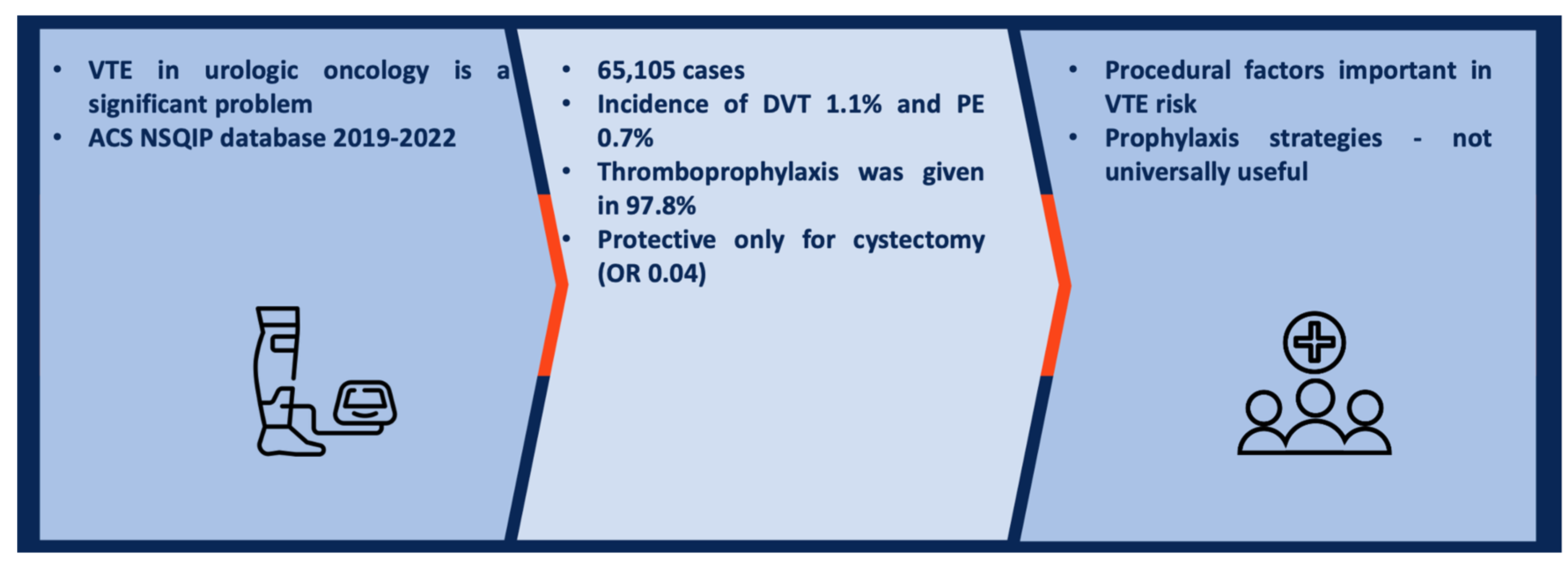
Incidence and Predictors of Venous Thromboembolism Following Major Urologic Cancer Surgery: Toward Risk-Stratified, Personalized Prophylaxis Strategies

Abstract
1. Introduction
2. Materials and Methods
2.1. Patients
2.2. Ethical Considerations
2.3. Study Outcomes
- Primary Outcome: 30-day incidence of deep vein thrombosis (DVT) following major urologic cancer surgery. Deep venous thrombosis was defined as a new diagnosis of a blood clot (thrombus) within the deep venous system, which may be accompanied by inflammation and require treatment. Must be noted within 30 days after the principal operative procedure AND one of the following (A or B): A. New diagnosis of a deep venous thrombosis, confirmed by a duplex, venogram, computed tomography (CT) scan, or any other definitive imaging modality (including direct pathology examination such as autopsy) AND the patient must be treated with anticoagulation therapy and/or placement of a vena cava filter or clipping of the vena cava, or the record indicates that treatment was warranted without additional appropriate treatment option available. B. As per (A) above, but the patient or decisionmaker has refused treatment. There must be documentation in the medical record of the refusal of treatment.
- Secondary Outcomes: Incidence of pulmonary embolism (PE), identification of independent predictors of DVT, and evaluation of the association between thromboprophylaxis strategies and DVT risk. Pulmonary embolism was defined as: Lodging of a blood clot in the pulmonary artery with subsequent obstruction of blood supply to the lung parenchyma. Blood clots usually originate from the deep leg veins or the pelvic venous system. The identification of a new blood clot in a pulmonary artery causes obstruction (complete or partial) of the blood supply to the lungs. A pulmonary embolism must be noted within 30 days after the principal operative procedure AND the following criteria, A AND B below: A. New diagnosis of a new blood clot in a pulmonary artery AND B. The patient has a ventilation-perfusion scan interpreted as high probability of pulmonary embolism, a positive CT exam, transesophageal echocardiogram, pulmonary arteriogram, CT angiogram, or any other definitive imaging modality (including direct pathology examination, such as autopsy).
2.4. Study Design and Definitions
2.5. Statistical Analysis
3. Results
3.1. Baseline Characteristics
3.2. Regression Analysis
- Length of hospital stay > 4 days: OR 2.63, 95% CI: 1.78–3.96, p < 0.001
- Operative time > 180 min: OR 2.20, 95% CI: 1.45–3.35, p < 0.001
- Age > 75 years: OR 1.70, 95% CI: 1.07–2.71, p = 0.025
- Radical prostatectomy cohort:
- ○
- Length of stay > 4 days: OR 2.96, 95% CI: 1.23–7.10, p = 0.015
- ○
- Operative time > 180 min: OR 2.03, 95% CI: 1.18–3.48, p = 0.01
- ○
- Diabetes Mellitus: OR 1.79, 95% CI: 1.06–3.04, p = 0.029
- Radical cystectomy cohort:
- ○
- Length of stay > 4 days: OR 5.37, 95% CI: 1.90–15.20, p = 0.004
- ○
- Operative time > 180 min: OR 3.38, 95% CI: 1.01–11.21, p = 0.047
- ○
- Age > 75 years: OR 1.53, 95% CI: 1.09–2.15, p <0.001
4. Discussion
5. Conclusions
Author Contributions
Funding
Institutional Review Board Statement
Informed Consent Statement
Data Availability Statement
Acknowledgments
Conflicts of Interest
References
- Tyson, M.D.; Castle, E.P.; Humphreys, M.R.; Andrews, P.E. Venous thromboembolism after urological surgery. J. Urol. 2014, 192, 793–797. [Google Scholar] [CrossRef]
- Garcia, C.C.; Tappero, S.; Piccinelli, M.L.; Barletta, F.; Incesu, R.-B.; Morra, S.; Scheipner, L.; Baudo, A.; Tian, Z.; Hoeh, B.; et al. In-Hospital Venous Thromboembolism and Pulmonary Embolism After Major Urologic Cancer Surgery. Ann. Surg. Oncol. 2023, 30, 8770–8779. [Google Scholar] [CrossRef]
- Najdi, J.; Ayoub, C.H.; Chawareb, E.A.; El Baba, B.; Malik, E.; El-Hajj, A. Preoperative risk factors for venous thromboembolism in major urologic cancer surgeries. World J. Urol. 2024, 43, 10. [Google Scholar] [CrossRef]
- Alhassan, N.; Trepanier, M.; Sabapathy, C.; Chaudhury, P.; Liberman, A.S.; Charlebois, P.; Stein, B.L.; Lee, L. Risk factors for post-discharge venous thromboembolism in patients undergoing colorectal resection: A NSQIP analysis. Tech. Coloproctol. 2018, 22, 955–964. [Google Scholar] [CrossRef]
- Björklund, J.; Rautiola, J.; Zelic, R.; Edgren, G.; Bottai, M.; Nilsson, M.; Vincent, P.H.; Fredholm, H.; Falconer, H.; Sjövall, A.; et al. Risk of Venous Thromboembolic Events After Surgery for Cancer. JAMA Netw. Open 2024, 7, e2354352. [Google Scholar] [CrossRef]
- Garas, S.N.; McAlpine, K.; Ross, J.; Carrier, M.; Bossé, D.; Yachnin, D.; Mallick, R.; Cagiannos, I.; Morash, C.; Breau, R.H.; et al. Venous thromboembolism risk in patients receiving neoadjuvant chemotherapy for bladder cancer. Urol. Oncol. 2022, 40, 381.e1–381.e7. [Google Scholar] [CrossRef] [PubMed]
- Ruppert, A.; Lees, M.; Steinle, T. Clinical burden of venous thromboembolism. Curr. Med. Res. Opin. 2010, 26, 2465–2473. [Google Scholar] [CrossRef] [PubMed]
- Chopard, R.; Albertsen, I.E.; Piazza, G. Diagnosis and Treatment of Lower Extremity Venous Thromboembolism: A Review. JAMA 2020, 324, 1765–1776. [Google Scholar] [CrossRef]
- Dahm, P.; Antonio Gonzalez Padilla, D. An Obituary for the European Association of Urology Guidelines on Thromboprophylaxis in Urological Surgery (2017–2023). Eur. Urol. Open Sci. 2024, 69, 5–6. [Google Scholar] [CrossRef] [PubMed]
- Anderson, D.R.; Morgano, G.P.; Bennett, C.; Dentali, F.; Francis, C.W.; Garcia, D.A.; Kahn, S.R.; Rahman, M.; Rajasekhar, A.; Rogers, F.B.; et al. American Society of Hematology 2019 guidelines for management of venous thromboembolism: Prevention of venous thromboembolism in surgical hospitalized patients. Blood Adv. 2019, 3, 3898–3944. [Google Scholar] [CrossRef]
- Violette, P.D.; Lavallee, L.T.; Kassouf, W.; Gross, P.L.; Shayegan, B. Canadian Urological Association guideline: Perioperative thromboprophylaxis and management of anticoagulation. Can. Urol. Assoc. J. 2019, 13, 105–114. [Google Scholar] [CrossRef]
- Martins, R.S.; Christophel, E.; Poulikidis, K.; Razi, S.S.; Latif, M.J.; Luo, J.; Bhora, F.Y. Variations in Perioperative Thromboprophylaxis Practices: Do the Guidelines Need a Closer Look? Ann. Thorac. Surg. Short Rep. 2024, 2, 422–426. [Google Scholar] [CrossRef]
- Pourjamal, N.; Lavikainen, L.I.; Halme, A.L.; Cartwright, R.; Ahopelto, K.; Guyatt, G.H.; Tikkinen, K.A. Global practice variation in pharmacologic thromboprophylaxis for general and gynaecological surgery: Systematic review. BJS Open 2022, 6, zrac129. [Google Scholar] [CrossRef]
- Violette, P.D.; Vernooij, R.W.; Aoki, Y.; Agarwal, A.; Cartwright, R.; Arai, Y.; Tailly, T.; Novara, G.; Baldeh, T.; Craigie, S.; et al. An International Survey on the Use of Thromboprophylaxis in Urological Surgery. Eur. Urol. Focus. 2021, 7, 653–658. [Google Scholar] [CrossRef] [PubMed]
- Guntupalli, S.R.; Brennecke, A.; Behbakht, K.; Tayebnejad, A.; Breed, C.A.; Babayan, L.M.; Cheng, G.; Ramzan, A.A.; Wheeler, L.J.; Corr, B.R.; et al. Safety and Efficacy of Apixaban vs Enoxaparin for Preventing Postoperative Venous Thromboembolism in Women Undergoing Surgery for Gynecologic Malignant Neoplasm: A Randomized Clinical Trial. JAMA Netw. Open 2020, 3, e207410. [Google Scholar] [CrossRef]
- Stewart, K.T.; Jafari, H.; Pattillo, J.; Santos, J.; Jao, C.; Kwok, K.; Singh, N.; Lee, A.Y.; Kwon, J.S.; McGinnis, J.M. Avoiding the needle: A quality improvement program introducing apixaban for extended thromboprophylaxis after major gynecologic cancer surgery. Gynecol. Oncol. 2024, 188, 131–139. [Google Scholar] [CrossRef] [PubMed]
- Lassen, M.R.; Gallus, A.; Raskob, G.E.; Pineo, G.; Chen, D.; Ramirez, L.M. Apixaban versus enoxaparin for thromboprophylaxis after hip replacement. N. Engl. J. Med. 2010, 363, 2487–2498. [Google Scholar] [CrossRef]
- Chen, E.C.; Papa, N.; Lawrentschuk, N.; Bolton, D.; Sengupta, S. Incidence and risk factors of venous thromboembolism after pelvic uro-oncologic surgery--a single center experience. BJU Int. 2016, 117, 50–53. [Google Scholar] [CrossRef]
- Azawi, N.H.; Subhi, Y.; Tolouee, S.; Geertsen, L.; Bjerrum, S.N.; Laier, G.H.; Dahl, C.; Lund, L.; Dabestani, S. Incidence and Associated Risk Factors of Venous Thromboembolism After Open and Laparoscopic Nephrectomy in Patients Administered Short-period Thromboprophylaxis: A Danish Nationwide Population-based Cohort Study. Urology 2020, 143, 112–116. [Google Scholar] [CrossRef]
- Elsayed, A.S.; Ozair, S.; Iqbal, U.; Mostowy, M.; Jing, Z.; Gibson, S.; Durrani, M.; Hussein, A.A.; Guru, K.A. Prevalence and Predictors of Venous Thromboembolism After Robot-Assisted Radical Cystectomy. Urology 2021, 149, 146–153. [Google Scholar] [CrossRef] [PubMed]
- Domenech Lopez, P.; Robles Garcia, J.E.; Gutierrez Castane, C.; Chiva San Roman, S.; Garcia Cortes, A.; Ancizu Marckert, F.J.; Tamariz Amador, L.E.; Andrés Boville, G.; Villacampa Aubá, F.; de Fata Chillón, F.R.; et al. Surgical thromboprophylaxis in daily urologic surgery: Beyond bridge therapy. Actas Urol. Esp. (Engl. Ed.) 2019, 43, 455–466. [Google Scholar] [CrossRef] [PubMed]
- Naik, R.; Mandal, I.; Hampson, A.; Lane, T.; Adshead, J.; Rai, B.P.; Vasdev, N. The role of extended venous thromboembolism prophylaxis for major urological cancer operations. BJU Int. 2019, 124, 935–944. [Google Scholar] [CrossRef]
- Ivankovic, V.; McAlpine, K.; Delic, E.; Carrier, M.; Stacey, D.; Auer, R.C. Extended-duration thromboprophylaxis for abdominopelvic surgery: Development and evaluation of a risk-stratified patient decision aid to facilitate shared decision making. Res. Pract. Thromb. Haemost. 2022, 6, e12831. [Google Scholar] [CrossRef]
- Pariser, J.J.; Pearce, S.M.; Anderson, B.B.; Packiam, V.T.; Prachand, V.N.; Smith, N.D.; Steinberg, G.D. Extended Duration Enoxaparin Decreases the Rate of Venous Thromboembolic Events after Radical Cystectomy Compared to Inpatient Only Subcutaneous Heparin. J. Urol. 2017, 197, 302–307. [Google Scholar] [CrossRef]
- Douroumis, K.; Fragkiadis, E.; Moulavasilis, N.; Stratigopoulou, P.; Adamakis, I.; Anastasiou, I.; Mitropoulos, D. Comparative evaluation of venous thromboembolic risk in urologic inpatients using different risk assessment models. Can. Urol. Assoc. J. 2025, 19, E179–E182. [Google Scholar] [CrossRef] [PubMed]
- Klaassen, Z.; Wallis, C.J.D.; Lavallee, L.T.; Violette, P.D. Perioperative venous thromboembolism prophylaxis in prostate cancer surgery. World J. Urol. 2020, 38, 593–600. [Google Scholar] [CrossRef] [PubMed]
| Procedure | DVT N, % | PE N, % |
|---|---|---|
| Radical cystectomy | 545, 1.92% | 354, 1.24% |
| Radical nephrectomy | 35, 0.44% | 33, 0.42% |
| Radical prostatectomy | 137, 0.48% | 134, 0.47% |
| All cases | 717, 1.1% | 521, 0.8% |
| No DVT (n = 64,388) | DVT (n = 717) | p-Value | |
|---|---|---|---|
| Age in years Mean, SD | 66.33, 9.283 | 70.05, 9.349 | <0.001 |
| BMI in kg/m2 Mean, SD | 30.18, 6.19 | 30.54, 6.54 | 0.223 |
| % DM, requiring Insulin | 3541, 5.5% | 59, 8.2% | <0.001 |
| % Current smoker | 9400, 14.6% | 104, 14.5% | 0.933 |
| %Functional status, independent | 60,460, 93.9% | 696, 97% | <0.001 |
| % History of COPD | 2446, 3.8% | 41, 5.7% | <0.001 |
| % History of CHF | 772, 1.2% | 21, 2.9% | <0.001 |
| % History of Hypertension | 30,584, 47.5% | 384, 53.5% | <0.001 |
| % CKD, On Dialysis | 708, 1.1% | 16, 2.23% | <0.001 |
| ASA 3/4/5 | 34,125, 53% | 530,74% | <0.001 |
| % Open Surgery | 20,668, 32.1% | 420, 58.57% | <0.001 |
| Operation time (Min) Mean, SD | 259.42, 111.9 | 332.90, 133.9 | <0.001 |
| Length of hospital stay (days) Mean, SD | 4.383, 3.28 | 9.73, 7.1 | <0.001 |
| Prophylaxis strategy: | 0.011 | ||
| Mechanical and pharmacologic prophylaxis % | 48,741, 75.7% | 619, 86.3% | |
| Mechanical prophylaxis, % | 11,589, 18% | 78, 10.8% | |
| Pharmacologic prophylaxis, % | 2641, 4.1% | 8, 1.1% | |
| No prophylaxis | 1417, 2.2% | 12, 1.6% |
| All Cases | Radical Prostatectomy | Radical Cystectomy | Radical Nephrectomy | |||||
|---|---|---|---|---|---|---|---|---|
| Odds Ratio (95% CI) | p-Value | Odds Ratio (95% CI) | p-Value | Odds Ratio (95% CI) | p-Value | Odds Ratio (95% CI) | P-Value | |
| Age > 75 years | 1.705 (1.071–2.715) | 0.025 | 1.998 (0.865–4.611) | 0.105 | 1.528 (1.092–2.156) | <0.001 | 1.270 (0.357–4.516) | 0.711 |
| BMI > 35 kg/m2 | 1.401 (0.956–2.055) | 0.084 | 1.509 (0.891–2.556) | 0.126 | 1.894 (0.970–3.683) | 0.06 | 1.219 (0.415–3.575) | 0.719 |
| ASA 3/4/5 | 1.385 (0.931–2.061) | 0.108 | 1.412 (0.887–2.246) | 0.146 | 1.166 (0.967–1.407) | 0.108 | 1.045 (0.451–2.392) | 0.929 |
| Current smoker | 0.765 (0.441–1.326) | 0.340 | 0.505 (0.184–1.388) | 0.185 | 0.770 (0.163–3.622) | 0.740 | 0.960 (0.447–2.062) | 0.916 |
| Diabetes Mellitus | 1.288 (0.858–1.953) | 0.222 | 1.797 (1.060–3.045) | 0.029 | 0.876 (0.425–1.808) | 0.721 | 0.840 (0.226–3.131) | 0.795 |
| Hypertension | 1.015 (0.718–1.434) | 0.935 | 0.986 (0.624–1.557) | 0.951 | 1.242 (0.671–2.298) | 0.491 | 0.681 (0.237–1.955) | 0.475 |
| COPD | 1.029 (0.416–2.543) | 0.951 | 1.243 (0.302–5.113) | 0.763 | 0.700 (0.213–2.294) | 0.556 | NE | NE |
| CHF | 1.528 (0.661–3.535) | 0.322 | 0.804 (0.110–5.879) | 0.830 | 1.979 (0.752–5.208) | 0.167 | NE | NE |
| Functional status, partly dependent/ totally dependent | 1.778 (0.542–5.837) | 0.343 | 3.167 (0.843–6.925) | 0.071 | 4.173 (0.824–7.126) | 0.084 | 0.850 (0.447–1.616) | 0.621 |
| Operation time > 180 min | 2.205 (1.452–3.356) | <0.001 | 2.030 (1.183–3.483) | 0.01 | 3.380 (1.019–11.214) | 0.047 | 0.418 (0.143–1.222) | 0.111 |
| Open Surgery Minimally invasive surgery | 1.427 (0.841–2.420) 1 | 0.188 | 1.220 (0.167–8.935) 1 | 0.845 | 3.563 (0.884–14.369) 1 | 0.074 | 1.069 (0.549–2.082) 1 | 0.845 |
| Length of hospital stay > 4 days | 2.632 (1.782–3.958) | <0.001 | 2.966 (1.238–7.107) | 0.015 | 5.371 (1.902–15.204) | 0.004 | 0.962 (0.413–2.239) | 0.928 |
| Mechanical and pharmacological prophylaxis Mechanical prophylaxis Pharmacological prophylaxis No prophylaxis | 0.616 (0.347–1.094) 0.593 (0.293–1.197) 0.346 (0.085–1.413) 1 | 0.098 0.145 0.139 | 0.458 (0.056–3.770) 0.355 (0.036–3.534) 1.016 (0.059–1.7457) 1 | 0.468 0.377 0.991 | 0.235 (0.022–2.540) 0.205 (0.026–1.648) 0.048 (0.003–0.835) 1 | 0.235 0.136 0.037 | 0.209 (0.017–2.612) 0.469 (0.113–1.954) 0.251 (0.027–2.351) 1 | 0.225 0.299 0.226 |
Disclaimer/Publisher’s Note: The statements, opinions and data contained in all publications are solely those of the individual author(s) and contributor(s) and not of MDPI and/or the editor(s). MDPI and/or the editor(s) disclaim responsibility for any injury to people or property resulting from any ideas, methods, instructions or products referred to in the content. |
© 2026 by the authors. Licensee MDPI, Basel, Switzerland. This article is an open access article distributed under the terms and conditions of the Creative Commons Attribution (CC BY) license.
Share and Cite
Manivasagam, S.S.; Aminsharifi, A.; Raman, J.D. Incidence and Predictors of Venous Thromboembolism Following Major Urologic Cancer Surgery: Toward Risk-Stratified, Personalized Prophylaxis Strategies. J. Pers. Med. 2026, 16, 82. https://doi.org/10.3390/jpm16020082
Manivasagam SS, Aminsharifi A, Raman JD. Incidence and Predictors of Venous Thromboembolism Following Major Urologic Cancer Surgery: Toward Risk-Stratified, Personalized Prophylaxis Strategies. Journal of Personalized Medicine. 2026; 16(2):82. https://doi.org/10.3390/jpm16020082
Chicago/Turabian StyleManivasagam, Sri Saran, Alireza Aminsharifi, and Jay D. Raman. 2026. "Incidence and Predictors of Venous Thromboembolism Following Major Urologic Cancer Surgery: Toward Risk-Stratified, Personalized Prophylaxis Strategies" Journal of Personalized Medicine 16, no. 2: 82. https://doi.org/10.3390/jpm16020082
APA StyleManivasagam, S. S., Aminsharifi, A., & Raman, J. D. (2026). Incidence and Predictors of Venous Thromboembolism Following Major Urologic Cancer Surgery: Toward Risk-Stratified, Personalized Prophylaxis Strategies. Journal of Personalized Medicine, 16(2), 82. https://doi.org/10.3390/jpm16020082