Review

Molecular-Guided Precision Oncology in Cancer of Unknown Primary: A State-of-the-Art Perspective


1
Sarah Cannon Research Institute, Nashville, TN 37203, USA
2
Department of Medical Oncology, Gustave Roussy, University Paris-Saclay, 94805 Villejuif, France
3
CESP, INSERM U1018, Université Paris-Saclay, 94807 Villejuif, France
4
Sarah Cannon Cancer Center, Tennessee Oncology, Greco-Hainsworth Centers for Research, Nashville, TN 37203, USA
*
Author to whom correspondence should be addressed.
J. Pers. Med. 2026, 16(2), 80; https://doi.org/10.3390/jpm16020080 (registering DOI)
Submission received: 11 September 2025 / Revised: 15 January 2026 / Accepted: 17 January 2026 / Published: 1 February 2026
(This article belongs to the Section Precision Oncology)

Abstract

Cancer of unknown primary (CUP) is evolving from a diagnosis of exclusion treated with empirical chemotherapy to a molecularly defined entity amenable to precision-based interventions. This heterogeneous entity, comprising 2–3% of all metastatic malignancies, encompasses diverse cancers with clinically occult primary sites at diagnosis after a thorough workup. Recent landmark trials including CUPISCO and Fudan CUP-001 have demonstrated significant survival improvements with molecularly guided therapies compared to empirical chemotherapy, fundamentally enhancing and complementing traditional organ-centric treatment paradigms. This review synthesizes the current evidence supporting molecular diagnostics, tumor-agnostic therapies, and precision-based approaches in CUP management. We examine the clinical utility of comprehensive genomic profiling, gene expression profiling, and liquid biopsy technologies, while addressing implementation challenges and future directions. The integration of molecular tumor boards and the emergence of tissue/tissue-of-origin agnostic therapies herald a new era where CUP transitions from therapeutic nihilism to personalized oncology. As molecular technologies advance and targeted therapies proliferate, CUP may no longer represent a diagnosis of exclusion but rather an opportunity for molecularly informed precision care.

1. Introduction

Cancer of unknown primary (CUP) has historically represented one of the most challenging oncologic clinical scenarios—a heterogeneous syndrome characterized by metastatic disease without an identifiable primary tumor despite comprehensive diagnostic evaluation [1]. Far from being a rare entity, CUP affects an estimated 37,350 patients annually in the United States, surpassing the incidence of multiple myeloma, chronic lymphocytic leukemia, and several organ-specific de novo metastatic cancers, including pancreatic and renal carcinomas [2]. Globally, CUP comprises 2–3% of all metastatic malignancies, underscoring its significant clinical burden.
The absence of an identified anatomical primary site has traditionally complicated staging, prognostication, and treatment selection, relegating most patients to empirical chemotherapy with limited survival benefits [3]. This organ-centric paradigm, rooted in anatomical classification systems, has yielded disappointing outcomes with median overall survival typically ranging from 6 to 16 months [3]. However, the landscape of CUP management is undergoing a fundamental transformation, driven by advances in molecular diagnostics (clinical next-generation sequencing adoption), precision oncology (availability of genomically targeted therapies and immunotherapies), and our evolving understanding of cancer biology [4,5,6].
Recent pivotal trials have demonstrated that molecularly guided therapies can significantly improve outcomes compared to empirical chemotherapy, challenging the conventional wisdom that has dominated CUP management for decades [7,8]. This paradigm shift represents more than incremental progress—it signals a fundamental reconceptualization of CUP from a diagnosis of exclusion to a molecularly defined entity amenable to precision-based interventions [6].

2. Historical Context and Evolution of CUP Management

2.1. Traditional Classification and Treatment Approaches

Historically, CUP has been dichotomized into “favorable” and “unfavorable” subtypes based on clinicopathological features [9]. Approximately 20% of cases present with characteristics suggestive of a responsive or treatable presumptive primary tumor, previously defined as favorable CUP. The most common metastatic sites in CUP are, e.g., liver, lung, bone, lymph nodes. Novel qualitative assessments such as PET-CT have improved diagnostic yield but still fail to identify primaries in a subset of patients. Site-specific therapy (SST) in these cases yields outcomes comparable to those seen in patients with known primary tumors of similar histology.
The remaining 80% of cases, lacking definitive clinicopathological features pointing to a specific primary site, were classified as unfavorable CUP. For these patients, empirical chemotherapy became the standard of care, typically employing broad-spectrum cytotoxic regimens such as carboplatin/paclitaxel or gemcitabine/cisplatin. Despite decades of clinical trials, this approach has yielded consistently disappointing results with minimal improvement in overall survival.

2.2. Early Molecular Approaches and Initial Setbacks

The advent of and experience with gene expression profiling (GEP) approximately 15 years ago offered the first molecular approach to CUP diagnosis and management [10]. These platforms promised to identify tissue of origin (TOO) and guide site-specific therapy based on molecular signatures rather than morphological features alone. A large, single-arm, phase II study conducted by a cooperative group demonstrated improved overall survival in patients with cancer of unknown primary (CUP) who received assay-directed, site-specific therapy. These results compare favorably with historical outcomes from empiric CUP treatment regimens, thereby emphasizing the clinical value of GEP in CUP.
However, early randomized studies evaluating GEP-guided treatment yielded disappointing results. A phase II study conducted from 2008 to 2015 and a phase III trial from 2012 to 2018 failed to demonstrate improved outcomes with SST compared to empirical chemotherapy [11]. Several factors contributed to these negative results. The limited therapeutic options available at the time meant that site-specific therapies were predominantly chemotherapy regimens similar to empirical treatments [11]. Furthermore, the absence of targeted agents was notable, as molecularly targeted therapies and immunotherapy were not yet available or integrated into these studies. Additionally, technological limitations of early GEP platforms resulted in lower accuracy and limited cancer type representation. Consequently, major clinical practice guidelines from the National Comprehensive Cancer Network (NCCN) and European Society for Medical Oncology (ESMO) did not recommend routine use of GEP, reinforcing reliance on empirical chemotherapy approaches.

3. The Molecular Revolution in CUP Management

3.1. Landmark Clinical Trials

Landmark trials in cancer of unknown primary (CUP) have fundamentally altered the management landscape. FUDAN-CUP-01, CUPISCO, and GEFCAPI represent pivotal studies that have evaluated molecularly guided therapy, site-specific treatment approaches, and precision medicine strategies in CUP. Key features and outcomes of these major trials are outlined below. (Table 1).

The Fudan CUP-001 Study

The prospective phase III Fudan CUP-001 study marked a defining moment in CUP management [8]. This randomized trial enrolled 182 patients with unfavorable CUP, comparing GEP-directed SST with empirical chemotherapy [9]. The results demonstrated a statistically significant and clinically meaningful improvement in survival for patients in the GEP-directed group [14]. Critically, this study differed from earlier negative trials by incorporating targeted therapies and immunotherapy when available and indicated. However, only 26% of patients who would be expected to benefit from immunotherapy actually received these agents, suggesting that the survival benefit might have been even greater with optimal matching and better drug access.

3.2. The CUPISCO Trial

The CUPISCO randomized phase II trial represented the largest evaluation of molecularly guided therapy in CUP to date, involving 573 patients with non-squamous, unfavorable CUP [7]. This innovative study design required the initial comprehensive genomic profiling (CGP) of tissue or blood, followed by three cycles of empirical chemotherapy [15]. Patients without progressive disease (438 patients) were then randomized 3:1 to receive either molecularly targeted therapies (including immunotherapy) or continuation of empirical chemotherapy. The study demonstrated a significant and clinically beneficial improvement in progression-free survival for patients treated with molecularly targeted therapy versus empirical chemotherapy. This tumor-agnostic approach, guided by molecular alterations rather than presumed tissue of origin since there was no attempt to determine TOO, represented a new template toward precision oncology in CUP management [7].

3.3. Meta-Analysis of CUP Trials

A systematic review and meta-analysis encompassing six prospective studies (including four randomized controlled trials) with 1644 patients confirmed meaningful survival improvements with molecularly directed therapy versus empirical chemotherapy [13]. This analysis included the Fudan CUP-001 study, CUPISCO trial, and earlier negative studies, providing evidence for the practice-changing potential of molecular approaches [13]. Squamous cell carcinoma (SCC) has often been excluded from molecular CUP trials due to its distinct clinical behavior and relatively favorable prognosis when localized to cervical lymph nodes. The American Cancer Society and NCI guidelines recommend site-specific management for SCC CUPs, often involving head and neck protocols. Pembrolizumab, nivolumab and nivolumab and ipilimumab have demonstrated clinical activity, especially in MSI- and TMB-high cases. Although PD-L1 is not a perfect predictive marker, when added with MSI-H and TMB-H, it has better predictability of response.

3.4. Complementary Molecular Strategies

The success of both GEP-guided and CGP-guided approaches has established two complementary strategies for CUP management [16,17]. The first strategy involves GEP-directed site-specific therapy based on the predicted tissue of origin, while the second encompasses CGP-guided tumor-agnostic therapy based on actionable molecular alterations regardless of histology [4]. These approaches may be synergistic, as CGP can provide specific therapeutic guidance even within GEP-diagnosed primary tumor categories [18,19,20,21].

4. Molecular Diagnostic Technologies

4.1. Comprehensive Genomic Profiling (CGP)

Modern CGP platforms enable the identification of actionable mutations, gene fusions, microsatellite instability, tumor mutational burden, and other biomarkers relevant to targeted therapy selection [4,18,19,20,21] (Table 2). These assays can be performed on tissue specimens or circulating tumor DNA (ctDNA), providing flexibility in sample acquisition and real-time monitoring capabilities.
CGP offers several key advantages in the CUP setting [22]. The broad biomarker coverage allows for single assay evaluation of hundreds of genes, providing comprehensive molecular characterization in a single test [16,22]. The therapeutic actionability of CGP enables direct guidance for FDA-approved targeted therapies, streamlining the translation from molecular findings to clinical interventions [23,24,25]. Furthermore, the tumor-agnostic applicability of CGP allows for treatment selection independent of tissue of origin, which is particularly relevant in the CUP context where primary site identification remains challenging. Finally, the dynamic monitoring capabilities through liquid biopsy enable treatment monitoring and resistance detection throughout the disease course [23,26].

4.2. Gene Expression Profiling (GEP)

Contemporary GEP assays have evolved significantly from early platforms, achieving sensitivity rates of 80–90% for TOO identification across expanded cancer type libraries [27,28,29]. These molecular classifiers analyze expression patterns of carefully selected gene panels to predict primary site with high confidence [30].
Improvements in GEP technology have substantially enhanced clinical utility. Enhanced accuracy has been achieved through improved algorithms and expanded reference libraries that better represent the molecular diversity of human cancers [20,27,28]. The integration of artificial intelligence and machine-learning approaches has improved pattern recognition capabilities, leading to more precise tissue-of-origin predictions [28,31,32,33,34]. Liquid biopsy compatibility has been developed, enabling circulating tumor DNA analysis for patients where tissue sampling is challenging [32]. Extensive clinical validation in CUP patient cohorts has provided robust evidence for the clinical utility of modern GEP platforms.

4.3. Circulating Tumor DNA (ctDNA) Methylation Classifiers

Emerging technologies such as the CUPiD classifier utilize DNA methylation patterns in ctDNA to predict tissue of origin [35]. These approaches offer several distinct advantages in the clinical management of CUP patients. The non-invasive sampling approach through blood-based analysis eliminates the need for repeat tissue biopsies and enables testing in patients with inaccessible lesions [35,36]. The high specificity achieved through methylation pattern analysis reflects the tissue-specific nature of epigenetic modifications. Real-time assessment capabilities allow for serial monitoring throughout the disease course, providing dynamic insights into tumor evolution [35]. Finally, these methylation-based classifiers serve as a complement to tissue-based assays, providing additional diagnostic information that can enhance overall diagnostic accuracy. Table 2 presents a synthesis of the molecular diagnostic platforms employed in CUP, including examples of their application in precision oncology [5].

5. Tumor-Agnostic Therapeutic Landscape

5.1. FDA-Approved Tumor-Agnostic Therapies

The approval of tissue-agnostic therapies has fundamentally altered the CUP treatment paradigm [24,37,38,39] (Table 3). Several classes of these agents have demonstrated clinical efficacy across multiple tumor types regardless of primary site of origin. Immunotherapy agents represent a major category of tumor-agnostic therapies with established efficacy in CUP patients. Pembrolizumab has received FDA approval for microsatellite instability-high (MSI-high) or mismatch repair deficient (dMMR) tumors as well as high tumor mutational burden (TMB-H) malignancies [40]. Dostarlimab has been approved specifically for dMMR solid tumors, while nivolumab has received approval for MSI-high/dMMR colorectal cancer.
Genomically targeted therapy agents have also shown remarkable efficacy in biomarker-selected populations. Larotrectinib, entrectinib and repotrectinib have been approved for NTRK fusion-positive tumors, representing the first truly tissue-agnostic targeted therapies. Selpercatinib has received approvals for RET fusion-positive solid tumors. The combination of dabrafenib plus trametinib has been approved for BRAF V600E-mutated solid tumors, extending the success of this combination beyond melanoma.
Several emerging agents represent the expanding landscape of tumor-agnostic therapies. Fam-trastuzumab deruxtecan has shown promising efficacy for HER2-positive solid tumors across multiple histologies and has been approved for all HER2-positive solid tumors defined by Immunohistochemistry 3 + (IHC3+), indicating that IHC is now emerging as a validated test in addition to NGS testing. Various PARP inhibitors are being investigated for homologous recombination deficient tumors, potentially expanding their utility beyond ovarian and breast cancers [41].

5.2. Clinical Implementation Challenges

Despite these therapeutic advances, several challenges limit the widespread application of tumor-agnostic therapies in CUP [42].The limited biomarker prevalence means that only a minority of CUP patients harbor currently actionable alterations, highlighting the need for continued biomarker discovery [43]. Access barriers persist, with geographic and economic disparities in molecular testing availability creating inequities in care delivery. Sequencing decisions regarding the optimal timing and sequencing of site-specific versus tumor-agnostic approaches remain uncertain, requiring evidence-based guidelines. Furthermore, resistance mechanisms to targeted therapies in the CUP context remain poorly understood, limiting the development of resistance-directed treatment strategies.

5.3. Research Challenges

All studies in CUP have inherent challenges. First, the limited prevalence of actionable biomarkers in cancer of unknown primary (CUP) restricts the proportion of patients who may benefit from targeted therapies. Second, access and reimbursement barriers, particularly in low-resource settings, pose significant challenges to the global implementation of precision oncology approaches. Third, heterogeneity in trial populations, including variability in diagnostic workup and prior treatments, may confound outcome comparisons and limit interpretability. Fourth, the potential for bias from single-center trials, especially those conducted at tertiary referral institutions, may affect the generalizability of findings. Fifth, short and variable follow-up durations across cohorts may underestimate long-term outcomes and late toxicities. Future multicenter studies with harmonized protocols are needed to validate and extend these observations.

6. Molecular Tumor Boards and Multidisciplinary Care

6.1. Role of Molecular Tumor Boards (MTBs)

MTBs have emerged as critical components of precision oncology infrastructure, facilitating multidisciplinary evaluation of genomic data and personalized treatment planning. In the CUP context, MTBs serve several essential functions that are particularly relevant given the complexity of these cases [44].
Complex case review represents a fundamental function of MTBs, involving the interpretation of molecular findings within the broader clinical context of each individual patient [44]. Treatment recommendations are developed through consensus-driven therapeutic guidance that incorporates multiple expert perspectives and current evidence. Clinical trial matching involves the systematic identification of appropriate investigational options for patients whose molecular profiles suggest potential benefit from experimental therapies. Finally, MTBs serve as educational platforms for knowledge dissemination and capacity building, ensuring that the broader oncology team remains current with rapidly evolving molecular diagnostics and targeted therapies [45].

6.2. Integration with Community Practice

Expanding MTB access to community oncology settings remains a critical implementation challenge [45]. Several potential solutions have been proposed to address this gap in precision oncology infrastructure. Virtual consultation platforms can provide remote access to MTB expertise, leveraging telemedicine technology to overcome geographic barriers. Decision support tools utilizing artificial intelligence can assist in the interpretation of molecular findings, providing evidence-based recommendations at the point of care [45,46]. Standardized protocols can offer simplified algorithms for common scenarios, enabling community providers to manage straightforward cases without specialist consultation. Educational initiatives, including comprehensive training programs for community providers, can build local expertise in molecular oncology and precision medicine principles [45].

7. Clinical Algorithm for Modern CUP Management

Proposed Integrated Approach

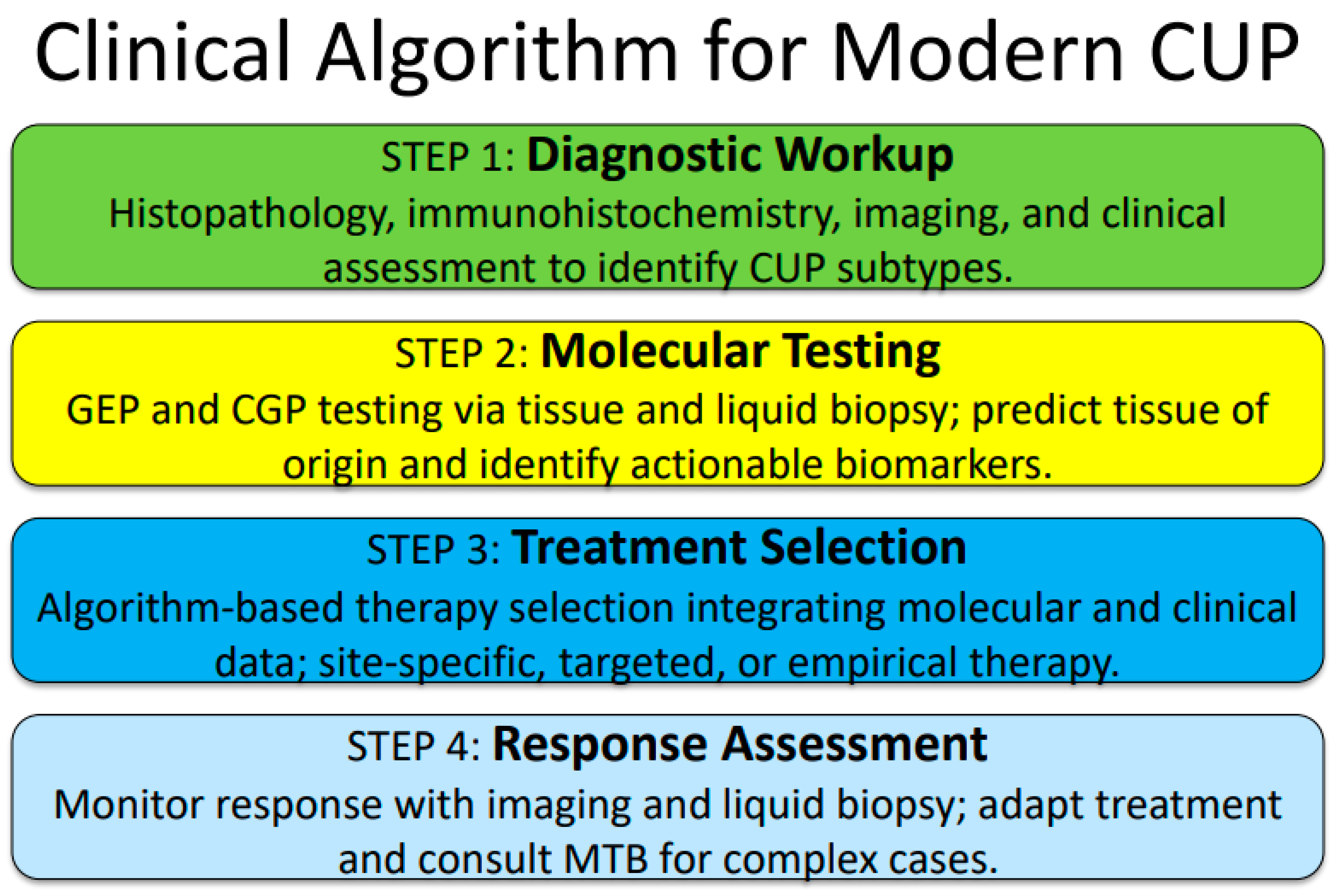
Based on current evidence and expert consensus, we propose a comprehensive algorithm for CUP management that integrates molecular diagnostics with clinical decision-making. This approach consists of four sequential steps that build upon each other to optimize patient outcomes (Figure 1).
STEP 1 involves comprehensive diagnostic workup, beginning with standard histopathological evaluation complemented by appropriate immunohistochemistry panels. Baseline imaging and clinical assessment establish the extent of disease and performance status. This phase concludes with the identification of favorable versus unfavorable CUP subtypes based on established clinical and pathological criteria.
STEP 2 focuses on molecular testing strategy implementation, involving concurrent GEP and CGP testing using both tissue and liquid biopsy approaches when feasible. TOO prediction is performed with confidence scoring to guide subsequent treatment decisions. Simultaneously, actionable biomarker identification is conducted to determine eligibility for tumor-agnostic therapies.
STEP 3 encompasses treatment selection using an algorithm-based approach that integrates molecular findings with clinical factors. Patients with high-confidence tissue-of-origin predictions and actionable biomarkers receive a combined approach incorporating both site-specific and targeted therapies. Those with high-confidence tissue-of-origin predictions but no actionable biomarkers receive site-specific therapy based on the predicted primary site. Patients with indeterminate or low-confidence TOO predictions but actionable biomarkers receive tumor-agnostic therapy directed by the identified molecular alterations. Finally, patients without molecular guidance receive empirical chemotherapy with early reassessment for molecular testing if initial results are inconclusive.
STEP 4 involves response assessment and treatment adaptation, including regular clinical and radiological monitoring according to established guidelines. MTB consultation is recommended for cases with disease progression or complex clinical scenarios requiring multidisciplinary input.

8. Evidence Summary and Key Studies

8.1. Pivotal Clinical Trials Comparison

The evolution of CUP management can be understood through the lens of several pivotal clinical trials that have shaped current practice (Table 1). The Fudan CUP-001 phase III randomized controlled trial enrolled 182 patients and used progression-free survival as the primary endpoint [8]. The study demonstrated a hazard ratio of 0.64 (95% CI 0.46–0.89, p = 0.008), favoring GEP-guided site-specific therapy over empirical chemotherapy.
The CUPISCO phase II randomized controlled trial represented a larger effort with 573 patients, using progression-free survival as the primary endpoint [7]. This study achieved a hazard ratio of 0.69 (95% CI 0.52–0.91, p = 0.009), favoring CGP-guided targeted therapy over empirical chemotherapy [38].
In contrast, earlier studies demonstrated the limitations of molecular approaches when targeted therapies and immunotherapy were not available. The Hayashi et al. phase II randomized controlled trial with 130 patients showed a hazard ratio of 0.79 (95% CI 0.54–1.16, p = 0.23) for GEP-guided using microarray analysis SST, failing to reach statistical significance [12]. Similarly, the GEFCAPI 04 phase III trial with 243 patients demonstrated a hazard ratio of 0.87 (95% CI 0.57–1.33, p = 0.52), also failing to show significant benefit [11]. Considering the improved therapies for many advanced cancers today, these earlier studies are now outdated.

8.2. Biomarker Prevalence in CUP

Understanding the prevalence of actionable biomarkers in CUP is crucial for treatment planning and resource allocation. Microsatellite instability-high (MSI-H) or mismatch repair deficiency (dMMR) occurs in approximately 2–4% of CUP cases, with established therapeutic options including pembrolizumab and dostarlimab receiving FDA approval [6,24,47,48,49]. High tumor mutational burden (TMB-H) is found in 8–12% of cases, with pembrolizumab representing the primary FDA-approved therapeutic option [38]. NTRK fusions, while rare at less than 1% prevalence, have highly effective targeted therapies available, including larotrectinib, entrectinib and repotrectinib, which have received FDA approval. RET alterations occur in 1–2% of CUP cases, with selpercatinib providing an FDA-approved treatment option. BRAF V600E mutations are found in 2–5% of cases, with the combination of dabrafenib plus trametinib receiving FDA approval [39]. HER2 amplification occurs in 5–10% of cases, with trastuzumab deruxtecan showing promising results in investigational studies and having received approval for all IHC3+ cancers. Several biomarkers remain under investigation for CUP applications. Homologous recombination deficiency affects 10–15% of cases, with various PARP inhibitors under investigation for this indication. Although the identification and appreciation of actionable biomarkers is an essential element in CUP management, if a presumptive primary tumor is diagnosed, agnostic therapies may or may not be indicated as a first-line therapy depending on the specific cancer and the biomarker. The absence of actionable targets in many CUP cases remains a clinical challenge. As highlighted in the recent literature, molecular profiling may still provide diagnostic clarity or prognostic insights even when direct therapeutic targets are absent. Furthermore, the integration of transcriptomic and epigenetic data may help uncover cryptic lineage markers or indirect therapeutic vulnerabilities.

9. Perspectives and Clinical Considerations

The transition from empirical to molecularly guided therapy represents more than an incremental advance—it fundamentally challenges our conceptualization of CUP as a single-disease entity. Early prospective trials comparing site-specific therapy (SST) guided by molecular profiling versus empiric chemotherapy (EC) did not demonstrate clear superiority but had limitations such as heterogeneous patient populations, limited access to effective targeted agents, and evolving molecular platforms. However, more recent trials like Fudan CUP-001 have shown improved progression-free survival with SST guided by a 90-gene expression assay. The diagnostic approach must evolve to recognize that molecular characterization becomes as important as traditional pathological evaluation in determining optimal treatment strategies. Treatment selection increasingly relies on biomarker-driven decisions that may supersede anatomical considerations, fundamentally altering the decision-making process. Clinical trial design must adapt to emphasize basket trials and adaptive designs that become more relevant than traditional organ-specific studies [50]. Finally, regulatory considerations must evolve to accommodate tumor-agnostic approvals that gain precedence over site-specific indications.

10. Implementation Challenges and Solutions

Several key challenges must be addressed to successfully implement molecularly guided approaches in CUP management. Limited molecular testing access represents a significant barrier, requiring solutions that include expanded insurance coverage, development of point-of-care testing capabilities, and establishment of regional molecular pathology networks.
Interpretation complexity of molecular results poses another challenge, necessitating solutions such as standardized reporting formats, development of clinical decision support tools, and expanded access to MTB expertise. Treatment sequencing uncertainty creates clinical dilemmas that require evidence-based algorithms, comparative effectiveness studies, and the establishment of registry programs to guide optimal care.
Cost-effectiveness concerns must be addressed through comprehensive health economics studies that demonstrate value, development of risk stratification tools to optimize resource utilization, and optimization of testing strategies to balance comprehensiveness with cost efficiency.

11. Future Directions and Research Priorities

11.1. Technological Advances

The future of CUP management will be shaped by several emerging technological innovations. Artificial intelligence-enhanced diagnostics promise to revolutionize TOO prediction through sophisticated machine-learning algorithms that can identify complex patterns in molecular data. Multi-omics integration approaches will combine genomic, transcriptomic, and epigenomic profiling to provide unprecedented insights into tumor biology and therapeutic vulnerabilities.
Liquid biopsy evolution continues to advance with enhanced sensitivity for minimal residual disease detection, enabling more precise monitoring of treatment response and disease recurrence. Circulating tumor DNA (ctDNA) analysis and methylation classifiers such as CUPiD offer non-invasive, real-time diagnostic capabilities, which are particularly valuable when tissue samples are limited or exhausted by immunohistochemistry. Liquid biopsy also enables serial monitoring and complements tissue-based assays, enhancing diagnostic accuracy and therapeutic decision-making. Single-cell analysis technologies will facilitate tumor heterogeneity characterization and clonal evolution tracking, providing insights into resistance mechanisms and therapeutic adaptation.

11.2. Clinical Research and Care Delivery Priorities

Several key areas require focused research efforts to advance CUP management. Comparative effectiveness studies are needed to provide direct comparison of GEP-guided versus CGP-guided approaches, enabling evidence-based selection of optimal molecular strategies. Biomarker discovery efforts must continue to identify novel therapeutic targets in molecularly uncharacterized CUP cases, expanding treatment options for currently untreatable patients. Understanding resistance mechanisms to targeted therapies in the CUP context represents a critical knowledge gap that requires dedicated investigation. Quality-of-life studies examining patient-reported outcomes with molecular versus empirical approaches will inform treatment decision-making and healthcare policy. Innovation in healthcare delivery systems will be essential for the widespread implementation of precision oncology approaches in CUP. Telemedicine integration enables remote MTB consultations, overcoming geographic barriers to specialized expertise. Community implementation strategies must include enabling broader access to molecularly guided care. Global access initiatives through international collaborations can address disparities in molecular testing availability, particularly in resource-limited settings. Comprehensive training programs must develop educational curricula for molecular oncology in CUP, building workforce capacity to deliver precision medicine.

12. Conclusions and Future Outlook

The management of CUP stands at an inflection point. The convergence of advanced molecular diagnostics, tumor-agnostic therapies, and precision oncology principles has transformed CUP from a diagnosis of therapeutic nihilism to one of cautious optimism [51,52]. The landmark CUPISCO and Fudan CUP-001 trials have provided compelling evidence that molecularly guided approaches significantly improve outcomes compared to traditional empirical chemotherapy.
As we look toward the future, several key principles that will guide the continued evolution of CUP management emerge. A molecular-first approach represents the integration of GEP and CGP into routine CUP evaluation, signifying a paradigm shift from empirical chemotherapy and an organ-centric approach to a more biomarker-driven treatment selection. The recognition that complementary strategies involving GEP-guided site-specific therapy and CGP-guided tumor-agnostic approaches may be synergistic rather than competitive offers personalized treatment pathways based on individual molecular profiles.
Multidisciplinary integration through MTBs and precision oncology infrastructure is essential for optimal implementation of molecularly guided therapies. Continued innovation in artificial intelligence-enhanced diagnostics, multi-omics profiling, and liquid biopsy technologies promises further improvements in diagnostic accuracy and therapeutic targeting. Finally, ensuring equity and access to molecular testing and targeted therapies remains a critical challenge, requiring healthcare policy innovation and international collaboration. The journey from empirical chemotherapy to precision-based therapy in CUP exemplifies the broader transformation occurring throughout oncology. As molecular technologies continue to evolve and our understanding of cancer biology deepens, CUP may transition from an enigmatic syndrome to a molecularly defined collection of treatable diseases. This transformation requires sustained collaboration between clinicians, researchers, payers, and policymakers to ensure that every patient with CUP receives the benefit of molecularly informed precision care.
The paradigm shift in CUP management represents more than scientific progress— it embodies the promise of precision oncology to transform outcomes for patients facing previously intractable diagnoses. As we continue to unlock the molecular secrets of these enigmatic tumors, we move closer to a future where no cancer is truly “unknown” and every patient has access to personalized, biomarker-driven precision-based therapy.

Author Contributions

Conceptualization, V.S., E.R., and F.A.G.; data curation, V.S., E.R., and F.A.G.; writing—original draft preparation, V.S., E.R., and F.A.G.; writing—review and editing, V.S., E.R., and F.A.G. All authors have read and agreed to the published version of the manuscript.

Funding

This research received no external funding.

Institutional Review Board Statement

Not applicable.

Informed Consent Statement

Not applicable.

Data Availability Statement

No new data were created or analyzed in this study. Data sharing is not applicable to this article.

Acknowledgments

We thank the patients and their families who have participated in clinical trials that have advanced our understanding of CUP biology and treatment. We also acknowledge the multidisciplinary teams worldwide who have contributed to the paradigm shift toward molecular-guided precision medicine in CUP management.

Conflicts of Interest

The content is solely the responsibility of the author and does not necessarily represent the official views of the institution. Vivek Subbiah reports: Research funding for clinical trials paid to institution from Abbvie, Agensys, Alfasigma, Altum, Amgen, Bayer, BERG Health, Blueprint Medicine, Boston Biomedical, Boston Pharmaceuticals, D3 Bio, Dragonfly Therapeutics, Exelixis, Fujifilm, GlaxoSmith-Kline, Idera Pharmaceuticals, Incyte, Inhibrix, Eli Lilly/Loxo Oncology, MedImmune, NanoCarrier, Novartis, PharmaMar, Pfizer, Relay Therapeutics, Roche/Genentech, Takeda, Turning Point Therapeutics, and Vegenics. Consulting/advisory role (paid to institution) from Abbvie, Astex Pharmaceuticals, AstraZeneca, Bayer, Genmab, Incyte, Lilly/Loxo Oncology, Novartis, Obsidian Therapeutics, Pfizer, Pheon Therapeutics, Regeneron, Relay Therapeutics, Roche, Endeavor Biomedicines, RevMed, LabGenius therapeutics, Other consulting/advisory role/CME from Helsinn Healthcare, Jazz Pharmaceuticals, Incyte, Loxo Oncology/Lilly, Novartis, Relay Therapeutics, Daiichi Sankyo, Illumina, Bayer, Medscape, OncLive, Clinical Care Communications, PERS, and Med learning group. These companies and COI’s played no role in this manuscript. Elie Rassy reports: Research grants from Gilead (institutional); travel, accommodations, and expenses fees from Pfizer, Roche, Mundipharma, Eli Lilly, Gilead, and Novartis; and honoraria for lectures, presentations from Eli Lilly, Seagen, and Novartis none of which are related to the treatment of CUP. These companies played no role in this manuscript. F. Anthony Greco reports: Advisor to Hologic and Speaker’s Bureau Hologic. Hologic played no role in this manuscript. These companies had no role in the design, execution, interpretation, or writing of the study.

References

  1. Pentheroudakis, G.; Golfinopoulos, V.; Pavlidis, N. Switching benchmarks in cancer of unknown primary: From autopsy to microarray. Eur. J. Cancer 2007, 43, 2026–2036. [Google Scholar] [CrossRef]
  2. Society, A.C. Key Statistics for Cancers of Unknown Primary. 2025. Available online: https://www.cancer.org/cancer/types/cancer-unknown-primary/about/key-statistics.html (accessed on 1 January 2026).
  3. Greco, F.A. Cancer of Unknown Primary Site: A New Era of Practice-Changing Approaches to Diagnosis, Staging, and Precision Therapy. JCO Oncol. Adv. 2024, 1, e2400041. [Google Scholar] [CrossRef]
  4. Ross, J.S.; Wang, K.; Gay, L.; Otto, G.A.; White, E.; Iwanik, K.; Palmer, G.; Yelensky, R.; Lipson, D.M.; Chmielecki, J.; et al. Comprehensive Genomic Profiling of Carcinoma of Unknown Primary Site: New Routes to Targeted Therapies. JAMA Oncol. 2015, 1, 40–49. [Google Scholar] [CrossRef]
  5. Kato, S.; Krishnamurthy, N.; Banks, K.C.; De, P.; Williams, K.; Williams, C.; Leyland-Jones, B.; Lippman, S.M.; Lanman, R.B.; Kurzrock, R. Utility of Genomic Analysis In Circulating Tumor DNA from Patients with Carcinoma of Unknown Primary. Cancer Res. 2017, 77, 4238–4246. [Google Scholar] [CrossRef]
  6. Krämer, A.; Bochtler, T.; Pauli, C.; Baciarello, G.; Delorme, S.; Hemminki, K.; Mileshkin, L.; Moch, H.; Oien, K.; Olivier, T.; et al. Cancer of unknown primary: ESMO Clinical Practice Guideline for diagnosis, treatment and follow-up . Ann. Oncol. 2023, 34, 228–246. [Google Scholar] [CrossRef]
  7. Krämer, A.; Bochtler, T.; Pauli, C.; Shiu, K.-K.; Cook, N.; de Menezes, J.J.; Pazo-Cid, R.A.; Losa, F.; Robbrecht, D.G.J.; Tomášek, J.; et al. Molecularly guided therapy versus chemotherapy after disease control in unfavourable cancer of unknown primary (CUPISCO): An open-label, randomised, phase 2 study. Lancet 2024, 404, 527–539. [Google Scholar] [CrossRef]
  8. Liu, X.; Zhang, X.; Jiang, S.; Mo, M.; Wang, Q.; Wang, Y.; Zhou, L.; Hu, S.; Yang, H.; Hou, Y.; et al. Site-specific therapy guided by a 90-gene expression assay versus empirical chemotherapy in patients with cancer of unknown primary (Fudan CUP-001): A randomised controlled trial. Lancet Oncol. 2024, 25, 1092–1102. [Google Scholar] [CrossRef]
  9. Pouyiourou, M.; Bochtler, T.; Pauli, C.; Moch, H.; Brobeil, A.; Pantel, K.; Stenzinger, A.; Krämer, A. Rethinking cancer of unknown primary: From diagnostic challenge to targeted treatment. Nat. Rev. Clin. Oncol. 2025, 22, 781–799. [Google Scholar] [CrossRef] [PubMed]
  10. Bridgewater, J.; van Laar, R.; Floore, A.; Van’T Veer, L. Gene expression profiling may improve diagnosis in patients with carcinoma of unknown primary. Br. J. Cancer 2008, 98, 1425–1430. [Google Scholar] [CrossRef] [PubMed]
  11. Fizazi, K.; Maillard, A.; Penel, N.; Baciarello, G.; Allouache, D.; Daugaard, G.; Van de Wouw, A.; Soler, G.; Vauleon, E.; Chaigneau, L.; et al. A phase III trial of empiric chemotherapy with cisplatin and gemcitabine or systemic treatment tailored by molecular gene expression analysis in patients with carcinomas of an unknown primary (CUP) site (GEFCAPI 04). Ann. Oncol. 2019, 30, v851. [Google Scholar] [CrossRef]
  12. Hayashi, H.; Kurata, T.; Takiguchi, Y.; Arai, M.; Takeda, K.; Akiyoshi, K.; Matsumoto, K.; Onoe, T.; Mukai, H.; Matsubara, N.; et al. Randomized Phase II Trial Comparing Site-Specific Treatment Based on Gene Expression Profiling with Carboplatin and Paclitaxel for Patients with Cancer of Unknown Primary Site. J. Clin. Oncol. 2019, 37, 570–579. [Google Scholar] [CrossRef]
  13. Labaki, C.; Eid, M.; Bakouny, Z.; Hobeika, C.; Chehade, R.E.H.; Chebel, R.; Boussios, S.; Anthony Greco, F.; Pavlidis, N.; Rassy, E. Molecularly directed therapy in cancers of unknown primary: A systematic review and meta-analysis. Eur. J. Cancer 2025, 222, 115447. [Google Scholar] [CrossRef]
  14. Anthony Greco, F. Cancer of unknown primary site and TNM staging: A new paradigm for patient management. Ann. Oncol. 2025, 36, 1299–1306. [Google Scholar] [CrossRef]
  15. Pauli, C.; Bochtler, T.; Mileshkin, L.; Baciarello, G.; Losa, F.; Ross, J.S.; Pentheroudakis, G.; Zarkavelis, G.; Yalcin, S.; Özgüroğlu, M.; et al. A Challenging Task: Identifying Patients with Cancer of Unknown Primary (CUP) According to ESMO Guidelines: The CUPISCO Trial Experience. Oncol. 2021, 26, e769–e779. [Google Scholar] [CrossRef] [PubMed]
  16. Sun, W.; Wu, W.; Wang, Q.; Yao, Q.; Feng, Q.; Wang, Y.; Sun, Y.; Liu, Y.; Lai, Q.; Zhang, G.; et al. Clinical validation of a 90-gene expression test for tumor tissue of origin diagnosis: A large-scale multicenter study of 1417 patients. J. Transl. Med. 2022, 20, 114. [Google Scholar] [CrossRef] [PubMed]
  17. Meiri, E.; Mueller, W.C.; Rosenwald, S.; Zepeniuk, M.; Klinke, E.; Edmonston, T.B.; Werner, M.; Lass, U.; Barshack, I.; Feinmesser, M.; et al. A Second-Generation MicroRNA-Based Assay for Diagnosing Tumor Tissue Origin. Oncol. 2012, 17, 801–812. [Google Scholar] [CrossRef] [PubMed]
  18. Ross, J.S.; Sokol, E.S.; Moch, H.; Mileshkin, L.; Baciarello, G.; Losa, F.; Beringer, A.; Thomas, M.; Elvin, J.A.; Ngo, N.; et al. Comprehensive Genomic Profiling of Carcinoma of Unknown Primary Origin: Retrospective Molecular Classification Considering the CUPISCO Study Design. Oncol. 2020, 26, e394–e402. [Google Scholar] [CrossRef]
  19. Pentheroudakis, G.; Pavlidis, N.; Fountzilas, G.; Krikelis, D.; Goussia, A.; Stoyianni, A.; Sanden, M.; St Cyr, B.; Yerushalmi, N.; Benjamin, H.; et al. Novel microRNA-based assay demonstrates 92% agreement with diagnosis based on clinicopathologic and management data in a cohort of patients with carcinoma of unknown primary. Mol. Cancer 2013, 12, 57. [Google Scholar] [CrossRef]
  20. Moran, S.; Martínez-Cardús, A.; Sayols, S.; Musulén, E.; Balañá, C.; Estival-Gonzalez, A.; Moutinho, C.; Heyn, H.; Diaz-Lagares, A.; de Moura, M.C.; et al. Epigenetic profiling to classify cancer of unknown primary: A multicentre, retrospective analysis. Lancet Oncol. 2016, 17, 1386–1395. [Google Scholar] [CrossRef]
  21. Wasan, H.S.; Wang, J.; Elaine McCartney, E.M.; Soifer, H.; Treuner, K.; Zhang, Y.; Schnabel, C.; Carty, K.; McMahon, L.; Evans, T.R.J.; et al. LBA100 CUP-ONE trial: A prospective double-blind validation of molecular classifiers in the diagnosis of cancer of unknown primary and clinical outcomes. Ann. Oncol. 2023, 34, S1339. [Google Scholar] [CrossRef]
  22. Varghese, A.M.; Arora, A.; Capanu, M.; Camacho, N.; Won, H.H.; Zehir, A.; Gao, J.; Chakravarty, D.; Schultz, N.; Klimstra, D.S.; et al. Clinical and molecular characterization of patients with cancer of unknown primary in the modern era. Ann. Oncol. 2017, 28, 3015–3021. [Google Scholar] [CrossRef]
  23. El Rassy, E.; Khaled, H.; Pavlidis, N. Liquid biopsy: A new diagnostic, predictive and prognostic window in cancers of unknown primary. Eur. J. Cancer 2018, 105, 28–32. [Google Scholar] [CrossRef] [PubMed]
  24. Subbiah, V.; Gouda, M.A.; Ryll, B.; Burris, H.A., III; Kurzrock, R. The evolving landscape of tissue-agnostic therapies in precision oncology. CA Cancer J. Clin. 2024, 74, 433–452. [Google Scholar] [CrossRef] [PubMed]
  25. Westphalen, C.B.; Martins-Branco, D.; Beal, J.R.; Cardone, C.; Coleman, N.; Schram, A.M.; Halabi, S.; Michiels, S.; Yap, C.; André, F.; et al. The ESMO Tumour-Agnostic Classifier and Screener (ETAC-S): A tool for assessing tumour-agnostic potential of molecularly guided therapies and for steering drug development. Ann. Oncol. 2024, 35, 936–953. [Google Scholar] [CrossRef] [PubMed]
  26. Gouda, M.A.; Janku, F.; Wahida, A.; Buschhorn, L.; Schneeweiss, A.; Abdel Karim, N.; De Miguel Perez, D.; Del Re, M.; Russo, A.; Curigliano, G.; et al. Liquid Biopsy Response Evaluation Criteria in Solid Tumors (LB-RECIST). Ann. Oncol. 2024, 35, 267–275. [Google Scholar] [CrossRef]
  27. Erlander, M.G.; Ma, X.-J.; Kesty, N.C.; Bao, L.; Salunga, R.; Schnabel, C.A. Performance and Clinical Evaluation of the 92-Gene Real-Time PCR Assay for Tumor Classification. J. Mol. Diagn. 2011, 13, 493–503. [Google Scholar] [CrossRef]
  28. Varadhachary, G.R.; Talantov, D.; Raber, M.N.; Meng, C.; Hess, K.R.; Jatkoe, T.; Lenzi, R.; Spigel, D.R.; Wang, Y.; Greco, F.A.; et al. Molecular Profiling of Carcinoma of Unknown Primary and Correlation with Clinical Evaluation. J. Clin. Oncol. 2008, 26, 4442–4448. [Google Scholar] [CrossRef]
  29. Ma, W.; Wu, H.; Chen, Y.; Xu, H.; Jiang, J.; Du, B.; Wan, M.; Ma, X.; Chen, X.; Lin, L.; et al. New techniques to identify the tissue of origin for cancer of unknown primary in the era of precision medicine: Progress and challenges. Brief. Bioinform. 2024, 25, bbae028. [Google Scholar] [CrossRef]
  30. Handorf, C.R. Gene Expression Analysis and Immunohistochemistry in Evaluation of Cancer of Unknown Primary: Time for a Patient-Centered Approach. J. Natl. Compr. Cancer Netw. 2011, 9, 1415–1420. [Google Scholar] [CrossRef]
  31. Lu, M.Y.; Chen, T.Y.; Williamson, D.F.K.; Zhao, M.; Shady, M.; Lipkova, J.; Mahmood, F. AI-based pathology predicts origins for cancers of unknown primary. Nature 2021, 594, 106–110. [Google Scholar] [CrossRef]
  32. Spurgeon, L.; Mitchell, C.; Cook, N.; Conway, A.-M. Cancer of unknown primary: The hunt for its elusive tissue-of-origin—Is it time to call off the search? Br. J. Cancer 2025, 133, 733. [Google Scholar] [CrossRef]
  33. Lorkowski, S.W.; Dermawan, J.K.; Rubin, B.P. The practical utility of AI-assisted molecular profiling in the diagnosis and management of cancer of unknown primary: An updated review. Virchows Arch. 2024, 484, 369–375. [Google Scholar] [CrossRef]
  34. Abraham, J.; Heimberger, A.B.; Marshall, J.; Heath, E.; Drabick, J.; Helmstetter, A.; Xiu, J.; Magee, D.; Stafford, P.; Nabhan, C.; et al. Machine learning analysis using 77,044 genomic and transcriptomic profiles to accurately predict tumor type. Transl. Oncol. 2021, 14, 101016. [Google Scholar] [CrossRef]
  35. Conway, A.-M.; Pearce, S.P.; Clipson, A.; Hill, S.M.; Chemi, F.; Slane-Tan, D.; Ferdous, S.; Hossain, A.S.M.M.; Kamieniecka, K.; White, D.J.; et al. A cfDNA methylation-based tissue-of-origin classifier for cancers of unknown primary. Nat. Commun. 2024, 15, 3292. [Google Scholar] [CrossRef]
  36. Dao, J.; Conway, P.J.; Subramani, B.; Meyyappan, D.; Russell, S.; Mahadevan, D. Using cfDNA and ctDNA as Oncologic Markers: A Path to Clinical Validation. Int. J. Mol. Sci. 2023, 24, 13219. [Google Scholar] [CrossRef]
  37. Subbiah, V. Tissue-agnostic cancer therapies: Promise, reality, and the path forward. Nat. Commun. 2025, 16, 4972. [Google Scholar] [CrossRef]
  38. Sledge, G.W.; Yoshino, T.; Xiu, J.; Helmstetter, A.; Ribeiro, J.R.; Klimov, S.; Gilg, B.; Gao, J.J.; Elton, J.; Oberley, M.J.; et al. Real-world evidence provides clinical insights into tissue-agnostic therapeutic approvals. Nat. Commun. 2025, 16, 2646. [Google Scholar] [CrossRef] [PubMed]
  39. Gouda, M.A.; Subbiah, V. Tissue-Agnostic Cancer Therapy Approvals. Surg. Oncol. Clin. 2024, 33, 243–264. [Google Scholar] [CrossRef] [PubMed]
  40. Chan, T.A.; Yarchoan, M.; Jaffee, E.; Swanton, C.; Quezada, S.A.; Stenzinger, A.; Peters, S. Development of tumor mutation burden as an immunotherapy biomarker: Utility for the oncology clinic. Ann. Oncol. 2019, 30, 44–56. [Google Scholar] [CrossRef] [PubMed]
  41. Fanale, D.; Corsini, L.R.; Pedone, E.; Randazzo, U.; Fiorino, A.; Di Piazza, M.; Brando, C.; Magrin, L.; Contino, S.; Piraino, P.; et al. Potential agnostic role of BRCA alterations in patients with several solid tumors: One for all, all for one? Crit. Rev. Oncol. Hematol. 2023, 190, 104086. [Google Scholar] [CrossRef]
  42. Zaun, G.; Borchert, S.; Metzenmacher, M.; Lueong, S.; Wiesweg, M.; Zaun, Y.; Pogorzelski, M.; Behrens, F.; Schildhaus, H.-U.; Virchow, I.; et al. Comprehensive biomarker diagnostics of unfavorable cancer of unknown primary to identify patients eligible for precision medical therapies. Eur. J. Cancer 2024, 200, 113540. [Google Scholar] [CrossRef] [PubMed]
  43. Hayashi, H.; Takiguchi, Y.; Minami, H.; Akiyoshi, K.; Segawa, Y.; Ueda, H.; Iwamoto, Y.; Kondoh, C.; Matsumoto, K.; Takahashi, S.; et al. Site-Specific and Targeted Therapy Based on Molecular Profiling by Next-Generation Sequencing for Cancer of Unknown Primary Site: A Nonrandomized Phase 2 Clinical Trial. JAMA Oncol. 2020, 6, 1931–1938. [Google Scholar] [CrossRef] [PubMed]
  44. Weiss, L.; Heinrich, K.; Zhang, D.; Dorman, K.; Rühlmann, K.; Hasselmann, K.; Klauschen, F.; Kumbrink, J.; Jung, A.; Rudelius, M.; et al. Cancer of unknown primary (CUP) through the lens of precision oncology: A single institution perspective. J. Cancer Res. Clin. Oncol. 2023, 149, 8225–8234. [Google Scholar] [CrossRef]
  45. Westphalen, C.B.; Boscolo Bielo, L.; Aftimos, P.; Beltran, H.; Benary, M.; Chakravarty, D.; Collienne, M.; Dienstmann, R.; El Helali, A.; Gainor, J.; et al. ESMO Precision Oncology Working Group recommendations on the structure and quality indicators for molecular tumour boards in clinical practice. Ann. Oncol. 2025, 36, 614–625. [Google Scholar] [CrossRef] [PubMed]
  46. Grewal, J.K.; Tessier-Cloutier, B.; Jones, M.; Gakkhar, S.; Ma, Y.; Moore, R.; Mungall, A.J.; Zhao, Y.; Taylor, M.D.; Gelmon, K.; et al. Application of a Neural Network Whole Transcriptome–Based Pan-Cancer Method for Diagnosis of Primary and Metastatic Cancers. JAMA Netw. Open 2019, 2, e192597. [Google Scholar] [CrossRef]
  47. Bhamidipati, D.; Subbiah, V. Impact of tissue-agnostic approvals for patients with gastrointestinal malignancies. Trends Cancer 2023, 9, 237–249. [Google Scholar] [CrossRef]
  48. Bhamidipati, D.; Subbiah, V. Tumor-agnostic drug development in dMMR/MSI-H solid tumors. Trends Cancer 2023, 9, 828–839. [Google Scholar] [CrossRef]
  49. Gouda, M.A.; Nelson, B.E.; Buschhorn, L.; Wahida, A.; Subbiah, V. Tumor-Agnostic Precision Medicine from the AACR GENIE Database: Clinical Implications. Clin. Cancer Res. 2023, 29, 2753–2760. [Google Scholar] [CrossRef]
  50. Subbiah, V.; Burris, H.A., III; Kurzrock, R. Revolutionizing cancer drug development: Harnessing the potential of basket trials. Cancer 2024, 130, 186–200. [Google Scholar] [CrossRef]
  51. Suehnholz, S.P.; Nissan, M.H.; Zhang, H.; Kundra, R.; Nandakumar, S.; Lu, C.; Carrero, S.; Dhaneshwar, A.; Fernandez, N.; Xu, B.W.; et al. Quantifying the Expanding Landscape of Clinical Actionability for Patients with Cancer. Cancer Discov. 2024, 14, 49–65. [Google Scholar] [CrossRef]
  52. Wu, S.; Thawani, R. Tumor-Agnostic Therapies in Practice: Challenges, Innovations, and Future Perspectives. Cancers 2025, 17, 801. [Google Scholar] [CrossRef] [PubMed]
Figure 1. Clinical algorithm for modern CUP management.
Jpm 16 00080 g001
Table 1. Major clinical trials of CUP.
StudyDesignPopulationMolecular StrategyPrimary EndpointKey ResultsClinical Impact
Fudan CUP-001
Liu et al. 2024 [8]
Phase III RCT
N = 182
Unfavorable CUP
First-line setting
90-gene GEP
Site-specific therapy
Progression-free survivalPFS (9.6 vs. 6.6 months) hazard ratio of 0.68 (95% CI 0.50–0.94; p = 0.017).Practice-changing
NCCN/
ESMO impact
CUPISCO
Kramer et al. 2024 [7]
Phase II RCT
N = 573
Non-squamous unfavorable CUP
Post-chemotherapy
CGP-based
Tumor-agnostic therapy
Progression-free SurvivalHR 0.72 (95% CI 0.56–0.92; p = 0.0079)Tumor-agnostic validation
Precision oncology
Hayashi et al.
JCO 2019 [12]
Phase II RCT
N = 150
CUP patients
Treatment-naive
Microarray, GEP-guided
Site-specific therapy
Overall SurvivalHR 0.79
(95% CI 0.54–1.16)
p = 0.23
Negative study
Limited targeted options
GEFCAPI 04
Fizazi et al. 2019 [11]
Phase III RCT
N = 150
Unfavorable CUP
First-line setting
92-gene GEP Molecular profiling
Tailored therapy
Overall SurvivalHR 0.87
(95% CI 0.57–1.33)
p = 0.52
Negative study
Pre-precision era
Meta-Analysis
Labaki et al. 2025 [13]
Systematic Review
N = 1644
6 prospective studies
4 RCTs included
Various molecular approaches
Pooled analysis
Overall SurvivalFavors molecular therapy,
Statistical significance
Confirmatory evidence
Practice validation
NOTE: NCCN—National Comprehensive Cancer Network, ESMO—European Society for Medical Oncology, RCT—randomized controlled trial; CUP: Carcinoma of Unknown Primary; CUPISCO: Comprehensive profiling and molecularly guided therapy for carcinomas of unknown primary; JCO: Journal of Clinical Oncology; GEFCAPI: Groupe d’Etude Français des Carcinomes de Primatif Inconnu (French Study Group for Carcinoma of Unknown Primary); GEP: Gene Expression Profiling; CGP: Comprehensive Genomic Profiling; PFS: Progression-Free Survival; CI: Confidence Interval; HR: Hazard Ratio.
Table 2. Molecular Diagnostic Technologies employed in CUP.
Platform TypeTechnologySample TypeKey FeaturesAccuracyClinical UtilityLimitations
Gene Expression Profiling (GEP)90-and 92-gene assays
RT-PCR/NGS
FFPE tissue
Fresh tissue
  • TOO prediction
  • 50+ cancer types/subtypes
  • Confidence scoring
80–90% sensitivity
85–95% specificity
Site-specific therapy guidance
Treatment selection
  • Reference library gaps
  • Overlapping diagnoses
  • Sample quality dependent
Comprehensive Genomic Profiling (CGP)300+ gene NGS
WES/WGS
Tissue biopsy
Liquid biopsy
  • Actionable mutations
  • MSI/TMB status
  • Gene fusions
  • CNV analysis
95%+ analytical accuracy
Variable actionability
Tumor-agnostic therapy
Clinical trial matching
  • Cost considerations
  • Interpretation complexity
  • Limited actionable targets
cfDNA MethylationCUPiD classifier
Methylation arrays
Plasma/serum
Blood-based
  • Non-invasive
  • Real-time monitoring
  • TOO classification
High tissue specificity
Good sensitivity
Serial monitoring
Minimal invasive diagnosis
  • Technology emerging
  • Limited validation
  • Cost barriers
Multi-omics IntegrationAI/ML algorithms
Combined platforms
Multi-modal
Tissue + liquid
  • Enhanced accuracy
  • Pattern recognition
  • Integrated reporting
Potentially superior
Under development
Future precision medicine
Comprehensive profiling
  • Developmental stage
  • Regulatory pathway
  • Infrastructure needs
Note: TOO—Tissue of Origin, RT-PCR—Reverse Transcription Polymerase Chain Reaction. FFPE—Formalin-Fixed, Paraffin-Embedded, WES—Whole-Exome Sequencing, WGS—Whole-Genome Sequencing; NGS: Next-Generation Sequencing; CUPiD: Cancer of Unknown Primary integrated Diagnostics; AI/ML: Artificial Intelligence/Machine Learning; MSI/TMB: Microsatellite Instability/Tumor Mutational Burden; CNV: Copy Number Variation.
Table 3. Tissue-agnostic drugs that could be deployed in treatment of CUP.
Agent(s)Target/BiomarkerMechanismPrevalence in CUPApproval StatusKey Efficacy DataClinical Considerations
PembrolizumabMSI-H/dMMR
TMB-H (≥10 mut/Mb)
PD-1 inhibitor
Immune checkpoint
2–4% MSI-H
8–12% TMB-H
FDA-ApORR 29–57%
Durable responses
OS benefit
  • First-line option
  • Biomarker testing essential
  • irAE monitoring
Larotrectinib
Entrectinib Repotrectinib
NTRK gene fusions
TRK A/B/C
TRK inhibitor
ATP-competitive
<1% prevalenceFDA-ApORR 75–80%
Tumor-agnostic efficacy
CNS activity
  • Rare but actionable
  • Resistance mechanisms
SelpercatinibRET alterations
Fusions/mutations
Selective RET inhibitor
Multi-kinase activity
1–2% prevalenceFDA-ApORR 60–85%
CNS penetration
Durable responses
  • Tissue-agnostic approval
  • Multiple RET alterations
Dabrafenib + TrametinibBRAF V600E
V600K mutations
BRAF + MEK inhibition
MAPK pathway
2–5% prevalenceFDA-ApORR 46%
6-month PFS 46%
Multiple histologies
  • Combination required
Trastuzumab DeruxtecanHER2 overexpression
IHC 3+/ISH+
ADC technology
Topoisomerase I inhibitor
5–10% prevalenceFDA-apORR 37–54%
Multiple solid tumors
Low HER2 activity
  • ILD monitoring
  • Bystander effect
Note: RAE—Immune-Related Adverse Event, ILD—Interstitial Lung Disease, ISH—in situ Hybridization, IHC—Immunohistochemistry, ORR—Overall Response Rate, OS—Overall Survival; CUP: Cancer of Unknown Primary; MSI-H: Microsatellite Instability-High; dMMR: Deficient Mismatch Repair; TMB-H: Tumor Mutational Burden-High; NTRK: Neurotrophic Tyrosine Receptor Kinase (gene); TRK: Tropomyosin Receptor Kinase (protein); RET: REarranged during Transfection (proto-oncogene); BRAF: B-Rapidly Accelerated Fibrosarcoma (proto-oncogene); HER2: Human Epidermal Growth Factor Receptor 2; PD: Progressive Disease; ATP: Adenosine Triphosphate; MEK: Mitogen-Activated Protein Kinase Kinase; MAPK: Mitogen-Activated Protein Kinase; ADC: Antibody-Drug Conjugate; FDA-Ap: FDA-Approved; ORR: Overall Response Rate; OS: Overall Survival; CNS: Central Nervous System; irAE: Immune-Related Adverse Events.
Disclaimer/Publisher’s Note: The statements, opinions and data contained in all publications are solely those of the individual author(s) and contributor(s) and not of MDPI and/or the editor(s). MDPI and/or the editor(s) disclaim responsibility for any injury to people or property resulting from any ideas, methods, instructions or products referred to in the content.