



Drug-Coated Balloons in Coronary Bifurcation Disease: A State-of-the-Art Review

Abstract
1. Introduction
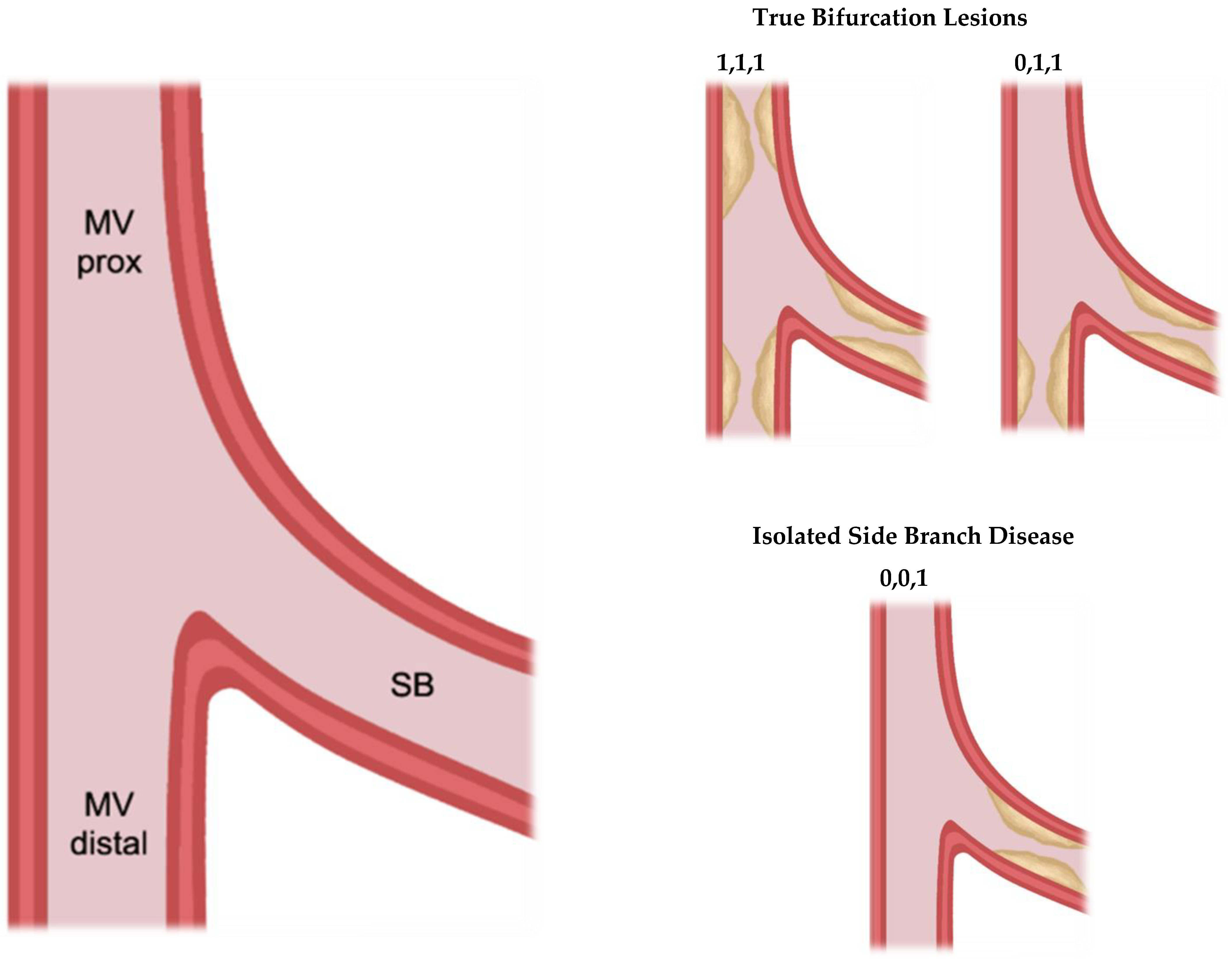
2. Bifurcation Disease and Traditional PCI Strategies
3. Drug-Coated Balloon Technology Overview
4. Paclitaxel- and Limus-Coated DCBs
5. Drug Transfer Dynamics
6. DCB Use in Bifurcation Lesions
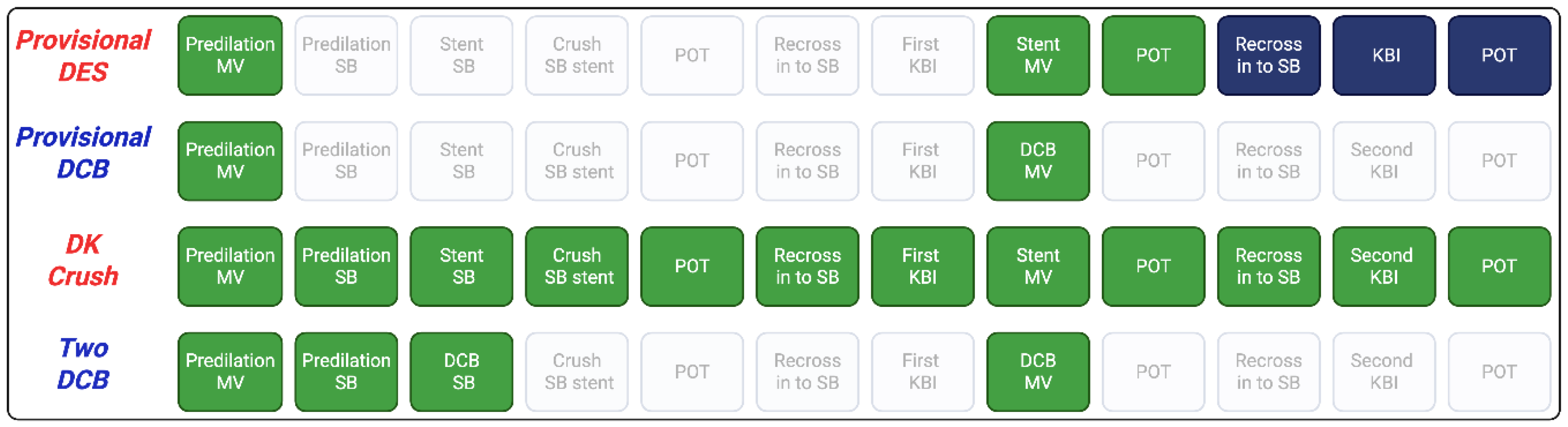
6.1. Provisional Main Vessel Treatment
6.2. Isolated Side Branch Disease
6.3. Full DCB Treatment of Both Main Vessel and Side Branch
6.4. Hybrid Strategy
7. Technical and Procedural Considerations
7.1. Lesion Preparation
7.1.1. ‘Leave Nothing Behind’ Approach
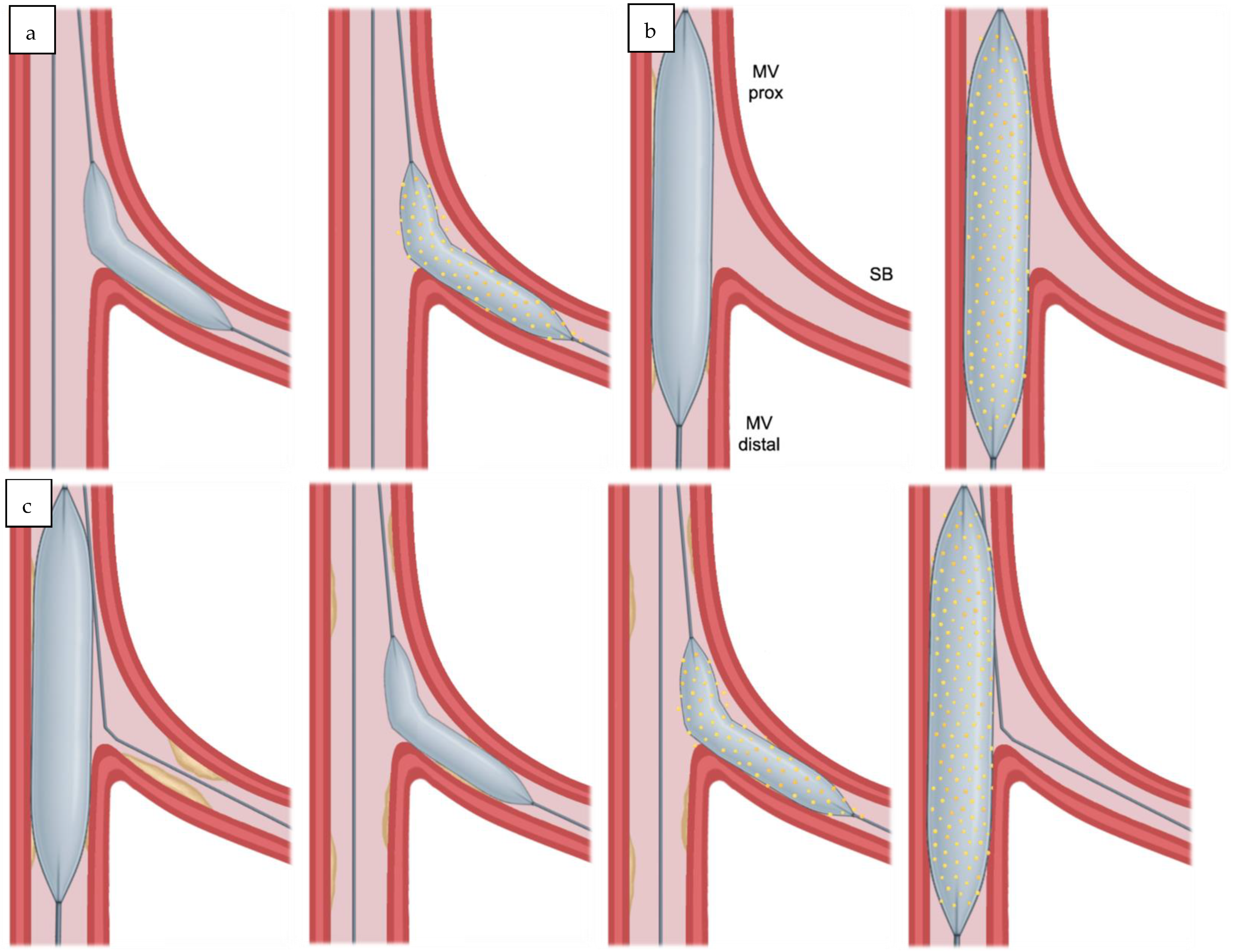
7.1.2. Provisional Strategy
7.1.3. Isolated Side Branch Disease
7.1.4. Two-DCB Strategy
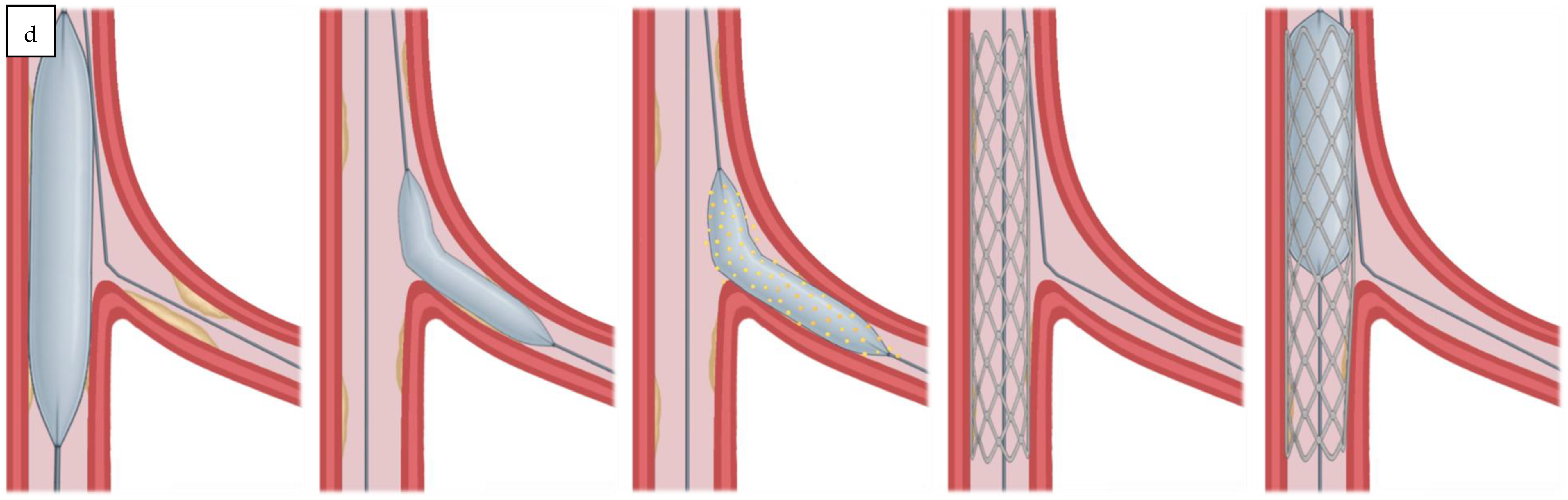
7.1.5. Hybrid Strategy
- (i)
- Upfront treatment of both branches.
- (ii)
- Stepwise provisional strategy with subsequent side branch compromise.
8. Knowledge Gaps and Future Research Directions
9. Conclusions
Author Contributions
Funding
Institutional Review Board Statement
Informed Consent Statement
Data Availability Statement
Conflicts of Interest
Abbreviations
| DCB | Drug-coated balloon |
| DES | Drug-eluting stent |
| ISR | In-stent restenosis |
| KBI | Kissing balloon inflation |
| LLL | Late lumen loss |
| PCI | Percutaneous coronary intervention |
| POBA | Plain old balloon angioplasty |
| POT | Proximal optimisation technique |
References
- Gruntzig, A. Transluminal dilatation of coronary-artery stenosis. Lancet Lond. Engl. 1978, 1, 263. [Google Scholar] [CrossRef]
- Fischman, D.L.; Leon, M.B.; Baim, D.S.; Schatz, R.A.; Savage, M.P.; Penn, I.; Detre, K.; Veltri, L.; Ricci, D.; Nobuyoshi, M.; et al. A randomized comparison of coronary-stent placement and balloon angioplasty in the treatment of coronary artery disease. Stent Restenosis Study Investigators. N. Engl. J. Med. 1994, 331, 496–501. [Google Scholar] [CrossRef]
- Serruys, P.W.; de Jaegere, P.; Kiemeneij, F.; Macaya, C.; Rutsch, W.; Heyndrickx, G.; Emanuelsson, H.; Marco, J.; Legrand, V.; Materne, P.; et al. A comparison of balloon-expandable-stent implantation with balloon angioplasty in patients with coronary artery disease. Benestent Study Group. N. Engl. J. Med. 1994, 331, 489–495. [Google Scholar] [CrossRef] [PubMed]
- Madhavan, M.V.; Kirtane, A.J.; Redfors, B.; Généreux, P.; Ben-Yehuda, O.; Palmerini, T.; Benedetto, U.; Biondi-Zoccai, G.; Smits, P.C.; von Birgelen, C.; et al. Stent-Related Adverse Events > 1 Year After Percutaneous Coronary Intervention. J. Am. Coll. Cardiol. 2020, 75, 590–604. [Google Scholar] [CrossRef] [PubMed]
- Jeger, R.V.; Farah, A.; Ohlow, M.-A.; Mangner, N.; Möbius-Winkler, S.; Leibundgut, G.; Weilenmann, D.; Wöhrle, J.; Richter, S.; Schreiber, M.; et al. Drug-coated balloons for small coronary artery disease (BASKET-SMALL 2): An open-label randomised non-inferiority trial. Lancet Lond. Engl. 2018, 392, 849–856. [Google Scholar] [CrossRef]
- Fezzi, S.; Giacoppo, D.; Fahrni, G.; Latib, A.; Alfonso, F.; Colombo, A.; Mahfoud, F.; Scheller, B.; Jeger, R.; Cortese, B. Individual patient data meta-analysis of paclitaxel-coated balloons vs. drug-eluting stents for small-vessel coronary artery disease: The ANDROMEDA study. Eur. Heart J. 2025, 46, 1586–1599. [Google Scholar] [CrossRef]
- Cortese, B.; Di Palma, G.; Guimaraes, M.G.; Piraino, D.; Orrego, P.S.; Buccheri, D.; Rivero, F.; Perotto, A.; Zambelli, G.; Alfonso, F. Drug-Coated Balloon Versus Drug-Eluting Stent for Small Coronary Vessel Disease: PICCOLETO II Randomized Clinical Trial. JACC Cardiovasc. Interv. 2020, 13, 2840–2849. [Google Scholar] [CrossRef]
- Yeh, R.W.; Shlofmitz, R.; Moses, J.; Bachinsky, W.; Dohad, S.; Rudick, S.; Stoler, R.; Jefferson, B.K.; Nicholson, W.; Altman, J.; et al. Paclitaxel-Coated Balloon vs Uncoated Balloon for Coronary In-Stent Restenosis: The AGENT IDE Randomized Clinical Trial. JAMA 2024, 331, 1015–1024. [Google Scholar] [CrossRef] [PubMed]
- Giacoppo, D.; Alfonso, F.; Xu, B.; Claessen, B.E.P.M.; Adriaenssens, T.; Jensen, C.; Pérez-Vizcayno, M.J.; Kang, D.-Y.; Degenhardt, R.; Pleva, L.; et al. Paclitaxel-coated balloon angioplasty vs. drug-eluting stenting for the treatment of coronary in-stent restenosis: A comprehensive, collaborative, individual patient data meta-analysis of 10 randomized clinical trials (DAEDALUS study). Eur. Heart J. 2020, 41, 3715–3728. [Google Scholar] [CrossRef]
- Giacoppo, D.; A Alvarez-Covarrubias, H.; Koch, T.; Cassese, S.; Xhepa, E.; Kessler, T.; Wiebe, J.; Joner, M.; Hochholzer, W.; Laugwitz, K.-L.; et al. Coronary artery restenosis treatment with plain balloon, drug-coated balloon, or drug-eluting stent: 10-year outcomes of the ISAR-DESIRE 3 trial. Eur. Heart J. 2023, 44, 1343–1357. [Google Scholar] [CrossRef]
- Lassen, J.F.; Holm, N.R.; Stankovic, G.; Lefèvre, T.; Chieffo, A.; Hildick-Smith, D.; Pan, M.; Darremont, O.; Albiero, R.; Ferenc, M.; et al. Percutaneous coronary intervention for coronary bifurcation disease: Consensus from the first 10 years of the European Bifurcation Club meetings. EuroIntervention J. Eur. Collab. Work. Group. Interv. Cardiol. Eur. Soc. Cardiol. 2014, 10, 545–560. [Google Scholar] [CrossRef]
- Hildick-Smith, D.; de Belder, A.J.; Cooter, N.; Curzen, N.P.; Clayton, T.C.; Oldroyd, K.G.; Bennett, L.; Holmberg, S.; Cotton, J.M.; Glennon, P.E.; et al. Randomized trial of simple versus complex drug-eluting stenting for bifurcation lesions: The British Bifurcation Coronary Study: Old, new, and evolving strategies. Circulation 2010, 121, 1235–1243. [Google Scholar] [CrossRef]
- Burzotta, F.; Annone, U.; Paraggio, L.; D’aScenzo, F.; Biondi-Zoccai, G.; Aurigemma, C.; Romagnoli, E.; Verdirosi, D.; Trani, C.; Crea, F. Clinical outcome after percutaneous coronary intervention with drug-eluting stent in bifurcation and nonbifurcation lesions: A meta-analysis of 23 981 patients. Coron. Artery Dis. 2020, 31, 438–445. [Google Scholar] [CrossRef]
- Chen, S.-L.; Sheiban, I.; Xu, B.; Jepson, N.; Paiboon, C.; Zhang, J.-J.; Ye, F.; Sansoto, T.; Kwan, T.W.; Lee, M.; et al. Impact of the complexity of bifurcation lesions treated with drug-eluting stents: The DEFINITION study (Definitions and impact of complEx biFurcation lesIons on clinical outcomes after percutaNeous coronary IntervenTIOn using drug-eluting steNts). JACC Cardiovasc. Interv. 2014, 7, 1266–1276. [Google Scholar] [CrossRef]
- Kinnaird, T.; Gallagher, S.; Anderson, R.; Sharp, A.; Farooq, V.; Ludman, P.; Copt, S.; Curzen, N.; Banning, A.; Mamas, M. Are Higher Operator Volumes for Unprotected Left Main Stem Percutaneous Coronary Intervention Associated With Improved Patient Outcomes? A Survival Analysis of 6724 Procedures From the British Cardiovascular Intervention Society National Database. Circ. Cardiovasc. Interv. 2020, 13, e008782. [Google Scholar] [CrossRef] [PubMed]
- Hildick-Smith, D.; Egred, M.; Banning, A.; Brunel, P.; Ferenc, M.; Hovasse, T.; Wlodarczak, A.; Pan, M.; Schmitz, T.; Silvestri, M.; et al. The European bifurcation club Left Main Coronary Stent study: A randomized comparison of stepwise provisional vs. systematic dual stenting strategies (EBC MAIN). Eur. Heart J. 2021, 42, 3829–3839. [Google Scholar] [CrossRef] [PubMed]
- Raphael, C.E.; O’kAne, P.D.; Johnson, T.W.; Prasad, A.; Gulati, R.; Sandoval, Y.; Di Mario, C.; Holmes, D.R. Evolution of the Crush Technique for Bifurcation Stenting. JACC Cardiovasc. Interv. 2021, 14, 2315–2326. [Google Scholar] [CrossRef] [PubMed]
- Jang, W.J.; Chun, W.J.; Park, I.H.; Choi, K.H.; Bin Song, Y.; Koo, B.; Doh, J.; Hong, S.; Nam, C.; Gwon, H. Impact of stent designs of second-generation drug-eluting stents on long-term outcomes in coronary bifurcation lesions. Catheter. Cardiovasc. Interv. Off. J. Soc. Card. Angiogr. Interv. 2021, 98, 458–467. [Google Scholar] [CrossRef]
- Généreux, P.; Kumsars, I.; Lesiak, M.; Kini, A.; Fontos, G.; Slagboom, T.; Ungi, I.; Metzger, D.C.; Wykrzykowska, J.J.; Stella, P.R.; et al. A randomized trial of a dedicated bifurcation stent versus provisional stenting in the treatment of coronary bifurcation lesions. J. Am. Coll. Cardiol. 2015, 65, 533–543. [Google Scholar] [CrossRef]
- Jeger, R.V.; Eccleshall, S.; Ahmad, W.A.W.; Ge, J.; Poerner, T.C.; Shin, E.-S.; Alfonso, F.; Latib, A.; Ong, P.J.; Rissanen, T.T.; et al. Drug-Coated Balloons for Coronary Artery Disease: Third Report of the International DCB Consensus Group. JACC Cardiovasc. Interv. 2020, 13, 1391–1402. [Google Scholar] [CrossRef]
- Sianos, G.; Morel, M.-A.; Kappetein, A.P.; Morice, M.-C.; Colombo, A.; Dawkins, K.; Brand, M.V.D.; Van Dyck, N.; E Russell, M.; Mohr, F.W.; et al. The SYNTAX Score: An angiographic tool grading the complexity of coronary artery disease. EuroIntervention J. Eur. Collab. Work Group Interv. Cardiol. Eur. Soc. Cardiol. 2005, 1, 219–227. [Google Scholar]
- Caro, C.G.; Fitz-Gerald, J.M.; Schroter, R.C. Atheroma and arterial wall shear. Observation, correlation and proposal of a shear dependent mass transfer mechanism for atherogenesis. Proc. R. Soc. Lond. B Biol. Sci. 1971, 177, 109–159. [Google Scholar] [CrossRef]
- Nakazawa, G.; Yazdani, S.K.; Finn, A.V.; Vorpahl, M.; Kolodgie, F.D.; Virmani, R. Pathological findings at bifurcation lesions: The impact of flow distribution on atherosclerosis and arterial healing after stent implantation. J. Am. Coll. Cardiol. 2010, 55, 1679–1687. [Google Scholar] [CrossRef]
- Medina, A.; de Lezo, J.S.; Pan, M. A new classification of coronary bifurcation lesions. Rev. Esp. Cardiol. 2006, 59, 183. [Google Scholar] [CrossRef]
- Ahn, J.-M.; Lee, J.-Y.; Kang, S.-J.; Kim, Y.-H.; Song, H.-G.; Oh, J.-H.; Park, J.S.; Kim, W.-J.; Lee, S.-W.; Lee, C.W.; et al. Functional assessment of jailed side branches in coronary bifurcation lesions using fractional flow reserve. JACC Cardiovasc. Interv. 2012, 5, 155–161. [Google Scholar] [CrossRef]
- Burzotta, F.; Louvard, Y.; Lassen, J.F.; Lefèvre, T.; Finet, G.; Collet, C.; Legutko, J.; Lesiak, M.; Hikichi, Y.; Albiero, R.; et al. Percutaneous coronary intervention for bifurcation coronary lesions using optimised angiographic guidance: The 18th consensus document from the European Bifurcation Club. EuroIntervention J. Eur. Collab. Work Group Interv. Cardiol. Eur. Soc. Cardiol. 2024, 20, e915–e926. [Google Scholar] [CrossRef]
- Hahn, J.-Y.; Chun, W.J.; Kim, J.-H.; Bin Song, Y.; Oh, J.H.; Koo, B.-K.; Rha, S.W.; Yu, C.W.; Park, J.-S.; Jeong, J.-O.; et al. Predictors and outcomes of side branch occlusion after main vessel stenting in coronary bifurcation lesions: Results from the COBIS II Registry (COronary BIfurcation Stenting). J. Am. Coll. Cardiol. 2013, 62, 1654–1659. [Google Scholar] [CrossRef] [PubMed]
- Xu, J.; Hahn, J.-Y.; Bin Song, Y.; Choi, S.-H.; Choi, J.-H.; Lu, C.; Lee, S.H.; Hong, K.P.; Park, J.E.; Gwon, H.-C. Carina shift versus plaque shift for aggravation of side branch ostial stenosis in bifurcation lesions: Volumetric intravascular ultrasound analysis of both branches. Circ. Cardiovasc. Interv. 2012, 5, 657–662. [Google Scholar] [CrossRef]
- Kang, S.; Kim, W.; Lee, J.; Park, D.; Lee, S.; Kim, Y.; Lee, C.W.; Mintz, G.S.; Park, S.; Park, S. Hemodynamic impact of changes in bifurcation geometry after single-stent cross-over technique assessed by intravascular ultrasound and fractional flow reserve. Catheter. Cardiovasc. Interv. Off. J. Soc. Card. Angiogr. Interv. 2013, 82, 1075–1082. [Google Scholar] [CrossRef]
- Vassilev, D.I.; Kassab, G.S.; Collet, C.; Gutiérrez-Chico, J.L.; Rigatelli, G.; Gil, R.J.; Serruys, P.W. Elliptical stretch as a cause of side branch ostial compromise after main vessel stenting in coronary bifurcations: New insights from numerical analysis. Cardiol. J. 2020, 27, 507–517. [Google Scholar] [CrossRef] [PubMed]
- Abdelfattah, O.M.; Radwan, A.; Sayed, A.; Elbadawi, A.; Derbas, L.A.; Saleh, Y.; Ahmad, Y.; ElJack, A.; Masoumi, A.; Karmpaliotis, D.; et al. Meta-Analysis of Provisional Versus Systematic Double-Stenting Strategy for Left Main Bifurcation Lesions. Cardiovasc. Revascularization Med. Mol. Interv. 2022, 45, 53–62. [Google Scholar] [CrossRef]
- Chen, S.-L.; Zhang, J.-J.; Han, Y.; Kan, J.; Chen, L.; Qiu, C.; Jiang, T.; Tao, L.; Zeng, H.; Li, L.; et al. Double Kissing Crush Versus Provisional Stenting for Left Main Distal Bifurcation Lesions: DKCRUSH-V Randomized Trial. J. Am. Coll. Cardiol. 2017, 70, 2605–2617. [Google Scholar] [CrossRef] [PubMed]
- Zhang, J.-J.; Ye, F.; Xu, K.; Kan, J.; Tao, L.; Santoso, T.; Munawar, M.; Tresukosol, D.; Li, L.; Sheiban, I.; et al. Multicentre, randomized comparison of two-stent and provisional stenting techniques in patients with complex coronary bifurcation lesions: The DEFINITION II trial. Eur. Heart J. 2020, 41, 2523–2536. [Google Scholar] [CrossRef] [PubMed]
- Kleber, F.X.; Rittger, H.; Ludwig, J.; Schulz, A.; Mathey, D.G.; Boxberger, M.; Degenhardt, R.; Scheller, B.; Strasser, R.H. Drug eluting balloons as stand alone procedure for coronary bifurcational lesions: Results of the randomized multicenter PEPCAD-BIF trial. Clin. Res. Cardiol. Off. J. Ger. Card. Soc. 2016, 105, 613–621. [Google Scholar] [CrossRef]
- Schulz, A.; Hauschild, T.; Kleber, F.X. Treatment of coronary de novo bifurcation lesions with DCB only strategy. Clin. Res. Cardiol. Off. J. Ger. Card. Soc. 2014, 103, 451–456. [Google Scholar] [CrossRef]
- Bruch, L.; Zadura, M.; Waliszewski, M.; Platonic, Z.; Eränen, J.; Scheller, B.; Götting, B.; Herberger, D.; Palmieri, C.; Sinicròpi, G.; et al. Results From the International Drug Coated Balloon Registry for the Treatment of Bifurcations. Can a Bifurcation Be Treated Without Stents? J. Intervent Cardiol. 2016, 29, 348–356. [Google Scholar] [CrossRef] [PubMed]
- Kitani, S.; Igarashi, Y.; Tsuchikane, E.; Nakamura, S.; Seino, Y.; Habara, M.; Takeda, Y.; Shimoji, K.; Yasaka, Y.; Kijima, M. Efficacy of drug-coated balloon angioplasty after directional coronary atherectomy for coronary bifurcation lesions (DCA/DCB registry). Catheter. Cardiovasc. Interv. Off. J. Soc. Card. Angiogr. Interv. 2021, 97, E614–E623. [Google Scholar] [CrossRef]
- Jing, Q.-M.; Zhao, X.; Han, Y.-L.; Gao, L.-L.; Zheng, Y.; Li, Z.-Q.; Yang, P.; Cong, H.-L.; Gao, C.-Y.; Jiang, T.-M.; et al. A drug-eluting Balloon for the trEatment of coronarY bifurcatiON lesions in the side branch: A prospective multicenter ranDomized (BEYOND) clinical trial in China. Chin. Med. J. 2020, 133, 899–908. [Google Scholar] [CrossRef]
- Pellegrini, D.; Donahue, M.; Regazzoli, D.; Tedeschi, D.; Loffi, M.; Pellicano, M.; De Blasio, G.; Tespili, M.; Guagliumi, G.; Ielasi, A. Drug-coated balloon combined with drug-eluting stent for the treatment of coronary bifurcation lesions: Insights from the HYPER study. Eur. Heart J. Suppl. J. Eur. Soc. Cardiol. 2023, 25, C79–C83. [Google Scholar] [CrossRef]
- Gao, X.; Tian, N.; Kan, J.; Li, P.; Wang, M.; Sheiban, I.; Figini, F.; Deng, J.; Chen, X.; Santoso, T.; et al. Drug-Coated Balloon Angioplasty of the Side Branch During Provisional Stenting: The Multicenter Randomized DCB-BIF Trial. J. Am. Coll. Cardiol. 2025, 85, 1–15. [Google Scholar] [CrossRef]
- Gao, C.; He, X.; Ouyang, F.; Zhang, Z.; Shen, G.; Wu, M.; Yang, P.; Ma, L.; Yang, F.; Ji, Z.; et al. Drug-coated balloon angioplasty with rescue stenting versus intended stenting for the treatment of patients with de novo coronary artery lesions (REC-CAGEFREE I): An open-label, randomised, non-inferiority trial. Lancet Lond. Engl. 2024, 404, 1040–1050. [Google Scholar] [CrossRef] [PubMed]
- One-Year Results of the SELUTION DeNovo Trial Comparing a Strategy of PCI with a Sirolimus-Eluting Balloon and Provisional Stenting Versus Systematic DES Implantation to Treat DeNovo Coronary Lesions. TCTMD.com. 26 October 2025. Available online: https://www.tctmd.com/slide/one-year-results-selution-denovo-trial-comparing-strategy-pci-sirolimus-eluting-balloon-and (accessed on 29 November 2025).
- Heldman, A.W.; Cheng, L.; Jenkins, G.M.; Heller, P.F.; Kim, D.-W.; Ware, M.; Nater, C.; Hruban, R.H.; Rezai, B.; Abella, B.S.; et al. Paclitaxel stent coating inhibits neointimal hyperplasia at 4 weeks in a porcine model of coronary restenosis. Circulation 2001, 103, 2289–2295. [Google Scholar] [CrossRef] [PubMed]
- Räsänen, A.; Kärkkäinen, J.M.; Eranti, A.; Eränen, J.; Rissanen, T.T. Percutaneous coronary intervention with drug-coated balloon-only strategy combined with single antiplatelet treatment in patients at high bleeding risk: Single center experience of a novel concept. Catheter. Cardiovasc. Interv. Off. J. Soc. Card. Angiogr. Interv. 2023, 101, 569–578. [Google Scholar] [CrossRef]
- O’CAllaghan, D.; Rai, H.; Giacoppo, D.; Coughlan, J.J.; Durand, R.; Paradies, V.; Colleran, R.; Blake, G.J.; Alfonso, F.; Byrne, R.A. Drug Coated Balloons Versus Drug-Eluting Stents in Patients With De Novo Coronary Artery Disease. Catheter. Cardiovasc. Interv. Off. J. Soc. Card. Angiogr. Interv. 2025, 106, 1843–1853. [Google Scholar] [CrossRef]
- Rissanen, T.T.; Uskela, S.; Eränen, J.; Mäntylä, P.; Olli, A.; Romppanen, H.; Siljander, A.; Pietilä, M.; Minkkinen, M.J.; Tervo, J.; et al. Drug-coated balloon for treatment of de-novo coronary artery lesions in patients with high bleeding risk (DEBUT): A single-blind, randomised, non-inferiority trial. Lancet Lond. Engl. 2019, 394, 230–239. [Google Scholar] [CrossRef]
- Camaj, A.; Leone, P.P.; Colombo, A.; Vinayak, M.; Stone, G.W.; Mehran, R.; Dangas, G.; Kini, A.; Sharma, S.K. Drug-Coated Balloons for the Treatment of Coronary Artery Disease: A Review. JAMA Cardiol. 2025, 10, 189–198. [Google Scholar] [CrossRef]
- Woolford, S.; Tran, M.; Yoda, C.; Oktem, B.; NguyenPho, A.; McDermott, M.; Wickramasekara, S. Studying the effect of drug-to-excipient ratio on drug release profile for drug coated balloons. Int. J. Pharm. 2022, 620, 121749. [Google Scholar] [CrossRef] [PubMed]
- Radke, P.; Joner, M.; Joost, A.; Byrne, R.; Hartwig, S.; Bayer, G.; Steigerwald, K.; Wittchow, E. Vascular effects of paclitaxel following drug-eluting balloon angioplasty in a porcine coronary model: The importance of excipients. EuroIntervention J. Eur. Collab. Work Group Interv. Cardiol. Eur. Soc. Cardiol. 2011, 7, 730–737. [Google Scholar] [CrossRef]
- Chang, G.H.; Azar, D.A.; Lyle, C.; Chitalia, V.C.; Shazly, T.; Kolachalama, V.B. Intrinsic coating morphology modulates acute drug transfer in drug-coated balloon therapy. Sci. Rep. 2019, 9, 6839. [Google Scholar] [CrossRef]
- Xiong, G.M.; Ang, H.; Lin, J.; Lui, Y.S.; Phua, J.L.; Ni Chan, J.; Venkatraman, S.; Foin, N.; Huang, Y. Materials technology in drug eluting balloons: Current and future perspectives. J. Control Release Off. J. Control Release Soc. 2016, 239, 92–106. [Google Scholar] [CrossRef]
- Kempin, W.; Kaule, S.; Reske, T.; Grabow, N.; Petersen, S.; Nagel, S.; Schmitz, K.-P.; Weitschies, W.; Seidlitz, A. In vitro evaluation of paclitaxel coatings for delivery via drug-coated balloons. Eur. J. Pharm. Biopharm. Off. J. Arbeitsgemeinschaft Pharm. Verfahrenstechnik EV 2015, 96, 322–328. [Google Scholar] [CrossRef]
- Choi, T.W.; Won, J.H.; Kim, J.; Joh, J.H.; Jeong, J.; Park, S.W.; Oh, J.S.; Kim, H.O.; Kim, C.W.; Jae, H.J. Comparison of 2 Paclitaxel-Coated Balloons with Different Excipients for the Treatment of Femoropopliteal Artery Disease: A Randomized Prospective Trial. J. Vasc. Interv. Radiol. 2025, 36, 844–851.e1. [Google Scholar] [CrossRef] [PubMed]
- Gemeinhardt, O.; Schnorr, B.; Speck, U.; Scheller, B. A novel paclitaxel coated balloon with increased drug transfer for treatment of complex vascular lesions. PLoS ONE 2021, 16, e0259106. [Google Scholar] [CrossRef]
- Cao, Z.; Li, J.; Fang, Z.; Feierkaiti, Y.; Zheng, X.; Jiang, X. The factors influencing the efficiency of drug-coated balloons. Front. Cardiovasc. Med. 2022, 9, 947776. [Google Scholar] [CrossRef]
- Zaza, G.; Granata, S.; Caletti, C.; Signorini, L.; Stallone, G.; Lupo, A. mTOR Inhibition Role in Cellular Mechanisms. Transplantation 2018, 102, S3–S16. [Google Scholar] [CrossRef]
- Kolachalama, V.B.; Pacetti, S.D.; Franses, J.W.; Stankus, J.J.; Zhao, H.Q.; Shazly, T.; Nikanorov, A.; Schwartz, L.B.; Tzafriri, A.R.; Edelman, E.R. Mechanisms of tissue uptake and retention in zotarolimus-coated balloon therapy. Circulation 2013, 127, 2047–2055. [Google Scholar] [CrossRef]
- Ang, H.; Koppara, T.R.; Cassese, S.; Ng, J.; Joner, M.; Foin, N. Drug-coated balloons: Technical and clinical progress. Vasc. Med. Lond. Engl. 2020, 25, 577–587. [Google Scholar] [CrossRef]
- Bangalore, S.; Kumar, S.; Fusaro, M.; Amoroso, N.; Attubato, M.J.; Feit, F.; Bhatt, D.L.; Slater, J. Short- and long-term outcomes with drug-eluting and bare-metal coronary stents: A mixed-treatment comparison analysis of 117 762 patient-years of follow-up from randomized trials. Circulation 2012, 125, 2873–2891. [Google Scholar] [CrossRef] [PubMed]
- Spaulding, C.; Krackhardt, F.; Bogaerts, K.; Urban, P.; Meis, S.; Morice, M.-C.; Eccleshall, S. Comparing a strategy of sirolimus-eluting balloon treatment to drug-eluting stent implantation in de novo coronary lesions in all-comers: Design and rationale of the SELUTION DeNovo Trial. Am. Heart J. 2023, 258, 77–84. [Google Scholar] [CrossRef]
- Tanaka, T.; Kawakami, R.; Grogan, A.; Virmani, R.; Finn, A. TCT-465 A Pharmacokinetic Comparison Between Three Drug Delivery Devices in Porcine Coronary Arteries. JACC 2025, 86, B204. [Google Scholar] [CrossRef]
- TCT 465: A Pharmacokinetic Comparison Between Three Drug Delivery Devices in Porcine Coronary Arteries. TCTMD.com. 27 October 2025. Available online: https://www.tctmd.com/slide/tct-465-pharmacokinetic-comparison-between-three-drug-delivery-devices-porcine-coronary (accessed on 1 December 2025).
- Scheller, B.; Mangner, N.; Jeger, R.V.; Afan, S.; Mahfoud, F.; Woitek, F.J.; Fahrni, G.; Schwenke, C.; Schnorr, B.; Kleber, F. A randomised trial of sirolimus- versus paclitaxel-coated balloons for de novo coronary lesions. EuroIntervention J. Eur. Collab. Work Group Interv. Cardiol. Eur. Soc. Cardiol. 2024, 20, e1322–e1329. [Google Scholar] [CrossRef]
- Liu, H.; Li, Y.; Fu, G.; An, J.; Chen, S.; Zhong, Z.; Liu, B.; Qiu, C.; Ma, L.; Cong, H.; et al. Sirolimus- vs Paclitaxel-Coated Balloon for the Treatment of Coronary In-Stent Restenosis: The SIBLINT-ISR Randomized Trial. JACC Cardiovasc. Interv. 2025, 18, 963–971. [Google Scholar] [CrossRef]
- Leone, P.P.; Calamita, G.; Gitto, M.; Regazzoli, D.; Tartaglia, F.; Mincione, G.; Cozzi, O.; Mangieri, A.; Gasparini, G.; Rossi, M.L.; et al. Sirolimus- Versus Paclitaxel-Coated Balloons for Treatment of Coronary Artery Disease. Am. J. Cardiol. 2025, 255, 74–82. [Google Scholar] [CrossRef]
- Shin, D.; Singh, M.; Shlofmitz, E.; Scheller, B.; Latib, A.; Kandzari, D.E.; Zaman, A.; Mylotte, D.; Dakroub, A.; Malik, S.; et al. Paclitaxel-coated versus sirolimus-coated balloon angioplasty for coronary artery disease: A systematic review and meta-analysis. Catheter. Cardiovasc. Interv. Off. J. Soc. Card. Angiogr. Interv. 2024, 104, 425–436. [Google Scholar] [CrossRef]
- Byrne, R.A.; Hahn, J.-Y.; O’kAne, P.; Sabaté, M.; Toelg, R.; Copt, S.; Fitzgerald, S.; Morice, M.-C.; Trevelyan, J.; Mylotte, D.; et al. Randomized Trial of Biolimus DCB for In-Stent Restenosis: The Primary Results of the REFORM Study. JACC Cardiovasc. Interv. 2025, 18, 654–662. [Google Scholar] [CrossRef] [PubMed]
- Ninomiya, K.; Serruys, P.W.; Colombo, A.; Reimers, B.; Basavarajaiah, S.; Sharif, F.; Testa, L.; Di Mario, C.; Nerla, R.; Ding, D.; et al. A Prospective Randomized Trial Comparing Sirolimus-Coated Balloon With Paclitaxel-Coated Balloon in De Novo Small Vessels. JACC Cardiovasc. Interv. 2023, 16, 2884–2896. [Google Scholar] [CrossRef] [PubMed]
- Ahmad, W.A.W.; Nuruddin, A.A.; Kader, M.A.S.A.; Ong, T.K.; Liew, H.B.; Ali, R.M.; Zuhdi, A.S.M.; Ismail, M.D.; Yusof, A.K.; Schwenke, C.; et al. Treatment of Coronary De Novo Lesions by a Sirolimus- or Paclitaxel-Coated Balloon. JACC Cardiovasc. Interv. 2022, 15, 770–779. [Google Scholar] [CrossRef]
- Basavarajaiah, S.; Sharma, V.; Sticchi, A.; Caiazzo, G.; Mottola, F.F.; Waduge, B.H.L.; Athukorala, S.; Fawazy, M.; Testa, L.; Colombo, A. Use of sirolimus-coated balloon in de novo coronary lesions; long-term clinical outcomes from a multi-center real-world population. Catheter. Cardiovasc. Interv. Off. J. Soc. Card. Angiogr. Interv. 2024, 104, 1159–1167. [Google Scholar] [CrossRef]
- Cortese, B.; Testa, L.; Heang, T.M.; Ielasi, A.; Bossi, I.; Latini, R.A.; Lee, C.Y.; Perez, I.S.; Milazzo, D.; Caiazzo, G.; et al. Sirolimus-Coated Balloon in an All-Comer Population of Coronary Artery Disease Patients: The EASTBOURNE Prospective Registry. JACC Cardiovasc. Interv. 2023, 16, 1794–1803. [Google Scholar] [CrossRef]
- Basavarajaiah, S.; Athukorala, S.; Kalogeras, K.; Panoulas, V.; Waduge, B.H.L.; Bhatia, G.; Watkin, R.; Pulikal, G.; Lee, K.; Ment, J.; et al. Mid-term clinical outcomes from use of Sirolimus coated balloon in coronary intervention; data from real world population. Catheter. Cardiovasc. Interv. Off. J. Soc. Card. Angiogr. Interv. 2021, 98, 57–65. [Google Scholar] [CrossRef]
- Iwańczyk, S.; Lazar, F.-L.; Onea, H.-L.; Pesenti, N.; Wańha, W.; Woźniak, P.; Gościniak, W.; Lesiak, M.; Cortese, B. Sirolimus-coated balloon versus drug-eluting stent for complex coronary lesions. A propensity matched comparison. Int. J. Cardiol. 2024, 415, 132436. [Google Scholar] [CrossRef]
- Seidlitz, A.; Kotzan, N.; Nagel, S.; Reske, T.; Grabow, N.; Harder, C.; Petersen, S.; Sternberg, K.; Weitschies, W. In vitro determination of drug transfer from drug-coated balloons. PLoS ONE 2013, 8, e83992. [Google Scholar] [CrossRef]
- Tzafriri, A.R.; Muraj, B.; Garcia-Polite, F.; Salazar-Martín, A.G.; Markham, P.; Zani, B.; Spognardi, A.; Albaghdadi, M.; Alston, S.; Edelman, E.R. Balloon-based drug coating delivery to the artery wall is dictated by coating micro-morphology and angioplasty pressure gradients. Biomaterials 2020, 260, 120337. [Google Scholar] [CrossRef]
- Stratakos, E.; Antonini, L.; Poletti, G.; Berti, F.; Tzafriri, A.R.; Petrini, L.; Pennati, G. Investigating Balloon-Vessel Contact Pressure Patterns in Angioplasty: In Silico Insights for Drug-Coated Balloons. Ann. Biomed. Eng. 2023, 51, 2908–2922. [Google Scholar] [CrossRef]
- Colombo, M.; Corti, A.; Berceli, S.; Migliavacca, F.; McGinty, S.; Chiastra, C. 3D modelling of drug-coated balloons for the treatment of calcified superficial femoral arteries. PLoS ONE 2021, 16, e0256783. [Google Scholar] [CrossRef]
- Her, A.Y.; Kim, B.; Kim, S.; Kim, Y.H.; Scheller, B.; Shin, E.S. Comparison of angiographic change in side-branch ostium after drug-coated balloon vs. drug-eluting stent vs. medication for the treatment of de novo coronary bifurcation lesions. Eur. J. Med. Res. 2024, 29, 280. [Google Scholar] [CrossRef] [PubMed]
- Her, A.-Y.; Ann, S.H.; Singh, G.B.; Kim, Y.H.; Okamura, T.; Garg, S.; Koo, B.-K.; Shin, E.-S. Serial Morphological Changes of Side-Branch Ostium after Paclitaxel-Coated Balloon Treatment of De Novo Coronary Lesions of Main Vessels. Yonsei Med. J. 2016, 57, 606–613. [Google Scholar] [CrossRef]
- Matsuna, N.; Kuramitsu, S.; Tadano, Y.; Sugie, T.; Kaneko, U.; Yui, H.; Shimizu, T.; Miura, S.; Kobayashi, K.; Kanno, D.; et al. Long-Term Outcomes of True Versus Nontrue Coronary Bifurcation Lesions Treated With Bioresorbable Polymer Sirolimus-Eluting Ultimaster Stent Under Intravascular Imaging Guidance. Am. J. Cardiol. 2025, 239, 57–63. [Google Scholar] [CrossRef] [PubMed]
- Jiang, Z.M.; Liu, L. Drug-Coated versus Uncoated Balloon for Side Branch Protection in Coronary Bifurcation Lesions Treated with Provisional Stenting Using Drug-Eluting Stents: A Meta-analysis. Int. J. Clin. Pract. 2022, 2022, 5892589. [Google Scholar] [CrossRef] [PubMed]
- Rocchetti, M.; Tua, L.; Cereda, A.; Conconi, B.; Franchina, A.G.; Carlà, M.; Spangaro, A.; Lucreziotti, S. Drug-Coated Balloons Versus Non-Coated Balloons for Side Branch Treatment in Bifurcation Lesions: A Systematic Review and Meta-Analysis. Catheter. Cardiovasc. Interv. Off. J. Soc. Card. Angiogr. Interv. 2025, 106, 530–539. [Google Scholar] [CrossRef]
- Pan, L.; Lu, W.; Han, Z.; Pan, S.; Wang, X.; Shan, Y.; Peng, M.; Qin, X.; Sun, G.; Zhang, P.; et al. Drug-coated balloon in the treatment of coronary left main true bifurcation lesion: A patient-level propensity-matched analysis. Front. Cardiovasc. Med. 2022, 9, 1028007. [Google Scholar] [CrossRef] [PubMed]
- Valencia, J.; Torres-Mezcua, F.; Herrero-Brocal, M.; Torres-Saura, F.; Pineda, J.; Ruiz-Nodar, J.M. Prognostic factors in drug-coated balloon interventions for treating the side branch of coronary bifurcation lesions. REC Interv. Cardiol. 2025, 7, 57–59. [Google Scholar] [CrossRef] [PubMed]
- Dohi, T.; Ishihara, T.; Kida, H.; Nakamura, D.; Kikuchi, A.; Kawai, T.; Mori, N.; Okamoto, N.; Ueda, Y.; Shutta, R.; et al. Comparison of drug-coated versus conventional balloons for the side branch of the bifurcation lesion—Multicenter randomized controlled study—(OCVC-BIF): Design and rationale. Cardiovasc. Revascularization Med. Mol. Interv. 2025, 81, 57–61. [Google Scholar] [CrossRef] [PubMed]
- Comparison of Drug-Coated Versus Conventional Balloons for Treatment of Side Branches of Bifurcation Lesions: The OCVC-BIF Study. TCTMD.com. 27 October 2025. Available online: https://www.tctmd.com/slide/comparison-drug-coated-versus-conventional-balloons-treatment-side-branches-bifurcation (accessed on 29 November 2025).
- Zhou, Y.; Hu, Y.; Zhao, X.; Chen, Z.; Li, C.; Ma, L.; Liu, Z.; Zhou, H.; Zang, X.; Zhang, X.; et al. Sirolimus-coated versus paclitaxel-coated balloons for bifurcated coronary lesions in the side branch: The SPACIOUS trial. EuroIntervention J. Eur. Collab. Work Group Interv. Cardiol. Eur. Soc. Cardiol. 2025, 21, e307–e317. [Google Scholar] [CrossRef]
- Kang, D.O.; Lee, J.-S.; Kim, B.; Kim, Y.-H.; Lim, S.-Y.; Kim, S.H.; Ahn, J.-C.; Her, A.-Y.; Song, W.-H.; Shin, E.-S.; et al. Predictors of optimal angiographic lesion outcomes in drug-coated balloon treatment for de novo coronary artery disease. Sci. Rep. 2025, 15, 9391. [Google Scholar] [CrossRef]
- Lee, T.; Ashikaga, T.; Nozato, T.; Nagata, Y.; Kaneko, M.; Miyazaki, R.; Misawa, T.; Taomoto, Y.; Okata, S.; Nagase, M.; et al. Predictors of target lesion failure after percutaneous coronary intervention with a drug-coated balloon for de novo lesions. EuroIntervention J. Eur. Collab. Work Group Interv. Cardiol. Eur. Soc. Cardiol. 2024, 20, e818–e825. [Google Scholar] [CrossRef]
- Yamamoto, M.; Hara, H.; Kubota, S.; Hiroi, Y. Predictors of late lumen enlargement after drug-coated balloon angioplasty for de novo coronary lesions. EuroIntervention J. Eur. Collab. Work Group Interv. Cardiol. Eur. Soc. Cardiol. 2024, 20, 602–612. [Google Scholar] [CrossRef]
- Ito, H.; Piel, S.; Das, P.; Chhokar, V.; Khadim, G.; Nierzwicki, R.; Williams, A.; Dieter, R.S.; Leya, F. Long-term outcomes of plaque debulking with rotational atherectomy in side-branch ostial lesions to treat bifurcation coronary disease. J. Invasive Cardiol. 2009, 21, 598–601. [Google Scholar]
- Allali, A.; Abdel-Wahab, M.; Traboulsi, H.; Hemetsberger, R.; Mankerious, N.; Byrne, R.; Geist, V.; El-Mawardy, M.; Sulimov, D.; Toelg, R.; et al. Impact of Lesion Preparation Technique on Side Branch Compromise in Calcified Coronary Bifurcations: A Subgroup Analysis of the PREPARE-CALC Trial. J. Intervent Cardiol. 2020, 2020, 9740938. [Google Scholar] [CrossRef]
- Mizuno, Y.; Sakakura, K.; Jinnouchi, H.; Taniguchi, Y.; Tsukui, T.; Watanabe, Y.; Yamamoto, K.; Seguchi, M.; Wada, H.; Fujita, H. Impact of rotational atherectomy on the incidence of side branch compromise in calcified bifurcation lesions undergoing elective percutaneous coronary intervention. J. Cardiol. 2022, 80, 518–524. [Google Scholar] [CrossRef]
- Samy, M.; Alali, A.; Elbasha, K.; Amoey, D.; Hemetsberger, R.; Kandil, N.; Elawady, M.; Allali, A.; Nef, H.; Toelg, R.; et al. Clinical outcomes of single- versus two-stent PCI technique in severely calcified true bifurcation lesions after rotational atherectomy. Clin. Res. Cardiol. Off. J. Ger. Card. Soc. 2024, 113, 1070–1080. [Google Scholar] [CrossRef]
- Tellez, A.; Dattilo, R.; Mustapha, J.A.; Gongora, C.A.; Hyon, C.M.; Palmieri, T.; Rousselle, S.; Kaluza, G.L.; Granada, J.F. Biological effect of orbital atherectomy and adjunctive paclitaxel-coated balloon therapy on vascular healing and drug retention: Early experimental insights into the familial hypercholesterolaemic swine model of femoral artery stenosis. EuroIntervention J. Eur. Collab. Work Group Interv. Cardiol. Eur. Soc. Cardiol. 2014, 10, 1002–1008. [Google Scholar] [CrossRef]
- Barman, N.; Okamoto, N.; Ueda, H.; Chamaria, S.; Bhatheja, S.; Vengrenyuk, Y.; Gupta, E.; Sweeny, J.; Kapur, V.; Hasan, C.; et al. Predictors of side branch compromise in calcified bifurcation lesions treated with orbital atherectomy. Catheter. Cardiovasc. Interv. Off. J. Soc. Card. Angiogr. Interv. 2019, 94, 45–52. [Google Scholar] [CrossRef] [PubMed]
- Sturm, R.; Armstrong, E.J.; Benhuri, B.; Okamoto, N.; Vengrenyuk, Y.; Shlofmitz, E.; Revtyak, G.E.; Martinsen, B.J.; Igyarto, Z.; Valle, J.A.; et al. Orbital Atherectomy for Treatment of Severely Calcified Coronary Artery Bifurcation Lesions: A Multicenter Analysis. Cardiovasc. Revascularization Med. 2021, 26, 34–38. [Google Scholar] [CrossRef]
- Mitsui, K.; Lee, T.; Miyazaki, R.; Hara, N.; Nagamine, S.; Nakamura, T.; Terui, M.; Okata, S.; Nagase, M.; Nitta, G.; et al. Drug-coated balloon strategy following orbital atherectomy for calcified coronary artery compared with drug-eluting stent: One-year outcomes and optical coherence tomography assessment. Catheter. Cardiovasc. Interv. Off. J. Soc. Card. Angiogr. Interv. 2023, 102, 11–17. [Google Scholar] [CrossRef]
- Oliveri, F.; D’ACunto, G.; van Oort, M.J.; Phagu, A.; Al Amri, I.; Bingen, B.O.; Paradies, V.; Mincione, G.; Claessen, B.E.; Dimitriu-Leen, A.C.; et al. Intravascular Lithotripsy for Calcific Coronary Bifurcations: Procedural Success and 1-Year Clinical Outcomes. Catheter. Cardiovasc. Interv. Off. J. Soc. Card. Angiogr. Interv. 2025, 106, 1489–1498. [Google Scholar] [CrossRef]
- Sim, E.W.J.; Li, K.F.C.; Ho, H.H. TCTAP A-044 Novel Use of Shockwave Intravascular Lithotripsy With Drug Coated Balloon Angioplasty in De Novo Calcified Coronary Lesions. JACC 2022, 79, S29. [Google Scholar] [CrossRef]
- Kleber, F.X.; Dang, M.A. TCT-344 Intravascular Lithotripsy (IVL) Prior to Drug-Coated Balloons (DCB): A Single Center Experience. J. Am. Coll. Cardiol. 2024, 84, B88. [Google Scholar] [CrossRef]
- Mutlu, D.; Ser, O.S.; Strepkos, D.; Carvalho, P.E.; Alexandrou, M.; Kultursay, B.; Karagoz, A.; Krestyaninov, O.; Khelimskii, D.; Uluganyan, M.; et al. Impact of Bifurcation Angle on Side Branch Occlusion in Provisional Bifurcation Percutaneous Coronary Intervention: Analysis from the PROGRESS-BIFURCATION Registry. Am. J. Cardiol. 2025, 253, 41–48. [Google Scholar] [CrossRef] [PubMed]
- Riley, R.F.; Patel, M.P.; Abbott, J.D.; Bangalore, S.; Brilakis, E.S.; Croce, K.J.; Doshi, D.; Kaul, P.; Kearney, K.E.; Kerrigan, J.L.; et al. SCAI Expert Consensus Statement on the Management of Calcified Coronary Lesions. J. Soc. Cardiovasc. Angiogr. Interv. 2024, 3, 101259. [Google Scholar] [CrossRef] [PubMed]
- Gitto, M.; Leone, P.P.; Gioia, F.; Chiarito, M.; Latini, A.; Tartaglia, F.; Kilic, I.D.; Rossi, M.L.; Regazzoli, D.; Gasparini, G.; et al. Coronary Artery Dissection in Drug-Coated Balloon Angioplasty: Incidence, Predictors, and Clinical Outcomes. Am. J. Cardiol. 2025, 239, 28–35. [Google Scholar] [CrossRef]
- Sgueglia, G.A.; Todaro, D.; Bisciglia, A.; Conte, M.; Stipo, A.; Pucci, E. Kissing inflation is feasible with all second-generation drug-eluting balloons. Cardiovasc. Revascularization Med. Mol. Interv. 2011, 12, 280–285. [Google Scholar] [CrossRef]
- Worthley, S.; Hendriks, R.; Worthley, M.; Whelan, A.; Walters, D.L.; Whitbourn, R.; Meredith, I. Paclitaxel-eluting balloon and everolimus-eluting stent for provisional stenting of coronary bifurcations: 12-month results of the multicenter BIOLUX-I study. Cardiovasc. Revascularization Med. Mol. Interv. 2015, 16, 413–417. [Google Scholar] [CrossRef] [PubMed]
- Yang, H.; Song, Y.; Cao, J.; Chen, J.; Zhang, F.; Huang, Z.; Qian, J.; Ge, J. A novel hybrid strategy of drug coated balloon and stent for coronary bifurcation lesions. Scand. Cardiovasc. J. SCJ 2023, 57, 2161620. [Google Scholar] [CrossRef] [PubMed]
- Korjian, S.; McCarthy, K.J.; Larnard, E.A.; Cutlip, D.E.; McEntegart, M.B.; Kirtane, A.J.; Yeh, R.W. Drug-Coated Balloons in the Management of Coronary Artery Disease. Circ. Cardiovasc. Interv. 2024, 17, e013302. [Google Scholar] [CrossRef]
- Somsen, Y.B.O.; Rissanen, T.T.; Hoek, R.; Ris, T.H.; Stuijfzand, W.J.; Nap, A.; Kleijn, S.A.; Henriques, J.P.; de Winter, R.W.; Knaapen, P. Application of Drug-Coated Balloons in Complex High Risk and Indicated Percutaneous Coronary Interventions. Catheter. Cardiovasc. Interv. Off. J. Soc. Card. Angiogr. Interv. 2025, 105, 494–516. [Google Scholar] [CrossRef]
- Choi, S.-S.; Jung, J.; Kim, K.; Her, S.-H.; Lee, K.; Jeon, D.-S.; Hwang, B.-H.; Park, C.S.; Lim, S.; Seo, S.M.; et al. Comparison of Provisional 1-Stent Strategy With Drug-Eluting Balloon Versus Planned 2-Stent Strategy in Patients With Non-LM Coronary True-Bifurcation Lesions (PROVISION-DEB). Am. J. Cardiol. 2025, 242, 18–23. [Google Scholar] [CrossRef]
- Dillen, D.M.; Vlaar, P.J.; Vermeer, A.J.; Paradies, V.; van Kuijk, J.P.; Vink, M.A.; Oemrawsingh, R.M.; Hofma, S.H.; Magro, M.; Remkes, W.S.; et al. Bifurcation PCI with a hybrid strategy with drug- eluting balloons versus a stepwise provisional two- stent strategy: Rationale and design of the hybrid DEB study. Am. Heart J. 2023, 266, 168–175. [Google Scholar] [CrossRef]
- Gao, X.-F.; Ge, Z.; Kong, X.-Q.; Chen, X.; Han, L.; Qian, X.-S.; Zuo, G.-F.; Wang, Z.-M.; Wang, J.; Song, J.-X.; et al. Intravascular Ultrasound vs Angiography-Guided Drug-Coated Balloon Angioplasty: The ULTIMATE III Trial. JACC Cardiovasc. Interv. 2024, 17, 1519–1528. [Google Scholar] [CrossRef] [PubMed]
- Holm, N.R.; Andreasen, L.D.; Neghabat, O.; Laanmets, P.; Kumsars, I.; Bennett, J.; Olsen, N.T.; Odenstedt, J.; Hoffmann, P.; Dens, J.; et al. OCT or Angiography Guidance for PCI in Complex Bifurcation Lesions. N. Engl. J. Med. 2023, 389, 1477–1487. [Google Scholar] [CrossRef]
- Longobardo, L.; Mattesini, A.; Valente, S.; Di Mario, C. OCT-guided Percutaneous Coronary Intervention in Bifurcation Lesions. Interv. Cardiol. Rev. 2019, 14, 5–9. [Google Scholar] [CrossRef] [PubMed]



| Study/Trial | Year | N | Study Design | Inclusion Criteria | Primary Endpoint(s) | Follow-Up | Results | Limitations | Conclusion |
|---|---|---|---|---|---|---|---|---|---|
| Traditional DES strategies | |||||||||
| DKCRUSH V [32] | 2017 | 482 | Multicentre randomised trial DK crush two-stent (n = 240) vs. PS DES (n = 242) | True de novo distal LM bifurcation lesion (Medina 1,1,1 or 0,1,1) with >50% diameter stenosis of both the ostial LAD and LCx | TLF at 1 year | Angiographic at 13 months and clinical at 1, 7, and 12 months | TLF at 1 year: 5.0% DK crush vs. 10.7% PS (p = 0.02) Angiographic restenosis within LM complex: 7.1% vs. 14.6% (p = 0.10) Clinically driven TLR: 3.8% vs. 7.9% (p = 0.06) | Excluded non-true bifurcations Not powered for rare events Intravascular imaging not performed in >50% procedures FFR guidance of SB stenting in the PS group not routinely performed POT and KBI performed more often with DK crush than PS | DK crush 2-stent strategy superior to provisional DES for LM bifurcation |
| DEFINITION II [33] | 2020 | 653 | Multicentre randomised trial Two-stent group (n = 328) vs. PS approach (n = 325) (DEFINITION criteria-defined complex coronary bifurcation lesions) | Medina 1,1,1 or 0,1,1 with reference vessel diameter in the SB ≥2.5 mm, and had to be a complex bifurcation per DEFINITION criteria | TLF at 1 year | Angiographic at 13 months and clinical at 1, 6, and 12 months | TLF: 11.4% in PS vs. 6.1% in two-stent group (p = 0.019), largely driven by target vessel MI and clinically driven TLR in the PS group Cardiac death: 2.5% PS vs. 2.1% two-stent (p = 0.772) | Not DCB-focused, complex bifurcations only Intravascular imaging used in only 25% of patients | Favoured two stent technique for complex bifurcation lesions |
| EBC MAIN [16] | 2021 | 467 | Multicentre randomised trial Randomised patients with true LM bifurcations to dual stent (n = 237) vs. PS approach (n = 230) | True LM bifurcation (Medina 1,1,1 or 0,1,1) in which vessel reference diameters were ≥2.75 mm, suitable for PCI | Composite of all-cause death, myocardial infarction, and target lesion revascularisation at 12 months | Clinical at 6 and 12 months | Primary endpoint composite: 14.7% in PS vs. 17.7% in dual stent (p = 0.34) Death: 3.0% PS vs. 4.2% dual stent (p = 0.48) MI: 10.0% vs. 10.1% (p = 0.91) TLR: 6.1% vs. 9.3% (p = 0.16) Stent thrombosis: 1.7% vs. 1.3% (p = 0.90) | Open design Not DCB-focused Excluded non-true bifurcations European centres only | Fewer MACE with PS approach, however, nil statistically significant difference at 12 months between approaches. |
| Isolated side branch disease | |||||||||
| PEPCAD-BIF [34] | 2016 | 64 | Multicentre, RCT DCB-only in SB DCB (n = 32) vs. POBA (n = 32) | De novo bifurcation, side branch ≥2.0 mm, main branch DES | LLL at 9 months | Angiographic at 9 months | LLL 0.13 mm DCB vs. 0.51 mm POBA (p = 0.013) TLR: 1 patient in DCB, 3 patients in POBA Restenosis rate 6% DCB vs. 26% POBA (p = 0.045) | Small sample Surrogate endpoint Short follow-up | DCB superior to POBA for SB or distal main branch LLL |
| Full DCB Treatment | |||||||||
| Schulz et al. [35] | 2014 | 39 | Observational study Consecutive DCB only interventions in de novo bifurcation lesions with SB ≥2 mm | Bifurcation lesions with SB ≥2.0 mm, de novo lesions treated with DCB only | MACE: TLR, restenosis at 4 months | Angiographic at 4 months; patients refusing angiography had telephone follow-ups | Restenosis at 4 months: 10% TLR: 7.7% | Single centre Non-randomised Short follow-up | Treatment of de novo bifurcation lesions with DCB only intervention without additional stenting is a safe therapy |
| Bruch et al. [36] | 2016 | 127 | Single arm observational study DCB only (n = 70) vs. DCB + BMS (n = 57) | DCB for bifurcation | Clinically driven TLR at 9 months | Clinical at 9 months | TLR: 4.5% DCB-only vs. 3.6% DCB + BMS (p = 0.802) MACE: 6.1% vs. 7.3% (p = 0.789) | Small sample Non-randomised Short follow-up | DCB-only strategy is safe & effective for selected bifurcations |
| Kitani et al. [37] | 2020 | 129 | Retrospective, multicentre registry Combined DCA/DCB with follow-up angiogram | Major bifurcation lesion involving SB ≥2.0 mm in diameter De novo lesion DCA + DCB for bifurcation | TVF at 12 months | Angiographic at 6–15 months | TLR at 12 months: 3.1% TVF: 10.9% TVR: 1.6% | Retrospective Selection bias Small sample size Only paclitaxel-coated balloon was used as DCB | DCA/DCB provided good clinical outcomes and minimal SB damage and could be an optimal non-stent PCI strategy for bifurcation lesions |
| Hybrid strategy | |||||||||
| BEYOND [38] | 2020 | 222 | Prospective, multicentre RCT DES in MV, PCB in SB (n = 113) vs. DES in MV, BA in SB (n = 109) | De novo bifurcation lesion in the MV scheduled for DES, with SB scheduled for DCB, with reference vessel diameter ≥1.25 mm | Angiographic TLS at 9 months | Angiographic at 9 months and clinical at 30, 180, and 270 days after surgery | TLS: 28.7% PCB vs. 40.0% BA (p < 0.0001) LLL: −0.06 ± 0.32 PCB vs. 0.18 ± 0.34 mm BA (p < 0.0001) Nil TVR/TLR, TLF, all-cause death, cardiac death or thrombosis in either group | Short follow-up | In non-LM bifurcations treated with provisional T stenting, PCB in SB group demonstrated better angiographic results than treatment with regular BA |
| HYPER trial sub-study [39] | 2023 | 50 | Sub-study of the HYPER trial- a prospective, single-arm, multicentre, pilot Patients with true CBL were treated with a hybrid strategy (DCB and DES) | CBL involving the SB and at least one main vessel, i.e., 1,0,1; 0,1,1; or 1,1,1 lesions per Medina classification Involvement of a segment with a reference vessel diameter <2.75 mm. | Device-oriented composite endpoint (DOCE; including cardiac death, TV-MI, and ID-TLR) within 1 year | Clinical at 30 days, 6 months and 1 year | Procedural success was 96%, one case of peri-procedural myocardial infarction and one case of TLF (in a DES-treated segment) at 1 year | Small sample size Observational study No angiographic follow-up | Hybrid strategy combining DES and DCB was a feasible & safe option for treating CBL with a small calibre SB |
| DCB-BIF [40] | 2025 | 784 | Multicentre RCT DCB (n = 391) vs. NCB (n = 393) for SB after provisional stenting for true coronary bifurcation lesions | Simple and true CBL (Medina 1,1,1; 0,1,1; 1,0,1) Target lesions reference vessel diameter (both MV and SB) of ≥2.5 mm, baseline diameter stenosis of ≥50%, SB lesion length of <10 mm | MACE, a composite of cardiac death, target vessel myocardial infarction, or clinically driven target-lesion revascularisation at 1 year | Clinical +/- Angiographic at 1 year | MACE at 1 year: 7.2% DCB vs. 12.5% NCB (p = 0.013) | Potential performance bias (random assignment to DCB and NCB angioplasty for SB not masked) Complex bifurcation lesions excluded Sirolimus-coated balloons not used Intravascular imaging guidance not used for all patients, albeit similarly used in two groups Fewer female participants (23.2%) Interventional procedures not guided by physiologic assessment | For provisional stenting, MV stenting with a DCB for the compromised SB resulted in a lower 1-year MACE rate compared with an NCB SB intervention |
| REC-CAGEFREE I [41] | 2024 | 2272 | Open-label randomised, non-inferiority trial Paclitaxel-coated balloon/DCB angioplasty (n = 1133) with the option of rescue stenting vs. DES (n = 1139) Bifurcation lesions (n = 773); bifurcation involved in 32.5% lesions in DCB group, 31.1% DES | De novo, non-complex target lesions, any vessel diameter | Device-oriented composite endpoint (DOCE; including cardiovascular death, TVMI, and TLR) at 24 months | Clinical at 1 (±14 days), 3, 6, 12, 18, and 24 (±30 days) months after randomisation | 24-month DOCE: 6.4% DCB vs. 3.4% DES (p = 0.0008); criterion for non-inferiority not met 9.4% in DCB received rescue DES after unsatisfactory DCB angioplasty Periprocedural MI: 0.9% DCB vs. 0.8% DES Equipoise in outcomes for bifurcation lesion subgroup: HR 1.25, 95%CI 0.70–2.23 | Excluded complex/bifurcation lesions Open-label Short follow-up Patients only treated with paclitaxel-coated balloons Study only conducted in China with an east Asian population | DCB with rescue stenting did not achieve non-inferiority vs. intended DES implantation in terms of the DOCE at 2 years, indicating DES as preferred treatment. |
| SELUTION DeNovo [42] | 2025 | 3326 | Randomised, multicentre, international, single-blind, clinical trial Comparing a PCI strategy with sirolimus eluting balloon and provisional DES or systematic DES | PCI indicated for ≥1 lesion considered suitable for treatment by either sirolimus eluting balloon or DES and clinical presentation with chronic coronary syndrome, unstable angina or non-ST segment elevation myocardial infarction Target lesions diameters between 2 and 5 mm. | Target vessel failure (TVF) at 1 and 5 years (composite endpoint comprised of cardiac death, target vessel myocardial infarction or clinically driven target vessel revascularisation) | Clinical follow-up at 30 days, 6 months, 1, 2, 3, 4, and 5 years | 12 month TVF in DES 4.4% vs. 5.3% in DCB (p = 0.02 for variable non-inferiority margin) | Manuscript not currently available for full review | Selution DCB is a reasonable alternative to DES in denovo coronary disease (excluding LMS, STEMI, CTO, grafts) |
| Parameter | Paclitaxel-Coated Balloon (PCB) | Sirolimus-Coated Balloon (SCB) |
|---|---|---|
| Mechanism of Action | Microtubule inhibitor (cytotoxic) Irreversible binding to β-tubulin, inhibits microtubule disassembly, halts cell cycle progression–cytotoxic | mTOR inhibitor (cytostatic) Binds FKBP-12, inhibits mTOR, blocks cell cycle progression G1→S, cytostatic effect |
| Pharmacokinetics | Highly lipophilic Rapid cellular uptake and longer tissue retention, irreversible | Less lipophilic Slower cellular uptake, reversible Requires encapsulation into nanocarriers |
| Typical Dosage (μg/mm2) | 3 | 4 |
| Downstream Myocardial Injury | More frequent (myocyte necrosis/scarring) due to narrower therapeutic range | Less frequent Wider safety therapeutic range |
| Drug Concentration (Tissue) | Higher | Lower |
| Therapeutic range | Wide | Narrow |
| Trial Identifier (ClinicalTrials.gov) | Status | Study Title | Study Design | Inclusion Criteria | Primary Endpoint(s) | Target Sample Size | Follow-Up | Completion Timeline |
|---|---|---|---|---|---|---|---|---|
| Drug-coated balloons (DCB) in bifurcations | ||||||||
| NCT05731687 | Recruiting | Bifurcation PCI With a Hybrid Strategy With Drug Eluting Balloons Versus a Stepwise Provisional Two-stent Strategy (Hybrid DEB) | Multicentre randomised controlled trial and registry Compare hybrid DEB approach with a stepwise provisional two-stent strategy | De novo true coronary bifurcation lesions, left main (LM) and non-LM | Composite endpoint of the occurrence of all-cause death, periprocedural or spontaneous myocardial infarction and/or target vessel revascularisation (TLR) | 500 | Clinical at 12 months, and at median 2-year follow-up | Study start (actual): 2023-03 Estimated primary completion: 2026-03 Estimated study completion: 2030-03 |
| NCT06002932 | Recruiting | Comparison of PROVISIONal 1-stent Strategy with Drug-Eluting Balloon Versus Planned 2-stent Strategy in Patients with Non-LM Coronary True-Bifurcation Lesions (PROVISION-DEB) | Multicentre randomised trial One-stent strategy with DCB vs. planned two-stent strategy | Non-LM coronary true bifurcation lesions undergoing PCI | TLF (composite outcome of cardiac death, target vessel myocardial infarction or TLR) | 750 stratified randomisation by diabetes, n = 375 in conventional arm (planned two-stent strategy) and N = 375 in PROVISION-DCB arm (provisional one-stent + DEB strategy) | 3 years clinical follow-up (6, 12, and 36 months) Coronary angiography at discretion of investigator, typically at 6 months | Study start (actual): 2023-09 Estimated primary completion: 2028-07 Estimated study completion: 2028-12 |
| NCT06822322 | Recruiting | The European Bifurcation Club Randomized Trial of Stepwise Provisional Stenting Versus Drug Coated Balloon Therapy for Non-left Main True Coronary Bifurcations—EBC DCB Study | Prospective, multi-centre, open-label, randomised (1:1) non-inferiority trial | Non-LM bifurcations requiring revascularisation and both MV and SB diseased (≥2.5 mm and Medina 1,1,1; 1,0,1 or 0,1,1) | Bifurcation Orientated Composite Endpoint (BOCE): defined by cardiovascular death, target bifurcation-related myocardial infarction or target bifurcation revascularisation | 750 | Clinical follow-up at 6 months, 1 year, 3 years, 5 years, and 8 years | Study start (estimated): 2025-05 Estimated primary completion: 2028-05 Estimated study completion: 2035-08 |
| Intravascular lithotripsy with DCB | ||||||||
| NCT05625997 | Recruiting | Shockwave IVL + DCB | Observational, prospective | Coronary artery disease with PCI to treat lesions with criteria: de novo lesion with diameter stenosis >50% Coronary vessel diameter <3.0 mm Severe calcification at the target segment, defined as fluoroscopic radiopacities noted without cardiac motion prior to contrast injection involving both sides of the arterial wall in at least 1 location OR Intravascular Ultrasound/Optical Coherence Tomography demonstrated calcium angle of ≥270° on at least 1 cross section. | TLF, successful IVL + DCB (composite of IVL application at target site, DCB inflation, residual in-segment diameter stenosis <40% by quantitative coronary angiography, and no need for bailout stenting | 50 | 1-month follow-up | Study start (actual): 2023-06 Estimated primary completion: 2025-06 Estimated study completion: 2026-06 |
Disclaimer/Publisher’s Note: The statements, opinions and data contained in all publications are solely those of the individual author(s) and contributor(s) and not of MDPI and/or the editor(s). MDPI and/or the editor(s) disclaim responsibility for any injury to people or property resulting from any ideas, methods, instructions or products referred to in the content. |
© 2026 by the authors. Licensee MDPI, Basel, Switzerland. This article is an open access article distributed under the terms and conditions of the Creative Commons Attribution (CC BY) license.
Share and Cite
Ezad, S.M.; Khullar, N.; O’Kane, P.; Hinton, J. Drug-Coated Balloons in Coronary Bifurcation Disease: A State-of-the-Art Review. J. Pers. Med. 2026, 16, 75. https://doi.org/10.3390/jpm16020075
Ezad SM, Khullar N, O’Kane P, Hinton J. Drug-Coated Balloons in Coronary Bifurcation Disease: A State-of-the-Art Review. Journal of Personalized Medicine. 2026; 16(2):75. https://doi.org/10.3390/jpm16020075
Chicago/Turabian StyleEzad, Saad M., Natasha Khullar, Peter O’Kane, and Jonathan Hinton. 2026. "Drug-Coated Balloons in Coronary Bifurcation Disease: A State-of-the-Art Review" Journal of Personalized Medicine 16, no. 2: 75. https://doi.org/10.3390/jpm16020075
APA StyleEzad, S. M., Khullar, N., O’Kane, P., & Hinton, J. (2026). Drug-Coated Balloons in Coronary Bifurcation Disease: A State-of-the-Art Review. Journal of Personalized Medicine, 16(2), 75. https://doi.org/10.3390/jpm16020075