
Interleukin-23p19 Inhibitors in Inflammatory Bowel Disease: From Current Insights to Future Directions

 , , ,
, , ,  and
and
Abstract
1. The Role of IL-23 in the Pathogenesis of IBD
2. Current Evidence for IL-23p19 Inhibitors
2.1. Clinical Trial Data for Classical Administration Routes of IL-23p19 Inhibitors
2.1.1. Risankizumab
2.1.2. Guselkumab
2.1.3. Mirikizumab
2.2. Oral IL-23 Pathway Inhibition
3. IL-23p19 Class Effects
3.1. Head-to-Head Studies and Comparative Trials
3.2. Recent Meta-Analyses
4. Structural Characteristics of IL-23p19 Inhibitors
5. Pharmacokinetics and Dosing Considerations
5.1. Pharmacokinetics of IL-23p19 Inhibitors
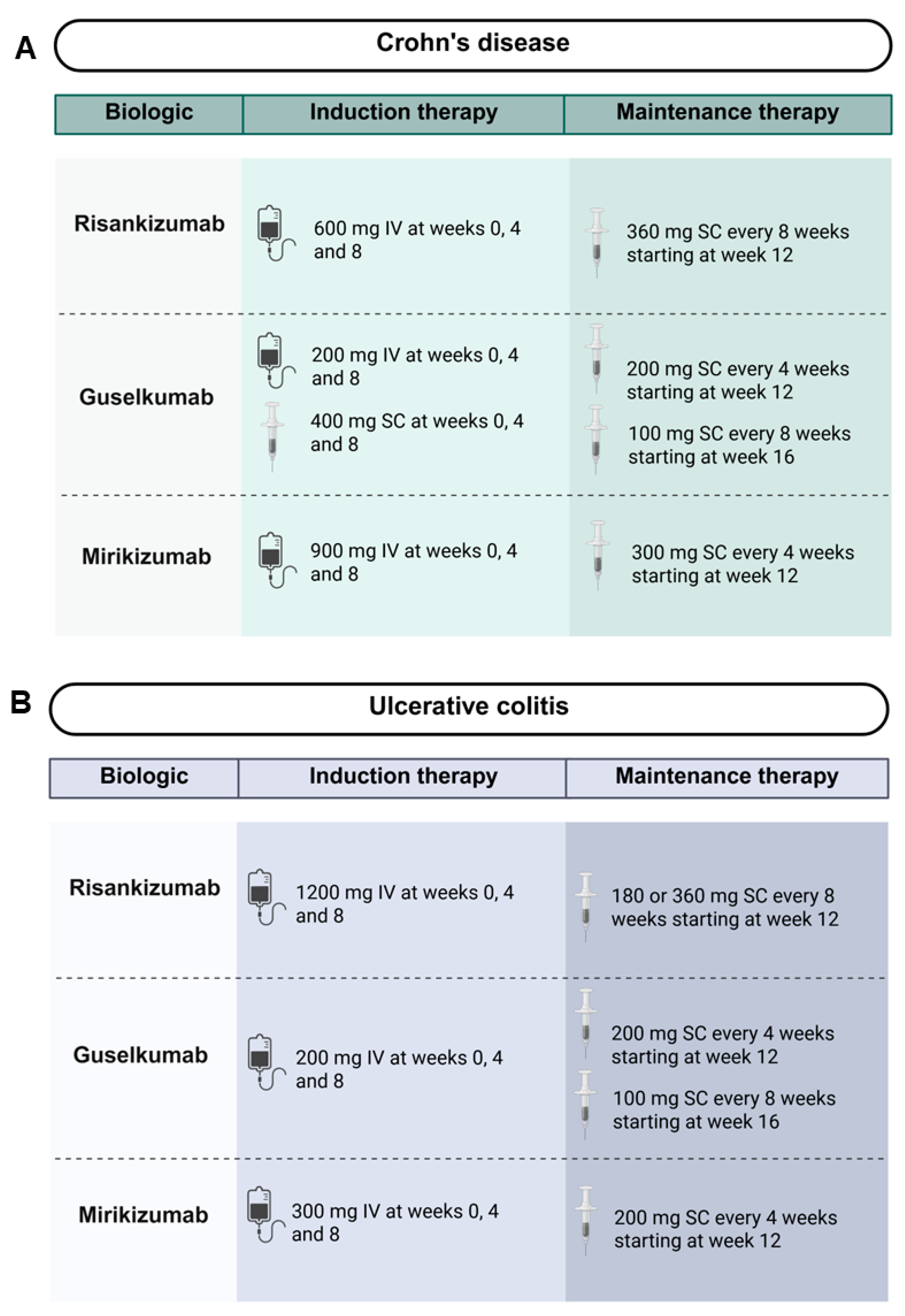
5.2. Dosing Regimens for IV and SC Administration of IL-23p19 Inhibitors
5.3. Practical Dosing Considerations
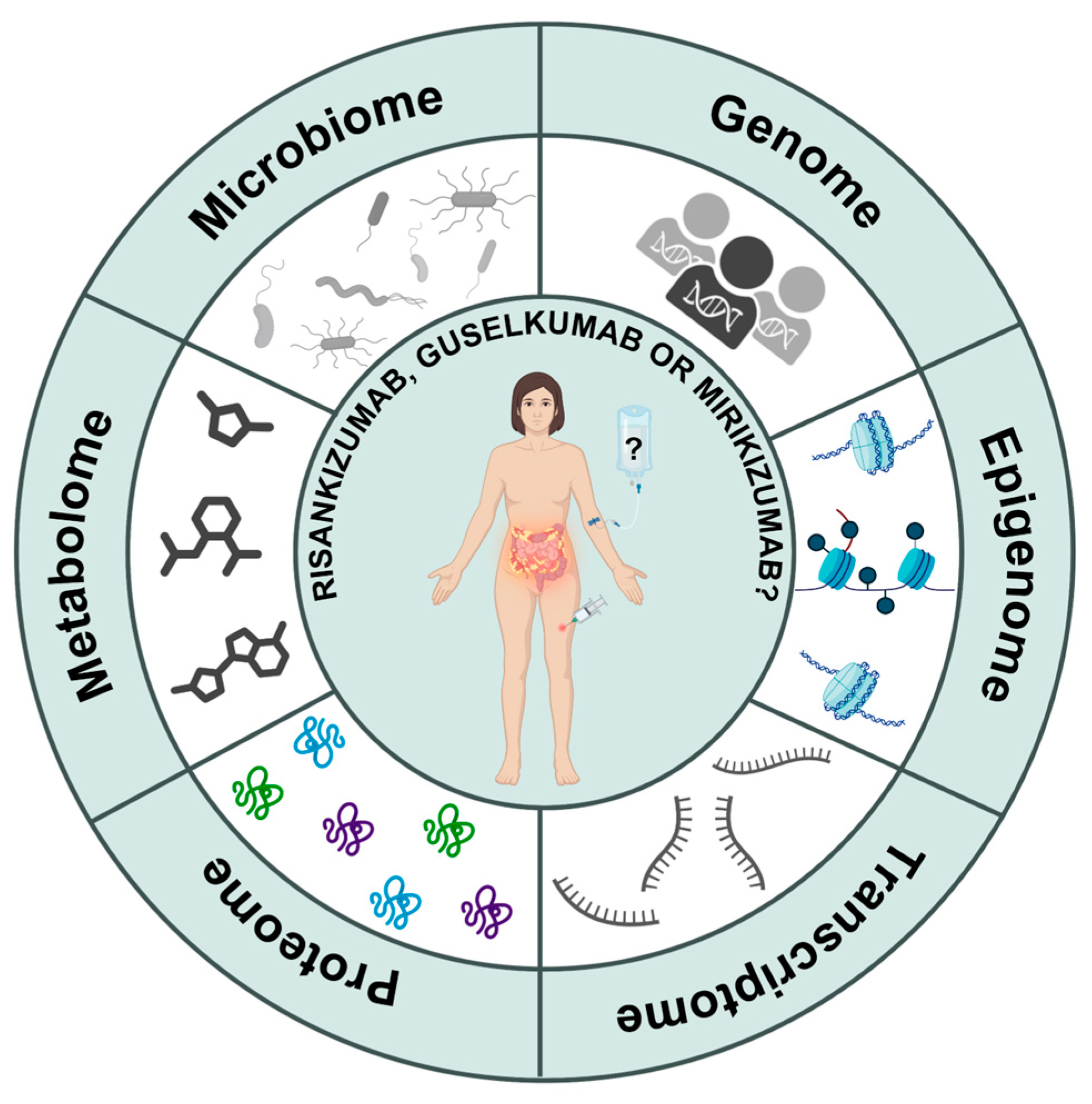
6. Multi-Omics and Precision Medicine
6.1. Current Knowledge on Different Multi-Omics Domains
6.1.1. Genomics
6.1.2. Epigenomics
6.1.3. Transcriptomics
6.1.4. Proteomics
6.1.5. Microbiome and Metabolomics
6.2. Therapeutic Drug Monitoring and Model-Informed Precision Dosing: Bridging the Gap Between Multi-Omics and Treatment Algorithms
7. Future Perspectives
7.1. Real-World Data on IL-23p19 Inhibitors
7.2. IBD-Specific Subpopulations
7.3. Defining the Therapeutic Role of IL-23p19 Inhibitors in the IBD Treatment Landscape
8. Concluding Remarks
Author Contributions
Funding
Institutional Review Board Statement
Informed Consent Statement
Data Availability Statement
Conflicts of Interest
Abbreviations
| BLIMP-1 | B lymphocyte-induced maturation protein 1 |
| CDAI | Crohn’s Disease Activity Index |
| CD | Crohn’s disease |
| CD | Cluster of differentiation |
| CCL | C-C motif chemokine ligand |
| CL | Clearance |
| DC | Dendritic cell |
| EMA | European Medicines Agency |
| FALA | Phenylalanine to alanine substitution and leucine to alanine substitution |
| Fc | Fragment crystallizable |
| FDA | Food and Drug Administration |
| Fig. | Figure |
| GATA3 | GATA-binding protein 3 |
| IBD | Inflammatory bowel disease |
| IκBα | Inhibitor of nuclear factor-κB alpha |
| Ig | Immunoglobulin |
| IL | Interleukin |
| IV | Intravenous |
| JAK2 | Janus kinase 2 |
| Kg | Kilogram |
| L | Liters |
| LALA | Leucine to alanine substitution |
| LCN-2 | Lipocalin-2 |
| MIF | Macrophage migration inhibitory factor |
| MIPD | Model-informed precision dosing |
| ML | Milliliters |
| Mg | Milligram |
| MMP | Matrix metallopeptidase |
| NF-κB | Nuclear factor κ-light-chain-enhancer of activated B cells |
| NK | Natural killer |
| PK | Pharmacokinetics |
| Pop | Population |
| PsA | Psoriatic arthritis |
| RANKL | Receptor activator of nuclear factor-κB ligand |
| REG | Regenerating protein |
| RORγt | RAR-related orphan receptor γ t |
| Satb1 | Special AT-rich sequence-binding protein 1 |
| SC | Subcutaneous |
| SES-CD | Simple Endoscopic Score for Crohn’s Disease |
| STAT | Signal transducers and activators of transcription |
| t1/2 | Half life |
| TDM | Therapeutic drug monitoring |
| Th17 cells | T-helper 17 cells |
| TYK2 | Tyrosine kinase 2 |
| UC | Ulcerative colitis |
| Vd | Volume of distribution |
Appendix A

| Trial Name, Reference | Study Population | Study Arms, N | Clinical Remission | Endoscopic Response/ Remission | Histological Response |
|---|---|---|---|---|---|
| Risankizumab (Skyrizi) | |||||
| Feagan et al., 2017 [20] Phase 2 RCT Induction | CD CDAI 220–450 and CDEIS ≥ 7 or ≥4 for L1 disease Previous anti-TNF and vedo allowed |
1: Risankizumab IV 200 mg q4w (n = 41) 2: Risankizumab IV 600 mg q4w (n = 41) 3: Placebo (n = 39) | Clinical remission (CDAI score < 150) at wk 12 - Risankizumab 200 mg 24% (p = 0.31 vs. placebo) - Risankizumab 600 mg 37% (p = 0.03 vs. placebo) - Placebo: 15% | Endoscopic response (>50% reduction in CDEIS) at wk 12: - Risankizumab 200 mg 27% (p = 0.10 vs. placebo) - Risankizumab 600 mg 37% (p = 0.01 vs. placebo) - Placebo: 13% Endoscopic remission (CDEIS score ≤ 4 or ≤2 in L1 disease) at wk 12: - Risankizumab 200 mg 15% (p = 0.04 vs. placebo) - Risankizumab 600 mg 20% (p = 0.01 vs. placebo) - Placebo: 3% | Mucosal healing (absence of mucosal ulceration) - Risankizumab 200 mg 2% (p = 0.97 vs. placebo) - Risankizumab 600 mg 7% (p = 0.31 vs. placebo) - Placebo: 3% |
| ADVANCE D’Haens et al., 2022 [21] Phase 3 RCT induction | CD CDAI 220–450 and SES-CD ≥6, or ≥4 for L1 disease Intolerance or inadequate response to conventional and/or biologic therapies | 1: Risankizumab IV 600 mg q4w (n = 336) 2: Risankizumab 1200 mg q4w (n = 339) 3: Placebo (n = 175) | Clinical remission (CDAI score < 150) at wk 12 - Risankizumab 600 mg 45% (p < 0.001 vs. placebo) - Risankizumab 1200 mg 42% (p < 0.001 vs. placebo) - Placebo: 25% | Endoscopic response (SES-CD decrease of >50% from baseline; or ≤2 point deduction in L1 disease) at wk 12 - Risankizumab 600 mg 40% (p < 0.001 vs. placebo) - Risankizumab 1200 mg 32% (p < 0.001 vs. placebo) - Placebo: 28% | NR. |
| MOTIVATE D’Haens et al., 2022 [21] Phase 3 RCT induction | CD CDAI 220–450 and SES-CD ≥6, or ≥4 for L1 disease only patients with inadequate response to biologic therapies | 1: Risankizumab IV 600 mg q4w (n = 191) 2: Risankizumab 1200 mg q4w (n = 191) 3: Placebo (n = 187) | Clinical remission (CDAI score < 150) at wk 12 - Risankizumab 600 mg: 42% (p < 0.001 vs. placebo) - Risankizumab 1200 mg: 40% (p < 0.001 vs. placebo) - Placebo: 17% | Endoscopic response (SES-CD decrease of >50% from baseline; or ≤2 point deduction in L1 disease) at wk 12: - Risankizumab 600 mg: 29% (p < 0.001 vs. placebo) - Risankizumab 1200 mg: 34% (p < 0.001 vs. placebo) - Placebo: 11% | NR |
| FORTIFY Ferrante et al., 2022 [22] Phase 3 RCT maintenance | CD Participants in ADVANCE or MOTIVATE trial achieving clinical response to risankizumab (≥30% decrease in mean stool frequency or ≥30% decrease in mean daily abdominal pain score) | 1: Risankizumab SC 180 mg q8w (n = 157) 2: Risankizumab SC 360 mg q8w (n = 141) 3: Placebo q8w (n = 164) | Clinical remission (CDAI score < 150) at wk 52 - Risankizumab 180 mg: 55% (p < 0.01 vs. placebo) - Risankizumab 360 mg: 52% (p < 0.01 vs. placebo) - Placebo: 41% | Endoscopic response (SES-CD decrease of >50% from baseline of the induction study; or ≤2 point deduction in L1 disease) at wk 52: - Risankizumab 180 mg: 47% (p < 0.001 vs. placebo) - Risankizumab 360 mg: 47% (p < 0.001 vs. placebo) - Placebo: 22% Endoscopic remission (SES-CD ≤ 4 and ≥2-point reduction with no single subscore > 1) at wk 52 - Risankizumab 180 mg: 30% (p < 0.01 vs. placebo) - Risankizumab 360 mg: 39% (p < 0.01 vs. placebo) - Placebo: 13% | NR |
| SEQUENCE Peyrin-Biroulet et al., 2024 [55] Phase 3B RCT | CD CDAI 220–450 and SES-CD ≥6, or ≥4 for L1 disease Patients with inadequate response to biologic therapies | 1: Risankizumab 600 mg IV induction at weeks 0, 4, and 8, followed by a 360 mg SC maintenance q8w (n = 255) 2: Ustekinumab weight-based IV induction at weeks 0, followed by a 90 mg SC maintenance q8w (n = 265) | Clinical remission (CDAI score < 150) at wk 48 - Risankizumab: 61% (p < 0.001 vs. ustek) - Ustekinumab: 41% | Endoscopic response (SES-CD decrease of >50% from baseline; or ≤2 point deduction in L1 disease) at wk 48 - Risankizumab: 45% (p < 0.001 vs. ustek) - Ustekinumab: 22% Endoscopic remission (SES-CD ≤ 4 and ≥2-point reduction with no single subscore > 1) at wk 48 - Risankizumab: 32% (p < 0.001 vs. ustek) - Ustekinumab: 16% | NR |
| INSPIRE Louis et al., 2024 [24] Phase 3 RCT induction | UC Adapted mayo score 5–9 points and Endoscopic subscore of 2–3 Intolerance or inadequate response to conventional and/or biologic therapies, with exclusion of ustek and other Il23p19-inhibitors | 1: Risankizumab IV 1200 mg q4w (n = 652) 2: Placebo q4w (n = 325) |
Clinical remission (≥1-point decrease in stool frequency subscore or subscore 0 or 1, and rectal bleeding subscore of 0, and endoscopic subscore 0 or 1) at wk 12: - Risankizumab 1200 mg: 20% (p < 0.001 vs. placebo) - Placebo: 6% | Endoscopic response (Mayo endoscopic subscore 0 or 1) at wk 12: - Risankizumab 1200 mg: 37% (p < 0.001 vs. placebo) - Placebo: 12% Endoscopic remission (Mayo endoscopic subscore of 0) at wk 12: - Risankizumab 1200 mg: 11% (p < 0.001 vs. placebo) - Placebo: 3% | Histologic improvement (Mayo endoscopic subscore 0 or 1 and Geboes score < 3.2) at wk 12: - Risankizumab 1200 mg: 25% (p < 0.001 vs. placebo) - Placebo: 8% Histological remission (Mayo endoscopic subscore of 0 and Geboes score < 2.1) at wk 12: - Risankizumab 1200 mg: 6% (p < 0.001 vs. placebo) - Placebo: 1% |
| COMMAND Louis et al., 2024 [24] Phase 3 RCT maintenance | UC Participants in INSPIRE trial achieving adequate response to risankizumab (reduction in adapted mayo score ≥ 30% from baseline and a decrease of ≥1 in rectal bleeding score or an absolute rectal bleeding score ≤ 1) | 1: Risankizumab SC 180 mg q8w (n = 193) 2: Risankizumab SC 360 mg q8w (n = 195) 3: Placebo (n = 196) |
Clinical remission (≥1-point decrease in stool frequency subscore or subscore 0 or 1, and rectal bleeding subscore of 0, and endoscopic subscore 0 or 1) at wk 52: - Risankizumab 180 mg: 40% (p < 0.001 vs. placebo) - Risankizumab 360 mg: 38% (p < 0.001 vs. placebo) - Placebo: 25% | Endoscopic response (Mayo endoscopic subscore 0 or 1) at wk 52: - Risankizumab 180 mg: 51% (p < 0.01 vs. placebo) - Risankizumab 360 mg: 48% (p < 0.01 vs. placebo) - Placebo: 32% Endoscopic resmission (Mayo endoscopic subscore 0) at wk 52: - Risankizumab 180 mg: 23% (p = 0.01 vs. placebo) - Risankizumab 360 mg: 24% (p = 0.01 vs. placebo) - Placebo: 15% | Histologic improvement (Mayo endoscopic subscore 0 or 1 and Geboes score < 3.2) at wk 52: - Risankizumab 180 mg: 43% (p < 0.01 vs. placebo) - Risankizumab 360 mg: 42% (p < 0.01 vs. placebo) - Placebo: 24% Histological remission (Mayo endoscopic subscore of 0 and Geboes score < 2.1) at wk 52: - Risankizumab 180 mg: 13% (p = 0.21 vs. placebo) - Risankizumab 360 mg: 16% (p = 0.06 vs. placebo) - Placebo: 10% |
| Guselkumab (Tremfya) | |||||
| GALAXI-1 Sandborn et al., 2022 [27] Phase 2 RCT induction | CD CDAI 220–450 and SES-CD ≥3 Inadequate response or intolerance to conventional therapy or biologic therapy | 1: Guselkumab IV 200 mg q4w (n = 61) 2: Guselkumab IV 600 mg q4w (n = 63) 3: Guselkumab IV 1200 mg q4w (n = 61) 4: Ustekinumab IV ∼6 mg/kg at wk 0 and SC 90 mg at wk 8 (n = 63) 5: Placebo (n = 61) | Clinical remission (CDAI score < 150) at wk 12: - Guselkumab 200 mg: 57% (p < 0.05 vs. placebo) - Guselkumab 600 mg: 56% (p < 0.05 vs. placebo) - Guselkumab 1200 mg: 46% (p < 0.05 vs. placebo) - Ustekinumab: 46% (p < 0.05 vs. placebo) - Placebo: 16% | Endoscopic response (≥50% improvement in SES-CD or SES-CD ≤ 2) at wk 12 - Guselkumab 200 mg: 38% (p < 0.05 vs. placebo) - Guselkumab 600 mg: 37% (p < 0.05 vs. placebo) - Guselkumab 1200 mg: 33% (p < 0.05 vs. placebo) - Ustekinumab: 29% (p < 0.05 vs. placebo) - Placebo: 12% Endoscopic remission (SES-CD ≤ 2) at wk 12 - Guselkumab 200 mg: 16% (p = 0.064 vs. placebo) - Guselkumab 600 mg: 10% (p = 0.255 vs. placebo) - Guselkumab 1200 mg: 16% (p < 0.05 vs. placebo) - Ustekinumab: 14% (p < 0.05 vs. placebo) - Placebo: 4% | NR |
| GALAXI-1 Danese et al., 2024 [28] Phase 2 RCT maintenance | CD CDAI 220–450 and SES-CD ≥ 3 Inadequate response or intolerance to conventional therapy or biologic therapy | 1: Guselkumab SC 100 mg q8w (from IV 200 mg induction) (n = 61) 2: Guselkumab SC 200 mg q4w (from IV 600 mg induction) (n = 63) 3: Guselkumab SC 200 mg q4w (from IV 1200 mg induction) (n = 61) 4: Ustekinumab IV SC 90 mg q8w (n = 63) | Clinical remission (CDAI score < 150) at wk 48 - Guselkumab SC 100 mg: 64% - Guselkumab SC 200 mg (from 600 mg IV induction): 73% - Guselkumab SC 200 mg (from 1200 mg IV induction): 57% - Ustekinumab: 59% | Endoscopic response (≥50% improvement in SES-CD or SES-CD ≤ 2) at wk 48 - Guselkumab SC 100 mg: 44% - Guselkumab SC 200 mg (from 600 mg IV induction): 46% - Guselkumab SC 200 mg (from 1200 mg IV induction): 44% - Ustekinumab: 30% Endoscopic remission (SES-CD ≤ 2) at wk 12 - Guselkumab SC 100 mg: 18% - Guselkumab SC 200 mg (from 600 mg IV induction): 17% - Guselkumab SC 200 mg (from 1200 mg IV induction): 33% - Ustekinumab: 6% | NR |
| GALAXI-2 and -3 Panaccione et al., 2025 [26] Phase 3 RCT maintenance GALAXI-2 and GALAXI-3 had identical study designs | CD CDAI 220–450 and SES-CD ≥ 6, or ≥4 for L1 disease Inadequate response or intolerance to conventional therapy or biologic therapy | 1: Guselkumab SC 100 mg q8w (from IV 200 mg induction) (n = 286) 2: Guselkumab SC 200 mg q4w (from IV 200 mg induction) (n = 296) 3: Ustekinumab IV SC 90 mg q8w (n = 291) 4: Placebo (n = 148) | Clinical remission (CDAI score < 150) at wk 48 GALAXI-2: - Guselkumab SC 100 mg q8w: 49% (p < 0.001 vs. placebo) - Guselkumab SC 200 mg q4w: 55% (p < 0.001 vs. placebo) - Placebo: 12% GALAXI-3: - Guselkumab SC 100 mg q8w: 47% (p < 0.001 vs. placebo) - Guselkumab SC 200 mg q4w: 48% (p < 0.001 vs. placebo) - Placebo: 13% | Endoscopic response (≥50% improvement in SES-CD or SES-CD ≤ 2) at wk 48 GALAXI-2: - Guselkumab SC 100 mg q8w: 27% (p < 0.001 vs. placebo) - Guselkumab SC 200 mg q4w: 33% (p < 0.001 vs. placebo) - Placebo: 3% GALAXI-3: - Guselkumab SC 100 mg q8w: 24% (p < 0.001 vs. placebo) - Guselkumab SC 200 mg q4w: 23% (p < 0.001 vs. placebo) - Placebo: 6% Pooled GALAXI-2 and -3 Endoscopic response (≥50% improvement in SES-CD or SES-CD ≤ 2) at wk 48: - Guselkumab SC 100 mg q8w: 48% (p < 0.01 vs. ustek) - Guselkumab SC 200 mg q4w: 53% (p < 0.001 vs. ustek) - Ustekinumab IV SC 90 mg q8w: 37% Endoscopic remission (SES-CD ≤ 4 and ≥2-point reduction with no single subscore > 1) at wk 48: - Guselkumab SC 100 mg q8w: 33% (p = 0.02 vs. ustek) - Guselkumab SC 200 mg q4w: 37% (p < 0.01 vs. ustek) - Ustekinumab IV SC 90 mg q8w: 25% | NR |
| QUASAR Peyrin-Biroulet et al., 2023 [29] Phase 2b RCT induction | UC Adapted mayo score 5–9 points, with rectal bleeding subscore ≥1 and endoscopic subscore ≥ 2 Inadequate response or intolerance to conventional therapy or anti-TNF, VEDO, and/or JAK inhibitor | 1: Guselkumab IV 200 mg q4w (n = 101) 2: Guselkumab IV 400 mg q4w (n = 107) 3: Placebo (n = 105) |
Clinical remission at wk 12 (a Mayo stool frequency subscore of 0 or 1 and a Mayo rectal bleeding subscore of 0) - Guselkumab 200 mg: 50% (p < 0.001 vs. placebo) - Guselkumab 400 mg: 48% (p < 0.001 vs. placebo) - Placebo: 20% | Endoscopic response (Mayo endoscopic subscore 0 or 1) at wk 12 - Guselkumab 200 mg: 31% (p < 0.05 vs. placebo) - Guselkumab 400 mg: 31% (p < 0.001 vs. placebo) - Placebo: 12% Endoscopic remission (Mayo endoscopy subscore of 0) at wk 12 - Guselkumab 200 mg: 18% (p < 0.05 vs. placebo) - Guselkumab 400 mg: 14% (p = 0.076 vs. placebo) - Placebo: 7% | Histologic improvement (Mayo endoscopic subscore 0 or 1 and geboes score < 3.2) at wk 12 - Guselkumab 200 mg: 20% (p=0.014 vs. placebo) - Guselkumab 400 mg: 27% (p < 0.001 vs. placebo) - Placebo: 8.6% |
| QUASAR Rubin et al., 2025 [30] Phase 3 RCT induction | UC Adapted mayo score 5–9 points, with rectal bleeding subscore ≥1 and endoscopic subscore ≥ 2 Inadequate response or intolerance to conventional therapy or anti-TNF, VEDO, and/or JAK inhibitor | 1: Guselkumab IV 200 mg q4w (n = 421) 2: Placebo (n = 280) |
Clinical remission (a Mayo stool frequency subscore of 0 or 1 and a Mayo rectal bleeding subscore of 0) at wk 12 - Guselkumab 200 mg: 23% (p < 0.001 vs. placebo) - Placebo: 8% | Endoscopic response (Mayo endoscopic subscore 0 or 1) at wk 12 - Guselkumab 200 mg: 27% (p < 0.001 vs. placebo) - Placebo: 11% Endoscopic remission (Mayo endoscopy subscore of 0) at wk 12 - Guselkumab 200 mg: 15% (p < 0.001 vs. placebo) - Placebo: 5% | Histologic improvement (Mayo endoscopic subscore 0 or 1 and Geboes score < 3.2) at wk 12 - Guselkumab 200 mg: 45% (p < 0.001 vs. placebo) - Placebo: 21% Histological remission (Mayo endoscopic subscore of 0 and Geboes score < 2.1) at wk 12: - Guselkumab 200 mg: 40% (p < 0.001 vs. placebo) - Placebo: 19% |
| QUASAR Rubin et al., 2025 [30] Phase 3 RCT maintenance | UC Participants of QUASAR induction trials who showed clinical response to guselkumab (decrease from induction baseline in Mayo score by at least 30% and at least 2 points) | 1: Guselkumab SC 100 mg q8w (n = 188) 2: Guselkumab SC 200 mg q4w (n = 190) 3: Placebo (n = 190) |
Clinical remission (a Mayo stool frequency subscore of 0 or 1 and a Mayo rectal bleeding subscore of 0) at wk 44 - Guselkumab 100 mg q8w: 45% (p < 0.001 vs. placebo) - Guselkumab 200 mg q4w: 50% (p < 0.001 vs. placebo) - Placebo: 19% | Endoscopic response (Mayo endoscopic subscore 0 or 1) at wk 44 - Guselkumab 100 mg q8w: 549% (p < 0.001 vs. placebo) - Guselkumab 200 mg q4w: 52% (p < 0.001 vs. placebo) - Placebo: 19% Endoscopic remission (Mayo endoscopic subscore = 0) at wk 44 - Guselkumab 200 mg q4w: 35% (p < 0.001 vs. placebo) - Guselkumab 100 mg q8w: 34% (p < 0.001 vs. placebo) - Placebo: 15% | Histologic improvement (Mayo endoscopic subscore 0 or 1 and Geboes score < 3.2) at wk 44 - Guselkumab 100 mg q8w: 65% (p < 0.001 vs. placebo) - Guselkumab 200 mg q4w: 65% (p < 0.001 vs. placebo) - Placebo: 31% Histological remission (Mayo endoscopic subscore of 0 and Geboes score < 2.1) at wk 12: - Guselkumab 100 mg q8w: 59% (p < 0.001 vs. placebo) - Guselkumab 200 mg q4w: 61% (p < 0.001 vs. placebo) - Placebo: 27% |
| Mirikizumab (Omvoh) | |||||
| SERENITY Sands et al., 2022 [31] Phase 2 RCT induction | CD Stool frequency ≥4 and/or abdominal pain ≥2 at baseline and a SES-CD ≥ 6 and ≥4 with L1 disease Inadequate response or intolerance to conventional therapy or biologic therapy | 1: Mirikizumab IV 200 mg q4w (n = 31) 2: Mirikizumab IV 600 mg q4w (n = 32) 3: Mirikizumab IV 1000 mg q4w (n = 64) 4: Placebo (n = 64) | Clinical remission (CDAI score < 150) at wk 12: - Mirikizumab 200 mg: 16% (p = 0.41 vs. placebo) - Mirikizumab 600 mg: 41% (p < 0.001 vs. placebo) - Mirikizumab 1000 mg: 27% (p = 0.032 vs. placebo) - Placebo: 9% | Endoscopic response (SES-CD 50% reduction) at wk 12: - Mirikizumab 200 mg: 26% (p = 0.079 vs. placebo) - Mirikizumab 600 mg: 38% (p = 0.003 vs. placebo) - Mirikizumab 1000 mg: 44% (p < 0.001 vs. placebo) - Placebo: 11% Endoscopic remission (SES-CD < 4 for ileocolonic disease or <2 for L1 disease, no subscore > 1) at wk 12: - Mirikizumab 200 mg: 7% (p = 0.241 vs. placebo) - Mirikizumab 600 mg: 16% (p = 0.032 vs. placebo) - Mirikizumab 1000 mg: 20% (p = 0.009 vs. placebo) - Placebo: 2% | NR |
| SERENITY Sands et al., 2022 [31] Phase 2 RCT maintenance | CD Participants of the SERENITY induction trials who achieved an improvement of at least 1 point decrease in their SES-CD score | 1: Mirikizumab IV dose continued as received during induction q4w(n = 41) 2: Mirikizumab SC 300 mg q4w (n = 46) | Clinical remission (CDAI score < 150) at wk 52: - Mirikizumab IV dose as received during induction: 39% - Mirikizumab SC 300 mg: 57% | Endoscopic response (SES-CD 50% reduction) at wk 52 - Mirikizumab IV dose as received during induction: 59% - Mirikizumab SC 300 mg: 59% Endoscopic remission (SES-CD < 4 for ileocolonic disease or <2 for L1 disease, no subscore > 1) at wk 52 - Mirikizumab IV dose as received during induction: 20% - Mirikizumab SC 300 mg: 32% | NR |
| VIVID-1 Ferrante et al., 2024 [32] Phase 3 RCT maintenance | CD Stool frequency ≥ 4 and/or abdominal pain ≥2 at baseline and a SES-CD ≥6 and ≥4 with L1 disease Inadequate response or intolerance to conventional therapy or biologic therapy | 1: Mirikizumab IV 900 mg w4–8, then 300 mg SC q4w (n = 579) 2: ustekinumab 6 mg/kg IV at w0, then 90 mg SC q8w (n = 287) 3: Placebo (n = 199) | Clinical remission (CDAI score < 150) at wk 52: - Mirikizumab 900 mg: 45% (p < 0.001 vs. placebo) - Placebo: 20% | Endoscopic response (SES-CD 50% reduction) at wk 52 - Mirikizumab 900 mg: 38% (p < 0.001 vs. placebo) - Placebo: 9% Endoscopic remission (SES-CD <4 for ileocolonic disease or <2 for L1 disease, no subscore > 1) at wk 52 - Mirikizumab 900 mg: 16% (p < 0.001 vs. placebo) - Placebo: 2% | NR |
| Sandborn et al., 2020 [33] Phase 2 RCT induction | UC Mayo score of 6–12, including an endoscopic subscore ≥ 2 No previous exposure to therapy targeting IL-23 pathway | 1: Mirikizumab IV 50 mg q4w (n = 63) 2: Mirikizumab IV 200 mg q4w (n = 62) 3: Mirikizumab IV 600 mg q4w (n = 61) 4: Placebo (n = 63) |
Clinical remission (Mayo subscore = 0 for rectal bleeding, 0 or 1 for stool frequency) at wk 12: - Mirikizumab 50 mg: 15% (p = 0.066 vs. placebo) - Mirikizumab 200 mg: 23% (p = 0.004 vs. placebo) - Mirikizumab 600 mg: 12% (p = 0.14 vs. placebo) - Placebo: 5% |
Endoscopic response (Mayo endoscopic subscore of 0 or 1) at wk 12 - Mirikizumab 50 mg: 24% (p = 0.012 vs. placebo) - Mirikizumab 200 mg: 31% (p < 0.001 vs. placebo) - Mirikizumab 600 mg: 13% (p = 0.22 vs. placebo) - Placebo: 6% Endoscopic remission (Mayo endoscopic subscore = 0) at wk 12: - Mirikizumab 50 mg: 3% (p = 0.56 vs. placebo) - Mirikizumab 200 mg: 3% (p = 0.55 vs. placebo) - Mirikizumab 600 mg: 2% (p = 0.99 vs. placebo) - Placebo: 2% |
Histological remission (Geboes histologic subscores of 0 for the neutrophils in lamina propria, neutrophils in epithelium, and erosion or ulceration parameters) at wk 12: - Mirikizumab 50 mg: 14% (p = 0.632 vs. placebo) - Mirikizumab 200 mg: 45% (p = 0.001 vs. placebo) - Mirikizumab 600 mg: 34% (p = 0.028 vs. placebo) - Placebo: 14% |
| LUCENT-1 D’Haens et al., 2023 [34] Phase 3 RCT induction | UC Adapted mayo score 4–9 points and endoscopic subscore ≥ 2 Inadequate response or intolerance to conventional therapy or biological therapy | 1: Mirikizumab IV 300 mg q4w (n= 868) 2: Placebo (n= 294) |
Clinical remission (≥1-point decrease in stool frequency subscore or subscore 0 or 1, and rectal bleeding subscore of 0) at wk 12 - Mirikizumab 300 mg: 24% (p < 0.001 vs. placebo) - Placebo: 13% |
Endoscopic remission (Mayo endoscopic subscore 0 or 1) at wk 12 - Mirikizumab 300 mg: 36% (p < 0.001 vs. placebo) - Placebo: 21% |
Histologic improvement (Mayo endoscopic subscore 0 or 1 + neutrophil infiltration in crypts <5% and absence of crypt destruction, ulcerations, erosions, and granulation tissue) at wk 12 - Mirikizumab 300 mg: 27% (p < 0.001 vs. placebo) - Placebo: 14% |
| LUCENT-2 D’Haens et al., 2023 [34] Phase 3 RCTmaintenance | UC All the patients who completed the induction trial, regardless of clinical response, were eligible to participate in the maintenance trial | 1: Mirikizumab SC 200 mg (n= 365) 2: Placebo (n= 179) |
Clinical remission (≥1-point decrease in stool frequency subscore or subscore 0 or 1, and rectal bleeding subscore of 0) at wk 40: - Mirikizumab 200 mg: 50% (p < 0.001 vs. placebo) - Placebo: 25% |
Endoscopic remission (Mayo endoscopic subscore 0 or 1) at wk 40: - Mirikizumab 200 mg: 59% (p < 0.001 vs. placebo) - Placebo: 29% |
Histologic improvement (Mayo endoscopic subscore 0 or 1 + neutrophil infiltration in crypts <5% and absence of crypt destruction, ulcerations, erosions, and granulation tissue) at wk 40 - Mirikizumab 200 mg: 49% (p < 0.001 vs. placebo) - Placebo: 25% |
| LUCENT-3 Sands et al., 2024 [35] Phase 3 maintenance open-label extension trial | UC | 1. Mirikizumab SC 200 mg q4w |
Clinical remission at wk 104 (based on modified Mayo score): wk 52 responders: 54.0% wk 52 remitters: 65.6% |
Endoscopic remission (Mayo endoscopic subscore 0 or 1) at wk 104: wk 52 responders: 65.3% wk 52 remitters: 77.3% Endoscopic/histologic remission at wk 104: wk 52 responders: 47.7% wk 52 remitters: 74.0% | |
References
- De Souza, H.S.P.; Fiocchi, C. Immunopathogenesis of IBD: Current State of the Art. Nat. Rev. Gastroenterol. Hepatol. 2016, 13, 13–27. [Google Scholar] [CrossRef] [PubMed]
- Caballero Mateos, A.M.; Cañadas de la Fuente, G.A.; Gros, B. Paradigm Shift in Inflammatory Bowel Disease Management: Precision Medicine, Artificial Intelligence, and Emerging Therapies. J. Clin. Med. 2025, 14, 1536. [Google Scholar] [CrossRef] [PubMed]
- Ben-Horin, S.; Kopylov, U.; Chowers, Y. Optimizing Anti-TNF Treatments in Inflammatory Bowel Disease. Autoimmun. Rev. 2014, 13, 24–30. [Google Scholar] [CrossRef]
- Schreiber, S.; Dignass, A.; Peyrin-Biroulet, L.; Hather, G.; Demuth, D.; Mosli, M.; Curtis, R.; Khalid, J.M.; Loftus, E.V. Systematic Review with Meta-Analysis: Real-World Effectiveness and Safety of Vedolizumab in Patients with Inflammatory Bowel Disease. J. Gastroenterol. 2018, 53, 1048–1064. [Google Scholar] [CrossRef] [PubMed]
- Alipour, O.; Gualti, A.; Shao, L.; Zhang, B. Systematic Review and Meta-Analysis: Real-World Data Rates of Deep Remission with Anti-TNFα in Inflammatory Bowel Disease. BMC Gastroenterol. 2021, 21, 312. [Google Scholar] [CrossRef]
- An Induction Study of Mirikizumab in Participants with Moderately to Severely Active Ulcerative Colitis (LUCENT 1). Available online: https://www.clinicaltrials.gov/study/NCT03518086?term=NCT03518086&rank=1 (accessed on 10 September 2025).
- A Maintenance Study of Mirikizumab in Participants with Moderately to Severely Active Ulcerative Colitis (LUCENT 2). Available online: https://www.clinicaltrials.gov/study/NCT03524092?term=NCT03524092&rank=1 (accessed on 10 September 2025).
- A Study Evaluating the Efficacy and Safety of Guselkumab Administered Subcutaneously in Participants with Active Psoriatic Arthritis. Available online: https://clinicaltrials.gov/study/NCT03158285 (accessed on 10 September 2025).
- A Study of Guselkumab in the Treatment of Participants with Moderate to Severe Plaque-Type Psoriasis (VOYAGE 1). Available online: https://clinicaltrials.gov/study/NCT02207231 (accessed on 10 September 2025).
- A Study of the Efficacy and Safety of Guselkumab in Participants with Moderately to Severely Active Crohn’s Disease (GALAXI). Available online: https://clinicaltrials.gov/study/NCT03466411 (accessed on 16 October 2025).
- A Study of Guselkumab in the Treatment of Participants with Moderate to Severe Plaque-Type Psoriasis with Randomized Withdrawal and Retreatment (VOYAGE 2). Available online: https://clinicaltrials.gov/study/NCT02207244 (accessed on 10 September 2025).
- A Study of the Efficacy and Safety of Risankizumab in Participants with Crohn’s Disease (FORTIFY). Available online: https://clinicaltrials.gov/study/NCT03105102 (accessed on 10 September 2025).
- A Study to Assess the Efficacy and Safety of Risankizumab in Participants with Ulcerative Colitis (COMMAND). Available online: https://clinicaltrials.gov/study/NCT03398135 (accessed on 10 September 2025).
- A Study of the Efficacy and Safety of Risankizumab in Participants with Moderately to Severely Active Crohn’s Disease. Available online: https://clinicaltrials.gov/study/NCT03105128 (accessed on 10 September 2025).
- Sewell, G.W.; Kaser, A. Interleukin-23 in the Pathogenesis of Inflammatory Bowel Disease and Implications for Therapeutic Intervention. J. Crohns Colitis 2022, 16, ii3–ii19. [Google Scholar] [CrossRef]
- Su, Q.-Y.; Gao, H.-Y.; Duan, Y.-R.; Luo, J.; Wang, W.-Z.; Qiao, X.-C.; Zhang, S.-X. The Immunologic Role of IL-23 in Psoriatic Arthritis: A Potential Therapeutic Target. Expert Opin. Biol. Ther. 2024, 24, 1119–1132. [Google Scholar] [CrossRef]
- Audia, S.; Brescia, C.; Dattilo, V.; Torchia, N.; Trapasso, F.; Amato, R. The IL-23R and Its Genetic Variants: A Hitherto Unforeseen Bridge Between the Immune System and Cancer Development. Cancers 2024, 17, 55. [Google Scholar] [CrossRef]
- Bourgonje, A.R.; Ungaro, R.C.; Mehandru, S.; Colombel, J.-F. Targeting the Interleukin 23 Pathway in Inflammatory Bowel Disease. Gastroenterology 2025, 168, 29–52.e3. [Google Scholar] [CrossRef]
- Deng, Z.; Wang, S.; Wu, C.; Wang, C. IL-17 Inhibitor-Associated Inflammatory Bowel Disease: A Study Based on Literature and Database Analysis. Front. Pharmacol. 2023, 14, 1124628. [Google Scholar] [CrossRef]
- Feagan, B.G.; Sandborn, W.J.; D’Haens, G.; Panés, J.; Kaser, A.; Ferrante, M.; Louis, E.; Franchimont, D.; Dewit, O.; Seidler, U.; et al. Induction Therapy with the Selective Interleukin-23 Inhibitor Risankizumab in Patients with Moderate-to-Severe Crohn’s Disease: A Randomised, Double-Blind, Placebo-Controlled Phase 2 Study. Lancet 2017, 389, 1699–1709. [Google Scholar] [CrossRef] [PubMed]
- D’Haens, G.; Panaccione, R.; Baert, F.; Bossuyt, P.; Colombel, J.-F.; Danese, S.; Dubinsky, M.; Feagan, B.G.; Hisamatsu, T.; Lim, A.; et al. Risankizumab as Induction Therapy for Crohn’s Disease: Results from the Phase 3 ADVANCE and MOTIVATE Induction Trials. Lancet 2022, 399, 2015–2030. [Google Scholar] [CrossRef] [PubMed]
- Ferrante, M.; Panaccione, R.; Baert, F.; Bossuyt, P.; Colombel, J.-F.; Danese, S.; Dubinsky, M.; Feagan, B.G.; Hisamatsu, T.; Lim, A.; et al. Risankizumab as Maintenance Therapy for Moderately to Severely Active Crohn’s Disease: Results from the Multicentre, Randomised, Double-Blind, Placebo-Controlled, Withdrawal Phase 3 FORTIFY Maintenance Trial. Lancet 2022, 399, 2031–2046. [Google Scholar] [CrossRef]
- Panaccione, R.; Louis, E.; Colombel, J.-F.; D’Haens, G.; Peyrin-Biroulet, L.; Dubinsky, M.; Takeuchi, K.; Rubin, D.T.; Kalabic, J.; Chien, K.B.; et al. Risankizumab Efficacy and Safety Based on Prior Inadequate Response or Intolerance to Advanced Therapy: Post Hoc Analysis of the INSPIRE and COMMAND Phase 3 Studies. J. Crohns Colitis 2025, 19, jjaf005. [Google Scholar] [CrossRef] [PubMed]
- Louis, E.; Schreiber, S.; Panaccione, R.; Bossuyt, P.; Biedermann, L.; Colombel, J.-F.; Parkes, G.; Peyrin-Biroulet, L.; D’Haens, G.; Hisamatsu, T.; et al. Risankizumab for Ulcerative Colitis. JAMA 2024, 332, 881. [Google Scholar] [CrossRef]
- Pbo, I. Risankizumab Induction Therapy in Patients with Moderately to Severely Active Ulcerative Colitis: Efficacy and Safety in the Randomized Phase 3 INSPIRE Study. Gastroenterol. Hepatol. 2023, 19, 9–10. [Google Scholar]
- Panaccione, R.; Feagan, B.G.; Afzali, A.; Rubin, D.T.; Reinisch, W.; Panés, J.; Danese, S.; Hisamatsu, T.; Terry, N.A.; Salese, L.; et al. Efficacy and Safety of Intravenous Induction and Subcutaneous Maintenance Therapy with Guselkumab for Patients with Crohn’s Disease (GALAXI-2 and GALAXI-3): 48-Week Results from Two Phase 3, Randomised, Placebo and Active Comparator-Controlled, Double-Blind, Triple-Dummy Trials. Lancet 2025, 406, 358–375. [Google Scholar] [CrossRef]
- Sandborn, W.J.; D’Haens, G.R.; Reinisch, W.; Panés, J.; Chan, D.; Gonzalez, S.; Weisel, K.; Germinaro, M.; Frustaci, M.E.; Yang, Z.; et al. Guselkumab for the Treatment of Crohn’s Disease: Induction Results from the Phase 2 GALAXI-1 Study. Gastroenterology 2022, 162, 1650–1664.e8. [Google Scholar] [CrossRef]
- Danese, S.; Panaccione, R.; Feagan, B.G.; Afzali, A.; Rubin, D.T.; Sands, B.E.; Reinisch, W.; Panés, J.; Sahoo, A.; Terry, N.A.; et al. Efficacy and Safety of 48 Weeks of Guselkumab for Patients with Crohn’s Disease: Maintenance Results from the Phase 2, Randomised, Double-Blind GALAXI-1 Trial. Lancet Gastroenterol. Hepatol. 2024, 9, 133–146. [Google Scholar] [CrossRef]
- Peyrin-Biroulet, L.; Allegretti, J.R.; Rubin, D.T.; Bressler, B.; Germinaro, M.; Huang, K.-H.; Shipitofsky, N.; Zhang, H.; Wilson, R.; Han, C.; et al. Guselkumab in Patients with Moderately to Severely Active Ulcerative Colitis: QUASAR Phase 2b Induction Study. Gastroenterology 2023, 165, 1443–1457. [Google Scholar] [CrossRef]
- Rubin, D.T.; Allegretti, J.R.; Panés, J.; Shipitofsky, N.; Yarandi, S.S.; Huang, K.-H.G.; Germinaro, M.; Wilson, R.; Zhang, H.; Johanns, J.; et al. Guselkumab in Patients with Moderately to Severely Active Ulcerative Colitis (QUASAR): Phase 3 Double-Blind, Randomised, Placebo-Controlled Induction and Maintenance Studies. Lancet 2025, 405, 33–49. [Google Scholar] [CrossRef]
- Sands, B.E.; Peyrin-Biroulet, L.; Kierkus, J.; Higgins, P.D.R.; Fischer, M.; Jairath, V.; Hirai, F.; D’Haens, G.; Belin, R.M.; Miller, D.; et al. Efficacy and Safety of Mirikizumab in a Randomized Phase 2 Study of Patients with Crohn’s Disease. Gastroenterology 2022, 162, 495–508. [Google Scholar] [CrossRef] [PubMed]
- Ferrante, M.; D’Haens, G.; Jairath, V.; Danese, S.; Chen, M.; Ghosh, S.; Hisamatsu, T.; Kierkus, J.; Siegmund, B.; Bragg, S.M.; et al. Efficacy and Safety of Mirikizumab in Patients with Moderately-to-Severely Active Crohn’s Disease: A Phase 3, Multicentre, Randomised, Double-Blind, Placebo-Controlled and Active-Controlled, Treat-through Study. Lancet 2024, 404, 2423–2436. [Google Scholar] [CrossRef]
- Sandborn, W.J.; Ferrante, M.; Bhandari, B.R.; Berliba, E.; Feagan, B.G.; Hibi, T.; Tuttle, J.L.; Klekotka, P.; Friedrich, S.; Durante, M.; et al. Efficacy and Safety of Mirikizumab in a Randomized Phase 2 Study of Patients with Ulcerative Colitis. Gastroenterology 2020, 158, 537–549.e10. [Google Scholar] [CrossRef]
- D’Haens, G.; Dubinsky, M.; Kobayashi, T.; Irving, P.M.; Howaldt, S.; Pokrotnieks, J.; Krueger, K.; Laskowski, J.; Li, X.; Lissoos, T.; et al. Mirikizumab as Induction and Maintenance Therapy for Ulcerative Colitis. N. Engl. J. Med. 2023, 388, 2444–2455. [Google Scholar] [CrossRef] [PubMed]
- Sands, B.E.; D’Haens, G.; Clemow, D.B.; Irving, P.M.; Johns, J.T.; Hunter Gibble, T.; Abreu, M.T.; Lee, S.; Hisamatsu, T.; Kobayashi, T.; et al. Two-Year Efficacy and Safety of Mirikizumab Following 104 Weeks of Continuous Treatment for Ulcerative Colitis: Results From the LUCENT-3 Open-Label Extension Study. Inflamm. Bowel Dis. 2024, 30, 2245–2258. [Google Scholar] [CrossRef] [PubMed]
- Awad, A.; Madla, C.M.; McCoubrey, L.E.; Ferraro, F.; Gavins, F.K.H.; Buanz, A.; Gaisford, S.; Orlu, M.; Siepmann, F.; Siepmann, J.; et al. Clinical Translation of Advanced Colonic Drug Delivery Technologies. Adv. Drug Deliv. Rev. 2022, 181, 114076. [Google Scholar] [CrossRef]
- Ota, N.; Davies, C.W.; Kang, J.; Yan, D.; Scherl, A.; Wong, A.; Cook, R.; Tao, X.; Dunlap, D.; Klabunde, S.; et al. Engineering a Protease-Stable, Oral Single-Domain Antibody to Inhibit IL-23 Signaling. Proc. Natl. Acad. Sci. USA 2025, 122, e2501635122. [Google Scholar] [CrossRef]
- Berger, S.; Seeger, F.; Yu, T.-Y.; Aydin, M.; Yang, H.; Rosenblum, D.; Guenin-Macé, L.; Glassman, C.; Arguinchona, L.; Sniezek, C.; et al. Preclinical Proof of Principle for Orally Delivered Th17 Antagonist Miniproteins. Cell 2024, 187, 4305–4317.e18. [Google Scholar] [CrossRef]
- Roberts, K.J.; Cubitt, M.F.; Carlton, T.M.; Rodrigues-Duarte, L.; Maggiore, L.; Chai, R.; Clare, S.; Harcourt, K.; MacDonald, T.T.; Ray, K.P.; et al. Preclinical Development of a Bispecific TNFα/IL-23 Neutralising Domain Antibody as a Novel Oral Treatment for Inflammatory Bowel Disease. Sci. Rep. 2021, 11, 19422. [Google Scholar] [CrossRef]
- Jairath, V.; Danese, S.; D’Haens, G.R.; Feagan, B.G.; Peyrin-Biroulet, L.; Sands, B.E.; Gaemers, I.; Westfall, M.; Terry, A.Q.; Roberts, K.J.; et al. Safety and Pharmacokinetics of SOR102, an Oral Bispecific Inhibitor of TNF and Interleukin-23 in Healthy Participants and Patients with Ulcerative Colitis: A First-in-Human, Double-Blind, Randomised, Placebo-Controlled, Phase 1 Trial. Lancet Gastroenterol. Hepatol. 2026, 11, 34–45. [Google Scholar] [CrossRef] [PubMed]
- Cheng, X.; Lee, T.Y.; Ledet, G. Safety, Tolerability, and Pharmacokinetics of PTG-200, an Oral GI-Restricted Peptide Antagonist of the IL-23 Receptor, in Normal Healthy Volunteers. Am. J. Gastroenterol. 2019, 114, S439–S440. [Google Scholar] [CrossRef]
- Fourie, A.M.; Cheng, X.; Chang, L.; Greving, C.; Li, X.; Knight, B.; Polidori, D.; Patrick, A.; Bains, T.; Steele, R.; et al. JNJ-77242113, a Highly Potent, Selective Peptide Targeting the IL-23 Receptor, Provides Robust IL-23 Pathway Inhibition upon Oral Dosing in Rats and Humans. Sci. Rep. 2024, 14, 17515. [Google Scholar] [CrossRef] [PubMed]
- A Study Evaluating Participants with Moderately to Severely Active Crohn’s Disease (PRISM). Available online: https://www.clinicaltrials.gov/study/NCT04102111 (accessed on 19 December 2025).
- Abreu, M. Icotrokinra, a Targeted Oral Peptide That Selectively Blocks IL-23 Receptor Activation, in Moderately to Severely Active Ulcerative Colitis: Week 12 Results from the Phase 2b, Randomized, Double-Blind, Placebo-Controlled, Treat-through, Dose-Ranging ANTHEMUC Trial. In Proceedings of the United European Gastroenterology Week (UEGW), Berlin, Germany, 4–7 October 2025. [Google Scholar]
- Jairath, V.; Siegmund, B.; Surace, L.; Erondu, N.; Chen, M.; Chachu, K.; Louis, E.; Matsuoka, K.; Limdi, J.; Arthur, E.; et al. S1449 Efficacy and Safety of Icotrokinra, a Targeted Oral Peptide That Selectively Blocks IL-23 Receptor Activation, in Ulcerative Colitis: Results from Week 28 of ANTHEM-UC, a Phase 2b Dose-Ranging Trial. Am. J. Gastroenterol. 2025, 120, S312. [Google Scholar] [CrossRef]
- A Study of Icotrokinra in Participants with Moderately to Severely Active Crohn’s Disease (ICONIC-CD). Available online: https://clinicaltrials.gov/study/NCT07196722 (accessed on 9 December 2025).
- A Protocol of Icotrokinra Therapy in Adult and Adolescent Participants with Moderately to Severely Active Ulcerative Colitis (ICONIC-UC). Available online: https://clinicaltrials.gov/study/NCT07196748 (accessed on 9 December 2025).
- D’Haens, G.; Danese, S.; Panaccione, R.; Rubin, D.T.; Peyrin-Biroulet, L.; Matsuoka, K.; Loftus, E.V.; Kobayashi, T.; Elsharkawi, W.; Miceli, R.; et al. Deucravacitinib in Patients with Inflammatory Bowel Disease: 12-Week Efficacy and Safety Results from 3 Randomized Phase 2 Studies in Crohn’s Disease and Ulcerative Colitis. J. Crohns Colitis 2025, 19, jjaf080. [Google Scholar] [CrossRef] [PubMed]
- Danese, S.; Jairath, V.; Sands, B.E.; Schreiber, S.; Panaccione, R.; D’Haens, G.; Lindstrom, B.; Liu, K.; Sandborn, W.; Rubin, D.T.; et al. P1001 Efficacy and Safety of an Oral Tyrosine Kinase 2 Inhibitor VTX958 in Moderately to Severely Active Crohn’s Disease: A Randomised, Double-Blind, Placebo-Controlled, Phase 2 Trial. J. Crohns Colitis 2025, 19, i1853–i1854. [Google Scholar] [CrossRef]
- Lebwohl, M.; Warren, R.B.; Sofen, H.; Imafuku, S.; Paul, C.; Szepietowski, J.C.; Spelman, L.; Passeron, T.; Vritzali, E.; Napoli, A.; et al. Deucravacitinib in Plaque Psoriasis: 2-Year Safety and Efficacy Results from the Phase III POETYK Trials. Br. J. Dermatol. 2024, 190, 668–679. [Google Scholar] [CrossRef] [PubMed]
- Leit, S.; Greenwood, J.; Carriero, S.; Mondal, S.; Abel, R.; Ashwell, M.; Blanchette, H.; Boyles, N.A.; Cartwright, M.; Collis, A.; et al. Discovery of a Potent and Selective Tyrosine Kinase 2 Inhibitor: TAK-279. J. Med. Chem. 2023, 66, 10473–10496. [Google Scholar] [CrossRef]
- A Study on the Safety of TAK-279 and Whether It Can Reduce Inflammation in the Bowel of Participants with Moderately to Severely Active Crohn’s Disease. Available online: https://clinicaltrials.gov/study/NCT06233461 (accessed on 19 December 2025).
- Vermeire, S.; Allegretti, J.R.; Kim, H.J.; Long, M.D.; Leszczyszyn, J.; Schreiber, S.; Mross, M.R.; Kierkus, J.; Peeva, E.; Vincent, M.S.; et al. OP09 Oral Ritlecitinib and Brepocitinib in Patients with Moderate to Severe Active Crohn’s Disease: Data from the PIZZICATO Umbrella Study. J. Crohns Colitis 2024, 18, i16. [Google Scholar] [CrossRef]
- Jairath, V.; Sands, B.E.; Bossuyt, P.; Farraye, F.; Ferrante, M.; Hisamatsu, T.; Kaser, A.; Kierkus, J.; Laharie, D.; Reinisch, W.; et al. OP35 Efficacy of Mirikizumab in Comparison to Ustekinumab in Patients with Moderate to Severe Crohn’s Disease: Results from the Phase 3 VIVID 1 Study. J. Crohns Colitis 2024, 18, i62–i64. [Google Scholar] [CrossRef]
- Peyrin-Biroulet, L.; Chapman, J.C.; Colombel, J.-F.; Caprioli, F.; D’Haens, G.; Ferrante, M.; Schreiber, S.; Atreya, R.; Danese, S.; Lindsay, J.O.; et al. Risankizumab versus Ustekinumab for Moderate-to-Severe Crohn’s Disease. N. Engl. J. Med. 2024, 391, 213–223. [Google Scholar] [CrossRef] [PubMed]
- Feagan, B.G.; Sands, B.E.; Sandborn, W.J.; Germinaro, M.; Vetter, M.; Shao, J.; Sheng, S.; Johanns, J.; Panés, J.; Tkachev, A.; et al. Guselkumab plus Golimumab Combination Therapy versus Guselkumab or Golimumab Monotherapy in Patients with Ulcerative Colitis (VEGA): A Randomised, Double-Blind, Controlled, Phase 2, Proof-of-Concept Trial. Lancet Gastroenterol. Hepatol. 2023, 8, 307–320. [Google Scholar] [CrossRef] [PubMed]
- Blauvelt, A.; Papp, K.A.; Griffiths, C.E.M.; Randazzo, B.; Wasfi, Y.; Shen, Y.-K.; Li, S.; Kimball, A.B. Efficacy and Safety of Guselkumab, an Anti-Interleukin-23 Monoclonal Antibody, Compared with Adalimumab for the Continuous Treatment of Patients with Moderate to Severe Psoriasis: Results from the Phase III, Double-Blinded, Placebo- and Active Comparator–Controlled VOYAGE 1 Trial. J. Am. Acad. Dermatol. 2017, 76, 405–417. [Google Scholar] [CrossRef]
- Pugliano, C.L.; Liang, R.F.-H.; Ruffa, A.; Iacucci, M.; Ghosh, S. Practical Considerations for the Use of IL-23p19 Inhibitors in Inflammatory Bowel Disease: How to Choose between Them and Why It Matters? J. Crohns Colitis 2025, 19, jjaf144. [Google Scholar] [CrossRef]
- Shehab, M.; Alrashed, F.; Alrashidi, A.; Hassan, A.; Ma, C.; Narula, N.; Jairat, V.; Regueiro, M.; Bessissow, T. Network Meta-Analysis: Comparative Efficacy of Biologics and Small Molecules in the Induction and Maintenance of Remission in Crohn’s Disease. Aliment. Pharmacol. Ther. 2025, 62, 472–482. [Google Scholar] [CrossRef]
- Wang, S.; Sun, H.; Wang, Q.; Xiao, H. Efficacy and Safety of IL-23 P19 Inhibitors in the Treatment for Inflammatory Bowel Disease: A Systematic Review and Meta-Analysis. Front. Pharmacol. 2025, 16, 1490667. [Google Scholar] [CrossRef]
- Vuyyuru, S.K.; Nguyen, T.M.; Murad, M.H.; Narula, N.; Bessissow, T.; Zou, G.; McCurdy, J.D.; Peyrin-Biroulet, L.; Danese, S.; Ma, C.; et al. Comparative Efficacy of Advanced Therapies for Achieving Endoscopic Outcomes in Crohn’s Disease: A Systematic Review and Network Meta-Analysis. Clin. Gastroenterol. Hepatol. 2024, 22, 1190–1199.e15. [Google Scholar] [CrossRef]
- Singh, S.; Murad, M.H.; Yuan, Y.; Ananthakrishnan, A.N.; Click, B.; Syal, G.; Haydek, J.P.; Agrawal, M.; Kappelman, M.D.; Lewis, J.D.; et al. Comparative Efficacy of Advanced Therapies for Management of Moderate-to-Severe Crohn’s Disease: 2025 AGA Evidence Synthesis. Gastroenterology 2025, 169, 1516–1536. [Google Scholar] [CrossRef]
- Kaneko, M.; Sakuraba, A. Efficacy and Safety of IL-23p19 and IL-12/23p40 Inhibitors in Moderate-to-Severe Crohn’s Disease: A Systematic Review and Network Meta-Analysis. Ann. Med. 2025, 57, 2595874. [Google Scholar] [CrossRef]
- Shehab, M.; Alrashed, F.; Alsayegh, A.; Aldallal, U.; Ma, C.; Narula, N.; Jairath, V.; Singh, S.; Bessissow, T. Comparative Efficacy of Biologics and Small Molecule in Ulcerative Colitis: A Systematic Review and Network Meta-Analysis. Clin. Gastroenterol. Hepatol. 2025, 23, 250–262. [Google Scholar] [CrossRef] [PubMed]
- Lasa, J.S.; Olivera, P.A.; Danese, S.; Peyrin-Biroulet, L. Efficacy and Safety of Biologics and Small Molecule Drugs for Patients with Moderate-to-Severe Ulcerative Colitis: A Systematic Review and Network Meta-Analysis. Lancet Gastroenterol. Hepatol. 2022, 7, 161–170. [Google Scholar] [CrossRef]
- Wilkinson, I.; Anderson, S.; Fry, J.; Julien, L.A.; Neville, D.; Qureshi, O.; Watts, G.; Hale, G. Fc-Engineered Antibodies with Immune Effector Functions Completely Abolished. PLoS ONE 2021, 16, e0260954. [Google Scholar] [CrossRef]
- Nardone, O.M.; Vuyyuru, S.K.; Yuan, Y.; Hanzel, J.; Jairath, V. Differentiating IL-23 Inhibitors in Crohn’s Disease. Drugs 2025, 85, 725–740. [Google Scholar] [CrossRef]
- TREMFYA® (Guselkumab) Medical Information. Available online: https://www.jnjmedicalconnect.com/products/tremfya/medical-content/tremfya-mechanism-of-action-and-molecular-profile#bibRef0aea3e89d8fbf44599ae1c53a1b786858 (accessed on 4 December 2025).
- Sachen, K.L.; Hammaker, D.; Sarabia, I.; Stoveken, B.; Hartman, J.; Leppard, K.L.; Manieri, N.A.; Bao, P.; Greving, C.; Lacy, E.R.; et al. Guselkumab Binding to CD64+ IL-23–Producing Myeloid Cells Enhances Potency for Neutralizing IL-23 Signaling. Front. Immunol. 2025, 16, 1532852. [Google Scholar] [CrossRef] [PubMed]
- Omvoh, INN: Mirikizumab—European Medicines Agency. Available online: https://www.ema.europa.eu/en/documents/product-information/omvoh-epar-product-information_en.pdf (accessed on 31 October 2025).
- Tremfya, INN—Guselkumab—European Medicines Agency. Available online: https://www.ema.europa.eu/en/documents/product-information/tremfya-epar-product-information_en.pdf (accessed on 31 October 2025).
- Skyrizi, INN—Risankizumab—EMA. Available online: https://www.ema.europa.eu/en/documents/product-information/skyrizi-epar-product-information_en.pdf (accessed on 31 October 2025).
- SKYRIZI (Risankizumab-Rzaa) Injection, for Subcutaneous or Intravenous Use. 2024. Available online: https://www.accessdata.fda.gov/drugsatfda_docs/label/2024/761105s032lbl.pdf (accessed on 16 October 2025).
- OMVOH (Mirikizumab-Mrkz) Injection for Intravenous or Subcutaneous Use. Available online: https://www.accessdata.fda.gov/drugsatfda_docs/label/2025/761279s003lbl.pdf (accessed on 16 October 2025).
- TREMFYA® (Guselkumab) Injection, for Subcutaneous or Intravenous Use. Available online: https://www.accessdata.fda.gov/drugsatfda_docs/label/2025/761061s024lbl.pdf (accessed on 16 October 2025).
- Feig, V.R.; Zhang, S.; Patel, A.; Santos, B.; Kang, Z.; Wasan, S.; Beloqui, A.; Traverso, G. Designing for Medication Adherence in Inflammatory Bowel Disease: Multi-Disciplinary Approaches for Self-Administrable Biotherapeutics. eClinicalMedicine 2024, 77, 102850. [Google Scholar] [CrossRef] [PubMed]
- van Deen, W.K.; Khalil, C.; Bonthala, N.N.; Gale, R.; Patel, D.B.; Warui, E.; Melmed, G.Y.; Spiegel, B.M.R. Inflammatory Bowel Disease Patients’ Preferences for Subcutaneous versus Intravenous Therapies: A Mixed-Methods Study. Dig. Dis. 2023, 41, 412–421. [Google Scholar] [CrossRef] [PubMed]
- Teeple, A.; Muser, E. Cost per Response for Guselkumab versus Adalimumab in the United States Using Data from a Head-to-Head Trial in Moderate-to-Severe Plaque Psoriasis. J. Med. Econ. 2019, 22, 1268–1273. [Google Scholar] [CrossRef]
- Armstrong, A.W.; Puig, L.; Joshi, A.; Skup, M.; Williams, D.; Li, J.; Betts, K.A.; Augustin, M. Comparison of Biologics and Oral Treatments for Plaque Psoriasis. JAMA Dermatol. 2020, 156, 258. [Google Scholar] [CrossRef]
- Wang, X.; Bakker, L.; Upadhyay, N.; Hartz, S.; Treur, M.; Svedbom, A. Cost-Effectiveness Analysis of Mirikizumab versus Ustekinumab in Advanced Therapy Experienced Patients with Moderately to Severely Active Ulcerative Colitis in the US. Inflamm. Bowel Dis. 2024, 30, S44–S45. [Google Scholar] [CrossRef]
- Chen, L.; Zhang, C.; Niu, R.; Xiong, S.; He, J.; Wang, Y.; Zhang, P.; Su, F.; Liu, Z.; Zhou, L.; et al. Multi-Omics Biomarkers for Predicting Efficacy of Biologic and Small-Molecule Therapies in Adults with Inflammatory Bowel Disease: A Systematic Review. United Eur. Gastroenterol. J. 2025, 13, 517–530. [Google Scholar] [CrossRef]
- Bourgonje, A.R.; van Goor, H.; Faber, K.N.; Dijkstra, G. Clinical Value of Multiomics-Based Biomarker Signatures in Inflammatory Bowel Diseases: Challenges and Opportunities. Clin. Transl. Gastroenterol. 2023, 14, e00579. [Google Scholar] [CrossRef]
- Lee, J.W.J.; Plichta, D.; Hogstrom, L.; Borren, N.Z.; Lau, H.; Gregory, S.M.; Tan, W.; Khalili, H.; Clish, C.; Vlamakis, H.; et al. Multi-Omics Reveal Microbial Determinants Impacting Responses to Biologic Therapies in Inflammatory Bowel Disease. Cell Host Microbe 2021, 29, 1294–1304.e4. [Google Scholar] [CrossRef] [PubMed]
- Visvanathan, S.; Baum, P.; Salas, A.; Vinisko, R.; Schmid, R.; Grebe, K.M.; Davis, J.W.; Wallace, K.; Böcher, W.O.; Padula, S.J.; et al. Selective IL-23 Inhibition by Risankizumab Modulates the Molecular Profile in the Colon and Ileum of Patients with Active Crohn’s Disease: Results from a Randomised Phase II Biopsy Sub-Study. J. Crohns Colitis 2018, 12, 1170–1179. [Google Scholar] [CrossRef]
- Hoffmann, P.; Lamerz, D.; Hill, P.; Kirchner, M.; Gauss, A. Gene Polymorphisms of NOD2, IL23R, PTPN2 and ATG16L1 in Patients with Crohn’s Disease: On the Way to Personalized Medicine? Genes 2021, 12, 866. [Google Scholar] [CrossRef]
- Stanton, M.B.; Solinski, M.A.; Hanauer, S.B. Genetic Polymorphisms Impacting Clinical Pharmacology of Drugs Used to Treat Inflammatory Bowel Disease: A Precursor to Multi-Omics Approach to Precision Medicine. Expert Rev. Clin. Immunol. 2025, 21, 461–472. [Google Scholar] [CrossRef] [PubMed]
- Tammen, S.A.; Friso, S.; Choi, S.-W. Epigenetics: The Link between Nature and Nurture. Mol. Asp. Med. 2013, 34, 753–764. [Google Scholar] [CrossRef] [PubMed]
- Servian, J.E.; Brady, B.; Biswas, P.; Sukumar, T.K.; King, S.E. Pharmacoepigenetic Biomarkers in Inflammatory Bowel Diseases: A Narrative Review. Yale J. Biol. Med. 2025, 98, 171–186. [Google Scholar] [CrossRef]
- Joustra, V.W.; Li Yim, A.Y.F.; Henneman, P.; Hageman, I.; de Waard, T.; Levin, E.; Noble, A.J.; Chapman, T.P.; Mol, F.; van Zon, S.; et al. Development and Validation of Peripheral Blood DNA Methylation Signatures to Predict Response to Biological Therapy in Adults with Crohn’s Disease (EPIC-CD): An Epigenome-Wide Association Study. Lancet Gastroenterol. Hepatol. 2025, 10, 818–830. [Google Scholar] [CrossRef]
- Siebert, S.; Sweet, K.M.; Ritchlin, C.T.; Hsia, E.C.; Kollmeier, A.P.; Xu, X.L.; Seridi, L.; Song, Q.; Gao, S.; Chen, W.; et al. Guselkumab Modulates Differentially Expressed Genes in Blood of Patients with Psoriatic Arthritis: Results from Two Phase 3, Randomized, Placebo-Controlled Trials. ACR Open Rheumatol. 2023, 5, 490–498. [Google Scholar] [CrossRef]
- Fabian, O.; Bajer, L.; Drastich, P.; Harant, K.; Sticova, E.; Daskova, N.; Modos, I.; Tichanek, F.; Cahova, M. A Current State of Proteomics in Adult and Pediatric Inflammatory Bowel Diseases: A Systematic Search and Review. Int. J. Mol. Sci. 2023, 24, 9386. [Google Scholar] [CrossRef]
- Cayatte, C.; Joyce-Shaikh, B.; Vega, F.; Boniface, K.; Grein, J.; Murphy, E.; Blumenschein, W.M.; Chen, S.; Malinao, M.-C.; Basham, B.; et al. Biomarkers of Therapeutic Response in the IL-23 Pathway in Inflammatory Bowel Disease. Clin. Transl. Gastroenterol. 2012, 3, e10. [Google Scholar] [CrossRef]
- Ananthakrishnan, A.N.; Luo, C.; Yajnik, V.; Khalili, H.; Garber, J.J.; Stevens, B.W.; Cleland, T.; Xavier, R.J. Gut Microbiome Function Predicts Response to Anti-Integrin Biologic Therapy in Inflammatory Bowel Diseases. Cell Host Microbe 2017, 21, 603–610.e3. [Google Scholar] [CrossRef]
- Ding, N.S.; McDonald, J.A.K.; Perdones-Montero, A.; Rees, D.N.; Adegbola, S.O.; Misra, R.; Hendy, P.; Penez, L.; Marchesi, J.R.; Holmes, E.; et al. Metabonomics and the Gut Microbiome Associated with Primary Response to Anti-TNF Therapy in Crohn’s Disease. J. Crohns Colitis 2020, 14, 1090–1102. [Google Scholar] [CrossRef]
- Wang, C.; Gu, Y.; Chu, Q.; Wang, X.; Ding, Y.; Qin, X.; Liu, T.; Wang, S.; Liu, X.; Wang, B.; et al. Gut Microbiota and Metabolites as Predictors of Biologics Response in Inflammatory Bowel Disease: A Comprehensive Systematic Review. Microbiol. Res. 2024, 282, 127660. [Google Scholar] [CrossRef]
- Oh, H.N.; Shin, S.Y.; Kim, J.-H.; Baek, J.; Kim, H.J.; Lee, K.-M.; Park, S.J.; Kim, S.-Y.; Choi, H.-K.; Kim, W.; et al. Dynamic Changes in the Gut Microbiota Composition during Adalimumab Therapy in Patients with Ulcerative Colitis: Implications for Treatment Response Prediction and Therapeutic Targets. Gut Pathog. 2024, 16, 44. [Google Scholar] [CrossRef] [PubMed]
- Fernandes, S.R.; Bernardo, S.; Simões, C.; Gonçalves, A.R.; Valente, A.; Baldaia, C.; Moura Santos, P.; Correia, L.A.; Tato Marinho, R. Proactive Infliximab Drug Monitoring Is Superior to Conventional Management in Inflammatory Bowel Disease. Inflamm. Bowel Dis. 2020, 26, 263–270. [Google Scholar] [CrossRef]
- Porth, R.; Deyhim, T.; Geeganage, G.; Smith, B.; Zullow, S.; Rabinowitz, L.G.; Grossberg, L.B.; Cheifetz, A.S.; Papamichael, K. Proactive Therapeutic Drug Monitoring of Ustekinumab Is Associated with Increased Drug Persistence in Patients with Inflammatory Bowel Disease. Inflamm. Bowel Dis. 2025, 31, 1806–1810. [Google Scholar] [CrossRef] [PubMed]
- Evaluation of the Predictive Value of Early Serum Trough Concentrations and Anti-Drug Antibodies of Risankizumab and the Development of a Response-Concentration Curve for Risankizumab in Patients with Psoriasis. Available online: https://clinicaltrial.be/nl/details/188748?active_not_recruiting=0&completed=0&enrolling_by_invitation=0¬_yet_recruiting=0&only_eligible=0&only_recruiting=1&per_page=100&recruiting=1 (accessed on 17 October 2025).
- Faelens, R.; Wang, Z.; Bouillon, T.; Declerck, P.; Ferrante, M.; Vermeire, S.; Dreesen, E. Model-Informed Precision Dosing during Infliximab Induction Therapy Reduces Variability in Exposure and Endoscopic Improvement between Patients with Ulcerative Colitis. Pharmaceutics 2021, 13, 1623. [Google Scholar] [CrossRef] [PubMed]
- Kim, Y.; Baek, S.H.; Jang, I.; Chung, J. Model-Informed Precision Dosing of Infliximab in Korean Inflammatory Bowel Disease Patients: External Validation of Population Pharmacokinetic Models. CPT Pharmacomet. Syst. Pharmacol. 2025, 14, 1682–1694. [Google Scholar] [CrossRef]
- Thomas, C.M.; Baudry, D.; Arkir, Z.; Coker, B.; Dasandi, T.; Powell, K.; Arenas-Hernandez, M.; Leung, J.; Rawstron, K.; Nwaogu, C.; et al. Personalizing Biologic Therapy in Psoriasis: Development, Validation, and User Testing of a Precision-Dosing Dashboard. J. Investig. Dermatol. 2025, 145, 2251–2260. [Google Scholar] [CrossRef]
- Fumery, M.; Caron, B.; Hébuterne, X.; Altwegg, R.; Roblin, X.; Stefanescu, C.; Meyer, A.; Nachury, M.; Laharie, D.; Le Berre, C.; et al. Long-Term Outcome of Risankizumab in Crohn’s Disease: A Real-World GETAID Study. Clin. Gastroenterol. Hepatol. 2024, 22, 2451–2458.e1. [Google Scholar] [CrossRef] [PubMed]
- Johnson, A.M.; Askar, M.; Belani, S.; Khan, A.; Xu, A.A.; Kassmeyer, B.; Said, H.; Santiago-Castro, M.; Devi, J.; Huang, K.; et al. A Multicenter Study of the Real-World Effectiveness and Safety of Risankizumab in Crohn’s Disease. J. Crohns Colitis 2025, 19, jjaf070. [Google Scholar] [CrossRef] [PubMed]
- Morikawa, R.; Fujii, T.; Tamura, A.; Kawamoto, A.; Hibiya, S.; Takenaka, K.; Shimizu, H.; Ohtsuka, K.; Okamoto, R. Real-World Data on the Effectiveness of Ustekinumab and Risankizumab for Crohn’s Disease. Inflamm. Intest. Dis. 2025, 10, 285–289. [Google Scholar] [CrossRef]
- Mortato, E.; Talamonti, M.; Marcelli, L.; Megna, M.; Raimondo, A.; Caldarola, G.; Bernardini, N.; Balato, A.; Campanati, A.; Esposito, M.; et al. Long-Term Real-World Effectiveness and Drug Survival of Guselkumab in Patients with Psoriasis: A 5-Year Retrospective Study. Psoriasis Targets Ther. 2025, 15, 455–469. [Google Scholar] [CrossRef]
- A Study to Generate Real-World Evidence of Guselkumab Effectiveness in Inflammatory Bowel Disease in Germany (GORGEOUS). Available online: https://clinicaltrials.gov/study/NCT07102368?tab=results (accessed on 5 November 2025).
- St-Pierre, J.; Choi, D.; Fear, E.; Choi, N.K.; Mathew, A.J.; Cohen, R.D.; Dalal, S.R.; Pekow, J.; Krugliak Cleveland, N.; Rubin, D.T. Mirikizumab in the Treatment of Ulcerative Colitis: Initial Real-World Data in a Population from a Large Tertiary Center. Dig. Dis. Sci. 2025, 70, 1864–1872. [Google Scholar] [CrossRef] [PubMed]
- Takagi, Y.; Sato, T.; Nishiguchi, T.; Nogami, A.; Igeta, M.; Yagi, S.; Ikenouchi, M.; Kawai, M.; Kamikozuru, K.; Yokoyama, Y.; et al. Real-World Effectiveness and Safety of Mirikizumab Induction Therapy in Patients With Ulcerative Colitis: A Multicentre Retrospective Observational Study. Aliment. Pharmacol. Ther. 2025, 61, 1923–1934. [Google Scholar] [CrossRef]
- Kubesch, A.; Lande, R.; Leutgöb, A.; Farrag, K.; Dahmer, I.; Stratmann-Vollrath, K.; Dienethal, A.; Michael, F.A.; Sprinzl, K.; Zeuzem, S.; et al. Sequencing Therapy for Optimal Response in Mirikizumab (STORM)-Study: A Tertiary Referral Center Study on Patients with Therapy-Refractory Ulcerative Colitis. PLoS ONE 2025, 20, e0334897. [Google Scholar] [CrossRef]
- Ferrari, M.; El Hage Chehade, N.; Lanser, O.; Brookover, R.; Konijeti, G. S3894 Use of Risankizumab in a Patient with Recurrent Isolated Perianal Crohn’s Disease Despite Total Proctocolectomy: A Case Report. Am. J. Gastroenterol. 2024, 119, S2540. [Google Scholar] [CrossRef]
- A Study of Guselkumab in Participants with Fistulizing, Perianal Crohn’s Disease (FUZION CD). Available online: https://clinicaltrials.gov/study/NCT05347095 (accessed on 6 November 2025).
- Gao, X.; Fujii, T.; Ye, B.D.; Chou, J.; Sugimoto, K.; Cao, Q.; Kligys, K.; Murakoshi, K.; Teng, D.; Zhang, Y.; et al. Efficacy and Safety of Risankizumab for Crohn’s Disease in Patients from Asian Countries: A Post Hoc Subanalysis of the Global Phase 3 ADVANCE, MOTIVATE, and FORTIFY Studies. J. Gastroenterol. Hepatol. 2024, 39, 55–65. [Google Scholar] [CrossRef]
- Spencer, E.; Stein, R.; Shalem, T.; Zifman, E.; Dubinsky, M.; Lev Tzion, R.; Turner, D.; Assa, A. P775 Efficacy and Safety of Risankizumab in Children with Crohn’s Disease: A Preliminary Report. J. Crohns Colitis 2024, 18, i1435–i1436. [Google Scholar] [CrossRef]
- Otani, Y.; Chua, L.; Komocsar, W.J.; Larkin, A.; Johns, J.; Zhang, X. Mirikizumab Pharmacokinetics and Exposure–Response in Pediatric Patients with Moderate-to-severe Ulcerative Colitis. CPT Pharmacomet. Syst. Pharmacol. 2025, 14, 474–485. [Google Scholar] [CrossRef] [PubMed]
- A Study of Guselkumab in Pediatric Participants with Moderately to Severely Active Ulcerative Colitis (QUASAR Jr). Available online: https://clinicaltrials.gov/study/NCT06260163 (accessed on 6 November 2025).
- A Study of Guselkumab in Pediatric Participants with Moderately to Severely Active Crohn’s Disease (MACARONI-23). Available online: https://clinicaltrials.gov/study/NCT05923073 (accessed on 6 November 2025).
- A Master Protocol (AMAZ): A Study of Mirikizumab (LY3074828) in Pediatric Participants with Ulcerative Colitis or Crohn’s Disease (SHINE-ON) (SHINE-ON). Available online: https://clinicaltrials.gov/study/NCT04844606 (accessed on 6 November 2025).
- Kaplan, J.L.; Bousvaros, A.; Turner, D.; Dubinsky, M.; Larkin, A.; Johns, J.; Otani, Y.; Crandall, W.; Komocsar, W.J.; Hyams, J.S. Efficacy and Safety of Mirikizumab in Paediatric Participants with Moderately-to-Severely Active Ulcerative Colitis (SHINE-1): A Multicentre, Open-Label, Non-Randomised Phase 2 Trial. Lancet Gastroenterol. Hepatol. 2025, 11, 100–109. [Google Scholar] [CrossRef] [PubMed]
- van Gendt, J.; Emaus, R.; Visschedijk, M.C.; Touw, D.J.; Bouwknegt, D.G.; de Leeuw, K.; Prins, J.R.; Malik, P.; Mian, P. Pharmacokinetics of Monoclonal Antibodies Throughout Pregnancy: A Systematic Literature Review. Clin. Pharmacokinet. 2024, 63, 589–622. [Google Scholar] [CrossRef]
- Mahadevan, U.; Long, M. Low Placental Transfer Rates of Risankizumab Among Pregnant Women with Inflammatory Bowel Disease. Inflamm. Bowel Dis. 2024, 30, 2240–2241. [Google Scholar] [CrossRef]
- Tsur, N.; Ben Ya’acov, A.; Ungar, B.; Ron, Y.; Avni-Biron, I.; Reiss Mintz, H.; Koslowsky, B.; Mishael, T.; Bar Gil Shitrit, A. Safety of Risankizumab during Pregnancy in IBD. Inflamm. Bowel Dis. 2025, izaf305. [Google Scholar] [CrossRef]
- Juillerat, P.; Grueber, M.M.; Ruetsch, R.; Santi, G.; Vuillèmoz, M.; Michetti, P. Positioning Biologics in the Treatment of IBD: A Practical Guide—Which Mechanism of Action for Whom? Curr. Res. Pharmacol. Drug Discov. 2022, 3, 100104. [Google Scholar] [CrossRef]
- Morizot, C.; Sequier, L.; Jouzeau, J.-Y.; Moulin, D.; Netter, P.; Caron, B.; Honap, S.; Lœuille, D.; Peyrin-Biroulet, L. Advanced Combination Therapy in Inflammatory Bowel Disease. Jt. Bone Spine 2025, 92, 105922. [Google Scholar] [CrossRef] [PubMed]
- A Study of Combination Therapy with Guselkumab and Golimumab in Participants with Moderately to Severely Active Ulcerative Colitis (DUET-UC). Available online: https://clinicaltrials.gov/study/NCT05242484 (accessed on 19 November 2025).
- A Study of Combination Therapy with Guselkumab and Golimumab in Participants with Moderately to Severely Active Crohn’s Disease (DUET-CD). Available online: https://clinicaltrials.gov/study/NCT05242471 (accessed on 19 November 2025).


| Name | Targeting Mechanism |
|---|---|
| V56B2 | Neutralizing TNF-α domain and IL-23p19 domain. |
| SOR102 | Neutralizing TNF-α domain and IL-23p19 domain. |
| PTG-200 | Peptide targeting the IL-23 receptor. |
| VTX958 | TYK2 inhibitor. |
| Icotrokinra | Macrocyclic peptide that selectively blocks IL-23 receptor activation. |
| Deucravacitinib | TYK2 inhibitor. |
| Zasocitinib | TYK2 inhibitor. |
| Brepocitinib | TYK2 and JAK1 inhibitor. |
| Side Effects | Risankizumab [72] | Guselkumab [71] | Mirikizumab [70] |
|---|---|---|---|
| Very common (more than 1 in 10) | Upper respiratory infections. | Upper respiratory infections. | Injection site reactions. |
| Common (up to 1 in 10) | Fatigue, headache, fungal skin infection, injection site reactions, itching, rash and eczema. | Headache, injection site reactions, skin rash, joint pain, diarrhea and increased liver enzymes. | Headache, upper respiratory tract infections, rash and joint pain. |
| Uncommon (1 in 100) | Small raised red bumps on the skin and urticaria. | Neutropenia, herpes simplex infection, fungal infection of the skin, gastroenteritis and urticaria. | Shingles, itching, urticaria, increased liver enzymes. |
| Rare (1 in 1000) | Anaphylaxis. | Anaphylaxis. | Anaphylaxis. |
Disclaimer/Publisher’s Note: The statements, opinions and data contained in all publications are solely those of the individual author(s) and contributor(s) and not of MDPI and/or the editor(s). MDPI and/or the editor(s) disclaim responsibility for any injury to people or property resulting from any ideas, methods, instructions or products referred to in the content. |
© 2026 by the authors. Licensee MDPI, Basel, Switzerland. This article is an open access article distributed under the terms and conditions of the Creative Commons Attribution (CC BY) license.
Share and Cite
Pool, I.A.; Otten, A.T.; Kosterink, J.G.W.; Dijkstra, G.; Mian, P.; Bourgonje, A.R. Interleukin-23p19 Inhibitors in Inflammatory Bowel Disease: From Current Insights to Future Directions. J. Pers. Med. 2026, 16, 119. https://doi.org/10.3390/jpm16020119
Pool IA, Otten AT, Kosterink JGW, Dijkstra G, Mian P, Bourgonje AR. Interleukin-23p19 Inhibitors in Inflammatory Bowel Disease: From Current Insights to Future Directions. Journal of Personalized Medicine. 2026; 16(2):119. https://doi.org/10.3390/jpm16020119
Chicago/Turabian StylePool, Ilse A., Antonius T. Otten, Jos G. W. Kosterink, Gerard Dijkstra, Paola Mian, and Arno R. Bourgonje. 2026. "Interleukin-23p19 Inhibitors in Inflammatory Bowel Disease: From Current Insights to Future Directions" Journal of Personalized Medicine 16, no. 2: 119. https://doi.org/10.3390/jpm16020119
APA StylePool, I. A., Otten, A. T., Kosterink, J. G. W., Dijkstra, G., Mian, P., & Bourgonje, A. R. (2026). Interleukin-23p19 Inhibitors in Inflammatory Bowel Disease: From Current Insights to Future Directions. Journal of Personalized Medicine, 16(2), 119. https://doi.org/10.3390/jpm16020119