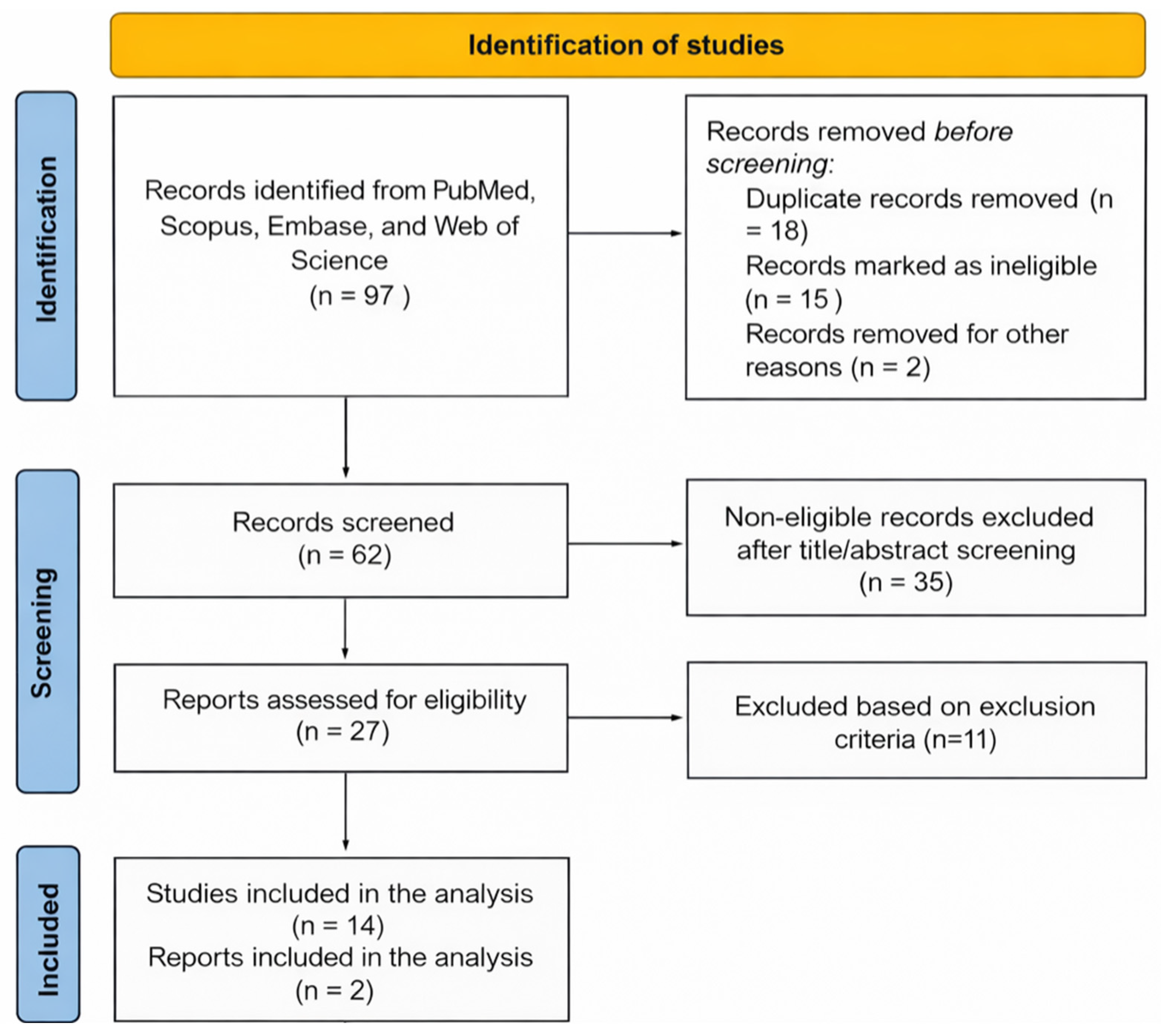

Occupational Radiation Risk Stratification and Protection in Fluoroscopy-Guided Surgeons and Interventionalists: A Multispecialty Structured Narrative Review

 , , , and
Abstract
1. Introduction
2. Materials and Methods
2.1. Article Selection
2.2. Data Extraction
2.3. Data Analysis
3. Results
3.1. Sample Characteristics
3.2. Radiation Exposure and Shielding Effectiveness
3.3. Cancer Incidence and Modeled Risk
3.4. Comparison Groups and Risk Ratios
3.5. Protection Protocols and Compliance
3.6. Innovative Methodologies
3.7. Summary Statistics
3.8. Key Trends and Insights
4. Discussion
4.1. Shielding Efficacy and Practice Patterns
4.2. Risk Estimation and Long-Term Health Outcomes
4.3. Implications for Practice and Future Research
4.4. Limitations
5. Conclusions
Author Contributions
Funding
Institutional Review Board Statement
Informed Consent Statement
Data Availability Statement
Conflicts of Interest
Abbreviations
| BEIR | Biological Effects of Ionizing Radiation |
| ALARA | As Low As Reasonably Achievable |
| LAR | Lifetime Attributable Risks |
| ICRP | International Commission on Radiological Protection |
References
- Smith-Bindman, R.; Chu, P.W.; Firdaus, H.A.; Stewart, C.; Malekhedayat, M.; Alber, S.; Bolch, W.E.; Mahendra, M.; de González, A.B.; Miglioretti, D.L. Projected Lifetime Cancer Risks from Current Computed Tomography Imaging. JAMA Intern. Med. 2025, 185, 710–719, Erratum in JAMA Intern Med. 2025, 185, 747. [Google Scholar] [CrossRef] [PubMed] [PubMed Central]
- El Ghissassi, F.; Baan, R.; Straif, K.; Grosse, Y.; Secretan, B.; Bouvard, V.; Benbrahim-Tallaa, L.; Guha, N.; Freeman, C.; Galichet, L.; et al. A review of human carcinogens--part D: Radiation. Lancet Oncol. 2009, 10, 751–752. [Google Scholar] [CrossRef]
- López, P.O.; Dauer, L.; Loose, R.; Martin, C.; Miller, D.; Vañó, E.; Doruff, M.; Padovani, R.; Massera, G.; Yoder, C. on behalf of the ICRP. ICRP Publication 139: Occupational radiological protection in interventional procedures. Ann. ICRP 2018, 47, 1–118. [Google Scholar] [CrossRef]
- Stewart, F.A.; Akleyev, A.V.; Hauer-Jensen, M.; Hendry, J.H.; Kleiman, N.J.; Macvittie, T.J.; Aleman, B.M.; Edgar, A.B.; Mabuchi, K.; Muirhead, C.R.; et al. ICRP publication 118: ICRP statement on tissue reactions and early and late effects of radiation in normal tissues and organs--threshold doses for tissue reactions in a radiation protection context. Ann. ICRP 2012, 41, 1–322. [Google Scholar] [CrossRef]
- Matityahu, A.; Duffy, R.K.; Goldhahn, S.; Joeris, A.; Richter, P.H.; Gebhard, F. The Great Unknown-A systematic literature review about risk associated with intraoperative imaging during orthopaedic surgeries. Injury 2017, 48, 1727–1734. [Google Scholar] [CrossRef] [PubMed]
- Hamid, M.A.; Younis, Z.; Raza, A.; Tauseef, A.; Khan, M.A.H.; Mir, S.; Abdulsattar, S.; Rashid, N. Radiation in the Orthopedic Operating Room: What We Know, What We Do, and What Needs Attention. Cureus 2025, 17, e90911. [Google Scholar] [CrossRef]
- Calgary Orthopaedic Resident Research Group. Quantification of Radiation Exposure in Canadian Orthopaedic Surgery Residents. JBJS Open Access 2024, 9, e23-00170. [Google Scholar] [CrossRef] [PubMed]
- National Research Council (US) Committee on Health Effects of Exposure to Low Levels of Ionizing Radiations (BEIR VII). Health Effects of Exposure to Low Levels of Ionizing Radiations: Time for Reassessment? National Academies Press: Washington, DC, USA, 1998. [Google Scholar] [PubMed]
- Aljohmani, L.; Gaffney, A.; Kelly, L.; O’Sullivan, L.-A.; Leyva, E.; O’Connor, M.; McCavana, J.; Heffernan, E.; Quinlan, C.; Dolan, R. Knowledge gaps and radiation exposure concerns: Time for a revamp of radiation training structures for trainee surgeons. Surgeon 2025, 23, 393–398. [Google Scholar] [CrossRef]
- Kang, S.; Cha, E.S.; Bang, Y.J.; Na, T.W.; Lee, D.; Song, S.Y.; Lee, W.J. Radiation exposure and fluoroscopically-guided interventional procedures among orthopedic surgeons in South Korea. J. Occup. Med. Toxicol. 2020, 15, 24. [Google Scholar] [CrossRef] [PubMed]
- Rivera, K.; Ahn, S.S. Radiation Physics and Safety in Fluoroscopy: A Clinician’s Guide to Principles and Practice. Cureus 2025, 17, e87245. [Google Scholar] [CrossRef]
- Sukhera, J. Narrative Reviews: Flexible, Rigorous, and Practical. J. Grad. Med. Educ. 2022, 14, 414–417. [Google Scholar] [CrossRef] [PubMed]
- Hayda, R.A.; Hsu, R.Y.; DePasse, J.M.; Gil, J.A. Radiation Exposure and Health Risks for Orthopaedic Surgeons. J. Am. Acad. Orthop. Surg. 2018, 26, 268–277. [Google Scholar] [CrossRef]
- Hurley, R.J.; McCabe, F.J.; Turley, L.; Maguire, D.; Lucey, J.; Hurson, C.J. Whole-body radiation exposure in Trauma and Orthopaedic surgery. Bone Jt. Open 2022, 3, 907–912. [Google Scholar] [CrossRef] [PubMed]
- Wan, R.C.W.; Chau, W.W.; Tso, C.Y.; Tang, N.; Chow, S.K.; Cheung, W.-H.; Wong, R.M. Occupational hazard of fluoroscopy: An invisible threat to orthopaedic surgeons. J. Orthop. Trauma. Rehabilit. 2021, 28, 22104917211035547. [Google Scholar] [CrossRef]
- Agarwal, A. Radiation Risk in Orthopedic Surgery: Ways to Protect Yourself and the Patient. Oper. Tech. Sports Med. 2011, 19, 220–223. [Google Scholar] [CrossRef]
- Massey, P.A.; Myers, M.E.; Guedry, R.D.; Lowery, M.T.; Perry, K.J.; Barton, R.S. Improved Radiation Exposure Monitoring of Orthopaedic Residents After Institution of a Personalized Lead Protocol. JBJS Open Access 2022, 7, e21. [Google Scholar] [CrossRef]
- Harstall, R.; Heini, P.F.; Mini, R.L.; Orler, R. Radiation exposure to the surgeon during fluoroscopically assisted percutaneous vertebroplasty: A prospective study. Spine 2005, 30, 1893–1898. [Google Scholar] [CrossRef]
- Dorey, S.; Gray, L.; Tootell, A.; Higgins, R.; Al-Islam, S.; Baxter, H.; Dixon, P.; Hogg, P. Radiation protection value to the operator from augmented reality smart glasses in interventional fluoroscopy procedures using phantoms. Radiography 2019, 25, 301–307. [Google Scholar] [CrossRef]
- Kastrati, M.; Langenbrink, L.; Piatkowski, M.; Michaelsen, J.; Reimann, D.; Hoffmann, R. Reducing Radiation Dose in Coronary Angiography and Angioplasty Using Image Noise Reduction Technology. Am. J. Cardiol. 2016, 118, 353–356. [Google Scholar] [CrossRef] [PubMed]
- Picano, E.; Vañó, E. Updated Estimates of Radiation Risk for Cancer and Cardiovascular Disease: Implications for Cardiology Practice. J. Clin. Med. 2024, 13, 2066. [Google Scholar] [CrossRef]
- Kim, J.B.; Lee, J.; Park, K. Radiation hazards to vascular surgeon and scrub nurse in mobile fluoroscopy equipped hybrid vascular room. Ann. Surg. Treat. Res. 2017, 92, 156–163. [Google Scholar] [CrossRef]
- Ho, P.; Cheng, S.W.K.; Wu, P.M.; Ting, A.C.; Poon, J.T.; Cheng, C.K.; Mok, J.H.; Tsang, M. Ionizing radiation absorption of vascular surgeons during endovascular procedures. J. Vasc. Surg. 2007, 46, 455–459. [Google Scholar] [CrossRef]
- Sritharan, K.; Sheikh, Z.; Saratzis, A.; Lakshminarayan, R.; Garnham, A.; Bowbrick, G.; Morgan, R. Standards of radiation protection amongst UK vascular surgeons: A clinician’s perspective. J. Vasc. Soc. Great Br. Irel. 2024, 4, 25–32. [Google Scholar] [CrossRef]
- Bhinder, J.; O’Brien-Irr, M.; Reilly, B.; Montross, B.; Khan, S.; Rivero, M.; Cherr, G.; Harris, L. Understanding Radiation Exposure and Improving Safety for Vascular Surgery Trainees. J. Vasc. Surg. 2023, 77, 269–278. [Google Scholar] [CrossRef] [PubMed]
- Kirkwood, M.L.; Guild, J.B.; Arbique, G.M.; Anderson, J.A.; Valentine, R.J.; Timaran, C. Surgeon radiation dose during complex endovascular procedures. J. Vasc. Surg. 2015, 62, 457–463. [Google Scholar] [CrossRef] [PubMed]
- Haqqani, O.P.; Agarwal, P.K.; Halin, N.M.; Iafrati, M.D. Minimizing radiation exposure to the vascular surgeon. J. Vasc. Surg. 2012, 55, 799–805. [Google Scholar] [CrossRef]
- Endovascular Today. Radiation Exposure, Effects, and Safety Measures for Vascular Operators (with Bijan Modarai, PhD, FRCS); Endovascular Today: Conshohocken, PA, USA, 2022. [Google Scholar]
- International Commission on Radiological Protection. Statement on Tissue Reactions; International Commission on Radiological Protection: Ottawa, ON, Canada, 2011. Available online: https://www.nrc.gov/docs/ML1326/ML13269A317.pdf (accessed on 5 January 2026).
- International Atomic Energy Agency. Radiation Protection and Safety of Radiation Sources: International Basic Safety Standards. IAEA Safety Standards Series No. GSR Part 3; International Atomic Energy Agency: Vienna, Austria, 2014; STI/PUB/1578; ISBN 978-92-0-135310-8. Available online: https://www-pub.iaea.org/MTCD/Publications/PDF/Pub1578_web-57265295.pdf (accessed on 5 January 2026).
- U.S. Nuclear Regulatory Commission. Standards for Protection Against Radiation. 10 CFR § 20.1201 Occupational Dose Limits for Adults. Electronic Code of Federal Regulations. Available online: https://unblock.federalregister.gov/ (accessed on 5 January 2026).
- Unberath, M.; Fotouhi, J.; Hajek, J.; Maier, A.; Osgood, G.; Taylor, R.; Armand, M.; Navab, N. Augmented reality-based feedback for technician-in-the-loop C-arm repositioning. Health Technol. Lett. 2018, 5, 143–147. [Google Scholar] [CrossRef]
- Modlińska, S.; Rojek, M.; Bielówka, M.; Kufel, J. Establishing Local Diagnostic Reference Levels for Head Computed Tomography Examinations. Biomedicines 2024, 12, 2446. [Google Scholar] [CrossRef]


| Inclusion Criteria | |
|---|---|
| 1. Topic Relevance | Addressed occupational radiation exposure, operator safety, or the effectiveness of protective measures (e.g., lead aprons, thyroid collars, lead glasses, leg shields, table skirts, ceiling-mounted barriers) during fluoroscopy-guided procedures. |
| 2. Specialty Scope | Included any surgical or interventional specialty using fluoroscopy, such as orthopedics, trauma surgery, interventional cardiology, interventional radiology, vascular surgery, or cardiothoracic surgery. |
| 3. Outcome Measures | Reported quantitative data on measured or modeled operator radiation dose, shielding-related dose reductions, procedural factors influencing exposure, or compliance with safety protocols. |
| 4. Study Types | Peer-reviewed primary research (prospective, retrospective, or experimental), cohort studies, phantom or cadaver simulations, and high-quality narrative reviews with quantitative findings. |
| 5. Language | English |
| 6. Publication Time Frame | January 2000 to March 2024, ensuring relevance to modern imaging systems and protective technologies. |
| |
| |
| |
| |
| Author, Year Published | Study Type | Specialty | Summary Results | Reference |
|---|---|---|---|---|
| Hayda et al., 2018 | Review article | Orthopaedic surgery—trauma, spine, general ortho; also referenced interventional cardiology, radiology for comparison | This article discusses the health risks associated with radiation exposure in orthopedic surgery, emphasizing the importance of protective measures to mitigate cancer risks. While focused on orthopedic surgeons, the findings are relevant to other surgical specialties that utilize fluoroscopy. | [13] |
| Kim et al., 2017 | Prospective measurement study | Vascular surgery | Although yearly radiation hazards for vascular surgeons and scrub nurses are still within safety guidelines, protection principles can never be too stringent when aiming to minimize the cumulative harmful effects. | [22] |
| Hurley et al., 2022 | Prospective observational study | Trauma and Orthopaedic surgery | PPE currently used by surgeons in orthopaedic trauma theatre adequately reduces radiation exposure to below recommended levels. Normative data per trauma case show specific an- atomical areas of higher exposure, which may benefit from enhanced radiation protection. EPDs can be used to assess real-time radiation exposure in orthopaedic surgery. | [14] |
| Wan et al., 2021 | Narrative review | Orthopedic surgery—trauma, spine, foot and ankle, sports medicine, general orthopedics | Fluoroscopy brings radiation hazard to the physicians and other staffs in operating theatre. Risk of leukaemia, risk to eyes, thyroid, skin, breast and fetes cannot be underestimated. Physician should properly use protective equipment including lead aprons, thyroid shields, radiation protection goggles and gloves, and dosimeter, to protect one-self from the invisible radiation hazard. The medical field should observe principles of justification and optimization, to reduce the radiation hazard to ALARA. Proper understanding of radiation risk will encourage doctors to use proper protection gear, and to clear unnecessary worries. Formal training on radiation safety and safe fluoroscopy use should also be encouraged and adopted. | [15] |
| Peri Ho et al., 2007 | Prospective observational study | Vascular surgery—endovascular procedures | With current radiation protection practice, the radiation absorbed by vascular surgeons with a high endovascular workload did not exceed the safety limits recommended by ICRP. Variations in practice, however, can result in significant discrepancy of radiation absorption between surgeons. | [23] |
| Agarwal 2011 | Narrative review | Orthopedic surgery—general, trauma, spine, foot and ankle | Orthopedic surgeons should use protective measures, which include lead aprons, thyroid shields, and, if at all possible, lead goggles. Techniques described to minimize direct and scatter exposure to the hands, eyes, and neck should be used. Measures to protect the patient should also be used intraoperatively, if feasible, such as shielding of the gonads. This is even more important as the awareness of patient radiation exposure increases. | [16] |
| Sritharan et al., 2024 | Cross-sectional online survey | Vascular surgery | This survey highlights significant and concerning deficiencies in knowledge, access to personal radiation protection and failures in monitoring individual exposure to ionising radiation amongst the UK vascular surgical workforce. | [24] |
| Massey et al., 2022 | Retrospective case-control study | Orthopedic surgery—general, trauma, C-arm fluoroscopy-assisted procedures | Institution of a PLP increased the compliance and exposure readings of radiation dosimeter badges for orthopedic surgery residents, whereas the actual monthly fluoroscopy time did not change. Teaching hospitals should consider implementing a PLP to more accurately monitor exposure. | [17] |
| Bhinder et al., 2023 | Prospective quality improvement study | Vascular surgery—endovascular, hybrid OR, angiography | Safety policies in place at vascular residency and fellowship programs were inadequate in securing the safety of their trainees. Interventions such as inventorying and ensuring availability of safety equipment, hands-on instruction to complement traditional didactics, lowering the default frame rates, and converting to real-time dosimetry to be effective measures for reducing radiation exposure. | [25] |
| Kirkwood et al., 2015 | Prospective observational study | Vascular surgery—complex endovascular interventions | Surgeon radiation dose during FGIs depends on case type, operator position, and table skirt use but not on the level of fellow training. On the basis of these data, the primary operator could perform approximately 12 FEVARs/wk and have an annual dose <10 mSv, which would not exceed lifetime occupational dose limits during a 35-year career. With practical case loads, operator doses are relatively low and unlikely to exceed occupational limits. | [26] |
| Harstall et al., 2005 | Prospective case-control study | Orthopaedic spine surgery | While performing percutaneous vertebroplasty, the surgeon is exposed to a significant amount of radiation. Proper surgical technique and shielding devices to decrease potentially high morbidity are mandatory. Training in radiation protection should be an integral part of the education for all surgeons using minimally invasive radiologic-guided interventional techniques. | [18] |
| Haqqani et al., 2012 | Prospective controlled study | Vascular surgery—endovascular procedures, digital subtraction angiography | Varying imaging techniques results in different radiation exposure to members of an endovascular surgery team. Knowledge of the variable intensity of radiation exposure may allow modification of the technique to minimize radiation exposure to the team while providing suitable imaging. | [27] |
| Dorey et al., 2019 | Controlled laboratory experiment | Interventional radiology | If the clinician’s gaze is directed towards the main scattering source, a potential exists for reducing eye lens dose compared with fixed location computer monitors. Introduction of lead lined smart glasses into interventional radiology may lead to improvements in patient care, reducing the need for the clinician to look away from the patient to observe a radiographic image. | [19] |
| Kastrati et al., 2016 | Retrospective Observational Study | Cardiology—coronary angiography and angioplasty | A new x-ray technology with image noise reduction algorithm provides a substantial reduction in radiation exposure without the need to prolong the procedure or fluoroscopy time. | [20] |
| Modarai 2022 | Expert commentary | Vascular surgery—endovascular procedures | Vascular operators are at significant occupational risk from cumulative ionizing radiation exposure, with potential long-term health consequences. Consistent use of protective equipment, adherence to radiation-minimizing techniques, and increased awareness and education are essential to reduce exposure and improve operator safety. | [28] |
| Picano et al., 2024 | Comprehensive review | Cardiology—diagnostic and interventional radiology, nuclear cardiology, electrophysiology | Review updates estimated societal health burden from diagnostic radiology and nuclear medicine, showing that rising population radiation exposure is associated with higher-than-previously-recognized risks of both cancer and cardiovascular disease. Emerging epidemiological evidence refutes the assumption that low-dose radiation is biologically negligible, and combined cancer and cardiovascular risks are now understood to impose a substantially greater public health impact than earlier estimates suggested. | [21] |
| Metric | Mean | Median | Range | Std. Dev. |
|---|---|---|---|---|
| Sample Size (where reported) | ~4200 | ~1200 | 60–120,000 | High spread |
| Chest-level dose (mSv/procedure) | ~0.10 | 0.09 | 0.08–0.11 | 0.01 |
| Eye-level dose (mSv/procedure, no lead) | ~0.05 | 0.045 | 0.04–0.07 | 0.01 |
| Gonadal dose (mSv/year, busy trauma surgeons) | ~2.7 | 2.5 | 2.4–3.8 | 0.5 |
| Estimated risk ratios (solid cancer, per Sv) | 1.6 | 1.6 | 1.5–1.7 | 0.1 |
Disclaimer/Publisher’s Note: The statements, opinions and data contained in all publications are solely those of the individual author(s) and contributor(s) and not of MDPI and/or the editor(s). MDPI and/or the editor(s) disclaim responsibility for any injury to people or property resulting from any ideas, methods, instructions or products referred to in the content. |
© 2026 by the authors. Licensee MDPI, Basel, Switzerland. This article is an open access article distributed under the terms and conditions of the Creative Commons Attribution (CC BY) license.
Share and Cite
Okraku-Yirenkyi, N.K.; Bonthu, S.S.R.; Bhakta, H.; Duyile, O.O.; Bernas, M. Occupational Radiation Risk Stratification and Protection in Fluoroscopy-Guided Surgeons and Interventionalists: A Multispecialty Structured Narrative Review. J. Pers. Med. 2026, 16, 50. https://doi.org/10.3390/jpm16010050
Okraku-Yirenkyi NK, Bonthu SSR, Bhakta H, Duyile OO, Bernas M. Occupational Radiation Risk Stratification and Protection in Fluoroscopy-Guided Surgeons and Interventionalists: A Multispecialty Structured Narrative Review. Journal of Personalized Medicine. 2026; 16(1):50. https://doi.org/10.3390/jpm16010050
Chicago/Turabian StyleOkraku-Yirenkyi, Nana Kwadwo, Sri Snehita Reddy Bonthu, Hanisha Bhakta, Oluwatoyin O. Duyile, and Michael Bernas. 2026. "Occupational Radiation Risk Stratification and Protection in Fluoroscopy-Guided Surgeons and Interventionalists: A Multispecialty Structured Narrative Review" Journal of Personalized Medicine 16, no. 1: 50. https://doi.org/10.3390/jpm16010050
APA StyleOkraku-Yirenkyi, N. K., Bonthu, S. S. R., Bhakta, H., Duyile, O. O., & Bernas, M. (2026). Occupational Radiation Risk Stratification and Protection in Fluoroscopy-Guided Surgeons and Interventionalists: A Multispecialty Structured Narrative Review. Journal of Personalized Medicine, 16(1), 50. https://doi.org/10.3390/jpm16010050