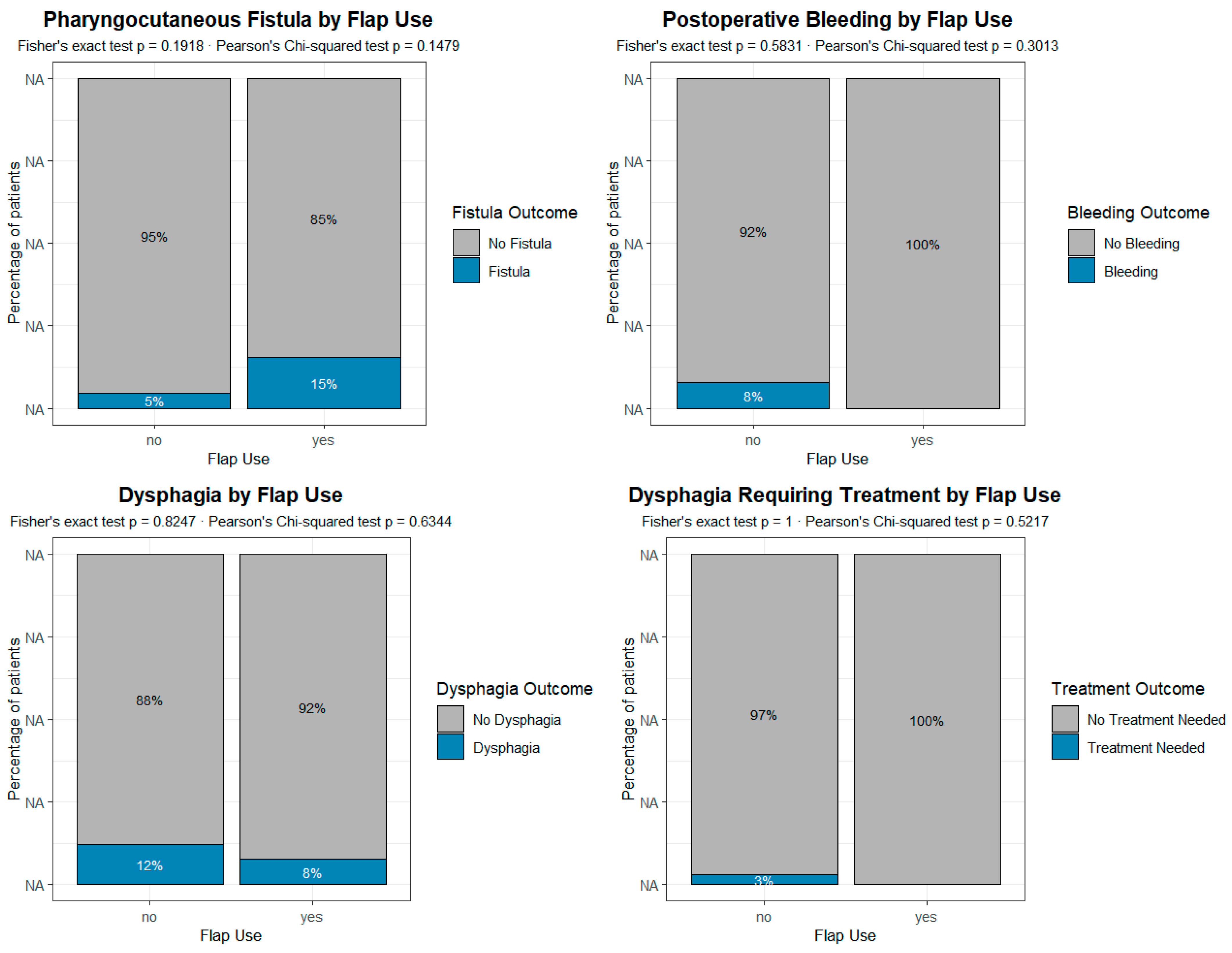
Correction: Degni et al. Safety of Primary Tracheoesophageal Puncture in Patients Submitted to Enlarged Total Laryngectomy with Pectoralis Major Reconstruction. J. Pers. Med. 2025, 15, 435

 , , , , , , and
 Figure Legend

Error in Table
- Pharyngocutaneous Fistula, n (%): The percentage reported for “Yes” has been corrected from “3.0%” to “6.0%”; (%): the percentage reported for “No” has been corrected from “94.1%” to “94.0%”.
- Relapse, n (%): The percentage reported for relapse cases was based on a preliminary version of the dataset and did not reflect the final validated data used for the statistical analyses. This discrepancy was also evident in the subsequent section, “Pattern of Relapse, n (%)”, where the total number of relapse cases did not match the value shown in the table. Specifically, the number and percentage of “Yes” has been corrected from “11 (11.1%)” to “6 (6.0%)”; the number and percentage of “No” has been corrected from “88 (88.9%)” to “95 (94.0%)”.
- pStage, n (%): The percentages reported for stages II, III, IVA, and IVB were incorrectly calculated in the published version. Specifically, the percentage of stage II has been corrected from “13.87%” to “14.0%”; the percentage of stage III has been corrected from “28.7%” to “29.0%”; the percentage of stage IVA has been corrected from “39.6%” to “39.0%”; the percentage of stage IVB has been corrected from “13.9%” to “14.0%”.

| Descriptive Item | Summary |
|---|---|
| Demographics | |
| Age at TL (years), Mean ± SD | 67.6 ± 9.6 |
| Age at TL, Median (Range) | 67 (47–86) |
| Sex, n (%) | |
| Male | 87 (86.1%) |
| Female | 14 (13.9%) |
| Clinical History | |
| Alcohol Use, n (%) | |
| Current | 53 (52.5%) |
| Former | 15 (14.9%) |
| Never | 23 (22.8%) |
| Unknown | 10 (9.9%) |
| Smoking Status, n (%) | |
| Current | 46 (45.5%) |
| Former | 46 (45.5%) |
| Never | 3 (3.0%) |
| Unknown | 6 (6.0%) |
| Primary Total Laryngectomy, n (%) | 91 (90.0%) |
| Salvage Laryngectomy, n (%) | 10 (10.0%) |
| Non-Surgical Organ Preservation | 7 (7.0%) |
| Surgical Organ Preservation | 3 (3.0%) |
| Tumor Characteristics | |
| Site of Primary Tumor, n (%) | |
| Glottic Larynx | 46 (45.5%) |
| Supraglottic Larynx | 39 (38.6%) |
| Hypopharynx | 12 (11.9%) |
| Subglottic Larynx | 4 (4.0%) |
| pTN Staging, n (%) | |
| pT1b | 4 (4.0%) |
| pT2 | 21 (20.8%) |
| pT3 | 35 (34.6%) |
| pT4a | 41 (40.6%) |
| pN0 | 59 (58.4%) |
| pN1 | 15 (14.9%) |
| pN2a | 1 (1.0%) |
| pN2b | 6 (5.9%) |
| pN2c | 6 (5.9%) |
| pN3b | 14 (13.9%) |
| Margins, n (%) | |
| R0 | 92 (91.1%) |
| R1 | 6 (5.9%) |
| Close | 3 (3.0%) |
| pStage, n (%) | |
| I | 3 (3.0%) |
| II | 14 (14.0%) |
| III | 29 (29.0%) |
| IVA | 40 (39.0%) |
| IVB | 14 (14.0%) |
| IVC | 1 (1.0%) |
| Surgery | |
| Enlarged Laryngectomy, n (%) | |
| Hypopharynx | 17 (16.9%) |
| Base of Tongue | 4 (3.9%) |
| Skin | 1 (1.0%) |
| Trachea | 1 (1.0%) |
| No | 78 (77.2%) |
| Closure, n (%) | |
| Pectoralis Major | 17 (16.8%) |
| Primary Closure | 84 (83.2%) |
| Pectoralis Flap Variant, n (%) | |
| Myocutaneous | 7 (6.9%) |
| Myofascial | 10 (9.9%) |
| Voice Prosthesis, n (%) | |
| Yes | 78 (77.2%) |
| No | 23 (22.8%) |
| Neck Dissection, n (%) | |
| Yes | 100 (99.0%) |
| No | 1 (1.0%) |
| Adjuvant treatment, n (%) | |
| Radiochemotherapy | 40 (39.6%) |
| Radiotherapy | 15 (14.9%) |
| No Adjuvant | 46 (45.5%) |
| Postoperative Complications and Sequelae | |
| Pharyngocutaneous Fistula, n (%) | |
| Yes | 6 (6.0%) |
| No | 95 (94.0%) |
| Postoperative Bleeding, n (%) | |
| Yes | 5 (5.0%) |
| No | 96 (95.0%) |
| Dysphagia, n (%) | |
| Yes | 11 (10.9%) |
| No | 90 (89.1%) |
| Dysphagia Needing Treatment, n (%) | |
| Yes | 2 (2.0%) |
| No | 99 (98.0%) |
| Outcomes | |
| Follow-up (months) | Mean ± SD: 44.6 ± 3.2; Median: 41 (4–93) |
| Overall Survival (5-year OS) | 36.6% |
| Alive | 65 (64.4%) |
| Deceased | 36 (35.6%) |
| Disease-Specific Survival (5-year DSS) | 83.9% |
| Relapse-Free Survival (5-year RFS) | 90.8% |
| Relapse, n (%) | |
| Yes | 6 (6.0%) |
| No | 95 (94.0%) |
| Pattern of Relapse, n (%) | |
| Locoregional | 2 (2.0%) |
| Locoregional and Distant | 1 (1.0%) |
| Regional | 3 (3.0%) |
| No Relapse | 95 (94.0%) |
| Second Primary Tumor (SPT), n (%) | |
| Yes | 19 (18.8%) |
| No | 82 (81.2%) |
Reference
- Degni, E.; Lai, S.; Ciccarelli, C.C.; Yesilli Puzella, G.; Crescio, C.; Tropiano, P.; Fois, V.; Parrilla, C.; Galli, J.; Bussu, F. Safety of Primary Tracheoesophageal Puncture in Patients Submitted to Enlarged Total Laryngectomy with Pectoralis Major Reconstruction. J. Pers. Med. 2025, 15, 435. [Google Scholar] [CrossRef] [PubMed]
Disclaimer/Publisher’s Note: The statements, opinions and data contained in all publications are solely those of the individual author(s) and contributor(s) and not of MDPI and/or the editor(s). MDPI and/or the editor(s) disclaim responsibility for any injury to people or property resulting from any ideas, methods, instructions or products referred to in the content. |
© 2025 by the authors. Licensee MDPI, Basel, Switzerland. This article is an open access article distributed under the terms and conditions of the Creative Commons Attribution (CC BY) license (https://creativecommons.org/licenses/by/4.0/).
Share and Cite
Degni, E.; Lai, S.; Ciccarelli, C.C.; Yesilli Puzella, G.; Crescio, C.; Tropiano, P.; Fois, V.; Parrilla, C.; Galli, J.; Bussu, F. Correction: Degni et al. Safety of Primary Tracheoesophageal Puncture in Patients Submitted to Enlarged Total Laryngectomy with Pectoralis Major Reconstruction. J. Pers. Med. 2025, 15, 435. J. Pers. Med. 2025, 15, 627. https://doi.org/10.3390/jpm15120627
Degni E, Lai S, Ciccarelli CC, Yesilli Puzella G, Crescio C, Tropiano P, Fois V, Parrilla C, Galli J, Bussu F. Correction: Degni et al. Safety of Primary Tracheoesophageal Puncture in Patients Submitted to Enlarged Total Laryngectomy with Pectoralis Major Reconstruction. J. Pers. Med. 2025, 15, 435. Journal of Personalized Medicine. 2025; 15(12):627. https://doi.org/10.3390/jpm15120627
Chicago/Turabian StyleDegni, Emilia, Sebastiana Lai, Carlo Camillo Ciccarelli, Gamze Yesilli Puzella, Claudia Crescio, Paolo Tropiano, Valeria Fois, Claudio Parrilla, Jacopo Galli, and Francesco Bussu. 2025. "Correction: Degni et al. Safety of Primary Tracheoesophageal Puncture in Patients Submitted to Enlarged Total Laryngectomy with Pectoralis Major Reconstruction. J. Pers. Med. 2025, 15, 435" Journal of Personalized Medicine 15, no. 12: 627. https://doi.org/10.3390/jpm15120627
APA StyleDegni, E., Lai, S., Ciccarelli, C. C., Yesilli Puzella, G., Crescio, C., Tropiano, P., Fois, V., Parrilla, C., Galli, J., & Bussu, F. (2025). Correction: Degni et al. Safety of Primary Tracheoesophageal Puncture in Patients Submitted to Enlarged Total Laryngectomy with Pectoralis Major Reconstruction. J. Pers. Med. 2025, 15, 435. Journal of Personalized Medicine, 15(12), 627. https://doi.org/10.3390/jpm15120627