
Article

A Longitudinal Study Investigating Whether Chronic Rhinosinusitis Influences the Subsequent Risk of Developing Dementia

1
Department of Data Science and Data Science Convergence Research Center, Hallym University, Chuncheon 24252, Republic of Korea
2
Department of Physiology, Neurology, Hallym University, Chuncheon 24252, Republic of Korea
3
Department of Otorhinolaryngology-Head and Neck Surgery, Chuncheon Sacred Heart Hospital, Hallym University College of Medicine, Chuncheon 24252, Republic of Korea
4
Institute of New Frontier Research, Division of Big Data and Artificial Intelligence, Chuncheon Sacred Heart Hospital, Hallym University College of Medicine, Chuncheon 24252, Republic of Korea
*
Author to whom correspondence should be addressed.
J. Pers. Med. 2024, 14(11), 1081; https://doi.org/10.3390/jpm14111081
Submission received: 20 September 2024 / Revised: 11 October 2024 / Accepted: 20 October 2024 / Published: 30 October 2024
(This article belongs to the Section Epidemiology)

Abstract

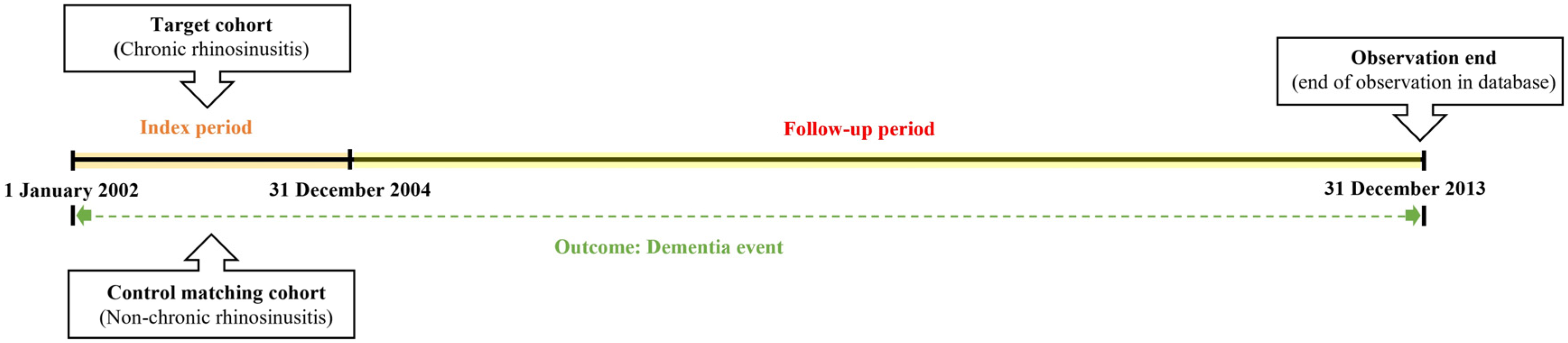
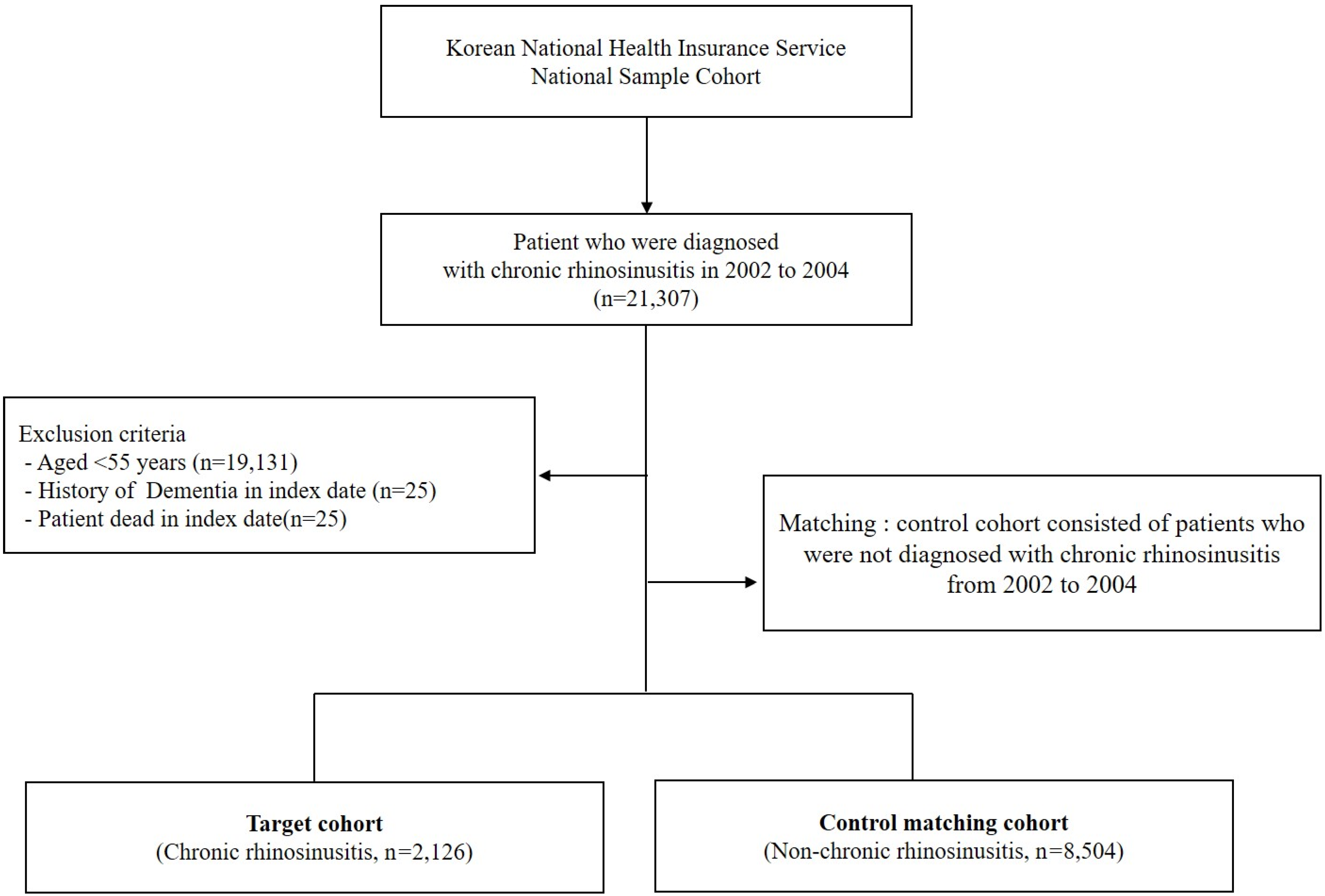
Background/Objectives: Numerous studies have explored the association between chronic rhinosinusitis (CRS) and cognitive decline. However, whether CRS is an independent risk factor for the development of dementia remains unclear. Thus, this retrospective cohort study sought to examine the potential association between CRS and increased incidence and risk of dementia by utilizing a representative population-based cohort dataset. Methods: In this study, we identified 2126 patients with CRS aged >55 years and matched them with 8504 controls to assess the incidence and risk of dementia. Results: We found that the incidence of all-cause dementia in CRS patients was 0.125 per 1000 person-years. The risk of developing all-cause dementia events (adjusted hazard ratio [HR] = 1.0, 95% confidence interval = 0.8–1.3) also did not differ significantly between the control group and the CRS group, irrespective of the CRS phenotype. Subgroup analysis also showed no increased adjusted HR for developing Alzheimer’s disease (0.9, 0.7–1.2), Parkinson’s disease (0.9, 0.5–1.4), and other types of dementia (1.0, 0.7–1.4) in the CRS group compared to the control group. Conclusions: Therefore, the present study demonstrated that patients over 55 years of age with CRS did not exhibit an increased incidence or risk of dementia compared to individuals without CRS.
Keywords: rhinosinusitis; dementia; incidence; risk; cohort study rhinosinusitis; dementia; incidence; risk; cohort study