
Aortic Risks Prediction Models after Cardiac Surgeries Using Integrated Data

Abstract
1. Introduction
2. Materials and Methods
3. Results
4. Discussion
5. Conclusions
Author Contributions
Funding
Institutional Review Board Statement
Informed Consent Statement
Data Availability Statement
Acknowledgments
Conflicts of Interest
Appendix A
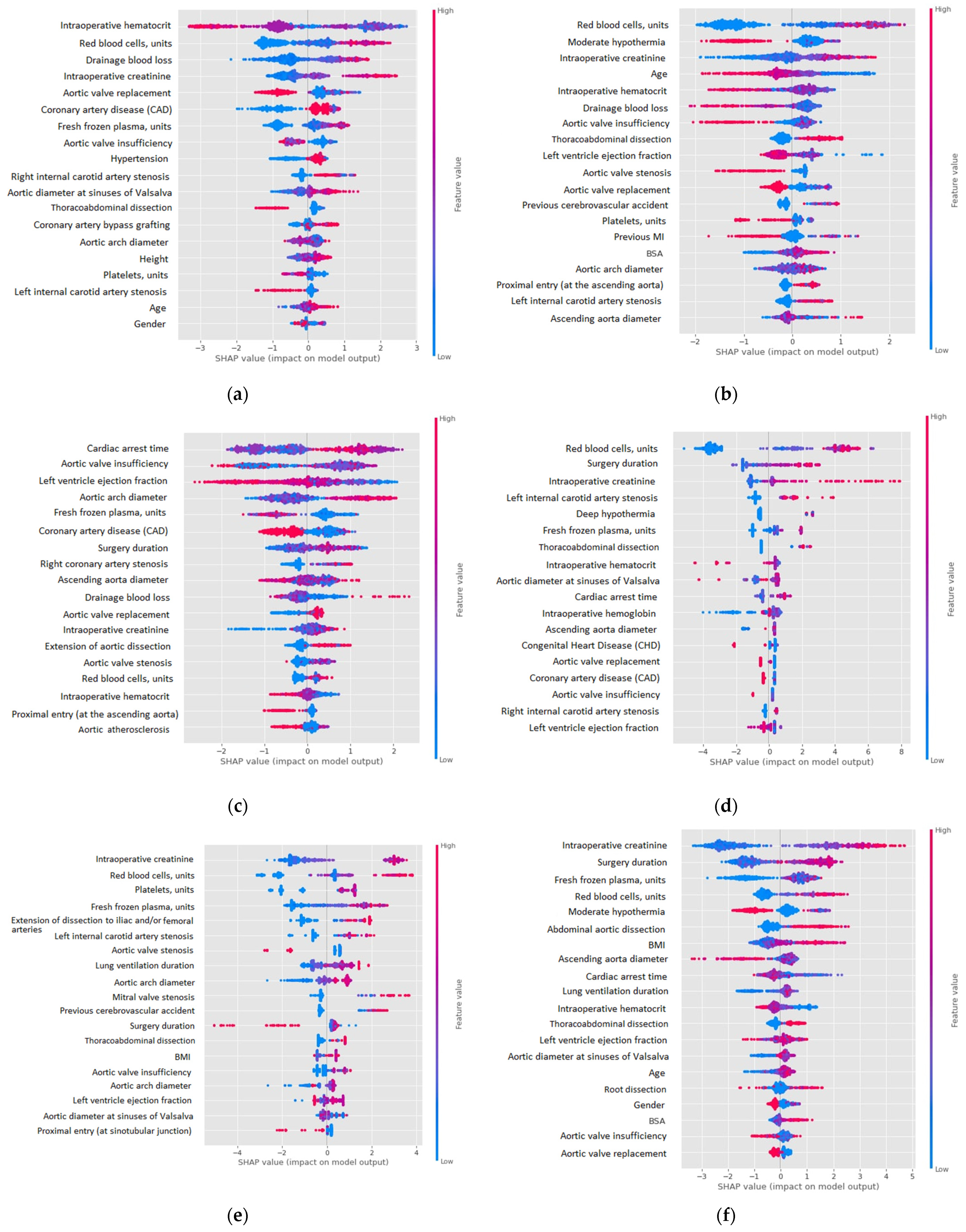
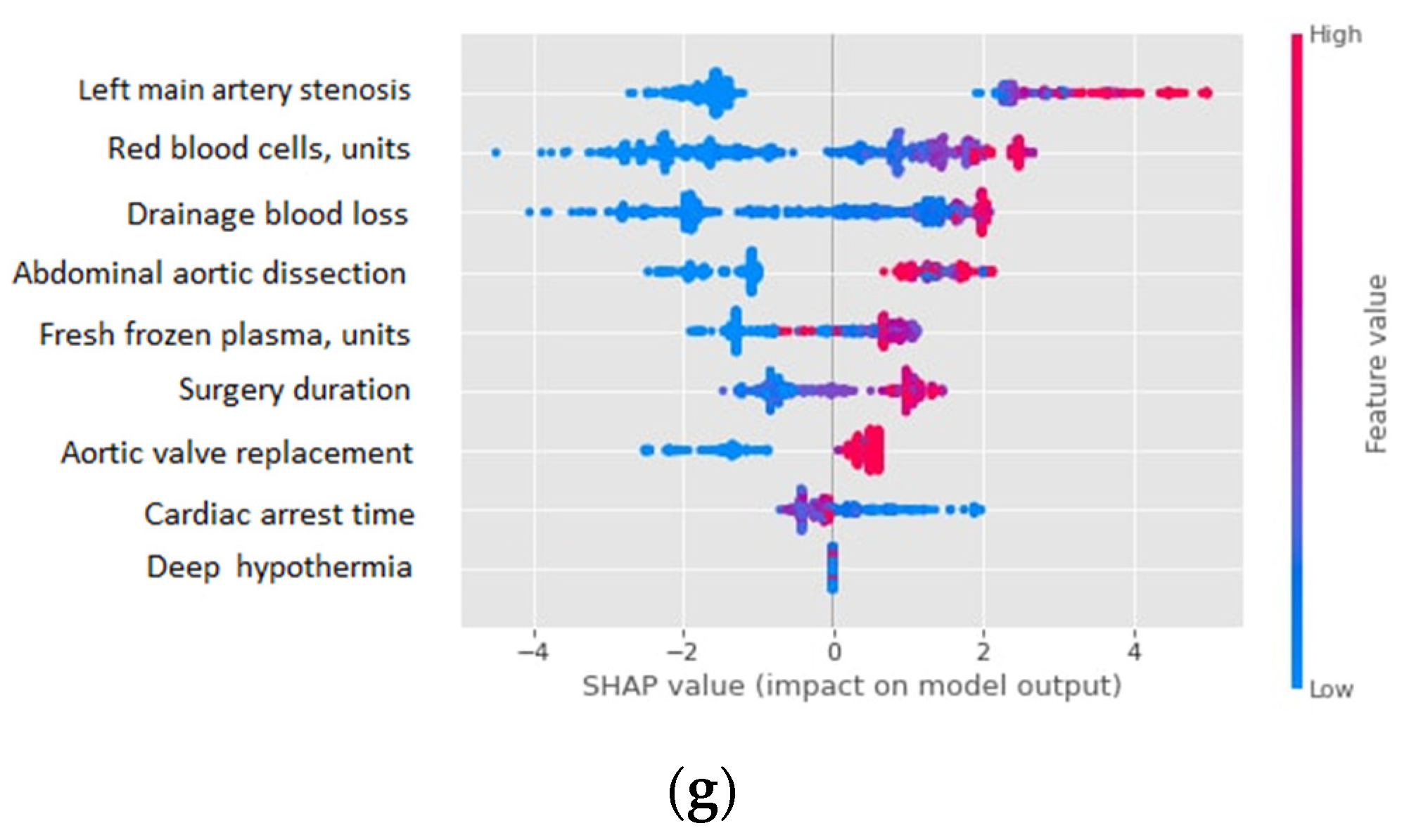
- In-hospital mortality;
- Temporary neurological deficit (TND);
- Permanent neurological deficit (PND);
- Prolonged lung ventilation (LV) (>7 days);
- Renal replacement therapy (RRT);
- Myocardial infarction (MI);
- Multiple organ failure (MOF).
- Gender;
- Age;
- Height;
- Weight;
- Body mass index (BMI);
- Body surface area (BSA).
- Congenital heart disease (CHD);
- Hypertension;
- Coronary artery disease (CAD);
- Previous MI;
- Previous cerebrovascular accident;
- Chronic obstructive pulmonary disease (COPD);
- Marfan syndrome;
- Aortic atherosclerosis.
- Preoperative hematocrit;
- Preoperative urea;
- Preoperative creatinine;
- Preoperative glomerular filtration rate (GFR).
- Left main artery stenosis (LMA);
- Right coronary artery stenosis (RCA);
- Obtuse margin artery stenosis (OMA);
- Left anterior descending artery (LAD).
- Left internal carotid artery stenosis;
- Right internal carotid artery stenosis;
- Left ventricle ejection fraction;
- Aortic valve stenosis;
- Aortic valve insufficiency;
- Mitral valve stenosis;
- Mitral valve insufficiency;
- Aortic diameter at sinuses of Valsalva.
- Ascending aorta diameter;
- Aortic arch diameter;
- Segment A diameter = proximal descending aortic diameter;
- Segment B diameter = distal descending aortic diameter;
- Segment C diameter = abdominal aortic diameter;
- Proximal entry (at sinotubular junction);
- Proximal entry (at the ascending aorta);
- Proximal entry (at the aortic arch);
- Proximal entry behind the left subclavian artery = type B aortic dissection;
- Involvement aortic root in dissection;
- Involvement ascending aortic in dissection;
- Involvement aortic arch in dissection;
- Thoracoabdominal dissection;
- Abdominal aortic dissection;
- Extension of aortic dissection down to iliac and/or femoral arteries.
- Cardiac arrest time;
- Antegrade cerebral perfusion time;
- Circulatory arrest time;
- Deep hypothermia;
- Moderate hypothermia;
- Re-sternotomy for bleeding;
- Surgery duration;
- Red blood cells, units;
- Fresh frozen plasma, units;
- Platelets, units;
- Drainage blood loss;
- Intraoperative hematocrit.
- Intraoperative creatinine.
- Coronary artery bypass grafting;
- Aortic valve replacement;
- Mitral valve replacement.
References
- Saeyeldin, A.A.; Velasquez, C.A.; Mahmood, S.U.B.; Brownstein, A.J.; Zafar, M.A.; Ziganshin, B.A.; Elefteriades, J.A. Thoracic aortic aneurysm: Unlocking the “silent killer” secrets. Gen. Thorac. Cardiovasc. Surg. 2019, 67, 1–11. [Google Scholar] [CrossRef] [Scilit] [PubMed]
- Orandi, B.J.; Dimick, J.B.; Deeb, G.M.; Patel, H.J.; Upchurch, G.R. A population-based analysis of endovascular versus open thoracic aortic aneurysm repair. J. Vasc. Surg. 2009, 49, 1112–1116. [Google Scholar] [CrossRef] [Scilit] [PubMed]
- Czerny, M.; Siepe, M.; Beyersdorf, F.; Feisst, M.; Gabel, M.; Pilz, M.; Pöling, J.; Dohle, D.S.; Sarvanakis, K.; Luehr, M.; et al. Prediction of mortality rate in acute type A dissection: The German Registry for Acute Type A Aortic Dissection score. Eur. J. Cardiothorac. Surg. 2020, 58, 700–706. [Google Scholar] [CrossRef] [Scilit] [PubMed]
- Wagner, M.A.; Wang, H.; Benrashid, E.; Keenan, J.E.; Ganapathi, A.M.; Englum, B.R.; Hughes, G.C. Risk Prediction Model for Major Adverse Outcome in Proximal Thoracic Aortic Surgery. Ann. Thorac. Surg. 2019, 107, 795–801. [Google Scholar] [CrossRef] [Scilit] [PubMed]
- Weng, S.F.; Reps, J.; Kai, J.; Garibaldi, J.M.; Qureshi, N. Can Machine-learning improve cardiovascular risk prediction using routine clinical data? PLoS ONE 2017, 12, e0174944. [Google Scholar] [CrossRef] [Scilit]
- Lareyre, F.; Adam, C.; Carrier, M.; Raffort, J. Prediction of Abdominal Aortic Aneurysm Growth and Risk of Rupture in the Era of Machine Learning. Angiology 2020, 71, 767. [Google Scholar] [CrossRef] [Scilit]
- Hirata, K.; Nakaura, T.; Nakagawa, M.; Kidoh, M.; Oda, S.; Utsunomiya, D.; Yamashita, Y. Machine Learning to Predict the Rapid Growth of Small Abdominal Aortic Aneurysm. J. Comput. Assist. Tomogr. 2020, 44, 37–42. [Google Scholar] [CrossRef] [Scilit]
- Lee, R.; Jarchi, D.; Perera, R.; Jones, A.; Cassimjee, I.; Handa, A.; Clifton, D.A.; Bellamkonda, K.; Woodgate, F.; Killough, N.; et al. Applied Machine Learning for the Prediction of Growth of Abdominal Aortic Aneurysm in Humans. EJVES Short Rep. 2018, 39, 24–28. [Google Scholar] [CrossRef] [Scilit]
- Estrera, A.L.; Miller, C.C.; Lee, T.Y.; Shah, P.; Safi, H.J. Ascending and transverse aortic arch repair: The impact of retrograde cerebral perfusion. Circulation 2008, 118, S160–S166. [Google Scholar] [CrossRef] [Scilit]
- Ghincea, C.V.; Reece, T.B.; Eldeiry, M.; Roda, G.F.; Bronsert, M.R.; Jarrett, M.J.; Pal, J.D.; Cleveland, J.C.; Fullerton, D.A.; Aftab, M. Predictors of Acute Kidney Injury Following Aortic Arch Surgery. J. Surg. Res. 2019, 242, 40–46. [Google Scholar] [CrossRef] [Scilit]
- Wang, X.; Yang, F.; Zhu, J.; Liu, Y.; Sun, L.; Hou, X. Aortic arch surgery with hypothermic circulatory arrest and unilateral antegrade cerebral perfusion: Perioperative outcomes. J. Thorac. Cardiovasc. Surg. 2020, 159, 374–387.e4. [Google Scholar] [CrossRef] [Scilit] [PubMed]
- Lee, H.; Yoon, H.; Nam, K.; Cho, Y.; Kim, T.; Kim, W.; Bahk, J. Derivation and Validation of Machine Learning Approaches to Predict Acute Kidney Injury after Cardiac Surgery. J. Clin. Med. 2018, 7, 322. [Google Scholar] [CrossRef] [Scilit] [PubMed]
- Zhong, Z.; Yuan, X.; Liu, S.; Yang, Y.; Liu, F.F. Machine learning prediction models for prognosis of critically ill patients after open-heart surgery. Sci. Rep. 2021, 11, 3384. [Google Scholar] [CrossRef] [Scilit] [PubMed]
- Allyn, J.; Allou, N.; Augustin, P.; Philip, I.; Martinet, O.; Belghiti, M.; Provenchere, S.; Montravers, P.; Ferdynus, C. A comparison of a machine learning model with EuroSCORE II in predicting mortality after elective cardiac surgery: A decision curve analysis. PLoS ONE 2017, 12, e169772. [Google Scholar] [CrossRef] [Scilit] [PubMed]
- Fernandes, M.P.B.; Armengol de la Hoz, M.; Rangasamy, V.; Subramaniam, B. Machine Learning Models with Preoperative Risk Factors and Intraoperative Hypotension Parameters Predict Mortality After Cardiac Surgery. J. Cardiothorac. Vasc. Anesth. 2021, 35, 857–865. [Google Scholar] [CrossRef] [Scilit] [PubMed]
- Coulson, T.; Bailey, M.; Pilcher, D.; Reid, C.M.; Seevanayagam, S.; Williams-Spence, J.; Bellomo, R. Predicting Acute Kidney Injury After Cardiac Surgery Using a Simpler Model. J. Cardiothorac. Vasc. Anesth. 2021, 35, 866–873. [Google Scholar] [CrossRef] [Scilit]
- Hanley, J.A.; McNeil, B.J. The meaning and use of the area under a receiver operating characteristic (ROC) curve. Radiology 1982, 143, 29–36. [Google Scholar] [CrossRef] [Scilit]
- Pedregosa Fabianpedregosa, F.; Michel, V.; Grisel Oliviergrisel, O.; Blondel, M.; Prettenhofer, P.; Weiss, R.; Vanderplas, J.; Cournapeau, D.; Pedregosa, F.; Varoquaux, G.; et al. Scikit-learn: Machine Learning in Python. J. Mach. Learn. Res. 2011, 12, 2825–2830. [Google Scholar]
- Prokhorenkova, L.; Gusev, G.; Vorobev, A.; Dorogush, A.V.; Gulin, A. CatBoost: Unbiased boosting with categorical features. In Proceedings of the NIPS’18: Proceedings of the 32nd International Conference on Neural Information Processing Systems, Montréal, QC, Canada, 3–8 December 2018; pp. 6639–6649. [Google Scholar] [CrossRef]
- Waskom, M.L. seaborn: Statistical data visualization. J. Open Source Softw. 2021, 6, 3021. [Google Scholar] [CrossRef] [Scilit]
- Hunter, J.D. Matplotlib: A 2D graphics environment. Comput. Sci. Eng. 2007, 9, 90–95. [Google Scholar] [CrossRef] [Scilit]
- Chawla, N.V.; Bowyer, K.W.; Hall, L.O.; Kegelmeyer, W.P. SMOTE: Synthetic minority over-sampling technique. J. Artif. Intell. Res. 2002, 16, 321–357. [Google Scholar] [CrossRef] [Scilit]
- Lundberg, S.M.; Lee, S.-I. A Unified Approach to Interpreting Model Predictions. In Proceedings of the NIPS’17: Proceedings of the 31st International Conference on Neural Information Processing Systems, Long Beach, CA, USA, 4–9 December 2017; pp. 4768–4777. [Google Scholar] [CrossRef]
- Kartal, E.; Balaban, M.E. Machine learning techniques in cardiac risk assessment. Turkish J. Thorac. Cardiovasc. Surg. 2018, 26, 394. [Google Scholar] [CrossRef] [Scilit] [PubMed]
- Lenivtceva, I.; Grechishcheva, S.; Kopanitsa, G.; Panfilov, D.; Kozlov, B. Predicting the Aortic Aneurysm Postoperative Risks Based on Russian Integrated Data. Stud. Health Technol. Inform. 2021, 285, 88–93. [Google Scholar] [CrossRef] [Scilit] [PubMed]
- Cabitza, F.; Campagner, A. Who wants accurate models? Arguing for a different metrics to take classification models seriously. arXiv 2019, arXiv:1910.09246. [Google Scholar] [CrossRef] [Scilit]
- Hicks, S.A.; Strümke, I.; Strümke, S.; Thambawita, V.; Hammou, M.; Riegler, M.A.; Al Halvorsen, P.; Parasa, S. On evaluation metrics for medical applications of artificial intelligence. medRxiv 2021, 12, 5979. [Google Scholar] [CrossRef] [Scilit]
- Kim, W.H.; Park, M.H.; Kim, H.J.; Lim, H.Y.; Shim, H.S.; Sohn, J.T.; Kim, C.S.; Lee, S.M. Potentially modifiable risk factors for acute kidney injury after surgery on the thoracic aorta: A propensity score matched case-control study. Medicine 2015, 94, e273. [Google Scholar] [CrossRef] [Scilit]
- Zhou, H.; Wang, G.; Yang, L.; Shi, S.; Li, J.; Wang, M.; Zhang, C.; Li, H.; Qian, X.; Sun, X.; et al. Acute Kidney Injury After Total Arch Replacement Combined With Frozen Elephant Trunk Implantation: Incidence, Risk Factors, and Outcome. J. Cardiothorac. Vasc. Anesth. 2018, 32, 2210–2217. [Google Scholar] [CrossRef] [Scilit]
- Nota, H.; Asai, T.; Suzuki, T.; Kinoshita, T.; Ikegami, H.; Takashima, N. Risk factors for acute kidney injury in aortic arch surgery with selective cerebral perfusion and mild hypothermic lower body circulatory arrest. Interact. Cardiovasc. Thorac. Surg. 2014, 19, 955–961. [Google Scholar] [CrossRef] [Scilit]
- Codner, J.A.; Lou, X.; Duwayri, Y.M.; Chen, E.P.; Binongo, J.N.; Moon, R.; Jordan, W.D.; Leshnower, B.G. The distance of the primary intimal tear from the left subclavian artery predicts aortic growth in uncomplicated type B aortic dissection. J. Vasc. Surg. 2019, 69, 692–700. [Google Scholar] [CrossRef] [Scilit]
- Hoogmoed, R.C.; Patel, H.J.; Kim, K.M.; Williams, D.M.; Deeb, G.M.; Yang, B. Acute Kidney Injury in Acute Type B Aortic Dissection: Outcomes Over 20 Years. Ann. Thorac. Surg. 2019, 107, 486–492. [Google Scholar] [CrossRef] [Scilit]
- Heo, W.; Song, S.W.; Lee, S.Y.; Kim, T.H.; Lee, J.S.; Yoo, K.J.; Cho, B.K. Locational impact of luminal communication on aortic diameter changes and reintervention in acute type I aortic dissection. Eur. J. Cardiothorac. Surg. 2019, 55, 1037–1044. [Google Scholar] [CrossRef] [Scilit] [PubMed]




| Scheme | Algorithm | AUC-ROC | Data | Target |
|---|---|---|---|---|
| Lee, 2018 [12] | XGBoost | 0.78 | Open heart and TAA surgery | Acute kidney injury |
| Zhong, 2021 [13] | XGBoost | 0.93 | Coronary artery bypass surgery, aortic valve replacement and other heart surgeries | 30-day mortality, septic shock, liver dysfunction, and thrombocytopenia |
| Allyn, 2017 [14] | Model ensemble | 0.78 | Elective heart surgery | Postoperative mortality |
| Fernandes, 2021 [15] | XGBoost | 0.88 | Intraoperative open heart surgery data | Postoperative mortality |
| Coulson, 2020 [16] | Logistic regression | 0.78–0.85 | Open heart surgery | Acute kidney injury |
| Model | Parameters |
|---|---|
| LR* (imp. feat.) | ‘C’: 2.83, ‘solver’: ‘newton-cg’ |
| LR + SMOTE (imp. feat.) | ‘C’: 0.5, ‘solver’: ‘newton-cg’ |
| LR + SMOTE (all feat.) | ‘C’: 4.0, ‘solver’: ‘liblinear’ |
| RF (imp. feat.) | ‘criterion’: ‘gini’, ‘max_features’: ‘auto’ |
| RF + SMOTE (imp. feat.) | ‘criterion’: ‘gini’, ‘max_features’: ‘auto’ |
| RF + SMOTE (all feat.) | ‘criterion’: ‘gini’, ‘max_features’: ‘log2’ |
| CC * (all. feat.) | ‘depth’: 4, ‘l2_leaf_reg’: 3, ‘learning_rate’: 0.6 |
| CC + SMOTE (imp. feat.) | ‘depth’: 5, ‘l2_leaf_reg’: 2, ‘learning_rate’: 0.9 |
| CC + SMOTE (all feat.) | ‘depth’: 4, ‘l2_leaf_reg’: 1, ‘learning_rate’: 0.2 |
| Target | Best Classifier | ROC AUC | F-Score | Recall | Precision |
|---|---|---|---|---|---|
| In-hospital mortality | CC * + SMOTE (all feat.) | 0.965 | 0.966 | 0.992 | 0.942 |
| Temporary neurological deficit (TND) | CC + SMOTE (all feat.) | 0.960 | 0.959 | 0.936 | 0.983 |
| Permanent neurological deficit (PND) | CC + SMOTE (all feat.) | 0.946 | 0.947 | 0.969 | 0.926 |
| Prolonged lung ventilation (>7 days) | CC + SMOTE (all feat.) | 0.957 | 0.958 | 0.984 | 0.934 |
| Renal replacement therapy (RRT) | CC + SMOTE (all feat.) | 0.985 | 0.984 | 0.992 | 0.978 |
| Myocardial infarction (MI) | CC + SMOTE (imp. feat.) | 0.986 | 0.984 | 0.993 | 0.979 |
| Multiple organ failure (MOF) | CC + SMOTE (all feat.) | 0.952 | 0.950 | 0.964 | 0.958 |
Publisher’s Note: MDPI stays neutral with regard to jurisdictional claims in published maps and institutional affiliations. |
© 2022 by the authors. Licensee MDPI, Basel, Switzerland. This article is an open access article distributed under the terms and conditions of the Creative Commons Attribution (CC BY) license (https://creativecommons.org/licenses/by/4.0/).
Share and Cite
Lenivtceva, I.; Panfilov, D.; Kopanitsa, G.; Kozlov, B. Aortic Risks Prediction Models after Cardiac Surgeries Using Integrated Data. J. Pers. Med. 2022, 12, 637. https://doi.org/10.3390/jpm12040637
Lenivtceva I, Panfilov D, Kopanitsa G, Kozlov B. Aortic Risks Prediction Models after Cardiac Surgeries Using Integrated Data. Journal of Personalized Medicine. 2022; 12(4):637. https://doi.org/10.3390/jpm12040637
Chicago/Turabian StyleLenivtceva, Iuliia, Dmitri Panfilov, Georgy Kopanitsa, and Boris Kozlov. 2022. "Aortic Risks Prediction Models after Cardiac Surgeries Using Integrated Data" Journal of Personalized Medicine 12, no. 4: 637. https://doi.org/10.3390/jpm12040637
APA StyleLenivtceva, I., Panfilov, D., Kopanitsa, G., & Kozlov, B. (2022). Aortic Risks Prediction Models after Cardiac Surgeries Using Integrated Data. Journal of Personalized Medicine, 12(4), 637. https://doi.org/10.3390/jpm12040637