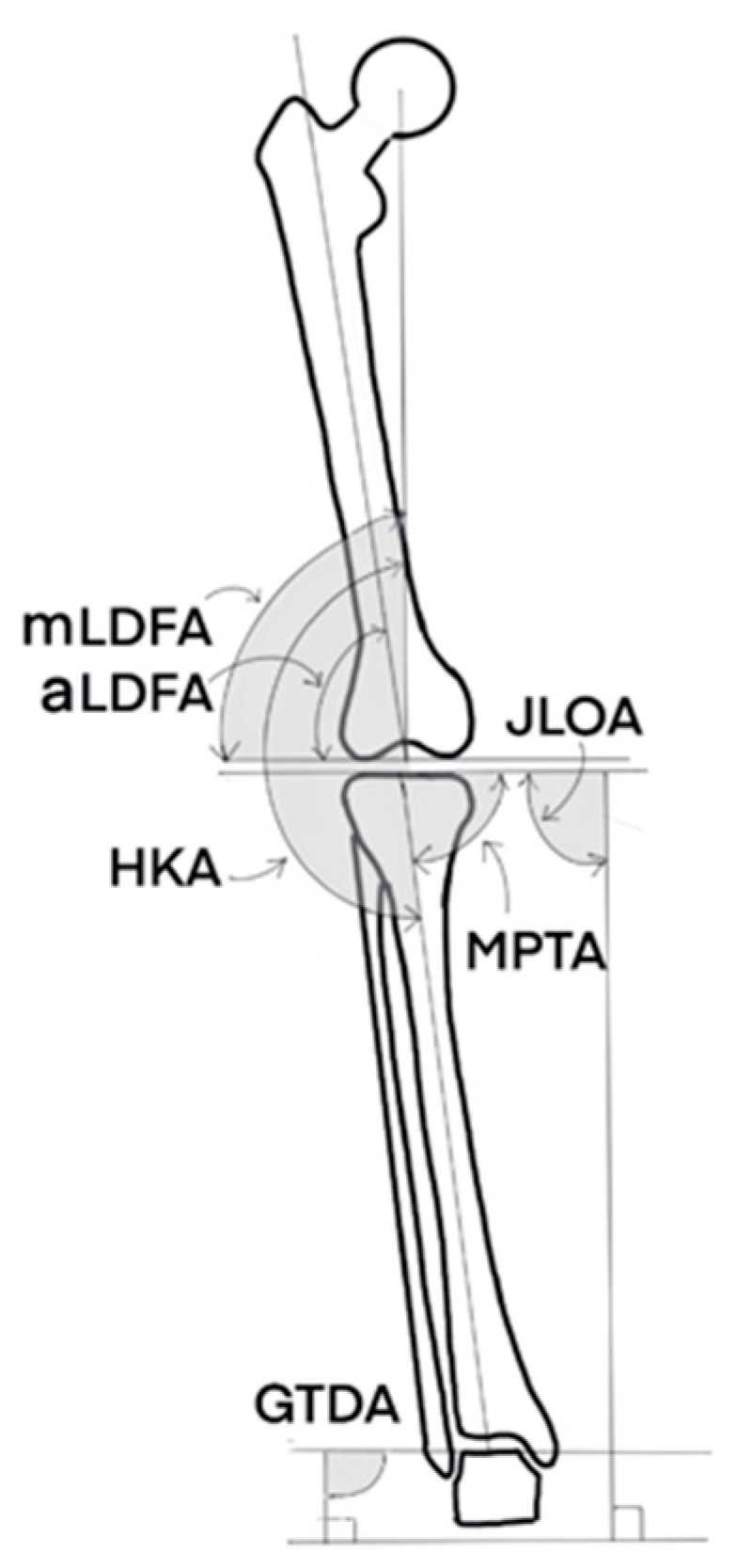


Kinematic Alignment of Failed Mechanically Aligned Total Knee Arthroplasty Restored Constitutional Limb Alignment and Improved Clinical Outcomes: A Case Report of 7 Patients


Abstract
1. Introduction
2. Materials and Methods
2.1. Patients
2.2. Methods of Assessment
2.3. Surgical Technique
2.4. Prosthesis
2.5. Statistical Analysis
3. Results
4. Discussion
5. Conclusions
Author Contributions
Funding
Institutional Review Board Statement
Informed Consent Statement
Conflicts of Interest
References
- Schmidt, A.; Batailler, C.; Lording, T.; Badet, R.; Servien, E.; Writing Committee; Lustig, S. Why Reintervention After Total Knee Arthroplasty Fails? A Consecutive Cohort of 1170 Surgeries. J. Arthroplast. 2020, 35, 2550–2560. [Google Scholar] [CrossRef] [Scilit] [PubMed]
- Baker, P.; Cowling, P.; Kurtz, S.; Jameson, S.; Gregg, P.; Deehan, D. Reason for Revision Influences Early Patient Outcomes after Aseptic Knee Revision. Clin. Orthop. Relat. Res. 2012, 470, 2244–2252. [Google Scholar] [CrossRef] [Scilit] [PubMed]
- Sheng, P.-Y.; Konttinen, L.; Lehto, M.; Ogino, D.; Jämsen, E.; Nevalainen, J.; Pajamäki, J.; Halonen, P.; Konttinen, Y.T. Revision Total Knee Arthroplasty: 1990 through 2002. A Review of the Finnish Arthroplasty Registry. J. Bone Jt. Surg. Am. 2006, 88, 1425–1430. [Google Scholar] [CrossRef] [Scilit]
- Insall, J.; Scott, W.N.; Ranawat, C.S. The Total Condylar Knee Prosthesis. A Report of Two Hundred and Twenty Cases. J. Bone Jt. Surg. Am. 1979, 61, 173–180. [Google Scholar] [CrossRef] [Scilit]
- Churches, T.; Naylor, J.; Harris, I.A. Arthroplasty Clinical Outcomes Registry National (ACORN) Annual Report, 2016; Whitlam Orthopaedic Research Centre: Sydney, Australia, 2017; Available online: Http://Www.Acornregistry.Org/Images/Acorn-Annual-Report-2016-V12.Pdf (accessed on 1 October 2022).
- Nam, D.; Nunley, R.M.; Barrack, R.L. Patient Dissatisfaction Following Total Knee Replacement: A Growing Concern? Bone Jt. J. 2014, 96, 96–100. [Google Scholar] [CrossRef] [Scilit]
- Gunaratne, R.; Pratt, D.N.; Banda, J.; Fick, D.P.; Khan, R.J.K.; Robertson, B.W. Patient Dissatisfaction Following Total Knee Arthroplasty: A Systematic Review of the Literature. J. Arthroplast. 2017, 32, 3854–3860. [Google Scholar] [CrossRef] [Scilit]
- Hamilton, D.F.; Simpson, P.M.; Patton, J.T.; Howie, C.R.; Burnett, R. Aseptic Revision Knee Arthroplasty With Total Stabilizer Prostheses Achieves Similar Functional Outcomes to Primary Total Knee Arthroplasty at 2 Years: A Longitudinal Cohort Study. J. Arthroplast. 2017, 32, 1234–1240.e1. [Google Scholar] [CrossRef] [Scilit]
- Howell, S.M.; Bini, S.A.; Steele, G.D. Revision Total Knee Arthroplasty Using Kinematic Alignment Principles. In Calipered Kinematically Aligned Total Knee Arthroplasty: Theory, Surgical Techniques, Perspectives, 1st ed.; Howell, S.M., Bini, S.A., Steele, G.D., Eds.; Elsevier: Amsterdam, The Netherlands, 2021; Volume 1, p. 7. [Google Scholar]
- Rivière, C.; Vigdorchik, J.M.; Vendittoli, P.-A. Mechanical Alignment: The End of an Era! Orthop. Traumatol. Surg. Res. 2019, 105, 1223–1226. [Google Scholar] [CrossRef] [Scilit]
- Howell, S.M.; Bini, S.A.; Steele, G.D. Calipered Kinematically Aligned Total Knee Arthroplasty Performed with Specific Manual Instrumentation, Verification Checks, and A Decision Tree. In Calipered Kinematically Aligned Total Knee Arthroplasty: Theory, Surgical Techniques, Perspectives, 1st ed.; Howell, S.M., Bini, S.A., Steele, G.D., Eds.; Elsevier: Amsterdam, The Netherlands, 2021; Volume 1, p. 7. [Google Scholar]
- Luo, Z.; Zhou, K.; Peng, L.; Shang, Q.; Pei, F.; Zhou, Z. Similar Results with Kinematic and Mechanical Alignment Applied in Total Knee Arthroplasty. Knee Surg. Sports Traumatol. Arthrosc. 2019, 28, 1720–1735. [Google Scholar] [CrossRef] [Scilit]
- Sappey-Marinier, E.; Pauvert, A.; Batailler, C.; Swan, J.; Cheze, L.; Servien, E.; Lustig, S. Kinematic versus Mechanical Alignment for Primary Total Knee Arthroplasty with Minimum 2 Years Follow-up: A Systematic Review. SICOT J. 2020, 6, 18. [Google Scholar] [CrossRef] [Scilit]
- Kostretzis, L.; Roby, G.B.; Martinov, S.; Kiss, M.-O.; Barry, J.; Vendittoli, P.-A. Revision Total Knee Arthroplasty With the Use of Restricted Kinematic Alignment Protocol: Surgical Technique and Initial Results. Front. Surg. 2021, 8, 721379. [Google Scholar] [CrossRef] [Scilit]
- Insall, J.N.; Dorr, L.D.; Scott, R.D.; Scott, W.N. Rationale of the Knee Society Clinical Rating System. Clin. Orthop. Relat. Res. 1989, 248, 13–14. [Google Scholar] [CrossRef] [Scilit]
- Paley, D.; Tetsworth, K. Mechanical Axis Deviation of the Lower Limbs. Preoperative Planning of Uniapical Angular Deformities of the Tibia or Femur. Clin. Orthop. Relat. Res. 1992, 280, 48–64. [Google Scholar]
- Jeong, B.O.; Kim, T.Y.; Baek, J.H.; Jung, H.; Song, S.H. Following the Correction of Varus Deformity of the Knee through Total Knee Arthroplasty, Significant Compensatory Changes Occur Not Only at the Ankle and Subtalar Joint, but Also at the Foot. Knee Surg. Sports Traumatol. Arthrosc. 2018, 26, 3230–3237. [Google Scholar] [CrossRef] [Scilit]
- MacDessi, S.J.; Griffiths-Jones, W.; Harris, I.A.; Bellemans, J.; Chen, D.B. The Arithmetic HKA (AHKA) Predicts the Constitutional Alignment of the Arthritic Knee Compared to the Normal Contralateral Knee: A Matched-Pairs Radiographic Study. Bone Jt. Open 2020, 1, 339–345. [Google Scholar] [CrossRef]
- MacDessi, S.J.; Allom, R.J.; Griffiths-Jones, W.; Chen, D.B.; Wood, J.A.; Bellemans, J. The Importance of Joint Line Obliquity: A Radiological Analysis of Restricted Boundaries in Normal Knee Phenotypes to Inform Surgical Decision Making in Kinematically Aligned Total Knee Arthroplasty. Knee Surg. Sports Traumatol. Arthrosc. 2022, 30, 2931–2940. [Google Scholar] [CrossRef] [Scilit]
- MacDessi, S.J.; Griffiths-Jones, W.; Chen, D.B.; Griffiths-Jones, S.; Wood, J.A.; Diwan, A.D.; Harris, I.A. Restoring the Constitutional Alignment with a Restrictive Kinematic Protocol Improves Quantitative Soft-Tissue Balance in Total Knee Arthroplasty: A Randomized Controlled Trial. Bone Jt. J. 2020, 102, 117–124. [Google Scholar] [CrossRef] [Scilit]
- Sappey-Marinier, E.; Batailler, C.; Swan, J.; Schmidt, A.; Cheze, L.; MacDessi, S.J.; Servien, E.; Lustig, S. Mechanical Alignment for Primary TKA May Change Both Knee Phenotype and Joint Line Obliquity without Influencing Clinical Outcomes: A Study Comparing Restored and Unrestored Joint Line Obliquity. Knee Surg. Sports Traumatol. Arthrosc. 2021, 30, 2806–2814. [Google Scholar] [CrossRef] [Scilit]
- Tran, T.; McEwen, P.; Peng, Y.; Trivett, A.; Steele, R.; Donnelly, W.; Clark, G. Kinematic Alignment in Total Knee Arthroplasty: A Five-Year Prospective, Multicentre, Survivorship Study. Bone Jt. Open 2022, 3, 656–665. [Google Scholar] [CrossRef] [Scilit]
- Kim, J.-T.; Han, J.; Lim, S.; Shen, Q.H.; Won, Y.Y. Kinematically Aligned TKA Aligns the Ankle Joint Line Closer to Those of the Native Ankle than Mechanically Aligned TKA in Bipedal Stance. J. Knee Surg. 2019, 32, 1033–1038. [Google Scholar] [CrossRef] [Scilit]
- Moya-Angeler, J.; Bas, M.A.; Cooper, H.J.; Hepinstall, M.S.; Rodriguez, J.A.; Scuderi, G.R. Revision Arthroplasty for the Management of Stiffness After Primary TKA. J. Arthroplast. 2017, 32, 1935–1939. [Google Scholar] [CrossRef] [Scilit] [PubMed]
- Kim, G.K.; Mortazavi, S.M.J.; Parvizi, J.; Purtill, J.J. Revision for Stiffness Following TKA: A Predictable Procedure? Knee 2012, 19, 332–334. [Google Scholar] [CrossRef] [Scilit] [PubMed]
- Cohen, J.S.; Gu, A.; Lopez, N.S.; Park, M.S.; Fehring, K.A.; Sculco, P.K. Efficacy of Revision Surgery for the Treatment of Stiffness After Total Knee Arthroplasty: A Systematic Review. J. Arthroplast. 2018, 33, 3049–3055. [Google Scholar] [CrossRef] [Scilit]
- Christensen, C.P.; Crawford, J.J.; Olin, M.D.; Vail, T.P. Revision of the Stiff Total Knee Arthroplasty. J. Arthroplast. 2002, 17, 409–415. [Google Scholar] [CrossRef] [Scilit]
- Heesterbeek, P.J.C.; Goosen, J.H.M.; Schimmel, J.J.P.; Defoort, K.C.; van Hellemondt, G.G.; Wymenga, A.B. Moderate Clinical Improvement after Revision Arthroplasty of the Severely Stiff Knee. Knee Surg. Sports Traumatol. Arthrosc. 2016, 24, 3235–3241. [Google Scholar] [CrossRef] [Scilit]
- Howell, S.M.; Shelton, T.J.; Hull, M.L. Implant Survival and Function Ten Years After Kinematically Aligned Total Knee Arthroplasty. J. Arthroplast. 2018, 33, 3678–3684. [Google Scholar] [CrossRef] [Scilit]
- Lee, Y.S.; Howell, S.M.; Won, Y.-Y.; Lee, O.-S.; Lee, S.H.; Vahedi, H.; Teo, S.H. Kinematic Alignment Is a Possible Alternative to Mechanical Alignment in Total Knee Arthroplasty. Knee Surg. Sports Traumatol. Arthrosc. 2017, 25, 3467–3479. [Google Scholar] [CrossRef] [Scilit]


| Characteristics | Pre-Revision Means ± SD (Range) |
|---|---|
| Body-Mass-Index | 27 ± 3 kg/m2 (22 to 31) |
| Extension | 10 ± 8° (0 to 20°) |
| Flexion | 84 ± 35° (40 to 125°) |
| Knee Society Score Knee (100 is best, 0 is worst) | 47 ± 7 points (38 to 56) |
| Knee Society Score Function (100 is best, 0 is worst) | 49 ± 20 points (25 to 75) |
| Total Knee Society Score (200 is best, 0 is worst) | 96 ± 23 points (69 to 131) |
| Radiological Measurements | Native Alignment Means ± SD (Range) | Pre-Revision TKA Means ± SD (Range) | Post-Revision TKA Means ± SD (Range) | p-Value |
|---|---|---|---|---|
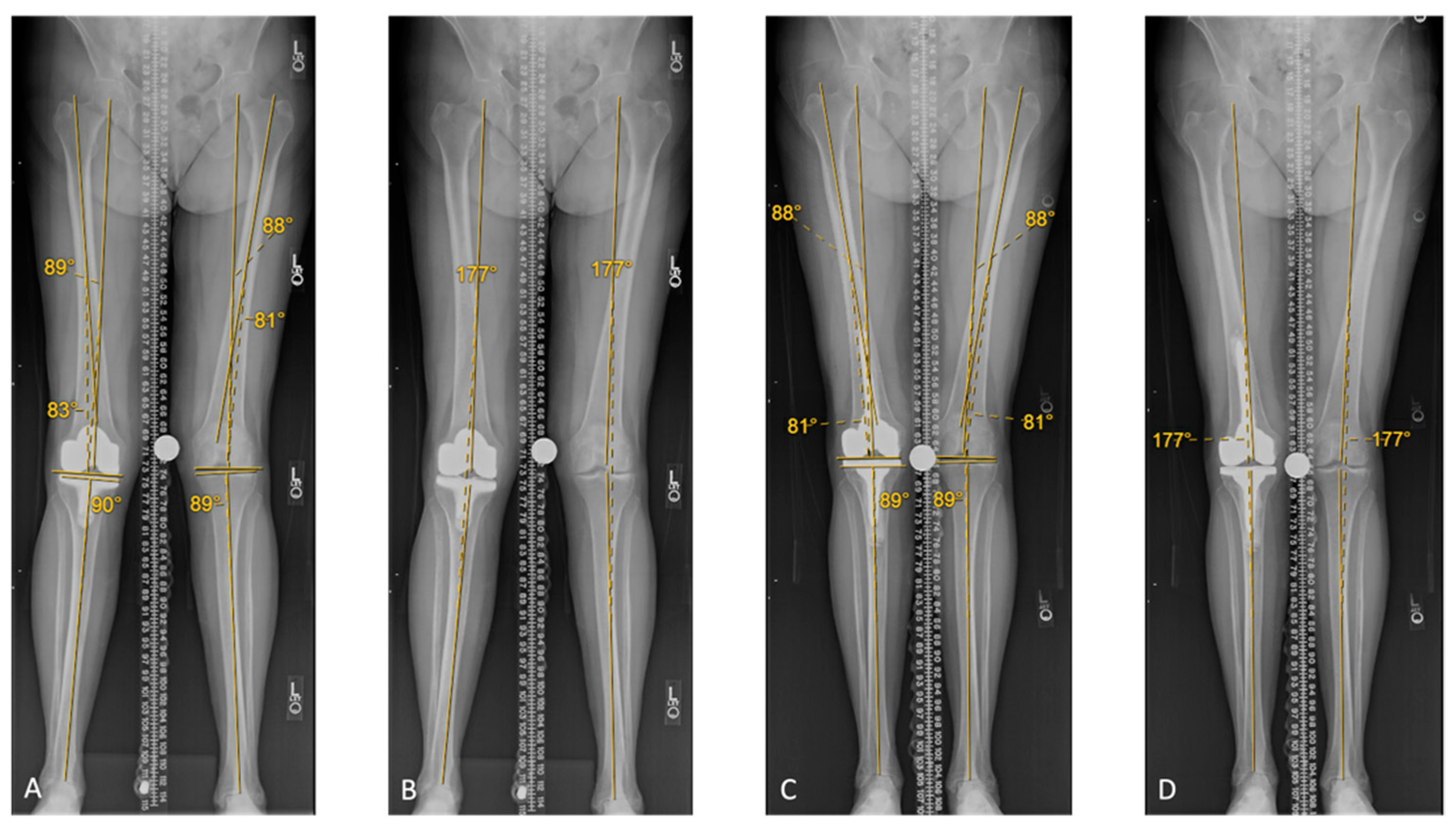
| Hip-Knee-Ankle Angle | 176 ± 5° (170 to 184°) | 181 ± 4° (177 to 183°) | 179 ± 2° (176 to 181°) | 0.005 * 0.051 ** |
| Mechanical Lateral Distal Femoral Angle | 88 ± 3° (83 to 91°) | 90 ± 2° (87 to 92°) | 88 ± 3° (83 to 91°) | 0.03 * 0.5 ** |
| Medial Proximal Tibial Angle | 88 ± 2° (85 to 90°) | 90 ± 1° (88 to 92°) | 88 ± 2° (85 to 90°) | 0.04 * 1 ** |
| Joint Line Obliquity Angle | 2 ± 3° (−2 to 5°) | −0.3 ± 3° (−5 to 4°) | 1 ± 3° (−2 to 5°) | 0.03 * 0.2 ** |
| Ground Talar Dome Angle | −1 ± 5° (−7 to 5°) | −7 ± 7° (−19 to −1°) | −2 ± 4° (−6 to 3°) | <0.001 * 0.3 ** |
Publisher’s Note: MDPI stays neutral with regard to jurisdictional claims in published maps and institutional affiliations. |
© 2022 by the authors. Licensee MDPI, Basel, Switzerland. This article is an open access article distributed under the terms and conditions of the Creative Commons Attribution (CC BY) license (https://creativecommons.org/licenses/by/4.0/).
Share and Cite
Sappey-Marinier, E.; Wu, S.A.; Bini, S.A. Kinematic Alignment of Failed Mechanically Aligned Total Knee Arthroplasty Restored Constitutional Limb Alignment and Improved Clinical Outcomes: A Case Report of 7 Patients. J. Pers. Med. 2022, 12, 1780. https://doi.org/10.3390/jpm12111780
Sappey-Marinier E, Wu SA, Bini SA. Kinematic Alignment of Failed Mechanically Aligned Total Knee Arthroplasty Restored Constitutional Limb Alignment and Improved Clinical Outcomes: A Case Report of 7 Patients. Journal of Personalized Medicine. 2022; 12(11):1780. https://doi.org/10.3390/jpm12111780
Chicago/Turabian StyleSappey-Marinier, Elliot, Scott A. Wu, and Stefano A. Bini. 2022. "Kinematic Alignment of Failed Mechanically Aligned Total Knee Arthroplasty Restored Constitutional Limb Alignment and Improved Clinical Outcomes: A Case Report of 7 Patients" Journal of Personalized Medicine 12, no. 11: 1780. https://doi.org/10.3390/jpm12111780
APA StyleSappey-Marinier, E., Wu, S. A., & Bini, S. A. (2022). Kinematic Alignment of Failed Mechanically Aligned Total Knee Arthroplasty Restored Constitutional Limb Alignment and Improved Clinical Outcomes: A Case Report of 7 Patients. Journal of Personalized Medicine, 12(11), 1780. https://doi.org/10.3390/jpm12111780