
Review

Oncogenic Role of miRNA in Environmental Exposure to Plasticizers: A Systematic Review

by
Margherita Ferrante
1,2,*,
Antonio Cristaldi
1 and
Gea Oliveri Conti
1
1
Department of Medical, Surgical Sciences and Advanced Technologies “G.F. Ingrassia”, University of Catania, 95123 Catania, Italy
2
Catania, Messina, Enna Cancer Registry, Via S. Sofia 87, 95123 Catania, Italy
*
Author to whom correspondence should be addressed.
J. Pers. Med. 2021, 11(6), 500; https://doi.org/10.3390/jpm11060500
Submission received: 2 April 2021 / Revised: 26 May 2021 / Accepted: 28 May 2021 / Published: 2 June 2021
(This article belongs to the Special Issue Role of MicroRNA in Cancer Development and Treatment)

Abstract

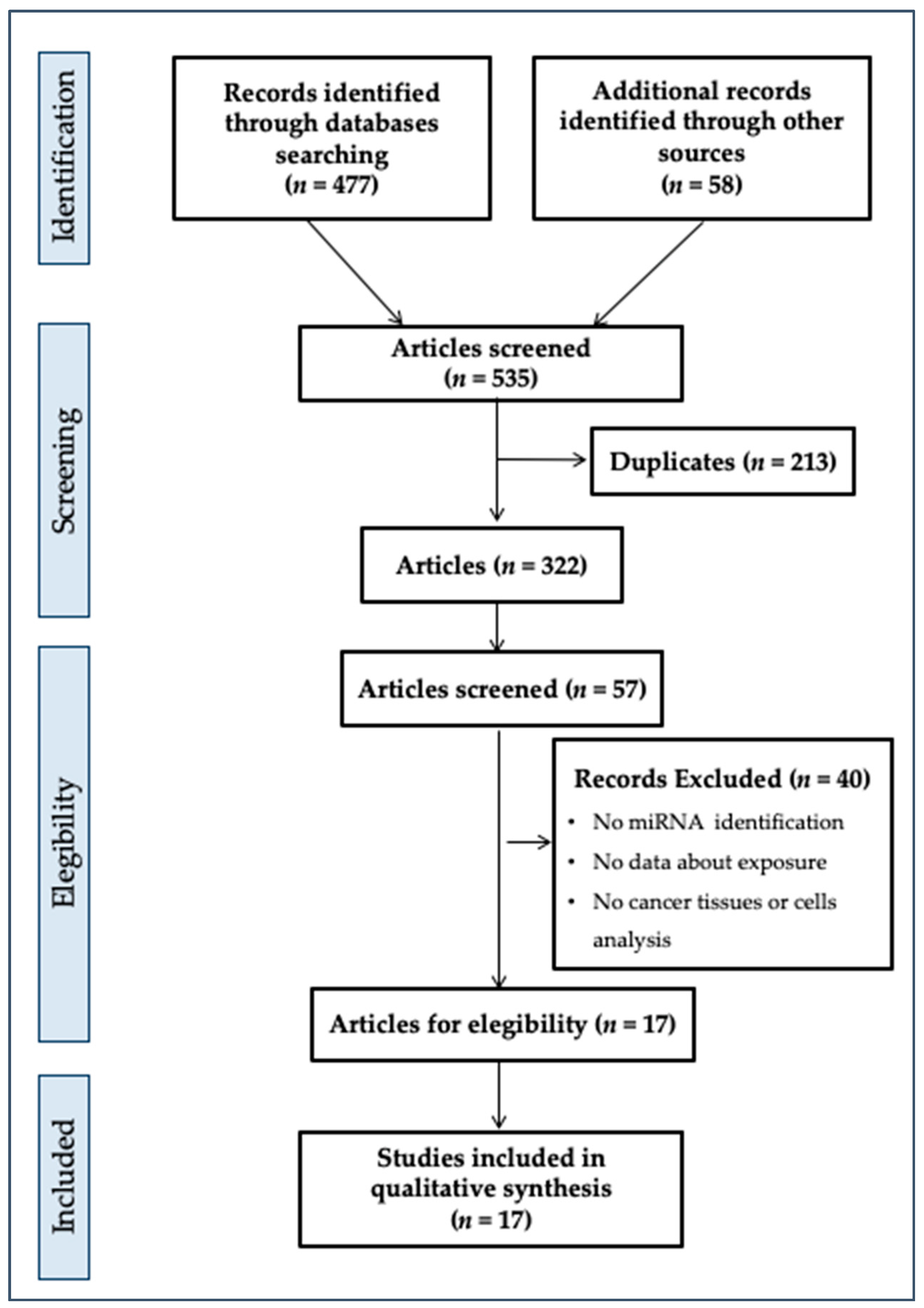
The daily environmental exposure of humans to plasticizers may adversely affect human health, representing a global issue. The altered expression of microRNAs (miRNAs) plays an important pathogenic role in exposure to plasticizers. This systematic review summarizes recent findings showing the modified expression of miRNAs in cancer due to exposure to plasticizers. Following the Preferred Reporting Items for Systematic Reviews and Meta-Analyses (PRISMA) methodology, we performed a systematic review of the literature published in the past 10 years, focusing on the relationship between plasticizer exposure and the expression of miRNAs related to cancer. Starting with 535 records, 17 articles were included. The results support the hypothesis that exposure to plasticizers causes changes in or the deregulation of a number of oncogenic miRNAs and show that the interaction of plasticizers with several redundant miRNAs, such as let-7f, let-7g, miR-125b, miR-134, miR-146a, miR-22, miR-192, miR-222, miR-26a, miR-26b, miR-27b, miR-296, miR-324, miR-335, miR-122, miR-23b, miR-200, miR-29a, and miR-21, might induce deep alterations. These genotoxic and oncogenic responses can eventually lead to abnormal cell signaling pathways and metabolic changes that participate in many overlapping cellular processes, and the evaluation of miRNA-level changes can be a useful target for the toxicological assessment of environmental pollutants, including plastic additives and plasticizers.
Keywords: plasticizers; cancer; microRNA; in vitro study; PRISMA plasticizers; cancer; microRNA; in vitro study; PRISMA