


Machine-Learning Models Outperform Clinicians in Predicting Postnatal Growth Failure Among Very Low Birth Weight Infants

 , , , , ,
Abstract
1. Introduction
2. Materials and Methods
2.1. Study Population and Data Source
2.2. Clinical Variables and Data Collection
2.3. Machine-Learning Model Development
2.4. Model Evaluation
2.5. Clinician Prediction Experiment
2.6. Statistical Analysis
3. Results
3.1. Baseline Characteristics
3.2. Predictive Performance of Clinicians
3.3. Comparison Between Machine Learning and Clinicians
4. Discussion
5. Conclusions
Supplementary Materials
Author Contributions
Funding
Institutional Review Board Statement
Informed Consent Statement
Data Availability Statement
Conflicts of Interest
Abbreviations
| PGF | Postnatal growth failure |
| VLBW | Very low birth weight |
| NICU | Neonatal intensive care unit |
| AUROC | Area under the receiver operating characteristic curve |
| PPV | Positive predictive value |
| RDS | Respiratory distress syndrome |
| PDA | Patent ductus arteriosus |
| IVH | Intraventricular hemorrhage |
References
- Chang, Y.S.; Park, H.Y.; Park, W.S. The Korean Neonatal Network: An Overview. J. Korean Med. Sci. 2015, 30, S3–S11. [Google Scholar] [CrossRef] [PubMed]
- Fenton, T.R.; Cormack, B.; Goldberg, D.; Nasser, R.; Alshaikh, B.; Eliasziw, M.; Hay, W.W.; Hoyos, A.; Anderson, D.; Bloomfield, F.; et al. “Extrauterine Growth Restriction” and “Postnatal Growth Failure” Are Misnomers for Preterm Infants. J. Perinatol. 2020, 40, 704–714. [Google Scholar] [CrossRef] [PubMed]
- Strobel, K.M.; Wood, T.R.; Valentine, G.C.; German, K.R.; Gogcu, S.; Hendrixson, D.T.; Kolnik, S.E.; Law, J.B.; Mayock, D.E.; Comstock, B.A.; et al. Contemporary Definitions of Infant Growth Failure and Neurodevelopmental and Behavioral Outcomes in Extremely Premature Infants at Two Years of Age. J. Perinatol. 2024, 44, 811–818. [Google Scholar] [CrossRef] [PubMed]
- De Nardo, M.C.; Mario, C.D.; Laccetta, G.; Boscarino, G.; Terrin, G. Enteral and Parenteral Energy Intake and Neurodevelopment in Preterm Infants: A Systematic Review. Nutrition 2022, 97, 111572. [Google Scholar] [CrossRef]
- Figueras-Aloy, J.; Palet-Trujols, C.; Matas-Barceló, I.; Botet-Mussons, F.; Carbonell-Estrany, X. Extrauterine Growth Restriction in Very Preterm Infant: Etiology, Diagnosis, and 2-Year Follow-Up. Eur. J. Pediatr. 2020, 179, 1469–1479. [Google Scholar] [CrossRef]
- Kavurt, S.; Celik, K. Incidence and Risk Factors of Postnatal Growth Restriction in Preterm Infants. J. Matern.-Fetal Neonatal Med. 2018, 31, 1105–1107. [Google Scholar] [CrossRef]
- Singhasem, N.; Maneenil, G.; Thatrimontrichai, A.; Praditaukrit, M.; Dissaneevate, S. Predictors and Risk Scoring of Postnatal Growth Failure in Very-Low-Birth-Weight Infants. Nutrients 2026, 18, 460. [Google Scholar] [CrossRef]
- Su, B.H. Optimizing Nutrition in Preterm Infants. Pediatr. Neonatol. 2014, 55, 5–13. [Google Scholar] [CrossRef]
- Hanson, C.W.I.; Marshall, B.E. Artificial Intelligence Applications in the Intensive Care Unit. Crit. Care Med. 2001, 29, 427–435. [Google Scholar] [CrossRef]
- Shu, L.-Q.; Sun, Y.-K.; Tan, L.-H.; Shu, Q.; Chang, A.C. Application of Artificial Intelligence in Pediatrics: Past, Present and Future. World J. Pediatr. 2019, 15, 105–108. [Google Scholar] [CrossRef]
- Baker, S.; Kandasamy, Y. Machine Learning for Understanding and Predicting Neurodevelopmental Outcomes in Premature Infants: A Systematic Review. Pediatr. Res. 2023, 93, 293–299. [Google Scholar] [CrossRef]
- van Doorn, W.; Stassen, P.M.; Borggreve, H.F.; Schalkwijk, M.J.; Stoffers, J.; Bekers, O.; Meex, S.J.R. A Comparison of Machine Learning Models Versus Clinical Evaluation for Mortality Prediction in Patients with sepsis. PLoS ONE 2021, 16, e0245157. [Google Scholar] [CrossRef] [PubMed]
- Beam, K.S.; Zupancic, J.A.F. Machine Learning: Remember the Fundamentals. Pediatr. Res. 2023, 93, 291–292. [Google Scholar] [CrossRef] [PubMed]
- Ashoori, M.; O’Toole, J.M.; O’Halloran, K.D.; Naulaers, G.; Thewissen, L.; Miletin, J.; Cheung, P.Y.; El-Khuffash, A.; Van Laere, D.; Straňák, Z.; et al. Machine Learning Detects Intraventricular Haemorrhage in Extremely Preterm Infants. Children 2023, 10, 917. [Google Scholar] [CrossRef] [PubMed]
- O’Shea, A.; Ahmed, R.; Lightbody, G.; Pavlidis, E.; Lloyd, R.; Pisani, F.; Marnane, W.; Mathieson, S.; Boylan, G.; Temko, A. Deep Learning for EEG Seizure Detection in Preterm Infants. Int. J. Neural Syst. 2021, 31, 2150008. [Google Scholar] [CrossRef]
- Vesoulis, Z.A.; Trivedi, S.B.; Morris, H.F.; McKinstry, R.C.; Li, Y.; Mathur, A.M.; Wu, Y.W. Deep Learning to Optimize Magnetic Resonance Imaging Prediction of Motor Outcomes after Hypoxic-Ischemic Encephalopathy. Pediatr. Neurol. 2023, 149, 26–31. [Google Scholar] [CrossRef]
- Chu, Y.; Hu, S.; Li, Z.; Yang, X.; Liu, H.; Yi, X.; Qi, X. Image Analysis-Based Machine Learning for the Diagnosis of Retinopathy of Prematurity: A Meta-Analysis and Systematic Review. Ophthalmol. Retin. 2024, 8, 678–687. [Google Scholar] [CrossRef]
- Li, Y.; Zhang, P.; Wu, J.; Wang, Y.; Chen, Y.; Sheng, S.; Wang, Y.; Li, X. Machine Learning-Based Prediction of Surgical Intervention in Preterm Infants with Necrotizing Enterocolitis: A Retrospective Cohort Study. Children 2025, 13, 21. [Google Scholar] [CrossRef]
- Zhu, C.; Li, J.; Ren, M.; Chen, Y.; Chen, Y.; Li, M.; Cai, Q.; Wang, T.; Wang, Z.; Song, H.; et al. Machine Learning-Enhanced Prediction of Fetal Growth Restriction Using Fetal Cardiac Remodeling Parameters. BMC Med. 2025, 23, 634. [Google Scholar] [CrossRef]
- Zheng, M.; Zhang, Y.; Laws, R.A.; Vuillermin, P.; Dodd, J.; Wen, L.M.; Baur, L.A.; Taylor, R.; Byrne, R.; Ponsonby, A.L.; et al. Development of Machine Learning-Based Risk Prediction Models to Predict Rapid Weight Gain in Infants: Analysis of Seven Cohorts. JMIR Public Health Surveill. 2025, 11, e69220. [Google Scholar] [CrossRef]
- Yoon, S.J.; Kim, D.; Park, S.H.; Han, J.H.; Lim, J.; Shin, J.E.; Eun, H.S.; Lee, S.M.; Park, M.S. Prediction of Postnatal Growth Failure in Very Low Birth Weight Infants Using a Machine Learning Model. Diagnostics 2023, 13, 3627. [Google Scholar] [CrossRef]
- Han, J.H.; Yoon, S.J.; Lee, H.S.; Park, G.; Lim, J.; Shin, J.E.; Eun, H.S.; Park, M.S.; Lee, S.M. Application of Machine Learning Approaches to Predict Postnatal Growth Failure in Very Low Birth Weight Infants. Yonsei Med. J. 2022, 63, 640–647. [Google Scholar] [CrossRef]
- Allotey, J.; Archer, L.; Coomar, D.; Snell, K.I.; Smuk, M.; Oakey, L.; Haqnawaz, S.; Betrán, A.P.; Chappell, L.C.; Ganzevoort, W.; et al. Development and Validation of Prediction Models for Fetal Growth Restriction and Birthweight: An Individual Participant Data Meta-Analysis. Health Technol. Assess. 2024, 28, 1–119. [Google Scholar] [CrossRef]
- Bians, N.K.; Lyeo, J.S.; Gilchrist, J.; Honeywell, C.; Cloutier, P.; Kennedy, A.; Pajer, K. Predicting Child and Adolescent Mental Health Emergency Department Revisits: A Machine-Learning Approach Compared to a Clinician-Derived Baseline. BMC Med. Inform. Decis. Mak. 2025, 26, 2. [Google Scholar] [CrossRef]
- Kainth, D.; Gupta, A.; Singh, P.; Prakash, S.; Thukral, A.; Deorari, A.; Kapoor, M.; Agarwal, R.; Sethi, T.; Sankar, M.J. A machine Learning Model for Prediction of Early-Onset Neonatal Sepsis in Low-Income and Middle-Income Countries: Development and Validation Study. BMJ Paediatr. Open 2026, 10, e003561. [Google Scholar] [CrossRef]
- Chen, M.; Decary, M. Artificial Intelligence in Healthcare: An Essential Guide for Health Leaders. Healthc. Manag. Forum 2020, 33, 10–18. [Google Scholar] [CrossRef]

| Total | Non-PGF (n = 49) | PGF (n = 51) | p-Value | |
|---|---|---|---|---|
| Gestational age, weeks | 28.6 ± 2.5 | 29.6 ± 2.5 | 27.6 ± 2.3 | <0.001 |
| Birth weight, g | 1136 ± 261 | 1202 ± 258 | 1072 ± 250 | 0.012 |
| Body weight at PNA 7 days, g | 1077 ± 249 | 1153 ± 248 | 1004 ± 229 | 0.002 |
| Male infants, n (%) | 51 (51) | 21 (43) | 30 (59) | 0.110 |
| Small for gestational age, n (%) | 10 (10) | 9 (18) | 1 (2) | 0.007 |
| Maternal hypertension, n (%) | 14 (14) | 8 (16) | 6 (12) | 0.511 |
| RDS, n (%) | 88 (88) | 39 (80) | 49 (96) | 0.011 |
| Invasive ventilator care at PNA 7 days, n (%) | 38 (38) | 9 (18) | 29 (57) | <0.001 |
| Non-invasive ventilator care at PNA 7 days, n (%) | 37 (37) | 21 (43) | 16 (31) | 0.234 |
| Medication of PDA for during PNA 7 days, n (%) | 16 (16) | 3 (6) | 13 (25) | 0.008 |
| Achievement of full enteral feeding at PNA 7 days, n (%) | 0 (0) | 0 | 0 | - |
| Parenteral nutrition at PNA 7 days, n (%) | 98 (98) | 47 (96) | 51 (100) | 0.238 |
| Neonatal sepsis, n (%) | 17 (17) | 5 (10) | 12 (23) | 0.076 |
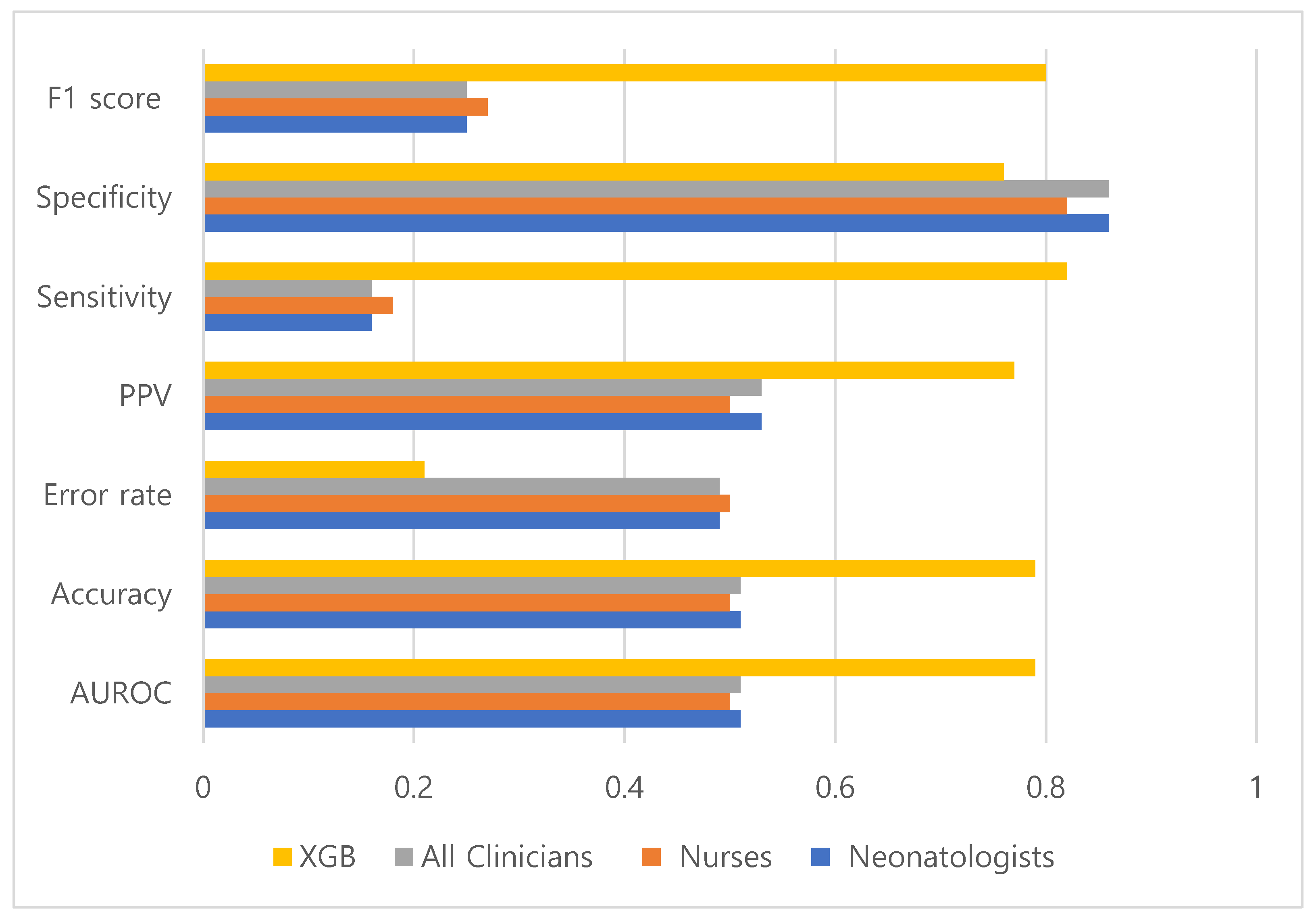
| Neonatologists (N = 9) | Nurses (N = 7) | p-Value | All Clinicians (N = 16) | XGB | p-Value | |
|---|---|---|---|---|---|---|
| AUROC | 0.51 (0.47–0.55) | 0.50 (0.46–0.54) | 0.715 | 0.51 (0.47–0.55) | 0.79 (0.71–0.87) | <0.001 |
| Accuracy | 0.51 (0.42–0.60) | 0.50 (0.41–0.59) | 0.817 | 0.51 (0.42–0.60) | 0.79 (0.71–0.87) | <0.001 |
| Error rate | 0.49 (0.40–0.58) | 0.50 (0.41–0.59) | 0.817 | 0.49 (0.40–0.58) | 0.21 (0.13–0.29) | <0.001 |
| PPV | 0.53 (0.30–0.76) | 0.50 (0.30–0.70) | 0.811 | 0.53 (0.30–0.76) | 0.77 (0.67–0.88) | 0.06 |
| Sensitivity | 0.16 (0.07–0.25) | 0.18 (0.08–0.28) | 0.742 | 0.16 (0.07–0.25) | 0.82 (0.71–0.93) | <0.001 |
| Specificity | 0.86 (0.77–0.95) | 0.82 (0.72–0.92) | 0.551 | 0.86 (0.77–0.95) | 0.76 (0.64–0.88) | 0.28 |
| F1 score | 0.25 (0.13–0.37) | 0.27 (0.14–0.39) | 0.816 | 0.25 (0.13–0.37) | 0.80 (0.71–0.88) | <0.001 |
Disclaimer/Publisher’s Note: The statements, opinions and data contained in all publications are solely those of the individual author(s) and contributor(s) and not of MDPI and/or the editor(s). MDPI and/or the editor(s) disclaim responsibility for any injury to people or property resulting from any ideas, methods, instructions or products referred to in the content. |
© 2026 by the authors. Licensee MDPI, Basel, Switzerland. This article is an open access article distributed under the terms and conditions of the Creative Commons Attribution (CC BY) license.
Share and Cite
Lim, J.; Park, S.H.; Cha, T.; Yoon, S.J.; Han, J.H.; Shin, J.E.; Song, I.G.; Lee, S.M.; Eun, H.S.; Park, M.S. Machine-Learning Models Outperform Clinicians in Predicting Postnatal Growth Failure Among Very Low Birth Weight Infants. Diagnostics 2026, 16, 1282. https://doi.org/10.3390/diagnostics16091282
Lim J, Park SH, Cha T, Yoon SJ, Han JH, Shin JE, Song IG, Lee SM, Eun HS, Park MS. Machine-Learning Models Outperform Clinicians in Predicting Postnatal Growth Failure Among Very Low Birth Weight Infants. Diagnostics. 2026; 16(9):1282. https://doi.org/10.3390/diagnostics16091282
Chicago/Turabian StyleLim, Joohee, Sook Hyun Park, Teahyen Cha, So Jin Yoon, Jung Ho Han, Jeong Eun Shin, In Gyu Song, Soon Min Lee, Ho Seon Eun, and Min Soo Park. 2026. "Machine-Learning Models Outperform Clinicians in Predicting Postnatal Growth Failure Among Very Low Birth Weight Infants" Diagnostics 16, no. 9: 1282. https://doi.org/10.3390/diagnostics16091282
APA StyleLim, J., Park, S. H., Cha, T., Yoon, S. J., Han, J. H., Shin, J. E., Song, I. G., Lee, S. M., Eun, H. S., & Park, M. S. (2026). Machine-Learning Models Outperform Clinicians in Predicting Postnatal Growth Failure Among Very Low Birth Weight Infants. Diagnostics, 16(9), 1282. https://doi.org/10.3390/diagnostics16091282

