Evaluation of the Proliferation Marker Ki-67 for Improved Risk Stratification of Prostate Cancer Patients Under Active Surveillance

 , ,
, ,  , ,
, ,
Abstract
1. Introduction
2. Patients and Methods
2.1. Patient Population
2.2. Tissue Selection
2.3. Immunohistochemistry
2.4. Statistical Analysis
3. Results
3.1. Clinico-Pathological Characteristics of the AS Cohort
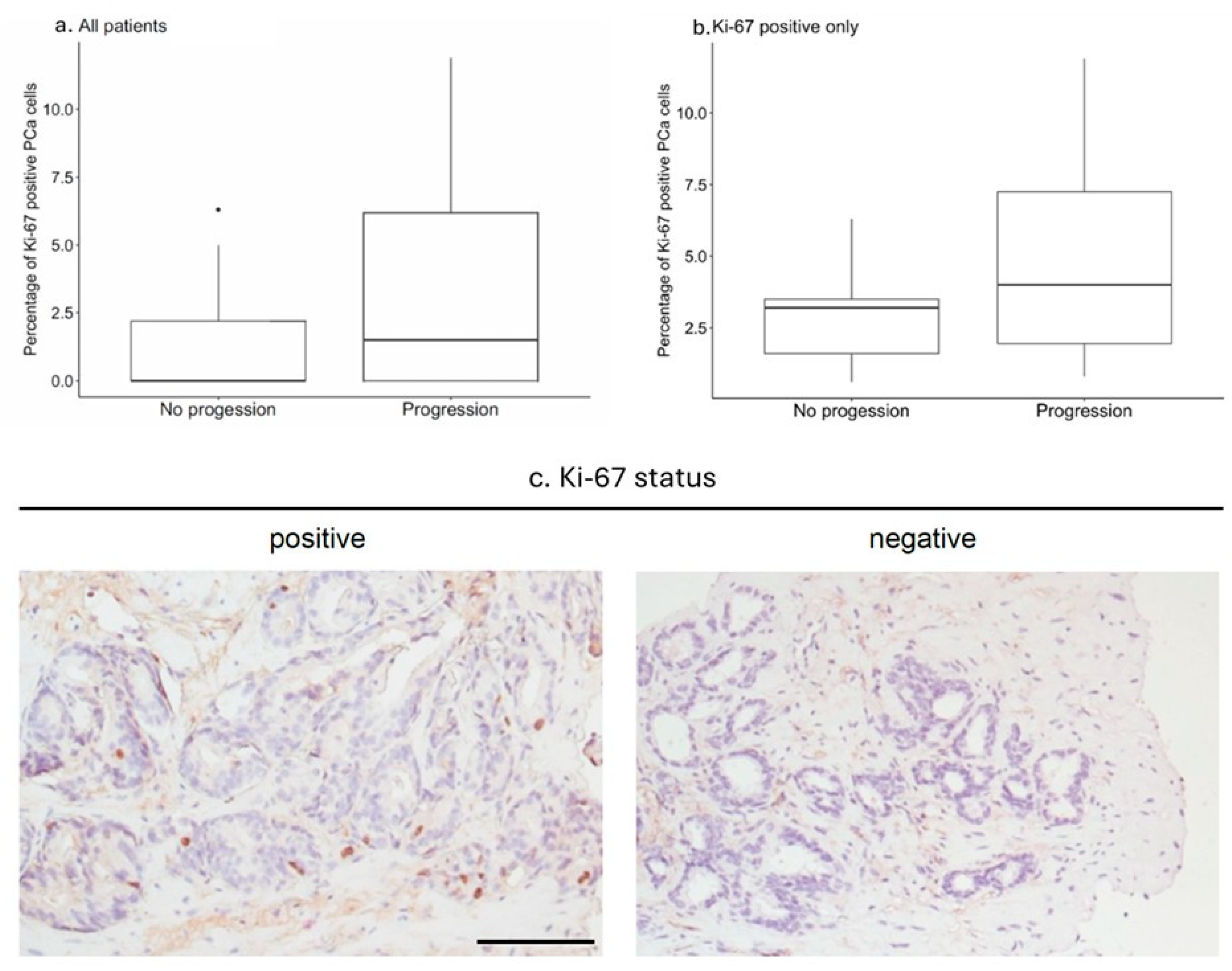
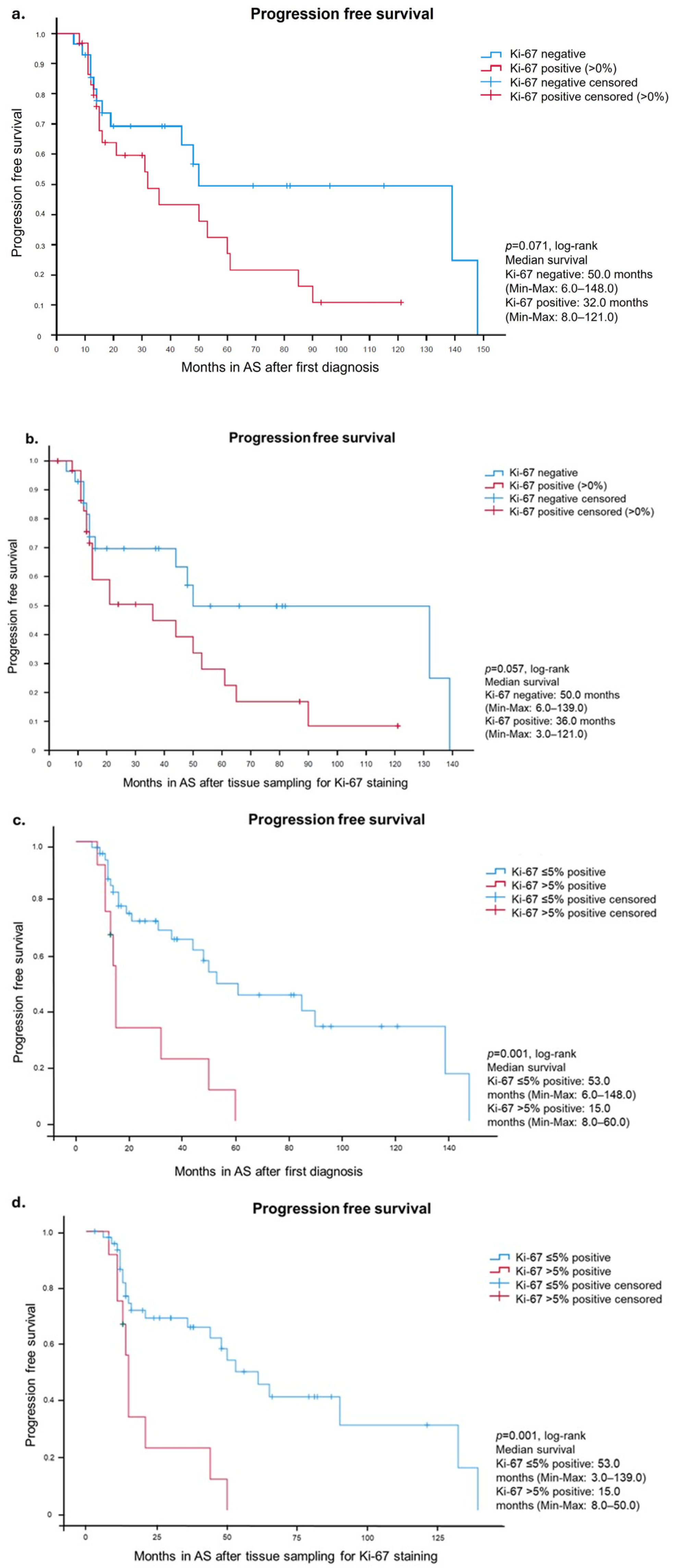
3.2. Ki-67 Immunohistochemistry of Prostate Biopsies Correlates with Patient Survival in an Exploratory Analysis
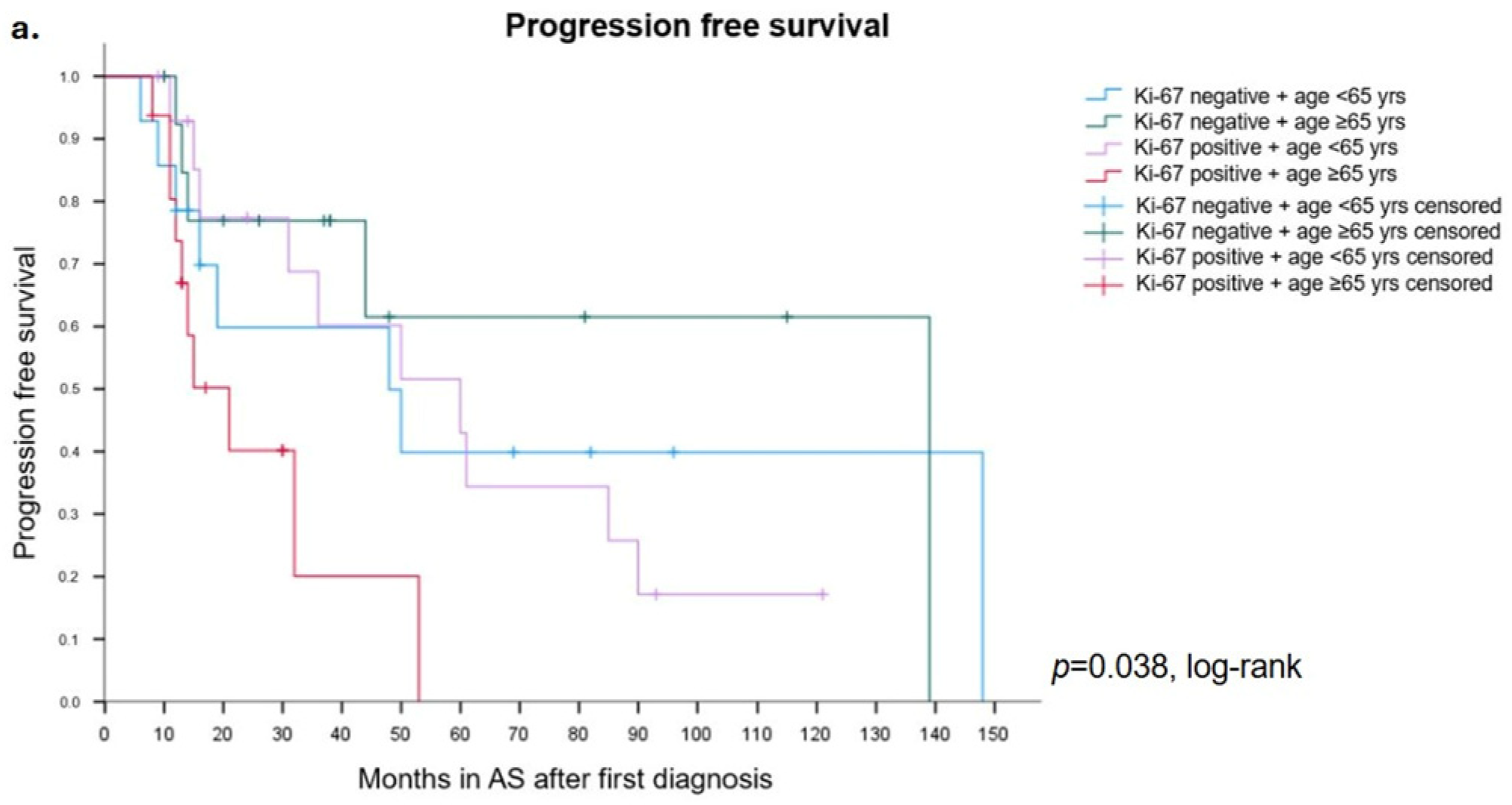
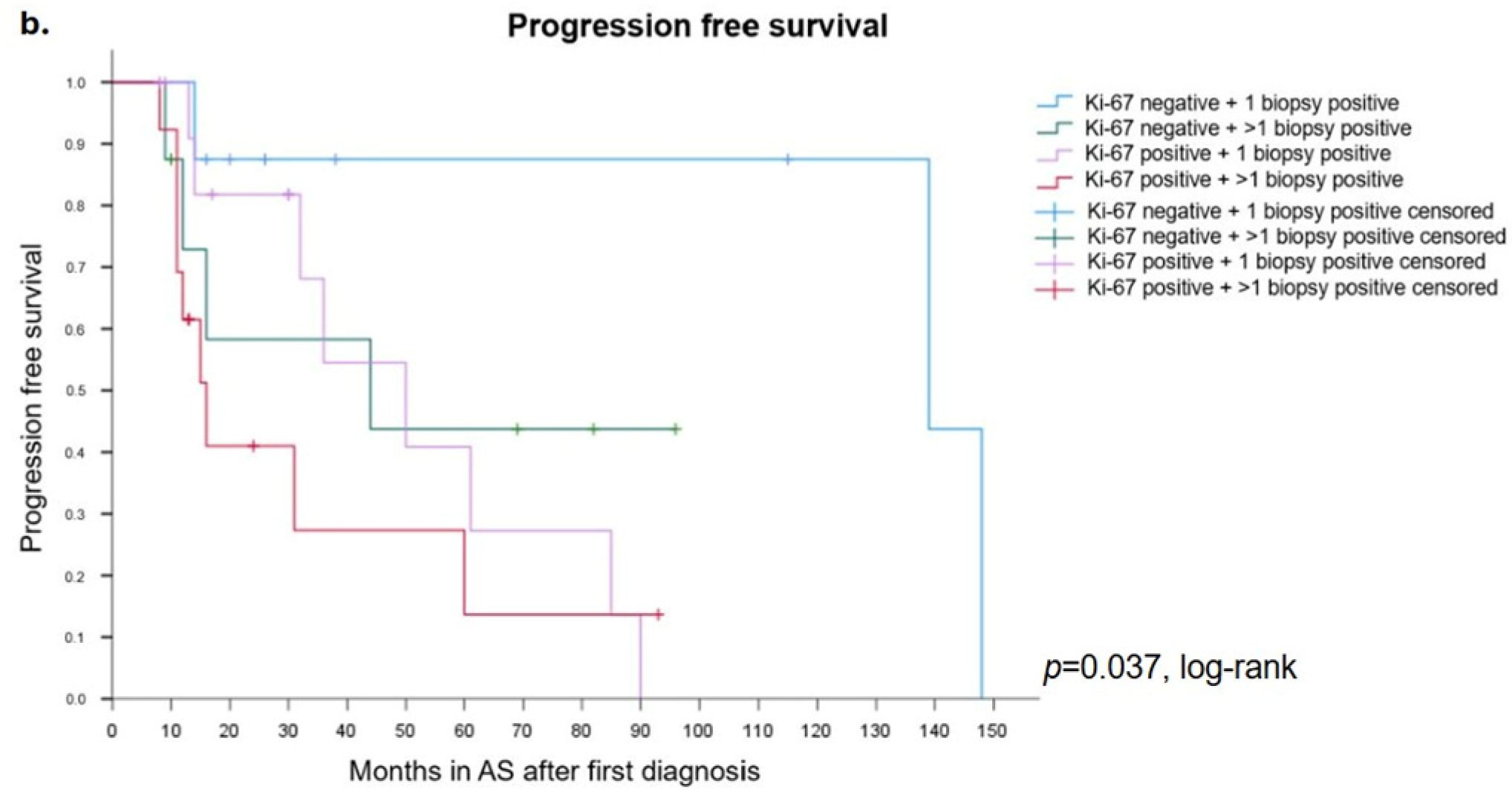
3.3. Additional Clinical Parameters May Enhance Diagnostic Accuracy of Ki-67
4. Discussion
5. Conclusions
Supplementary Materials
Author Contributions
Funding
Institutional Review Board Statement
Informed Consent Statement
Data Availability Statement
Acknowledgments
Conflicts of Interest
Abbreviations
| AS | Active surveillance |
| PCa | Prostate cancer |
| IHC | Immunohistochemistry |
| RP | Radical prostatectomy |
| RT | Radiotherapy |
| DRE | Digital rectal examination |
| IQR | Interquartile range |
| PFS | Progression free survival |
| PSA | Prostate specific antigen |
References
- Siegel, R.L.; Giaquinto, A.N.; Jemal, A. Cancer statistics, 2024. CA: A Cancer J. Clin. 2024, 74, 12–49. [Google Scholar] [CrossRef] [PubMed]
- Andriole, G.L.; Crawford, E.D.; Grubb, R.L., 3rd; Buys, S.S.; Chia, D.; Church, T.R.; Fouad, M.N.; Isaacs, C.; Kvale, P.A.; Reding, D.J.; et al. Prostate cancer screening in the randomized Prostate, Lung, Colorectal, and Ovarian Cancer Screening Trial: Mortality results after 13 years of follow-up. J. Natl. Cancer Inst. 2012, 104, 125–132. [Google Scholar] [CrossRef]
- Lundgren, P.O.; Kjellman, A.; Norming, U.; Gustafsson, O. Long-Term Outcome of a Single Intervention Population Based Prostate Cancer Screening Study. J. Urol. 2018, 200, 82–88. [Google Scholar] [CrossRef]
- Klotz, L. Prostate cancer overdiagnosis and overtreatment. Curr. Opin. Endocrinol. Diabetes Obes. 2013, 20, 204–209. [Google Scholar] [CrossRef]
- Bul, M.; Zhu, X.; Valdagni, R.; Pickles, T.; Kakehi, Y.; Rannikko, A.; Bjartell, A.; van der Schoot, D.K.; Cornel, E.B.; Conti, G.N.; et al. Active Surveillance for Low-Risk Prostate Cancer Worldwide: The PRIAS Study. Eur. Urol. 2013, 63, 597–603. [Google Scholar] [CrossRef]
- Cornford, P.; van den Bergh, R.C.N.; Briers, E.; Van den Broeck, T.; Brunckhorst, O.; Darraugh, J.; Eberli, D.; De Meerleer, G.; De Santis, M.; Farolfi, A.; et al. EAU-EANM-ESTRO-ESUR-ISUP-SIOG Guidelines on Prostate Cancer-2024 Update. Part I: Screening, Diagnosis, and Local Treatment with Curative Intent. Eur. Urol. 2024, 86, 148–163. [Google Scholar] [CrossRef]
- Eastham, J.A.; Auffenberg, G.B.; Barocas, D.A.; Chou, R.; Crispino, T.; Davis, J.W.; Eggener, S.; Horwitz, E.M.; Kane, C.J.; Kirkby, E.; et al. Clinically Localized Prostate Cancer: AUA/ASTRO Guideline, Part I: Introduction, Risk Assessment, Staging, and Risk-Based Management. J. Urol. 2022, 208, 10–18. [Google Scholar] [CrossRef]
- Moore, C.M.; King, L.E.; Withington, J.; Amin, M.B.; Andrews, M.; Briers, E.; Chen, R.C.; Chinegwundoh, F.I.; Cooperberg, M.R.; Crowe, J.; et al. Best Current Practice and Research Priorities in Active Surveillance for Prostate Cancer-A Report of a Movember International Consensus Meeting. Eur. Urol. Oncol. 2023, 6, 160–182. [Google Scholar] [CrossRef] [PubMed]
- Ploussard, G.; Rouvière, O.; Rouprêt, M.; van den Bergh, R.; Renard-Penna, R. The current role of MRI for guiding active surveillance in prostate cancer. Nat. Rev. Urol. 2022, 19, 357–365. [Google Scholar] [CrossRef] [PubMed]
- Lam, T.B.L.; MacLennan, S.; Willemse, P.M.; Mason, M.D.; Plass, K.; Shepherd, R.; Baanders, R.; Bangma, C.H.; Bjartell, A.; Bossi, A.; et al. EAU-EANM-ESTRO-ESUR-SIOG Prostate Cancer Guideline Panel Consensus Statements for Deferred Treatment with Curative Intent for Localised Prostate Cancer from an International Collaborative Study (DETECTIVE Study). Eur. Urol. 2019, 76, 790–813. [Google Scholar] [CrossRef]
- Bokhorst, L.P.; Valdagni, R.; Rannikko, A.; Kakehi, Y.; Pickles, T.; Bangma, C.H.; Roobol, M.J. A Decade of Active Surveillance in the PRIAS Study: An Update and Evaluation of the Criteria Used to Recommend a Switch to Active Treatment. Eur. Urol. 2016, 70, 954–960. [Google Scholar] [CrossRef]
- Newcomb, L.F.; Schenk, J.M.; Zheng, Y.; Liu, M.; Zhu, K.; Brooks, J.D.; Carroll, P.R.; Dash, A.; de la Calle, C.M.; Ellis, W.J.; et al. Long-Term Outcomes in Patients Using Protocol-Directed Active Surveillance for Prostate Cancer. JAMA 2024, 331, 2084–2093. [Google Scholar] [CrossRef]
- Iremashvili, V.; Soloway, M.S.; Rosenberg, D.L.; Manoharan, M. Clinical and demographic characteristics associated with prostate cancer progression in patients on active surveillance. J. Urol. 2012, 187, 1594–1599. [Google Scholar] [CrossRef]
- Barayan, G.A.; Brimo, F.; Bégin, L.R.; Hanley, J.A.; Liu, Z.; Kassouf, W.; Aprikian, A.G.; Tanguay, S. Factors influencing disease progression of prostate cancer under active surveillance: A McGill University Health Center cohort. BJU Int. 2014, 114, E99–E104. [Google Scholar] [CrossRef]
- Hamdy, F.C.; Donovan, J.L.; Lane, J.A.; Metcalfe, C.; Davis, M.; Turner, E.L.; Martin, R.M.; Young, G.J.; Walsh, E.I.; Bryant, R.J.; et al. Fifteen-Year Outcomes after Monitoring, Surgery, or Radiotherapy for Prostate Cancer. N. Engl. J. Med. 2023, 388, 1547–1558. [Google Scholar] [CrossRef] [PubMed]
- Tseng, K.S.; Landis, P.; Epstein, J.I.; Trock, B.J.; Carter, H.B. Risk stratification of men choosing surveillance for low risk prostate cancer. J. Urol. 2010, 183, 1779–1785. [Google Scholar] [CrossRef]
- Cohn, J.A.; Dangle, P.P.; Wang, C.E.; Brendler, C.B.; Novakovic, K.R.; McGuire, M.S.; Helfand, B.T. The prognostic significance of perineural invasion and race in men considering active surveillance. BJU Int. 2014, 114, 75–80. [Google Scholar] [CrossRef] [PubMed]
- Cullen, J.; Brassell, S.; Chen, Y.; Srivastava, S.; McLeod, D. 152 ALL-Cause Mortality Among Military Health Care Beneficiaries with Prostate Cancer Undergoing Active Surveillance. J. Urol. 2011, 185, e64. [Google Scholar] [CrossRef]
- Abern, M.R.; Bassett, M.R.; Tsivian, M.; Bañez, L.L.; Polascik, T.J.; Ferrandino, M.N.; Robertson, C.N.; Freedland, S.J.; Moul, J.W. Race is associated with discontinuation of active surveillance of low-risk prostate cancer: Results from the Duke Prostate Center. Prostate Cancer Prostatic Dis. 2013, 16, 85–90. [Google Scholar] [CrossRef]
- Fleshner, N.; Lucia, M.; Egerdie, B.; Black, L.; Melich, K.; Nandy, I.; Rittmaster, R. 78 Effect of Baseline Characteristics on Relative Risk of Prostate Cancer Progression in the Reduction by Dutasteride of Clinical Progression Events in Expectant Management (Redeem) Trial. Eur. Urol. Suppl. 2011, 2, 51–52. [Google Scholar] [CrossRef]
- Light, A.; Lophatananon, A.; Keates, A.; Thankappannair, V.; Barrett, T.; Dominguez-Escrig, J.; Rubio-Briones, J.; Benheddi, T.; Olivier, J.; Villers, A.; et al. Development and External Validation of the STRATified CANcer Surveillance (STRATCANS) Multivariable Model for Predicting Progression in Men with Newly Diagnosed Prostate Cancer Starting Active Surveillance. J. Clin. Med. 2022, 12, 216. [Google Scholar] [CrossRef]
- Castro, E.; Eeles, R. The role of BRCA1 and BRCA2 in prostate cancer. Asian J. Androl. 2012, 14, 409–414. [Google Scholar] [CrossRef] [PubMed]
- Edwards, S.M.; Evans, D.G.; Hope, Q.; Norman, A.R.; Barbachano, Y.; Bullock, S.; Kote-Jarai, Z.; Meitz, J.; Falconer, A.; Osin, P.; et al. Prostate cancer in BRCA2 germline mutation carriers is associated with poorer prognosis. Br. J. Cancer 2010, 103, 918–924. [Google Scholar] [CrossRef]
- Mitra, A.; Fisher, C.; Foster, C.S.; Jameson, C.; Barbachanno, Y.; Bartlett, J.; Bancroft, E.; Doherty, R.; Kote-Jarai, Z.; Peock, S.; et al. Prostate cancer in male BRCA1 and BRCA2 mutation carriers has a more aggressive phenotype. Br. J. Cancer 2008, 98, 502–507. [Google Scholar] [CrossRef]
- Kluth, M.; Harasimowicz, S.; Burkhardt, L.; Grupp, K.; Krohn, A.; Prien, K.; Gjoni, J.; Haß, T.; Galal, R.; Graefen, M.; et al. Clinical significance of different types of p53 gene alteration in surgically treated prostate cancer. Int. J. Cancer 2014, 135, 1369–1380. [Google Scholar] [CrossRef]
- Nientiedt, C.; Budczies, J.; Endris, V.; Kirchner, M.; Schwab, C.; Jurcic, C.; Behnisch, R.; Hoveida, S.; Lantwin, P.; Kaczorowski, A.; et al. Mutations in TP53 or DNA damage repair genes define poor prognostic subgroups in primary prostate cancer. Urol. Oncol. 2022, 40, 8.e11–18.e18. [Google Scholar] [CrossRef]
- Yoshimoto, M.; Cunha, I.W.; Coudry, R.A.; Fonseca, F.P.; Torres, C.H.; Soares, F.A.; Squire, J.A. FISH analysis of 107 prostate cancers shows that PTEN genomic deletion is associated with poor clinical outcome. Br. J. Cancer 2007, 97, 678–685. [Google Scholar] [CrossRef]
- Krohn, A.; Diedler, T.; Burkhardt, L.; Mayer, P.S.; De Silva, C.; Meyer-Kornblum, M.; Kötschau, D.; Tennstedt, P.; Huang, J.; Gerhäuser, C.; et al. Genomic deletion of PTEN is associated with tumor progression and early PSA recurrence in ERG fusion-positive and fusion-negative prostate cancer. Am. J. Pathol. 2012, 181, 401–412. [Google Scholar] [CrossRef]
- Bramhecha, Y.M.; Rouzbeh, S.; Guérard, K.P.; Scarlata, E.; Brimo, F.; Chevalier, S.; Hamel, L.; Aprikian, A.G.; Lapointe, J. The combination of PTEN deletion and 16p13.3 gain in prostate cancer provides additional prognostic information in patients treated with radical prostatectomy. Mod. Pathol. 2019, 32, 128–138. [Google Scholar] [CrossRef] [PubMed]
- Trock, B.J.; Fedor, H.; Gurel, B.; Jenkins, R.B.; Knudsen, B.S.; Fine, S.W.; Said, J.W.; Carter, H.B.; Lotan, T.L.; De Marzo, A.M. PTEN loss and chromosome 8 alterations in Gleason grade 3 prostate cancer cores predicts the presence of un-sampled grade 4 tumor: Implications for active surveillance. Mod. Pathol. 2016, 29, 764–771. [Google Scholar] [CrossRef] [PubMed]
- Richardsen, E.; Andersen, S.; Al-Saad, S.; Rakaee, M.; Nordby, Y.; Pedersen, M.I.; Ness, N.; Grindstad, T.; Movik, I.; Dønnem, T.; et al. Evaluation of the proliferation marker Ki-67 in a large prostatectomy cohort. PLoS ONE 2017, 12, e0186852. [Google Scholar] [CrossRef]
- Tollefson, M.K.; Karnes, R.J.; Kwon, E.D.; Lohse, C.M.; Rangel, L.J.; Mynderse, L.A.; Cheville, J.C.; Sebo, T.J. Prostate Cancer Ki-67 (MIB-1) Expression, Perineural Invasion, and Gleason Score as Biopsy-Based Predictors of Prostate Cancer Mortality: The Mayo Model. Mayo Clin. Proc. 2014, 89, 308–318. [Google Scholar] [CrossRef] [PubMed]
- Pollack, A.; DeSilvio, M.; Khor, L.-Y.; Li, R.; Al-Saleem, T.I.; Hammond, M.E.; Venkatesan, V.; Lawton, C.A.; Roach, M.; Shipley, W.U.; et al. Ki-67 Staining Is a Strong Predictor of Distant Metastasis and Mortality for Men with Prostate Cancer Treated with Radiotherapy Plus Androgen Deprivation: Radiation Therapy Oncology Group Trial 92–02. J. Clin. Oncol. 2004, 22, 2133–2140. [Google Scholar] [CrossRef]
- Khor, L.-Y.; Bae, K.; Paulus, R.; Al-Saleem, T.; Hammond, M.E.; Grignon, D.J.; Che, M.; Venkatesan, V.; Byhardt, R.W.; Rotman, M.; et al. MDM2 and Ki-67 Predict for Distant Metastasis and Mortality in Men Treated with Radiotherapy and Androgen Deprivation for Prostate Cancer: RTOG 92-02. J. Clin. Oncol. 2009, 27, 3177–3184. [Google Scholar] [CrossRef] [PubMed]
- Jhavar, S.; Bartlett, J.; Kovacs, G.; Corbishley, C.; Dearnaley, D.; Eeles, R.; Khoo, V.; Huddart, R.; Horwich, A.; Thompson, A.; et al. Biopsy tissue microarray study of Ki-67 expression in untreated, localized prostate cancer managed by active surveillance. Prostate Cancer Prostatic Dis. 2009, 12, 143–147. [Google Scholar] [CrossRef] [PubMed]
- Fisher, G.; Yang, Z.H.; Kudahetti, S.; Møller, H.; Scardino, P.; Cuzick, J.; Berney, D.M.; on behalf of the Transatlantic Prostate, G. Prognostic value of Ki-67 for prostate cancer death in a conservatively managed cohort. Br. J. Cancer 2013, 108, 271–277. [Google Scholar] [CrossRef]
- Byun, S.S.; Lee, M.; Hong, S.K.; Lee, H. Elevated Ki-67 (MIB-1) expression as an independent predictor for unfavorable pathologic outcomes and biochemical recurrence after radical prostatectomy in patients with localized prostate cancer: A propensity score matched study. PLoS ONE 2019, 14, e0224671. [Google Scholar] [CrossRef]
- Laitinen, S.; Martikainen, P.M.; Tolonen, T.; Isola, J.; Tammela, T.L.J.; Visakorpi, T. EZH2, Ki-67 and MCM7 are prognostic markers in prostatectomy treated patients. Int. J. Cancer 2008, 122, 595–602. [Google Scholar] [CrossRef]
- Kristiansen, G. Diagnostic and prognostic molecular biomarkers for prostate cancer. Histopathology 2012, 60, 125–141. [Google Scholar] [CrossRef]
- Cowen, D.; Troncoso, P.; Khoo, V.S.; Zagars, G.K.; von Eschenbach, A.C.; Meistrich, M.L.; Pollack, A. Ki-67 staining is an independent correlate of biochemical failure in prostate cancer treated with radiotherapy. Clin. Cancer Res. 2002, 8, 1148–1154. [Google Scholar]
- Rubio, J.; Ramos, D.; López-Guerrero, J.A.; Iborra, I.; Collado, A.; Solsona, E.; Almenar, S.; Llombart-Bosch, A. Immunohistochemical Expression of Ki-67 Antigen, Cox-2 and Bax/Bcl-2 in Prostate Cancer; Prognostic Value in Biopsies and Radical Prostatectomy Specimens. Eur. Urol. 2005, 48, 745–751. [Google Scholar] [CrossRef]
- Stattin, P.; Damber, J.E.; Karlberg, L.; Bergh, A. Cell proliferation assessed by Ki-67 immunoreactivity on formalin fixed tissues is a predictive factor for survival in prostate cancer. J. Urol. 1997, 157, 219–222. [Google Scholar] [CrossRef]
- Nagao, K.; Yamamoto, Y.; Hara, T.; Komatsu, H.; Inoue, R.; Matsuda, K.; Matsumoto, H.; Hara, T.; Sakano, S.; Baba, Y.; et al. Ki67 and BUBR1 may discriminate clinically insignificant prostate cancer in the PSA range <4 ng/mL. Jpn. J. Clin. Oncol. 2011, 41, 555–564. [Google Scholar] [CrossRef]
- Bokhorst, L.P.; Roobol, M.J.; Bangma, C.H.; van Leenders, G.J. Effect of pathologic revision and Ki67 and ERG immunohistochemistry on predicting radical prostatectomy outcome in men initially on active surveillance. Prostate 2017, 77, 1137–1143. [Google Scholar] [CrossRef]
- D’Amico, A.V.; Whittington, R.; Malkowicz, S.B.; Schultz, D.; Blank, K.; Broderick, G.A.; Tomaszewski, J.E.; Renshaw, A.A.; Kaplan, I.; Beard, C.J.; et al. Biochemical Outcome After Radical Prostatectomy, External Beam Radiation Therapy, or Interstitial Radiation Therapy for Clinically Localized Prostate Cancer. JAMA 1998, 280, 969–974. [Google Scholar] [CrossRef]
- Falagario, U.G.; Abbadi, A.; Remmers, S.; Björnebo, L.; Bogdanovic, D.; Martini, A.; Valdman, A.; Carrieri, G.; Menon, M.; Akre, O.; et al. Biochemical Recurrence and Risk of Mortality Following Radiotherapy or Radical Prostatectomy. JAMA Netw. Open 2023, 6, e2332900. [Google Scholar] [CrossRef] [PubMed]
- Greene, F.L.; Page, D.L.; Fleming, I.D.; Fritz, A.G.; Balch, C.M.; Haller, D.G.; Morrow, M. (Eds.) Prostate. In AJCC Cancer Staging Manual; Springer: New York, NY, USA, 2002; pp. 309–316. [Google Scholar]
- Manfred Wirth (Vorsitzender), R.B.; Fröhner, M.; Miller, K.; Rübben, H.; Stöckle, M.; Frederik Wenz, T.W.; Wörmann, B.; Hakenberg, O. Leitlinienprogramm Onkologie (Deutsche Krebsgesellschaft, Deutsche Krebshilfe, AWMF): Konsultationsfassung: Interdisziplinäre Leitlinie der Qualität S3 zur Früherkennung, Diagnose und Therapie der Verschiedenen Stadien des Prostatakarzinoms, Lang Version 4.0, 2016 AWMF Registernummer: 043/022OL. Available online: https://leitlinienprogrammonkologie.de/Prostatakarzinom.58.0.html (accessed on 19 January 2026).
- Kammerer-Jacquet, S.F.; Ahmad, A.; Møller, H.; Sandu, H.; Scardino, P.; Soosay, G.; Beltran, L.; Cuzick, J.; Berney, D.M. Ki-67 is an independent predictor of prostate cancer death in routine needle biopsy samples: Proving utility for routine assessments. Mod. Pathol. 2019, 32, 1303–1309. [Google Scholar] [CrossRef]
- Moul, J.W. Angiogenesis, p53, bcl-2 and Ki-67 in the Progression of Prostate Cancer after Radical Prostatectomy. Eur. Urol. 2012, 35, 399–407. [Google Scholar] [CrossRef] [PubMed]
- Dall’Era, M.A.; Cooperberg, M.R.; Chan, J.M.; Davies, B.J.; Albertsen, P.C.; Klotz, L.H.; Warlick, C.A.; Holmberg, L.; Bailey, D.E., Jr.; Wallace, M.E.; et al. Active surveillance for early-stage prostate cancer: Review of the current literature. Cancer 2008, 112, 1650–1659. [Google Scholar] [CrossRef] [PubMed]
- Gerdes, J.; Schwab, U.; Lemke, H.; Stein, H. Production of a mouse monoclonal antibody reactive with a human nuclear antigen associated with cell proliferation. Int. J. Cancer 1983, 31, 13–20. [Google Scholar] [CrossRef]
- Yerushalmi, R.; Woods, R.; Ravdin, P.M.; Hayes, M.M.; Gelmon, K.A. Ki67 in breast cancer: Prognostic and predictive potential. Lancet Oncol. 2010, 11, 174–183. [Google Scholar] [CrossRef] [PubMed]
- Melling, N.; Kowitz, C.M.; Simon, R.; Bokemeyer, C.; Terracciano, L.; Sauter, G.; Izbicki, J.R.; Marx, A.H. High Ki67 expression is an independent good prognostic marker in colorectal cancer. J. Clin. Pathol. 2016, 69, 209–214. [Google Scholar] [CrossRef] [PubMed]
- Hoster, E.; Rosenwald, A.; Berger, F.; Bernd, H.W.; Hartmann, S.; Loddenkemper, C.; Barth, T.F.; Brousse, N.; Pileri, S.; Rymkiewicz, G.; et al. Prognostic Value of Ki-67 Index, Cytology, and Growth Pattern in Mantle-Cell Lymphoma: Results From Randomized Trials of the European Mantle Cell Lymphoma Network. J. Clin. Oncol. 2016, 34, 1386–1394. [Google Scholar] [CrossRef]
- Carlsson, S.; Benfante, N.; Alvim, R.; Sjoberg, D.D.; Vickers, A.; Reuter, V.E.; Fine, S.W.; Vargas, H.A.; Wiseman, M.; Mamoor, M.; et al. Long-Term Outcomes of Active Surveillance for Prostate Cancer: The Memorial Sloan Kettering Cancer Center Experience. J. Urol. 2020, 203, 1122–1127. [Google Scholar] [CrossRef] [PubMed]
- Dai, C.; Ganesan, V.; Nyame, Y.A.; Almassi, N.; Greene, D.J.; Hettel, D.; Magi-Galluzzi, C.; Gong, M.; Jones, J.S.; Stephenson, A.J.; et al. Older Age at Diagnosis and Initial Disease Volume Predict Grade Reclassification Risk on Confirmatory Biopsy in Patients Considered for Active Surveillance. Urology 2019, 130, 106–112. [Google Scholar] [CrossRef]
- Petrelli, F.; Vavassori, I.; Cabiddu, M.; Coinu, A.; Ghilardi, M.; Borgonovo, K.; Lonati, V.; Barni, S. Predictive Factors for Reclassification and Relapse in Prostate Cancer Eligible for Active Surveillance: A Systematic Review and Meta-analysis. Urology 2016, 91, 136–142. [Google Scholar] [CrossRef]
- Druskin, S.C.; Mamawala, M.; Tosoian, J.J.; Epstein, J.I.; Pavlovich, C.P.; Carter, H.B.; Trock, B.J. Older Age Predicts Biopsy and Radical Prostatectomy Grade Reclassification to Aggressive Prostate Cancer in Men on Active Surveillance. J. Urol. 2019, 201, 98–104. [Google Scholar] [CrossRef]
- de la Calle, C.M.; Shee, K.; Chu, C.E.; Cowan, J.E.; Nguyen, H.G.; Carroll, P.R. Association of Age with Risk of Adverse Pathological Findings in Men Undergoing Delayed Radical Prostatectomy Following Active Surveillance. Urology 2021, 155, 91–95. [Google Scholar] [CrossRef]
- Ohori, M.; Kattan, M.W.; Koh, H.; Maru, N.; Slawin, K.M.; Shariat, S.; Muramoto, M.; Reuter, V.E.; Wheeler, T.M.; Scardino, P.T. Predicting the presence and side of extracapsular extension: A nomogram for staging prostate cancer. J. Urol. 2004, 171, 1844–1849, discussion 1849. [Google Scholar] [CrossRef]
- Abdollah, F.; Sun, M.; Thuret, R.; Jeldres, C.; Tian, Z.; Briganti, A.; Shariat, S.F.; Perrotte, P.; Rigatti, P.; Montorsi, F.; et al. A Competing-Risks Analysis of Survival After Alternative Treatment Modalities for Prostate Cancer Patients: 1988–2006. Eur. Urol. 2011, 59, 88–95. [Google Scholar] [CrossRef]
- Bechis, S.K.; Carroll, P.R.; Cooperberg, M.R. Impact of Age at Diagnosis on Prostate Cancer Treatment and Survival. J. Clin. Oncol. 2011, 29, 235–241. [Google Scholar] [CrossRef]
- Leapman, M.S.; Cowan, J.E.; Nguyen, H.G.; Shinohara, K.K.; Perez, N.; Cooperberg, M.R.; Catalona, W.J.; Carroll, P.R. Active Surveillance in Younger Men with Prostate Cancer. J. Clin. Oncol. 2017, 35, 1898–1904. [Google Scholar] [CrossRef]
- Wilt, T.J.; Jones, K.M.; Barry, M.J.; Andriole, G.L.; Culkin, D.; Wheeler, T.; Aronson, W.J.; Brawer, M.K. Follow-up of Prostatectomy versus Observation for Early Prostate Cancer. N. Engl. J. Med. 2017, 377, 132–142. [Google Scholar] [CrossRef]
- Wilt, T.J.; Vo, T.N.; Langsetmo, L.; Dahm, P.; Wheeler, T.; Aronson, W.J.; Cooperberg, M.R.; Taylor, B.C.; Brawer, M.K. Radical Prostatectomy or Observation for Clinically Localized Prostate Cancer: Extended Follow-up of the Prostate Cancer Intervention Versus Observation Trial (PIVOT). Eur. Urol. 2020, 77, 713–724. [Google Scholar] [CrossRef]
- Li, T.; Nalavenkata, S.; Fainberg, J. Imaging in Diagnosis and Active Surveillance for Prostate Cancer: A Review. JAMA Surg. 2025, 160, 93–99. [Google Scholar] [CrossRef]
- Giganti, F.; Aupin, L.; Thoumin, C.; Faouzi, I.; Monnier, H.; Fontaine, M.; Navidi, A.; Ritvo, P.-G.; Ong, V.; Chung, C.; et al. Promoting the use of the PRECISE score for prostate MRI during active surveillance: Results from the ESOR Nicholas Gourtsoyiannis teaching fellowship. Insights Into Imaging 2022, 13, 111. [Google Scholar] [CrossRef] [PubMed]
- Radtke, J.P.; Kuru, T.H.; Bonekamp, D.; Freitag, M.T.; Wolf, M.B.; Alt, C.D.; Hatiboglu, G.; Boxler, S.; Pahernik, S.; Roth, W.; et al. Further reduction of disqualification rates by additional MRI-targeted biopsy with transperineal saturation biopsy compared with standard 12-core systematic biopsies for the selection of prostate cancer patients for active surveillance. Prostate Cancer Prostatic Dis. 2016, 19, 283–291. [Google Scholar] [CrossRef] [PubMed]
- Moore, C.M.; Giganti, F.; Albertsen, P.; Allen, C.; Bangma, C.; Briganti, A.; Carroll, P.; Haider, M.; Kasivisvanathan, V.; Kirkham, A.; et al. Reporting Magnetic Resonance Imaging in Men on Active Surveillance for Prostate Cancer: The PRECISE Recommendations-A Report of a European School of Oncology Task Force. Eur. Urol. 2017, 71, 648–655. [Google Scholar] [CrossRef] [PubMed]
- Hettiarachchi, D.; Geraghty, R.; Rice, P.; Sachdeva, A.; Nambiar, A.; Johnson, M.; Gujadhur, R.; McNeill, M.; Haslam, P.; Soomro, N.; et al. Can the Use of Serial Multiparametric Magnetic Resonance Imaging During Active Surveillance of Prostate Cancer Avoid the Need for Prostate Biopsies?-A Systematic Diagnostic Test Accuracy Review. Eur. Urol. Oncol. 2021, 4, 426–436. [Google Scholar] [CrossRef]
- Rajwa, P.; Pradere, B.; Quhal, F.; Mori, K.; Laukhtina, E.; Huebner, N.A.; D’Andrea, D.; Krzywon, A.; Shim, S.R.; Baltzer, P.A.; et al. Reliability of Serial Prostate Magnetic Resonance Imaging to Detect Prostate Cancer Progression During Active Surveillance: A Systematic Review and Meta-analysis. Eur. Urol. 2021, 80, 549–563. [Google Scholar] [CrossRef]
- Chu, C.E.; Lonergan, P.E.; Washington, S.L.; Cowan, J.E.; Shinohara, K.; Westphalen, A.C.; Carroll, P.R.; Cooperberg, M.R. Multiparametric Magnetic Resonance Imaging Alone is Insufficient to Detect Grade Reclassification in Active Surveillance for Prostate Cancer. Eur. Urol. 2020, 78, 515–517. [Google Scholar] [CrossRef] [PubMed]
- Carver, B.S.; Tran, J.; Gopalan, A.; Chen, Z.; Shaikh, S.; Carracedo, A.; Alimonti, A.; Nardella, C.; Varmeh, S.; Scardino, P.T.; et al. Aberrant ERG expression cooperates with loss of PTEN to promote cancer progression in the prostate. Nat. Genet. 2009, 41, 619–624. [Google Scholar] [CrossRef] [PubMed]
- Antonarakis, E.S.; Keizman, D.; Zhang, Z.; Gurel, B.; Lotan, T.L.; Hicks, J.L.; Fedor, H.L.; Carducci, M.A.; De Marzo, A.M.; Eisenberger, M.A. An immunohistochemical signature comprising PTEN, MYC, and Ki67 predicts progression in prostate cancer patients receiving adjuvant docetaxel after prostatectomy. Cancer 2012, 118, 6063–6071. [Google Scholar] [CrossRef] [PubMed]



| Variable | |
|---|---|
| Age, years, median (IQR) | 65 (59.5–68) |
| PSA, ng/mL, median (IQR) | 5.7 (4.5–7.2) |
| Prostate volume, mL, median (IQR) | 39 (31.5–56.9) |
| PSA density, ng/mL/cc, median (IQR) | 0.12 (0.09–0.18) |
| Digital rectal examination (DRE) suspicious, n (%) | |
| Yes | 8 (13.6) |
| No | 50 (84.7) |
| Unknown | 1 (1.7) |
| mpMRI, n (%) | |
| Yes | 45 (76.3) |
| No | 6 (10.2) |
| Unknown | 8 (13.6) |
| Clinical T Stage, n (%) | |
| cT1 | 51 (86.4) |
| cT2 | 8 (13.6) |
| Number of biopsies, median (IQR) | 24 (23–28) |
| Unknown, n (%) | 4 (6.8) |
| Number of biopsy cores with PCa, median (IQR) | 2 (1–2.8) |
| Unknown, n (%) | 21 (35.6) |
| Gleason Score 6, n (%) | 59 (100) |
| Maximum PCa infiltration rate, %, median (IQR) | 5 (5–10) |
| Unknown, n (%) | 6 (10.2) |
| Follow up time since start of AS, months, median (IQR) | 58 (18–95.5) |
| Variable | |
|---|---|
| Overall time on AS, months, median (IQR) | 21 (13–50) |
| Still on AS, n (%) | 4 (6.8) |
| Progression, n (%) | 33 (55.9) |
| Evidence of progression, n (%) | |
| Histology | 23 (69.7) |
| Radiological | 3 (9.1) |
| Clinical | 1 (3.0) |
| PSA | 2 (6.1) |
| Combination of the above | 4 (14.8) |
| Progression treatment, n (%) | |
| RP | 16 (48.5) |
| RT | 1 (3.0) |
| Other | 6 (18.2) |
| Unknown | 10 (30.3) |
| Conversion to active treatment w/o evidence of progression, n (%) | 4 (6.8) |
| Lost to follow-up, n (%) | 18 (30.5) |
| Death from other causes, n (%) | 2 (3.4) |
| Variable | |
|---|---|
| RP, n (%) | 16 (48.5) |
| Pathological T stage pT, n (%) | |
| 1c | 0 (0.0) |
| 2a | 2 (12.5) |
| 2b | 0 (0.0) |
| 2c | 9 (56.3) |
| 3a | 1 (6.3) |
| 3b | 4 (25.0) |
| Pathological N stage, pN, n (%) | |
| N0 | 13 (81.3) |
| N1 | 1 (6.3) |
| NX | 2 (12.5) |
| Gleason Score/Grade Group, n (%) | |
| 6 (1) | 2 (12.5) |
| 7a (2) | 11 (68.8) |
| 7b (3) | 2 (12.5) |
| 8 (4) | 0 (0.0) |
| 9 (5) | 1 (6.3) |
| Resection margins, n (%) | |
| R0 | 14 (87.5) |
| R1 | 2 (12.5) |
| RX | 0 (0.0) |
| RT, n (%) | 1 (3.0) |
| Others, n (%) | 6 (18.2) |
| Unknown, n (%) | 10 (30.3) |
| BCR, n (%) | |
| Yes | 8 (24.2) |
| No | 16 (48.5) |
| Unknown | 9 (27.3) |
| PSA at BCR, ng/mL, median (IQR) | 0.49 (0.25–4.9) |
| BCR-free survival, months, median (IQR) | 10 (5–13.5) |
| Radiological Progression, n (%) | |
| Yes | 2 (6.1) |
| No | 19 (57.8) |
| Unknown | 12 (36.4) |
| Variable | Progression (n = 33) | No Progression (n = 26) | p |
|---|---|---|---|
| Year of PCa diagnosis, median (range) | 2013 (2009–2017) | 2013 (2006–2016) | 0.299 |
| Age at start of AS, years, median (IQR) | 63 (59–69) | 65 (60.3–68) | 0.884 |
| PSA at start of AS, ng/mL, median (IQR) | 5.8 (4.6–7.2) | 5.7 (4.7–7.2) | 0.647 |
| Prostate volume, mL, median (IQR) | 38.0 (31–56) | 40.8 (33.3–56.9) | 0.658 |
| PSA density, PSA/mL, median (IQR) | 0.12 (0.09–0.18) | 0.11 (0.09–0.16) | 0.497 |
| DRE suspicious, n (%) | 0.135 | ||
| Yes | 2 (6.1) | 6 (23.1) | |
| No | 30 (90.9) | 20 (76.9) | |
| Unknown | 1 (3.0) | 0 (0.0) | |
| mpMRI at start of AS, n (%) | 0.609 | ||
| Yes | 25 (75.8) | 20 (76.9) | |
| No | 4 (12.1) | 2 (7.7) | |
| Unknown | 4 (12.1) | 4 (15.4) | |
| Clinical T Stage, n (%) | 0.135 | ||
| cT1 | 2 (6.1) | 6 (23.1) | |
| cT2 | 30 (90.9) | 20 (76.9) | |
| Unknown | 1 (3.0) | 0 | |
| Number of biopsies, median (IQR) | 24 (22–28) | 25 (23.8–28) | 0.673 |
| Unknown, n (%) | 2 (6.0) | 2 (7.7) | |
| Number of biopsy cores with PCa, median (IQR) | 2 (1–3) | 1.5 (1–2) | 0.215 |
| Unknown, n (%) | 10 (30.3) | 10 (38.5) | |
| Maximum PCa infiltration rate, %, median (IQR) | 5 (5–15) | 5 (5–10) | 0.892 |
| Unknown, n (%) | 1 (3.0) | 5 (19.2) | |
| Follow up time since start of AS, months, median (IQR) | 78 (24–108) | 33.5 (16.3–80.5) | 0.054 |
| Overall time in AS, months, median (IQR) | 16 (12–50) | 28 (14–63.8) | 0.384 |
| Ki-67-positive PCa cells, median (IQR) | 1.5 (0–11.9) | 0.0 (0.0–6.3) | 0.081 |
Disclaimer/Publisher’s Note: The statements, opinions and data contained in all publications are solely those of the individual author(s) and contributor(s) and not of MDPI and/or the editor(s). MDPI and/or the editor(s) disclaim responsibility for any injury to people or property resulting from any ideas, methods, instructions or products referred to in the content. |
© 2026 by the authors. Licensee MDPI, Basel, Switzerland. This article is an open access article distributed under the terms and conditions of the Creative Commons Attribution (CC BY) license.
Share and Cite
Schütz, V.; Rothermel, M.; Kaczorowski, A.; Dieffenbacher, S.; Böning, S.H.; Schwab, C.; Stenzinger, A.; Huber, J.; Duensing, A.; Hohenfellner, M.; et al. Evaluation of the Proliferation Marker Ki-67 for Improved Risk Stratification of Prostate Cancer Patients Under Active Surveillance. Diagnostics 2026, 16, 975. https://doi.org/10.3390/diagnostics16070975
Schütz V, Rothermel M, Kaczorowski A, Dieffenbacher S, Böning SH, Schwab C, Stenzinger A, Huber J, Duensing A, Hohenfellner M, et al. Evaluation of the Proliferation Marker Ki-67 for Improved Risk Stratification of Prostate Cancer Patients Under Active Surveillance. Diagnostics. 2026; 16(7):975. https://doi.org/10.3390/diagnostics16070975
Chicago/Turabian StyleSchütz, Viktoria, Maresa Rothermel, Adam Kaczorowski, Svenja Dieffenbacher, Sarah Heike Böning, Constantin Schwab, Albrecht Stenzinger, Johannes Huber, Anette Duensing, Markus Hohenfellner, and et al. 2026. "Evaluation of the Proliferation Marker Ki-67 for Improved Risk Stratification of Prostate Cancer Patients Under Active Surveillance" Diagnostics 16, no. 7: 975. https://doi.org/10.3390/diagnostics16070975
APA StyleSchütz, V., Rothermel, M., Kaczorowski, A., Dieffenbacher, S., Böning, S. H., Schwab, C., Stenzinger, A., Huber, J., Duensing, A., Hohenfellner, M., & Duensing, S. (2026). Evaluation of the Proliferation Marker Ki-67 for Improved Risk Stratification of Prostate Cancer Patients Under Active Surveillance. Diagnostics, 16(7), 975. https://doi.org/10.3390/diagnostics16070975