


Abstract
Background/Objectives: Cirrhosis is associated with increased mortality. In this study, we aimed to investigate the prognostic relevance of 6-min-walk-distance- and cardiopulmonary exercise testing (CPET)-derived peak oxygen uptake (VO2) as estimates of exercise capacity in outpatients with cirrhosis. Methods: Patients underwent a comprehensive clinical characterization including cardiopulmonary exercise testing, six-minute-walking-test-derived distance, and echocardiography. We stratified the cohort using established prognostic thresholds for the six-minute-walking-test-derived distance (440 m) and peak VO2 (65% predicted) and Child–Pugh class (A vs. B/C). Competing risk analyses were performed using cumulative incidence functions and subdistribution hazard models to assess the impact of baseline variables on mortality, accounting for liver transplantation (LT) as a competing event and for age and sex. The prognostic value of exercise performance was analyzed first, followed by the stepwise inclusion of additional variables; multicollinearity precluded a full multivariable model. Results: We enrolled 197 patients in Child–Pugh Class A, B, and C (N = 92, N = 80, N = 25 patients; male N = 146, age: 56 ± 9 years). During the observation time of 85 (25–105) months, 48 patients underwent a liver transplant, and 88 died. Both the six-minute-walking-test-derived distance ≤ 440 m (p = 0.002, sHR: 0.996 95% CI: 0.993–0.998) and peak VO2 ≤ 65% predicted (p = 0.023, sHR: 0.987 95% CI: 0.976–0.998) were strong independent predictors of mortality. While the six-minute-walking-test-derived distance consistently remained significant across most models, the peak VO2 retained significance only when adjusted for creatinine. Combining exercise capacity and the Child–Pugh classification identified patients at a particularly high mortality risk. Conclusions: In patients with liver cirrhosis outside the liver transplant setting, the impaired six-minute-walking-test-derived distance and peak VO2 serve as predictors of mortality and may help to identify patients at a particularly high mortality risk. These results suggest that functional capacity provides complementary information to established liver disease severity scores and could be considered in a multidimensional risk assessment approach in patients with liver cirrhosis.
1. Introduction
Patients with cirrhosis are often limited in their exercise performance [1]. Disease complicating conditions like cirrhotic cardiomyopathy, hepatopulmonary syndrome (HPS), or portopulmonary hypertension may significantly contribute to exercise limitation, causing impaired oxygen delivery and utilization during exertion [1,2,3]. Moreover, profound muscle wasting resulting in sarcopenia, which is highly prevalent in cirrhosis, further restricts daily activities and is an independent predictor of mortality and liver transplant outcomes [4,5,6,7]. The American Association for the Study of Liver Diseases highlights that frailty and sarcopenia should be routinely assessed using standardized tools such as the Liver Frailty Index, hand grip strength, and gait speed, as these are practical and prognostically relevant in ambulatory settings [7].
The cardiopulmonary-exercise-testing-derived peak oxygen uptake (peak VO2) and six-minute-walking-test-derived distance are established prognosticators in various conditions including chronic heart disease [8,9], chronic lung disease [10,11] and pulmonary hypertension [12,13]. A lower peak VO2 and shorter six-minute-walking distance are associated with increased mortality, a higher risk of decompensation, and poorer post- transplant outcomes [14]. While the six-minute-walking-test-derived distance is an easy, non-invasive, and widely available tool, cardiopulmonary exercise testing can provide more detailed insights about specific components of exercise limitation. Furthermore, physical activity interventions, including aerobic and resistance exercise, are safe and can improve muscle mass, strength, functional capacity, and quality of life in compensated cirrhosis [7,14,15]. The American Association for the Study of Liver Diseases recommends tailored exercise prescriptions and regular reassessment to optimize outcomes [7].
For patients on the liver transplant waiting list, exercise testing is considered as an established predictor of outcome [16,17]. However, few data exist regarding the underlying mechanisms of exercise limitation and the impact of physical capacity on long-term survival in outpatients with mild-to-moderate liver disease outside the liver transplant setting.
The aim of this study was to assess exercise capacity and its association with disease severity and long-term outcomes in patients with mild-to-moderate liver cirrhosis. In particular, we sought to evaluate the prognostic significance of the six-minute-walking-test-derived distance and peak VO2, and to determine whether combining functional parameters with established clinical scores, such as the Child–Pugh classification, helps to identify patients at a particular mortality risk.
2. Methods
2.1. Patients
We analyzed patients with liver cirrhosis from our prospective registry study undergoing evaluation for exercise limitations and pulmonary vascular disease. Consecutive patients from our liver outpatient clinic were prospectively enrolled between 2011 to 2016. All patients were screened for pulmonary vascular disease such as hepatopulmonary syndrome and portopulmonary hypertension and exercise limitations. Accordingly all study participants were invited to undergo cardiopulmonary exercise testing, six-minute-walking-test-derived distance, and resting and exercise echocardiography [1]. If clinically indicated, patients also underwent right heart catheter investigation. Liver cirrhosis was diagnosed based on liver histology or typical clinical, biochemical, and radiological findings. Exclusion criteria comprised comorbidities for exercise testing like the presence of pulmonary hypertension, except for portopulmonary hypertension, history of acute pulmonary embolism, myocardial infarction, esophageal variceal hemorrhage, severe infectious diseases within 6 months before study, hepatocellular carcinoma, liver transplantation, moderate-to-severe obstructive or restrictive pulmonary disease, left ventricular ejection fraction < 50%, refractory ascites, hepatorenal syndrome, persistent hepatic encephalopathy > grade I, and pregnancy. For this analysis, subjects with non-cirrhotic portal hypertension were also excluded. All patients provided written informed consent. Survival data were provided by Statistics Austria, the federal statistical institute of Austria. This study was approved by the local ethics committee at the Medical University of Graz (35-313 ex 22/23).
2.2. Clinical Evaluation and Exercise Testing
At baseline, all patients underwent clinical evaluation including cardiopulmonary exercise testing, six-minute-walking-test-derived distance, standard pulmonary function tests, blood gas analysis using ABL-800-FLEX blood gas analyzer (Fa. Drott, Wiener Neudorf, Austria), laboratory testing, resting echocardiography, and contrast enhanced echocardiography (Vivid E9 Ultrasound® device by GE healthcare, Chicago, IL, USA) performed by trained staff using a conventional ultrasound system with a 2.5 MHz duplex transducer. Tricuspid regurgitation was used to estimate systolic pulmonary arterial pressure (sPAP) using simplified Bernoulli equation (sPAP = 4 × velocity2 + RAP), where RAP is the estimated right atrial pressure, as previously suggested [12,18]. Contrast enhanced echocardiography was performed by injection of agitated saline into the brachial vein to investigate the presence of hepatopulmonary syndrome, as previously described [1]. Hepatopulmonary syndrome was defined as the signs of intrapulmonary vascular dilatations and impaired gas exchange, as assessed by blood gas analysis (AaDO2 ≥ 15 mmHg or ≥20 mmHg for patients aged >64 years). Cardiopulmonary exercise testing was performed on a cycle ergometer (ER 900 EL, ergoline, Bitz, Germany) using a stepwise increasing workload with 25 Watt increase every 2 min. Complaints and other reasons for exercise cessation were noted after each cardiopulmonary exercise testing investigation. Patients pointed to a scale from 0–10 (0 = no symptom, 10 = most severe symptoms) to indicate dyspnea, general exhaustion, and other reasons for exercise termination. Peak VO2 was calculated as previously described [19]. A reduced exercise capacity was defined by a peak VO2 < 80% predicted. In case of a reduced peak VO2, cardiac, ventilatory, and metabolic limitation was defined by the amount of utilization of the heart rate, ventilatory, and base excess reserves, respectively.
2.3. Statistics
Data are expressed as means ± standard deviation (SD) or median and interquartile range (IQR) for continuous variables. Categorical data are presented as absolute and relative frequencies. For in-between group comparisons, ANOVA and Mann–Whitney U-Tests were used, as appropriate. Categorical variables were analyzed using Fisher’s exact test or Chi2 test. Pearson and Spearman correlations were performed for parametric and non-parametric variables, respectively. We used established predictive cutoff values of six-minute-walking-test-derived distance (440 m) and peak VO2 (65% predicted) used in the field of cardiopulmonary and pulmonary vascular disease [12] to split the group into two and further subdivided them by Child–Pugh Score A vs. Child–Pugh Score B + C.
Cumulative incidence functions (CIFs) were used to show the proportions of patients with the event of interest (death) or the competing event (liver transplantation, LT). To analyze the effect of baseline characteristics on CIFs, the proportional subdistribution hazard regression described by Fine and Gray [20] was used and subdistribution hazard ratios (sHRs) were calculated. In a first step, the impact of six-minute-walking-test-derived distance and peak VO2 was analyzed. In a second step, additional baseline variables (Child–Pugh Stage, MELD score, bilirubin, albumin, International Normalized Ratio (INR), creatinine, and N-terminal pro-brain natriuretic peptide (NT-proBNP)) were added individually to the two models. Due to multicollinearity reasons, no overall model was calculated. Multicollinearity was assessed using variance inflation factor (VIF). In each analysis, sex and age were included as covariates. Prediction models including MELD or Child–Pugh class, adjusted for age and sex, were compared with age- and sex-adjusted models including 6MWD or peak VO2. Time-adjusted ROC curves were performed to check for the additive predictive value of 6MWD and peak VO2 compared to MELD and Child–Pugh Class. A p-value < 0.05 was considered significant. Statistical analysis was performed using SAS 9.4 (Copyright (c) 2016 by SAS Institute Inc., Cary, NC, USA).
3. Results
3.1. Patients
A total of 197 patients met all the inclusion and exclusion criteria and were analyzed. At the time of enrolment, the patients were 56 ± 10 years old and the majority were male. Most patients were in Child–Pugh Stage A and Child–Pugh Stage B (92 (47%) and 80 (41%)), while only 25 were in Child–Pugh Stage C (13%)). Dyspnea on exertion was quite common but mostly mild. Overall, the patients had normal lung function and cardiac performance. Laboratory testing and further patient characteristics are provided in Table 1. The underlying etiology of cirrhosis was alcohol (60%), Hepatitis C Virus Infection (16%), Metabolic-Dysfunction-Associated Steatotic Liver Disease (MASLD) (6%), and autoimmune hepatitis (6%) (Supplemental Table S1). Furthermore, N = 54 (27%) patients were diagnosed with hepatopulmonary syndrome and five (2.5%) with portopulmonary hypertension. Supplemental Table S2 shows the comorbidities.
Table 1.
Patient characteristics.
3.2. Exercise Performance
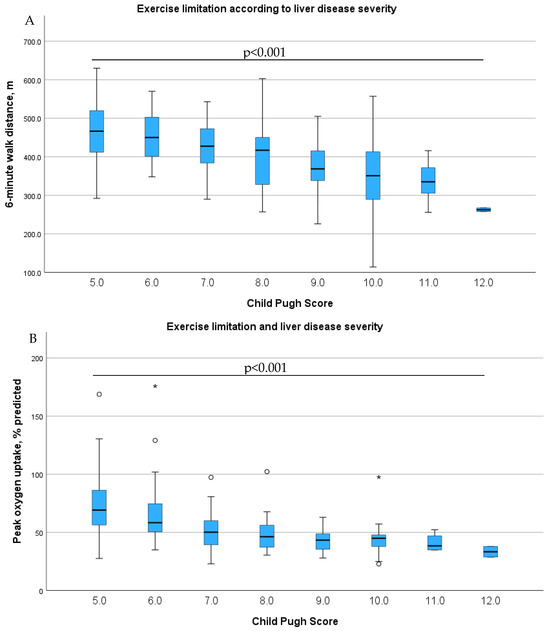
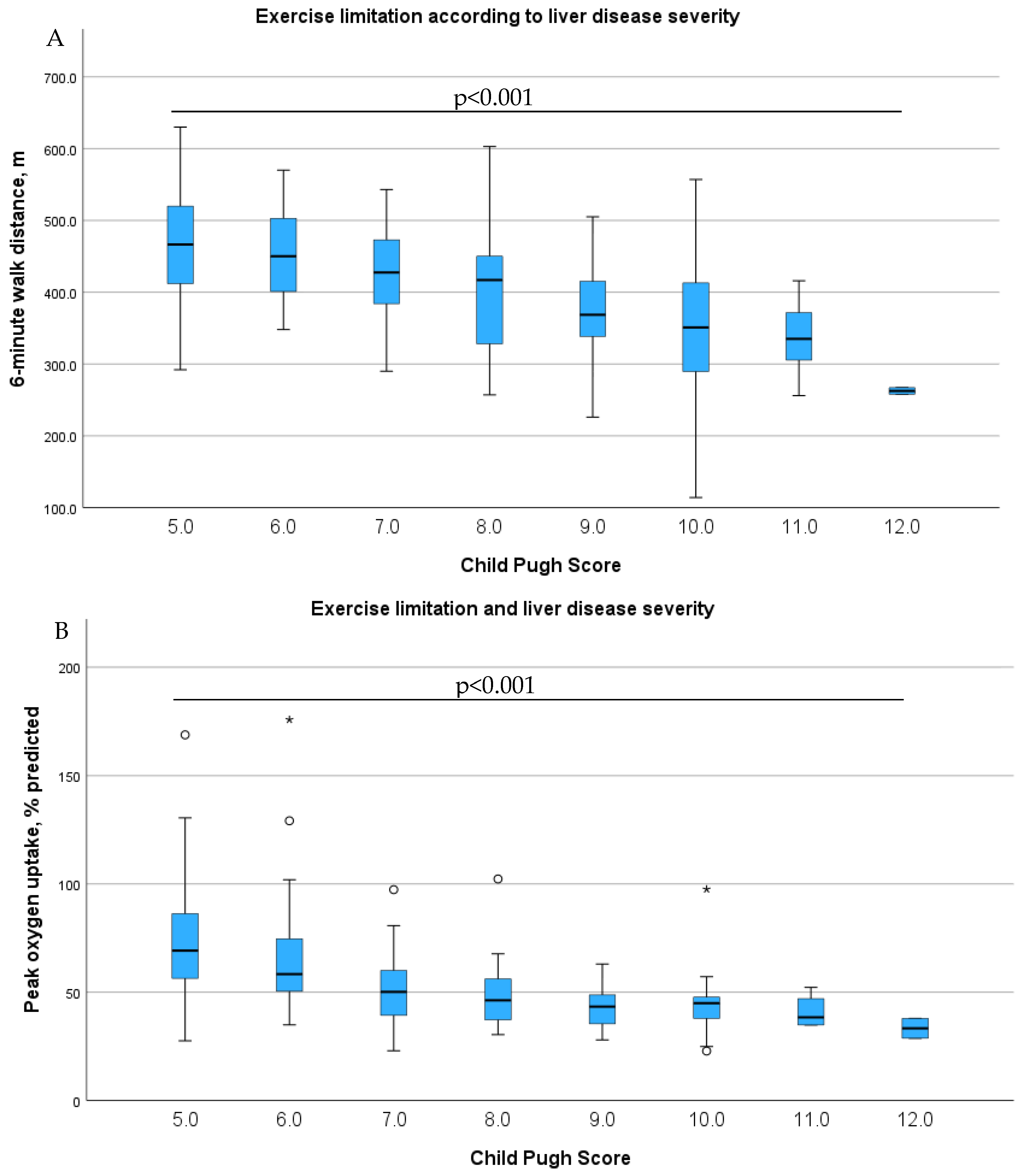
All patients underwent at least one type of exercise testing. The six-minute-walking-test-derived distance was performed in N = 177 patients and cardiopulmonary exercise testing in N = 170 patients, and N = 150 underwent both tests. Overall, the patients were markedly reduced in their daily exercise performance with 422 ± 79 m in the six-minute-walking-test-derived distance and a peak VO2 of 54 (42–70) % predicted (Table 1), and the impairment in exercise capacity was significantly associated with liver disease severity (peak VO2% predicted: Child–Pugh A 71% (57–92), Child–Pugh B 50% (40–60), Child–Pugh C 42% (35–54), p < 0.001; and six-minute-walking-test-derived distance: Child–Pugh A 459 ± 73 m, Child–Pugh B 402 ± 81 m, Child–Pugh C 342 ± 93 m, p < 0.001) (Figure 1).
Figure 1.
Boxplots showing that 6-min-walk distance (A) and peak oxygen uptake (B) are continuously decreasing with liver disease severity. ° Moderate outliers, meaning values that lie somewhat outside the typical range (by definition, between 1.5 × IQR and 3 × IQR from the quartile); * Extreme outliers, meaning values that lie far outside the typical range (by definition, more than 3 × IQR from the quartile).
Subjective and objective exercise-limiting factors:
At cessation of exercise, subjects reported muscular exhaustion or muscle pain (65%), dyspnea (13%), or other reasons (9%) as the main exercise-limiting factor. Chest pain was rare (3%). As a major cause of exercise limitation, we identified ventilatory (41%) and metabolic (34%) factors. Cardiac limitation was rare (6%) (Table 2).
Table 2.
Reasons for exercise limitation.
3.3. Exercise Performance as Predictor of Survival
During the median (IQR) observation time of 85 (25–105) months, a total of 48 (24%) patients underwent liver transplantation and 88 patients (59%) died. Mortality rates were significantly associated with increasing liver disease severity: Child–Pugh A 45% (38 of 85), Child–Pugh B 75% (38 of 51), and Child–Pugh C 87% (13 of 15). The leading cause of death was liver failure (n = 46, 52%), hepatocellular carcinoma (N = 10, 11%), sepsis (N = 9, 10%), and esophageal varices bleeding (N = 6; 7%). In n = 8 (9%), the cause of death remained unknown. Stratifying the cohort by the predefined cutoff values, we found that patients with a six-minute-walking-test-derived distance ≤ 440 m and a peak VO2 ≤ 65% predicted had significantly worse liver function, more dyspnea, a higher body mass index (BMI), a lower vital capacity, and higher cardiac index values as compared to those with a preserved six-minute-walking-test-derived distance and peak VO2 (Table 1). Out of the 88 patients who died, n = 70 (80%) had a low six-minute-walking-test-derived distance ≤ 440 m and n = 60 (68%) had a peak VO2 ≤ 65% predicted.
The cumulative incidence of death, while accounting for liver transplantation, was higher with increasing age (p = 0.008; sHR 1.03 95% CI: 1.01–1.06), but was not affected by sex (p = 0.919; sHR 1.03 95% CI: 0.63–1.62). Exercise markers had an age- and sex-independent impact on survival (six-minute-walking-test-derived distance; p = 0.002, sHR: 0.996 95% CI: 0.993–0.998 and peak VO2 p = 0.023, sHR: 0.987 95% CI: 0.976–0.998).
In outcome models including age, sex, and one of the baseline parameters such as albumin, creatinine, NT-proBNP, bilirubin, INR, MELD, and Child–Pugh score, all models with the six-minute-walking-test-derived distance were significant except for models including the MELD score and Child–Pugh score. In contrast, peak VO2 only remained a significant predictor when adjusted for age, sex, and creatinine (Table 3).
Table 3.
Competing risk analysis for prediction of death (competing risk: liver transplantation) by 6MWD (left) and peak VO2 (right), respectively.
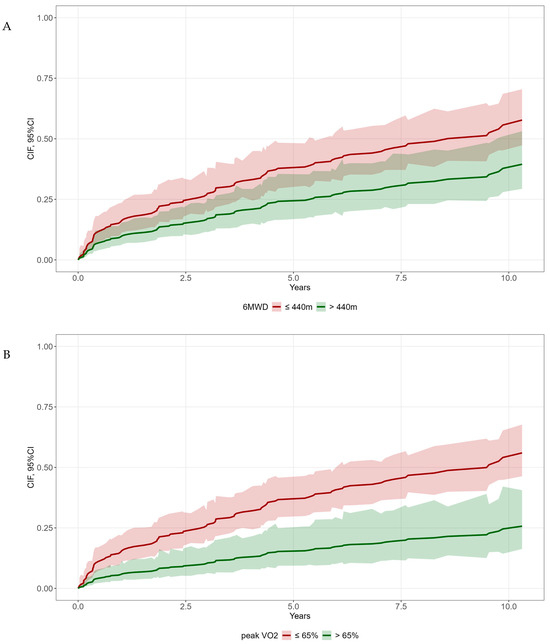
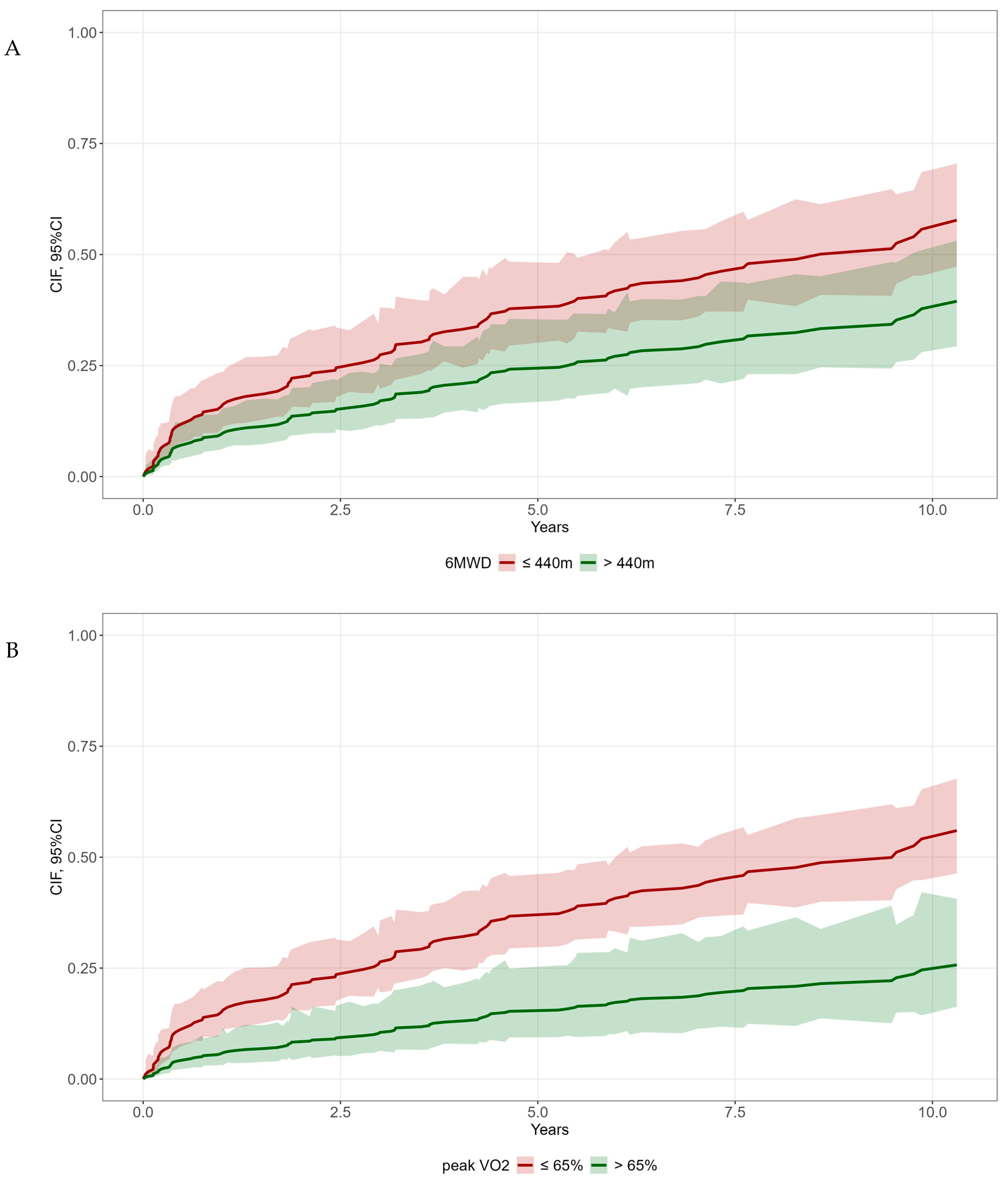
After dichotomization and adjustment for age and sex, both the six-minute-walking-test-derived distance (p = 0.020, sHR: 0.58, 95% CI: 0.37–0.92; Figure 2A) and peak VO2 (p = 0.001, sHR: 0.36, 95% CI: 0.20–0.64; Figure 2B) remained significant predictors of mortality.
Figure 2.
Cumulative incidence function overall survival and liver transplantation (competing risk) adjusted for age and sex by (A) six-minute-walking distance (6MWD) (p = 0.020); (B) peak VO2 of ≤ vs. >65% predicted (p = 0.001). Abbreviations: 6MWD: 6-min-walk distance. Peak VO2: peak oxygen uptake.
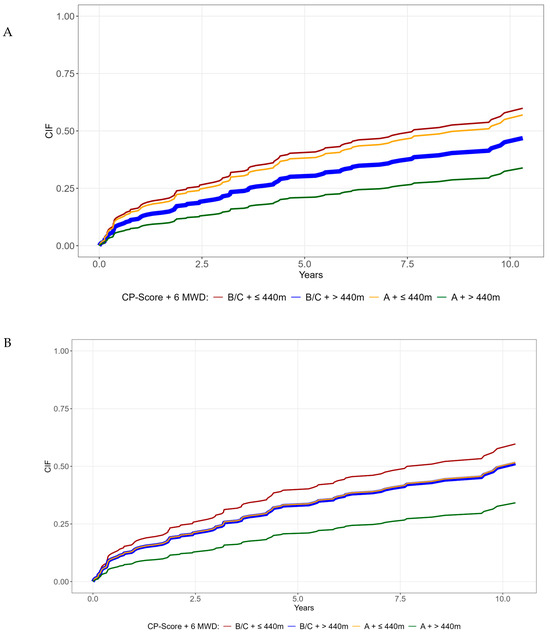
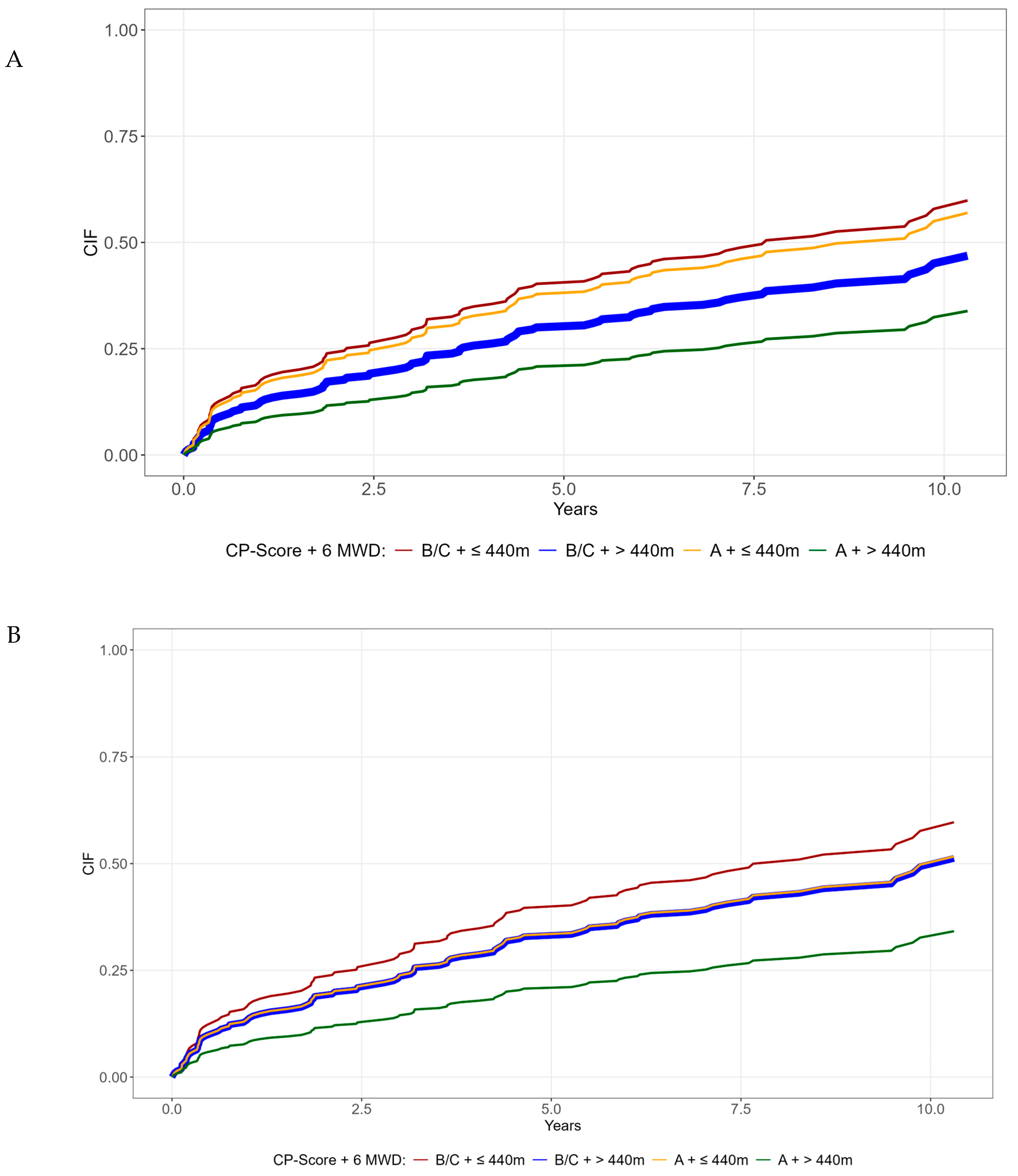
Combining the dichotomized six-minute-walking-test-derived distance with the Child–Pugh class identified subgroups with an additional mortality risk (Figure 3A). Patients with Child–Pugh Class A and a six-minute-walking-test-derived distance ≤ 440 m had worse outcomes than those with Class A and a six-minute-walking-test-derived distance > 440 m (p = 0.016, sHR: 2.04, 95% CI: 1.14–3.64), although this difference was not significant after adjustment for age and sex (p = 0.065) (Figure 3B). Interestingly, these patients had similar survival to those with Child–Pugh Class B + C and a six-minute-walking-test-derived distance > 440 m (Figure 3B).
Figure 3.
Cumulative incidence function overall survival and liver transplantation (competing risk) for (A) combined CP score/6MWD groups (Group 1: Child–Pugh B,C 6MWD ≤ 440 m (red line); group 2: Child–Pugh B,C, 6MWD > 440 m (orange line); group 3: Child–Pugh A, 6 MWD ≤ 440 m (blue line); Reference: Child–Pugh A, 6 MWD > 440 m (green line); group 1 vs Reference: p = 0.006, group 2 vs. Reference, p = 0.307., group 3 vs. Reference: p = 0.016). (B) In the multivariate model, correcting for age and sex (group 1 vs Reference: p = 0.008, group 2 vs. Reference, p = 0.196, group 3 vs. Reference: p = 0.065).
Comparing prediction models including MELD or CP (adjusted for age and sex) showed no significant different predictive value compared to models including 6MWD (Supplementary Table S3A,B) or peak VO2 (Supplementary Table S4A,B). Moreover, the time-dependent AUC did not differ (Supplementary Table S3A,B and Supplementary Table S4A,B).
4. Discussion
This study aimed to evaluate the clinical impact and prognostic value of exercise capacity, assessed by six-minute-walking-test-derived distance and peak VO2, in patients with mild-to-moderate liver cirrhosis. Our findings suggest that both the reduced six-minute-walking-test-derived distance and peak VO2 are strong predictors of mortality, even after adjustment for age and sex. The combination of the six-minute-walking-test-derived distance and Child–Pugh classes identified patients at a particularly high mortality risk.
There is broad evidence that patients with liver cirrhosis are limited in their exercise capacity and that this limitation is associated with liver disease severity [1,15]. Wiesinger et al. performed a study in 26 patients with cirrhosis and found that they were impaired in their daily activities, which was also associated with cirrhosis severity [21]. Terziyski et al. found in 19 patients with mild-or-moderate liver cirrhosis a reduced exercise tolerance dependent on liver disease severity [22]. Our prospective large study, including 197 outpatients, confirmed these findings. The pathophysiology of impaired exercise capacity in patients with cirrhosis may be multifactorial and is still not fully understood. Up to one-third of patients with cirrhosis develop cirrhotic cardiomyopathy, characterized by impaired left ventricular contractility, diastolic dysfunction, and electrophysiological alterations [23,24]. Interestingly, at rest, patients with cirrhotic cardiomyopathy typically show a hyperdynamic circulation with decreased systemic arterial pressures due to vasomotor collapse. During exercise, however, the cardiac output response is nearly completely blunted, which, per se, limits exercise capacity [25,26]. In addition, pulmonary vascular complications of liver cirrhosis, including hepatopulmonary syndrome and portopulmonary hypertension, are associated with an impaired exercise capacity [27,28]. Hepatopulmonary syndrome is characterized by a loss of pulmonary vascular tone and, accordingly, ventilation perfusion mismatch, causing systemic hypoxemia [28,29]. The prevalence has been estimated at up to 33% in patients with cirrhosis [1]. Portopulmonary hypertension, in transplant candidates, has a prevalence of 4–16% and is caused by the constrictive remodeling of pulmonary arteries leading to an increased pulmonary vascular resistance and right ventricular strain [1,12]. In our collective, N = 40 patients had an increased cardiac output as an indicator for a hyperdynamic state. None of these patients showed a clinically relevant left ventricular dysfunction. However, this may be due to the fact that relevant left ventricular dysfunction was an exclusion criterium for our study. In our few patients with portopulmonary hypertension, exercise limitation by a circulatory limitation was caused in 3 patients and a metabolic limitation in 2 of the overall cohort. The presence of ascites may further limit exercise capacity by ventilatory limitation due to restrictive ventilation caused by the abdominal compression of the lung [30]. Indeed, 36 patients had this restrictive ventilation pattern and 35 of them had ascites.
In addition to cardiopulmonary exercise limitation, up to 68% of cirrhotic patients suffer from frailty, which is defined as a syndrome of decreased reserve and resistance to stressors that results in multiple organ dysfunction including skeletal muscle and causing vulnerability to adverse outcomes [6,7]. Frailty is strongly associated with impaired exercise tolerance [5].
This study is the first to analyze exercise-limiting factors in patients with cirrhosis. Interestingly, among the subjective factors, muscle exhaustion and muscle pain were the most frequent reasons for exercise termination, while dyspnea and cardiac complaints were rare (3%). Among the objective exercise-limiting factors, ventilatory (41%) and metabolic factors (34%) were predominant and cardiac factors remained rare. This result may be biased by the fact that patients with severe cardiac comorbidities were excluded. Therefore, this population might underestimate the true prevalence of cardiac exercise limitation in an unselected cohort. A total of 29 patients exhibited combined exercise-limiting factors, and, notably, all of them reported muscular weakness/pain as their primary reason for exercise cessation. This finding suggests that frailty and, particularly, peripheral muscle dysfunction may represent a major limiting factor in this subset of patients. However, neither frailty nor functional performance measures are currently integrated into liver disease severity scores, despite their importance for transplant-free survival and post-transplant outcomes [31,32,33]. This may be due to the fact that frail patients and those with a reduced functional status may lack the physiological reserves to survive the transplant procedure. We acknowledge that frailty and sarcopenia are important determinants of both exercise capacity and prognosis in patients with cirrhosis. The lack of formal frailty assessments in our cohort represents a potential confounder, as it may partly account for the observed associations between 6MWD, peak VO2, and clinical outcomes. Future studies incorporating standardized assessments of frailty and sarcopenia are needed to better delineate their independent prognostic contributions. Taken together, multiple factors including frailty- and cirrhosis-associated comorbidities such as ventilatory limitation due to increased intra-abdominal pressure contribute to an impaired exercise capacity in patients with cirrhosis.
Data from the literature indicate that a reduced exercise tolerance is associated with a worse outcome in the liver transplant setting [34]. Epstein et al. performed a prospective study in 156 patients with cirrhosis on the liver transplant waiting list and found that a reduced peak VO2 (<60% predicted) was associated with short-term survival after liver transplantation [34]. In another prospective study by Dharancy et al., patients with cirrhosis waiting for liver transplantation had a significantly lower 1-year survival (65%) when the peak VO2 was <60% predicted compared to those with a peak VO2 exceeding 60% predicted (96%) [35]. Ow et al. investigated the association between functional capacity and short-term survival before liver transplantation in 176 patients. They found the peak VO2 to be a predictor of short-term survival, adjusted for the MELD score, UK Model for End-Stage Liver Disease (UKELD) score, age, and anaerobic threshold [36]. In a study of 106 outpatients with all stages of liver cirrhosis without relevant cardiopulmonary comorbidities, the six-minute-walking-test-derived distance was an independent predictor of mortality when adjusted for the Child–Pugh score [37]. A distance of 387 m (sensitivity 91%, specificity 88%) was associated with mortality.
Few data exist on the prognostic relevance of exercise performance in compensated cirrhosis not listed for liver transplantation. In a prospective study of 55 patients with compensated cirrhosis, a six-minute-walking-test-derived distance of 402 m turned out to be a significant predictor of clinical decompensation. The authors suggested to add the six-minute-walking-test-derived distance to the clinical assessment of these patients [38]. However, survival was not investigated.
Established prognostic tools such as the MELD and Child–Pugh scores are widely used to predict disease progression and transplant need [30]. However, these scores do not account for physical performance, an important determinant of the ability to tolerate peri-transplant stress and complications [34,35,36]. Our findings extend previous observations by demonstrating that a reduced exercise capacity, assessed by both the six-minute-walking-test-derived distance and peak VO2, are age- and sex-independent predictors of long-term mortality in patients with mild-to-moderate liver cirrhosis. In our cohort, a six-minute-walking-test-derived distance ≤ 440 m or a peak VO2 ≤ 65% predicted were significantly associated with poor liver function, dyspnea, and poor survival compared to those with better functional performance. Importantly, both the six-minute-walking-test-derived distance and peak VO2 remained significant prognostic markers even after adjusting for age and sex, while other baseline variables such as albumin, creatinine, NT-proBNP, and INR did not add prognostic value and were even outperformed when combined with markers of exercise performance. Interestingly, adding the six-minute-walking-test-derived distance to established risk scores (Child–Pugh score and MELD score) did not result in prediction improvement. This finding suggests that exercise capacity explains the outcome heterogeneity in a manner partly overlapping with the clinical severity captured by these scores. In our models, approximately 16% of the variance was shared between the six-minute-walking-test-derived distance and the cumulative scores, indicating a meaningful but not complete overlap without violating multicollinearity assumptions. Notably, in several adjusted models, the 6MWD remained a more robust predictor than peak VO2, which lost statistical significance in multiple analyses. Of note, a direct comparison of the Child–Pugh class or MELD with peak VO2 and 6MWD showed no differences in the prognostic value of exercise tests as compared to these established biochemical risk prediction scores. These data suggest that the simpler and more widely accessible 6MWD may represent a pragmatic and clinically sufficient tool for risk stratification in clinical routine. Moreover, the combination of the dichotomized six-minute-walking-test-derived distance with established risk scores identified particularly high-risk subgroups within CP stages. This supports the prior findings by Ow et al. [36], who showed that the peak VO2 independently predicts short-term survival even after adjusting for the MELD and UKELD scores. However, after adjustment for age and sex, these differences did not remain significant (p = 0.065). Both the reduced six-minute-walking-test-derived distance and peak VO2 were age- and sex-independent predictors of mortality, and their combination further improved risk stratification, identifying patients with a more-than-threefold-higher risk of death. Notably, a preserved peak VO2 appeared slightly more protective than the six-minute-walking-test-derived distance alone when the two measures were discordant.
Taken together, these results suggest that functional capacity, as assessed by simple tests such as the six-minute-walking-test-derived distance or cardiopulmonary exercise testing, provides complementary information to established severity scores and could be considered in a multidimensional risk assessment approach in patients with liver cirrhosis.
5. Limitations
The single-center character is a limitation of the present study. However, the cohort size and the number of events was high enough to allow for a multivariate survival analysis correcting for covariates like age, gender, Child–Pugh score, and MELD score, as well as bilirubin, creatine, International Normalized Ratio (INR), albumin, and NT-proBNP. Due to multicollinearity reasons, no overall model was calculated. Another limitation might be the fact that not all of the patients underwent both cardiopulmonary exercise testing and the six-minute-walking test; however, this was only the case in 10% of patients. Furthermore, 17% of the patients had not reached any objective exercise-limiting factor at cessation of exercise testing, suggesting motivational or peripheral factors. Another limitation is the lack of sarcopenia and frailty markers as part of our dataset.
6. Conclusions
In well-characterized outpatients with mostly compensated cirrhosis, cardiopulmonary exercise capacity is severely limited and significantly associated with poor survival. The reduced six-minute-walking-test-derived-distance and impaired peak VO2 independently predict mortality. The combination of functional parameters may further refine risk stratification and help to identify subgroups at particular risk. A functional assessment, when integrated with liver disease severity scores, provides additional prognostic information and may guide clinical decision-making.
Supplementary Materials
The following supporting information can be downloaded at: https://www.mdpi.com/article/10.3390/diagnostics16071036/s1, Table S1: etiology of cirrhosis; Table S2: comorbidities; Table S3A: Model comparison Child Pugh Class vs. 6MWT; Table S3B: Model comparison MELD vs. 6MWT; Table S4A: Model comparison Child Pugh Class vs. peak VO2; Table S4B: Model comparison MELD vs. peak VO2.
Author Contributions
Conceptualization, P.D.; methodology, A.A. and P.D.; formal analysis, T.J. and A.A.; investigation, P.D.; data curation, M.G. and A.L.; writing—original draft, T.J.; writing—review and editing, T.J., A.A., G.K., P.F., V.F., M.G., N.J., A.L., H.O., V.S., N.K., R.S., and P.D.; supervision, P.D.; project administration, T.J. and P.D. All authors have read and agreed to the published version of the manuscript.
Funding
This research received no external funding.
Institutional Review Board Statement
The study was conducted in accordance with the Declaration of Helsinki. This study was approved by the local ethics committee at the Medical University of Graz (approved 5 May 2023: 35-313 ex 22/23).
Informed Consent Statement
Informed consent was obtained from all subjects involved in the study.
Data Availability Statement
The data presented in this study are available on request from the corresponding author. The data are not publicly available due to legal reasons.
Conflicts of Interest
The authors declare no conflicts of interest related to the present work.
Abbreviations
The following abbreviations are used in this manuscript:
| AaDO2 | Alveolar–arterial oxygen difference |
| AIH | Autoimmune Hepatitis |
| ANOVA | Analysis of Variance |
| BMI | Body Mass Index |
| CI | Confidence Interval |
| CIF | Cumulative Incidence Function |
| CP | Child–Pugh |
| CPET | Cardiopulmonary Exercise Testing |
| FVC | Forced Vital Capacity |
| HCV | Hepatitis C Virus |
| HPS | Hepatopulmonary Syndrome |
| IQR | Interquartile Range |
| INR | International Normalized Ratio |
| LT | Liver Transplantation |
| MASLD | Metabolic-dysfunction-associated steatotic liver disease |
| MELD | Model for End-Stage Liver Disease |
| mmHg | Millimeters of Mercury |
| N/A | Not Applicable |
| NT-proBNP | N-terminal pro-B-type Natriuretic Peptide |
| RAP | Right Atrial Pressure |
| sHR | Subdistribution Hazard Ratio |
| sPAP | Systolic Pulmonary Arterial Pressure |
| SD | Standard Deviation |
| VO2 | Oxygen Uptake |
| WHO-FC | World Health Organization—Functional Class |
| 6MWD | Six-Minute-Walk Distance |
References
- Douschan, P.; Kovacs, G.; Sassmann, T.; Stadlbauer, V.; Avian, A.; Foris, V.; Tatscher, E.; Durchschein, F.; Rainer, F.; Spindelboeck, W.; et al. Pulmonary vascular disease and exercise hemodynamics in chronic liver disease. Respir. Med. 2022, 202, 106987. [Google Scholar] [CrossRef] [Scilit] [PubMed]
- Główczyńska, R.; Borodzicz-Jażdżyk, S.; Peller, M.; Raszeja-Wyszomirska, J.; Milkiewicz, P.; Zieniewicz, K.; Opolski, G. Chronotropic incompetence in end-stage liver disease. PLoS ONE 2022, 17, e0270784. [Google Scholar] [CrossRef] [Scilit]
- Sogbe, M.; Hummer, B.; Stine, J.G.; Lizaola-Mayo, B.; Forman, D.E.; Vargas, H.E.; Duarte-Rojo, A. Advanced Liver Fibrosis Impairs Cardiorespiratory Fitness in Patients with Metabolic Dysfunction-Associated Steatotic Liver Disease. Dig. Dis. Sci. 2025, 70, 1530–1539. [Google Scholar] [CrossRef] [Scilit] [PubMed]
- Bunchorntavakul, C.; Reddy, K.R. Review article: Malnutrition/sarcopenia and frailty in patients with cirrhosis. Aliment. Pharmacol. Ther. 2020, 51, 64–77. [Google Scholar] [CrossRef] [Scilit]
- Lai, J.C.; Volk, M.L.; Strasburg, D.; Alexander, N. Performance-Based Measures Associate With Frailty in Patients with End-Stage Liver Disease. Transplantation 2016, 100, 2656–2660. [Google Scholar] [CrossRef] [Scilit]
- Bhanji, R.A.; Montano-Loza, A.J.; Watt, K.D. Sarcopenia in Cirrhosis: Looking Beyond the Skeletal Muscle Loss to See the Systemic Disease. Hepatology 2019, 70, 2193–2203. [Google Scholar] [CrossRef] [Scilit] [PubMed]
- Lai, J.C.; Tandon, P.; Bernal, W.; Tapper, E.B.; Ekong, U.; Dasarathy, S.; Carey, E.J. Malnutrition, Frailty, and Sarcopenia in Patients with Cirrhosis: 2021 Practice Guidance by the American Association for the Study of Liver Diseases. Hepatology 2021, 74, 1611–1644. [Google Scholar] [CrossRef] [Scilit]
- Fuentes-Abolafio, I.J.; Stubbs, B.; Pérez-Belmonte, L.M.; Bernal-López, M.R.; Gómez-Huelgas, R.; Cuesta-Vargas, A.I. Physical functional performance and prognosis in patients with heart failure: A systematic review and meta-analysis. BMC Cardiovasc. Disord. 2020, 20, 512. [Google Scholar] [CrossRef] [Scilit]
- Coulshed, A.; Coulshed, D.; Pathan, F. Systematic Review of the Use of the 6-Minute Walk Test in Measuring and Improving Prognosis in Patients with Ischemic Heart Disease. CJC Open 2023, 5, 816–825. [Google Scholar] [CrossRef] [Scilit]
- García-Talavera, I.; Figueira-Gonçalves, J.M.; Golpe, R.; Esteban, C.; Amado, C.; Pérez-Méndez, L.I.; Aramburu, A.; Conde-Martel, A. Early Desaturation During 6-Minute Walk Test is a Predictor of Mortality in COPD. Lung 2023, 201, 217–224. [Google Scholar] [CrossRef] [Scilit] [PubMed]
- Waatevik, M.; Frisk, B.; Real, F.G.; Hardie, J.A.; Bakke, P.; Nilsen, R.M.; Eagan, T.M.; Johannessen, A. One Year Change in 6-Minute Walk Test Outcomes is Associated with COPD Prognosis. COPD 2020, 17, 662–671. [Google Scholar] [CrossRef] [Scilit] [PubMed]
- Humbert, M.; Kovacs, G.; Hoeper, M.M.; Badagliacca, R.; Berger, R.M.F.; Brida, M.; Carlsen, J.; Coats, A.J.; Escribano-Subias, P.; Ferrari, P.; et al. 2022 ESC/ERS Guidelines for the diagnosis and treatment of pulmonary hypertension. Eur. Respir. J. 2023, 61, 2200879. [Google Scholar] [CrossRef] [Scilit] [PubMed]
- Kovacs, G.; Bartolome, S.; Denton, C.P.; Gatzoulis, M.A.; Gu, S.; Khanna, D.; Badesch, D.; Montani, D. Definition, classification and diagnosis of pulmonary hypertension. Eur. Respir. J. 2024, 64, 2401324. [Google Scholar] [CrossRef] [Scilit]
- Jamali, T.; Raasikh, T.; Bustamante, G.; Sisson, A.; Tandon, P.; Duarte-Rojo, A.; Hernaez, R. Outcomes of Exercise Interventions in Patients With Advanced Liver Disease: A Systematic Review of Randomized Clinical Trials. Am. J. Gastroenterol. 2022, 117, 1614–1620. [Google Scholar] [CrossRef] [Scilit]
- Tandon, P.; Ismond, K.P.; Riess, K.; Duarte-Rojo, A.; Al-Judaibi, B.; Dunn, M.A.; Holman, J.; Howes, N.; Haykowsky, M.J.F.; Josbeno, D.A.; et al. Exercise in cirrhosis: Translating evidence and experience to practice. J. Hepatol. 2018, 69, 1164–1177. [Google Scholar] [CrossRef] [Scilit]
- Moody, W.E.; Holloway, B.; Arumugam, P.; Gill, S.; Wahid, Y.S.; Boivin, C.M.; Thomson, L.E.; Berman, D.S.; Armstrong, M.J.; Ferguson, J.; et al. Prognostic value of coronary risk factors, exercise capacity and single photon emission computed tomography in liver transplantation candidates: A 5-year follow-up study. J. Nucl. Cardiol. 2021, 28, 2876–2891. [Google Scholar] [CrossRef] [Scilit]
- Pollok, J.M.; Tinguely, P.; Berenguer, M.; Niemann, C.U.; Raptis, D.A.; Spiro, M.; Mayr, A.; Dominguez, B.; Muller, E.; Rando, K.; et al. Enhanced recovery for liver transplantation: Recommendations from the 2022 International Liver Transplantation Society consensus conference. Lancet Gastroenterol. Hepatol. 2023, 8, 81–94. [Google Scholar] [CrossRef] [Scilit]
- Galiè, N.; Humbert, M.; Vachiery, J.-L.; Gibbs, S.; Lang, I.; Torbicki, A.; Hoeper, M. 2015 ESC/ERS Guidelines for the diagnosis and treatment of pulmonary hypertension: The Joint Task Force for the Diagnosis and Treatment of Pulmonary Hypertension of the European Society of Cardiology (ESC) and the European Respiratory Society (ERS): Endorsed by: Association for European Paediatric and Congenital Cardiology (AEPC), International Society for Heart and Lung Transplantation (ISHLT). Eur. Heart J. 2016, 37, 67–119. [Google Scholar] [CrossRef] [Scilit]
- John, T.; Tello, K.; Olschewski, H.; Abeln, H.; Foris, V.; Guettler, B.R.; John, N.; Zeder, K.; Kneidinger, N.; Kovacs, G.; et al. Noninvasive mean pulmonary arterial pressure/oxygen uptake slope as a predictor of pulmonary exercise haemodynamics and outcome. ERJ Open Res. 2025, 12, 01135-2025. [Google Scholar] [CrossRef] [Scilit] [PubMed]
- Fine, J.P.; Gray, R.J. A Proportional Hazards Model for the Subdistribution of a Competing Risk. J. Am. Stat. Assoc. 1999, 94, 496–509. [Google Scholar] [CrossRef]
- Wiesinger, G.F.; Quittan, M.; Zimmermann, K.; Nuhr, M.; Wichlas, M.; Bodingbauer, M.; Asari, R.; Berlakovich, G.; Crevenna, R.; Fialka-Moser, V.; et al. Physical performance and health-related quality of life in men on a liver transplantation waiting list. J. Rehabil. Med. 2001, 33, 260–265. [Google Scholar] [CrossRef] [Scilit]
- Terziyski, K.; Andonov, V.; Marinov, B.; Kostianev, S. Exercise performance and ventilatory efficiency in patients with mild and moderate liver cirrhosis. Clin. Exp. Pharmacol. Physiol. 2008, 35, 135–140. [Google Scholar] [CrossRef] [Scilit]
- Ying, X.; Oje, A.O.; De Witte, A.J.; Slaughter, J.C.; Spann, A.L.; Jesudian, A.B.; Rosenblatt, R.; Ng, C.; Sholle, E.; Reidy, D.; et al. Severity of liver disease is associated with cirrhotic cardiomyopathy: A multicenter study. Liver Transplant. 2025, 32, 539–548. [Google Scholar] [CrossRef] [Scilit]
- Razpotnik, M.; Bota, S.; Wimmer, P.; Hackl, M.; Lesnik, G.; Alber, H.; Peck-Radosavljevic, M. The prevalence of cirrhotic cardiomyopathy according to different diagnostic criteria. Liver Int. 2021, 41, 1058–1069. [Google Scholar] [CrossRef] [Scilit]
- Xanthopoulos, A.; Starling, R.C.; Kitai, T.; Triposkiadis, F. Heart Failure and Liver Disease: Cardiohepatic Interactions. JACC Heart Fail. 2019, 7, 87–97. [Google Scholar] [CrossRef] [Scilit]
- Danielsen, K.V.; Wiese, S.; Busk, T.; Nabilou, P.; Kronborg, T.M.; Petersen, C.L.; Hove, J.D.; Møller, S.; Bendtsen, F. Cardiovascular Mapping in Cirrhosis From the Compensated Stage to Hepatorenal Syndrome: A Magnetic Resonance Study. Am. J. Gastroenterol. 2022, 117, 1269–1278. [Google Scholar] [CrossRef] [Scilit] [PubMed]
- Kawut, S. “Impact of hepatopulmonary syndrome in liver transplantation candidates and the role of angiogenesis.” S.M. Kawut, M.J. Krowka, K.A. Forde, N. Al-Naamani, K.L. Krok, M. Patel, C.R. Bartoli, M. Doyle, J. Moutchia, G. Lin, J.K. Oh, C.D. Mottram, P.D. Scanlon and M.B. Fallon for the Pulmonary Vascular Complications of Liver Disease Study Group. Eur Respir J 2022; 60: 2102304. Eur. Respir. J. 2023, 62, 2152304. [Google Scholar] [CrossRef] [Scilit]
- Del Valle, K.; DuBrock, H.M. Hepatopulmonary Syndrome and Portopulmonary Hypertension: Pulmonary Vascular Complications of Liver Disease. Compr. Physiol. 2021, 11, 3281–3302. [Google Scholar] [CrossRef] [Scilit] [PubMed]
- Rodríguez-Roisin, R.; Krowka, M.J.; Agustí, A. Hepatopulmonary Disorders: Gas Exchange and Vascular Manifestations in Chronic Liver Disease. Compr. Physiol. 2018, 8, 711–729. [Google Scholar] [CrossRef] [Scilit]
- Karvellas, C.J.; Bajaj, J.S.; Kamath, P.S.; Napolitano, L.; O’Leary, J.G.; Solà, E.; Subramanian, R.; Wong, F.; Asrani, S.K. AASLD Practice Guidance on Acute-on-chronic liver failure and the management of critically ill patients with cirrhosis. Hepatology 2024, 79, 1463–1502. [Google Scholar] [CrossRef] [Scilit]
- Elsabaawy, M.; Afify, S.; Othman, W.; Ragab, A. Frailty and liver transplant eligibility beyond MELD scores: Integrating functional status into candidate selection. BMC Gastroenterol. 2025, 25, 743. [Google Scholar] [CrossRef] [Scilit]
- Williams, F.R.; Quinlan, J.; Freer, A.; Morrison, B.; Sitch, A.; Hockey, F.; Klas, N.; Towey, J.; Perera, T.P.R.; Rajoriya, N.; et al. Duke Activity Status Index and Liver Frailty Index predict mortality in ambulatory patients with advanced chronic liver disease: A prospective, observational study. Aliment. Pharmacol. Ther. 2024, 59, 547–557. [Google Scholar] [CrossRef] [Scilit]
- Valeriano, V.; Funaro, S.; Lionetti, R.; Riggio, O.; Pulcinelli, G.; Fiore, P.; Masini, A.; Castro, S.; Merli, M. Modification of cardiac function in cirrhotic patients with and without ascites. Am. J. Gastroenterol. 2000, 95, 3200–3205. [Google Scholar] [CrossRef]
- Epstein, S.K.; Freeman, R.B.; Khayat, A.; Unterborn, J.N.; Pratt, D.S.; Kaplan, M.M. Aerobic capacity is associated with 100-day outcome after hepatic transplantation. Liver Transplant. 2004, 10, 418–424. [Google Scholar] [CrossRef] [Scilit]
- Dharancy, S.; Lemyze, M.; Boleslawski, E.; Neviere, R.; Declerck, N.; Canva, V.; Wallaert, B.; Mathurin, P.; Pruvot, F.R. Impact of impaired aerobic capacity on liver transplant candidates. Transplantation 2008, 86, 1077–1083. [Google Scholar] [CrossRef] [Scilit]
- Ow, M.M.G.; Erasmus, P.; Minto, G.; Struthers, R.; Joseph, M.; Smith, A.; Warshow, U.M.; Cramp, M.E.; Cross, T.J.S. Impaired functional capacity in potential liver transplant candidates predicts short-term mortality before transplantation. Liver Transplant. 2014, 20, 1081–1088. [Google Scholar] [CrossRef] [Scilit] [PubMed]
- Pimentel, C.F.M.G.; Amaral, A.C.d.C.; Gonzalez, A.M.; Lai, M.; Mota, D.d.O.; Ferraz, M.L.G.; Junior, W.M.; Kondo, M. Six-minute walking test performance is associated with survival in cirrhotic patients. World J. Hepatol. 2021, 13, 1791–1801. [Google Scholar] [CrossRef] [Scilit] [PubMed]
- Henrique, D.M.N.; Malaguti, C.; Limonge, T.M.; Siqueira, M.R.; Paticcie, T.M.F.; Mira, P.A.C.; Laterza, M.C.; Mourão-Junior, C.A.; Pacce, F.H.d.L.; Chebli, J.M.F. Six-Minute Walking Test as a Predictor of Clinical Decompensation in Patients with Cirrhosis. J. Gastrointest. Liver Dis. 2021, 30, 103–109. [Google Scholar] [CrossRef] [Scilit] [PubMed]

Disclaimer/Publisher’s Note: The statements, opinions and data contained in all publications are solely those of the individual author(s) and contributor(s) and not of MDPI and/or the editor(s). MDPI and/or the editor(s) disclaim responsibility for any injury to people or property resulting from any ideas, methods, instructions or products referred to in the content. |
© 2026 by the authors. Licensee MDPI, Basel, Switzerland. This article is an open access article distributed under the terms and conditions of the Creative Commons Attribution (CC BY) license.