Article

Proteomics-Based Study of Potential Emphysema Biomarkers Reveals Systemic Redox System and Extracellular Matrix Component Dysregulation


1
Department of Pulmonology, University Hospital Dubrava, 10 000 Zagreb, Croatia
2
Department of Proteomics, Center for Translational and Clinical Research, School of Medicine, University of Zagreb, 10 000 Zagreb, Croatia
3
BIMIS—Biomedical Research Center Šalata, School of Medicine, University of Zagreb, 10 000 Zagreb, Croatia
4
Department of Clinical Immunology, Allergology and Rheumatology, University Hospital Dubrava, 10 000 Zagreb, Croatia
5
Central European Institute of Technology, Masaryk University, 612 00 Brno, Czech Republic
6
Department of Internal Medicine, School of Medicine, University of Zagreb, 10 000 Zagreb, Croatia
7
Department of Anatomy, “Drago Perović”, School of Medicine, University of Zagreb, 10 000 Zagreb, Croatia
*
Author to whom correspondence should be addressed.
Diagnostics 2026, 16(6), 931; https://doi.org/10.3390/diagnostics16060931

Submission received: 13 February 2026 / Revised: 16 March 2026 / Accepted: 19 March 2026 / Published: 21 March 2026
(This article belongs to the Special Issue Diagnosis and Management of Lung Diseases)

Abstract

Objective: Emphysema is an important chronic obstructive pulmonary disease (COPD) phenotype characterized by the destruction of air spaces distal to the terminal bronchiole. Aiming to detect potential emphysema biomarkers and to assess the systemic effects of emphysema in blood plasma, we conducted a small cross-sectional shotgun proteomics study. Methods: This study included N = 40 participants divided into four subgroups (N = 10 per group): patients with emphysema and COPD (CE), patients with COPD but without emphysema (CN), healthy smokers (HS) and healthy never-smokers (HN). The participants were sampled non-probabilistically to be similar in terms of age, sex and comorbidities. Participants’ blood plasma was analyzed using liquid chromatography–mass spectrometry. Bioinformatic analysis included detection of differentially expressed proteins (DEPs) and overrepresentation analysis (ORA). Results: Across all groups, a total of 994 proteins were identified, with NADP-dependent malic enzyme (NADP-ME; encoded by ME1) being the only DEP in the CE vs. CN contrast. Proteins such as BMP1, ADAMTSL-2, -4 and IGFBP4, -5, 6 were identified to be upregulated in CE vs. HN. Fibulin-1, -3 and several immunoglobulin components were identified to be downregulated in the CE vs. HN contrast. ORA revealed several enriched processes, including serine-type endopeptidase activity, insulin-like growth factor I and II binding, and signaling receptor binding. Conclusion: We propose NADP-ME, an important enzyme of intermediary metabolism and redox homeostasis, as a potential biomarker candidate of emphysema. Notably, NADP-ME is also implicated in anoikis resistance. Additionally, changes in the expression levels of BMP1, ADAMTSL-2 and -4, and fibulin suggest potential major systemic effects of extracellular matrix perturbation. As all data was derived from LC-MS analysis, these findings need to be further evaluated with complementary methods.

1. Introduction

Chronic obstructive pulmonary disease (COPD) is a heterogenous condition characterized by chronic respiratory symptoms and abnormalities of the airways and/or alveoli (emphysema) that cause persistent, often progressive airflow obstruction [1]. It is considered that COPD results from gene–environment interactions occurring over the individual’s lifetime that damage the lungs and alter their normal aging process. Cigarette smoking has long been recognized as a key environmental risk factor for COPD development [1].
Emphysema is a condition (and COPD phenotype) that affects the air spaces distal to the terminal bronchiole, marked by abnormal and permanent enlargement of lung air spaces, destruction of air space walls (historically regarded to be without fibrosis, but local fibrosis may coexist) and loss of lung parenchyma elasticity [2,3,4]. At the structural level, emphysema primarily affects the alveolar wall (a delicate composite of epithelial and endothelial cells anchored to a highly specialized extracellular matrix (ECM) rich in elastin), whose integrity is essential for gas exchange and mechanical stability [2,5]. The pathogenesis of emphysema (and COPD) is very complex and incompletely understood [6]. Several pathophysiologic mechanistic axes, which are likely interconnected, in which imbalances occur, have been proposed [5,6]. The most famous is the imbalance of the protease–antiprotease system. Namely, cigarette smoking induces abnormal inflammation, which creates a protease-rich environment, and thus, an imbalance between proteases and antiproteases occurs [5]. Another hypothesis considers oxidant–antioxidant dysregulation, which highlights the fact that exposure to irritants (most notably cigarette smoke) leads to an increase in exogenous oxidants in the lungs. These irritants also lead to the recruitment of inflammatory cells, which are in turn responsible for the production of endogenous oxidants (and elastases), thus aggravating the condition [5]. Additionally, ROS activate the transcription of proinflammatory cytokines via the NF-kB pathway, thus completing the vicious cycle [7]. However, a counterbalance system comprising an elaborate antioxidant network exists, which is of paramount importance for maintaining redox homeostasis [7]. This system comprises non-enzymatic molecules (such as glutathione, vitamins C and E, and taurine) which act as a first line of defense against ROS. Additionally, several enzymes (including superoxide dismutases, peroxiredoxins, thioredoxins and glutaredoxins) act in concert with non-enzymatic antioxidants to maintain cellular redox homeostasis [7]. Reactive oxygen species (ROS) target host macromolecules, which results in cell dysfunction and death [5]. Importantly, several types of programmed cell death have been recognized as an emerging driving mechanism of emphysema pathogenesis [5,8]. Furthermore, elastic fiber injury in the lungs plays a detrimental role in the initiation and progression of emphysema. Specifically, elastic fibers prevent airway collapse and allow passive expiration (elastic recoil). Elastic fibers such as elastin and its microfibrils are known to be impacted by protease degradation and direct oxidation of elastin, which reduces lung elasticity and ultimately leads to impaired gas exchange [5,9]. Additionally, elastin antibodies have been identified, and the role of autoimmunity in emphysema development is currently being explored [10,11].
In clinical practice, emphysema is an important COPD phenotype: specifically, emphysema often leads to secondary pulmonary hypertension and muscle wasting, it is an independent risk factor for lung cancer, and there is evidence that individuals with upper lobe emphysema are at higher risk for rapid lung function decline [1,12,13,14]. Nowadays, emphysema is commonly diagnosed using chest computed tomography (CT) scans, visible as areas of low attenuation, usually without visible walls [3,4]. However, in order to mitigate risks of radiation, identification of emphysema biomarkers is an important research area as the discovery of emphysema biomarkers could potentially lead to a more personalized approach to COPD management. Several blood biomarkers of emphysema, such as increased adiponectin or decreased advanced glycosylation end product-specific receptor variant (sRAGE), have been proposed, but they have not been validated in large cohorts and are not used in clinical practice [15].
We conducted a small cross-sectional shotgun proteomics study which included COPD patients with emphysema (CE), COPD patients without emphysema (CN) (with similar clinical characteristics in terms of airflow limitation, symptomatic burden, inhalation therapy and comorbidities), healthy smokers (HS), and healthy never-smokers (HN), aiming to explore the systemic effects of (smoking-induced) emphysema and to identify its potential biomarkers.

2. Materials and Methods

We conducted a small cross-sectional proteomic study aiming to identify potential biomarkers of emphysema and to identify COPD- and smoking-related biomarkers. This study was approved by the University Hospital Dubrava’s Institutional Ethics Committee (approval no. 2022/2908-05; approval date 31 August 2022) and by the School of Medicine, University of Zagreb’s Institutional Ethics Committee (approval no. 251-59-10106-24-111/119, approval date 23 September 2024).
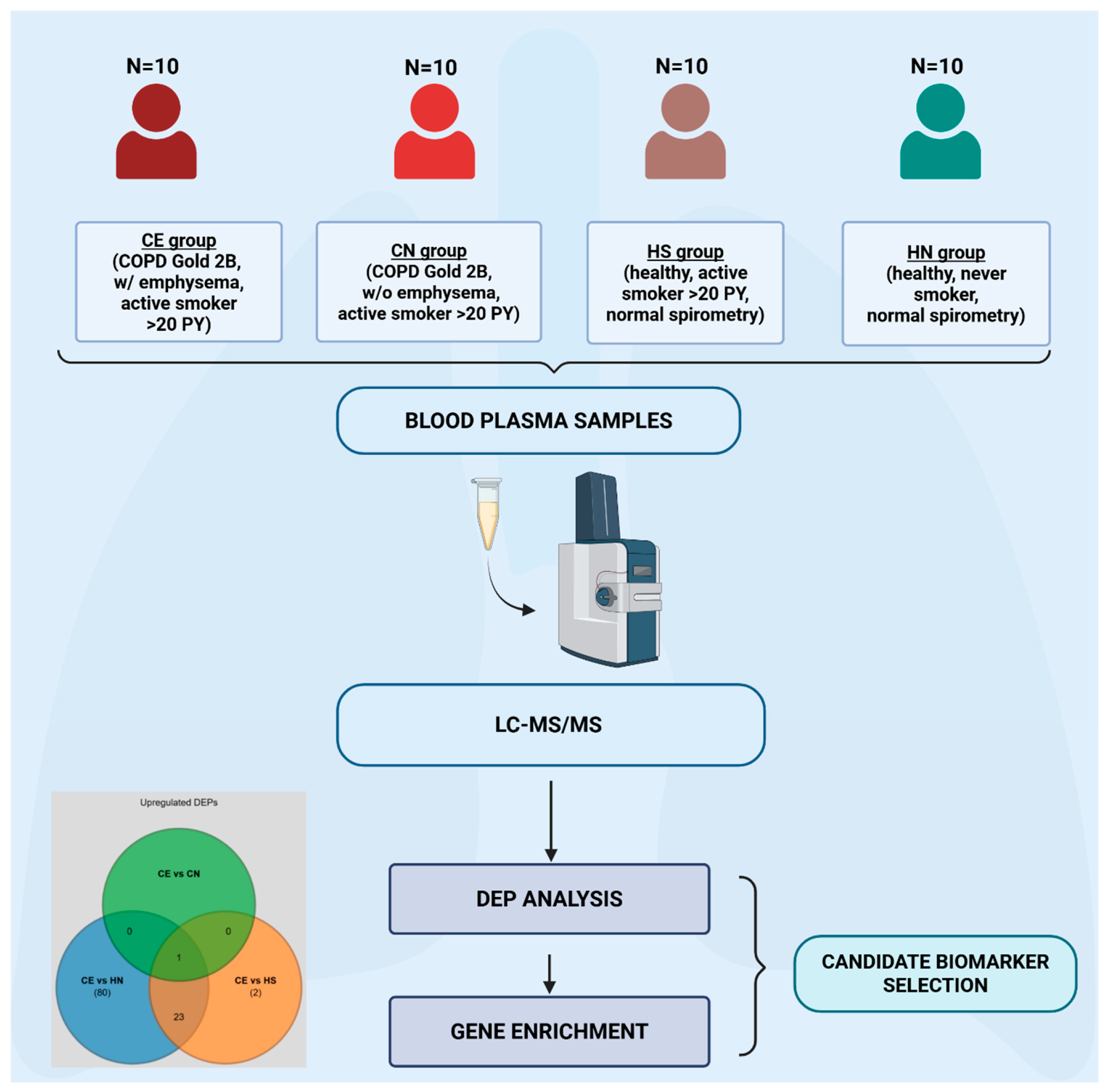
This study included a total of 40 participants, divided into four equal age- and gender-matched groups (N = 10 participants per group): (1) patients with COPD and radiologically verified emphysema (with a threshold of -950 HU) on chest computed tomography (CT) (CE group), confirmed by a radiologist; (2) patients with COPD without radiological signs of emphysema on chest CT (CN group), confirmed by a radiologist; (3) healthy smokers (active smokers (>20 pack-years) without respiratory symptoms and normal spirometry) (HS group); and (4) healthy never-smokers (without respiratory symptoms and with normal spirometry) (HN group). A graphic study outline is shown in Figure 1.
Participants were included in the study in a non-probabilistic manner in order to be matched by age, gender, comorbidity and body mass index to ensure group homogeneity among these factors. Patients with COPD were recruited from the Department of Pulmonology’s out-patient clinic, and healthy individuals were recruited from the University Hospital Dubrava’s Polyclinic after they underwent a health-screening examination. After being invited to participate and accepting, all participants in the study signed an informed consent form.
Patients with COPD (CE and CN groups) were GOLD 2B patients as defined by GOLD 2023 [16], active smokers (>20 pack-years), and on dual inhalation therapy (combination of long-acting β2 agonist (LABA) and long-acting muscarinic antagonist (LAMA)). Healthy participants were people without respiratory symptoms and with normal spirometry. Exclusion criteria for all participants were: reversible airflow limitation, positive bronchodilator test (either by the GINA criteria or by the ERS/ATS technical standard 2022 [16,17]), concomitant malignancy, autoimmune disease or concomitant asthma, and alpha-1-antitrypsin deficiency. Participants that consumed tobacco products other than classical cigarettes (including e-cigarettes, heat-not-burn tobacco products, vapes, cigars and cigarillos) were also excluded from the study. None of the participants were taking glucocorticoids or other immunosuppressive medications. Exclusion criteria for COPD patients was an acute exacerbation of COPD in the last 6 months. No participant had significant exposure to biomass fuels.
Comorbidities were assessed using the Charlson’s comorbidity index and also a modified Charlson’s comorbidity index in which “chronic pulmonary disease” was excluded. The participants underwent spirometry testing, and all COPD patients had a chest CT no older than 3 months prior to inclusion. Due to ethical concerns of exposing the healthy participants to radiation without clinical indication, they were not required to undergo a chest CT in order to be included in the study. Spirometry with a subsequent bronchodilator test (with 400 mcg of salbutamol) was performed according to the international standards, using Global Lung Initiative (GLI) reference values [17,18,19]. Expiratory airflow limitation was determined using the proposed GOLD criteria with a fixed FEV1/FVC ratio of 0.7 [16].
Participants’ characteristics (displayed in Table 1) were analyzed by employing descriptive statistical methods, using jamovi 2.6.44. Type one error (alpha) was set at 0.05. Data distribution normality was assessed with Shapiro–Wilk’s test. Variables with parametric distribution were analyzed using the one-way analysis of variance (ANOVA) test with the Games–Howell post hoc test, in case of statistical significance. Non-parametric variables were formally assessed with the Kruskal–Wallis test, followed by Dwass–Steel–Critchlow–Flinger (DSCF) pairwise comparisons in the case of a statistically significant result. As expected, participants with COPD (CE and CN) differed from the healthy individuals (HS and HN) in terms of FEV1, FVC and FEV1/FVC values and Charlson’s comorbidity index. When a modified score of Charlson’s comorbidity index (in which we omitted the category for “chronic pulmonary disease”) was employed, there was no statistically significant difference between the groups. The Games–Howell post-hoc test for FEV1 and FVC, as well as the DSCF pairwise comparison for FEV1/FVC, did not reveal statistically significant differences between CE vs. CN and HS vs. HN.
Venipuncture was performed in order to draw blood samples and place them in a vacuette (3.8% sodium citrate tubes), and the samples were centrifuged for 15 min at 4 °C and 3000 g to obtain plasma and then stored at −80 °C until further analysis. Before use, samples were thawed and centrifuged at 16,000 g for 10 min to remove residual larger debris and the supernatant was used in subsequent experiments. Total protein concentration was determined using the RC DC Lowry protein assay (BioRad, Hercules, CA, USA; #5000122) according to the manufacturer’s instructions. Samples containing 100 μg of protein per participant were transferred to 10 kDa centrifugal filter units for further processing. Briefly, proteins were denatured in 8 M urea, alkylated in 55 mM iodoacetamide (in 8 M urea), and finally digested overnight in 25 mM ammonium bicarbonate with 1 μg of TPCK-treated trypsin (Worthington Industries, Columbus, OH, USA; #11418025001), as described previously [20]. The obtained tryptic peptides were desalted and concentrated using in-house-made Stage Tips mini-columns, as described previously [20,21].
Peptides were extracted for LC-MS using 80% acetonitrile (ACN) in 0.1% formic acid (FA). LC-MS/MS analysis was done using the UltiMate 3000 RSLCnano system (Thermo Fisher Scientific) and the timsTOF HT (Bruker). Before LC separation, peptides were concentrated and desalted online and then separated using an analytical column (EASY-Spray column, 75 μm ID, 250 mm long, 2 μm particles, Thermo Fisher Scientific; #ES902) for 90 min in a gradient of ACN/H2O (FA). DIA LC-MS data processing was performed using DIA-NN application (version 2.1.0) [22,23]. Library-free search mode was applied using the custom iRTs_trypsin and UniProtKB-Human databases specificity. Match between runs (MBR) was used across the whole dataset, and the database search results were set to follow the false discovery rate (FDR) thresholds: precursor level, 1% FDR; protein group level, 1% FDR. Fixed algorithm settings were used for the search (MS2 and MS1 accuracy of 15 and 15 ppm, respectively, with scan window 11), and the default protein inference algorithm implemented in DIA-NN was used to construct the list of protein groups utilizing proteotypic peptides (i.e., peptides unique for the given protein within the whole protein database). Two outlier samples per experimental group were identified using cluster analysis and sample-to-sample correlation analysis. Samples showing inconsistent clustering and deviating strongly from their respective experimental groups were excluded from further analysis. Precursors were filtered for those being quantified in 60% of replicates in at least one sample group. Filtered precursor intensities (Precursor.Normalised column from the main DIA-NN report, i.e., raw precursor intensities normalized internally by DIA-NN) were further normalized using loessF function, and normalized precursor intensities were imputed using global quantile (0.001) value; normalized and imputed precursor intensities were used to calculate MaxLFQ protein level intensities using iq R package [24] for relative protein abundance evaluation. Filtered and normalized precursor intensities were used to calculate DIA-TPA protein level intensities useable as absolute protein abundance estimates [25] (MaxLFQ values were used for LIMMA statistical processing).
The MS raw data were deposited at the ProteomeXchange Consortium via the PRIDE partner repository and are available via ProteomeXchange with identifier PXD074107.
For comparisons between study groups (CE vs. CN, CE vs. HS and CE vs. HN), linear models for microarray and RNA data (LIMMA) t-test was used with Benjamini & Hochberg adjustment for multiple hypothesis testing [26,27]. Proteins with an adjusted p-value < 0.05 and a log2-transformed fold change (FC) of log2(FC) > 1 or log2(FC) < −1 were deemed statistically significant. Data were visualized in the in-house built software Proteo Visualizer 3.0.8 (Cupak, M. Proteo-Visualizer 2026 (CEITEC, Brno, Czech Republic)).
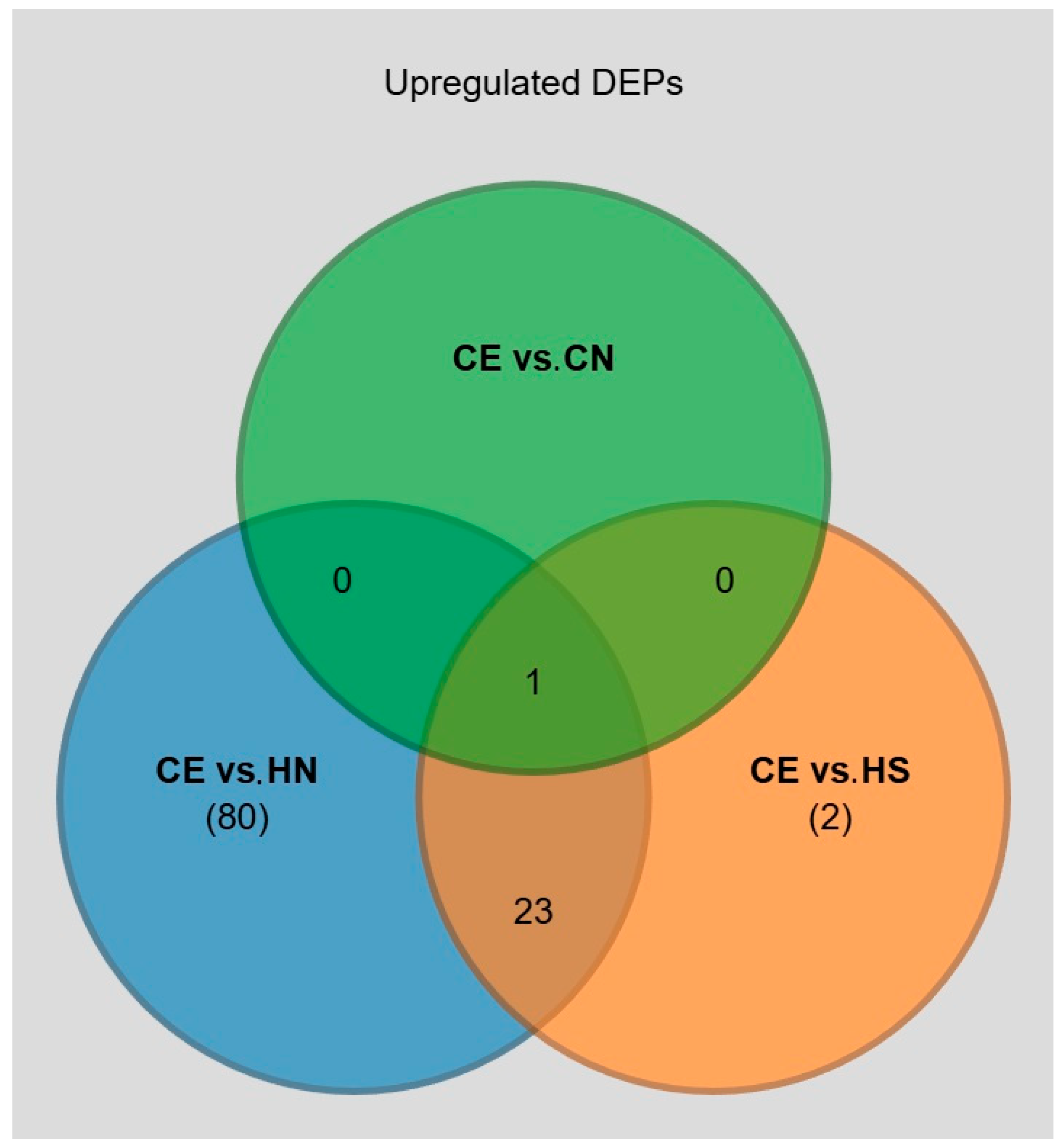
Gene enrichment was performed via the ShinyGO 0.85 platform [28] by employing STRING [28,29]. Overrepresentation analysis (ORA) was performed with an FDR cutoff of 0.05. This was conducted only for the identified DEPs from the CE vs. HN contrast to avoid redundancy (due to the fact that 23 out of 25 (92%) of upregulated DEPs identified in CE vs. HS were also identified as DEPs in CE vs. HN).
Additionally, protein–protein interactions for the DEPs in the CE vs. HN contrast were visualized using STRING (version 12.0) [29]. Cluster analysis was performed within the STRING platform using the Markov cluster algorithm (MCL) (inflation parameter = 3) in order to find natural clusters based on stochastic flow.

3. Results

A total of 994 proteins were detected across all analyzed samples; however, 858 86.4%) were further analyzed as they were identified across a sufficient number of samples per group.
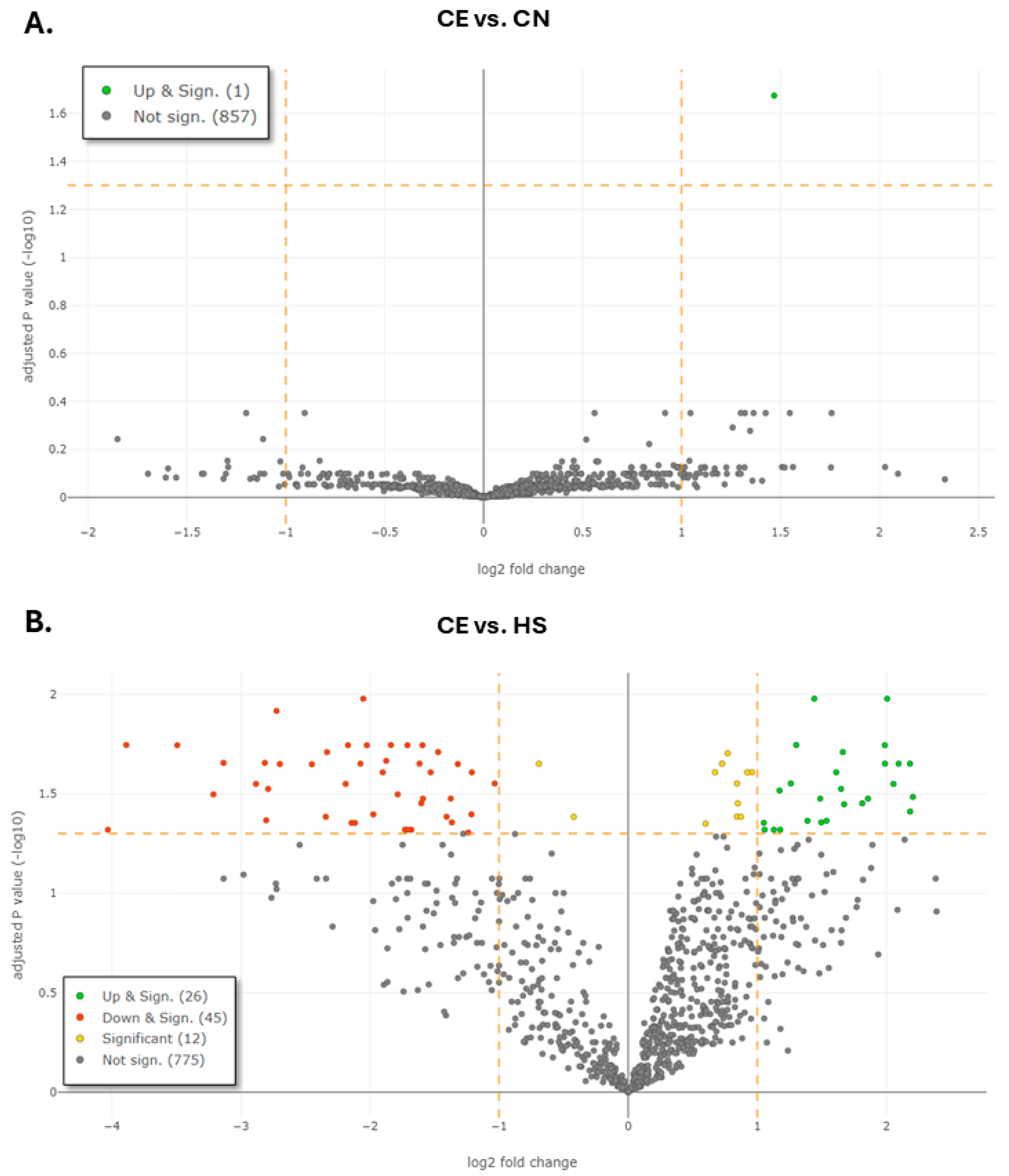
There was a single statistically significantly upregulated DEP when comparing COPD with emphysema and COPD without emphysema (CE vs. CN): NADP-dependent malic enzyme (NADP-ME) (FC = 2.78, p = 0.02). When using this approach, we did not identify statistically significant downregulated DEPs (Figure 2A).
When comparing the CE group with healthy smokers (CE vs. HS), we identified 26 upregulated and 45 downregulated DEPs (Table 2 and Table S1, Figure 2B). The top three overabundant proteins (with the highest fold change) were fibroblast growth factor receptor 1 (FGFR-1) (FC 4.61, p = 0.03), V-type proton ATPase subunit S1 (FC 4.55, p = 0.039) and mannosyl-oligosaccharide glucosidase (FC 4.54, p = 0.022).
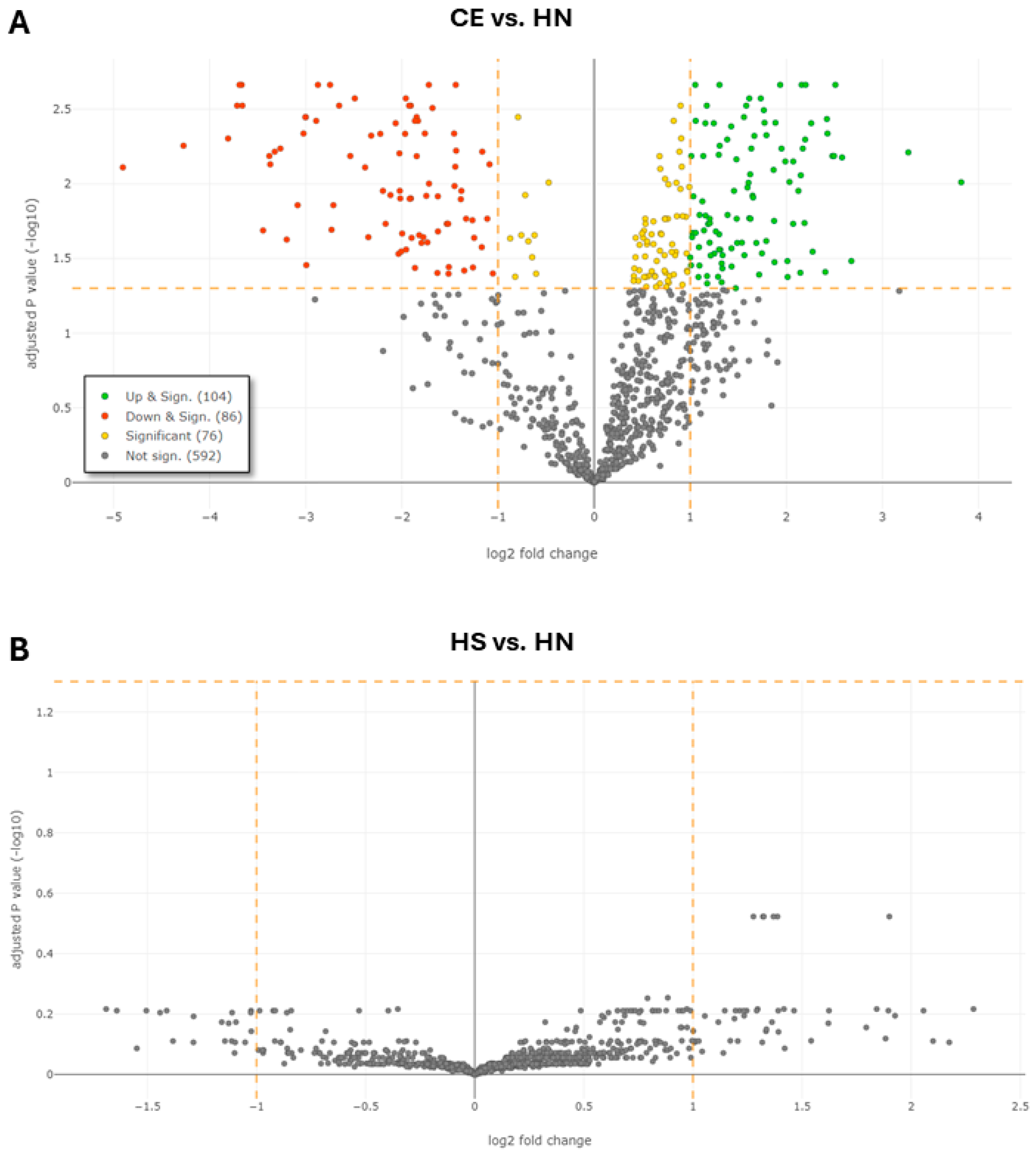
For the comparison of CE with healthy never-smokers (CE vs. HN), we identified 104 upregulated and 86 downregulated proteins (Table 3 and Table S2, Figure 3A). The most overabundant DEPs were plastin-1 (FC 14.11, p = 0.009), pulmonary surfactant-associated protein A1 (SP-A1) (FC 9.64, p = 0.006) and apolipoprotein(a) (FC 6.39, p = 0.03). Importantly, several immunoglobulin components were detected as significantly downregulated DEPs in both CE vs. HS and CE vs. HN contrasts.
Using this approach, we did not identify statistically significant DEPs between the two subgroups of healthy individuals (Figure 3B). The majority of upregulated DEPs in the CE vs. HS contrast were also identified in the CE vs. HN contrast (Figure 4). DEPs derived from the comparison between CN and HN is depicted in Supplementary Table S3.
Interestingly, in addition to being a statistically significantly upregulated DEP in the CE vs. CN contrast, NADP-ME was also identified as a significantly upregulated DEP in CE vs. HS (FC = 2.466, p = 0.018) and in CE vs. HN (FC = 2.198, p = 0.065) (Figure 4).
Overexpression analysis (ORA) for all DEPs (as well as for only upregulated and only downregulated) for CE vs. HN is depicted in Supplementary Table S4. Notably, serine-type endopeptidase activity, insulin-like growth factor I binding, fibronectin binding and transmembrane receptor protein tyrosine kinase activity were among the identified functions. Upon analysis of only upregulated DEPs, thioredoxin peroxidase activity, fibronectin binding, insulin-like growth factor I and II binding and signaling receptor binding were identified to be significantly enriched functions (full list in Supplementary Table S5). Interestingly, processes such as adaptive immune response, classical pathway of complement activation and intermediate filament organization were identified when only downregulated DEPs were analyzed (Supplementary Table S6).
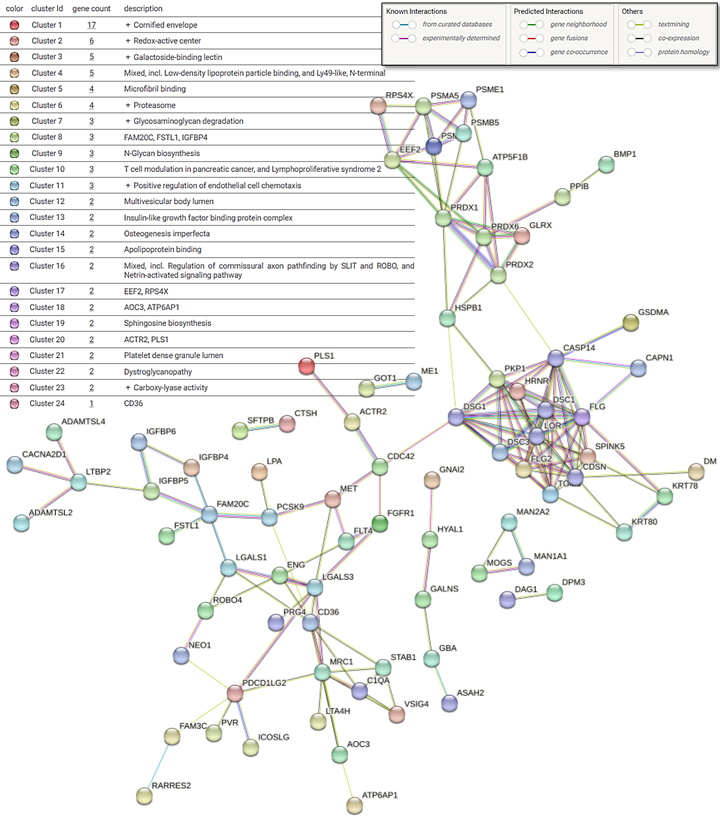
Additionally, STRING analysis of a protein–protein interaction network from the upregulated DEPs for CE vs. HN revealed several functional clusters of interconnected proteins (Figure 5). MCL cluster analysis revealed 24 distinct clusters, including redox-active center, galactoside-binding lectin, proteasome, insulin-like growth factor binding protein complex, microfibril binding and glycosaminoglycan degradation. Protein–protein interaction of downregulated DEPs is depicted in Supplementary Figure S1. MCL cluster analysis of downregulated DEPs revealed six distinct clusters, including immunoglobulin complex, scavenging by B class receptors, complement pathway and molecules associated with elastic fibers.

4. Discussion

We conducted a small shotgun LC-MS-based proteomics study in order to find potential plasma biomarkers of emphysema by comparing patients with stable symptomatic COPD (Gold 2B (2023) [16]) that have emphysema detected on chest CT to those that do not, as well as by comparing them with healthy active smokers and healthy never-smokers.
Our study found (cytosolic) NADP-ME (encoded by the ME1 gene) to be upregulated in emphysema patients (CE) compared to all other study groups (CN, HS and HN). Namely, NADP-ME catalyzes reversible oxidative decarboxylation of malate to pyruvate, resulting in the reduction of NADP+ to NADPH, meaning it is a crucial enzyme of intermediary metabolism and redox homeostasis [30,31].
Cigarette smoke increases oxidative stress levels in COPD patients. Specifically, reactive oxygen and nitrogen species (ROS and RNS) activate the NF-κB pathway with a consequent increase in pro-inflammatory cytokines and recruitment of inflammatory cells, which further generate ROS and increase the oxidative stress burden [32]. NAPDH is a substrate for inducible nitric oxide synthase (iNOS) involved in the synthesis of NO and a substrate for NADPH oxidase (NOX), which leads to the synthesis of ROS through the generation of superoxide anions [31,33]. Increased ROS levels in the lungs increase inflammation, accelerate aging and cellular senescence, increase the potential of development of autoantibodies by protein carbonylation, and cause DNA damage [33]. Additionally, increased iNOS levels have been implicated in the pathogenesis of cigarette-smoke-induced emphysema, and it has been observed that mice with iNOS knockout were protected against emphysema development [33,34].
Another important biological role of NADP-ME (ME1) is its association with resistance to anoikis, a caspase-dependent programmed cell death, which is induced by the loss of cell contacts to the extracellular matrix or to other cells [35,36,37,38]. Anoikis is considered to be a physiological process which acts to safeguard the organism and to maintain tissue integrity [36,39]. Anoikis resistance has been recognized as an important step in cancer progression and metastasis [36,39,40]. Ryan et al. found a complete downregulation of ME1 RNA transcript in COPD-derived alveolar macrophages [30]. It is possible that plasma NADP-ME may therefore reflect tissue injury and systemic metabolic adaptation. However, Hu et al. recently found ME1 to be overexpressed in lung tissues of COPD mice and peripheral blood mononuclears of COPD patients. The authors also developed a diagnostic model based on transcriptional levels of ME1 and other anoikis resistance-related genes (SLC2A1 and BMP4) that were negatively correlated with emphysema index but positively correlated with airway wall thickness [41]. Additionally, elevated levels of cytosolic NADP-ME in plasma stress the importance of exploring the role of anoikis in emphysema development, as imbalances favoring protease activity that promote excessive ECM degradation create conditions that facilitate anoikis [7,8,42].
Elevated NADP-ME levels have thus far been associated with inflammatory (autoimmune) diseases such as rheumatoid arthritis and systemic lupus erythematosus [31]. Systemic immune dysregulation is also suggested by functional clusters of DEPs in CE vs. HN. We also identified upregulated DEPs such as macrophage mannose receptor 1 and Stabilin-1, which are associated with macrophage scavenging and with Galectin-3, which is associated with macrophage activation [43,44,45]. This may indicate persistent innate immune activation and impaired resolution, consistent with chronic tissue injury and remodeling [46].
Therefore, the biological roles of NADP-ME may span several interconnected levels relevant to emphysema pathogenesis: intermediary metabolism, redox homeostasis, amplifcation of inflammatory signaling cascades and anoikis [7,31,36,38,39,41]. We hypothesize that the disturbance in these pathogenic axes in the setting of emphysema might lead to a release of NADP-ME to systemic circulation and propose that plasma NADP-ME might be a potential plasma biomarker candidate of emphysema. However, further studies with other methods are required to validate our results.
When comparing emphysema patients with healthy individuals, other than NADP-ME, our study revealed several DEPs implicated in the homeostasis of redox processes, such as peroxiredoxin-1, -2, and -6 (CE vs. HN), as well as glutaredoxin-1 (CE vs. HN, CE vs. HS), which is also highlighted by the cluster analysis. Glutaredoxin-1 levels have been found to be increased in induced sputum from COPD patients during acute exacerbations; conversely, lower expression levels were found in the alveolar macrophages of COPD patients than in healthy smokers, and decreased enzymatic activity was demonstrated in mice models of pulmonary fibrosis [47,48,49]. Peroxiredoxin-1 was previously suggested as a potential COPD biomarker, and serum levels of peroxiredoxin-6 were higher in COPD patients and correlated with disease severity [50,51].
Our study also identified BMP1 as a significantly upregulated DEP in CE vs. HN (but not in CN vs. HN; Supplementary Table S1). BMP1 is a zinc metalloproteinase responsible for fibrillar procollagen maturation and processing [52,53]. It is important to remark that our findings reflect circulating plasma abundance, suggesting systemic extracellular matrix remodeling rather than local pulmonary expression. Additionally, BMP1 is responsible for the cleavage of several substrates, including Chordin (BMP-2 and BMP-4 antagonist), myostatin, insulin-like growth factor-binding protein 3 (which can bind and sequester IGF-I and IGF-II) [54]. Interestingly, we identified three insulin-like growth factor-binding proteins (IGFBP4, -5 and -6) to be significantly upregulated DEPs in CE vs. HN (IGF-I and II binding were also identified as significantly enriched processes by ORA). Anastasi et al. found that increasing BMP-1 led to the loss of cell adhesion that depended on thrombospondin-1 (TSP-1). BMP1 cleaved TSP-1, which led to TSP-1-mediated activation of latent transforming growth factor-β (TGF-β), leading to increased signaling through the canonical SMAD pathway [54]. Increased immunohistochemistry levels of BMP1 expression were detected in the fibroblastic foci of IPF patients compared to a minimally present signal in healthy lung samples, and its role was observed in liver and kidney fibrosis, as well [52,55,56,57,58]. Stefano et al. did not find a significant difference in immunohistochemical expression of BMP1 (or BMP2, -7, -9, -10 and noggin) in the bronchial epithelium of COPD patients compared to healthy smokers and non-smokers [59]. However, they found a lower number of BMP4+-stained cells in moderate and severe COPD patients compared to healthy individuals [59]. They also found a significantly increased number of BMPER+ cells in COPD and healthy smokers compared to healthy non-smokers [59]. BMP1 has not, thus far, been heavily implicated in the pathogenesis of emphysema or COPD. However, our identification of BMP1 as a significantly overabundant protein in blood plasma of emphysema patients might open a new research avenue. In addition to finding BMP1, the identification of upregulated ECM proteins like ADAMTSL2, ADAMTSL4 and Tsukushi, accompanied by downregulated fibulin-1, -3 and cartilage intermediate layer protein 1 (CILP-1) in blood plasma, indicate the likely systemic effects of significant ECM perturbation in patients with pulmonary emphysema, accompanied by the above-mentioned possible growth factor sequestration.
Our study has several important limitations: namely, this was a small cross-sectional study with a small sample size. However, participants for this study were controlled by matching the sex, age and comorbidities among all four study groups. Additionally, COPD patient groups (CE and CN groups) were clinically similar: they included Gold 2B patients with stable but symptomatic disease undergoing LAMA + LABA therapy with comparable lung function levels. Smoking levels in terms of pack-years measurement were also comparable between smoking groups (CE, CN, and HS). Due to the fact that this study used non-probabilistic sampling, sampling bias is inherently present. An additional study limitation is the fact that emphysema was not quantified but only qualitatively assessed by a radiologist.
To conclude, our small shotgun proteomic study identified NADPH-ME as a potential emphysema biomarker candidate and put emphasis on the importance of ROS homeostasis and the potential role of anoikis in emphysema pathogenesis. Additionally, we found BMP1 and dysregulated ECM components in plasma, which opens a new research horizon to be explored. Taken together, our findings support the concept of emphysema as a systemic disorder reflected by intertwined metabolic, redox and extracellular matrix perturbations. Finally, due to the fact that our findings are based only on LC-MS data, they require further validation with complementary methods and larger cohorts.

Supplementary Materials

The following supporting information can be downloaded at: https://www.mdpi.com/article/10.3390/diagnostics16060931/s1. Figure S1. A protein-protein interaction network based on the downregulated differentially expressed proteins derived from the comparison of patients with COPD and emphysema (CE) and healthy never-smokers (HN); Table S1. List of statistically significant downregulated proteins in patients with COPD and emphysema (CE), compared to healthy smokers (HS); Table S2. List of statistically significant downregulated proteins in patients with COPD and emphysema (CE), compared to healthy non-smokers (HN); Table S3. List of statistically significant upregulated and downregulated differentially expressed proteins in patients with COPD without emphysema (CN), compared to healthy never-smokers (HN). Table S4. Identified enriched functions and processes through overrepresentation analysis for all (up- and downregulated) differentially expressed proteins in comparison of patients with COPD and emphysema to healthy never-smokers. Table S5. Identified enriched functions and processes through overrepresentation analysis for upregulated differentially expressed proteins in comparison of patients with COPD and emphysema to healthy never-smokers. Table S6. Identified enriched functions and processes through overrepresentation analysis for downregulated differentially expressed proteins in comparison of patients with COPD and emphysema to healthy never-smokers.

Author Contributions

Conceptualization, G.S. and L.G.; Methodology, G.S., R.N., S.H., V.P., D.P., Z.Z. and L.G.; Validation, R.N., G.S., S.H.and L.G.; Formal Analysis, R.N., V.P., D.P. and Z.Z.; Investigation, G.S., R.N., S.H, L.G., V.P., D.P., Z.Z. and D.L.; Resources, Z.Z., S.H. and L.G.; Data Curation, G.S., D.L. and R.N.; Writing—Original Draft Preparation, G.S.; Writing—Review and Editing, R.N., S.H., V.P., D.P., Z.Z., D.L. and L.G.; Visualization, G.S., S.H. and R.N.; Supervision, L.G.; Funding Acquisition, L.G. and Z.Z. All authors have read and agreed to the published version of the manuscript.

Funding

This research was funded by CIISB: Instruct-CZ Centre of Instruct-ERIC EU consortium, funded by the MEYS CR infrastructure project LM2023042 and the European Regional Development Fund-Project “Innovation of Czech Infrastructure for Integrative Structural Biology” (No. CZ.02.01.01/00/23_015/0008175). Computational resources were provided by the e-INFRA CZ project (ID:90254), supported by MEYS CR.

Institutional Review Board Statement

This study adhered to the Declaration of Helsinki and its later amendments and was approved by the University Hospital Dubrava’s Institutional Ethics Committee (approval no. 2022/2908-05, approval date 31 August 2022), as well as by the School of Medicine, University of Zagreb’s Institutional Ethics Committee (approval no. 251-59-10106-24-111/119; approval date 23 September 2024).

Informed Consent Statement

Informed consent was obtained from all participants involved in the study.

Data Availability Statement

The original data presented in the study are openly available in ProteomeXchange Consortium via the PRIDE partner repository with identifier PXD074107.

Acknowledgments

We thank all study participants. CIISB, Instruct-CZ Centre of Instruct-ERIC EU consortium, funded by MEYS CR infrastructure project LM2023042 and the European Regional Development Fund-Project “Innovation of Czech Infrastructure for Integrative Structural Biology” (No. CZ.02.01.01/00/23_015/0008175), is gratefully acknowledged for providing financial support for the measurements at the CEITEC Proteomics Core Facility. Computational resources were provided by the e-INFRA CZ project (ID:90254), supported by MEYS CR.

Conflicts of Interest

Grgur Salai received speaker fees from Astra Zeneca Croatia, Berlin Chemie Menarini Croatia, Alkaloid Ltd. and Providens Ltd., as well as travel support for attending scientific congresses from Boehringer Ingelheim Croatia, Berlin Chemie Menarini, Viatris Croatia and Providens Ltd. Stela Hrkač received support for attending scientific congresses from Boehringer Ingelheim Croatia and Octapharma AG. Đivo Ljubičić received speaker fees from Berlin Chemie Menarini Croatia, Providens Ltd., Alkaloid Ltd., Astra Zeneca Croatia, Viatris Croatia, MSD Croatia, Teva Croatia, Belupo Ltd., and Mibe Pharmaceuticals Croatia. The funder was not involved in the study design; collection, analysis, or interpretation of data; the writing of this article; or the decision to submit it for publication.

References

  1. Venkatesan, P. GOLD COPD Report: 2026 Update. Lancet Respir. Med. 2025, 14, e14–e15. [Google Scholar] [CrossRef]
  2. Pahal, P.; Avula, A.; Afzal, M. Emphysema. In StatPearls [Internet]; StatPearls Publishing, LLC: Petersburg, FL, USA, 2025. [Google Scholar]
  3. Bankier, A.A.; MacMahon, H.; Colby, T.; Gevenois, P.A.; Goo, J.M.; Leung, A.N.C.; Lynch, D.A.; Schaefer-Prokop, C.M.; Tomiyama, N.; Travis, W.D.; et al. Fleischner Society: Glossary of Terms for Thoracic Imaging. Radiology 2024, 310, e232558. [Google Scholar] [CrossRef] [PubMed]
  4. Desai, S.R.; Lynch, D.A.; Elicker, B.M.; Devaraj, A.; Sverzellati, N. Illustrated Flossary of High-Resolution CT Terms. In Webb, Müller and Naidich’s High-Resolution CT of the Lung; Wolters Kluwer: Philadelphia, PA, USA, 2021; pp. 636–653. [Google Scholar]
  5. Bentaher, A.; Glehen, O.; Degobert, G. Pulmonary Emphysema: Current Understanding of Disease Pathogenesis and Therapeutic Approaches. Biomedicines 2025, 13, 2120. [Google Scholar] [CrossRef]
  6. Cantor, J.O.; Turino, G.M. COPD Pathogenesis. Chest 2019, 155, 266–271. [Google Scholar] [CrossRef]
  7. Deshane, J.; Thannickal, V.J. Redox Signalling and Oxidative Stress in Lung Disorders. In Fishman’s Pulmonary Diseases and Disorders; Grippi, M.A., Antin-Ozerkis, D.E., Dela Cruz, C.S., Kotloff, R.M., Kotton, C.N., Pack, A.I., Eds.; McGraw Hill: New York, NY, USA, 2023; Volume 1, pp. 356–375. [Google Scholar]
  8. Wang, T.; Dong, Y.; Fang, L.; Zhou, H. Patterns and Underlying Mechanisms of Airway Epithelial Cell Death in COPD. COPD J. Chronic Obstr. Pulm. Dis. 2025, 22, 2542153. [Google Scholar] [CrossRef]
  9. Mauad, T.; Silva, L.F.F.; Santos, M.A.; Grinberg, L.; Bernardi, F.D.C.; Martins, M.A.; Saldiva, P.H.N.; Dolhnikoff, M. Abnormal Alveolar Attachments with Decreased Elastic Fiber Content in Distal Lung in Fatal Asthma. Am. J. Respir. Crit. Care Med. 2004, 170, 857–862. [Google Scholar] [CrossRef] [PubMed]
  10. Lee, S.-H.; Goswami, S.; Grudo, A.; Song, L.; Bandi, V.; Goodnight-White, S.; Green, L.; Hacken-Bitar, J.; Huh, J.; Bakaeen, F.; et al. Antielastin Autoimmunity in Tobacco Smoking–Induced Emphysema. Nat. Med. 2007, 13, 567–569. [Google Scholar] [CrossRef] [PubMed]
  11. Wen, L.; Krauss-Etschmann, S.; Petersen, F.; Yu, X. Autoantibodies in Chronic Obstructive Pulmonary Disease. Front. Immunol. 2018, 9, 66. [Google Scholar] [CrossRef]
  12. Wilson, D.O.; Weissfeld, J.L.; Balkan, A.; Schragin, J.G.; Fuhrman, C.R.; Fisher, S.N.; Wilson, J.; Leader, J.K.; Siegfried, J.M.; Shapiro, S.D.; et al. Association of Radiographic Emphysema and Airflow Obstruction with Lung Cancer. Am. J. Respir. Crit. Care Med. 2008, 178, 738–744. [Google Scholar] [CrossRef]
  13. Leduc-Gaudet, J.-P.; Hussain, S.N.A. Muscle Wasting in Chronic Obstructive Pulmonary Disease: Not Enough Autophagy? Am. J. Respir. Cell Mol. Biol. 2022, 66, 587–588. [Google Scholar] [CrossRef]
  14. Chaouat, A.; Naeije, R.; Weitzenblum, E. Pulmonary Hypertension in COPD. Eur. Respir. J. 2008, 32, 1371–1385. [Google Scholar] [CrossRef]
  15. Mannino, D.M. Biomarkers for Chronic Obstructive Pulmonary Disease Diagnosis and Progression. Curr. Opin. Pulm. Med. 2019, 25, 144–149. [Google Scholar] [CrossRef]
  16. Venkatesan, P. GOLD COPD Report: 2023 Update. Lancet Respir. Med. 2023, 11, 18. [Google Scholar] [CrossRef]
  17. Stanojevic, S.; Kaminsky, D.A.; Miller, M.R.; Thompson, B.; Aliverti, A.; Barjaktarevic, I.; Cooper, B.G.; Culver, B.; Derom, E.; Hall, G.L.; et al. ERS/ATS Technical Standard on Interpretive Strategies for Routine Lung Function Tests. Eur. Respir. J. 2022, 60, 2101499. [Google Scholar] [CrossRef]
  18. Bowerman, C.; Bhakta, N.R.; Brazzale, D.; Cooper, B.R.; Cooper, J.; Gochicoa-Rangel, L.; Haynes, J.; Kaminsky, D.A.; Lan, L.T.T.; Masekela, R.; et al. A Race-Neutral Approach to the Interpretation of Lung Function Measurements. Am. J. Respir. Crit. Care Med. 2023, 207, 768–774. [Google Scholar] [CrossRef]
  19. Graham, B.L.; Steenbruggen, I.; Miller, M.R.; Barjaktarevic, I.Z.; Cooper, B.G.; Hall, G.L.; Hallstrand, T.S.; Kaminsky, D.A.; McCarthy, K.; McCormack, M.C.; et al. Standardization of Spirometry 2019 Update. An Official American Thoracic Society and European Respiratory Society Technical Statement. Am. J. Respir. Crit. Care Med. 2019, 200, e70–e88. [Google Scholar] [CrossRef] [PubMed]
  20. Grgurević, L.; Novak, R.; Jambrošić, L.; Močibob, M.; Jaganjac, M.; Halasz, M.; Salai, G.; Hrkač, S.; Milošević, M.; Vlahović, T.; et al. Systemic Lipid Metabolism Dysregulation as a Possible Driving Force of Fracture Non-Unions? Bioengineering 2024, 11, 1135. [Google Scholar] [CrossRef] [PubMed]
  21. Rappsilber, J.; Mann, M.; Ishihama, Y. Protocol for Micro-Purification, Enrichment, Pre-Fractionation and Storage of Peptides for Proteomics Using StageTips. Nat. Protoc. 2007, 2, 1896–1906. [Google Scholar] [CrossRef] [PubMed]
  22. Demichev, V.; Messner, C.B.; Vernardis, S.I.; Lilley, K.S.; Ralser, M. DIA-NN: Neural Networks and Interference Correction Enable Deep Proteome Coverage in High Throughput. Nat. Methods 2020, 17, 41–44. [Google Scholar] [CrossRef]
  23. DIA-NN. Application (Version 2.1.0). 2025. Available online: https://github.com/vdemichev/diann (accessed on 2 December 2025).
  24. Pham, T.V.; Henneman, A.A.; Jimenez, C.R. iq: An R Package to Estimate Relative Protein Abundances from Ion Quantification in DIA-MS-Based Proteomics. Bioinformatics 2020, 36, 2611–2613. [Google Scholar] [CrossRef]
  25. He, B.; Shi, J.; Wang, X.; Jiang, H.; Zhu, H.-J. Label-Free Absolute Protein Quantification with Data-Independent Acquisition. J. Proteom. 2019, 200, 51–59. [Google Scholar] [CrossRef]
  26. Ritchie, M.E.; Phipson, B.; Wu, D.; Hu, Y.; Law, C.W.; Shi, W.; Smyth, G.K. Limma Powers Differential Expression Analyses for RNA-Sequencing and Microarray Studies. Nucleic Acids Res. 2015, 43, e47. [Google Scholar] [CrossRef]
  27. Benjamini, Y.; Hochberg, Y. Controlling the False Discovery Rate: A Practical and Powerful Approach to Multiple Testing. J. R. Stat. Soc. Ser. B Stat. Methodol. 1995, 57, 289–300. [Google Scholar] [CrossRef]
  28. Ge, S.X.; Jung, D.; Yao, R. ShinyGO: A Graphical Gene-Set Enrichment Tool for Animals and Plants. Bioinformatics 2020, 36, 2628–2629. [Google Scholar] [CrossRef]
  29. Szklarczyk, D.; Kirsch, R.; Koutrouli, M.; Nastou, K.; Mehryary, F.; Hachilif, R.; Gable, A.L.; Fang, T.; Doncheva, N.T.; Pyysalo, S.; et al. The STRING Database in 2023: Protein–Protein Association Networks and Functional Enrichment Analyses for Any Sequenced Genome of Interest. Nucleic Acids Res. 2023, 51, D638–D646. [Google Scholar] [CrossRef] [PubMed]
  30. Ryan, E.M.; Sadiku, P.; Coelho, P.; Watts, E.R.; Zhang, A.; Howden, A.J.M.; Sanchez-Garcia, M.A.; Bewley, M.; Cole, J.; McHugh, B.J.; et al. NRF2 Activation Reprograms Defects in Oxidative Metabolism to Restore Macrophage Function in Chronic Obstructive Pulmonary Disease. Am. J. Respir. Crit. Care Med. 2023, 207, 998–1011. [Google Scholar] [CrossRef] [PubMed]
  31. Santarsiero, A.; Todisco, S.; Convertini, P.; De Leonibus, C.; Infantino, V. Transcriptional Regulation and Function of Malic Enzyme 1 in Human Macrophage Activation. Biomedicines 2024, 12, 2089. [Google Scholar] [CrossRef]
  32. Finicelli, M.; Digilio, F.A.; Galderisi, U.; Peluso, G. The Emerging Role of Macrophages in Chronic Obstructive Pulmonary Disease: The Potential Impact of Oxidative Stress and Extracellular Vesicle on Macrophage Polarization and Function. Antioxidants 2022, 11, 464. [Google Scholar] [CrossRef] [PubMed]
  33. Barnes, P.J. Oxidative Stress-Based Therapeutics in COPD. Redox Biol. 2020, 33, 101544. [Google Scholar] [CrossRef]
  34. Seimetz, M.; Parajuli, N.; Pichl, A.; Veit, F.; Kwapiszewska, G.; Weisel, F.C.; Milger, K.; Egemnazarov, B.; Turowska, A.; Fuchs, B.; et al. Inducible NOS Inhibition Reverses Tobacco-Smoke-Induced Emphysema and Pulmonary Hypertension in Mice. Cell 2011, 147, 293–305. [Google Scholar] [CrossRef]
  35. Peltoniemi, M.J.; Rytilä, P.H.; Harju, T.H.; Soini, Y.M.; Salmenkivi, K.M.; Ruddock, L.W.; Kinnula, V.L. Modulation of Glutaredoxin in the Lung and Sputum of Cigarette Smokers and Chronic Obstructive Pulmonary Disease. Respir. Res. 2006, 7, 133. [Google Scholar] [CrossRef] [PubMed][Green Version]
  36. Ogata, F.T.; Branco, V.; Vale, F.F.; Coppo, L. Glutaredoxin: Discovery, Redox Defense and Much More. Redox Biol. 2021, 43, 101975. [Google Scholar] [CrossRef]
  37. Anathy, V.; Lahue, K.G.; Chapman, D.G.; Chia, S.B.; Casey, D.T.; Aboushousha, R.; van der Velden, J.L.J.; Elko, E.; Hoffman, S.M.; McMillan, D.H.; et al. Reducing Protein Oxidation Reverses Lung Fibrosis. Nat. Med. 2018, 24, 1128–1135. [Google Scholar] [CrossRef] [PubMed]
  38. Hu, C.; Qian, W.; Wei, R.; Liu, G.; Jiang, Q.; Sun, Z.; Li, H. Identification of Novel Lactylation-Related Biomarkers for COPD Diagnosis Through Machine Learning and Experimental Validation. Biomedicines 2025, 13, 2006. [Google Scholar] [CrossRef]
  39. Wen-yu, X.U.; Mo-ran, Z.H.U.; Chun-yan, X.U.; Xian-ji, Z.H.U.; SHEN, Y. The Expression of Peroxiredoxin-6 in Chronic Obstructive Pulmonary Disease. Fudan Univ. J. Med. Sci. 2022, 49, 466–468. [Google Scholar] [CrossRef]
  40. Frisch, S.; Francis, H. Disruption of Epithelial Cell-Matrix Interactions Induces Apoptosis. J. Cell Biol. 1994, 124, 619–626. [Google Scholar] [CrossRef]
  41. Chen, D.; Yi, R.; Hong, W.; Wang, K.; Chen, Y. Anoikis Resistance of Small Airway Epithelium Is Involved in the Progression of Chronic Obstructive Pulmonary Disease. Front. Immunol. 2023, 14, 1155478. [Google Scholar] [CrossRef]
  42. D’Amore, T.; Bravoco, D.; Di Paola, G.; Albano, F.; Brancaccio, M.; Sabato, C.; Cesta, G.; Zolfanelli, C.; Lauciello, V.; Falco, G.; et al. Anoikis Resistance in Gastric Cancer: A Comprehensive Review. Cell Death Dis. 2025, 16, 528. [Google Scholar] [CrossRef] [PubMed]
  43. MacKinnon, A.C.; Farnworth, S.L.; Hodkinson, P.S.; Henderson, N.C.; Atkinson, K.M.; Leffler, H.; Nilsson, U.J.; Haslett, C.; Forbes, S.J.; Sethi, T. Regulation of Alternative Macrophage Activation by Galectin-3. J. Immunol. 2008, 180, 2650–2658. [Google Scholar] [CrossRef]
  44. Kzhyshkowska, J.; Gratchev, A.; Goerdt, S. Stabilin-1, a Homeostatic Scavenger Receptor with Multiple Functions. J. Cell. Mol. Med. 2006, 10, 635–649. [Google Scholar] [CrossRef]
  45. Martinez-Pomares, L. The Mannose Receptor. J. Leukoc. Biol. 2012, 92, 1177–1186. [Google Scholar] [CrossRef]
  46. Kotlyarov, S. Involvement of the Innate Immune System in the Pathogenesis of Chronic Obstructive Pulmonary Disease. Int. J. Mol. Sci. 2022, 23, 985. [Google Scholar] [CrossRef] [PubMed]
  47. Lu, Y.-X.; Ju, H.-Q.; Liu, Z.-X.; Chen, D.-L.; Wang, Y.; Zhao, Q.; Wu, Q.-N.; Zeng, Z.; Qiu, H.-B.; Hu, P.-S.; et al. ME1 Regulates NADPH Homeostasis to Promote Gastric Cancer Growth and Metastasis. Cancer Res. 2018, 78, 1972–1985. [Google Scholar] [CrossRef]
  48. Koltai, T.; Fliegel, L. Anoikis: To Die or Not to Die? Int. J. Mol. Sci. 2026, 27, 579. [Google Scholar] [CrossRef]
  49. Simpson, C.D.; Anyiwe, K.; Schimmer, A.D. Anoikis Resistance and Tumor Metastasis. Cancer Lett. 2008, 272, 177–185. [Google Scholar] [CrossRef]
  50. Hu, W.; Sun, J.; Wang, M.; Wang, Y.; Mu, C.; Yu, X.; Yuan, P.; Han, W.; Li, Y.; Li, Q. Development of Diagnostic and Predictive Models for COPD Based on Anoikis Resistance. J. Inflamm. Res. 2025, 18, 12263–12278. [Google Scholar] [CrossRef] [PubMed]
  51. Demedts, I.K.; Demoor, T.; Bracke, K.R.; Joos, G.F.; Brusselle, G.G. Role of Apoptosis in the Pathogenesis of COPD and Pulmonary Emphysema. Respir. Res. 2006, 7, 53. [Google Scholar] [CrossRef] [PubMed]
  52. Grgurevic, L.; Macek, B.; Healy, D.R.; Brault, A.L.; Erjavec, I.; Cipcic, A.; Grgurevic, I.; Rogic, D.; Galesic, K.; Brkljacic, J.; et al. Circulating Bone Morphogenetic Protein 1–3 Isoform Increases Renal Fibrosis. J. Am. Soc. Nephrol. 2011, 22, 681–692. [Google Scholar] [CrossRef]
  53. N’Diaye, E.-N.; Cook, R.; Wang, H.; Wu, P.; LaCanna, R.; Wu, C.; Ye, Z.; Seshasayee, D.; Hazen, M.; Lin, W.; et al. Extracellular BMP1 Is the Major Proteinase for COOH-Terminal Proteolysis of Type I Procollagen in Lung Fibroblasts. Am. J. Physiol.-Cell Physiol. 2021, 320, C162–C174. [Google Scholar] [CrossRef]
  54. Anastasi, C.; Rousselle, P.; Talantikite, M.; Tessier, A.; Cluzel, C.; Bachmann, A.; Mariano, N.; Dussoyer, M.; Alcaraz, L.B.; Fortin, L.; et al. BMP-1 Disrupts Cell Adhesion and Enhances TGF-β Activation through Cleavage of the Matricellular Protein Thrombospondin-1. Sci. Signal. 2020, 13, eaba3880. [Google Scholar] [CrossRef]
  55. Ma, H.-Y.; N’Diaye, E.-N.; Caplazi, P.; Huang, Z.; Arlantico, A.; Jeet, S.; Wong, A.; Brightbill, H.D.; Li, Q.; Wong, W.R.; et al. BMP1 Is Not Required for Lung Fibrosis in Mice. Sci. Rep. 2022, 12, 5466. [Google Scholar] [CrossRef]
  56. Grgurevic, L.; Erjavec, I.; Grgurevic, I.; Dumic-Cule, I.; Brkljacic, J.; Verbanac, D.; Matijasic, M.; Paljetak, H.C.; Novak, R.; Plecko, M.; et al. Systemic Inhibition of BMP1-3 Decreases Progression of CCl4-Induced Liver Fibrosis in Rats. Growth Factors 2017, 35, 201–215. [Google Scholar] [CrossRef]
  57. Bai, M.; Lei, J.; Wang, S.; Ding, D.; Yu, X.; Guo, Y.; Chen, S.; Du, Y.; Li, D.; Zhang, Y.; et al. BMP1 Inhibitor UK383,367 Attenuates Renal Fibrosis and Inflammation in CKD. Am. J. Physiol.-Ren. Physiol. 2019, 317, F1430–F1438. [Google Scholar] [CrossRef]
  58. Vojtusek, I.K.; Laganovic, M.; Burek Kamenaric, M.; Bulimbasic, S.; Hrkac, S.; Salai, G.; Ivkovic, V.; Coric, M.; Novak, R.; Grgurevic, L. First Characterization of ADAMTS-4 in Kidney Tissue and Plasma of Patients with Chronic Kidney Disease & mdash;A Potential Novel Diagnostic Indicator. Diagnostics 2022, 12, 648. [Google Scholar] [CrossRef]
  59. Di Stefano, A.; Rosani, U.; Levra, S.; Gnemmi, I.; Brun, P.; Maniscalco, M.; D’Anna, S.E.; Carriero, V.; Bertolini, F.; Ricciardolo, F.L.M. Bone Morphogenic Proteins and Their Antagonists in the Lower Airways of Stable COPD Patients. Biology 2023, 12, 1304. [Google Scholar] [CrossRef]
Figure 1. Study outline depicting study groups and methods. The study included four study groups: (1) patients with COPD and emphysema visible on chest CT (CE), (2) patients with COPD without emphysema visible on chest CT (CN), (3) healthy active smokers (>20 pack-years) (HS), and (4) healthy-never smokers (HN). There were N = 10 participants per group. Blood samples were analyzed by LC-MS after which differentially expressed proteins (DEPs) were identified and gene enrichment analysis (i.e., overexpression analysis (ORA)) was performed. Created in BioRender. Hrkač, S. (2026) https://BioRender.com/sv5czjj (accessed 15 March 2026).
Diagnostics 16 00931 g001
Figure 2. Volcano plots showing differences in protein expression levels across the compared subject groups: (A) Comparison of patients with COPD and emphysema (CE) and patients with COPD, without emphysema (CN). (B) Comparison of patients with COPD and emphysema (CE) and healthy smokers (HS). Significantly upregulated differentially expressed proteins (DEPs) are depicted in green; significantly downregulated DEPs are depicted in red. Proteins that achieved significance threshold, but not the fold-change threshold, are depicted in yellow. Proteins which are not significant are depicted in grey.
Diagnostics 16 00931 g002
Figure 3. Volcano plots showing differences in protein expression levels across the compared subject groups: (A) Comparison of patients with COPD and emphysema (CE) and healthy never-smokers (HN). (B) Comparison of healthy smokers (HS) and healthy never-smokers (HN). Significantly upregulated differentially expressed proteins (DEPs) are depicted in green; significantly downregulated DEPs are depicted in red. Proteins that achieved the significance threshold, but not the fold-change threshold, are depicted in yellow. Proteins which are not significant are depicted in grey.
Diagnostics 16 00931 g003
Figure 4. Venn diagram of upregulated proteins across the compared subject groups. The central protein shared across all analyzed groups is NADPH-dependent malic enzyme. CE—patients with emphysema and CODP. CN—patients with COPD without emphysema. HS—healthy smokers. HN—healthy never-smokers.
Diagnostics 16 00931 g004
Figure 5. A protein–protein interaction network based on the upregulated differentially expressed proteins derived from the comparison of patients with COPD and emphysema (CE) and healthy never-smokers (HN). Cluster edges are represented with dotted lines. Disconnected nodes are hidden from the network. Created using STRING 12.0.
Diagnostics 16 00931 g005
Table 1. Participants’ characteristics.
COPD and Emphysema
(CE)
COPD Without Emphysema
(CN)
Healthy Smokers
(HS)
Healthy Never-Smokers
(HN)
Statisticp-Value
N10101010NA
Female sex5 (50%)5 (50%)5 (50%)5 (50%)NA
Age (mean ± SD)63 ± 3.864.5 ± 3.6161.5 ± 4.5363 ± 4.94F = 0.520.673
BMI25.0 ± 3.36 26.7 ± 1.7926.8 ± 3.6125.8 ± 3.12F = 0.690.572
Smoking statusActiveActiveActiveNeverNA
Smoking years
(median Q1–Q3))
45.5
(42.3–47.5)
46.5
(43.3–48.8)
41.5
(40–46.5)
/χ2 = 1.4920.474
Average packs/day
(median Q1–Q3))
1
(1–1.75)
1
(1–1.75)
1
(1–2)
/χ2 = 0.1020.950
TI (pack/years)
(median Q1–Q3))
48
(43.5–72.5)
50.5
(43.3–82.3)
47.5
(40.3–83)
/χ2 = 0.1270.939
CCI
(median (Q1–Q3))
3.5 (3–4)4 (3.25–4.75)2.5 (2–3)2.5 (2–3)χ2 = 16.9<0.001
Modified CCI
(median (Q1–Q3))
2.5 (2–3)3 (2.25–3.75)2.5 (2–3)2.5 (2–3)χ2 = 2.30.51
FEV1 (%)
mean ± SD
64.2 ± 7.862.2 ± 7.5193.1 ± 10.295 ± 11.6F = 36.4<0.001
FVC (%)
mean ± SD
81.7 ± 11.482.3 ± 11.296.7 ± 11.797.9 ± 10.8F = 5.840.005
FEV1/FVC ratio
(median (Q1–Q3))
0.61
(0.58–0.65)
0.58
(0.54–0.63)
0.73
(0.72–0.78)
0.77
(0.73–0.79)
χ2 = 30<0.001
CAT score
mean ± SD
22.4 ± 5.9725 ± 3.87NAF = 15.40.14
BMI—body mass index; CCI—Charlson’s comorbidity index; modified CCI—Charlson’s comorbidity index when “chronic pulmonary disease” was left out from the score; FEV1—forced expiratory volume in 1 s; FVC—forced vital capacity; SD—standard deviation; Q1—first quartile; Q3—third quartile; TI—tobacco index. Statistically significant results are highlighted in bold.
Table 2. List of statistically significant upregulated proteins in patients with COPD and emphysema (CE) compared to healthy smokers (HS).
Accession
(UNIPROT ID)
NameFold ChangeAdjusted
p-Value
P11362Fibroblast growth factor receptor 1 (FGFR-1)4.6131410.032777
Q15904V-type proton ATPase subunit S1 4.5460220.038782
Q13724Mannosyl-oligosaccharide glucosidase 4.5417450.022314
Q08188Protein-glutamine gamma-glutamyltransferase E 4.2718740.022314
O75493Carbonic anhydrase-related protein 11 (carbonic anhydrase-related protein 2)4.1558700.028208
P60985Keratinocyte differentiation-associated protein4.0171370.010512
P42357Histidine ammonia-lyase (Histidase) 3.9704380.022314
P13639Elongation factor 2 (EF-2) 3.9664990.018004
P35754Glutaredoxin-1 (Thioltransferase-1) 3.6251210.033438
Q86YZ3Hornerin3.5155430.035270
Q5D862Filaggrin-2 3.1882840.035684
P08581Hepatocyte growth factor receptor (HGF receptor)3.1662600.019505
Q13835Plakophilin-1 (band 6 protein) (B6P)3.1362090.029858
P28066Proteasome subunit alpha type-5 3.0571530.024636
O75340Programmed cell death protein 6 2.9001890.043178
P30043Flavin reductase (NADPH)2.8197340.044065
Q6E0U4Dermokine (epidermis-specific secreted protein SK30/SK89)2.8043290.033438
O95497Pantetheinase2.7161290.010512
Q92520Protein FAM3C2.6187840.043178
P48163NADP-dependent malic enzyme2.4656380.017974
A1L4H1Soluble scavenger receptor cysteine-rich domain-containing protein SSC5D2.3954660.028038
P34096Ribonuclease 4 (RNase 4) 2.2622130.047869
Q6UX71Plexin domain-containing protein 2 2.2540910.030421
P16671Platelet glycoprotein 42.1863760.047869
Q16853Amine oxidase [copper-containing] 32.0800220.047869
P28074Proteasome subunit beta type-5 2.0713030.044227
Table 3. List of statistically significant upregulated proteins in patients with COPD and emphysema (CE) compared to healthy non-smokers (HN).
Accession
(UNIPROT ID)
NameFold ChangeAdjusted
p-Value
Q14651Plastin-1 (Intestine-specific plastin) 14.1177800.009773
Q8IWL2;Q8IWL1Pulmonary surfactant-associated protein A1 9.6408330.006159
P08519Apolipoprotein(a) 6.3948860.03285
Q96QA5Gasdermin-A (Gasdermin-1)5.9767230.00666
P07988Pulmonary surfactant-associated protein B (SP-B) 5.6966720.002175
P11362Fibroblast growth factor receptor 1 (FGFR-1) 5.6435830.006516
Q9P2X0Dolichol-phosphate mannosyltransferase subunit 35.5746670.006516
O75493Carbonic anhydrase-related protein 11 (Carbonic anhydrase-related protein 2) 5.3806490.004603
Q08188Protein-glutamine gamma-glutamyltransferase E 5.3595280.003685
P49721Proteasome subunit beta type-2 5.2983830.038909
P20930Filaggrin4.8342710.02844
P09668Pro-cathepsin H4.7858780.003927
Q9BQ51Programmed cell death 1 ligand 2 (PD-1 ligand 2) (PD-L2) 4.5949200.002175
Q86YZ3Hornerin4.5810050.005055
P01718Immunoglobulin lambda variable 3-27 (Ig lambda chain V-IV region Kern)4.5603970.0183
P35754Glutaredoxin-1 (Thioltransferase-1) 4.5043600.005804
P08581Hepatocyte growth factor receptor (HGF receptor) 4.4675830.002175
Q9Y279V-set and immunoglobulin domain-containing protein 4 (protein Z39Ig)4.4398140.008761
P62701Small ribosomal subunit protein eS4, X isoform4.4238700.039415
Q9NQ38Serine protease inhibitor Kazal-type 54.3632490.011153
Q9BXR6Complement factor H-related protein 5 (FHR-5)4.2043830.007082
P22692Insulin-like growth factor-binding protein 4 (IBP-4) (IGF-binding protein 4) (IGFBP-4)4.2013280.018519
P04899Guanine nucleotide-binding protein G(i) subunit alpha-2 4.0915850.009713
Q14213Interleukin-27 subunit beta4.0376650.042017
P23381Tryptophan--tRNA ligase, cytoplasmic 4.0314350.032897
P42357Histidine ammonia-lyase (Histidase)3.9704380.007082
Q9NS71Gastrokine-1 3.8631790.005804
P34096Ribonuclease 4 (RNase 4) (EC 3.1.27.-)3.8263870.002175
Q6E0U4Dermokine 3.6982610.003898
Q15904V-type proton ATPase subunit S13.6731080.033427
Q8WUA8Tsukushi (E2-induced gene 4 protein) (leucine-rich repeat-containing protein 54)3.6624890.017682
Q5D862Filaggrin-2 (FLG-2) 3.6490610.008073
Q92520Protein FAM3C 3.4651870.004726
P61160Actin-related protein 2 (actin-like protein 2)3.4611030.024141
Q99969Retinoic acid receptor responder protein 2 (chemerin) 3.4178700.003898
P09960Leukotriene A-4 hydrolase (LTA-4 hydrolase)3.4005290.003212
P30046D-dopachrome decarboxylase3.3545500.029182
O75144ICOS ligand (B7 homolog 2)
(CD antigen CD275)
3.3258530.002677
P17538;Q6GPI1Chymotrypsinogen B 3.2873770.040561
P17174Aspartate aminotransferase3.2209440.024876
P15151Poliovirus receptor (CD antigen CD155)3.1754100.004771
P13639Elongation factor 2 (EF-2)3.1475440.012351
Q13835Plakophilin-1 (band 6 protein) (B6P)3.1362090.011997
O75356Nucleoside diphosphate phosphatase ENTPD53.1062140.005804
P23284Peptidyl-prolyl cis-trans isomerase B3.0877640.017113
P28066Proteasome subunit alpha type-53.0819380.00863
P32119Peroxiredoxin-2 3.0630800.016982
P24593Insulin-like growth factor-binding protein 5 (IGFBP-5)3.0620920.002677
Q06830Peroxiredoxin-13.0447090.009841
P30041Peroxiredoxin-63.0228200.010595
Q9NZK5Adenosine deaminase 2 2.9962100.002997
P11277Spectrin beta chain, erythrocytic 2.9553150.030042
A1L4H1Soluble scavenger receptor cysteine-rich domain-containing protein SSC5D2.9467500.003579
P60953Cell division control protein 42 homolog 2.9020050.024797
Q12794Hyaluronidase-12.8056780.024876
P17813Endoglin (CD antigen CD105)2.7959340.017113
P34059N-acetylgalactosamine-6-sulfatase (chondroitinsulfatase)2.7908650.00686
Q13724Mannosyl-oligosaccharide glucosidase2.7765720.049997
Q12841Follistatin-related protein 1
(follistatin-like protein 1)
2.7426680.011153
Q8WZ75Roundabout homolog 4 (magic roundabout)2.6957230.03573
Q8N1N4Keratin, type II cytoskeletal 782.6933860.02702
Q6UX71Plexin domain-containing protein 2 2.6875490.004123
P06576ATP synthase F(1) complex subunit beta, mitochondrial2.6174510.016173
Q16853Amine oxidase
(vascular adhesion protein 1) (VAP-1)
2.6111250.005055
P04792Heat shock protein beta-1 (HspB1)2.5252080.030042
Q6UY14ADAMTS-like protein 4 (ADAMTSL-4) 2.5220550.036864
P13497Bone morphogenetic protein 1 (BMP-1)2.5090890.034063
P35916Vascular endothelial growth factor receptor 3 (VEGFR-3)2.5089360.045614
P18850Cyclic AMP-dependent transcription factor ATF-6 alpha (activating transcription factor 6 alpha) 2.4848120.027612
Q9NY15Stabilin-12.4733380.005556
P22897Macrophage mannose receptor 1
(CD antigen CD206)
2.4694030.002175
P04062Lysosomal acid glucosylceramidase2.4641670.021779
Q6KB66Keratin, type II cytoskeletal 802.4615390.027561
P28074Proteasome subunit beta type-52.4573060.006389
O75340Programmed cell death protein 6 2.4450390.041905
Q92484Cyclic GMP-AMP phosphodiesterase SMPDL3A2.4058270.02085
Q14767Latent-transforming growth factor beta-binding protein 2 (LTBP-2)2.3803750.029284
P49641Alpha-mannosidase 2x2.3702620.003927
O75828;P16152Carbonyl reductase [NADPH] 3 2.3176650.030166
Q8IWV2Contactin-4 (brain-derived immunoglobulin superfamily protein 2) (BIG-2)2.3046690.0183
Q86TH1ADAMTS-like protein 2 (ADAMTSL-2)2.3024480.017113
Q8TDL5BPI fold-containing family B member 12.3005710.024797
O15335Chondroadherin (cartilage leucine-rich protein)2.2753750.018601
P09382Galectin-1 (Gal-1) 2.2597940.046466
P17931Galectin-3 (Gal-3) 2.2575790.041507
Q8NBP7Proprotein convertase subtilisin/kexin type 92.2533410.002997
P00918Carbonic anhydrase 2 (CA-II) 2.2336740.016313
P54289Voltage-dependent calcium channel subunit alpha-2/delta-12.2305890.003927
Q8IXL6Extracellular serine/threonine protein kinase FAM20C2.2087890.020499
P48163NADP-dependent malic enzyme (NADP-ME) (EC 1.1.1.40) (malic enzyme 1)2.1976160.006516
Q86U17Serpin A112.1833160.013121
Q14574Desmocollin-3 (Desmocollin-4) (HT-CP)2.1391470.016173
P24592Insulin-like growth factor-binding protein 6 (IBP-6) (IGF-binding protein 6) (IGFBP-6)2.1371080.035248
P16671Platelet glycoprotein 42.1301660.02657
P07384Calpain-1 catalytic subunit 2.1215110.042113
Q92859Neogenin 2.0800390.003783
Q06323Proteasome activator complex subunit 1 2.0793380.021289
P33908Mannosyl-oligosaccharide 1,2-alpha-mannosidase IA 2.0745460.002175
O95497Pantetheinase2.0462740.012125
Q9P232Contactin-3 2.0292090.021289
Q92954Proteoglycan 4 (lubricin) 2.0276550.022776
Q9NR71Neutral ceramidase2.0153630.006516
Q14118Dystroglycan 1 (dystroglycan) 2.0119170.035147
P02745Complement C1q
subcomponent subunit A
2.0005590.031144
Disclaimer/Publisher’s Note: The statements, opinions and data contained in all publications are solely those of the individual author(s) and contributor(s) and not of MDPI and/or the editor(s). MDPI and/or the editor(s) disclaim responsibility for any injury to people or property resulting from any ideas, methods, instructions or products referred to in the content.