Grad-CAM Enhanced Explainable Deep Learning for Multi-Class Lung Cancer Classification Using DE-SAMNet Model

 , , , , and
Abstract
1. Introduction
1.1. Literature Review
1.2. Literature Gaps
- •
- Most of the studies primarily focus on binary classification tasks, typically aiming to distinguish between malignant and benign tumors. The clinical significance of cystic tumors remains underexplored. Cystic lung tumors are often overlooked or grouped together with non-cancerous classes, which limits the level of detail and diagnostic relevance of the results. This is a significant limitation, as cystic lung lesions may present morphological features that overlap with those of malignancies, and inadequate classification models may lead to misinterpretation or delayed diagnosis. Consequently, there is a clear need for multi-class models that explicitly address cystic tumor differentiation.
- •
- Deep learning success strongly depends on large, diverse, and accurately labeled datasets. However, available LC datasets are generally restricted to malignant and benign classes and do not offer cystic tumor samples. This absence prevents robust model training, comparative benchmarking, and reproducibility across cystic lung tumor analysis.
- •
- Although recent deep learning-based lung cancer studies have demonstrated strong diagnostic performance, many of them evaluate their models using a single dataset. This raises concerns regarding generalizability, as results obtained from a single source may be influenced by dataset-specific distributions, imaging characteristics, or class compositions. To address this limitation, the present study evaluates the proposed model on two independent datasets—one public and one private—providing a more rigorous assessment of robustness and clinical applicability.
1.3. Innovations and Contributions
- •
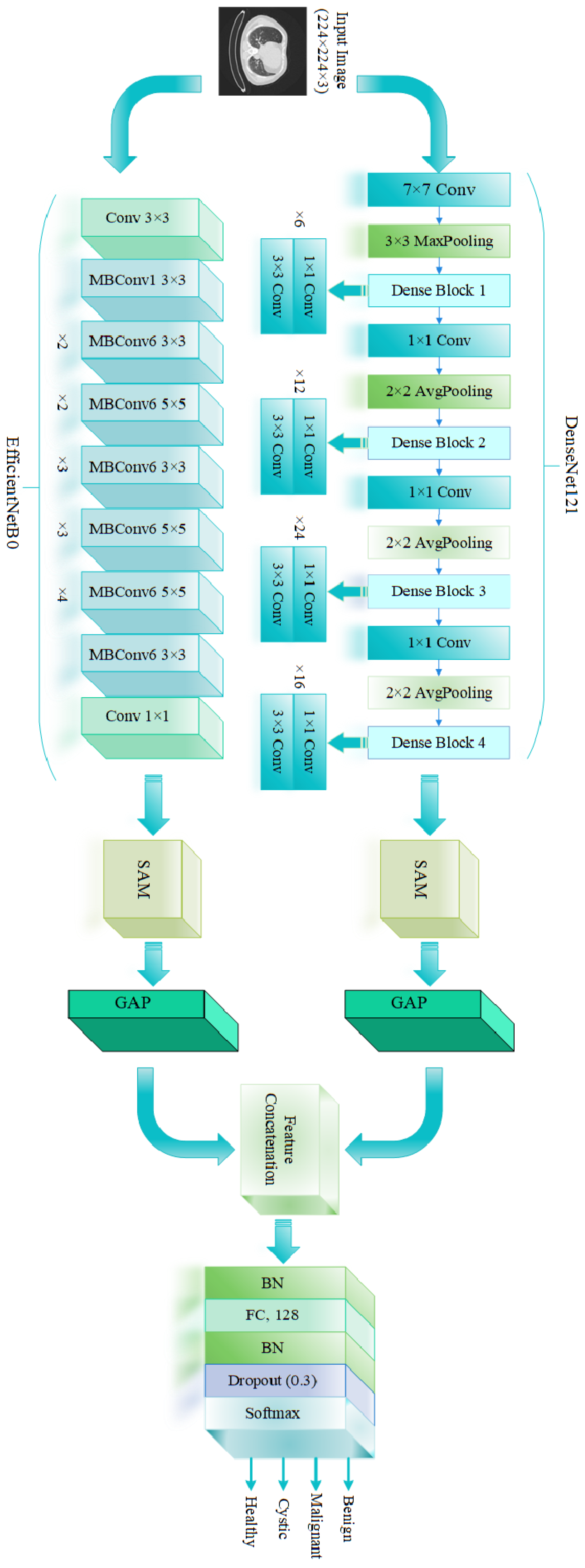
- A novel ensemble architecture is proposed by integrating two pre-trained convolutional neural networks—DenseNet121 and EfficientNetB0—which are used in parallel to extract complementary low-, mid-, and high-level features. This dual-backbone strategy combines the deep feature reuse capabilities of DenseNet121 with the compound-scaled efficiency of EfficientNetB0, resulting in a robust and informative feature representation.
- •
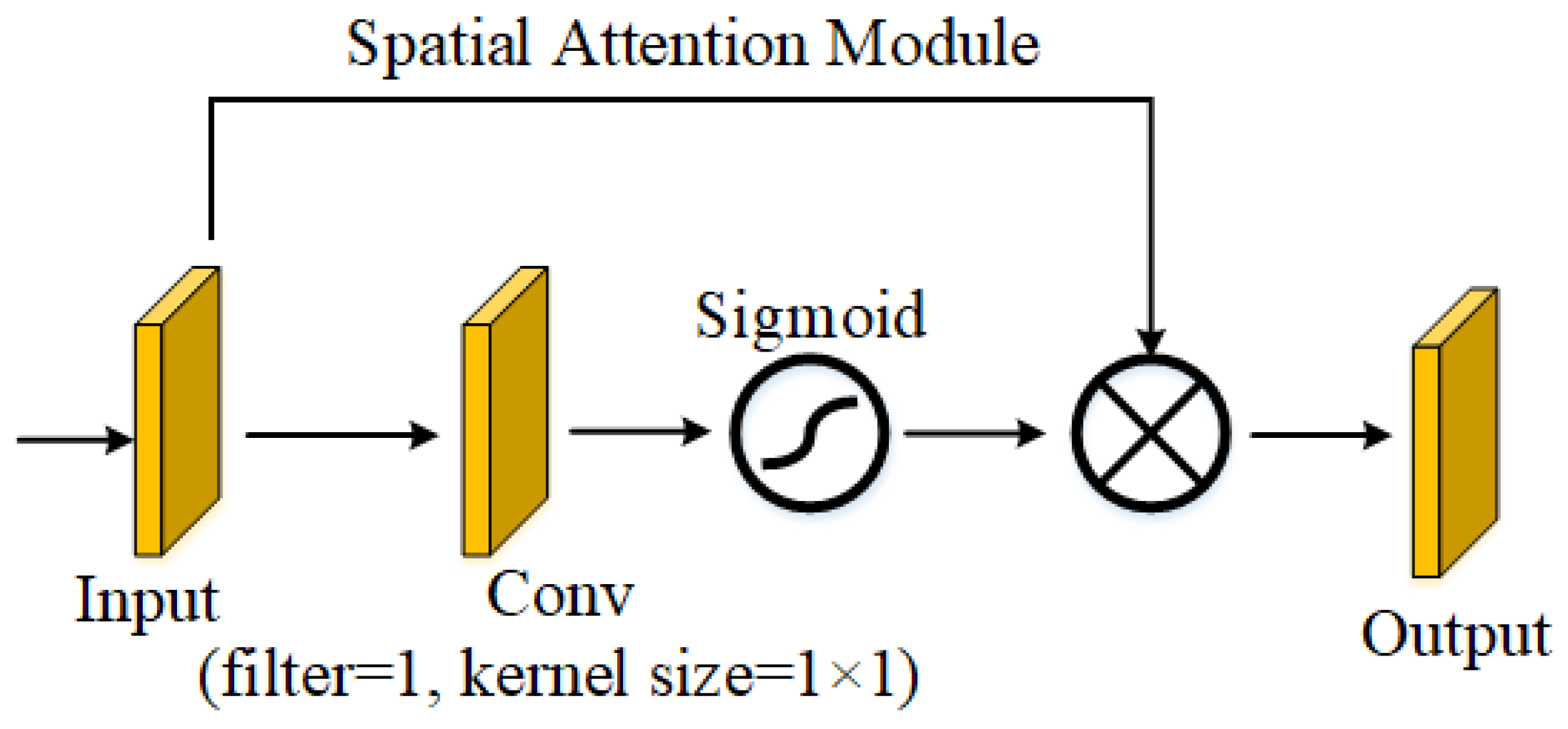
- A Spatial Attention Module (SAM) is applied individually to the outputs of both DenseNet121 and EfficientNetB0 to enable the network to focus more effectively on clinically relevant spatial regions within lung CT images. This adaptive attention mechanism selectively amplifies important features such as lesions or tumors, thus improving the model’s discriminative capacity without significantly increasing computational complexity.
- •
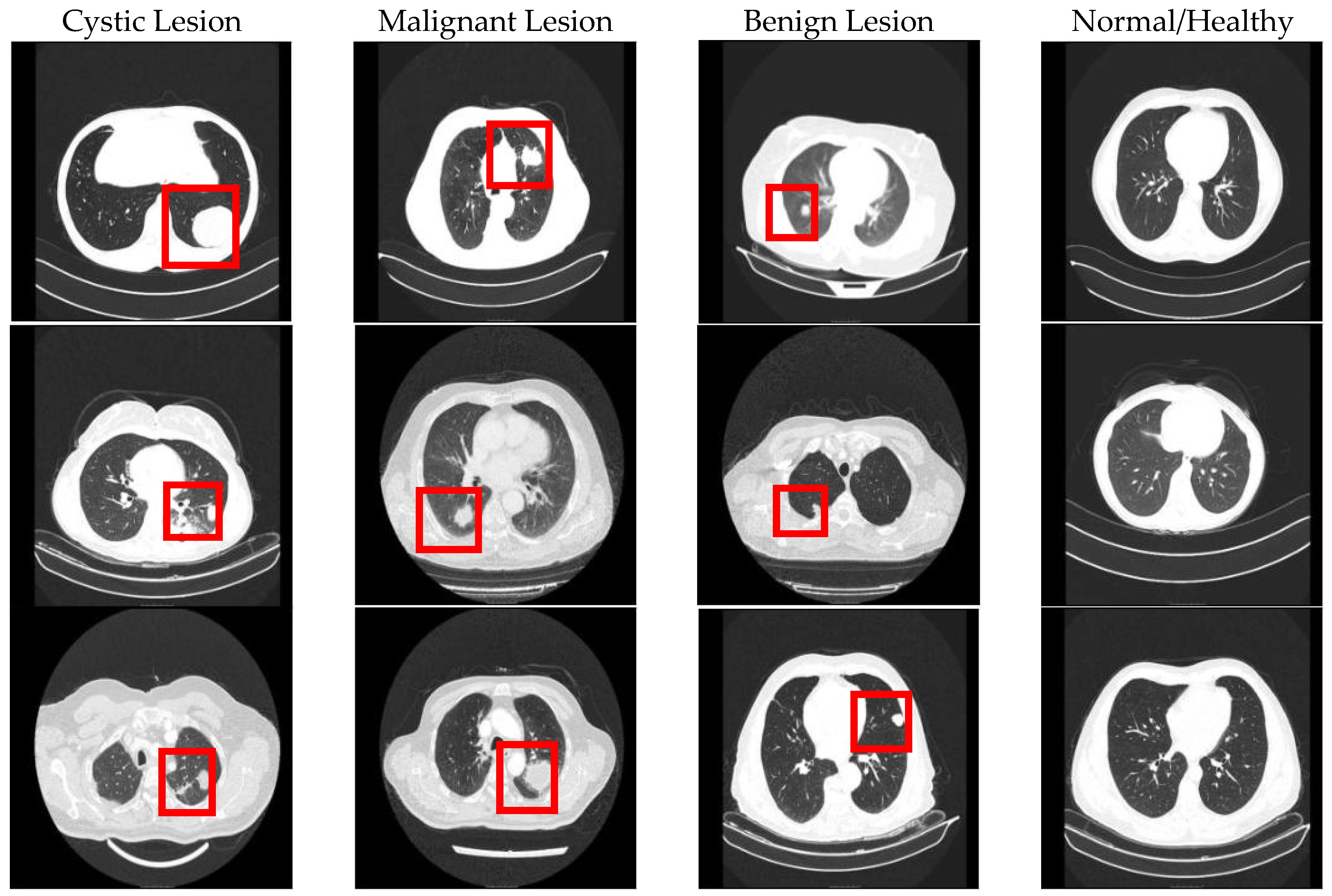
- This study introduces a newly developed, clinically verified four-class dataset that includes benign, malignant, cystic, and healthy lung tissues, addressing a previously understudied diagnostic area by incorporating cystic lesions. Unlike many existing approaches that are limited to binary classification, the proposed model is capable of effectively distinguishing among these four clinically meaningful classes, providing fine-grained diagnostic information that supports earlier and more accurate decision-making, and enabling radiologists to deliver more tailored and timely interventions.
- •
- By concatenating the attention-enhanced outputs from DenseNet121 and EfficientNetB0, the model captures both low-level and high-level features across different spatial resolutions. This multi-scale feature fusion significantly boosts the model’s ability to distinguish subtle differences in lung tissue appearance, leading to improved performance in detecting early-stage malignancies and differentiating between pathological and healthy structures.
- •
- By training and testing on both public (IQ-OTH/NCCD) and private datasets, this study demonstrates strong model robustness and real-world applicability—addressing the common limitations of dataset dependency and lack of external validation.
- •
- The experimental results demonstrate that the proposed architecture surpasses several leading LC classification models in terms of accuracy, precision, recall, and F1-score. These findings underscore the value of combining ensemble feature extraction with adaptive spatial attention and highlight the potential of the proposed framework to advance automated LC diagnosis.
2. Proposed Model
2.1. DenseNet121
2.2. EfficientNetB0
2.3. Spatial Attention Module
3. Experimental Results
3.1. Datasets
3.2. Setting of Hyperparameters
3.3. Evaluation Criteria
3.4. Results
3.4.1. Results of Public Dataset (IQ-OTH/NCCD)
3.4.2. Results of Our Private Dataset
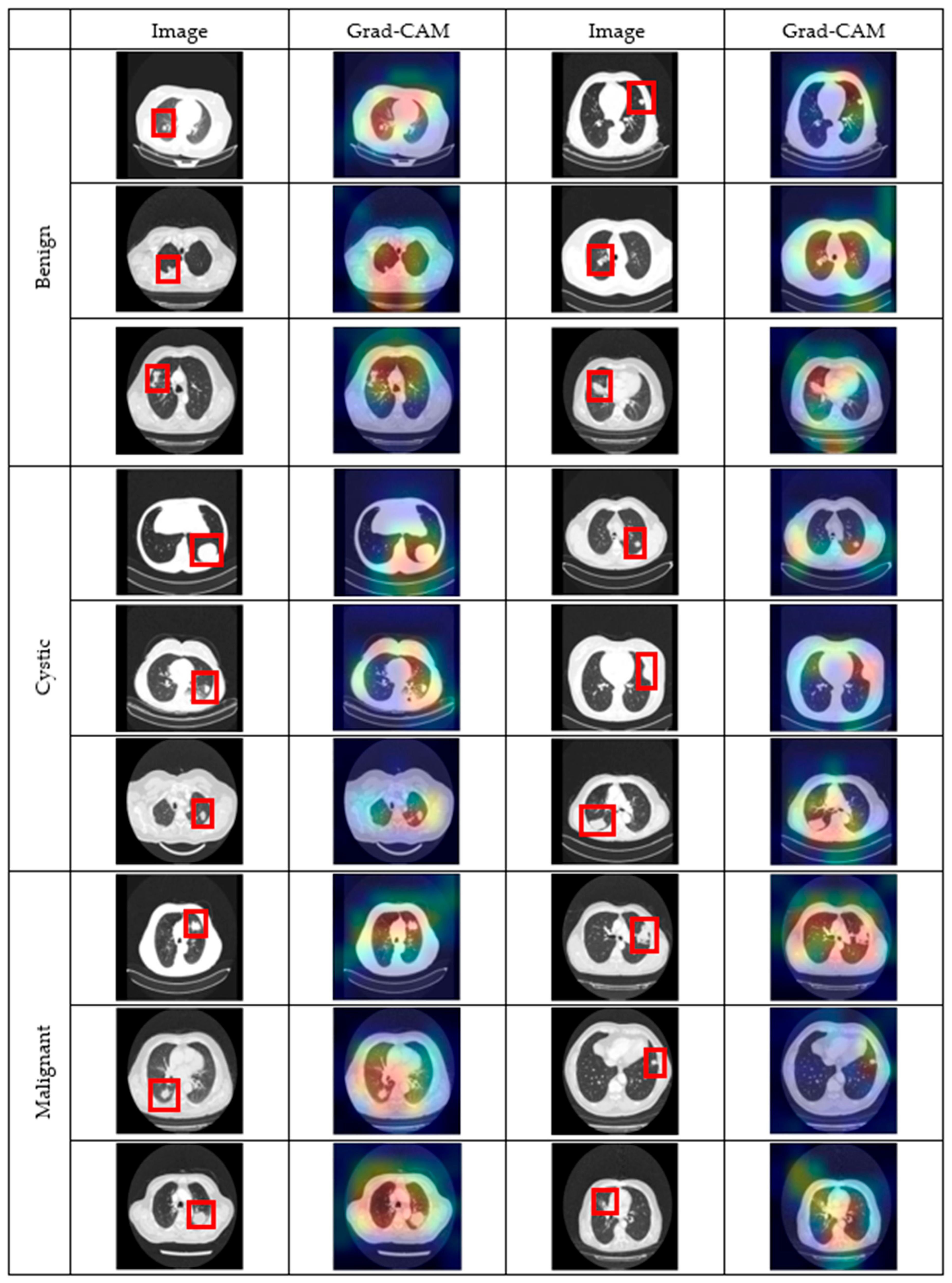
3.5. Grad-CAM Analysis
3.6. Ablation Analysis
4. Discussion
4.1. Interpretation of Results
4.2. Model Robustness
4.3. Comparison with Related Work
4.4. Clinical Implications
4.5. Limitations
5. Conclusions
Author Contributions
Funding
Institutional Review Board Statement
Informed Consent Statement
Data Availability Statement
Acknowledgments
Conflicts of Interest
Abbreviations
| LC | Lung cancer |
| CT | Computed tomography |
| SAM | Spatial attention module |
| XAI | Explainable AI |
| VATS | Video-assisted thoracoscopic surgery |
| NSCLCs | Non-small cell lung cancers |
| AI | Artificial intelligence |
| DL | Deep learning |
| BN | Batch normalization |
| GAP | Global average pooling |
| FC | Fully connected |
| ACC | Accuracy |
| PRE | Precision |
| REC | Recall |
| F1 | F1-score |
| M | Million |
References
- Rana, D.J.; Rana, K. SEMLCC: A Stacked Ensemble Model with Transfer Learning for High-Accuracy Lung Cancer Classification from CT Images. Procedia Comput. Sci. 2025, 258, 2584–2596. [Google Scholar] [CrossRef]
- Abe, A.A.; Nyathi, M.; Okunade, A.A.; Pilloy, W.; Kgole, B.; Nyakale, N. A Robust Deep Learning Algorithm for Lung Cancer Detection from Computed Tomography Images. Intell. Med. 2025, 11, 100203. [Google Scholar] [CrossRef]
- Kumar, A.; Ansari, M.K.; Singh, K.K. A Combined Approach of Vision Transformer and Transfer Learning Based Model for Accurate Lung Cancer Classification. SN Comput. Sci. 2025, 6, 509. [Google Scholar] [CrossRef]
- Ozdemir, B.; Aslan, E.; Pacal, I. Attention Enhanced InceptionNeXt-Based Hybrid Deep Learning Model for Lung Cancer Detection. IEEE Access 2025, 13, 27050–27069. [Google Scholar] [CrossRef]
- Güraksın, G.E.; Kayadibi, I. A Hybrid LECNN Architecture: A Computer-Assisted Early Diagnosis System for Lung Cancer Using CT Images. Int. J. Comput. Intell. Syst. 2025, 18, 35. [Google Scholar] [CrossRef]
- Nitha, V.R.; Vinod Chandra, S.S. ExtRanFS: An Automated Lung Cancer Malignancy Detection System Using Extremely Randomized Feature Selector. Diagnostics 2023, 13, 2206. [Google Scholar] [CrossRef]
- Lundeen, K.S.; Raj, M.S.; Rajasurya, V.; Sharma, S.; Ludhwani, D. Pulmonary Hamartoma. In StatPearls; StatPearls Publishing: Treasure Island, FL, USA, 2024. [Google Scholar]
- Re Cecconi, E.; Mangiameli, G.; De Simone, M.; Cioffi, U.; Marulli, G.; Testori, A. Vats Lobectomy for Lung Cancer. What Has Been the Evolution over the Time? Front. Oncol. 2023, 13, 1268362. [Google Scholar] [CrossRef]
- Mina, S.A.; Shanshal, M.; Leventakos, K.; Parikh, K. Emerging Targeted Therapies in Non-Small-Cell Lung Cancer (NSCLC). Cancers 2025, 17, 353. [Google Scholar] [CrossRef] [PubMed]
- Mendoza, D.P.; Heeger, A.; Mino-Kenudson, M.; Lanuti, M.; Shepard, J.-A.O.; Sequist, L.V.; Digumarthy, S.R. Clinicopathologic and Longitudinal Imaging Features of Lung Cancer Associated With Cystic Airspaces: A Systematic Review and Meta-Analysis. AJR Am. J. Roentgenol. 2021, 216, 318–329. [Google Scholar] [CrossRef] [PubMed]
- Usharani, C.; Selvapandian, A. FedLRes: Enhancing Lung Cancer Detection Using Federated Learning with Convolution Neural Network (ResNet50). Neural Comput. Appl. 2025, 37, 8273–8284. [Google Scholar] [CrossRef]
- Venkatraman, K.; Reddy, S.N.P.S. Augmenting Clinical Decisions with Deep Learning Lung Cancer Image Abnormality Segmentation. In Proceedings of the 2024 14th International Conference on Cloud Computing, Data Science & Engineering (Confluence), Noida, India, 18–19 January 2024; IEEE: New York, NY, USA, 2024; Volume 2024, pp. 674–678. [Google Scholar] [CrossRef]
- Sabzalian, M.H.; Kharajinezhadian, F.; Tajally, A.R.; Reihanisaransari, R.; Ali Alkhazaleh, H.; Bokov, D. New Bidirectional Recurrent Neural Network Optimized by Improved Ebola Search Optimization Algorithm for Lung Cancer Diagnosis. Biomed. Signal Process. Control 2023, 84, 104965. [Google Scholar] [CrossRef]
- Yan, C.; Razmjooy, N. Optimal Lung Cancer Detection Based on CNN Optimized and Improved Snake Optimization Algorithm. Biomed. Signal Process. Control 2023, 86, 105319. [Google Scholar] [CrossRef]
- Deepika, R.; Shanmugam, P.; Moorthi, K.; Kumar, P.K.M.; Swarna, S.L.; K, R. Optimized Transfer Learning Model for Lung Cancer Stage Classification Using Computed Tomography Images. In Proceedings of the 2024 International Conference on IoT Based Control Networks and Intelligent Systems (ICICNIS), Bengaluru, India, 17–18 December 2024; IEEE: New York, NY, USA, 2024; pp. 912–917. [Google Scholar]
- Raza, R.; Zulfiqar, F.; Khan, M.O.; Arif, M.; Alvi, A.; Iftikhar, M.A.; Alam, T. Lung-EffNet: Lung Cancer Classification Using EfficientNet from CT-Scan Images. Eng. Appl. Artif. Intell. 2023, 126, 106902. [Google Scholar] [CrossRef]
- Ghosh, S.; Chatterjee, A. Self-Attention Driven Transfer Learnt Deep Neural Network for Improved Lung Cancer Detection from Radiographic Images. Heliyon 2025, 11, e44066. [Google Scholar] [CrossRef]
- Huang, G.; Liu, Z.; Van Der Maaten, L.; Weinberger, K.Q. Densely Connected Convolutional Networks. In Proceedings of the 2017 IEEE Conference on Computer Vision and Pattern Recognition (CVPR), Honolulu, HI, USA, 21–26 July 2017; IEEE: New York, NY, USA, 2017; pp. 2261–2269. [Google Scholar]
- Tan, M.; Le, Q.V. EfficientNet: Rethinking Model Scaling for Convolutional Neural Networks. In Proceedings of the 36th International Conference on Machine Learning, Long Beach, CA, USA, 9–15 June 2019; pp. 10691–10700. [Google Scholar]
- Woo, S.; Park, J.; Lee, J.Y.; Kweon, I.S. CBAM: Convolutional Block Attention Module; Lecture Notes in Computer Science (LNCS); Springer: Cham, Switzerland, 2018; Volume 11211, pp. 3–19. [Google Scholar] [CrossRef]
- Liu, T.; Luo, R.; Xu, L.; Feng, D.; Cao, L.; Liu, S.; Guo, J. Spatial Channel Attention for Deep Convolutional Neural Networks. Mathematics 2022, 10, 1750. [Google Scholar] [CrossRef]
- Demirbaş, A.A.; Üzen, H.; Fırat, H. Spatial-Attention ConvMixer Architecture for Classification and Detection of Gastrointestinal Diseases Using the Kvasir Dataset. Health Inf. Sci. Syst. 2024, 12, 32. [Google Scholar] [CrossRef] [PubMed]
- Hamdalla, F. Al-Yasriy The IQ-OTH/NCCD Lung Cancer Dataset. Available online: https://www.kaggle.com/datasets/hamdallak/the-iqothnccd-lung-cancer-dataset (accessed on 15 June 2025).
- Liu, Z.; Mao, H.; Wu, C.Y.; Feichtenhofer, C.; Darrell, T.; Xie, S. A ConvNet for the 2020s. In Proceedings of the 2022 IEEE/CVF Conference on Computer Vision and Pattern Recognition (CVPR), New Orleans, LA, USA, 18–24 June 2022; IEEE: New York, NY, USA, 2022; pp. 11966–11976. [Google Scholar] [CrossRef]
- Szegedy, C.; Vanhoucke, V.; Ioffe, S.; Shlens, J.; Wojna, Z. Rethinking the Inception Architecture for Computer Vision. In Proceedings of the 2016 IEEE Conference on Computer Vision and Pattern Recognition (CVPR), Las Vegas, NV, USA, 27–30 June 2016; IEEE: New York, NY, USA, 2016; pp. 2818–2826. [Google Scholar] [CrossRef]
- Howard, A.G.; Zhu, M.; Chen, B.; Kalenichenko, D.; Wang, W.; Weyand, T.; Andreetto, M.; Adam, H. MobileNets: Efficient Convolutional Neural Networks for Mobile Vision Applications. arXiv 2017, arXiv:1704.04861. [Google Scholar] [CrossRef]
- He, K.; Zhang, X.; Ren, S.; Sun, J. Deep Residual Learning for Image Recognition. In Proceedings of the 2016 IEEE Conference on Computer Vision and Pattern Recognition (CVPR), Las Vegas, NV, USA, 27–30 June 2016; IEEE: New York, NY, USA, 2016; pp. 770–778. [Google Scholar]
- Simonyan, K.; Zisserman, A. Very Deep Convolutional Networks for Large-Scale Image Recognition. In International Conference on Learning Representations, Proceedings of the 3rd International Conference on Learning Representations, ICLR 2015, San Diego, CA, USA, 7–9 May 2015; MIT Press: Cambridge, MA, USA, 2015. [Google Scholar]
- Chollet, F. Xception: Deep Learning with Depthwise Separable Convolutions. In Proceedings of the 2017 IEEE Conference on Computer Vision and Pattern Recognition (CVPR), Honolulu, HI, USA, 21–26 July 2017; IEEE: New York, NY, USA, 2017; pp. 1800–1807. [Google Scholar] [CrossRef]
- Gupta, A.; Kumar, A.; Rautela, K. UDCT: Lung Cancer Detection and Classification Using U-Net and DARTS for Medical CT Images. Multimed. Tools Appl. 2025, 84, 19065–19085. [Google Scholar] [CrossRef]
- Ma, L.; Wu, H.; Samundeeswari, P. GoogLeNet-AL: A Fully Automated Adaptive Model for Lung Cancer Detection. Pattern Recognit. 2024, 155, 110657. [Google Scholar] [CrossRef]





| Model | ACC (%) | PRE (%) | REC (%) | F1 (%) | Params (M) | GFLOPs |
|---|---|---|---|---|---|---|
| ConvNeXtTiny | 95.89 | 94.05 | 91.93 | 92.91 | 27.9 | 8.7 |
| DenseNet121 | 98.63 | 96.60 | 97.68 | 97.12 | 7.1 | 5.7 |
| DenseNet201 | 96.80 | 93.58 | 92.66 | 93.09 | 18.5 | 8.6 |
| EfficientNetB0 | 98.17 | 97.29 | 96.09 | 96.67 | 4.2 | 0.8 |
| InceptionV3 | 96.35 | 93.25 | 92.30 | 92.75 | 22.07 | 5.6 |
| MobileNet | 97.26 | 97.94 | 91.75 | 94.28 | 3.3 | 1.1 |
| ResNet50 | 95.43 | 93.53 | 90.29 | 91.74 | 23.8 | 7.7 |
| VGG16 | 95.43 | 92.14 | 93.95 | 92.96 | 14.7 | 30.7 |
| Xception | 96.35 | 97.33 | 92.19 | 94.41 | 21.1 | 9.1 |
| DE-SAMNet | 99.54 | 99.64 | 98.41 | 99.00 | 11.3 | 6.5 |
| Author (Year) | ACC (%) | PRE (%) | REC (%) | F1 (%) | Train–Test Split |
|---|---|---|---|---|---|
| Rana et al. (2025) [1] | 96.89 | 97.04 | 96.89 | 96.89 | 70-15-15 |
| Abe et al. (2025) [2] | 98.17 | - | 98.21 | - | 80-20 |
| Güraksın et al. (2025) [5] | 99.00 | 99.06 | 98.82 | 98.94 | 80-20 |
| Venkatraman & Reddy (2024) [12] | 89.36 | 90.10 | 91.78 | 92.00 | - |
| Sabzalian et al. (2023) [13] | 97.06 | 98.52 | 96.15 | 97.32 | - |
| Yan and Razmjooy (2023) [14] | 96.58 | 95.38 | 84.16 | 91.53 | 75-25 |
| Deepika, R. et al. (2024) [15] | 97.85 | 96.68 | 97.68 | 97.15 | - |
| Raza et al. (2023) [16] | 99.10 | 99.10 | 99.12 | 99.08 | 80-20 |
| Gupta et al. (2025) [30] | 96.82 | 98.70 | 97.50 | 98.24 | 80-20 |
| Ma et al. (2024) [31] | 97.32 | 99.45 | 98.20 | 98.82 | - |
| Ghosh et al. (2025) [17] | 98.64 | 98.25 | 97.96 | 98.10 | 80-20 |
| Proposed DE-SAMNet model | 99.54 | 99.64 | 98.41 | 99.00 | 80-20 |
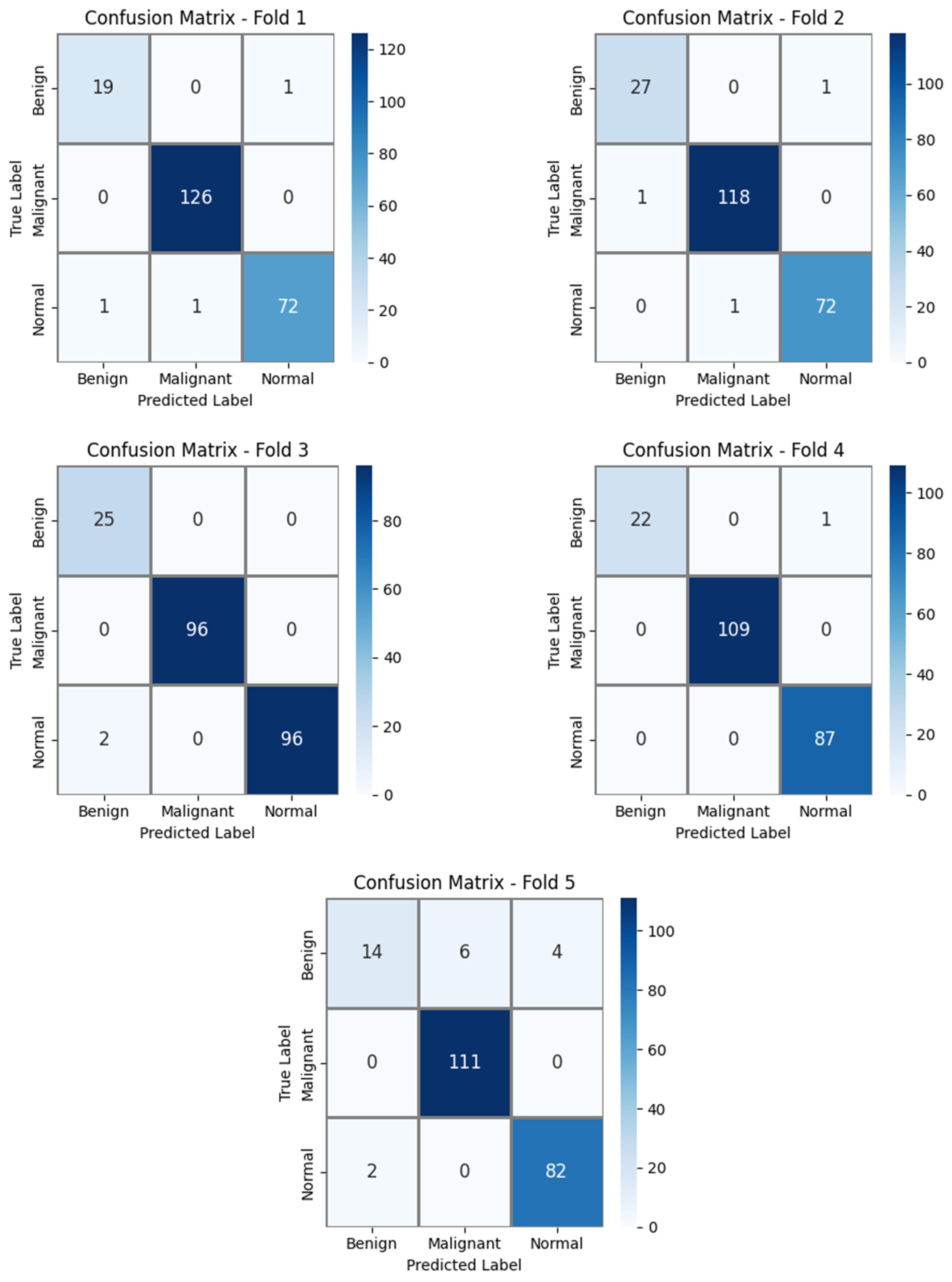
| Proposed DE-SAMNet model | 98.08 | 98.04 | 98.08 | 97.99 | 5-fold cross-validation |
| Model | ACC (%) | PRE (%) | REC (%) | F1 (%) | Confidence Intervals Across Folds |
|---|---|---|---|---|---|
| ConvNeXtTiny | 96.17 ± 1.5 | 96.25 ± 1.2 | 96.17 ± 1.5 | 96.13 ± 1.3 | [94.2%, 98.1%] |
| DenseNet121 | 97.81 ± 0.6 | 97.97 ± 0.6 | 97.81 ± 0.6 | 97.75 ± 0.6 | [97.05%, 98.57%] |
| DenseNet201 | 96.90 ± 1.3 | 96.87 ± 1.4 | 96.90 ± 1.3 | 96.81 ± 1.3 | [95.28%, 98.52%] |
| EfficientNetB0 | 97.54 ± 1.3 | 97.56 ± 1.3 | 97.54 ± 1.3 | 97.48 ± 1.3 | [95.91%, 99.17%] |
| InceptionV3 | 94.80 ± 0.5 | 94.65 ± 0.5 | 94.80 ± 0.5 | 94.60 ± 0.6 | [94.15%, 95.45%] |
| MobileNet | 97.17 ± 1.5 | 97.22 ± 1.5 | 97.17 ± 1.5 | 97.11 ± 1.6 | [95.27%, 99.07%] |
| ResNet50 | 97.54 ± 1.6 | 97.60 ± 1.7 | 97.54 ± 1.6 | 97.50 ± 1.7 | [95.47%, 99.61%] |
| VGG16 | 96.90 ± 1.6 | 96.89 ± 1.7 | 96.90 ± 1.6 | 96.86 ± 1.7 | [94.90%, 98.91%] |
| Xception | 96.72 ± 1.1 | 96.71 ± 1.1 | 96.72 ± 1.1 | 96.60 ± 1.1 | [95.36%, 98.07%] |
| DE-SAMNet | 98.08 ± 2.03 | 98.04 ± 2.16 | 98.08 ± 2.03 | 97.99 ± 2.25 | [95.6%, 100%] |
| Model | ACC (%) | PRE (%) | REC (%) | F1 (%) | Params (M) | GFLOPs |
|---|---|---|---|---|---|---|
| ConvNeXtTiny | 91.53 | 91.57 | 91.74 | 91.62 | 27.9 | 8.7 |
| DenseNet121 | 92.70 | 92.70 | 92.87 | 92.67 | 7.1 | 5.7 |
| DenseNet201 | 93.53 | 93.61 | 93.77 | 93.66 | 18.5 | 8.6 |
| EfficientNetB0 | 91.53 | 91.49 | 91.76 | 91.55 | 4.2 | 0.8 |
| InceptionV3 | 89.06 | 88.96 | 89.34 | 89.11 | 22.07 | 5.6 |
| MobileNet | 90.88 | 90.95 | 90.89 | 90.84 | 3.3 | 1.1 |
| ResNet50 | 90.36 | 90.31 | 90.67 | 90.42 | 23.8 | 7.7 |
| VGG16 | 88.67 | 88.90 | 88.79 | 88.82 | 14.7 | 30.7 |
| Xception | 87.36 | 87.32 | 87.34 | 87.33 | 21.1 | 9.1 |
| DE-SAMNet | 95.96 | 95.99 | 96.21 | 96.04 | 11.3 | 6.5 |
| Model | ACC (%) | PRE (%) | REC (%) | F1 (%) | Confidence Intervals Across Folds |
|---|---|---|---|---|---|
| ConvNeXtTiny | 88.23 ± 1.8 | 88.34 ± 1.8 | 88.23 ± 1.8 | 88.23 ± 1.8 | [86.04%, 90.44%] |
| DenseNet121 | 90.45 ± 1.03 | 90.47 ± 1.04 | 90.45 ± 1.03 | 90.45 ± 1.04 | [89.18%, 91.72%] |
| DenseNet201 | 90.71 ± 0.9 | 90.73 ± 0.9 | 90.71 ± 0.9 | 90.71 ± 0.9 | [89.57%, 91.86%] |
| EfficientNetB0 | 89.95 ± 0.9 | 89.97 ± 1.0 | 89.95 ± 0.9 | 89.93 ± 1.0 | [89.12%, 91.19%] |
| InceptionV3 | 82.59 ± 1.5 | 82.66 ± 1.5 | 82.59 ± 1.5 | 82.56 ± 1.5 | [80.84%, 84.34%] |
| MobileNet | 90.24 ± 1.7 | 90.30 ± 1.8 | 90.24 ± 1.7 | 90.24 ± 1.7 | [88.85%, 91.63%] |
| ResNet50 | 91.85 ± 0.8 | 91.89 ± 0.8 | 91.85 ± 0.9 | 91.81 ± 0.8 | [90.84%, 92.88%] |
| VGG16 | 90.71 ± 0.9 | 90.74 ± 0.9 | 90.71 ± 0.9 | 90.69 ± 0.9 | [89.48%, 91.95%] |
| Xception | 87.95 ± 2.7 | 88.10 ± 2.7 | 87.95 ± 2.7 | 87.96 ± 2.7 | [84.50%, 91.41%] |
| DE-SAMNet | 92.32 ± 1.08 | 92.35 ± 1.08 | 92.32 ± 1.08 | 92.30 ± 1.09 | [91.0%, 93.6%] |
| Public Dataset | Our Private Dataset | |||||||
|---|---|---|---|---|---|---|---|---|
| Model | ACC (%) | PRE (%) | REC (%) | F1 (%) | ACC (%) | PRE (%) | REC (%) | F1 (%) |
| DenseNet121 | 98.63 | 96.60 | 97.68 | 97.12 | 92.70 | 92.70 | 92.87 | 92.67 |
| DenseNet121 + SAM | 99.02 | 97.17 | 98.22 | 97.56 | 93.48 | 93.48 | 93.67 | 93.19 |
| EfficientNetB0 | 98.17 | 97.29 | 96.09 | 96.67 | 91.53 | 91.49 | 91.76 | 91.55 |
| EfficientNetB0 + SAM | 98.63 | 98.96 | 96.46 | 97.63 | 92.89 | 92.78 | 93.12 | 92.88 |
| DenseNet121+ EfficientNetB0 | 99.08 | 99.28 | 98.10 | 98.66 | 94.18 | 94.24 | 94.64 | 94.52 |
| Proposed DE-SAMNet | 99.54 | 99.64 | 98.41 | 99.00 | 95.96 | 95.99 | 96.21 | 96.04 |
Disclaimer/Publisher’s Note: The statements, opinions and data contained in all publications are solely those of the individual author(s) and contributor(s) and not of MDPI and/or the editor(s). MDPI and/or the editor(s) disclaim responsibility for any injury to people or property resulting from any ideas, methods, instructions or products referred to in the content. |
© 2026 by the authors. Licensee MDPI, Basel, Switzerland. This article is an open access article distributed under the terms and conditions of the Creative Commons Attribution (CC BY) license.
Share and Cite
Kılıç, M.; Bıyıklı, M.; Yelman, A.; Fırat, H.; Üzen, H.; Çiçek, İ.B.; Şengür, A. Grad-CAM Enhanced Explainable Deep Learning for Multi-Class Lung Cancer Classification Using DE-SAMNet Model. Diagnostics 2026, 16, 757. https://doi.org/10.3390/diagnostics16050757
Kılıç M, Bıyıklı M, Yelman A, Fırat H, Üzen H, Çiçek İB, Şengür A. Grad-CAM Enhanced Explainable Deep Learning for Multi-Class Lung Cancer Classification Using DE-SAMNet Model. Diagnostics. 2026; 16(5):757. https://doi.org/10.3390/diagnostics16050757
Chicago/Turabian StyleKılıç, Murat, Merve Bıyıklı, Abdulkadir Yelman, Hüseyin Fırat, Hüseyin Üzen, İpek Balikçi Çiçek, and Abdulkadir Şengür. 2026. "Grad-CAM Enhanced Explainable Deep Learning for Multi-Class Lung Cancer Classification Using DE-SAMNet Model" Diagnostics 16, no. 5: 757. https://doi.org/10.3390/diagnostics16050757
APA StyleKılıç, M., Bıyıklı, M., Yelman, A., Fırat, H., Üzen, H., Çiçek, İ. B., & Şengür, A. (2026). Grad-CAM Enhanced Explainable Deep Learning for Multi-Class Lung Cancer Classification Using DE-SAMNet Model. Diagnostics, 16(5), 757. https://doi.org/10.3390/diagnostics16050757